Archive for the ‘New Launches’ Category

h1

Comics! The Magazine: A Dream Come True And An Indispensable Guide To Everything Comics: The Mr. Magazine™ Interview With Joe Keatinge, Editor-in-Chief & Atom! Freeman, Publisher.

July 12, 2026

Those who know me, they know that my entire career and profession started at age 10 when the first issue of the Arabic Superman was published in my original home country Lebanon in February of 1964.  It was the beginning of a love affair with storytelling, heroes and villains, ink on paper, comics and magazines. 63 years later that love affair continues with no let down or a break.

This love affair left a soft spot in my heart for comics until this day. So, when I heard about the launch of Comics! The Magazine I felt that all my dreams have come true, comics, magazines, and ink on paper.  Mr. Magazine™ could not ask for any better.  I acquired every issue since its launch earlier this year and three of the secret variant covers of issues 1, 2, and 4 at a price that will go unmentioned for fear in getting in trouble with the family.

My affair did not end there, I needed to know the folks behind the magazine and why someone will publish such a great magazine in this digital age?  I reached out to Joe Keatinge, the editor-in-chief of the magazine and Atom! Freeman, the publisher and had one of most delightful interviews in my career.  It brought back memories of a pleasant childhood and a firm belief in the future of magazines, as in ink on paper.

So, without any further ado, please enjoy those two lightly edited interviews with the editor-in-chief and the publisher of Comics! The Magazine:

But first the soundbites of the interview with Joe Keatinge, editor-in-chief, Comics! The Magazine:

On the need for Comics! The Magazine: “It’s time that there’s a platform for comics that speaks to that level of enthusiasm is the operative word, but also confidence too.”

On the intended audience: “The younger generation is tired of the Internet. I don’t know how close you follow print sales in the comics industry, stores are reporting up to 30 to 40 percent year over year. And that last year was 20 to 30 percent. The people coming in are like 20 years old.”

On the secret variant covers: “There’s a secret cover program and we don’t do it every issue. We like to keep people on their toes.”

On his mission for the magazine: “My mission, personally, with the magazine, again, is what I said earlier: Is to get people enthusiastic about comics. And so with the variant covers, it’s great. They’re selling high.”

On the connectivity between human and paper: “So when you’re a kid and you’re reading Superman, and it’s on paper, and it’s yours, and it’s in your hand, and you’re reading the story, I would assume that there’s a higher level of connection there.”

On the magazine’s goal: “To be of greater service to this industry and become an essential part about how people learn about comics.”

On his future vision for the magazine: “Is that we help inspire people to make great comics. And read great comics, of course. I want people to read it and think, I could do that. Then, they think they can do that and they work really hard and talk about the fight we mentioned earlier. It doesn’t work out. And then it does work out. They keep going and they keep getting better and better and better. And one day, they’re so good, they’re so undeniable, we profile them on the cover.”

On how people decide to buy a comic book: “Atom! (the publisher) did some research a while ago and found that 82% of customers, at comic bookstores, made decisions of what to buy in the store.”

And now the soundbites of the interview with Atom! Freeman, publisher, Comics! The Magazine:

On the magazines mission: “From a business standpoint, it is a platform. From a consumer standpoint, it is just a celebration and a guide for the world of comics.”

On a major challenge: “But print advertising budgets are not something they’ve been doing for a while. Convincing them to make that room or to take away from something else in order to get involved early, that was a challenge early on.”

On another major challenge: “But as a result of that, really our biggest challenge right now is what do we do next? How do we keep the magazine itself exciting? How do we build off of the success of the magazine? Those are the bigger questions that Joe and I spend a lot of time talking about.”

On the high selling price of variant covers: “It takes a lot to really surprise me. I was pleasantly taken aback by the values.”

On the magazine’s digital future: “While we’ve discussed what it would look like to make Comics! The Magazine digital, I think that so far, everything we’ve heard would just be diminishing of the print version.”

On the value of print: “We’re able to have more complex conversations because you’re going to sit and digest it in a way that you don’t, anything that’s on a screen.”

On the future of magazines: “I do think that magazines are going to have a comeback. What we’re seeing in print in comics and magazine right now, I expect to see all over the place.”

More on the value of print: “One of the things that happens in our world is any comic that is on a digital platform ends up on a piracy site. And Comics! The Magazine is on no piracy sites right now.”

And now for the lightly edited interviews with Joe Keatinge, editor-in-chief and Atom! Freeman, publisher, Comics! The Magazine:

Samir Husni: My first question to you is, you said in your last editorial, I love fighters. I love people with vision. Tell me about your fight and your vision with Comics! the Magazine.

Joe Keatinge: Sure. I really appreciate that. I would say the fight or the mission with the magazine is really simple. It’s just to get people genuinely enthusiastic about comics, and that can be genuinely enthusiastic about reading comics.

There’s enough in the world about how everything’s horrible, and that’s just not what we do here.

We are celebrating this art form to the highest degree. Bringing in people that have same sort of mentality, different voices, of course. It’s to spread that genuine enthusiasm for the art form.

Art form that’s fueling not just comics, but television and film and video games. It’s time that there’s a platform for comics that speaks to that level of enthusiasm is the operative word, but also confidence too.

Samir Husni: Why did you decide to do it in print in this digital age?

Joe Keatinge: That’s a great question. It’s something we talked about a lot. It’s because there’s so much digital’s gotten through so much noise. If I live a busy life and I have 10 minutes to determine what comics are out there, you go online and you search comics, there’s a lot of different sources.

A lot of them are skewing negative. So there’s that. The other aspect of it is there’s a new generation coming in and they want physical media.

The younger generation is tired of the Internet. I don’t know how close you follow print sales in the comics industry, stores are reporting up to 30 to 40 percent year over year. And that last year was 20 to 30 percent.

The people coming in are like 20 years old. And it’s two things. One is they’re raised on comics.

They were raised on comics by people like Raina Telgemeier or Jeff Smith or Dave Pelkey. They went in their teen years and they got manga from libraries. Now thanks to there’s a book called Absolute Batman, which is The Book.

It’s the top book in the industry by a huge margin. That’s the new readership. These people who were kids 10 years ago, but now they’re 20 and they have disposable income are interested in this. So they have that education with comics, but also they saw the fruit of the generation that is so digitally focused and living lives online and consuming digital media.

I’m not against the Internet. I mean, that’s how you and I are talking.

There’s a huge great net benefit to it. But you got to be careful in terms of how much you like moderation, essentially.

So I think people really want things like this is 32 pages. It’s now going to be 40 pages. We’re increasing the page count by signature.

You can read it in 10, 15 minutes, maybe 20 minutes, maybe a little longer, depending on the issue. You can know everything you need to know to go to the comic bookstore.

Samir Husni: I noticed that with some issues, you have two different covers. You have a regular cover and you have a variant cover, which is selling for up to like 150 dollars on eBay.

Screenshot

Joe Keatinge:  We’re experimenting a lot because it’s been a while since there’s been a comics magazine. We’re not the only one. There are other ones.

There’s one called Dummy and there’s one called American Nature. There’s one kind of a comic staple. So, we’re not the only one, but we’re the only one doing it our way.

Part of that is what can we do in print? That’s fun and unexpected. You can’t do in digital.

We were at a comic book trade show, Comics Pro, and coincidentally, it was when we got our first issue comps. We did an early edition of the first issue. An Absolute Batman cover.

I was sitting there and I knew that we did bundles of about 25. And I was thinking you could put anything in these bundles. Because, when the stores receive the bundles, they just have to scan in the initial receiving the UPC of the bundle itself. And then the individual UPCs of the covers so that we can sneak in something really cool. And so I contacted Skybound, the company that created Invincible and The Walking Dead. They do surprise better than anybody else in the industry right now. I knew they would get it. I contacted them and said you got this great book called Terminal coming out. Robert Kirkman, Joe Casey, Art Adams, Dave Finch, Andy Kubert, like all- star team. I was like, what if because we were already planning to do a Battle Beast cover with them, what if we did a secret Terminal cover? We don’t announce it. And it gets in there. And then that sold really well. Then we just did a cover. So, we did a feature in the new issue with Mark Spears, the artist behind a series called Monster Monsters. He is doing a new Spawn book.  Spawn, one of the most popular comics in the last 30 years. He actually suggested it.  I’ll give Mark full credit.

He suggested what if we do a secret Spawn cover? I thought that would light the world on fire. If Todd McFarlane would approve it, that’d be great. And he did.

There’s a secret cover program and we don’t do it every issue. We like to keep people on their toes.

We also do variant covers with different partners. Sometimes it’s a store. We’ll want to do a variant cover with an artist whom we have relationship with.

With number five, we’re doing covers with Alex Ross. So we have an Alex Ross interview in there. The opportunity came because of that interview. To do a variant cover with him that he will be given out at his booth at San Diego Comic Con. Mad Cave Studios, another publisher. They’re doing a similar thing.

They have a book coming out with John Cusack, the actor. And again, they thought, hey, can we do a variant cover of this? We don’t do pay to play. As the editor, I don’t care what advertisers we have.

It doesn’t affect in terms of content. Obviously, we love our advertisers, and they make the magazine possible. But in terms of content, it’s what’s interesting, period.

If it’s not interesting, they can’t pay enough money to be in there. But it just worked out. Alex Ross is one of the greatest artists of all time.

I’d want to talk to him. And then this opportunity came to do the cover. Great. Same with John Cusack. That’s interesting. He wants to make comics.

Why? If there was a compelling story there, and there was, great. So any opportunity to do something interesting in print.

I think you’ll appreciate this. It feels like there is a re-education going on. Which is funny, because we work in a print industry.

But in terms of having a promotional venture in print, there’s a lot of re-education. And a lot of like, you can do things differently than you were doing them digitally. Actually, I will even go further and say, a level of freedom.

This is going off on a tangent here. We serialized a comic book called Chew. Chew was by Rob Guillory and John Layman.

One of the major hits of the 2010s. And we were talking with them about doing a new comic. And they agreed to do a new Chew, which is a big deal.

And at first, it starts off as, from the get-go, now that I think about it. They have been doing things you really can only do, storytelling-wise. Because it’s a single page every issue, is Chew.

Just one page. The things that they were storytelling are so interesting. Like the first ever edition looked like it was just an ad.

Then in the second issue, well it turns out that ad is part of the story. Why is it? What’s going on there? And then John Layman, the writer, just sent me scripts for issues 9 and 10. And he is doing, again, it only makes sense in print.

The advertisers really get it. We work with a company, one of their advertisers is a company called Oni Press. And they run ads for, it looks like it’s an ad for another product.

Like a liquor ad that takes place in the world of the comic. It only makes sense. It only makes sense in print. If you ran it online, it wouldn’t work as well. They really understood how we can utilize print to tell a different story than we would be able to if it was just like an Instagram ad even.

Samir Husni: What do you think about those variant covers demanding high prices on eBay and are selling much, much more than the regular $2.99 cover price of the magazine?

Joe Keatinge: Well, you have to understand the perspective of the person you’re asking.

Because I’m the editor-in-chief, right? And so, you might get a different answer from our publisher. You might get a different answer from the ad sales guy. My mission, personally, with the magazine, again, is what I said earlier.

Is to get people enthusiastic about comics. And so with the variant covers, it’s great. They’re selling high. It seems like higher every time we do it. But to me, what that metric really… Because that’s data, right? And the data, to me, says people are excited about this. People want… We put the variant covers out in the marketplace and the marketplace dictated the value of it.

And the value of especially that Spawn cover is, again, upwards of $130.  We did a giveaway. We gave it away for free at a convention. A number zero issue. That was something we handed out. And now it goes for $80 to $100. You know what I mean?

What I love about your story is you were a kid when you first saw that Superman. It was this relationship between reader and the magazine. There was nothing else in that world. There was nothing else distracting you. But I assume that there’s ads in there, you know. But otherwise, it’s the experience between reader and story. There’s no other noise.

There’s a lot of great digital ventures. I’m not discounting them. Like, obviously, Webtoon. Webcomics in general have been going strong.

A lot of the comics I cited earlier, like Raina Telgemeier’s work and a lot of her contemporaries had webcomics. But there’s just something about the relationship between the reader and print.

It may be biological as well. I read a report a long time ago about the data retention you have reading print versus digital. This is purely hypothetical. I don’t know this for sure. But I wonder, too, when you’re reading a fictional story, if there’s a level of empathy you have when you read print versus digital. So, when you’re a kid and you’re reading Superman, and it’s on paper, and it’s yours, and it’s in your hand, and you’re reading the story, I would assume that there’s a higher level of connection there.

Samir Husni: I noticed in some of the issues you have DC on the cover, and some issues you don’t have DC on the cover. So how do you that?

Screenshot

Joe Keatinge: That’s part of the arrangement we have when we utilize their covers and characters. You know, DC is not the publisher of the magazine.

But it’s just how they protect their copyright of their characters. As simple as that. It’s just like other licenses they do; it’s the same arrangement.

Samir Husni: If you and I are having this discussion a year from now, what would you tell me Joe accomplished in this year, in 26 – 27?

Joe Keatinge: That’s an excellent question. I just want to be of service to this industry, you know, and I think I can speak for myself and my business partners, Atom! Freeman, Rico Renzi, and Gabe Yocum.

We’ve got a good team. And I do feel that we’re all unified. Atom! did some research a while ago and found that 82% of customers, at comic bookstores, made decisions of what to buy in the store. Not influenced by the internet, not influenced by anything else. And that’s why Comics! The Magazine, at this current state, is exclusively through comic bookstores. Because it’s there. and that’s where you’re making your decisions, we want to be there. To me, if you ask the publisher the question, his answer may be different. But for me, it is just to be of greater service to this industry and become an essential part about how people learn about comics. It’s not just reading comics. It’s not just sales to me. That’s an aspect that’s important.

But my real dream with this magazine, beyond 2027, is that somebody reads it and they read about whoever we’re profiling. Che Grayson, Scott Snyder, Mark Spears, or Alex Ross and they read it and he and she are like, you know what? I can make comics.  This is just a person. That’s one thing that’s really important to me with the magazine, is the how and the why.  Who, what, where, when, why.

All those questions. How and why interests me the most. In part, because I want people to read it and think, I could do that.

Then, they think they can do that and they work really hard and talk about the fight we mentioned earlier. It doesn’t work out. And then it does work out.

They keep going and they keep getting better and better and better. And one day, they’re so good, they’re so undeniable, we profile them on the cover. That’s the dream for me. Is that we help inspire people to make great comics. And read great comics, of course.

Samir Husni: Before I ask you my typical questions at the end, is there any question that I failed to ask you I should ask you about Comics! The Magazine?

Joe Keatinge: I mean, honestly, you’re doing great. Your insight is wonderful. So, I’m really grateful for the opportunity.

Samir Husni: Joe, tell me how did you get involved with comics in general?

Joe Keatinge: Oh, boy. Nobody really knows. Comics have just always been around. I am a child of the 80s. And comics were at 7-Eleven. Comics were at Toys R Us. Comics were everywhere. Comics were at newsstands. I think it was probably pack-ins with action figures. There was the Masters of the Universe had comics.

I believe Transformers had comics as well. G.I. Joe, maybe. But Masters of the Universe definitely did.

I had those toys around. So, I would guess that that’s how I was first exposed. However, I will say what made me really love comics were comic bookstores.

I was blessed enough to be surrounded by some of the greatest stores of all time. Like, Santa Monica, California, where I was frequently at. There was a store, unfortunately, no longer there. There was a store called Hi De Ho Comics. If you research the history of Hi De Ho, and I really hope someone writes an extensive history of Hi De Ho, I’d run it in the magazine. You know, it was a comic store where so many people came through.

And they had everything. And it was kind of a mess from what I remember. It wasn’t very, in terms of the organization, Rob Liefeld comics were next to Mobius, which was next to Hugo Pratt, which was next to Manga, which was next to Underground Comics. It was all just there. I remember the first time I ever saw Wizard was there.

I was just like, what is this? Why is Spider-Man wearing a, like a wizard hat? What is this? Everything was so wonderful and strange. Because it was just like Matt Groening, I discovered around the same time, pre-Simpsons, when it was Life and Hell ran in the newspapers. And then they had the Pantheon reprints there.

And it was just this wonderful assortment of work. And that’s really influenced my brain.

It also really influences the magazine. Because I don’t distinguish, people are like are you going to cover Manga at all? Are you going to cover Webtoons? You’re going to cover, it’s all comics. It’s all lines on paper.

A lot of the early issues obviously are influenced by what I’m, what I’m aware of and everything. But, again, talk about what I want in 26 – 27. I want there to be a larger scope to what we cover. I know I have blinders on. And I know there’s so much, I was talking to one of our frequent contributors. Well, he did the thing in number one.

He’s doing another thing in number 10. He’s interviewed in number six. It’s Jim Rugg.

And, you know, great guy. He wrote, he was one of the guys behind Cartoonist Kayfabe, which is really instrumental in building an audience. And he was saying after that Comics Pro conference I mentioned earlier, he realized there are more channels than ever to sell comics in.

Atom! Freeman, the publisher, joins our conversation…

Screenshot

Joe Keatimge: We’re just talking comics here. I was going to say what Jim Rugg was mentioning that there’s more channels than ever. And he also estimates that there are more creators working in comics right now than there ever has been, including the golden age, so to speak. I’m assuming there’s stuff I’m not aware of.

Samir Husni: My typical last questions are, one, if I come to visit you one evening at your house unannounced, what do I catch you doing? Reading a comic? Watching TV? On your computer having a glass of wine?

Joe Keatinge: I live a very private life. I’ll say that. I don’t talk about my personal life openly. But I may be fly fishing. I may not be home.

Samir Husni: And what keeps you up at night?

Joe Keatinge: That’s an excellent question. That might be my favorite question you’ve asked. Providing for my family.

And now for the lightly edited interview with Atom! Freeman, publisher of Comic! The Magazine:

Samir Husni: Tell me, from a business point of view, what’s the mission of Comics! The Magazine?

Atom! Freeman: Comics! The Magazine is designed to celebrate the world of comics. It’s designed to give somebody who is new to comics, maybe they just picked up their first Superman comic and they are trying to figure out what this world is.

It’s an entree into a world that Joe and I speak natively. I would say that from a marketing business side, it is a platform upon which marketers and advertisers and promoters can use to launch new properties into the world of comics. The world of comics is very open to new ideas.

It’s a wonderful place to build IP. We’re seeing companies that do multiple TV series, multiple video games. They have tons and tons of properties and projects that are going in other multimedia and making tens of millions of dollars there still launch all of their properties inside a world of comics.

The problem that we saw as marketers was how do we get in front of that audience? Because nothing that was happening on the internet was doing it in this way that magazines used to. There were many of us behind the scenes who were thinking, boy, we really just need a magazine. Eventually, Joe and I ran out of excuses for why not to make one.

We had to do it. I think from a business standpoint, it is a platform. From a consumer standpoint, it is just a celebration and a guide for the world of comics.

Samir Husni: Since issue Zero, has it been a walk in a rose garden or did you have some challenges? How did you overcome them?

Atom! Freeman: Wide open field, Samir. Wide open. We’re just one step in front of the next.

I will say the biggest challenge from a business side was convincing companies that really do need a platform like Comics! The Magazine, that a print advertising budget is something they needed to make room for. They all have advertising budgets. They all have marketing budgets.

But print advertising budgets are not something they’ve been doing for a while. Convincing them to make that room or to take away from something else in order to get involved early, that was a challenge early on. Now I will say that our challenge really is just where do we grow to? We are the best-selling magazine about comics in our space.

There are a few others. They are with different focuses and different mission statements.

But as a result of that, really our biggest challenge right now is what do we do next? How do we keep the magazine itself exciting? How do we build off of the success of the magazine? Those are the bigger questions that Joe and I spend a lot of time talking about.

Samir Husni: Were you surprised when you saw the value of the variant covers selling on eBay for $150 and $80?

Atom! Freeman: Listen, it takes a lot. I’ve been at this now for, I don’t know, 30 years, Samir.

I’ve been in this industry. It takes a lot to really surprise me. I was pleasantly taken aback by the values.

But we know the value of a secret, the value of a surprise. That’s the real challenge. That’s why we come to fiction.

That’s why we come to story, is we want to be surprised. And so we know now occasionally do, like I will say, the Spawn one I really thought was going to, I didn’t know if it was going to do as well as it did. And we have a couple more that are coming up, a couple other surprises that are coming up that I think are going to have a similar effect.

But you never know. Where the market decides those values land, that’s always a surprise, no matter what you do.

Samir Husni: Do you think this can only be done in print?

Atom! Freeman:  So far, yeah, so far.

Magazines, books and movies, TV, all of them really did lend themselves to the shift to digital. I don’t know about you, but I don’t even have cable TV or broadcast TV in my home anymore. I only stream.

I do still buy physical books, but I’m just as likely to read them as a Kindle app on my phone, right? Audiobooks are more likely what I consume the most. I will say that of those other platforms, comics really has not made the shift to digital in the way that the others have. And so while we’ve discussed what it would look like to make Comics! The Magazine digital, I think that so far, everything we’ve heard would just be diminishing of the print version.

And I will say that there’s a focus that comes with reading in print that we’re not getting from anything digital. If you’re reading the pages of a magazine, you’re never going to be caught off guard by an alert popping up on the screen, on the page. You’re never going to have anything reminding you of a calendar invite that you agreed to six months ago, which is not exactly what’s going on here, maybe a little.

But it’s never going to happen that way. It’s going to be you are able to sit and focus. And so as a result, there’s this really interesting thing where websites, even social media posts, they could go 10,000 words.

They could go 1,000 words, but they don’t. They go 10, 20, maybe 50 words. We, in a magazine, we have your attention.

So in that having of your attention, we are able to tell more complex stories. We’re able to have more complex conversations because you’re going to sit and digest it in a way that you don’t, anything that’s on a screen.

Everything about the experience. I love the fact that you have Mr. Magazine because I do think that magazines are going to have a comeback. What we’re seeing in print in comics and magazine right now, I expect to see all over the place. People want that community that comes from sitting and consuming something on a monthly schedule, and they want the ability to reclaim their attention.

They want those things, and all of that comes with print, and all of that comes with magazines. I also want to focus. I’m already seeing it in my other interests that I have.

I just picked up two new jujitsu magazines. Field and Stream is back, and it’s a huge, beautiful format.

I think people are ready to unplug and to focus. Unplug and refocus.

It’s a good time to be Mr. Magazine.

I can tell you it’s going to be a good time for that.

Samir Husni: Allow me to ask some personal questions. First, I have to ask, why the exclamation mark after your first name?

Atom! Freeman: That was a social media, or early, it wasn’t even social media. It was an early Internet joke that kind of got out of hand, and it just made it easier to get myself. I’m a marketer by trade, so it just made it easier to get people to talk about me and to quote me and, you know, ask for interviews.

And also, it’s fun listening to British people pronounce it. That’s always fun, too.

Samir Husni: If I come to visit you one evening unannounced, what do I catch you doing? Reading a book, watching TV, fly fishing?

Atom! Freeman: I’m trying to get everyone in comics to fly fish, but we’ll see.

I’m not nearly as private as Joe, but I will tell you that I, in the evenings especially, sometimes I’m gardening. I spend a lot of time, I’m very lucky in that we moved into a property with a big garden. I do spend a lot of time in that, you know, might be a dip in the pool, might be whatever.

But a lot of times it is just sitting and reading. I’ve learned that if I don’t sit and read, my 11-year-old doesn’t sit and read, and I want that for him more than anything else. And, you know, otherwise it’s just cooking, spending time with family.

I will say, the more often than I like, I’m working. Because, you know, trying to build a career inside of comics, it means you do a lot of different, you wear a lot of different hats.

Samir Husni: And what keeps you up at night these days?

Atom! Freeman: Keeps me up at night these days. That’s an excellent question. Very little.

I sleep really good. I work real hard, Samir. I wake up early.

I’m already on, I was up at like 4 or 5 a.m. and outbuilding bamboo garden beds and then working for several hours. And then I’ll spend some time with family. So, by the time my head hits the pillow, it takes a lot to keep me awake.

But when it does, it’s usually these businesses that we run, that Joe and I are involved in, they’re here because people have forgotten how. They’re viable because there’s not as much competition for what we do because people have forgotten these skills. And so a lot of times we will come up with an idea or a solution, and it doesn’t feel like it fits right. Or if we just had more experience, we might be able to find somebody who knew how to solve this problem.

Those are the things that will wake me up is, that’s not how we should have done that? It’s that stuff. So, running businesses in this environment that are not AI data centers, it’ll keep you up at night, that’s for sure.

Samir Husni: Well, see the nice thing about AI, I didn’t ask you about AI, but the nice thing about if it’s print, AI cannot steal it.

Atom! Freeman: That’s very true. You know, Samir, one of the things that happens in our world is any comic that is on a digital platform ends up on a piracy site. And Comics! The Magazine is on no piracy sites right now.

Samir Husni:  Thank you and best of luck.

h1

Like The Wind Magazine: A Phenomenal Publication Crosses The Atlantic To Launch A USA Edition.  The Mr. Magazine™ Interview with Simon Freeman, Publisher & Editor-in-Chief.

June 29, 2026

Once in a blue moon you receive a magazine that you can’t put down until every page, every picture, every illustration is looked at, time after time, and it gives you the feeling of satisfaction, relief, and an emotional energy to continue enjoying life, the good life. 

Like the Wind USA

Last month I received the first issue of the USA edition of the British magazine Like The Wind, and it was exactly what I wrote about in my first paragraph of this blog: beautiful, comforting, soothing, and all encompassing with every page I turned, and I did turn every single page from cover to cover. Mind you, I am not a runner…

I loved the magazine so much that I reached out to its co-founder Simon Freeman in the United Kingdom and requested an interview about this phenomenal magazine that just launched an American edition after launching a Japanese one two years ago, and are ready to launch a French and German editions later this year.

Simon was as passionate about the magazine, ink on paper, running and the human spirit that goes with it, and all things “Like The Wind,” as the magazine itself.

Simon Freeman

So please enjoy my interview with Simon and read all about the launch story of Like The Wind in the UK, Japan, and the USA. 

But first the soundbites:

On what is Like The Wind selling: “what we are selling is 20 minutes with a cup of coffee, reading something not on a screen. That’s actually what we’re selling, is just a moment of calm, sitting with a print magazine, just taking a moment to relax and enjoy yourself.”

On the goal of the magazine: “We want to continue to create that sense of calm around the experience of reading the magazine.”

On the uniqueness of the USA edition: “The US edition now uses US spelling. And some of the stories that are in the US edition are unique only to that North American edition.”

On expending into global markets: “It’s about trying to kind of create a magazine that is as high quality and as enjoyable a reading experience as possible for a local audience.”

On his love for the magazine format: “I just love the format of a magazine. I love the fact you read a story. It’s done. You put it down. You don’t have to remember where you are. You pick it up the next time you read another story. I love the long form journalism. I love the way they feel in my hand.”

On the decision to launch the magazine: “Very famously in my world, (my wife Julie) said, we should give it a go. How hard can it be? And that was honestly how it started.”

On choosing the name Like The Wind: “We need a magazine that is evocative, and sort of inspirational. And I just remember we were just sat thinking about it, and Julie said, Like The Wind.”

On why the word run is not in any article title: “We work hard to not include the word run or running in the titles of any of the stories. So when people go to the contents, we don’t have the word run or running in the titles of any of the stories.”

On the usage of social media to advertise: “It’s ironic and interesting. The world that we live in today, outside of social media, it’s hard to imagine how you can reach people with a new title. It’s difficult to know.”

On the status of magazines today: “They’re not the center of culture anymore. They’re very peripheral. And people don’t go looking for them.”

On their unique selling point: “We are selling a product that encourages people to spend half an hour a week or an hour a week off their screens.”

On the difference between ink on paper and digital screens: “The screen is so flat, whatever screen you’re on, whether it’s a laptop or a phone or whatever, it’s just this two-dimensional surface, right? There’s no texture. I love the idea of embossing the cover or foil blocking or like trying to put in rougher paper or smoother paper, because what you’re doing is you’re activating a whole another sense, which is the feel of the thing in your hands.”

On using different types of paper in the magazine: “We put different types of paper in because we can, because it’s something that print allows you to do that digital doesn’t.”

On AI when it comes to content: “I don’t believe that AI has the capacity to be truly creative. So, when it comes to the art, the imagery, the words in the magazine, the editing, the sub editing, I feel that that’s got to be a human, because they bring a creative sensibility that a machine, at least currently, can’t replicate.

I want to read something that’s come from somebody’s heart. I want something that has come from their soul. And I need to know, I need to feel that it’s come from that.”

On going for a run: “It’s amazing, the feeling in your lungs when you finish and the fact that your legs are burning a little bit. It’s all very visceral and analogue. There’s no digital version of that.”

On the importance of diversity in the magazine: “I think there is a continual need and drive to diversify the voices that are telling stories about running.”

On what keeps him up at night these days: “We are pushing our business to the limits and that is causing a lot of financial stress.”

And now for the lightly edited Mr. Magazine™ Interview with Simon Freeman, Publisher and Editor in Chief, Like The Wind magazine:

Practicing what he preaches

Samir Husni: Congratulations first on the launch of the US edition of Like the Wind. I know that you’ve launched an edition in Japan and you’re getting ready to launch one in France and one in Germany, and you’ve been publishing the magazine in England for 12 years or so. Why this global expansion in print in a digital age?

Simon Freeman: Oh, that’s such a good question. It’s a two-part answer. The first part is that three years ago, my wife and I (Julie and I are the co-founders of Like The Wind), were approached by, by a book publisher to work on a book with them.

We said, yeah, absolutely. We love working on it. It was a great book.

It was good fun. What we didn’t understand is that with book publishing, the publisher will then sell the rights to different language versions of the book. We didn’t know that.

So there’s a German edition and a French edition. There’s an Italian edition of this book that we wrote, which is cool. Then, one day the publisher rang us and said, we are selling the rights to a Japanese publisher, but the Japanese publisher has asked whether he can be put in touch with you directly because he wants to talk to you about the magazine.

We were like, sure, sounds cool. So, we got on a call with this guy Mr. Kiyo Fujishiro. He said, I have this business where I translate English language running books into Japanese, which is fine, but I love the idea of a magazine because a magazine is a regular thing you do three, four times a year.

How many copies do you sell in Japan? he asked. We said, none, like 20 copies or something. It was like nothing. He said, could we talk about me buying the license to publish the magazine in Japanese? And in the end, the way things worked out, instead of paying us for the license, why don’t we go into a joint venture? So Kiyo basically takes the English language version, the PDF, and he picks the stories that he wants, he translates them.

Obviously, he’s got, when he started, 46 editions to go back through, none of which had been seen in Japan because we weren’t selling any copies. So, he just picks the stories that he wants, translates them into Japanese, and then he adds probably about 20-25% Japanese stories. That was how Japan started.

What the Japanese edition explained to us was that what we are selling is 20 minutes with a cup of coffee, reading something not on a screen. That’s what we’re selling, is just a moment of calm, sitting with a print magazine, just taking a moment to relax and enjoy yourself. So, the French and German editions that we’re launching this year are based on the same principle, which is, if you’re a native French-speaking person, reading a magazine in English is not as relaxing as reading the stories in French.

We want to continue to create that sense of calm around the experience of reading the magazine. The US edition is slightly different. Basically, it became apparent that printing all of the editions in the UK and then shipping to the US as our US audience was growing fast was, from a sustainability point of view, not great, and from a cost point of view, not great.

We reached a point where we were able to go to a printer in the US and say, well, can we afford to print the copies that we require for the US audience in the US? It will reduce our transport costs, it reduces the amount of time, it’s much better for the environment. So we’ve hit a number that’s allowed us to start working with a US printer. There is an element of the same idea, which is, because we’re doing two different PDFs, they don’t have to be the same.

The US edition now uses US spelling. And some of the stories that are in the US edition are unique only to that North American edition.And I’ll give you an example of why I think that’s important.

There’s a thing in US sport called NIL, Name Image Licensing. Outside of the US, no one knows what that is. It makes no sense at all.

So, if we’re writing a story about NIL, for everyone else in the world, we must explain what NIL is in the story. But the US audience, we don’t need to do that. So, it means that we can now slightly tailor the reading experience to the local audience.

And it’s the same the other way around, right? There might be, a concept that is commonly understood in France. But for the US audience, we need to just explain what it is a little bit because it’s foreign. It’s about trying to kind of create a magazine that is as high quality and as enjoyable a reading experience as possible for a local audience.

That’s why we’re doing it.

Samir Husni: What is the genesis of Like the Wind?

Simon Freeman:  When we launched the magazine 12 years ago, I was much more a runner than I am now.

The media options in the UK at the time were very, what I would call, functional. So, the magazines that you could buy were full of training tips and nutrition articles and stuff like that. I already had a coach.

I was trying to break two and a half hours for the marathon. I was running 80, 90 miles a week. So, I felt like I didn’t need the advice in terms of how to run.

But there were this whole bunch of magazines. Rouleur is a good example in cycling. There was another cycling magazine called The Ride Journal, which doesn’t exist anymore.

The Surfer’s Journal. And I was buying these magazines. And so my wife and I were running a route around the Mont Blanc called the TMB over three days.

One of the things we were talking about was Julie was saying to me, I see that you’re buying these surfing magazines and these cycling magazines, but you don’t cycle and you don’t surf. So why are you buying them? And I said, well, I just love the format of a magazine. I love the fact you read a story. It’s done. You put it down. You don’t have to remember where you are. You pick it up the next time you read another story. I love the long form journalism. I love the way they feel in my hand.

I was already at that point spending, goodness knows, 12, 13, 14 hours a day on a screen for work. So, I love the idea that when I wasn’t at work, I could just sit and read something in ink on paper. And Julie said to me, well, why does this magazine not exist in running? And I said, I don’t know.

Julie said, well, we should give it a go. Very famously in my world, she said, we should give it a go. How hard can it be? And that was honestly how it started.

We were doing that run around the Mont Blanc in the September, and we launched issue one the following February. We had no idea what we were doing. I remember Julie going on to Google and saying, how do you design a magazine? We quickly got support.

The team at Rouleur were amazing. They’re based in London. They invited us as soon as they saw what we were doing. They invited us down and said, how can we help? Is there any advice that you need? Other people helped quickly that we emailed them and said, we’re trying to launch this running magazine. How do we do it? So, it’s a nice community of people that are happy to support, especially if you’re making a magazine not in their sector. You know, I’m sure if we’ve been launching a cycling magazine, Rouleur might not have been quite as helpful.

Samir Husni:  How did you choose the name Like The Wind?

Simon Freeman: We came up with the name, and again, all credit to Julie, she was the person that came up with the name. The reason we came up with the name was that we didn’t want it to have the word run or running in it. Because all the other magazines were Men’s Running, Women’s Running, Runner’s World, Running Fitness.

We’re like, we need a magazine that is evocative, and sort of inspirational. And I just remember we were just sat thinking about it, and Julie said, Like the Wind. Interestingly, we do sometimes get people who will send us a message and they say, I’ve just discovered Run Like The Wind magazine.

It’s not Run Like The Wind, it’s just Like the Wind.  We work hard to not include the word run or running in the titles of any of the stories. So, when people go to the contents, we don’t have the word run or running in the titles of any of the stories.

Samir Husni: How was the reaction for the launch of the USA edition?

Simon Freeman: It’s been amazing. It’s been really, positive. We’re fortunate in that we’ve been selling the magazine in the US almost since issue one, so 12 and a half years ago.

We already had an audience. What’s been interesting is that launching a US specific edition has given us a good reason to talk about the magazine beyond there’s another edition coming out. We can explain why we’re doing it.

It feels as though we reached far beyond our existing audience of subscribers. It’s good. There’s also, which I think is true, an element of collecting.

You mentioned earlier that you had a collection of magazines with first editions. There’s lots of people who’ve discovered Like The Wind at issue 37. And you know that there’s an element in many of their minds that they’re like I want the full collection.

So, launching Like The Wind USA issue one has again given us this opportunity to say, you can start from issue one, you can build this collection with us over the next decade or whatever.

Samir Husni: I’ve noticed you’ve been using social media to advertise the magazine.

Simon Freeman: Yes, it’s ironic and interesting. The world that we live in today, outside of social media, it’s hard to imagine how you can reach people with a new title. It’s difficult to know.

Sometimes I think to myself, well, how did people advertise magazines before social media? I think what’s happened, and I love learning about magazines, I love all sources of information about magazines. I think people would discover magazines on newsstands, right? And that doesn’t really exist anymore, or not in any meaningful sense. So that source of reaching people doesn’t exist.

Magazines, they’re not the center of culture anymore. They’re very peripheral. And people don’t go looking for them.

So, it’s not like people, when I was younger, magazines meant so much to me that I would go and seek them out. I really want a magazine about whatever this topic that I’m interested in. That doesn’t seem to happen so much anymore.

So, unfortunately, well, not unfortunately, the reality is that what people do is they go online and they look for, they search for running stories. We need to make sure that when they look for running stories alongside YouTube videos and books and whatever else, Like The Wind magazine is featured.  We are selling a product that encourages people to spend half an hour a week or an hour a week off their screens. And we’re using those screens to advertise the product. What can you do?

Samir Husni: I noticed in the first issue, you use two different types of paper, the matte and the glossy. The reason behind that?

Simon Freeman: Well, again, there’s two reasons, really. One is because the photos fit beautifully on gloss paper. But I think the matte paper has a nice feel. So, it’s like, it’s nice to just have the photos really ping. It gives you that wow, they look sharp on gloss paper. It feels nice to hold a magazine that’s got lots of matte material in it.

Maybe, the other side of it, is because we can, because the screen is so flat, whatever screen you’re on, whether it’s a laptop or a phone or whatever, it’s just this two-dimensional surface, right? There’s no texture. I love the idea of embossing the cover or foil blocking or like trying to put in rougher paper or smoother paper, because what you’re doing is you’re activating a whole another sense, which is the feel of the thing in your hands, which the screen just removes all of that. We put different types of paper in because we can, because it’s something that print allows you to do that digital doesn’t.

Samir Husni: Speaking of digital, do you ever use AI?

Simon Freeman: We do. We are judicious in our use of it. When I’m doing an interview, I’ll sometimes use an AI tool to transcribe the audio file. There are certain things that we’re using it for in the kind of operational side, the backend, like managing subscriptions and things like that.

There are ways that we can use AI to ensure that we are using the data that we need to ship people’s copies in a way that is secure, but faster than us going through a spreadsheet.  AI is a phenomenal tool to do something where there are very clear rules and structures to follow. It does it fast.

So, if you say I need you to transcribe this piece of audio, there’s not a lot of art in that. You’re looking for as accurate a representation of that audio file as possible in words. And if you can do it in 60 seconds while you make a cup of tea, and then you come back and it’s ready, rather than spending four hours with it in your ears, trying to transcribe it.

That’s an efficiency. I don’t believe that AI has the capacity to be truly creative. So, when it comes to the art, the imagery, the words in the magazine, the editing, the sub editing, I feel that that’s got to be a human, because they bring a creative sensibility that a machine, at least currently, can’t replicate.

I want to read something that’s come from somebody’s heart. I want something that has come from their soul. And I need to know, I need to feel that it’s come from that.

The other thing, of course, is that what we are publishing stories about is an inherently analogue activity. You can’t AI going for a run. I went out with my brother-in-law this morning for a run along the lakeshore here in Switzerland, with the wind in our hair.

It’s amazing, the feeling in your lungs when you finish and the fact that your legs are burning a little bit. It’s all very visceral and analogue. There’s no digital version of that.

It makes sense then that as far as possible, the storytelling bit should be from humans. If you think about publishing in the broader sense, I think information and maybe news is more under threat because an AI agent can pull information together quickly, more efficiently, potentially, than a human writer. But if you’re publishing what we’re writing, what we’re publishing, which is not informational, it’s inspiration, it’s entertainment, it’s ideas and concepts. That’s got to be a person, in my opinion.

Samir Husni: If it’s not on the web, if it’s print only, AI cannot touch or steal it, or come close to it.

Simon Freeman: I totally agree. It’s part of the joy. There’s a joy and a frustration in things that are not ubiquitous. You can’t have it. I’m sorry. You have to literally buy a physical copy and wait for it to arrive.

It’s amazing, the feeling in your lungs when you finish and the fact that your legs are burning a little bit. It’s all very visceral and analogue. There’s no digital version of that.

We will always publish stories that are written by people, honestly. I think that’s entertainment. People don’t want to go to an art gallery to look at art that’s been created by a robot. People don’t want to go to a rock concert to listen to music that’s been created by these robots.

Art forms, writing, art, fine art, music, you want to know that there’s been a sweaty, fallible human being kind of behind it, because I think that’s why we indulge in it.

Samir Husni: Before I ask you my typical last questions, is there any question that I should ask you that I failed not to ask you?

Simon Freeman: I love asking that question. The question I would ask is, if I was asking myself this question is, how do we improve the storytelling that we’re doing in Like The Wind magazine? And to answer my own question, I think there is a continual need and drive to diversify the voices that are telling stories about running.

There’s this myth that running is this easily accessible, you just need a pair of shoes, and you can go for a run, and it’s not true. It’s really not true. I remember when we started, when I started gathering momentum, when we started the magazine, I was the editor originally, and it’s a complete joke because I didn’t know what I was doing, but I would be gathering stories, and you suddenly realize that if you are not an able-bodied, relatively wealthy white man, running is not universally accessible.

What we’re able to do with Like The Wind is to try and tell some of the stories of people for whom running is important, but it’s not ubiquitous. It’s not this easy thing. I remember there was a young man called Ahmed Arbery who was murdered whilst out on a run by some people who decided that he was running in the wrong place, and we had to respond to that, we had to do something about that. I was phoning friends of mine who are black and asking them about this sort of thing, and they were, the universality of their response, which is, it’s not safe for me to go running at night, or in this part of town, or whatever.

I was horrified, I mean, horrified. I was like, what are you talking about? Going out for a run? Surely, it’s just this universal human right. Or I remember talking to women, friends of mine, who would say, it’s annoying when the clocks change.

I remember saying to one of these women why? What’s the problem with the clocks changing? She said, well, I don’t feel safe running on my own after dark. I was like, that’s potentially half the human population. So, I think, the question I like being asked is, how do we make the magazine better? The answer is more diverse voices, more people who can share their experience of running.

I’ll tell you another quick story. We published 40 editions in 10 years, and the 41st edition, the first edition of our second decade, we decided that we would make it a women’s edition. So, we hired a woman called Amory Rowe, and she was the editor for that one edition. It was a fully female team, only female writers, only female illustrators, only female characters within the magazine.

We published this edition, and somebody wrote to us and said, I see that you’ve published this women’s only edition. Should I assume that there’ll be a men’s only edition in the future? And I was like, if we published only women’s stories for the next 500 editions, we would not even come close to rebalancing the lack of coverage that women’s sport gets in the media.

So, in our own tiny little way, I think that giving voice to, to be blunt, giving voice to not me is important. And it’s something that we’ve really focused on. It’s part of the editorial.

Samir Husni: My typical two last questions, if I come to visit you at your flat or your house one evening unannounced, what do I catch Simon doing? Reading a book, watching TV, having a glass of wine? How do you rewind the day?

Simon Freeman: I stopped drinking at the beginning of this year.

The best decision I ever made. I work too late. I’ll often at 9:30 or 10 o’clock, I’ll have to remind myself to switch off. I love reading books.

I’m currently reading Robert Caro’s autobiography of President Lyndon Johnson.  That’s probably how I relax towards the end of the day. Political history is exciting.

I love reading about political history or I’ve always got a magazine. There’s always a magazine on the go, whatever different topics. That’s hopefully what you’d catch me doing. We don’t own a TV, so it wouldn’t be watching TV.

Samir Husni: What keeps Simon up at night these days?

Simon Freeman: We are pushing our business to the limits and that is causing a lot of financial stress. And it’s intentional, but it does mean that I will often wake up at two o’clock in the morning and pay for the next print bill or the next salary run or whatever else. It’s hard, making sure that the magazine or the business is financially secure.

It’s the thing that keeps me awake at night.

Samir Husni: Thank you and all the best.

h1

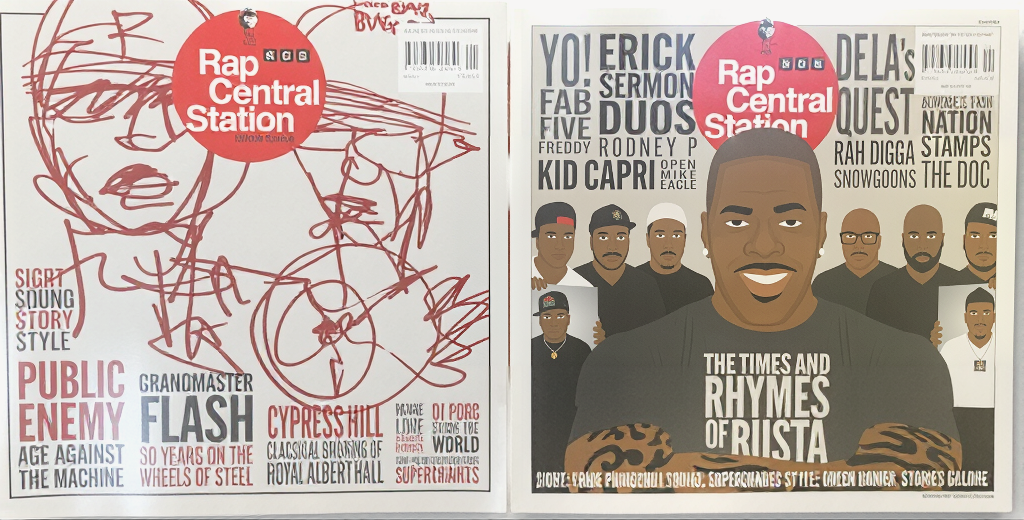
Rap Central Station: The Essence Of A New Magazine 2026 (As In INK ON PAPER Magazine): A Mr. Magazine™ Musing

May 31, 2026

Slow the culture so we can breathe again…

At least 30 new magazines were launched in the first five months of 2026.  Those who know me, know that my definition of a magazine is, “If it is not ink on paper, it is NOT a magazine.”  Feel free to call those digital platforms anything you want, except a magazine.  We never called television radio with pictures.

This leads me to a great editorial written by the editor of the new magazine Rap Central Station.  An oversized publication measuring 12X12 inches and refers to itself as a MAGPAPER.  The editor writes in the second issue of the magazine, and I quote, “Scrolling ain’t reading. Texting ain’t writing. That line hit even harder after the response to the debut issue of Rap Central Station earlier this year.  What we didn’t expect – but we fully respect – is how fast the magazine is becoming a collector’s item.  That tells us something important: people still need tangible culture. Something you can hold. Something that doesn’t disappear with a swipe.”

The editor continues, “I’m not gonna front I h’ve been inspired with stories of 2 fledgling magazine publishers from 75 years ago.  John Johnson with JET EBONY and Hugh Hefner from Playboy.  Both ironically from Chicago.  They had visions against insurmountable odds.”

So, what is this magazine that was inspired by two of our great magazine publishers of the last century.  The editor writes, “We are an art magazine first.  Then artist – driven storytelling.  Then music—charted with intention. We believe artists should write their own reviews. Nobody listens harder than the creator. That’s the innovation. That’s how you reverse some of the damage done to hip-hop by speed, neglect, and surface-level coverage.  This magazine slows the culture down—so it can breathe again.”

And all what Mr. Magazine™ can say to that is Amen!  Let’s slow the culture down a bit, so we can all breathe again.

h1

“Magazines Are Here For Good,” Says Nikki Simpson, Founder Of The International Magazine Center in Scotland.  The Mr. Magazine™ Interview

May 26, 2026

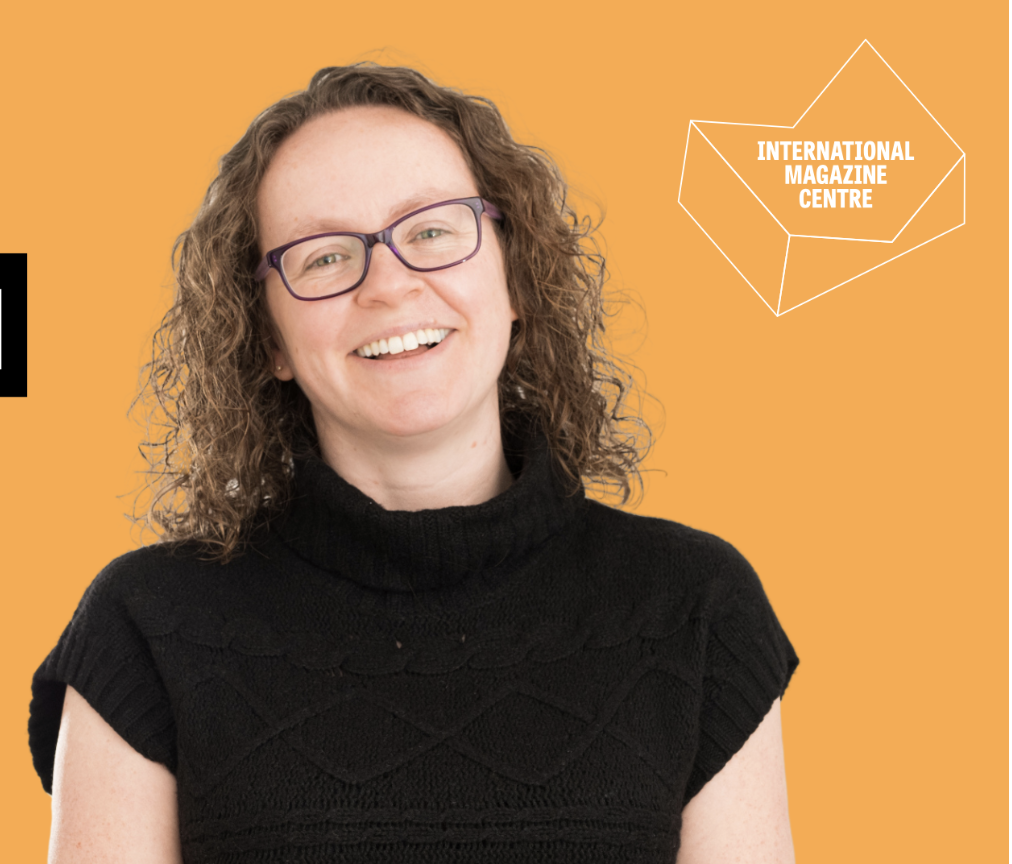
Nikki Simpson is on a “one woman’s adventure” to help and support independent magazines worldwide.  Nikki sees the future of magazines in those independent titles that are being published worldwide on “a daily basis.”

She founded the International Magazine Center specifically for that purpose.  She writes about the Center, “My baby is the International Magazine Center – a membership organization supporting independent publishers and freelancers working in magazines.  We focus on teams between 1 and 10 people, most of which are owner-run.”

For the first time since establishing the Center, Nikki is bringing her workshops to the United States on June 12 and 13.  Titled “Magazine Are Here For Good,” the conference will take place in Portland, Oregon, and will run workshops on circulation, membership and publishing among other subjects.

I reached out to Nikki via Zoom and asked her about the International Magazine Center, and the Magazines Are Here For Good conference.  What follows is my interview with Nikki Simpson, founder of the Internation Magazine Center in Edinburgh, Scotland. 

But first, the soundbites:

On her goal with the IMC: “What I wanted to do was support independent publishers, teams of between one and ten in a company, because those were the people who were isolated and not just during the pandemic but all the time.”

On the total number of members in IMC: “We’ve got about 190 members and they’re all over the world. 80% of them I suppose are in the UK for obvious reasons but we’re expanding all the time and picking up new members in America, Canada, Australia, New Zealand and we’ve got a couple in Amsterdam.”

On why a conference in the United States: “I’ve been wanting to run an event in America for a while.”

On why Portland, Oregon: “I thought well if everything’s happening in New York then what’s happening on the other side of town? And so Portland seemed like a good place…”

On the role of digital in magazine publishing: “I always feel digital publishing is the add-on, it’s the way that people can access information if they can’t afford to pay for the (magazine).”

On her hopes for the Magazine Are Here For Good conference: “To meet people who are working in publishing basically.”

On what keeps her up at night: “Falling asleep on the couch usually trying desperately to do the hard sudoku and just getting nowhere.  I’m getting pretty good at sleeping…”

And now for the lightly edited interview with Nikki Simpson, founder of the International Magazine Center in Edinburgh, Scottland.

Samir Husni: My first question to you, tell me a little bit about this whole one woman’s adventure creating an International Magazine Center.

Nikki Simpson: Yeah, I love the way you put that one woman’s adventure. I suppose that’s exactly what it is really.

I used to work for a magazine publisher years ago and that’s where I fell in love with magazines. Then I went to work for PPA, which is the National Association for Magazine Publishers in the UK, and I was there for about four and a half years. I had a great time but there were elements of it that I found difficult, and I wanted to run my own thing, but didn’t feel that I could. Then I had a kid. He’s nine now, so I had him and when I came back, I just thought I really want to work for myself because if something’s going to drag me away from my son in this moment, my little baby, then it needs to be something that I really love.

But while I’d been at PPA I had this idea to open a physical building dedicated to magazines and that was what the original idea was. We were kind of trying to think about ways to attract people to come and live and work in Scotland and work in magazines obviously. When I left PPA and I had my child, I came back and thought I want to really spend time on that and see what comes of it. It is not a physical building in any way at all apart from this office that I’m sitting in, but what’s come of it is an international membership for magazine publishers. When I first started that, like the first two years, I couldn’t really quite find my niche because I was still talking to all the PPA members I knew in Scotland and nobody was used to communicating by video so it was difficult to run events internationally and then of course the pandemic hit and that’s when everything changed for me.

I realized that what I wanted to do was support independent publishers, teams of between one and ten in a company, because those were the people who were isolated and not just during the pandemic but all the time.  I had people coming to me who had been publishing for five, ten years and say, “do you know any other publishers” and I’m like “oh yeah I know a few.” They thought they were the anomaly, they thought they were the one crazy person in town. So, now we’ve got about 190 members and they’re all over the world. 80% of them I suppose are in the UK for obvious reasons but we’re expanding all the time and picking up new members in America, Canada, Australia, New Zealand and we’ve got a couple in Amsterdam and it’s just basically where I spend my time is where we tend to be able to pick up members and I love it.

Samir Husni: I see that you are coming to the States and you are doing the first conference or workshop in Portland, Oregon June 12 and 13. Why Portland and why did you decide to start with the States as your first international venture?

Nikki Simpson: That’s a good question. I think specifically Portland because I’ve been having conversations with a friend called Megan, Megan Schertler, I don’t know if you know her, she does a blog called In Real Life Media and she’s a massive print advocate, runs her own consultancy and so on.

Anyway, I’ve been talking to her a lot about events in the US and how most of them were happening in New York. She’d just been involved with a New York event, Mag Culture were running annual events in New York, and I knew of course that being New York there’s going to be hundreds of events going on full stop. The way I approach things in Scotland is I run maybe one event in London a year because everything happens in London in the UK.

So, for me it’s much nicer to run things locally in either Scotland or we run a regular Manchester event as well. I felt the same way about America. I thought well if everything’s happening in New York then what’s happening on the other side of town? And so Portland seemed like a good place, Megan introduced me to somebody who runs a magazine shop there and it looked like there was lots of great independent titles in the area. Then I heard that Broccoli was based in Portland and then one of my members, it turns out, Kitchen Table magazine, they’re in Portland as well. I thought well this is brilliant, all signs lead to Portland.

And then why the US in general? I don’t know, I’ve been wanting to run an event in America for a while. I think, I mean interestingly I’ve been speaking to quite a few people about this and they kind of said why are you coming to America now? This feels like not the best time for it and I kind of feel like well maybe, but if you know if everybody feels that way then maybe I should go against the grain a little bit and go well maybe what people need now is support right and that’s my job is to support independent publishers so why would I, why would I steer clear of that when something bad’s happening you know or something is controversial is happening depending on which way you look at things. I would much rather come and say well, I’m here to help and support you if you want it.

Samir Husni: You say magazines are here for good, I say we are going to have magazines as long as we have human beings.

Nikki Simpson: Yes, I am absolutely 100% on the same page with you on that. One the independent titles specifically are having a bit of a moment now, but I feel like that moment has been building for so long.

When I first started working in magazines, I’ve been working in magazines for about four or five years by that point, and I remember we did this exhibition on magazine publishing, and it was curated by Jeremy Leslie at Mag Culture. It was a fabulous exhibition and it was all these amazing new titles but I mean you could have chosen another 50 different titles, it was just those ones that he happened to choose and so I feel like that was when people really started to go oh okay there’s an alternative to mass media and there’s an alternative to the rhetoric around mass media and print is dying and so on. I just can’t bear that sentence, print is dead, print is dying, I’m like really, really, do you want to meet some of my members?

Samir Husni: My definition of what a magazine is, “if it’s not income paper it’s not a magazine.”  We never called television, radio with pictures, we called it television, why can’t we call those digital platforms some name besides magazine?

Nikki Simpson: Another name for it, that’s a good question.

I’ve got a friend who, well one of my members and friend, up until recently she was a digital publisher only and every time she’d come to my conference she’d say to me afterwards Nikki there’s lots of digital publishers out there who are doing great things too and I’m like I’ll think about that. Now she’s just started publishing in print as well and she absolutely loves it and her readers absolutely love it as well. I always feel digital publishing is the add-on, it’s the way that people can access information if they can’t afford to pay for the £30 or $30 in postage. But it’s not the place where people enjoy reading, it’s not the place where people go oh happy days my digital magazine has arrived. It’s just like oh okay well I need to read it, or I should read it or I can read it because I couldn’t afford the print version or whatever but it’s not everybody’s first choice, is it?

Samir Husni: I just picked up the first two issues of a new magazine from the UK, it’s a rap magazine called Rap Central Station, it’s an oversized rap music magazine and in one of their introductions they write, “scrolling ain’t reading. Texting ain’t writing,” which is amazing. So, what are your hopes for this conference in Portland?

Nikki Simpson: To meet people who are working in publishing basically. We’ve got two workshops in the afternoon so I’m running a workshop on how to turn your magazine into a membership and then Joe Berger, a circulation consultant, is running a circulation health check for people.  So, people can come along with their magazines and talk about their circulation.

Then we’ve got an evening social event where we’ve got Anja Charbonneau coming from Broccoli magazine and Brett Warnock from Kitchen Table magazine and the whole event is being sponsored by Neesh who are the company that are connecting publishers direct to retailers as opposed to going through a distributor so they’re going to be talking as well and then the following day on Saturday we’ve got a how to launch a magazine workshop for people who aren’t really actually working in magazines at the moment but who want to.

The idea is just to meet new publishers and to help support people. I’ve never been to Portland. In fact, I’ve never been to America so I’m excited to meet new people and to find new ways and approaches of publishing.

Samir Husni: before I ask my typical last questions, is there anything I failed to ask you about the International Magazine Center and about the Magazines Are Here For Good conference?

Nikki Simpson: That’s a big question.  As for the Magazines Are Here For Good conference, anybody that’s coming just don’t forget to bring your magazines. For the International Magazine Center, we run a whole series of training courses and events now.  I counted it up the other day I’m running 57 events this year albeit three of them are recurring events but 57 events and they’re all tailored for independent publishers.  What else can you say?  It’s a welcoming community I’m very non-hierarchical a lot of the events that I run are more about peer-to-peer learning.

Our conference is like the people that I invite to come and speak at it are a real range of people so we have people who aren’t even in the market yet, like they’re still students and they’ve maybe you know produced a magazine as a part of their course right through to you know CEOs of major companies,  so we try to really cover the spectrum there and I think that’s really important to for people to feel recognized it’s when you have that focus of teams of one and ten people.  Huge problems come from that, usually through lack of confidence , so like the majority of my members are teams of one and two people in a team, or you get one person and then they work with three or four freelancers, which means that they’re not sure about whether they’re doing things correctly or  where to focus their attention because they’re doing absolutely everything in their business.

You get that kind of moment of inertia when you have too many decisions to make, so it’s difficult for them to move their businesses. That’s something that we help with.

Samir Husni: My two typical last questions are personal questions:  If I come to visit Nikki one evening unannounced what do I catch her doing, reading, cooking, taking care of her child?

Nikki Simpson: Now gardening. We’ve got a big garden, and we stuck our garden through Chat GPT and we’re in the middle of building a dry-stone wall and then putting down you know making it split level and all this kind of thing.  I do a lot of swimming in my spare time I go to two different swimming classes now a week and I just want to work my way up to be able to do long distance sea swimming. That’s what I’m aiming for or even just a bit of scuba diving that would be nice.

Samir Husni: My final question is what keeps you up at night?

Nikki Simpson: Falling asleep on the couch usually trying desperately to do the hard sudoku and just getting nowhere.  I’m getting pretty good at sleeping, what tends to keep me up I often work late so that I can communicate with people over time zones but I think what keeps me awake at night is when I haven’t worked out in my head what the worst case scenario is because once I’ve discovered what the worst case scenario is, I can go okay, and so that will look like what it looks and that’s okay.  

But if I haven’t done that yet, I’m going oh my god it needs 300 people to come to my event and how am I going to get them, that kind of a hamster wheel in my head.

Samir Husni:  Thank you and good luck on your Magazines Are Here For Good conference June 12 and 13 in Portland, Oregon.

h1

2025: New Magazines On The Upbound…

January 14, 2026

I gauge my believe in the status of print on the fall and rise of new magazines. Please note that I did not say future of print but rather status.  As long as we have humans we are going to have print.  End of discussion.  And for those who know me and know my writings and analysis know that. “It is only a magazine if it is ink on paper: i.e. print.”

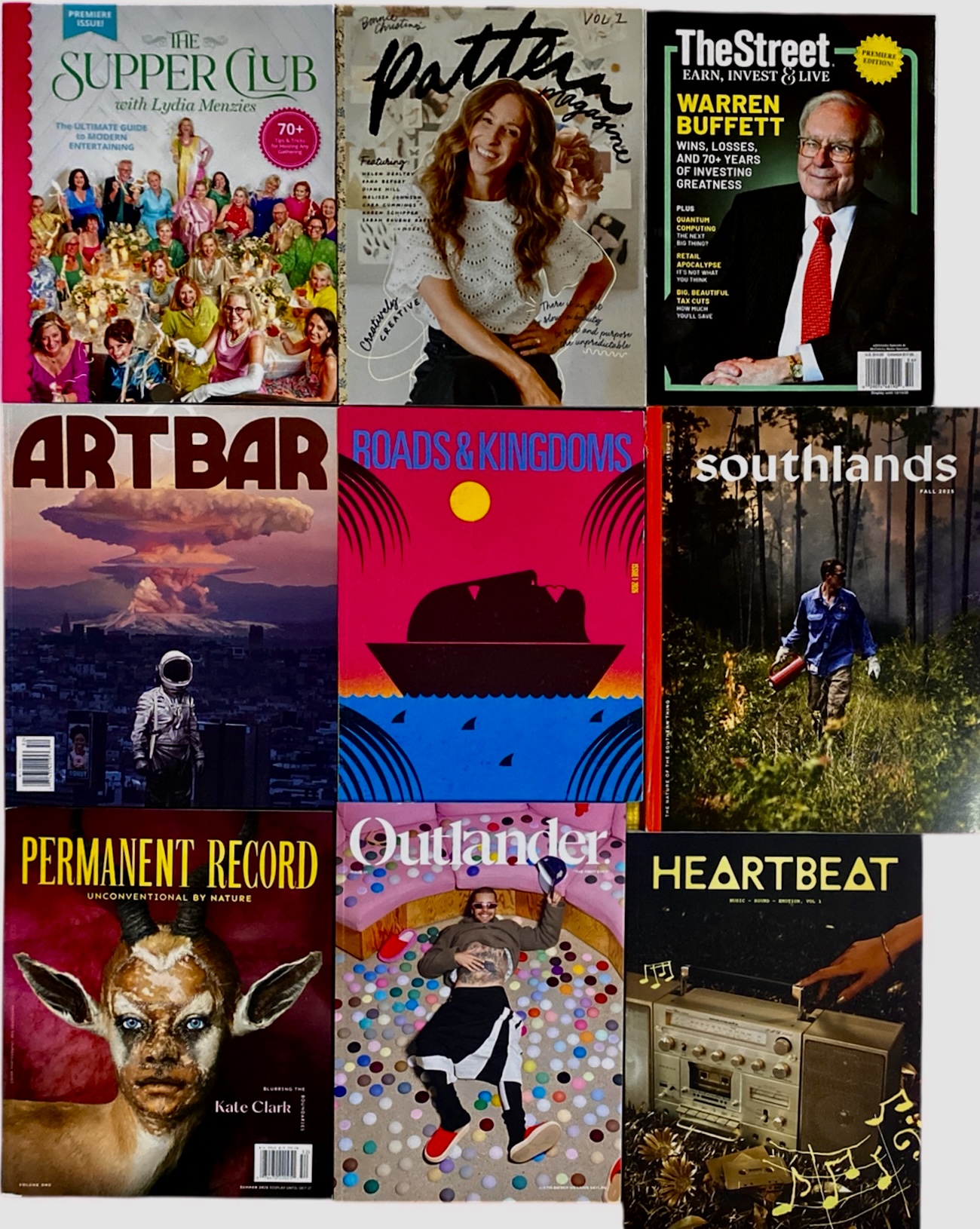
So it should come to no surprise when I tell you I was delighted when the post office delivered to my mailbox the first issue of Hoffman’s Media The Supper Club with Lydia Menzies. The same happened on Christmas Eve when the first issue of the magazine dedicated to the late chef Anthony Bourdain Roads & Kingdom landed in my mailbox.

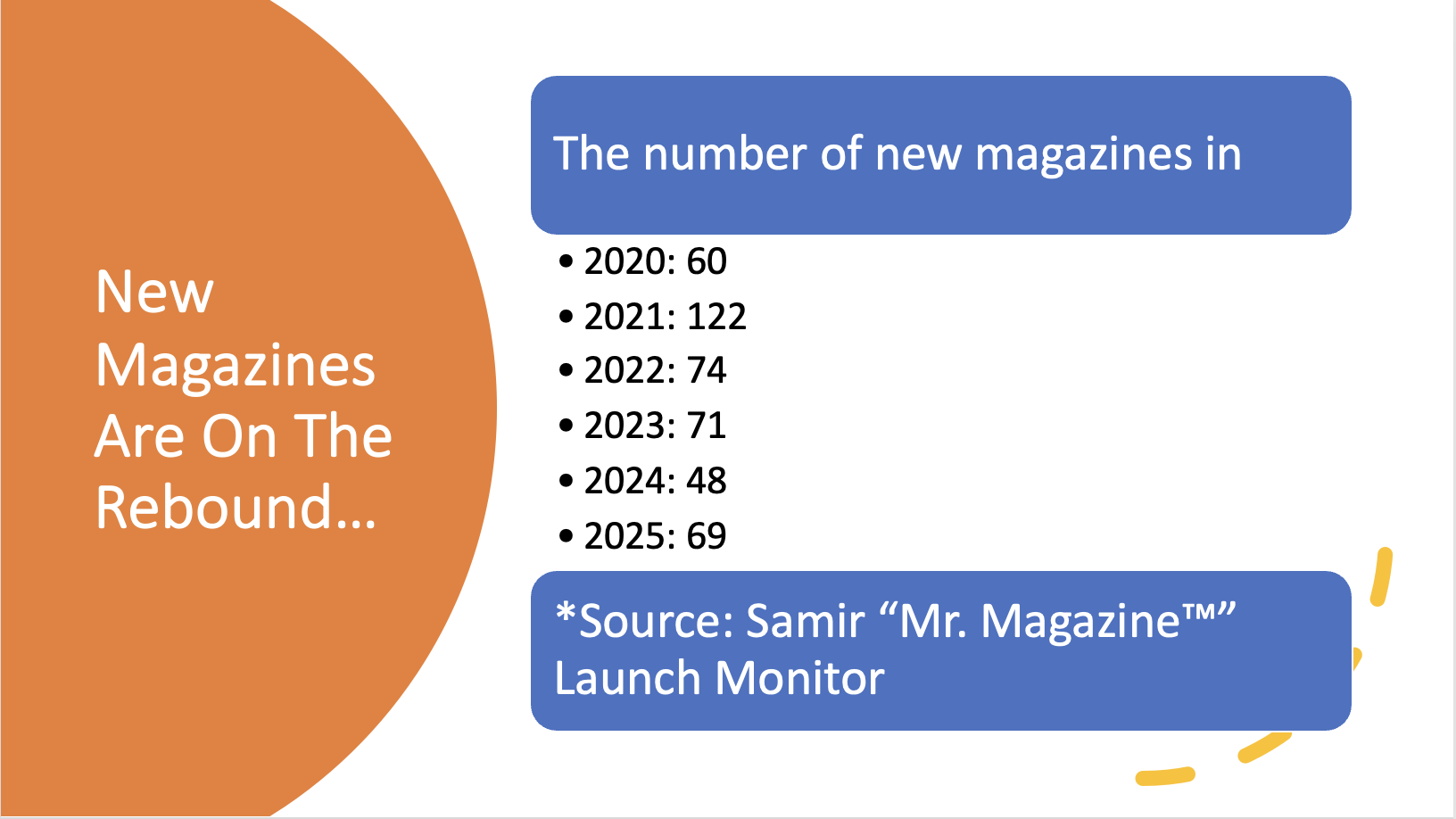
Those two magazines were but two from a total of 69 new magazines that were launched in 2025, a number that showed an upward move compared with 2024 as the chart below shows.

Of note among the launches are Art Bar, Bonnie Christine’s Pattern magazine, Southlands, Outlander, Permanent Record, The Street, and Heartbeat.

An Editor’s Note: Starting next week, I will start publishing a book-in-a-blog about the status of magazines in general a century ago and one specific magazine that changed the status of Art magazines in the 1920s.  So, stay tuned.

h1

The Fabulist:  A New Speculative Literature Magazine With A Print First Business Model. The Mr. Magazine™ Interview With Josh Wilson, Editor & Publisher

December 1, 2025

Born from the womb of the web, The Fabulist launches its first print issue in 2026 after being a web only platform since 2007.  To quote Josh Wilson, the magazine’s editor and publisher, in his letter to the readers accompanying issue zero of the magazine, “In a world that’s glutted with disposable digital ephemera, we love working with print: It is a tactile, tangible, dynamic, and long-lasting medium that transforms your experience as a reader, and celebrates the meaning and value of the works we publish.”

Issue zero of The Fabulist, art by Glenn Buack

And Mr. Magazine™ can’t but 100% agree with Mr. Wilson.  There is no better place to combine “amazing stories, rich illustrations, and wild art,” than print.  The Fabulist publishers believe so much in print that they make their business model print first.

Intrigued by the concept and the business plan, I reached out to Mr. Wilson to ask him more about the inception of The Fabulist, the plans and the reason for the print magazine after being a web only platform.  We had a lovely conversation and learned the secrets behind the transformation from digital to print.

So, without any further ado, please join me in this lovely conversation with Josh Wilson, editor and publisher of The Fabulist.

But first, the soundbites:

Josh Wilson, editor and publisher, The Fabulist

On the reason for print: “I realized that print really was something people were attracted to and aspired to be a part of.”

On the background history of The Fabulist: “For several years we printed chapbooks, short 20, 30, 40, 50 pages, saddle stitched, single story publications. Then we began to think through our model and what we could do with it, which brought us around to this print magazine. I’m surprised to see that it’s really gaining traction.”

On his background: “I started out in print in the 1993 – 1995 period. I’m a journalist who worked at SF Gate in San Francisco and never went back to print until now. And it’s been a pleasure. I’m also amazed to find that readers and writers and everybody else is thrilled to see print happening.”

On The Fabulist elevator pitch: “We’re a literary, a speculative literature magazine. We publish fantasy and science fiction.”

On the business model: “I find that digital monetization is very, very hard, and it’s amazing to me that print from the previous millennium, the previous century, turns out to be a viable business model.”

On the zero issue: “It is a viable standalone issue. But we wanted to just see what we could do with print.”

On the art of curation in print: “There are space considerations in print, which makes the curation process more interesting. What order do the stories go in? What’s the effect of reading them in order? Each piece of art and its positioning, the layout.”

More on the art of curation in print: “I find it a much more interesting and creative medium to curate for that the constraints produce innovation and fun. Whereas on the Internet, every page is the same. It’s a template.”

On the future: “We want to continue to develop work in print and on the web. But we want to lead with print as a beautiful standalone document.”

On what keeps him up at night: “Worrying about the magazine and its success. There’s always something to worry about.”

The first issue of The Fabulist, art by Sergiu Grapa.

To learn more about The Fabulist or to order a subscription please click here.

And now for the lightly edited conversation with Josh Wilson, editor and publisher, The Fabulist:

Samir Husni: First, congratulations on the new magazine.

Josh Willson: Thank you.

Samir Husni: Anybody that launches a print magazine today deserves to be congratulated.

Josh Wilson: Thank you.

Samir Husni: Tell me, what’s the story of The Fabulist?

Josh Wilson: The story of The Fabulist

Well, way back in 2007, I kept getting my stories declined by magazines, and I decided to start a little blog, just a website where I could put my stories and those of my friends. About six months later, we began getting submissions, which was very strange because I never posted a submissions link.

People would just email us their stories. It turned out that we had been listed in a writer’s market called Duotrope. I don’t know who put us there, but we ended up in this writer’s market, and the submissions have been coming constantly since then, far more than we can deal with, and usually better than my own stories.

I took down all my stories and, for a long time, posted new work whenever we could get around to it. I would say about the mid-teens, 2015, 2016, 2017, we were at a reading event in San Francisco, where we live. I was approached by Elizabeth Gonzales James, who went on to become a novelist. She has two novels out, The Bullet Swallower and Mona at Sea. The Bullet Swallower is being developed for a feature film. She approached me before her first book contract and said, Do I need any help?

I remember being overwhelmed by submissions. I said, I could really use a hand managing all the submissions. She read a gigantic backlog of hundreds of submissions and said, You could do a story a week. Why don’t you?

I said, OK. We went with that. At that point, I realized we really should have a contract.

I contacted other publishers I know and asked them for advice. We made a writer contract. There are a few other steps to this.

One is that I realized there is a big difference between genre and literary journals. We were kind of in both places. The literary journals, you often pay a reading fee and don’t get paid for your work, to the extent that I would send a submission’s call to creative writing and MFA programs and get the department chairs sending me their work for this blog.

But the genre magazines, Fantasy & Science Fiction magazine, Asimov’s magazine, these all came out of the pulp era. There was a very strong writer’s advocacy movement. A lot of that business was pretty fast and loose. In the genre world, you don’t pay reading fees. You always pay the writers.

We decided we should at least do an honorarium. We grew that from $25 to $100 per story. Still operating at a loss. All digitally.

Finally, the final chapter for this evolution, in 2023, in the depths of the COVID pandemic, we were, I guess at the end of the worst of it. A colleague of mine here in San Francisco, Jennifer Joseph from Manic D Press, a great local imprint that has their work collected in the Library of Congress, their LGBTQ work, said that she’s going to AWP, the Association of Writers and Writing Programs conference. This was in Seattle.

Did I want to share a table, an exhibitor table at the book fair? I thought, yes, why not? I did that rashly because I didn’t have anything to sell because it was all digital, but I realized the contract that we had been using enabled us to make books. So I got an $80 color printer and began making chapbooks. And my colleague, our art director, Adam Myers, is a gentleman of very high production values.

We produced some beautiful books and they sold. They almost sold out. And I realized that print really was something people were attracted to and aspired to be a part of.

For several years we printed chapbooks, short 20, 30, 40, 50 pages, saddle stitched, single story publications. Then we began to think through our model and what we could do with it, which brought us around to this print magazine. I’m surprised to see that it’s really gaining traction.

This is after months of agonizing and product development. We got a small grant from CLMP, Community of Literary Magazines and Presses, to hire a digital marketing specialist. Lots of thoughts about how to convert from a weekly digital blog to an issue-based periodical.

I started out in print in the 1993 – 1995 period. I’m a journalist who worked at SF Gate in San Francisco and never went back to print until now. And it’s been a pleasure. I’m also amazed to find that readers and writers and everybody else is thrilled to see print happening.

So that’s where we are. I guess that’s a little bit of a long intro.

Samir Husni: In 2025, it looks like a lot of independent publishers, like yourself, are rediscovering print and bringing print magazines to the market.You were born from the digital womb, bringing The Fabulist to print. Tell me, if you are going to give an elevator pitch about what The Fabulist is, what would you tell people?

Josh Wilson: My elevator pitch for The Fabulist is that we’re a literary, a speculative literature magazine. We publish fantasy and science fiction.

But with a literary bent, a magic realist bent, there’s a lot of interest in what’s been called new weird and new fabulism. And we feel that there’s a lot of terrain that is undeveloped for speculative fiction and speculative literature, poetry and art that doesn’t quite fit in genre. Genre has a lot of straight expectations.

We feel that there’s a lot more room to develop this stuff, that we don’t want to be constrained by the expectations of the market, that certainly there’s no limit to the work being produced — the fantastical work that’s not realist fiction, that’s not straight genre, that sometimes sits in between. And it needs a place, a beautiful home. We tried to develop that beautiful home on the Internet, and it worked.

We have a brand. We’re an established presence. But we didn’t have a business model.

I find that digital monetization is very, very hard, and it’s amazing to me that print from the previous millennium, the previous century, turns out to be a viable business model. I guess that’s longer than an elevator pitch.

Samir Husni: It’s a very tall building.

Josh Wilson: Yes. We’re on the way up.

Samir Husni: Your business model is based on giving subscribers, a free complimentary zero issue or a dummy copy. So what’s the idea behind this business model, giving the one issue free for people who subscribe and then billing them technically per issue?

Josh Wilson: Yes. Two reasons.

First, the per issue billing was something I observed and we observed in Patreon. It’s a creator’s platform. It’s like Kickstarter, but you make your contributions serially over time. And musicians and artists and so on use it and every month you pay $2 or $10 or whatever and you get a new song or a new story or a new piece of art. So, that seemed like a really viable model.

It’s been of interest in the journalism world as well, this monthly income. Rather than having it all happen at once in a cluster annually, it gives the reader a lot of flexibility to exit without having to make a full commitment. So, we decided, we tried a Patreon account and it did work, but we get double hit with fees.

Patreon takes 3% or 5% and the credit card company takes a percent, and we really wanted to reduce that friction. So, we are selling subscriptions without Patreon. We are going with a bimonthly for now and we hope to increase to monthly. So that’s why we’re billing per issue.

And the free issue was our marketing consultant, a gentleman named Neal Gorenflo. He is a marketing guy. He started a publication himself called Shareable, Shareable.net and it covered the sharing economy when that was first coming up.

He’s a very astute and accomplished marketing person who said, you got to have a free offer. You got to have a no risk trial. And we already knew we were going to forge ahead with the print periodical and had made this issue zero.

You called it a dummy. It is a viable standalone issue. But we wanted to just see what we could do with print.

I had a whole bunch of those, you know, in a box on our shelf in our spacious corporate offices here. I thought, okay, let’s do it. Let’s use these.

I had to do another print run. We ran out. It’s been so popular.

I’m going down to San Jose to a printer a little later today to pick up another 150 copies.

Samir Husni: One of the things about print is you must do more curation than digital. As an experienced journalist, how is your curation takes place or the difference between accepting something for digital or accepting something for print?

Josh Wilson: We remain really concerned about quality control the whole way through. So, we did not and we never wanted to treat the Internet as a disposable medium where we could just throw stuff.

We always had a long review process. How will this look in our pages? How much work does the story need? It starts with whether we love it and we want to see it flourish. And if we love it, we’ll commit to it.

I would not say that we’re treating the Internet as more of an easy medium to throw stuff into.

There are space considerations in print, which makes the curation process more interesting. What order do the stories go in? What’s the effect of reading them in order? Each piece of art and its positioning, the layout.

I find it a much more interesting and creative medium to curate for, because the constraints produce innovation and fun. Whereas on the Internet, every page is the same. It’s a template.

We try to make it beautiful and we’re going to do a design refresh and get that website up to speed. But, although it is a boundless medium, it is ironically much more constrained, I think, than print. Because you can’t do an interesting layout.

For all its dynamism, it’s much harder to make it an art piece. And with this print magazine, we want to make an art piece. This is collectible.

Samir Husni: When’s your first issue coming out?

Josh Wilson: January. We had to push it back because of the two holidays, there’s no way we can get the proof back. And then everybody’s going out of state at the end of December.

So mid-January, we aim to have that out and then bi-monthly afterwards. I was just looking at the new cover and it’s great. It’s quite different, too.

Samir Husni: Is there any question I’m supposed to ask you, that I did not ask you?

Josh Wilson: I suppose you could ask me about the state of genre and literary publishing in print and online. I find that fascinating and something I’ve gone deep into over the summer, although I might talk a little bit.

Samir Husni: So tell me about the competition. Who’s out there?

Josh Wilson: The interesting thing is a realization that the folks here aren’t competing. The audience for written-text genre fiction, fantasy and science fiction mostly, and the stuff that spills out over into the literary edges of that, is substantial and undiscovered and undeveloped.

There are a lot of conventions and conferences that happen nationally and globally, science fiction and fantasy conventions and comic book and movie conventions and the ones that are game conventions. And there’s some overlap, some Venn diagram overlap, but the literary conferences are tiny. The World Science Fiction Convention, where they give out the Hugo Awards, it’s one of the highest awards in genre fiction, only gets about 8 to 10,000 attendees, whereas Comic Con in San Diego or Dragon Con in Atlanta, Georgia gets tens of thousands or hundreds of thousands of attendees.

These people do read books, maybe not a full percentage of them. But a lot of people are genre fans without ever knowing that they’re genre readers. They watch movies, they watch TV, they love Star Trek, they love Star Wars. They’ll follow the movies and the characters.

The same is true in the literary world. When I was at AWP, the Association of Writers and Writing Conferences conference in LA, we covered all our expenses, including travel and conference registration and housing.  We covered all our costs.

A lot of it was these young MFAs walking up to our table and realizing that they could do genre, that they weren’t stuck in a realist, forgive the term, a realist ghetto. There was a lot of room for them to follow their interest and desires.

We broadly feel that the audience is vast and undeveloped. And there isn’t a national, there aren’t national scale, mass media scale consumer magazines. They’re more literary journals.

So, we’re all working together. And there’s a lot of great ones. Asimov’s Science Fiction magazine, Fantasy & Science Fiction magazine, Analog are all the warhorses from the pulp era.

There’s a host of amazing online magazines that sometimes have print as well. Clarkesworld, Lightspeed, Nightmare magazine, Strange Horizons, and Uncanny magazine are really sort of among the top tier of these online magazines that do issues in e-books. And sometimes audio books as well.

But also release all the stories for free on the web. So, there’s this freemium model. And then they’ll do print on demand for print.

I think we may be distinct in really going, switching hard to print first. The editor of, publisher of Clarkesworld, Neil Clarke, who’s an analyst of the industry and an accomplished publisher, pointed out that he goes where the readers are. He has an audio book version.

The people who listen to audio books are different from the ones who read online or who read e-books even. They’re all distinct. And he has a print on demand magazine.

We may be, The Fabulist, may be taking a risk on going so hard on print first. But we are at break-even. We, in about three or four weeks, we sold more than 100 subscriptions with an online ad campaign.

And it’s very interesting to realize that we have such a latent audience. We were getting one to five subscriptions every day. And the subscription drive ends tomorrow.

We’re going to assess, redesign it, redeploy it around our issue one with the new cover. The fact that you must go where the readers are is, as Neil (Clarke) says, is absolutely true. And we want to do audio books.

We can do e-books. And we want to continue to develop work in print and on the web. But we want to lead with print as a beautiful standalone document. This is a distinction.

There’s another magazine, Reckoning magazine, that also does a beautiful print document. And then eyedroppers out their content for free. I feel that that’s an exciting approach that you can do because audiences don’t overlap. Digital is a loss leader. And digital content enters social media and the Internet as a sort of promotional mechanism for your publication.

The print people who are repeatedly exposed to it, they realize they want the magazine. Although there’s a specific strategy we did. We have a landing page.

We show off all the interiors. We boast about the contributors. Try to showcase our production values.

Samir Husni: My typical last two questions. If I come uninvited to your home one evening, what do I catch Josh doing? Cooking, having a glass of wine, watching TV, reading a book?

Josh Wilson:  I’m cooking. I love to cook. I’m feeding other people. I want them all to eat, so I try to do a good job.

And I’m usually listening to an audio book while I’m cooking, because I can’t read it. Right now, I’m listening to Barbara Tuchman, the historian.

She’s got a great book called The March of Folly about governments doing stupid things over time. After dinner, ideally, everybody else cleans up and I go back to work.

Samir Husni: And what keeps you up at night these days?

Josh Wilson: Worrying about the magazine and its success. There’s always something to worry about. But I have been sufficiently exhausted that I usually fall asleep quickly.

I’m reading a great book that is keeping me up. It’s a new version of The Tempest, Shakespeare’s Tempest. It’s called Kalivas by the author Nick Mamatas, who is one of our book reviewers.

And it’s in the future. And there’s been a cataclysm. And Caliban/Kalivas lives on the Farallon Islands off San Francisco.

His mother was a nanotech Sycorax. The witch was a nanotech engineer. And Prospero is a techno magnate in this post-human society who invades the island and colonizes it.

And it’s a romp. It’s a great read. That’s been keeping me up a little too late.

Samir Husni: Excellent. Thank you and good luck.

h1

The Birth Of A Dummy… Magazine, That Is.  The Mr. Magazine™ Interview With John Kelly, Publisher And Editor of Dummy Magazine.

September 19, 2025

John F. Kelly fell in love with comics at age 10. He was so fascinated by Air Pirates Funnies that he dedicated the second issue of his new magazine, Dummy, to the Air Pirates. His story reminded me a lot of my own childhood in Lebanon, when I first discovered Superman at the same age that he discovered Air Pirates Funnies.

John went on to become a writer, a marketer, an educator, and later in life, an editor and publisher of a new magazine he aptly named Dummy. In the magazine industry, the term “dummy” refers to a prototype edition of a publication. He had originally been showing the prototype of his magazine and referred to it as the Pee-Wee Playhouse zine prototype—essentially, the dummy issue. And thus, Dummy magazine was born.

As a comics historian, John uses Dummy to explore comics history one subject at a time. In addition to the magazine, he also hosts a YouTube channel called DummyZine. I had the pleasure of interviewing John, where we talked about his love for print, his views on comics and their history, the impact of new technologies such as AI, and the reasons many are returning to print as independent publishers in this digital age.

So, without any further ado, please join me in this pleasant conversation with an editor and publisher that reminded me of myself falling in love with comics and transitioning to magazines.  

Enjoy the Mr. Magazine™ Interview with John Kelly, publisher and editor of Dummy magazine.  But first, the soundbites:

On what is Dummy magazine: “It’s a comics history publication that I focus on one particular topic for each issue.”

On why he launched Dummy: “I missed the printed magazine, holding something in my hand that had something that I spent a long time writing about and researching.”

On naming the magazine Dummy: “I was taking out this Pee-Wee’s Playhouse zine and showing it to them and saying, here’s the dummy of my new zine, my new Pee-Wee’s Playhouse zine. And that’s just what I was calling it because I started in printing and publishing, and that was just a term that I was familiar with.”

On the resurgence of print in this digital age: “There’s an analog movement for different people in this country and in the world. We consume so much information online. Print is like taking a break medium. I think that’s part of it.”

On the difference between issue one and two: “It was very important to me to have it look like a real magazine, so that there was a much more of a disciplined approach to it than my, let’s just throw this thing together, first issue. The second issue, which took a lot longer, in part was also tracking down the art.”

On his love for Air Pirates Funnies since he was a kid: “I opened Air Pirates Funnies number one and looked inside and saw, ah, this is not Mickey Mouse. This is not the Mickey Mouse that I know. They’re doing something very different here. And so from that point on, I’ve been really puzzled and fascinated by the Air Pirates. This was my chance to explore that deeper.”

On his view about AI: “I don’t really consider any technology a foe. I think things can be misused. Anything can be misused, and AI certainly misuses a lot of things.”

More on his views on AI: “Most of my friends are cartoonists or artists or writers. I’m a writer myself. The threat of AI stealing the intellectual property of artists and other people, plus other issues beyond that, makes it extremely dangerous and something that is theft.”

On his advice to start a new magazine: “It’s very difficult and very expensive, but that’s not a reason not to do it, right?”

On what he does to rewind: “I don’t really rewind.  I’m working all of the time.”

On what keeps him up at night: “Nothing. I sleep great. I take care of myself. I eat well. I exercise.  I’m doing something I absolutely love to do.  I’m completely content with everything.”

And now for the lightly edited Mr. Magazine™ Interview with John Kelly, publisher and editor of Dummy magazine:

Samir Husni: Give me the elevator pitch of this new magazine, Dummy.

John Kelly: Well, it’s a funny story. The elevator pitch, I guess, would be that it’s a comics history publication that I focus on one particular topic for each issue, and the guideline for what that topic is, is that it’s something that I’m extremely interested in, maybe I know something about it, but I want to know a lot more.

So by doing the research in the writing and putting it all together, I do a very deep dive on that topic so that I educate myself about it. And as a result, when it’s printed, others can also learn what I’ve learned.

Samir Husni: What’s the genesis of the magazine and why did you decide to call it Dummy?

John Kelly:  It’s a funny backstory because I was not planning on doing this at all.

I’ve been writing about comics history for many years. I’ve been writing for The Comics Journal magazine since the late 1980s or early 1990s, but more than 35 years. And I’ve written many, many pieces for that publication.

In recent years, as magazines, the printed magazines, have mostly disappeared, including, for the most part, The Comics Journal. They do a print publication occasionally. Most of my pieces have only existed online, and I was just kind of getting sick of that.

I missed the printed magazine, holding something in my hand that had something that I spent a long time writing about and researching. I’d written many pieces, and they only existed somewhere out there on the internet. I love printed materials.

I certainly am of the age that I grew up with them, and I wanted to put together something for myself. I chose to do that first issue on the Art of the Pee-Wee’s Playhouse show because I knew the people who were involved in that process, and I had seen all their archival material many times. So, I put together, really just for myself, a printed publication about that story, and I brought it to a friend’s house.

He had a color copy machine, and I had laid it out in InDesign and quickly put it together, brought over some flats to his house. We printed out the pages, folded, stapled them, and there it was. I held it in my hand, and I was very happy, and I thought that would be it.

I thought that I was making one copy just for myself because it was something that I wanted to do. Then people started seeing it. I was showing it to them, and I was saying, you know the term dummy in printing? It refers to a prototype publication. I was taking out this Pee-Wee’s Playhouse zine and showing it to them and saying, here’s the dummy of my new zine, my new Pee-Wee’s Playhouse zine. And that’s just what I was calling it because I started in printing and publishing, and that was just a term that I was familiar with.

More and more people wanted copies of it, so I thought I would print up a couple of them. I wanted to give a copy to the people who I had interviewed, to Gary Panter and Mark Newgarden and Kaz and Wayne White and Ric Heitzman. I wanted to send them copies for their own, and I thought I would print up 10 copies of it.

But more people learned about it and they wanted copies, so I, reluctantly, decided that I would print up a hundred copies of it. And the last thing that I did before I sent the files to the printer was, I thought, well it’s got to have a name, you know? I just don’t want to call it the Pee-Wee’s Playhouse zine? I wanted to call it something, and I liked the name Dummy. It was stupid and it had a secondary meaning to it, so I thought it was kind of funny to call a magazine Dummy.

Very quickly, maybe in 90 seconds, I composed the logotype for that name for the masthead title and just slapped it on to the magazine at the last moment. I was printing a hundred copies thinking that it would take me 10 years to get rid of them, that they would be in boxes in my basement forever. Then I posted one little thing on my Facebook page saying, hey, I made up some copies of this.

If you want one, just contact me. And they sold out in two hours. They were all gone immediately.

I was like, wow. Then the money from selling those copies allowed me to print 300 more, and those sold out immediately too. Then since then, I’ve just been reprinting them and still today, I still get orders for that copy.

That’s basically how it all started, but it was not something that was planned. I’m extremely happy that there are people out there who want it, who want a printed publication. I didn’t realize that there as many people out there, like me, who missed print and the printed matter. I’m happy that they exist.

Samir Husni: Why do you think is this resurgence of the independent return to print?

John Kelly: There’s an analog movement for different people in this country and in the world.

We consume so much information online. Print is like taking a break medium. I think that’s part of it. There’s a novelty aspect to it too, that people are not expecting a printed publication that’s well printed, produced, and designed as possible.

I want it to be a beautiful piece that people can look at. I can only say personally, I absolutely hate reading long things online. I’m getting older, maybe that has something to do with it.

My eyesight is failing and the chore of reading something online that is extremely long and complicated. I just won’t do it, and that includes my own work. I still write for The Comics Journal, and I tend to write very long pieces, one of the things that prompted me to really embrace doing a publication again, myself, was that I would say I wouldn’t even read my pieces online because they’re too long.

Not that because they’re bad, but just because there’s too long, and you get distracted. You get pulled away from something and you think, well, I’ll go back to that. Then you’re bombarded with 9 million other things that take you away from it.

You end up two years later thinking, oh, there was something that I wanted to read. If you have the printed thing, you can read part of it, put it down, read it again. And if you like it, you can save it and read it years from now.

Samir Husni: Your journey from issue one to issue two, has it been a walk in a rose garden or you had some issues?

John Kelly: No, no, no, no, no. With the first issue, since I wasn’t expecting it to exist, I probably designed that issue very quickly. I have rudimentary InDesign skills and layout skills.

I can get by to do like a mock-up of something. I’ve been using Adobe products since they came out, so I know how to use them. Also the subject matter for that first issue, the looseness of the art of the Pee Wee Herman program really worked well with my somewhat laissez-faire design for that issue, right? Once I was going to do a second issue, I wanted to really step it up and make it as beautiful as I possibly could.

All the images in the second issue are scanned at very high resolution from primary sources, so either the original art or usually a very rare, printed publication. There’s a lot of work that goes into cleaning up those images and having them color corrected and presented on the page so that they look like the actual artifact, like you could reach down and pick it up off the page.

That’s what I was going for, at least. It was very important to me to have it look like a real magazine, so that there was a much more of a disciplined approach to it than my, let’s just throw this thing together, first issue. The second issue, which took a lot longer, in part was also tracking down the art.

There were specific pieces of art that I wanted for that issue that took a long time to find, like who owned the originals for this piece, who had the original piece or who had a copy of this thing that there’s maybe three copies in existence. Getting that and then scanning it and working with the it took a long time, but in the end, it was worth it. Also, the Air Pirates story is a very complicated story.

It’s an extremely complicated story that I don’t think has been captured in the way that I’ve done in this issue. So, there were a lot of moving parts and a lot of people that I was talking to from the Air Pirates and around the Air Pirates for that issue. I wanted to make sure that I said that story as well as I possibly could.

Samir Husni: Judging by the poster above your chair, you’re an Air Pirates fan?

John Kelly: Oh yeah, sure. The Air Pirates have been very important to me since I was a little boy. I first saw copies of Air Pirates one and two when I was 10 years old and I was over a friend’s house. This friend had an older brother who was a junior or senior in high school.

He had a stash of underground comics hidden in his room that I knew about. When I would be over their house and when the brother wasn’t around, I would sneak into his room and go through the comics and look at them. I was way younger than I should have been looking at those things. But mixed in with the guy’s copies of Zap and Freak Brothers and some other underground comics were these like Mickey Mouse comic books.

At first, I didn’t know what they were. To me, they were just like regular Mickey Mouse comic books. That’s what they look like to me.

I paid no attention to them. But I wondered why those were there? Why were these Mickey Mouse comic books in there with these dirty comic books? And eventually I opened Air Pirates Funnies number one and looked inside and saw, ah, this is not Mickey Mouse. This is not the Mickey Mouse that I know.

They’re doing something very different here. And so from that point on, I’ve been really puzzled and fascinated by the Air Pirates.

This was my chance to explore that deeper.

Samir Husni: We live in a digital age and AI is everywhere now. Do you consider AI a friend or a foe of the printed matter?

John Kelly: I don’t really consider any technology a foe. I think things can be misused. Anything can be misused, and AI certainly misuses a lot of things.

Most of my friends are cartoonists or artists or writers. I’m a writer myself. The threat of AI stealing the intellectual property of artists and other people, plus other issues beyond that, makes it extremely dangerous and something that is theft.

I agree with those friends of mine who absolutely hate it and don’t want it in their lives. They don’t want their artwork stolen and reconfigured and used for other purposes without their permission. I completely understand that, and I support that.

That said, AI is a lot more than just that. That’s a bad side of what it does. I don’t think we were recording this, but when we first started, you were talking about how you do your transcriptions and that’s an AI process. That’s helpful.

That’s extremely helpful. There are other things that AI can do that is beneficial.

So, I am not 100 percent against it, because in theory it can be a very useful tool. I remember when desktop publishing was first starting, that was a threat to people who were publishing in the earlier, more traditional ways.

Society adapted to the new technology and now it’s what’s used. I still love the old methods of printing. I print a lot of things on a letterpress machine.

I love the fact that I have access to a letterpress, not just one, access to several letterpress machines. And I take advantage of that, and I print things with that technology.

I love the way that they look. It’s not efficient for me to be printing an entire issue of Dummy on a letterpress machine these days. And so it’s offset printed in Chicago and then mailed to me.

I would love it if I had a letterpress machine or some other old-fashioned printer in my basement that I could crank it out whenever I wanted a new copy and do it myself. But, logistically, I’m not able to do that.

So, that’s how I view AI.  It can be a very bad thing. In some ways it is a very bad thing. In a lot of ways, it’s a very bad thing.

In other ways, it’s something that we all use, whether we know it or not.

Samir Husni: If someone came to you and says, John, I have this idea of a new magazine, should I go ahead, and do it? Would you tell them, yes? Or you would tell them forget about it.

John Kelly:  It’s very difficult and very expensive, but that’s not a reason not to do it, right? It would depend on what their idea was. I hope that because of Dummy and a couple of other newer publications that I really love, I hope a lot more people start doing their own, whatever it is, their own printed thing.

I was just at the Small Press Expo this past weekend in Bethesda, Maryland, and I ran, along with Gary Hallgren, a member of the Air Pirates, we ran a workshop for younger artists on how to make mini-comics, Tijuana Bibles, and how to print your own little publication. We had a jammed session. The session was sold out, and it was great to see all these artists making their own little comics and holding them up and showing them. They were coming up to me afterwards and showing me what they did, and I loved that. I think people should explore whatever channels they can to have their expression created, whether that’s digital, whether it’s printed, whether it’s music, whether it’s painting, anything that they have a passion for.

I would say that I think one of the reasons Dummy is doing well is that it’s really a pure labor of love on my part. I think that’s very important. I’m not doing it because this will, I’m thinking, oh, this is going to make me money, because that’s probably not going to happen. My goal is that it makes enough money that I can keep doing it.  So far it is.

The reason to do it is because it’s something I want to do. Each issue of Dummy so far there’s only been two, but subsequent issues, they’re all going to be based on, here’s something that I wish existed, you know, here’s something that I don’t know enough about. As a writer, the only way that I learn, truly learn about something, is through the process of writing about it, through the process of researching it, to talking to the people who were involved in it, and writing the story, and then rewriting, and rewriting, and rewriting, and rewriting, and talking to more people, and then it comes together for me. I’m doing it as, because my focus, my target audience is one person, that’s me.

I’m the target audience. It’s something that I wish that existed, that if I walked into a store and I saw, or if I saw somebody posting about it, I would say, I need that, I’ve been waiting my whole life for that thing, and now it exists. So, if other people feel the same way, that’s great, but I’m doing it for myself, and that’s important for people, and especially doing a printed thing like this, it’s just because you got to really do it, because it’s something that you’re just motivated to do, because you want it to exist.

Samir Husni: Well, John, before I ask you my typical last two questions, is there any question I should have asked you I did not? John Kelly:  No, I think you’ve hit all of them so far. I’m having a lot of fun doing this. It’s a lot of work.

It’s a tremendous amount of work. I would say one thing that I wasn’t expecting, I hadn’t really thought about was the amount of work.  I sell a lot of copies of the magazine as a result, I’m going to the post every single day, dropping off stuff at the post office to mail out, sometimes two times a day, sometimes three times a day, bringing piles of mailers stuffed with Dummys to the post office, and that’s great. It’s a lot of time.

It’s a lot of time to stuff them into the envelope to get them to look the way that they want to. All the mailers are hand stamped. You know, they have a little note in there.

There’re some extra items. It’s very time consuming. There’re issues with mail delivery at times, especially right now, international mail delivery is really a nightmare.

You take a lot of questions from people about their orders.  I also sell t-shirts and other related merchandise. Somebody orders the wrong color or the wrong size.  What do you do then? There’s a lot of customer service stuff that takes a lot of time away from the actual writing.

I wasn’t expecting that because I wasn’t expecting any of this. It’s been a real learning experience.

Samir Husni:  If I come to visit you one evening, unannounced, what do I catch John doing? Reading a book, watching TV, cooking, having a glass of wine? What do you do to rewind at the end of the day?

John Kelly: I don’t really rewind.  I’m working all of the time.

The only I leave the house is I go to the gym every day, early in the morning. I get up really early. I get up around 4, 4:30 in the morning and I start working on Dummy at that point.

I’ll go to the gym around 7:00 or 8:00 am and then I’m working on Dummy or something for The Comics Journal or some other project until my wife and I usually watch about an hour of non-traditional television. It’s like a movie or a documentary or something, maybe an hour and a half of that before I, I usually start falling asleep about 10 minutes into it. Then we’re in bed at 10 or 9 pm.

Samir Husni: What keeps you up at night?

John Kelly: Nothing. I sleep great. I take care of myself. I eat well.

I exercise.  I’m doing something I absolutely love to do.  I’m completely content with everything.

I’m a very happy person at this point in my life. I don’t think there’s anything that keeps me up at night.  Everybody’s life has issues and concerns, and you just deal with them as they come.

I’m like powerless over most things. Usually, I figure out a way to make things work.

Samir Husni:  Thank you and good luck.

h1

Quiltfolk & homecooked: Two Successful Ad-Free Magazines Led By Publisher Michael McCormick. The Mr. Magazine™ Interview.

September 2, 2025

Cooking and quilting—two hobbies that require a lot of love and patience—find their match in homecooked magazine and Quiltfolk magazine, each providing that same love and patience to their audiences every quarter. These two beautiful, ad-free publications bring a tactile experience to two tactile crafts.

Michael McCormick is the young man behind both magazines. He started Quiltfolk nine years ago and launched homecooked just last year. You may ask, why would a young man start two print magazines in this digital age? His answer is simple: “I love magazines, and I believe in the business model.” It’s a model that has served him well with Quiltfolk and now with homecooked: 164 pages, no advertising, and excellent content. Each issue carries a premium price—$22 on the newsstand, or $16 per issue by subscription.

Michael is quick to credit his success to the art of storytelling and the tactile nature of his products. His passion for these topics is evident in every issue of both magazines. He is constantly on the road, searching for stories to tell, and focuses on one region at a time. As one Facebook ad for homecooked puts it: “You’ll read it like a magazine. And keep it like a cookbook.”

I had a fascinating interview with Michael, where we discussed both magazines, his love for print, and the challenges of owning a small business. Without further ado, please join me on this journey with Michael McCormick, publisher of homecooked and Quiltfolk magazines.

But first, the soundbites:

On the reasons he is publishing printed magazines: “I’ve always loved magazines, I believe in the business model fundamentally, and we like storytelling. I think the combination of storytelling, the tactile nature of what we’re producing, and just an underlying belief in the business.”

On why “Live to eat and not eat to live”: “It would make sense that we wouldn’t just do it just to live. It’s not just like breathing or whatever, it’s an outlet. I would say the same thing for quilting.”

On whether the ad free business model is working: “Yes, it’s working. If you a single issue, it is $22. And when you join us with a subscription, you get a discount plus you get a free issue. It works out to be about $15 or $16 an issue for your first year.”

On the challenges of owning a business: “Owning a business, no matter what it is, it’s just never a straight path. It’s never a straight line.”

On using Facebook for marketing the magazines: “That’s pretty much our number one paid platform would be Facebook and Instagram.”

On the reason for regional coverage of each issue: The “reason why that makes sense for us is that both Quilts and Food, you do have regional differences and curiosities and different pockets of the world that you get to explore.”

On what he does to recharge at the end of the day: “I would say right now in this stage of my life, there’s not a lot of recharging, relaxing. It’s sort of we’re going 100 miles an hour from usually 5:30 in the morning till 8:30 at night.”

On what keeps him up at night: “The answer is always, at least for me, it’s always cash flow.”

 And now for the lightly edited interview with Michael McCormick, publisher, Quiltfolk and homecooked magazines:

Samir Husni: My first question to you is, why would a young guy like you start a print magazine in this digital age?

Michael McCormick: Actually, I don’t know if you know this, but I have another magazine called Quiltfolk that we started about nine years ago that’s very similar to homecooked. It’s very similar format, 164 pages, no ads, we travel around.

And why? I’ve always loved magazines, I believe in the business model fundamentally, and we like storytelling. I think the combination of storytelling, the tactile nature of what we’re producing, and just an underlying belief in the business, I think, why not? I mean, there’s not as many people doing it. I feel like in a way it’s a little bit less competition, we get to go out there and make the thing that we really want to make, and we love doing it.

Samir Husni: Both magazines deal with tactile issues, Quiltfolk and homecooked. Are the printed magazines a reflection of the concept of the two magazines?

Michael McCormick: I think so. I think especially for quilters, that’s the space that I know the best.

They are tactile, and they’re getting that joy and that pleasure from feeling their materials and sitting down in quiet time and producing something that means a lot to them. Quilts hold a lot of stories in them. And then food, it’s amazing, the similarities between food, cooking and quilts in that way.

A lot of times it’s something you’re making for somebody else, it’s creative, it’s traditional, but you can also put a new spin on it. So, there’s a lot of overlap there, and I think the audience is to your point, appreciate being able to hold something in their hands and pass it around, and even enjoy it in a quiet setting.

Samir Husni: I read an article in the first issue of homecooked, “Live to eat and don’t eat to live.” What do you mean by live to eat, but don’t eat to live?

Michael McCormick: It was a quote from somebody in the article, but I think just on the topic we’ve been discussing, There are things we do every day, like as an example, eating and preparing food, that you can put a little bit more care into, a little bit more creativity, elevate those things into something that expresses who you are and what you love a little bit more deeply. And especially with cooking and food, we’re doing it multiple times a day, all the time, all around the world. We’re doing it with people that we love in the spaces that are the most intimate to us.

So, it would make sense that we wouldn’t just do it just to live. It’s not just like breathing or whatever, it’s an outlet. I would say the same thing for quilting.

You could just have a blanket, but in the case of quilting, that thing is with you when you’re sleeping on your bed and again, in the places that are the most used. So, as humans, we find ways of adding our own personal spin and our passion and our creativity into the things that we spend the most time with. I think that’s one of the uniquely fun things about being human.

Samir Husni: You utilize an advertising free model and even no sponsorships, nothing. 164 pages of editorial and a hefty cover price of $22.  Why do you believe this business model works or is it working for you?

Michael McCormick: Yes, it’s working. If you a single issue, it is $22. And when you join us with a subscription, you get a discount plus you get a free issue. It works out to be about $15 or $16 an issue for your first year.

I don’t think it’s astronomically more than a lot of other newsstand prices. It does catch people off guard the first time that you see a magazine that’s priced at that price point. But we believe in the model because in the end of the day, people will pay for stories and content, they love and that they enjoy that inspire them.

So, for me, it’s not so much will the customer pay, it’s can we produce the kind of magazine that they really, truly love and that has the potential of transforming their lives? Because if that’s the case, whether it’s $15 or $20 or whatever that price point is, it’s still a small price to pay for, what in a perfect world, they’re getting back from us.

Samir Husni: Since you started Quiltfolk like nine years ago and now homecooked, has your journey been a walk in a rose garden or there have been some challenges?

Michael McCormick: Owning a business, no matter what it is, it’s just never a straight path. It’s never a straight line.

Sometimes maybe for a selected few people, but most people, it’s full of ups and downs. That’s certainly been my experience. I tend to always be overly optimistic about how long it’s going to take us to hit certain goals.

On one hand, that’s frustrating because I always feel like we’re sometimes missing the mark. On the other hand, I think that optimism is probably why I felt we could start a print magazine in 2024. But I would say the education of the customer, in terms of what we really are, is difficult because when you say the word magazine, particularly now, people have a specific idea of what comes to mind.

It’s usually thinner and there’s ads and whatever that is, what we expect from a magazine.  The process of trying to educate the audience is what we’re trying to and this is what makes us different It can take a lot longer than we anticipate. It’s been a slow but pretty steady climb, I think for us in terms of subscriptions.

We’ve been fortunate. But it’s always something, if it’s not selling things and whatnot, it’s something else, it’s paper costs or shipping costs or whatever it might be, there’s always something going on.

Samir Husni: How are you marketing the magazines? I first saw it on Facebook…

Michael McCormick: That’s pretty much our number one paid platform would be Facebook and Instagram. And then we are on newsstand for homecooked, which we think more as a marketing value to us just to get us out in the world.

It’s really word of mouth. I would say paid Facebook, Instagram to kind of amplify that message.

Samir Husni: With homecooked, with every issue you concentrate on an area, either a region or a city, why is that?

Michael McCormick: Well, it’s two reasons.

And they’re very different, but they come together, which is great. The first reason is, it’s just more cost effective to, because, let me back up. One of the things that’s different is we send photographers and writers on the road for these issues that we produce.

So, I just got off the road from Kentucky a week before that we were in Coeur d’Alene, Idaho. And so, we’re in their homes, in their spaces, in their studios, on the road for two weeks at a time at the bare minimum to produce these issues. It’s very difficult logistically.

And from a cost standpoint, if we were doing that, across the country, across the world. So just logistically, it allows us to do what we want to do, which is be on the ground in person with our crew.

The second reason why that makes sense for us is that both Quilts and Food, you do have regional differences and curiosities and different pockets of the world that you get to explore.

So one thing we like to do is say, hey, look, there’s this through line of people who are passionate about cooking as an example. And there are things that they do that are the same. There are values that they share that are the same.

But also, when you’re doing that in Louisiana versus the Pacific Northwest where I’m from, you’re working with different ingredients, you’re working with different cultural things that add a little spice and a little bit of uniqueness to those home cooking dishes. So for us why not celebrate that? Why not lean into it and just make that both logistically make sense and editorially provide like a backbone for the way we do storytelling.

Samir Husni: If somebody comes to you and say, Michael, I want to start a new magazine, what do you tell them today?

Michael McCormick: I would say, well, the piece of advice I give people for starting anything is if it takes twice as long as you think, and it’s twice as expensive as you think, and you still want to do it and can afford to do it, then you’re in the right framework for kind of tackling that.

It’s just starting stuff is difficult no matter what it is, whether it’s a magazine or an app or anything like that. So just going in with the right mindset of knowing it’s going to be like a lot of pushing and a lot of getting that flywheel spinning. I think that’s important.

But from a magazine specific standpoint, I would say, make the thing that you really want to make. Don’t worry a lot about what’s out in the market or what people have done before. Just try to make the thing that really excites you that you believe other people will find valuable.

Then you just must have a crazy conviction for that. And you must be willing to adjust and pivot as time goes on. And that’s exactly what we did with homecooked.

We had the core of the idea, but I would say this first year has been a lot of trial and error, a lot of learning. So, the North Star remains where it’s always been. We know the product we want to make, but the whole team has worked hard to try to figure out how to get there.

So, it’s not, again, been a straight road. It’s a lot of trial and error and you must be kind of prepared to go on that journey.

Samir Husni: Can you pinpoint a major challenge that you faced and then you’ve overcome and how?

Michael McCormick: The initial marketing launch of homecooked was slower than I thought it was going to be.

It took probably four to six months to really figure out the messages that were resonating with folks online. So, you can imagine during that first four to six months, you got a lot of cash burn. There’s a lot of frustration because we’re producing this great product.

Everyone likes it. We believe in it. And you have enthusiasm on one hand, is at an all-time high, because you just launched something, but you’re not seeing things necessarily respond that way in the market when you first start.

That was very difficult. Thankfully, our team kept going, kept working on that. Now we’re in a good spot, six, nine months later, we’ve found our voice a little bit and settled in and things are coming along much better.

Samir Husni: Is there a question that I failed to ask you you’d like me to ask?

Michael McCormick: I don’t think so. Hopefully those answers are okay.

Samir Husni: My typical last two questions are, one, if I come uninvited to your house one day in the evening, what do I catch you doing to rewind from the busy day?

Michael McCormick: If you came to my house right now, I would be chasing my three children.

They’re six, four and two. And then my wife’s also pregnant with our fourth. She’s due in a couple of months.

I would say right now in this stage of my life, there’s not a lot of recharging, relaxing. It’s sort of we’re going 100 miles an hour from usually 5:30 in the morning till 8:30 at night. My wife and I get a half hour or so to catch up on the day.

Then we’re usually in bed and trying to get ready for the next day. So that’s sort of what it’s like right now.

Samir Husni: And my typical last question, what keeps you up at night?

Michael McCormick: It’s a small business. The answer is always, at least for me, it’s always cash flow. We bootstrap everything and we’re always constantly working on sales and managing costs and trying to balance what we can build and how fast we can go with what we have. I’m always paranoid about that. I’m always working on sales, and the team knows like Monday morning when I got off here, we’ll have a marketing call.

We’ll review our numbers. I’m pretty dialed into that. I would say around the clock, even when I’m sleeping.

Samir Husni: Thank you and all the best.

h1

A Trio of Youngsters Launch A New Craft Magazine: “Craftwerk.” The Mr. Magazine™ Interview with Chloe Harthan, Eli Clayton, and Ayla Hayes

June 14, 2025

Nothing brings more joy to the heart of Mr. Magazine™ than seeing three young people publishing a print magazine.  When I heard about Craftwerk magazine, I thought it is, yet another magazine aimed at old folks who enjoy arts and crafts at their later years.  And wrong I was.  Craftwerk is not for old folks and nor it is published by old folks.  It is the brainchild of two young graduates from the School of the Art Institute of Chicago assisted with a third graduate from the same school.  Even combining all their ages will not give you one old person’s age.

Smart, driven and determined those three young people are adamant on making a difference in the art and crafts word.  In their issue one, that they labeled “The Manifesto,” they write: “We believe that there is a new American craft movement in hyper-contemporary art.”

The manifesto continues, “The distinction between what has occurred previously versus now is the combination of late-stage capitalism, abundant internet usage, complete globalization, and digital archive accessibility. Culturally, there is an emphasis on individuality in conflicting tandem with mass-production and the search for “one of a kind” objects while impersonal plasticity rules over the maker.  We are divided from our things while being collectors of masses.”

It was my pleasure to sit down for a zoom interview with all three of them and we talked about Craftwerk, print in this digital age, and whether they are out of their minds doing this.

What follows is the Mr. Magazine™ interview with Chloe Harthan, Eli Clayton, and Ayla Hayes, founders and creators of Craftwerk.  But first the soundbites:

Chloe Harthan, Eli Clayton, and Ayla Hayes

On starting a new print magazine: Yeah, probably so. We, since we’re all artists, do a lot of things that are difficult to start, and we see it through anyways. I think that’s kind of in all our natures.

On why Craftwerk with an E and not an A: “In switching the E instead of an O, it’s pop-cultural and very in tune with queer culture to change “work” to being that. It’s also the German ending to change to “werk.”

On trying to create a new manifesto on crafts: “It would be cool if people read it and identified with it. But it isn’t really a specific agenda, I would say, for future generations. I think it’s responding to the people that we’re around and the community that we’re in in Chicago.”

On why Chicago and why crafts magazine: “We talked about Chicago in the manifesto being in the center geographically. And then craft is also in a center of an arts practice. There’s craft as in little, tiny projects like knitting, or there’s craft on the total other end, like Renaissance craft. So contemporary craft is in the middle.”

On the Craftwerk team: “Eli and I are the creators; Ayla is the editor. And so, Eli and I first had the idea for a project with jeans, and that was our passion. But before doing that, we wanted to decide what we were doing entirely. That’s why we did the manifesto.”

 On Craftwerk audience: “A lot of artists, creatives, people in our network or in people we know network. Since it is such a small starting project, it’s really all about connecting and getting people to learn about it through other people.”

And now for the lightly edited interview with Chloe Harthan, Eli Clayton, and Ayla Hayes, founders and creators of Craftwerk. 

Samir Husni: For a group of young folks like you, are you out of your mind starting a new print magazine?

Chloe: Yeah, probably so. We, since we’re all artists, do a lot of things that are difficult to start, and we see it through anyways. I think that’s kind of in all our natures.

But it’s been a learning process, and we’re continually learning as we’re doing it. It’s been very fun thus far.

Samir Husni: Why did you decide on craft and Craftwerk spelled with an E instead of an O?

Chloe: All of us being in art school, we saw a trend happening of people returning to craft and the importance of craft in their work. A lot of different things, like fibers work or really anything that is displayed in the manifesto, we saw becoming more popular. And so, we wanted to investigate that and highlight younger artists that were also investigating it.

In switching the E instead of an O, it’s pop-cultural and very in tune with queer culture to change “work” to being that. It’s also the German ending to change to “werk.” But it’s not just about changing the word but contextualizing where we’re thinking of. So, if we changed it and it was just Kraftwerk as in the German spelling, that wouldn’t be accurate to what we’re doing.

“Craft” and then “werk” puts in all the different parts of coming from queer culture, coming from an internet culture, being younger. That’s why we changed that.

Samir Husni: As you look at the first two issues, you had the manifesto in the first issue, then you had the jeans issue. What’s behind the theme? Are you like trying to put a new manifesto on crafts for the future generation?

Eli: It would be cool if people read it and identified with it. But it isn’t really a specific agenda, I would say, for future generations. I think it’s responding to the people that we’re around and the community that we’re in in Chicago. I think being in Chicago is a unique place.

Chloe: We talked about Chicago in the manifesto being in the center geographically. And then craft is also in a center of an arts practice. There’s craft as in little, tiny projects like knitting, or there’s craft on the total other end, like Renaissance craft. So contemporary craft is in the middle.

In the manifesto, we were really trying to get our bearings. In the first one, we were working hard to figure out what we wanted to do. It’s more of a guideline for us, because we started with jeans. Eli and I are the creators, Ayla is the editor. And so, Eli and I first had the idea for a project with jeans, and that was our passion. But before doing that, we wanted to decide what we were doing entirely. That’s why we did the manifesto.

Samir Husni: And why print in this digital age? Why ink on paper?

Ayla:  I’ve always been really drawn to analog ways of making.

I like analog in terms of music, and when I’m looking for reading. And there’s such a power to being able to print things yourself. There’s a whole culture of zines, and magazines, and artists making that.

It’s a very countercultural medium, to be able to do it as an individual, to take on something that seems so daunting, like making a magazine. Yeah, I think that’s why we print. And there’s something so great about having a physical object, too.

I think as makers, it really lends to craft, using physical medium. If it was digital, I just don’t think it would feel as tangible as us as artists and makers.

Samir Husni: And how easy has it been? Is it a walk in the rose garden, or have there been some obstacles?

Chloe:  Not easy at all.

We’re getting better. Eli and I started with the Manifesto, and Ayla informally edited that one by just looking for grammatical errors and small formatting errors. The second one, we brought Ayla on fully to do editing for the whole process. And we figured out, being such a tiny team, how long it takes us to do it, what our goals are visually and physically. Of course, you can see we changed our binding, going from the first one to the second one.

We changed where we got them printed at. We might even change where we get them printed again. Being able to go from one to the other and have the physical version has really been helpful for making it better. And if we didn’t print it, going back to your previous question, I don’t even know how our formatting would look because it’s so different. But it’s a challenge.

Even though it’s more work, there is so much fun stuff to get to change with printing. Even just what type of paper you use is another aspect of it to have fun with. It lends to the theme.

Samir Husni: And who’s the audience?

Ayla: Going back to it not being a walk in the rose garden, we’re all so busy with other things. This is for all of us a side project that is more out of a passion and less from a business or financial standpoint.

It’s a break-even project. That both puts pressure on it but also relieves some pressure in a sense.

But it was a lot of learning, and it was not easy. Still isn’t easy. Still a lot like learning a lot, but for me, it’s worth it at least.

Samir Husni: And who’s your audience?

Eli: I don’t know. I’ll be frank. Anyone that sees it and is interested in picking it up. Mainly right now it’s Chicago based.

A lot of artists, creatives, people in our network or in people we know network. Since it is such a small starting project, it’s really all about connecting and getting people to learn about it through other people.

Chloe: I don’t think it’s a specific group of people. Part of why we’re able to have flexibility within our audience is because we get all the artwork through an open call. We release it online and ask artists to respond to the theme.

For the denim theme, it was much more specific, but through open calls we get lots of eyes on it. People have a free ability to participate in something that will be printed, which is something that many artists are interested in. And then it blooms from that because each person has people that they want to share it with.

That also changes the way that it looks. It’s unpredictable when we put out the open call, but it makes all the work accessible. Everything is different in the denim issue even though it’s based on one thing. All of the pieces have something unique about them that caters to people’s individual interests. So, if you enjoy looking at art, you know, there’s something for everybody, which I like.

Samir Husni: Looking forward, what will be the theme of issue three?

Chloe: We haven’t decided. We have some ideas that we’ve kind of thrown around. We haven’t landed on one specifically.

We all have such different tastes. So, it makes it hard to pick a theme too. But that tension between the things that we all like, whenever it coalesces into something, it’s something that’s able to be responded to by many people, which is great.

Samir Husni: So, you and I are having this conversation a year from now. What would you tell me you’ve accomplished in 2025? Do you want to do another edition by the end of this year?

Chloe: By a year from now, we’ll have another edition, I think.

Eli: Since the second one was put out in 2025, the third might not be put out by the end of 2025. No, it’ll be 2026.

I think it’d be cool to investigate local printing, and being able to be more involved in that process would be cool.

Chloe: Doing something with inserts, just a little texture in the magazine would be something I’m interested in. We’ve talked about having takeaways on the inside, things that are practical, like instructions to make something. We were talking about having instructions on how to mend jeans but didn’t end up having time to do that in this one. Having something that you can use instead of just going through it and reading, something that can impact day-to-day life would be interesting. We’d like to be selling it at local shops and magazine stands, or even non-local places.

Ayla: I’d like to do something that’s more involved and less of us-specific but revolving around the theme instead of just releasing the magazine. That could be much more involved within the community as well.

Samir Husni: So, tell me, how far are you in school?

Chloe: Ayla and I graduated. We both recently graduated this past fall.

Eli: I have two weeks left, and then I’m also graduating from The School of the Art Institute.

Samir Husni: My typical last two questions are, one, what do you do to unwind at the end of the day?

Chloe:  That’s a good question. I don’t know if I do unwind. Right now, I can’t afford to unwind.

While we were working on the magazine, I was doing a lot of the editing in very, very late hours of the night because that was when I had the time to work. When I was unwinding at that time, I was shutting my laptop computer when I was done, opening my window because it was the winter, so super cold air would come in.

Things that weren’t screens was good for me, like doing my laundry. Random things that weren’t related to looking at or typing on something. I recently have done lots of gardening on my patio, and that has been nice. Yeah, I think when working on digital projects like this, once you’re doing such small changes, you must just change environment.

Ayla: I tend to just go outside or read.

But reading is hard because your kind of reading when you’re doing this. So, it’s like, what reading is fun reading and what reading is like, working. Painting helps. I’m a painter.

Chloe: I am also a painter.

With that, I can shut my brain off in a different way and activate different parts. So, I think the painting really helps me too. While I was working on this, I wasn’t painting much. And then I was able to dive back into that, which was like an explosion of reward at the end to just be able to paint again.

Eli: I would say for me, that would be sewing. I do a lot of hand sewing and machine sewing.

And it can be such a tedious, monotonous task that I’m able to just kind of let go. I unwind by doing something physical, which I think kind of circles back to the importance of craft that we were exploring.

Ayla: I listen to music a lot at home. My roommate and I have a turntable. We like to sit and do that a lot.

Samir Husni: My last question is what keeps you up at night?

Chloe: Well, here we’re in an art space. Ayla and I run this space. It’s a small art gallery and we do a handful of events also. This place keeps me up at night and is another huge thing that we’ve bitten off together. But planning for shows and thinking about the future, thinking about our space and where we want to go and what our goals are. That keeps the gears turning for sure.

Eli: The future. The unknown of the future.

Samir Husni: Well, is there any question that I should have asked you? I didn’t ask you…

Samir Husni: What are your magazine inspirations?

Ayla: Recently, over the past summer, I took a class on artist books. And taking that was really, really inspiring to get involved in making books in some way. The school has a great resource, a library of artist books. They bend and twist the medium of a book so much.

It’s so inspiring. That made me want to get into it. And I’ve always liked magazines – like fashion and skateboarding magazines, all that kind of stuff. I think they are so fun.

Eli: Also took that artist books class. And so that was interesting to me. It is the main reason why I have an interest in print and publishing. Books, magazines, stuff like that. My grandma was a librarian, so I would always learn from the things that she got from being a librarian. I feel that also made me interested in print and publishing.

Chloe: I’m very unfamiliar with print media, so I learn from these two all the time. Especially in digital design, I learn from Ayla. She spits out so many examples of magazines to look at because she’s so in touch with it.

And then Eli, he is a printmaker. Eli knows how to do the different types of binding. When we were physically making the first edition, we were going over the most cost-effective options. We were looking at paperweights. We were looking at the finishes. Eli knows so much more about that than I do. So, I think my answer is them because I’m less familiar.

Samir Husni: Thank you and best of luck on your venture.

h1

Envoy: A New Magazine Shedding A Positive Light On The United Nations And Its Organizations. The Mr. Magazine™ Interview With Razi Canikligil, Managing Editor, Envoy Magazine.

April 21, 2025

They say you can’t judge a book by its cover, but in the case of Envoy magazine, you easily can.  One of the smartest covers that I have seen in a long time, Envoy magazine’s first issue cover tells it all.  “What we don’t know is blurry for all of us…” says the major cover line that is accompanied by a blurry picture of a dove.  Once you open the cover a stunning and clear picture of the dove welcomes you to the inside of the magazine and the back of the cover declares, “…everything becomes clearer as we learn.”

The brainchild of Razi Canikligil and a group of United Nations based journalists, Envoy magazine was launched in the Spring of 2024. In the first issue Mr. Canikligil writes, “Enovy is more than just a publication; it is a platform for dialogue, engagement, and advocacy.  Through our pages, we seek to illuminate the vital work of the United Nations and its agencies, shedding light on the efforts to address climate change, promote peace and security, and advance sustainable development goals.”

Envoy is published by UNEMAG,  a non-profit 501 (C)  (3) organization and is headquartered in the United Nations in New York City. Razi Canikligil is the founder and president of the organization and is the managing editor of Envoy magazine.

I had the pleasure to interview Mr. Canikligil and to talk about the birth of a new magazine celebrating its first anniversary this Spring.  The conversation was as lovely and intriguing as the magazine itself.  So without any further ado, please enjoy this lively conversation with Razi Canikligil, managing editor, Envoy magazine:

But first the soundbites…

On why Envoy magazine:  “To give opportunity to NGOs to be seen. Give opportunity to UN reports to be published in detail in a magazine. And not just UN, also international affairs, but mostly related to UN issues.”

On the mission of the magazine: “We are creating a new style of current affairs magazine. I might say it’s like a mix of current Foreign Affairs and National Geographic magazines.”

On the magazine’s drive: “We are trying to put the good things happening, positive things, like when we cover the oceans or climate change. We are focusing on the things and process, things that are trying to be done, focus on this, in a positive mode.”

On the current status of the magazine: “We are selling good now. And the ads started to come in. We are happy, very excited.”

On what if Envoy became a huge success: “If we are really doing good, then we will sponsor and support the journalist. We will help, we will give fellowships, we will send reporters to cover all the international issues around the world.”

On what keeps him up at night: “When we start preparing the pages, I’m nervous. I focus on every detail. And sometimes we can’t decide how to cover one issue or what to put on the cover.”

And now for the lightly edited conversation with Razi Canikligil, managing editor, Envoy magazine:

Samir Husni:  Why Envoy?

Razi Canikligil: Let me tell you briefly, we are a group of journalists at the United Nations headquarters in New York. And we thought that we should create a non-profit organization and publish a magazine.

The reason behind this is we used to have almost 600 journalists covering the United Nations, UN correspondents. Now they are down to 200. The reason behind this is big media corporations, they can’t support correspondents anymore, they can’t pay in full.

They rather like to work on a freelance basis. CNN just retired its correspondent and CBS did the same. The New York Times shut down its office at the UN.

Voice of America recently shut down its operations. And big newspapers, from the British, The Times, and The Guardian, to Turkey’s Hürriyet newspaper or the French Le Monde, they don’t have full-time reporters at the UN anymore. Most of our colleagues are laid off and they are having trouble finding a job.

They are freelancers now and their income is low. The UN is now mostly one person wire news agencies, most of the time. They can’t cover the UN fully. UN is not just Security Council. UN has a lot of other stuff. There is a lot of stuff happening at the UN. There are many agencies. There are 11,000 NGOs, registered NGOs to the UN. They come and do some events at the UN. But nobody is covering them. They want the coverage. But the few remaining journalists don’t have time.

We don’t have manpower. As individual journalists, most of us, cover the Security Council meetings. But the UN has provided a lot of content. They release reports every day on every agenda.

So we thought, why don’t we create this foundation and publish a magazine and a website so we can create a new platform for the resident journalists. They can have new income, and they can cover the UN in detail.

Most issues we cover only up to 300 words or 500 words, like a short article. We thought that we should go in-depth. We should cover deep interviews, deep analysis of these reports. And NGOs.

So that’s what we do now.

Samir Husni: And is that the reason you decided on an ink on paper magazine? To provide that in-depth coverage? In-depth coverage of the UN…

Razi Canikligil: … And give opportunity to NGOs to be seen. Give opportunity to UN reports to be published in detail in a magazine. And not just UN, also international affairs, but mostly related to UN issues.

From climate change, sustainable development goals, diplomacy, human rights, the oceans, AI, immigration, those things. And we also give a new platform to the young journalists. Because when I go to the bookstores to see the magazines, to check the magazines and Barnes & Noble or Hudson News, I see beautiful interior decoration magazines, beautiful women’s magazines, health or car, the garden magazines.

But when I look at the current affairs section, they are almost the same we’ve seen past 50 years. Same magazines. They are afraid to change their style, their coverage, because they have existing readers.

They don’t want to lose them, so they want to do something new, but they are afraid that they don’t want to lose their current readers. But we said, okay, we are beginning, we are new, so we can start new. But most of our colleagues are well-experienced journalists.

We thought that we should mix it with the young journalists. We give chance to all the young journalists coming in from Columbia University, from journalism schools, or international affairs schools, from around the country and the world, not necessarily from New York city only. They contribute, they write for us, and we will give fellowships to these people.

We’re going to mix the real professional journalists and the young journalists. We are creating a new style of current affairs magazine. I might say it’s like a mix of current Foreign Affairs and National Geographic magazines.

There’s a lot of pictures, data, graphics, and maps, along with long articles. It’s very well done.

Samir Husni: Tell me, you just published Issue 4.  Has your journey with Envoy, since you were the founding publisher and the one that came up with this idea, has your journey with Envoy been a trip in a rose garden, or you had quite a few stumbling blocks, and how did you overcome them?

Razi Canikligil: It was difficult. The reason is that: most people were asking, who’s behind this? Who’s paying for this?  The permanent missions of countries and the UN agencies, wanted to see what you publish, and see what you do.

At the beginning, they were shy to give us interviews. We told them, look, we are not politicized, we are focused on the positive things, good things happening. We are not looking to expose things.

We are trying to put the good things happening, positive things, like when we cover the oceans or climate change. We are focusing on the things and process, things that are trying to be done, focus on this, in a positive mode. We needed to get, of course, donations from NGOs and foundations, and they were shy at the beginning.

But now, the donations are coming in. Ads are coming in. We didn’t have any database, any profile or a media kit.  We created the first issue, and we thought that we should just give it away for free. We gave the first issue of the magazine to the UN missions, the NGOs, and the delegates at the United Nations. We printed 5,000 copies and the people loved the magazine so much.

They said, why don’t you just sell this magazine, try to distribute. And we said, okay, let’s try. Many people turned us down.

But one big national distributor, Disticor, said they loved the magazine, they want to distribute it, and they talked with Barnes & Noble. Barnes & Noble loved the magazine, and they started selling it all across the country, and Canadians loved it. So we started distributing in Chapters and in Nego in Canada.

They loved it. And then the third issue came, and Hudson News started distributing it. Hudson News is a big one, because Hudson News, has the train stations and airports.

They are a big seller, and they love the magazine. They distributed the third and fourth issues of our magazine. They placed it as a hot read among all the other magazines.

We are selling good now. And the ads started to come in. We are happy, very excited.

Last night we celebrated our first anniversary, with the fourth issue release. It was good.

More journalists will contribute to us, not just from the UN. We are open to all the freelance journalists around the world, also young journalists who are passionate about our issues. They give us ideas, they send us some pictures, they think they can write about this, and we talk with them. And we give them a chance.

So far, we are happy with the results.

Samir Husni: Excellent. If you and I are having this conversation a year from now, as you celebrate your second anniversary, what can you tell me you’ve accomplished in 2025?

Razi Canikligil: We started subscription now, we started taking subscriptions.

We want to reach out to a high number of subscribers. It’s a challenge for us because we don’t know how to publish, we don’t know how to market. We are all journalists.

We never published a magazine before, but we are getting a lot of help. We are all investigators, we understand, we talk, we learn.

Another issue is half of our journalists corresponds at UN are TV reporters, broadcasters. We should have a YouTube channel on the web for webcasts, Podcasts, etc. I think we’re going to start this because many of our journalists are having difficulty because they don’t write, they just do TV stuff. More TV, the webcasts will be available, I think, next year when we talk.

Also, next year, the next summer issue will be distributed in Europe.

We have a great distributor in London. They will put us in London, Geneva, Brussels, and Vienna. And then hopefully by fall, we’ll go to other capitals in Europe, Paris, and Istanbul and other places.

Then maybe next year we’ll be in Asia. Envoy is not an American magazine; it’s an international global magazine.

Samir Husni: So, Razi, tell me, is there any question I should ask you I did not ask you?

Razi Canikligil: Well, what happens if this magazine becomes big and you guys make enough money?

If we are really doing good, then we will sponsor and support the journalist. We will help, we will give fellowships, we will send reporters to cover all the international issues around the world. We will have a powerful group to support journalists around the world to have really excellent coverage. Expert journalists, experts diplomats, and UN people.

We don’t go into the country’s political issues. We are just going into how it affects all the other countries.

If something is happening in America or other countries, how it affects, side effects.

Samir Husni: My typical last two questions that I ask always in my interviews. If I come to your home unannounced one evening, what do I catch Razi doing to unwind from a busy day? Reading a book, watching TV?

Razi Canikligil: Trying to sleep. I go to bed early and get up like 5 a.m. in the morning because the time difference. I don’t have much of an evening. I go to bed 9 p.m. and get up like 5 or 4:30 a.m. in the morning. Do a lot of reading about publishing, marketing, it’s a new field for us. We are learning about AI. How can we use AI to help us or how can we teach AI to our colleagues? Because everything is expensive in the publishing. And we are trying to find out ways. This magazine really doesn’t cost that much.

Samir Husni: And what keeps you up at night these days?

Razi Canikligil: When we start preparing the pages, I’m nervous. I focus on every detail. And sometimes we can’t decide how to cover one issue or what to put on the cover.

Of the magazine, I get stressed out. They prepare a lot of graphics for us, a lot of alternatives. It’s hard. And I think the cover, it’s hard to choose the cover. We have a lot of ideas, and we get conflict among us which cover should be best for the magazine. At the end, I make the final decision.

That’s very difficult for me. But I think this fourth cover, this new cover, I think we all like it. We were on the same page with this cover.

We had confusion with other covers in the past. But this cover, everybody loved it. Nobody had any other idea, had other options, everyone loved this cover.

So that’s a first. Because the cover tells the reader who we are.

We are a new magazine.

It’s important, especially in the first couple of years. It was a little bit political cover also. It gave us some stress, but so far everybody loved it.

Samir Husni: Thank you very much and congratulations on your first anniversary.