At least 30 new magazines were launched in the first five months of 2026. Those who know me, know that my definition of a magazine is, “If it is not ink on paper, it is NOT a magazine.” Feel free to call those digital platforms anything you want, except a magazine. We never called television radio with pictures.
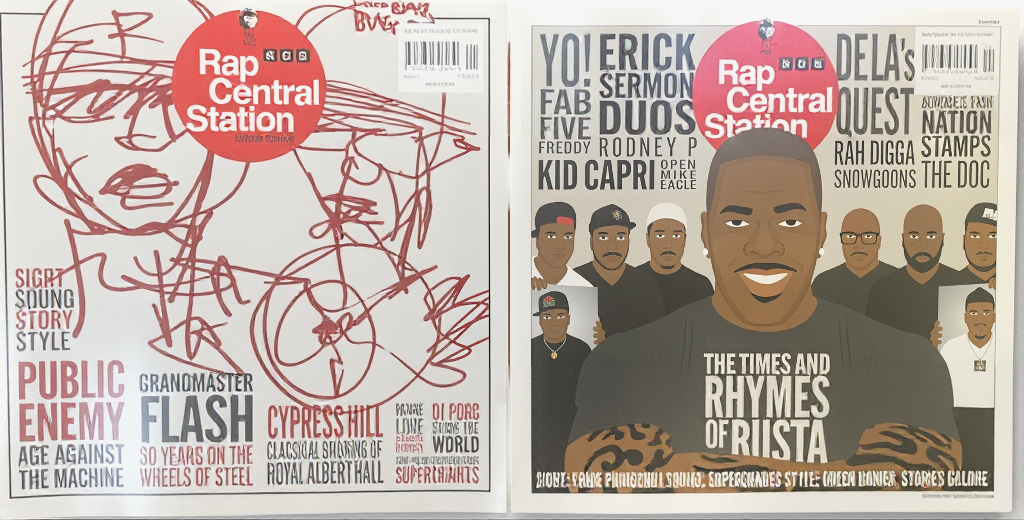
This leads me to a great editorial written by the editor of the new magazine Rap Central Station. An oversized publication measuring 12X12 inches and refers to itself as a MAGPAPER. The editor writes in the second issue of the magazine, and I quote, “Scrolling ain’t reading. Texting ain’t writing. That line hit even harder after the response to the debut issue of Rap Central Station earlier this year. What we didn’t expect – but we fully respect – is how fast the magazine is becoming a collector’s item. That tells us something important: people still need tangible culture. Something you can hold. Something that doesn’t disappear with a swipe.”
The editor continues, “I’m not gonna front I h’ve been inspired with stories of 2 fledgling magazine publishers from 75 years ago. John Johnson with JET EBONY and Hugh Hefner from Playboy. Both ironically from Chicago. They had visions against insurmountable odds.”
So, what is this magazine that was inspired by two of our great magazine publishers of the last century. The editor writes, “We are an art magazine first. Then artist – driven storytelling. Then music—charted with intention. We believe artists should write their own reviews. Nobody listens harder than the creator. That’s the innovation. That’s how you reverse some of the damage done to hip-hop by speed, neglect, and surface-level coverage. This magazine slows the culture down—so it can breathe again.”
And all what Mr. Magazine™ can say to that is Amen! Let’s slow the culture down a bit, so we can all breathe again.
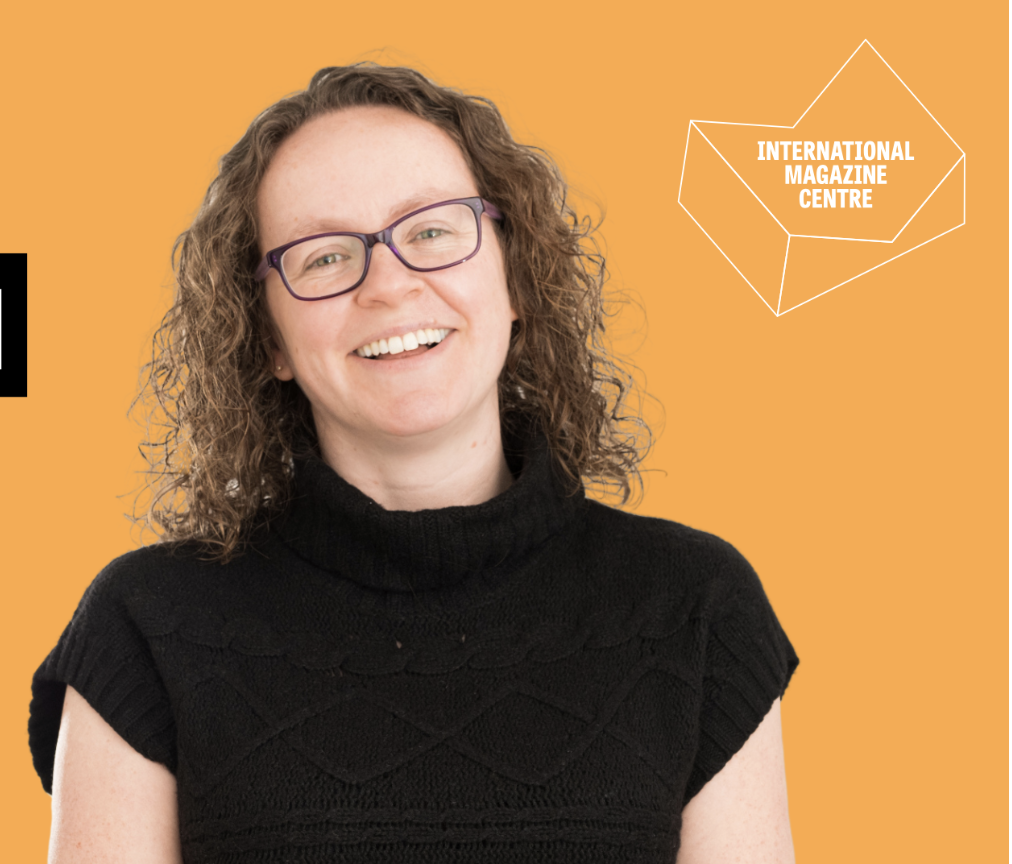
Nikki Simpson is on a “one woman’s adventure” to help and support independent magazines worldwide. Nikki sees the future of magazines in those independent titles that are being published worldwide on “a daily basis.”
She founded the International Magazine Center specifically for that purpose. She writes about the Center, “My baby is the International Magazine Center – a membership organization supporting independent publishers and freelancers working in magazines. We focus on teams between 1 and 10 people, most of which are owner-run.”
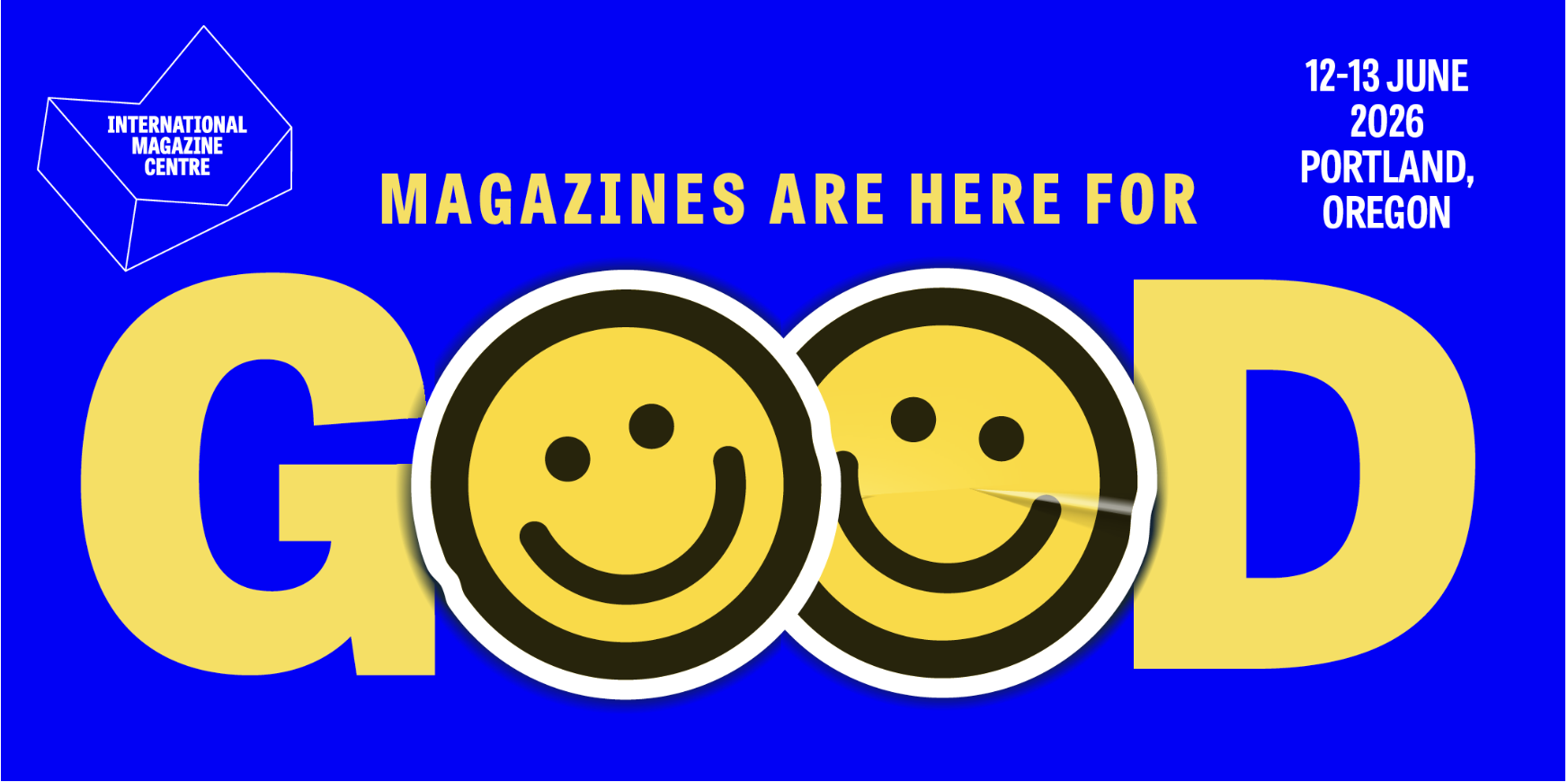
For the first time since establishing the Center, Nikki is bringing her workshops to the United States on June 12 and 13. Titled “Magazine Are Here For Good,” the conference will take place in Portland, Oregon, and will run workshops on circulation, membership and publishing among other subjects.
I reached out to Nikki via Zoom and asked her about the International Magazine Center, and the Magazines Are Here For Good conference. What follows is my interview with Nikki Simpson, founder of the Internation Magazine Center in Edinburgh, Scotland.
But first, the soundbites:
On her goal with the IMC:“What I wanted to do was support independent publishers, teams of between one and ten in a company, because those were the people who were isolated and not just during the pandemic but all the time.”
On the total number of members in IMC: “We’ve got about 190 members and they’re all over the world. 80% of them I suppose are in the UK for obvious reasons but we’re expanding all the time and picking up new members in America, Canada, Australia, New Zealand and we’ve got a couple in Amsterdam.”
On why a conference in the United States: “I’ve been wanting to run an event in America for a while.”
On why Portland, Oregon: “I thought well if everything’s happening in New York then what’s happening on the other side of town? And so Portland seemed like a good place…”
On the role of digital in magazine publishing: “I always feel digital publishing is the add-on, it’s the way that people can access information if they can’t afford to pay for the (magazine).”
On her hopes for the Magazine Are Here For Good conference: “To meet people who are working in publishing basically.”
On what keeps her up at night: “Falling asleep on the couch usually trying desperately to do the hard sudoku and just getting nowhere. I’m getting pretty good at sleeping…”
And now for the lightly edited interview with Nikki Simpson, founder of the International Magazine Center in Edinburgh, Scottland.
Samir Husni: My first question to you, tell me a little bit about this whole one woman’s adventure creating an International Magazine Center.
Nikki Simpson: Yeah, I love the way you put that one woman’s adventure. I suppose that’s exactly what it is really.
I used to work for a magazine publisher years ago and that’s where I fell in love with magazines. Then I went to work for PPA, which is the National Association for Magazine Publishers in the UK, and I was there for about four and a half years. I had a great time but there were elements of it that I found difficult, and I wanted to run my own thing, but didn’t feel that I could. Then I had a kid. He’s nine now, so I had him and when I came back, I just thought I really want to work for myself because if something’s going to drag me away from my son in this moment, my little baby, then it needs to be something that I really love.
But while I’d been at PPA I had this idea to open a physical building dedicated to magazines and that was what the original idea was. We were kind of trying to think about ways to attract people to come and live and work in Scotland and work in magazines obviously. When I left PPA and I had my child, I came back and thought I want to really spend time on that and see what comes of it. It is not a physical building in any way at all apart from this office that I’m sitting in, but what’s come of it is an international membership for magazine publishers. When I first started that, like the first two years, I couldn’t really quite find my niche because I was still talking to all the PPA members I knew in Scotland and nobody was used to communicating by video so it was difficult to run events internationally and then of course the pandemic hit and that’s when everything changed for me.
I realized that what I wanted to do was support independent publishers, teams of between one and ten in a company, because those were the people who were isolated and not just during the pandemic but all the time. I had people coming to me who had been publishing for five, ten years and say, “do you know any other publishers” and I’m like “oh yeah I know a few.” They thought they were the anomaly, they thought they were the one crazy person in town. So, now we’ve got about 190 members and they’re all over the world. 80% of them I suppose are in the UK for obvious reasons but we’re expanding all the time and picking up new members in America, Canada, Australia, New Zealand and we’ve got a couple in Amsterdam and it’s just basically where I spend my time is where we tend to be able to pick up members and I love it.
Samir Husni: I see that you are coming to the States and you are doing the first conference or workshop in Portland, Oregon June 12 and 13. Why Portland and why did you decide to start with the States as your first international venture?
Nikki Simpson: That’s a good question. I think specifically Portland because I’ve been having conversations with a friend called Megan, Megan Schertler, I don’t know if you know her, she does a blog called In Real Life Media and she’s a massive print advocate, runs her own consultancy and so on.
Anyway, I’ve been talking to her a lot about events in the US and how most of them were happening in New York. She’d just been involved with a New York event, Mag Culture were running annual events in New York, and I knew of course that being New York there’s going to be hundreds of events going on full stop. The way I approach things in Scotland is I run maybe one event in London a year because everything happens in London in the UK.
So, for me it’s much nicer to run things locally in either Scotland or we run a regular Manchester event as well. I felt the same way about America. I thought well if everything’s happening in New York then what’s happening on the other side of town? And so Portland seemed like a good place, Megan introduced me to somebody who runs a magazine shop there and it looked like there was lots of great independent titles in the area. Then I heard that Broccoli was based in Portland and then one of my members, it turns out, Kitchen Table magazine, they’re in Portland as well. I thought well this is brilliant, all signs lead to Portland.
And then why the US in general? I don’t know, I’ve been wanting to run an event in America for a while. I think, I mean interestingly I’ve been speaking to quite a few people about this and they kind of said why are you coming to America now? This feels like not the best time for it and I kind of feel like well maybe, but if you know if everybody feels that way then maybe I should go against the grain a little bit and go well maybe what people need now is support right and that’s my job is to support independent publishers so why would I, why would I steer clear of that when something bad’s happening you know or something is controversial is happening depending on which way you look at things. I would much rather come and say well, I’m here to help and support you if you want it.
Samir Husni: You say magazines are here for good, I say we are going to have magazines as long as we have human beings.
Nikki Simpson: Yes, I am absolutely 100% on the same page with you on that. One the independent titles specifically are having a bit of a moment now, but I feel like that moment has been building for so long.
When I first started working in magazines, I’ve been working in magazines for about four or five years by that point, and I remember we did this exhibition on magazine publishing, and it was curated by Jeremy Leslie at Mag Culture. It was a fabulous exhibition and it was all these amazing new titles but I mean you could have chosen another 50 different titles, it was just those ones that he happened to choose and so I feel like that was when people really started to go oh okay there’s an alternative to mass media and there’s an alternative to the rhetoric around mass media and print is dying and so on. I just can’t bear that sentence, print is dead, print is dying, I’m like really, really, do you want to meet some of my members?
Samir Husni: My definition of what a magazine is, “if it’s not income paper it’s not a magazine.” We never called television, radio with pictures, we called it television, why can’t we call those digital platforms some name besides magazine?
Nikki Simpson: Another name for it, that’s a good question.
I’ve got a friend who, well one of my members and friend, up until recently she was a digital publisher only and every time she’d come to my conference she’d say to me afterwards Nikki there’s lots of digital publishers out there who are doing great things too and I’m like I’ll think about that. Now she’s just started publishing in print as well and she absolutely loves it and her readers absolutely love it as well. I always feel digital publishing is the add-on, it’s the way that people can access information if they can’t afford to pay for the £30 or $30 in postage. But it’s not the place where people enjoy reading, it’s not the place where people go oh happy days my digital magazine has arrived. It’s just like oh okay well I need to read it, or I should read it or I can read it because I couldn’t afford the print version or whatever but it’s not everybody’s first choice, is it?
Samir Husni: I just picked up the first two issues of a new magazine from the UK, it’s a rap magazine called Rap Central Station, it’s an oversized rap music magazine and in one of their introductions they write, “scrolling ain’t reading. Texting ain’t writing,” which is amazing. So, what are your hopes for this conference in Portland?
Nikki Simpson: To meet people who are working in publishing basically. We’ve got two workshops in the afternoon so I’m running a workshop on how to turn your magazine into a membership and then Joe Berger, a circulation consultant, is running a circulation health check for people. So, people can come along with their magazines and talk about their circulation.
Then we’ve got an evening social event where we’ve got Anja Charbonneau coming from Broccoli magazine and Brett Warnock from Kitchen Table magazine and the whole event is being sponsored by Neesh who are the company that are connecting publishers direct to retailers as opposed to going through a distributor so they’re going to be talking as well and then the following day on Saturday we’ve got a how to launch a magazine workshop for people who aren’t really actually working in magazines at the moment but who want to.
The idea is just to meet new publishers and to help support people. I’ve never been to Portland. In fact, I’ve never been to America so I’m excited to meet new people and to find new ways and approaches of publishing.
Samir Husni: before I ask my typical last questions, is there anything I failed to ask you about the International Magazine Center and about the Magazines Are Here For Good conference?
Nikki Simpson: That’s a big question. As for the Magazines Are Here For Good conference, anybody that’s coming just don’t forget to bring your magazines. For the International Magazine Center, we run a whole series of training courses and events now. I counted it up the other day I’m running 57 events this year albeit three of them are recurring events but 57 events and they’re all tailored for independent publishers. What else can you say? It’s a welcoming community I’m very non-hierarchical a lot of the events that I run are more about peer-to-peer learning.
Our conference is like the people that I invite to come and speak at it are a real range of people so we have people who aren’t even in the market yet, like they’re still students and they’ve maybe you know produced a magazine as a part of their course right through to you know CEOs of major companies, so we try to really cover the spectrum there and I think that’s really important to for people to feel recognized it’s when you have that focus of teams of one and ten people. Huge problems come from that, usually through lack of confidence , so like the majority of my members are teams of one and two people in a team, or you get one person and then they work with three or four freelancers, which means that they’re not sure about whether they’re doing things correctly or where to focus their attention because they’re doing absolutely everything in their business.
You get that kind of moment of inertia when you have too many decisions to make, so it’s difficult for them to move their businesses. That’s something that we help with.
Samir Husni: My two typical last questions are personal questions: If I come to visit Nikki one evening unannounced what do I catch her doing, reading, cooking, taking care of her child?
Nikki Simpson: Now gardening. We’ve got a big garden, and we stuck our garden through Chat GPT and we’re in the middle of building a dry-stone wall and then putting down you know making it split level and all this kind of thing. I do a lot of swimming in my spare time I go to two different swimming classes now a week and I just want to work my way up to be able to do long distance sea swimming. That’s what I’m aiming for or even just a bit of scuba diving that would be nice.
Samir Husni: My final question is what keeps you up at night?
Nikki Simpson: Falling asleep on the couch usually trying desperately to do the hard sudoku and just getting nowhere. I’m getting pretty good at sleeping, what tends to keep me up I often work late so that I can communicate with people over time zones but I think what keeps me awake at night is when I haven’t worked out in my head what the worst case scenario is because once I’ve discovered what the worst case scenario is, I can go okay, and so that will look like what it looks and that’s okay.
But if I haven’t done that yet, I’m going oh my god it needs 300 people to come to my event and how am I going to get them, that kind of a hamster wheel in my head.
Samir Husni: Thank you and good luck on your Magazines Are Here For Good conference June 12 and 13 in Portland, Oregon.
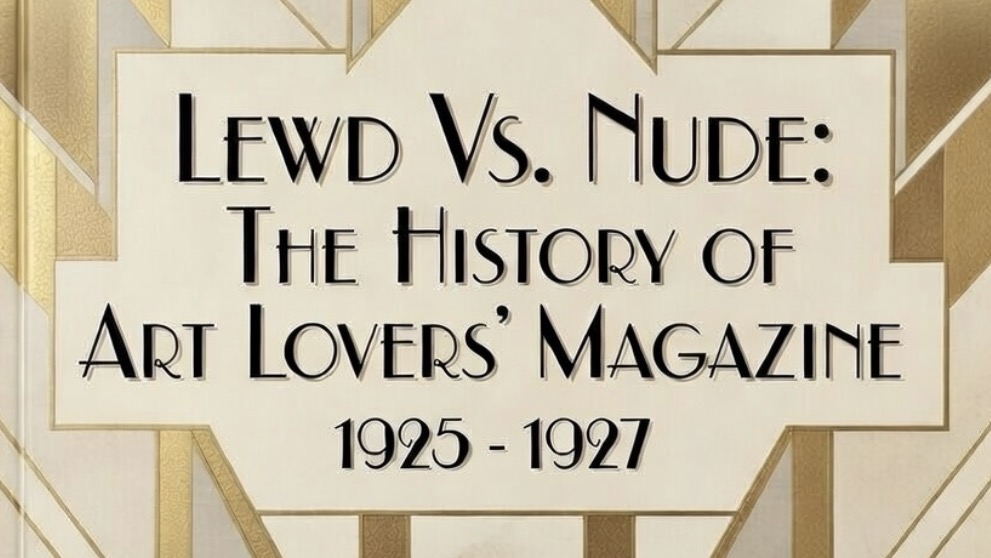
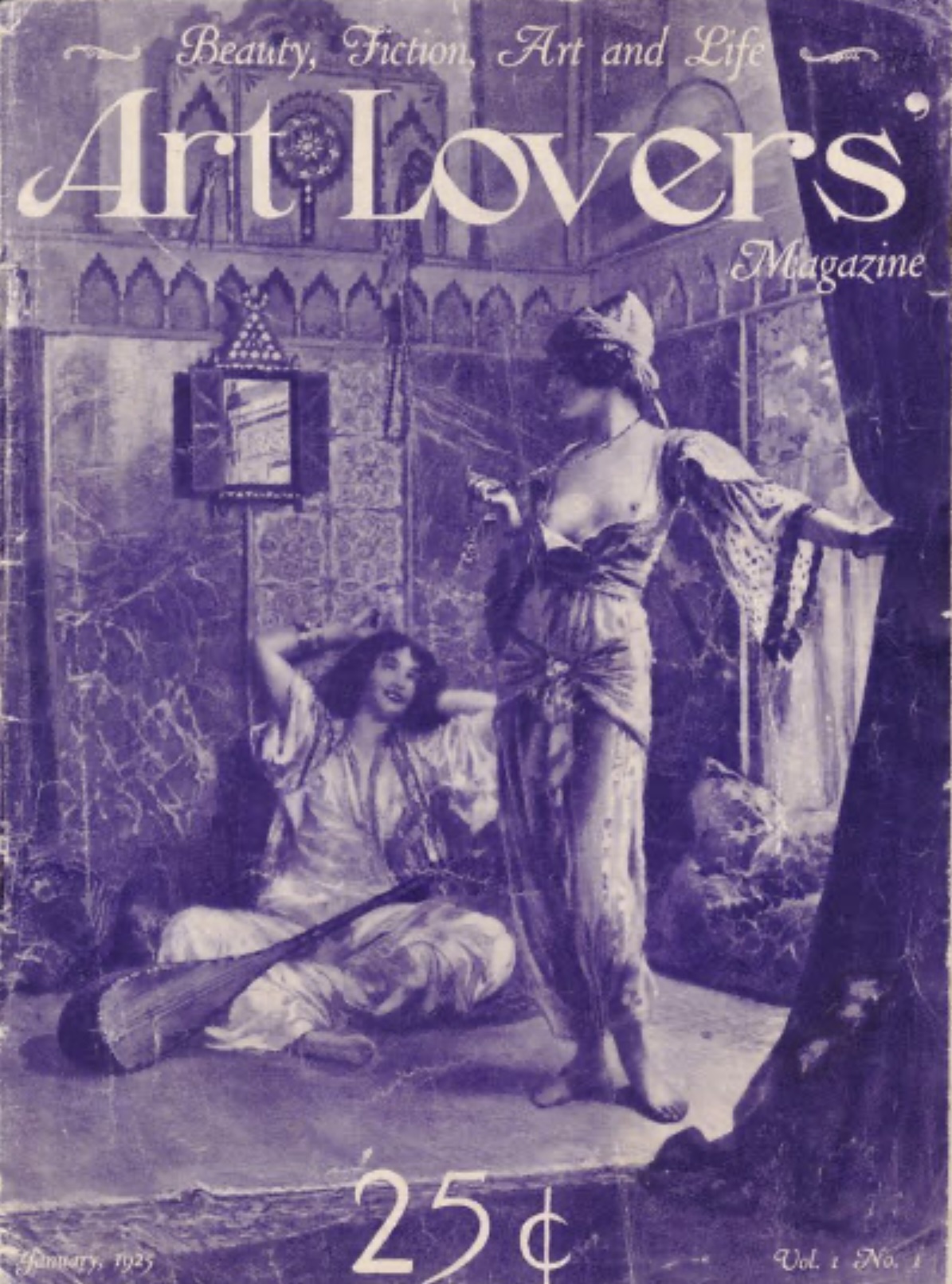
A century ago, we were more culturally and artistically advanced. Magazines in the 1920s shined a very bright light on art and culture. One such magazine, albeit short lived, Art Lovers’ Magazine, is but one example of a cultural and artistic publication from 100 years ago when magazines ruled the media world. Here is its story:
The Audience
In case you are wondering how many artists and art students were there in the 1920s to support and sustain these magazines, the answer is simple: E.B. Hesser wrote in the first issue of ARTS MONTHLY PICTORIAL, “To the laymen, it is surprising how many people need this magazine in their daily word. Without exaggeration, we can point to the following figures: 24,000 photographers, 15,000 commercial artists, including theater lobby artists, 20,000 teachers of art in high and elementary schools, 3,000 advertising experts, 350 editorial and make up men on rotogravure sections of newspapers…”
He added, “All these in addition to thousands of advanced art students, and artists who are “live” enough to keep abreast of the newest compositional ideas. So it is easy to see that this magazine has a decided and distinct field to cover.”
Hesser was quick to add, “It should be regarded primarily as an art trade publication, but it is so edited that nothing therein should be offensive to a clean minded laymen.”
And Hesser was not alone defining his audience. MODERN ART AND STORIES identified itself as “A magazine devoted to the inspiration and technical development of the Graphic Arts. Published for the use of Artists and Art Students, not the general public.”
The same can be said about Paris Art magazine; “With this issue PARIS ART is introduced to art and camera students and all who are interested in the development of modern art.”
One has to wonder if the fact that those magazines are not aimed at the general public, with less than 65,000 possible population according to Hesser’s number, was just a ploy to avoid the troubles with the vice societies, the United States Postal Service, and The New York Daily newspaper that launched a crusade “to eliminate the art magazines from the newstands (sic) resulted in a tremendous increase of the sales of these magazines should prove that the majority of our readers look upon these magazines as a means toward aiding themselves,” wrote the editors of Art & Beauty magazine in that same issue of April 1927.
However, the leading organization that was after the art magazines and other publications they considered immoral was the New York Society for the Suppression of Vice.
The New York Society for the Suppression of Vice
In the 1920s there was a non-governmental agency by the name of The New York Society for the Suppression of Vice. The society was founded in 1873 to enforce laws for the “suppression of trade in and circulation of obscene literature, and illustrations, advertisements, and articles of indecent and immoral use, as it is or may be forbidden by the laws of the State of New York or of the United States.”
The society was a direct dissentient of the Young Men’s Christian Association and was spearheaded by Anthony Comstock, who served as the secretary of the society and as well as an agent and inspector for both the Society and the United States Postal Service. (nyhistory.org)
Upon Mr. Comstock death in 1915, John S. Sumner succeeded him in the role of secretary and an agent and inspector for both the Society and the United States Postal Service.
This society was chartered by the New York state legislature, “which granted its agents the powers of search, seizure, and arrest, and awarded the society half of all fines levied in resulting cases.” Encyclopedia of Censorship, New York: Facts on File, 2005. Page 522.
One documented case on how this Society acted in New York City in the 1920s can be found in a one page editorial that Samuel Roth wrote in the March 1927 issue of Beau magazine. Under the heading “MR. SUMNER and BEAU” Samuel Roth, the editor and publisher of the man’s magazine wrote, “Thursday morning, January 27th of this year, I received word from the organization which nurses the sales of TWO WORLDS MONTHLY (Roth’s other magazine) and BEAU nationally that the February issues of these periodicals, which had already been shipped out to all points domestic and foreign, would not be distributed for sale upon the news stands (sic) of New York City.”
“Upon inquiry, I learned that Mr. John Sumner, secretary of that charming body of people known as the New York Society for the Suppression of Vice, had communicated with the local distributing agency, and had informed it that if certain advance information concerning the impending numbers of TWO WORLDS MONTHIY and BEAU was accurate he would take immediate action against any company that would dare to distribute them in New York City. The local agency had the alternative to refuse to distribute, which it did.”
Mr. Roth, with his lawyer, went to meet with Mr. Sumner. He brought with him copies of the magazines that he found out that Mr. Sumner have not seen or read. Mr. Roth told Mr. Sumner that the two magazines “are written and published for the sophisticated only, that neither by lewd pictures or lewd contents do we make appeal to the baser passions of mankind.”
Mr. Sumner promised Mr. Roth to look at the magazines overnight and would render a decision in the morning. “Came the dawn– and” Mr. Roth wrote, “confident and carefree, I went to see Mr. Sumner who very speedily dissipated my peace of mind. TWO WORLDS MONTHLY was quite alright, he said, and we could go ahead distributing it immediately, but BEAU, ah, that was a different story. It was absolutely unthinkable to let BEAU go out on the harmless news stands dripping with nudes which any little boy may purchase for fifteen cents. No, he did not approve BEAU and if I dared to issue it of my own accord he would unfailingly prosecute me.”
It’s that very fragile line that separates nudity from lewdity that the art magazines had to maneuver their way with the Society and the United States Postal Service. That is the main reason the art magazines of the 1920s continued to emphasize that they are not for general public, but rather for artists and art students.
In the words of E. B. Hesser, the founder of ARTS Monthly Pictorial, he wrote, “The Magazine of Pictures for Artists and Art Students.” He added that the magazine “should be regarded primarily as an art trade publication, but it is so edited that nothing therein should be offensive to a clean minded layman.”
Unlike the rest of the art magazines, a new magazine appeared on the newsstands in January of 1925 with the name Art Lovers’ vowing to be completely different than the rest of the publications, yet it did not escape the wrath of Mr. Sumner of the New York Society for the Suppression of Vice. What follows is its story.
The first issue of Art Lovers’ magazine January 1925
A century ago, we were more culturally and artistically advanced. Magazines in the 1920s shined a very bright light on art and culture. One such magazine, albeit short lived, Art Lovers’ Magazine, is but one example of a cultural and artistic publication from 100 years ago when magazines ruled the media world. Here is its story:
Bringing God as the Defense Attorney
Under the headline “Tolerance” the editorial of Art Studio Life’s April 1926 stated, “In the Art field more than in any other may we find a wealth of beauty and inspiration that will soften life for everyone. WE do not claim that everything perpetrated in the name of Art is beautiful, but we do claim that nothing in true art can possibly offend any but those who, having tainted minds and questionable morals themselves, seek to smear the world with their personal tar of iniquity.”
The editorial concluded by stating, “They launch their attacks against all. In the name of religion, they seek to cover themselves by persecuting lovers of beauty. They purposely lose track of the fact that the greatest figure in history of the world was the incarnation of Tolerance, Christ. They seek to reform His world and His children, contrary to His Will.”
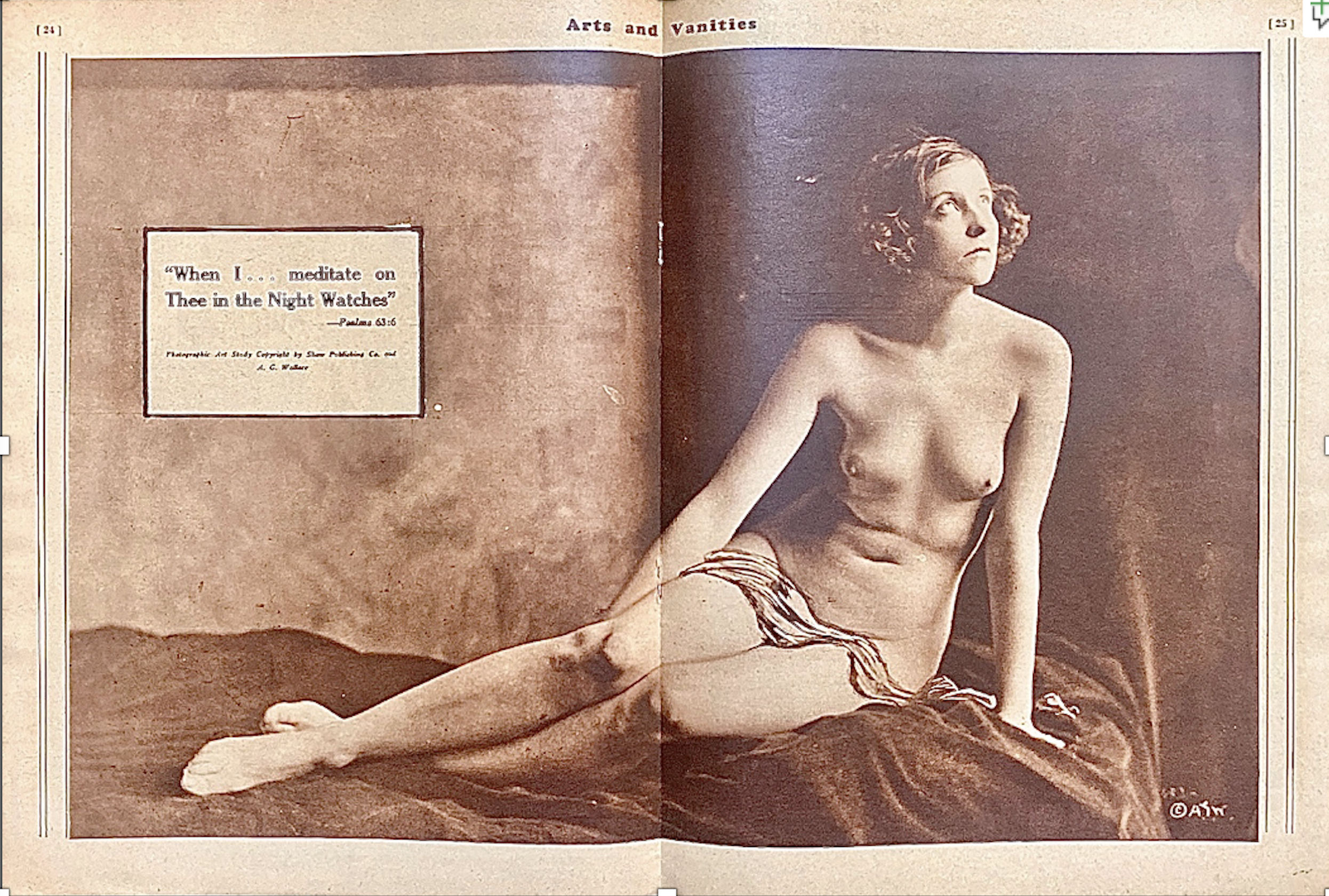
In another magazine, Art and Vanities, the editors didn’t stop at the necessity of nudity to the artist, but they went one step further bringing God into the equation of art and nudity. In the September 17, 1926 issue of Arts and Vanities, the editors wrote “In order to create beautiful statuary, soul stirring canvases, and monumental works, he must grasp the significance of each line in the human body. To him the human form spells perfection. No one can improve on the works of our Creator. We do not try. We seek only to understand and appreciate what he has given us in order that our lives and our hopes and aspirations may reach upward to the source of all good.”
And here is that powerful conclusion that sets the stage for all the nude art magazines of 1920s, “God was the first artist, he created plants, trees, animals, birds, and last but most beautiful, he created woman to adorn the universe. Man in order to elevate the ideals of his brother man endeavors to interpret these works for the Master. May we always do our share to help the artists in their struggle for the highest and most idealistic interpretations of Nature.”
In fact, Arts and Vanities went as far as placing a bible verse on its center spread of the October 17, 1926 issue that was displaying a picture of a half-naked woman. (Yes, there were centerfolds before Hugh Hefner’s Playboy of the 1950s, the only difference they were only one spread).
Arts and Vanities was not the only magazine using God as its defense attorney, Art and Life was doing the same. Art and Life’s motto was The Body Beautiful, The Mind Intellectual, and The Soul Intuitional. The editor wrote in the November 1925 issue, “This magazine stands consistently for the above program (their moto above). That the body may be beautiful it must be healthy, athletic, vibrant with life and action. The editor of this magazine believes that the nude body is inherently decent, the noblest work of the Creator, and those who look upon it as indecent, and to be hid from sight, have indecent minds; that nudeness and lewdness are in no way synonymous terms.”
In fact, earlier in the year, Art and Life magazine, raised the same topic in its July 1925 issue. In an editorial written by the magazine’s editor Guy Lockwood under the title “Concerning The Nude. What Is All The Fuss About?” He wrote “While we have strenuously defended the nude body as the highest work not only of art, but of the Creator, as well yet we are no more in favor of lewdness and real indecency than are those who are behind the movement to rid the news stands of objectionable publications.”
Lockwood added, “Real art magazines have endeavored to supply real needs in the line of figure study by publishing studies of the human body that give a knowledge of basic form and structure, proportions and action. These photographs or drawings, as the case may be, have necessarily often been nude, and Art and Life Magazine has published this kind of photographs and drawings, believing that in doing so this magazine was rendering a valuable assistance to real art advancement.”
Keep in mind that the aforementioned magazines were all in line with the tag line of Hesser’s magazine Arts Monthly Pictorial, “The Magazine of Pictures for Artists and Art Students.” A lot of these magazines did not accept subscriptions, “but Art Clubs or similar organizations may order twelve copies or more shipped by express each month, to be used for instructional purposes,” stated the masthead in ARTS Monthly Pictorial. Those art clubs and the newsstands were the major outlets of the art magazines of the 1920s.