Archive for the ‘Innovation in print’ Category

h1

Nifty At Fifty: The Never-Aging, Always-Rocking Cosmopolitan Magazine. The Mr. Magazine™ Interview With Donna Kalajian Lagani, Senior Vice President, Publishing Director & Chief Revenue Officer, Cosmopolitan…

March 5, 2015

“The whole idea of this one-to-one; she (Helen Gurley Brown) used to say that she wanted to have a one-to-one conversation with millions of women at the same time. So that whole idea of community, which is now what everyone is talking about, that’s something that Cosmo has always had. We’ve always said that we were the first interactive medium. Before there was an internet, there was Cosmo.” Donna Kalajian Lagani

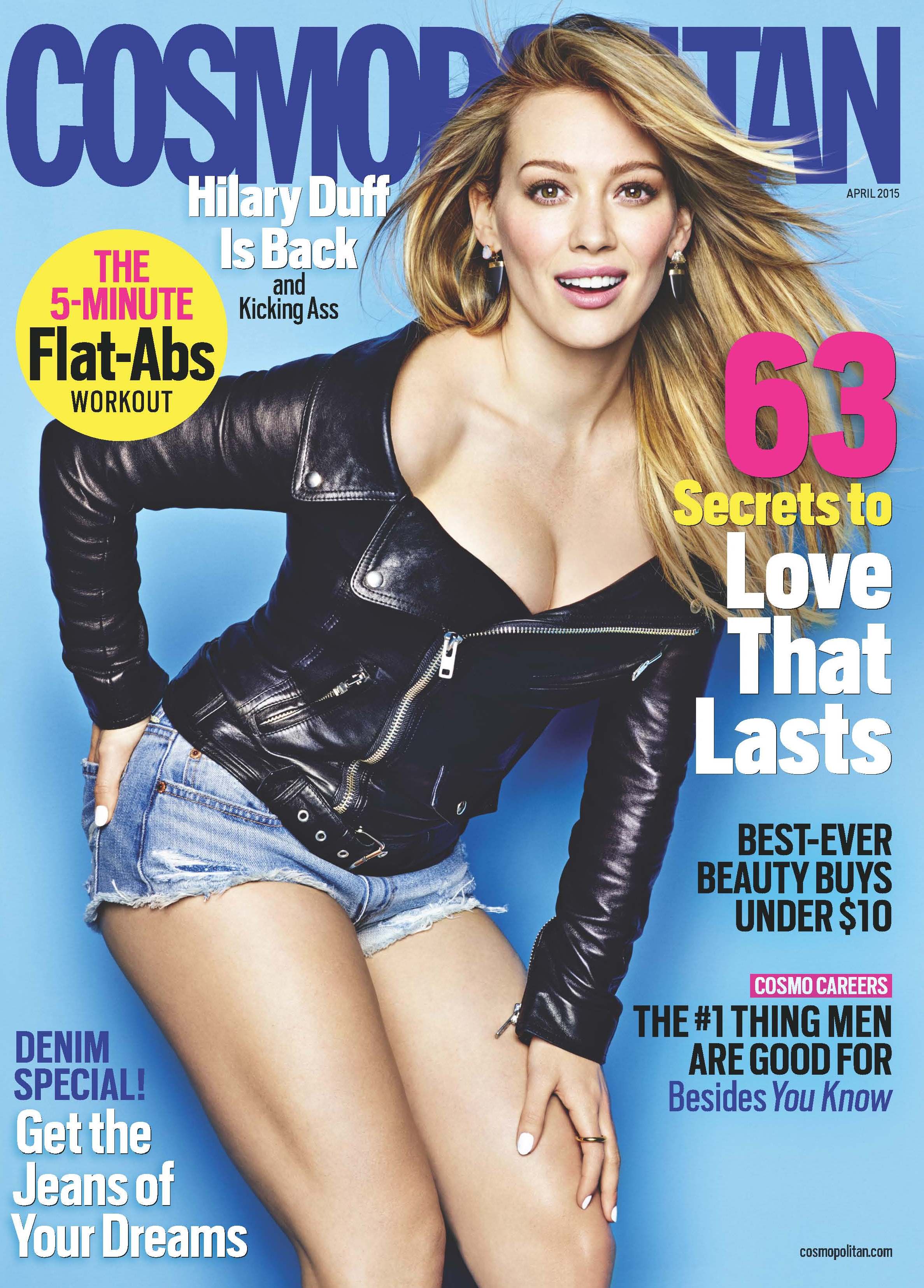
Cosmo April '14 Cover Addictive content, beautiful models that articulate style and fashion to readers, and a core concept created by the woman who started it all – Helen Gurley Brown – that is based on relationships and the ability to openly discuss every aspect of the male-female, family-to-family connection. That is the definition of success; that is Cosmopolitan.

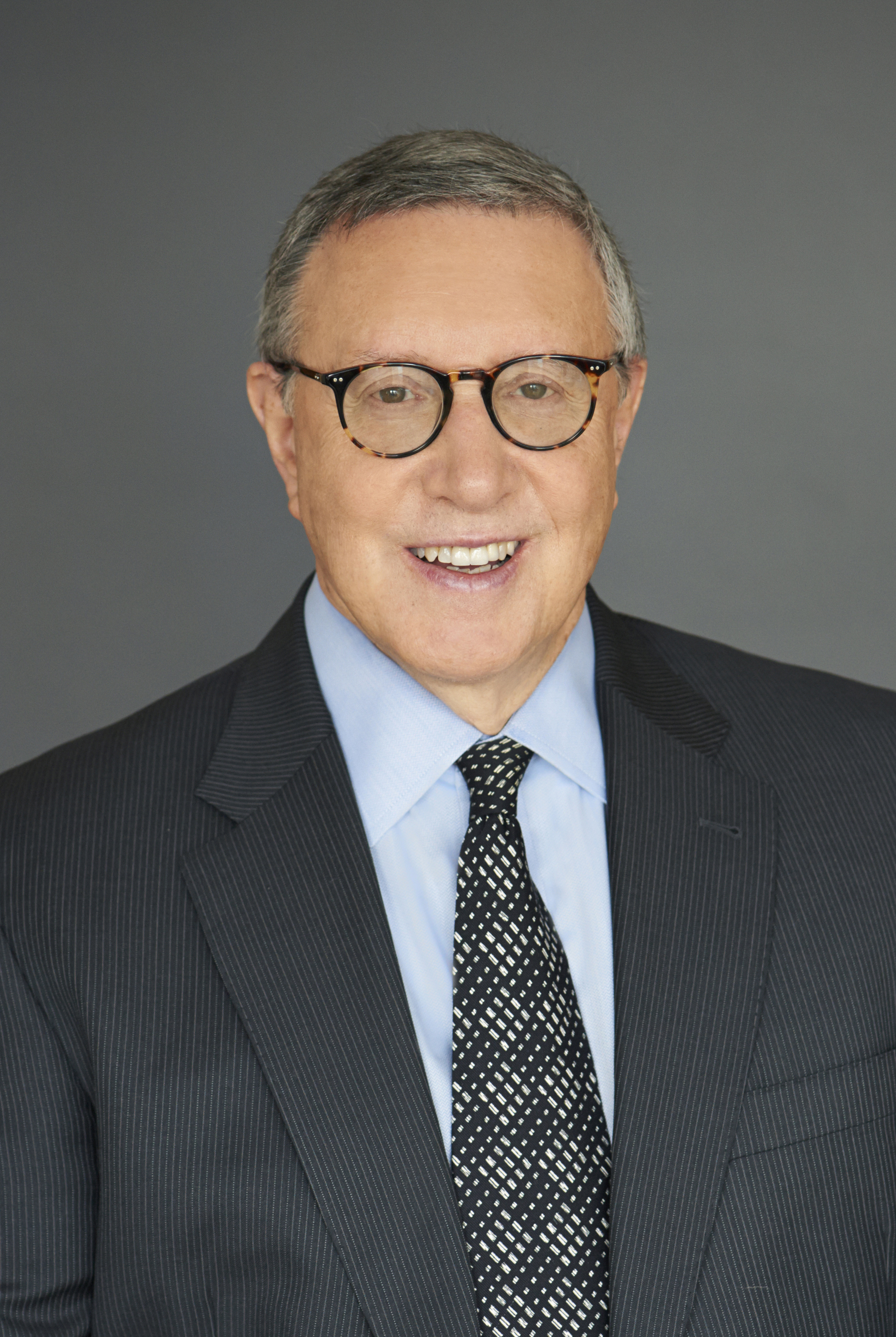
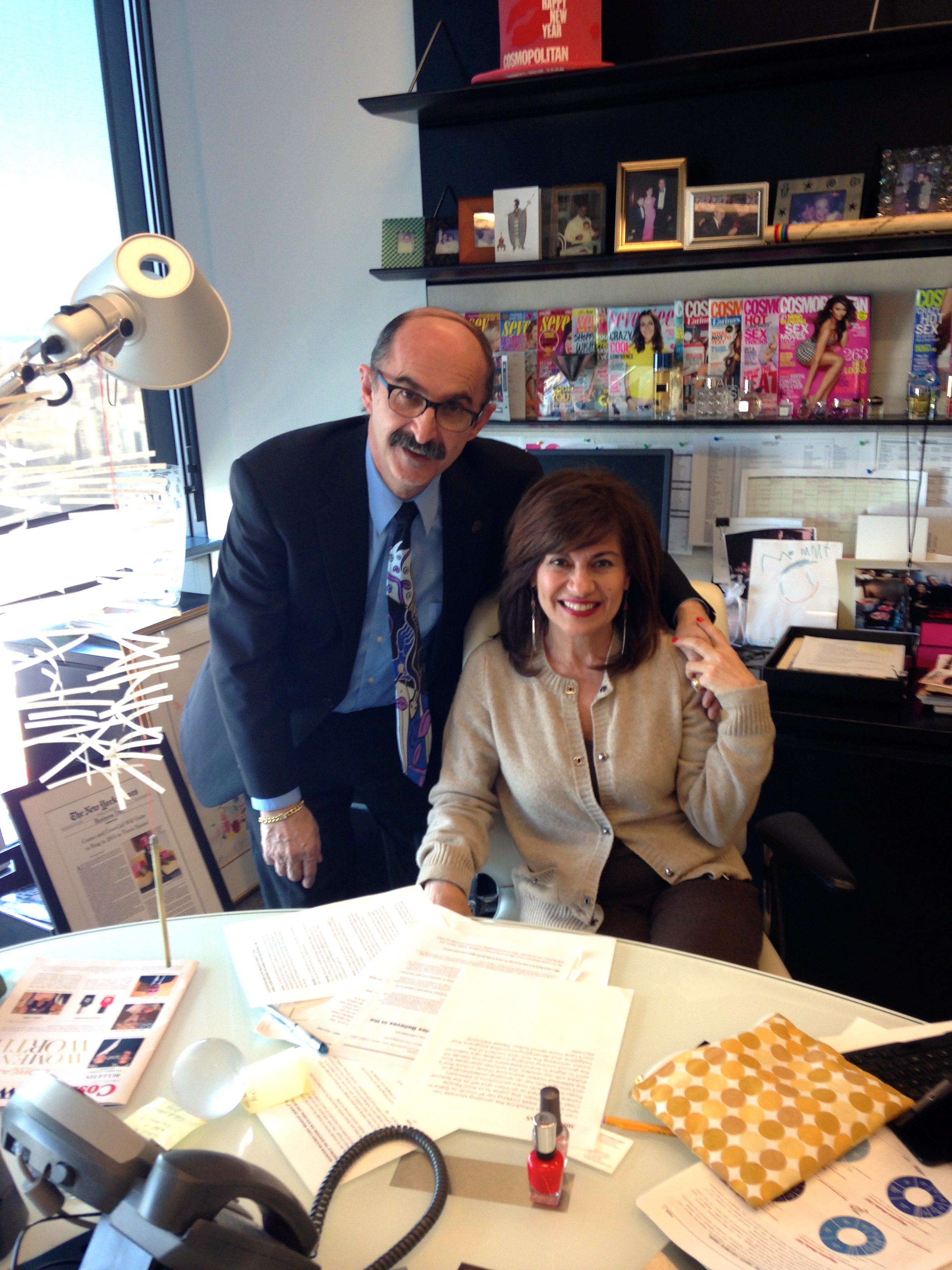
Recently, I was in New York and had the chance to speak with Donna Kalajian Lagani, Senior Vice President, Publishing Director and Chief Revenue Officer of Cosmopolitan. Donna is an open, friendly and totally animated person who welcomed me in her office on the 38th floor of the Hearst Tower. She shared her thoughts on Cosmo’s upcoming 50th birthday and its past and, more importantly, the brand’s future.

We talked about what it takes to keep a magazine fresh and successful with its readers after 50 years on the newsstands and how the brand is pivotal in its presentation, in terms of its digital/print relationship. The conversation was lively, fun, and totally a joy to participate in. I hope you have as much enjoyment reading it as I did visiting with the inimitable Ms. Lagani. Cosmopolitan is a world filled with beauty, fashion and advice that you might not necessarily get from your mother, but you’d definitely get from your best friend.

But first the sound-bites…

Sound-bites:

donna1 On the secret ingredient that continues to make Cosmopolitan click, tick and stick with its audience: I think it’s that we understand in this country and all around the world, one of the most important things to women is to talk about their relationships. Relationships with their family, boyfriends and their girlfriends; and if you look at any pop culture today, any television shows or movies; it all comes back to the relationships.

On Cosmopolitan’s sense of community that has been going strong for 50 years: You brought up something great when you talked about Helen; the whole idea of this one-to-one; she used to say that she wanted to have a one-to-one conversation with millions of women at the same time. So that whole idea of community, which is now what everyone is talking about, that’s something that Cosmo has always had. We’ve always said that we were the first interactive medium. Before there was an internet, there was Cosmo.

On whether the brand would exist without the print component: Sure, I think the community would exist. Of course it would. It would be a different community and certainly shaped differently. But the magazine isn’t going anywhere. I like to say when the earth is over there will be cockroaches and there will be Cosmo. We are an enduring brand through thick and thin.

On the major stumbling block the magazine faces today and how she plans to overcome it: What we often hear from advertisers is digital, digital, digital. I think one of the stumbling blocks is that younger marketers coming up in the business are being brought up by digital media. That’s what they know the best and that’s what they’re the most comfortable with. And we just need to be sure that we continue to educate them and have them understand that when someone crawls into bed at night or boards a plane or goes to the beach, and they’re reading a magazine, there is something very close and intimate about that.

On why she believes Hearst never stopped investing or believing in their print product: It’s that the consumer demand was and is still there. As long as we have 17 million women every month who are reading Cosmo; that’s really powerful. So, why shouldn’t we invest in something that consumers are showing incredible demand for? And innovation is just part of what we always do.

On how she combats the stereotype of sex-only that the magazine seems to have cultivated: I think that stereotype comes from people who don’t read the magazine; that may be their perception and we know that perceptions are very difficult to overcome. But what we have to do is to show people what we’re actually doing.

On her most pleasant moment over the last 20 years at Cosmo: Maybe because it has just happened, but I would have to say standing up on the stage in Times Square and looking 360° around and seeing Cosmo everywhere put a shiver up my spine and tears in my eyes.

On what keeps her up at night: Just thinking about all the fun and exciting new things that we can continue to do with the brand. What’s next and what’s new?

And now the lightly edited transcript of the Mr. Magazine™ conversation with Donna Kalajian Lagani, Senior Vice President, Publishing Director and Chief Revenue Officer of Cosmopolitan.

Samir Husni: You have a brand that’s 50 years old, yet it’s still going as strong as ever. What’s the secret ingredient that makes Cosmopolitan continue to click, tick and stick with its audience?

Donna Kalajian Lagani: I think it’s that we understand in this country and all around the world, one of the most important things to women is to talk about their relationships. Relationships with their family, boyfriends and their girlfriends; and if you look at any pop culture today, any television shows or movies; it all comes back to the relationships. And that’s what differentiates Cosmo from any other women’s media brand that’s out there. We really understand that relationships are the heart and core of everything.

If you’ve been around for 50 years that also means that you have had to adapt, change and stay very modern. And I would say Helen Gurley Brown, of course, who was the founder of our brand and the long-time, four-decade editor set the standard. Three years ago when Joanna Coles, our editor-in-chief, came over, she elevated everything about the brand. She kept the heart and the core and the DNA of Cosmopolitan the same as Helen had it, which was important. And remember when Helen launched our magazine, she was at the beginning of the women’s movement, the beginning of the sexual revolution and believed that women could have it all, believed that our mission as a brand was to empower women to have whatever they wanted.

Joanna comes onboard three years ago; she dusts off the original mission and brings back the original DNA of our brand to be all about empowerment. And she’s brought smarter voices into the magazine; she’s just elevated everything. So, on one hand, we’re 50 years old and on the other, we change every moment. The photographers, models and the stylists; everything has been elevated in the magazine and that has kept us really fresh.

And it’s not just about the magazine. It’s about the community of Cosmo, which is so much bigger than just the magazine. On our website; we’re up to 30 million unique visitors a month, that’s huge, and 9 million social followers.

Samir Husni: I remember a quote from Helen Gurley Brown where she was telling her husband after she published the book, Sex and the Single Girl, that she was getting all these letters and having to spend a lot of time answering them, and he asked her why she just didn’t do a magazine so that she could respond to everyone at the same time.

Donna Kalajian Lagani: That’s exactly right.

Samir Husni: So this sense of community has been going strong for 50 years. And Cosmo is still, by far, the leading selling magazine on college campuses; the second or third largest-selling monthly on the newsstands; yet you hear people in ad agencies and other places saying young women don’t read anymore. We don’t have anyone coming to us to advertise in print any longer. Why do you think there is this stereotype that’s as far from reality as you can get? Do you face those problems when you call on advertisers, telling you that young women no longer read print anymore?

donnaandsamir Donna Kalajian Lagani: We face it, but it can also be just a negotiation ploy. They’re using that as a way to negotiate with us, perhaps. But you brought up something great when you talked about Helen; the whole idea of this one-to-one; she used to say that she wanted to have a one-to-one conversation with millions of women at the same time. So that whole idea of community, which is now what everyone is talking about, that’s something that Cosmo has always had. We’ve always said that we were the first interactive medium. Before there was an internet, there was Cosmo.

So, are women reading magazines? Of course they are. We’re selling 3 million copies a month; we’re reaching 17 million women every month. But we have to do more than that; we have to be everywhere that 18 to 34-year-old is; we have to make sure that we’re intersecting with her. So when she wakes up in the morning and rolls out of bed, reaches for her phone; the first thing she wants to see is cosmo.com.

And what we’re doing now with Snapchat is very cool. We’re not supposed to be telling numbers, but I can tell you this; we guarantee 700,000 views per day and we’re over-delivering above that, 700,000 views per day of Cosmo on Snapchat. That tells us that our community has a thirst for this information, not only monthly with the magazine, but daily online and certainly daily on Snapchat.

Samir Husni: Do you think that community would exist without the print magazine?

Donna Kalajian Lagani: That’s a great question. Sure, I think the community would exist. Of course it would. It would be a different community and certainly shaped differently. But the magazine isn’t going anywhere. I like to say when the earth is over there will be cockroaches and there will be Cosmo. We are an enduring brand through thick and thin. You said it: we’re the number one best-sold magazine on college campuses and yes, we still are the best-sold magazine on the newsstands.

Samir Husni: What is the major stumbling block that you’re facing today and how do you plan on overcoming it?

Donna Kalajian Lagani: I would say what you said, what we often hear from advertisers is digital, digital, digital. I think one of the stumbling blocks is that younger marketers coming up in the business are being brought up by digital media. That’s what they know the best and that’s what they’re the most comfortable with. And we just need to be sure that we continue to educate them and have them understand that when someone crawls into bed at night or boards a plane or goes to the beach, and they’re reading a magazine, there is something very close and intimate about that, especially for beauty and fashion advertisers where it’s all about the color and seeing and touching and being able to rip out; I don’t think that’s ever going to go away, that whole tactile experience. Do you think that’ll ever go away?

Samir Husni: Oh, I agree, it never will. In fact, I’m known in the industry as the one who defines a magazine as: if it’s not ink on paper, then it’s not a magazine. I even trademarked that phrase.

Donna Kalajian Lagani: There you go; I love that. I think what we have to keep doing is showing marketers all the innovative things that can be done in our magazine that does break through.

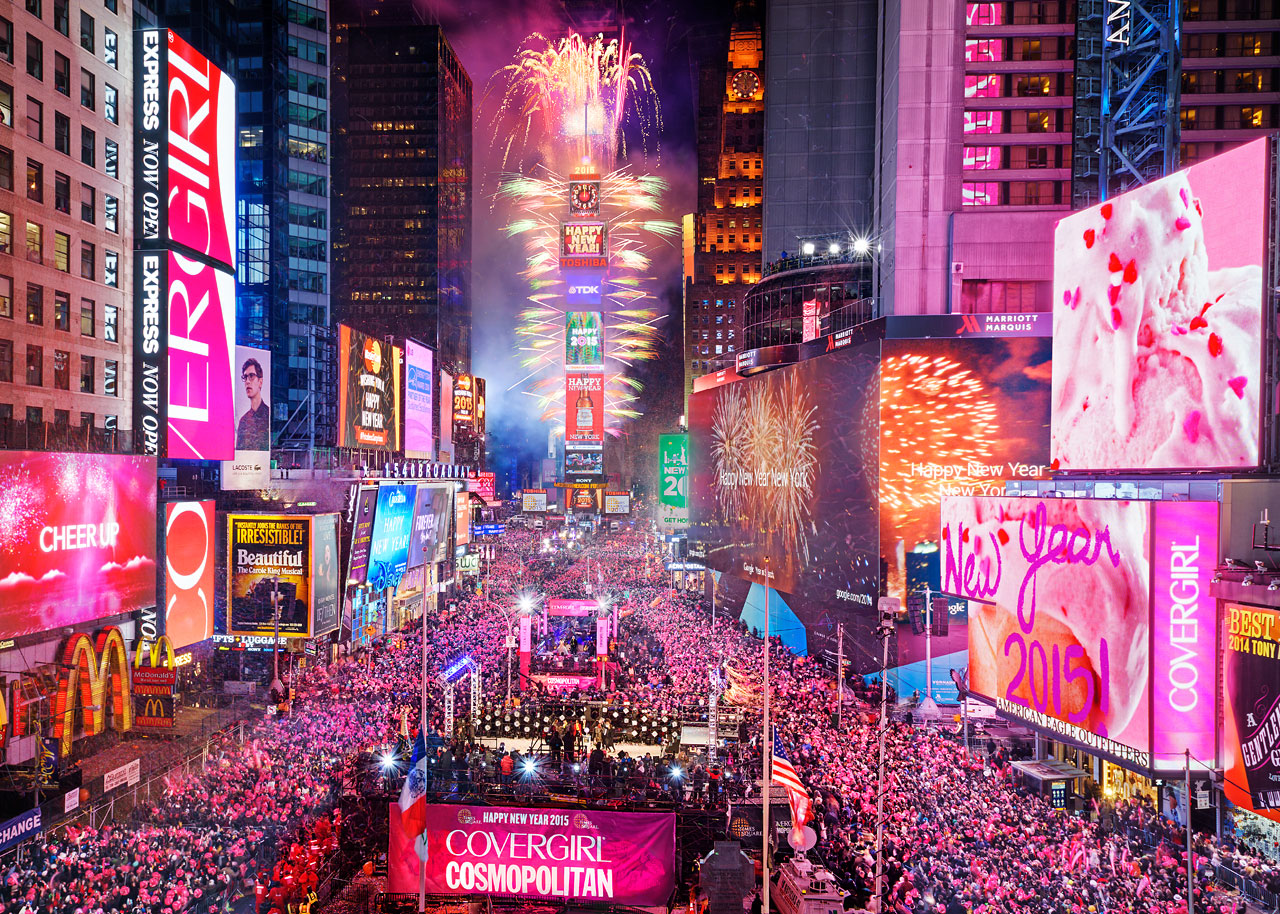
TSq15-Horizontal-ScrnSize Two things: it’s our 50th birthday, so we thought OK, we knew it was coming; it wasn’t a surprise. We planned on it and said, OK – let’s celebrate our 50th and we are Cosmo; we only know how to do things in a very big way; what could we do that would make a very big brand statement? Do you know what we did on New Year’s Eve? We went to Times Square on New Year’s Eve and we had 30,000 pink hats and balloons, we had two musical stages; everywhere you looked that night was Cosmopolitan. And every single person that I have spoken to since saw what we did on New Year’s Eve, because it was live-streamed on Cosmo.com everywhere around the world. So, that was sort of a big, big brand way to say: here we are, this is Cosmo, and we’re powerful. And everyone got that.

Then every single month this year, and there are such cool things that you can do with print; we’ve done special sections or units every month in the magazine. We did this in partnership with Cover Girl. And what we did is took their Colorlicious brand, which is their new line of lipsticks that have four different shades, we took the colors to make it really native, you’ve heard of native advertising for digital, we did native advertising for print, and we took the background of the colors of the magazine and made it into the same color family as the lipstick.

And we just did a cover peel-off where with the subscriber covers we actually take the ad and put it on the front cover of the magazine with the Cosmo logo. It’s very intrusive and it really stands out. And that’s the kind of thing that can really be done only in print.

For the March issue we did a multiple cover with Lancome. In April, and it’s not out yet; with Unilever, we developed a big section on hair. So their ad: Cosmo cover hair secrets inside, which tells the consumer to open up the magazine, and then becomes what we call a nested booklet; it’s 24 pages of content, all with advertising from Unilever brand. Then it can be removed and held onto.

Samir Husni: Why are Hearst Magazines in general and Cosmo specifically, doing a lot of this innovation in print? If you look at the paper quality of your magazines and the size; Hearst did not ignore print while running after digital. Hearst invested in print, and went after digital, providing the customer with both. Why?

Donna Kalajian Lagani: It’s that the consumer demand was and is still there. As long as we have 17 million women every month who are reading Cosmo; that’s really powerful. That’s bigger than the top-ten network television shows, in terms of a GRP. If Cosmo were a rating point in magazine brand alone; we’d be bigger than the top-ten TV shows. So, why shouldn’t we invest in something that consumers are showing incredible demand for? And innovation is just part of what we always do. That’s what makes me wake up in the morning; what am I going to do today that’s different from yesterday? And that’s what makes my job so much fun. I have so much fun at my job, if you can’t tell. (Laughs) I love my job. And part of what is so much fun about it is that I’ve been here for 20 years and I’ve never had the same job two years in a row. Every year we’re doing something different; every year we’re recreating something. And that’s what a media brand is and does; we’re this living, breathing thing that we have to keep nurturing and coming up with new things to do to keep the audience and the advertisers delighted.

Samir Husni: Give me a synopsis on a day-in-the-life of Donna.

Donna Kalajian Lagani: I wake up in the morning and roll out of bed; I look at Cosmo.com, download what I’m going to read for the day onto my tablet; I make breakfast every morning for my 17-year-old son, when he’ll let me. (Laughs) And then the day gets really busy; I spend a lot of time out of the office and with clients. I spend a lot of time ideating about all of the cool new things we could be doing with the brand and I’m out on the streets all the time with our salespeople. And that’s why I have fun.

Samir Husni: Does your 17-year-old son read Cosmo? Just so he can know the mind of the opposite sex, maybe?

Donna Kalajian Lagani: He does sometimes. But his 17-year-old girlfriend does. (Laughs)

Samir Husni: How do you feel about the fact that when most people think about Cosmo, they think about sex, when we know that there is much more to Cosmo than just sex. How do you combat such a stereotype?

Donna Kalajian Lagani: I think that when Joanna Coles came onboard and pivoted the editorial, it made that objection pretty much go away. We are reporting on Washington; we’re reporting on politics; we’re reporting on women’s health issues; we just won an ASME award last year for the excellent piece we did on contraception.

I think that stereotype comes from people who don’t read the magazine; that may be their perception and we know that perceptions are very difficult to overcome. But what we have to do is to show people what we’re actually doing. I’ve always said, and I don’t know whose quote this is, but I’ve stolen it and it’s a good one; you’re entitled to your own opinion, but you’re not entitled to your own facts. And the facts are that of course we cover relationships; sex is an important part of what we do at the magazine; it’s an important part of what all girls are about today, but the amount of beauty, fashion and journalism and health that we do exceeds that. So, those are the facts.

Samir Husni: In 2008 we were hit by a double whammy: the economy crashed and technology really came onto the scene. Do you recall how life was before 2008 and then right after?

Donna Kalajian Lagani: Oh, yes, definitely. (Laughs) Before 2008 people were marketers who spent more in advertising-to-sales in overall advertising. I think after that everyone really tightened on the amount they were doing as an advertising-to-percentage-of-sales ratio. And the internet was there, but it didn’t come up in every conversation.

But that doesn’t bother me because it’s such an important part of our brand. We love the internet; I love mobile and I love the tablet and what we’re doing on Snapchat; it’s just part of who our community is. And what’s fascinating about it is the duplication is practically nothing. The duplication between our magazine brand and our digital brand is only 3 or 4%, so that says to me that the community of Cosmo is only getting larger. And isn’t that a good thing for us at the Hearst Corporation and isn’t it a great thing for marketers too?

Samir Husni: I know that the duplication of content is very little.

Donna Kalajian Lagani: Very little.

Samir Husni: Is their audience duplication, or do you know?

Donna Kalajian Lagani: That’s what I’m saying; 3 to 4% duplication is it. So that’s why the footprint is just getting larger.

Samir Husni: Five years from now, you and I are sitting and talking about Cosmo at 55; what will you tell me?

Donna Kalajian Lagani: That it’s as beautiful and young as ever. We will continue to have a very large print footprint and probably an even larger mobile footprint.

Samir Husni: Many publishers had put a lot of odds and wagers on the iPad; on the tablet, and then five years later nothing really came from it. Now are we moving our wagers from the tablet to mobile?

Donna Kalajian Lagani: Well, I wouldn’t count the tablet out. We still have about 200,000 subscriptions that are sold – paid for. And I would suppose as the tablet increases in just the percentage of Americans who own one, that that number will probably continue to grow. Mobile is a big play. Right now, 65% of all of our traffic comes from mobile. So, girls that are reading Cosmo.com; they’re all doing it either on their mobile phone or on their tablet. It’s very important today and will probably be more important five years from now.

Samir Husni: You’ve been at Cosmo for 20 years; what has been the most pleasant moment for you? An experience that you can remember thinking: Wow!

Donna Kalajian Lagani: Maybe because it has just happened, but I would have to say standing up on the stage in Times Square and looking 360° around and seeing Cosmo everywhere put a shiver up my spine and tears in my eyes. I was literally teary-eyed thinking, oh my goodness, Helen, you’re up there in the universe looking at this great brand. It was a very proud moment for our brand. (See Times Square picture above).

Samir Husni: Anything else you’d like to add?

Donna Kalajian Lagani: We’re doing a lot of really fun stuff to celebrate 50 years; we touched on Unilever and next month in Austin, Texas, South by Southwest, for the first time, is doing something called South by Style, which is sort of the convergence of technology and fashion and Cosmopolitan is the their media partner. We have a 1,000 sq. foot space where we’ll be having incredible speakers come in and talk and it’ll be a place where women can come and listen to those great speakers and at the same time get their hair touched up and get their nails redone; just a place to unwind a little. And our sponsors for that are Intel and Cover Girl.

And in May, we’re doing two big birthday issues; why have one birthday per year, when you can have two? In that May issue we have an iconic cover; I can’t tell you who it is. But for that same issue we have a spectacular opening that’s done by L’Oreal Paris; they’re doing a butterfly gate of advertising, adjacent to a very interesting, cool cover model.

In November is our other big issue for the year and we’re going to celebrate with a heck of a party; I hope you’re in New York; you can come and hang out with us.

Samir Husni: Just send me an invite and I’ll be here. Now, my typical last question; what keeps you up at night?

Donna Kalajian Lagani: Just thinking about all the fun and exciting new things that we can continue to do with the brand. What’s next and what’s new? What’s going to delight the reader and the advertiser?

Samir Husni: Thank you.

h1

On Audience First & The Characteristics Of A Successful Magazine… An Interview With Mr. Magazine™

February 23, 2015

“We definitely live in a digital age, there is no escaping that. And as I wrote recently in my Mr. Magazine™ Manifesto for 2015, there is no media company today that can exist without being platform agnostic. However, our audience is not necessarily platform agnostic. Some of our audience still want a printed magazine, some want online only and some want a printed newspaper.” Samir “Mr. Magazine™” Husni

Recently I was interviewed by one of my colleagues, Debora Wenger, a 17-year broadcast news veteran, and associate professor of journalism and director of the undergraduate program at the University of Mississippi’s Meek School of Journalism and New Media. She conducted the interview for the benefit of her Journalism 101 students and discussed some of the content of a new book she and I and another colleague have written called Managing Today’s News Media: Audience First. (FYI, the book will be published this summer by CQ Press, an Imprint of SAGE Publications, Inc.”

Within the interview we discuss what it takes to be a successful print magazine in the digital age that we live in today in comparison to the way things used to be in publishing days gone by. The information may surprise you…

So sit back and enjoy the flipside of this Mr. Magazine™ interview as the man usually asking the questions, this time around provides the answers.

You can either click on the video below and watch the interview, or you can read the sound-bites and the complete transcribed interview below.

Now for the sound-bites:

On his passion for magazines: It started as a hobby before it turned into my education and my profession. I was probably nine or ten years old when I bought my very first copy of Superman in Arabic when it first came to Lebanon, my home country. And I fell in love with the art of storytelling; fell in love with holding something in my hands that I could read on my own and at my own pace and didn’t have to depend on my father or my grandfather to tell me about.

On how he believes digital technology has affected magazines:
This is going to be very important in how we apply the usage of technology to print because for one thing the technological advances that we have now makes it possible to print the magazine a few hours before it is available to the general public on the newsstands or by mail. So, those deadlines that used to be like two or three weeks ahead of time; now Time magazine can change their cover on Tuesday night before they print on Wednesday and have the magazine on the stands the next day.

On whether all successful magazines need to have a relationship with their readers: When you hear about people falling in love with Time or falling in love with Cosmopolitan or Woman’s World; they’re not necessarily falling in love with the ink on paper, but with the content. Somebody once said that successful magazines are those that are purveyors of meaning. Add to that, say the meaning of life; ‘what is in it for me?’

On whether he believes a magazine provides information that you can’t get anywhere else:
Not necessarily that it provides you with information that you can’t get any other place, but rather explains the information in a way that you can’t get any other place, because in this day and age it is so easy for anyone to tell you what’s going on.

On whether magazines have adapted to the social changes of today:
Definitely. And we have to remember when television came onto the scene; television became part of the American household in the late 1950s and early 1960s, television fundamentally changed the mission of magazines.

On his opinion of provocative, powerful covers and whether they spark public discussion about important topics:
Magazines today are finding themselves playing the role of initiator and a lot of good magazine covers are those that ignite the discussion. Not only start it, but ignite it.

On the role advertising plays in the success of today’s new magazines: The majority of the big established magazines are still making at least 80% of their revenue from advertising, but it’s just the opposite with the new magazines, where they make 80% of their revenue from their customers who buy the magazines.

On why he believes journalism and marketing/communications students should be as passionate as he is about magazines:
One simple reason: I tell students all the time that there are three F’s in journalism that all marketing or communications people need to pay attention to, as long as they’re not part of your grades: fun, fame and fortune.

Professor Debora Wenger asks and Mr. Magazine™ answers...

Professor Debora Wenger asks and Mr. Magazine™ answers…


And now the lightly edited transcription of the Mr. Magazine™ interview conducted by Professor Debora Wenger…


Debora Wenger: Tell me a little about your passion for magazines. I know it’s been a part of your life for many, many years.

Samir Husni: It started as a hobby before it turned into my education and my profession. I was probably nine or ten years old when I bought my very first copy of Superman in Arabic when it first came to Lebanon, my home country. And I fell in love with the art of storytelling; fell in love with holding something in my hands that I could read on my own and at my own pace and didn’t have to depend on my father or my grandfather to tell me about. I could use my own tone of voice, flip the pages myself, and it was as though somehow the ink transferred into my blood. And since that day my heart began to pump ink instead of blood. (Laughs)

Debora Wenger: Obviously, you and I talk a lot about the future of journalism in particular, and you’re very passionate about the future of magazines. We live in a digital world right now and obviously digital technology has had an impact on all forms of communication; could you talk a little about how you see digital technology affecting magazines.

Samir Husni: Well, we definitely live in a digital age, there is no escaping that. And as I wrote recently in my Mr. Magazine™ Manifesto for 2015, there is no media company today that can exist without being platform agnostic. However, our audience is not necessarily platform agnostic. Some of our audience still wants a printed magazine, some want online only and some want a printed newspaper; we have to be careful before we make a decision on what we’re going to do to identify our audience. That’s why you and I and another colleague have written the book: Audience First.

This is going to be very important in how we apply the usage of technology to print because for one thing the technological advances that we have now makes it possible to print the magazine a few hours before it is available to the general public on the newsstands or by mail. So, those deadlines that used to be like two or three weeks ahead of time; now Time magazine can change their cover on Tuesday night before they print on Wednesday and have the magazine on the stands the next day.

Technology has helped a lot in terms of the speed of printing. The cost of printing, because of technology, has become so cheap that anybody and their neighbor can now launch a new magazine. The cost of entry into our business has become so small and that’s one reason that we are seeing more magazines being published now more than ever before.

Debora Wenger: In fact, we make the point that you’re talking about in the text book: despite the doom and gloom that you hear about print, the magazine industry is very robust now and has been for many, many years. In the text we talk about a number of characteristics of successful magazines and I’d like to walk through them with you one by one and get your take on whether you believe that these are in fact legitimate characteristics or if there is anything that you would add or take away from this list.

The first one is the relationship between magazines and readers and that all successful magazines actually have a relationship with their readers; what’s your response to that?

Samir Husni: If we go back in history, magazines in the United States and the rest of the world were the very first national medium; they were the very first mass medium worldwide which connected people virtually in California, in Mississippi, in New York; so when you received a copy of your Life magazine or Look or Saturday Evening Post, there was this virtual community, you knew that people in California were reading the exact same thing as here. You have to remember radio was local, newspapers were local; so the only thing that was a national marketing tool was the magazines.

That virtual community continues to exist into today. When you hear about people falling in love with Time or falling in love with Cosmopolitan or Woman’s World; they’re not necessarily falling in love with the ink on paper, but with the content. Somebody once said that successful magazines are those that are purveyors of meaning. Add to that, say the meaning of life; ‘what is in it for me?’ When I pick up a magazine, it’s like an older sister giving me advice, a younger brother terrorizing me or a friend coming to visit; so in fact it’s that sense of virtual community that has helped magazines succeed.

If I look at a magazine as a human being, then I’m spending time with a friend; I’m spending time with a consultant, or a doctor, without actually having to go any other place.

One very successful example that people always give is Cosmopolitan. When Helen Gurley Brown wrote her book about Sex and the Single Girl, she started receiving letters at home and her husband, who was a psychiatrist, asked her: why don’t you do a magazine and answer all these questions? And that’s how Cosmopolitan came about. With the magazine, she began answering the virtual community, instead of each one individually. And of course Cosmopolitan, which will celebrate 50 years in 2015, has become one of the most successful women’s magazines in the United States.

Debora Wenger: And that leads us into what is considered the second characteristic of a successful magazine; that it provides you information you can’t get anywhere else. Do you see that as a fundamental characteristic of successful publications?

Samir Husni: Not necessarily that it provides you with information that you can’t get any other place, but rather explains the information in a way that you can’t get any other place, because in this day and age it is so easy for anyone to tell you what’s going on. What we used to call our friends of journalism: the five W’s and the H; the Who, What, When, Where, Why and How, are easily accessible now via online and social media.

But the ‘what is in it for me’ and specifically for me; the more that I can make the magazine content give me the answer to that simple question, what’s in it for me, the more my relationship with the magazine is going to be successful, because I truly believe in the magazine business, just like in any other successful business, we have to be in the business of addiction. We have to get people addicted to the advice, addicted to the way of explaining how life goes on; how you can lose weight in this way or that way; how you can get to know your husband or wife better; how you can meet your boyfriend or girlfriend and what you can do. The more we create this habitual repetition of the information and the explanation of the information, the more we are creating that relationship that when the magazine comes to your mailbox and you open it up and see the magazine in there, you say: wow, she’s back; she’s here, rather than: oh no, here she comes again.

Debora Wenger: (Laughs) I think you have already referenced this to some extent with the story about Cosmopolitan, but the next characteristic that’s mentioned is magazines that are successful have adapted to social change. Certainly, there was a societal shift about the time that Cosmo came out with the statement: it’s OK to talk about sex, and have that topic be a feature in every single magazine. Do you agree that magazines that are successful have adapted to social changes?

Samir Husni: Definitely. And we have to remember when television came onto the scene; television became part of the American household in the late 1950s and early 1960s, television fundamentally changed the mission of magazines. Magazines until that era were the only national medium and the only connectors of that virtual community. So, when television came there was no need for the magazines to be that national, virtual community. When you sat down and watched TV back then, one-third of the country was watching the same thing you were watching.

Connectivity shifted from the virtual printed medium in your hand to the screen of the television in your den. We saw the beginnings of a social movement and a change in the role of American magazines, starting with magazines like Rolling Stone, MS, Playboy, Cosmopolitan and The Advocate; all these magazines had a specialty, a goal in mind that they wanted to relate to a specific community.

We started serving clusters of communities and when social media came onto the scene, where every person and their brother can be their own publisher and have their own blog; magazines starting playing a different role; one that said: OK, I know you have a community, but you need a voice for that community that can reach more people who think like you. And that’s why we’re seeing the power of that social impact. When we put the Boston Bomber on the cover of Rolling Stone; all of a sudden all hell broke loose. Everybody in the country was talking about it. When Time magazine put the mom nursing her three-year-old child on its cover, the whole country was talking about it. Magazines still impact culture, especially with the power of the printed cover. You don’t go looking for it; you’ll see it when you walk inside the grocery store or at the airports; it’s in your face.

Magazines are adapting and editors are getting cleverer in the use of things that they know will ignite social media.

Debora Wenger: Which leads to another one of the characteristics which is they define the major issues of society. They are leaders in setting the agenda for public discourse and they take sometimes controversial and important topics and put them in the public spotlight. And it sounds like that you definitely agree that with a provocative, powerful cover; you can actually spark public discussion about important topics.

Samir Husni: When I wrote my dissertation in 1983 about what makes magazines survive and fail; I wrote that magazines have two roles: they have a commercial role like any other business, if you’re not making money, you’re not going to stay in business, but they also have a social role. Magazines have been the best reflectors of society. They initiate some things, such as when Dr. Martin Luther King was assassinated or Robert Kennedy was assassinated. Esquire magazine took the lead trying to ban gun advertising and trying to have all the magazines unite in the ban. When the September 11th catastrophe took place, magazines initiated putting the American flag on every cover of the magazines during their October issues.

The role of reflecting society and initiating issues is shifting a little bit; we are becoming more of the initiators because social media is now the bigger reflector of society. Anybody these days now has access to tell you what’s taking place in their lives; that they’re waking up and having a cup of coffee or they are coming to class sleepy.

Magazines today are finding themselves playing the role of initiator and a lot of good magazine covers are those that ignite the discussion. Not only start it, but ignite it. Social media can then pour as much gasoline as it wants onto the fire or they can pour water onto it.

Debora Wenger: So you touched on what is the last characteristic that’s mentioned in the text as being indicators of a successful magazine and that’s the idea that they are adjusting to current economic conditions and limitations; although advertising still plays a significant role, but there’s more than just being funded by advertisers for magazines. What would you say about that?

Samir Husni: That’s a definite. When you look at the magazines that were published, let’s say, in the 1980s, the average cover price of a magazine then was $2.50. The average cover price of a new magazine today is more than $8.00. So, we’re shifting the business model, where it used to be that a big chunk of our money came from advertisers, now we are seeing the customer, the reader is carrying some of that burden.

But the majority of the big established magazines are still making at least 80% of their revenue from advertising, but it’s just the opposite with the new magazines, where they make 80% of their revenue from their customers who buy the magazines.

That’s why you’re also seeing a new shift taking place. Where we used to have a lot of magazines published on a regular frequency, weeklies like TV Guide selling 80 million copies every week, those magazines don’t exist anymore. Now you’d need 100 magazines, if not more, to sell 80 million copies in one week.

What we are seeing is that magazines are becoming more of a coffee table item, glossier and more like what we call book-a-zines. And with very high cover prices: $14.99 is becoming more the norm and they’re published less frequently. You have a lot of new magazines coming to the marketplace now published four to six times per year. In fact, in 2014, I saw more titles being published four times per year than any other frequency.

Nobody can compete with the speed of technology or social media. Any magazine that’s trying to compete with the delivery the same way social media delivers, is going to have the same fate the magazines of 1960s did when they tried to compete with television. No matter how many copies Life magazine increased their circulation by, 7 million or 8 million, or Look, or the Saturday Evening Post; they were never able to reach the 70 million a television channel could reach.

We’ve learned our lesson and we’ve learned that the best way to survive is to create a product, create content that the readers are not only willing to pay for, but can also afford to pay for. That remains the number one cornerstone for survival.

Debora Wenger: Before we wrap up, how about a few words to students about why they should be as passionate about magazines as you are.

Samir Husni: One simple reason: I tell students all the time that there are three F’s in journalism that all marketing or communications people need to pay attention to, as long as they’re not part of your grades: fun, fame and fortune.

Debora Wenger: Thank you.

______________________________________________________________________________________________________________________________
Picture 40

h1

The Mr. Magazine™ Manifesto 2015: Audience First…

January 6, 2015

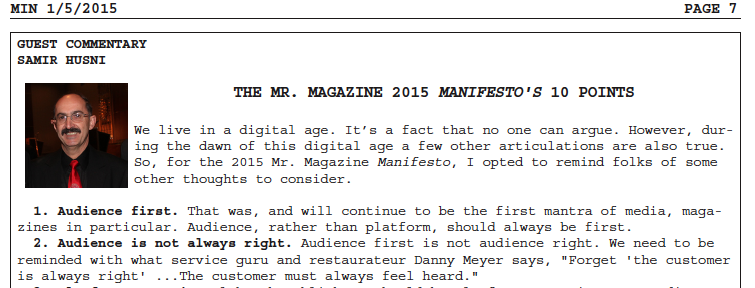
The Mr. Magazine™ Manifesto 2015

The Mr. Magazine™ Manifesto 2015

We live in a digital age. It’s a fact that no one can argue. However, during the dawn of this digital age a few other articulations are also true.

So, for the 2015 Mr. Magazine™ Manifesto, I opted to remind folks of some other thoughts to consider.

1. Audience first. That was, and will continue to be the first mantra of media, magazines in particular. Audience, rather than platform, should always be first.

2. Audience is not always right. Audience first is not audience right. We need to be reminded with what service guru and restaurateur Danny Meyer says, “Forget ‘the customer is always right’ …The customer must always feel heard.”

3. Platform agnostic. Although publishers should be platform agnostic, your audience is not. Readers have their preferred platforms and they are attached to them. So don’t fall in love with the platforms; rather, fall in love with the audience. Make each and every platform content complete.

4. Technology does not kill print. It’s neither technology nor its digital components that threatens the survival of printed magazines. The perpetrators are the people behind print, its content and the investment or lack thereof. Remember the old adage, “Guns don’t kill people; people kill people.”

5. Advertisers are not departing print. Some magazines in 2014 published their largest issues since their inception. More ad pages mean bigger magazines than ever. When you hear some ad agency folks declaring that “we have no customers walking into our office and asking to place their ads in print,” ask them who their clients are and what about those pages and pages of ads in print? Are they representing the wrong clients?

The Mr. Magazine™ Manifesto 2015 as it appeared in min:media industry newsletter Jan. 5, 2015

The Mr. Magazine™ Manifesto 2015 as it appeared in min:media industry newsletter Jan. 5, 2015

6. New printed magazines are thriving. Since the dawn of the digital age (desktop publishing) in 1984, more print magazines have started. Did you know that some of the most successful magazines in the country are less than 30-years old? Men’s Health, InStyle, Marie Claire, Food Network magazine, O The Oprah Magazine and ESPN are just a few.

7. Without new magazines, the industry is dead. Any industry that fails to introduce new products is a dying industry. We should pay more attention to the business of new print launches and cherish and celebrate their arrivals. The industry must also focus on the fact that these infants always give us hope and a reason to believe in the future.

8. Learn from digital. More digital and online companies have discovered print in the last few years. From Web MD to Cnet, they’ve all have opted to produce print magazines in addition to their digital presence. Those digital companies are in the business of “no customer left behind.” A good mantra to follow.

9. Rediscover print and its power. If digital is discovering print and its power, the magazine industry should do the same. Rediscovering print means investing, on both the physical and content side. Leave speed and disposability to digital and create and produce a product with lasting collectability. Ensure that your content is right and your paper is great.

10. Statistics lie, numbers don’t. When you hear the statistics and percentages of increases or decreases in a particular publishing area, please do me a favor. Ask for numbers, real numbers. One percent of a billion-dollar industry is larger than fifty percent of a thousand-dollar industry.

Last but not least, it gives me great pleasure to mention that the same people who promoted and used the phrase the death of print from 2009 to 2014 have revised their phrase and predictions. Their new slogan is now the decline of print. Give them five more years and they will swallow their pride, admit they were wrong not once, but twice, and their new phrase will be the power of print.
_______________________________________________________________________________________________________________________________
Screen shot 2015-01-04 at 2.21.28 PMEditor’s Note: The Mr. Magazine™ Manifesto 2015 was first published in the Jan. 5 issue of min: media industry newsletter: The authoritative media/marketing newsletter since 1947. In the Dec. 22 of min, the editor in chief Steve Cohn wrote, “This issue, min’s last for 2014, extends our 28-year tradition of magazine launch reviews with Dr. Samir Husni. When we return on January 5, 2015, Husni will present his fifth Mr. Magazine Manifesto of New Year’s resolutions. He knows which titles have been naughty or nice.” For more about min newsletter click here.

h1

Joe Ripp, David Carey, and Samir Husni in This Week’s Edition of Mr. Magazine™ Monday Morning

December 15, 2014

Screen shot 2014-12-15 at 9.59.04 AMThe Dec. 15 edition of Mr. Magazine™ Monday Morning is out. This week’s issue includes interviews with Joe Ripp, CEO of Time Inc., David Carey, President of Hearst Magazines and a profile story on yours truly written by Angela Rogalski, a free-lance journalist and the administrative assistant at the Magazine Innovation Center. Angela is also a former student of mine. The weekly e-mail Mr. Magazine™ Monday Morning is free of charge. You can read this week’s issue here and you can have your own subscription here.
Screen shot 2014-12-15 at 10.14.05 AM

h1

Innovation in Print: Country Life’s Advent Calendar Cover

December 9, 2014

25 windows to open on this cover.

25 windows to open on this cover.


Country Life, Time Inc.’s weekly publication in the United Kingdom, offers one of the best examples of innovation in print.

The November 26 issue, which looks and feels like a monthly, has an Advent Calender Cover with 25 windows to open every day in December. The magazine asks readers to find “What’s behind the windows?”

The cover illustration was done by Fred van Deelen.

I have opened my first nine windows as the cover image to the right shows… This is a keeper.

h1

Interactive Print Magazines: Open Here, Smell There and Other Print Goodies.

November 20, 2014

It must be the holidays and magazines are celebrating with new creative tricks and lots and lots of red covers. Four magazines, all from Hearst Magazines, grabbed my attention for their creativity and interactivity of their covers.

woman's day-1
Woman’s Day with its “Open Here for a whiff of gingerbread.” Once you open the window on the cover you can rub and sniff the “cute gingerbread reindeer cookies!” If that does not entice you to buy the magazine, I do not know what will… See the video below:

Oprah-2
O, The Oprah Magazine has a cover with a gate-fold and three windows to open. One on the front cover and two on the inside gate-fold. Each window has a message under the opened window from Oprah. Also there is also a message from IkEA which sponsored all three windows and the ad inside the back cover and its gate-fold. Take a look:

As for Dr. Oz The Good Life and Good Housekeeping magazines, each of the two titles sports two different covers to choose from. Take a look and let me know which one do you like best.

Dr. Oz The Good Life
Dr.Oz 1-3Dr.Oz 2-4

Good Housekeeping
GH Christmas Cover 2-2Good Housekeeping Christmas Cover 1-1

Happy Holidays.

h1

Samir “Mr. Magazine™” Husni: 30 Years of Teaching and Mentoring at the University of Mississippi*

November 5, 2014

Meek-School-14-15-Cover
Samir Husni
Mr. Magazine™

It’s been said that until the magazine service journalism program began in August 1984, Mississippi was not the first state one thought of when it came to magazine publishing. Music maybe and great literature, but not necessarily the world of magazines and how they’re made. But all that changed after Dr. Samir Husni started the magazine service journalism program at the University of Mississippi.

Steve Cohn
, editor-in-chief of Media Industry Newsletter, described Husni as “a wonderful representative for the state of Mississippi, especially where magazine journalism is concerned.”

“In fact, in New York and all over America,” Cohn said, “when you hear the word Mississippi today, magazines are the first things that come to mind. And it’s because of Dr. Husni’s passion.”

The magazine service journalism program at Ole Miss is celebrating 30 years.

“When Jim Autry and the Meredith Corp. funded the magazine program at Ole Miss, it brought a great deal of media attention to the department of journalism and the University of Mississippi,” said Will Norton, Jr., dean of the Meek School.

Since the inception of the program Husni has been asked to deliver seminars or consult with magazines and magazine media companies on every populated continent of the world.

Many years ago one of his students gave him the moniker “Mr. Magazine™.” Today he is considered the leading expert on magazines and magazine media publishing.

Tony Silber
, vice president/Content of Folio: Min, Expo, Audience Development, and PR News at Access Intelligence, said, “Samir Husni is a magazine-industry treasure.”

“He has built a business as a consultant through his extraordinary intellect and understanding of how magazine-companies work.

“But he’s far more than just that: he’s an icon. He’s a brand. He’s an evangelist for print media who understands the interplay of print and digital media.

“The magazine industry is more successful because of Samir Husni’s work, and the good news is that he’s imparting his knowledge not just to his peers, but also to the next generation of media specialists, through his work at the University of Mississippi.”

The funding and the idea were the first steps. After Husni was hired to head the program, it was time to get down to details.

“With the help of a lot of people from the Meredith Corp. we developed five courses, and we began to offer the program,” Husni said.

Students needed “to know more than just your basic reporting, writing, editing and designing,” Husni said. That was uncommon for the 1980s. Ole Miss was the first school to include journalism and the business side of magazines in one program.

Husni developed editing by design, a course that provided everything a journalist should know about design and what every designer should know about journalism. Students in the department of art as well as students in the service journalism program took the course.

“Then we created a sequence of two courses,” Husni said, “in which students developed an idea from scratch for a new magazine and they created an entire business plan for that magazine, including developing content, design and the budget.

“Along with everything else that goes with a magazine: the media kit, the circulation plan and the advertising plan.”

The program has seen a lot of graduates who have gone on to establish impressive careers and they give Husni and the magazine service journalism program all of the credit.

Newell Turner
, one of Husni’s former students, is now editorial director for Hearst Design Group, specifically Elle Décor, House Beautiful and Veranda.

“After I graduated from Ole Miss with my undergraduate degree in journalism and Southern Studies,” Turner said, “I went to work for a while. I came back to Ole Miss to go to law school and did it for about a year and a half.

“Then I found out this magazine program was launching in the journalism school and I’ve had a passion for magazines that goes back to when I was an early teen.

“So I switched from law over to the magazine service journalism program, and it was like a light came on because suddenly I knew what I wanted to do with my career.”

Turner said magazine design wound up opening up a door for him in his career.

“The first year,” he said, “I met Dorothy Kalins, then editor-in-chief of Metropolitan Home and also that year she was president of ASME.

She spoke at Journalism Week in the spring, and Samir found out that there was a job opening, and he encouraged me to look in to it and help me realize what a great opportunity it was.

“So I pursued it and interviewed for the job, and they hired me.

“Without Dr. Husni and the magazine service journalism program, who knows where I’d be.”

Clinton Smith
, editor-in-chief of Veranda magazine and also a former student of Husni and the magazine service journalism program, said the program always had been unique, and that’s why it has worked.

“The foundation of his coursework has served as my compass throughout my 15-year journalism career—from intern to assistant editor to editor in chief,” Smith said.

“Dr. Husni’s magazine program has never been about textbook learning,” he said, “and that’s why it’s had such an impact on students’ lives over the past 30 years. The practical, real-world experience he instills will serve them throughout their careers.

“Dr. Husni’s magazine program has signaled to the country – and the world – that important and innovative things are happening not only at Ole Miss, but in Mississippi. His influence and the power of the program cannot be underestimated.”

The magazine service journalism program has begun many careers for students and will continue to do so in the future.

Scott Jones
was executive editor of Southern Living magazine from 1999 to 2010. Then he left to start his own companies, called Jones is Hungry and Jones is Thirsty, two separate entities on culinary-related custom content, education and consulting.

“I went to Ole Miss specifically for the magazine program,” Jones said. “The service journalism program and Dr. Husni. This was in 1988 and desktop publishing was really in its infancy. So it was an exciting time to be there because the whole world of magazine publishing was changing, and you could do things then right on your own PC which before would have taken a lot of capital and a huge staff.

“The program had terrific benefits for me. It opened doors and got me up close and personal with people I would have never been connected with if not for the program.”

Cathy Still McGowin
, editor of Birmingham Home and Garden, said the university did not have a graphic design program when she got to campus.

“At the time, I majored in magazine journalism to learn the graphics programs,” she said. “Little did I realize that I would not only learn graphic design in one of the most advanced programs in the South, I also would learn everything I needed to know to gain entrance into the publishing world.

“Editing by design, made the most impact on me, and the tools I learned in that class are ones I still use every day. I learned that information comes in a package—and the more the parts work together, both visually and in words, the greater the impact of the message.”

Still was hired at Southern Progress Corp. when she graduated.

“I worked at Southern Accents and later Coastal Living for 14 years,” she said. “First as a graphic artist, then as a writer, stylist, and editor. At such a large company, tasks and duties are specialized and there wasn’t a lot of crossover with skill sets.

“Now, as editor of Birmingham Home and Garden, a small city magazine, the ability to use all of my skill sets are more critical than ever.

“I still maintain that Dr. Husni’s approach to looking at things from all angles is the reason I have been able to grow and meet the challenges of my career. That, and a lot of hard work.

“Those fundamentals are timeless—no matter your medium of journalism.”

Katriina Kaarre is publishing director for Women, Family and Children Media, published by Otavamedia in Finland.

“Meeting Samir in the corridor of Farley Hall in the fall of 1987 changed my career path,” Kaarre said. “I came to Ole Miss originally only for one year.

“I wanted to learn about the Southern culture and enjoy the blues archives – and take a few classes of marketing on the side.

“After meeting Samir, I quit classes at the business school and started my M.A. in journalism,” she said. “During the three-and-a- half years that I stayed at Ole Miss, I managed to visit the Center for Southern Culture only a few times.

“I’ve stayed on that path ever since, and I still love the touch and feel of a newly printed magazine.

“I still get excited when thinking about editing by design, the mission/vision of a magazine and the tone of it.”

Clearly, Dr. Husni opened doors for many students to develop exceptional careers.

“The ultimate goal,” Husni said, “was and is to teach students about service journalism, which can easily be defined as the factual, service-oriented, active-oriented, non-news type of journalism that has in it the power to activate the readers.

“The magazine service journalism program at the University of Mississippi was designed to create the type of journalism that will activate readers and get them personally involved with the content.”

And that continues today.

* This article, the cover story of the 2014-15 Meek School of Journalism and New Media Alumni magazine, was written by Angela Rogalski.

h1

Bringing Back the Good Times Again: Reminisce Magazine Rediscovers Its Roots. The Mr. Magazine Interview With Editor-In-Chief, Liz Vaccariello.

November 3, 2014

“The biggest challenge, and it’s a daily one, is to listen to the readers. You know, I put my personal email address in Reminisce and Reader’s Digest. I read every consumer letter and I respond to every one of them. That engagement with the audience is so very important.” Liz Vaccariello

NOV_COVER_REX In the spirit of celebrating Reminisce’s history as a place for reading and sharing memories – and to attract new generations of consumers steeped in nostalgia, Reminisce magazine has turned to the editor in chief of Reader’s Digest Liz Vaccariello and her team to breathe new life into the magazine. Ms. Vaccariello’s first goal is to reaffirm Reminisce’s mission “to touch and inspire readers with stories of cherished memories as told by some of those same readers.” ( Right: The New Reminisce)

After all, the magazine that was started by Roy Reiman in 1991 (and given the name Reminisce by his wife Bobbi) was one of the fastest growing circulation magazines in recent history. It went from zero to one million in less than a year and when the magazine was sold in 1998 it had a circulation of 2.5 million. The magazine, by design, did not carry a single ad and was totally circulation driven. Reminisce was one of many other titles in the Reiman group that in 2002 was sold to the Reader’s Digest Association (RDA).

After the sale, the magazine drifted from its original mission and DNA. The once 2.5 million circulation is now around one million. However, 12 years after the RDA ownership, an awakening is taking place. Reader’s Digest Association is moving the magazine from its original home in Wisconsin to New York City and placing it in the tender-loving hands of the editor in chief of Reader’s Digest magazine. Liz Vaccariello, who successfully reinvented Reader’s Digest magazine just a year ago, was given the additional responsibilities of Reminisce. Ms. Vaccariello brought Reader’s Digest back to its roots and reconnected the magazine with its DNA and audience.

Now, together with her Reader’s Digest team, she plans to do the same thing with Reminisce. I reached out to Liz Vaccariello, and we made some wonderful conversational memories of our own. We spoke about the magazine’s past, present and the possibilities for the future, with a great deal of emphasis put on the importance of getting back to the magazine’s roots of being an audience-first publication.

As witnessed on Facebook and other social media sites, the millennial generation has revived nostalgia and grand old memories in mammoth proportions just with “Throwback Thursdays” alone, so wistful reminiscing is more popular than ever. And the magazine plans on returning to their roots and in turn, capturing that new gene pool through the art of “remembering when,” while keeping their loyal and long-time core audience happy as well.

I hope you enjoy the Mr. Magazine™ conversation with Liz Vaccariello, and maybe you’ll relive the original tag-line of the magazine “that brings back the good times…by taking you on a walk down memory lane.”

But first the sound-bites:

Vaccariello_Digest_02_04_131540Mar04-2013On whether she took a reinvention or a return-to-roots route for the magazine: I went back to the roots and that’s what makes this magazine so extraordinary. Readers spend an average of 3.5 hours with this magazine. They want to lose themselves in other people’s personal histories.

On the fact that young people enjoy reading nostalgia more today than ever:
That’s absolutely right. First and foremost, it connects the generations, but more than that there has been research done on nostalgia. And people as young as six can feel the emotion of nostalgia.

On her biggest stumbling block: This is a consumer magazine. And like many publications, we hadn’t been marketing to a new gene pool, if you will, of readers. We’d been marketing to the same audience over and over again.

On whether she considers her new job an easy reward for past success with Reader’s Digest:
No, but it is an easy job when you’re given a magazine that is beloved by its audience and you have to be humble about the brand that’s now in your care.

On whether her dual-editing role gives her twice the excitement in the office than before:
Oh my goodness, I’m living the dream. I don’t know any other way of putting it.

On what she hopes to have accomplished a year from now with Reminisce:
I would hope that I can tell you that I’ve pleased the nearly one million current subscribers of Reminisce, that they feel as if they have a publication that lives up to the importance of their stories.

On whether she believes the magazine can ever attain its 2.5 million in circulation again:
I think it absolutely could.

On what keeps her up at night:
What keeps me up at night, to be honest; nothing.

And now the lightly edited transcript of the Mr. Magazine™ conversation with Liz Vaccariello, Editor, Reminisce and Reader’s Digest Magazines…

Samir Husni: Congratulations on your dual positions with Reader’s Digest and now also Reminisce Magazine.

Liz Vaccariello: Thank you, I’m so delighted. Reminisce and Reader’s Digest has a lot in common. They’re about reading and sharing and in the case of Reader’s Digest, people throughout history have shared jokes with each other, parents have ripped out articles and shared them with sons, daughters and neighbors.

Then Reminisce is all about reader’s sharing their memories and their nostalgia with likeminded people, but also with their families: “Look son, here is my first car” or “this is the story about how I met your mother” and it’s here in this magazine. So it becomes more of a collectable experience by being in the magazine.

So there is a lot of similarity in terms of the missions of both magazines and their audiences.

Samir Husni: Historically speaking, since we are talking about a magazine that deals with nostalgia and history; when the magazine launched in 1991 it was one of the few magazines that in less than 12 months exceeded one million subscribers. And then of course by the time it was sold, it had almost 2.5 million. So it was a huge magazine that back then was totally written by readers before anyone was really talking about audience-generated content. Then the magazine drifted a bit into the celebrity-oriented topics. So tell me, what is your vision now for the magazine? Did you re-invent it or, like with Reader’s Digest, did you go back to the roots?

Liz Vaccariello: I went back to the roots and that’s what makes this magazine so extraordinary. Readers spend an average of 3.5 hours with this magazine. They want to lose themselves in other people’s personal histories.

But to your point; the magazine had drifted away over the years and had become more, as I call it, “magazinified” and they put more editor’s voices in the magazine and they used stories from other places.

Reminisce is the reader’s magazine. They tell us what they want to write about by what they send in. And so the re-launch is really about committing to that user experience; which is personal histories. We’ve taken out almost all of the stock images and Getty images and now almost all of the images inside the magazine are submitted by readers.

Over the years the magazine had developed a little more white space and it tried to feel a little breezier, but our reader wants a sea of stories, they want pages that are packed with information and words. They wanted smaller photographs and more stories.

We really wanted to return it to that scrapbook feel and have that sense of discovery as the reader goes through the magazine. They don’t know if they’re going to stumble upon a story about growing up or about how someone met their first love, beautiful stories like that.

Returning the magazine to its roots is just about having as many stories as possible between the pages and gets the editors out of the way. My job is just to create a setting that does the people’s memories justice and honors them.

Samir Husni: And those stories are important. I even hear it from my students; you don’t have to be ancient to enjoy those types of stories. Even young people in their late teens and early twenties are looking for content to read about memories and life when their parents or grandparents were younger.

Liz Vaccariello: That’s absolutely right. First and foremost, it connects the generations, but more than that there has been research done on nostalgia. And people as young as six can feel the emotion of nostalgia. And they have found that people are at their most nostalgic in times of transition. They found that people who have recently graduated from college feel very nostalgic for high school or for when they were actually in college. People who have just started a family of their own feel nostalgic for their own childhoods. And of course, empty-nesters feel nostalgic for when their children were young and seniors feel nostalgic for when life was simpler and times were better.

So you’re absolutely right, there is no demographic for nostalgia.

Samir Husni: What do you think is going to be your biggest stumbling block?

Liz Vaccariello: This is a consumer magazine. And like many publications, we hadn’t been marketing to a new gene pool, if you will, of readers. We’d been marketing to the same audience over and over again. So for 20 years we haven’t found a new generation of likeminded people to subscribe to Reminisce.

The biggest stumbling block is going to be to continue to appeal to the older reader who wants to reminisce about the 30s, 40s and 50s, while also getting their sons and daughters to consider the magazine their own as well, so they can reminisce about the 60s, 70s and so on.

To do that we’re trying something called “Decade Diversity.” We might do a story on Friday night television and no matter what the demographic; you have a Friday night television show. For my grandmother maybe it was “I Love Lucy,” for my mother maybe it was something else and for me it was “Happy Days” or “Dallas” or “Full House,” so there are ways to introduce the later decades and those stories as part of the mix.

Of course, we don’t want to alienate the readers who have been with us 30 years and who loves this magazine and wants to spend hours and hours with it. We don’t want to all of a sudden turn it into a magazine that’s nostalgic for the 80s.

Samir Husni: By the way, “Sanford and Son” was my favorite television program. (Laughs)

Liz Vaccariello: “Sanford and Son,” I love it. (Laughs) “All In the Family;” we all had a favorite and our destination television.

Samir Husni: In addition to that, which is a big stumbling block; what other hurdles do you see looming before you to clear? It’s a given that you have done great with Reader’s Digest, that it was the cruise ship you were able to turn around; so now does it feel like it’s going to be an easy job? Do you feel as though you’re being rewarded with Reminisce and the powers-that-be think you can also turn around this magazine?

Liz Vaccariello: (Laughs) No, but it is an easy job when you’re given a magazine that is beloved by its audience and you have to be humble about the brand that’s now in your care. You have to have enormous respect for what made the consumer become so attached to it in the first place. You can’t be dismissive and you can’t be like a bull in a china shop, run in and think you have all the answers.

The biggest challenge, and it’s a daily one, is to listen to the readers. You know, I put my personal email address in Reminisce and Reader’s Digest. I read every consumer letter and I respond to every one of them. That engagement with the audience is so very important. They will tell you the stories they like, what they want more of, what they want less of and to respond to that is a delicate task. You have to understand who’s yelling the loudest and that’s not necessarily the person you need to listen to. You have to look at the big arrows.

Samir Husni: Since the last time we spoke, and that was mainly about Reader’s Digest; do you now feel more excitement when you come to the office in the mornings or do you ask yourself what have I gotten myself into?

Liz Vaccariello: (Laughs) Oh my goodness, I’m living the dream. I don’t know any other way of putting it. To have two magazines actually in my care where the overriding emotion is optimism and looking at the world through a hopeful lens, where my job is to curate the most meaningful stories about family, history and about how to live a better life, with a sprinkle of humor in there; there is nothing to not like about that job. I love every minute of it.

And I also have a wonderful team, the Reader’s Digest team absorbed all of the work that’s done on Reminisce, so we didn’t bring the staff of Reminisce with us. We just absorbed it and threw ourselves into it and it’s been a wonderfully energizing project to work on.

FullSizeRender Samir Husni: Why do you think as a major editor in our industry; why do you think that there aren’t more of those beacons of hope and light out there on the stormy ocean of doom and gloom stories that we are told?
(Right: Cover of the first issue of Reminisce.)

Liz Vaccariello: That’s a wonderful question. I think it’s interesting because the media landscape to a large extent is this cacophony of snarky cynicism, darkness, worry and partisanship, particularly broadcast media. And I think they’re doing it, frankly, because that’s what people respond to. That’s a quick fix; the ratings heroine, if you will.

But if you look at other media and I think magazine media in particular, magazines tend to be an oasis from that, with a few exceptions. I look at the service magazines; I look at health and fitness magazines, at magazines like Oprah and Real Simple. When you get to the end of those publications, you feel wonderful.

So I believe the magazine industry has done a good job of being an oasis from that snarky cynicism. And frankly, I think radio has too. I was just reading this morning about 24-hour Christmas on radio stations. This is the number one trick that radio has found to boost ratings; go Christmas all the time and they’ve bumped it back so that now it’s happening even before Halloween, because radio knows that people want to feel good.

I think that there are pockets of cynicism and negativity, but many people, particularly in magazine media, have seen their role as being a place where people can feel good. You want to spend time with a magazine; you don’t want to spend hours with your snarky friend, you want to spend hours with the friend who’s going to make you laugh, teach you something, make you feel good and tell you a great story that will warm your heart. Those are the people who you want to spend time with and those are the magazines you want to spend time with.

Samir Husni: If we talk again a year from now; what do you hope will have been accomplished in that year with Reminisce?

Liz Vaccariello: I would hope that I can tell you that I’ve pleased the nearly one million current subscribers of Reminisce, that they feel as if they have a publication that lives up to the importance of their stories. That they feel like it’s a collectable experience and that they’re proud to have it in their home and they’re proud to have their stories inside of it.

I hope that I can say that and I hope that I can also tell you that the sons and daughters, the next generation of those readers, are starting to discover us on Facebook, Pinterest and on the web. And that they’re starting to share their photos and stories in that new digital way and that we’ve brought a new network of consumers and readers into the fold.

Samir Husni: Do you see the magazine ever going back to the 2.5 million in circulation?

Liz Vaccariello: I think it absolutely could. I think there is no limit to the amount of people to whom these sort of stories appeal to.

Samir Husni: Is there anything that you’d like to add about Reminisce specifically?

Liz Vaccariello: Just that I’m thrilled and honored to be working on Reminisce and Reader’s Digest.

Samir Husni: My typical last question; what keeps you up at night?

Liz Vaccariello: (Laughs) What keeps me up at night, to be honest; nothing. (Laughs again) I have to answer you very honestly and tell you that I’m sleeping really well and it may sound corny, but I am filled with so much gratitude that I get to do this kind of work with this amazing team.

Samir Husni: You must be reading Reader’s Digest and Reminisce before going to bed.

Liz Vaccariello: (Laughs) And a little Jon Stewart and Stephen Colbert.

Samir Husni: Thank you.
h1

Falling in Love With Your Audience! Reflections on Magazine Relationships and Addictions. From Spain with Love….

November 1, 2014

IMG_7216 Complications, dilemmas, obstacles and concerns: all words used when describing the problems going on in magazine media today. In fact, problems that have materialized in our traditional magazine world since 2008 when the economy went bust and technology burst upon the scene. Since then we heard the naysayers who cried: “Print is dead! Long live digital!” And more recently the catchphrase: “Print isn’t dead; it’s just in decline,” as magazine media scrambles to adjust and rise like a phoenix from the ashes of problems that digital supposedly caused print and the entire industry when it fusilladed into prominence in 2008.

But the problem is not with ink on paper and the solution is not with just pixels on a screen. The problem is what are we trying to engage our audience/customers with, and that’s where our troubles lie. And that happens when we forget the importance of the one and only reason we exist; we create, we design and we plan for our audience. That’s it. The only reason we exist. Not for the advertisers, not for the accolades we receive when we put out a noticeably great product (which don’t get me wrong, that’s an amazing and honorable achievement), but we breathe and live for our audience, period.

When we cocoon ourselves inside our offices, falling in love with our many platforms, instead of the many readers who buy our magazines and magazine media, regardless of the platforms, the result can’t be anything but disastrous.

Our audience, our customer, can detect when there is no passion, no relationship; when everything we are providing them is just via automation and there is no blood, sweat or tears involved. In fact, I used to say that we have to be experience-makers, but after a recent trip to Spain where someone said, no not just experience-makers; we have to be experience-love makers, did I really begin to see why addiction and obsession are two things missing in our attempt to satisfy our customers. Addiction and obsession are both parts of real loving relationships, whether we’re talking about human-to-human or human-to-object and that’s a proven fact, and above all, we in magazine media are in the relationship business, without a doubt.

Being in the relationship business, we are then aware that those relationships must exceed ink on paper and they must exceed pixels on a screen. And unless we humanize our magazines and magazine media, there will be no relationship. That’s why it’s so important for us to keep in mind that as we venture into the future, we should not put our hopes in new gadgets, such as tablets or mobile. Less than a few years ago, it was all about tablets, today it’s all about mobile and smart phones; who knows what it will be next?

But truly our only hope for survival is in creating a long-lasting relationship with our audience and creating a brand that relates to that audience and engages that audience, which in turn will create an addiction to that brand; an addiction so strong that the customer will feel a vacuum or a void without it, whether it’s every day, every week or every minute. We have to create this type of long-lasting relationship.

foro6-1
At a recent presentation I gave in Madrid, Spain for the combined ARI (consumer magazine association) and Coneqtia (business magazine association) third annual forum day; I spoke about the necessity of putting the audience first and the importance of learning how to be chief addiction officers, rather than chief content officers or chief design officers. Before giving that presentation, I thought about all the unnecessary additions of titles we have now, especially those that involve the word “chief.” It seems everyone is a chief: chief content officer, chief design officer, chief revenue officer, which puts us heavy on chiefs and light on the regular soldiers who actually do the work. Is everybody a chief officer now? Where are the people who actually do the work?

If that’s the case, maybe we should start thinking about some new titles that include the word chief: how about chief inspiration officer or chief dream officer or chief addiction officer? In a relationship, those are the only kind of chiefs that matter, believe me.

Here are three points from the presentation I made in Madrid and they hold very true:

• Destroy all the platforms…
• Reinvent the way we think about publishing, marketing, branding, etc… and the way we do each and every one of the aforementioned professions…
• To each medium and to each profession their own and we have to respect that and put that as priority number one…

IMG_7129 And in the 21st century it should never be a question of print or digital – the advancement of the generations does not sound a death knell for either one. When television came onto the scene, theaters didn’t die; books didn’t die, nor did radio. Therefore digital did not or will not kill print and vice versa. There is room enough on our audience’s page for both, if we engage them and fascinate them and be their addiction connection. Pushing narcotics may be illegal, but pushing content, captivating content, definitely isn’t.

Here are four mile markers on the highway of a successful future for magazine media:

• Know your audience (all of your audience)
• Free yourself from the platform
• Become an experience and not a guide
• Create a necessary, sufficient, and relevant product

The worst, absolutely the worst, title recently invented for people in magazine media is Chief Content Officer. No one is in the content delivery business only; no one. Magazines are much more than content. You have to be the Chief Drug Dispenser and you have to know what makes your audience addicted…good drugs, good addictions!

But what are the drugs at your disposal that you can use to create the addiction:

• The ABCs… know your words
• Color… learn the psychology of color
• Pictures… bigger is better
• Videos… if you are on the screen, make it move
• Sounds… make them hear
• All combined in one way or another to get you addicted…

And remember: what we create in print is permanent, but digital is ever-changing. That matters and is vitally important to remember. In print there is VALUE… monetary value that you can own, show and engage with… Print is the bridge between yesterday and tomorrow. In digital there is no lasting value… but rather instant value, now you see me now you don’t… now you own me now you don’t.

Another invaluable chief, since we’re so attached to the word in today’s magazine media, is the Chief Seduction Officer. You are to decide whether you want to seduce your audience to a:

• One night stand!
• Love affair!
• A long lasting relationship!

It’s all up to you.

After my Madrid presentation, an editor walked up to me and asked why I was known as “Mr. Magazine™.” I didn’t know quite what to say, until she smiled and returned with,” If magazines were a country, I would definitely think of you more as Mr. Ambassador than Mr. Magazine™.”

The point was well-taken and only confirms what I feel about the power of addiction. I am addicted to magazines and have been since I was a young boy. And that addiction produced a passion that people take note of.

Another editor came up to me later and gave me the honorary title of Chief Inspiration Officer, which also gave me pause.

If my addiction produced a passion that people noticed and in turn inspired people to think outside of the box or propelled their creativity; what in the world could these two new “chiefs” do on the payroll of a magazine: chief addiction officer and chief inspiration officer!

Hmm…

h1

Lessons From the ACT 5 Experience: John Harrington, Bob Sacks and Lisa Scott. The Final ACT 5 Presentaion.

October 30, 2014

There was not a better way to end the ACT 5 Experience than putting three current industry leaders in front of the future industry leaders and engage the two groups in a conversation that summed up the Experience. The three current industry leaders are John Harrington, founder and publisher of The New Single Copy, Bob Sacks, president of Precision Media and Lisa Scott, executive director of the Periodical and Book Association of America.
Click on the video below to watch the final chapter of the ACT 5 Experience…

Looking forward to ACT 6… stay tuned!