Archive for the ‘Innovation in print’ Category

h1

The Pioneers Of Chicago Blazed A Selling Trail That’s Still Visible Today…A Mr. Magazine™ Blast From The Past, Circa April, 1953

August 15, 2019

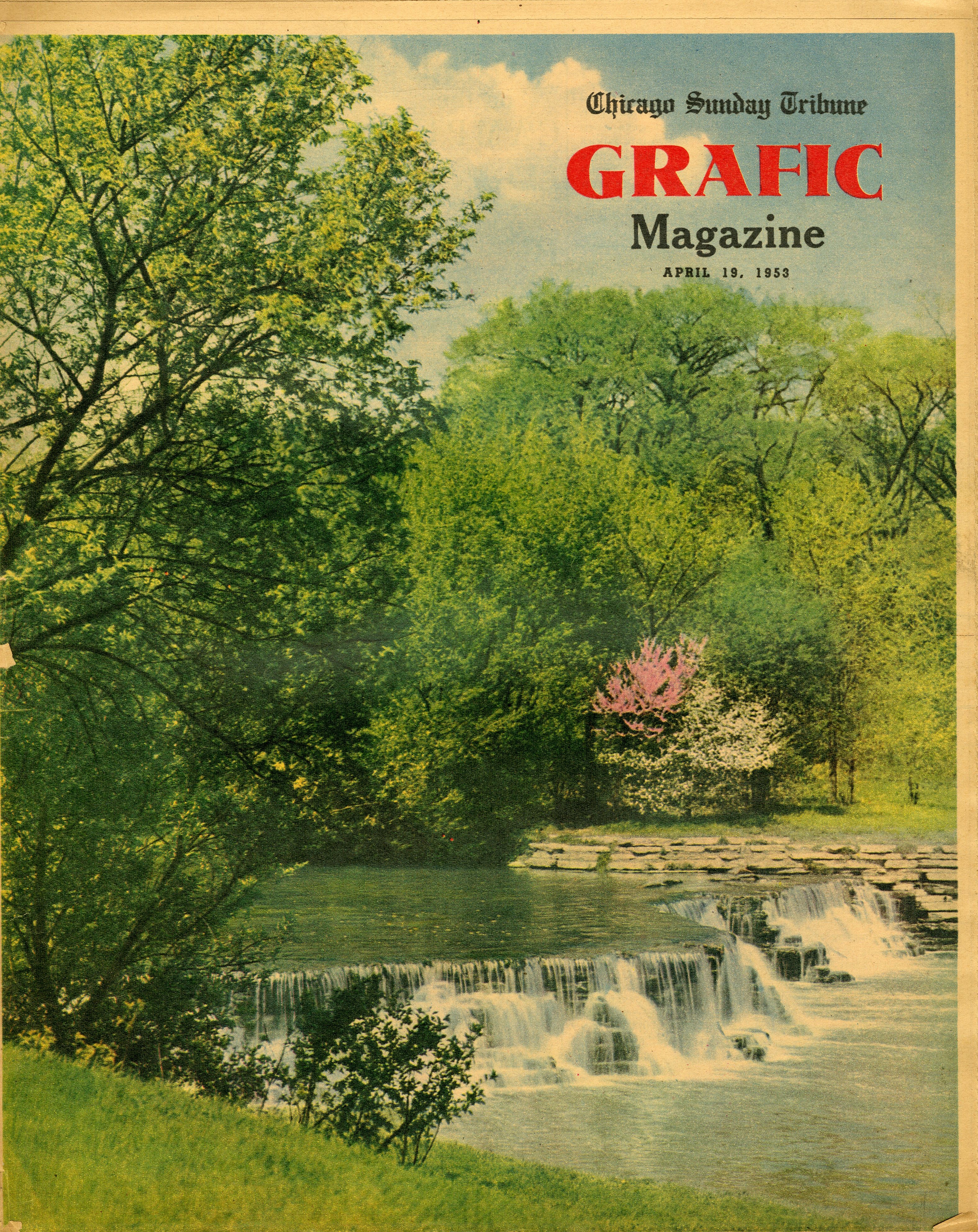
Once again Mr. Magazine™ has been exploring the past, still in that wondrous year known as 1953 (the year of my birth, don’t you know) and I ran across this story in Grafic, which was the Sunday Chicago Tribune’s magazine at the time. The history and the inspiration of this story had to bolster Chicago’s own spirit when it ran on April 19, 1953. The pioneers of the Windy City were the epitome of entrepreneurs. From William Wrigley Jr., who only had $32 in his pockets when he set out to teach the world to chew gum, to Montgomery Ward, who had the world’s first mail order house, Chicago certainly has something to brag about when it comes to the humble beginnings that certainly blazed the trail for what it is today – a major metropolitan destination.

And print was there in 1953 to showcase it! The story is amazingly historical without being preachy and does what ink on paper still does so brilliantly – tells a unique story in a format that can be archived and drawn upon in any generation. That’s one of the things that Mr. Magazine™ loves about ink on paper: if you decide you want to go diving into 1953 or any other year, the information is still there. It hasn’t disappeared into the realms of cyberspace, never to be seen again.

In fact, in the book I’m working on about the magazines of March 1953, I chose my birth year and month (Feb. or April will do if I can’t find a March issue or if the magazine was bimonthly) to concentrate on and physically have 532 magazines to hold in my hands and touch and do research from – all from that month. Amazing! I dare you to find 532 websites out there from 1953… (Mr. Magazine™ feels safe in offering that dare). So, enjoy this Blast From the Past and let me know what you think of the story and the idea that ink on paper lasts forever – even from way back in 1953…

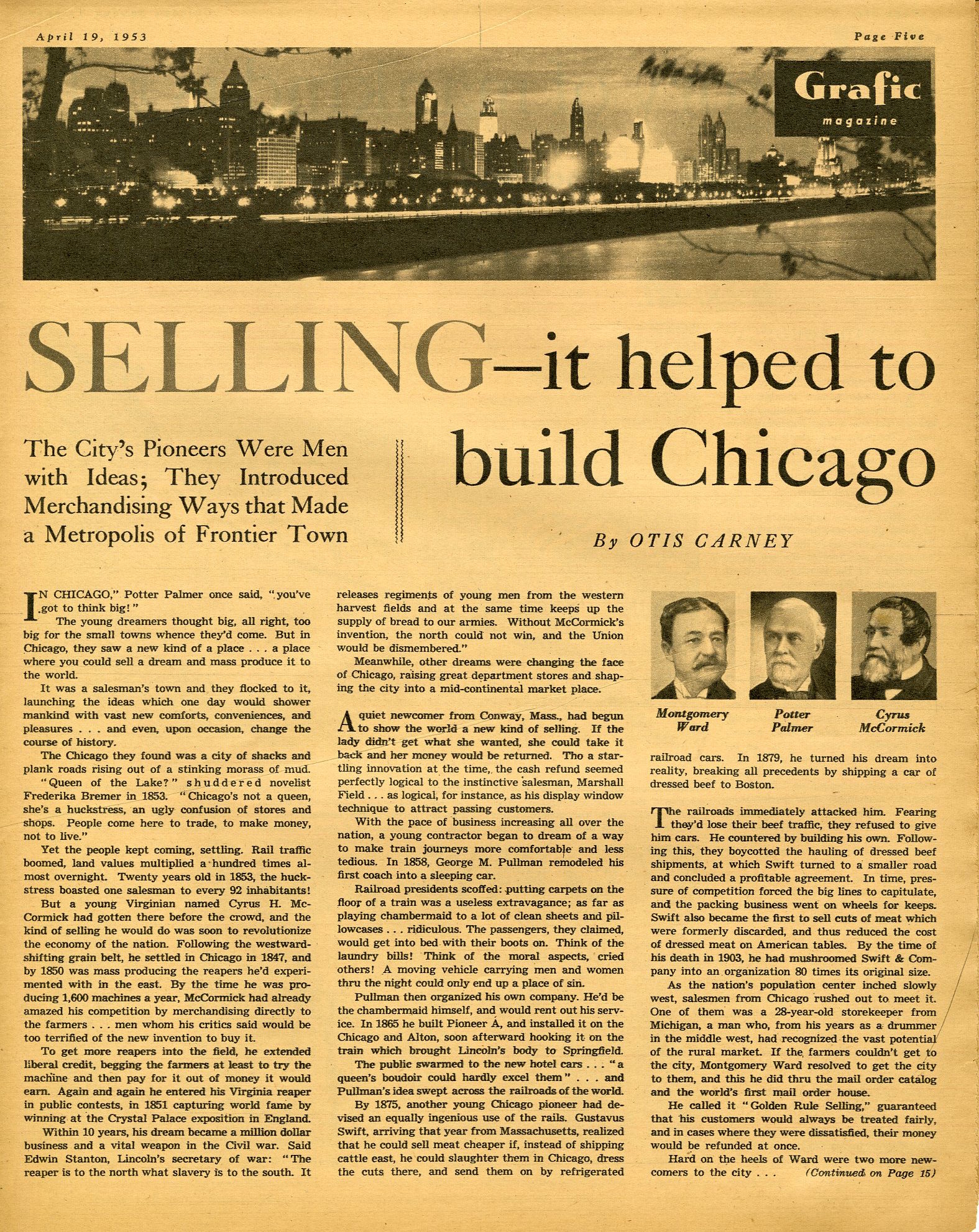
SELLING – it helped to build Chicago

By Otis Carney

April 19, 1953


The City’s Pioneers Were Men with Ideas; They Introduced Merchandising Ways that Made a Metropolis of Frontier Town

“In Chicago,” Potter Palmer once said, “you’ve got to think big!”

The young dreamers thought big, all right, too big for the small towns whence they’d come. But in Chicago, they saw a new kind of place…a place where you could sell a dream and mass produce it to the world.

It was a salesman’s town and they flocked to it, launching the ideas which one day would shower mankind with vast new comforts, conveniences, and pleasures…and even, upon occasion, change the course of history.

The Chicago they found was a city of shacks and plank roads rising out of a stinking morass of mud.

“Queen of the Lake?” shuddered novelist Frederika Bremer in 1853. “Chicago’s not a queen, she’s a huckstress, an ugly confusion of stores and shops. People come here to trade, to make money, not to live.”

Yet the people kept coming, settling. Rail traffic boomed, land values multiplied a hundred times almost overnight. Twenty years old in 1853, the huckstress boasted one salesman to every 92 inhabitants!

But a young Virginian named Cyrus H. McCormick had gotten there before the crowd, and the kind of selling he would do was soon to revolutionize the economy of the nation. Following the westward-shifting grain belt, he settled in Chicago in 1847, and by 1850 was mass producing the reapers he’d experimented with in the east. By the time he was producing 1,600 machines a year, McCormick had already amazed his competition by merchandising directly to the farmers…men whom his critics said would be too terrified of the new invention to buy it!

To get more reapers into the field, he extended liberal credit, begging the farmers at least to try the machine and then pay for it out of money it would earn. Again and again he entered his Virginia reaper in public contests, in 1851 capturing world fame by winning at the Crystal Palace exposition in England.

Within 10 years, his dream became a million dollar business and a vital weapon in the Civil War. Said Edwin Stanton, Lincoln’s secretary of war: “The reaper is to the north what slavery is to the south. It releases regiments of young men from the western harvest fields and at the same time keeps up the supply of bread to our armies. Without McCormick’s invention, the north could not win, and the Union would be dismembered.”

Meanwhile, other dreams were changing the face of Chicago, raising great department stores and shaping the city into a mid-continental market place.

A quiet newcomer from Conway, Mass., had begun to show the world a new kind of selling. If the lady didn’t get what she wanted, she could take it back and her money would be returned. Tho a startling innovation at the time, the cash refund seemed perfectly logical to the instinctive salesman, Marshall Field…as logical, for instance, as his display window technique to attract passing customers.

With the pace of business increasing all over the nation, a young contractor began to dream of a way to make train journeys more comfortable and less tedious. In 1858, George M. Pullman remodeled his first coach into a sleeping car.

Railroad presidents scoffed: putting carpets on the floor of a train was a useless extravagance; as far as playing chambermaid to a lot of clean sheets and pillowcases…ridiculous. The passengers, they claimed, would get into bed with their boots on. Think of the laundry bills! Think of the moral aspects, cried others! A moving vehicle carrying men and women thru the night could only end up a place of sin.

Pullman then organized his own company. He’d be the chambermaid himself, and would rent out his service. In 1865 he built Pioneer A, and installed it on the Chicago and Alton, soon afterward hooking it on the train which brought Lincoln’s body to Springfield.

The public swarmed to the new hotel cars… “a queen’s boudoir could hardly excel them”…and Pullman’s idea swept across the railroads of the world.

By 1875, another young Chicago pioneer had devised an equally ingenious use of the rails. Gustavus Swift, arriving that year from Massachusetts, realized that he could sell meat cheaper if, instead of shipping cattle east, he could slaughter them in Chicago, dress the cuts there, and send them on by refrigerated railroad cars. In 1879, he turned his dream into reality, breaking all precedents by shipping a car of dressed beef to Boston.

The railroads immediately attacked him. Fearing they’d lose their beef traffic, they refused to give him cars. He countered by building his own. Following this, they boycotted the hauling of dressed beef shipments, at which Swift turned to a smaller road and concluded a profitable agreement. In time, pressure of competition forced the big lines to capitulate, and the packing business went on wheels for keeps. Swift also became the first to sell cuts of meat which were formerly discarded, and thus reduced the cost of dressed meat on American tables. By the time of his death in 1903, he had mushroomed Swift & Company into an organization 80 times its original size.

As the nation’s population center inched slowly west, salesmen from Chicago rushed out to meet it. One of them was a 28-year-old storekeeper from Michigan, a man who, from his years as a drummer in the middle west, had recognized the vast potential of the rural market. If the farmers couldn’t get to the city, Montgomery Ward resolved to get the city to them, and this he did thru the mail order catalog and the world’s first mail order house.

He called it “Golden Rule Selling,” guaranteed that his customers would always be treated fairly, and in cases where they were dissatisfied, their money would be refunded at once.

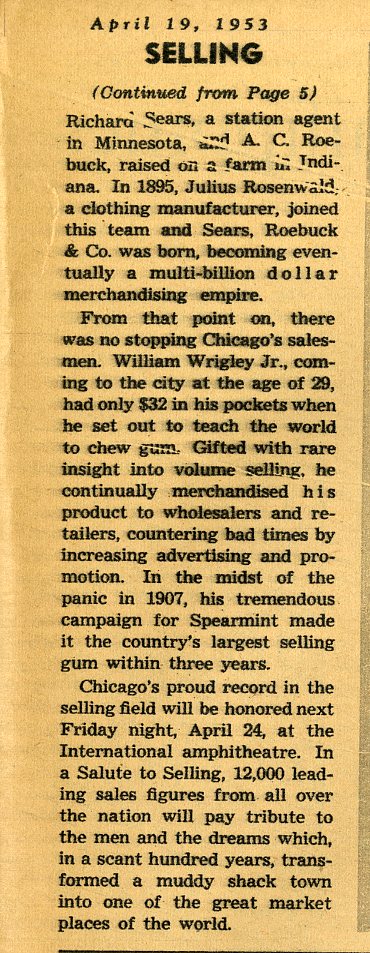
Hard on the heels of Ward were two more newcomers to the city…Richard Sears, a station agent in Minnesota, and A.C. Roebuck, raised on a farm in Indiana. In 1895, Julius Rosenwald, a clothing manufacturer, joined this team and Sears, Roebuck & Co. was born, becoming eventually a multi-billion dollar merchandising empire.

From that point on, there was no stopping Chicago’s salesmen. William Wrigley Jr., coming to the city at the age of 29, had only $32 in his pockets when he set out to teach the world to chew gum. Gifted with rare insight into volume selling, he continually merchandised his product to wholesalers and retailers, countering bad times by increasing advertising and promotion. In the midst of the panic in 1907, his tremendous campaign for Spearmint made it the country’s largest selling gum within three years.

Chicago’s proud record in the selling field will be honored next Friday night, April 24, at the International amphitheater. In a Salute to Selling, 12,000 leading sales figures from all over the nation will pay tribute to the men and the dreams which, in a scant hundred years, transformed a muddy shack town into one of the great market places of the world.

h1

“Garment” Never Disappoints – The Student-Created Magazine From The Amsterdam Fashion Institute Showcases New Ideas To The World Of Fashion Brilliantly

August 13, 2019

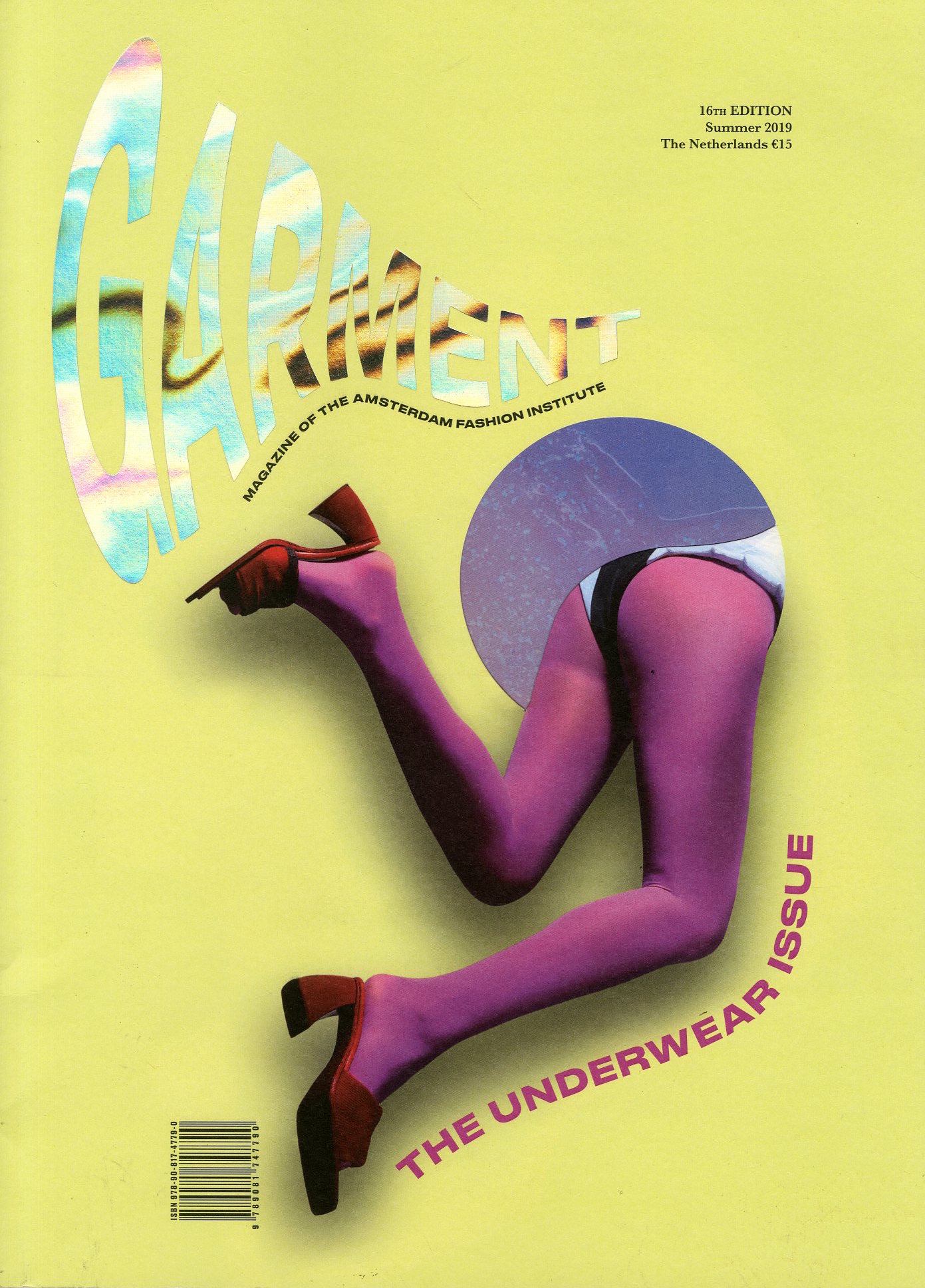
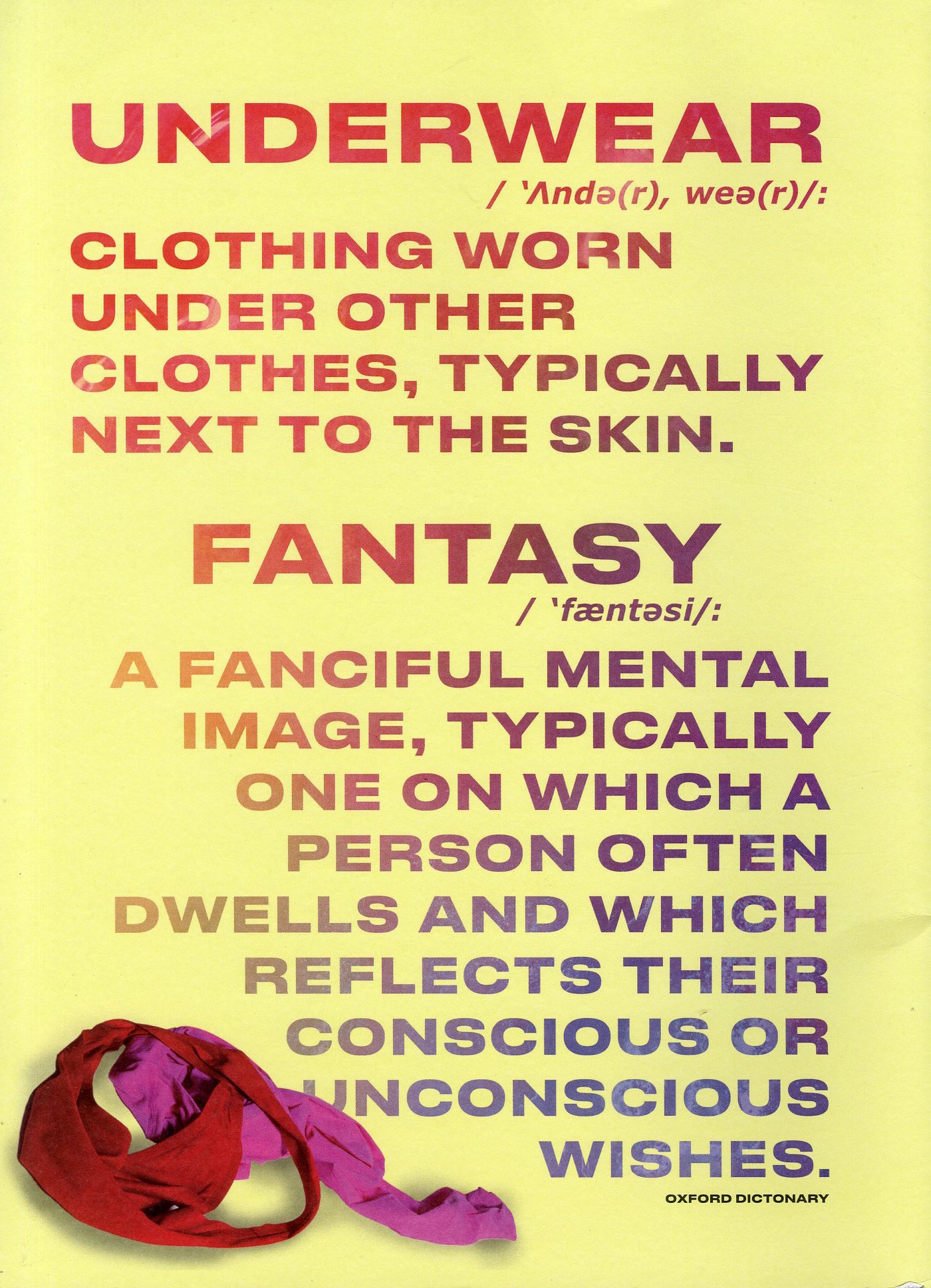
Garment, a student-produced magazine from the Amsterdam Fashion Institute, is a whimsically creative publication that Mr. Magazine™ has been delighting in now for 16 years. My friend and fellow educator, Frank Jurgen Wijlens, recently sent me the latest issue and as usual it does not disappoint.

The theme from these incredibly passionate and ambitious students this go-round is “underwear.” You can let your imagination take you away from there, because the students certainly did! The magazine cover is incredible, with a die cut center that as the students who created this issue say:

“… encourages you to interact with your inner fantasies and define your own identity in society through underwear.”

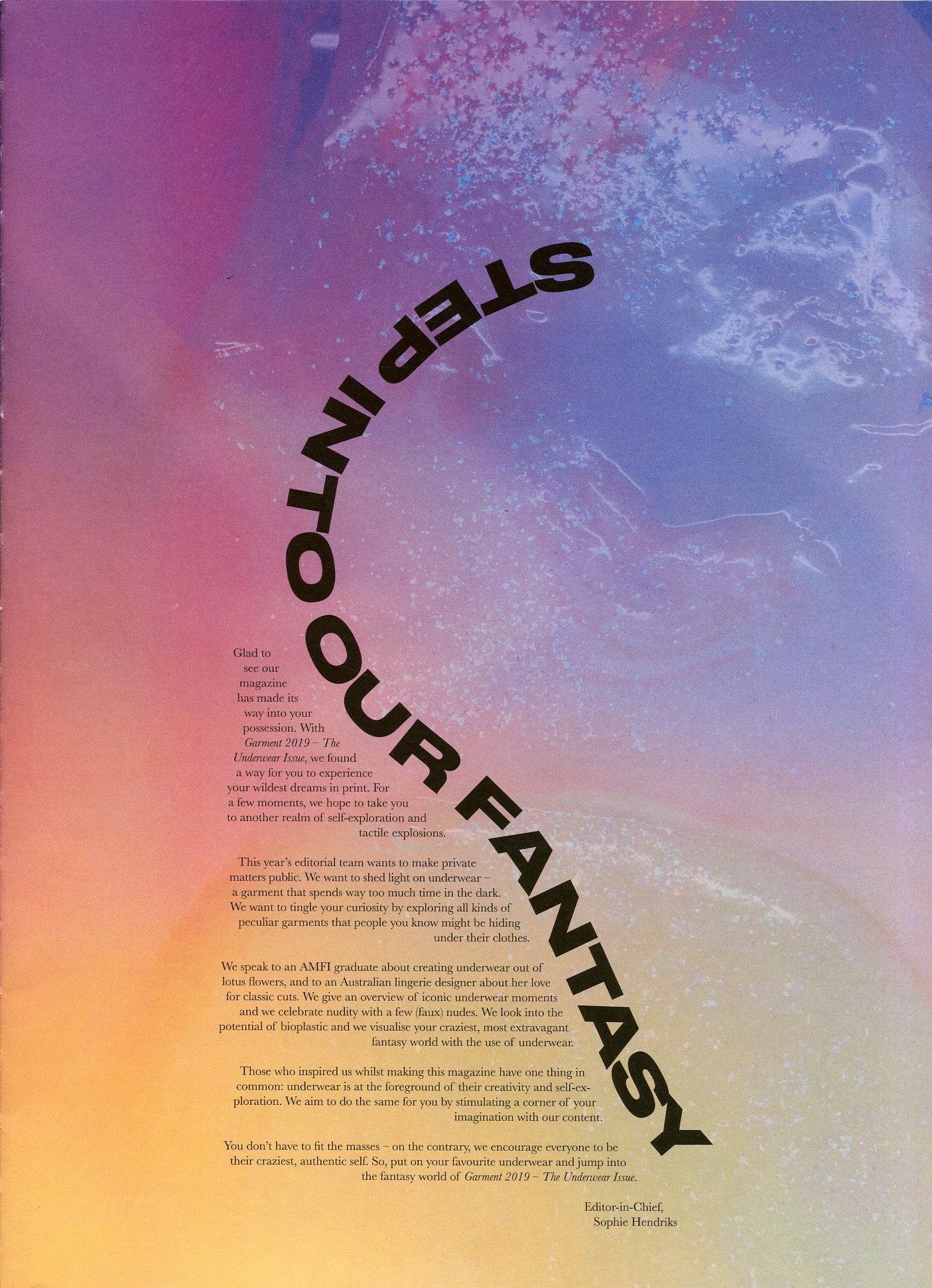
Editor in Chief Sophie Hendriks writes in her editorial:

Glad to see our magazine has made its way into your possession. With Garment 2019 – The Underwear Issue, we found a way of you to experience your wildest dreams in print. For a few moments, we hope to take you to another realm of self-exploration and tactile explosions. This year’s editorial team wants to make private matters public. We want to shed light on underwear – a garment that spends way too much time in the dark. We want to tingle your curiosity by exploring all kinds of peculiar garments that people you know might be hiding under their clothes.

Frank, along with the stunning new issue, sent me a lovely note expressing how these students love of print is really visible in the quality of the production of this edition:

Dear Samir, I hope all is well! We’re still going strong and I’m happy to send you this year’s version of Garment Magazine. I guess the students’ love for print is really visible in the quality cover, the special binding, and the size of the magazine. Hope you enjoy it!

And the oversized format just invites a long, leisurely sit-down with this great title.

Which is what Mr. Magazine™ is about to do…

So, grab your inner fantasies and check out the website for the magazine and enjoy these students’ magical minds.

garmentmagazine.com

Until the next time…

See you at the newsstands…

h1

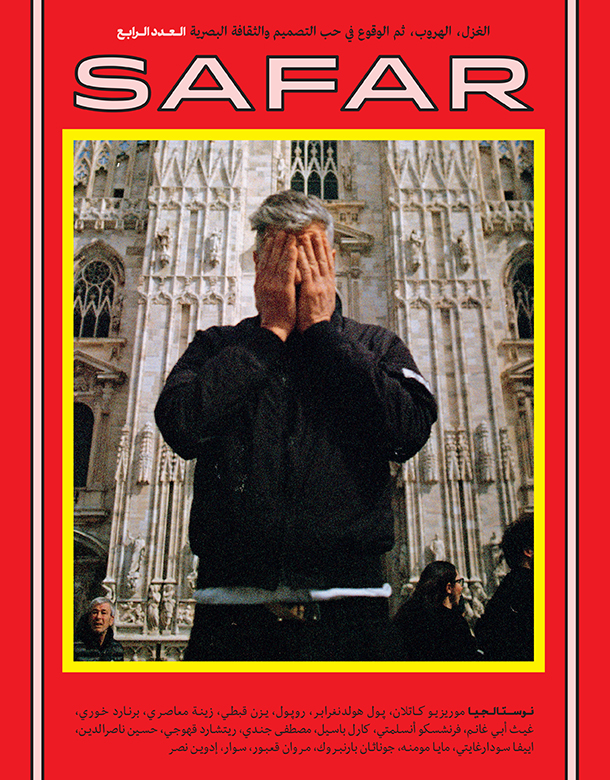
Safar Magazine: A Lebanese Publication That’s Flirting With, Fleeing From & Falling For Graphic Design & Visual Culture – The Mr. Magazine™ Interview With Maya Moumne, Cofounder, Editor In Chief & Creative Director…

August 2, 2019

“We’re not even sure that it’s the best format (print), but it’s where our heart is taking us. And I’m always a firm believer in following your gut instinct and following your heart. To be very transparent, the magazine has not taken off financially at all, but I feel like if we’re stubborn and we study our audience a little better, the magazine will definitely take us there. There’s this aspect of archives that doesn’t exist online and in digital magazines that we’d like to retain with this print magazine.” Maya Moumne…

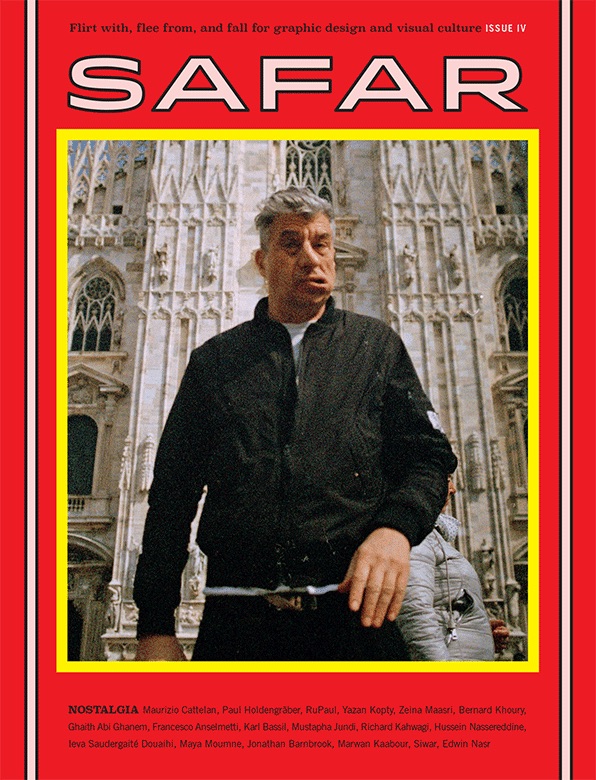
An independent magazine that focuses on the visual beauty and technique of graphic design in the Arab world is something worth talking about, as graphic design becomes more and more important and prominent in the Middle East. Safar magazine is published both in English and in Arabic in each issue (something done intentionally to attract a wider audience). And with each of its themed issues, the founders, Maya Moumne and Hatem Imam, invite a diverse set of contributors to talk about graphic design in their own individual voices as the theme allows.

On a recent trip to Lebanon, I spoke with Maya Moumne, one of the brand’s founders, and we talked about the unique aspects of the magazine, from the intriguing content of a print publication all about graphic design, a very rare thing in the Arab world, and the public talks between esteemed people in the cultural sphere, that is an extension of the magazine.

The magazine was born from an embryo started by Maya and Hatem in the form of Studio Safar, a graphic design company, mainly commission-based, that indulged their passion for design and print. It’s a lovely magazine and a very welcomed breath of fresh air to graphic design enthusiasts around the globe.

So, I hope that you enjoy this glimpse into the world of graphic design through the eyes of a very passionate young woman who is both an entrepreneur and an artist with a very important mission and dream, the Mr. Magazine™ interview with Maya Moumne, cofounder, editor in chief and creative director, Safar magazine.

But first the sound-bites:

On the story of Safar magazine: In 2012, my partner and I started a design studio called Studio Safar. It was mainly in a commission-based context. Throughout, with the type of work we were doing, my partner and I realized  that we already had a passion for print and it had always been our dream to delve into the publishing realm. So we decided to start a magazine on graphic design because there were no magazines in the area that tackled graphic design specifically. And certainly none that were available in Arabic. When we started we called it Journal Safar and the format of the magazine was very different from the current one that you have seen. It was more like a journal that was published by the Studio.

On the magazine’s tagline, “flirt with, flee from, and fall for graphic design and visual culture”: Say, we’re designing a publication; the role of the graphic designer cannot only be to design the page given the photography and the text, the designer’s role is really enacting the way that you read the publication or that you receive the content. You give me an article and you tell me that this is the text and these are the images. I can design this article in five different ways and in each one of these different ways, you will receive the content in a different manner. You’ll understand the content differently. So, the rule of the designer really is to flirt with the viewer. What we’re trying to do with the magazine is get people to flirt with this idea of design being an agent of cultural production, and getting them to fall for it, and also getting them to flee from misconceptions around design or trends around design.

On why she and her partner, Hatem Imam, decided print would be the best format for the magazine: We’re not even sure that it’s the best format, but it’s where our heart is taking us. And I’m always a firm believer in following your gut instinct and following your heart. To be very transparent, the magazine has not taken off financially at all, but I feel like if we’re stubborn and we study our audience a little better, the magazine will definitely take us there. There’s this aspect of archives that doesn’t exist online and in digital magazines that we’d like to retain with this print magazine. And for that reason the magazine is completely translated into English and Arabic in one publication or one document for the sake of having this material there five to ten years down the line. In Arabic, the dictionary of graphic design terms does not exist because graphic design is a very new field.

On where her journey began: My family moved to Canada many years ago and they stayed there for about eight years, but they eventually moved back to Lebanon. I was very young when they moved back to Lebanon, and when everyone asks me where I was raised, I say that I was raised in Beirut but the first half of my childhood was in Montreal, Canada. But the rest of my life, such as character-building, interest-building, everything, was in Beirut, Lebanon and nowhere else.

On what got her hooked on graphic design: The infinite possibilities. The fact that a graphic designer can be someone who is so well-informed about a musical project because they have to design a printed ephemera or an online ephemera around that musical project. And the fact that a graphic designer can be so well-informed about helping cybersecurity because they’re working with a cybersecurity company on their communications strategy. It’s really the infinite possibilities.

On the future of graphic design in the Arabic world since it’s a relatively new field: I can tell you from working based out of this region that people are turning more toward hiring graphic design agencies versus advertising agencies, and that’s been a really big shift and accomplishment in understanding the value of graphic design versus advertising. More and more advertising agencies are closing and more and more graphic design agencies are opening. I’m pretty confident that the times will change and graphic designers will be given much more agency than they are right now.

On the eclectic mix of stories and articles in the current edition and what made them decide to bring such a diverse group of individuals together in one issue: Most of the time the articles that we pick could really be a midnight project; I wake up at 3:00 a.m. and think, I really want to learn more about this or that. And then I’ll think, who’s a good designer? Whose research has touched on that? Or whose research is based on that? I’ll contact them and if they’re interested, then they’ll write an article about that. Other ideas will come really whimsically, almost accidentally.

On the biggest stumbling block they have had to face: I would have to say that it’s the finances. Every other part of it was a lot of hard work, but a very enjoyable process. I wouldn’t call it a stumbling block.

On what she would hope to have accomplished with the magazine one year from now: There’s a lot that I hope to accomplish with the magazine, but there are two things that I will mention in this interview. One of them is graphic designers will understand and learn that their role isn’t just to design what clients tell them to design; their role is much more important than that. They are actually cultural producers. That is one thing I would like to achieve with the magazine in one year.

On where people can go to get a copy of the magazine: For now, our Instagram account is the best way because we’re in the process of distributing the last issue to the distribution company and to bookstores around the world. And while we have one centralized link where people can just visit online to purchase the magazine from, they’re going to have to contact us and we can tell them where they can go online and what bookstores they can get it from based on what city they live in.

On anything she’d like to add: I’d like to elaborate a bit more on the last answer I gave and say that for example, with the launch of this last issue, an organization with so much history and so much prestige like Onassis Culture, based in Athens, took a particular interest in us and partnered with us to create the launch event of our last issue. And the launch event wasn’t just a matter of selling the magazine and partying and drinking, it included a series of public talks between Paul Holdengräber, who is someone that I have so much respect for and I was star struck when I met him, and we conducted a talk between three people in an auditorium with a stage and an audience, to talk about matters that are related to cultural production, nostalgia and design.

On what someone would find her doing if they showed up unexpectedly one evening at her home: Definitely having a glass of wine, it relaxes me. Definitely reading relaxes me, and definitely watching a movie relaxes me.

On the biggest misconception she thinks people have about her: I don’t know and I don’t really care what misconceptions people have about me.

On what keeps her up at night: It’s funny that you ask that because I actually do wake up in the middle of the night thinking about work. There are two main things: what’s the next step, which is always on my mind, what am I going to do next, let’s do this or do that. And the second one is how am I going to pay the bills.

And now the lightly edited transcript of the Mr. Magazine™ interview with Maya Moumne, cofounder, editor in chief, and creative director, Safar magazine.

Samir Husni: Can you tell me the story of Safar?

Maya Moumne: Yes, of course. In 2012, my partner and I started a design studio called Studio Safar. It was mainly in a commission-based context. So, if an art institution wants to design an identity, they’ll hire us, and if a publisher wants to have a book designed, he or she will contact us and we’ll design the book for them. And we have worked with art institutions, clients mainly in the cultural sector, some musicians, some corporate agencies and such.

Throughout, with the type of work we were doing, my partner and I realized  that we already had a passion for print and it had always been our dream to delve into the publishing realm. So we decided to start a magazine on graphic design because there were no magazines in the area that tackled graphic design specifically. And certainly none that were available in Arabic. When we started we called it Journal Safar and the format of the magazine was very different from the current one that you have seen. It was more like a journal that was published by the Studio.

In the last issue we decided that in order to make the publication more accessible, and to change this misconception of graphic design being something that is only service-oriented, we need to reach a larger audience, so we changed the name from Journal Safar to Safar alone, hoping that with the coming years the magazine will overpower the Studio. We’re hoping that people will recognize Safar as the magazine and not just the Studio, which is currently what’s happening.

We’ve also changed the type of articles that exist in the magazine that we publish. Before they were a bit more abstract than they are right now. We’re going more in the direction of content that is not just from graphic designers, and that’s the only way that we can disrupt that misconception.

Samir Husni: Your tagline is that you want to “flirt with, flee from, and fall for graphic design and visual culture.” Can you expand a little bit on that?

Maya Moumne: Of course. Everything that we do comes from our personalities, my partner and I, Hatem Imam. And also from the nature of the type of work that we do at the Studio and the culture that exists there. Every project that we take on, especially the commissioned ones, there is always a phase where we are trying to provoke the client, evoke the client, and we try to get them to question the nature of their own business. We feel very strongly that the rules of the graphic designer, in any given project, are so essential.

Say, we’re designing a publication; the role of the graphic designer cannot only be to design the page given the photography and the text, the designer’s role is really enacting the way that you read the publication or that you receive the content. You give me an article and you tell me that this is the text and these are the images. I can design this article in five different ways and in each one of these different ways, you will receive the content in a different manner. You’ll understand the content differently. So, the rule of the designer really is to flirt with the viewer.

What we’re trying to do with the magazine is get people to flirt with this idea of design being an agent of cultural production, and getting them to fall for it, and also getting them to flee from misconceptions around design or trends around design.

Samir Husni: Has anyone asked you or your partner, Hatem, whether you both have lost your minds, doing a print magazine in this digital age?

Maya Moumne: Yes, we have been asked that for sure.

Samir Husni: So, why did you decide print is the best format to flirt, flee and fall for graphic design?

Maya Moumne: We’re not even sure that it’s the best format, but it’s where our heart is taking us. And I’m always a firm believer in following your gut instinct and following your heart. To be very transparent, the magazine has not taken off financially at all, but I feel like if we’re stubborn and we study our audience a little better, the magazine will definitely take us there. There’s this aspect of archives that doesn’t exist online and in digital magazines that we’d like to retain with this print magazine. And for that reason the magazine is completely translated into English and Arabic in one publication or one document for the sake of having this material there five to ten years down the line. In Arabic, the dictionary of graphic design terms does not exist because graphic design is a very new field.

Samir Husni: I read a bit of your bio; how did your journey start, is it from Lebanon to Canada back to Lebanon?

Maya Moumne: My family moved to Canada many years ago and they stayed there for about eight years, but they eventually moved back to Lebanon. I was very young when they moved back to Lebanon, and when everyone asks me where I was raised, I say that I was raised in Beirut but the first half of my childhood was in Montreal, Canada. But the rest of my life, such as character-building, interest-building, everything, was in Beirut, Lebanon and nowhere else.

Samir Husni: What got you hooked on graphic design?

Maya Moumne: The infinite possibilities. The fact that a graphic designer can be someone who is so well-informed about a musical project because they have to design a printed ephemera or an online ephemera around that musical project. And the fact that a graphic designer can be so well-informed about helping cybersecurity because they’re working with a cybersecurity company on their communications strategy. It’s really the infinite possibilities.

And where I learned about graphic design was at AUB (American University of Beirut). Their graphic design program is quite particular because it’s not a technical program at all. In fact, a lot of it is critiqued for being very theoretical and not practical enough. But I think that the big theoretical part of their graphic design program is what enables the graphic designer to graduate from this degree and really delve into any field that they want.

Samir Husni: As you look at the entire subject of graphic design in the Arabic world and the Middle East, and as you said, it’s a brand new field, where do you see graphic design going and moving five years from now?

Maya Moumne: I can tell you from working based out of this region that people are turning more toward hiring graphic design agencies versus advertising agencies, and that’s been a really big shift and accomplishment in understanding the value of graphic design versus advertising. More and more advertising agencies are closing and more and more graphic design agencies are opening. I’m pretty confident that the times will change and graphic designers will be given much more agency than they are right now.

If we look at the ladder of design, design includes architecture, product design, interior design, industrial design , urban design and graphic design. I’m sure I’m missing a few more, but on that ladder graphic design is on the very bottom of it. They’re paid less than any other designer on the ladder and they’re also given much less importance. In Lebanon, for example, there are a lot of design festivals or design biannual for fashion designers, product designers and industrial designers, but there really isn’t much for graphic designers. And there are no programs that help graphic designers start new projects or apply for master’s degrees, such as financial aid and that sort of stuff.

But I’m pretty sure it’s going to change with time, and if anything that’s the mission of the magazine. I’d like to have a second compartment to the magazine, which is an online platform in addition to the print one, that would be an authority on graphic design.

Samir Husni: As I look at the current issue and I see the eclectic mix of articles and stories, from discussing posters for old movies to drag queens, to an interview that you did in Italy with Maurizio Cattelan. What was the thinking behind putting all of these different subjects together, yet they are all connected through graphic design and visual culture?

Maya Moumne: First and foremost, we started the theme as Nostalgia, and the theme of the last issue being about nostalgia too, in particular. And we try also to not let all of the articles discuss the technical aspect of graphic design just to be able to blur the lines a bit between what technical graphic design is and what visual culture is. And we feel that they fall hand in hand with each other. For example, the article on the print chimera that came with the Lebanese film posters in the ‘70s, ‘80s. and ‘90s. This was about how the history of film production leaves out all of the print aesthetics that came with the films. And all of that printed material was what made the films understandable for people and helped them to learn about the films.

If you read about the history of film production in a certain region, these texts on that history usually leave out the print part, the design part of it. And this article talks about that in particular. So, in that sense, it’s an article that’s related to nostalgia and it’s related to graphic design. And it talks about things that we like to read about.

Most of the time the articles that we pick could really be a midnight project; I wake up at 3:00 a.m. and think, I really want to learn more about this or that. And then I’ll think, who’s a good designer? Whose research has touched on that? Or whose research is based on that? I’ll contact them and if they’re interested, then they’ll write an article about that. Other ideas will come really whimsically, almost accidentally.

Samir Husni: What was the biggest stumbling block that you faced when you decided to launch the print magazine and how did you overcome it?

Maya Moumne: I would have to say that it’s the finances. Every other part of it was a lot of hard work, but a very enjoyable process. I wouldn’t call it a stumbling block.

Samir Husni: If you and I are having this conversation a year from now, what would you hope to tell me you had accomplished with the magazine?

Maya Moumne: There’s a lot that I hope to accomplish with the magazine, but there are two things that I will mention in this interview. One of them is graphic designers will understand and learn that their role isn’t just to design what clients tell them to design; their role is much more important than that. They are actually cultural producers. That is one thing I would like to achieve with the magazine in one year.

And the other thing is to prove everyone wrong in showing that a magazine about graphic design can reach people who are not only graphic designers, and that it can make money.

Samir Husni: If someone wants to get a copy of Safar, how would they do that?

Maya Moumne: For now, our Instagram account is the best way because we’re in the process of distributing the last issue to the distribution company and to bookstores around the world. And while we have one centralized link where people can just visit online to purchase the magazine from, they’re going to have to contact us and we can tell them where they can go online and what bookstores they can get it from based on what city they live in.

Samir Husni: Is there anything that you’d like to add?

Maya Moumne: I’d like to elaborate a bit more on the last answer I gave and say that for example, with the launch of this last issue, an organization with so much history and so much prestige like Onassis Culture, based in Athens, took a particular interest in us and partnered with us to create the launch event of our last issue. And the launch event wasn’t just a matter of selling the magazine and partying and drinking, it included a series of public talks between Paul Holdengräber, who is someone that I have so much respect for and I was star struck when I met him, and we conducted a talk between three people in an auditorium with a stage and an audience, to talk about matters that are related to cultural production, nostalgia and design.

These public talks are a very important extension of the magazine, it’s not just about it being a print magazine but it’s about a cultural exchange and dialogue. And that’s what I would like to add.

Samir Husni: If I showed up unexpectedly at your home one evening after work, what would I find you doing? Having a glass of wine; reading a magazine; cooking; designing; watching TV; or something else? How do you unwind?

Maya Moumne: All of the above. (Laughs) Definitely having a glass of wine, it relaxes me. Definitely reading relaxes me, and definitely watching a movie relaxes me.

Samir Husni: What is the biggest misconception people have about you?

Maya Moumne: I don’t know and I don’t really care what misconceptions people have about me.

Samir Husni: My typical last question; what keeps you up at night?

Maya Moumne: It’s funny that you ask that because I actually do wake up in the middle of the night thinking about work. There are two main things: what’s the next step, which is always on my mind, what am I going to do next, let’s do this or do that. And the second one is how am I going to pay the bills.

Samir Husni: Thank you.
h1

From Front Row To Front Cover: A Spellbinding And Intoxicating New Magazine Book By Didier Guérin…

July 31, 2019

In a career spanning over 40 years, Didier Guérin has launched over 40 magazines and websites.  In his new book, From Front Row To Front Cover,  he sums up those 40 years in a captivating 230 pages. And believe me, once you open the first page you can’t put the book down until you are finished.

Didier asked me to write the introduction to his book and I was more than delighted to do so.  What follows is the introduction that I wrote.

From Front Row to Front Cover: Inside the Business of International Fashion Magazines

Introduction by Samir “Mr. Magazine™” Husni

Spellbinding And Intoxicating Like A Fine Glass Of Red Wine

To me there are three types of books that are published: the book with the cover that attracts you, but not enough to motivate you to read it; the book that you pick up because of the cover and you start reading it, but then you lose interest; and finally, the book that you pick up not just for the cover, but for the content as well, and you can’t put it down, you start reading and you absolutely have to finish it, cover to cover. Didier Guérin’s “From Front Row to Front Cover – Inside the Business of International Fashion Magazines” is most definitely the latter, once you start reading it you can’t put it down.

I first met Didier Guérin through the pages of Elle magazine, when he brought the publication to the United States on behalf of the Hachette Filipacchi-News Corp joint venture. As I vividly remember him telling me, I was the first person to send him a letter congratulating him about Ellecoming to the U.S.

With Didier Guérin and The University of Mississippi’s Chancellor Gerald Turner in 1987.

It wasn’t long after that, I invited Didier to come to the University of Mississippi in 1987 and he very graciously accepted my invitation. He came and he spoke to my students here and that began a journey for him that was parallel to my own in the magazine world, yet he was on the inside looking out, while I was always on the outside looking in.

I was so impressed by Didier’s passion for the magazine world and his business acumen when he came to speak to my students. I felt his struggles were so similar to my own struggles, trying to understand what makes a magazine work; what makes a magazine fail; what are the processes of launching a magazine. He was just coming out of the strife of spending almost two years trying to launchEllein the United States and facing all of the obstacles from every magazine media company back then until the magazine was launched in 1985, and then later he launched Premierein 1987.

So, to me Didier Guérin is much more than a magazine maker, he is an experience maker. He experienced the magazines that he made and that’s why if you read his book, “From Front Row to Front Cover,” while he wasn’t on the cover of any magazine, he was the cover of the magazine. His new book is an intimate journey through the life of someone who for 40 years has not only followed the magazine industry, but was immersed in it, both as an idea-maker and a business-maker. The combination of those two gives the book an authenticity and realism that is unparalleled.

After we met in 1987, I asked him to write the introduction to my book, “Samir Husni’s Guide to New Magazines,” the 1988 edition. And one of his most memorable lines in that missive was, “Launching a magazine is such a seductive idea for so many people, that it beats even racing cars, a dream that every boy and some girls in America have had at least once.” And for Didier, and myself, that seduction is very real.

“From Front Row to Front Cover” takes us through Didier’s childhood and university days in Paris, to his time with Hachette Filipacchi and launchingEllein the United States. It is an exciting and often gut-wrenching tale of one young man’s foray into the world of magazines and magazine making, while searching for his own personal happiness within the realms of love and finding that “right” person. I thoroughly enjoyed it.

Didier relives leaving Hachette and moving to Condé Nast in 1995, and the angst that decision caused him. Then the launches of VogueTaiwan and GlamourKorea, preparing for VogueChina and launching Vogue Japan, and ultimately his firing from Condé Nast with no warning or reason.

The book is one man’s intimate and powerful journey through the ups and downs, power plays, and often hard decisions made within the higher echelons of the magazine publishing business. It is a read that will keep you spellbound and intoxicated without benefit of your favorite glass of wine.

When Didier asked me to write this introduction I was at once both honored and humbled to be able to return his own large favor to me all those years ago. But after receiving “From Front Row to Front Cover – Inside the Business of International Fashion Magazines,” I can’t imagine not writing it. It made a compelling impact on me and gave me such a deeper insight into the magazines that I have spent my life in love with. So for this, thank you, Didier. Thank you for the opportunity to do for you what you did for me, but thank you more for the amazing read.

To learn more about From Front Row To Front Cover click here and to order a copy of the book click here.

h1

RQ (Root Quarterly): A New Regional Magazine That Combines Local Art & Culture Along With Information About The City, All In One Beautiful Design – The Mr. Magazine™ Interview With Publisher & Editor In Chief, Heather Shayne Blakeslee…

July 22, 2019

“What I’m offering people is a chance to reconnect with their attention spans, with their ability to critically think, and with their ability to enjoy long-form profiles of artists and others who are in their city.” Heather Shayne Blakeslee (On why print)…

A Mr. Magazine™ Launch Story…

Root Quarterly, or RQ as the magazine is lovingly called, is a new title that Publisher and Editor in Chief, Heather Shayne Blakeslee, says is one part magazine, one part collaborative art project, and one part social experiment. The magazine offers insightful and provocative essays, profiles of local makers and artists, cultural criticism, fiction, poetry, and carefully-curated recommendations for getting the most out of life in Philadelphia—including a cocktail or dinner recipe here and there—all in a beautifully designed and printed magazine you can hold in your hands and settle down with on a Sunday afternoon, or argue over at Thursday night happy hour.

I spoke with Heather recently and we talked about this great new title and about its uniqueness in the Regional space. While on the one hand, RQ is a literary magazine that gives you the best in fiction, poetry and essays, it also has all the regional recommendations you could need or want for the city of Philadelphia. It has multiple personalities that lends itself to some fantastic reading and to some knowledgeable information.

And it has a creator who knows the value of a great team and the value of good storytelling. Heather is not only a publisher and editor, but she’s a businessperson, and a musician, keeping her eye on the future of this new print title by focusing on one goal, providing the best high-quality content that she can. With a goal like that, how could she be anything but successful.

So, now let’s get to the “root” of the story about RQ, the Mr. Magazine™ interview with  Heather Shayne Blakeslee, publisher and editor in chief, RQ magazine.

But first the sound-bites:

On the genesis of RQ (Root Quarterly) magazine: It had a long and maybe humorous start, going back 10 years or so. I was joking with my brother and he was joking with me. We were at a party in Brooklyn, and he’s kind of a witty guy, so he walked up to me and said, “Hey, didn’t I see you on the cover of Fancy Bitch magazine?” (Laughs) And I started laughing. He’s an art director and photographer and I’m a writer and editor and we had been batting around forever the idea of starting a magazine that was for women, but wasn’t a traditional women’s magazine. I thought about it for a really long time. I restarted the idea of thinking about putting a magazine together and looked at the landscape in Philadelphia and realized that we had very little arts and culture coverage anymore. The city paper, which was one of our main weeklies, went dark. And Philadelphia Weekly, which was still around, was much diminished from the state that it had been in 10 years ago even. And so, there was room for a publication like this, but it really has a dual purpose.

On why she chose print as a component for the magazine: I think people are so used to being able to fly off the handle in comment sections and have knee-jerk reactions to things. What I’m offering people is a chance to reconnect with their attention spans, with their ability to critically think, and with their ability to enjoy long-form profiles of artists and others who are in their city.

On whether any of her friends or colleagues thought she was crazy for starting a print magazine in this digital age: (Laughs) It’s interesting because, actually, the first thing that people say when they see the magazine is, “It is so beautiful. I can’t wait to sit down with this when I have time alone to enjoy it.” I did salons for a year before I started the magazine; I asked friends and colleagues to host salons in their homes. I asked them to create lists of people who might be interested in hearing more about a project like this. We did about seven or eight of them; I probably talked to about 100 people over the course of the year to get really specific feedback. Universally, people said if you do this, we will buy a subscription. They all said they would love to have something like this.

On whether the power of print today is more about just nostalgia: I think it’s absolutely more than nostalgia. One of the things that I’m curious about, frankly, is how un-self-aware we are as a species (Laughs), especially in the last 100 years or so, about the fact that our society has radically changed in the way that we organize ourselves. And our technology has radically changed.  Our minds and our brains and our bodies have not changed that quickly. There is a continuing evolutionary process going on here and we’re not meant to have 2,000 friends. And we’re not meant to organize ourselves even in the large groups that we do now in cities and in nations. And we’re not meant to consume as much information as the human mind consumes. It’s overwhelming to people.

On whether there have been stumbling blocks for her on this magazine journey: There are stumbling blocks at every turn. The main one though is time. I have a small business doing strategy and consulting for non-profit organizations and small businesses and doing editorial services. I have two major clients that I work with and this is the third thing that I’m working on, in addition to also being a musician who records and plays in Philadelphia. I’m on the Board for the local Folksong Society, so there’s a lot going on. Time, for me, is the main thing.

On the “root” origins of the magazine’s name: For me, I am a gardener and a plant person. And I am a lay biologist, so that’s a big world that’s important to me. I am not from Philadelphia, I’m from Central Pennsylvania. So for me, part of it is just being rooted in this particular region. It’s being rooted in, as I said, our own reality, rather than the online world, which is much more easily manipulated. And it’s about trying to connect and grow with other people and creating an intentional community of people who want this kind of thing in their lives.

On what she would hope to tell someone a year from now that she had accomplished with the magazine: I hope we’ve attracted additional investment; I hope our print runs have gone up; and I hope that we have attracted the people, whether they are writers and artists, or subscribers and supporters, who want to continue to make the project grow. We have already exceeded our very modest expectations that we set for ourselves in the first year. I was thinking if we got 250 people to subscribe the first year, that would make me happy and it would help to pay for some of the print runs. And nearly 100 people, some of them sight unseen, not even having seen a copy of the magazine, have subscribed already. (Laughs) And we’re just getting started and I think there’s a lot of room for growth on that and a lot of potential.

On anything she’d like to add: Yes, because you’re a magazine person, and maybe would be interested in the kind of hybrid that we’ve come up with. I don’t think that I have seen anywhere, especially in the U.S., a quarterly magazine that is both a city magazine, in that it will offer people the carefully curated recommendations of things that are happening in the city of makers, artists, destination restaurants, and other things like that, but that will also be publishing fiction, poetry, essays, and profiles of artists. It really is splitting the difference between a city magazine and an arts and culture journal.

On what someone would find her doing if they showed up unexpectedly one evening at her home: First of all, often in the evening, and this is the other reason why I suppose we’re able to do this because it’s really being done in partnership with many people, including my life partner, Walter, who is our copy chief, he and I read books aloud to each other in the evening. And often on things that we end up wanting to write about or have others write about in the magazine, we spar all the time on arguments and exposing each other to new thinkers, new writers and authors. So, a lot of our evenings are spent doing that. That’s sort of how our relationship is based, I suppose.

On the biggest misconception she thinks people have about her: That’s a super interesting question. (Laughs) I’m not sure I have an easy answer to that. People who know me well, who have either worked for me for a long time or have been my friend for a long time, or both, I think they recognize that I can come across as somewhat stern or very demanding, but that’s born from a desire to do really good work. Being demanding of the people who are around you is okay as long as you give them equal support, love and attention.

On what keeps her up at night: Oh gosh, so many things. (Laughs) I did sustainability work for a really long time, more than 10 years, and I think we continue to degrade our level of discourse to the point where we may not be able to solve issues like climate change or we may not be able to reconcile our modern world with the more modest ways that our bodies and our brains have evolved. That we may create things that destroy us. That’s the main thing that keeps me up at night, whether it’s the threat of nuclear war or the threat of climate change or the threat of AI advancing more quickly. I’m totally with Yuval Harari on that trifecta of monsters that keeps us up.

And now the lightly edited transcript of the Mr. Magazine™ interview with Heather Shayne Blakeslee, publisher and editor in chief, RQ (Root Quarterly) magazine.

Samir Husni: Tell me about the genesis of RQ (Root Quarterly).

Heather Shayne Blakeslee: It had a long and maybe humorous start, going back 10 years or so. I was joking with my brother and he was joking with me. We were at a party in Brooklyn, and he’s kind of a witty guy, so he walked up to me and said, “Hey, didn’t I see you on the cover of Fancy Bitch magazine?” (Laughs) And I started laughing. He’s an art director and photographer and I’m a writer and editor and we had been batting around forever the idea of starting a magazine that was for women, but wasn’t a traditional women’s magazine. I thought about it for a really long time.

I started working about four or five years ago at a small, independent publisher in Philadelphia. And ended up being the editor of one of the magazines there. And I realized how much I loved putting print magazines together and learned how to do it there. After the 2016 election, I realized in part that the level of civil discourse in the country  and the level of journalism had deteriorated to the point where people couldn’t talk to one another anymore, even if they had a small disagreement about something. And that was due in part to social media. And to people not getting together in rooms face-to-face.

So, I restarted the idea of thinking about putting a magazine together and looked at the landscape in Philadelphia and realized that we had very little arts and culture coverage anymore. The city paper, which was one of our main weeklies, went dark. And Philadelphia Weekly, which was still around, was much diminished from the state that it had been in 10 years ago even. And so, there was room for a publication like this, but it really has a dual purpose. One is arts and culture in Philadelphia, and ideas, essays, and analyses from mostly writers from here. Although, I’m open to a handful of people occasionally in each of the issues weighing in that are not from this region. But part of it is also around re-teaching ourselves critical thinking skills, analysis, and rhetoric.

Samir Husni: And you don’t think digital would have helped with that?

Heather Shayne Blakeslee: I don’t, because I think people are so used to being able to fly off the handle in comment sections and have knee-jerk reactions to things. What I’m offering people is a chance to reconnect with their attention spans, with their ability to critically think, and with their ability to enjoy long-form profiles of artists and others who are in their city.

Samir Husni: Did any of your friends or colleagues ask you if were you out of your mind for doing a print magazine in this digital age?

 Heather Shayne Blakeslee: (Laughs) It’s interesting because, actually, the first thing that people say when they see the magazine is, “It is so beautiful. I can’t wait to sit down with this when I have time alone to enjoy it.” I did salons for a year before I started the magazine; I asked friends and colleagues to host salons in their homes. I asked them to create lists of people who might be interested in hearing more about a project like this. We did about seven or eight of them; I probably talked to about 100 people over the course of the year to get really specific feedback. Universally, people said if you do this, we will buy a subscription. They all said they would love to have something like this.

So, I definitely wouldn’t have done it if the reaction had been tepid or lukewarm, but lots of people were really excited about it. I also had offers of help, people who offered to donate some money. I had offers where people said they would like to host one of these, could I come and talk to their friends. So, I’m going to keep doing that and keep connecting with people in person.

Certainly, there are people who have said, “Heather, are you crazy?” (Laughs) But they also have said, “If anybody can do it, you can do it.” So, I’m just going to continue on with the experiment, and it’s an experiment that may fail, but we’re going to give it our best shot.

Samir Husni: Can you elaborate a little on the power of print in this digital age, because one of the accusations that I receive is that I’m so nostalgic. Is it nostalgia or is there more to the power of print in today’s world?

Heather Shayne Blakeslee: I think it’s absolutely more than nostalgia. One of the things that I’m curious about, frankly, is how un-self-aware we are as a species (Laughs), especially in the last 100 years or so, about the fact that our society has radically changed in the way that we organize ourselves. And our technology has radically changed.  Our minds and our brains and our bodies have not changed that quickly. There is a continuing evolutionary process going on here and we’re not meant to have 2,000 friends. And we’re not meant to organize ourselves even in the large groups that we do now in cities and in nations. And we’re not meant to consume as much information as the human mind consumes. It’s overwhelming to people.

And it absolutely makes sense to me that we medicate ourselves with drugs, and don’t pay attention to what we eat, and we wonder why everyone is anxious and suppressed. I think even more than just thinking of it as a magazine, it’s really a way to reconnect with the idea that we have to slow down and be more mindful. And we have to accept that our minds are not equipped to handle the digital age. But we keep telling ourselves it’s progress, so I don’t think it’s nostalgia, I think it’s just an acknowledgement of our reality.

Samir Husni: Has it been a walk in a rose garden for you from the time you conceived of the idea and executed it? Or has there been some stumbling blocks along the way?

Heather Shayne Blakeslee: There are stumbling blocks at every turn. The main one though is time. I have a small business doing strategy and consulting for non-profit organizations and small businesses and doing editorial services. I have two major clients that I work with and this is the third thing that I’m working on, in addition to also being a musician who records and plays in Philadelphia. I’m on the Board for the local Folksong Society, so there’s a lot going on. Time, for me, is the main thing.

Money will come from being able to invest in the project and I’ve seen that already. Producing a really high-quality product and being explicit about what the vision of the magazine is has really been great, in terms of attracting investment and people who are supportive of it. But time is a huge issue and being able to find the right team of people who are willing to work as volunteers for as long as they need to. But we’ve been able to assemble a really great team over the course of the last year and I absolutely would not be able to do this without their support.

The biggest, almost-snafu was losing our designer the week before we went to print with almost nothing finished. Luckily, I’ve been working in the business world for a long time and my first instinct was, okay, how do I fix this? And I just got on my phone and texted the designer in town that I knew ideated and executed work quicker than anyone I knew, and he’s also a joy to work with. And he designed a beautiful magazine in six days, even with a full-time job and moving that week. So, having the right team of people who are dedicated and willing to get onboard behind you is just absolutely critical.

Samir Husni: Here’s a question where the pun is intended; what’s the “root” of the name of the magazine?

Heather Shayne Blakeslee: (Laughs) For me, I am a gardener and a plant person. And I am a lay biologist, so that’s a big world that’s important to me. I am not from Philadelphia, I’m from Central Pennsylvania. So for me, part of it is just being rooted in this particular region. It’s being rooted in, as I said, our own reality, rather than the online world, which is much more easily manipulated. And it’s about trying to connect and grow with other people and creating an intentional community of people who want this kind of thing in their lives.

Samir Husni: Heather, if you and I are having this conversation a year from now, what would you hope to tell me you had accomplished with the magazine?

Heather Shayne Blakeslee: I hope we’ve attracted additional investment; I hope our print runs have gone up; and I hope that we have attracted the people, whether they are writers and artists, or subscribers and supporters, who want to continue to make the project grow. We have already exceeded our very modest expectations that we set for ourselves in the first year. I was thinking if we got 250 people to subscribe the first year, that would make me happy and it would help to pay for some of the print runs. And nearly 100 people, some of them sight unseen, not even having seen a copy of the magazine, have subscribed already. (Laughs) And we’re just getting started and I think there’s a lot of room for growth on that and a lot of potential.

Samir Husni: Is there anything else you’d like to add?

Heather Shayne Blakeslee: Yes, because you’re a magazine person, and maybe would be interested in the kind of hybrid that we’ve come up with. I don’t think that I have seen anywhere, especially in the U.S., a quarterly magazine that is both a city magazine, in that it will offer people the carefully curated recommendations of things that are happening in the city of makers, artists, destination restaurants, and other things like that, but that will also be publishing fiction, poetry, essays, and profiles of artists. It really is splitting the difference between a city magazine and an arts and culture journal.

The closest thing that I can think of would be The New Yorker, but of course that’s a huge operation and a weekly and it also has national interest, but that is a little bit of what I’m thinking. I looked at magazines like Harper’s, The Atlantic, and The New Yorker, but also the London-based magazine, Riposte, is something that I enjoy. California Sunday Magazine is another that I really enjoy.

I also don’t see people paying enough attention to the design of the magazines. That is also really important to me, to have very high-production quality. And very, very good design, because I think if you’re going to ask people to subscribe to a print journal at this point, it kind of has to be an art object that they want to put on their coffee table and that they will not usually put into a recycling bin.

Samir Husni: If I showed up unexpectedly at your home one evening after work, what would I find you doing? Having a glass of wine; reading a magazine; cooking; gardening; watching TV; or something else? How do you unwind?

Heather Shayne Blakeslee: (Laughs) All of those things. First of all, often in the evening, and this is the other reason why I suppose we’re able to do this because it’s really being done in partnership with many people, including my life partner, Walter, who is our copy chief, he and I read books aloud to each other in the evening. And often on things that we end up wanting to write about or have others write about in the magazine, we spar all the time on arguments and exposing each other to new thinkers, new writers and authors. So, a lot of our evenings are spent doing that. That’s sort of how our relationship is based, I suppose.

I’m also a musician, I’m a singer/songwriter that does folk and Americana. I have a new record coming out in the fall with a band called Sweetbriar Rose that I’ve led for many years. And I also have been playing the cello for the last five years, so that gets me into a very meditative state and gets me away from words and into music and vibrations; just kind of centering myself in that way.

And I definitely spend a lot of time gardening, and I do cook to relax as well, but often I’m also listening to a podcast, usually Sam Harris, whose podcast used to be called “Waking Up” and is now called “Making Sense.” He’s one of my favorites.

It’s interesting because I’m also targeting this magazine at Gen Xers and Boomers; any enlightened millennials are welcomed to come along for the ride as well. (Laughs) I had a “Letter to the Editor” once at the magazine I was working at a couple of years ago that was interesting because it was about an editorial concerning my editor’s notes, and she failed to realize that the editor’s notes were in dialogue with the entire magazine that came after it.

And it was curious to me because I was thinking about it and these are people who just download songs. They don’t see the album anymore. And I think musicians are a little bit more tuned into the fact that we do think of things a little more holistically.

Samir Husni: What do you think is the biggest misconception that people have about you?

Heather Shayne Blakeslee: That’s a super interesting question. (Laughs) I’m not sure I have an easy answer to that. People who know me well, who have either worked for me for a long time or have been my friend for a long time, or both, I think they recognize that I can come across as somewhat stern or very demanding, but that’s born from a desire to do really good work. Being demanding of the people who are around you is okay as long as you give them equal support, love and attention.

I think that’s one of the reasons that the group of people that I have right now, who have gravitated toward the project, because they too are often more intellectual and not as emotional as other people are. But I can guarantee you I bleed just as red as everybody else and I’ve had my heart broken just as many times. (Laughs) I think I just have a disposition that bends toward rationality and reason and calm.

Samir Husni: My typical last question; what keeps you up at night?

Heather Shayne Blakeslee: Oh gosh, so many things. (Laughs) I did sustainability work for a really long time, more than 10 years, and I think we continue to degrade our level of discourse to the point where we may not be able to solve issues like climate change or we may not be able to reconcile our modern world with the more modest ways that our bodies and our brains have evolved. That we may create things that destroy us. That’s the main thing that keeps me up at night, whether it’s the threat of nuclear war or the threat of climate change or the threat of AI advancing more quickly. I’m totally with Yuval Harari on that trifecta of monsters that keeps us up.

And this magazine is in some ways a response to all of that and trying to get people to slow down, recognize the world that’s around them, including the existential threats that we face right now as a species with climate change.

Samir Husni: Thank you.  


h1

Double Blind: A New Magazine That Looks At The Healing Properties Of Psychedelics In Both A Provocative And Scientific Way – The Mr. Magazine™ Interview With Cofounders, Shelby Hartman and Madison Margolin…

July 15, 2019

“We’re not just doing 500 word stories with sensationalistic headlines; we’re doing real journalism with 1,500 words or more and three or more resources and fact-checked quotes and studies where we look at the sample size and we look at who funded it. We wanted to put these stories out in a format that encourages people to sit down and absorb them with the care with which they were created.” Shelby Hartman (On why there had to be a print component)…

“Print is something that is beautiful and that you can hold; you can put it on your coffee table. It commands a different sort of respect than online pieces. Not to say that online doesn’t also command a lot of respect, but there’s something special about print. Shelby and I met in journalism school and both come from backgrounds in investigative writing. I took a major magazine course at Columbia and we really believe in the format. The design is really beautiful and this isn’t just about the story, it’s about putting something together that speaks to the whole package: the design, the art, and being able to highlight psychedelic-inspired art, poetry, and the stories.” Madison Margolin (On why there had to be a print component)…

A Mr. Magazine™ Launch Story…

Double Blind is a new biannual print magazine and media company covering timely, untold stories about the expansion of psychedelics around the globe. The magazine offers a provocative look at medicinal plants that have been used for centuries around the world in healing ceremonies and other medicinal applications. While many have a preconceived idea of the word “psychedelics” thanks in part to the 1960s and all of the connotations that has followed that era into the 21st century, the magazine also offers science along with the provocative.

I spoke with cofounders Shelby Hartman and Madison Margolin recently, two women who attended Columbia Journalism School at the same time but didn’t know each other, but who came together a little later to realize the need for a product like Double Blind, both the print magazine and the media company.

Shelby and Madison are both moderate users of what they believe in, psychedelics. And their true belief in the healing powers of plant-based medicine is unmistakable. Couple that with the research, such as the FDA’s laborious double-blind trials—psychedelics are slowly gaining legitimacy. The name Double Blind comes from those types of trials, where randomized clinical trial was invented—to ensure that scientists were not accidentally designing their research in a way that just confirmed what they already believed.

It’s an intriguing magazine that opens up tremendous possibilities for helping people with depression, post-traumatic stress disorder and many other illnesses. So, I hope that you enjoy this enlightening interview with two people who are passionate about journalism and about their magazine’s subject matter, the Mr. Magazine™ interview with Shelby Hartman and Madison Margolin, cofounders, Double Blind.

Madison Margolin (Left) and Shelby Hartman (Right)

 But first the sound-bites:

On the genesis of Double Blind (Shelby Hartman): Madison (Margolin) and I both began by reporting in cannabis. And at the same time, obviously, alongside our professional journeys we all have personal lives and personal journeys. Both of us have been on personal journeys of healing for a long time. And for me that has included a variety of different Psychedelic medicines which have really transformed my internal landscape and the way that I move through the world. I was always very fascinated by these medicines and wanted to report on them. And there was a natural opening for me to do so; I wrote a story for Vice on MDMA therapy for  post-traumatic stress disorder. And that provided me with a window into how rich this topic was and how much burgeoning research  there is going on in the field right now.

On how they came up with the name Double Blind (Madison Margolin): Basically, it’s a nod first and foremost to the double blind critical studies that are happening with psychedelics at various research institutions. Double blind meaning that neither the subject of the study nor the researcher knows whether the person is taking a placebo or the actual substance, whatever that is. But also we think that with Double Blind, it’s provocative and open to interpretation; what does it mean to really lift your blinders; what are we blind to? And a double blind indicates this level of truth that isn’t readily apparent. And that’s the background of the name specifically, the science and then also allowing people to have a little more philosophical take on Double Blind.

On the fact that there are so many other medicinal lifestyle magazines out there, many focusing on cannabis, what is their unique selling proposition (Madison Margolin): We’re specifically not a cannabis magazine. The main focus, obviously, is inspired by psychedelics, but we also see psychedelics as a lens to look at other issues like mental health, spirituality feelings, social equity, and environmental justice. But specifically because we know that there already is so much saturation in the cannabis space, we want to really delineate that we’re not a cannabis magazine.

On the fact that there are so many other medicinal lifestyle magazines out there, many focusing on cannabis, what is their unique selling proposition (Shelby Hartman): I’ll just add to that by saying there are similarities between cannabis and psychedelics in that they both are showing extraordinary promise for healing mental health conditions that basically the Western medical community at large has failed to heal. If we look at post-traumatic stress disorder, there is a huge number of people who have just been failed by the currently available treatments on the market. The same goes for depression and for anxiety; the same goes for addiction – nicotine addiction, opioid addiction, alcoholism.

On the 1960s perception of psychedelics (Madison Margolin): I think society at large has this notion of psychedelics that’s largely built on the image that was made popular during the sixties with Timothy Leary, who was at Harvard doing psychedelic research there with Richard Alpert , who became Ram Dass, and a lot of other researchers. And the proliferation of the psychedelic culture through The Grateful Dead and the Summer of Love, and things like that. I think that was an incredible contribution to the psychedelic movement and to people’s perception of psychedelics, but that’s not really the only thing that we can use to look at these substances.

 On whether people have thought they were on drugs when they decided to launch a print magazine in a digital age (Shelby Hartman): As I said, alongside my professional journey I’ve had a personal relationship with psychedelics and plant medicine. I would say that the most powerful plant medicine in my life has been iowaska. I wasn’t, obviously, on the iowaska when I had the idea for Double Blind, but I will say that I wouldn’t be who I am without it, and every single decision that I make in my life is a result of who I am and what I care about. And that is a result of iowaska.

On what they would hope to tell someone they had accomplished a year from now with Double Blind (Madison Margolin): When Shelby asked me to be a part of this with her, we said, okay, we’re going to create a magazine about psychedelics and related topics. I really feel like Double Blind is something that, coming through us, I think it’s something that needs to exist, whether it’s us or anyone else, but right now it’s us. We’re building a whole media company, so we’re going to be doing the magazine biannually; we’re putting online content out later this summer. We have people already who are interested in creating podcasts for us. We have a video person who is enthusiastic. We’re starting to partner with different groups and also doing our own events. Double Blind is going to be in various brick and mortar stores.

On why they decided to have a print product specifically (Madison Margolin): Print is something that is beautiful and that you can hold; you can put it on your coffee table. It commands a different sort of respect than online pieces. Not to say that online doesn’t also command a lot of respect, but there’s something special about print. Shelby and I met in journalism school and both come from backgrounds in investigative writing. I took a major magazine course at Columbia and we really believe in the format. The design is really beautiful and this isn’t just about the story, it’s about putting something together that speaks to the whole package: the design, the art, and being able to highlight psychedelic-inspired art, poetry, and the stories.

 On how they put the first issue together (Madison Margolin): Shelby had the idea of doing Double Blind and it started out with me and art designer, David Good, and it really sort of snowballed from there. We have a photo editor, a poetry editor, and we got a publicist pretty early on, Zoe Wilder. As far as the actual print magazine, we wrote some of the stories, some come from contributors, other writers who we are familiar with in the space and who we asked to be a part of this.

 On how they put the first issue together (Shelby Hartman): I’ll say in terms of the stories; I said before that Madison and I both have a love for long-form journalism. So we knew that we wanted the print issue to have at least three really substantial, long pieces. But we also, being that it’s a magazine, we also wanted it to have a diversity of content, in terms of length and seriousness, because we wanted it to be an enjoyable experience for people when they’re sitting down and flipping through it. We began to brainstorm around the different pillars of what we wanted our content to be. One area that we’re really passionate about covering, as Madison mentioned before, is the corporatization of medicine and the extent to which psychedelics will or will not be a part of that and the implications that will have for the access that people will have to psychedelics.

On anything they’d like to add (Shelby Hartman): I’ve said this before, but we care a lot and we’re very open. For me, this isn’t about us; it isn’t about Double Blind. We really want to be a part of a larger movement that is about awakening and about healing. And so I’ll just put it out to any of the journalists or companies or artists, or anyone who might be reading this interview, that we’re very open. So if you feel inspired by what we’re doing then reach out. We’re available.

On what someone would find either of them doing if they showed up unexpectedly one evening at one of their homes (Madison Margolin): I don’t really watch TV, but if I’m going to watch anything, it’s maybe a movie. If I’m not working, I really do try to spend time with the people I care about. Sometimes I work until the end of the day; sometimes I kind of peter out and I try to make dinner, or go to yoga, or go on a walk, or go out with friends somewhere. Sometimes I’ll smoke a joint before I go to bed because it helps me relax a little bit. Once I start smoking cannabis, I’m done. I cannot work anymore. I’m just not that kind of cannabis consumer, so to speak. I live in Los Angeles, so I love to explore the city and go to different spots that I’m curious about.

On the biggest misconception people have about either of them (Shelby Hartman): I don’t know how this is going to come across, but to be honest, I think you asked what we do when we get off work, and I’m a musician and I play ukulele. For a lot of years I would bike around with my ukulele and people called me “Ukulele Girl.” So, I don’t know if that’s still the impression people have of me, but I also go to Burning Man, this is going to be my eighth burn, and I bring my ukulele there and I bike around the festival with it. I also  play at people’s weddings and things like that, so people see me I think as this sort of whimsical, extraverted person, and I guess that is a part of me. But there is another very serious part of me that is on this deeply personal healing journey and is just trying to be okay like everyone else.

On the biggest misconception people have about either of them (Madison Margolin): Especially as a journalist who covers cannabis and psychedelics, people think that I’m much more of a heavy consumer than I am. The majority of my work, up until this point, has been in cannabis because there is just so much to cover there. I don’t know this strain from that strain, things like that, and the same with psychedelics. People think I’m some sort of psycho nut that eats all of the acid I can tolerate. (Laughs) That’s just not true of me. I’m really observant of how often and how much I take. I know people who have a tolerance for psychedelics or other drugs that I probably won’t ever have. I do have a really deep intellectual and spiritual attraction to them.

On what keeps them up at night (Shelby Hartman): Starting a company is a lot and I have no doubts about whether or not this is what we should be doing. It feels so right. And the reception that we’ve gotten from luminaries in the field who have been at this for decades is so humbling. And the number of people who have come up to us and said how this is the time for this and it needs to be done, there is no doubt about it. But we’re a startup and we’re not just a startup, we’re a media startup.

On what keeps them up at night (Madison Margolin): I actually sleep very well, but when I wake up feeling anxious about things, it’s really about how any business is difficult to get off the ground and media especially. The landscape for it hasn’t really been the most encouraging just seeing the way that other publications have started and failed or how even publications that have been around forever are now in the process of getting rebought or shifting. And Shelby and I both went to journalism school and a lot of our professors are coming out of an era of journalism that was so much different than what we’re growing up in and what we’re practicing now. So, it really is a fresh landscape and I think it’s going to take a fresh perspective and a fresh business approach to maintain and build a thriving media company.

And now the lightly edited transcript of the Mr. Magazine™ interview with cofounders, Shelby Hartman and Madison Margolin, Double Blind magazine.

Samir Husni: What is the genesis of Double Blind?

Shelby Hartman: Madison (Margolin) and I both began by reporting in cannabis. And at the same time, obviously, alongside our professional journeys we all have personal lives and personal journeys. Both of us have been on personal journeys of healing for a long time. And for me that has included a variety of different Psychedelic medicines which have really transformed my internal landscape and the way that I move through the world.

I was always very fascinated by these medicines and wanted to report on them. And there was a natural opening for me to do so; I wrote a story for Vice on MDMA therapy for  post-traumatic stress disorder. And that provided me with a window into how rich this topic was and how much burgeoning research  there is going on in the field right now. Since then it has only grown. Over the last five years it has really become what I see as a legitimate area of coverage. There is just so much. And we really felt like given how much there is that it was time for a media company and a magazine that was solely devoted to covering these topics.

Samir Husni: And where did the name come from?

Madison Margolin: Basically, it’s a nod first and foremost to the double blind critical studies that are happening with psychedelics at various research institutions. Double blind meaning that neither the subject of the study nor the researcher knows whether the person is taking a placebo or the actual substance, whatever that is. But also we think that with Double Blind, it’s provocative and open to interpretation; what does it mean to really lift your blinders; what are we blind to? And a double blind indicates this level of truth that isn’t readily apparent. And that’s the background of the name specifically, the science and then also allowing people to have a little more philosophical take on Double Blind.

Samir Husni: There are so many magazines in the marketplace today that deal with cannabis. From MJ Lifestyle to Kitchen Toke and many others. How do you differentiate Double Blind from all of the other medicinal lifestyle magazines using marijuana and other alternative remedies that are in the marketplace today? What is your unique selling proposition?

Madison Margolin: We’re specifically not a cannabis magazine. The main focus, obviously, is inspired by psychedelics, but we also see psychedelics as a lens to look at other issues like mental health, spirituality feelings, social equity, and environmental justice. But specifically because we know that there already is so much saturation in the cannabis space, we want to really delineate that we’re not a cannabis magazine.

We do focus on plant medicines and cannabis is a plant medicine, there is even an article in our issue that compares the up and coming psychedelic industry to the cannabis industry and looking at the lessons that psychedelics can learn from the route that cannabis has taken to legalization, to decriminalization, and things like that.

But aside from being the template and seeing how cannabis has paved the way, I sometimes feel that it is a gateway print. It opens people up to this whole other, broader notion of how plants can be part of our lives and healing. And that’s really just the tip of the iceberg for us. We’re trying to really go into a greater variety of plants and a profoundness with that.

Shelby Hartman: I’ll just add to that by saying there are similarities between cannabis and psychedelics in that they both are showing extraordinary promise for healing mental health conditions that basically the Western medical community at large has failed to heal. If we look at post-traumatic stress disorder, there is a huge number of people who have just been failed by the currently available treatments on the market. The same goes for depression and for anxiety; the same goes for addiction – nicotine addiction, opioid addiction, alcoholism.

And so there is a similarity there, but really the way that they function is fundamentally different. And I don’t think this is something that is talked about very often, particularly in the cannabis industry. I don’t want to diminish the extraordinary value of cannabis, but really cannabis is something that has to be used regularly. So, if you’re a veteran with, say, post-traumatic stress disorder and you’re using cannabis to quell your nightmares so that you can sleep, you have to take a small edible every day or you have to vape regularly. Whereas with psychedelics, you really only have to do a psychedelic two or three times it’s been shown by the research, and then you’re essentially cured. So, the whole experience of what it is and how it works is very different.

Samir Husni: Every time I hear the word psychedelics, I’m thrown back to the sixties. Is this a magazine in the making that had to wait 50 years before it came into being? Or is it a different psychedelic magazine than was published back in the 1960s?

Madison Margolin: I think society at large has this notion of psychedelics that’s largely built on the image that was made popular during the sixties with Timothy Leary, who was at Harvard doing psychedelic research there with Richard Alpert , who became Ram Dass, and a lot of other researchers. And the proliferation of the psychedelic culture through The Grateful Dead and the Summer of Love, and things like that. I think that was an incredible contribution to the psychedelic movement and to people’s perception of psychedelics, but that’s not really the only thing that we can use to look at these substances.

Psychedelics weren’t just discovered in the sixties, they’ve been a part of humanity really since the beginning of time in the form of plant medicines. Really only the synthetics got popular in that time period, but from the beginning of time people have been doing ceremonial healing for mental health and spiritual purposes in India, South America, the Middle East. Really anywhere there are plants, there are people using them medicinally.

What people are saying now is that we’re in the middle of a so-called psychedelic renaissance, in that people have gotten over the trauma of the sixties (Laughs) in that the 1960s really were wild and pushed boundaries and limits. The reaction by the government was the drug war. That’s the one thing that people should keep in mind, is how powerful psychedelics are to really inspire people like Nixon to misunderstand all drugs that are out there that can do a lot to heal you.

Since around the 1980s, especially when Rick Doblin founded MAPS, which is the Multidisciplinary Association for Psychedelic Studies, through the ‘90s and now, psychedelic research has been picking up again with people getting FDA approval to look at psilocybin or MDMA-assisted psychotherapy and going through these double blind critical trials.

And especially now, as there is more and more of that science  happening and getting approved, plus now with the decriminalization of psilocybin in Denver and of all entheogenic plants in Oakland, the magazine is coming at a time when people are starting to come back into the popular consciousness again, but not necessarily through pop culture first, but through science first. And that’s shifting the popular culture at large.

Shelby Hartman: And the science came through policy.

Madison Margolin: Yes, exactly. And one thing that I think we need to cover is that people are going to read about a study in any major news outlet, but we want to go deeper, such as what are the implications of that study; what are the biases that your average news article is maybe not privy to; how is this going to effect the culture at large; who has access to it; is it going to be affordable; what are the political and socioeconomic dynamics that are at play here, especially as these become more popular thanks to the policy changes and the scientific progress that’s being made.

Samir Husni: Did anybody ever ask you what drugs you were taking when you decided to launch a print magazine in this digital age?

Shelby Hartman: (Laughs) As I said, alongside my professional journey I’ve had a personal relationship with psychedelics and plant medicine. I would say that the most powerful plant medicine in my life has been iowaska. I wasn’t, obviously, on the iowaska when I had the idea for Double Blind, but I will say that I wouldn’t be who I am without it, and every single decision that I make in my life is a result of who I am and what I care about. And that is a result of iowaska.

The actual story is that I was sitting on my meditation pillow when I had the idea for Double Blind. I meditate every morning and it has become a hugely important part of my life. And I started meditating about four or five years ago after my first iowaska ceremony, because I sat in a ceremony and, obviously, what psychedelics do is they give you a window into your own mind, and what I realized when I looked into my own mind was, “My Goodness, there’s a lot going on in there; I really need to get this under control.” (Laughs) So, there is sort of a relationship there, but no, I wasn’t like on acid in the forest when I had the idea for the magazine. (Laughs again)

Samir Husni: If you and I are talking a year from now, what would you hope to tell me you had accomplished with Double Blind?

Madison Margolin: When Shelby asked me to be a part of this with her, we said, okay, we’re going to create a magazine about psychedelics and related topics. I really feel like Double Blind is something that, coming through us, I think it’s something that needs to exist, whether it’s us or anyone else, but right now it’s us. We’re building a whole media company, so we’re going to be doing the magazine biannually; we’re putting online content out later this summer. We have people already who are interested in creating podcasts for us. We have a video person who is enthusiastic. We’re starting to partner with different groups and also doing our own events. Double Blind is going to be in various brick and mortar stores.

What we’re trying to do is build an entire media company and something that people can go to as a place where they can learn about psychedelics and about what’s happening in psychedelic culture and science.

Samir Husni: But why print specifically; why did you decide to have a print product?

Madison Margolin: Print is something that is beautiful and that you can hold; you can put it on your coffee table. It commands a different sort of respect than online pieces. Not to say that online doesn’t also command a lot of respect, but there’s something special about print. Shelby and I met in journalism school and both come from backgrounds in investigative writing. I took a major magazine course at Columbia and we really believe in the format. The design is really beautiful and this isn’t just about the story, it’s about putting something together that speaks to the whole package: the design, the art, and being able to highlight psychedelic-inspired art, poetry, and the stories.

Shelby Hartman: I’m sure, Samir, that you having one foot in the editorial world and one foot in the business world, part of your question comes from is it even realistic to do a print issue in 2019? And obviously we see around the country that legacy newsrooms are struggling; I briefly worked at The Times-Picayune, which was the first major daily to stop printing every day. And I have mentors and friends who are in newsrooms around the country that are struggling, so I get it. But Madison and I, for right or for wrong, are doing this because we care, because we really, really, in our heart of hearts, care.

Psychedelics, and we sort of hinted at this before, they’re not just about psychedelics, they’re about healing. And they’re about mindfulness. And they’re about being more present in our lives. And in that spirit, it makes 100 percent sense for us to have a print edition because, I’m not going to get on my soapbox about technology, but we all know that as much as it has provided an opportunity for us to connect and create in efficient ways, it’s also really at the heart of what is detracting so many of us from the things that matter most in our lives. To have a print issue, to us, really sort of pushes back on that.

We’re not just doing 500 word stories with sensationalistic headlines; we’re doing real journalism with 1,500 words or more and three or more resources and fact-checked quotes and studies where we look at the sample size and we look at who funded it. We wanted to put these stories out in a format that encourages people to sit down and absorb them with the care with which they were created.

Samir Husni: Can you talk a little bit about that process of curation; how did you put this first issue together?

Madison Margolin: Shelby had the idea of doing Double Blind and it started out with me and art designer, David Good, and it really sort of snowballed from there. We have a photo editor, a poetry editor, and we got a publicist pretty early on, Zoe Wilder. As far as the actual print magazine, we wrote some of the stories, some come from contributors, other writers who we are familiar with in the space and who we asked to be a part of this.

Shelby Hartman: I’ll say in terms of the stories; I said before that Madison and I both have a love for long-form journalism. So we knew that we wanted the print issue to have at least three really substantial, long pieces. But we also, being that it’s a magazine, we also wanted it to have a diversity of content, in terms of length and seriousness, because we wanted it to be an enjoyable experience for people when they’re sitting down and flipping through it. We began to brainstorm around the different pillars of what we wanted our content to be. One area that we’re really passionate about covering, as Madison mentioned before, is the corporatization of medicine and the extent to which psychedelics will or will not be a part of that and the implications that will have for the access that people will have to psychedelics.

We already see right now that esketamine, which is a component of ketamine, was approved by the FDA for depression. There are some clinical trials looking to develop a synthetic version of ibogaine, called 18-MC. There is a for-profit company called Compass that’s basically looking to patent the way in which they synthesize psilocybin. So we’re already seeing for-profit companies in the pharmaceutical space that are interested in capitalizing upon the healing potential of these plants and potentially limiting the extent to which they’re acceptable to patients. So, that’s a really important area that we’re going to be following and we knew that we wanted a big feature on that. Madison put that one on and made it the pillar of our first issue, and it’s the first story you’ll read in there.

And then we also really wanted to talk about some other topics that we’ll be following, so we needed a story on each of those things. We knew we wanted to do a story on the relationship between personal and planted healing, looking at how when we heal ourselves we also begin to be more conscientious about the environment. That was the inspiration for our big piece on the relationship between “awe” over the natural world and starting to care about it or environmental justice.

And then we wanted to cover philosophy and consciousness; we want to cover intersexuality and social justice, so we have a piece in there about queerness; we have a piece about people of color and trauma experiences, such as people of color and racism. And then we have some fun, shorter, illustrated pieces that we hoped would make the overall issue more enjoyable for people to look through.

Samir Husni: Is there anything either of you would like to add?

Shelby Hartman: I’ve said this before, but we care a lot and we’re very open. For me, this isn’t about us; it isn’t about Double Blind. We really want to be a part of a larger movement that is about awakening and about healing. And so I’ll just put it out to any of the journalists or companies or artists, or anyone who might be reading this interview, that we’re very open. So if you feel inspired by what we’re doing then reach out. We’re available.

Samir Husni: If I showed up unexpectedly at your home one evening after work, what would I find you doing? Having a glass of wine; reading a magazine; cooking; watching TV; or something else? How do you unwind?

Madison Margolin: I don’t really watch TV, but if I’m going to watch anything, it’s maybe a movie. If I’m not working, I really do try to spend time with the people I care about. Sometimes I work until the end of the day; sometimes I kind of peter out and I try to make dinner, or go to yoga, or go on a walk, or go out with friends somewhere. Sometimes I’ll smoke a joint before I go to bed because it helps me relax a little bit. Once I start smoking cannabis, I’m done. I cannot work anymore. I’m just not that kind of cannabis consumer, so to speak. I live in Los Angeles, so I love to explore the city and go to different spots that I’m curious about.

Samir Husni: What is the biggest misconception that people have about the two of you?

Shelby Hartman: I don’t know how this is going to come across, but to be honest, I think you asked what we do when we get off work, and I’m a musician and I play ukulele. For a lot of years I would bike around with my ukulele and people called me “Ukulele Girl.” So, I don’t know if that’s still the impression people have of me, but I also go to Burning Man, this is going to be my eighth burn, and I bring my ukulele there and I bike around the festival with it. I also  play at people’s weddings and things like that, so people see me I think as this sort of whimsical, extraverted person, and I guess that is a part of me. But there is another very serious part of me that is on this deeply personal healing journey and is just trying to be okay like everyone else.

Madison Margolin: Especially as a journalist who covers cannabis and psychedelics, people think that I’m much more of a heavy consumer than I am. The majority of my work, up until this point, has been in cannabis because there is just so much to cover there. I don’t know this strain from that strain, things like that, and the same with psychedelics. People think I’m some sort of psycho nut that eats all of the acid I can tolerate. (Laughs) That’s just not true of me. I’m really observant of how often and how much I take. I know people who have a tolerance for psychedelics or other drugs that I probably won’t ever have. I do have a really deep intellectual and spiritual attraction to them.

Shelby Hartman: I actually think that’s one of our biggest strains as the founders of Double Blind, that we are very moderate and intentional about how we use drugs. I do believe, of course, like I’ve said, that they have extraordinary power, but I also believe that they have to be respected and they have to be taken seriously and they have to be taken in the right context. We come at this not from an advocacy standpoint, although it may have sounded that way in the interview, but really also as journalists.

And we want to listen to everybody and we want to report on the risks of these things, because we think ultimately that to be just waving the “everybody should be smoking weed and everyone should be doing psychedelics all the time” flag is actually  going to be damaging to the overall movement. It does have the potential to help people who really need help.

Samir Husni: My typical last question; what keeps you up at night?

Shelby Hartman: Starting a company is a lot and I have no doubts about whether or not this is what we should be doing. It feels so right. And the reception that we’ve gotten from luminaries in the field who have been at this for decades is so humbling. And the number of people who have come up to us and said how this is the time for this and it needs to be done, there is no doubt about it. But we’re a startup and we’re not just a startup, we’re a media startup.

I was joking the other day with a business advisor of ours that I’m speaking to investors and I’m speaking to journalism mentors and just all kinds of people, but I’m also a one-woman shipping department. And I’m also going back and forth between the postage offices and sticking labels on envelopes myself, and there is the feeling, which is probably common to all startups, not just us, that this is very delicate and I care about this so much that I don’t want to make a wrong move. Not just because this is my life, but because I think we’re really doing a service to all of the potential readers out there who are going to care about the stories that we’re doing.

Madison Margolin: I actually sleep very well, but when I wake up feeling anxious about things, it’s really about how any business is difficult to get off the ground and media especially. The landscape for it hasn’t really been the most encouraging just seeing the way that other publications have started and failed or how even publications that have been around forever are now in the process of getting rebought or shifting. And Shelby and I both went to journalism school and a lot of our professors are coming out of an era of journalism that was so much different than what we’re growing up in and what we’re practicing now. So, it really is a fresh landscape and I think it’s going to take a fresh perspective and a fresh business approach to maintain and build a thriving media company.

Samir Husni: Thank you both.


h1

The “Pipeline From Washington” Still Flows Freely – A Mr. Magazine™ Blast From The Past, Circa June 1953

July 10, 2019

You may have noticed lately that I am not as active on the blog as usual.  Two reasons for that, first, the summer break and second, working on two books, the first on how to launch a magazine and the second on the magazines of the 1950s.

As I continue to delve into the Mr. Magazine™ research project for the book I will be doing on the magazines of the 1950s, I came across this article in Dare magazine, issue date June 1953. The article is titled “Washington Pipeline” by Paul Scott and focuses on a maneuver to control the Supreme Court by the party in power, which at the time was the Republican Party. Dwight D. Eisenhower had been sworn in as president of the United States in January 1953 and while this struggle was far different than the most recent power play that took place within the structure of the Supreme Court, the Brett Kavanaugh controversy, the fact that magazines were and still are the best reflectors of our society’s times and actions remains the same.

There is nothing new under the sun when it comes to topics such as politics. The players may be different, but the scenarios can be variably similar. And while “variably similar” may be an oxymoron, the past and the present can be harmoniously contradictory as well, especially where magazines are concerned.

So, I hope that you enjoy this Mr. Magazine™ Blast From the Past and please feel free to leave me your comments. I look forward to your thoughts…

Dare Magazine – June 1953

WASHINGTON PIPELINE

BY PAUL SCOTT

WASHINGTON, D.C.—– History is about to repeat itself.

A determined move to pack the supreme court will be underway by June 15.

The battle will rival the famous legislative struggle which began on February 5, 1937, when the late President Roosevelt disclosed his plans to enlarge the high court.

While the present objective is the same- control of the court by the party in power -the battle stage will be set very differently from the ’37 struggle.

Main attack on the court will come from congress, not the White House.

GOP Senate leaders, aiming to strip the court of its New Deal influence, will direct the battle. President Eisenhower will remain in the background.

The senators already have mapped their secret strategy. Plans call for restricting and packing, not enlarging the court. First objective is to slip quietly through Congress Joint Resolution No. 44 sponsored by Senator John M. Butler, R., Md. It proposes:

  1. -Compulsory retirement of all Supreme Court Judges at 70.
  2. -New powers for Congress to restrict appellate jurisdiction of the high court.
  3. -Prohibition against any member of the court running for presidency or vice presidency.

The exact proposals were considered at length by Roosevelt and his advisers. While all agreed they would accomplish the late president’s objectives, the proposals were rejected in favor of the much simpler approach to enlarge the court. This was done on the belief that it would be too much trouble to seek ratification of a resolution by the legislature of three-fourths of the states.

GOP leaders Taft, Knowland, and Butler take a different view. They believe they can profit on ROOSEVELT’s mistake and plan to use the legislatures to drum up support for their court packing plan.

Note. Ban on justices seeking the presidential office in aimed directly at two 1956 Democratic hopefuls on the court-Justices Vinson and Douglas.

h1

Day + Night: Creativity & Print Innovation Inside A Small Cassette Case – The Mr. Magazine™ Interview With Josef Reyes, Publisher/Editor/Designer…

July 8, 2019

“A friend of mine recently judged the ASME’s (American Society of Magazine Editors) earlier this year and she had this interesting line, which was, nice paper no longer cuts it. You have to go beyond that to really make something special. And I think that’s where print still has a lot of power; you can make it a more distinct experience in the way that digital can’t really replicate. And that’s why I’m making print magazines in this day and age.” Josef Reyes…


 A Mr. Magazine™ Launch Story…

  Created to rest inside a small cassette case, Day + Night is a new magazine that highlights New York City through 14 songs that are important to the 14 contributors whose content lives within the small pages of this highly innovative title. Josef Reyes is the mastermind behind this great new publication and says giving voice to the diversity of NYC and showcasing how special the City is, was the driving force behind this first issue.

A designer by trade, Josef brings the nostalgia of the ‘70s and ‘80s to the forefront with his incredible design, throwing back to the days of the mixed tape and the uniqueness and meaning behind each song recorded on those cassettes.

I spoke with Josef recently and we talked about Day + Night and the headspace it takes you to by simply holding it in your hands. The dimensionality and subsequent quality of the content within combines to make this one of the most unique magazines Mr. Magazine™ has ever owned.

When you open the transparent case, and the publication slips out, it reveals two “sides,” Side A and Side B, giving you the Day and Night. Each story told (7 on Side A and 7 on Side B) showcases a particular song that has meaning to the writer and highlights something New York City. It’s an amazing concept and a literal hats off to the City. And who knows what might be next? A different metropolis? Or maybe even your hometown.

Either way, Mr. Magazine™ hopes you enjoy this very delightful interview with Josef Reyes as he talks about this great new title.

But first the sound-bites:

On the idea behind Day + Night: I first had the idea to do this back in 2015 actually and it was directly inspired by another magazine that I saw which was from Singapore and called Rubbish. And the thing about that magazine is they think of different formats for each issue. And that first issue I saw was all about plant life in Singapore and they packaged it inside a flower press. It really impressed me. That being said, this was not the first time I had seen a magazine do something like that, but I thought it was well-produced and well-conceived. And it really inspired me to think about what else could be done in unorthodox formats.

On whether the magazine will always be about New York City or will it evolve to other cities: While I did say that I always wanted to make a New York City magazine; in fact, initially this was going to be different cities, with more about cities in general. But in the process of trying to hone down the idea, I felt that it would feel more special if it was about one city. And since I live in New York City, that made perfect sense. But I did structure it in a way that there is a flexibility to expand it to other cities. Look at the cover, there’s a line that reads in New York City, so I could switch that out to other cities. But I think for now I want to focus it on New York City. I feel that there’s something special about being very specific. At the same time, I’m keeping it open.

On being publisher, editor and designer and which of those three hats he thrives under: I am a designer by profession, so that’s certainly my starting point. As a designer though, what I am most drawn to is the fact that we have the skills to give people a voice. I also see publishing in some ways as an inevitable arm of being a designer. But certainly, first and foremost I am a designer and I am very proud of this product.

On what he is trying to accomplish or to say by creating a tangible print object in this digital age, one with such a limited edition: The limited is really more of a consequence of the available funds. (Laughs) We need more of that. As far as the reality of it, I think in this day and age what print still has power over is in terms of its specific dimensionality and materiality. If you use it right you can really use it to amplify the message that you’re sending out. As far as the reason why I feel like this format works, and I really believe that it’s more than a gimmick, even though it may seem like that, but because of its small size and because it’s in a cassette case, if you are familiar with that format then it will automatically bring you back into that headspace of making mixed tapes.

On whether he feels that publishers have misused digital by just throwing print magazines onto the screen and who needs to rethink the design, print or digital: Obviously, they’re very different mediums. I don’t think we’ve figured out a way to make that sort of multi-style designing effective yet, because here’s the problem, you design something for print and when you do, if you do it right – for example, if you art drag a photograph you try to make it work within the page size, the spread size, all that stuff. But then when you transport it to digital, all that doesn’t matter anymore. (Laughs)  But the problem is there are different needs, especially now. I feel like we need something more vertical, things like that. As far as who needs to rethink design, print or digital, I guess the answer is both. But the problem is I don’t think it’s been resolved as to how they can make something special for both cases.

On how often he will publish Day + Night and where can people get a copy of the magazine: Right now this is coming out of my own pocket, so it’s limited by that. Ideally, I would love to publish another one by the second half of this year. I think realistically would have to be a yearly thing. I’m committed to doing three issues in this means. But basically I want to spend that time building up some sort of reputation, and hopefully by issue four we can scale up. So right now it’s primarily available at some stores in New York City. I don’t have a distributor. And I kind of like it right now because I feel like that makes it special. There’s something to us only being available in certain places.

On the cover price: It’s $10. And definitely not what it costs to produce. (Laughs)

On whether Day + Night trumps an earlier quote he made about fax cover designs being his favorite project ever from what he has done over the years: (Laughs) Yes, for sure. This definitely trumps it. What I was saying in that quote was what I like about draft design is that the things you make are things that people use on a daily basis. It’s not an expensive chair or things like that. And I think this is too. If we grow enough to keep the price point at that range, it still makes it accessible to a lot of people. There’s something very democratic about draft design that I like.

On anything he’d like to add: The name Day + Night is very generic, which I kind of like I guess. (Laughs) It fits in with the whole design of it, which is referencing blank tape packaging. In some ways I wanted it to feel as generic as possible. And that would allow the stories to really take on their own personalities. My hope is that readers get a real sense of what New York City feels like and that they get it through as diverse a range of perspectives as possible. I think that’s one of the things that make magazines great. They allow for different voices to coexist together. And the best magazines are able to do that in such a way that it’s still one unified voice.

On what someone would find him doing if they showed up unexpectedly one evening at his home: I consume a lot of magazines for sure, I really love the industry. And I really love the business. That being said, it does make me sad the state of the way things are.

On the biggest misconception he thinks people have about him: It may be inevitable that people would say this; going back to Day + Night, one pet peeve of mine is when the extent of feedback that I get from people is they think it looks good. (Laughs) And it’s understandable because it is a very visual product and they know that’s what I do, but I would say that in this project that 80 percent of the effort was in the editing. It wasn’t actually the visual part. The visual part was more of a classic one, instead of the editing part. Again, it’s understandable that people would only comment on the visual aspect of it, but I do wish that they would also respond to the editorial aspect of it. It’s not just a visual project, it’s more than that. We’re trying to give people a voice.

On what keeps him up at night: The industry, for sure. There are definitely a lot of new magazines opening up, but from the point of view of a career, it’s just getting shakier and shakier. I guess that’s why I’m doing this project. In some ways I’m trying to take control of that track, and not be beholden to what’s happening in the industry. That certainly keeps me up at night. It doesn’t look good as far as the major players are concerned. That being said, there is still some very inspiring stuff being made and that’s what keeps me going too.

And now the lightly edited transcript of the Mr. Magazine™ interview with Josef Reyes, Publisher/Editor/Designer, Day + Night.

Samir Husni: What’s the idea behind Day + Night? And how many old people like me will know that this looks like a cassette tape? (Laughs)

Josef Reyes: (Laughs too) I first had the idea to do this back in 2015 actually and it was directly inspired by another magazine that I saw which was from Singapore and called Rubbish. And the thing about that magazine is they think of different formats for each issue. And that first issue I saw was all about plant life in Singapore and they packaged it inside a flower press. It really impressed me. That being said, this was not the first time I had seen a magazine do something like that, but I thought it was well-produced and well-conceived. And it really inspired me to think about what else could be done in unorthodox formats.

Around the same time, 2015, I started hearing about cassettes making a comeback, which kind of baffled me because it’s not a great format, really. (Laughs) But at the same time, it really intrigued me because I grew up with cassettes and had some nostalgic feelings about it. But I also loved the form factor of it; I loved the small size. I don’t recall how I started thinking in those terms, but I started thinking about what if there was a book inside a cassette case and tried to retrace how I arrived at that. Certainly, the whole process of thinking about alternate formats probably got me there.

So actually it was the format that came first, not any sort of concept. I sort of worked backward from there, just thinking about what sort of editorial concept would demand such a form. When I think about cassettes, the first thing I think about are mixed tapes. Mixed tapes are basically communication tools, especially the ones made for specific people. There is a reason why you select the songs that you do; you’re trying to say something. And over the years I’ve heard all of these analogies about how a magazine is like a mixed tape; you’re assembling these stories into a flow. And that makes it literal. So, I started thinking in terms of what if a magazine was a mixed tape, but without thinking about how when you make a mixed tape you have specific reasons why you select them.

And the other idea that was circulating in my mind was that I’ve always wanted to make a New York City magazine. And I love the city magazine format, but I wanted to see what other format types there were, other than the usual listings. The thing about a city like New York is that it has such a distinct sense of place, because in a city like this you can get so many different experiences out of it, but nonetheless it’s still one, single entity.

And coming back to the mixed tape idea, I started thinking about how when you hear a certain song it brings you back to a very specific headspace. When you her a certain song, you’re instantly back to a certain moment. Then I began to think of asking people to think of a certain song that brings back a strong memory that is set in New York City and then just write about that in 350 words. So we asked 14 people, and that’s 14 songs, which is about the length of an album or a mixed tape. And that’s how this worked out.

There is one last element, which was thinking further about the cassette as a format. The Side A/Side B thing is of course such a central element of that. Back when I came up with this idea in 2015, I couldn’t figure out how that would be executed. Back then I thought it would be more semantic; it could be like Side A is about maybe happy memories, or Side B is about sad memories, or about love and hate, so on and so forth. But the problem was I felt that I was limiting construct, so I continued just thinking about it.

Finally last summer I had this breakthrough where day and night was the perfect split for that because on the one hand it’s very specific, but also really broad. And I feel like this could keep going with this structure. So that’s it in a nutshell, the whole evolution of the idea.

Samir Husni: There used to be a magazine in the 1920s, 1930s, and 1940s called Day and Night. It was an oversized magazine about entertainment and celebrities. As you explain the concept for this Day + Night, is it always going to be about New York City or are you going to explore other cities as well? How is the future of the magazine going to evolve?

Josef Reyes: Good question. While I did say that I always wanted to make a New York City magazine; in fact, initially this was going to be different cities, with more about cities in general. But in the process of trying to hone down the idea, I felt that it would feel more special if it was about one city. And since I live in New York City, that made perfect sense. But I did structure it in a way that there is a flexibility to expand it to other cities. Look at the cover, there’s a line that reads in New York City, so I could switch that out to other cities. But I think for now I want to focus it on New York City. I feel that there’s something special about being very specific. At the same time, I’m keeping it open.

Samir Husni: You are the publisher, editor and designer. Which of those three hats do you thrive under?

Josef Reyes: I am a designer by profession, so that’s certainly my starting point. As a designer though, what I am most drawn to is the fact that we have the skills to give people a voice. I also see publishing in some ways as an inevitable arm of being a designer. But certainly, first and foremost I am a designer and I am very proud of this product.

There is a lot of effort being put into how we select people for this. For example, in this issue and hopefully throughout the life of this, we put a lot of effort in getting a very diverse and broad range of contributors. And we hope to keep going with that. But yes, the object nature of it is definitely my first priority.

Samir Husni: What are you trying to accomplish or to say by creating a tangible print object in this digital age, one with such a limited edition? Are you saying that there’s still room for print, but it has to be limited in this digital age? What’s your message to the world of journalism, print and digital?

Josef Reyes: The limited is really more of a consequence of the available funds. (Laughs) We need more of that. As far as the reality of it, I think in this day and age what print still has power over is in terms of its specific dimensionality and materiality. If you use it right you can really use it to amplify the message that you’re sending out. As far as the reason why I feel like this format works, and I really believe that it’s more than a gimmick, even though it may seem like that, but because of its small size and because it’s in a cassette case, if you are familiar with that format then it will automatically bring you back into that headspace of making mixed tapes.

For example, I met Jeremy Leslie (magCulture) here in New York last May at a popup shop. I came over and showed him the magazine and when he was looking through it, anyone could see in his eyes that he was instantly back in the ‘80s making mixed tapes. (Laughs) And that’s exactly the effect that I want to have happen, to instantly transport you back to that.

Now that being said, if you are someone who is not at all familiar with this format; in fact, just recently I gave someone in their twenties a copy of this, and he couldn’t figure out how to open the cassette case. (Laughs) He didn’t know what it was. But I think that’s also fine. There is something very different about it and very novel. I feel like that becomes a distinguishing point.

A friend of mine recently judged the ASME’s earlier this year and she had this interesting line, which was, nice paper no longer cuts it. You have to go beyond that to really make something special. And I think that’s where print still has a lot of power; you can make it a more distinct experience in the way that digital can’t really replicate. And that’s why I’m making print magazines in this day and age.

Samir Husni: As a designer, do you feel that print must be designed in a different way? There is a lot of copying from print onto digital screens. Do you feel that publishers have misused digital by just throwing print magazines onto the screen? Who needs to rethink design, is it the print design or the digital?

Josef Reyes: Obviously, they’re very different mediums. I don’t think we’ve figured out a way to make that sort of multi-style designing effective yet, because here’s the problem, you design something for print and when you do, if you do it right – for example, if you art drag a photograph you try to make it work within the page size, the spread size, all that stuff. But then when you transport it to digital, all that doesn’t matter anymore. (Laughs)  But the problem is there are different needs, especially now. I feel like we need something more vertical, things like that.

I’m seeing this problem where if you design it for print, it kind of limits what you can do digitally and vice versa. But then when you do try to design it for everything, then you kind of lose the impact in each case. So as far as rethinking it, right now a lot of print designers are having to take to digital more and more. There are a lot more magazines closing now and focusing on digital properties. But I am finding that a lot of print designers are still thinking in terms of pixel-perfect types of design. And vice versa I guess.

Many of the magazines that I see coming out now, I feel like they don’t capitalize enough on how print has very specific dimensions and materiality. A lot of new magazines that I see now, they’re agnostic as far as what the medium is. And that’s sort of been lacking too.

As far as who needs to rethink design, print or digital, I guess the answer is both. But the problem is I don’t think it’s been resolved as to how they can make something special for both cases.

Samir Husni: How often will you publish Day + Night and where can people get a copy of the magazine?

Josef Reyes: Right now this is coming out of my own pocket, so it’s limited by that. Ideally, I would love to publish another one by the second half of this year. I think realistically would have to be a yearly thing. I’m committed to doing three issues in this means. But basically I want to spend that time building up some sort of reputation, and hopefully by issue four we can scale up. So right now it’s primarily available at some stores in New York City. I don’t have a distributor. And I kind of like it right now because I feel like that makes it special. There’s something to us only being available in certain places.

Now that being said, what I’ve found after releasing this issue is I’ve been getting a lot of requests from everywhere really, overseas and in this country, so I think definitely by issue two we need to look into having a proper infrastructure for selling this online. But right now for this issue it is primarily sold at New York City magazine stores. And again, that’s really a consequence of small scale. We’re in a phase where we’re trying to see what the demand is and how we can grow based off of that.

Samir Husni: What’s the cover price?

Josef Reyes: It’s $10. And definitely not what it costs to produce. (Laughs)

Samir Husni: From everything you’ve done so far, and you’ve done a lot, you were quoted that your favorite project is not in your portfolio, it’s not a magazine, it’s not on the bookshelves; it was fax cover sheets you designed. Does Day + Night trump that now?

Josef Reyes: (Laughs) Yes, for sure. This definitely trumps it. What I was saying in that quote was what I like about draft design is that the things you make are things that people use on a daily basis. It’s not an expensive chair or things like that. And I think this is too. If we grow enough to keep the price point at that range, it still makes it accessible to a lot of people. There’s something very democratic about draft design that I like.

Samir Husni: Is there anything you’d like to add?

Josef Reyes: I thanked Adam Moss in this first issue because I worked at New York magazine for two and a half years and it was definitely a huge influence in terms of just general magazine making. And actually at around the time I was finishing up the issue was when the news broke that Adam was retiring, so in some ways I just wanted to dedicate the first issue to him.

The name Day + Night is very generic, which I kind of like I guess. (Laughs) It fits in with the whole design of it, which is referencing blank tape packaging. In some ways I wanted it to feel as generic as possible. And that would allow the stories to really take on their own personalities. My hope is that readers get a real sense of what New York City feels like and that they get it through as diverse a range of perspectives as possible. I think that’s one of the things that make magazines great. They allow for different voices to coexist together. And the best magazines are able to do that in such a way that it’s still one unified voice.

As I mentioned earlier, this issue we really put a lot of effort into making sure that we had as broad a range of people as possible. I think more and more in this day and age it just becomes more important to give everyone a fair and balanced platform. I hope that when people read this magazine they come away feeling that, first of all, they get a real sense of how diverse the City is and how all of that makes it one special place.

Samir Husni: If I showed up unexpectedly at your home one evening after work, what would I find you doing? Having a glass of wine; reading a magazine; cooking; watching TV; or something else? How do you unwind?

Josef Reyes: I consume a lot of magazines for sure, I really love the industry. And I really love the business. That being said, it does make me sad the state of the way things are.

 Samir Husni: What do you think is the biggest misconception people have about you?

Josef Reyes: It may be inevitable that people would say this; going back to Day + Night, one pet peeve of mine is when the extent of feedback that I get from people is they think it looks good. (Laughs) And it’s understandable because it is a very visual product and they know that’s what I do, but I would say that in this project that 80 percent of the effort was in the editing. It wasn’t actually the visual part. The visual part was more of a classic one, instead of the editing part. Again, it’s understandable that people would only comment on the visual aspect of it, but I do wish that they would also respond to the editorial aspect of it. It’s not just a visual project, it’s more than that. We’re trying to give people a voice.

Samir Husni: My typical last question; what keeps you up at night?

Josef Reyes: The industry, for sure. There are definitely a lot of new magazines opening up, but from the point of view of a career, it’s just getting shakier and shakier. I guess that’s why I’m doing this project. In some ways I’m trying to take control of that track, and not be beholden to what’s happening in the industry. That certainly keeps me up at night. It doesn’t look good as far as the major players are concerned. That being said, there is still some very inspiring stuff being made and that’s what keeps me going too.

Samir Husni: Thank you.
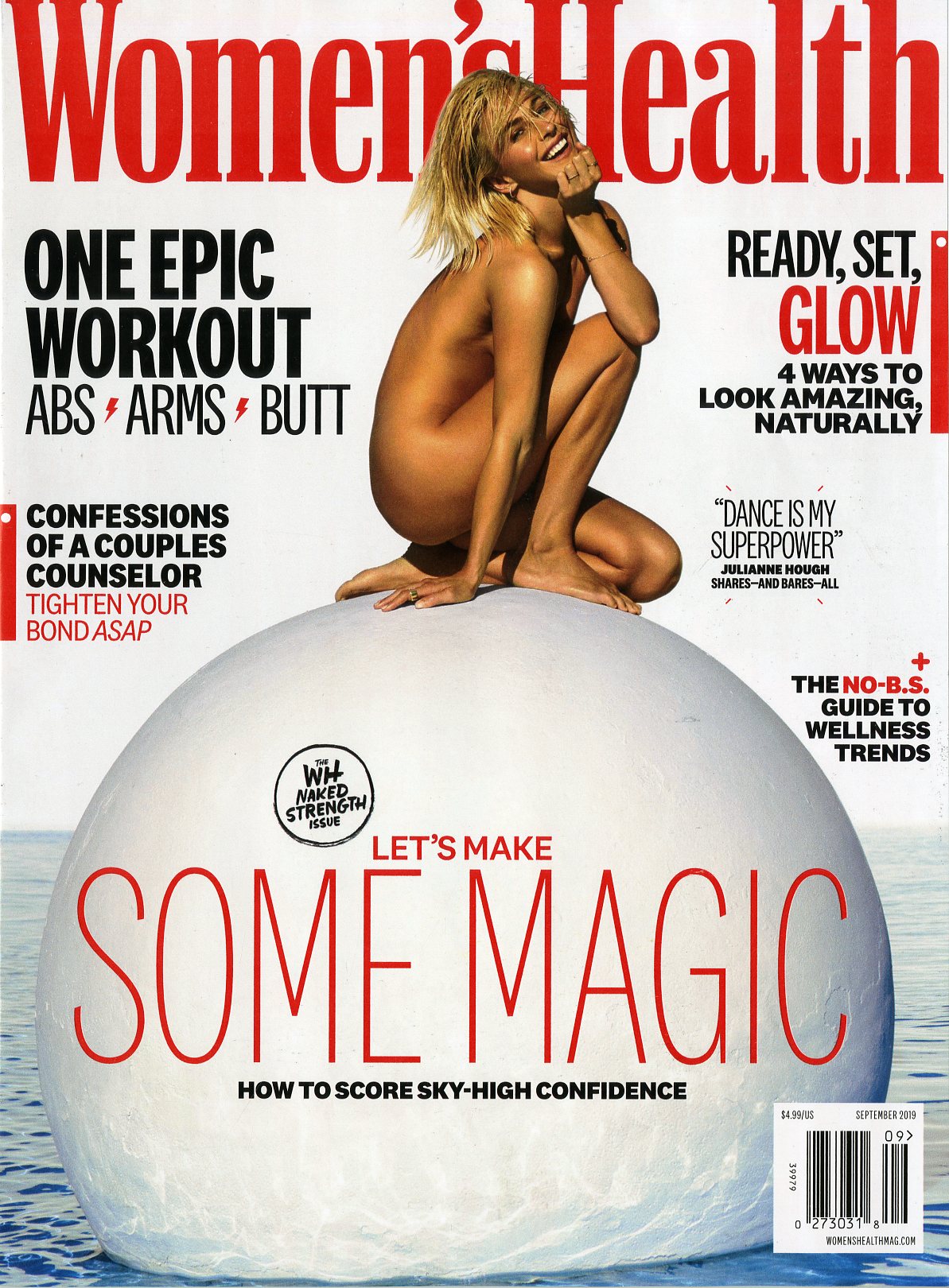
h1

77 New Titles Launched In The First Six Months Of 2019… The Mr. Magazine™ Launch Monitor

July 1, 2019

Continuing the normal trend of one year up – one year down, the first six months of 2019 show a slight decrease in new magazine titles. We have 77 new magazines for the first half of 2019 versus 105 titles for the first half of 2018. So, the year has begun with a deficit of 28 titles in comparison to last year. However, negativity does not belong on our radar when it comes to print, just the facts. And the slight decrease in the numbers reflects only those facts, no predictions. Because of course if Mr. Magazine™ is looking into his crystal ball, the future of print looks bright indeed. Always has, always will.

And while the numbers may be a bit short in comparison to last year, the creativity and innovation certainly wasn’t lacking. June 2019 gave us a new title that could fit into a cassette player, that is, if it wasn’t ink on paper. Day + Night is an intriguing look at the city of New York in the daytime on “Side A” and then flip the cassette-sized magazine over and on “Side B” you can visit New York at night. The minds of magazine makers are amazing! Welcome Day + Night!

PRINT IS DEAD. LONG LIVE PRINT.

This statement is on the RQ website. This new Philly-born title is one part magazine, one part collaborative art project, and one part social experiment. Publisher and Editor-in-Chief Heather Shayne Blakeslee says that this new magazine offers you insightful and provocative essays, profiles of local makers and artists, cultural criticism, fiction, poetry, and carefully-curated recommendations for getting the most out of life in Philadelphia—including a cocktail or dinner recipe here and there—all in a beautifully designed and printed magazine you can hold in your hands and settle down with on a Sunday afternoon, or argue over at Thursday night happy hour. And Mr. Magazine™ is thrilled to welcome RQ to the fold.

So, as we gear up for another long, hot summer, get ready for a Jumping July as the new titles are already lining up at the newsstands. But until then, please enjoy our beautiful June covers.

And as always, Mr. Magazine™ will see you at the newsstands…

******And please remember, if Mr. Magazine™ can’t physically hold, touch and purchase the magazine, it does not enter the monthly counts. And counts now include only the titles with a regular frequency that are either new, first-seen on Mr. Magazine’s™ radar, or arriving to the national newsstands for the first time.

h1

Sweet Jane Magazine: Empowering Women Through Cannabis & Removing The Stigma Of Its Use – The Mr. Magazine™ Interview With Katy Ibsen, Publisher & Editor…

June 25, 2019

“I’m an optimist no matter what. I think people are overwhelmed with the constant connectivity that we have today. So even from a basic city, regional magazine in a community of 80,000 to a national print magazine about cannabis and women, it’s an experience that allows you to step away from technology. What’s old is new again sometimes, and I believe we’re seeing a resurgence of print in many ways because people feel like it’s a different experience that they’re not getting elsewhere.” Katy Ibsen…

A Mr. Magazine™ Launch Story…

In today’s magazine marketplace there is a wide variety of titles focusing on the still controversial world of the cannabis industry. From cooking with it to the best way to grow it, the highly-touted green herb has made a wide footprint in the printed space. But Sweet Jane, a new magazine that is all about cannabis, yet zeroes in on women and mothers in particular, strives to remove the stigma that is still attached to smoking, eating, or using the plant in general, making it clear that health and wellbeing is the focal point for the title.

Katy Ibsen is the publisher and editor of the magazine and the driving force behind the title’s mission. Katy believes that cannabis can and should be used by women and mothers for their physical and emotional wellbeing. Sharing the benefits of the plant is what Katy says is the vital message of Sweet Jane.

I spoke with Katy recently and she talked about the fact that our society seems to have no problem with mothers drinking wine for relaxation, yet smoking a joint would automatically make that same mother a bad parent in many social sets. The stigma attached to cannabis is very real and Katy says that Sweet Jane strives to bring greater understanding and acceptance of the plant to people across the country.

It was a very eye-opening conversation and deeply honest, and Mr. Magazine™ thoroughly enjoyed it. And I hope that you do as well. And now the Mr. Magazine™ interview with Katy Ibsen, publisher and editor, Sweet Jane magazine.

But first the sound-bites:

On the concept of Sweet Jane: Sweet Jane is a publication that empowers women through cannabis. As legalization, both medical and adult use, continues to occur across the country and individuals begin to experiment, I really felt like there was a lack of education, and a need for any sort of product, whether that be a magazine or a website, in my opinion, that really helps people feel comfortable approaching cannabis and to not feel stigmatized, and to have somewhere they could ask the right questions, even if they felt taboo. So, we wanted to create a magazine that helped people answer those questions and learn more at their own pace and in their own comfortable space.

On why she felt that she needed a print publication in this digital age: Well for one I love print; my background is in print publishing. I worked with city, regionals and tourism publications for most of my career. I think once you start publishing print, it’s hard to ever walk away from it. But the cannabis industry is kind of unique, where a lot of my research into how companies are able to approach their consumers showed that the online aspect was becoming more and more difficult. Cannabis is still a Schedule 1 drug in the Federal Government’s eyes, so because of that platforms like Facebook and Google, Instagram and Twitter have limitations of drug-related content. For example, the National Cannabis Industry Association had indicated that they even struggled publishing certain lobbying events because it’s related to cannabis and marijuana.

 On why she thinks cannabis magazines that elevate women are now becoming so prominent: I think that what we’re seeing is females happen to be one of the larger market segments who are consuming cannabis. Some have even gone as far to say that soccer moms are the largest demographic right behind baby boomers. So, right away we know that if a publication is going to be particularly successful, it’s probably going to want to appeal to women. And I think in a non-direct way people are not as comfortable accepting that a woman or a mother would consume cannabis for either recreational purposes or for anxiety or depression, pain or inflammation. There still seems to be a struggle accepting that. And I have many friends across the country who have indicated that and wanted to see something that helps them feel more comfortable talking about it.

On the genesis of the name, Sweet Jane: Originally it was a song by Lou Reed and the Velvet Underground, which they covered in the ‘70s. And it’s been in my rotation for a while. I wish that I could tell you that there was a little bit more inspiration behind it, but it really came from the song. And the song’s lyrics actually play a part because as parents and as women we’re trying to make ends meet. The Jane hook is obviously “Mary Jane,” but the Sweet Jane came from the song and its lyrics. But in my opinion the name provided a softness for it to be a feminine magazine. We are talking to women and to mothers.

On what “high” she hopes Sweet Jane will have reached in a year: I think greater acceptance of female and parent use of cannabis. We’re seeing more and more of the conversation about the debate of what’s more appropriate, a mother drinking a lot of wine and thinking that’s okay, that it’s very much a “Mommy Juice” or “Mommy Wine” culture and it is more accepted in our society. But if you see a mother smoke a joint, she’s a bad mom, potentially risking the wellbeing of her child. And that all stems from ignorance.

On what she believes the future of print is: I’m an optimist no matter what. I think people are overwhelmed with the constant connectivity that we have today. So, even from a basic city, regional magazine in a community of 80,000 to a national print magazine about cannabis and women, it’s an experience that allows you to step away from technology. What’s old is new again sometimes, and I believe we’re seeing a resurgence of print in many ways because people feel like it’s a different experience that they’re not getting elsewhere.

On how she decided on $5.99 for a cover price: It goes back to what you asked earlier: what do we want to achieve in five years. And that’s greater acceptance of the female and mother use of cannabis for their own wellbeing. So if I price my magazine at a price point where maybe a middle or lower income mother can’t afford it, then I’m not really achieving that mission. The access to it is greater if I have a manageable cover price that a woman can say, I can buy this magazine because all of this information is relevant to me and I can keep this magazine and reference it many times for a small price of $5.99, which is still a significant price for a lot of people. So, we wanted to make sure that it was as accessible as possible.

On what her plans are for the frequency: I’ve always felt that a four times per year frequency is good. Again, for justification of the reasons, the connectivity, people making time for a print product; all of that. I think publishing more than that can be costly and maybe not necessary. Currently we’re twice a year for 2019/2020. We’re hoping to increase our frequency to four times a year in 2021. We’re underwritten by advertising and our newsstand and cover price sales. We’ve built a very lean business model financially to continue the project through 2020 in hopes that we will increase our advertising enough to move to four times per year.

On anything she’d like to add: The other thing that I think is just really fascinating about the cannabis industry is that it has more opportunities for women. And states that don’t have any form of legalization yet aren’t seeing that, but I think just in general, a lot of the innovation that comes with cannabis is advancing a lot of industries, not just print publications. As we continue to see these magazines pop up and we’re very proud to be one of them, across the board greater acceptance of cannabis might actually become a reality. Putting our necks out there, Kitchen Toke, MJ, and many others that are also in the legacy of High Tines, my hope is that we are a small step toward greater acceptance and greater legalization. And I’m using my journalism background to do that.

On the biggest misconception people have about her: I lost my publishing job two years ago to take a sabbatical and spend time with my husband and start a family. And I knew at some point I would start a new project. Honestly, I don’t think that I would be pursuing a print publication if it weren’t in cannabis because of the opportunity that the print platform provides for the industry and for its consumers. And I think trying to explain that to people was challenging at times.

On what someone would find her doing if they showed up unexpectedly one evening at her home: To be completely clear, I live in a prohibition state, so I don’t have legal access to cannabis. So while I have experienced cannabis in my life and I currently use CBD for wellness, you wouldn’t catch me smoking a joint because I legally cannot. But you would catch me either running with my daughter  or enjoying a glass wine, because I still do that with my husband. And listening to some music, watching her play and grow. My daughter will be one soon. We laugh that I had a baby in a year and I had a magazine in a year. (Laughs) I only had one birth, but it feels like two. So, when I get the chance to just sit down and catch my breath, I take full advantage of that with my family.

On what keeps her up at night: I’m building a business and Sweet Jane is the largest piece of that pie. But I still service a lot of publishing clients; I do a lot of contract editing and publishing consulting and so, if anything, what keeps me up at night is how to get it all done. I am the primary child-caregiver in my house, so I balance everything that I do while raising my daughter. And it’s hard at times and things fall through the cracks, but I think what’s keeping me up at night is what’s the next priority and how do we accomplish that.

And now the lightly edited transcript of the Mr. Magazine™ interview with Katy Ibsen, publisher and editor, Sweet Jane magazine.

Samir Husni: Tell me about the concept of Sweet Jane.

Katy Ibsen: Sweet Jane is a publication that empowers women through cannabis. As legalization, both medical and adult use, continues to occur across the country and individuals begin to experiment, I really felt like there was a lack of education, and a need for any sort of product, whether that be a magazine or a website, in my opinion, that really helps people feel comfortable approaching cannabis and to not feel stigmatized, and to have somewhere they could ask the right questions, even if they felt taboo. So, we wanted to create a magazine that helped people answer those questions and learn more at their own pace and in their own comfortable space.

Cannabis comes with a lot of taboo stuff. And because of that I think we find that people aren’t comfortable talking about it; they’re not comfortable searching certain terms or asking other people about it, especially if they happen to live in a prohibition state. And by creating a magazine, a print magazine, that was a way that we could help people get that information and consume it however they wanted to.

Samir Husni: Why did you feel that you needed a printed edition in this digital age?

Katy Ibsen: Well for one I love print; my background is in print publishing. I worked with city, regionals and tourism publications for most of my career. I think once you start publishing print, it’s hard to ever walk away from it. But the cannabis industry is kind of unique, where a lot of my research into how companies are able to approach their consumers showed that the online aspect was becoming more and more difficult. Cannabis is still a Schedule 1 drug in the Federal Government’s eyes, so because of that platforms like Facebook and Google, Instagram and Twitter have limitations of drug-related content. For example, the National Cannabis Industry Association had indicated that they even struggled publishing certain lobbying events because it’s related to cannabis and marijuana.

But because of that there’s actually a little bit of  a print resurgence in the cannabis industry because they are limited in digital ways to reach consumers. It kind of created a good opportunity to actually use print.

Samir Husni: Suddenly, it went from one magazine, such as High Times, to a host of magazines about cannabis. At last count, I was up to 22 different titles. Why do you think cannabis magazines that elevate women are now becoming so prominent? We have had MJ Lifestyle, which elevates the feminine voice in cannabis and its culture; we have had Broccoli: Kitchen Toke; is that a unique selling feature of the magazine, aiming at cannabis and women? Or what’s the difference between cannabis and “people” and cannabis and “women?”

Katy Ibsen: That’s a great question and all of those publications that you named are phenomenal and founded by women. I think that what we’re seeing is females happen to be one of the larger market segments who are consuming cannabis. Some have even gone as far to say that soccer moms are the largest demographic right behind baby boomers. So, right away we know that if a publication is going to be particularly successful, it’s probably going to want to appeal to women.

And I think in a non-direct way people are not as comfortable accepting that a woman or a mother would consume cannabis for either recreational purposes or for anxiety or depression, pain or inflammation. There still seems to be a struggle accepting that. And I have many friends across the country who have indicated that and wanted to see something that helps them feel more comfortable talking about it.

Broccoli, Kitchen Toke, MJ Lifestyle are all perfect examples of advancing that conversation, but Sweet Jane’s differentiation is that we are focusing on the parenting/mother aspect of it, as well as the educational aspect. So, while we certainly profile women who are doing unique things, or things that are happening in the industry, we’re also trying to provide a healthy dose of really basic education that has been vetted and is from professionals who can help new cannabis users learn how to incorporate cannabis into their lives should they choose to.

And I think that’s something that really gets overlooked, especially as the legalization continues to happen and is even happening in the Midwest. Illinois just went recreational, Missouri has Amendment 2, which is the implementation of their medical program, Oklahoma went medical a year ago. And so you have a lot of Midwesterners, and especially, we’ll just say suburban housewives, who are curious, but don’t know what to do to start to incorporate it or even research or understand it.  And as those states start legalization, their staffs and individuals that are working in dispensaries will also have a learning curve about how they talk to consumers about cannabis.

We’re hoping to be a support and an intersect there to help women feel comfortable going into that dispensary in the Midwest or wherever the next legal state is going to be and asking the right questions to make sure they get the right product to have the best cannabis experience for whatever they’re wanting to use it for.

Samir Husni: And when you said the magazine provides a “healthy dose,” there’s no pun intended, right? (Laughs)

Katy Ibsen: (Laughs too) No pun intended. It seems basic, but some women would probably prefer to use a vape pen or an edible, but those are two very different experiences. And so we want to help them understand what those experiences are before they just blindly try it and have a really poor experience and decide that cannabis isn’t right for them or that plant medicine isn’t something that they believe will help them.

Samir Husni: Tell me about the genesis of the name, Sweet Jane.

Katy Ibsen: Originally it was a song by Lou Reed and the Velvet Underground, which they covered in the ‘70s. And it’s been in my rotation for a while. I wish that I could tell you that there was a little bit more inspiration behind it, but it really came from the song. And the song’s lyrics actually play a part because as parents and as women we’re trying to make ends meet. The Jane hook is obviously “Mary Jane,” but the Sweet Jane came from the song and its lyrics. But in my opinion the name provided a softness for it to be a feminine magazine. We are talking to women and to mothers.

But anybody who knows Lou Reed and the Velvet Underground is attracted to the name. We have had many compliments on it from middle-aged men. (Laughs) So, saying it’s specific to just women maybe isn’t the case, it’s specific to a couple different spaces. It works because ultimately, while we’re appealing to women, a lot of the content that we’re incorporating is gender neutral. Everybody needs to know the difference between flowers, concentrates, vaporizers and edibles. It’s not necessarily specific to women, albeit women may have a different reaction than men. But the information is basic in its form for all genders.

Samir Husni: If I ask you to put your futuristic hat on for a moment and you and I are having this conversation a year from now, what would you hope to tell me Sweet Jane has accomplished in that year? What “high” will Sweet Jane have reached a year from now?

Katy Ibsen: I think greater acceptance of female and parent use of cannabis. We’re seeing more and more of the conversation about the debate of what’s more appropriate, a mother drinking a lot of wine and thinking that’s okay, that it’s very much a “Mommy Juice” or “Mommy Wine” culture and it is more accepted in our society. But if you see a mother smoke a joint, she’s a bad mom, potentially risking the wellbeing of her child. And that all stems from ignorance.

If we at Sweet Jane, in the company of Kitchen Toke, Broccoli and MJ Lifestyle can show that cannabis is actually a very safe alternative, it’s a healthy alternative with less consequences than drinking. And I think the research is coming out more and more to prove that. So if we can help achieve conversations and greater acceptance then I think we’re on a path to success five years from now.

Samir Husni: You mentioned earlier that because of the subject matter you feel there is a resurgence for print with cannabis-related topics, but what do you think the future of print is?

Katy Ibsen: I’m an optimist no matter what. I think people are overwhelmed with the constant connectivity that we have today. So even from a basic city, regional magazine in a community of 80,000 to a national print magazine about cannabis and women, it’s an experience that allows you to step away from technology. What’s old is new again sometimes, and I believe we’re seeing a resurgence of print in many ways because people feel like it’s a different experience that they’re not getting elsewhere.

And there are examples of other individuals, entrepreneurs or publishers seeing a need for somebody to want to be involved in this niche and be engaged with it in this form versus a digital form. And with supporters like Barnes & Noble who are taking a risk on these publications and giving them an outlet to be consumed, there’s potential for it to keep growing. If we put content in our publication that people can’t find anywhere else then there’s a reason for people to seek out our print product. So, I think there’s a future.

Samir Husni: When I look at the cover price of all of your competitors, you’re at $5.99 and they’re at $18 and $20 an issue. How did you reach the decision to charge $5.99 per issue?

Katy Ibsen: Well, it goes back to what you asked earlier: what do we want to achieve in five years. And that’s greater acceptance of the female and mother use of cannabis for their own wellbeing. So if I price my magazine at a price point where maybe a middle or lower income mother can’t afford it, then I’m not really achieving that mission. The access to it is greater if I have a manageable cover price that a woman can say, I can buy this magazine because all of this information is relevant to me and I can keep this magazine and reference it many times for a small price of $5.99, which is still a significant price for a lot of people. So, we wanted to make sure that it was as accessible as possible.

Samir Husni: Your next issue is coming out in November. Are you starting as a quarterly or plans to move to six times per year? What are your plans for the frequency?

Katy Ibsen: I’ve always felt that a four times per year frequency is good. Again, for justification of the reasons, the connectivity, people making time for a print product; all of that. I think publishing more than that can be costly and maybe not necessary. Currently we’re twice a year for 2019/2020. We’re hoping to increase our frequency to four times a year in 2021. We’re underwritten by advertising and our newsstand and cover price sales. We’ve built a very lean business model financially to continue the project through 2020 in hopes that we will increase our advertising enough to move to four times per year.

Samir Husni: Is there anything you’d like to add?

Katy Ibsen: The other thing that I think is just really fascinating about the cannabis industry is that it has more opportunities for women. And states that don’t have any form of legalization yet aren’t seeing that, but I think just in general, a lot of the innovation that comes with cannabis is advancing a lot of industries, not just print publications. As we continue to see these magazines pop up and we’re very proud to be one of them, across the board greater acceptance of cannabis might actually become a reality. Putting our necks out there, Kitchen Toke, MJ, and many others that are also in the legacy of High Tines, my hope is that we are a small step toward greater acceptance and greater legalization. And I’m using my journalism background to do that.

Samir Husni: When you told people you were doing this, that you were launching this magazine, what was the biggest misconception they had about you?

Katy Ibsen: That’s a great question. I lost my publishing job two years ago to take a sabbatical and spend time with my husband and start a family. And I knew at some point I would start a new project. Honestly, I don’t think that I would be pursuing a print publication if it weren’t in cannabis because of the opportunity that the print platform provides for the industry and for its consumers. And I think trying to explain that to people was challenging at times.

And not necessarily because of their ignorance, but because they would look at me like, why would you do a print magazine? Aren’t those dying? (Laughs) Then they’d say, what are you going to write about with cannabis? There’s not a whole lot to it, but they’d come to find that there’s a great deal to it. And if we don’t educate the ignorance continues. Or if we don’t use our voice to help with criminal justice reform, then legalization continues to create a lot of social injustices.

So, we had, and my family had, an opportunity to shift that conversation. And I think we’re seeing it happen more and more and now people see it. Those who have loved the magazine since it’s been out have given us great feedback and they’ve been extremely complimentary.

My graphic designer and I laughed a little bit that we were some craft between The New Yorker and Real Simple, because we felt that the magazine was wordy, but it was a lot of useful, do-it-yourself information for cannabis. And people want to use cannabis. And the biggest compliment that people keeping saying is how beautiful the magazine is. (Laughs) We’re happy we achieved that, but our mission was ultimately that they walk away with more power based on the knowledge they learned from it. It’s a good bonus that they think it’s beautiful as well.

Samir Husni: If I showed up unexpectedly at your home one evening after work, what would I find you doing? Smoking a joint; having a glass of wine; reading a magazine; cooking; watching TV; or something else? How do you unwind?

Katy Ibsen: To be completely clear, I live in a prohibition state, so I don’t have legal access to cannabis. So while I have experienced cannabis in my life and I currently use CBD for wellness, you wouldn’t catch me smoking a joint because I legally cannot. But you would catch me either running with my daughter  or enjoying a glass wine, because I still do that with my husband. And listening to some music, watching her play and grow. My daughter will be one soon. We laugh that I had a baby in a year and I had a magazine in a year. (Laughs) I only had one birth, but it feels like two. So, when I get the chance to just sit down and catch my breath, I take full advantage of that with my family.

Samir Husni: My typical last question; what keeps you up at night?

Katy Ibsen: (Laughs) I’m building a business and Sweet Jane is the largest piece of that pie. But I still service a lot of publishing clients; I do a lot of contract editing and publishing consulting and so, if anything, what keeps me up at night is how to get it all done. I am the primary child-caregiver in my house, so I balance everything that I do while raising my daughter. And it’s hard at times and things fall through the cracks, but I think what’s keeping me up at night is what’s the next priority and how do we accomplish that.

Samir Husni: Thank you.