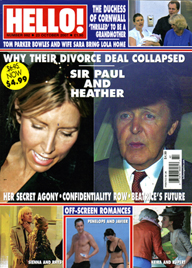
In the midst of the gossip weeklies raising their cover prices (In Touch and Life & Style from $1.99 to $2.99, and US from $3.49 to $3.99) the British import HELLO! is just doing the opposite by decreasing its American cover price from $6.95 to $4.99. This is the second time the British magazine seems to test the waters for a launch in the USA. Back in the late 80s HELLO! ran a full page ad in The New York Times offering a free sample issue of the magazine. Based on the response to that ad, the powers at HELLO! opted not to launch the magazine in the USA. But now, with OK doing better than expected and the gossip market still going strong, it looks as if HELLO! is testing the USA waters one more time. The magazine that had a limited distribution in the USA is now more widely distributed with an added yellow circle promoting the new reduced American price. Is the USA ready to welcome HELLO!? Wait and see is the name of the game for now. Keep your greetings and enjoy the British editions for now…

Is HELLO! testing the waters for a USA launch?
November 5, 2007Lessons we can learn from Finland…
November 3, 2007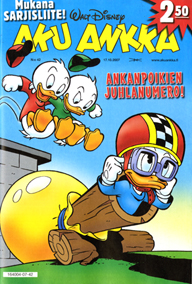
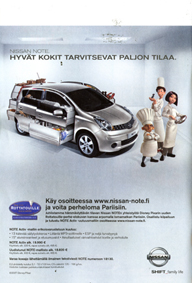
I just came back from a week’s visit to Helsinki where I was conducting seminars and workshops with the staff of several magazines published by Sanoma Magazines Finland. One magazine stopped me in my tracks: Aku Ankka, which simply means Donald Duck. The weekly magazine has a circulation of over 320,000 and a readership of over one million in a country of five million. It is the best known media brand in Finland and is read by almost one fifth of the population. What stopped me more than the statistics is the cover price. The magazine sells normally for two Euros, but when they have any special supplement or extra pages they cross the two Euros and have a big star burst with the higher cover price of two fifty…yes, they highlight the higher cover price. Talk about dedicated readership. Just the opposite of what we do in the States where we highlight the lower cover prices not the higher. Another surprise with Aku Ankka is the ads the magazine carries: automotive, yes automotive. Just look at the picture of the back cover above. So, the first lesson I have learned from Finland on this trip is very simple: create an addictive content for a magazine, even a comic magazine, and people will pay for the content. It is the content that people pay for and the more you give them the more they will pay. If you are in the business of selling content you do not have to fear raising your cover price.
New Magazine Launches: A hot, very hot October follows the cold, very cold September…
November 1, 2007The October numbers of new magazine launches are in and they are the highest of any month this year. Wow, what a month after a very cold and lousy September. It brought back memories from the “father of magazine launches” John Mack Carter who once told me “October is the best time to launch a magazine.” Well 96 magazines listened to John’s advice and launched in the month of October. You can see each and every one of them if you click here. Sorry prophets of doom and gloom who have used my numbers for September as a stepping-stone to mourn the death of print yet one more time. So, recapping the October numbers, a total of 96 new titles were launched compared to that of 94 last October bringing the number of new magazines so far to 571 which is short of the 866 new titles launched in the same period of 2006. The overall number of new titles launched with a frequency of four times or above so far this year has reached 197 compared to that of 288 for the same reporting period of 2006. For a complete list and images of all the new titles of 2007 so far click here.
Saving Reader’s Digest…take three
October 31, 2007A brief, but interesting report on the current changes at Reader’s Digest is in today’s mediabistro.com: FishbowlNY. The headline and the opening paragraph follows:
Big Changes at Reader’s Digest
Since February’s takeover of Reader’s Digest Association by the private equity firm Ripplewood Holdings, the 85-year old company has undergone many changes. Mary Berner was named President and CEO. In March, Eva Dillon was named President. Jeff Wellington was named publisher at the end of September. And last month, Bill Beaman left as Reader’s Digest Washington Bureau Chief to become EIC of Campaigns and Elections.
To read the entire article click here.
As a side bar for the article mediabistro.com: FishbowlNY interviewed me via e mail on my take on the changes at Reader’s Digest. The headline and the opening paragraph follows:
“Mr. Magazine” on the New Reader’s Digest
”Mr. Magazine” Samir Husni is the Chair of the Journalism Department at the University of Mississippi, and, in his spare time, a dedicated blogger on the subject of magazines. Dr. Husni has been critical of the direction Reader’s Digest has been veering in under the leadership of Jacqueline Leo. This past July, after sinus surgery, Dr. Husni — stirred by the connection with DeWitt Wallace, who conceived of RD in a hospital — blogged a critique of the new magazine.
To read the entire interview click here.
A great future for newspapers
October 30, 2007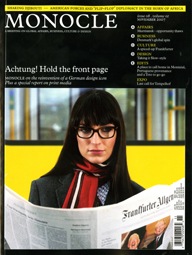
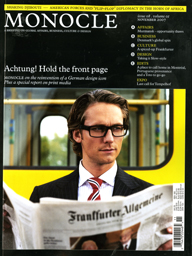
Yes, you’ve read that right. There is a great future for newspapers and you do not have to take my word for it. Just read the cover story and look at the numbers published in the November issue of Monocle, Tyler Brulé’s one-year old British magazine. Brulé writes in his preface, “Print media might be faced with some serious challenges but it’s time to stop calling its relevance into question — that goes to newspapers too. In many markets the humble daily has never looked so good, in others there’s a bit of work to be done…” Monocle offers a three part package on the future of newspapers including a look at the redesign of the leading German newspaper Frankfurter Allgemeine Zeitung, a review of “the next best thing” the Dutch newspaper NRC Next, and a look into the future of newspapers. In addition to the three parts, Monocle sums the facts on newspapers from the World Association of Newspapers. Some of those facts:
1. There has been an explosion in the number of new titles, and now a record 11,000 daily papers are produced worldwide.
2. Global newspaper circulation is up almost 10 percent over the past five years.
3. Over 550 million people globally buy one every day.
A summary of this package will not give justice to this great series of stories, so try to get yourself a copy of the November issue of Monocle. It is worth every penny of your $10. I bought the magazine in Amsterdam on my way from a week of work in Finland. It was the best reading on the plane that I’ve done in a long time. One of the best quotes I have read in the article was by Jan Paul van der Wijk the chief of design for NRC Next, “News is free, but information is not — we tell people the news but do more with it.” Visit Monocle here or order a copy of the magazine at www.universalnewsondemand.com
“The more things change, the more they stay the same,” and other words of wisdom from Bruce Brandfon, VP and Publisher of Scientific American
October 21, 2007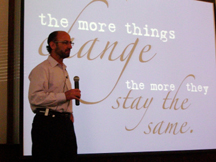
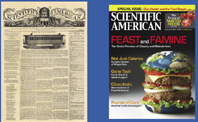 During a recent speech to The University of Mississippi journalism students, Bruce Brandfon, VP and Publisher of Scientific American, the oldest continuously published magazine (since 1845) in the United States, asked the question “Who is a journalist?” He answered his own question Who is a journalist by the following:
“A journalist is someone who engages the intellectual and emotional lives of others, and has a profound effect on them.”
Mr. Brandfon gave several examples of whom he considers journalists: Matthew Brady’s Civil War Photography, David Halberstam on Vietnam, Woodward and Bernstein exposing Watergate, eyewitness accounts of 9/11, and Ko Htike’s blog on the Myanmar protests.” Other remarks he made:
“Outlets for journalism come in and out of fashion. Some media have staying power because they always look ahead, rather than clinging to passing trends. Unlike good journalism, which is timeless, some things disappear and we don’t miss them, because they’re replaced by something better…however, some things never go out of style:
Truth,
Conviction,
Ideas,
Creativity,
Intelligence,
Insight,
Courage,
Optimism,
and Passion for a great story.
The aforementioned journalist had them and “we like to think Scientific American has them too…”
Mr. Brandfon, we agree on all of the above, including the fact that Scientific American has all of the above and a little bit more…thanks for a great speech and the many words of wisdom that we all need. Your speech’s title said it all, “the more things change, the more they stay the same.” Yes indeed.
The media changing landscape according to Kevin McKean, VP and Editorial Director of Consumer Reports
October 17, 2007
Kevin McKean, vice-president and editorial director of Consumer Union’s Consumer Reports, met with students last week as part of the 23rd annual Journalism Week, sponsored by the Ole Miss Department of Journalism. Although the landscape of the media is changing and will continue to change at an ever increasing pace, McKean made it clear that this does not signal the demise of the industry we know; but instead, shows a shift in the way we make our products relevant. As I have always said, change is the one constant in life. Below are the five points Kevin put forth of the changing landscape of the industry and what we must know to succeed in the industry.
1) There is an historic shift in media habits.
• Audiences have been migrating to electronic delivery for the information they desire. This has been going on for more than 10 years already, and is still going strong.2) Advertisers chase their audience.
• It may have taken them years to figure out that their audience was migrating online and away from the printed pages, but now that advertisers see this shift, they are deserting traditional media to pursue their customers (as they should).3) As a result of this shift, traditional media are experiencing a squeeze.
• This squeeze is true for all media but it is most dramatically witnesses in print. And where the main squeeze was traditionally seen in newspapers, magazines are beginning to feel the tightening of their belts as well.
• The root cause of this “disease” is that print ad revenue is declining. While print ad revenue declines, online revenue is growing. This growth may be with high percentages but is seen across a much smaller base. The net result of all these points is a drop in overall revenue of 50% or more.
• But there are other common symptoms that can be seen in the industry: Circulation numbers are down, newsstand sales are continuing on a 15-year slide, newsstand costs have been slowly creeping up, there is a movement of cost-shifting to publishers, direct mail response rates have steadily declined, subscription pricing has dramatically lowered, there have been layoffs, cutbacks, satellite office closings, fewer perks being offered and more.4) Online media is growing.
• We are seeing growth in the online staff numbers at traditional outlets, and even more dramatic growth in newer, online-only media companies such as Gawker Media. This results in a huge opportunity for anyone starting out in this field.
• There is a resulting disruption of hiring patterns because it is much harder to hire good online journalists today than good print journalists – nearly as hard, for some positions, as
at the beginning of Bubble in late 1990s. The differentiation between print and online hires creates two classes of journalists with two salary structures.5) We have been witnessing the rise of the citizen-journalist.
• There are millions of amateur reporters around the world that provide low-quality & non-professional content, but have unbeatable timing and opportune locations. Recent examples include: Myanmar, Virginia Tech and Hurricane Katrina. Because of their timing and location, these citizen-journalists have the ability to compete with professional journalists, and not just in news …
And when it comes to the user generated content Kevin had this advice to give…
• It is increasingly important that professional journalists not only use UGC as a source, but that they actively promote its creation in order to serve their audience.
• The aim must be to create “content” not blather.
Words of wisdom from someone who knows what it means to develop content and sell it both in print and on line without a single ad. As I have mentioned many times before on this blog, unless we change the model by which we sell content to our readers and customers, we are not going to have a happy ending…we must be in the business of selling content to customers who count and not in the business of counting customers.
The picture above is for Kevin McKean with one of UM’s journalism majors Meghan Blalock.
New Magazine Launches: A cold, a very cold September…
October 16, 2007The September numbers of new magazine launches are in and they match those of the two coldest months of new magazine launches this year: February and July. A total of only 32 new titles were launched in September compared to that of 91 last September bringing the number of new magazines so far to 475 which is way short of the 772 new titles launched in the same period of 2006. Any good news reported last month disappeared with almost two thirds less new magazine launches last month. The overall number of new titles launched with a frequency of four times or above so far this year has reached 169 compared to that of 250 for the same reporting period of 2006. For a complete list and images of all the new titles of 2007 so far click here.
On publishing well…great advice from David Carey
October 12, 2007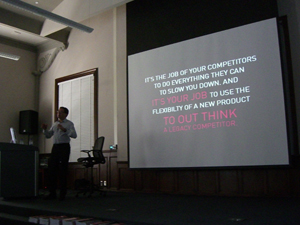
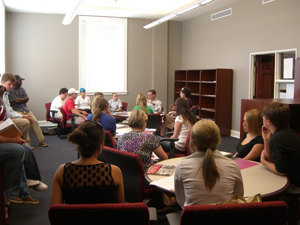
15 years and four magazines later David Carey, one of three group presidents at Condé Nast and publisher of Condé Nast Portfolio, has seen the good, the bad and the ugly in magazine publishing. Carey who spoke at the University of Mississippi Department of Journalism‘s 23rd annual Journalism Week recalled his publishing career from the early days at Esquire to the latest launch of CN Portfolio. One word sums it all: passion. And it showed during his presentation and later during his discussions with the magazine students at Ole Miss. In a world filled with people who see the glass half empty, Carey sees it half full. He challenged the students (and future magazine publishers) to:
1. Go outside your comfort zone,
2. The industry is at an inflection point,
3. It’s the job of our competitors to do everything they can to slow you down. And it is your job to use the flexibility of a new product to out think a legacy competitor,
4. You have to have the confidence to hit the re-set button then hold on,
5. Trust your intuition, and
6. Stay very close to your audience and learn how to engage them in new ways.
In short, Carey told the students, “to succeed in this business you have to:
1. Trust your intuition.
2. Learn to ignore conventional wisdom.
3. Discover the most soul-satisfying moments of your career.”
Why should future publishers listen to David Carey? Well he has a 4 – 0 record with the magazines he held the publisher title at. He succeeded in 1991 with Smart Money, later he hit the reset button on both House & Garden and The New Yorker, and now he is the “talk of the town” with Condé Nast Portfolio. Carey’s visit to Ole Miss and his candid discussions with the students was a breath of fresh air from a magazine publisher who is not only passionate about the magazine business, but also “gives a hoot” about this business.
On writing well…Great advice from Peter Jacobi
October 8, 2007Peter Jacobi is a household name when in comes to magazine editing and writing. The professor emeritus at The University of Indiana is probably more famous than the former basketball coach Bobby Knight (well, at least in the magazine circles). I had the pleasure to meet Professor Jacobi in person for the first time at the first children’s magazine editors retreat at Boyds Mill home of the founders of Highlights for Children magazine. We both spoke at the retreat. He talked about writing and I talked about publishing. What follows is Professor Jacobi’s advice regarding successful writing:
To be a successful writer your article must have:
1. The invitation: the lead or the initial tease; it should even hook the reluctant reader
2. The thesis: telling the reader what the article is all about, sort of an early summary. Perhaps a response to the readers expectations.
3. Purpose: the why it is for me “piece of writing.” It is an extended explanation of the purpose of the piece. The purpose must be made evident (another sales pitch).
4. Direction: you must have a sense of clear direction. Every point along the “verbal highway” must set the course… a crystal clear viewable course…you must write with a compass.
5. Propulsion: a sense of motion, going forward. Your writing must have actual movement with pulse and progress.
6. Memory: pleasure of reading should be followed by a sense of recalling. Good writing should give me “something to remember.”
In short, Professor Jacobi said, “the best writing supplies the ties that bind.” And no matter what, read your article aloud”…yes, Jacobi said, “read it aloud and see if it tells a story and keeps you connected.” Great advice from the master himself.


