Archive for the ‘News and Views’ Category

h1

Rethinking Newsstand Sales: Magazines, Money and Mobile Blinders*

August 21, 2013

Screen shot 2013-06-11 at 4.45.47 PM David Carey, president of Hearst Magazines, believes that people crave “spontaneous combustion” from their media purchases. “We live in this on-demand world,” Carey elaborates. “There’s nothing more satisfying than going to the newsstand, [browsing] by a subject area that you’re passionate about, and you literally own it right then. You take it home, and you get to devour it.”

Newsstand sales exceed $3 billion, and magazines are sold at more than 100,000 retail spaces across North America. Single-copy magazine sales are critical to the industry’s future prognosis. The newsstand, in its many retail manifestations, often provides insight into trends in magazine sales and how to best target magazine readers. The picture, however, is often bleak.

John Harrington is a partner in Harrington Associates, publisher of The New Single Copy newsletter and the annual Magazine Retail Sales Experience. “Newsstand, single copy, retail magazines – whatever you choose to call it – is sick,” Harrington affirms. “Sales are down more than 40% in five years, and the decline is continuing. Retail dollar sales . . . are below what they were in 1993. Beyond that, the wholesale level is financially distressed, and then some.”

Joe Berger of Joseph Berger Associates, a circulation marketing and consulting firm in Chicago, agrees with Harrington: “The present status of single copy sales in the U.S. is, at best, tenuous.” Much analysis about the declining vital stats of newsstand sales has revealed numerous contributing factors, and left publishers pondering if the trends are irreversible. Everyone from CEOs to copy editors can cite causes for the newsstand’s declining health, but few offer viable remedies. Yet a close look at some of the crucial issues related to newsstand sales points the way to a brighter outlook.

Disparity in Distribution

Luke Magerko is a 20-year publishing industry veteran who spent a number of years at Meredith Corporation and with wholesaler Independent Direct Distributors before his venture into the publishing arm. Most recently, he founded The Market Analytics Project, which compiles and interprets actionable data analytics for publishers, vendors and retailers.

The contemporary newsstand climate is “bleak,” according to Magerko.

“Retailers are reducing in-store magazine space due to rapid sales declines. Wholesalers continue to add small fees and adjust terms and conditions in the hope they can generate incremental revenues at publisher expense. Lastly, newsstand departments, national distributors, and consultants avoid industry challenges by blaming outside forces such as the debilitating 2008 recession and the Internet,” he confides.

“Sales have never recovered from the Great Recession,” according to Harrington. “But the biggest killer today is digital – not just the Internet or tablets, but the breadth of social media, the names of which I can’t even keep up with. Answers? I could become a rich man if I knew that, but how about finding new ways and places to display magazines? And I don’t mean putting cooking magazines in the produce section. I mean getting them where people are willing to spend money, like when they enter the store. By the time they get to the checkout, they’ve already spent their impulse money. I know it’s not that simple, but not much has changed with [magazine] merchandising and marketing for maybe 30 years.”

Merchandising and marketing in a new way could potentially have a big impact, but the industry must begin by controlling its own narrative, according to Joe Berger: “The first thing is perception and marginalization. The perception issue is that we are going away; we’re dinosaurs, and we have horrible press. We also seem to be our own worst enemy, because in the name of transparency we now trumpet our sales results on a quarterly basis, so news writers – who don’t really understand the business – can write articles about the ‘Continued Problems of the Newsstand: What Should Be Done!’

“The second issue seems to be simple economics,” Berger adds. “Each link in the distribution chain has a different measure for success. A publisher may break even at 35 percent, but a wholesaler may be deep in the hole at a 35-percent sell-through. The solution for the wholesaler is to try and sell more efficiently and revise the distribution to a lower, more efficient draw. That can even work on a national basis. But I have seen that strategy succeed, and I have seen it fail. Often we just see a lower draw and the same or even lower sell-through, even if the entire distribution is worked.”

Luke Magerko also notes that wholesalers face disparity challenges in the way they manage their magazine sales. “Wholesalers currently work under two separate business models,” Magerko explains. “According to the Point of Sale [POS] Panel at PBAA, 55 percent of magazines sales are recorded using retail POS data. Wholesalers pay national distributors, and by extension publishers, using the traditional debit/credit method (Draw – Return = Sale). This is inefficient, and wholesalers are financially damaged by this model.”

And Magerko concurs newsstand marketing needs an overhaul. “Checkout space is not being utilized to its fullest potential, and I believe there are specific titles, categories and formats not being represented. There needs to be a new mix at the checkout,” he explains.

Publishers need to manage their own expectations, he adds. “Publishers should evaluate every part of their newsstand supply chain using profitability, not sales, as the basis for their decisions.”

Mining for Better Data
Gil Brechtel is President and CEO of MagNet, which provides critical sales and marketing information to the publishing industry. As the man with his forefinger on the pulse of the industry’s newsstands, Brechtel offers particular insight and hope.

“Bookazine sales have increased during the last five years when the industry sales were suffering,” he notes, “and that’s certainly a positive. I think it says that consumers are prepared to spend money on good quality publications, even though they may be at a $10 cover price. I think it also says that the consumer is smart enough to realize, why buy a magazine at full price on the newsstand, when they can get it through subscription at a reduced price?”

Brechtel notes that because bookazines aren’t offered through subscription, consumers are accustomed to paying full cover price for them. He also notes the impact of celebrity-style publications slipping in popularity. “Celebrity categories represent 25 percent of the business,” Brechtel asserts, “and when those sales are down 12-13 percent a year; alone, they represent a two- to three-percent decline on the overall business. And I don’t see the celebrity titles turning around anytime soon, mainly because of social media and the Internet, and the fact that the fans of the celebrities appearing on the cover already know the information way before the consumer can read it in People magazine.”

“Good, quality publications are selling, but at the same time the overall business is tough on the people involved, mainly the wholesalers and the publishers who are looking at and focusing their attention on digital and social media and not on the newsstand,” Brechtel adds, “which means we’re not seeing as many good, quality launches as we would hope, that would sustain the business long-term.”

There’s also a big question of mobile blinders – the phenomenon by which consumers are involved with their mobile devices while standing in retail lines. This is time that used to be spent perusing magazine covers.

“We need to think about two things: One, those celebrity titles for the most part are weeklies, so they’re turning 52 times a year, and therefore generating revenues on every issue,” he explains. “But I think we do need to look at the checkout titles and determine their true profitability for the retailers, and perhaps we should be rotating some of these high-cover-priced specials through pockets up at the checkouts, so that they’re more visible to the consumer.”

Brechtel strongly believes the industry should work together more collaboratively – publishers, distributors, wholesalers, retailers – to glean new ways to drive sales, and not solely focus on cost reduction.

Newsstand & Subscription: A Healthy Codependency
Despite its diminishing appearance, the newsstand still represents a vital revenue vein for the publishing organization. “Newsstand remains a key factor in the launch of a new magazine,” according to Harrington. “It is also a valuable source of new subscriptions, and it is still profitable in itself.”

Joe Berger agrees that the newsstand can prove to be the perfect platform for new title launches. “The newsstand is still quite important,” he cautions. “As long as we have bricks-and-mortar retail, a newsstand is a good measure of how well your audience – presuming you have placement in the right locations – will respond to what you’ve published. Is there a link between single copy and subscriptions? Sadly, in our market, the link is that single copy is a loss leader and a marketing ploy for selling subscriptions. If there was more equity in pricing, we may see stronger newsstand sales. However, that genie has been out of the bottle for years.”

“Newsstand provides a great opportunity to understand customers better,” Magerko suggests. “My research indicates that newsstand is actually a leading indicator for each publishing department. Newsstand results can predict renewal rates for consumer marketing groups, provide feedback to editors because the main message is located on the magazine cover and consumers make a choice based on those messages. And lastly, through advanced text analytics and marketing analytics, a consumer marketing group should use cover results to determine the most effective message for direct mail.”

Steve Lacy, CEO, Meredith Corporation, is of the “all-platforms, all the time” school of thought. “I see an amazing opportunity to support the consumer – especially the Gen Y consumer that is very, very engaged,” Lacy confides. “As a cook, as a gardener, as a home enthusiast, she wants the print product for relaxation when she finally gets the kids in bed. She wants the digital property for taking action, and she wants the mobile property when she’s engaged at retail and ready to make a buy.”

The Good News
“Look, publishing is being challenged from a thousand directions,” Harrington affirms. “The primary response has been to expand into digital, but there needs to be a major effort to help newsstand. The wholesale level does not work under the current financial structure. It needs to be restructured before it collapses, and publishers have an even larger void to wallow around in.”

“Publishers need to reestablish their role in the supply chain and within their own newsstand departments,” suggests Luke Magerko. “The publisher is the second most important player in the supply chain behind the retailer. However, they have ceded their authority almost completely to members of the supply chain.” But publishers must remain diligent about the quality of the product they’re increasingly worried about disseminating.

Bob Sauerberg, president, Condé Nast, believes his company’s primary role today is in building brands. “Our strategy is to build brands, and our brands start with our magazines,” he expounds. “Print has never been more vital. The consumers tell us every day through all of our business channels, from subscriptions to retail, that they want print. They love it, and they are actually willing to pay more for it, which is an important part of our strategy in the long term.”

As CEO of Active Interest Media, Skip Zimbalist also remains bullish on print. “I’m very optimistic, and we see our audience in print as stable. We don’t see our audience as going down. . . . When television came in, people said it was the death of radio; well, radio is still here and doing very well, thank you. And I think print magazines are going to be here 20 years from now and doing very well, as well.”

MPA’s president and CEO Mary Berner has faith in the future of magazines – whether they’re distributed in print or electronically, as part of a subscription, or by way of a supermarket check-out line.

“I think we have key assets that are important in this wildly-competitive market,” she reminds industry colleagues. “And we’ve got brand relationships. People go and seek out the magazine brand,” Berner continues. “They go and look for Vogue or Cosmopolitan on every platform. So, that relationship with the consumer, I think, in this kind of digital explosion, is what’s going to be the most important.”

* The above article is a reprint of my article that appeared in the July/August issue of Publishing Executive magazine.

h1

The Saga of the American Newsstand: Newsstand Innovation Vs. Other Innovation in Media. The Man Who Wants to Save the Newsstand. Part Three of the Mr. Magazine™ Interview with Luke Magerko

August 19, 2013

Screen shot 2013-06-11 at 4.45.47 PM

A fair question: Are the innovations in the single copy sales of American magazines keeping up with the pace of the innovations in the electronic field? A fair answer, from a man who wants to save the newsstands, Luke Magerko, is a resounding NO. So, in this third part of my interviews with Luke about the newsstands I decided to look at a growing industry on the periphery of publishing. Working with Luke, we assembled a simple timeline of major innovations in personal digital assistants (remember those?) since 2000, focusing on the Blackberry, the smartphone, iPad and touch screen devices. These devices dominate our world and have legitimately decimated some and impacted other magazine categories, if not all magazine categories. (See the list at the end of this blog entry).


SO MY FIRST QUESTION TO LUKE WAS, WHY START WITH THE YEAR 2000?

In October 2000, Cathie Black, the former Hearst Magazines President, was quoted at the AMC Conference by the New Single Copy. She said: “[the industry must] make sure we really understand scan-based trading (“SBT”) before we implement it, and make sure that the system accepts new products.” The publishing industry has been stuck in this same operational morass for more than 4,500 days. The leaders of this industry should be embarrassed that this is still an issue.

WHY ARE YOU COMPARING PRINT TO ELECTRONICS?
I want publishers to focus on the concept of competition. For example, the Blackberry was an unrivaled success, and then competitors duplicated and enhanced similar products for customer satisfaction. Apple’s iPod and iPhone were unrivaled before Google Android and Samsung became power players. In this competitive set, each company tries to grow their business by outperforming each other.

WHAT ARE YOU ADDRESSING TODAY?
Publishers should ask its newsstand leadership, its wholesalers, and its consultants how they have tried to outperform each other at retail in the past two decades. Publishers are not going to like the answers they receive because they will hear a series of industry platitudes and excuses.

In the 1990s, publishers were told sales declines were caused by the expansion of gum, candy, salty snacks, and soda coolers at checkouts. The industry response was to defend checkout space by raising cover prices and paying more for checkout space in the form of higher placement fees. The result: even more sales erosion.

The 2000s brought us 9/11 in the first half of the decade and a recession in the second. The publisher response again was to pay higher fees to maintain the ever-shrinking checkout space. But two important events conspired against raising prices to offset these fees. It is impossible to raise prices in a severe recession. Also, because publishers initially embraced free internet content, it is equally difficult to raise cover prices; therefore the industry is in more peril today than ever before.

THIS IS NOT REALLY A FAIR COMPARISON – ELECTRONICS BECAME UBIQUITOUS AND PRINT, IN SOME PEOPLE’S MIND, IS DYING!
I can point out a print industry that is doing anything but dying: Diamond Comic Distributors is the sole distributor of comics to comic shops in the United States and Canada. I was privileged to work with them from 2011 – 2013, and they taught me a great deal about the publisher/distributor/retailer relationship. The symbiotic relationship reinvigorated the comic book industry after the 2008 recession, the same time magazine sales continued to decline.

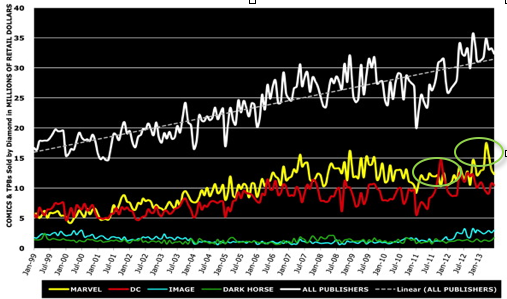
Below, is a chart of comic retail sales by month dating back to 1999. I want to thank The Comic Chronicles for their work reporting data to the comic industry. This, and many more reports, are found at their website http://www.comicchron.com.

Top-Selling Comic Books and Trade Paperbacks Ordered by Comics Shops in North America (in $)
Picture 9

The chart makes three points. 1) While there was a small decline after 9/11, sales resumed their normal pace quickly thereafter. 2) Comic sales were hurt as badly as magazines from mid-2009 through mid–2011. 3) Look at the sharp increase in DC Comics sales (red) in late 2011, and the Marvel Comics sales spike (yellow) in 2012. I highlighted the growth in with green circles.

WHY DID DC SALES SPIKE?

In August, 2011, DC Comics launched the New 52, a brilliantly-conceived editorial change described by one industry leader as “the biggest development for DC Comics since 1985 and…may, in fact, be the company’s biggest development ever.” (http://screenrant.com/dc-universe-reboot-justice-league-film-benm-117890/)

DC Comics Senior Vice President of Sales Bob Wayne described the change:
“[T]he new #1s will introduce readers to a more modern, diverse DC Universe, with some character variations in appearance, origin and age. All stories will be grounded in each character’s legend – but will relate to real world situations, interactions, tragedy and triumph.” (http://screenrant.com/dc-universe-reboot-justice-league-film-benm-117890/)

ONE EDITORIAL CHANGE CAUSED SUCH A BIG SPIKE?

Partially. The second largest comic publisher developed a revolutionary new concept and, working hand-in-hand with Diamond Comic Distributors, successfully rolled out the biggest thing in comics flawlessly. I was working on other projects for Diamond, but I witnessed remarkable competency from both companies.

WHAT HAPPENED WITH MARVEL IN LATE 2012?

Marvel NOW! was a relaunch of the Marvel comic line. Marvel editor-in-chief Axel Alonso differentiated Marvel NOW! from DC Comics’ in an interview with Entertainment Weekly. “This ain’t a reboot. It’s a new beginning…every week you can go into a comic book store and find a few new jumping-on points for the Marvel Universe, a place you’re going to like visiting. Or revisiting.” (http://popwatch.ew.com/2012/07/03/marvel-now-jean-grey-exclusive/).

HOW DO YOU RELATE THIS TO MAGAZINES?

First, let me pose a question to you: can you think of the last major change in the magazine business where a publisher worked closely with its national distributor, its consultant and its wholesaler to make a positive difference in existing titles? You will be hard pressed to come up with one.

Second, and I will elaborate on this in upcoming sessions: the current level of distrust and animosity between supply chain “partners” guarantees that nothing like the Diamond/DC and Marvel success will ever happen unless major changes come to pass.

ARE MAGAZINE PUBLISHERS OUT OF IDEAS?

No. Think of your roundtable meeting with the CEOs at PBAA. The major publisher CEOs have great ideas and want to implement them. Smaller publishers are coming out with new products all the time and are looking to expand distribution and have ideas of their own.

SO WHERE IS THE EPICENTER OF THE PROBLEM?

Publishers are, without question, the second-most important player in the magazine supply chain behind the retailer. Due to a series of unwise business decisions, publishers ceded their authority to consultants, national distributors, wholesalers and a myriad of other middlemen. Each one of these middlemen have different agendas, so any major change is blocked, delayed or just killed in the gauntlet set up by these entities.

For the next few weeks, I will focus on publisher challenges and opportunities. This week, I ask publishers to consider the following: most publishers (knowingly or unknowingly) employ most or all of the following agents:
• Wholesalers
• RDA Consultants
• National Distributors
• Publisher Consultants
• IPDA
• MAGNET
I ask publishers to please answer the following questions for each entity:
1.) Which of these groups are part of my supply chain?

2.) What purpose does each entity serve?

3.) How much do we pay each group?

4.) What is the publisher’s profitability after paying for three, four, five, six or seven agents?

5.) Have there been times publisher proposed a marketing plan but was prevented by any of the entities other than the retailer?

6.) Was the negative response plausible to the publisher?

7.) Does my publisher consultant and national distributor prioritize my business, and are they working in a way that makes me most profitable?

This is just the beginning, Luke Magerko has still plenty to say in this continuing, yet very important saga of the American Newsstands… Stay Tuned.

The Ever Changing Electronic and Digital Market

Picture 7

h1

“No One Does It Like Sports Illustrated Does It.” Matt Bean, SI.com Managing Editor Tells Samir Husni the Secrets of Sports Illustrated’s Success… The Mr. Magazine™ Minute

August 13, 2013

Matt Bean, SI.com managing editor, was my guest on a panel about Sports in a Digital Age at the annual convention of the Association for Educators in Journalism and Mass Communication in Washington, D.C. After the panel I asked Matt a question about the secrets of success of SI.com and how he thinks the integration between Sports Illustrated, the print weekly, and its digital counterpart, SI.com, is going.
His answers in this segment of The Mr. Magazine™ Minute:

h1

Woman’s World Dethrones Cosmopolitan as the Single Copy Sales Queen… and the Facts Behind the Magazine Circulation Figures

August 7, 2013

WomansWorldCosmo There is a new queen ruling the newsstands. Woman’s World has dethroned Cosmopolitan as the number one selling magazine on the newsstands on an issue by issue basis. The latest figures released by the AMM (The Alliance for Audited Media) shows Woman’s World single copy sales at 1,103,996 compared with Cosmo’s 1,028,892. No wonder Bauer, publisher of Woman’s World, is readying to launch Closer, another woman’s lifestyle magazine this fall.

However, with every release of the circulation numbers of the audited consumer magazine titles, media pundits and reporters apply their own interpretations to the numbers. The numbers are “flat, plummeted or increased” depending on the messenger. The same message was told and delivered by different harbingers and in some cases offered an interpretation as different as black and white. Folio: magazine announced that the numbers were flat; Publishing Executive announced that the numbers plummeted; the MPA, in a release by its president and CEO Mary Berner, downplayed the numbers and rightly focused on the total picture of the increased magazine media audiences. So what gives?

If all the media are reporting on the same numbers, what went wrong and what goes wrong every time numbers are released? Is it that hate-love relationship we have with numbers? And why is Hearst Magazine celebrating the numbers with their record circulation figures? Their numbers show record circulation figures for all their combined titles.

Why are Better Homes and Gardens, Woman’s Day, Food Network, etc. etc., showing an increase in circulation numbers at the time Woman’s World celebrates dethroning Cosmopolitan as the number one selling magazine on the nation’s stands for the first time in recent history?

Why is Meredith launching Allrecipes.com a new print magazine based on a website? And is their really room for another weekly women’s lifestyle magazine coming this fall from Bauer? Closer will be joining the ranks of Woman’s World, In Touch and Life & Style weeklies, making Bauer the only publisher to introduce four weeklies in the last few years.

Also, if the numbers are so bad, why are Hearst, Meredith and Bauer launching these new print magazines? It is about time to celebrate our industry, to light a candle rather than cursing the dark (in this case the decline in single copy sales, which Ms. Berner reminds us is less than 10% of the total magazine circulation).

With this in mind, and with the recent sale of Newsweek, The Boston Globe and The Washington Post, it appears, regardless of what some media pundits may say or write, there is still hope for print and folks are latching onto print to validate their virtual presence. Print is still, by far, generating more stories, more news, more emotions, more reactions that any digital platform. The problem in not with print or with numbers, the problem is with the folks who have preconceived ideas of the future of print. They are writing to fit their preconceived notions.

NOW, for a fun sidebar, during my visit to Lebanon, I visited my childhood newsstand on the main square in Tripoli, which has been operating at the same location since I can recall, and I was able to buy a few newspapers and a magazine. You ask which magazine? Newsweek, my friends; a printed edition of Newsweek. As I mentioned earlier, the magazine is still alive and kicking in the rest of the world. Enjoy the video below and keep in mind, when we were told it is “# last print issue,” that too was not true! Have fun.

h1

A Cover in Print is Worth Thousands of Tweets: Controversy Anyone? Just Visit Your Nearest Newsstand. See And Feel The Power Of The Magazine Cover. It’s A Rush Like No Other…

July 31, 2013

photo-2My recent trip to Lebanon and the controversies surrounding magazine covers in the United States reminded me of an important milestone in my life-long magazine journey.

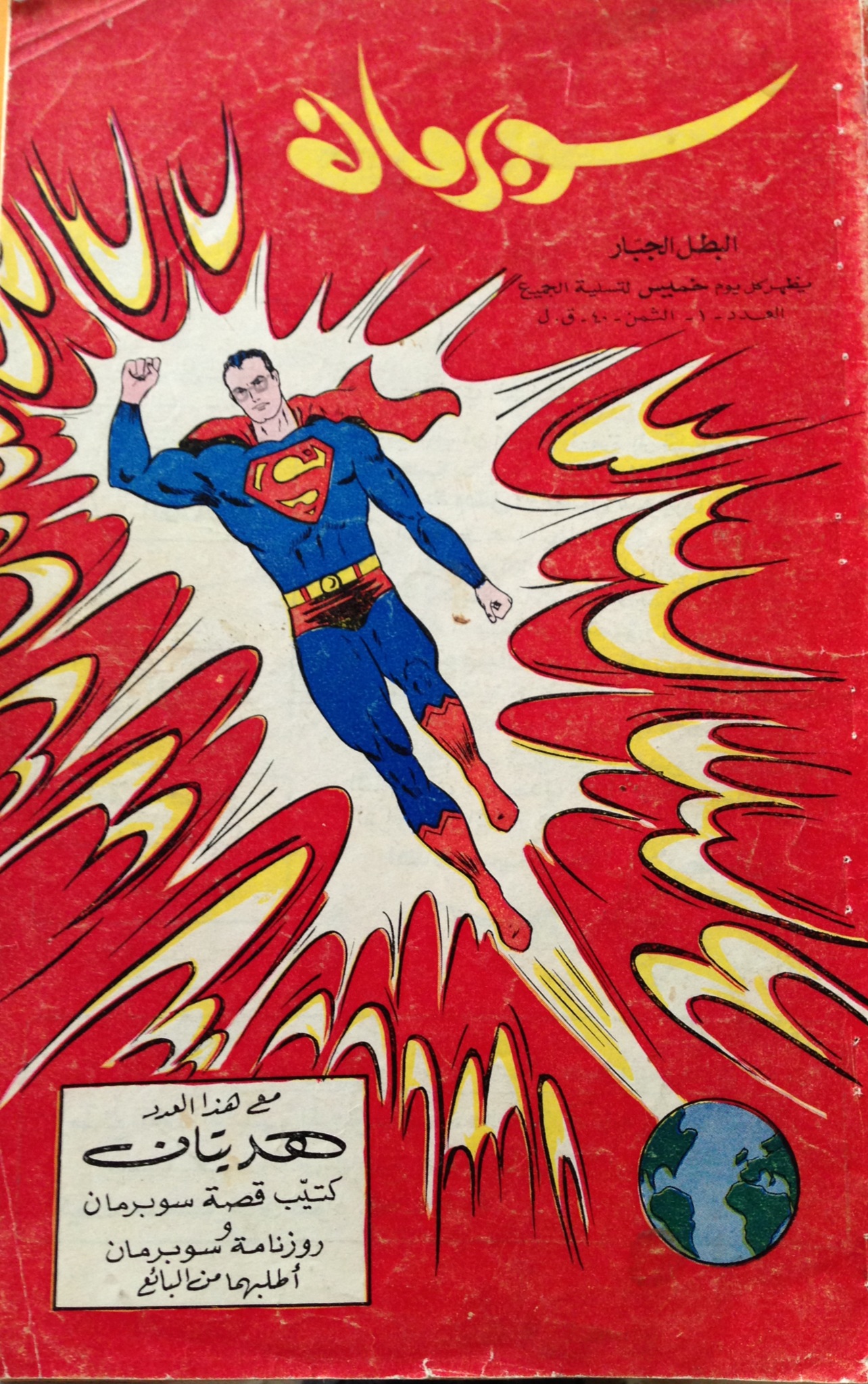
I used to think I was special… due to the powers that Superman telepathically sent me when I was a child through the cover of the first Arabic edition of the comic book. The moment I traced the outline of the Man-of-Steel blasting into the atmosphere from Earth on that magazine cover, I knew the connection we made was distinctive and very personal.

Surely Superman had chosen only me to follow in his footsteps.

Alas, eventually I realized the power that magazine covers wield is very far-reaching and extends to humans around the globe, not just young boys growing up in Tripoli, Lebanon.

If covers can breed controversy and ignite the digital fires of social media better than the latest neighborhood gossip, then I believe it’s safe to say magazine covers command a power not unlike a knight brandishing the winning lance in a tournament: swift and to the point.

The debate about covers reminded me of what my brother Shukri, the philosopher and historian of the family, and his illustration about the two great Greek philosophers Parmenides and Heraclitus.

Parmenides is the pre-platonic Greek philosopher who theorized about permanence as reality; what is permanent, what lasts and what is stable. What you cannot get rid of, in other words, is really what is real and true.

Heraclitus, on the other hand, was the theorician of change. He’s the one famous for saying, “You cannot step in the same river twice,” basically because the water keeps on changing. Effectively, to him, change was the one reality. The only permanent thing in the universe according to Heraclitus is change.

But Parmenides insisted that only what lasts is real. What is in print lasts. What is in print is actually what remains in your face. You can dispose of it, you can tear it apart, but there will always be somebody who kept a copy in print. That’s actually the origin of documentation. Documentation is what you can keep.

While social media is more in liquid form and change form, like the water of Heraclitus, it keeps on changing and moving. It’s so mobile that, very often, by the time you realize whether it’s true or not, it has changed already.

And this is a significant part of the power a magazine cover has. The power to hit you with that first in-your-face impact and then, unlike the Facebook pages filled with posts that eventually scroll into the great digital abyss, the magazine cover remains there in all its firestorm of glory to forever remind you of the message it delivers.

RSThe cover of Rolling Stone recently unleashed a maelstrom of controversy by putting Boston bombing suspect, Dzhokhar Tsarnaev, on its August 2013 cover. Right, wrong or indifferent; Rolling Stone made an impact. They didn’t have to parry, they knocked the competition off their steeds in one fell swoop.

Even though some stores refused to stock the issue, single copy sales of this issue are already up. I believe you could describe that as a definitive impact.

So why critics focused on the photo itself – describing it rock-star-like, rather than as a murder suspect – and not the content of the article.

The fact is that study after study shows that the picture is the first thing that stops readers when looking at a magazine. So it is normal for the audience to look at the picture; the surprise is when media people stop at just the picture too. We are reaching such a state of non-journalism by allowing mass emotions and social media to dictate what is and is not journalism.

I am sure Rolling Stone did not mean to cause a stir with their provocative subject; not at all. It was an editorial decision based on an investigative piece of journalism; a rarity in today’s world. We need more magazines to follow in the footsteps of Rolling Stone, ignoring the mass emotional reaction of a knowledge-less mass basing their opinions on perception and not reality.

Magazine covers have been known to blow a few minds in their time and lately they seem more determined than ever to cause people the SMH syndrome…that most wonderful of social media verbal shortcuts defined as “shaking my head.”

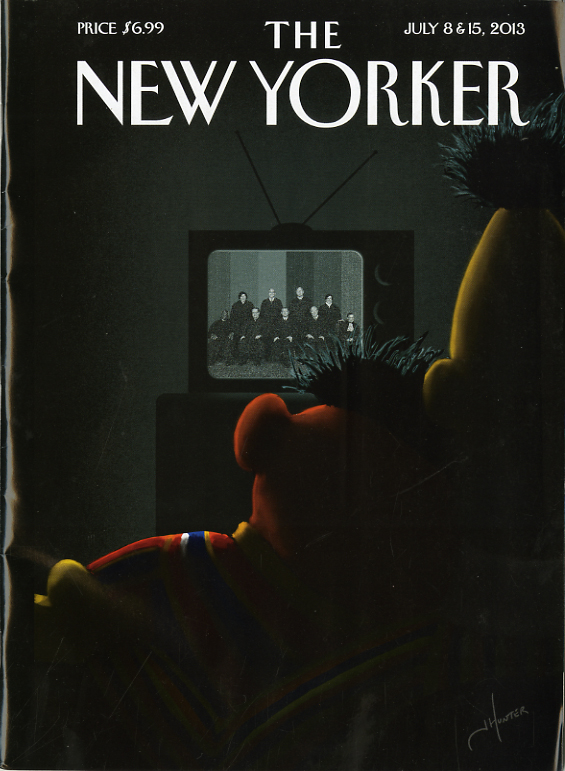
New YorkerTake The New Yorker’s Bert and Ernie’s “Moment of Joy,” created by artist Jack Hunter. As the two Sesame Street characters sit cuddling on the couch together, staring at a TV still of the Supreme Court Justices, after their ruling on same-sex marriages, the world looks on with two faces. The one side is ecstatic by the decision, the other appalled. But the magazine makes its point and the best knight wins: Sir Cover.

Untitled-4Bloomberg Businessweek made a rather “exaggerated” point with a cover about hedge funds and the supposed great return on investments a person can make, with the picture of a man, complete with jacket slung over his shoulder, glancing down at an overextended arrow pointing outward from the direction of his pants zipper. The caption above the arrow: perception. Then “reality” falls somewhere short of the fantasy and there’s a much smaller squiggly arrow lying on the floor at his feet, teasing the reader with the correlation between the mythical male body part and the truth. Controversial and comical, yes…but once again a magazine cover packs a punch.

espnESPN the Magazine is not to be outdone by the implied parts of the male anatomy. Their annual edition called “The Body Issue” came out in July and has NHRA racer, Courtney Force, posing nude for the magazine. While the cover is strategically done so that nothing describable is actually shown, the picture lends more than an illusion of Ms. Force’s shapeliness. While covers such as this may have once been reserved for magazines like Playboy and Penthouse, ESPN the Magazine proves that it’s not just bunnies and pinups that emanate allure; even race car drivers can grace a cover with enticing comeliness. And if you think that last description was overflowing with adjectives; once again the power of a magazine cover ignites a passionate response.
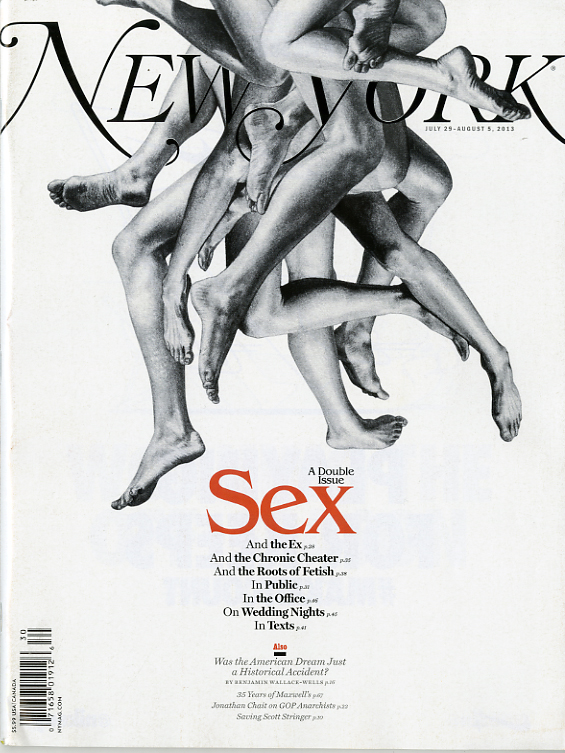
nyThe July 29 – August 5 issue of New York Magazine is a double issue featuring intertwined male and female legs hanging above, through and below the magazine’s name. What is the image’s significance, you might ask? Sex, what else. The cover story involves first times, sneaky cheating and trysts all over the place, and something thrown in there about fetishism.

It’s a melting pot of all things sexual and boiling over with a spicy brew that has spurred many a conversation. Nothing like a magazine cover to get things stirred up, right?

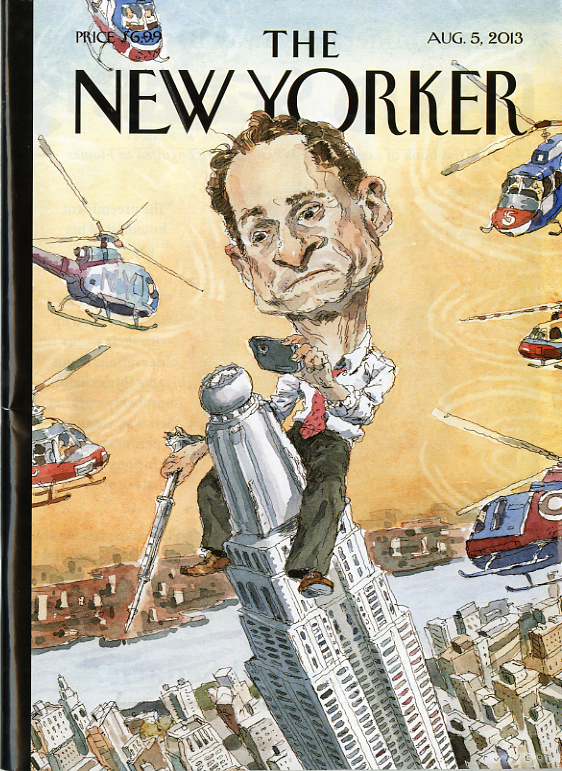
The New YorkerAnthony Weiner sexting, straddling the Empire State Building as though he were the human version of King Kong; this is the August 5 cover of The New Yorker, created by artist John Cuneo. The cover says it all in a funny and original way and proves that politicians who revel in their own deceptions sometimes can’t hide from the press even from the tallest building.

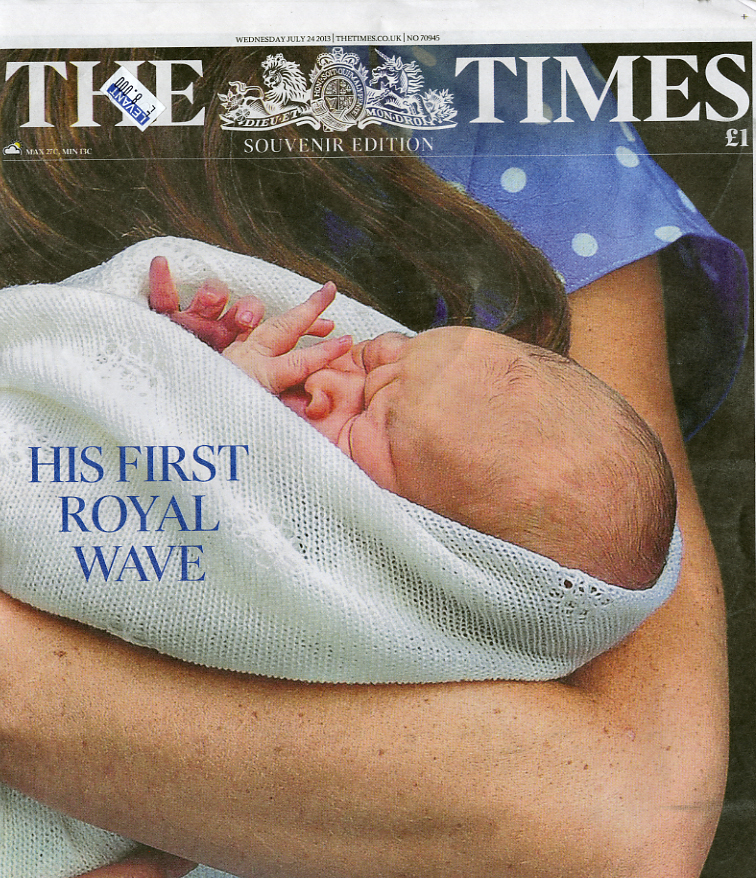
Untitled-7And then of course, the baby the world had been waiting on: the Royal tyke who would be King. The Times in London had the infant and its proud parents, Prince William and Kate, splashed across front and back, announcing the first “royal wave” from little hands reaching out from beneath the august blanket. It’s a cover that touched hearts and displays a legacy the child will never outrun (even if he wants to), the heritage of his birthright – the future King of England.

peopleBut People Magazine grabbed the first headline of “It’s A Prince” on their cover and called it a special collector’s issue, featuring a spectacular photo of the royal parents and their little bundle of joy. But it’s the cover that grabs the attention immediately and proves yet again that magazines and the wrappings they wear definitely make an impression.

In-your-face, controversial, heartrending, funny; magazine covers run the gamut of emotions and tirades. From quiet and serene conversations that last for months, to spitting quarrels and shouts of boycott all across the country; the cover of a magazine can spark a reaction better than any other type of media. Digital headlines are instantaneous and satisfy the moment very sufficiently, but they’re fleeting and can become a lost link in the blink of an eye. Not so with a magazine cover. Once it’s printed and becomes a reality, there is no disappearing. That cover will stare up at you from your coffee table until you’re old and gray if you don’t remove it. It’s solid, not liquid like digital. There is a difference in form and there is a difference in impact. And its impetus is in the never-ending moment and the platform.

And as the buying public, we get to be a part of that moment, sometimes a part of history-in-the-making. And it’s a delightful experience. Whether you agree or disagree with their statement, you must admit the power of the magazine cover gives new meaning to an old phrase paraphrased: a cover in print is worth thousands of tweets.

h1

Audience First and Other Essentials for Magazines and Magazine Media Survival in a Digital Age

July 8, 2013

The following is a review of my presentation at the MPA/PBAA Retail Marketplace conference By Karlene Lukovitz in IPDA Daily Publishing & Retail News, June 14, 2013.

Screen shot 2013-07-06 at 10.17.31 PM

Perception Vs. Reality: Print’s Power in a Digital Age
Samir “Mr. Magazine” Husni offered statistics and arguments demonstrating the ongoing relevance of print magazines, as well as the futility (at least to date) of trying to turn a print-plus-digital magazine brand into an economically viable digital-only entity.

While estimates of the total number of magazines currently sold at retail in the U.S. vary depending on how one defines a magazine, MagNet puts the number at approximately 10,000, noted Husni, director of the Magazine Innovation Center at the Meek School of Journalism and New Media at the University of Mississippi.

Husni, who tracks print magazine launches on an ongoing basis, found and purchased 870 new magazine titles in retail stores last year alone, 237 of which launched with regular frequencies (published quarterly or more often). “I’m seeing no signs of a slowdown,” he reported. Further, the numbers of magazines being folded are considerably smaller than the numbers being launched.

Those who point to Newsweek or other instances of high-profile print magazines being converted to an all-digital model, or folded, as evidence that the print magazine medium as a whole is on its last legs are ignoring the current and historical context, Husni argues.

“If one magazine dies, it’s not the end of the industry,” he said. “Do I need to tell you how many TV shows have come and gone over the years? Yet nobody said that television was dead.”

While the industry is rightfully focused on addressing magazine retail sales declines through innovation and collaboration with retailers and other supply-chain partners, the larger context is that discretionary products of all kinds experience sales declines when the economy forces many consumers to forgo non-essential purchases as they struggle to meet basic living needs, he said.

Moreover, overall print magazine circulation is stable to slightly up, and both print and digital magazine readership is increasing–while other traditional media are experiencing overall declines in audience or circulation, he added.

Meanwhile, for all of their growth, magazine apps are up against formidable odds, Husni said. As of January 2013, publishing consultant Thea Selby reported that there were 446 magazine apps available through the Nexus Google Play store, 744 in the Amazon Kindle store, and 2,954 in the Apple iTunes store. But those apps are competing for visibility, discovery and consumer dollars and time with at least 850,000 total apps of all kinds in the marketplace, he said.

The Age of ‘Transcended Infinite Media’

Many seem determined to deny the reality that all media have always been subject to change brought about by technology and other mega-trends, Husni observed.

He believes that, after a “bubble” lasting about 150 years, the age of mass media–characterized by a relatively small number of companies and media realizing large profits by reaching mass audiences–is giving way to what he calls the “transcended infinite media age,” characterized by burgeoning numbers of interpersonal networks and new technological platforms and devices.

Today, “we have the major media outlets seeing shrinking influence, and clusters of audiences who are talking and negotiating and engaging within themselves,” he said. At a time when consumers have hundreds of television channels, along with seemingly limitless blogs, Web sites and other media from which to choose, the media and the world at large need to accept the reality that audience segmentation means smaller revenues for individual media, as revenue is spread across the plethora of options available, he asserted.

Magazines have always had life cycles, he pointed out: “New magazines arrive on the scene, and other magazines depart the scene. There’s nothing new here.” This year and last, some magazines that are over a hundred years old have been publishing their largest-ever issues, he noted.

“There is a [print] magazine for every age group…for every interest…magazines large and small” and magazines spanning a wide variety of formats, he pointed out. “There are more magazines in the marketplace than ever,” even without counting digital replica versions, which have doubled in number since 2011, he said. In fact, there were just 2,000 print magazines in 1980, versus today’s 10,000.

At the same time, the models of magazines and all media are being transformed by those “transcended infinite media” dynamics, which have put far greater power and choice in the hands of consumers, he said.

The Internet and social media have enabled consumers to be content creators, forcing traditional media to “play catch-up,” Husni observed. However, with all of their ability to create or shape or choose their own media experiences (including expanded choices in terms of immediacy and formats viewable on a wide variety of devices and screen sizes), consumers still want content from trusted sources–a major advantage for trusted magazine brands, he said.

However, Husni cautioned that magazines need to beware of falling into a syndrome that’s become all too common in the media world: Surrendering content creation, which is resulting in a “welfare information society.”

Amid all of this change, the one constant is the primary importance of magazines knowing their audiences and serving them with relevant, useful, compelling content, he stressed.

The Futility of Converting Print Brands to Digital-Only

Turning to the subject of print magazines going to all-digital models, Husni listed a roster of brands that have attempted this, only to become weak presences at best on the Web, or disappear altogether.

He said that he’s been unable to identify a single magazine brand that has succeeded or thrived by going digital-only. He quoted an observation from electronic media analyst/author Thad Mcllroy: “Few magazine publishers could survive the loss of ad revenue if they discontinued their print versions. While they are becoming increasingly adept at generating revenue from their Web sites, Web-only publishing models cannot supplant a print and Web model.”

“When a print magazine is about to draw its last breath of ink, is digital really a life support for it, or just prolonging the inevitable…defining a vegetative state as new life?,” Husni asked.

His own answer: “A print magazine that can’t make it in print is not going to make it in the digital sphere. The problem is not with the medium–the problem is with the magazine.”
When a magazine declares that it’s going digital-only, several “death signs” can be counted on: staff reduction, leadership changes, blaming the advertisers, blaming the economy, and blaming the changing habits of the audience, he noted.

“If you fail to connect with your customers/readers time and time again, going to digital online heaven can’t save you,” he declared. “Cut your losses, let your magazine die in peace and don’t torture it anymore.”

However, while print magazines can’t live solely as digital entities, “there is absolutely no reason that the two can’t live side-by-side,” Husni stressed.

“In fact, today, the question is not print versus digital media. Media now are not either/or, but rather all,” he said. “And at the end of the day, it is audience first, not digital or print first.”

h1

64 New Magazines Arrive in June: 11 With Frequency and 53 Specials and Bookazines

July 2, 2013

The titles for June are just as eclectic and interesting as your imagination. You can Discover Your Roots while reading your Guide to Field and Lawn Care where you might discover you’re related to Vikings who love Monsters U. From Raising the Royal Baby to What Justin Bieber Wants in a Girl – the selections for mid-summer span the spectrum of something else a reader might want to absorb while they’re soaking up their summer rays. Oddly enough not one bridal issue in the bunch…hmm…
Check each and every one of the 64 new titles on the Mr. Magazine™ Launch Monitor here.

h1

The Battle of Gettysburg: For Those Who Can Still Hear the Guns: Mr. Magazine™ Relives the Battle in Eight Different Ink on Paper Publications…

July 1, 2013

Television can’t do it.
Apps can’t do it.
Magazines can and are doing it on a regular basis. That in-your-face, on-your-coffee-table display with constant and instant recall of memories of days gone by, is no more evident than in the latest show of force in the titles devoted to the Battle of Gettysburg. Touted as the battle with the largest number of casualties during the American Civil War, the Battle of Gettysburg lasted for three days – July 1-3, 1863. Today (Monday July 1) is the 150th anniversary of this significant military fray (some call it the turning point of the entire Civil War). And magazines are well-armed for the occasion.

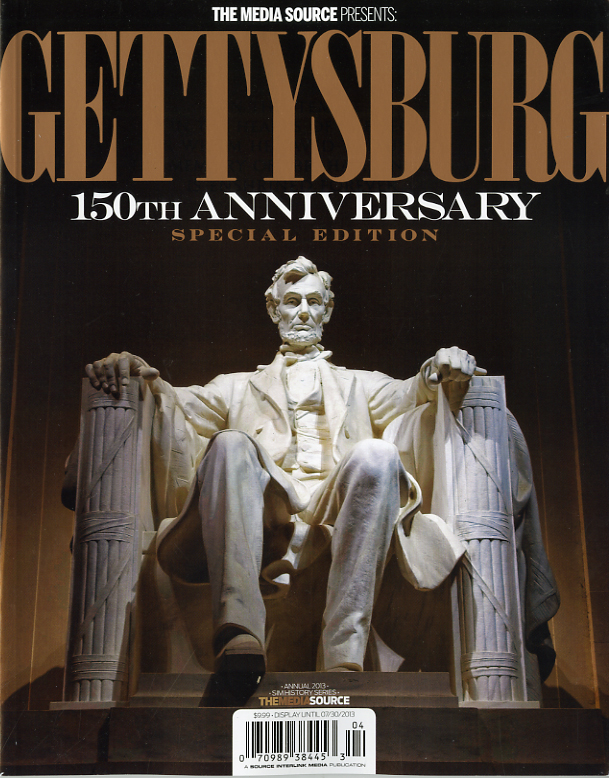
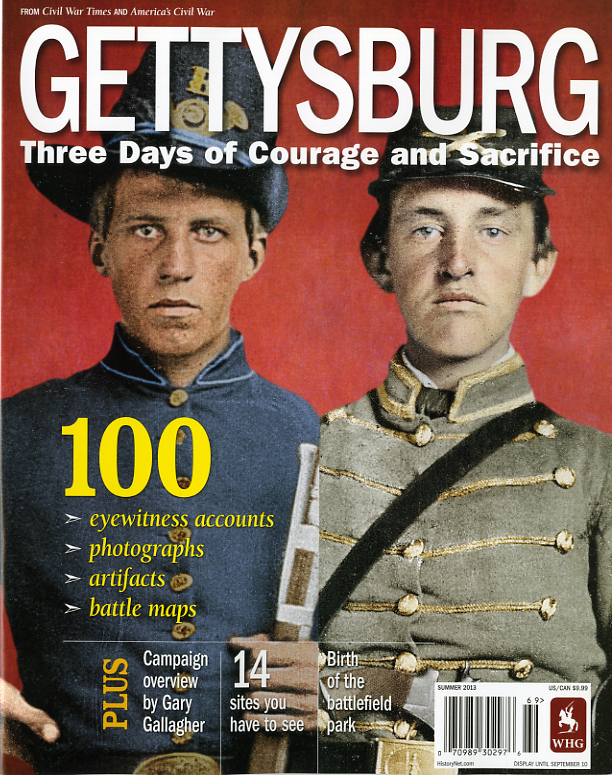
Gettysburg150-8Gettysburg USA-9Gettysburg NG-7Gettysburg Media Source-4Gettysburg last-10Gettysburg courage-6Gettysburg - TIMEBBC American CIvil-5

From Time to National Geographic, Civil War Times to The Media Source, print is ready to do battle with any other media platform to gain your undivided attention during this commemorative observance. The first to arrive on the scene was I-5’s Gettysburg: 150th Anniversary with the cover line, Three Days That Saved The United States, and a glossy cover worthy of coffee table display.

The Time Bookazine presents you with a day-by-day account of the campaign and The Media Source offers you 130 pages devoted to anything and everything you could possibly want to know about the illustrious battle; I find myself curling my mustache with the tips of my fingers, contemplative and amazed, much like I imagine Gen. Robert E. Lee was when he realized his invasion of the North just wasn’t working out for him.

Niche marketing is pushing the naysayers of print back, just as the Union did with the Confederacy when they tried to take the war onto the road. And Bookazines are wearing their Union blue very well, assisting General “Niche” quite nicely.

So I ask you, truthfully, in what other medium, besides print, could you relive such an historic event as the Battle of Gettysburg with the true, stirring experience of emotion? I ask that because of the tactile combination of content, real-life photos and pages that fairly come to life beneath your fingertips as you turn the pages.

Sure, you can go online and read and observe – and it’s a fantastic interlude, but can you touch the pages? Can you trace each word as though running your fingertips across a name on an old, battered tombstone in some long-forgotten cemetery left over from the war? Can you hold the pictures closer, for a better examination of a gun used back then or the clothes worn, when you peruse a website to research just where the battle went (pardon the pun) – South for General Lee?

Without doubt, the print experience is still the only way to exact true emotion and that sense of ownership you feel when you purchase your one-and-only copy of that magazine or Bookazine that can transport you smack dab into the middle of the battle – or anywhere you happen to want to go.

And with the “cater-to” mentality of today’s niche marketing – from the Bookazines to the Special Editions, there is always something on the newsstands for everyone.

So, to all you history buffs out there who are planning on a commemorative respite from the rest of the world by kicking back and enjoying one of the eight magazines shown here devoted to the 150th anniversary of the Battle of Gettysburg– I wish you happy reading, indulgent fantasies and the agility to duck when you hear the cannons!

h1

New Magazine Launches A Plenty in First Half of 2013: 96 With Regular Frequency and 293 Specials and Bookazines

June 27, 2013

An average of one new regularly published consumer print magazine arrived on the scene every other day in the first half of 2013. There was no let down in new magazine titles reaching the nation’s stands in comparison to the same period in 2012. As we approach the end of the second quarter of the year the numbers are holding up at 389 titles compared to that of 394 in the same time period of 2012. It should be noted that, historically speaking, more new magazines are published in the second half of the year than the first half.

Manor House-11Maximum Drive-14One Direction-16Travel & Adventure-12What Doctors-13Wherever-15

The number of titles published on a regular frequency in the first six months of 2013 reached 96 titles compared with 100 titles in 2012.

New magazines, all in print… as in ink on paper, continue to arrive at the market place at a very fast pace that seems not to be affected by the economy or the downturn in sales at the single copy front.

Needless to say the phenomena of bookazines continue to lead the way and titles devoted to single topics are the leaders of the new magazine crop of 2013 thus far.

Note from Mr. Magazine™: All the numbers mentioned above are from actual copies of said magazines, all bought or mailed to me. Those numbers do not include magazines to be published or magazines that were not purchased or obtained. It has been my policy that if I do not have the actual physical copy of the magazine I do not include it in any count.

h1

The Newsstand Data: Harbinger of Things to Come. The Man Who Want to Save the Newsstands. Part two of the Mr. Magazine™ Interview with Luke Magerko

June 26, 2013

Chart Two - Store Count by Draw Per Issue The American magazine business model is not one that depends heavily on single copy sales. It is a subscription based business model. No wonder than that some publishing companies seem disconnected from their newsstand departments despite the fact that sales at newsstand exceed 3 billion dollars and more than 100,000 stores sell magazines in the United States and Canada. Newsstand is a leading indicator of consumer trends but its complicated distribution system and financial terms such as RDA, IPO, rack fees, etc. make it difficult to embrace. In spite of its complexities, however, newsstand should be at the forefront of publishing because of its ability to predict future successes and failures for a publisher.

For example: Editors at a top-ranked, niche magazine radically adjusted editorial focus based upon two factors: a change in advertising strategy designed to expand sales opportunities, and recognition that the existing audience for the niche was contracting. The publisher’s marketing projection predicted a small decline in readership from core subscribers, but believed the gains from the new audience would outstrip the losses. The results, however, were far worse than the projections. The title successfully grew the new desired audience, but the success was mitigated by a rapid decline in existing audience. My team provided the disappointing results to consumer marketing, warning that similar declines might be recognized in renewals, and ultimately in direct mail results. Indeed, newsstand predicted the consumer marketing declines accurately and ultimately the title folded.

In the second part of the Mr. Magazine™ Interview, Luke Magerko continues his explanation on how we can fix and enhance this important venue of magazine distribution. Click here to read part two of the interview.