Archive for the ‘News and Views’ Category

h1

The Power and Future of PRINT…Part V As told by Magazine and Magazine Media Makers…

January 5, 2016

A Mr. Magazine™ “Quotable” Retrospective…

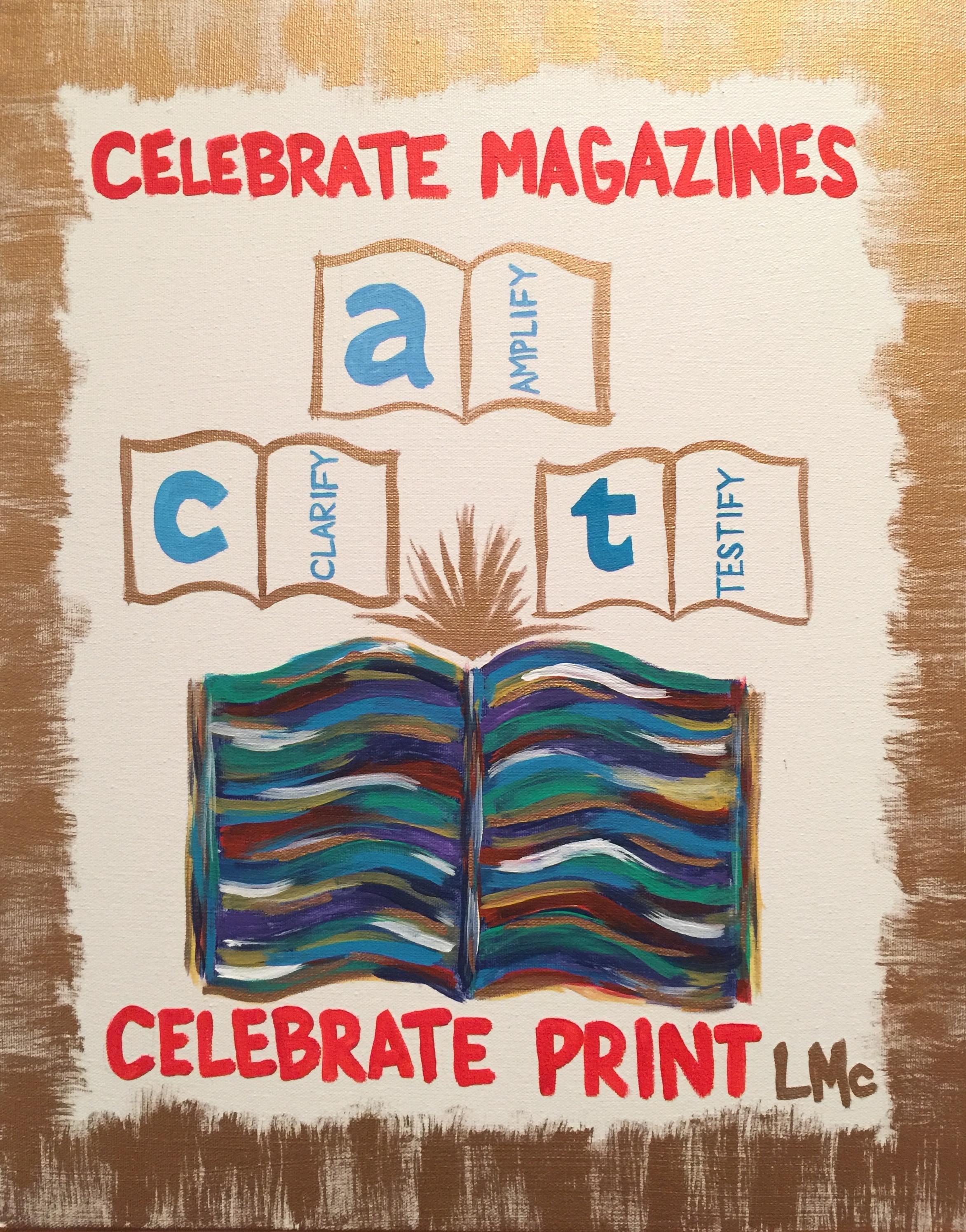
Celebrate Magazines Celebrate Print. The theme for ACT 6 Experience that takes place April 20 to 22, 2016.  Painting by and © Laura McCrory. For information about the ACT 6 Experience email me at samir.husni@gmail.com

Celebrate Magazines Celebrate Print. The theme for ACT 6 Experience that takes place April 20 to 22, 2016. Painting by and © Laura McCrory.
For information about the ACT 6 Experience email me at samir.husni@gmail.com

I have been a firm believer in print and its power even when many doubted its future and even its role in today’s media world. I have been quoted as saying, “As long as we have human beings, we will have print.” And that quote stands firm and true as we enter into a brand New Year.

Of course, I’m not oblivious to the fact that we live in a digital age…just check the many devices you and I are using on a daily basis, even the platform that you’re reading this on now as we connect. Yet that did not deter my belief in the role and future of print. Nor, will it ever.

However, as an academic and a professor of journalism, I’d rather share with you what others from the field say about the future and the role of print in today’s media world and tomorrow’s; that way it isn’t just my word you’re hearing and reading. Never would I yearn to be lumped in with others who pontificate to high heaven with their opinions and speculations for the condition of magazines and magazine media; be it print or digital or any other platform that may arise before I can finish writing this. The blah-blah-blah disease spreads pretty fast on its own, without any help from Mr. Magazine™

And so without any further ado, here is the fifth installment of the 136 quotes (in random order) that Mr. Magazine™ has accumulated over the last two years through the wonderfully informative conversations I have had with the game changers and the passionate entrepreneurs in the magazine industry.

65. “I really can’t imagine Real Simple without a print product. I mean, we are thrilled to see the growth that we’ve experienced in other areas, but I can’t imagine us never being a magazine. And I happen to know that you define a magazine as something that exists on paper.” Kristin van Ogtrop, Editor-in-Chief, Real Simple magazine.

66. “When we first put up the website for GX, I had a Mom call me and she said, hey, can you print this story, because I want to keep it. So, I printed it out for her on nice paper and mail it to her. I printed it and mailed it to her and she told me she ended up framing it. People want to physically hold it; they want to see it and share it that way. It legitimizes everything when it’s in print.” Keith Kawasaki, Vice President, Client Services, iostudio.

67. “It is such a beautiful print product and I think to be inspired to make real changes in your life, and some of them may be small, such as a lip gloss that’s moisturizing, and some of them are big, like you’re going to think differently about your life, and then some are medium, such as taking the stairs instead of the elevator, but for those kinds of inspiring changes I think print is a great medium for them. It tells a story and it tells it so completely.” Laura Frerer-Schmidt, Publisher, Women’s Health magazine.

68. “The whole idea of this one-to-one; she (Helen Gurley Brown) used to say that she wanted to have a one-to-one conversation with millions of women at the same time. So that whole idea of community, which is now what everyone is talking about, that’s something that Cosmo has always had. We’ve always said that we were the first interactive medium. Before there was an internet, there was Cosmo.” Donna Kalajian Lagani, Senior Vice President, Publishing Director & Chief Revenue Officer, Cosmopolitan magazine.

69. “Print is not dead for us; it’s thrilling. Of course, I hear it in other magazines and it scares me to death because I’m such an old print horse that I never want it to go away. And so it’s really exciting for me to be at a magazine where there’s never talk of not doing print anymore. Yes, it’s doing well.” Diane Anderson-Minshall, Editor-in-Chief, Plus magazine.

70. “When I’ve worked at legacy publications, we’d create this content that was basically designed to be an adjacency to advertising. Whatever, fine. Then the advertising disappears. Advertising definitely comes and goes; you have to make sure that you have a product at the end of the day that your readers actually care about, because the advertising dollar today will disappear tomorrow.” Adi Ignatius, Editor-in-Chief, Harvard Business Review magazine.

71. “By creating My Smart Newspaper, with its 16 pages, the reader will be able to spend 10 or 15 minutes to get a summary of everything that’s in the market today through a small, compact newspaper, and at the same time has the feel and look that only print can deliver. You are getting all the information with no waste whatsoever. No waste in paper and no waste of the readers time… it is a win-win situation.” Faisal Salem Bin Haider, CEO, Printing & Distribution Sector, Dubai Media Inc.

72. I’m very excited about this part of our business. I was brought up in print and I do believe that it’s the role of print and how it plays in the overall world of our media. You see it as much as I do; now we’re seeing digital-only plays that want to get into the print business and so, isn’t it right that we should actually start with the median and grow it the other way? That’s where I see the future going, creating content that can be deeper and articulated in different ways in the world of publishing.” Steve Giannetti, Publisher, Smithsonian Journeys magazine.

73. “I believe very much in the importance of the commercial side. I don’t feel successful without being successful.” Victoria Pope, Editor-in-Chief, Smithsonian Journeys magazine.

74. “There is something very particular about the act of physically holding a magazine in one’s hand and flipping through it slowly, then placing it aside onto your nightstand or coffee table or kitchen counter and returning to that same thing that you placed aside an hour later or even a few days later. The way that our minds and indeed our bodies interact with printed matter, it’s simply not the same.” James Oseland, Editor-in-Chief, Organic Life magazine.

75. “I think that the pendulum always swings back and forth and I think the pendulum, which had swung pretty much to digital, now may swing, while not all the way back, certainly somewhat toward starting the comeback a bit, because there is a recognition that audiences do like their magazine products.” Lewis DVorkin, Chief Product Officer, Forbes magazine.

76. “People think that print has gone away because they don’t understand what they’re hearing about the decline of newsstand sales. But newsstand is only a small portion of magazines and the idea that, in the case of Parents and American Baby, thousands of them a day are raising their hands and inviting print products into their home, which to me says this is still a really robust area.” Dana Points, Editor-in-Chief & Content Director, Parents group, Meredith.

77. “And these tributaries (collector’s editions) are how I think print will stay around because it’s specialized. I can go to any dot com or any digital platform and get all of my news for every facet of my life right then on the spot. But we don’t want to do that. We just want to do one very specific brand of news, for one very specific customer and that’s it.” Tony Romando, CEO & Co-founder, Topix Media Lab.

78. “We’re not surprised that digital brands are launching publishing products; it’s the most powerful level of engagement, whether it’s a book, newspaper, or a magazine; there is no higher level of engagement than when a consumer is reading a printed product. We’re in for the long-haul.” Scott Dickey, CEO, TEN (The Enthusiast Network).

79. “We will not pull the plug on the print edition. It does too well with advertisers; it does too well with people who like print, and not just people of a certain age, but across a whole stretch. So, I can’t foresee it.” Bruce Kelley, Editor-in-Chief, Prevention magazine.

80. “The number two media channel that the entire pharmaceutical industry spends in is print. Consumers are hungry for this information and they want to make great choices.” Lori Burgess, Publisher, Prevention magazine.

Stay tuned for Part VI of the Mr. Magazine™ “Quotable” Retrospective…

h1

At Least 236 Magazines Launched in 2015, 4 More Than 2014… All Other Published Numbers And Reports Are Dead Wrong!

January 4, 2016

The news of the decline of magazine launches has been greatly exaggerated…

This is a post that I did not want to publish, but the professor of journalism in me is what forced me to publish it… This is not a Mr. Magazine™ blog post, but rather a Dr. Samir A. Husni, Ph.D. blog post. Even in a digital age, the truth must always be told and reporting should continue to be held to the same rigor regardless what some may call Speed First, Truth Second. So, here it goes:

When it comes to MediaFinder’s number of new magazine launches the numbers reported are dead wrong. Media reporters who publish the numbers based on the MediaFinder numbers are also dead wrong. Both MediaFinder and the reporters who promote their numbers are doing nothing but a disfavor to truth first and the media industry second. Without any research and questioning of such numbers (which I have called reporters and researchers to pose questions to) I have seen more articles written about the sad status of new magazines. Media Post, Quartz, Folio.com, Crain’s New York Business… all reported the 35% decline in new magazine launches according to the press release from MediaFinder. No questions or fact-checking whatsoever…

Here is one such article:

Books and newspapers will do just fine in 2016. Magazines? Not so much By Amy X. Wang
http://qz.com/584744/books-and-newspapers-will-do-just-fine-in-2016-magazines-not-so-much/

The fact is I have collected and recorded 236 new magazines this past year compared to 232 from the previous year. MediaFinder numbers says 96 (some reported 113) titles were launched compared to 148 (some reported 190) in 2014. My numbers show an increase of 4 magazines. MediaFinder numbers show a decrease of 35% (depends on which numbers reporters opted to use). I have each and every one of those magazines. If I do not have a physical copy of the magazine, I do not include it in my numbers. The reason I say at least, because I know I may have missed some regional and city magazines that I could not reach or visit. My numbers are based on my field research on the newsstands first, media research second, and requesting first editions if I miss one here or there.

I publish monthly on the Mr. Magazine™ Launch Monitor the numbers of new magazines, bookazines, and specials and annuals. All you have to do is look and count the titles.

And so you will have a feel of what magazines launched in Dec. 2015, here is the post from my Mr. Magazine™ Launch Monitor (which by the way is open and free to anyone who bothers to check the facts and record the numbers…

The reason for this post is obvious – numbers – true reported and researched numbers – don’t lie…

And now the Launch Monitor:

It was a very Merry Christmas indeed with a total of 68 new titles, 32 with promised frequency. From the Neue Journal with a stellar cost of $35 to  more coloring and activity magazines for adults; the month of December was filled with gifts for everyone. From the array of beautiful covers below, one can tell that diversity was relevant as several digital entities such as Tablet, SwimSwam, Gear Patrol, and Pure Times stepped out to join the ranks of print as 2016 has been declared, by Mr. Magazine™ at least, as the year to Celebrate Print!

Welcome to the New Year of print as we revel in our new December launches…and stay tuned for a magnificent January!

Up first our frequency titles:

Ambrosia-5 American Christian Voice-20 Art Dependence-29 ArtBlend-18

Baldwyn-28 Cannabis Business Times-22 Cigar Times-30 Classic Sewing-4 Clever Root-1 CR Men's Book-13 Designing Colors-6 Fathers-15 Gear Patrol-32 Habitual-19 Haute Residence-21 Life & Thyme-10 Living Colors-3 Neue Journal-9 Professional Photography-11 PureTimes-26 Satellite-2 Swim Swam-25 Tablet-16 The Coloring Studio-8 The Unleashed Voice-27 The Window-12 Thoughtfully-14Waiting for the Light-23 Toast-17 Tread-24 Upstater-7 UVape-31


And now our specials:

100 Big Ideas-8100 New Health Discoveries-92016 The Year Ahead-21Birds & Blooms-2

Cafe Racer-4Color Create Relax-5Coloring Book-5Coloring Crystals-3


Declassified-13Epicurious-18Extreme-4Gourmet Comfort-8

rtGun Show-14Life on Earth-2Organizing-11Peaceful Patterns-3

How theBible was Written -17PEOPLE Star Wars-1PEOPLE Yearbook-7Physics at the Limits-20

Pro Football Champions-4SEC Champions-7Slow Cooker Soups & Stews-3Star Trek 50 years-19


Star Wars Collectibles-15Star Wars The Force Awakens-1Star Wars The Force is Back-22The Best of Farm Collector-16

Superbowl 50-5The 70s-6The Private Marilyn-10The Ultimate Guide to Star Wars-2

The Future of Everything-9TIME Alexander Hamilton-12Vintage Collector-1Vanity Fair Confidential-6

h1

The Power and Future of PRINT…Part IV As told by Magazine and Magazine Media Makers…

January 4, 2016

A Mr. Magazine™ “Quotable” Retrospective…

Celebrate Magazines Celebrate Print. The theme for ACT 6 Experience that takes place April 20 to 22, 2016.  Painting by and © Laura McCrory. For information about the ACT 6 Experience email me at samir.husni@gmail.com

Celebrate Magazines Celebrate Print. The theme for ACT 6 Experience that takes place April 20 to 22, 2016. Painting by and © Laura McCrory.
For information about the ACT 6 Experience email me at samir.husni@gmail.com

I have been a firm believer in print and its power even when many doubted its future and even its role in today’s media world. I have been quoted as saying, “As long as we have human beings, we will have print.” And that quote stands firm and true as we enter into a brand New Year.

Of course, I’m not oblivious to the fact that we live in a digital age…just check the many devices you and I are using on a daily basis, even the platform that you’re reading this on now as we connect. Yet that did not deter my belief in the role and future of print. Nor, will it ever.

However, as an academic and a professor of journalism, I’d rather share with you what others from the field say about the future and the role of print in today’s media world and tomorrow’s; that way it isn’t just my word you’re hearing and reading. Never would I yearn to be lumped in with others who pontificate to high heaven with their opinions and speculations for the condition of magazines and magazine media; be it print or digital or any other platform that may arise before I can finish writing this. The blah-blah-blah disease spreads pretty fast on its own, without any help from Mr. Magazine™

And so without any further ado, here is the fourth installment of the 136 quotes (in random order) that Mr. Magazine™ has accumulated over the last two years through the wonderfully informative conversations I have had with the game changers and the passionate entrepreneurs in the magazine industry.

49. “But the reality is, to actually create a beautiful, curated, well-edited printed magazine; it’s not an easy process. And when we really looked at the space and thought about who our reader and customer was and what she’s really interested in right then, which is having some me-time, we felt the reader was looking for a publication where she could actually turn off her phone or the TV and have an appointed reading time with a tangible product that she can hold in her hands and go through page by page.” Danny Seo, Naturally Danny Seo magazine.

50. “The biggest challenge, and it’s a daily one, is to listen to the readers. You know, I put my personal email address in Reminisce and Reader’s Digest. I read every consumer letter and I respond to every one of them. That engagement with the audience is so very important.” Liz Vaccariello, Editor-in-Chief, Reader’s Digest magazine.

51. “I’m a firm believer in print; I love print and my kids love print. My eight-year-old daughter asked for magazines on her Christmas list, which I think is a good sign. But I think every media finds its place in our lives.” Maria Rodale, CEO & Chairman, Rodale Inc.

52. “We’re having our biggest print magazine readership in our 97-year history right now. You just have to listen to your readers and understand the medium that you’re working in and not try to make it something it doesn’t want to be. If you try to make a magazine like a website, it’ll be a bad magazine.” Randall Lane, Editor-in-Chief, Forbes magazine.

53. “In fact, our new magazines plus digital, now account for 32% of the profits of our U.S. companies. These are businesses that 5 years ago either did not exist or were in a loss position.” David Carey, President, Hearst Magazines.

54. “We believe print is a really unique way to experience content and a really unique way to engage with our readers. The tactile quality of the paper that we’re producing the magazine on, the photography; all of it, really comes to life on paper in a way you can’t necessarily get on a digital screen.” Christopher Lukezic, Publisher, Pineapple magazine.

55. “We keep hearing: print is dead, print is dead. Well, no, print is not dead. What’s happening is it’s shifting and the people who are on the internet, it’s in their best interests to promote the internet over print and they’re saying it as loud as they can.” Buzz Kanter, Publisher, TAM Communications.

56. “I love print magazines and I will never give up the fight or the belief that I have in their value. I was just at the beach with my family and everyone that I saw there had a print magazine. I mean, you just don’t read on an iPad when you’re at the beach.” Ryan Waterfield, Co-founder & Editor-in-Chief, Big Life magazine.

57. “Our particular niche, which is inflight magazines, bucks trends because more and more people are traveling each year, so in fact, where you might have a decline in newsstand titles, we’re actually getting more readers.” Michael Keating, CEO & Co-founder, INK Global.

58. “When I deal with the Internet, I don’t feel there’s a sense of accomplishment necessarily or permanence with it; it’s so fleeting. And I wonder if that’s something that my generation is responding to, in terms of something tangible. When I finish reading a book or a magazine; I can look at it and say, I finished that, rather than just moving on to the next click or page.” Seth Putnam, Editorial Director, Collective Quarterly magazine.

59. “We had a very successful website, but we felt that the engagement with the material was superficial. People were only spending a few minutes, even less than a minute, on an article and not really thinking deeply about the topics we were raising.” Sam Hine, Publisher, Plough Quarterly magazine.

60. “The magazine is an outlet. We all need something to inspire us and if it’s going to inspire other people, so much the better. I get emails from people telling me they cry when they look through the magazine or they tense up. And when I read that I say, wow, it’s not just me. There are other people who appreciate what I’m doing.” Jimon Aframian, Editor-in-Chief, Jimon magazine.

61. “Now that digital media are around, print hasn’t disappeared, but it has changed. And it’ll continue to change and I would expect it to. It would probably be very boring living on this planet if things didn’t change.” Mariette DiChristina, Editor-in-Chief & Senior Vice President, Scientific American magazine.

62. “We may change the (publishing) model in different ways; we may become more sophisticated about printing and delivering content by zip code or by ways in which our readers define themselves, but I think that there’s still a robust market for print having had such a long tradition of creating content.” Norman Pearlstine, Executive Vice President & Chief Content Officer, Time Inc.

63. “I do believe there will continue to be an audience for a printed product who will be willing to pay for that delivery system.” Norman Pearlstine, Executive Vice President & Chief Content Officer, Time Inc.

64. “Having to figure out how to make a story a compelling one, but where a desire for fairness really forces you to understand what people do; why they do it, and to really seek out that kind of balance, I think doesn’t come automatically. And that’s one of the things that I always worry about.” Norman Pearlstine, Executive Vice President & Chief Content Officer, Time Inc.

Stay tuned for Part V of the Mr. Magazine™ “Quotable” Retrospective…

h1

The Power and Future of PRINT…Part III As told by Magazine and Magazine Media Makers…

January 3, 2016

A Mr. Magazine™ “Quotable” Retrospective…

Celebrate Magazines Celebrate Print. The theme for ACT 6 Experience that takes place April 20 to 22, 2016.  Painting by and © Laura McCrory. For information about the ACT 6 Experience email me at samir.husni@gmail.com

Celebrate Magazines Celebrate Print. The theme for ACT 6 Experience that takes place April 20 to 22, 2016. Painting by and © Laura McCrory.
For information about the ACT 6 Experience email me at samir.husni@gmail.com

I have been a firm believer in print and its power even when many doubted its future and even its role in today’s media world. I have been quoted as saying, “As long as we have human beings, we will have print.” And that quote stands firm and true as we enter into a brand New Year.

Of course, I’m not oblivious to the fact that we live in a digital age…just check the many devices you and I are using on a daily basis, even the platform that you’re reading this on now as we connect. Yet that did not deter my belief in the role and future of print. Nor, will it ever.

However, as an academic and a professor of journalism, I’d rather share with you what others from the field say about the future and the role of print in today’s media world and tomorrow’s; that way it isn’t just my word you’re hearing and reading. Never would I yearn to be lumped in with others who pontificate to high heaven with their opinions and speculations for the condition of magazines and magazine media; be it print or digital or any other platform that may arise before I can finish writing this. The blah-blah-blah disease spreads pretty fast on its own, without any help from Mr. Magazine™

And so without any further ado, here is the third installment of the 136 quotes (in random order) that Mr. Magazine™ has accumulated over the last two years through the wonderfully informative conversations I have had with the game changers and the passionate entrepreneurs in the magazine industry.

33. “I believe that you have to be the reader. You can’t try and force the reader to be you. So you have to give them what they want and understand it emotionally, understand the voice and the need.” Ellen Levine, Editorial Director, Hearst Magazines.

34. “The whole world doesn’t tip over to online or digital and there’s something about holding that magazine with the content and the experience you have with it in your hands that clearly consumers still enjoy.” Debra Janssen, President & CEO, CDS Global.

35. “I think that it would be Pollyannaish to say that print will never disappear. I do think that someday print will not be around, but I’ll have to say that it’s much farther into the future than many of us were talking about four years ago. And I don’t see it coming in the near future at all. Print is stronger than ever.” Bob Cohn, Co-President & COO, The Atlantic magazine.

36. “Print is coming back. It has credibility and it’s deeper; it just has so many attributes to it that the digital world lacks.” Greg Sullivan, Co-Founder and CEO, Afar Media.

37. “There’s something people like, whether you’re fifteen or fifty, about the printed product. You don’t have to charge it, no worries if it gets sandy or wet at the beach; you don’t panic if you leave it on a plane and that’s not changing. I don’t think digital will ever fully replace that.” Jason Wagenheim, Publisher, Teen Vogue magazine.

38. “I think there is an incorrect belief that younger readers aren’t reading print. And I think that belief has largely been because so many people are watching the shifts in the industry that are happening that have made it more challenging for some of the huge mass market titles to be successful in the same way they were in the past.” Will Pearson, Co-founder, Mental Floss magazine.

39. “It’s not one or the other. True success lies in the complimentary nature of digital and print, this is where we see customers deliver and increase their business and brand value.” Roel-Jan Mouw, CEO, WoodWing software.

40. “I’m fully behind magazines and magazines have lived through television, they have lived through radio and they’ll live through the Internet, but we have to adapt and make our magazines a little bit easier to read, such as with smaller stories.” Jeff Greif, Publisher, Chilled magazine.

41. “I don’t think digital will be the demise of print at all; in fact, I don’t know why we keep talking about the death of print because I don’t think it’s happening.” Bruce Sherbow, Senior Vice President, Penny Publications.

42. “I absolutely think that the social conscience of Marie Claire is as important today as it was 20 years ago. And I believe that has a great deal to do with our present success.” Anne Fulenwider, Editor-in-Chief, Marie Claire magazine.

43. “I’ve been very clear; I think print is around for the next 25 years. Print will be around for a long time. It’s in a slow decline. There’s always going to be room for someone to sit down with a magazine on a cozy afternoon and read a great magazine. That is always going to go on.” Joe Ripp, CEO & Chairman, Time Inc.

44. “High Times is not a magazine; it has always been a cause from the beginning. It was founded by Tom King Forcade, who was part of the Underground Press Syndicate. His goal from the very beginning was the legalization of marijuana and this was 40 years ago.” Mary McEvoy, Publisher, High Times magazine.

45. “I think the biggest challenge is going to be to grow print, not just maintain it. This idea of maintaining print or maintaining a slow decline; no, I’m not down with that. I think it’s going to be about growing our print audience and growing our digital audience.” Hunter Lewis, Editor-in-Chief, Cooking Light magazine.

46. “The Internet and print are not in competition and the way we work here at The Fader is when we’re pitching stories for web or for the print magazine, we do it in the same way.” Naomi Zeichner, Editor-in-Chief, The Fader magazine.

47. “A lot of the changes were designed to do two things: create a contemporary magazine, because readers are used to getting their information from a variety of media, particularly from contemporary, sophisticated magazines and we wanted to make our mission very obvious and clear.” Ellen Kampinsky, Editor-in-Chief, Consumer Reports magazine.

48. “What this does is make us the first-ever media to capture as an industry, basically the cross-platform demand by brand. No other industry does this.” Mary Berner, President & CEO, MPA (The Association of Magazine Media).

Stay tuned for Part IV of the Mr. Magazine™ “Quotable” Retrospective…

h1

The Power and Future of PRINT…Part II As told by Magazine and Magazine Media Makers…

January 2, 2016

A Mr. Magazine™ “Quotable” Retrospective…

Celebrate Magazines Celebrate Print. The theme for ACT 6 Experience that takes place April 20 to 22, 2016.  Painting by and © Laura McCrory. For information about the ACT 6 Experience email me at samir.husni@gmail.com

Celebrate Magazines Celebrate Print. The theme for ACT 6 Experience that takes place April 20 to 22, 2016. Painting by and © Laura McCrory.
For information about the ACT 6 Experience email me at samir.husni@gmail.com

I have been a firm believer in print and its power even when many doubted its future and even its role in today’s media world. I have been quoted as saying, “As long as we have human beings, we will have print.” And that quote stands firm and true as we enter into a brand New Year.

Of course, I’m not oblivious to the fact that we live in a digital age…just check the many devices you and I are using on a daily basis, even the platform that you’re reading this on now as we connect. Yet that did not deter my belief in the role and future of print. Nor, will it ever.

However, as an academic and a professor of journalism, I’d rather share with you what others from the field say about the future and the role of print in today’s media world and tomorrow’s; that way it isn’t just my word you’re hearing and reading. Never would I yearn to be lumped in with others who pontificate to high heaven with their opinions and speculations for the condition of magazines and magazine media; be it print or digital or any other platform that may arise before I can finish writing this. The blah-blah-blah disease spreads pretty fast on its own, without any help from Mr. Magazine™

And so without any further ado, here is the second installment of the 136 quotes (in random order) that Mr. Magazine™ has accumulated over the last two years through the wonderfully informative conversations I have had with the game changers and the passionate entrepreneurs in the magazine industry.

17. “When I look at another reason magazines aren’t going to die, it’s because one of the most enjoyable things to do for people is to go sit on the beach or by the pool, or in the mountains and bring your magazines along with you. Or bring your books and you just read. And for me that’s a great pleasure. If I can have time to sit outside and read my magazines, I have a one-year-old (Laughs), so if I can have that time, that’s heaven. And some kind of device is never going to replace that.” Yolanda Yoh Bucher, Chief Content Officer and Editor-in-Chief, New Beauty magazine.

18. “The future of print is good. It’s changed, particularly in the more mass market area of the business. It’s changed a lot. And consumers have not fallen out of love with what we do and our content, but their habits of buying printed magazines have changed. It’s much less so at the more high-end of the market where the products are very tangible and nice to have.” Duncan Edwards, CEO, Hearst Magazines International.

19. “We’re going to put emphasis on wherever the customer wants to consume content. If customers like our print products, we’ll continue to sell them. Print isn’t going away; it’s going to be around for the next 50 years. It’s still a very significant part of our business and it will be for the next 25 years.” Joe Ripp, CEO, Time Inc.

20. “The advantage that print has is really two-fold. One is that as digital media moves to the phone, it’s pretty easy to see what the difference is between digital media and print media. Print is just so much bigger and the display is huge, the colors are vibrant and you get to use design and it’s just a completely different experience. Fifteen years ago everybody was just trying to put what magazines did or what newspapers did onto a computer screen. And this is kind of the same thing. Now, what gets created for a phone is very different from what gets created for a magazine. In general, though there are some exceptions to this these days, what’s being created for a magazine is more ambitious and more sprawling and more built-to-last.” David Granger, Editor-in-Chief, Esquire magazine.

21. “I’ve been discouraged and disappointed when people expressed this idea that inevitably print was going to go away. And it’s not just because I believe that it’s the greatest medium ever created. I think that there is some appeal to it that is being demonstrated all over again. You see sales in books, in paper, are climbing while the digital experience in books is beginning to decline.” David Granger, Editor-in-Chief, Esquire magazine.

22. “I think forever and always there will be an audience for print. I don’t think the inevitable path for print is to go away, I don’t even think the inevitable path is for print to be some sort of retro-iconic version of what records are to music lovers. But what I do think is print will evolve and print will change and I believe the path that we’re on, expanding the size and the weight and increasing the experience for consumers as opposed to decreasing, which is what most of our competitors are doing, is the right path.” Howard Mittman, Publisher, GQ magazine.

23. “I also think that there is a way for print magazines to live on, they just have to adapt. We look at some great magazines like Kinfolk Magazine and Sweet Paul Magazine, even Edible Magazine to some degree; these are people who are doing great things with print, but also trying to rejigger the business model of the print magazine. And that’s really what we’re doing with the partnership with Meredith; we wanted to create this really beautiful magazine using amazing paper; a magazine that people would actually want to keep and hold onto, rather than toss it away.” Brent Ridge, Co-Founder and Co-Editor-in-Chief, Beekman 1802 Almanac magazine.

24. “I don’t believe in the death of either of those (the homepage and the tablet) because, you know yourself, the “death of print” has been covered extensively over the last few years; we’ve read hundreds of articles about the death of print and we know that prediction was BS. It’s not about the death of the tablet or the death of the homepage; it’s about where the audience is and how they’re getting their information.” Hunter Lewis, Editor-in-Chief, Cooking Light magazine.

25. “You’re not going to be surprised to hear me say that print is very important, I’m sure, but I will tell you why. And I’ll even go one step further, which is, although I certainly don’t have insight into all of the financials of the Rachael Ray brand, but I would guess that we’re not her main moneymaker, given that she has a national daily TV show. Obviously, we’re profitable and successful, but what I will say is the magazine for her is her legacy piece, no offense to television at all, but television doesn’t really have the longevity that a print product does. Rachael’s books and this magazine are where she can deliver a message that she can be unbelievably passionate about over and over again, so that the message is really sticky.” Lauren Purcell, Editor-in-Chief, Rachael Ray Everyday magazine.

26. “And you know magazines are not going away. The one thing that I think is so special about print is it’s the one medium where consumers say that the advertising is part of the overall experience.” Eric Schwarzkopf, Publisher, Fitness magazine.

27. “I will say I expected some publicity. I didn’t expect it to be so global and so intense. I am really surprised and I think, in a funny way, it’s getting more publicity for coming back than it got for going out of print. I don’t know, I love the fact that people are talking about it — it speaks to the power of the brand.” Jim Impoco, Editor-in-Chief, Newsweek magazine.

28. “If you don’t know why your brand needs to exist and how it exists in all those other arenas, whether it’s on social media feeds or digitally or on mobile; if you don’t know your voice and how you’re different than everybody else, you’re really screwed.” Ariel Foxman, Editor-in-Chief, InStyle magazine.

29. “The three main themes behind the name: the idea of print being exciting or going extinct, the idea that there’s this diminished cultural relevance that gets put on people that are a certain age, and the idea that the magazine itself is large.” Steven Gdula, Publisher and Editor –in-Chief, Dinosaur Magazine.

30. “What probably keeps me up at night is the dynamic relevance of printed magazines and what they mean to the consumer and making sure that a generation of advertising and media professionals appreciates the value of the medium.” Michael Clinton, President, Marketing & Publishing Director, Hearst Magazines.

31. “I think brands that will survive are strong brands that have a multi-faceted approach which offers the user or the reader an experience. It will be spearheaded by a print experience because people appreciate that.” Jason Brown, Editor-in-Chief, Men’s Health magazine, South Africa.

32. “We have a lot of data that shows in most instances print is a very important component to the media mix.” Carey Witmer, President, Meredith Parents Network.

Stay tuned for Part III of the Mr. Magazine™ “Quotable” Retrospective…

h1

The Power And Future Of PRINT As Told By Magazine And Magazine Media Makers…Part I

January 1, 2016

A Mr. Magazine™ “Quotable” Retrospective

Celebrate Magazines Celebrate Print. The theme for ACT 6 Experience that takes place April 20 to 22, 2016.  Painting by and © Laura McCrory. For information about the ACT 6 Experience email me at samir.husni@gmail.com

Celebrate Magazines Celebrate Print. The theme for ACT 6 Experience that takes place April 20 to 22, 2016. Painting by and © Laura McCrory.
For information about the ACT 6 Experience email me at samir.husni@gmail.com

I have been a firm believer in print and its power even when many doubted its future and even its role in today’s media world. I have been quoted as saying, “As long as we have human beings, we will have print.” And that quote stands firm and true as we enter into a brand New Year.

Of course, I’m not oblivious to the fact that we live in a digital age…just check the many devices you and I are using on a daily basis, even the platform that you’re reading this on now as we connect. Yet that did not deter my belief in the role and future of print. Nor, will it ever.

However, as an academic and a professor of journalism, I’d rather share with you what others from the field say about the future and the role of print in today’s media world and tomorrow’s; that way it isn’t just my word you’re hearing and reading. Never would I yearn to be lumped in with others who pontificate to high heaven with their opinions and speculations for the condition of magazines and magazine media; be it print or digital or any other platform that may arise before I can finish writing this. The blah-blah-blah disease spreads pretty fast on its own, without any help from Mr. Magazine™.

And so without any further ado, here are the first 16 out of the 136 quotes (in random order) that Mr. Magazine™ has accumulated over the last two years through the wonderfully informative conversations I have had with the game changers and the passionate entrepreneurs in the magazine industry.

1.“There’s an advantage with print in that it is wholly an intimate and static environment by which you can consume the content, so as your reading it’s quiet and it’s intimate. And the looking at photographs and the movement of photographs in print also has an intimacy and quietness to it. Whereas on the web, it’s unfortunate that you consume the web generally on a device that also is being used for a lot of other things like email and text messaging, phone calls and everything else that’s coming in to that device and hence that quietness I was talking about is broken. And it becomes a more disruptive environment and because of that, words and static pictures have a tendency to feel lacking, particularly when you’ve got everything else buzzing and speaking and making noise and moving all around it.” David Griffin, Art Director, Smithsonian Journeys, and Founder, Griffin Studio

2. “People want something beautiful in their hands; I see it over and over. And again, the requests we were getting, even before the first issue came out with all the buzz we received, but after the second issue, and no pun intended on the buzz (Laughs), after that issue did come out the requests have been in the thousands every week.” Meridith May, Editorial Director and Publisher, The Clever Root, The Tasting Panel, and The Somm Journal.

3. “I think that print has the ability to commemorate a moment. I think it was a top executive at ESPN Magazine years ago who was talking about being at Tiger Woods’ house and he went down into his basement and there alongside all of his major trophies, he had framed his first cover of ESPN Magazine. And his first cover of Sports Illustrated. And that’s something that magazines can do; they can commemorate a moment in time and they do convey, when done right, a sort of importance.” Cindi Leive, Editor-in-Chief, Glamour magazine.

4. “Print is never going to go away. We already have a very, very healthy newsstand base and subscriber base. We’re over delivering on our audience, our advertisers, and we’ve broken into the Top 10 bestselling magazines on American newsstands. So, it’s clear that there’s a strong desire to see Dr. Oz’s brand represented in print. And that people like the version that we’re doing right now.” Jill Herzig, Editor-in-Chief, Dr. Oz The Good Life magazine.

5. “In terms of revenue from luxury advertisers, we’ve seen growth in print. Obviously, we’ve seen it in digital too; that’s a growing area, everyone knows that. But it’s rewarding to know that for a product like Wallpaper* in print, there is a market for it. It’s something that people treat as a moment to absorb media in a luxury way, as opposed to on your mobile phone, which is much more about news and immediacy and for solving immediate problems. I think print still has that place where you sort of lose yourself and relax.” Tony Chambers, Editor-in-Chief, Wallpaper*magazine.

6. “I like being able to hold our product. All of the design is done on a computer in the digital space, but we even have a wall that we put up and place the printouts of the design on so that we can take a look. Even then these flat spreads are just single sheets of paper. It’s just a completely different experience when we get our advances in from the printer and we can actually flip through it and it’s a bound piece of work. It really comes together then in a way that, for me at least, is hard to replicate in a digital space.” Dustin McNeal, Art Director, GX magazine.

7. “I think the printed magazine’s mission is to curate all of these things that might be of the reader’s interest and put it into the perfect format that you don’t need to plug in and charge; in fact, you don’t need to do anything with it except enjoy it. You can take it with you everywhere and you can keep it forever. It’s a good photography of the time that it shows. If you see the magazine in 20 years’ time and you pick it up and read it; you’ll find that it’s a perfect history book because you can see the time represented in its pages vividly.” Maria Pardo de Santayana, Editor-in-Chief, Marie Claire magazine, Spain.

8. “It’s fascinating, the last thing that we feel in our brand here is that print is a difficult sell or that print is dying. I think that AD lives in a very unique place in the marketplace in that the subject matter is an extremely tactile one. It is still a product that our reader demographic wants to consume as a printed product.” Giulio Capua, Publisher and Chief Revenue Officer, Architectural Digest magazine.

9. “Magazines to me are not the thing that people carry around in their purse or under their arm as much as they used to, but the magazine to me is a quieter activity; it’s a less hectic information experience. It’s not like going through your Twitter feed or your Instagram feed where things are coming at you from every space. It’s a highly-curated space in time that you have for yourself. Before I even came here, I thought to myself, what is the BH&G reader doing and how is he or she looking at the magazine and I think it’s like a me-time moment where he or she has a moment during the day when things are quiet, kids are in bed or there’s a quiet space in the day and she’s going to sit for a while and look through her favorite magazine. We want to be that magazine.” Stephen Orr, Editor-in-Chief, Better Homes and Gardens magazine.

10. “I think it functions holistically. When we think about our health holistically, we don’t just say if we run we’ll be healthy. Or I eat right, so therefore I don’t have to exercise. They all have to work together, but I think we are stronger for figuring out how they can all work together in meaningful ways and support each other. We get amazing cover subjects on the cover of our magazine. And there is no better poster for the brand than the magazine and that’s why we put so much time, attention, effort, thought and creativity into making these covers. And then these covers go everywhere. They’re on the homepage of Yahoo; they’re being spread socially through all of Ronda Rousey’s fan pages, and my sister, my best friend; everyone is a part of this.” Joyce Chang, Editor-in-Chief, Self magazine. (On what she believes is the cornerstone of the SELF brand)

11. “One of the big things that have come out of this is that, perhaps some people thought we were crazy to launch a paper product a year ago; people were looking at us and saying, are you sure you want to do this and we said yes, absolutely. We believe in magazines in the food category and we believe there’s a market and we believe we have something great to offer. And we were confident that it would work and we were right. Actually, people welcome new magazines when you’re doing them the right way, because you’ve seen what’s happened in past years; a lot of publishers have been their own worst enemies, with smaller editorial ratios and decreasing the overall quality of the magazine, such as the paper.” Marie-Josè Desmarais, Publisher, Ricardo magazine.

12. “For me what this magazine represents is a prize that you can keep on your table; the design is so thoughtful and the colors are so rich and the photography striking. I do think that with the Internet and online journalism there’s an immediacy to news nowadays that isn’t our purpose. Our purpose is to have something that’s kind of a keepsake that you want to really look at. So, I do think that print, as we’ve seen in the industry, is continuing to grow. We’re all just trying to make it the most gorgeous process that we can to differentiate from everything else that’s out there.” Emma Rosenblum, Editor-in-Chief, Bloomberg Pursuits magazine.

13. “Having been a teacher, I worked in a school that had no lack of resources. It was a private school in D.C. But whenever I tried to use the laptop cards or bring my kids to one of those free computer labs, we always had trouble. Through the tried-and-true ink on paper; I was never let down, nor were my kids. And just the tactile nature of it and being able to pull it off a shelf and escape into text; it’s just a kind of reprieve that kids need to escape the noise in their lives.” Jill Colella, Founder, Butternut magazine.

14. “I think that you can really have a lot of things on your desktop or on your mobile phone, in the sense that you collect movies, TV shows, music and images, but the type of collectability that we’re talking about is very different. A magazine is something that lives as a whole and not just as one story. A magazine is about the conceptualization of each image and the way each story relates to the other. It’s a living package, a living organism and it’s not just something that can be taken apart.” Stefano Tonchi, Editor-in-Chief, W magazine.

15. “Now, that we’re incredibly successful, the challenge is how do we continue to keep this beautiful print product special and continue the growth? I believe we absolutely have runway in print, despite the decline in the overall print market, and we’ll scale digitally. And that’s really what’s exciting for both of us because we’ve achieved such great success in the past five years and there’s so much brand love. When we look at various studies and data about our readers and brand awareness; if they know us, they love us. So, how do we spread the brand love and how do we scale? And that’s been a really fun and exciting challenge for us.” Lucy Kriz, Publisher, W magazine.

16. “How can you be relevant if you’re a print publication when you have to be able to bring all the information together, digest it, make it pretty and distribute it? The print publication is I would say a quarter of our business. The media aspect of it – the web presence, the mobile app, the videos – they all support the now, the immediacy of the information. But the print publication puts it into a medium that is coming back into popularity. I think in the last 10 years for publications there has been a downtrend of desire for print publications. But, specifically for niche focuses and for connoisseurs, having that print medium is a fundamental need in the core business.” Eugenio Garcia, Co-Founder and Publisher, Cannabis Now magazine.

Stay tuned for Part II of the Mr. Magazine™ “Quotable” Retrospective…

h1

Mr. Magazine’s ™ Baker’s Dozen Magazine Wish List for 2016…

December 30, 2015
Live.Breathe.Magazines. No one knows me better than my family. A  painting by my daughter Laura McCrory says it all. ©2015

Live.Breathe.Magazines. No one knows me better than my family. A
painting by my daughter Laura McCrory says it all. ©2015

2016 marks the beginning of my 32 years of teaching as a professor of journalism and my 50+ years of falling in love with print in general and magazines in particular. That being said, I thought it would only be fair to start a new tradition of an annual wish list for the New Year in magazines. So, here are my wishes for 2016 in no particular order:


1. At least three of the top five magazine media companies will launch new ink on paper magazines that will create a new buzz in the magazine media field.

2. At least three new magazines launched by individual entrepreneurs will take the industry by storm simply because these folks have a strong belief in the power of print in a digital age.

3. Media reporters will stop using press releases as issued by different measuring companies and start doing some actual reporting and interviewing before reporting numbers issued via press releases.

4. The old and trusted media publications such as Ad Age, Ad Week and Folio will go back to their old formats of informing their readers with everything related to the magazine media world as they did in the 1980s and beyond. WWD, the fashion publication, is becoming the go-to publication for media scoops and media reporting. As much as I love the magazine, I hate it that a fashion publication is doing a much better job covering the media business than the media publications themselves.

5. I wish 2016 to be the year that I do not receive an offer to subscribe to a magazine for $2 or $5 regardless of the reason for that cheap subscription.

6. I also hope that no magazine is going to email me an offer asking me to shift from the print subscription to the digital one. If folks don’t know by now that print is my medium of choice, I do not know when they will know it.

7. I look for the day where my weeklies are starting to look like monthlies on a weekly basis: heavier paper, better printing and more in depth articles.

8. While book-a-zines are continuing their invasion of the newsstands, I hope that we will see a slow down in those book-a-zines because they are starting to impact the sales of regular magazines. Who can afford to pay $13 for a book-a-zine and then buy two or three other magazines?

9. I wish for a new magazine distribution system to be put into place with magazine publishers and retailers working together with national distributors and wholesalers to reinvent the whole process and not just to renovate it.

10. As an educator, I hope that journalism schools around the nation will go back to focusing on the fundamentals of journalism: reporting, writing, editing and critical thinking, instead of just teaching the toys of new media. Remember when the typewriter was new media? We did not teach students typing… they learned in some other school.

11. The NEED for Journalism (with a capital J), the credible, created and curated kind, returns to the forefront of the discussion when it comes to the future of newspapers, newsmagazines, and print in general.

12. I wish for those who pretend to know everything about the future of newspapers and magazines to take some time to keep their opinions to themselves. I need not remind them every time that there are only two people who can tell you the future: God and a Fool.

13. I wish for those people who are in the media business to recognize that there is no problem with the technologies called INK and PAPER, the problem is rather with what you’re putting on that ink on paper.

So, in short, these are my wishes for the new year. I will keep you posted as each wish comes true, so stay tuned and have a wonderful, prosperous, healthy and peaceful 2016.

All the best,
Samir “Mr. Magazine™” Husni, Ph.D.

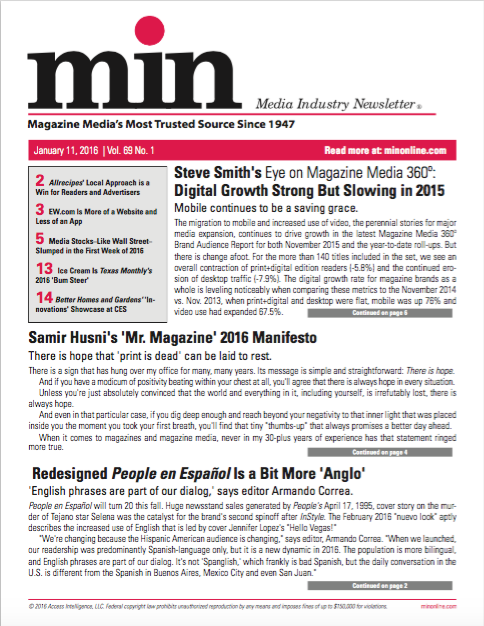
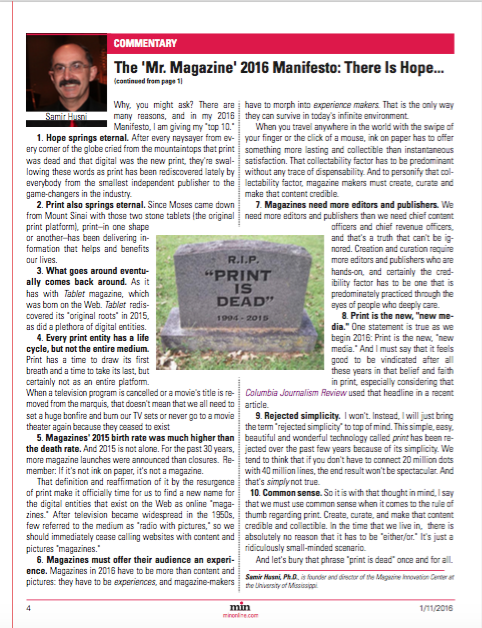
P.S.: The Mr. Magazine™ Manifesto… Look for my Mr. Magazine™ Sixth Manifesto in the January 11, 2016 issue of min: media industry newsletter.

h1

Southern Living Magazine: Putting The “Southern” Back Into The Brand As The Magazine Celebrates Its 50th Anniversary – The Mr. Magazine™ Interview With Sid Evans, Editor-In-Chief & Ron King, Publisher, Southern Living

December 23, 2015

“No, I don’t see that day in my lifetime. I think that the bond that we have with our audience is really extraordinary. It’s remarkably strong. And don’t get me wrong; we have a very diverse business and we’re being very aggressive about what we’re doing in the digital space and what we’re doing in terms of video and in brand extensions and new businesses and in books. But our readers love the print magazine and we hear from them all of the time asking us to never do anything to the print magazine.” Sid Evans (on whether he can envision a day when Southern Living does not have a printed magazine)


“The excitement that comes and builds on Instagram and all of the posts that we re-Gram, the day the issue arrives; these consumers stage little photo shoots the day their magazine gets there because it is their time, when they’re online looking for recipes, that’s not me-time, that’s family-prep time. They’re working. When they sit down to go through Southern Living magazine that is time that they’ve decided to set aside for them every single month. They really lose themselves in the pages of Southern Living and I can’t think of a better time for advertisers to reach them than during their me-time.” Ron King (on the advantage of having a printed magazine in this digital age)

Picture 23 The South has always been a place steeped in good food, beautiful homes, glorious landscapes and a culture that is both magnetic and unexplainable. Much like the magazine that epitomizes “Southern Living” to the hilt.

In 2016 Southern Living celebrates its 50th anniversary of personifying its regional namesake: the South. The largest issue ever, since May 2008, will be on sale in February 2016, and both Sid Evans, editor-in-chief and Ron King, publisher, are as doubly excited as the colossal double issue will make its readers.

I spoke with Sid and Ron recently and we talked about the enormous responsibility they both have when it comes to leading the country’s largest regional magazine, and one of the largest publications period in the United States, into the future. It is a passionate duty they both welcome and look forward to with excitement and a clear vision of where their powerful brand is heading.

We spoke about the legacy of the magazine, its generational rite of passage attraction to its audience, and the powerful footprint it has in the future, both digitally and in print. It was an enlightening and illuminating conversation about a giant brand that remains intimately connected to its audience, even though its reach is all-encompassing.

So, grab a glass of sweet tea and relax for a moment in your front porch swing, wherever that might be, and enjoy the Mr. Magazine™ interview with two southern gentlemen who love their very own style of “Southern Living.”

But first, the sound-bites:


Sid Evans portrait.

Sid Evans portrait.

On whether the powers-that-be 50 years ago could have predicted the success of Southern Living magazine today (Sid Evans): I don’t think that they could have predicted how big an idea they had. I can tell you that they had a lot of confidence in what they were doing when they founded the magazine. But I don’t think that they realized the impact or the longevity or the resonance that it would have with southern consumers.

On whether the powers-that-be 50 years ago could have predicted the success of Southern Living magazine today (Ron King):
I think it was launched by some very smart people, but I think it was happy coincidence. They just did it right. Looking back, it’s very easy to understand why it’s been so successful. One of my favorite stories to tell advertisers in the market is actually why the magazine was launched. What was going on in the south 50 years ago was not good and there were a group of businessmen who got together and agreed that what was going on wasn’t good. But they knew that there were a lot of good things about the south that were not being talked about in the media then. So, they thought about how they could inform people and give them a forum to celebrate the things that were good about the south during those trying times.

On whether Sid feels a different type of editorial responsibility at Southern Living than he did at Garden & Gun or Field & Stream or any of the other magazines that he’s worked on (Sid Evans): I always like to say that this is not our magazine, this is their magazine. Southern Living was built on the backs of the readers and their recipes; their homes and their gardens. It’s really about them.

On whether Ron feels, as a publisher, Southern Living is where he wants it to be at this point in time (Ron King):
One is I’m a southern boy; I think that’s important too. I was born and raised in Arkansas. And I’m a publisher, so I’m greedy. It’s never quite enough. We just closed our February issue, which is our actual 50th anniversary issue; Sid has made it a commemorative issue. And it is the largest revenue-producing February issue in the 50-year history of Southern Living. Even in the heyday of magazines where we couldn’t take the insertion orders off of our fax machines fast enough, we have beaten that February. And if you look beyond February issues, at all issues; it’s the largest issue since May 1996.

On the thought that print is dead and advertisers are fleeing from the medium (Ron King):
Southern Living’s business is a very healthy mix of both consumer revenue and advertising revenue. A lot of brands in the industry don’t have that mix scaled quite correctly. Our consumers love our magazine and they don’t unsubscribe because it is their connection to the south. So, it is not the first thing that goes when they look at their discretionary spending. We gave very strong consumer revenue and we have one of the healthiest pink sheets in the industry.

-1 On what Sid can reveal about the upcoming 50th anniversary commemorative issue (Sid Evans):
I can’t reveal too much, but I can tell you a few things about it. First of all, it’s a double issue, so it’ll have twice as many pages as a typical issue. Secondly, it really is a celebration of the south. That’s the theme of the issue. And we wanted to recognize all of the extraordinary things that are happening in southern culture right now.

On whether Sid can envision a day when Southern Living isn’t a printed entity (Sid Evans):
No, I don’t see that day in my lifetime. I think that the bond that we have with our audience is really extraordinary. It’s remarkably strong. And don’t get me wrong; we have a very diverse business and we’re being very aggressive about what we’re doing in the digital space and what we’re doing in terms of video and in brand extensions and new businesses and in books. But our readers love the print magazine and we hear from them all of the time asking us to never do anything to the print magazine.

On the advantage to having a printed magazine in this digital age from an editorial viewpoint (Sid Evans):
I think one of the things that I love about the print magazine is just the sense of discovery. You never know what you’re going to get. It’s always a pleasant surprise. And it’s not the same thing in digital. You go onto the website and you’re looking for something; you’re usually looking for a specific thing. With the print magazine, it’s a surprise every month. And it’s a pleasant surprise.

Ron King 2[1] On the advantage to having a printed magazine in this digital age from an advertising standpoint (Ron King):
I think the engagement is what the advertisers really want. The term that I hear most used when I’m in market is the idea of “me time.” So, what we know about our consumer is that she lives a busy, busy life and she’s pulled in a million different directions. There’s a particular time that’s very important to her and it’s getting her kids on that school bus, wrapping up her errands, grabbing her Southern Living and sitting down with it, and going through it cover to cover.

On the biggest challenge that Ron has faced since he took the job as publisher (Ron King):
For me, the biggest challenge that I’ve faced since rejoining the brand a little over three years ago was turning our revenue around. We were on the exact same revenue trajectory as the other brands in the industry. But we stopped it and in fact, reversed it and that took a lot of work and was a much longer process than I thought it would be.

On the biggest challenge that Sid has faced since he took the job as editor-in-chief (Sid Evans):
I think in the same way; we had to rebuild some trust with our consumers. We had made some decisions years ago to try to make Southern Living more generic in an effort to broaden the audience. And it had the opposite effect. It was resisted by our readers who felt that we had perhaps abandoned our southern mandate for a time. And this didn’t go on for very long, but there was a period of experimentation there and it was a failed experiment. What I had to do after that was to try and put the southern back in Southern Living and to make sure that we rebuilt that trust and that bridge that we had with our consumers; that everything in this magazine is going to be southern to the core.

On future plans for Southern Living to stay relevant and current with print, digital and any other brand extensions (Sid Evans): I could say that we’ve had extraordinary success in terms of digital growth. And we have a very engaged digital audience that’s growing by leaps and bounds. We’re also rolling out a much-improved website in January in sync with our 50th anniversary. We’re going to be very focused on mobile, of course. And we’re also very focused on video. Video has been one of the most exciting new mediums that we’ve been working with. Our consumers respond to it very powerfully and I think that’s going to be a big focus for us going forward.

On future plans for Southern Living to stay relevant and current with print, digital and any other brand extensions (Ron King):
Beyond the magazine and beyond the website, you can buy more than 600 different Southern Living branded products in Dillard stores across the South. You can stay in Southern Living hotels; you can hire a Southern Living custom builder to build your Southern Living house plan and live within a Southern Living-inspired community. You can landscape Southern Living plants from the Southern Living plant collection, so we are exactly as your question stated; our consumer is everywhere, all-encompassing. And we are meeting her at as many of those points as possible.

On the new Southern Living test kitchens (Sid Evans):
We have incredible new test kitchens. It’s called the Time Inc. Food Studios and is based here in Birmingham. We have 35,000 sq. ft. of test kitchens and photo studios and a video studio. There are a dozen photo studios and 28 kitchens and a state-of-the-art video facility. Food has always been the core franchise for Southern Living. This magazine and this brand were built on the power of its recipes; the reliability of its recipes; the fact that our recipes always work every time; that you can serve them for company and you know that it’s going to work.

On what either of them would be doing if someone showed up at their house unexpectedly in the evening (Ron King):
The truth is I work all day; I go home, do a little bit of exercise and I start working again.

On what either of them would be doing if someone showed up at their house unexpectedly in the evening (Sid Evans):
I might be playing my guitar very badly. (Laughs)

On what motivates them to get out of bed in the mornings (Ron King):
We come in and we work really hard every day and we have such an amazing team and so to see this team working as hard as they do and seeing the results, because unfortunately, so many times in life we work really hard and we don’t see the results. And their passion for this brand is contagious. And that feeling that we have created the culture at Southern Living and that it is a very special culture. And I am aware that it may not always be this way in my career.

On what motivates them to get out of bed in the mornings (Sid Evans):
I’m very lucky to work with an extraordinary team and there is a great surprise in store from my team every day. There are so many ideas flowing through this place that it just makes it very exciting to walk through the door. And I still get a great charge out of seeing an amazing picture or reading a great story or even seeing a great headline. And I also get a great charge out of having a successful video that gets 20 million views.

On what keeps them up at night (Ron King):
I feel a lot of responsibility for this team and it’s a recurring thing that you’ve heard Sid and I talk about, our products and our teams are first. So, are we doing enough and working hard enough to create a brand that will keep these team members employed and engaged and happy with their work life for the next decade?

On what keeps them up at night (Sid Evans): I worry about the main things like numbers, budgets and hitting our targets in terms of traffic, but I think what really keeps me up at night is making sure that I’m keeping the consumers happy. I thrive on feedback from them. That’s my life’s blood and what keeps me going. And it’s also what keeps me awake at night; thinking about have we done the right thing; have we put together the 50th anniversary issue that they’re going to be just ecstatic about? And I think we have.

And now the lightly edited transcript of the Mr. Magazine™ conversation with Sid Evans, Editor-In-Chief & Ron King, Publisher, Southern Living Magazine.

Samir Husni: When Southern Living began; do you think anyone could have predicted that it would become the powerful magazine that it is today; the largest regional magazine in the country and one of the largest magazines period in the United States? Do you think anybody thought that Southern Living would be around and still publishing when it began 50 years ago?

Picture 21 Sid Evans: I don’t think that they could have predicted how big an idea they had. I can tell you that they had a lot of confidence in what they were doing when they founded the magazine. But I don’t think that they realized the impact or the longevity or the resonance that it would have with southern consumers.

Ron King: I think it was launched by some very smart people, but I think it was happy coincidence. They just did it right. Looking back, it’s very easy to understand why it’s been so successful.

One of my favorite stories to tell advertisers in the market is actually why the magazine was launched. What was going on in the south 50 years ago was not good and there were a group of businessmen who got together and agreed that what was going on wasn’t good. But they knew that there were a lot of good things about the south that were not being talked about in the media then. So, they thought about how they could inform people and give them a forum to celebrate the things that were good about the south during those trying times.

And so they launched a magazine that’s all about celebration. And all of the editors since then, all the way up to Sid, focus on celebrating the south. And so we are a very positive and very specific message across five different pillars and our consumer is an exceptional consumer.

I recently gave a presentation talking about the 16 million women who read this magazine. And they don’t read this magazine just because they’re magazine readers. And they subscribe to a list of six or seven magazines and we’re one of them. They are southerners and Southern Living is their connection to this culture that’s so important to them.

So, it’s very easy to understand its success and to look back and say, well of course we’ve been around for 50 years and we have decades ahead of us, although the platforms will be changing. We have decades ahead of us staying connected to our consumers. But I don’t know if they exactly knew that when they launched it.

What they did know was that there was a change happening in the south. They were very prescient because they recognized that there was a migration happening from the rural areas into the cities. People were leaving their farms and they were moving into the cities and the suburbs. And all of those people needed guidance; they needed ideas about how to improve their homes; how to cook; how to take care of their gardens and their yards. There was a vacuum there. There was nothing for them and Southern Living stepped into that place at just the right time.

Samir Husni: Sid, as a southerner yourself; how big does the responsibility feel on your shoulders to be creating and editing a magazine that reaches 16 million women readers, as Ron said? Or does it feel the same as when you were editing Garden & Gun or Field & Stream, or any of the other magazines that you’ve worked on? Do you feel a different type of editorial responsibility at Southern Living?

Sid Evans: I always like to say that this is not our magazine, this is their magazine. Southern Living was built on the backs of the readers and their recipes; their homes and their gardens. It’s really about them. It’s always been a reflection of who they are and I feel like my job is to make sure that reflection is accurate. As long as the magazine is about them, I feel like that connection really stays strong.

Samir Husni: And Ron, with all of the changes that have taken place at Southern Living over the years; as a publisher, do you feel that the magazine is where you want it to be at this point in time?

Ron King: Two things. One is I’m a southern boy; I think that’s important too. I was born and raised in Arkansas. And I’m a publisher, so I’m greedy. It’s never quite enough, but I’m very proud of where we are as a business.

We just closed our February issue, which is our actual 50th anniversary issue; Sid has made it a commemorative issue. And it is the largest revenue-producing February issue in the 50-year history of Southern Living. Even in the heyday of magazines where we couldn’t take the insertion orders off of our fax machines fast enough, we have beaten that February. And if you look beyond February issues, at all issues; it’s the largest issue since May 1996. We are doing a really good job. It’s never quite enough for me, but we’re doing a really good job.

Samir Husni: But I thought that print is dead and advertisers are fleeing from it as fast as they can?

Ron King: Unfortunately, for some brands that is true. But in a recent meeting, we talked about that very subject and we’re very fortunate at Southern Living; Sid is a great leader on the editorial side and I’m a great leader on the publishing side and we both have amazing teams that we support. But the product and the consumer are the reasons that we’re so successful.

Southern Living’s business is a very healthy mix of both consumer revenue and advertising revenue. A lot of brands in the industry don’t have that mix scaled quite correctly. Our consumers love our magazine and they don’t unsubscribe because it is their connection to the south. So, it is not the first thing that goes when they look at their discretionary spending. We gave very strong consumer revenue and we have one of the healthiest pink sheets in the industry.

On the advertising side, Southern Living performs a function on a media plan that not a single other magazine in publishing can do. And that is filling in and bringing unduplicated eyeballs, 60 million southern consumers into a national media plan. So, very rarely do we say that Southern Living should be the only magazine on your media plan. But we do say that you do not have a truly national print media scope without Southern Living. And we have the U.S. Census data and pink sheet data to prove it.

We do something that nobody else does. Our magazine is the best it’s ever been and our consumers are very loyal and engaged consumers. And that is really our recipe for success.

Samir Husni: Sid, can you give me a preview of the 50th anniversary issue? What can you reveal about the commemorative issue?

Sid Evans: I can’t reveal too much, but I can tell you a few things about it. First of all, it’s a double issue, so it’ll have twice as many pages as a typical issue.

Secondly, it really is a celebration of the south. That’s the theme of the issue. And we wanted to recognize all of the extraordinary things that are happening in southern culture right now. The south is really going through a kind of renaissance and you see it in the emergence of southern food, in the exciting things that are happening in the cities, in the creative communities and design communities. There’s just an explosion of interest in southern culture right now. And I wanted this issue to reflect that and how exciting it is to live in the south right now.

But we also wanted to take a moment to look back at our history. You know, Southerners are obsessed with our history and our past. So, we had a lot of fun digging through the archives, pulling out some of our best recipes ever and revisiting some of our favorite places.

And we also poked a little fun at ourselves as well. We have a story called “Bless Our Hearts” where we went back and looked at some of our more embarrassing moments and some of the things that we regretted doing. And that was one of the more fun stories that we worked on in the issue.

Samir Husni: Can you envision a day when we don’t have Southern Living in print?

Sid Evans: No, I don’t see that day in my lifetime. I think that the bond that we have with our audience is really extraordinary. It’s remarkably strong. And don’t get me wrong; we have a very diverse business and we’re being very aggressive about what we’re doing in the digital space and what we’re doing in terms of video and in brand extensions and new businesses and in books. But our readers love the print magazine and we hear from them all of the time asking us to never do anything to the print magazine.

There’s a visceral connection that they have and it really crosses generations. That’s been a big secret to our success. You have people passing this magazine down from one generation to the next. You have mothers passing it down to their daughters; it’s almost a rite of passage. When you’re getting married or buying your first home; you get a subscription to Southern Living. And that’s a really profound tradition in the south and I don’t see that going away. And I don’t see any softness in their response to the print magazine.

Samir Husni: From an editorial point of view, what’s the power of print? What’s the advantage to having a printed magazine in this digital age?

Picture 20 Sid Evans: I think one of the things that I love about the print magazine is just the sense of discovery. You never know what you’re going to get. It’s always a pleasant surprise. And it’s not the same thing in digital. You go onto the website and you’re looking for something; you’re usually looking for a specific thing. With the print magazine, it’s a surprise every month. And it’s a pleasant surprise.

It’s also the mood that the reader is in when they’re looking at the print magazine. I think they’re relaxed and open to new ideas and the excitement of seeing a new recipe or a decorating idea that they had never considered.

Samir Husni: And Ron, what about from an advertising standpoint; what is the advantage in having a printed magazine?

Ron King: I think the engagement is what the advertisers really want. The term that I hear most used when I’m in market is the idea of “me time.” So, what we know about our consumer is that she lives a busy, busy life and she’s pulled in a million different directions. There’s a particular time that’s very important to her and it’s getting her kids on that school bus, wrapping up her errands, grabbing her Southern Living and sitting down with it, and going through it cover to cover.

And we hear it every single month in a variety of different ways, even on Instagram. The excitement that comes and builds on Instagram and all of the posts that we re-Gram, the day the issue arrives; these consumers stage little photo shoots the day their magazine gets there because it is their time, when they’re online looking for recipes, that’s not me-time, that’s family-prep time. They’re working. When they sit down to go through Southern Living magazine that is time that they’ve decided to set aside for them every single month. They really lose themselves in the pages of Southern Living and I can’t think of a better time for advertisers to reach them than during their me-time.

Sid Evans: I think Ron is exactly right about that. We hear that all of the time, that they look forward to having time with the print magazine by themselves, when they can really relax and enjoy it. And I think they see themselves in the magazine as well.

Samir Husni: What has been the biggest challenge that you’ve faced since you took this job and how did you overcome it?

Ron King: For me, the biggest challenge that I’ve faced since rejoining the brand a little over three years ago was turning our revenue around. We were on the exact same revenue trajectory as the other brands in the industry. But we stopped it and in fact, reversed it and that took a lot of work and was a much longer process than I thought it would be. But Southern Living is a giant brand and to stop a downward trajectory and in fact reverse it, takes a lot of time and patience. And that has been both my biggest challenge and my biggest reward.

Samir Husni: And Sid, what has been your biggest challenge?

Picture 19 Sid Evans: I think in the same way; we had to rebuild some trust with our consumers. We had made some decisions years ago to try to make Southern Living more generic in an effort to broaden the audience. And it had the opposite effect. It was resisted by our readers who felt that we had perhaps abandoned our southern mandate for a time. And this didn’t go on for very long, but there was a period of experimentation there and it was a failed experiment.

What I had to do after that was to try and put the southern back in Southern Living and to make sure that we rebuilt that trust and that bridge that we had with our consumers; that everything in this magazine is going to be southern to the core. That’s the first mandate of any piece of content that we’re doing, it has to be southern.

It also has to do something for them. It has to provide a service to them and it has to give them an idea of something that they can work with. And the other S of the three S’s that we often talk about is that it needs to be seasonal and it needs to be relevant to the season in which they get it.

So, that has taken some time and I feel like our bond now with our readers is as strong as it has ever been. We’ve heard that loud and clear through email correspondence, through social media and it’s also been reflected in our numbers and in our success.

Samir Husni: You are a part of a big, major company, Time. Inc. in which I’ve heard from almost everybody, from the CEO down to other employees there, that this belief in print and these digital platforms that we’re creating have brought about the realization that it’s no longer either/or. So, what are the plans for Southern Living after 50 years to be a part of that dawning realization? We are in print and we are in digital, we are a brand that’s all over the place. What are the all-over-the-place plans for Southern Living besides the powerful printed magazine?

Sid Evans: I could say that we’ve had extraordinary success in terms of digital growth. And we have a very engaged digital audience that’s growing by leaps and bounds. We’re also rolling out a much-improved website in January in sync with our 50th anniversary. We’re going to be very focused on mobile, of course.

And we’re also very focused on video. Video has been one of the most exciting new mediums that we’ve been working with. Our consumers respond to it very powerfully and I think that’s going to be a big focus for us going forward.

I’ll give you an example. We have one of the most viewed, if not the most viewed, videos at Time Inc. We did a video earlier this year on Oreo Cookie Balls of all things. It’s been viewed more than 20 million times on Facebook.

So, people are watching these videos; they’re sharing them with their friends and they love where they’re coming from. And they love videos with a southern point of view. I think that there’s a lot of opportunity for us in that space.

Ron King: Beyond the magazine and beyond the website, you can buy more than 600 different Southern Living branded products in Dillard stores across the South. You can stay in Southern Living hotels; you can hire a Southern Living custom builder to build your Southern Living house plan and live within a Southern Living-inspired community. You can landscape Southern Living plants from the Southern Living plant collection, so we are exactly as your question stated; our consumer is everywhere, all-encompassing. And we are meeting her at as many of those points as possible.

When she eats lunch at Ruby Tuesday restaurant, there are items on the menu that we have sent to the Southern Living test kitchens and they are Southern Living approved. We’re always looking for unique and impactful ways to reach our consumer wherever she is.

Samir Husni: You mentioned the Southern Living test kitchens; Sid, can you talk a little bit about the test kitchens and their new surroundings at the Southern Living headquarters?

Picture 18 Sid Evans: Absolutely. We have incredible new test kitchens. It’s called the Time Inc. Food Studios and is based here in Birmingham. We have 35,000 sq. ft. of test kitchens and photo studios and a video studio. There are a dozen photo studios and 28 kitchens and a state-of-the-art video facility.

Food has always been the core franchise for Southern Living. This magazine and this brand were built on the power of its recipes; the reliability of its recipes; the fact that our recipes always work every time; that you can serve them for company and you know that it’s going to work.

So, we take that very seriously and the company also believes in the power of recipes and the importance of being able to create great food content. Time Inc. made a significant investment in these kitchens and studios. And I think it’s just going to add to the power and reach of the brand.

In addition to our ability to create incredible content there, we also have a great space where we can host events and where we can do chef demonstrations and videos and engage with our consumers. The first thing that consumers want to see when they come and visit us here in Birmingham is the test kitchens. That’s where they want to go. And I think we’ve got more beautiful and exciting test kitchens for them to see now than we’ve ever had before. It’s very exciting.

Samir Husni: Is there anything else either of you would like to add?

Ron King: I’d like to make one correction, Samir. I stated two facts about our February issue earlier and one of them was incorrect, so I’d like to restate them both for the record. Our February anniversary issue for February 2016 is the largest February issue in the 50-year history of Southern Living. It is the largest issue period since May 2008, not May 1996.

Samir Husni: If I showed up unexpectedly at your home one evening; what would I find you doing; would you be having a glass of wine and reading a magazine or reading something on your iPad, watching TV; what would you be doing?

Ron King: I’ll go first because mine is easy; I’d be working.

Samir Husni: At home?

Picture 17 Ron King: Yes, I’m not very interesting, Samir. (Laughs) The truth is I work all day; I go home, do a little bit of exercise and I start working again.

Samir Husni: And Sid, what about you?

Sid Evans: I might be playing my guitar very badly. (Laughs)

Samir Husni: What motivates either of you to get out of bed in the mornings?

Ron King: I have sort of a silly answer and a serious answer to that. One of my favorite moments of the day is, and this is a quote actually from something I read a long time ago that Robin Williams said; the moment that latte hits your chest. So when I open my eyes the first thought I have is how long until my latte? (Laughs)

But no, we come in and we work really hard every day and we have such an amazing team and so to see this team working as hard as they do and seeing the results, because unfortunately, so many times in life we work really hard and we don’t see the results. And their passion for this brand is contagious. And that feeling that we have created the culture at Southern Living and that it is a very special culture. And I am aware that it may not always be this way in my career. But at this moment I’m working with amazing people on an amazing brand and that culture is really energized. How could you not want to get up and come into work to that?

Samir Husni: And Sid?

Sid Evans: I would echo that. I’m very lucky to work with an extraordinary team and there is a great surprise in store from my team every day. There are so many ideas flowing through this place that it just makes it very exciting to walk through the door.

And I still get a great charge out of seeing an amazing picture or reading a great story or even seeing a great headline. And I also get a great charge out of having a successful video that gets 20 million views. So, those things keep me fired up and it never gets old and I hope it never does.

Samir Husni: My typical last question; what keeps you up at night?

Ron King: (Laughs) Hitting my numbers. I’m grateful that for the last 14 months that has not kept me up at night. But we are a giant brand with giant responsibilities. And I feel a lot of responsibility for this team and it’s a recurring thing that you’ve heard Sid and I talk about, our products and our teams are first. So, are we doing enough and working hard enough to create a brand that will keep these team members employed and engaged and happy with their work life for the next decade?

And I would say that I spend half my time focused on the success of Southern Living today and the other half of my time focused on the success of Southern Living five years from now. And that’s a huge responsibility that neither of us takes lightly, but one that we’re both happy to take on.

Samir Husni: And Sid, what keeps you up at night?

Picture 23 Sid Evans: I worry about the main things like numbers, budgets and hitting our targets in terms of traffic, but I think what really keeps me up at night is making sure that I’m keeping the consumers happy. I thrive on feedback from them. That’s my life’s blood and what keeps me going. And it’s also what keeps me awake at night; thinking about have we done the right thing; have we put together the 50th anniversary issue that they’re going to be just ecstatic about? And I think we have.

The consumer is always first in my mind and it’s a constant effort to keep them happy. You can’t ever relax or let your guard down or get lazy, because they expect great things from you. So, I’ve lost a little sleep over that. (Laughs)

Samir Husni: Thank you both.

—————————————————————————————————————————-

Happy Holidays and all the best for the New Year from Mr. Magazine™ and the staff of the Mr. Magazine™ blog. We will be back after the holidays… cheers and all the best.

h1

Tablet Magazine: Successfully Born Online & Now Available In Inimitable Print – Take Two “Tablets” For A More Robust Effect – The Mr. Magazine Interview With Jack Kliger, Publisher, & Alana Newhouse, Editor-In-Chief, Tablet Magazine.

December 21, 2015

“I think magazines are different; there’s a different creative concept; a different mix of text and graphics. Something that makes one plus one equal more than two and that’s something that maybe magazines can’t do as fast as electronic media can do, but there are things that magazines can do that aren’t just replicated online. And then there’s the more basic answer; you get better writing.” Jack Kliger


“I think that print has been wildly underestimated. The Internet came along and people imagined that it was a tool to be used for every single thing in their lives. But it’s not a tool for everything in their lives; it’s a tool for some very important things in our lives like news or information, information that we need for our daily lives, but I don’t necessarily know that the Internet is the right medium for deeper reads.” Alana Newhouse

TABLETcover When God gave his people the Ten Commandments they were etched onto stone tablets to read and follow, maybe it was no accident that you could conceivably consider that the original “printed” word.

And in 2009, when Tablet’s editor-in-chief, Alana Newhouse, originated the online entity that has since become a highly successful informational site, she’d had just that thought running through her mind, along with the idea that eventually she would love to expand the online experience into a more tangible and lasting conversation with its audience, and of course, follow God’s lead by doing that through a printed magazine.

Tablet Magazine was born from that idea and the passion that Alana has for its subject matter. And along with veteran media executive, Jack Kliger, who joined Alana as publisher and brought over 35 years of his own expertise to the magazine, they have set out to prove that when you really believe in the product you’re creating and the message being sent to your target audience, the printed word can be a Godsend.

I spoke with both Alana and Jack recently and we talked about what each of them hopes to accomplish with the new magazine. And about the community spirit that lives within its ink on paper pages and how they achieved that goal and many more.

It was an enlightening and inspiring conversation and one I know you will enjoy as much as Mr. Magazine™ did. And so without further hesitation, the Mr. Magazine™ interview with Jack Kliger, Publisher & Alana Newhouse, Editor-In-Chief, Tablet Magazine.

But first, the sound-bites:


AN-credit-MichelleIshay On the idea that print suddenly seems to be the new media for everyone (Alana Newhouse):
I think that print has been wildly underestimated. The Internet came along and people imagined that it was a tool to be used for every single thing in their lives. But it’s not a tool for everything in their lives; it’s a tool for some very important things in our lives like news or information, information that we need for our daily lives, but I don’t necessarily know that the Internet is the right medium for deeper reads. The example that I’d like to give you is the invention of the phone, or a fork. The fork is a great utensil, but it’s not the only utensil that you need for everything in your life. And it’s the same thing when it comes to the Internet.

On the idea that suddenly print seems to be the new media for everyone (Jack Kliger):
Personally, I don’t think people stopped reading magazines. Maybe some people never started in this new generation; maybe some people did start, but to me printed magazines are as bad as the theatre is. I went to the theatre the other day and I said isn’t it amazing that this is a form of performance that William Shakespeare was writing for years ago, but I remember reading articles that said when movies came along and television came along, who would need theatre? I’ve gone to the theatre lately and there are things that happen there, in terms of seeing live performances, and three-dimensional experiences, that aren’t different. And I think magazines are different; there’s a different creative concept; a different mix of text and graphics.

On the Tablet reader (Alana Newhouse):
Increasingly for us, paper and the web is the way to go because for Tablet’s audience; we have a very big readership on the web and then we have a smaller audience of, I would say, hardcore Tablet readers, people who are our most engaged, most excited and most committed reader. And for them, they really want to take Tablet more fully into their lives. And the only way for them to really be able to bring Tablet completely into their lives is through print.

On the name Tablet (Alana Newhouse):
When we started we tried to think about a name for the magazine and one thing we thought about was what the very first platform was, at least in our tradition, right? The idea behind it was we wanted to imagine a new medium that could send a message that could be lasting.

On the conversational cover of the printed magazine (Alana Newhouse):
In terms of the armchair cover; the cover is a little bit of an inside joke for American Jews who were raised in the post-war years, but not only American Jews, also people who were raised around Jews; all of those people are who the magazine is for. Many of us were raised by immigrants or by children of immigrants. One of the funny phenomena of those homes was that they all had this plastic-covered furniture. And the reason why they had plastic-covered furniture was because the furniture was the only thing they had of value, or frequently one of the only things of value. And it was permanent. And they wanted to protect it, so many of us grew up in these homes with those particular chairs and couches.

On whether Alana was surprised that the name Tablet was available (Alana Newhouse):
I don’t think we were that surprised; we learned later that there are other Tablets. There are Tablet Hotels and many other things with that name. And of course, the digital device started being called tablet.

On how Jack became publisher of Tablet (Alana Newhouse): The truth is meeting Jack was our real good fortune. I’m sure there’s a biblical metaphor here of why he came onboard. (Everyone laughs). But that was a real stroke of luck for us. I had wanted to do a print magazine, but I could not figure out how to do it. And not only could I not figure out how to do it; I couldn’t find people in New York who thought I was anything other than a lunatic for wanting to do it. I couldn’t even find anyone who believed in it with me. So, Jack and I were introduced and one of the strokes of luck for me was actually having someone who was such a brilliant publisher who looked at me and never said I was crazy, first of all, and believed that there was a value proposition here.

jack kliger MPA photo On what made Jack want to be a part of Tablet Magazine (Jack Kliger): First of all, I’ve been fortunate in working with editors who are real visionaries and not functionaries. I mean, I work with functionaries too, but one of the things that obviously impressed me in the beginning with Alana is she had a really clear and strong perspective on what she wanted to create, but she also knew very well who she wanted to create it for.

On how it feels for him to create his first not-for-profit venture (Jack Kliger):
It feels great because this is one of the proudest efforts I’ve made, not only for my own personal reasons about wanting to create an informational platform that would help what I call millennial and 21st century American Jews understand their identity better, but it’s also a very talented and enthusiastic group of people led by Alana who are genuinely passionate and committed to what they’re doing.

On how Tablet, the magazine, creates the community spirit that is felt between its pages (Alana Newhouse):
The first thing that has to happen is that we have to start by mirroring the community. One of the problems with both certain Jewish organizations and also with certain magazines is that they forget the actual people they’re supposed to be speaking to. So suddenly they determine that this person is a Jew, that person is not a Jew; this person is inside the community, that person is not.

On anything either of them would like to add (Jack Kliger):
I would just like to say that the response from people that I have talked to since they started getting the magazine has been just wonderful. They just started getting the magazine in the past couple of weeks. As you know, it’s not easy to find on the newsstands. The fact of the matter is this magazine is going to be built with a core of subscribers that we think will be not only strongly committed and heavily renewing, but will also be part of a community and we think they will use Tablet as a proud bag.

On what motivates him to get out of the bed (Jack Kliger):
What gets me up in the morning is finding out how many subscriptions we’ve sold to date. (Laughs) I want to know on a daily basis. Energy comes from engagement. And there are a lot of things that can engage you.

On what keeps him up at night (Jack Kliger):
The problem is people all over the world now feel threatened because they don’t know who’s going to do what. Society has some very big challenges. We have people who want to go back to the Wild West. What keeps me up at night is what kind of world my grandchildren are going to live in.

On what keeps Alana up at night (Alana Newhouse):
I think that watching how fast the world changes and sharing that it’s incumbent upon me and my staff to try our best to cover it as smartly and as clearly and as non-hysterically as possible, but then also feeling at the end of the day that there’s more to be done. And that’s what keeps me up at night as well. And what happens next.

And now the lightly edited transcript of the Mr. Magazine™ interview with Jack Kliger, Publisher, & Alana Newhouse, Editor-In-Chief, Tablet Magazine.

Samir Husni: The Columbia Journalism Review recently ran an article talking about print as the new media; what gives? What do you think has happened that suddenly many people are talking about print as the new media?

Jack Kliger: That’s a very good question. Alana, would you like to tackle that first?

Alana Newhouse: Sure. I think that print has been wildly underestimated. The Internet came along and people imagined that it was a tool to be used for every single thing in their lives. But it’s not a tool for everything in their lives; it’s a tool for some very important things in our lives like news or information, information that we need for our daily lives, but I don’t necessarily know that the Internet is the right medium for deeper reads.

In fact, I think the last 10 years have seen print be discarded by many people who assumed that they could get the same benefits that they always got from print, on the web. And I don’t think you can.

The example that I’d like to give you is the invention of the phone, or a fork. The fork is a great utensil, but it’s not the only utensil that you need for everything in your life. And it’s the same thing when it comes to the Internet. The Internet is a very valuable and a very important, and in some cases for many of us, one of the most important tools in our lives, but it’s not the only one.

So, I think that it’s understanding that print has always had a value that just needed to be rediscovered and I think that’s what the articles and the talk mean by that.

Jack Kliger: I would say Alana’s answer is a pretty good delineation. I would also say this, Samir; I’d rather talk about magazines as new media; it’s relatively broad and I can sit here and also talk about newspapers, but more specifically what we consider an art form called magazines. I’m one of those old horses that never thought magazines went away, they just have to morph in terms of a very differently dissected economic pie.

Personally, I don’t think people stopped reading magazines. Maybe some people never started in this new generation; maybe some people did start, but to me printed magazines are as bad as the theatre is. I went to the theatre the other day and I said isn’t it amazing that this is a form of performance that William Shakespeare was writing for years ago, but I remember reading articles that said when movies came along and television came along, who would need theatre? I’ve gone to the theatre lately and there are things that happen there, in terms of seeing live performances, and three-dimensional experiences, that aren’t different.

And I think magazines are different; there’s a different creative concept; a different mix of text and graphics. Something that makes one plus one equal more than two and that’s something that maybe magazines can’t do as fast as electronic media can do, but there are things that magazines can do that aren’t just replicated online. And then there’s the more basic answer; you get better writing. (Laughs)

Samir Husni: (Laughs too). And I agree with you. I’m the one that trademarked the phrase if it’s not ink on paper, it’s not a magazine.

TABLETtoc Jack Kliger: Exactly. That’s a great phrase. And mind you, we’re not thinking that digital or a website is a place to jump off of. Tablet started and is still doing very well as a website, but that’s a different thing from the magazine. We just think digital and print is better than digital or print.

Alana Newhouse: I would say that I don’t necessarily disagree with you as much as I definitely believe that we are running a magazine also on the web, because my original definition of a magazine was a publication that had a perspective. And it had a particular personality. And again, I’m not talking about general interest magazines; I’m talking about magazines that offered you a way of looking at the world.

And we try to do that online and I think that we do a very good job of it. I realized that you simply cannot transmit that perspective in the same way if it’s not on paper. And I think that right now Jack is right; increasingly for us, paper and the web is the way to go because for Tablet’s audience; we have a very big readership on the web and then we have a smaller audience of, I would say, hardcore Tablet readers, people who are our most engaged, most excited and most committed reader. And for them, they really want to take Tablet more fully into their lives. And the only way for them to really be able to bring Tablet completely into their lives is through print.

Samir Husni: You mentioned on the web that the experience of tuning the world out and losing yourself between the covers of a magazine is what you pushed you to actually bring the print edition to life. So, you’re talking about the experience; we’re not just about information; we’re experience makers. And the digital experience is completely different from the print experience.

Jack Kliger: I think what you’re saying is very true. Experience maker is a very interesting phrase.

TABLETcover Samir Husni: So tell me about the name Tablet and also about the cover; you have an armchair with text all over it that goes from, God never forgets Zion to ET, phone home. As you wrote in your Letter from the Editor, there’s seems to be a mix of fun, storytelling, along with the seriousness. Tell me about the name Tablet first and then about the DNA of the brand, from the web launch in 2009 to the print component that just came out.

Alana Newhouse: When we started we tried to think about a name for the magazine and one thing we thought about was what the very first platform was, at least in our tradition, right?

Jack Kliger: (Laughs). The first Jewish platform.

Alana Newhouse: In the Jewish story the very first media were the tablets. We came out before the tablets were known as iPads. It was earlier than that. But the idea behind it was we wanted to imagine a new medium that could send a message that could be lasting. And that’s where we came up with the name.

In terms of the armchair cover; the cover is a little bit of an inside joke for American Jews who were raised in the post-war years, but not only American Jews, also people who were raised around Jews; all of those people are who the magazine is for. Many of us were raised by immigrants or by children of immigrants.

One of the funny phenomena of those homes was that they all had this plastic-covered furniture. And the reason why they had plastic-covered furniture was because the furniture was the only thing they had of value, or frequently one of the only things of value. And it was permanent. And they wanted to protect it, so many of us grew up in these homes with those particular chairs and couches.

Jack Kliger: I didn’t know until I was 18 that chairs came without plastic. (Laughs)

TABLETmanga Alana Newhouse: Exactly. What we wanted to do was take the chair that was this sort of icon of the homes that we grew up in, and of the American Jewish experience in the post-war decades, and we wanted to use it as the basis for something. But then we also wanted to show what we were putting on it was our own. And we were going to sort of graffiti it with some of the elements of the Jewish inheritance that we feel is now ours to play with and also to save and to be stewards of.

There’s scripture, religion, faith, observance, literature, music and movies; it sort of runs the gamut of what we see as the wider American Jewish inheritance. But the idea was that it was being put on top of this chair as a way of expressing that we know what we’re sitting on. And we know our history and we know the foundation that we are on top of. And we also know that it’s important for us to respect it, and for us to use it as a basis for moving into the future.

Samir Husni: Were you surprised that the name Tablet wasn’t already taken?

Alana Newhouse: I don’t think we were that surprised; we learned later that there are other Tablets. There are Tablet Hotels and many other things with that name. And of course, the digital device started being called tablet.

Jack Kliger: I am surprised that seven years ago when Alana started it, it hadn’t yet been used. Every word in the vocabulary seems to have been used as a name for a magazine at one time or another. It was a pleasant surprise.

Alana Newhouse: Our blog is called The Scroll, and that’s the one I’m really surprised about. (Laughs) Think about it, right? That’s the one that has the great double meaning for now.

Samir Husni: This is one thing that I keep telling anyone who is willing to listen; the law of rejected simplicity. When we think something is so simple that there’s no way it will work, or someone has already done it, but yet everybody who heard that I was interviewing you both; when they heard the name Tablet, they knew exactly what I was talking about.

Jack Kliger: That’s great.

Samir Husni: As you said, it was the original form of communication.

Jack Kliger: The first platform.

Samir Husni: Take me through the journey of bringing Jack in, because Alana you were there from the beginning with the website. Then Jack came onboard to be the publisher.

Alana Newhouse: The truth is meeting Jack was our real good fortune. I’m sure there’s a biblical metaphor here of why he came onboard. (Everyone laughs). But that was a real stroke of luck for us. I had wanted to do a print magazine, but I could not figure out how to do it. And not only could I not figure out how to do it; I couldn’t find people in New York who thought I was anything other than a lunatic for wanting to do it. I couldn’t even find anyone who believed in it with me.

So, Jack and I were introduced and one of the strokes of luck for me was actually having someone who was such a brilliant publisher who looked at me and never said I was crazy, first of all, and believed that there was a value proposition here. And also on top of that to come in and say I’ll help you was a dream.

Jack Kliger: That’s very nice to hear.

Samir Husni: Jack, this isn’t the first time that you’ve worked with lunatics, right? (Laughs)

Jack Kliger: (Laughs too). No, I’ve made a career of working with lunatics. (Laughs)

Alana Newhouse: Thanks so much. (Laughs too)

Jack Kliger: First of all, I’ve been fortunate in working with editors who are real visionaries and not functionaries. I mean, I work with functionaries too, but one of the things that obviously impressed me in the beginning with Alana is she had a really clear and strong perspective on what she wanted to create, but she also knew very well who she wanted to create it for. And she had a seven year record of building an audience that was definable. But what struck me was when she described the reasons for creating a print magazine; it was really about what she felt could be produced in terms of the product, which was different from what was already being produced. But also what she wanted for the reader.

What I added to the mix was most people were advising her that it could be built on both a subscription and ad-driven model and I said it was going to be a predominately consumer-driven revenue product. It was going to have to be good enough to command a reasonable price and it was going to have to be good-looking enough to be something everybody is proud of. But it’ll never be large enough or broad enough to be substantially based on advertising revenue, nor should it be. That was another part of my recommendations for how to look at it.

Samir Husni: Jack, if I’m not mistaken this is your first not-for-profit publishing venture. How does that feel?

Jack Kliger: Yes. Well, it’s the first one that’s intentionally not-for-profit. (Laughs)

Samir Husni: (Laughs too).

TABLETratner Jack Kliger: It feels great because this is one of the proudest efforts I’ve made, not only for my own personal reasons about wanting to create an informational platform that would help what I call millennial and 21st century American Jews understand their identity better, but it’s also a very talented and enthusiastic group of people led by Alana who are genuinely passionate and committed to what they’re doing.

I have to tell you; one of the things that concerns me about the established media business, in particular I see this in magazines, is that many people who are working at magazines are just trying to hold on to their jobs and benefits and make it to retirement. Many times you go into places and you talk about change and people don’t want things to change

Here, it was an adverse change; here, after we went around a couple of times of coming up with what seemed like a reasonable way to execute, it was talking to a staff that you would assume didn’t believe in print because they were all young, digital hotshot kind of people. But it really wasn’t that hard because they believed in journalism and they believed in their audience. And they do know their audience.

I have come a long way in this business and I think frankly even though it’s a not-for-profit, I believe this product will be operationally profitable and I think that’s an important thing to target for in any case. Operationally, it’s a very important thing that we get enough revenue from our consumers to pay for the high quality of the product that we’re going to put out. That’s sometimes a radical notion in American magazine publishing, but it’s a basic notion for us.

Samir Husni: Alana, keeping that notion in mind, as I was reading the magazine and flipping through the pages; I felt that sense of community. From within the pages it felt like I was getting a letter from a friend just updating me on everything, those good old days when people used to write five, six, seven or eight page letters to friends. Tell me about that tribal sense that you talk about and that community sense and how Tablet, the magazine, actually creates that community spirit?

Alana Newhouse: The first thing that has to happen is that we have to start by mirroring the community. One of the problems with both certain Jewish organizations and also with certain magazines is that they forget the actual people they’re supposed to be speaking to. So suddenly they determine that this person is a Jew, that person is not a Jew; this person is inside the community, that person is not.

One of the things that I want to do to start with is to ask who wants to be a part of this community; raise your hand. I’m not asking any questions about who you are just yet. I just want to know who wants in. And if you want in and you’ve bought a subscription because you, for whatever reason, want to be a part of an American Jewish conversation, then the first step is I need to welcome you. And I need to invite you in and ask you to have a seat. Then my real job starts.

At that point, I need to say here’s the conversation. And if you pick up on the metaphor, sort of the cocktail party from my introduction, it’s essentially that. You open your doors, you say whoever wants to come in to my party, come in. I’m going to have a great meal; I’m going to serve you something fun. We’re going to have some nice wine and then we’re going to talk. I’m going to give you great stuff to talk about. I’m going to introduce you to some really interesting people and I’m also going to challenge some things. Maybe we’ll disagree and have some fights. As long as you don’t offend someone else in a way that I find inappropriate, then you’re in. So, let’s talk.

In some sense, my job with the magazine is to show people how interesting and fascinating I find the conversation about Jewish identity, both historically and in contemporary society as well. I want them to see that they can be a part of it. Those are the two legs of my job.

Jack Kliger: One thing that is very important in my mind is that with the American Jewish community in the 21st century is that it’s not a ghetto. It’s a community. And that’s a very important thing. One of the reasons that I’m very interested in that is that my parents were in ghettos and my kid is not. The American Jewish experience in this 21st century deserves a magazine and that’s what we’ve created, a 21st century media. So, I think print is certainly a part of the 21st century media. And we’re going to prove that.

Samir Husni: Is there anything that either of you would like to add?

Jack Kliger: I would just like to say that the response from people that I have talked to since they started getting the magazine has been just wonderful. They just started getting the magazine in the past couple of weeks. As you know, it’s not easy to find on the newsstands.

Samir Husni: And thank you for saving me my $10, although, I did try to find it. I went to every Barnes & Noble. (Laughs)

Jack Kliger: Oh, I know. We’re getting more of that. Who else but a Jewish group would launch a magazine at the time that you have the newsstand distributors blowing up? The fact of the matter is this magazine is going to be built with a core of subscribers that we think will be not only strongly committed and heavily renewing, but will also be part of a community and we think they will use Tablet as a proud bag. So, we think we have achievable, reasonable goals to get to a subscription level that will make us self-sustainable. And then I think you’re going to see a great new product on the American magazine scene, which I think is pretty cool.

Samir Husni: Jack, what motivates you to get out of bed in the mornings?

Jack Kliger: My dog. (Laughs)

Alana Newhouse: And I was basically going to make the same joke and say my one and a half year old. (Everyone laughs).

Jack Kliger: What gets me up in the morning is finding out how many subscriptions we’ve sold to date. (Laughs) I want to know on a daily basis. Energy comes from engagement. And there are a lot of things that can engage you.

Samir Husni: Jack, my typical last question; what keeps you up at night?

Jack Kliger: (Laughs) Frankly, what keeps me up at night is not a business question; it’s trying to figure out the crazy world we live in. What’s funny about this Tablet thing is one of the things that really motivated me was a book I read a year ago that talked about the challenge for Jews is we now live in an open society. We’re members of an open society. For generations we haven’t been, we’ve lived in ghettos and we’ve been threatened. There’s a generation of people now who aren’t threatened on a daily basis, afraid they’re going to be attacked just because of who they are.

The problem is people all over the world now feel threatened because they don’t know who’s going to do what. Society has some very big challenges. We have people who want to go back to the Wild West. What keeps me up at night is what kind of world my grandchildren are going to live in.

Samir Husni: Alana, what keeps you up at night?

Alana Newhouse: Well, what gets me out of bed in the mornings besides my child is the news. The truth is that the same thing that wakes me up puts me to bed. I believe that Jews have an obligation to themselves and also to others to try their best to understand the world and to try their best to understand how to organize the world to bring more safety and more justice and more potential for as many people as possible.

I think that watching how fast the world changes and sharing that it’s incumbent upon me and my staff to try our best to cover it as smartly and as clearly and as non-hysterically as possible, but then also feeling at the end of the day that there’s more to be done. And that’s what keeps me up at night as well. And what happens next.

Samir Husni: Thank you.

h1

Adventure Journal Quarterly: A New Title Born From The Outdoor Dreams Of One Man & From The Labyrinth Of The Web…To At Last Breathe In Print – The Mr. Magazine™ Interview With Steve Casimiro, Founder, Adventure Journal Quarterly

December 18, 2015

“And how not to burn out at it, if you’re small, just one or two people, how do you keep it fresh? I think that is one of the big challenges with digital media. It reminds me of going to a sushi place, where they have these little rivers and they do their California rolls and put them on floating plates and you sort of grab the little bites as they go by; to me digital media often feels like that. It’s just not sustaining from a reader’s standpoint. And that was a lot of the impetus for wanting to do print, because the relationship between the reader and the words is different. It feels like it sates you and fills you up better.” Steve Casimiro

aj1001-comp What do you do when you have 30 years of experience in outdoor magazines and you’ve been creating a successful online publication for six years, but you feel the need to allow that experience to develop in a more tactile and tangible way than the web? Why, you create a magazine of course.

In the spring of 2016, the online publication Adventure Journal will have a print component, Adventure Journal Quarterly. And in the words of founder, publisher and editor, Steve Casimiro, it’s something that was planned from the beginning, even before the first pixel was put into place. Steve added in a newsletter to his web audience that it needs no batteries and no internet connection. It won’t bug you to check your email or ask you to like it. It’s print, baby.

I spoke with Steve recently and we talked about the upcoming magazine that will bring Adventure Journal onto newsstands. Having worked extensively in print for most of his career, from Powder magazine to National Geographic Adventure, Steve knows and believes in the power and celebration of print. And with his business model of pre-selling issues until the actual magazine comes out, he can see the potential success already, having a robust subscription base almost immediately. And as an avid outdoor enthusiast himself, he’s certainly the man to bring adventure to a journal on a quarterly basis.

So, I hope you enjoy this entrepreneurial approach to magazine making from a man who has as much faith in and passion for the printed word as he does for the great outdoors he eloquently creates about. And now the Mr. Magazine™ interview with Steve Casimiro, Founder, Adventure Journal Quarterly.

But first, the sound-bites:

casimiro portrait On why he had always intended for Adventure Journal to be in print and not just online: The idea for the magazine, Adventure Journal Quarterly, goes back a couple of decades. Like so many editors, I have a vision of what I want XYZ magazine to look like. I was the editor at Powder magazine and it was my job to bring my vision to that magazine, so terrific, I did that, and I also did it when we launched Bike magazine. My teams have always been passionate about the outdoors and adventure. And it’s something that my whole life has really revolved around since then. And my roots are in print. I started in newspapers, and I’ve been in print one way or another for about 30 years. So, it’s what I know. But the financial barriers to doing print, way back when I was originally thinking about this, were obviously too high.

On whether the future of magazine launching is being digital-only first and then discovering or coming to print later: I think the model is fantastic. This idea of building an audience and proving the concept through your lowest cost barrier; it’s just pragmatic, right? It makes sense. I was looking at print back in 2009; I’ve been looking at it all along. I had done all sorts of business plans before the Internet and during the early days, but the costs were just exorbitant. Even if you were to launch with a website and print at the same time, just trying to build your audience and sell; how were you going to do that?

On that “aha” moment that convinced him he could actually do the magazine: There wasn’t so much just a single “aha” moment because these are ideas that have been evolving for my entire career. I love being outside; I love having adventures; I love doing long, mountain bike rides and long trail runs and going Backcountry skiing; I love it for the pure physicality of it. Just the feeling that you get from these experiences, like Powder Skiing; on a deep powder day that physical sensation, there’s just nothing else like it.

On the biggest challenge or stumbling block that he’s had to face: The biggest challenge by far is getting enough appropriately well-written stories a day to get the traffic, to get the readers, to be able to get enough advertising to make a living. My guess is that most publishers are dealing with that in one form or another. All of the people that I know who are with relatively small shops like mine are struggling with it and the bigger ones are too, because how much is enough? And what’s the right amount and the right stories, especially if you have a relatively narrow focus, such as you’re just covering surfing or mountain biking?

On whether there’s a difference in seeing one’s name in print compared to seeing one’s name credited in digital: Well, anybody can post anything these days, right? What is the value of that? To see your name in a Tweet; well, everybody is a publisher now and everyone is a photographer. By virtue of that, it inevitably diminishes the value. If anybody can do it with one click; what is the value of that? In print though, magazines cost money to make; they cost a lot of money and once they’re done that’s it. It’s finite; it’s never going to be changed. So, that’s a luxury and a leery, right? But there is a specialness built into it.

On whether a high cover price and curated content only available in the printed magazine and not on its website is the only way for print magazines to survive into the future: I think it’s one way. It really depends on your scale. I think before it closed National Geographic Adventure had 675,000 in circulation. So that’s huge. If AJ Quarterly has 20 to 30,000, I think that’s very realistic, based on other similar quarterlies like Surfer’s Journal, which is now a bimonthly. I believe the publishing model for large circulation magazines is just going to be very tricky going forward. I think staying focused and well-connected to the reader and giving and asking the readers to take a stake in it; I think that’s the future of publishing.

On anything else he’d like to add: One thing that I’d like to say is what I keep trying to tell myself basically, and encouraging myself with is, one of the mistakes that I think magazines make and businesses in general is trying to be everything to everybody and chase after every possible dollar and not be willing to say, this is what we are; we’re going to be great for some people and we won’t be the thing for others, and being comfortable with that.

On what motivates him to get out of bed in the mornings: Taking my daughter to school. (Laughs) But seriously, I hate to say this because it really does sound pretentious, but I feel like I have a mission with Adventure Journal. Adventure Journal though to me feels like the most important and the best thing that I’ve ever done.

On what keeps him up at night: Just that there are too many things that I need to do myself around Adventure Journal. Aside from the occasional stabs of anxiety, where I just go, oh my, what have I done? (Laughs) Generally I don’t worry about anything. I have faith. What’s the worst that’s going to happen? The way that I’ve built it, it’s not going to lose life. If I didn’t sell a single copy, I wouldn’t lose money with the first issue. I could not be successful, but I’m not going to lose my shirt with it either. And I do have faith that it’s going to be successful. Already it is, based on two weeks of pre-selling.

And now the lightly edited transcript of the Mr. Magazine™ conversation with Steve Casimiro, Founder, Adventure Journal Quarterly.

Samir Husni: You started Adventure Journal online in 2009, but you’ve said that it was always your intention to be in print. Why?

15149_1290432424914_1353335816_30839647_5825042_n Steve Casimiro: The idea for the magazine, Adventure Journal Quarterly, goes back a couple of decades. Like so many editors, I have a vision of what I want XYZ magazine to look like. I was the editor at Powder magazine and it was my job to bring my vision to that magazine, so terrific, I did that, and I also did it when we launched Bike magazine. My teams have always been passionate about the outdoors and adventure. And it’s something that my whole life has really revolved around since then.

So, I’ve really been a multi-sport, multi-adventure oriented person and so even as I was working at Ski magazine and Bike magazine, I’ve always wanted to share what I found out there and explore what I found out there through a broader outdoor magazine. So, I’ve wanted to do this for a long time. And of course, as a typical editor, I thought I could do it better and I had a different take on it. So, the seeds have always been there.

And my roots are in print. I started in newspapers, and I’ve been in print one way or another for about 30 years. So, it’s what I know. But the financial barriers to doing print, way back when I was originally thinking about this, were obviously too high.

In 2008, the folks that I was working with at National Geographic Adventure asked me to do some blogging, and I was kind of cynical about blogging. My thoughts were, really? But I said OK and then I found out right away that I loved it. I loved the direct interaction with readers. And of course with a magazine, if you really ticked somebody off, you mostly never heard from them. I mean you might sometimes get a few letters to the editor, but before the Internet, you never really heard from anybody. So, that loop back and forth, and I sort of mocked this idea in conversations with readers, but then I realized that was really what was going on there.

But I always felt like, and this was even before the boon in social media and Smartphones; I always felt that there was something radically different about the headspace of reading on a screen. It’s just different. It’s more distracting; I think the nature of electronics on its own changes how you view the words; forget about how your body actually reads something on paper versus an electronic device. I think the fact that somehow it’s kind of alive and dynamic changes how you feel about it.

And I always felt with any story, but especially the more thoughtful pieces, the more profuse and emotional pieces, you want to strip away the distractions and be able to immerse yourself, like when you get lost in a really good book, a page-turner.

And even in 2009, I felt like that experience was better delivered and better expressed in print. And of course, as time has gone on, and we’re all carrying around phones and we’re consuming more media online, I think those words of magnitude have never been truer.

Samir Husni: One of the things that you’ve said is that you used the web; you used online to build both the readership and the advertising. Did that work as well as you expected it to? You’ve now been offering subscriptions to the print edition, Adventure Journal Quarterly, for two weeks and you’re limiting the ads to 12 pages out of 124. Is this the future trend of launching magazines, because we’ve seen others doing it; Tablet magazine came about the same way and just a lot of digital-only entities lately are either discovering print or coming to print; is this the future of magazine launching?

Steve Casimiro: I think the model is fantastic. This idea of building an audience and proving the concept through your lowest cost barrier; it’s just pragmatic, right? It makes sense. I was looking at print back in 2009; I’ve been looking at it all along. I had done all sorts of business plans before the Internet and during the early days, but the costs were just exorbitant. Even if you were to launch with a website and print at the same time, just trying to build your audience and sell; how were you going to do that?

A magazine, especially one that is about exploring a culture or a subculture, really relies on the emotional and conceptual connection with the reader. They have to get it, especially when it’s a culture made up of enthusiasts, which one of the things that’s interesting about Adventure Journal is that in the outdoor space, traditionally you had a pretty hardcore focus.

Enthusiast magazines, like the ones that I was at, Powder and Bike, were truly enthusiast. And then you had more general interest ones like National Geographic Adventure and Outside magazine. The enthusiast folks tend to have a lot of credibility with the hardest core outdoor people and the broader ones, because of the broader audience, tended not to.

And what I tried to do with Adventure Journal and why I think it’s been successful is that we’re able to cover a lot of different topics and a lot of different sports, from environmental stuff to personal experiences and endurance sports like Ultra Running.

And the audience, according to a reader’s survey, is tremendously active and they’re not just armchair adventurers; they’re people who are actually doing it. And the reason is that there’s this curiosity about the world and this open-heartedness about it to see where adventure might take you is at the heart of what Adventure Journal is all about.

So, for any kind of publication that resonates with the reader around something that’s very defiant, that’s something that’s critically important, and digital lets you test that. It lets you test it with just some elbow grease. And when you can have a website up in 10 minutes for about $8; it doesn’t really take that much to test it. In 2009 if someone had handed me one or two million dollars, or whatever it would take to start this magazine from scratch, I would have done it exactly the same way. It reduces your risk and if you do well it builds a reader loyalty and a reader comfort.

You asked me about expectations; it’s been really difficult for me to know what essentially I have with this. On the one hand, Adventure Journal has around 300,000 uniques per month and that’s a lot of people. And the social media reach is around 200,000, so for any given blast that I put out there, that’s a lot of people.

On the other hand, Adventure Journal has never really had any kind of commerce platform; we’ve sold a few prints here and there, but people aren’t used to spending money with it. People are also, despite the rise of crowdfunding, just not used to subscribing to a publication that doesn’t technically exist yet, that hasn’t been produced.

There are a lot of variables there and a lot of uncertainty. I put it out there and I thought are we going to get everybody I know and that’s it? (Laughs) But the response was actually ahead of my expectations. When it actually comes out in late March or early April, I think things should accelerate fairly dramatically, hopefully exponentially, but at this point I’m really excited. There seems to be a tremendous amount of good will in the relationships with Adventure Journal and people are eager to see something like this because the idea is different from anything that’s out there.

Samir Husni: When you came up with the idea for Adventure Journal; at that moment of conception, what was the precise “aha” moment that convinced you it could be done?

Steve Casimiro: There wasn’t so much just a single “aha” moment because these are ideas that have been evolving for my entire career. I love being outside; I love having adventures; I love doing long, mountain bike rides and long trail runs and going Backcountry skiing; I love it for the pure physicality of it. Just the feeling that you get from these experiences, like Powder Skiing; on a deep powder day that physical sensation, there’s just nothing else like it.

But what I’ve tried to do through my whole career is explore the emotional and intellectual angle of that, such as what does it feel like, not just physically, but what does it do to your spirit and your heart and your head as you go through these experiences and you have doubts and fears and you overcome them?

So, these are all of the things that I have wrestled with and shared. And my commitment to wanting to do this has really come through my work with National Geographic Adventure, which is a fantastic magazine that still lives online, but the print version was shut down in 2009. NGA was a terrific book; John Rasmus was the editor and he’s a brilliant guy and has guided a number of magazines, Outside, Men’s Journal and then launching NGA, but it was always by the numbers. And because it was a part of a big organization and was expected to produce, it needed to have a very large circulation and so it relied on traditional ideas about package stories, etc. And it did a lot of great reporting, but I’m more interested in the emotional and intellectual and what these experiences mean.

Part of my excitement about blogging in 2008 and before Adventure Journal became what it is today was having a place where I could test those ideas and see if people really wanted to read that kind of stuff. Do people really want to hear about it?

For example, I wrote this piece about cleaning out my garage. I was doing a year purge and getting rid of things that we no longer needed, stuff that we’d had when my kids were little and I wrote this piece about finding all of these things. I found things we’d bought my daughter when we used to take her surfing when she was very little, maybe three or four years old. And so what are those feelings that come out when you come across things that reflect your life and your children growing up; how do you deal with those feelings?

Most commercial outdoor magazines don’t want those kinds of stories. They’re not interested in that because they’re not easily pleated or they don’t really work as a newsstand blurb or a cover graphic.

In 2009, NGA was struggling and everything was getting bad with the economy and advertising was going away; it was a really tough time. So, you could really see the writing on the wall in 2009. I could see National Geographic pulling the plug on NGA and of course, I asked myself what was I going to do next?

At that point, I was maybe doing one post a day on Adventure Journal and I started thinking that maybe that was the next step. People seemed to like it. I didn’t know how everything was going to work, but I knew the editorial and I was getting resonance and traction from the editorial.

Samir Husni: Since you started the blog in 2009; what has been your biggest challenge or stumbling block and how have you been able to overcome it?

IMG_7976 Steve Casimiro: The biggest challenge by far is getting enough appropriately well-written stories a day to get the traffic, to get the readers, to be able to get enough advertising to make a living. My guess is that most publishers are dealing with that in one form or another. All of the people that I know who are with relatively small shops like mine are struggling with it and the bigger ones are too, because how much is enough? And what’s the right amount and the right stories, especially if you have a relatively narrow focus, such as you’re just covering surfing or mountain biking? At what point are you doing so many stories that your editorial has been sliced so thin that it doesn’t have the kind of impact it once did?

If you’re model is based on six or seven stories a day and you cover one sport; at what point do people say, you know what, that’s just not that interesting? So, I think that’s a challenge.

And also how not to burn out at it, if you’re small, just one or two people, how do you keep it fresh? I think that is one of the big challenges with digital media. It reminds me of going to a sushi place, where they have these little rivers and they do their California rolls and put them on floating plates and you sort of grab the little bites as they go by; to me digital media often feels like that. It’s just not sustaining from a reader’s standpoint.

And that was a lot of the impetus for wanting to do print, because the relationship between the reader and the words is different. It feels like it sates you and fills you up better. And what I’ve found is that the really ambitious pieces that I’ve done; the longer pieces; the deeper and more nuanced pieces, they just don’t get the number of readers that they deserve. To be blunt, they don’t pay for themselves financially.

And they also don’t pay for themselves emotionally and creatively, because the people that I’m working with, the writers and the photographers; nobody is getting rich in our world. People are doing this because they’re super passionate about it. They love it and so they’re really invested in the stories that they’re writing and the photograph projects that they’re doing. And they want people to see them and sometimes the more ambitious stuff just doesn’t work online. So, I think that’s a big challenge as well.

You know when The New York Times won the Pulitzer for “Snow Fall,” for a lot of people that was an incentive for them to do something similar, the potential seemed to be there, but when you’re a small publisher trying to do that; man…(Laughs), you’re going to lose your shirt. It just doesn’t make sense financially.

Samir Husni: You’re offering so many incentives with the first issue, including for people who subscribe now, getting their names printed in the first issue of the magazine. Does that ego trip of seeing your name in print differ from seeing your name in digital?

Steve Casimiro: For me personally? Or speaking in general?

Samir Husni: For you as a magazine editor and in general for the general public.

Steve Casimiro: Well, anybody can post anything these days, right? What is the value of that? To see your name in a Tweet; well, everybody is a publisher now and everyone is a photographer. By virtue of that, it inevitably diminishes the value. If anybody can do it with one click; what is the value of that?

In print though, magazines cost money to make; they cost a lot of money and once they’re done that’s it. It’s finite; it’s never going to be changed. So, that’s a luxury and a leery, right? But there is a specialness built into it.

You may have a 5,000-plus run or a million-plus run, but still you’re not going to make any more of those. I think that brings, by its very nature, more value to the process. Nothing is forever, but there’s permanence to that. I think it’s cool to see it. To me, when I see a story in print, whether it has my byline on it or not, I know how much effort goes into that because you get one shot to do it right. You make a mistake and get a typo in a blog post, it’s easy to change. I’m always adding to it, or changing something here and there, just whatever, it’s dynamic and you can do those sorts of things.

But with print, it’s luxurious and impressive by the fact that you have to get it right the first time. And like any publisher I’m sure of the value of the magazine that I’m making. (Laughs)

I think it’s really cool that I can devote a page to and recognize the people who are helping it get off the ground. The outdoor culture is big in some ways and small in many others, especially now through social media. It feels very connected and I have readers who have been commenting about AJ for years and people who have won things from contests keep in touch with us, people who regularly share things on social media. It’s a cliché, but it feels tribal. It feels like we’ve known each other for a long time.

And the people who are subscribing; over and over again I’m seeing names that I recognize from the comments or social media or whatever. The personal connection really warms my heart; it’s a tremendous vote of confidence. And it’s absolutely true that I could not be doing this without them, so to be able to have them in some small way be recognized; I just wish that we could do more. I would like to be able to do every subscriber, but we just don’t have the space for that.

I want to recognize these folks and I want to show my appreciation, our appreciation, for them because it really means a lot. And so far I’ve reached out to every subscriber and sent them an email personally and with a lot of these guys, we end up having conversations back and forth and it really does warm you. It’s not a financial thing; this is really about wanting to share the cool stuff that we find outdoors and exploring what it means to be that person. The page with the readers names; there’s a lot behind it actually.

Samir Husni: You promised the readers in your promotional piece that the stories in the AJQ magazine will only be available in print; they will never appear online. None of the pieces will run on the dot com site. And there won‘t be a Kindle, E-Book or digital version of any kind; it’s print, baby. (Laughs)

Steve Casimiro: (Laughs too). Yes.

Samir Husni: So you’re really committing all that great content and photography and editorial that you’re creating to the magazine. If you want it, you have to buy it on the newsstand; you have to subscribe to it; you have to spend your $15 to get it. Having said that, do you think that high quarterly cover price package or curated content that’s only going to be available in print is the only way for the future of print to survive?

Steve Casimiro: I think it’s one way. It really depends on your scale. I think before it closed National Geographic Adventure had 675,000 in circulation. So that’s huge. If AJ Quarterly has 20 to 30,000, I think that’s very realistic, based on other similar quarterlies like Surfer’s Journal, which is now a bimonthly.

I believe the publishing model for large circulation magazines is just going to be very tricky going forward. I think staying focused and well-connected to the reader and giving and asking the readers to take a stake in it; I think that’s the future of publishing.

I don’t know how familiar you are with Surfer’s Journal?

Samir Husni: I am very familiar with it.

Steve Casimiro: Oh OK, well that’s really the model. I worked with Steve from Surfer’s Journal on several publications before he left to do the Journal and I learned a lot from Steve because he and Debbie both are just so generous with sharing their experience on how things have worked and not worked. Right from the get-go Steve was saying this is reader-supported publishing. And that’s my model and the model for most of these quarterlies.

And I think that is the key difference with large-scale publishing, which is one of the reasons why they’re so vulnerable to swings in the economy and to changes in taste. And the reason is because, as you know being a magazine expert, large circulation magazines are built based on selling huge advertisements and have very high ad rates because they have large circulations. And the magazine is essentially given away and is subsidized by the advertising and you do lose money at the newsstands. And the reader gets a year’s worth of the book for $12 or $15 in a tote bag or little trinkets that come with the subscription. So they don’t have the same kind of investment.

One of the things that I’ve always tried to do, in terms of writing a story or building a magazine, is build it in a way that it is irreplaceable. What difference are you making in your reader’s life? Like if you went away, would they even notice? Or would it be like, oh well, whatever? What are you doing that your competition can’t do? I think about that all of the time. What makes Adventure Journal uniquely Adventure Journal?

And along with that comes, I was about to say responsibility on the part of the reader, but the reader has no responsibility. But of you make something that is really solving a problem for them, or filling a need in their lives, they’re going to feel that connection and be willing to pay for it.

I do want to touch on one thing which is not doing crowdfunding on this. I know a number of people do through Kickstarter. And the reason I didn’t use it is that I really believe you have to give people something that they want and are willing to pay for. And that you really shouldn’t be asking for favors, if that makes sense? Crowdfunding is sort of a favor. Crowdfunding is also so many of these amazing Kickstarter ideas that never seem to come to fruition.

I would much rather have something that I just diddled and handed to somebody, rather than ask them to support me with a donation. I even feel a bit awkward pre-selling subscriptions, but there’s just no way that this model would work if we didn’t do that. I’d rather say here’s the magazine, what do you think? I think it’s better to just do things, rather than talk about what you’re going to do.

Samir Husni: Is there anything else you’d like to add?

Steve Casimiro: One thing that I’d like to say is what I keep trying to tell myself basically, and encouraging myself with is, one of the mistakes that I think magazines make and businesses in general is trying to be everything to everybody and chase after every possible dollar and not be willing to say, this is what we are; we’re going to be great for some people and we won’t be the thing for others, and being comfortable with that.

The decision to do print-only rests on that. It’s having the commitment to say, you know what, this is the product that we’re making and this is how it’s designed. It’s designed to be read in print; it’s designed to be consumed in a certain way. And yes, we could get more readers and put it behind a paywall, we could build more synergy, but why? This isn’t about the money, it’s about the experience. So, let’s have the faith that the experience on its own is good enough and luxurious enough and rewarding enough that people aren’t going to feel the need to do anything different like crowdfunding.

Samir Husni: What motivates you to get out of bed in the mornings?

Steve Casimiro: Taking my daughter to school. (Laughs) But seriously, I hate to say this because it really does sound pretentious, but I feel like I have a mission with Adventure Journal.

I have been so incredibly blessed in my career. I discovered skiing and it changed my life and within a couple of years I was working at the best ski magazine in the world and I was editing it. And that is a gift. And I got to start a mountain biking magazine and I got to have a hand in starting a snowboarding magazine and they’re all doing really well still today.

And I got to work with National Geographic and still do some work with those guys. I’ve been working with them since 1998. For a photographer and a writer and an editor, that’s a dream. I’ve been so fortunate.

Adventure Journal though to me feels like the most important and the best thing that I’ve ever done. And even though it’s been around for seven years, I feel like it’s just about to take off and the reason is because I am very, very idealistic about the power and potential for magazines to change people’s lives. They changed my life. And to move people, whether it’s about environmental issues or learning what adventure means to their lives; just whatever it is, magazines have so much power to do that, to communicate with people.

And at the end of the day with my own magazine; I’ve worked without compromising any of my own values. If you work for other people no matter how aligned you are, ultimately you’re going to be compromising your values at some point because you have your own perspective about things. So, AJ has given me the ability to share whatever it is I think is important. And to do stories that I know are not going to get as many viewers online, but they’re important stories. And to make decisions that are not just about commercial reasons. And I think that’s rare outside of small indie publications.

What I’m trying to do with AJ is have it not be a terribly small independent publication, but still take chances like one. And see where that takes us.

Samir Husni: My typical last question; what keeps you up at night?

Steve Casimiro: Just that there are too many things that I need to do myself around Adventure Journal. Aside from the occasional stabs of anxiety, where I just go, oh my, what have I done? (Laughs) Generally I don’t worry about anything. I have faith. What’s the worst that’s going to happen? The way that I’ve built it, it’s not going to lose life. If I didn’t sell a single copy, I wouldn’t lose money with the first issue. I could not be successful, but I’m not going to lose my shirt with it either. And I do have faith that it’s going to be successful. Already it is, based on two weeks of pre-selling.

The challenge is just trying to keep the direction straight. There are just so many directions you can go, right? Whether it’s a website or a magazine, you can go one way or another or both. There are so many challenges. So, how do you keep it as close as possible to that center line while still be willing to take chances? That doesn’t necessarily keep me up at night, but I think that’s something that I think a lot about, especially with this first issue. How do I balance the pieces that I find most interesting with what I think the readers are going to find interesting? And they’re not necessarily the same things because I’m kind of a nerd about stuff. I like to do really deep dives into things and I don’t mind reading a 15,000 word piece in The New Yorker. I love that. A 15,000 word piece in Adventure Journal is probably not going to work. (Laughs) You have to have a really firm hand on the tiller and not be afraid to say this is how it’s going to be.

But you also always have to be thinking about your ideal reader and what’s going to resonate with them.

Samir Husni: Thank you.