Archive for the ‘News and Views’ Category

h1

The Joys And Opportunities Of Magazine Publishing… The ACT 9 Experience. Linda Ruth Reporting… Part 5

May 1, 2019

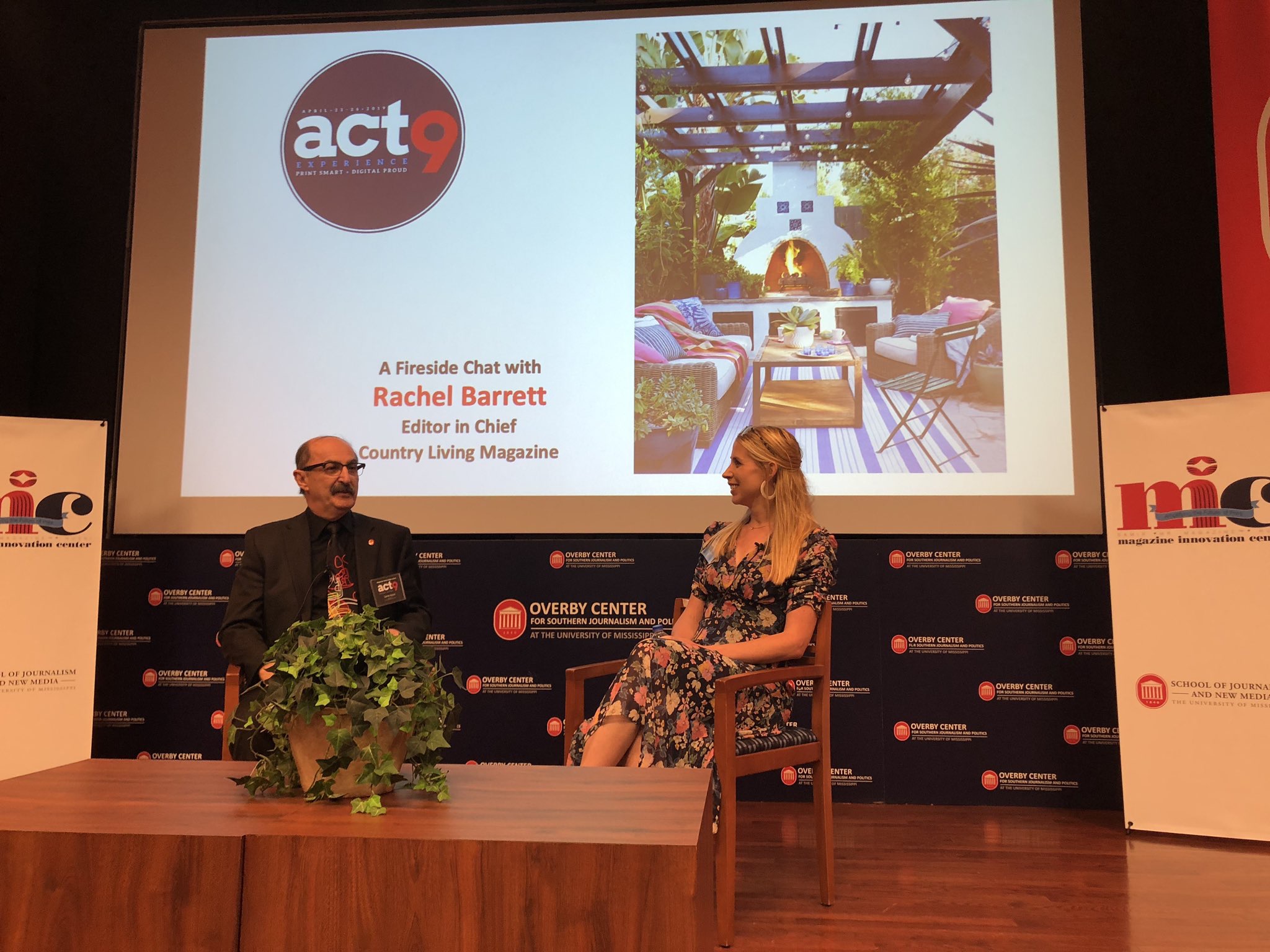
A magazine is so much more than a magazine now, and the job of an EIC so much more than editing, said Rachel Barret, Editor in Chief of Country Living Magazine, at the University of Mississippi’s ACT 9. Opportunities are coming up beyond the New York bubble, with publishing centers in Des Moines, Birmingham, and elsewhere; opportunities exist for scrappier ways of publishing to drive the brand economically and connect with the reader.

Jeff Joseph, publisher of Luckbox, concurs. “The first rule is there are no rules,” he said. “One of the advantages of coming in from outside the print realm.” You can’t be in the news business and be in print; Luckbox learned this from experience, and was nimble enough to pivot to a new model. For Joseph, the single most important metric is what percent of your audience don’t throw out your magazine. Luckbox is at an astounding 58%, as a result of providing useful, evergreen content. If your revenue model is from advertisers, then you are a content marketing platform. For online, look for how many clicks take the reader to content over three months old.

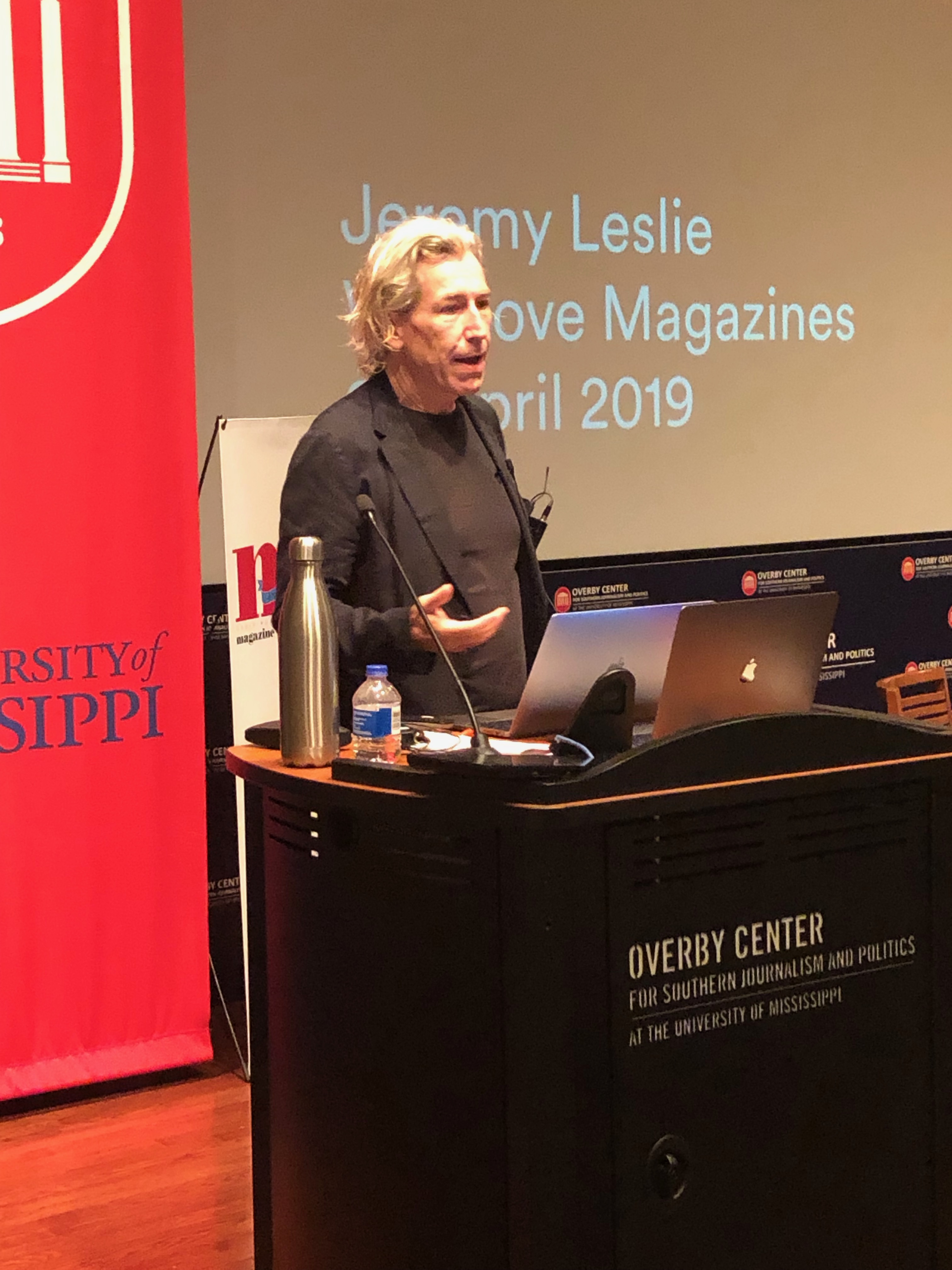
Now is a great time to be involved in magazines, said Jeremy Leslie, Founder and Curator of Magculture. “I love magazines,” he says. “They are like people; they have character, and they reflect the character of the people making them up. They become your friends.” They reflect the world they were created into, they exist in a historical context and become a great record of what people wanted, thought—and how they designed. The world of independent publishing, while still undervalued and under recognized, is coming into its own, breaking new ground to show people what a magazine can be. For example, Delayed Gratification, launched to look back at news three months ago and point out what was important. Migrant was launched to re-address the topic of immigration, limited itself to six issues and wound up the topic with the last issue. MacGuffin takes one object and tells many stories around it. Civilization melds design and content. Real Review is published as a triple fold. And Ordinary has a blank cover every issue, and every issue has an “extra” on the cover; they use that object in the photos in the visual-only content. These groundbreaking independent publishers are leading the big multi-title publishers in new directions.

Jo Packham, the 2018 Magazine Launch of the Year Winner (Where Women Create and its sister titles) launched Where Women Work with an augmented-reality video on the launch cover. Magazines are alive, she tells us, but must be integrated into the world of technology. The audience, the small entrepreneurs, the makers, loves print. Every publisher, every person, should have a mission in life, and Packham’s is to educate people on what it takes to create, and to deepen the appreciation of this process. Packham thinks of herself, not as a publisher, but as an entrepreneur who specializes in the written word. Entering publishing, she promised herself her magazines would be authentic. Her photos are submitted and her articles are in the writers’ voices, not re-written.

Her advice to others who want to share the joy and opportunities of this field: Be selective. Build a community. And do not waste your valuable time doing something you don’t care about. Do what you love.

To watch my fireside chats with Rachel Barrett and Jeff Joseph, Jeremy Leslie’s presentation, and Jo Packham presentation click on the videos below.


h1

“This Is Your Brain On Paper” Says Sappi’s Daniel Dejan… The ACT 9 Experience Recapped. Linda Ruth Reporting… Part 4

May 1, 2019

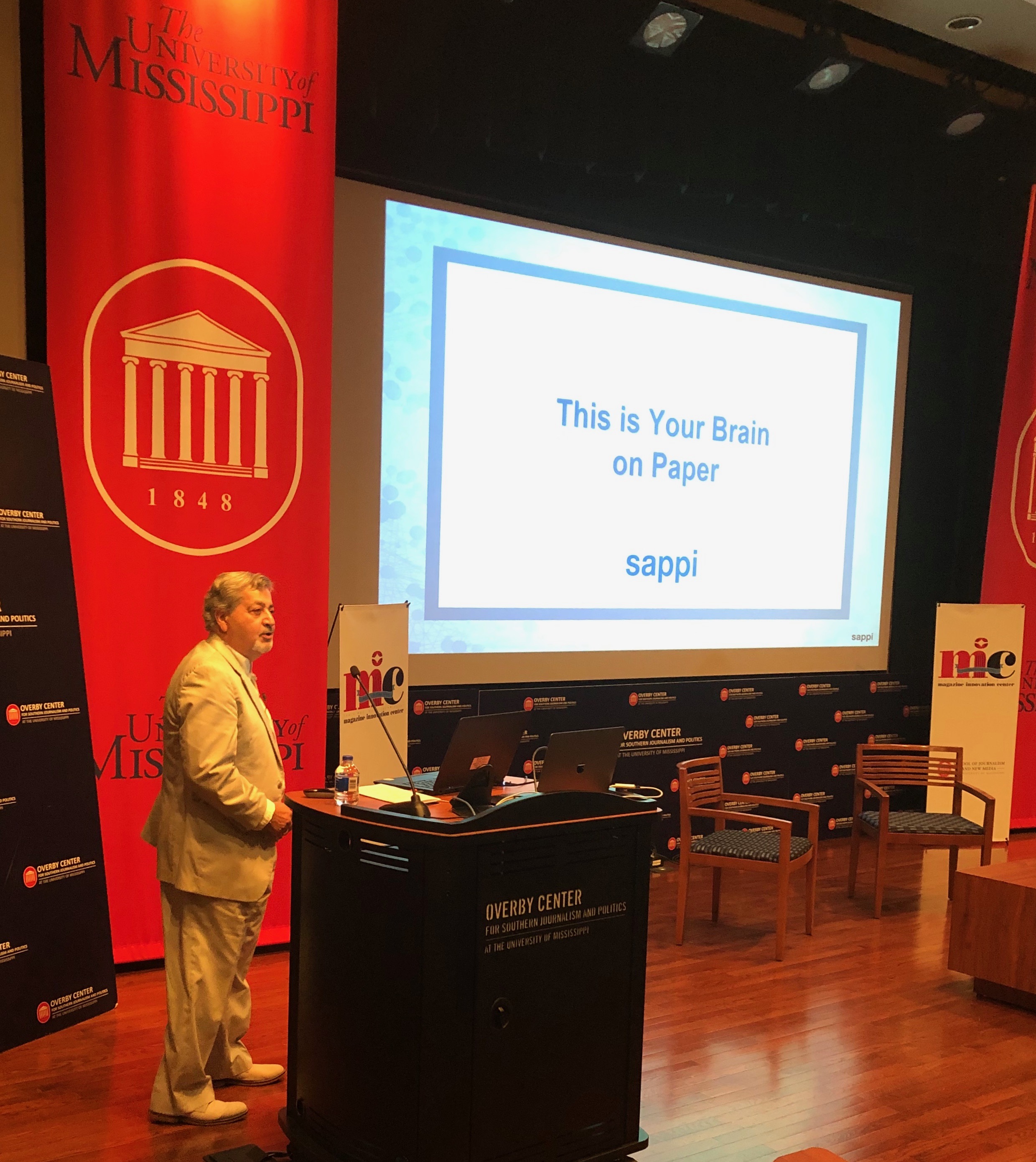
Is content just content? Daniel Dejan, Print Creative Manager for North American Sappi Paper, asked the question at Mr. Magazine’s ACT 9. If you take the same content and duplicate it across platforms, is it the same content, is it the same experience? Has technology impacted the user experience, and if so how? Sappi decided to do a deep dive research to answer these questions.

Brain activity is very different when reading on paper compared to reading on a device. The device adds nothing to the reading experience. Reading on paper stimulates visual memory. It leads to mapping of information in our brain for later retrieval. Mapping can’t be done well with the moving stream of digital. Ink on paper is tactile, stimulating four senses.

The endowment effect means that you want something more if you can touch and hold it. Touch is an important part of our decision making. Print can trigger ownership imagery. Well-crafted advertising in print creates connection with consumer, leads to purchases. Even online purchases, for example in catalog industry, are begun at the print level—in fact over 75% of online purchases, in some cases, are begun at the print level.

When you read ink on paper, you slow down. Your heart rate and blood pressure slow. You have a higher valuation of the content, the authorship, better understanding, better retention, and you have a higher valuation of the brand. Reading the same content on a digital device switches our brain to skim mode. Our brains have new, evolved digital synaptic cortexes, and the moment we open a device we switch to that mode, seeking key words, highlighted copy, links. This is called bi-lateral literacy. When we read content digitally, we don’t get the full depth of the content.

The next level of print offers opportunities to enhance the tactile nature of the medium and offers new levels of connection with the consumer. Electroluminescent Ink creates a mesmerizing cascading effect. Electroconductive Ink can connect paper to your phone.

The US ranks 24th in the world in reading. This problem might be connected to our increasing digital dependency. The child who is distracted will not learn as deeply. How we read is as important as what we read. Can we provide a foundation for the child so the formation of deep reading is part of our transition to digital? It is essential that we do so.

Because, we find, content is not just content. How we encounter that content is critical, and print is essential to our continued depth of experience and depth of learning.

To watch Daniel Dejan’s entire presentation click on the video below:

h1

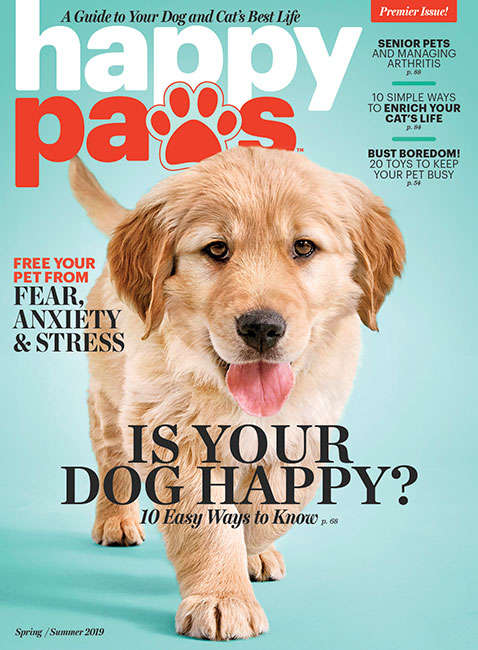
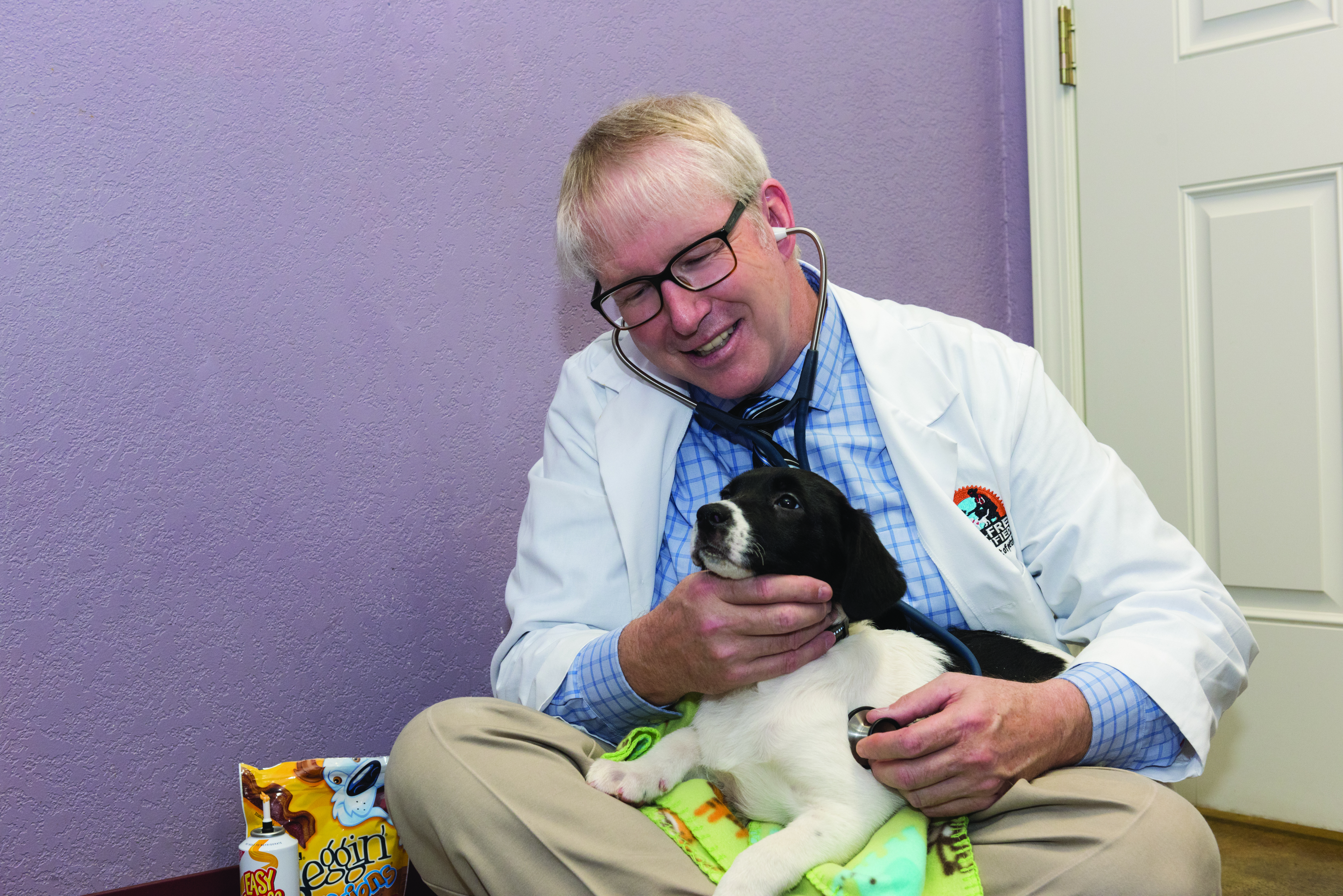
Happy Paws Magazine: Meredith Proves That When State-Of-The-Art Meets State-Of-The-Heart, A Print Product Can Be Relevant & Successful Even In This Digital Age – The Mr. Magazine™ Interview With Scott Mortimer, Vice President and Group Publisher, Meredith Corporation & Dr. Marty Becker, Founder, Fear Free Organization…

April 29, 2019

“There are obviously a lot of opinions out there as to why you’re seeing several examples of digital brands or brands that aren’t in the magazine space going into the print space. It’s just a different experience, as you well know. It’s a lean-back experience and it’s immersive. You just can’t get that in the digital space. The more our lives get connected and the more digitally-focused and digitally-centered that we become, I think there’s always going to be that opportunity for that relaxed experience where you get away and just sit in your favorite chair and immerse with a topic or a brand that you feel really passionate about. And magazines do that better than any other medium that we have.” Scott Mortimer…

“And I love paper quality. I love the finish of the cover. I love the quality of the photography and the quality of the paper inside the magazine. People have no idea how hard it is to write a book and I never had any idea of all of the steps that went into writing a magazine, I have to be honest. It’s a lot more complicated than I thought. Talking about dotting the I’s and crossing the T’s.” Dr. Marty Becker…

Happy Paws marks the latest magazine to debut from Meredith and as Vice President and Group Publisher, Scott Mortimer said, “There’s a real appetite for a print product out there, you just have to get the right product at the right time and then put it in the right place and your chances of success go way up.” And Meredith would definitely know about success after the phenomenal reaction readers have had to The Magnolia Journal and their successful partnership with the Hungry Girl, Lisa Lillien.

This time around Meredith has teamed up with America’s Veterinarian, Dr. Marty Becker, to bring a new and important twist to the pet space, a magazine devoted to not only the physical wellbeing of your pet, but also the emotional wellbeing. I spoke with Scott and Dr. Becker recently and we talked about this great new concept and about the relevance and extreme success that print products can have in today’s digital age. As Scott said, when the content is engaging, important and solid, consumers will pay for what they appreciate. And enjoy that lean-back experience while they’re doing it.

So, I hope that you enjoy this conversation with two people who each know their authentic area of expertise: pets and magazines, the Mr. Magazine™ interview with Scott Mortimer, Vice President and Group Publisher, Meredith, and Dr. Marty Becker, Founder, Fear Free Organization.

But first the sound-bites:

On why Meredith launching a print product still surprises the media industry (Scott Mortimer): I think when you dig a little deeper into what we’re doing and the success we’ve had in the past, it makes perfect sense. I oversee the newsstand operation for our special interest media group and the fiscal year we’re in, we’ll sell over 21 million magazine copies at retail, and 17 million of those will be priced at $10 and higher, so there’s a real appetite for a print product out there, you just have to get the right product at the right time and then put it in the right place and your chances of success go way up.

On how the partnership between Meredith and the Fear Free organization came about (Scott Mortimer): We had a relationship with their agent from some prior business dealings and the opportunity came through him, so that’s how the inbound came to us. We’ve had great success with pet themed titles in the Special Interest Media Group and when this one came along it seemed like a match made in heaven. So, we’re excited about it.

On the appetite for pet magazines today as opposed to the less than popular appeal of 40 years ago (Scott Mortimer): I don’t know that I can speak to 40 years ago, I really can’t. I can tell you that the pet space is a $90 billion market and it’s growing six, seven, eight percent per year, depending on who you talk to. And there’s 75 to 80 million homes that have pets, so pets are just a really big part of people’s lives today. And I think we’ve caught onto that trend and they’re much more a part of the family than they ever have been. They’ve always been a part of the family if you have a pet, but today there’s just this connection to our pets that we really haven’t seen in any other point in time.

On whether the definition of a magazine has changed over the years with newsstands carrying more bookazines and high-priced titles (Scott Mortimer): I don’t know if it has changed the definition of what a magazine title is, but there has certainly been a shift and a change at newsstand with what is selling. Obviously, we have great success with the People brand and it sells a great number of copies at newsstands, but the only growing part of the newsstand business is the bookazine category. And it grew about 10 percent in 2018, but it’s really growing by the number of titles that are being offered. So I think that if you look at the data there’s probably going to be 1,100 more titles in 2018 than the year prior.

On the amount of titles Meredith has and where many of the ideas come from (Scott Mortimer): Yes, the numbers are a bit staggering, aren’t they? We have a real process in place to vet ideas, and we’ve opened it up to our employees, so we get a lot of inbound ideas that come from our rank and file employees who may not be involved with the Special Interest Media Group, but they can have an idea or see something out there and they’ll shoot it to us and we’ll take a look at it. And that’s on top of all of the other things that the Special Interest Media Group does.

On his biggest challenge since taking over the Special Interest group at Meredith (Scott Mortimer): I think it’s ongoing and it’s the retail space that’s the biggest challenge. The space is shrinking that’s dedicated to magazines at checkout at all of the big retailers. You have people with what we call mobile blinders on when they’re in the checkout lane, so they’re looking at their phones and maybe not looking around at what magazines are in the racks next to them.

On the idea behind the Fear Free organization’s partnering with Meredith (Dr. Marty Becker): As far as the magazine, we wanted something to focus not just on emotional wellbeing, and that means freedom from noise phobias, such as thunderstorms, fireworks, and other noise phobias, separation anxiety, leash aggression, excessive barking, going to the vet, the groomer or the trainer, where those became pleasant experiences. And also focusing on enrichment. And again, if we think of children, there is so much work done on early childhood learning and enrichment activities, whether they’re doing dance, in arts and crafts, in childhood theatre or Baby Einstein. And pets aren’t born to be retired; dogs and cats have a genetic exuberance to hunt, to test things by sight or smell, and so we want to activate their brains and really let them express their genetic exuberance.

On the idea for the magazine (Dr. Marty Becker): I have an agent, Bill Stankey, who also has Chip and Joanna Gaines from Magnolia and Lisa Lillien from Hungry Girl, and so I have the same agent. He and I talked, even before Chip and Joanna Gaines, I’ve been with Bill for well over a decade and we talked about a magazine someday. I’m a voracious magazine consumer myself, so I’ll probably have subscriptions to 12 magazines at one time. And this is what’s interesting, my son is 29-years-old and he has subscriptions to six or seven magazines himself, so I think that the people who believe magazines are lost on millennials ought to rethink that.

On whether they will alternate between dogs and cats (Dr. Marty Becker): I don’t know. I think that’s a Meredith question, because they will know what people will pick up and buy. I will tell you that I’ve written “Chicken Soup for the Pet Lovers’ Soul,” “Chicken Soup for the Dog Lovers’ Soul,” “Chicken Soup for the Cat Lovers’ Soul,” and “Why Do Cats Always Land On Their Feet,” Why Do Dogs Drink Out Of The Toilet,” I have done quite a few dog and cat books, but we are going to make sure in the second issue that we do a little more cat coverage.

On the future plans for Happy Paws (Scott Mortimer): We have announced a second issue in October. And you’re right, that’s a little bit ahead of the normal cadence that we would announce a second issue that’s based off when we get sale data off of the first issue, but we’ve seen enough acceptance from advertisers; we had two really strong launch partner advertisers in this first issue with Purina and Elanco. And we’ve had tremendous interest from other advertisers going forward, and we know enough about the pet space and we’ve seen enough sales data from our existing titles to convince us that a second issue is certainly worth doing and by then we’ll have a better read on consumer acceptance for this.

On the cover price of $10 for Happy Paws, while someone can get an entire year of Better Homes & Gardens for that price (Scott Mortimer): All of those other businesses, and we have many of those here at Meredith, they have their own business model. And I think that what we’ve found to be successful in the Special Interest Media Group is that if consumers find something that they like and a topic that they’re passionate about, they will spend money. And I would say that it’s the Magnolia effect. It’s well-chronicled how well The Magnolia Journal has done and I think it’s opened a lot of our eyes inside of this building and across the company, enough to say that people will pay for great content and engaging content.

On why he thinks digital-only entities are moving into the print space (Scott Mortimer): There are obviously a lot of opinions out there as to why you’re seeing several examples of digital brands or brands that aren’t in the magazine space going into the print space. It’s just a different experience, as you well know. It’s a lean-back experience and it’s immersive. You just can’t get that in the digital space. The more our lives get connected and the more digitally-focused and digitally-centered that we become, I think there’s always going to be that opportunity for that relaxed experience where you get away and just sit in your favorite chair and immerse with a topic or a brand that you feel really passionate about. And magazines do that better than any other medium that we have.

On anything they’d like to add (Dr. Marty Becker): What Meredith overall has done is reached out to feature animal experts, such as a Boarded Veterinary Dermatologist on a skin issue, or if it’s an eye problem, there’s a Boarded Veterinary Ophthalmologist. All of the content in this magazine was created by experts that, if you went to the world’s largest Veterinarian convention or you went to the library and picked out a textbook, that’s the contributors for this magazine in large part. And every single part of the magazine was reviewed by Boarded Veterinary Behaviorists, all of the content. So, it’s authentic. It’s in entertainment style, but it’s authentic and the best information out there.

On what they would hope to accomplish one year from now with Happy Paws (Dr. Marty Becker): What it will do is people will have a lot more awareness about the importance of the emotional wellbeing of animals. It’ll start with their own pets, their dogs and cats, but it will showcase, whether it’s therapy animals or animals used for food production or animals in zoos or aquariums; we have to start looking at the emotional wellbeing of all animals. They’re sensitive beings and we have to look at both physical and emotional wellbeing.

On what they would hope to accomplish one year from now with Happy Paws (Scott Mortimer): I hope we sell lots and lots of magazines and we’re sitting down with Dr. Becker and his team and trying to figure out what type of frequency and is it a rate-based title, a newsstand title; we have a couple of steps to get through here, but we think we have enough data that the evidence points to this doing really well. We hope that it turns into a regular frequency title. We’ll see where it goes.

On what keeps them up at night (Dr. Marty Becker): For me, it’s pets that are euthanized for behavior problems. What happens with pets is people will take them back to shelters and surrender them for all the things the pet supposedly did wrong, but they never say they were bad owners. It’s always a bad pet. And just to understand how important the emotional wellbeing of animals is in basic training.

On what keeps them up at night (Scott Mortimer): I’m lucky, I sleep really well. (Laughs) It’s a really exciting time to be at Meredith and we have a lot of really fun things going on and Happy Paws is one of those.

And now the lightly edited transcript of the Mr. Magazine™ interview with Scott Mortimer, VP and Group Publisher, Meredith, and Dr. Marty Becker, Founder, Fear Free Organization.

Samir Husni: I was really surprised by the reaction of the media when the announcement for Happy Paws magazine came out and everybody was talking about Meredith launching a “print” magazine as if it were something new for Meredith. Why do you think people are still so surprised when a new print magazine is launched?

Scott Mortimer: I think when you dig a little deeper into what we’re doing and the success we’ve had in the past, it makes perfect sense. I oversee the newsstand operation for our Special Interest Media Group and the fiscal year we’re in, we’ll sell over 21 million magazine copies at retail, and 17 million of those will be priced at $10 and higher, so there’s a real appetite for a print product out there, you just have to get the right product at the right time and then put it in the right place and your chances of success go way up.

We really think that this product is a little different than anything that’s out there and it’s the right time. And if you look at how much money has been spent in the pet space, it’s a great product and we anticipate great success with it.

Samir Husni: How did the idea for Happy Paws come about? Who met with whom? Did Fear Free approach Meredith; how did this partnership come into being?

Scott Mortimer: We had a relationship with their agent from some prior business dealings and the opportunity came through him, so that’s how the inbound came to us. We’ve had great success with pet themed titles in the Special Interest Media Group and when this one came along it seemed like a match made in heaven. So, we’re excited about it.

Samir Husni: Back in the day when Meredith was doing SIPs (Special Interest Publications) before anyone actually in the market was doing them, if my memory serves me correctly, in the 1980s the only SIP magazine that really bombed on the newsstand was the pet magazine, Family Pet. What do you think has changed in the marketplace today that there is such an appetite for all kinds of pet magazines? Why is the market different than it was 40 years ago?

Scott Mortimer: I don’t know that I can speak to 40 years ago, I really can’t. I can tell you that the pet space is a $90 billion market and it’s growing six, seven, eight percent per year, depending on who you talk to. And there’s 75 to 80 million homes that have pets, so pets are just a really big part of people’s lives today. And I think we’ve caught onto that trend and they’re much more a part of the family than they ever have been. They’ve always been a part of the family if you have a pet, but today there’s just this connection to our pets that we really haven’t seen in any other point in time.

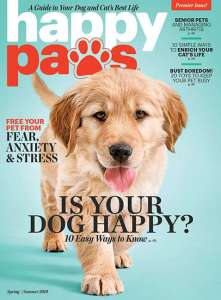
People are really hungry for this type of content and if you look at the big tagline on the cover “Is Your Dog Happy?” it shows this connection to your pet and the connection to their emotional wellbeing and happiness. And that’s what we’re seeing some success with.

Samir Husni: As you mentioned, you’re projected to sell 21 million copies of different SIPs this physical year. Are you seeing the change on the newsstands from what used to be defined as magazines to all of these bookazines and high cover priced titles? Is it time to change the definition of what a magazine is today with the amount of titles being put on the marketplace?

Scott Mortimer: I don’t know if it has changed the definition of what a magazine title is, but there has certainly been a shift and a change at newsstand with what is selling. Obviously, we have great success with the People brand and it sells a great number of copies at newsstands, but the only growing part of the newsstand business is the bookazine category. And it grew about 10 percent in 2018, but it’s really growing by the number of titles that are being offered. So I think that if you look at the data there’s probably going to be 1,100 more titles in 2018 than the year prior.

We’ve long known that this is a space that there’s opportunity in and I think that we have a lot of competitors that are also seeing that opportunity as well and are coming into the market with bookazine products. Our real point of difference in the category is that we have the analytic capabilities; we have close to a million pockets at checkout, and if you look at the category, we’re seven times the size of our nearest competitor. And we have over 40 percent market share in the category, and we use all of these things that I just mentioned to our advantage. And as I said in the beginning, when we get the right product in the right place and put it out at the right time, our chances of success go way up. And that’s the success we’ve seen and one that we want to continue to capitalize on.

Samir Husni: If we go inside Meredith to see where these ideas come from, what will we find? Is it that someone is daydreaming and says that you need to do a magazine on this or that, or is it a team effort? You just mentioned that there are 1,100 titles and Meredith has 40 percent of those, so you’re almost putting three titles per week out there?

Scott Mortimer: Yes, the numbers are a bit staggering, aren’t they? We have a real process in place to vet ideas, and we’ve opened it up to our employees, so we get a lot of inbound ideas that come from our rank and file employees who may not be involved with the Special Interest Media Group, but they can have an idea or see something out there and they’ll shoot it to us and we’ll take a look at it. And that’s on top of all of the other things that the Special Interest Media Group does.

Our edit team is terrific in kind of knowing topics that are on trend and would have an opportunity to sell. And when we layer in our analytic capabilities and our research capabilities on top of that, we’re not short on ideas, we have a lot of those that come in. It’s just like I said, finding the right idea that we think has the best opportunity to sell. It’s a trick and you never quite know. It’s a lot of outside factors that come into play in judging the success of one of these, but we think our process has worked pretty well and served us well, so we’re going to continue to lean into that.

Samir Husni: Since you took over the Special Interest Group, what has been the biggest challenge that you’ve had to face and how did you overcome it?

Scott Mortimer: I think it’s ongoing and it’s the retail space that’s the biggest challenge. The space is shrinking that’s dedicated to magazines at checkout at all of the big retailers. You have people with what we call mobile blinders on when they’re in the checkout lane, so they’re looking at their phones and maybe not looking around at what magazines are in the racks next to them.

And there’s just a tremendous amount of competition at checkout and I think that’s the one thing that we’re constantly monitoring and that we’re constantly having to innovate around. Bookazines tend to be an impulse purchase at checkout, so that’s why we spend so much of our time on cover blurbs and cover images and names, because we literally have five to six seconds to grab somebody’s attention when they’re in the checkout lane and want to make a purchase.

Samir Husni: Dr. Becker, if you could give us some background about, not only Happy Paws, but the whole idea of the Fear Free organization and how you’re trying to showcase Fear Free through the pages of Happy Paws? And why you decided to go with a print publication with Meredith for this project?

Dr. Marty Becker: I’ve written 25 books; I’ve done network TV in New York for 26 years; I still have a syndicated column, but there was nothing looking at the emotional wellbeing of animals. And that’s really what Fear Free does. If your dog has diarrhea or your cat has a hair ball, or you have a new puppy or kitten, there are so many resources online for that and there are so many books, but there is nothing really that looks at the emotional wellbeing of animals.

I’m 65-years-old and I come from the age when we were manhandled and manipulated, threatened and abused at the doctor’s office; I remember crying one time when I got a shot in the rear-end and I started wailing and my mom raised her hand above her head and yelled, “Shut up, Marty!” And then she said, “Don’t embarrass the doctor.” My older sister, who is 12 years older, I remember her getting her ponytail pulled at the dentist’s office to keep her mouth open.

But pediatricians had to change and pediatricians started looking at both the physical and the emotional wellbeing of children, pediatric dentistry changed, pediatric oncology changed in children’s hospitals. And in veterinary medicine, we were still just focused on the medicines. If a pet came in you treated a wound, you vaccinated or you cleaned their teeth, or you treated a sore ear or a torn paw or an abscess. And most of the time the pet was terrified. It had fear, anxiety and stress, so that’s what started the Fear Free movement, when myself and about 60 Boarded veterinary behavior professionals started looking at the emotional wellbeing of dogs and cats.

As far as the magazine, we wanted something to focus not just on emotional wellbeing, and that means freedom from noise phobias, such as thunderstorms, fireworks, and other noise phobias, separation anxiety, leash aggression, excessive barking, going to the vet, the groomer or the trainer, where those became pleasant experiences. And also focusing on enrichment. And again, if we think of children, there is so much work done on early childhood learning and enrichment activities, whether they’re doing dance, in arts and crafts, in childhood theatre or Baby Einstein.

And pets aren’t born to be retired; dogs and cats have a genetic exuberance to hunt, to test things by sight or smell, and so we want to activate their brains and really let them express their genetic exuberance.

Samir Husni: How did you come up with the actual idea for Happy Paws magazine?

Dr. Marty Becker: I have an agent, Bill Stankey, who also has Chip and Joanna Gaines from Magnolia and Lisa Lillien from Hungry Girl, and so I have the same agent. He and I talked, even before Chip and Joanna Gaines, I’ve been with Bill for well over a decade and we talked about a magazine someday. I’m a voracious magazine consumer myself, so I’ll probably have subscriptions to 12 magazines at one time. And this is what’s interesting, my son is 29-years-old and he has subscriptions to six or seven magazines himself, so I think that the people who believe magazines are lost on millennials ought to rethink that.

And what I love about the editorial team at Meredith, talk about pro; I’ve written 25 books and have sold about 9 million copies, but had never done a magazine, and to watch both the science and the process that went into creating that magazine was something to behold. The original photography; the format of kind of bite-sized chunks of information, just the muck of it and the way that you can easily digest it; it’s almost like going to Golden Corral. (Laughs) And there are a lot of cat lovers there as well, so it’s great.

And I love paper quality. I love the finish of the cover. I love the quality of the photography and the quality of the paper inside the magazine. People have no idea how hard it is to write a book and I never had any idea of all of the steps that went into writing a magazine, I have to be honest. It’s a lot more complicated than I thought. Talking about dotting the I’s and crossing the T’s.

Samir Husni: Are you going to alternate between cats and dogs? On the first issue cover “Is your dog happy” is the question asked, will it be a cat on the second issue?

Dr. Marty Becker: I don’t know. I think that’s a Meredith question, because they will know what people will pick up and buy. I will tell you that I’ve written “Chicken Soup for the Pet Lovers’ Soul,” “Chicken Soup for the Dog Lovers’ Soul,” “Chicken Soup for the Cat Lovers’ Soul,” and “Why Do Cats Always Land On Their Feet,” Why Do Dogs Drink Out Of The Toilet,” I have done quite a few dog and cat books, but we are going to make sure in the second issue that we do a little more cat coverage.

Samir Husni: Scott, what are Meredith’s plans for Happy Paws? With The Magnolia Journal and Hungry Girl, there was a space between the first and second issue, and then wait-and-see on the third issue, then going full-steam-ahead. What are the plans for Happy Paws?

Scott Mortimer: We have announced a second issue in October. And you’re right, that’s a little bit ahead of the normal cadence that we would announce a second issue that’s based off when we get sale data off of the first issue, but we’ve seen enough acceptance from advertisers; we had two really strong launch partner advertisers in this first issue with Purina and Elanco. And we’ve had tremendous interest from other advertisers going forward, and we know enough about the pet space and we’ve seen enough sales data from our existing titles to convince us that a second issue is certainly worth doing and by then we’ll have a better read on consumer acceptance for this.

Samir Husni: As the industry moves forward and continues to evolve, and as the studies continue to indicate that print does still work, do you feel that the business model is changing as a whole? For example, for $10 I can get an entire year of Better Homes & Gardens, yet here with Happy Paws, I only get one issue.

Scott Mortimer: All of those other businesses, and we have many of those here at Meredith, they have their own business model. And I think that what we’ve found to be successful in the Special Interest Media Group is that if consumers find something that they like and a topic that they’re passionate about, they will spend money. And I would say that it’s the Magnolia effect. It’s well-chronicled how well The Magnolia Journal has done and I think it’s opened a lot of our eyes inside of this building and across the company, enough to say that people will pay for great content and engaging content.

This is a good example, people shelling out $10 for a single copy, and we’ve had great success with that, and again, it all comes back to the topic and the time and the place. When you get those things right, people will pay for print.

Samir Husni: We’ve heard from Dr. Becker about his love for print and that feel and touch that comes with a print magazine, why do you think we’re seeing digital entities adding print? Hearst, for example, just launched Bumble, which is a dating website. Before that, there was The Magnolia Journal and The Pioneer Woman; why do you think all of these digital-first entities are coming to print?

Scott Mortimer: There are obviously a lot of opinions out there as to why you’re seeing several examples of digital brands or brands that aren’t in the magazine space going into the print space. It’s just a different experience, as you well know. It’s a lean-back experience and it’s immersive. You just can’t get that in the digital space. The more our lives get connected and the more digitally-focused and digitally-centered that we become, I think there’s always going to be that opportunity for that relaxed experience where you get away and just sit in your favorite chair and immerse with a topic or a brand that you feel really passionate about. And magazines do that better than any other medium that we have.

Dr. Marty Becker: Only three out of 10 Americans have children, but seven out of 10 Americans have pets. There is an incredible audience and I think in 2015, if you look at all movies, in theater, Netflix and Redbox, and all music, in concerts, CDs, Spotify, iTunes, all video games, and that’s Xbox 360, PS3; all of those together were about $33 million in 2015, and pet spending was over $50 billion. And in 2017, if you look at Amazon’s total revenue on one side, and on the other side you look at how much was spent on pets, it was equivalent of 40 percent of Amazon’s total revenue. Not that 40 percent of Amazon’s revenues were pet or vet, but that’s just how big the category is.

So, people will go to a pet store, Pet Smart or Petco and will spend $10 on a tiny bag of treats. And what this magazine allows them to do and is something that is a great resource, it helps them put the treat into treatment. How do you get a pet to take its medication when it doesn’t want to? And I’ve already heard from people buying the magazine about our strong admonition to not use food bowls; to throw your food bowls away and feed with food dispensing devices. And if you do that, you’re feeding not only the body, but you’re feeding the mind.

Samir Husni: Is there anything either of you would like to add?

Dr. Marty Becker: One of the things that I was really tickled with Meredith about is we launched a book last year, my 25th book called “From Fearful to Fear Free” and we did long-lead media, which is magazines. So, it went out in October 2017 for an April 2018 book launch and when I was talking to the different editors at Meredith, we were talking about the fact that often in magazines when it’s for the human side they quote doctors and registered nurses, or the head of the dermatology department at Yale University, for example.

But with the pet side, sometimes a story about itchy skin on a dog would quote a dog groomer, or a behavior issue would be a trainer but not a Boarded Veterinary Behaviorist. But what Meredith overall has done is reached out to feature animal experts, such as a Boarded Veterinary Dermatologist on a skin issue, or if it’s an eye problem, there’s a Boarded Veterinary Ophthalmologist. All of the content in this magazine was created by experts that, if you went to the world’s largest Veterinarian convention or you went to the library and picked out a textbook, that’s the contributors for this magazine in large part. And every single part of the magazine was reviewed by Boarded Veterinary Behaviorists, all of the content. So, it’s authentic. It’s in entertainment style, but it’s authentic and the best information out there.

Samir Husni: If we’re having this conversation a year from now, what would you hope to tell me you had accomplished with Happy Paws?

Dr. Marty Becker: What it will do is people will have a lot more awareness about the importance of the emotional wellbeing of animals. It’ll start with their own pets, their dogs and cats, but it will showcase, whether it’s therapy animals or animals used for food production or animals in zoos or aquariums; we have to start looking at the emotional wellbeing of all animals. They’re sensitive beings and we have to look at both physical and emotional wellbeing.

And the other part is enrichment, and that’s where Fear Free Happy Homes, our tagline is “Helping Pets Live Happy, Healthy Full Lives.” Happy is fear free, healthy is high-tech veterinary medicine, and full is enrichment. Put another way, it’s where state-of-the-art meets state-of-the-heart. Or high-tech meets high-touch.

Scott Mortimer: I hope we sell lots and lots of magazines and we’re sitting down with Dr. Becker and his team and trying to figure out what type of frequency and is it a rate-based title, a newsstand title; we have a couple of steps to get through here, but we think we have enough data that the evidence points to this doing really well. We hope that it turns into a regular frequency title. We’ll see where it goes.

Samir Husni: My typical last question; what keeps you up at night?

Dr. Marty Becker: For me, it’s pets that are euthanized for behavior problems. What happens with pets is people will take them back to shelters and surrender them for all the things the pet supposedly did wrong, but they never say they were bad owners. It’s always a bad pet. And just to understand how important the emotional wellbeing of animals is in basic training.

Scott Mortimer: I’m lucky, I sleep really well. (Laughs) It’s a really exciting time to be at Meredith and we have a lot of really fun things going on and Happy Paws is one of those.

Samir Husni: Thank you.

h1

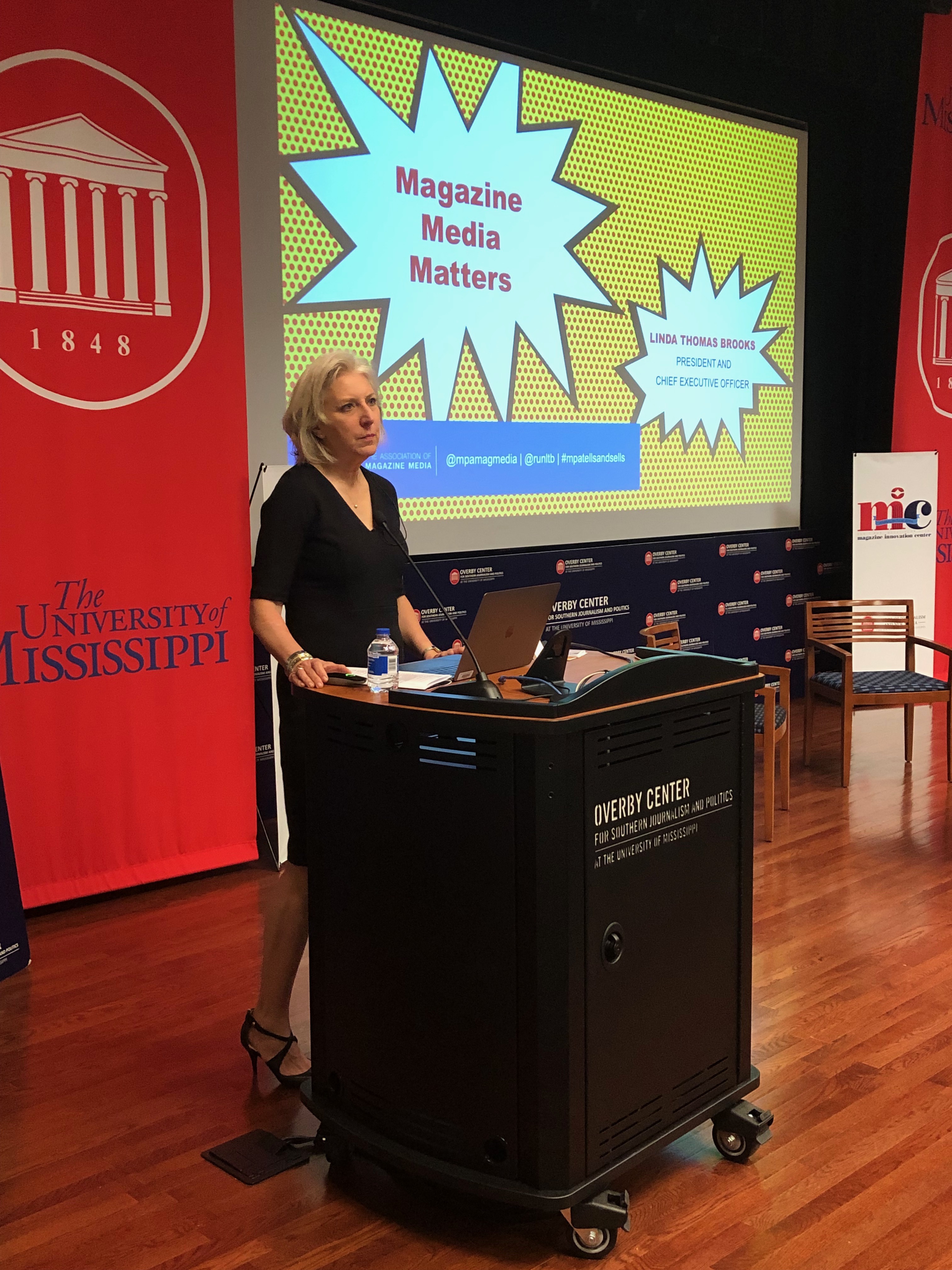
Linda Thomas Brooks On “Saving The World One Magazine At A Time”… Linda Ruth Reporting From ACT 9 Experience… Part 3

April 26, 2019

Linda Thomas Brooks, President and CEO, MPA- The Association of Magazine Media

Magazine offer busy readers a shortcut to quality, says Linda Thomas Brooks, President and CEO of MPA: The Association of Magazine Media at the first session of Samir Husni’s ACT 9 at the Magazine Innovation Center at the University of Mississippi. When trust in other sources of information is going down, trust in magazine media is going up.

Credible sustainable journalism becomes more important every day. Brooks began with a story about a new business dedicated to creating fake vacations to enhance social medial presence. Twitter and FB had to close fake accounts set up to divide our country. The steps between fake vacations and fake news are getting shorter, Brooks cautioned. As a result, never have magazines been more important. Magazine Media builds brands and sells product with proven verifiable results in a safe and transparent environment of quality, professional journalism that supports an economically, ecologically and socially sustainable society. This is important to us as individuals and also, even more, to us as a society. What we are fighting for is bigger than an ad page, another dollar. It’s for intelligent discourse and rigorous inventory.

And advertisers, Brooks tells us, are beginning to get it. They know that magazines are invited guests in consumers’ homes. Readers have asked for them. They savor them. And the advertisers get to come along as plus one to the invitation.Contextual relevance is an important element—it’s not just the numbers, it’s the context in which the message is delivered. The context is professionally researched, written, edited, produced, curated content. Trusted brands offer that, the shortcut to quality.

Silicon Valley itself is getting it, too. Brooks, whose background is digital, tells us that in the center of the tech world, parents are requiring nannies to sign an agreement to not use tech in front of the children. Learning outcome is a fascinating developing science. Paper based reading offers higher comprehension and recall, stimulates emotions and desires, slower reading, more focused attention, sensory involvement. While some school systems are still trying to build their tech resources, Silicon Valley is taking the tech out of school. They have learned that tech is actually impeding learning. Tech is great at quick hits of information, quick facts. Your brain ignores everything that is not that quick fact. Print facilitates learning.

Case studies, independently commissioned, have shown that in every case having magazines in an advertising media mix helps drive ad awareness. This includes TV advertising. The lift in purchase intent is significant when magazines are in an advertising mix. For years advertisers were getting addicted to the pure numbers offered by digital; but they didn’t see the results from it. They have learned that having magazines in the mix builds brand and sells product.

Other results, based on analyzing over 1400 studies of sales at retail, have shown that advertising in magazines yields a $3.94 return on every advertising dollar. It’s higher than digital, TV, mobile and video. Magazines still have a bigger consumer reach than TV; Brooks showed a comparison of the top ten TV show (including the NFL) with the top 10 magazines (print only, not even taking into account their digital presence). The print reach is about double TV.

Magazines have been great at keeping print robust while growing audiences across all platforms. So the measured magazine brands are showing robust growth across all platforms. Magazine brands dominate social media engagement over non-magazine influencers across every channel—Facebook, Twitter, Instagram, and Pinterest. Magazine brands have vastly more social influence and consumer trust than non-magazine brands.

Marketers need to simultaneously build brand and sell product. Magazines are the single best channel to do this. But more, magazines are important for their credibility, their research, curation, and quality. They are a bulwark against the deluge of fake news and unresearched, unedited opinion. Which is the reason that Brooks and her association aim to save the world—one magazine at a time.

To watch Linda Thomas Brooks’ presentation click on the video below:

h1

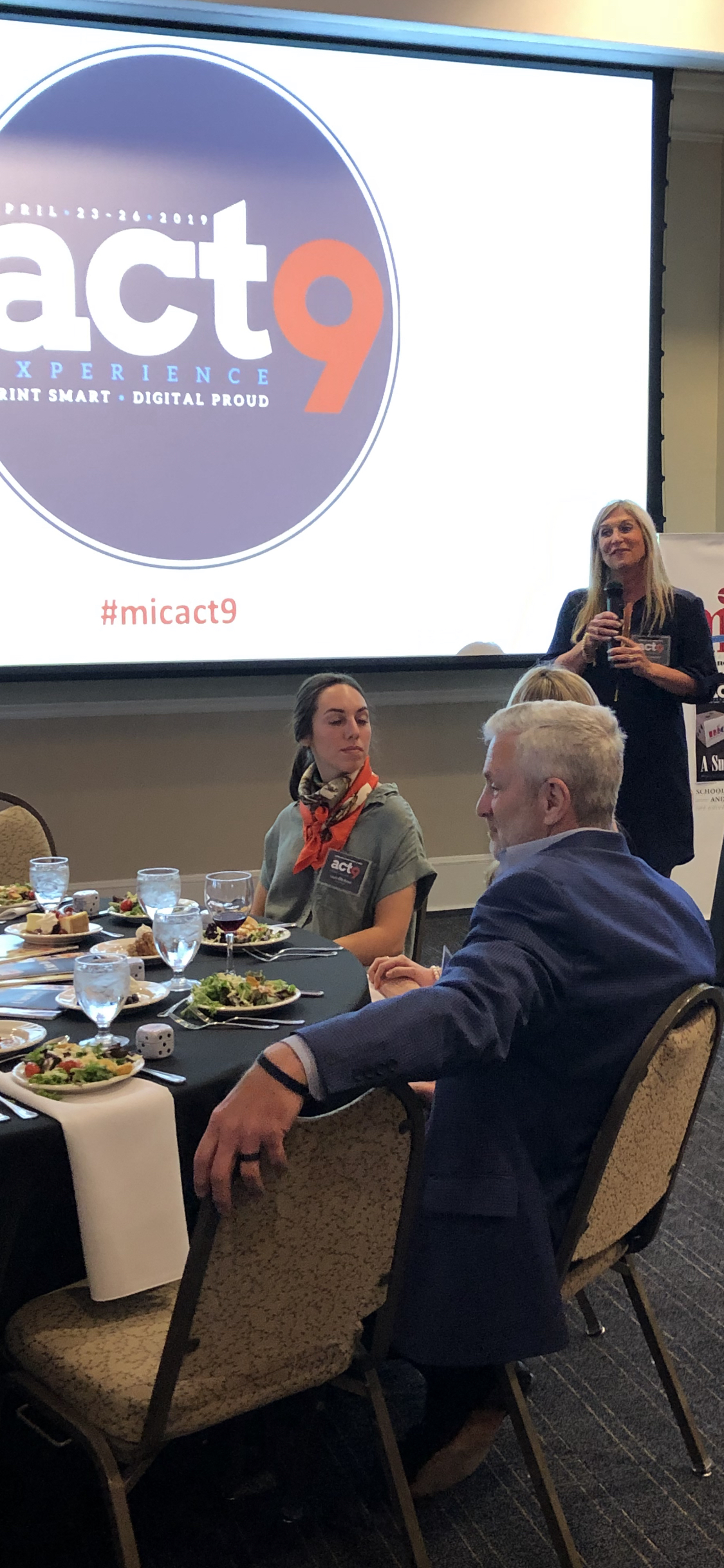
Welcome to ACT 9 Experience: Creativity and Innovation. Linda Ruth Reporting From Oxford, Mississippi. Part 1

April 24, 2019

I’m back at Ole Miss for ACT 9: Amplify, Clarify and Testify about the future of print in a digital world, and seeing lots of old friends and making some new ones. I rode in with Jeff Joseph, Publisher and Editorial Director of Lunchbox magazine. His magazine is a lovely example of the future of print: an independent publication serving an enthusiast audience with a premium package. He and Grayson, our student shadow, had a lively conversation about importance of innovation, of trying new things, of coming out from the shadow of the way we’ve always done things and breaking new ground.

Here on campus I see Bo Sacks, Tony Silber, and Samir Husni, Mr. Magazine himself, who is being honored by the University for his leadership in innovation and his insistence that his students and colleagues keep their thinking fresh.

It’s the opening gala and dinner and Robyn Tannehill, mayor of the city of Oxford, is here to welcome us to one of the best small towns in America in which to live, with one of the most beautiful town square in America, on one of the country’s most beautiful campuses; she came in 1988 and has been here ever since, and it isn’t hard to figure out why.

Noel Wilkin, Ole Miss’ provost, spoke about the nature of creativity. Creativity isn’t about waiting for the muse to strike, but about learning, forging new connections, imagining a new world. And ACT 9 aims to share thoughts and ideas that will lead to those connections, both for the good of our industry and for the good of the world.

It’s a worthy start to our three day venture.

h1

Print Smart Digital Proud: The Magazine Innovation Center’s ACT 9 Experience Opens April 23

April 17, 2019

OXFORD, Miss. – A who’s who of the international magazine industry will be at the University of Mississippi from April 23 to 25, but it won’t be the movers and shakers of publishing who will be in the spotlight.

The real stars of the show, according to ACT 9 Experience founder and coordinator Samir Husni, are the Ole Miss students.

“There are a whole bunch of magazine conferences, but, to me, what makes this conference unique is the presence of the students,” said Husni, a UM journalism professor, Hederman Lecturer and director of the Magazine Innovation Center. “This conference brings together current industry leaders and the future industry leaders.”

More than 30 speakers from the highest ranks of magazine publishing will be on campus, and Husni places a priority on having students in the university’s magazine publishing and management specialization interact with those professionals.

“I assign students to shadow the speakers; they actually will pick them up from the airport,” Husni said. “I want that interaction. I want the students to have enough time to spend time with these leaders of the magazine industry.”

For junior Sarah Smith, the ACT 9 Experience serves as a chance to further her knowledge of the industry in which she wants to work, but also to meet people who will prove to be invaluable for her future career.

“This is the only opportunity I know of that you’re going to get a taste of worldwide magazine making anywhere near here,” said Smith, a journalism major from Mount Pleasant. “I expect to gain a lot of information about the next few years of magazine making.

“For media students, this is an unparalleled event where we can meet and mingle with industry leaders. This is a great chance to secure a summer internship or even a job after college.”

The ACT Experience, which stands for “amplify, clarify and testify,” is hosted by the Magazine Innovation Center at the School of Journalism and New Media. The event began in 2010 and has more than doubled in size in nine years.

The university has created a name for itself as a higher education hub for magazine publishing, and the ACT 9 Experience is the highlight of that achievement, Husni said.

“We have people from all over the world coming to this conference, coming to Ole Miss,” he said. “That’s why I tell people, when they say, ‘You need to have something like this in New York or you need to do something like this here or there,’ I’m like, ‘No, the ACT Experience is Ole Miss and Ole Miss is the ACT Experience.’”

The theme of this year’s ACT 9 Experience is “print smart, digital proud,” which Husni said emphasizes the ever-changing landscape of print publications.

“I want to focus on the integration between print and digital, that we are no longer an either/or industry,” he said.

Among the speakers for this year’s event are Linda Thomas Brooks, president and CEO of MPA: The Association of Magazine Media; James Hewes, president and CEO of FIPP, the network for global media; Michael Marchesano, managing director of Connectiv, a leading business-to-business magazine media network; and Jerry Lynch, president of the Magazine and Books at Retail Association.
Husni will moderate a discussion featuring these industry leaders.

“We will talk about some of the challenges facing the entire magazine and media industry locally and worldwide,” Husni said. “It should be fun to have those CEOs at the same place on the same campus in front of future industry leaders.”

The diversity and depth of the speakers makes the event unique, Smith said.
“Dr. Husni is a genius when it comes to magazines, and he puts his heart and soul into this event,” she said. “I think that the fact someone as successful and well-known as him puts his heart in it, always creates something genuine and fresh that you can’t get anywhere else.”

All lectures at the Overby Center are open to the public.

Activities begin Tuesday (April 23), with an opening gala for registered participants, featuring welcoming remarks by Oxford Mayor Robyn Tannenhill and UM Provost Noel Wilkin and keynote speaker Stephen Orr, editor in chief of Better Homes and Gardens.

Speakers will continue all day Wednesday and Thursday, and Thursday’s events for paid participants feature a bus trip and tour of the Mississippi Delta. The Overby Center for the Study of Southern Journalism and Politics will host the majority of speakers, and a full list of speakers can be found online.

Registration for the event includes all meals, sessions and transportation to and from the Delta. The Inn at Ole Miss is also offering special rates to ACT 9 attendees.

Click here to see the entire agenda.

Ole Miss Press Release BY JUSTIN WHITMORE

h1

A Mr. Magazine™ Moment: Recreating The Magazine Scene of March 1953…

April 16, 2019

A recent headline in The New York Times “Does Anyone Collect Old Emails?” started me thinking of the best way for folks to collect their memories and to relive the precious moments of their lives from the very beginning. It should come as no surprise to anyone to find out that Mr. Magazine™ is recommending magazines as the vehicle to relive those memories… So sit back, relax and watch the video below to relive Mr. Magazine’s™ birth month of March 1953.

h1

The New Republic’s New Editor Chris Lehmann to Samir “Mr. Magazine™” Husni: “… I Think Print Is A Natural And Preferable Medium Of Ideas…” The Mr. Magazine™ Interview…

April 14, 2019

“Blaise Pascal said long ago that the entire problem with the world is the inability of a person to sit alone in a room. (Laughs) And reading a print magazine forces you to sit alone in a room and have an internal dialogue as you go. Do I agree with this writer, taking into account X point or the why objection. I think you get a closer reflection of the amorphous process of human thought, in my view, than online and digital experiences.” Chris Lehmann…

The New Republic has a “new” editor, though not new to the almost 105-year-old publication maybe, and certainly not new to the world of political journalism. From editor in chief of The Baffler to senior editor at Congressional Quarterly, and consulting editorial director at The New Republic, Chris is definitely known around the Washington D.C. arena and is a voice that brings an accomplished writer and editor in many forms to the legacy brand, from book author to columnist to hard-hitting journalist.

I spoke with Chris recently and it was a most delightful conversation as we tripped-the-political-forum-light-fantastic, talking about the past, present and future of the brand and the status of today’s political landscape. Chris will readily tell you he is not a “celebrity” editor and has no desire to be, and that the point of The New Republic is always ideas and advancing intellectual debate, political debate, policy debate, and that those things are not and should never be driven by celebrity.

And as a magazine that was once considered to be the inflight publication for Air Force One, Chris is proud of that piece of his brand’s history, but not bedazzled by it. In fact, he thinks it’s a bit dangerous if having your magazine read by an existing president is that vital to you, it’s more about the work itself, not the powerful person who is reading it.

Indeed, Mr. Magazine™ enjoyed this refreshing look at the world of politics and commentary, and certainly hopes that you do too. And now, the Mr. Magazine™ interview with Chris Lehmann, editor The New Republic.

But first the sound-bites:

On how it feels to be editing a magazine that will soon be 105-years-old: It’s absolutely great. It’s an interesting question though as it’s a little bit of being intimidated and overwhelmed by The New Republic’s history, and me just hoping that I carry on the great legacy. I would read all of these back issues of the magazine going back to the beginning and encounter many of the editors whose work I was actually studying and I would feel like, wow, this is an amazing magazine. So, it’s an honor all these years later to be at least a part of this legacy.

On whether he feels we are having a free discussion in today’s media world as Walter Lippmann described the theory of a free press: Largely, no. That’s a good watch word for my working moving forward. I do think truth is always sort of provisional and contingent and does emerge out of honest argument and forthright exchanges of views. Right now we have many other problems. We have a media industry that is largely failing economically; we have weaponized propaganda happening in outlets like Fox News and Breitbart News. And it’s not confined to the Right either, there are plenty of false filtering organs on the Left and in the Center. So, one modest hope going forward is I think we can revive that vision of honest debate of the past realizing that kind of truth.

On editors being shy or not being shy with their points of view: I’m certainly not shy myself, if you look over my work I’m very vocal in expressing my beliefs and views. And I think that is healthy. The newspaper industry going back to the 19th century, when everyone sort of bewailed the partisan drift of the press today as a symptom of falling away from some ideal of objectivity and impartiality, but in point of fact, American journalism has always been robustly driven by political ideas. And I don’t think there’s anything wrong with that; I think political ideas should be a part of the common conversation and debated openly.

On how he can ensure that The New Republic’s voice is being heard with all the noise that’s out there: You can’t. You want there to be an audience and you want them to be engaged, but there are no guarantees. I think it was George Seldes who said, the basic mission of journalists is to tell the truth and run. (Laughs) I think you have to trust that somehow, and this is not to say that we’re not mindful of the enormous amount of other voices and the glutted character of the information marketplace, but you just do that work that’s important to you and trust that an audience will follow.

On why commercial magazines always seem to do better than opinion magazines even with the money of millionaires and foundations behind them: To my knowledge I don’t think that The New Republic has ever made money; I don’t think The Nation has made money; there might have been a time during the Clinton impeachment period when The American Spectator made money, but that time came and went. To me it’s obvious, at a basic level of the business model there is a very limited amount of advertising you can count on to generate revenue for opinion magazines, sort of a built-in feeling based on the material you’re publishing for audience growth.

On whether he can envision The New Republic as being the inflight magazine for Air Force One ever again: I’m tempted to say, no, baby steps here, let’s first concentrate on electing a president who reads. I live in D.C. and I’m frequently in the company of people who are elbowing their way into positions of power and influence and saying they’re shaping opinion, and to be honest, I don’t share that impulse personally. Obviously, it’s flattering to your ego or vanity to think a powerful person is reading your work, but to me your work is the point. I don’t want to say that I wouldn’t care if a president read us again, but I think it’s dangerous to care too much if a president reads you. And I think to be perfectly honest that was part of the trap that the former New Republic fell into.

On whether he thinks this is the era of the celebrated editor rather than the celebrity editor: I have zero ambition to be a celebrity, (Laughs) so if the era of the celebrity editor is over, then that’s very good for me personally. I think you do have to have a certain kind of whatever, business model and perhaps, let’s just say, an enormous ego of certain proportions to think that your vision of a magazine somehow conquers everything. I’m just not put together that way and I’ve worked for celebrity editors and I hated the experience, so if anyone catches me behaving like one, I hope they strictly fire me. (Laughs) The point of The New Republic is always ideas to me, and advancing intellectual debate, political debate, policy debate, and those things are not and should never be driven by celebrity.

On whether he feels the role of the editor is changing from five or ten years ago: The role of the editor is always changing. It’s kind of the nature of the job, you are harnessed to a medium that is responding to dramatic, yes technological changes, but also political changes and cultural changes. I can’t even remember where I was ten years ago, probably Congressional Quarterly, and that was a time during the second Bush administration where in many respects the political outlook was, let’s just say, not sunny. (Laughs) And I remember feeling and talking to people at the time that it couldn’t get any worse than this, and look where we are today.

On the role he feels The New Republic plays in print in today’s digital world: I’m old-fashioned, I think print is a natural and preferable medium of ideas and requires a level of patience and inwardness, I would say, toward the reader that you don’t experience in the same way online. Blaise Pascal said long ago that the entire problem with the world is the inability of a person to sit alone in a room. (Laughs) And reading a print magazine forces you to sit alone in a room and have an internal dialogue as you go. Do I agree with this writer, taking into account X point or why objection. I think you get a closer reflection of the amorphous process of human thought, in my view, than online and digital experiences.

On returning to a weekly frequency: These are all questions of money and I’m the word person, not the money person, but I am always for greater frequency. At the same time, I recognize constraints and we do have a website that updates multiple times a day and also features our print content. This is another thing about the digital piece of it, our print content runs online and occasionally we will adapt an online piece to work in the print magazine. Even though I have been saying that there is something special about print, there is also crosspollination that I think is good and beneficial to readers and editors and writers alike.

On whether someone will be able to see his imprint on the magazine after editing it for one year: I hope so, yes. I’m certainly aware that we’re changing a lot over a very short period of time that I’ve been on the job. And I think readers will be the best judges of that, but I do feel like I could point to examples, yes. But I don’t want to spoil it for your readers. I want them to read the magazine and decide for themselves.

On the biggest misconception he thinks people have about him: That’s an interesting question. I’m not really sure what kind of conceptions that people have of me in the first place because I’m not a celebrity editor, but hypothetically I think people probably think that because I do have a sharp, polemic voice in my own writing, they probably think that I’m more ideologically rigid than I actually intend to be. I think that would probably be chief among the misconceptions.

On what someone would find him doing if they showed up unexpectedly one evening at his home: I do love to cook; I do love to read, fiction that is not at all related to my day job. And I play music when time permits, which is sadly not much these days. And I have two step-children and two dogs who are a big part of my daily life. So, all of that.

On what he would have tattooed upon his brain that would be there forever and no one could ever forget about him: Cultural critic, something like that, but I’m drawing a bit of a blank. (Laughs)

On what keeps him up at night: The fate of the country question, and I did just take on a big, new job, so I often think about that. And family stuff is always part of what I’m thinking about.

And now the lightly edited transcript of the Mr. Magazine™ interview with Chris Lehmann, editor, The New Republic.

Samir Husni: Congratulations on the new title of editor. You’ve been a consulting editorial director at the publication for some time, but now you’re officially the editor. How does it feel to be editing a magazine that in November will be 105-years-old?

Chris Lehmann: It’s absolutely great. It’s an interesting question though as it’s a little bit of being intimidated and overwhelmed by The New Republic’s history, and me just hoping that I carry on the great legacy. I would read all of these back issues of the magazine going back to the beginning and encounter many of the editors whose work I was actually studying and I would feel like, wow, this is an amazing magazine. So, it’s an honor all these years later to be at least a part of this legacy.

Samir Husni: As I was preparing for this interview, I found a quote from Walter Lippmann, one of the founders of the magazine, who said, “’The theory of a free press is that the truth will emerge from free reporting and free discussions, not that it will be presented perfectly and instantly in any one account.” Do you feel that we are having a free discussion in today’s media world?

Chris Lehmann: (Laughs) Largely, no. That’s a good watch word for my working moving forward. I do think truth is always sort of provisional and contingent and does emerge out of honest argument and forthright exchanges of views. Right now we have many other problems. We have a media industry that is largely failing economically; we have weaponized propaganda happening in outlets like Fox News and Breitbart News. And it’s not confined to the Right either, there are plenty of false filtering organs on the Left and in the Center. So, one modest hope going forward is I think we can revive that vision of honest debate of the past realizing that kind of truth.

Samir Husni: Recently, Anna Wintour was reported as saying, it’s about time for editors to take a position or share their opinions, and the more I look at the history of American magazines, editors were never shy, whether it was The New Republic or The Nation.

Chris Lehmann: Yes, I’m certainly not shy myself, if you look over my work I’m very vocal in expressing my beliefs and views. And I think that is healthy. The newspaper industry going back to the 19th century, when everyone sort of bewailed the partisan drift of the press today as a symptom of falling away from some ideal of objectivity and impartiality, but in point of fact, American journalism has always been robustly driven by political ideas. And I don’t think there’s anything wrong with that; I think political ideas should be a part of the common conversation and debated openly.

Our present political moment is, among many other things, a failure in basic civic education. People don’t know how to handle political ideas or disagreements and they retreat into conspiracy theories, victimhood, grandiose ideas about making America great again, let’s say. And the perverse thing is, those are all advanced in the service of ideological agendas that people don’t recognize. So, I think the way to guard against that contamination of our information culture is to be an educated, honest broker in the marketplace of ideas.

Samir Husni: As editor of The New Republic, how do you think you can ensure that your voice is heard with all the noise that’s out there?

Chris Lehmann: You can’t. You want there to be an audience and you want them to be engaged, but there are no guarantees. I think it was George Seldes who said, the basic mission of journalists is to tell the truth and run. (Laughs) I think you have to trust that somehow, and this is not to say that we’re not mindful of the enormous amount of other voices and the glutted character of the information marketplace, but you just do that work that’s important to you and trust that an audience will follow.

Samir Husni: Why do you think, with almost no exception, all of our opinion-driven, politically-driven publications, from the very beginning have been supported by moneyed individuals or organizations? The New Republic was founded by a multimillionaire woman and her husband back in 1914, and the same thing as Foundations are supporting a lot of the opinion magazines to continue to thrive or to survive, yet the commercial magazines always did better than the opinion magazines. Why do you think that’s the case? Do you think our public is not interested in opinion publications?

Chris Lehmann: I think that’s probably overstating it. To my knowledge I don’t think that The New Republic has ever made money; I don’t think The Nation has made money; there might have been a time during the Clinton impeachment period when The American Spectator made money, but that time came and went. To me it’s obvious, at a basic level of the business model there is a very limited amount of advertising you can count on to generate revenue for opinion magazines, sort of a built-in feeling based on the material you’re publishing for audience growth.

I don’t think it’s a bad thing, but people are motivated to support and finance opinion journalism out of other than financial motives. And I think you can see what happens when you’re driven purely by financial motives, Facebook happens. (Laughs) Fox News happens. Breitbart happens. I don’t think there is any correlation between market success and truth value, let’s say.

Samir Husni: If we go back, The New Republic, which was made even more famous by the movie “Shattered Glass,” has been described as the inflight Air Force One magazine. President Kennedy had a copy of the magazine with him, reading it on Air Force One in the early sixties. Do you envision The New Republic as being the inflight magazine for Air Force One ever again?

Chris Lehmann: I’m tempted to say, no, baby steps here, let’s first concentrate on electing a president who reads. I live in D.C. and I’m frequently in the company of people who are elbowing their way into positions of power and influence and saying they’re shaping opinion, and to be honest, I don’t share that impulse personally. Obviously, it’s flattering to your ego or vanity to think a powerful person is reading your work, but to me your work is the point. I don’t want to say that I wouldn’t care if a president read us again, but I think it’s dangerous to care too much if a president reads you. And I think to be perfectly honest that was part of the trap that the former New Republic fell into.

Samir Husni: As an outsider looking in, I think we are seeing a big changing of the guard in almost all of the magazines, where the era of the celebrity editor is moving out and the era of the celebrated editor, like yourself, is moving in. Am I seeing things differently or would you say that the brand is once again becoming more powerful than the person behind the brand?

Chris Lehmann: I have zero ambition to be a celebrity, (Laughs) so if the era of the celebrity editor is over, then that’s very good for me personally. I think you do have to have a certain kind of whatever, business model and perhaps, let’s just say, an enormous ego of certain proportions to think that your vision of a magazine somehow conquers everything. I’m just not put together that way and I’ve worked for celebrity editors and I hated the experience, so if anyone catches me behaving like one, I hope they strictly fire me. (Laughs) The point of The New Republic is always ideas to me, and advancing intellectual debate, political debate, policy debate, and those things are not and should never be driven by celebrity.

Samir Husni: As an editor driven by debate, do you feel the role of the editor, and this isn’t your first editorial job, nor is it the first time you’ve been an editor, do you feel the role of the editor is changing, say from five or ten years ago when we only had print and now we have print, digital and whatever is going to be invented next?

Chris Lehmann: Yes, the role of the editor is always changing. It’s kind of the nature of the job, you are harnessed to a medium that is responding to dramatic, yes technological changes, but also political changes and cultural changes. I can’t even remember where I was ten years ago, probably Congressional Quarterly, and that was a time during the second Bush administration where in many respects the political outlook was, let’s just say, not sunny. (Laughs) And I remember feeling and talking to people at the time that it couldn’t get any worse than this, and look where we are today.

So, it’s always a moving target and that’s part of the challenge of having the job of editing a timely news-driven publication that speaks to the present moment. You have to change, you have to take into account different platforms, different technologies, and different ideas continually as you go.

Samir Husni: Having the multiplatform now, and being in print only ten times per year instead of 40 times per year, what do you think the role of print plays today with a magazine like The New Republic and how do you differentiate that role from the website or digital presence?

Chris Lehmann: That’s a good question. I’m old-fashioned, I think print is a natural and preferable medium of ideas and requires a level of patience and inwardness, I would say, toward the reader that you don’t experience in the same way online. Blaise Pascal said long ago that the entire problem with the world is the inability of a person to sit alone in a room. (Laughs) And reading a print magazine forces you to sit alone in a room and have an internal dialogue as you go. Do I agree with this writer, taking into account X point or the why objection. I think you get a closer reflection of the amorphous process of human thought, in my view, than online and digital experiences.

Samir Husni: So, do you see yourself one day having a conversation concerning maybe one day going back to the original frequency; The Nation is weekly, why not The New Republic?

Chris Lehmann: These are all questions of money and I’m the word person, not the money person, but I am always for greater frequency. At the same time, I recognize constraints and we do have a website that updates multiple times a day and also features our print content. This is another thing about the digital piece of it, our print content runs online and occasionally we will adapt an online piece to work in the print magazine. Even though I have been saying that there is something special about print, there is also crosspollination that I think is good and beneficial to readers and editors and writers alike.

Samir Husni: If you and I are having this conversation a year from now and I ask you to show me your fingerprints on The New Republic; you’ve been editing it for a year, will I be able to visually see your imprint on the magazine?

Chris Lehmann: I hope so, yes. I’m certainly aware that we’re changing a lot over a very short period of time that I’ve been on the job. And I think readers will be the best judges of that, but I do feel like I could point to examples, yes. But I don’t want to spoil it for your readers. I want them to read the magazine and decide for themselves.

Samir Husni: What’s the biggest misconception you think people have about you?

Chris Lehmann: That’s an interesting question. I’m not really sure what kind of conceptions that people have of me in the first place because I’m not a celebrity editor, but hypothetically I think people probably think that because I do have a sharp, polemic voice in my own writing, they probably think that I’m more ideologically rigid than I actually intend to be. I think that would probably be chief among the misconceptions.

Samir Husni: If I showed up unexpectedly at your home one evening after work, what would I find you doing? Having a glass of wine; reading a magazine; cooking; watching TV; or something else? How do you unwind?

Chris Lehmann: I do love to cook; I do love to read, fiction that is not at all related to my day job. And I play music when time permits, which is sadly not much these days. And I have two step-children and two dogs who are a big part of my daily life. So, all of that.

Samir Husni: If you could have one thing tattooed upon your brain that no one would ever forget about you, what would it be?

Chris Lehmann: Cultural critic, something like that, but I’m drawing a bit of a blank. (Laughs)

Samir Husni: My typical last question; what keeps you up at night?

Chris Lehmann: The fate of the country question, and I did just take on a big, new job, so I often think about that. And family stuff is always part of what I’m thinking about.

Samir Husni: Thank you.

h1

Texas Monthly Magazine: Keeping Texas Stories Alive And Kicking – The Mr. Magazine™ Interview With Dan Goodgame, Editor In Chief, Texas Monthly Magazine…

April 8, 2019

“The mission won’t change very much from what it was when it was founded 46 years ago, and that’s an amazing number to me; you think about how many publications have risen and fallen over 46 years and Texas Monthly is running strong. And the reason is that it has always set out to provide the best storytelling about Texas and the best-informed advice about how to enjoy everything the state has to offer.” Dan Goodgame…

Veteran journalist Dan Goodgame has served as editor of Fortune Small Business magazine and was also the Washington bureau chief for Time magazine. He comes to Texas Monthly after nine years as vice president for executive communications at Rackspace, a San Antonio–based cloud computing company, but also with over 30 years of newsroom experience. Suffice it to say he knows a thing or two about how to tell a good story. In fact, his vision for the legacy brand includes continued storytelling with a new emphasis on scoops and angles on stories that may have lived already, but haven’t been told in the way a new point of interest can highlight them.

I spoke with Dan recently and he enlightened me to many things about Texas Monthly, one of which is a new online-first strategy that will feature stories in a different way than the print magazine and allow him to see the metrics and see just how the piece works first online. And while he is a firm believer in the power of digital, he is also a tried and true print believer as well and plans to continue the 46-year audience relationship with the ink on paper magazine that has served the distinctive state for almost half a century.

So, I hope that you enjoy this Mr. Magazine™ interview with a man who is a Rhodes scholar, has interviewed and profiled six U.S. presidents, as well as former secretary of defense Robert Gates, former Fed chairman Alan Greenspan, Apple founder Steve Jobs, media titan Rupert Murdoch, former secretary of state Colin Powell, golfer Tiger Woods, and former Iraq president Saddam Hussein, and who is now editor in chief of Texas Monthly, Dan Goodgame. And Mr. Magazine™ might add one heck of a storyteller.

But first the sound-bites:

On his plan as editor in chief to protect and promote the brand going forward: The mission won’t change very much from what it was when it was founded 46 years ago, and that’s an amazing number to me; you think about how many publications have risen and fallen over 46 years and Texas Monthly is running strong. And the reason is that it has always set out to provide the best storytelling about Texas and the best-informed advice about how to enjoy everything the state has to offer.

On whether we’re going to see the combination of politics and business from his background seeping into the pages of Texas Monthly: Yes, you will. Texas Monthly has almost always emphasized the coverage of politics, particularly I would say of power, all the way from fast express to the often real power behind a particular decision in the legislature among the congressional delegation, which can be wealthy people who hand out a lot of campaign contributions; it can be a really influential church in a particular congressional district, so we’re interested in all of that.

On the secret sauce that’s keeping the print edition growing, while also expanding into digital with podcasts and all of the other platforms: We’ve faced challenges financially as a business that are similar to those faced by others who deliver journalism across platforms, across online, print, live events, podcasts, and video, but we have some advantages they don’t. First of all, there is such a strong Texas identity. As a Mississippi native I thought we had a really strong identity, but I have to tell you after nine years of living here, Texas has even more of that. And folks in Houston are interested in relatives and college friends who live in San Antonio and Dallas and Midland. So, they’re interested in what happens throughout the state in a way that you don’t really find in a lot of other states.

On whether he has a plan that one particular story is for print and one for digital or is everything for every platform: That’s a great question, and what we’re gradually transitioning toward. We started this as soon as I got here and it’ll probably take us another couple of months, but we’re going fully web first, and I’ve done this other places that I’ve worked as an editor, where every story will go up first on the website. As soon it’s ready, it will go up on the website. And it will be presented differently there than it would be in the print magazine. And we will have an idea that a certain story would probably be good for the print magazine, but one of the things that online journalism gives you is a lot of metrics, so we’ll get to put that story up, watch it and see how it does.

On the possibility of having the same audience that has read a story online then read it in the print magazine: It’s a great question and we have studied the overlap between print and the entire website and it’s only about 15 percent. And I had experience with this with the magazine I edited most recently at Time Inc. when we went web first, and we really didn’t get any complaints. They’ll read some of the stories that we put on the website, but they’re not going to read everything, they’ll always be surprised by something that’s in print that they didn’t catch on the website. And then they love the holding of it, the tactile experience of it, and the way the pictures jump out of the page in a way that they still don’t quite as much when you’re reading from a screen.

On how he views the role of the magazine cover in today’s digital age: To me, it’s the equivalent of what you put into the window of your shop. It is what identifies you: is it a hat shop, a women’s clothing shop, a chocolate shop. So, the mix of things that we put onto the Texas Monthly cover tells people who we are, again there are 1,100 visitors a day who are arriving and asking what is this? Is this one of those things put out by the Chamber of Commerce or is it more intuitive than that, will I be able to read interesting profiles of people I might want to meet, moving to San Antonio or moving to Dallas? So, it’s really important to have a good mix of things on the cover.

On whether he feels there will always be an ink on paper version of Texas Monthly: I think and hope that we will always have a print magazine as part of our platform, it may end up being a smaller circulation; it may be an opportunity for us to use a better paper, something that has much more of a value and would be something that you’d want on your coffee table. And while it will really be up to the readers, we’re kind of agnostic about that, we want to deliver great storytelling and great informed advice about how to enjoy Texas on any platform the readers want to receive it on.

On Texas Monthly being not just a state magazine, but a bit of a national one as well: Yes, we call it the National Magazine of Texas, it kind of harkens back to the status of Texas at one time as an independent republic and a lot of people still think of it that way. And a good bit of our web traffic comes from out of state, it’s hard to measure with any precision, but it’s more than a third. People outside of Texas are very interested in this place and I think that’s an actual opportunity that we can take more advantage of.

On Texas today being a majority of ethnic minorities and whether he will be casting a wider net with the magazine or targeting it toward a specific audience that has made an impact on the brand over the years: We want to cover the changing Texas; we are I think covering the changing Texas in all of its wonderful diversity. We want to become more diverse geographically, I think it’s fair to say that the magazine has overemphasized Austin, we’re based here and we’re all trained observers and we come up with certain ideas from things we hear and people we know. I had a conversation recently with one of my editors who was thinking of moving back to the city where he and his wife are from and I encouraged that, and will help with that. There are a couple of our top writers here who are thinking of moving to other cities and I want us to get out and put the whole state geographically in and all of its ethnic diversity, all of its interests.

On whether he feels the role of editor has changed a lot over the years: I think a lot of the main things and the parts that I enjoy the most are still there, a good bit of everyday editing stories, one person or the other usually providing notes or guidance on the frontend of the story. I also try and get out, starting with Austin because while I’ve been in Texas for nine years I was in San Antonio, so there are a lot of folks that I need to meet in Austin, in state government and in other parts of the city. And soon I’ll start doing that in other cities. The biggest thing that’s changed I’d say is our editors and others feel pulled across many platforms. It’s different editing a print magazine than editing a website that’s changing every few minutes. And it’s different yet again developing live events and figuring out which of your journalists are good at condensing their story to an eight minute lively pitch on a stage. Some people can do that and some people can’t.

On anything he’d like to add: A couple of things. One of the challenges that we face is what is a Texas Monthly story online, a news story? When news breaks, what distinguishes a Texas Monthly story from something that might be on Public Radio or in the Texas Tribune or from what one of the newspapers might do? And it’s really not enough for us to report the news, we need to be on the news, but one of the biggest challenges we face is that when the news breaks, the way I like to describe it is we take the attitude, and what’s implicit in our value with the reader is, of course you’ve already heard this news item, but here’s an angle that you haven’t read about and you might be interested in.

On the biggest misconception he thinks people have about him: I have no idea. (Laughs) I’m just somebody who has been out of the game for nine years when I was working for Rackspace, so I’ve been welcomed as an experienced journalist and as somebody who has kept up with what’s happening with journalism online and at live events and podcasts and that sort of thing by what is a much-younger staff, so that was a concern I had. But people have been very welcoming and I try and be very transparent about what I don’t know and ask a lot of questions and people have been willing to teach me things.

On what someone would find him doing if they showed up unexpectedly one evening at his home: I’m an evening workout guy, so I work a pretty long day. And depending on what time you came, I might have a business-social engagement like a business dinner I would have to go to, but usually I go to the gym and then get something small and quick to eat and then read. I just have a lot to learn about Texas and about the different subcultures here, there are some cities I know way less well than others, and so just reading both in print and online to try and learn more for the job. And I actually don’t think of that part as work, that part is just fun for me. I’ve always been a learner and have enjoyed learning new things and reading.

On what he would have tattooed upon his brain that would be there forever and no one could ever forget about him: Storyteller. I think that’s the way many of my friends would describe me. I love hearing stories; I had the great good luck to grow up in a family of enthusiastic storytellers and yes, southern storytellers and that kind of rambling, funny discursive way. That’s one of the other things I do socially with friends, is encourage people to tell stories and swap those with them. So, I think that’s what people would say and I’d be happy to have that on my gravestone.

On what keeps him up at night: I’d say it’s are we making the transition? As our readers move from print to other platforms, primarily the website, are we making the transition rapidly enough and well enough to sustain quality journalism financially? Because as you know, even as the readers move, even as Texas Monthly has way more readers than it has ever had in its history when you combine print and online and the other platforms, the advertisers do not move quite as easily.

And now the lightly edited transcript of the Mr. Magazine™ interview with Dan Goodgame, editor in chief, Texas Monthly.

Samir Husni: Texas Monthly is a very well-known brand and in fact recently was on the morning news referring to the statistics that Texas Monthly provided about the immigrants coming to the country. As the new guardian, the new editor in chief of the magazine, what’s your plan to protect this brand and to promote this brand going forward?

Dan Goodgame: The mission won’t change very much from what it was when it was founded 46 years ago, and that’s an amazing number to me; you think about how many publications have risen and fallen over 46 years and Texas Monthly is running strong. And the reason is that it has always set out to provide the best storytelling about Texas and the best-informed advice about how to enjoy everything the state has to offer.

So, we’ll have the same broad mix of narrative stories and those will be about everything from crime to medical research, personality profiles, investigative pieces, on the one hand, and then on the other hand great stories about travel, music, style, design, hunting, fishing, food, and of course barbeque. One thing I’m very proud of about this job is to be the editor of the only magazine I know of in the world that has a dedicated barbeque editor.

Samir Husni: You bring to the job a political background, you were the Time magazine Washington correspondent for years, and a business background, you were the editor in chief of Fortune Small Business, are we going to see this combination of politics and business from your background seeping into the pages of Texas Monthly?

Dan Goodgame: Yes, you will. Texas Monthly has almost always emphasized the coverage of politics, particularly I would say of power, all the way from fast express to the often real power behind a particular decision in the legislature among the congressional delegation, which can be wealthy people who hand out a lot of campaign contributions; it can be a really influential church in a particular congressional district, so we’re interested in all of that.

I think there was a brief period when one of our editors was at least quoted as saying, Texans aren’t interested in politics and I think he was being provocative and what he was trying to say was that they’re interested in issues behind politics. We’re definitely interested in politics; we have Congressman Will Hurd on the cover of the current issue, and we were way ahead on Beto O’Rourke, including an award-winning podcast called “Underdog” about him, and the hilarious Fake Beto Diaries during that period when he was trying to find himself and decide whether to run. One of our young writers here has written just a hilarious series of Fake Diaries from Beto on the Road.

But yes, I think that’s something that in recent years we haven’t covered as much as Texans would like. You think about the topics on which Texans’ interests over indexes people in other areas, I think business and entrepreneurship would definitely be two of them, and I do think of those two things separately. We have more Fortune 500 companies headquartered in Texas than has ever been in New York and that’s what people here call “Bigness” and that’s big companies, including iconic Texas companies like Southwest Airlines and American Airlines.

Then you have such energy and vitality in Austin, around technology and also San Antonio increasingly around technology and Dallas. A whole lot of different kinds of technology around medicine and biotech in Houston and San Antonio in particular. And then the technologies around oil and gas extraction, fracking and then new ways of recycling the frack water, reducing the environmental impact. So, I think there are a lot of stories there for us to cover.

Samir Husni: You mentioned that the magazine is almost 50 years old and still going strong, it’s almost 170 or 180 pages in print; what do you think is the secret sauce that’s keeping the print edition growing, while also expanding into digital with podcasts and all of the other platforms?

Dan Goodgame: We’ve faced challenges financially as a business that are similar to those faced by others who deliver journalism across platforms, across online, print, live events, podcasts, and video, but we have some advantages they don’t. First of all, there is such a strong Texas identity. As a Mississippi native I thought we had a really strong identity, but I have to tell you after nine years of living here, Texas has even more of that. And folks in Houston are interested in relatives and college friends who live in San Antonio and Dallas and Midland. So, they’re interested in what happens throughout the state in a way that you don’t really find in a lot of other states.

And we have newcomers arriving at the rate of 1,100 a day here, so there are a lot of people who are moving here and want to learn about the place and find the right neighborhood for them, and where are the best swimming holes, places to hike, restaurants, that growing potential audience here. We now have four of the top 11 largest U.S. cities, our economy would be ranked number 10 in the world if it were its own country.

I think we’re also the place a lot of the rest of the country is watching as cutting edge in several ways. Two-thirds of the school children in Texas are Hispanic, Black or Asian, it’s what used to be called minorities but the schools will soon be, in long-term trends, a minority state, and how that’s being handled is a very interesting story for Texans and I think people outside Texas as well. So, those are the advantages we’ve got and we’re in town taking advantage of them.

Our print subscriber base is decreasing slowly, but it’s decreasing as those arenas move online. Our website is growing rapidly and we set a record back at the time of Hurricane Harvey because we had excellent coverage of that. And in February we came within two percent of that record, in terms of unique visitors.

One of the most encouraging things as I dive into those numbers is not just the number of unique visitors, it’s the number of people who may come in on a news story and then their second read will be a 10,000 word long-form narrative piece by one of our award-winners like Skip Hollandsworth or Mimi Swartz, and they will stay six to ten minutes on that story, and you know how unusual that is.

Samir Husni: Once, you and I talked about the art of storytelling and that will never fade away regardless of the platform. When you make the decision that “this” is going to be my cover story, “this” is going to be on the web or on digital, do you have something as your plan when you meet with your staff that something in particular is for print or is everything for every platform?

Dan Goodgame: That’s a great question, and what we’re gradually transitioning toward. We started this as soon as I got here and it’ll probably take us another couple of months, but we’re going fully web first, and I’ve done this other places that I’ve worked as an editor, where every story will go up first on the website. As soon it’s ready, it will go up on the website. And it will be presented differently there than it would be in the print magazine. And we will have an idea that a certain story would probably be good for the print magazine, but one of the things that online journalism gives you is a lot of metrics, so we’ll get to put that story up, watch it and see how it does.

It doesn’t necessarily have to bring in a lot of great page views, but if a significant portion of the readership is going deep on it, staying with it for six to ten minutes, that’s an important thing for us to know. And if it’s not getting either of those things, if it’s not getting a broad readership or an intense readership, then we need to rethink what we thought when we first assigned that story. Maybe that one doesn’t go online and then we’ll present them very differently in print than we did on the website.

One of the metaphors that we use is that we have this rigorous storytelling that we’re engaged in preparing across the state and the river flows first to the website and from that there are branches flowing to the print magazine, to our live events, which we’re expanding from two last year to six this year in major cities around Texas, and also to the podcast business that we’re just now getting into, but that we think is a really promising outlet for our storytelling.

Samir Husni: You mentioned the river, and a Greek philosopher once said that no one can cross the same river twice, because the water keeps changing. Can your readers cross the same river twice? If they pick up the magazine, what are the possibilities that you have the same audience that has read the story online, then why is it in the magazine?

Dan Goodgame: It’s a great question and we have studied the overlap between print and the entire website and it’s only about 15 percent. And I had experience with this with the magazine I edited most recently at Time Inc. when we went web first, and we really didn’t get any complaints. They’ll read some of the stories that we put on the website, but they’re not going to read everything, they’ll always be surprised by something that’s in print that they didn’t catch on the website. And then they love the holding of it, the tactile experience of it, and the way the pictures jump out of the page in a way that they still don’t quite as much when you’re reading from a screen.

Samir Husni: In this digital age, and it would take someone from Mars or Venus to not know we’re living in a digital age, how do you view the role of the magazine cover? What does the cover of Texas Monthly represent today compared to a few years back, pre-digital?

Dan Goodgame: To me, it’s the equivalent of what you put into the window of your shop. It is what identifies you: is it a hat shop, a women’s clothing shop, a chocolate shop. So, the mix of things that we put onto the Texas Monthly cover tells people who we are, again there are 1,100 visitors a day who are arriving and asking what is this? Is this one of those things put out by the Chamber of Commerce or is it more intuitive than that, will I be able to read interesting profiles of people I might want to meet, moving to San Antonio or moving to Dallas? So, it’s really important to have a good mix of things on the cover.

So, if you look at the two I have done since I’ve been here, the first one was about this iconic Texas business called Buc-ee’s, which is really hard to describe to people from outside the state, but the cities are far apart here and people drive a lot among them and Buc-ee’s are strategically located, giant convenience stores with lots of gas pumps, spotless restrooms, and custom-made jerky and lots of Texana products. And it’s thriving here and about to move into the rest of the south. So we thought that would be an interesting story for the cover. Texans who have been here for a while will be interested and newcomers will be interested too, which signals the kind of magazine we have. We will still be putting barbeque on the cover periodically, because that is something that Texans are hugely interested in.

Samir Husni: As you move forward and put your own imprint upon the magazine, do you feel that this web-first approach that you’re using will one day become the most dominant part of Texas Monthly, or will we always have an ink on paper version of the magazine?

Dan Goodgame: I think and hope that we will always have a print magazine as part of our platform, it may end up being a smaller circulation; it may be an opportunity for us to use a better paper, something that has much more of a value and would be something that you’d want on your coffee table. And while it will really be up to the readers, we’re kind of agnostic about that, we want to deliver great storytelling and great informed advice about how to enjoy Texas on any platform the readers want to receive it on.

And that’s why we’re still investing a lot in the print magazine, we’re standing rapidly on the website; we’re tripling the number of live events that we do this coming year where we bring the magazine to life with our journalists and our sources, even in the bands that we cover. And as I mentioned, we’re very encouraged by the prospects of doing podcasts.

Samir Husni: Texas Monthly is one of the few, if not the only, state magazine that is national in one way or the other.

Dan Goodgame: Yes, we call it the National Magazine of Texas, it kind of harkens back to the status of Texas at one time as an independent republic and a lot of people still think of it that way. And a good bit of our web traffic comes from out of state, it’s hard to measure with any precision, but it’s more than a third. People outside of Texas are very interested in this place and I think that’s an actual opportunity that we can take more advantage of.

Samir Husni: With the changing mix of Texas becoming a majority of minorities, how will that be reflected in the magazine, or will you be laser-targeting a specific audience that has left an impact on the magazine throughout the years?

Dan Goodgame: We want to cover the changing Texas; we are I think covering the changing Texas in all of its wonderful diversity. We want to become more diverse geographically, I think it’s fair to say that the magazine has overemphasized Austin, we’re based here and we’re all trained observers and we come up with certain ideas from things we hear and people we know. I had a conversation recently with one of my editors who was thinking of moving back to the city where he and his wife are from and I encouraged that, and will help with that. There are a couple of our top writers here who are thinking of moving to other cities and I want us to get out and put the whole state geographically in and all of its ethnic diversity, all of its interests.

We have a midterm report coming up, we do the best barbeque places every four years, and at the midterm we have the best new ones. And a lot of the new ones have an international flavor. There’s Korean-influenced barbeque, Japanese-influenced barbeque, German, you name it. And we want to cover that. Houston is one of the most diverse cities in the world and we want to cover that more carefully. And one of the things that’s going to require from us is becoming more diverse on our staff, because we’re woefully short on that. That’s a big challenge for us as it is I think for a lot of folks, but it’s more important for us than most publications just for the reason you cited, which is this state is becoming more diverse more rapidly than any other.

Samir Husni: You’ve been an editor for a long, long time; how is the job of an editor today different than when you were editor of Fortune Small Business? Are you still doing the same thing you did or do you feel that the responsibilities of today are much more than what they were back then?

Dan Goodgame: I think a lot of the main things and the parts that I enjoy the most are still there, a good bit of everyday editing stories, one person or the other usually providing notes or guidance on the frontend of the story. I also try and get out, starting with Austin because while I’ve been in Texas for nine years I was in San Antonio, so there are a lot of folks that I need to meet in Austin, in state government and in other parts of the city. And soon I’ll start doing that in other cities.

I have a visit to Houston coming up to do more of that, but I’m just sitting down with people and learning and getting to know them and trying to make sources, and it has already produced some story ideas. One of the scoops that we had recently on the website and then a version of that in the print magazine, was about the high stakes test that all of the school kids have to take in Texas. And it turns out that they’ve been giving the fifth grade test to third graders and the seventh grade test to the fifth graders, so that would help explain why some politicians like to wave around those test results and say that only 40 percent of Texas kids are reading grade level. Well, this appears to be a big part of the explanation as to why. And that just came out of a meeting that I had with someone who was explaining school finance to me.

And that’s an important part of the role of an editor too I think, is to develop sources and to develop story ideas. I reach out to several readers, people who have written into us or people who have been covering the magazine. I ask them what they think when they’re treated fairly; what they like about the magazine; what they dislike; what should we add, those parts of the job are very similar.

The biggest thing that’s changed I’d say is our editors and others feel pulled across many platforms. It’s different editing a print magazine than editing a website that’s changing every few minutes. And it’s different yet again developing live events and figuring out which of your journalists are good at condensing their story to an eight minute lively pitch on a stage. Some people can do that and some people can’t. Podcasts are a really different thing with the need for high quality sound gear and gathering ambient sound and editing the strips and having the timing of them. That’s one of the big differences, learning how to tell stories differently across all of those platforms and then helping the staff learn that.

Samir Husni: Once you are able to do all of these different skills, do they pay you four times what they paid you when you were just doing a few of them?

Dan Goodgame: (Laughs) I was working for a cloud computing company for a few years after 30 years in journalism and did that very happily, helping them tell their story in San Antonio, and I took a pay cut to come here and did so happily. It’s important work; it’s fun work, and it’s really an honor to be at a 46-year-old magazine with the storied history that Texas Monthly has. I’m not in this for the money and I think most people who work here aren’t.

Samir Husni: Is there anything you’d like to add?

Dan Goodgame: A couple of things. One of the challenges that we face is what is a Texas Monthly story online, a news story? When news breaks, what distinguishes a Texas Monthly story from something that might be on Public Radio or in the Texas Tribune or from what one of the newspapers might do? And it’s really not enough for us to report the news, we need to be on the news, but one of the biggest challenges we face is that when the news breaks, the way I like to describe it is we take the attitude, and what’s implicit in our value with the reader is, of course you’ve already heard this news item, but here’s an angle that you haven’t read about and you might be interested in.

For example, when the Feds began freezing property along the Southern border to build the Wall, that was a news item, when the first eminent domain notices started going out, others had reported that, but we looked back at some of the politicians in Texas who were raising hell with those eminent domain issues in the Red River Valley are now suddenly silent when it’s happening at the other end of the state. So, it’s providing that kind of angle. And where that comes from is I think two places, one is context; we have good expertise in quite a few areas but more importantly there are Texans on our staff. And then there are areas where we lack expertise and where we need to find it and develop it. So that context comes as soon as the news breaks and someone knows that here’s an angle that hasn’t been covered, here’s what Texas Monthly is doing on this.

And then the second thing is just having better story systems that everybody else. The beat system has broken down at a lot of newspapers and there’s a great opportunity for us to go back to that, to go back to great beat reporting and just developing deep expertise and deep sourcing so that we can add something to every story that breaks. So, that’s a big challenge.

And we put a fresh emphasis on scoops and we’ve had several in the short time that I’ve been here that have gotten us noticed and have been picked up in the Washington Post and The New York Times and other places where we were competitive with them on stories and worked through the weekend to get a story done. I’ve been very pleased with the staff’s response to that and their interest in being competitive. Our attitude is Texas is our gym. The New York Times does not get to come into our gym and win a game. Of course, occasionally they will, but that’s our attitude. We’re supposed to win here.

Samir Husni: What’s the biggest misconception you think people have about you?

Dan Goodgame: I have no idea. (Laughs) I’m just somebody who has been out of the game for nine years when I was working for Rackspace, so I’ve been welcomed as an experienced journalist and as somebody who has kept up with what’s happening with journalism online and at live events and podcasts and that sort of thing by what is a much-younger staff, so that was a concern I had. But people have been very welcoming and I try and be very transparent about what I don’t know and ask a lot of questions and people have been willing to teach me things.

Samir Husni: If I showed up unexpectedly at your home one evening after work, what would I find you doing? Having a glass of wine; reading a magazine; cooking; watching TV; or something else? How do you unwind?

Dan Goodgame: I’m an evening workout guy, so I work a pretty long day. And depending on what time you came, I might have a business-social engagement like a business dinner I would have to go to, but usually I go to the gym and then get something small and quick to eat and then read. I just have a lot to learn about Texas and about the different subcultures here, there are some cities I know way less well than others, and so just reading both in print and online to try and learn more for the job. And I actually don’t think of that part as work, that part is just fun for me. I’ve always been a learner and have enjoyed learning new things and reading.

Samir Husni: If you could have one thing tattooed upon your brain that no one would ever forget about you, what would it be?

Dan Goodgame: Storyteller. I think that’s the way many of my friends would describe me. I love hearing stories; I had the great good luck to grow up in a family of enthusiastic storytellers and yes, southern storytellers and that kind of rambling, funny discursive way. That’s one of the other things I do socially with friends, is encourage people to tell stories and swap those with them. So, I think that’s what people would say and I’d be happy to have that on my gravestone.

Samir Husni: My typical last question; what keeps you up at night?

Dan Goodgame: I’d say it’s are we making the transition? As our readers move from print to other platforms, primarily the website, are we making the transition rapidly enough and well enough to sustain quality journalism financially? Because as you know, even as the readers move, even as Texas Monthly has way more readers than it has ever had in its history when you combine print and online and the other platforms, the advertisers do not move quite as easily.

And so we need to achieve a certain volume online; our advertising is growing very rapidly, above target, over the last couple of months, which has been a nice surprise, but we have to have that happen pretty rapidly to be able to sustain quality journalism, so that’s one of the concerns I have.

Samir Husni: Thank you.

h1

MJ Lifestyle: The Magazine Elevating The Feminine Voice… – The Mr. Magazine™ Interview With Jennifer Skøg, Founder, Editor & Chief Creative, MJ Lifestyle Magazine…

April 4, 2019

“I am a photographer by trade, so I have been a fan of print for almost my entire life. If it’s stuck in a computer it’s not going to be seen; we have so many files that are just stuck in the Worldwide Web, but not necessarily something beautiful that you can touch and feel and experience. And so because of my background with fine art and high-end photography, that gave me one option for my magazine, and that was to be finely printed on ecofriendly paper. I believe that imagery often teaches people things; people feel things from imagery sometimes more than reading. So for me, imagery was a big part of getting people to understand and educate themselves on the benefits of cannabis.” Jennifer Skøg…

A Mr. Magazine™ Launch Story…

A luxury cannabis publication that not only respects the plant and educates readers about its much-touted benefits, but also empowers women to be strong leaders in their chosen lives and careers, MJ Lifestyle strives to showcase real women from all cultures and ethnicities, believing in the diversity of the world in which we all exist. The magazine is not a “stoner” title, but instead is one that chooses its partnerships carefully in order to maintain the integrity that Founder Jennifer Skøg is determined it will display.

I spoke with Jennifer recently and we talked about the magazine and its compelling imagery and editorials. Jennifer is a photographer by trade that specializes in intimate feminine photography, so making women feel comfortable while empowered in front of the camera is something that she is passionate about. Just as she is about her own personal usage of cannabis, a plant that she respects and is an advocate for when it comes to the many health and wellness issues the plant can address. And Jennifer realized that modern day women were not being properly represented in the space, so MJ Lifestyle was born. With an all-female team that she credits as being incredible, Jennifer is determined to elevate the female voice in the world of cannabis.

So, I hope that you enjoy this Mr. Magazine™ interview with a woman who is a magazine entrepreneur, a professional photographer, and a soccer mom, all rolled into one delightful person, Jennifer Skøg, MJ Lifestyle magazine.

But first the sound-bites:

On why she chose print for MJ Lifestyle magazine in this digital age: I am a photographer by trade, so I have been a fan of print for almost my entire life. If it’s stuck in a computer it’s not going to be seen; we have so many files that are just stuck in the Worldwide Web, but not necessarily something beautiful that you can touch and feel and experience. And so because of my background with fine art and high-end photography, that gave me one option for my magazine, and that was to be finely printed on ecofriendly paper. I believe that imagery often teaches people things; people feel things from imagery sometimes more than reading. So for me, imagery was a big part of getting people to understand and educate themselves on the benefits of cannabis.

On the concept of cannabis and feminism behind the magazine: Really, when I first got into the industry I was just starting to shoot for brands and helping to elevate imagery for those brands, and what we quickly realized was that women were not properly represented in the cannabis space, real professional women. It was typically more of a stoner culture type of thing and not a positive light for cannabis at all. I have actually been a consumer for most of my adult life and have definitely hidden my consumption from my professional world for fear of being judged or missing out on work, people not hiring me.

On how she came up with the tagline “For Women With High Taste”: That was actually our first tagline and it’s funny because we were switching back and forth between “For Women With High Taste” and “For Women Of High Taste.” There’s a big difference between “with” and “of” and some of our women of color thought Women With High Taste were born with it and Women Of High Taste was something that you accumulated overtime or something you gave yourself. We were trying to connect, obviously women, with having high-end values and aspirations and taste. But we’re actually changing that; we don’t know exactly what we want to do yet, but it’s really about elevating your feminine voice.

On the magazine selling out so quickly on its website and whether she feels she was right on target with seeing a need for the magazine in the marketplace: We weren’t expecting it to sell out so quickly; we actually got a really big order that was unexpected, which sold us out almost immediately. And that was really exciting and we’re still very excited, but also the hard part for us is marketing and advertising. And right now, because our magazine has to do with cannabis, we’re not able to advertise anywhere basically. So, we’ve had to get really creative with influential type stuff, social media, and just building an audience. So, yes we sold out online, but right now our biggest thing is we’ve got 400 stores that we still need to sell the magazine out in. We’re definitely trying to continue raising awareness.

On the concept of romancing the plant, merging photography, women, nudity, and art, all between the pages of MJ Lifestyle: As I mentioned, I’m a photographer by trade; I actually teach and one of my specialties is intimate photography of women. Over the past 20 years of doing this, that’s been singlehandedly the most rewarding thing that I’ve done. Almost every time I’m able to photograph a woman and have her feel comfortable in front of the camera and it’s like opening her world up to a type of self-love she’s never known before. So, that’s been easy to weave in because we are talking about self-love so much. We’re talking about caring for ourselves, caring for our families, and making those educated decisions. And so for us yes, we are romancing the plant, but there’s a very fine line between glamourizing it and obviously, kind of paying tribute to it.

On the wide diversity of the magazine and whether that was intentional: Oh no, it’s intentional. It’s absolutely intentional. And that’s the thing, especially with what our world is going through with racism right now, and social justice being a huge thing that we have in our cannabis space too, social equity and social justice, and so it’s a big thing for us to make sure diversity is key. I am a white woman and grew up with a somewhat privileged lifestyle, I’ve worked very hard, but I’ve also, because of the color of my skin, things have probably come easier for me than most other people of color. So, the only thing I can do is use my privilege to make sure that we’re raising awareness for everybody and including everybody.

On whether launching the magazine was a walk in a rose garden for her or has she faced any challenges along the way: It’s been very, very difficult. Not just entering into a new industry of cannabis, but also a new industry of magazine publication. Lots of things that I didn’t know before, but also things internally. Not every single woman can work with every woman and we have definitely had some trimming of the negative energies, so it’s been a bumpy ride, just trying to make sure we have the right team with us. We have recovered significantly from it, and we are very grateful.

On having to be over 21 to click into the website content and if it’s the cannabis or the nudity that required that: It’s the cannabis. I think there might be minor nudity, but no, it’s the cannabis. And that’s the reason why we can’t advertise anything. And even the young twenties are not in our demographic. We’re definitely thirty and up, so we really don’t want this getting into the hands of younger kids.

On what she hopes to accomplish with the magazine one year from now: It’s really exciting and fun; we’re meeting and participating in a lot of events, so we’re getting out there in the field and getting to know women. And not just at cannabis events, but holistic events, yoga, or business events, women being empowered. We want this to not be stoner culture, we want this to be real life. So, we’re trying to bridge that gap between the stoner culture and real women. For us, it would be that we had evolved into a greater team, putting on more events, and having another couple of issues under our belt.

On anything she’d like to add: The other really difficult part for us is that we really are trying to respect the plant and so we have to be very careful who we are partnering with, because there are companies that don’t have the best intentions, or we have cut companies that are coming in and flooding the market with misogynistic type of marketing, with half-naked women, and on their billboards you’ll see women with bongs and it’s just not appropriate. So for us, that’s one of our biggest things, making sure that the people we are partnering with have good intentions, integrity; obviously they have a safe product to consume, but also we’re about business too, we’re not here saying money is money. We’re very much pride over profit.

On the biggest misconception she thinks people have about her: Probably that we have money. (Laughs) What most people think is that we have a pretty well-oiled machine, but we’re really just taking it one day at a time. And we’re working really hard, but at the same time we’re also trying to enjoy our lives.

On what someone would find her doing if they showed up unexpectedly one evening at her home: Moms are busy. I pick up my kids; I do homework; I start dinner; I clean up after dinner, and by the time it’s 7:00 p.m., I actually go back to my computer and get to work. I take a couple of minutes to snuggle with my kids and if it’s been a really long day, I’ll fall asleep with them (Laughs) And falling asleep with them is the best ever. Sometimes I’ll consume some cannabis, but not until the kids are down or they’re away. I actually don’t drink a lot of alcohol, it upsets my stomach and that’s one of the reasons that cannabis has been my kind of “vice,” so to speak, for so long.

On what she would have tattooed upon her brain that would be there forever and no one could ever forget about her: Makes women feel amazing, feel beautiful, and powerful.

On what keeps her up at night: (Laughs) Work. I’m non-stop working; my office is in my house, so I’m literally on the desk. It’s sad because sometimes you’ll see that when all of my family wants quiet time, my husband is on his computer and I’m on mine and my kids are on their devices, it’s very techy. I am a great mom, but I’m also at my computer often.

And now the lightly edited transcript of the Mr. Magazine™ interview with Jennifer Skøg, founder, editor, & chief creative, MJ Lifestyle Magazine.

Samir Husni: When I saw MJ Lifestyle, I was impressed by the size of the magazine and the fact that you call it the “fine print” magazine. Tell me, why are you doing a print magazine in this digital age?

Jennifer Skøg: I am a photographer by trade, so I have been a fan of print for almost my entire life. If it’s stuck in a computer it’s not going to be seen; we have so many files that are just stuck in the Worldwide Web, but not necessarily something beautiful that you can touch and feel and experience. And so because of my background with fine art and high-end photography, that gave me one option for my magazine, and that was to be finely printed on ecofriendly paper. I believe that imagery often teaches people things; people feel things from imagery sometimes more than reading. So for me, imagery was a big part of getting people to understand and educate themselves on the benefits of cannabis.

Samir Husni: Can you tell me the genesis of MJ Lifestyle, because you go beyond cannabis; you’re combining feminism and cannabis, can you expand a little on that concept?

Jennifer Skøg: Really, when I first got into the industry I was just starting to shoot for brands and helping to elevate imagery for those brands, and what we quickly realized was that women were not properly represented in the cannabis space, real professional women. It was typically more of a stoner culture type of thing and not a positive light for cannabis at all. I have actually been a consumer for most of my adult life and have definitely hidden my consumption from my professional world for fear of being judged or missing out on work, people not hiring me.

So, this was something for me, coming out of the shadows so to speak and opening up about this, it expanded my eyes as to how much not just the plant had been criminalized and stigmatized, but women in general all over the world have had to fight for equality, and we need to support each other. We’re in a world where women are competitive, we get catty and it would be nice if we didn’t have to compete. It would be nice if we could help each other out. All of us need help at times, it takes a tribe to do anything. Whether it’s raising kids or getting our jobs done completely or throwing out a brand new notion like cannabis is friendly. That’s why we’re mixing the two.

And we’re battling a lot of misogynistic brands who think it’s okay to completely expose women or undermine women and put us in a negative light, so to speak. So, we’re really wanting to bring that unity and sisterhood into the magazine as well.

Samir Husni: How did you decide on the magazine’s tagline, and I see it’s even on your business card: “For Women With High Taste?”

Jennifer Skøg: That was actually our first tagline and it’s funny because we were switching back and forth between “For Women With High Taste” and “For Women Of High Taste.” There’s a big difference between “with” and “of” and some of our women of color thought Women With High Taste were born with it and Women Of High Taste was something that you accumulated overtime or something you gave yourself. We were trying to connect, obviously women, with having high-end values and aspirations and taste.

But we’re actually changing that; we don’t know exactly what we want to do yet, but it’s really about elevating your feminine voice. And a lot of it is not necessarily about getting high, so we definitely want to try and get that kind of terminology out and be a little bit more professional and scientific health wise.

Samir Husni: I noticed on your magazine’s website that the second issue, which is now on newsstands, has sold out online, from the website. Do you think that your gut feeling that there was a need for this magazine in the marketplace was right on target?

Jennifer Skøg: As far as us selling out so quickly?

Samir Husni: Yes, and the need for the magazine. Evidently there is an audience for it or it wouldn’t have sold so quickly.

Jennifer Skøg: We weren’t expecting it to sell out so quickly; we actually got a really big order that was unexpected, which sold us out almost immediately. And that was really exciting and we’re still very excited, but also the hard part for us is marketing and advertising. And right now, because our magazine has to do with cannabis, we’re not able to advertise anywhere basically. So, we’ve had to get really creative with influential type stuff, social media, and just building an audience. So, yes we sold out online, but right now our biggest thing is we’ve got 400 stores that we still need to sell the magazine out in. We’re definitely trying to continue raising awareness.

But this hasn’t been done before. We had a thought in our minds and at first no one was able to understand what we were trying to accomplish, but now that the first two issues are out I think it’s beginning to click in people’s minds. We’ve actually had quite a few brands come to us recently, grateful that they can find us and looking for a way to have a more refined audience and a more refined way of educating potential consumers. A lot of people are trying to get away from the High Times and the adult magazines and have it be something more.

Samir Husni: As I flipped through the pages of the magazine, it’s like you’re romancing the plant with the imagery and the photography. Tell me more about that concept of merging the photography, the women, the nudity, the art, all between the pages of MJ Lifestyle.

Jennifer Skøg: As I mentioned, I’m a photographer by trade; I actually teach and one of my specialties is intimate photography of women. Over the past 20 years of doing this, that’s been singlehandedly the most rewarding thing that I’ve done. Almost every time I’m able to photograph a woman and have her feel comfortable in front of the camera and it’s like opening her world up to a type of self-love she’s never known before. So, that’s been easy to weave in because we are talking about self-love so much. We’re talking about caring for ourselves, caring for our families, and making those educated decisions. And so for us yes, we are romancing the plant, but there’s a very fine line between glamourizing it and obviously, kind of paying tribute to it.

In the beginning it was very hard for me because I don’t want to glamourize it; I have two small children, I don’t want them to think that it’s cool to be smoking anything. So, while we want it to be a very nonjudgmental space and inclusive and diverse, at the same time we’re trying to really show how we can be more safe about our consumption and not have smoking everywhere. But also loving ourselves, loving our bodies, being body-positive and just trying to create something we don’t have, empowering women to be their own leaders and founders in their space. And all of this just really fits together for us. I’m essentially my own target market. I’m a self-made soccer mom. (Laughs)

I’m literally a stay-at-home working mom, it’s a whole lot of jobs in one. And every woman is just trying to figure things out. So, this is a way that we can really give resources and support throughout our sisterhood.

Samir Husni: Talking about every woman and sisterhood, it seems to me that you have not left a single ethnic group or race out of the magazine. Was that intentional or you’re just casting the widest net possible?

Jennifer Skøg: Oh no, it’s intentional. It’s absolutely intentional. And that’s the thing, especially with what our world is going through with racism right now, and social justice being a huge thing that we have in our cannabis space too, social equity and social justice, and so it’s a big thing for us to make sure diversity is key. I am a white woman and grew up with a somewhat privileged lifestyle, I’ve worked very hard, but I’ve also, because of the color of my skin, things have probably come easier for me than most other people of color. So, the only thing I can do is use my privilege to make sure that we’re raising awareness for everybody and including everybody.

For me it’s really important that we do that; we don’t want just a bunch of white women everywhere. That’s not what our world is and that’s not what makes our world beautiful. So yes, for us, it’s extremely intentional that we’re trying to include every single culture, background, and group so that we can have everyone represented.

Samir Husni: I can hear the passion in your voice talking about the magazine and its audience; has it been a walk in a rose garden for you, so easy to put the magazine together, or have you faced some challenges along the way?

Jennifer Skøg: It’s been very, very difficult. Not just entering into a new industry of cannabis, but also a new industry of magazine publication. Lots of things that I didn’t know before, but also things internally. Not every single woman can work with every woman and we have definitely had some trimming of the negative energies, so it’s been a bumpy ride, just trying to make sure we have the right team with us. We have recovered significantly from it, and we are very grateful.

Really, we’re a small group of women, all of us have our own side hustles and I’m the main one putting all of the pieces together, but I have an incredible community of women where we’re creating resources right now. We don’t have public or private funding or any funding right now, we’re funding this ourselves. So, a lot of it is trading resources. I have women working with the magazines and then I’m helping them by photographing their products, helping them with their websites, giving them business coaching, anyway that we can evolve and grow each other is what we’re doing until we’re able to actually be profitable.

Samir Husni: I’ve noticed on your website that you seem to be positioning yourself as an adult magazine because you have to be over 21 to click into the website content; is it the cannabis or the nudity that required that?

Jennifer Skøg: It’s the cannabis. I think there might be minor nudity, but no, it’s the cannabis. And that’s the reason why we can’t advertise anything. And even the young twenties are not in our demographic. We’re definitely thirty and up, so we really don’t want this getting into the hands of younger kids.

Samir Husni: If we’re having this conversation a year from now, what would you hope to tell me you had accomplished with MJ Lifestyle?

Jennifer Skøg: It’s really exciting and fun; we’re meeting and participating in a lot of events, so we’re getting out there in the field and getting to know women. And not just at cannabis events, but holistic events, yoga, or business events, women being empowered. We want this to not be stoner culture, we want this to be real life. So, we’re trying to bridge that gap between the stoner culture and real women. For us, it would be that we had evolved into a greater team, putting on more events, and having another couple of issues under our belt.

We have one coming out this summer and it’s on policy and social justice. This is a huge issue coming out that we’re working on right now. It involves a lot of reaching out to people, a lot of interviews, and then me flying to go and do photos. (Laughs) It’s a crazy, busy life, but really exciting.

Samir Husni: Is there anything you’d like to add?

Jennifer Skøg: The other really difficult part for us is that we really are trying to respect the plant and so we have to be very careful who we are partnering with, because there are companies that don’t have the best intentions, or we have cut companies that are coming in and flooding the market with misogynistic type of marketing, with half-naked women, and on their billboards you’ll see women with bongs and it’s just not appropriate. So for us, that’s one of our biggest things, making sure that the people we are partnering with have good intentions, integrity; obviously they have a safe product to consume, but also we’re about business too, we’re not here saying money is money. We’re very much pride over profit.

Samir Husni: What’s the biggest misconception you think people have about you?

Jennifer Skøg: Probably that we have money. (Laughs) What most people think is that we have a pretty well-oiled machine, but we’re really just taking it one day at a time. And we’re working really hard, but at the same time we’re also trying to enjoy our lives.

Samir Husni: If I showed up unexpectedly at your home one evening after work, what would I find you doing? Having a glass of wine; playing with the kids; reading a magazine; cooking; watching TV; or something else? How do you unwind?

Jennifer Skøg: Moms are busy. I pick up my kids; I do homework; I start dinner; I clean up after dinner, and by the time it’s 7:00 p.m., I actually go back to my computer and get to work. I take a couple of minutes to snuggle with my kids and if it’s been a really long day, I’ll fall asleep with them (Laughs) And falling asleep with them is the best ever. Sometimes I’ll consume some cannabis, but not until the kids are down or they’re away. I actually don’t drink a lot of alcohol, it upsets my stomach and that’s one of the reasons that cannabis has been my kind of “vice,” so to speak, for so long.

Samir Husni: If you could have one thing tattooed upon your brain that no one would ever forget about you, what would it be?

Jennifer Skøg: Makes women feel amazing, feel beautiful, and powerful.

Samir Husni: My typical last question; what keeps you up at night?

Jennifer Skøg: (Laughs) Work. I’m non-stop working; my office is in my house, so I’m literally on the desk. It’s sad because sometimes you’ll see that when all of my family wants quiet time, my husband is on his computer and I’m on mine and my kids are on their devices, it’s very techy. I am a great mom, but I’m also at my computer often.

Samir Husni: Thank you.