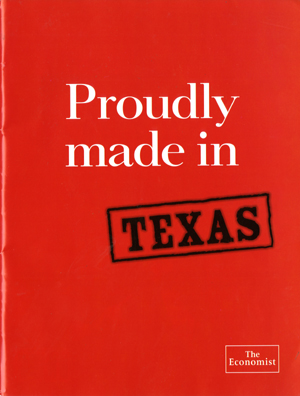

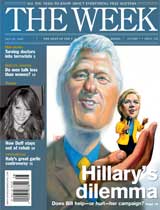
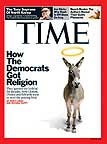
Not Radio, not Television, not the World Wide Web, not the thousands more magazines that arrived to the marketplace since 1843, not cable or satellite has stopped the growth of The Economist magazine. Bucking all trends the magazine has been growing both in advertising revenue and circulation year after year in the North American marketplace. In fact this year’s circulation in North America is 639,000, up 12.3% vs. last year. The secret is very simple and to quote The Economist folks: “The Economist is as topical and relevant today as it was at its founding in 1843.” I agree. The Economist today (that I am sure of, the 1843 I don’t know… I was not there) is still extremely relevant and indeed necessary. Together with The Week (My Rolls Royce of the weeklies) and the new Time (My best reinvented magazine this year) those three magazines give me all I need to know about all what matters for that week. The Economist gives me the analysis with the news; The Week provides me with the skinny on everything that matters (and I mean everything) and Time provides me with two or three in-depth packages on the important issues that answer the simple question of what is in it for me? My weekly journalistic diet is complete with those three magazines. They are not only necessary but also sufficient.
On a separate note, The Economist is now printed in three locations in the United States to make the delivery of the magazine faster to the newsstands and subscribers. The latest printing location is Texas, and thus the Proudly Made in Texas cover wrap of the June 23rd issue delivered to media folks announcing the new print site.
Once again, to paraphrase President Clinton, it is the content, stupid. And relevant content is what these three magazines deliver.
Archive for the ‘News and Views’ Category

Relevant content 1843 + Relevant content 2007 = The Successful Economist… plus The Week and Time = my weekly journalistic diet
July 17, 2007Saving Reader’s Digest…take two
July 15, 2007As you may recall, I published a blog two days ago on Saving Reader’s Digest. I also published a response from Reader’s Digest editor in chief Jakie Leo. (See both my blog and her response here.) Two more responses on Saving Reader’s Digest follow. One is from a former employee of Reader’s Digest Association who requested, for very good reasons to withhold the name, and the comments from Bob Sacks on his blog regarding Reader’s Digest. First is the former employee of RDA and second is Bob Sack’s.
Spot on!
Your observations about Reader’s Digest are right on the screws. They tried to turn it into a women’s service magazine–but one without the physical size needed to splash the photos up big. The formulaic face of this thing carries the same shouting cover lines everyone else on the newsstand uses. And one celebrity photo, one health story, a sex story, some government scandal, maybe a big numeral played up…..They mainstreamed it, made it a “me-too” magazine, and wonder why the rate base had to fall from 12 million to 10 million to 8 million in fewer than 10 years.
Geez, it just had to be competition from the internet, not that they’ve made something that emulates everything else shouting at people from the newsstand these days.
When they dropped the rate base from 12 to 10 million, they advised the investment analysts, “We’re not in trouble, we’ve just right-sized it!” And then guaranteed that 10 million circ. for 5 years. It was all smoke and mirrors…they held that number with 4-for1 and 5-for1 gift offers among other tricks tolerated by “the new ABC”. They gave it away.
Then, when Ripplewood buys the company and there is a regime change, the number drops 20% virtually overnight. Hmmm……
DeWitt Wallace, and later, Roy Reiman, did not face some of the same pressures that plague publishers today, but they did understand one truism that still holds: If you make something absolutely unique, and focus like a laser on the reader, you will succeed. Every other publisher out there would nod in agreement and say they do just that. But they don’t. In practice, they focus on the advertiser or the shareholder first and make bad decisions because of it. And instead of listening to the reader, they myopically look at what “the competition” is doing, and say, “We can do a magazine like that, but we’ll do it our way….and do it better!”
Bunk.
That’s why everyone is aping everyone else on the newsstand.
These days we could use a lot more DeWitt Wallaces and Roy Reimans. Energetic men of humble beginnings not afraid to be different. Or to work hard themselves. Egotistical know-it-alls who do nothing but hire freelancers to do their work while they fly to conferences, network, sit in endless meetings and find other pompous ways to play business are in trouble now. And they wonder why.
It must be the evil internet…..it couldn’t be that we are making something so mundane nobody wants to read it.
–A Former Employee of RDA
Bob Sacks response to my blog follows:
BoSacks Speaks Out: I had no idea that DeWitt Wallace who conceived of Reader’s Digest was such a visionary. Please read the article below (click here to read it) and send me back your thoughts. I think that the 87 year old wisdom of DeWitt Wallace displayed below, could help save our industry today. I have been preaching for over a decade, that the path to our success will be in developing addictive content. I have my own particular definition about that, but I am in love with Mr. Wallace’s excellent interpretation. I truly wish I could have had the opportunity to have a cup of coffee and a conversation with him about the industry.
Sometimes Samir Husni and I are at very opposite ends of magazine punditry. Today we are in total agreement. I must mark that down in my calendar
.
Behind the scenes with Mr. Magazine…
July 15, 2007Sid Salter, the Perspective section editor of The (Jackson, MS) Clarion-Ledger interviewed me for the “Sunday Morning With” department that appears every Sunday in the paper. The interview sheds more light on my job as Chair of the Journalism Department at The University of Mississippi, my journey from Lebanon to the United States, the origins of my Mr. Magazine name among many other interesting factoids about me. To read the entire interview click here.
Separated at Birth: Traditional Home and Atlanta Homes & Lifestyles
July 13, 2007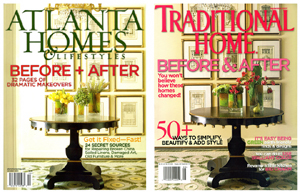
Is it a case of good editors thinking alike or is it the distance that separates Des Moines, Iowa from Atlanta, Georgia that caused the two magazines to have almost identical covers? Well, wait there is a catch to the identical covers… one came two years before the other (maybe the distance it takes to travel on foot from Des Moines to Atlanta)… Well the folks at Atlanta Homes & Lifestyles were not amused when they saw this month’s cover of Traditional Home. They wrote in their blog:
The staff of Atlanta Homes & Lifestyles had a deja vu moment this week when we spotted the September 2007 issue of Traditional Home magazine on the newsstand and arriving in our mailboxes. It is an almost exact copy of a cover we published in October 2005, a whopping two years ago!
The similarities are endless: the image itself, with the exception of a pear they added to the tabletop (nice touch!), as well as the composition of the cover. The bold “before & after” blurb and typeface are the most shocking likenesses. The producer of the story was Atlanta-based Lisa Mowry.
This is not the first time for a Trad Home repeat. A similar image from the cover of AH&L’s June 2005 “Color” issue appeared on Traditional Home’s May 2006 cover. Again, almost identical.
If imitation is the sincerest form of flattery….
Well, indeed imitation is the sincerest form of flattery…
Saving Reader’s Digest… (and RD’s Jackie Leo’s response)
July 11, 2007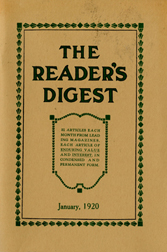
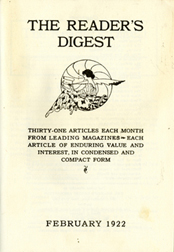
I know what people say about free advice, but while recovering from sinus surgery the news about the two million cut in circulation at Reader’s Digest and the plan to sell the back cover of the magazine to advertisers sent me back to the early years of Reader’s Digest and to the prototype issue and first issue of the magazine. I do not know whether it is the hospital connection that brought to mind the link with Reader’s Digest beginnings (DeWitt Wallace conceived RD on his hospital bed in France) or the recent news, but in any case I went to my magazine collection and pulled out the prototype issue and first issue of RD from Jan. 1920 and Feb. 1922 and guess what? I found the cure for all the ills of Reader’s Digest today. DeWitt Wallace referred to RD in his prototype issue as the “Pocket University” which “will enable you to keep yourself educated in the truest sense; it will yield immeasurable satisfaction in giving you a sense of being well-informed and well-read.” Wallace’s plan for the magazine was to be “of 100% Educational Interest— no fiction, no advertisements, no articles on purely transient topics and no articles of limited or specialized appeal.” His wife Lila defined the nature of such articles in the introduction to the first issue. She described the articles in RD as such: “Each article of enduring value and interest — today, next month, or a year hence; such articles as one talks about and wishes to remember.” Elsewhere in that first issue the editors wrote, “No articles of purely momentary interest — every article a worth while one, worthy of a permanent place in the storehouse of the mind.”
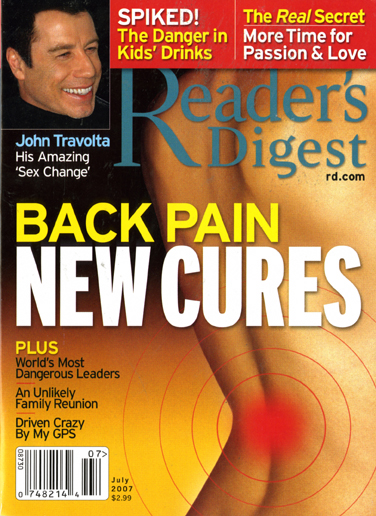
It is amazing as I flip through the pages of Reader’s Digest today I can’t but ask, Is there anything left from the magazine concept that the Wallaces created? Is any of the articles “worthy of a permanent place” in the reader’s mind? To save Reader’s Digest one only needs to go back and read those two issues from the 20s… the concept is still applicable today as it was then… The problem is not with the circulation or the advertising. Reader’s Digest problem is in its content. Be true to that mission statement of the past and bring back that “Pocket University” and you may see the cure of most of the ills of the magazine. John Travolta and the cures of back pain will not do it. Almost all the articles in the July issue of the magazine are of “purely momentary interest.” Once more it is the problem with the content and not the medium. I hope someone is reading, because I know the Wallaces are turning in their graves as they see what happened to their beloved magazine. It is not too late to save “The one magazine that is preeminently worth keeping– and binding– for future reference and enjoyment.” So says the words of the founders in their prototype issue. They are worth repeating.
Jackie Leo, Reader’s Digest editor-in-chief, responded to my blog with the following e-mail (I have asked Ms. Leo’s permission to publish the e-mail since it is my policy not to publish any e-mails sent to me unless I receive permission from the sender)… What follows is Ms. Leo’s response to the blog:
Samir: For someone as enlightened as yourself to publish such a naïve and inaccurate blog about RD was really stunning. We’ve known one another for a long time, and I can assure you that this rate base cut has everything to do with magazine economics and nothing to do with the magazine’s content (I challenge you to name another publication that has 8 million paid subscribers). I also wonder why you think the Digest didn’t cover the same subjects we now cover. They did–the only difference was that they condensed other magazine’s writings in most cases instead of creating original pieces, which is what we do now, for very obvious and good reasons.
You also seem to forget that the Wallace’s drove their extraordinary circulation through the use of the famous Reader’s Digest Sweepstakes, a practice that is no longer followed.
Had the Wallace’s lived to see the explosion of television channels, the Internet, the rise of Google, the speed with which information and ideas travel, they would have had two choices: Reflect the cultural shifts in the society by evolving the magazine and staying in the center of the mass market, or, reduce the circulation to that of, say, The Virginia Quarterly and hope that people would still want to read it.
One more point: if you don’t think that an outstanding medical breakthrough report on the causes of and the solutions to back pain does not have enduring value, then you’ve never bent over to pick up your i-phone and felt the unbearable agony that millions of Americans suffer every day.
If you’d like more information about RD, please call me.
No Cheers this Fall: Bauer pulls the plug on Cocktail Weekly
July 9, 2007
In a very short press release Bauer Publishing announced this afternoon that it has canceled the launch of Cocktail Weekly that was planned for Sept. 24, 2007. The complete press release follows:
BAUER PUBLISHING CANCELS LAUNCH OF COCKTAIL WEEKLY
Englewood Cliffs, NJ (July 9, 2007) Bauer Publishing today announced that it has canceled the launch of COCKTAIL WEEKLY. Today’s announcement reflects the uncertain conditions in the single copy marketplace.
The magazine that would have been the first of its kind on the newsstands (think Cosmo on a weekly basis) was the second casualty today after Jane magazine’s news that its August issue will be the last (See here Radar magazine’s breaking news on Jane). Is it the newsstand’s climate or is it the publishing climate that is causing all these closures. I have advocated at the recent PBAA meeting the need for publishers to rethink the advertising driven publishing model in this country and go back to the circulation driven model, but I guess it will take time and few more casualties before the industry starts rethinking its practices. The question is do we have the time? Well, only time will show…
Refrigerator Journalism for Adults…
July 7, 2007
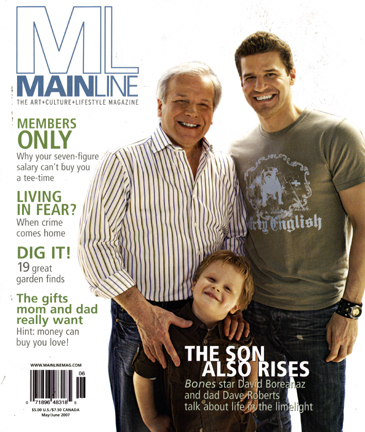
The publisher emeritus of our local paper Mr. Jesse Phillips once told me that he refers to his paper The Oxford Eagle as “refrigerator journalism.” When I asked to elaborate he said, “You know as in all community newspapers our job is to reflect and record all what is happening in town. Your son scores a soccer goal; we take his picture and put it in the paper. You buy the paper, cut the picture out and put it on the fridge for all to see…” I thought back that this type of “refrigerator journalism” made great sense and it still does. The good community newspaper still covers all the activities of the kids in town and stills provide a printed forum for all those stories and pictures to be cut and taped to the fridge door.
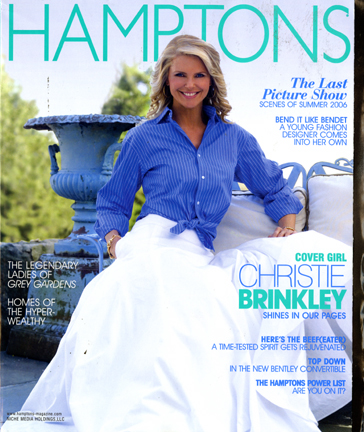
The reason for this lengthy introduction is the recent increase that I have noticed in the number of magazine titles sprouting in different communities around the country sporting pictures of social events. Page after page of parties, social events, and charity balls, etc. which showcase the movers and shakers in towns all across the nation. From a small town the size of Oxford, Mississippi to a major metropolitan town the size of Las Vegas, Nevada magazines are being published to provide a printed record of all the activities taking place in town…the catch is that all these activities are aimed at the elite and the rich and famous. It sort of reminded me of the above talk with Mr. Phillips. These magazines are nothing but “refrigerated journalism” for adults to see and be seen. Just pick any town U.S.A. and you will see one of these magazines. In most cases they are distributed free and they give you a quick glimpse at the lifestyle of the elite of the town. To give credit where credit is due, the leader of this trend is Ocean Drive magazine that was started more than ten years ago and is still going strong. Who said imitation is not the best form of flattery.
By the way, a journalist recently asked me if I consider these publications journalism. I immediately said no, they are anything but journalism. Like gossip and celebrity publications they join the ranks of other media outlets, but for the life of me I cannot consider them journalism. To me journalism, true journalism, is everything and anything that have a direct impact on you, your life, your home, your money, your country, your world, etc…. you name it.
Telemags should be the name of magazines on line…
July 4, 2007The beauty of technology is in the way it helps us create new media and new ways of delivering content. From the days content was delivered via the newspapers to the current days of the world wide web. Each medium served and continue to serve the needs, wants and desires of its audience. When television was invented it was called radio on the screen. When color was added to newspapers they were not called newspapers with color. Same is true with the rest of the advancements in print technology and other major advances in the tech world. The reason for this lengthy introduction is to pose the question regarding the so called “magazines on line.” Are they really magazines? Do they meet the real definition of a magazine? Or are they a new medium? The more I watch and read (note the word watch) these magazines on line (Watch Monkey or People test issue of its on line and judge for yourself) the more I feel that I am watching a television program with captions. It is a hybrid between the two media: magazines and television. So why don’t we call a spade a spade. It is a Telemag short and simple. We did that with the magazines that look like books, we called them Bookazines or Mooks. Calling the magazines on line what they really are will solve a lot of definition problems and will introduce a brand new addition to our world of media. So, as of today I will start referring to the so called “magazines on line” as Telemags. They are not magazines and they are not television. They are a new world of hybrid media that found yet another way of delivering relevant content to a relevant audience through a relevant medium. Telemag it is and I hope you will agree.
The Future is Good to plan for, but the Present is more important to Act upon
July 3, 2007“That was then but this is now. What are you going to do about it?” writes David Sullivan in The Inksniffer. A very informative and good article about focusing on the present status of our media situation. David notes the fact that the future receives a lot of ink in the media but not the present. David calls for a new newspaper organization. He writes, “We need to form a new trade organization: Journalists Who Believe in Printed Newspapers. JBPN isn’t much as an acronym, so someone else can do better.” I echo his call for a similar magazine association. One that takes care of all magazines, big and small, with or without ads, and one that updates the definition of a magazine that is written by the post office and not the people who create the magazines.Read the entire piece by clicking here.
Husni Vs Sacks… the PBAA debate continues…
July 1, 2007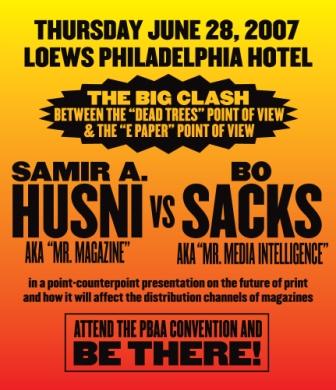
Now that the boxing match between Bob Sacks and myself at the PBAA’s 21st Convention is over, both of us have written about the stuff we’ve observed, learned, liked and disliked at the convention. To join the debate read Bob’s observations here and my observations here. Both of our comments are lengthy, but I will leave it up to you to judge the worthiness of both. Enjoy and again thanks to the PBAA for a great convention.


 Mr. Magazine