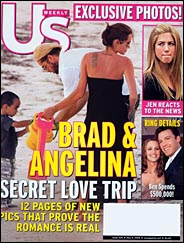
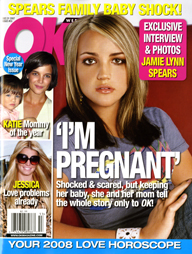
In an article published in The New York Times on May 9, 2005 Janice Min, the editor in chief of US Weekly, justified the fact that her magazine paid $500,000 for the pictures of Angelina Jolie and Brad Pitt on the beach together by telling the Times’ reporter Lia Miller “that every magazine was still looking for that one special photograph. ‘Usually the big-ticket photos involve a pregnancy, a wedding, a breakup or a hook-up.'” Well, last week OK Weekly landed such a picture of the pregnant Jamie Lynn Spears. Us Weekly, in this week’s issue, slams Jamie Lynn’s mother Lynne Spears for selling the story to OK Weekly. US Weekly goes on to write, “Lynne soon sought out OK! magazine, a struggling British-owned tabloid that pays generously for celeb interviews…” OK Weekly is now a struggling tabloid! OK Weekly, in fact has been growing in circulation in the United States and have published several editions world-wide. I, for one, do not agree with the concept of anyone been paid to be interviewed, but for the kettle (US Weekly) to call the pot (OK Weekly) black strikes me as funny to say the least. If Lynne Spears made the same offer to US Weekly, those same pictures would have appeared on the cover of US Weekly, and no other magazine would have attacked the rest of the magazines because they did not win the bidding. It is amazing what passes today as journalism; journalism with no profound impact on the life of any of the readers. Shame on all of us and on all of those who try to push this type of media as journalism.
Archive for the ‘News and Views’ Category

The “Kettle” Calling the “Pot” Black…
December 30, 2007The Best Use of “Christmas” in a Magazine…
December 24, 2007
New Statesman magazine bills itself “Britain’s award-winning current affairs weekly,” and keeping with current affairs this week’s issue celebrates Christmas and the New Year in a very special way. The magazine offers “100 pages of the finest writing…” inside this end-of-the-year issue. Included in the issue is more than one defense of the use of the terms Merry Christmas and Happy Christmas rather than the so-called politically correct Happy Holidays. What caught my attention was the essay by Richard Dawkins, the Oxford University professor and self professed atheist and author of The God Delusion book. He writes,
“For better or worse, ours is historically a Christian culture, and children who grow up ignorant of biblical literature are diminished, unable to take literary allusions, actually impoverished. I am no lover of Christianity, and I loathe the annual orgy of waste and reckless reciprocal spending, but I must say I’d rather wish you ‘Happy Christmas’ than ‘Happy Holiday Season.”
New Statesman magazine is filled with Christmas essays, fiction, quizzes and awards. Very well done and best usage of the word Christmas that I have seen in a long long time…
And for those of us who celebrate the birth of Jesus, Merry Christmas and a Happy New Year.
How Many Magazines Debuted This Year?
December 22, 2007The Wall Street Journal’s Numbers Guy tackles this issue on his blog and provides some explanations for all the numbers floating around, including my own numbers. The Numbers Guy Carl Bialik starts his blog stating, “If you want to know how many magazines debuted in the U.S. this year, you have to start by answering the question: What is a magazine launch?” Click here to read his entire blog.
“You’ve come a long way baby…”
December 22, 2007… And the baby here refers to both OK magazine and Britney Spears’ little sister Jamie Lynn. OK and Jamie Lynn were both born with silver spoons in their mouths and they were both in the shadows of other front runners, siblings or no siblings. With the latest “pregnancy” news both Jamie Lynn Spears and OK magazine landed a prime spot in the world of celebrity gossip. The pregnant teenager landed on the cover of OK magazine and together with her mom gave the magazine an exclusive interview. The rest of the media sadly jumped on the band wagon and spent hours reporting about the pregnancy and the exclusivity of the interview in OK magazine. What some may consider a great coup for OK magazine, I feel it is a sad day for a country where teen-age pregnancy has always been a problem. Rather than addressing the problem and the role and responsibilities of the parents, we are now celebrating kid pregnancies and referring to the pregnant teen as “the brave teenager.” Call me old-fashioned, but this is where I draw the line.
By the way, just in case you did not catch the irony behind the headline of this blog entry, “You’ve come a long way baby…” Here’s a brief explanation, it was the headline for an ad for a brand of cigarettes aimed at women. Well, now you know the rest of that story… need I say more!
Mr. Magazine’s™ 7 Great Magazine Moments in 07
December 17, 2007“So, how is the magazine business?” a friend whom I have not seen for more than a year asked me. What do you tell someone who has not been on the scene for more than a year?“ Great! It has been great,” was my answer and I proceeded to tell him, in a true magazine fashion, what I consider as my 7 great magazine moments of 2007:
1. The launch of Condé Nast Portfolio: It single handedly brought back the faith in new magazine launches from a major media company who still considers magazine business as its core business. Thank you S. I. Newhouse Jr., David Carey and Joanne Lipman.
2. The reinvention of Time magazine: The weekly has gone through a major reinvention bringing relevance and intelligence to its contents and readers. The new Time set the stage for changes at both Newsweek and U.S. News & World Report. Thank you Richard Stengel and Edward McCarrick.
3. The creation of a new genre of man’s magazines: The launch of Outside’s Go and Men’s Health Living magazines created a new genre of man’s magazines that cater to non-woman related issues in a man’s life. Both magazines are catering to a new niche that has gone unfulfilled for years: travel that meets the needs of the active man and interior design and home that meets the needs of the affluent man. Thank you Larry Burke and David Zinczenko.
4. Giving a new meaning to Garden and Gun: Through the launch of the new regional magazine Garden & Gun the two terms bestowed a new meaning on both of the words. One no longer thinks gardening or guns when they hear the two words, rather they think “21st Century Southern America.” Thank you Rebecca Darwin and welcome Sid Evans.
5. The Week is not for sale: With the sale of all the U.S. properties, Dennis Publishing did not include The Week on its “For sale” announcement. Felix Dennis once told me that he is a poor consumer of popular media. “I watch no television, see no movies and couldn’t, quite frankly, care less about magazines, with the exception of The Week…”Thank you Felix Dennis.
6. The Mook, a new word in the magazine world: Monocle magazine launched in London and few other international cities at the same time, added a new word to the English language and gave a brand new meaning and respect to the world of book-a-zines: The Mook. A magazine that looks and feels like a book, but reads as a magazine with all new content and non of the recycled content book-a-zines accustomed us to see. Thank you Tyler Brulé.
7. The launch of Everywhere and the re-launch of JPG: Both magazines, published by 8020 Publishing, show that a partnership can exist between both technologies: paper and pixels. Just give to paper what is paper’s and to pixels what is pixels’. Thank you Paul Cloutier.
So here you have it, 7 great moments in the life of the magazine industry in 2007.I’m looking forward to a great 2008.All the best to all, and here’s for a great new year.
The future of newspapers: The problem is in the newsroom, not the newspaper
December 10, 2007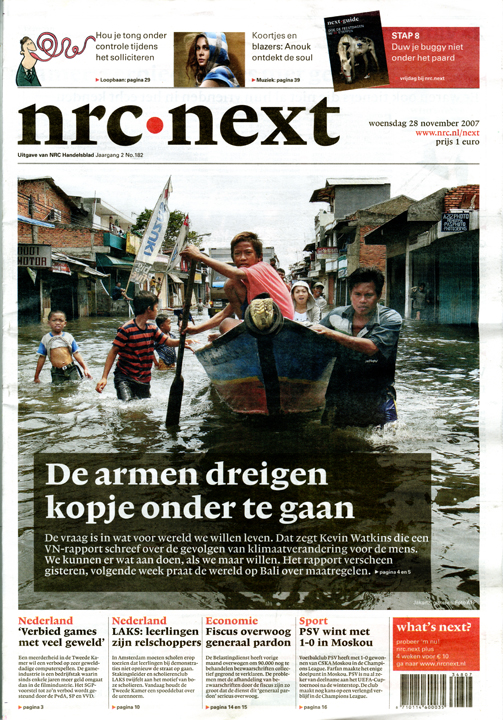
I recently gave a speech at the Paper and Pulp Products Council (PPPC) European Summit in Brussels, Belgium on the future of ink on paper and the magazine and newspaper’s future as we know it today. I noted that the problem is not with the medium but rather the problem is with the message. In fact, after further reflection and several visits with newspaper newsrooms both in the U.S. and in other parts of the world, I am more of the opinion now that the problem is rather with the newsroom also and not only with the message. In fact, I do not know if we can separate our message problems from our newsroom problems.
The majority of the newsrooms that I have visited are still operating in the same way they operated when I was working in a newsroom as if nothing has changed. Yes, we no longer use typewriters (we are talking 70s here) but we still have the beat system and the division of the newsroom between reporters, writers, editors and designers. The territorial divisions in the newspaper are still alive, well and kicking the newspaper to its grave. Try to tell the folks in the newsroom that the reporter from the city council beat needs to work with the reporter from the world beat and see what will happen. Try to tell the reporters to ignore yesterday’s news because their readers have already heard and seen the news and see their reaction. The newsroom has to go beyond the news and the reporters working there have to do the same.
As we move to adapt in this rapidly moving technology era, we need to make sure that our reporters and editors will focus their content on the right medium. That is why some forward thinking newspapers are moving more in the direction of content editors and directors rather than news editors.
I believe that we need to have two newsrooms in each paper, one to operate the on-line edition which will continue to operate like the old fashioned newsroom with beat reporters whose sole job is to chase and report the news (from their virtual office to the web directly) and a contents-room for journalists who are going to stop the news-race and rather focus on analyzing and studying the news in order to create information out of the news as the editor-in-chief of the Dutch newspaper nrc•next Hans Nijenhuis likes to say, “News is free, but information is not.” He told Monocle magazine last month, “We feel that Next is actually a daily magazine. Traditional papers are done page by page and sent off to the press to be put together. At Next we put all the pages on the floor at 18:00 and see how it works as a whole…”
The technology of paper (and yes paper is a technology for those who tend to forget that) may no longer be the best home for most of the news, but it sure IS the best technology to provide the information that is needed to link our yesterday with our tomorrow. The good paper technology still provides its customers with a “beyond the news” detailed information that as Bruce Brandfon, the publisher of Scientific American says “will have a profound impact” on its users. We must keep that in mind and start to implement that profound impact in our newsrooms.
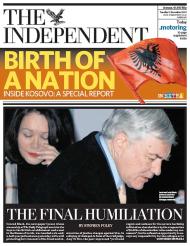
Change should start from within, or the prophets of doom and gloom will continue to predict the demise of the newspapers. A paper (notice that I did not use newspaper) must be that, a paper that offers unique journalism that will have that profound impact on the lives of its readers whether political, culture, financial, or even entertainment and lifestyle (Such as in the British paper The Independent). Profound is the key for a successful journalism paper in this century and beyond. The fun thing about the aforementioned is that it is not new. The necessity of journalism is as important today as it has ever been. The only change is in the way journalism is delivered. The paper technology is great for some journalism and the web technology is great for some other journalism. The key is to change and adapt. Change must come from the inside, inside the newsroom, otherwise, newspapers will be committing mass suicide in this country and their numbers will continue to drop. If your newspaper is not necessary and sufficient you can start counting the days to the grave, and if you are still talking about the need to change, IT IS TOO LATE.
The papers in this country can still have a great future if we free the newsroom and the way we do business in the newsrooms. Trimming the staff, redesigning the paper and closing national and overseas offices are nothing but band-aids on a major, deep cut that will not help the healing process. Now is the time to hit the brakes and rethink our entire strategy of the future. A strategy that should begin today and it should begin from within the newsroom.
Bringing Down the House of Reiman: Roy Reiman’s on the record response
November 30, 2007I have never written a blog that generated more responses and counter responses than the one I wrote on Bringing Down the House of Reiman one “Ripple” at a Time take one and take two. My friend Bob Sacks picked up the blog on his electronic newsletter Bosacks.com and even more people responded to the blog including Ellen Morgenstern, director of public relations at Reader’s Digest Association. Well, the man himself who founded Reiman publications has decided to respond to all the responses regarding my piece on Reiman publications. What follows is Roy’s response (on the record for the first time) to Ms. Morgenstern and others. Following his response is Bob Sacks’ entry regarding the matter and Ellen Morgenstern’s letter to Bob regarding the same issue. I look forward to other “on the record” comments about this important issue regarding magazine publishing, ownership and the possibility to publish magazines in this day and age with or without advertising.
Roy Reiman on setting the record straight:
“The writing has been on the wall for some time that a ‘no advertising’ model no longer works in this day and age. Even Roy Reiman’s new magazine venture, ‘Our Iowa’, accepts advertising.” –Ellen Morgenstern, Reader’s DigestThere she goes again–contending that a “no ad” magazine couldn’t make it today…and contending that even I no longer believe so, because we’re accepting advertising in Our Iowa.I’ve watched from the sidelines and tried to stay out of this fray, because I recognize that when someone buys a company, the buyer has the right to be wrong. But after seeing the quote above–for the second time at that–I can no longer resist sharing my opinion. I’ve concluded that if I don’t respond, it will not only add credence to her comment, but may appear I have no opinion or don’t care what’s happening to my old company, when the truth is I care a great deal.I don’t appreciate her implying that I no longer believe in the no-ad concept without first checking with me. The fact is I believe as strongly today as ever that it can be achieved with a national magazine that is truly different, sparkles with creativity and delivers what readers can’t easily find elsewhere. The lack of advertising was the most noticeable difference our 16 million subscribers mentioned and appreciated, and now–with the acceptance of advertising–that uniqueness is gone.The problem with Ellen’s conclusion is she’s comparing apples to tomatoes. Here’s why: With today’s printing, paper and postage costs, you need about 1 million paid subscribers to make a go of it with a no-ad magazine.Well, when you have a NATIONAL magazine directed at the U.S. population of nearly 300 million people, garnering 1 million subscribers is a reachable goal. I feel that’s still currently attainable with the right kind of magazine. As I’ve often said, if you can’t lure 1 million subscribers from a 300-million audience, maybe your new magazine isn’t really that good after all.But when you have a REGIONAL magazine, such as Our Iowa, directed at a much smaller audience (Iowa’s population is 2.8 million), any logical person would understand that attracting 1 million subscribers is out of reach. In that kind of limited market, you need the ancillary support of advertising. The comparison and facts are that simple.I’ve never been “against advertising”. My first success was with a magazine supported solely by ads, with no paid subscribers. But I also learned–with the right concept–you can make it without ads as well.We successfully launched 14 national magazines without advertising, eventually topping 16 million paid subscribers. But not one of those magazines would have made it without advertising if it had been limited to a single state or regional audience.This being the case, it bugs me big time that Ellen keeps implying I’ve “caved in” and that I no longer believe a NATIONAL magazine can make it without advertising…and bases her conclusion on what she now sees I’m doing with a REGIONAL magazine.For her to keep using me as a defense of RDA’s move to accepting advertising by asserting “even Roy Reiman knows that times have changed”, as she was quoted recently, is very disturbing, especially in view of her added comment: “It is normal to have disgruntled former employees acting as ‘sources’, but there’s always another side of the story.”I find that comment particularly interesting, when it appears she is now acting as the “source” of my thinking, without first checking my side of the story.Most bothersome of all, though, is her assertion that a “no advertising model no longer works in this day and age”. That comment minimizes and discredits the efforts of the incredibly creative crew at our company that successfully launched 14 national no-ad magazines over the years…and likely, if we surrounded up the best of them, would love the challenge of making it happen again today.
–Roy Reiman, FounderReiman Publications
Ellen Morgenstern and Bob Sacks exchanges
Bob Sacks on his bosacks.com electronic newsletter wrote:
Friends, A few weeks ago I accidentally reposted in this newsletter an article by Samir Husni about the goings on at Reiman Publishing, now owned by the RDA which is in turn actually owned by Ripplewood Holdings. It was a mistake on my part, because I had previously posted exactly the same article a month or so previously. To the best of my knowledge, it is the first time in fifteen years that I have reposted an identical article.Reader’s Digest Association has asked for an editorial correction and this is it. Mea Culpa.For the further enlightenment of our readership I will post the letter from RDA, which is printed here at their request. I am also posting Samir’s note to us on the same subject.As always, you can make up your own mind on the observations from RDA. Do you agree or disagree with the points taken?BoSacks
Ellen Morgenstern’s letter to Bob Sacks regarding my blog:
Dear Bob,I respect that you are servicing the publishing industry with your independent voice and insider’s perspective. You keep your fingers on the pulse of what’s current for publishers.Therefore, I am perplexed why you would choose to recycle Samir Husni’s column from August, where unidentified sources complain about changes taking place at the former Reiman publications under the Reader’s Digest Association. You know this is old news, and you already posted readers’ responses.After changes, it is normal to have disgruntled former employees acting as “sources,” but there’s always another side to the story.Here are a few points to consider:The writing has been on the wall for some time that a “no advertising” model no longer works in this day and age. Even Roy Reiman’s new magazine venture, “Our Iowa,” accepts advertising.The ads appear to be a non-issue for our readers. We received but a handful of letters expressing concern. (One loyal reader even sent a $5 cash donation in sympathy with the rising costs of printing and publishing!)The sale of Reiman to RDA made sense for both parties because of the natural synergies between the companies. It took some time to materialize, but by integrating the companies, the business is now headed in a much better direction than where it was at the time of the sale.The key titles – many of which had flattened out in circulation — are doing very well. Investments are being made to revitalize and sustain some of the beloved brands that otherwise might have faded. And the affinity-based strategy of supporting the Food / Entertaining and Home / Garden titles with specialized divisions, related assets and integrated marketing, is clearly designed to give the Reiman titles a great chance for a long and successful future!Change isn’t easy, but it is necessary in this rapidly evolving media landscape. We will continue to look for smart ways to bring the best content to our readers. They will ultimately decide if their interests are being served.
Ellen MorgensternDirector, Public RelationsReader’s Digest Association
And, if you are still with me, Bob’s respond to Ellen:
Ellen:I re-posted that in innocence without an agenda. On Samir’s site it was listed as a recent November release and appeared new. While on the road, I checked my database as best as I could, and, although it sounded familiar, I couldn’t find that I had sent it out before.Mea culpa.As you might expect I am an epicenter of an enormous amount of information and industry-wide emails. I have received dozens and dozens of emails on and about RDA, Ripplewood and Reiman. My guess is that it was this information overload that made me think that Samir’s article was new paralleling most the letters I have received.I will gladly write an editorial correction if you would like or empower you to write a response to my readership.Bob Sacks
People magazine’s latest Telemag…The sound of music
November 29, 2007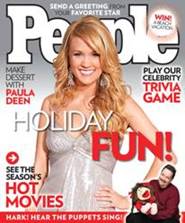
If you want to be entertained, be proactive, and listen to some good holiday music then go no further than the latest edition of People magazine “Digital magazine.” It is a special issue themed Holiday Fun and comes with all the bells and whistles an interactive digital magazine (or what I like to call Telemag) should have. The movement, the speed, the viewer driven interaction and the great sounds of music and advertising all in one. Is it People magazine? NO. Does it replace People magazine? NO. Can you enjoy it the same way you enjoy People magazine? NO. Would you use your brain less to watch it? YES. Would you know that only one company advertises in it? NO (Hint to the viewers: all the ads belong to KRAFT). Would I recommend all magazines to create something like that? YES if they can afford it and if their content supports the brand and not take away from it. Will it ever replace the print edition of People magazine? NEVER. So having said that, hurry up and click here to view the issue. It self destructs in four weeks.
Tech toys for the boys from Men’s Health…
November 22, 2007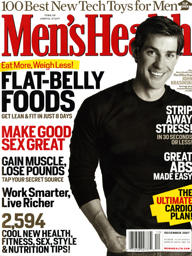
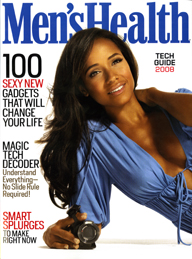
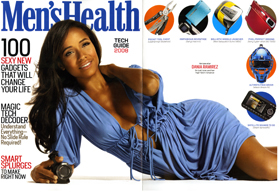
Are you looking for the “100 Best New Tech Toys for Men?” Well look no further than the December issue of Men’s Health. The magazine’s sky line invites you to flip over the magazine to look at those toys on the back cover. To my surprise, the back cover shows no toys, but instead the star of Heroes Dania Ramirez holding a camera in her hand with an added cover line “100 Sexy New Gadgets That Will Change Your Life.” I am not saying I was disappointed but rather surprised. One more action and the toys are revealed…the back cover opens to a gate-fold that shows some of the toys. The picture below is for the back cover opened…Toys or no toys, it is the season to be thankful, so many thanks to all the Mr. Magazine blog readers, and to all the friends and peers in the magazine world. Happy Thanksgiving and all the best from me and the entire staff of www.mrmagazine.com
Dave Eggers and the wisdom of the readers…
November 12, 2007

I met Dave Eggers for the first time in 1994 right after he published Might magazine which I have selected in that year as one of the most notable launches of 1994. I was so impressed (and still is) by the magazine that folded after a year or so for lack of funding. Dave tried his best to secure funding for the magazine, including sending a letter to John Mack Carter at Hearst (who was publishing my Guide at that year) asking for Hearst to be involved with Might. The response from John was negative and Dave, in a very smart move, published the letter from John in Might.
Well, times have changed and as fate will have it, Dave’s odds in book and magazine publishing have changed and he is in no need to write letters to big companies asking for help in funding his great magazine ideas. He can do it on his own (or with his wife) and in a completely different way. In the November 2007 issue of The Progressive Dave is interviewed in depth about his books, organizations and magazines. One paragraph caught my attention from that interview. It was the one dealing with Might, McSweeney’s and The Believer. Nina Siegal asked him whether he fears the corrupting influence of the mass market. Here is part of his answer (which works also as a great response to all the naysayers who continue to spread the word that no one can start a magazine in this day and age):
“With Might, we did it the dumb way. We thought we had to do 100,000 circulation and we had to have all this advertising, and it was never going to happen and no one got paid, we were all perpetually disappointed, and it folded. We found out that wasn’t the way to do it.
With McSweeny’s and The Believer we decided to do the math better, to depend on the readers, not on advertisers or anyone else. If the readers think it’s good, it will keep growing. That way, there’s no compromise. The Believer ahs a circulation of 17,000 to 20,000 and I don’t know if it will ever surpass that. And get this: Because of reader support, McSweeney’s, the literary quarterly, is able to subsidize some of the more eccentric projects we take on. It’s bizarre but it can work if you depend on the wisdom of your readers.


 Mr. Magazine