Archive for the ‘Magazine Power’ Category

h1

Magazine Media: A Global View Researched And Documented – From the United States and Beyond… Mr. Magazine™ Presents Highlights From Linda Thomas Brooks and James Hewes’ Presentations At The ACT 8 Experience…

May 7, 2018

President and CEO of MPA – The Association of Magazine Media, Linda Thomas Brooks and President and CEO of FIPP – The Network for Global Media, United Kingdom, James Hewes, were two of the keynote speakers on the opening evening of the ACT 8 Experience, April 17, 2018. The gala was a glittering event filled with good food, great conversation, and amazing overtures about the positivity of print and digital together, putting their adversarial roles toward each other to bed once and for all.

Linda Thomas Brooks, President and CEO, MPA: The Association of Magazine Media, speaking at the ACT 8 Experience April 17, 2018.

Linda’s presentation began with a conversation about the power of magazine media. Linda came to her job as president and CEO of MPA after having been immersed in digital media for about 15 years, so as she eloquently put it, she knows what digital does well. But she also knows what magazines do well. And she totally understands what the two can do together, because as Linda put it that opening evening, “Magazine media lives in multiple formats.”

Her stellar presentation continued as she talked about how magazine media builds brands and sells product in a safe and transparent environment with demonstrable results and more rigor to prove it than anyone else. Trustworthy information is of paramount importance today to marketers and to consumers. Linda presented, from research done by the Edelman Trust Study, that customers are beginning to differentiate between platforms and media brands, showing consumer trust in platforms going down and their trust in journalism going up. Consumers are really thinking about where they’re getting the information that they’re using in their lives.

Her discussion was both eye-opening and well-received as industry leaders, journalism and marketing students, and academics gathered in the beautiful ballroom at the Inn at Ole Miss and listened to one of the first Print Proud Digital Smart moments of the ACT 8 Experience.

To hear Linda Thomas Brooks’ entire presentation, please click the link below.

James Hewes, President and CEO, FIPP: The Network for Global Media, United Kingdom, speaking at the ACT 8 Experience April 17, 2018.

James Hewes, president and CEO of FIPP, the network for global media, took the stage that same evening right after Linda Thomas Brooks. FIPP is an organization that empowers its members to build market-leading international businesses through intelligence, solutions and partnerships. Its members include: Business Insider, BuzzFeed, Elle, Wired and many, many others. James opened his presentation on 8 Industry Trends with a powerful statement about the magazine media industry’s diversity and vibrancy.

The 8 Industry Trends that FIPP’s research has uncovered and that James discussed are both interesting and developmentally important as they represent current industry challenges across the board:

1. Talent & Culture
2. The Elephant in the Room (referring to social media, platform specific marketing & content, and the renewed importance of the Google algorithm)
3. Print Matters
4. The State of Advertising
5. Subscriptions and Reader Revenue
6. The Power of Platforms & Platform-Focused Content
7. Blockchain – Betamax or VHS? (a discussion on the pros and cons of this emerging technology)
8. The Coming AI Revolution (artificial intelligence and looking at its potential)

To listen to James Hewes talk about these 8 Industry Trends in depth with wisdom and well-placed humor brought those of us in the audience much food for thought. (pun intended, as we dined on our delicious meal). James humanized these complex topics and left us with a hopeful curiosity that was exceeded only by an immense hope for the future and the technologies to come.

To hear James Hewes’ entire presentation, please click the link below.

To relive all the presentations of the Magazine Innovation Center’s ACT 8 Experience go to http://www.mrmagazine.me and search for ACT 8.

h1

“Your Brain on Paper/Print” With Daniel Dejan, ETC Print Creative Manager, Sappi North America – Mr. Magazine™ Presents Highlights From The ACT 8 Experience…

May 4, 2018

Daniel Dejan, ETC Print Creative Manager, Sappi North America, speaking at the Magazine Innovation Center’s ACT 8 Experience, April 18, 2018.

“Your Brain on Paper” and why we still love print was the focus of Sappi Paper’s Print Creative Manager for North America, Daniel Dejan. Day Two of the ACT 8 Experience brought Daniel to the stage to talk about our brain on paper and how we still love to read in print. Daniel’s discussion was all about the sensory, and his points made were just as magnetic. Touch, smell, sound, and sight are all a part of the experiences magazines create. And we as humans respond to that. Touching the mouse of your computer, while very instantaneously satisfying because, if everything goes according to pixel-plan, rapid information is at hand, it cannot replace the completely holistic adventure that ink on paper gives you.

And nobody can depict and tell that story like Daniel Dejan. He is the voice of paper when it comes to the positive reaction that the platform gleans from consumers.

And Sappi is the company that is as passionate about paper as its print creative director. Research and development is high on Sappi’s priority list as they continue to further sustainable and revolutionary ways to serve their customers in paper, believing that while we live in a digital age, print products are still the core of the publishing industry, and many others. Last year’s report that Sappi released “The Neuroscience of Touch” was an amazing study on the impact of print on the brain. Applying neuroscience to marketing, Sappi’s report helped us to understand why consumers are still triggered by certain stimuli, which in turn can help brands create better experiences for consumers.

At ACT 7 in 2017, Daniel spoke eloquently about the Haptic Brain, Haptic Hand, and the power of touch from that all-important report. This year at ACT 8, he continued the conversation and brought the audience many compelling reasons for why print is still a powerhouse to the senses. From sight to touch, smell to sound, reading in print is an experience unlike anything that pixels on a screen can offer. When we read in print, even the turning of the pages and the crackling of the paper that we hear emits a sensory perception. As Daniel stressed, it’s the complete sensory involvement that helps to make the print reading experience much richer. Even our bodies respond physically to reading on paper as heart rates and blood pressures decrease, and our overall comprehension is much better.

During the ACT 8 conversation, while those of us in the audience were totally engaged, Daniel said that the biggest challenge right now in photographic communication is that financial people are making aesthetic and marketing decisions. There are engagement techniques that many magazine media companies are failing to utilize, a particular issue with some Canadian companies that Daniel works with, such as special effects on covers and/or special inks.

So, in a world where continuous notifications and other digital distractions are a part of our daily lives and something that we’ve come to depend on for instant communication, Daniel Dejan, in his own inimitable way, showed us all at the ACT 8 Experience that the print reading experience is both welcomed by consumers and well deserved.

And the Print Proud Digital Smart way of making magazines continues.

To hear Daniel Dejan’s entire presentation, please click the link below.

To watch the entire ACT 8 Experience presentations please go to http://www.mrmagazine.me and search for ACT 8 Experience.

h1

“Putting The Consumer First” With Bonnie Kintzer, President & CEO, Trusted Media Brands – Mr. Magazine™ Presents Highlights From The ACT 8 Experience

April 30, 2018

Bonnie Kintzer, President and CEO, Trusted Media Brands, speaking at the Magazine Innovation Center’s ACT 8 Experience, April 19, 2018.

“Adapting and adopting,” a phrase that Bonnie Kintzer, president and CEO of Trusted Media Brands, believes in strongly for the success of a company. When Bonnie came back to Trusted Media brands four years ago, after having been gone for seven years, the company was burdened by debt and had just emerged from its second bankruptcy. The overall mood then was one of despair and dejectedness. Not a great model for success. Hence, the phrase “adapt and adopt” was born.

But Bonnie was determined to see the company come back to growth again. As the Reader’s Digest Association, it had not weathered the times of change and disruption well, but the content of its brands was still trusted and strong.

And today through adapting and adoption of innovation and the taking advantage of new platforms and products that drive today’s magazine consumer, Trusted Media Brands is strong and growing. According to the latest data from comScore, the Trusted Media Brands Digital Network now reaches 63 million consumers a month and is among the top 30 out of 2,000 digital lifestyle networks. The brand teams create around 2,000 pieces of high quality written and video content a month. In fact, Bonnie pointed out in her presentation, based on the most recent data from the MPA: The Association of Magazine Media, Taste of Home and Family Handyman brands are now the top two magazine media brands on Pinterest, outperforming such well-known brands as Allrecipes, House Beautiful, Cooking Light and Bon Appetit. Adapting and adopting, indeed.

On day three of the ACT 8 Experience, Bonnie took the stage that morning of April 19 and talked about “putting the consumer first” and it was a mesmerizing conversation. Her wit, charm and engaging presentation was surmounted only by the truth and wisdom of her words. She opened the final morning of ACT 8 brilliantly.

And to hear Bonnie Kintzer’s entire presentation, please click the link below.

To watch the entire ACT 8 Experience presentations please go to http://www.mrmagazine.me and search for ACT 8 Experience.

h1

Liz Vaccariello & Her 11 New Rules for Making Magazines. Mr. Magazine™ Presents Highlights From The ACT 8 Experience

April 27, 2018

Liz Vaccariello, Editorial Director, Parents Magazine Network, Meredith, speaking at the Magazine Innovation Center’s ACT 8 Experience, April 18, 2018.

If the phrase “energetic enthusiasm” was defined in the dictionary, you’d find Liz Vaccariello’s name written categorically beside it. The editor in chief of the Meredith Parents Network has an exuberance for her brand and the industry in general that is contagious.

Liz was our opening keynote speaker for the first full day of the ACT 8 Experience on Wednesday morning, April 18. While the air in the room was expectant when she took the stage to give her presentation, by the time she accepted the resounding applause and descended the stairs to once again take her seat, it was electric.

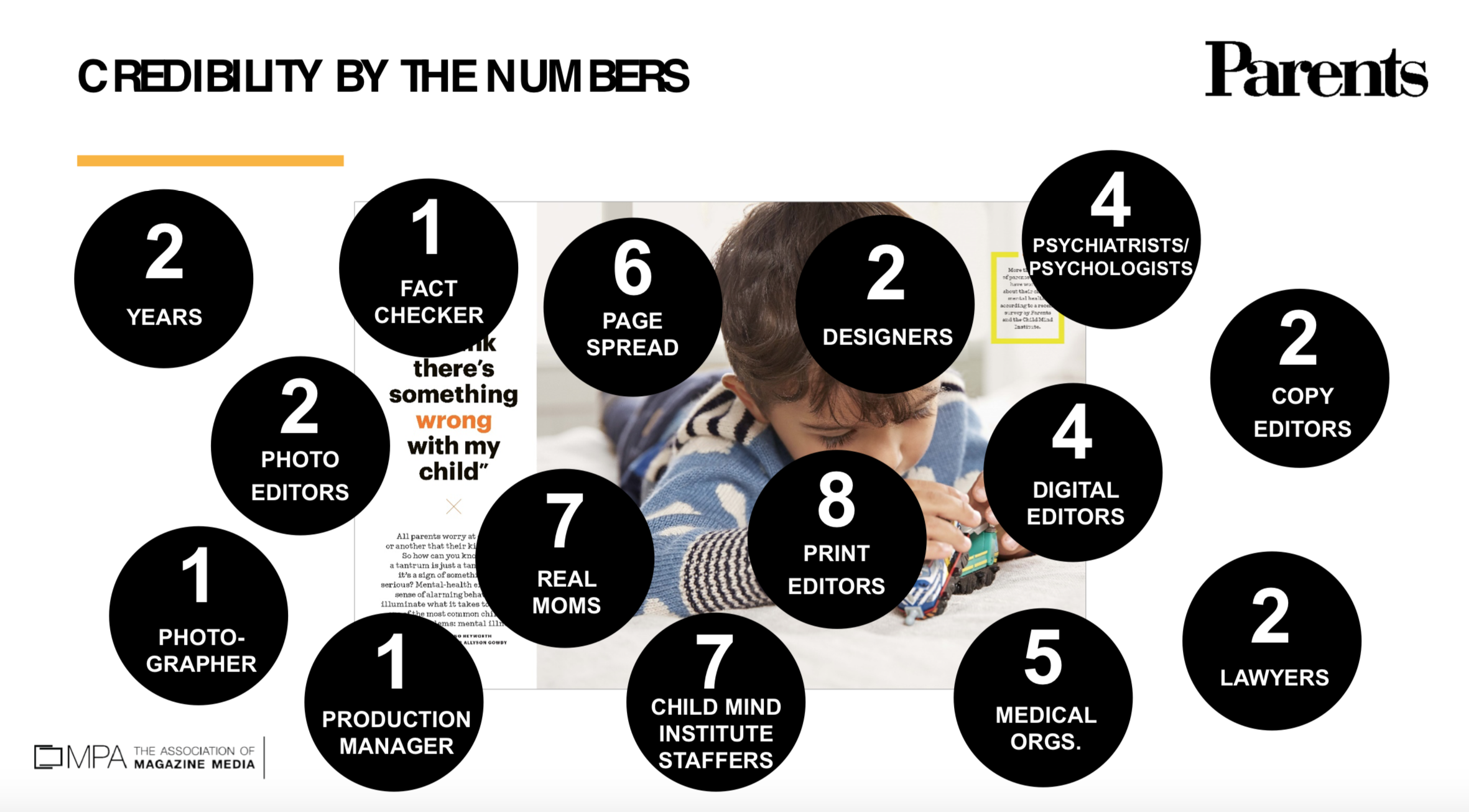
Several beautiful covers of Parents magazine began the story she told showing mothers and their real-life children together in varying poses, and progressing into the stories within the magazine’s pages that brings the lives of different people, such as celebrities, Jenny Mollen and Jason Biggs, along with their two sons, onto a level that we all understand, that of simply being parents. Liz’s belief is that Parents magazine, and ALL magazines, can have an emotional connection with readers, and that the cover is the best and most important place to start.

But the meat of Liz’s talk was about her 11 New Rules for Making Magazines, which you will find below. And along with each one she presented, we were as engaged as new students on the first day of class, learning these rules as though they were the difference between an A and an F in the class, and for all intents and purposes, when it comes to a successful magazine, they are.

1. Understand your audience
2. Diversity matters
3. Don’t be too cool for school
4. Go for “Wow” instead of “Ugh”
5. Know that digital natives skim print differently
6. Let your audiences tell stories too
7. Welcome advertisers as partners and collaborators
8. Art is your story’s best friend
9. Display copy is crucial for voice
10. More is not necessarily better
11. Use humor to break through

And to see these rules presented as only Liz can click on the video below.

To watch the entire ACT 8 Experience presentations please go to mr.magazine.me and search for ACT 8 Experience.

h1

House Beautiful Magazine: Bringing The Concept Of Wellness and Better Living Through Design To Its Printed Pages & Its Multiplatform Audiences – The Mr. Magazine™ Interview With Sophie Donelson, Editor In Chief…

April 23, 2018

“I do think that the way readers engage with the magazine versus digital or social platforms, for example, it is a little bit different. We still have a halo or a level of importance, in a way, with the fact that something has been printed. We had to go through all of these steps, we had to make it in the flesh. There is something that still resonates with readers about print. That’s why you see, for example, in higher-ticket items, there is more of a trustworthiness that readers report when they read about something in print versus digitally. There’s a little bit of integrity, importance and trustworthiness that the medium itself delivers.” Sophie Donelson…

Bold moves and the execution of bold things, two enterprising concepts that House Beautiful is bringing to its multiplatform brand. For 121 years, House Beautiful has been there for its audiences of the past and the present, always with an eye on the future. It’s a legacy brand that has stayed relevant through evolvement, innovation and a journalistic competence that instills trust and integrity with every word and picture published, be that in print or on its digital and social media platforms.

Recently, House Beautiful announced “The Whole Home Project Concept House,” the magazine’s first-ever custom-built show house devoted to wellness and better living. “The Whole Home Project Concept House” will be brought to life in the Brookhaven neighborhood of Atlanta, Ga., breaking ground in October 2018. Built by Michael Ladisic, of Ladisic Fine Homes and designed by architect Linda D’Orazio MacArthur, of Linda MacArthur Architects, this new home will showcase better living through design—from a kitchen designed to make you healthier, to an entryway and garage organized to eliminate clutter and promote calmness, to every space around and in between.

I spoke to Editor in Chief Sophie Donelson recently and we talked about this idea that a person’s physical and mental wellbeing can be impacted by the homes we live in. It is certainly food for thought and definitely an intriguing topic of conversation. And that is exactly what Sophie is passionate about, engaging in an intimate conversation with her audience.

In a recent press release, House Beautiful magazine announced that “The Whole Home Project Concept House will show readers how strategic design choices can deliver more than a pretty space—they can help you live a smarter, happier and healthier life. It’s our core belief at House Beautiful that happiness begins at home—and with this project, that the wellbeing of your WHOLE self, from health to energy to your outlook are informed by our homes.”

As a trusted authority on home design, with an audience of more than eight million (MPA June 2017), the brand and its master at the helm are excited about the future and ready to engage with its mass audience in a conversation about a more holistic view of home and hearth to reach the whole person, body, mind and spirit.

And now, please enjoy the Mr. Magazine™ interview with Sophie Donelson, editor in chief, House Beautiful magazine.

But first the sound-bites:

On Marshall McLuhan’s belief that the medium is the message and whether now the “house” is the message for House Beautiful: (Laughs) I love a good Marshall McLuhan paraphrase. Yes, it’s certainly one of the mediums, absolutely. I’m thinking why not; why not build a house on top of doing the coverage that’s already quite ambitious? I thought that the project already felt like a big undertaking and then we’re in a meeting discussing it, and suddenly it’s happening. I’m so excited about it and it’s fun and interesting, and I think it’s a time for taking bold moves, doing bold things.

On the brand’s core belief that “Happiness Begins at Home” and “The Whole Home Project Concept House”: For House Beautiful, the idea that happiness starts at home, home being yes, a physical place, but also obviously a mindset and something that looms very large for all of us. People who aren’t interested in decoration are still acutely interested in what’s happening at their home and what home means to them. And when things aren’t going well at home, things aren’t going well in life. And when things are happy at home, it’s a lot easier to build from there and to be a happy person and to go out and do great things in the world. So, the way we think about success and happiness has really shifted to be more inclusive of the whole person. And that’s where the name “The Whole Home Project” came about. It wasn’t about kicking off every single room, but actually about a home that could address the whole person.

On how House Beautiful, a legacy title with 121 years under its belt, is manifesting itself to today’s many-platform audiences: What’s fun for me today is how much outreach we do with marketing and events. And then also, of course, digital and social media have surfaced these communities of people out in a way where they talk and meet more readily. And that to me seems just really exciting because it’s not just us talking to them, it’s them talking amongst each other, and bonding over a story or idea. I see that all of the time as I travel throughout this country. So, that’s one thing that I feel is very impactful. I feel our readers are more quickly able to find each other.

On how her role as editor of House Beautiful has changed over the last five years or so: What’s really fun for me is the ability to deliver it to the reader on multiple platforms; to be able to meet them in real life; to be able to talk to advertisers about what their needs are and they’re often the same needs as ours. We have very similar goals, so we think of advertisers as partners that can help you get what you want. We think of readers who are talking to us and telling us what they’re interested in and what they respond to. It’s just a little bit more holistic, but the fun part is there’s just more platforms, channels and levers to work with. It’s not just us and the printed page. Those are all, yes, busy-making, but they’re also just opportunities.

On whether the job met her expectations: I knew some of the challenges, but I did not know how much fun it would be, I’ll be very honest. That was the big difference. I didn’t know how much passion everybody would bring to it and how so much of what I do during the day is just so interesting. That’s an amazing part of this job. It is absolutely a 24-hour per day job, in the way that you’re never not thinking about opportunities and what’s next, following what other people are doing and spending a lot of time listening. I love all of that.

On whether she feels one can show rigorous journalistic trustworthiness better in print or that both print and digital can have unfailing integrity: All of the above. I think journalism takes many, many forms. You can write a journalistic caption to an Instagram, and I often do. My favorite people to follow on Instagram are some of these young architects and architecture enthusiasts who will snap a picture of a home in their neighborhood and then give you the quick postage stamp-sized story of the former owner or how it was built or some architectural detail, and I think that’s service, that’s incredible. And it’s also catching you where you were just wasting time or looking for trust and they serve you something substantial. And I think that’s unbelievable. It makes me so happy to surprise people with integrity. That is one of the great joys of my job.

On the biggest stumbling block she’s had to face: I think learning to engage the team together, to create something bigger than just you and a couple of ideas, I constantly have to stop myself from overindulging with an idea myself. I would love to write a lot of the feature stories, and my managing editor will give me eyes and it’s like, no, you will not be writing that, you do not have time. Please don’t. Or I’ll find a book section that I just love and I’m being really picky about who gets the assignment, and I have to remind myself to step back and make sure that I’m leaving lots and lots of room for other people to bring their ideas forward. That mine are certainly not the best or most important.

On how she would summarize a day in her life: I sometimes describe it to somebody as doing 700 small things, and together they do add up to important things, but a lot of my day is very quick-moving. There’s a lot of decisions and just being decisive and feeling good about it. And also just making connections, such as saying I don’t know the answer to something, but I trust “this” person to do that, deputizing. Keeping things moving. The worst thing I can do is delay. Delay is death in magazines. You cannot sit on something.

On anything she’d like to add: I’d have to say that I am excited to be at a magazine that is able to talk to such a big readership about the importance of home. It’s not lost on me, the rare opportunity to talk about something so intimate with a mass audience. I think that we underestimate how big a role the physical space and the mental perception we have of our homes, what a role that plays in every single facet of our lives.

On what someone would find her doing if they showed up unexpectedly one evening at her home: I wrote about it for the first time, and it wasn’t something I had thought about until literally last month, I cook, I put things together. I’m fairly competent in the kitchen. There’s something about the ritual of using my hands. I use my brain all day, but the chopping and the prepping and the washing, I used to think it was so tedious, but it is a zone that I get into.

On what she would have tattooed upon her brain that would be there forever and no one could ever forget about her: The highest compliment that I ever get is that I have a nice spirit or energy to me. So, I think it would be something in that vein. I’d like to be somebody that you’re in a room with and you feel better after just being around. That would be a nice legacy to leave.

On what keeps her up at night: Not too much, I’m a pretty good sleeper. But I like A-1 news stories, honestly, like under resourced, underprivileged people, the saddest stories. The New York Times refers to it as the neediest. I remember the neediest.

And now the lightly edited transcript of the Mr. Magazine™ interview with Sophie Donelson, editor in chief, House Beautiful magazine.

Samir Husni: To paraphrase Marshall McLuhan, who used to say the medium is the message, in your case, is the “house” now the message?

Sophie Donelson: (Laughs) I love a good Marshall McLuhan paraphrase. Yes, it’s certainly one of the mediums, absolutely. I’m thinking why not; why not build a house on top of doing the coverage that’s already quite ambitious? I thought that the project already felt like a big undertaking and then we’re in a meeting discussing it, and suddenly it’s happening. I’m so excited about it and it’s fun and interesting, and I think it’s a time for taking bold moves, doing bold things.

Samir Husni: In one of the quotes that I’ve read – “Happiness Begins at Home,” you define the word home as much more than just the home, it’s the home project, the concept house that you’re building in Atlanta. Tell me a little bit more about it.

Sophie Donelson: For House Beautiful, the idea that happiness starts at home, home being yes, a physical place, but also obviously a mindset and something that looms very large for all of us. People who aren’t interested in decoration are still acutely interested in what’s happening at their home and what home means to them. And when things aren’t going well at home, things aren’t going well in life. And when things are happy at home, it’s a lot easier to build from there and to be a happy person and to go out and do great things in the world.

I like talking about this for House Beautiful and in broader strokes because we have a population of readers who are just obsessed with their homes, they love decorating and they love shopping. But there’s a much larger body of people who are interested in the power that having a great home can kind of give them.

So, I start from that mindset. And the color and the warm personality and the way that we take our pictures and write our stories, there’s an effervescence and joy in how House Beautiful covers home and an inclusiveness, I would say, that long precedes me and has been a part of this magazine for its 121-year history and right up through today. This is a magazine that you go to when you want to feel good about your home and to feel good about yourself.

And when I started to think about the parallels between the national conversation about, not just happiness, which was about 10 years ago when the “Happiness Project” came out by Gretchen Rubin, and a number of other authors were addressing happiness as a topic, I suppose, much in the way House Beautiful addressed color for the first time as an actual topic and not just as something happening out there, something loose and tangential. This national conversation in the last couple of years has really shifted toward health, mental wellbeing, positivity, not just happiness and not just being physically fit, but being mentally sound and feeling good.

We all started to really acutely understand that it’s all connected. It’s not just a positive mood or a good day, but potentially the way we eat and the way we fuel our bodies has an impact on our minds. How we sleep at night; I mean, how many conversations involve “sleeping your way to the top,” what do all the amazing executives and creatives have in common: they take time to sleep and to have downtime.

So, the way we think about success and happiness has really shifted to be more inclusive of the whole person. And that’s where the name “The Whole Home Project” came about. It wasn’t about kicking off every single room, but actually about a home that could address the whole person. Again, not just that a color might make you happy, but eventually your kitchen could be designed in a way that could help you be healthy. That your organization goals and executing them could make you feel calm and put together and capable. All of this made us feel that there were opportunities at home that our design decisions could radically impact our wellness and happiness. And that’s how it came about.

So people like my mother-in-law now would know words like Breathwork, and I’m asking, when did that happen? That mediation is not woo and it’s sort of an amazing time, there’s almost a national reckoning and welcoming of whatever someone needs to make them feel good. And I love that and there’s like an analogous part of it, and every single room of the house has the opportunity to seize on this idea.

Samir Husni: As an editor of a legacy title, how do you feel that the DNA of the magazine has evolved from pure ink on paper to manifest itself in Concept House, digital, and its many other platforms? How do you feel the DNA of House Beautiful today is manifesting itself to the multitude of audiences out there?

Sophie Donelson: I have January through June 1927 on my desk right now, because we’re working on the Small Spaces issue, and I’m being very careful since it’s a bound book. I was trying to find the first time that we talked about small spaces, and it’s in the June issue. It reads: it’s furnishing the small room, schemes for the living room in House Beautiful, home #16. Of course, House Beautiful, like many shelter titles had house plans and architect plans and elevations and that kind of thing. And there were five small-roomed schemes, which of course, I’m doing a version of today. So, we see this legacy every single day and it’s so much fun.

But the first thing that comes to mind is community. And what’s really fascinating to me is that magazine readers and subscribers still have very strong opinions of who they identify with, such as “I’m a House Beautiful person,” or “I’m more of a this or more of a that person.” We have brands that we identify with and that has sort of always happened.

But what’s fun for me today is how much outreach we do with marketing and events. And then also, of course, digital and social media have surfaced these communities of people out in a way where they talk and meet more readily. And that to me seems just really exciting because it’s not just us talking to them, it’s them talking amongst each other, and bonding over a story or idea. I see that all of the time as I travel throughout this country. So, that’s one thing that I feel is very impactful. I feel our readers are more quickly able to find each other.

Samir Husni: Years ago, editors used to just have a print magazine, a deadline, and just had to meet that deadline, but today even the definition of editor has changed. How has your role as editor of House Beautiful changed over the last five years or so?

Sophie Donelson: Oh my gosh, does wearing pink more often than I’d like to count? (Laughs) I really was representing the magazine at something recently and I picked out an outfit and I thought, no, that’s not who they want today. They want the joyful, happy, warm House Beautiful editor, so I changed my outfit.

I take the journalism aspect and the editing aspect of my job very seriously. Those are things that drew me to this industry and what I still take so much pleasure in doing. What we think of as an editor, whether it’s a pink pen and not a red one, doing edits, and thinking of concepts within the vision of the magazine.

But what’s really fun for me is the ability to deliver it to the reader on multiple platforms; to be able to meet them in real life; to be able to talk to advertisers about what their needs are and they’re often the same needs as ours. We have very similar goals, so we think of advertisers as partners that can help you get what you want. We think of readers who are talking to us and telling us what they’re interested in and what they respond to. It’s just a little bit more holistic, but the fun part is there’s just more platforms, channels and levers to work with. It’s not just us and the printed page. Those are all, yes, busy-making, but they’re also just opportunities.

Eliot Kaplan and Newell Turner, Newell primarily, but of course Eliot, the longtime Hearst recruiter, who recently retired, these are the guys who got me to Hearst. I remember taking meetings when I briefly left publishing for a couple of years to work in e-commerce, digital and marketing, and they would ask me what would I do at Hearst and I told them that I wanted a job where I could do special projects and work in marketing. I wanted to be a part of the print magazine, but also wanted to know what was happening online. I wanted to know about the revenue streams; I wanted to touch all of these different parts because so many of them interested me. And at the time, I think I thought I was kidding with them, that job didn’t exist. But ‘lo and behold it does exist. (Laughs) And it’s editor in chief, and it’s so cool. It’s so much more of an interesting job to me than I think a narrower land would have been maybe 20 or 30 years ago.

Samir Husni: Did the job meet your expectations?

Sophie Donelson: I knew some of the challenges, but I did not know how much fun it would be, I’ll be very honest. That was the big difference. I didn’t know how much passion everybody would bring to it and how so much of what I do during the day is just so interesting. That’s an amazing part of this job. It is absolutely a 24-hour per day job, in the way that you’re never not thinking about opportunities and what’s next, following what other people are doing and spending a lot of time listening. I love all of that. And of course, how can you not take it home with you, it’s a home magazine.

Samir Husni: You mentioned that you’re still a believer in the journalism, editing and trustworthiness of the job, do you feel that you can show those aspects more in print or can you show the same rigorous journalism criteria in the digital platform?

Sophie Donelson: All of the above. I think journalism takes many, many forms. You can write a journalistic caption to an Instagram, and I often do. My favorite people to follow on Instagram are some of these young architects and architecture enthusiasts who will snap a picture of a home in their neighborhood and then give you the quick postage stamp-sized story of the former owner or how it was built or some architectural detail, and I think that’s service, that’s incredible. And it’s also catching you where you were just wasting time or looking for trust and they serve you something substantial. And I think that’s unbelievable. It makes me so happy to surprise people with integrity. That is one of the great joys of my job.

Many people love this magazine, they love the way it looks, they like pretty things, and then to surprise them with something where it actually makes them feel an emotion, from a personal essay standpoint or just a really human connection like there’s something great there. Or again, a little bit of mystery or insight into how something works together. There are so many options and places to make that happen.

I do think that the way readers, back to Marshall McLuhan, the way that they engage with the magazine versus digital or social platforms, for example, it is a little bit different. We still have a halo or a level of importance, in a way, with the fact that something has been printed. We had to go through all of these steps, we had to make it in the flesh. There is something that still resonates with readers about print. That’s why you see, for example, in higher-ticket items, there is more of a trustworthiness that readers report when they read about something in print versus digitally. There’s a little bit of integrity, importance and trustworthiness that the medium itself delivers. It’s our job, obviously, as editors and journalists to make sure that is the case.

And as I see the generation kind of grow and shift, that sentiment may evolve, I would expect it to evolve, I would hope it would evolve. But for right now, I do think that people take rather seriously what are in the pages of a magazine, for sure.

Samir Husni: You seemed surprised when I asked you did the job meet your expectations, and you talked about the fun and the passion. What has been the biggest stumbling block and how did you overcome it? Or have there been any stumbling blocks or has it been a nice walk in a rose garden?

Sophie Donelson: The idea that I have expectations of this job is laughable, this job has expectations of me. The part that I always want to grow, as we say in career coaching, development opportunities, not challenges, just opportunities, such as inspiring my team, working together as unique, individual, creative people. The job is the people. They’re the best part; they’re what makes the days so fun.

When I talk to my five-year-old and he asks me about someone and I say, oh, it’s my friend at work. They are absolutely a colleague, they may report to me, but I naturally refer to them all of the time as a friend, especially when talking to a five-year-old, it’s the shortest way of saying this is a person who I talk with and laugh with every single day. So, that’s a friend, right?

But I think learning to engage the team together, to create something bigger than just you and a couple of ideas, I constantly have to stop myself from overindulging with an idea myself. I would love to write a lot of the feature stories, and my managing editor will give me eyes and it’s like, no, you will not be writing that, you do not have time. Please don’t. Or I’ll find a book section that I just love and I’m being really picky about who gets the assignment, and I have to remind myself to step back and make sure that I’m leaving lots and lots of room for other people to bring their ideas forward. That mine are certainly not the best or most important.

Samir Husni: If you were to summarize a day in the life of Sophie, how would you put it together? Do you go with the flow or are you an organized person?

Sophie Donelson: I sometimes describe it to somebody as doing 700 small things, and together they do add up to important things, but a lot of my day is very quick-moving. There’s a lot of decisions and just being decisive and feeling good about it. And also just making connections, such as saying I don’t know the answer to something, but I trust “this” person to do that, deputizing. Keeping things moving. The worst thing I can do is delay. Delay is death in magazines. You cannot sit on something.

It’s just a lot of small tasks and actions, and this is why editors put so much effort into their editor’s letter. It’s probably the most concentrated energy that any of us put into anything all week, which is just funny to me because we’re all writers. We all know how to do this, it’s a muscle that we use often. But that in terms of like concentrated time is a real rarity, to think about something over a month, which I do, and then to just sit for a couple of hours and actually write something and not just a headline.

Samir Husni: Is there anything you’d like to add?

Sophie Donelson: I’d have to say that I am excited to be at a magazine that is able to talk to such a big readership about the importance of home. It’s not lost on me, the rare opportunity to talk about something so intimate with a mass audience. I think that we underestimate how big a role the physical space and the mental perception we have of our homes, what a role that plays in every single facet of our lives.

In a really turbulent news cycle and with a technology default, where we might find ourselves busier or crankier or prone to ups and downs about how many Instagram likes something gets or some sour commenter, there is a panacea for all of this. Sometimes it’s just cheap, fresh flowers or a nice scent in your home, like cooking cinnamon buns or something, or tucking in early for the night, preferably with print so you’re not having that screen in your face.

I think these are really important times to talk about self-care through home and this is a really great magazine to go to. It’s a magazine that people naturally trust and don’t feel intimidated by, so we’re able to have richer conversations because people aren’t expecting to look at something and say, I want that, but I’ll never have it. This is a really uplifting magazine, where people can say, I want that and I think I might just go for it. It’s a privilege to sit here during this moment, in which I think we could all use to go home early.

Samir Husni: Since you’re going home early, if I showed up unexpectedly at your home one evening after work, what would I find you doing? Having a glass of wine; reading a magazine; cooking; watching TV; or something else?

Sophie Donelson: (Laughs) I wrote about it for the first time, and it wasn’t something I had thought about until literally last month, I cook, I put things together. I’m fairly competent in the kitchen. There’s something about the ritual of using my hands. I use my brain all day, but the chopping and the prepping and the washing, I used to think it was so tedious, but it is a zone that I get into.

And I cook for my family. I would absolutely eat a boiled egg or peanut butter on a rice cake standing up in the kitchen, if left to my own devices, while probably having a glass of wine. But if my husband is home, I’ll make a nice healthy dinner. I’ll describe it as feeding my body; I’m usually listening to a podcast and feeding my mind. I’m working with my hands, and so it’s very immersive. That, to me, gives me peace. Aldo, if my hands are busy in the kitchen, I don’t have to take care of the children, that becomes his job, so it’s a little bit of an escape as well. And that’s what you’ll find me doing on the weeknights when I’m not traveling or out for industry stuff, which I try to keep evenly split, half and half.

Samir Husni: If you could have one thing tattooed upon your brain that no one would ever forget about you, what would it be?

Sophie Donelson: The highest compliment that I ever get is that I have a nice spirit or energy to me. So, I think it would be something in that vein. I’d like to be somebody that you’re in a room with and you feel better after just being around. That would be a nice legacy to leave.

Samir Husni: My typical last question; what keeps you up at night?

Sophie Donelson: Not too much, I’m a pretty good sleeper. But I like A-1 news stories, honestly, like under resourced, underprivileged people, the saddest stories. The New York Times refers to it as the neediest. I remember the neediest.

Samir Husni: Thank you.
h1

ACT 8 Experience: Exporting Your Brand. Abdulsalam Haykal, CEO, Haykal Group, United Arab Emirates

April 22, 2018

Abdulsalam Haykal, CEO of Haykal Group in the United Arab Emirates, addresses the Magazine Innovation Center’s ACT 8 Experience attendees via video. For reasons beyond his control, Mr. Haykal could not make it in person to the ACT 8 Experience, but he did answer Samir “Mr. Magazine™” Husni’s questions on what it takes to export a brand overseas and what are some of the pitfalls of taking titles from one culture to another… Here are his answers in two videos…

h1

ACT 8 Experience: Print Proud Digital Smart. Day 3 Recap…

April 22, 2018

This is the last installment from the Magazine Innovation Center’s ACT 8 Experience:Print Proud Digital Smart. Today is ACT 8 Day 3. April 19, 2018.

ACT 8 Experience, Day 3, Part 1
Bonnie Kintzer, President and CEO, Trusted Media Brands

ACT 8 Experience, Day 3, Part 2
Daren Mazzucca, Vice President/Publisher, Martha Stewart Living, Meredith

ACT 8 Experience, Day 3, Part 3
Mona Hidayet, Executive Director, Clients & Products, Advantage CS Be Scholarly, Think Like a Shoemaker

ACT 8 Experience, Day 3, Part 4
Making Money in Magazines and Magazine Media: A Panel Discussion Moderated by Jim Elliott, Founder and President, James G. Elliott, Panelists:
Bonnie Kintzer, President and CEO, Trusted Media Brands
Daren Mazzucca, Vice President/Publisher, Martha Stewart Living
Kevin Novak, CEO, Founder and Chief Digital Strategist, 2040 Digital
John Thomas, Publisher, Psychology Today

ACT 8 Experience, Day 3, Part 5
Marisa Davis, Associate Director, Product Marketing, MNI Targeted Media Generation Z: Research Findings

ACT 8 Experience, Day 3, Part 6
Bo Sacks,President, Precision Media Group

ACT 8 Experience, Day 3, Part 7
Mark Potts, Managing Editor, Alta The Journal of Alta California Print Proud Digital Smart

ACT 8 Experience, Day 3, Part 8
Scott Coopwood, Publisher, Delta Magazine

Until next year, stay tuned to information and dates of the Magazine Innovation Center’s ACT 9 Experience in 2019.

To check the entire agenda for ACT 8 Experience click here.

h1

ACT 8 Experience: Print Proud Digital Smart. Day 2 Recap.

April 21, 2018

As I mentioned yesterday I will be posting the videos from the Magazine Innovation Center’s ACT 8 Experience:Print Proud Digital Smart. Today is ACT 8 Day 2. April 18, 2018.

ACT 8 Experience, Day 2, Part 1
Liz Vaccariello, Editorial Director, Parents Magazine Network, Meredith

ACT 8 Experience, Day 2, Part 2
Daniel Dejan, ETC Print Creative Manager, Sappi North America

ACT 8 Experience, Day 2, Part 3
Joe Hyrkin, CEO, issuu

ACT 8 Experience, Day 2, Part 4
Print Proud Digital Smart, Panel Moderated by Joe Berger, Publishers Marketing Sales Consultant, Joseph Berger Associates
Panelists:Joseph Ballarini, Founder and Editor in Chief, Tail Fly Fishing Magazine, Tony Frost, Senior Vice President, TVGM LLC, TV Guide, and Mark Potts, Managing Editor, Alta The Journal of Alta California.

ACT 8 Experience, Day 2, Part 5
Magazines at Retail: The View from Publisher, Distributor, Retailer & More. Moderated by Tony Silber, Magazine-Media Expert, Founder of M10 Magazine, President Long Hill Media
Panelists:Dave Forsman, EVP of Sales, TNG, Jerry Lynch, President, Magazine and Books, Retail Association, William Michalopoulos, Vice President, Retail, Sales & Marketing,PubWorX,Sebastian Raatz, Publisher/Co-Founder, Centennial Media, and Ray Shaw, Executive Vice President/Managing Director, MagNet.

End of Day 2. To check the entire agenda of the ACT 8 Experience click here.

h1

ACT 8 Experience: Print Proud Digital Smart Day 1 Recap…

April 20, 2018

Starting today I will be posting the videos from the ACT 8 Experience:Print Proud Digital Smart. Today is ACT 8 Day 1. April 17, 2018.

ACT 8, Day 1, Part 1
Samir Husni, Founder and Director of the Magazine Innovation Center
Charlie Mitchell, Associate Dean of the Meek School of Journalism and New Media
Noel Wilkin, Provost and Chief Academic Officer, The University of Mississippi
Susan Russ, Senior VP, Communications, MPA: The Association of Magazine Media
Amy Lyles Wilson, Author, Writer and Magazine Alumni

ACT 8, Day 1, Part 2
Linda Thomas Brooks, President and CEO, MPA: The Association of Magazine Media

ACT 8, Day 1, Part 3
James Hewes, President and CEO, FIPP: The Network for Global Media, United Kingdom

ACT 8, Day 2, Part 4

Tom Quinlan, Chairman and CEO, LSC Communications, Inc.

h1

Getting In Shape (The Magazine): An Evolution That Began By Asking The Question Of The 37-Year-Old Brand: If Shape Was Launching Today, What Would It Look Like? The Mr. Magazine™ Interview With Elizabeth Goodman-Artis, Editor In Chief, Shape Magazine…

April 12, 2018

“I felt like we could add more real women and their experiences. I really wanted to make it a more well-rounded experience. And the tagline we’re using is “Living the well-lived life,” something that’s a little more holistic and well-rounded, because we know that our audience is really engaged in this healthy, active lifestyle. And that means a lot of different things to a lot of different people. And so, we wanted to give a more well-rounded mix and really get a sense of the experiences that women are having living this lifestyle. We wanted to kind of bubble that up in the magazine some more.” Elizabeth Goodman-Artis…

“I think the print magazine is the place where you can sit back, lean-in, and get excited about the content. And in the digital iterations, whether you’re desktop or mobile, however you’re interacting, that becomes more transactional, and I mean that in a good way. It’s very specific information, like guidance. And I think it appeals to different parts of your brain and different needs in the moment.” Elizabeth Goodman-Artis…

Shape Magazine has been a staple in the health and fitness magazine realm for 37 years. It has been the go-to source for women who lead an active lifestyle, focusing on the magazine’s five pillars of coverage, which according to Elizabeth Goodman-Artis, editor in chief of the brand is: beauty, fitness, health, style and nutrition.

With the May issue, the legacy brand has undergone what Elizabeth calls an evolution, rather than a reimagining. She said there has been a massive cultural shift that is redefining
what healthy living means to women today. And in her May editor’s letter, she shares with her readers the mission of this evolution. Here’s an excerpt:

“My mission for Shape is to reflect this shift—really reflect it. What you’ll see in the pages of this issue is the result of a pivotal moment in our evolution, one that started when I asked myself this question: If Shape was launching today, what would it look like? To start, it would have more voices and viewpoints from inspiring people who are living this well-lived life—distinctive women from diverse backgrounds, all with unique stories to tell and a dedication to living with authentic, health-focused style. The innovations don’t stop there.”

The legacy brand has expanded and evolved with a mix of content, as well as an elevated design aesthetic. Elizabeth adds that the redesign also offers a shift in tonality and features more diverse voices, including influencer and real women. Overall, the new Shape focuses on content for the holistic, healthy lifestyle of today’s woman: beauty and style advice that adapts to her busy life; ways to discover the joys of healthy and delicious eating; relatable tips for health and relationships; and innovative ways to keep her body strong and fit.

And Mr. Magazine is very happy with the evolution. Shape is as “shapely” as ever, with a few new curves added. So, join Mr. Magazine™ as we get into Shape with Elizabeth Goodman-Artis, editor in chief.

But first the sound-bites:

On Shape magazine’s redesign/reinvention after 37 years: I wouldn’t say that we reinvented it at all. I would say that we’ve evolved it. Honestly, what really precipitated this was I got a new, amazing creative director, he started in August, and he wanted to put his stamp on it and we felt like it was time for a design upgrade. So, it started with that. And I also felt that there were things that we were missing. We could add more voices; I felt like we could add more real women and their experiences. I really wanted to make it a more well-rounded experience. And the tagline we’re using is “Living the well-lived life,” something that’s a little more holistic and well-rounded, because we know that our audience is really engaged in this healthy, active lifestyle.

On whether the more holistic and healthy focus of the new redesign puts Shape in a different competitive set: It’s the same, absolutely the same. Again, it’s an evolution, I wouldn’t say that we’ve really changed the DNA of the brand at all. One of the things that I wanted to do was change the voice and the tonality a little bit, just to make it feel more modern. I think a good example is the way the magazine was packaged, like the actual names of the sections before, things like, Eat Right, Get Fit. They’re clear, they say it, they make sense, they’re direct, but I feel like they’re a little bit of a command to perform. And I wanted to change that tonality a little bit, and when you go through the May issue you’ll see that the sections all start with the verb “to be.” And that was very deliberate, because I wanted to invite the readers “to be” in the moment, to experience the content, and really make it their own.

On whether she thinks the audience has changed or evolved in that the way they interact with a print magazine is different today than maybe 10 years ago: Sure, absolutely. I think a print magazine is more of a lean-back and engaged experience, rather than a servicey, transactional experience. A good example is the way we’re doing fitness content now. One of the things that we’ve seen, in terms of digital, is that over one million readers have joined our video challenges in the last year. Our visitors to shape.com workout content has risen exponentially. And that’s your very functional fitness, your very transactional fitness, here’s exactly how you do this workout. And I think that’s the way audiences are engaging with that kind of content. They’re doing it on their phones. So, I felt like with the fitness content in the magazine, it was really important to create content that was more about experience and the science of exercise and the storytelling. You can lean back into it and get inspired and get excited about this kind of content.

On how her job as editor in chief has changed over the years: In terms of actual day-to-day workflow, I think we’re more efficient than we used to be. We have to be. Obviously, the industry is changing, the media world is changing; we all know what’s going on and I think there’s a level of focus that’s required today. Thinking back to 25 years ago, or whenever I started at Glamour magazine, it was 1993, there were a lot more people and we just don’t have those kinds of staff anymore, because it’s not efficient nor cost-effective. So, I think we have to be just really focused.

On what content means to her today: (Laughs) What a good question. I could go into a lot of different rabbit-holes. I think content is changing all of the time. It’s impossible to immediately summarize that. I think it depends on who you are, what you want and what you’re looking for. An audience who’s interested in healthy, active living wants information, but they also want connectivity and motivation. And they’ll get that with all of the new voices and points of view that we’re adding. I think that’s really important. Whatever your goals are, and those are personal to you, it takes a lot of mental strength and courage to live this lifestyle. So, I think that’s one of the biggest changes I’ve seen and one I wanted to bring to the magazine, more of that emotion, into everything that we do.

On if that’s the reason for the more holistic approach Shape is now taking: Sure, that’s one. There were many reasons. Honestly, what was great about what we did with Shape, the magazine before was great, and this is just an evolution. And there wasn’t pressure to do it. It was just that we felt and I felt it was time for it, for many different reasons. And as I said, I really wanted to equalize the content distribution.

On how she can make the content of the magazine more of an emotional experience: I’ll give you an example. Our new fitness section is called “Be Strong and Fit,” and we’re actually debuting a new column that we just didn’t have room for in the May issue because it was so packed with amazing new content, and also not for nothing, it was content that we thought was really working well, so we morphed some columns. The DNA is still Shape Magazine, it’s really about an evolution. It’s not a reimagining at all. But we’re adding a new column that I’m excited about called “Everyday Athletes.” What I wanted to do with this was really showcase real women who have gone out and they’ve accomplished something physical across the spectrum.

On how she sees the future mix of print and digital for Shape: Well, it’s what I’ve said already, that I think the print magazine is the place where you can sit back, lean-in, and get excited about the content. And in the digital iterations, whether you’re desktop or mobile, however you’re interacting, that becomes more transactional, and I mean that in a good way. It’s very specific information, like guidance. And I think it appeals to different parts of your brain and different needs in the moment.

On whether she expects editors to practice what they preach: I can’t speak for other editors. This is how I run the magazine and it’s my point of view. I am very practical. (Laughs) I think about the brand as a whole and work closely with our amazing digital director, Amanda Wolfe. And it’s really collaborative and I’m brainstorming with my really talented staff about what all of this means today. Getting into the media is the message kind of thing, which shows my journalism school experience studying Marshall McLuhan. (Laughs) I think it’s just being clear and focused about it. Like, how do magazines make sense in people’s lives today? And how are they using the print magazine iteration as opposed to the digital arms? It’s kind of being logical.

On what she would have tattooed upon her brain that would be there forever and no one could ever forget about her: She just wants to help.

On what someone would find her doing if they showed up unexpectedly one evening at her home: Right now you’d find me very unhappy because I’m living in a rental apartment while my house is being renovated. And it’s dragging on and I’m really sick of the apartment, but once I’m back in my house and happier, you’d probably find me cooking. I love to cook. I find it really relaxing and I’m really into trying new recipes. And I’m very excited about the new kitchen I will hopefully have in the next few months. So, chopping, and focusing on cooking gets me out of the day and it focuses my attention. So, you’d find me doing that and hanging out with my husband and my cats. I don’t have kids, I have cats. That’s how I unwind.

On what keeps her up at night: Honestly, I’m not somebody who wakes up a lot and tosses and turns and worries too much, because there is nothing you can do about anything in life in the middle of the night. I do have some pretty good techniques. Usually breathing techniques or meditative techniques to help me go back to sleep. But what keeps me up at night is what keeps anybody up, the unknown. It’s very general; I wouldn’t say there is anything specific. And nothing specific about media and state of things, because I feel like we’re all just kind of watching the evolution and I want to be along for the ride. I’m somebody who is very flexible and I try to pivot and go with the flow.

And now the lightly edited transcript of the Mr. Magazine™ interview with Elizabeth Goodman-Artis, editor in chief, Shape magazine.

Samir Husni: Shape is going to be bold, I hear.

Elizabeth Goodman-Artis: Yes, we’re going to be bold.

Samir Husni: Tell me about the timing of this redesign. After 37 years, why now and why did you decide to reinvent Shape magazine?

Elizabeth Goodman-Artis: I wouldn’t say that we reinvented it at all. I would say that we’ve evolved it. Honestly, what really precipitated this was I got a new, amazing creative director, he started in August, and he wanted to put his stamp on it and we felt like it was time for a design upgrade. So, it started with that.

But honestly, I felt like it was time to redistribute our content in the sense that we weren’t giving the main five pillars of the things that we always cover, which is beauty, fitness, health, style and nutrition, we weren’t giving them all equal weight. There was too much emphasis in some places and not enough in the others. And I really wanted to just try and equalize the content in the magazine.

And I also felt that there were things that we were missing. We could add more voices; I felt like we could add more real women and their experiences. I really wanted to make it a more well-rounded experience. And the tagline we’re using is “Living the well-lived life,” something that’s a little more holistic and well-rounded, because we know that our audience is really engaged in this healthy, active lifestyle. And that means a lot of different things to a lot of different people. And so, we wanted to give a more well-rounded mix and really get a sense of the experiences that women are having living this lifestyle. We wanted to kind of bubble that up in the magazine some more.

Samir Husni: That combination of the holistic and healthy lifestyle, does it put you in a different competitive set or it’s the same?

Elizabeth Goodman-Artis: It’s the same, absolutely the same. Again, it’s an evolution, I wouldn’t say that we’ve really changed the DNA of the brand at all. One of the things that I wanted to do was change the voice and the tonality a little bit, just to make it feel more modern. I think a good example is the way the magazine was packaged, like the actual names of the sections before, things like, Eat Right, Get Fit. They’re clear, they say it, they make sense, they’re direct, but I feel like they’re a little bit of a command to perform.

And I wanted to change that tonality a little bit, and when you go through the May issue you’ll see that the sections all start with the verb “to be.” And that was very deliberate, because I wanted to invite the readers “to be” in the moment, to experience the content, and really make it their own. I don’t want to dictate to our audience, but I want to give them the tools and ideas and information they need to craft their own well-lived life.

Samir Husni: You’ve started all the sections with “to be,” to be healthy, to be food-curious, to be fit, etc. Do you think the audience has changed or evolved in that the way they interact with a print magazine is different today than maybe 10 years ago?

Elizabeth Goodman-Artis: Sure, absolutely. I think a print magazine is more of a lean-back and engaged experience, rather than a servicey, transactional experience. A good example is the way we’re doing fitness content now. One of the things that we’ve seen, in terms of digital, is that over one million readers have joined our video challenges in the last year. Our visitors to shape.com workout content has risen exponentially. And that’s your very functional fitness, your very transactional fitness, here’s exactly how you do this workout. And I think that’s the way audiences are engaging with that kind of content. They’re doing it on their phones.

So, I felt like with the fitness content in the magazine, it was really important to create content that was more about experience and the science of exercise and the storytelling. You can lean back into it and get inspired and get excited about this kind of content. And then you can go to shape.com and get your nuts and bolts. I think it’s really about engaging with this content that’s all about healthy living, and getting excited about it. And really leaning into it, and then you can go to shape.com and get more specific, functional workouts and content.

Samir Husni: You’ve been in the magazine media business for 20 years, give or take. How do you feel things have changed over the years? Is life easier for you now as an editor in chief or is it more complicated? Tell me about the changes based on your experience.

Elizabeth Goodman-Artis: In terms of actual day-to-day workflow, I think we’re more efficient than we used to be. We have to be. Obviously, the industry is changing, the media world is changing; we all know what’s going on and I think there’s a level of focus that’s required today. Thinking back to 25 years ago, or whenever I started at Glamour magazine, it was 1993, there were a lot more people and we just don’t have those kinds of staff anymore, because it’s not efficient nor cost-effective. So, I think we have to be just really focused.

There isn’t quite the time to spend days and weeks on one story, you have to move at a faster pace. Everybody is doing that, so I think that’s the biggest change. As an editor in chief, I would say that I owe it to my staff to make quick decisions and to have a clear vision for what I want, because we don’t have the time and the luxury to throw a lot of things at the wall and see what sticks.

I think with this evolution, I had a very clear vision, along with my creative director and my executive editor, of what we wanted this to look like. And then we gave the staff the blueprint and they were really excited about it. So, it was a very efficient, very focused process.

This summer we decided, when Noah (Dreier) came on, my creative director, we talked a lot about what we wanted to do with the brand and what we wanted it to look like. He came with so many great ideas. And speaking of my staff, I think you’ll see that we sort of beefed up our style content and that’s because we added a new fashion director, Brooke Ely Danielson, and she also came with so many great ideas and just a fresh approach to what style means today. And I was excited to get their ideas in the brand, so that was a big part of it.

Samir Husni: You’ve added the section “What Style Means Today.” My question to you is what does content mean today?

Elizabeth Goodman-Artis: (Laughs) What a good question. I could go into a lot of different rabbit-holes. I think content is changing all of the time. It’s impossible to immediately summarize that. I think it depends on who you are, what you want and what you’re looking for. An audience who’s interested in healthy, active living wants information, but they also want connectivity and motivation. And they’ll get that with all of the new voices and points of view that we’re adding. I think that’s really important.

Honestly, a good way to talk about the change, in terms of active, healthy living content, is I think it has gone from, in the last 10 or so years, just transactional and informative to more emotional. That’s the biggest sort of change that I’ve seen and wanted to incorporate into Shape now was the sense of emotion of this lifestyle, because it’s a very emotional experience. Whatever your goals are, and those are personal to you, it takes a lot of mental strength and courage to live this lifestyle. So, I think that’s one of the biggest changes I’ve seen and one I wanted to bring to the magazine, more of that emotion, into everything that we do.

Samir Husni: Is that the reason for the holistic approach?

Elizabeth Goodman-Artis: Sure, that’s one. There were many reasons. Honestly, what was great about what we did with Shape, the magazine before was great, and this is just an evolution. And there wasn’t pressure to do it. It was just that we felt and I felt it was time for it, for many different reasons. And as I said, I really wanted to equalize the content distribution.

A good example is our health section. I felt it was a little marginalized and that we could do more with it. Our audience is really interested in health beyond the numbers they get at their yearly doctor’s visit. This audience is really engaged with making sure of their health and I wanted to give that section a little more love. So, it was really about distributing our efforts equally among our five content pillars.

Samir Husni: As you move forward into the new evolution, and of course, you created the video series and the Shape Challenge that really brought a lot of audience experiences, I’m very intrigued by what you said about focusing on the more emotional link with the content. How can you make the content of the magazine more of an emotional experience, rather than the functional experience?

Elizabeth Goodman-Artis: I’ll give you an example. Our new fitness section is called “Be Strong and Fit,” and we’re actually debuting a new column that we just didn’t have room for in the May issue because it was so packed with amazing new content, and also not for nothing, it was content that we thought was really working well, so we morphed some columns. The DNA is still Shape Magazine, it’s really about an evolution. It’s not a reimagining at all.

But we’re adding a new column that I’m excited about called “Everyday Athletes.” What I wanted to do with this was really showcase real women who have gone out and they’ve accomplished something physical across the spectrum. So, the example I use is, I go to a gym called CrossFit South Brooklyn, I do CrossFit. And CrossFit is very, very hard. (Laughs) But what I love about it, the terminology that they use is, you can scale it. So, if you can’t do 50 pushups, do two. If you can’t do two, hold a plank for thirty seconds. At any skill level, you can do this kind of exercise.

One of the most inspiring things I’ve seen is, one of the trainers that I work with frequently, her name is Jess Fox, and one of her goals was to do a muscle-up, and that’s a very, very hard move. It’s like gymnastics, it requires hanging onto some rings, pulling yourself up and pushing upward until your arms are straight, so it requires a lot of strength. This was a goal she had for a long time and she worked at it in a myriad of ways. And now she can do it. I want to hear her story. So, in 200 words, what that felt like and kind of get inside her journey.

Likewise, I’d like to hear from a woman who tried her very first hot yoga class. Or her very first Pilates class, or her very first walking marathon, or triathlon. Athletic feats across the spectrum, but I want to get inside what that felt like. What the motivation, what they did, and how it felt on the other side. That’s what I mean by “Everyday Athletes.” Women across the spectrum of skill levels, abilities, and what motivated them and what it felt like. So, I think that’s a really good example of how, instead of telling you how to do a muscle-up, certainly it’s a very hard move and I wouldn’t recommend it to many people (Laughs), but if that’s your goal, that’s great. There are certainly a series of steps that you can take to learn how to do this move. You can break it down into the technical components of it, fine, that’s one way to approach it. But I also want to know what it feels like inside to have accomplished that. So, that’s a column that I’m really excited about. And it’s coming out in the June issue. I think that nicely encompasses what I mean by emotion and motivation, and the difference between that and the transactional experience.

Samir Husni: As you look into the future, and at the fact that publishers are making their print components “printier” and their brands “brandier,” and everyone is becoming Print Proud and Digital Smart, how do you see that combination of print and digital? People don’t talk anymore about Shape magazine, they talk about Shape the brand.

Elizabeth Goodman-Artis: Yes, and it is a brand.

Samir Husni: So, how do you see that future mix?

Elizabeth Goodman-Artis: Well, it’s what I’ve said already, that I think the print magazine is the place where you can sit back, lean-in, and get excited about the content. And in the digital iterations, whether you’re desktop or mobile, however you’re interacting, that becomes more transactional, and I mean that in a good way. It’s very specific information, like guidance. And I think it appeals to different parts of your brain and different needs in the moment.

In terms of fitness content, and I don’t think anybody would argue with me, that I just don’t think looking at a magazine and getting directions on how to do a specific move, nobody is taking magazines to the gym to do that anymore. They’re using their phones. If they want to know exactly how to a 10-minute AMRAP workout, which means as many rounds as possible, or an ab challenge, it doesn’t make sense to waste pages in a magazine detailing line by line exactly how to do that. You’re going to get that online. So, that’s the big difference I see, especially with this brand.

Samir Husni: You’re practicing what you preach and you’re speaking from experience. Do you expect editors nowadays to practice what they preach or just sometimes?

Elizabeth Goodman-Artis: I can’t speak for other editors. This is how I run the magazine and it’s my point of view. I am very practical. (Laughs) I think about the brand as a whole and work closely with our amazing digital director, Amanda Wolfe. And it’s really collaborative and I’m brainstorming with my really talented staff about what all of this means today. Getting into the media is the message kind of thing, which shows my journalism school experience studying Marshall McLuhan. (Laughs) I think it’s just being clear and focused about it. Like, how do magazines make sense in people’s lives today? And how are they using the print magazine iteration as opposed to the digital arms? It’s kind of being logical.

Samir Husni: If you could have one thing tattooed upon your brain that no one would ever forget about you, what would it be?

Elizabeth Goodman-Artis: She just wants to help.

Samir Husni: If I showed up unexpectedly at your home one evening after work, what would I find you doing? Having a glass of wine; reading a magazine; cooking; watching TV; or something else?

Elizabeth Goodman-Artis: Right now you’d find me very unhappy because I’m living in a rental apartment while my house is being renovated. And it’s dragging on and I’m really sick of the apartment, but once I’m back in my house and happier, you’d probably find me cooking. I love to cook. I find it really relaxing and I’m really into trying new recipes. And I’m very excited about the new kitchen I will hopefully have in the next few months. So, chopping, and focusing on cooking gets me out of the day and it focuses my attention. So, you’d find me doing that and hanging out with my husband and my cats. I don’t have kids, I have cats. That’s how I unwind.

Usually we pick one Netflix show to watch a night. I don’t like watching endless hours of TV, and flipping around. I like to have a plan for the night and I try to get to bed at a reasonable hour. It’s not that exciting. (Laughs)

Samir Husni: My typical last question; what keeps you up at night?

Elizabeth Goodman-Artis: Honestly, I’m not somebody who wakes up a lot and tosses and turns and worries too much, because there is nothing you can do about anything in life in the middle of the night. I do have some pretty good techniques. Usually breathing techniques or meditative techniques to help me go back to sleep. But what keeps me up at night is what keeps anybody up, the unknown. It’s very general; I wouldn’t say there is anything specific. And nothing specific about media and state of things, because I feel like we’re all just kind of watching the evolution and I want to be along for the ride. I’m somebody who is very flexible and I try to pivot and go with the flow.

Samir Husni: Thank you.