
Nude Vs. Lewd: Art Lovers’ Magazine 1925-1927. A Centennial History: A Book-In-A-Blog Part 4. The Audience
May 21, 2026
A century ago, we were more culturally and artistically advanced. Magazines in the 1920s shined a very bright light on art and culture. One such magazine, albeit short lived, Art Lovers’ Magazine, is but one example of a cultural and artistic publication from 100 years ago when magazines ruled the media world. Here is its story:

The Audience
In case you are wondering how many artists and art students were there in the 1920s to support and sustain these magazines, the answer is simple: E.B. Hesser wrote in the first issue of ARTS MONTHLY PICTORIAL, “To the laymen, it is surprising how many people need this magazine in their daily word. Without exaggeration, we can point to the following figures: 24,000 photographers, 15,000 commercial artists, including theater lobby artists, 20,000 teachers of art in high and elementary schools, 3,000 advertising experts, 350 editorial and make up men on rotogravure sections of newspapers…”
He added, “All these in addition to thousands of advanced art students, and artists who are “live” enough to keep abreast of the newest compositional ideas. So it is easy to see that this magazine has a decided and distinct field to cover.”
Hesser was quick to add, “It should be regarded primarily as an art trade publication, but it is so edited that nothing therein should be offensive to a clean minded laymen.”
And Hesser was not alone defining his audience. MODERN ART AND STORIES identified itself as “A magazine devoted to the inspiration and technical development of the Graphic Arts. Published for the use of Artists and Art Students, not the general public.”
The same can be said about Paris Art magazine; “With this issue PARIS ART is introduced to art and camera students and all who are interested in the development of modern art.”
One has to wonder if the fact that those magazines are not aimed at the general public, with less than 65,000 possible population according to Hesser’s number, was just a ploy to avoid the troubles with the vice societies, the United States Postal Service, and The New York Daily newspaper that launched a crusade “to eliminate the art magazines from the newstands (sic) resulted in a tremendous increase of the sales of these magazines should prove that the majority of our readers look upon these magazines as a means toward aiding themselves,” wrote the editors of Art & Beauty magazine in that same issue of April 1927.
However, the leading organization that was after the art magazines and other publications they considered immoral was the New York Society for the Suppression of Vice.
The New York Society for the Suppression of Vice
In the 1920s there was a non-governmental agency by the name of The New York Society for the Suppression of Vice. The society was founded in 1873 to enforce laws for the “suppression of trade in and circulation of obscene literature, and illustrations, advertisements, and articles of indecent and immoral use, as it is or may be forbidden by the laws of the State of New York or of the United States.”
The society was a direct dissentient of the Young Men’s Christian Association and was spearheaded by Anthony Comstock, who served as the secretary of the society and as well as an agent and inspector for both the Society and the United States Postal Service. (nyhistory.org)
Upon Mr. Comstock death in 1915, John S. Sumner succeeded him in the role of secretary and an agent and inspector for both the Society and the United States Postal Service.
This society was chartered by the New York state legislature, “which granted its agents the powers of search, seizure, and arrest, and awarded the society half of all fines levied in resulting cases.” Encyclopedia of Censorship, New York: Facts on File, 2005. Page 522.
One documented case on how this Society acted in New York City in the 1920s can be found in a one page editorial that Samuel Roth wrote in the March 1927 issue of Beau magazine. Under the heading “MR. SUMNER and BEAU” Samuel Roth, the editor and publisher of the man’s magazine wrote, “Thursday morning, January 27th of this year, I received word from the organization which nurses the sales of TWO WORLDS MONTHLY (Roth’s other magazine) and BEAU nationally that the February issues of these periodicals, which had already been shipped out to all points domestic and foreign, would not be distributed for sale upon the news stands (sic) of New York City.”
“Upon inquiry, I learned that Mr. John Sumner, secretary of that charming body of people known as the New York Society for the Suppression of Vice, had communicated with the local distributing agency, and had informed it that if certain advance information concerning the impending numbers of TWO WORLDS MONTHIY and BEAU was accurate he would take immediate action against any company that would dare to distribute them in New York City. The local agency had the alternative to refuse to distribute, which it did.”
Mr. Roth, with his lawyer, went to meet with Mr. Sumner. He brought with him copies of the magazines that he found out that Mr. Sumner have not seen or read. Mr. Roth told Mr. Sumner that the two magazines “are written and published for the sophisticated only, that neither by lewd pictures or lewd contents do we make appeal to the baser passions of mankind.”
Mr. Sumner promised Mr. Roth to look at the magazines overnight and would render a decision in the morning. “Came the dawn– and” Mr. Roth wrote, “confident and carefree, I went to see Mr. Sumner who very speedily dissipated my peace of mind. TWO WORLDS MONTHLY was quite alright, he said, and we could go ahead distributing it immediately, but BEAU, ah, that was a different story. It was absolutely unthinkable to let BEAU go out on the harmless news stands dripping with nudes which any little boy may purchase for fifteen cents. No, he did not approve BEAU and if I dared to issue it of my own accord he would unfailingly prosecute me.”
It’s that very fragile line that separates nudity from lewdity that the art magazines had to maneuver their way with the Society and the United States Postal Service. That is the main reason the art magazines of the 1920s continued to emphasize that they are not for general public, but rather for artists and art students.
In the words of E. B. Hesser, the founder of ARTS Monthly Pictorial, he wrote, “The Magazine of Pictures for Artists and Art Students.” He added that the magazine “should be regarded primarily as an art trade publication, but it is so edited that nothing therein should be offensive to a clean minded layman.”
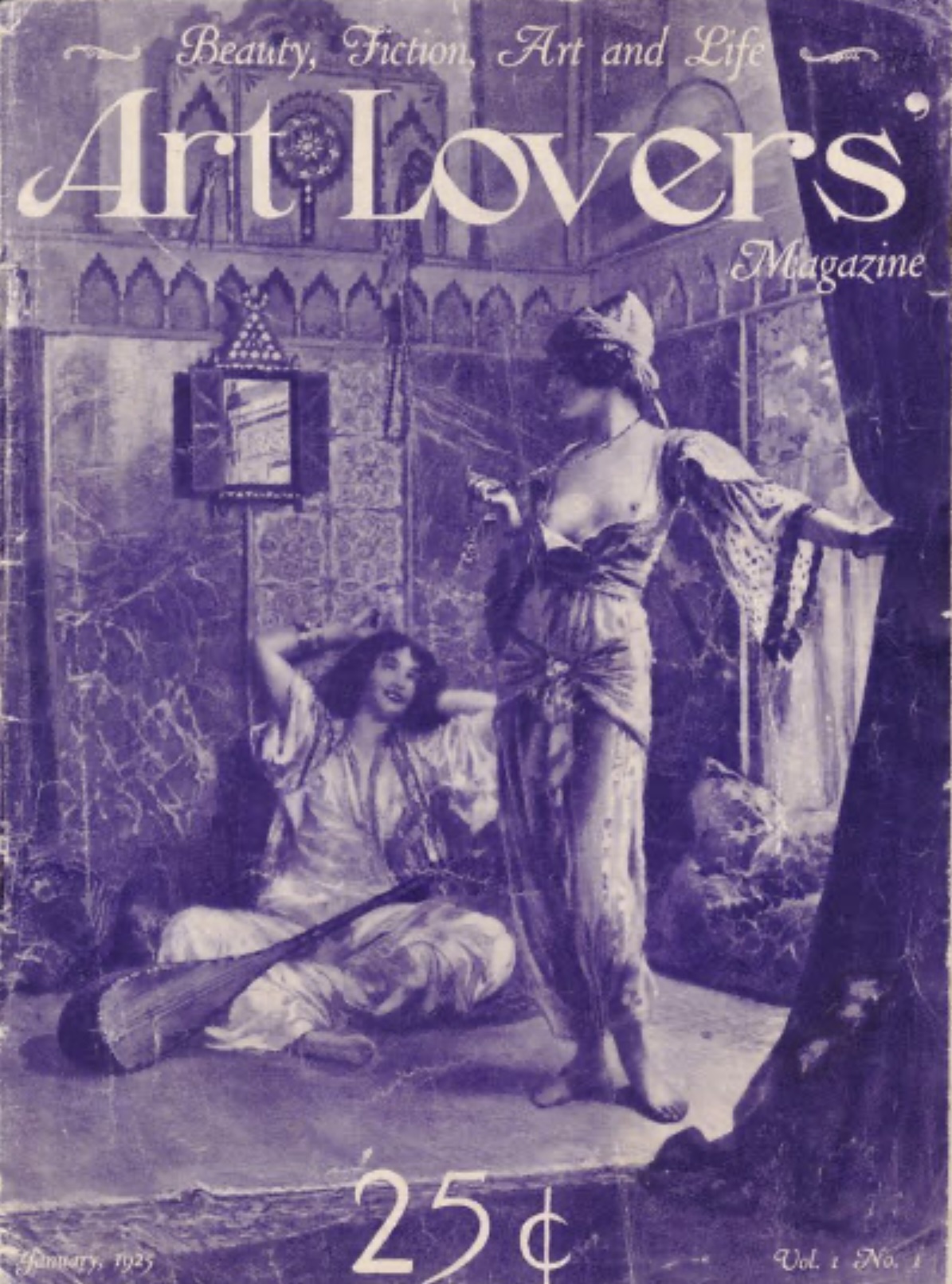
Unlike the rest of the art magazines, a new magazine appeared on the newsstands in January of 1925 with the name Art Lovers’ vowing to be completely different than the rest of the publications, yet it did not escape the wrath of Mr. Sumner of the New York Society for the Suppression of Vice. What follows is its story.
To be continued…


Leave a Reply