

First there was Cure the magazine for Cancer Updates, Research and Education. Cure launched in 2002 as a “quarterly magazine that combines the science and humanity of cancer for those who have to deal with it on a daily basis. CURE provides scientific information in easy-to-understand language with equally understandable illustrations.” Now comes Heal: Living Well After Cancer, a magazine “for cancer survivors from the day treatment ends, and for the rest of their lives.” For anyone who doubts the power of magazines in creating communities that can be felt, connected and shared, those two magazines are the prime example for that. My friend Eija Ailasmaa, CEO of Sanoma Magazines recently sent me a copy of Magazine, a book celebrating Sanoma’s Magazines fifth anniversary. In it I found this wonderful quote that best describes Heal and Cure among many other magazines. “Today, lifestyle magazines answer the question of how people can realize the potential in themselves and overcome all anxiety. How they can handle their human relationships, how to show to others a favorable picture of themselves; and how to set and achieve their life goals. People read these magazines with great enthusiasm. The chaotic richness of the problems described and their suggested therapies by magazines is astonishing. There are a wide variety of questions which arise with answers provided for all.” I guess the comments of Elemér Hankis, a Hungarian sociologist and philosopher, will more than suffice as a comment on both Heal and Cure.

“Heal”ing after the Cure: a great role for magazines
May 2, 2007God and War: Newsweek’s Meacham “favorite things” and other words of wisdom
May 1, 2007
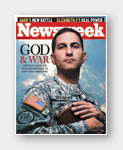
This week’s cover of Newsweek happens to reflect editor Jon Meacham’s “two favorite topics”: God and War. Meacham shared his views about his favorite topics and many others in an hour-long Q and A session with the journalism students at the University of Mississippi during a meeting with them on the Oxford campus. The Newsweek editor told students that these are “interesting times” and that the business of “printing on dead trees” will continue to be with us in the future. Armed with a circulation of over three million copies every week, a readership of over 20 million readers, and five to five and a half million unique visitors on the web, Meacham compared the reading habits of consumers in print and online. Meacham said “people do not read long form on the internet. 500 words is the max. An average cover story of Newsweek is 4,000 words, so it takes eight pages on the web.” Meacham asked the students to guess the percentage of viewers/readers who go from page one to page two on the web. “80% DO NOT…they drop before they flip to page two.” And how many stay until page 8 on the web with the story, he asked and quickly answered, “My mom will be the only one.” He reminded the students that journalism is not for the faint hearted and the future is always going to be for good writing…however he warned the students that we have to earn people’s attention and respect their most precious resource, time (I am sure he did not mean TIME). “In a blizzard of choices,” Meacham said, “To reach your audience, you need to be eloquent in the narrative with something new on every page to stop the readers.” Good words of wisdom for everyone who believes that our future is based on good reporting, good writing, good editing and above all a good sense of news judgment. Thank you Jon, we indeed live in “interesting times.”
The Good, the bad and the ugly…
April 30, 2007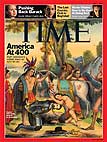
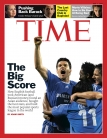
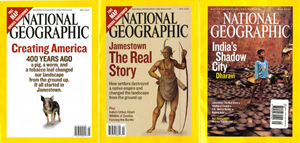
Just came back from Helsinki. My first stop was (of course a newsstand) at the Detroit Airport. Two things stopped me, both National Geographic and Time magazine share the same cover story. I guess great editors think alike. Walked a little bit more towards my gate and received my first welcome back surprise. A different cover of National Geographic at another newsstand stopped me. Same story but different cover within a few feet. (It seems that more than one distributor serves the Detroit Airport). My second surprise was that the covers of the magazines were not the same as their European edition covers that I bought in Amsterdam. I perfectly understand that the technology makes it easier for us to deliver relevant content to relevant audiences in relevant locations. So the decision of Time to have a story on European Soccer was perfectly understandable. But when I look at the cover story of the National Geographic European edition on India, I have to ask myself the question, how is a cover story on India more relevant to Europe than the story of America’s birth. All three insides of National Geographic are the same. There were no major changes inside National Geographic like those inside Time magazine. One thing I give credit to the National Geographic folks: they managed to confuse me here and abroad with this cover strategy. Please explain the relevance of having two different covers here, and of using India as the European cover story instead of either of the American covers. On the other hand, I continue to be pleasantly surprised by the direction Time magazine has taken since its revamp, and I can completely understand and expect the different covers of their overseas editions with their different content. The story of split covers will continue…
Bag it, fish it and live it (Hot and new this week… take 4)
April 30, 2007Once a week, I highlight three new magazines on my web site www.mrmagazine.com. This week the three new magazines are American Bagger, Destination Fish and The Journal of Life Sciences. Read here about these new launches. To be considered for review on my web site, please send a copy of your first issue to Samir “Mr. Magazine™” Husni, Department of Journalism, The University of Mississippi, University, MS 38677.
Move over Cosmo…Texas Monthly is here
April 28, 2007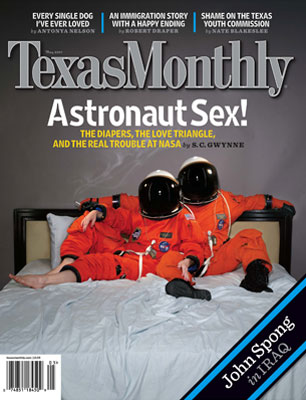
For more than 40 years, Cosmopolitan magazine has been introducing readers to all kinds of sex and sex positions, from the amazing to the shocking sex. Issue after issue the upper left hand corner under the name has been reserved to what many believe is the main reason the magazine sells almost two million copies every month on the nations newsstands. However, one type of sex never made it to the Cosmo cover: Astronaut Sex. Well, thanks to Texas Monthly magazine the new “amazing and shocking” sex lands on the cover of Texas Monthly and not Cosmo. Well, I am sure that in a month or two Cosmo will enhance the coverage of Astronaut Sex and will give us 31 new positions to enjoy Astronaut Sex. Well, as you prepare for that, make sure you will practice “safe sex” that will not land you in jail!
Victoria is Back: Hearst’s Southern Expansion
April 27, 2007
A joint venture between Hearst Magazines and Hoffman Media of Birmingham, AL is bringing Victoria magazine back to life and at the same time adding to the southern expansion of Hearst Magazines. Few years ago Hearst bought the Atlanta based magazine Veranda and yesterday they announced that they partnered with Hoffman Media, publisher of Cooking with Paula Deen, Southern Lady, and A Taste of the South magazines to bring Victoria magazine back to life. Victoria was founded in 1987 as a spin off of Good Housekeeping under the editorialship of “the father of new magazine launches” John Mack Carter and was the brainchild of her founding editor Nancy Lindemeyer. The magazine became an instant success with readers and in few years hit the million copies circulation mark. However, in 2003, and without any warning signs Hearst pulled the plug on the magazine citing lack of advertising pages and revenues. The magazine, according to my sources, had one of the highest subscription renewals at the time the magazine was folded. It was yet another sign from our industry leaders that they want to continue to use the same old model of subsidy by advertisers rather than readers paying the fair price of the magazine. It was like telling the millions of readers of Victoria, that we care more about the fifty advertising customers more than the two or three million readers. It is a sad but true fact in the thinking of most of our big “New York” based publishers. Well, now come Hoffman Media, the little engine that could, to bring Victoria back to life. Victoria will be entirely under the direction of Hoffman Media. The plan for the magazine is to launch in October and to hit the 250,000 circulation mark after only two issue. I am sure that both John Mack Carter and Nancy Lindemeyer are delighted to hear about their baby’s rebirth. Congratulations to both.
The Future of Newspapers: Daily Magazines…take 2
April 26, 2007
For almost five years now I have been preaching the need for newspapers to become daily magazines, both in content and shape, if they are going to survive the forces of change. Last month I wrote about this same matter (you can read it here). Now, my friend Sandy Woodcock, the director of the Newspaper Association of America Foundation e-mails me with the news that the founder of such a daily magazine is going to speak at the World Newspaper Congress, to be held in Cape Town, South Africa from June 3 -6. Here is the exact description of the session Gert Edlinger, the managing director of the Austrian paper Osterreich.
“IS THE DAILY MAGAZINE THE FUTURE FOR NEWSPAPERS?
A new Austrian daily blurs the lines between newspapers and magazines, and some say this is the future for newspapers in general. Gert Edlinger, the Managing Director of Osterreich, will discuss the innovative format and content strategy at the World Newspaper Congress, to be held in Cape Town, South Africa, from 3 to 6 June next…
The compact, full-colour Osterreich, launched in September 2006 in one of the most concentrated newspaper markets in Europe, mixes magazine and newspaper styles in one package, with several sections printed on glossy paper and stapled on the spine. These are not typical magazine inserts: they are daily sections, with daily deadlines that are paginated and printed along with the other daily sections. To use both newspaper and magazine quality paper in the same publication, Osterreich and its printing partners had to develop an innovative printing and workflow system that allows for both cold and heat set processes during the same printing run. The newspaper claims to be the first to use this technology. The high-quality paper allows the newspaper to attract a new brand of luxury goods and other advertisers who insist on magazine quality for their ads. Mr Edlinger will present the case of Osterreich during a session on Shaping the Future of the Newspaper at the Congress, which will examine new print products, new digital revenue generation, the best advertising strategies and the reorganization of newspaper companies for the multi-platform newspaper.”
You are not the READER… and 5 other commandments of journalism
April 25, 2007I just gave a keynote speech at the Finnish Periodical Publishers Association in Helsinki. The title of my speech was “Are magazines relevant in tomorrow’s marketplace?” The simple answer for the question was YES. The more detailed presentation followed this outline: 1. Journalists and reporters are not the readers. 2. Journalist should remain in charge in order to create Good Relevant Content to a Relevant Audience via the Relevant Medium. 3. Each and every member of your society may become your freelance informer, but he or she is NOT the trained expert or journalist. 4. The Smart One Shop Stop media company will be involved in all media, yet they have to provide different content in different departments (you do not want to buy your dress from the cafeteria in the store, although both items are in the store). 5. Good Content will remain King and Queen, based on four basic elements: good reporting, good writing, good editing and a good sense of news judgment, regardless of the medium. 6. Good design will help Good content, but Good design will NEVER help BAD content. In short, focus on the readers’ needs, wants and desires and not on your colleagues’ view of you or on the awards you may win for your work.
Loft Bookazine… Living, Travel and Architecture
April 25, 2007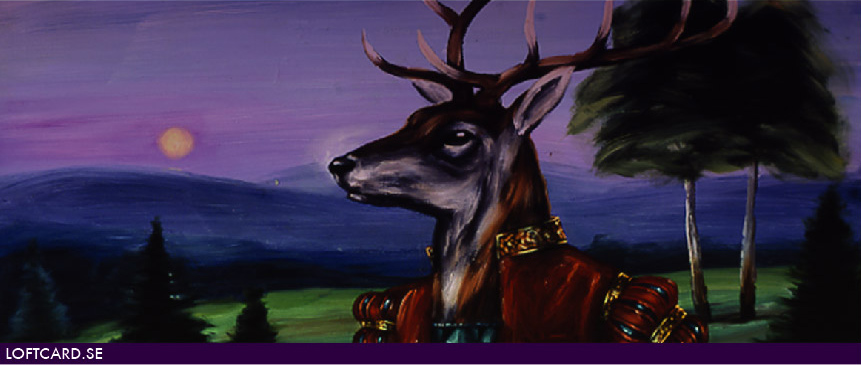
From Sweden comes this new quarterly “Bookazine” part book, part magazine. Yet, the whole is much larger than the sum of the two parts. The magazine is bilingual, Swedish and English, and is aimed at the cream of the crop of audiences worldwide. The price tag is a hefty one: 22 Euros in Europe and $28 in the USA. I picked up the first issue on the stands in Helsinki where I am keynoting today the Finnish Periodical Publishers Association conference. Loft’s founder Mikael Becker is a mutli-tasker. He writes in the first issue, “I created the Loft concept, which currently consists of Loft Bookazine, loftcard, the Loft television series and the Loft website. Right now I feel proud, happy and exhausted.” And can you blame him? It took him a year to get the whole concept of Loft refined “like polishing a diamond.” This boutique magazine continues in the latest trend of other boutique magazines from the Nordic countries using their own language and English as a second language in the magazine to create that instant international flavor and flair to the magazine. Loft has been able to do so ever so graciously. The picture above is from the loftcard web site. A very good example of what some like to call “publishing 360.”
Brits “cover up” for the U.S.A.
April 24, 2007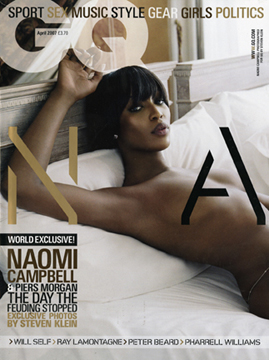

The cover of the UK’s April issue of GQ carried a three page fold out “world exclusive” picture of model Naomi Campbell revealing a little too much… however, when the magazine traveled across the Atlantic the cover had undergone some significant changes and additions in very strategic areas as you can see from the two covers above. The one on the left is the UK original, the one on the right is the British import to our shores…Who said we did not learn any lessons from Ms. Jackson’s mishap at the Super Bowl!


