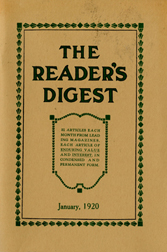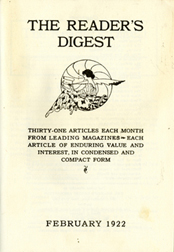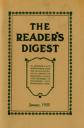
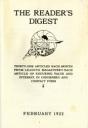
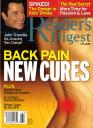
I know what people say about free advice, but while recovering from sinus surgery the news about the two million cut in circulation at Reader’s Digest and the plan to sell the back cover of the magazine to advertisers sent me back to the early years of Reader’s Digest and to the prototype issue and first issue of the magazine. I do not know whether it is the hospital connection that brought to mind the link with Reader’s Digest beginnings (DeWitt Wallace conceived RD on his hospital bed in France) or the recent news, but in any case I went to my magazine collection and pulled out the prototype issue and first issue of RD from Jan. 1920 and Feb. 1922 and guess what? I found the cure for all the ills of Reader’s Digest today. DeWitt Wallace referred to RD in his prototype issue as the “Pocket University” which “will enable you to keep yourself educated in the truest sense; it will yield immeasurable satisfaction in giving you a sense of being well-informed and well-read.” Wallace’s plan for the magazine was to be “of 100% Educational Interest— no fiction, no advertisements, no articles on purely transient topics and no articles of limited or specialized appeal.” His wife Lila defined the nature of such articles in the introduction to the first issue. She described the articles in RD as such: “Each article of enduring value and interest — today, next month, or a year hence; such articles as one talks about and wishes to remember.” Elsewhere in that first issue the editors wrote, “No articles of purely momentary interest — every article a worth while one, worthy of a permanent place in the storehouse of the mind.”
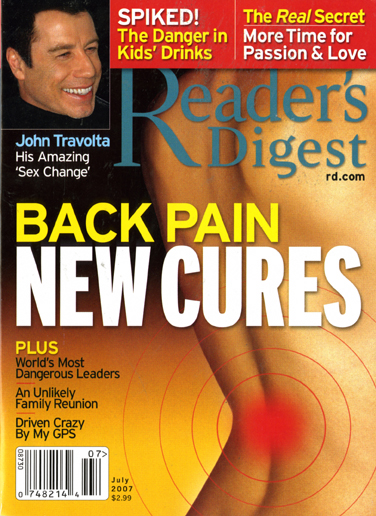
It is amazing as I flip through the pages of Reader’s Digest today I can’t but ask, Is there anything left from the magazine concept that the Wallaces created? Is any of the articles “worthy of a permanent place” in the reader’s mind? To save Reader’s Digest one only needs to go back and read those two issues from the 20s… the concept is still applicable today as it was then… The problem is not with the circulation or the advertising. Reader’s Digest problem is in its content. Be true to that mission statement of the past and bring back that “Pocket University” and you may see the cure of most of the ills of the magazine. John Travolta and the cures of back pain will not do it. Almost all the articles in the July issue of the magazine are of “purely momentary interest.” Once more it is the problem with the content and not the medium. I hope someone is reading, because I know the Wallaces are turning in their graves as they see what happened to their beloved magazine. It is not too late to save “The one magazine that is preeminently worth keeping– and binding– for future reference and enjoyment.” So says the words of the founders in their prototype issue. They are worth repeating.
Jackie Leo, Reader’s Digest editor-in-chief, responded to my blog with the following e-mail (I have asked Ms. Leo’s permission to publish the e-mail since it is my policy not to publish any e-mails sent to me unless I receive permission from the sender)… What follows is Ms. Leo’s response to the blog:
Samir: For someone as enlightened as yourself to publish such a naïve and inaccurate blog about RD was really stunning. We’ve known one another for a long time, and I can assure you that this rate base cut has everything to do with magazine economics and nothing to do with the magazine’s content (I challenge you to name another publication that has 8 million paid subscribers). I also wonder why you think the Digest didn’t cover the same subjects we now cover. They did–the only difference was that they condensed other magazine’s writings in most cases instead of creating original pieces, which is what we do now, for very obvious and good reasons.
You also seem to forget that the Wallace’s drove their extraordinary circulation through the use of the famous Reader’s Digest Sweepstakes, a practice that is no longer followed.
Had the Wallace’s lived to see the explosion of television channels, the Internet, the rise of Google, the speed with which information and ideas travel, they would have had two choices: Reflect the cultural shifts in the society by evolving the magazine and staying in the center of the mass market, or, reduce the circulation to that of, say, The Virginia Quarterly and hope that people would still want to read it.
One more point: if you don’t think that an outstanding medical breakthrough report on the causes of and the solutions to back pain does not have enduring value, then you’ve never bent over to pick up your i-phone and felt the unbearable agony that millions of Americans suffer every day.
If you’d like more information about RD, please call me.