Felix Dennis, in a typical Dennis style, gave earlier today his keynote address on “Innovating in a downturn” at the 37th FIPP World Magazine Congress. He recapped the story of launching Maxim in the United States against all odds and in the worst of times during the 1997 economic downturn.
After his speech I had the opportunity to catch up with Felix and ask him two questions regarding my series on innovation, print, the web and the future. In his three minutes answers he took the time first to acknowledge my work and then answer the questions. Thank you Felix for the kind words and for being honest and blunt about the future of magazines and print. Click the video above to hear my interview with Felix Dennis, Chairman of Dennis Publishing in the UK and The Week Publications in the USA.

Felix Dennis on the future of print and magazines
May 5, 2009From London with Print: The Opening of the 37th FIPP World Magazine Congress
May 4, 2009
Tonight was the official opening of the 37th FIPP World Magazine Congress at The Orangery, Kensington Palace. It is the beginning of two days of discussions, speeches, presentations that will focus on innovation, print and the web. From my brief conversations with a lot of the attendees (from all four corners of the world) everyone is looking for answers. The problems are well known, the answers, on the other hand, are a different story. I am looking forward to the next two days, and I hope that, in the words of a famous man, “we will not be all thinking the same, because when we do so nobody is thinking.”
Best Obama cover yet? Mr. President in Tea Leaves
May 3, 2009
As I have mentioned earlier on this blog, President Obama, and his entire family for that matter, have been a great newsstand magazine sellers. However, this last week a picked up a copy of Tea, A Magazine with one of the best rendering and surprising image of Mr. Obama on its cover: The president in tea leaves. Now all what we need to do is find an expert in reading tea leaves and all our problems will be revealed. I just wish those experts can tell us the solutions since most of us already know what the problems are…
Still, a well done and very smart cover of Tea, A Magazine…. Talking about tea, I am ready for my afternoon tea since I am visiting London and when in “London” I am supposed to act as “Londoners” act. Care to join me?
Is this the first sign of change? 3 Sub. prices for the same magazine
May 3, 2009
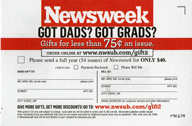
Just before I left the country heading to the UK, I picked up a copy of Newsweek before the major reinvention takes place on the magazine pages and its business model. I was surprised to see, in the same issue that I bought at the Ole Miss Bookstore, three subscription cards with three different prices: one is offering the entire year for $15.00 (Five more dollars than last year), another is offering the entire year for $25.00 and the third is gift card offering the magazine’s entire year for $40.00.
Now call me a skeptic, but which one of these cards you will think people will send to get their one year subscription to the magazine? I am sending the $15 one and showing you the other two! On a positive note, I am glad to see Newsweek taking the lead in raising their subscription prices and hopefully setting the stage for the American magazines to start charging their readers for the content and not just depend on advertisers. Change has brought us a new president, I am sure it will bring us a new American magazine publishing model. I am keeping my fingers crossed!
On innovation, print and the web: A series of Q and A with industry leaders. Part nine
May 1, 2009
“The web is a tool, but magazines like ours are an escape of the things that you find on the web…” The aforementioned and other words of wisdom from Barbara Fairchild, editor in chief of Condé Nast’s Bon Appétit magazine, in her answers to my two questions about innovation, the web and print. Ms. Fairchild answered my questions during a visit to the Journalism Department at The University of Mississippi last week. Click on the video above to hear her answers. To learn more about the Magazine Innovation Center click here.
Next week I will be reporting about more hands-on innovation ideas from the 37th FIPP Magazine World Congress in London.
Bringing the Global Magazine Family Together: Waving a Magic Wand in a Troubled Business Model
April 29, 2009
It is in tough and troubled times like these that meetings and gatherings of the members of the global magazine families are needed. Canceling a meeting or a convention may save you some money, but it is not the answer to enhancing your business model and to benefiting from the powerful collective thinking of the group.
One such convention has not been canceled and it promises to bring together a host of magazine makers from across the globe. It is the 37th FIPP World Magazine Congress that will be held in London next week.
 I asked Sarah Tunstall, COO of the PPA, the association for publishers and providers of consumer, customer and business media in the UK, who was instrumental in the preparations for this conference few questions regarding the World Magazine Congress and the Magic World of Magazines.
SH: Several magazine and newspaper associations have canceled their annual conventions due to the downturn in the economy. Why do you think the Magazine World Congress decided to go ahead with its meeting?
ST: It shows the confidence and dynamism of the worldwide magazine industry. This is the largest and highest profile event in the magazine world this year, with a stellar cast of speakers. Support from delegates and sponsors is very strong. It shows that if you have a market-leading product, people will support it.
SH: What do you expect to be the take away message from the conference?
ST: There will be many messages across all publishing platforms. The key message is that magazines are the perfect vehicle for providing valuable and entertaining and trusted content to every type of audience. They do this in print, digitally, and face to face – carrying their brand values across all platforms.
SH: What are the numbers? More people attending this year than the last event? Less? The same?
ST: Numbers are, if anything, better than expected. We will have a full hall and packed break-out sessions. Direct comparison with the 2007 event in Beijing is difficult because it was in many respects a different event.
SH: The Chinese define insanity as doing the same thing over and over and expecting different results every time. What do you think the Magazine Congress is going to do different this time and what do you expect the results to be…
ST: We are aiming for the best-ever Congress – as every host nation should do. We believe that we have brought extra qualities of imagination, together with meticulous planning. The next Congress in Delhi in 2011 should take London as the benchmark and move ahead from there.
SH: Some of the speakers have just folded some of their print magazines. What do you think is the message that they will be sending the audience?
ST: No product has a divine right to make money, and all products have a beginning and an end. The history of leading magazine brands is that they are remarkably resilient, and remarkably able to evolve and develop to meet changing market expectations. Magazines continue to be launched – in print and digitally. An alert, creative magazine industry is always looking for the market gap, the market niche – and continues to find gaps and niches even in the toughest market.
SH: How do you think the conference is going to add to the amplification of print?
ST: The conference program itself – the physical program – showcases innovative print techniques some of which have been specially developed for the program and have never been used before. The message is that print has a dynamic future and continues to evolve. Watch out for copies of the program on e-Bay….
Three Qs and As with Condé Nast Portfolio’s David Carey
April 27, 2009
While the prophets of doom and gloom are celebrating the death of Condé Nast Portfolio magazine, I opted to ask David Carey, group president and founding publisher of the magazine, three questions about the entire status of the magazine industry and the American publishing model.
SH: Is the closure of Portfolio another evidence that the American publishing model is dead and that a need for a new model is more than needed today?
DC: THE BUSINESS CYCLE IS ALIVE AND WELL — AND WITH IT, ECONOMIES EXPAND AND CONTRACT. WE’RE IN THE MIDDLE OF A SHARP CONTRACTION PHASE. THE MODELS FOR FEW INDUSTRIES ARE WORKING WELL TODAY — BUT THAT IS WHAT HAPPENS IN A RECESSION, IT FORCES EVOLUTION.
SH: Is it the economy, the internet or both that are hurting print
today? Were we after counting customers rather than finding and
charging the customers who count?
DC: FOR MAGAZINES, WHILE THERE IS PRESSURE FROM DIGITAL SUBSTITUTION, THE CORE ISSUE IS CYCLICAL, AS THE TYPE OF ADVERTISERS WHO SPEND THE MOST IN PRINT ARE FACING ENORMOUS PRESSURE ON THEIR BUSINESSES.
SH: Does David Carey still see the cup half full or he is now seeing
the empty side?
DC: THERE ARE ALWAYS OPPORTUNITIES, IN EVERY MARKET. DURING A TOUGH CYCLICAL RECESSION, THEY ARE HARDER TO FIND, BUT THE SMART, NIMBLE ENTREPRENEURS WILL FIND POCKETS OF OPPORTUNITY EVEN TODAY — OF THAT I’M VERY CONFIDENT.
On innovation, print and the web: A series of Q and A with industry leaders. Part eight
April 27, 2009
Innovation is not dead and so are many business to business magazines. Those of us who refuse to believe that print is dead and the end is near (I have to keep on reminding people that what we are witnessing these days is the death of the American publishing model and the publications that depend on it). Here is, in part eight of my series on Innovation, Print and the Web, an interview with Chris Beytes, editor & publisher of GrowerTalks and Green Profit magazines. I asked Mr. Beytes what is he doing to revitalize his print magazines? His answer, derived from interviews with his readers, sheds on the light on how he combined two magazines in one thus achieving a wider reach to the customers who count rather than just counting customers. Click on the video above to hear his entire answer.
On the decline of Journalism and other words of wisdom from Chris Hedges
April 24, 2009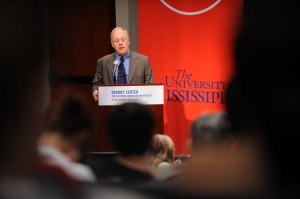
This has been a great week for me as a professor and chair of the Department of Journalism at the University of Mississippi. It was even a greater week for our students and faculty. It was the 25th annual Journalism Week, something that I started as Magazine Week when I joined the faculty here in 1984. Many speakers came to campus and interacted with our students on “all things journalism.” I will be sharing some of their insights here and all of their insights on the J-Department web site here.
Chris Hedges, Pulitzer Prize-winning journalist and author, gave the Stuart Bullion Memorial Lecture in Journalism. His speech “The Death of News and the Rise of the Entertainment Culture” touched on the major factors facing journalism in general, and newspapers in particular, today. Here are some excerpts:
The decline of newspapers is not about the replacement of the antiquated technology of news print with the lightning speed of the Internet. It does not signal an inevitable and salutary change. It is not a form of progress. The decline of newspapers is about the rise of the corporate state, the loss of civic and public responsibility on the part of much of our entrepreneurial class and the intellectual poverty of our post-literate world, a world where information is conveyed primarily through rapidly moving images rather than print.
The Internet will not save newspapers. Although all most newspapers have Web sites, and have had for a while, newspaper Web sites make up less than 10 percent of newspaper ad revenue. Advertisers have not gravitated to newspaper sites, either unsure of how to use the Internet or suspicious that it can’t match the viewer attention of older media. And the decline of revenues means an assault on the very heart of the news – the ability to gather and produce news. No internet site will ever bring in the kind of revenue that allows a large newspaper, such as The Los Angeles Times, to field a newsroom staff – a staff which even with all its lay offs — still employs 700 people.
Those who rely on the Internet gravitate to sites that reinforce their beliefs. The filtering of information through an ideological lens, which is destroying television journalism, defies the purpose of reporting. Journalism is about transmitting information that doesn’t care what you think. Reporting challenges, countermands or destabilizes established beliefs. Reporting, which is time-consuming and often expensive, begins from the premise that there are things we need to know and understand, even if these things make us uncomfortable. If we lose this ethic we are left with pandering, packaging and partisanship. We are left awash in a sea of competing propaganda. Bloggers, unlike most established reporters, rarely admit errors. They cannot get fired. Facts, for many bloggers, are interchangeable with opinions. Take a look at The Drudge Report. This may be the new face of what we call news.
We live in an age of moral nihilism. We have trashed our universities, turning them into vocational factories that produce corporate drones and chase after defense-related grants and funding. The humanities, the discipline that forces us to stand back and ask the broad moral questions of meaning and purpose, that challenges the validity of structures, that trains us to be self-reflective and critical of all cultural assumptions, have withered. And this assault has been a body blow to a free press, which is, like the humanities, designed to promote intellectual and moral questioning. The confusion of bread and circus with news means that social critics, those who do not shout clichés on cable news shows, but who challenge and question the assumptions and structures of the corporate state itself are left without a voice.
We are cleverly entertained during our descent. We have our own version of ancient Rome’s bread and circuses with our ubiquitous and elaborate spectacles, sporting events, celebrity gossip and television reality shows. Societies in decline, as the Roman philosopher Cicero wrote, see their emotional and political passions subsumed by the excitement and emotional life of the arena.
Television journalism is largely a farce. Celebrity reporters, masquerading as journalists, who make millions a year give a platform to the powerful and the famous so they can spin, equivocate, and lie. Sitting in a studio, putting on makeup, and chatting with Joe Biden, Hillary Clinton, or Lawrence Summers has little to do with journalism. If you are a true journalist, you should start to worry if you make $5 million a year. No journalist has a comfortable, cozy relationship with the powerful. No journalist believes that serving the powerful is a primary part of his or her calling. Those in power fear and dislike journalists – and they should. Ask Amy Goodman, Seymour Hersh, Walter Pincus, Robert Scheer or David Cay Johnston.
You can watch the entire lecture here and I welcome your comments on the future of news, journalism and the rest of the issues raised by Mr. Hedges.
Photo by Robert Jordan
On innovation, print and the web: A series of Q and A with industry leaders. Part seven
April 20, 2009
Greg Sullivan is founder and CEO of AFAR Media, a new media company that is ready to launch a new magazine AFAR this coming August. The magazine’s tag line is Where Travel Can Take You and its content will be solely devoted to international “Experiential Travel.” I asked Greg whether he is crazy to launch a new magazine, in print first and then on the web, in this day and age. Click on the video to hear his response.
By the way, Mr. Sullivan spoke earlier today to our students at Ole Miss about his new magazine venture. Stay tuned to a link soon to his speech on the Ole Miss campus.


