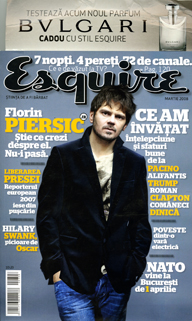
I have no doubt that you are familiar with all the perfume and cologne strips in most magazines. Those samples, loved by some and hated by others, have been a fixture in the magazine business for some time. So, when the folks at the Romanian edition of Esquire magazine decided to offer a sample of BVLGARI inside their March 08 magazine, they literally did that. They dug a hole in the magazine (from page to page) in the shape and size of the cologne bottle they wanted to offer their readers. The bottle was nestled inside the hole in the magazine and all the pages of the magazine had to be designed taking into consideration the design of the bottle. An insert extending beyond the magazine regular size announced the free gift to the readers. See the cover above and some sample pages below.

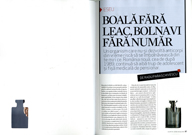
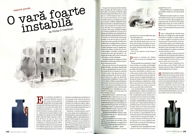

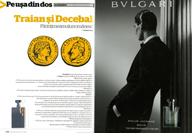

Innovation in Print (2): A Hole (with purpose) in the Romanian Esquire
March 17, 2008Print and the Stock Market: the Wrong Comparison
March 16, 2008I love British newspapers and all the innovation taking place across the pond. That is no secret, but when I read a blog on The Guardian web site by Roy Greenslade I was surprised, to say the least, not by his blog, but by the comments of one smart reader responding to his blog. Mr. Greeslade repeated on his blog on Thursday March 13 the same arguments I have been hearing from all the prophets of doom and gloom about the demise of print and print companies because their stock market prices are going down. He wrote
I am often accused of taking too negative a view of the future of newspapers. One commenter this week said I should stick up for our own trade instead of appearing to relish its death. But, as I said in response, I am merely recording what is happening and, based on that reality, predicting what will happen. In the face of the depressing truth, even if I was to “talk up” newspapers, it wouldn’t make a blind bit of difference.
At the risk of repeating that overworked phrase – it’s the economy, stupid – I base my views on the flight of advertising revenue and declines in circulation, another revenue drain. Investors, needless to say, are doing the same. So let’s take a look at some up-to-date facts from across the developed world that illustrate the parlous state of newspaper publishing.
I’ll start with the media sector on the British stock market. Shares in the Daily Mail & General Trust, publisher of two national titles that are regarded as the nation’s most successful papers of the past two decades, go on falling week by week. The Daily Mail ‘A’ ordinary share price today stands at 435p, down from its 52-week high of 875p, a decline of more than 50%.
To read the rest of his blog click here.
One reader responded to the Mr. Greenslade blog by writing:
Using newspaper company share prices – and therefore investor confidence – as a proxy for long-term structural fortunes is an interesting approach. But given that Google’s share price is also down almost 50% from its 52-week high, doesn’t your method imply that Google is facing a comparable fundamental structural challenge? Not that I mean to dispute your conclusion – newspapers in many markets clearly are facing the sort of challenges you describe. But I’m not sure investor confidence is a good measure for that, given that the same thing is also going on with the share price of the main winner from the shift of attention, and therefore ad revenues, to the web.
Need I comment? I don’t think so. However, what surprised me even more came from Mr. Greensdale himself the next day. In his Friday’s March 14 blog he describes his journey into the heart of Rupert Murdoch’s new print heaven. Mr. Greensdale wrote
For once the word “awesome” is justified. It is, without any shade of doubt, the most amazing newspaper publishing factory I’ve seen since I started in the business on a weekly in 1963.
Superlatives fail. It is the biggest, most efficient, least labour-intensive press plant in the world.
To read his record of the visit click here. What a difference one day makes…
Innovation in Print (1): COLORS is Back with a Vengeance
March 14, 2008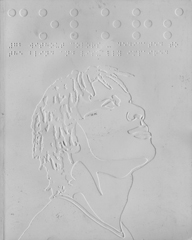


On a recent trip to Amsterdam I picked up the latest issue of COLORS magazine, the United Colors of Benetton magazine. Issue number 73 of the magazine that I cherished every issue of its first few years of existence. It was the example I gave in class for innovation, content, design, you name it. And, as is with a lot of great creative magazines, the magazine fell on hard times and was reduced to yet another printed publication. Well, starting with issue 72, innovation is back, and is back with a vengeance. The last two issues remind me so much of the early issue of COLORS the magazine that set a new standard of innovation in print. Issue 72 was dedicated to a world with color. The theme of the issue was Without Colors. A Braille cover on a white background adorned the front of the magazine with another cover on the back in black and white. A CD with audio readings of the entire magazine was enclosed with the magazine.
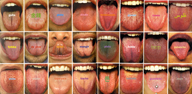
Issue 73 on the other hand was dedicated to Money. Back are the double covers, different size magazines, great use of multiple photography and of course, excellent use of design.
If you have not seen COLORS in some time, or if you have given up on the magazine, like I did, I invite you to take a look at some of the sample pages from issue 73 (below) and the covers of issues 72 and 73 (above). Trust me, you will not regret picking it up again.



The Whole Experience vs. the Hole Experience
March 11, 2008My friend Bob Sacks discovered a major gap in his e-paper experience. For years he has been predicting the future of mass reaching magazines and books to be on-line or through some usage of an electronic device such as the Sony Reader or Kindle. Well, Bob had the chance to put his predictions to practice and lived to write about it. He summed his e-reader, the Kindle, experience as such:
•The Ebook experience is excellent and enjoyable. It was book like and yet had features that no book has.
•The Enewspaper experience was fair. With a newspaper the expected visuals, photos and charts were non existent and that colored my reading and my expectations.
•The Emagazine was a complete flop.
To say I told so will be entirely unfair. But, what I have been saying for years is that the new technologies are yet another way to spread the word and to have content delivered to readers and viewers. It is a new way and not a replacement or even a substitute. Each media must present the entire whole experience on its own. No media should be made to be like this or that. If we are working so hard to invent a medium that looks like paper and feels like paper, why bother? We have paper, so there is no need to reinvent the wheel.
Well, folks, click here to read Bob’s entire review of the Kindle and enjoy the “hole” in his “whole” experience.
Get your free WIRED magazine…
February 27, 2008
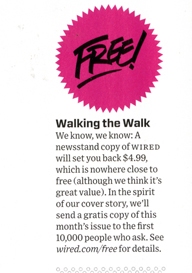
I had to buy my copy. It cost me $4.99. The cover, as usual, outstanding and inviting, screams Free. Well, the folks at the newsstands ignored the big free and looked at the small $4.99 which I had to pay. No problem until I reached to my hotel room and opened the magazine to start reading it. On the masthead page (yes, I try to read every page) I saw the free sign again. This time with some copy. Walking the Walk reads the title under the free sign. Here is what the rest of the copy says:
We know, we know: A newsstand copy of WIRED will set you back $4.99, which is nowhere close to free (although we think it’s great value). In the spirit of the cover story, we’ll send a gratis copy of this month’s issue to the first 10,000 people who ask. See wired.com/free for details.
So, what are you still waiting for. Click on the link above and get your free copy of WIRED. Free or $4.99, trust me, it is worth the price. But, why pay for something you can get for free… it is starting to feel as if I am writing about those who put their content for free on the web… well, I better stop, this blog is about the March issue of WIRED, so let me stop here.
If you reminisce the country get Our Iowa
February 17, 2008

I know Our Iowa is a magazine “for Iowans by Iowans,” but after looking at its first three issues I am sure that folks who reminisce the country and the country way of life will find in this regional magazine a lot to satisfy their desires to that way of life. You do not have to be an Iowan to enjoy this magazine. Founded by the man who created a whole genre of country and country lifestyle magazines Roy Reiman (the magazine’s publisher) and the former editor of Country and Country EXTRA magazines Jerry Wiebel (the magazine’s editor), Our Iowa presents itself as the magazine that “recognizes and celebrates why Iowa is so special to us and to all who live here.” The goal of the magazine is not “to make a fortune on this venture (Reiman already did that when he sold his Reiman Publications to Reader’s Digest Corp.), but “Rather, it’s a chance to put our publishing experience to good use while offering us an opportunity to give something back to our native state.”
In typical Reiman style, the magazine will be written by readers and will depend on field editors across the state of Iowa. In less than six months the magazine has signed up a “Hawk-Eye Field Editor” in all 99 Iowa counties expect for five. By the time you are reading this blog, chances are those five counties positions would have been filled. In the same time period the magazine has “over 23,000 subscribers, and more orders keep arriving daily by phone, mail and E-mail.”
The magazine is not only a delight to read, but also a delight to look at and interact. Yes, interact, since the magazine offers more chances for readers to engage with each other, to engage with the magazine editors, to engage with the state, and to provide a great sense of community in a way that only a magazine like Our Iowa can do.
Am I a fan? You bet you and you should be one. Check Our Iowa here. I know the founders of Our Iowa want the magazine to be for Iowans by Iowans, but I think the rest of the country folks deserve to see and look at Our Iowa. Maybe there is an “Iowan” in each one of them.
No, Not Another Celeb Magazine…
February 16, 2008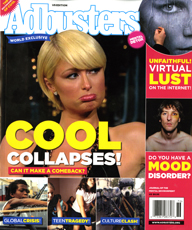
Adbusters magazine tags itself as the Journal of The Mental Environment and for years has been doing just that. The latest issue of the magazine celebrates The Reconquest of Cool with a parody cover that resembles the design of most of the so-called celeb magazines, i.e., gossip magazines. The issue starts with a visual essay on Cool : the rise, fall and rebirth of an attitude. The article traces Cool “from its roots in Africa through to the youth cultures of the present day, cool has always been an attitude of resistance to subjugation, an expression of rebellion and a posture of defiance.”
Adbusters is more than a magazine. They refer to themselves as “a global network of artists, activists, students, educators and entrepreneurs working to change the way information flows and meaning is produced in our society.”
The magazine is based in Canada and is published six times a year by the Adbusters Media Foundation which is soliciting support to its legal actions “Buy Nothing, True Cost and Media Carta campaigns and help launch the Spanish and Chinese editions of Adbusters…”
Interested, check the magazine and its foundation here. There is a lot more under the covers of this magazine.
Inside the Great Magazines: The Super Bowl of Magazines
February 4, 2008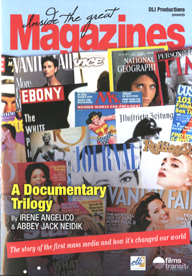
Whether you are a magazine insider or just someone who loves to read and flip through pages of different magazines, this documentary trilogy DVD set is a MUST. A three part series that will keep you glued to your television set as if you are watching the Super Bowl of magazines. The series opens with “how magazines define our cultural and personal images, and fuel the growth of democracy and consumerism.” From the days of the first magazine in London to the first use of a photograph in Paris to the days of Life and Vanity Fair in the United States, the first DVD has it all. Magazines as an element of social change is the topic of the second DVD. Leading magazines in this era of social change are included in this DVD. Playboy, Ms magazine and The Advocate are presented as an example of “how magazines find the way to challenge us with ideas that have the power to shape our political and social landscape.” The third DVD “investigates the work of impassioned individual editors, writers and photographers within the new market realities.”
This trilogy is produced by Irene Angelico and Abbey Jack Neidik from the Canadian DLI Productions company. The price for the series is :
Home — $45 for the three-part series
Institutions — $270 for three-part series
It’s available on DLI Productions website. Click here for information about Inside the Great Magazines. You will not regret it. Watch the intro to the series below.
More Good Journalism: World Affairs is Back
January 31, 2008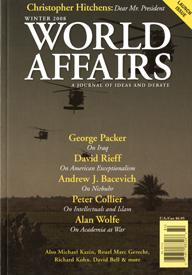
What do Lawrence F. Kaplan, Andrew J. Bacevich, Helene Cooper, Christopher Hitchens, Robert Kagan, Michel Kazin, Joshua Muravchik, P.J. O’Rourke, Ronald Steel and Leon Wieseltier have in common? They are the editorial board of the newly relaunched World Affairs journal. The journal was first published in London in 1837. Lawrence F. Kaplan, the journal’s editor asks and answers the question regarding the mission of the new World Affairs. “So what one idea will World Affairs champion?” Kaplan asks. He is quick to answer, “There won’t be one, but many: Rather than adhering to some party line, this journal will celebrate and encourage heterodoxy and open debate.” Kaplan adds, “The biases of World Affairs may seem quaint, even parochial, by comparison. The journal will not wear its heart on its sleeve; its probably somewhere in the space between board members Kagan and Kazin, which, as it happens, is also the distance between two sides of the same creed.”
World Affairs’ tag line is “A journal of ideas and debate” and it is indeed a journal of ideas that deserve debate. Ideas that give journalism that matters yet another venue for readers looking for something to sink their teeth into. So, once more for those mourning the death of good journalism, please pick up a copy of the launch issue of World Journal at a newsstand near you. I promise you will not regret it. To learn more about World Affairs click here.
Yes, Virginia, there is Good Journalism…
January 30, 2008
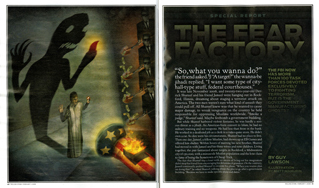
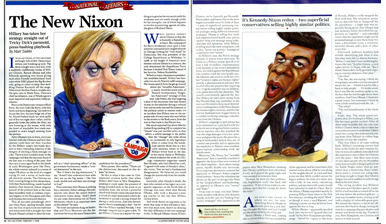

The bloggers and their websites have been filled of late with the news of the demise of journalism…real journalism, investigative journalism, journalism that matters, journalism that is necessary to run a democracy. We are told journalists have been exiting newspapers and are being replaced by soccer-mom journalists or what some like to call citizen journalists. News about Britney and Lindsy passes as journalism in this day and age. Is good journalism dead? Far from it. There is plenty of good, necessary journalism out there. All what you have to do is look in the right places.
One “right place” this week is Rolling Stone’s Feb. 7 issue. Even if you do not care about the cover story on Radiohead, three articles of good journalism caught my attention and I have recommended them to my students and colleagues alike. The first is The Fear Factory by Guy Lawson, the second is The New Nixon by Matt Taibbi and the third Blame Pedro by Tim Dickinson. Three articles worth much more than the cover price of $4.95.
So, yes it is getting harder to find journalism that is necessary, journalism that will have an impact on people’s lives, but it is still there. I am reminded by the biblical “parable of the weeds” where a man sowed good seed in the field, but at night an enemy came and sowed weed among the wheat. No doubt there is a lot of weed out there, but we can’t afford to give up now. There is still a lot of wheat. Tough it out and continue searching and recommending the necessity of journalism and thus journalism that matters. The three aforementioned articles, whether you agree or disagree with their points of view, are a prime example of journalism that matters and journalism that still cares to give a damn…


