Archive for the ‘A Launch Story…’ Category

h1

Dr. Oz The Good Life: A Magazine That Lives Up To Its Namesakes’ Robust Reputation & The Woman Who Makes Sure That It Does – The Mr. Magazine™ Interview With Editor-In-Chief Jill Herzig

December 4, 2015

“Print is never going to go away. We already have a very, very healthy newsstand base and subscriber base. We’re over delivering on our audience, our advertisers, and we’ve broken into the Top 10 bestselling magazines on American newsstands. So, it’s clear that there’s a strong desire to see Dr. Oz’s brand represented in print. And that people like the version that we’re doing right now.” Jill Herzig

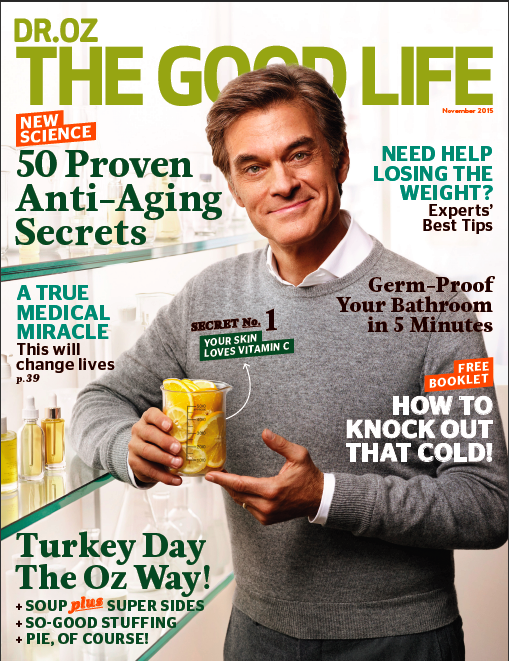
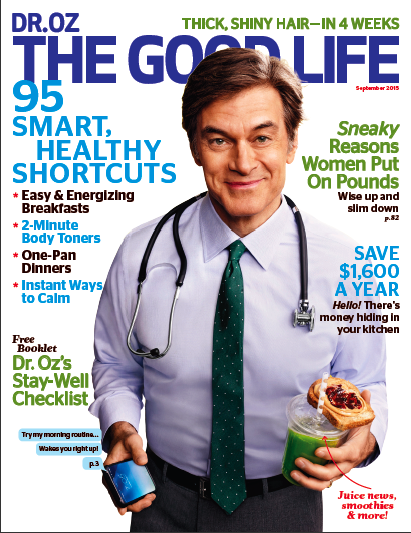
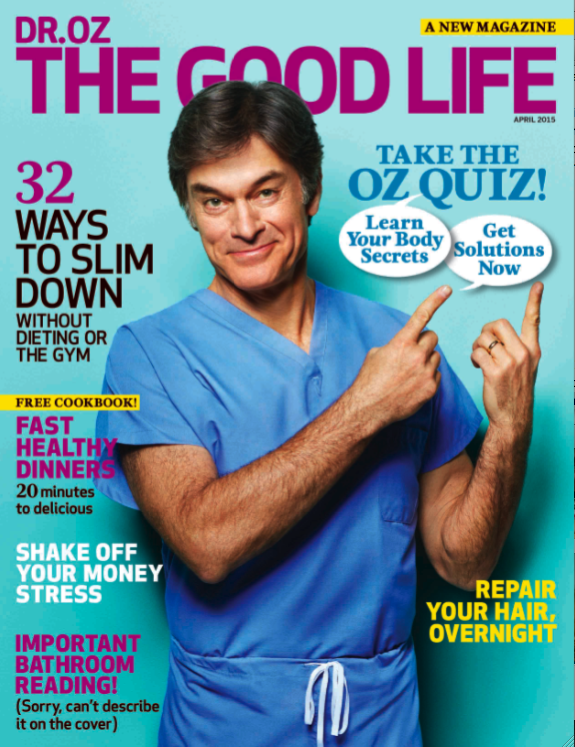
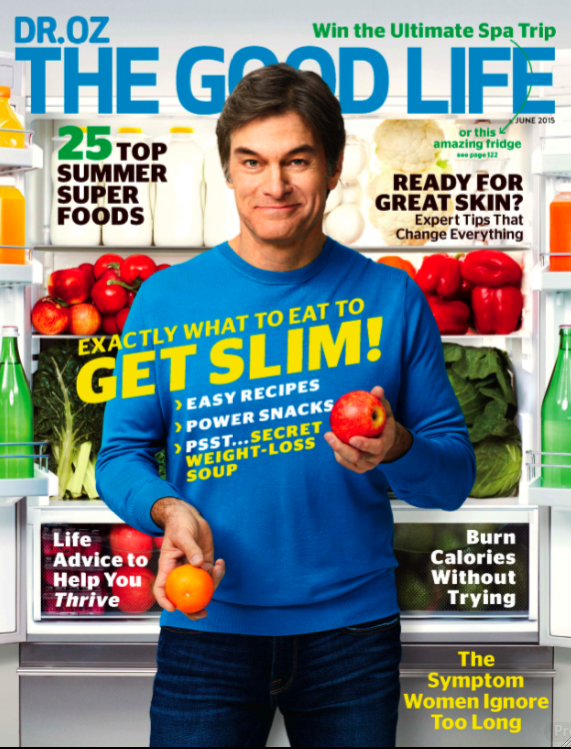
Picture 14 Wellness, recipes, fitness and beauty; Dr. Oz The Good Life is a magazine that was and is inspired by Dr. Mehmet Oz, the cardiothoracic surgeon, author and television personality who really needs no introduction anywhere in the country. He is a dynamic and charismatic individual who has become a mainstay favorite among audiences everywhere and in every medium, from television to magazines, by genuinely living and promoting his take on wellness and good health.

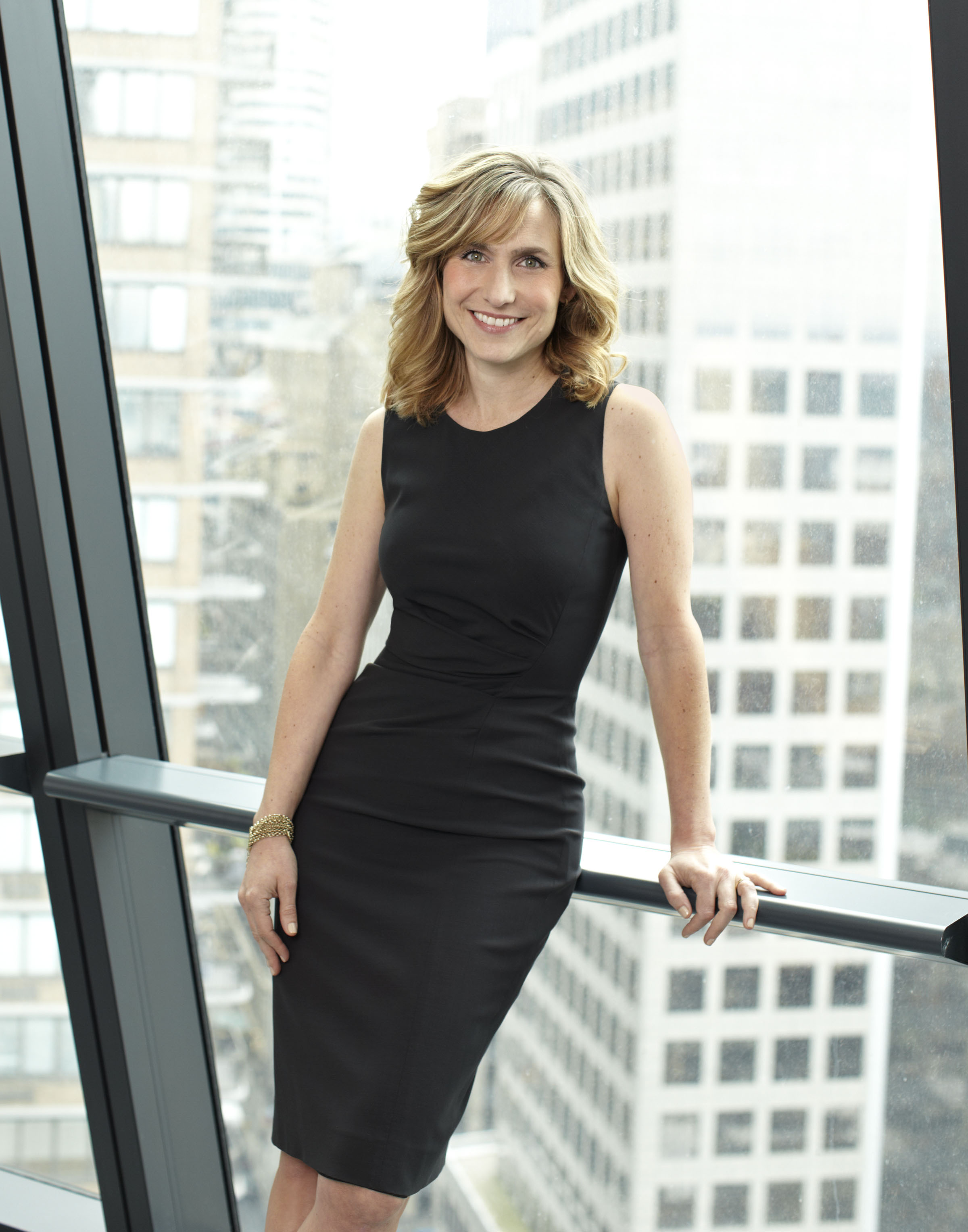
Jill Herzig is editor-in-chief of the magazine and brings her own style of zest and energy to the brand, complementing the living, breathing magazine progeny perfectly. Former editor-in-chief of Redbook since 2010, Jill joined Dr. Oz on his quest for nationwide good health and wellness in 2014, and hasn’t regretted it for a moment as she feels connected to his mission as she has no other throughout her magazine media career.

I spoke with Jill recently and we talked about her kindred spirit with the Oz’s, both Dr. and Mrs. and we discussed the future of the brand and the seemingly meant-to-be presence of the magazine among Dr. Oz’s many brand extensions.

It was an entertaining and informative conversation with a woman who truly believes in her brand’s calling and feels a passionate commission to further the cause.

So, I hope that you enjoy this meaningful look at a brand and a magazine that offers a wellness lifestyle experience that Mr. Magazine™ finds unique and extremely relevant to our health-conscious world of today. And now the Mr. Magazine™ interview with Jill Herzig, Editor-In-Chief, Dr. Oz The Good Life.

But first, the sound-bites:


RBK080113_010 On the difference between editing a magazine with a celebrity affiliation versus one that doesn’t have that attachment:
The day-to-day is not terribly different, but Dr. Oz isn’t an ordinary celebrity. He’s a cardiothoracic surgeon and he’s been doing that for decades, long before anyone knew his name. He’s a mission-driven guy and it seems as though he works 24 hours a day trying to educate the public about their health and that’s what inspires all parts of this brand.

On the fact that the magazine cover at Dr. Oz The Good Life is not something she has to ponder over:
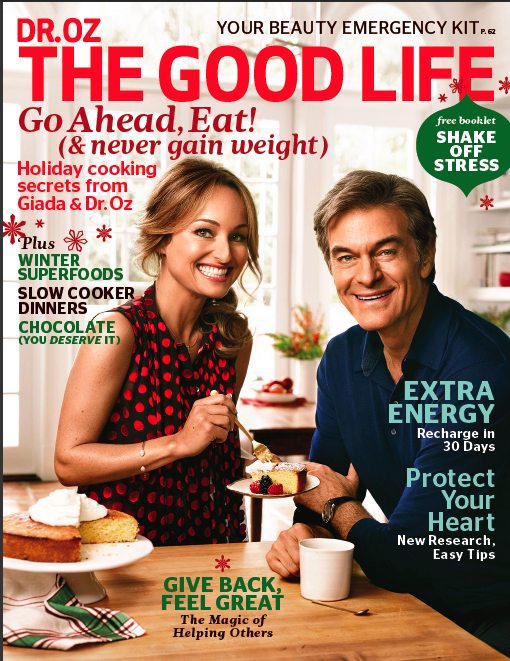
Well, I guess that is another obvious difference; I do know who is going to be on my cover every issue. (Laughs) But he’s not alone in December’s issue; we have him on with another celebrity, Giada de Laurentiis and we’ll be doing that again going forward.

On what her first reaction was when she was offered the job of editor-in-chief of Dr. Oz The Good Life:
I have to say, it was an instinctual yes for me. I knew basically the second the words came out of David Carey’s mouth; I knew that I wanted to take this job, which doesn’t do much for one’s negotiating powers. (Laughs) No, I was really excited and I loved the idea of the launch and I loved the idea of working with Dr. Oz.

On her relationship with Dr. Oz and his wife, Lisa:
Well, the relationship is a very easy one. In fact, it’s possible that the single easiest thing about this job is handling my relationship with the Oz’s. Lisa Oz is a great conduit to Dr. Oz and their family life, which is very important to him and to her as well. She’s a fantastic cook and very knowledgeable in her own right. And I just really like her as a person. We get along fantastically well.

On a major stumbling block that she’s had to face:
I can’t say that there has been a major stumbling block, other than simply having come onboard at the launch phase and putting together a staff from hardly anyone. I’m sure that our publisher Kristine Welker would tell you the same thing. It can be difficult to take over a legacy brand like Redbook, but you come in and the groundwork has already been laid, there’s a rich, deep history. When I came in here it was a pack of fabulous freelancers and some were arriving, some were leaving; it was a very tiny team and a high-pressure moment. But I wouldn’t call it a stumbling block. It was a big challenge.

On whether she feels a higher responsibility to the brand since there is a living, breathing progeny:
Oh, yes. I feel that responsibility and I think about it all the time. I’ve joked to Kristine that there’s no Dr. Marie Claire or no Dr. Harper’s Bazaar, but there is a Dr. Mehmet Oz. And he has dedicated his life to improving public health. It’s of the utmost importance to me that we protect his reputation, that we live up to his standards and that our reporting is deep and always quadruple-checked.

On how she plans the magazine issue to issue:
Honestly, the problem is that my mind is so crowded with ideas and my team brings a whole bucketful to every meeting. It’s about figuring out what’s the latest thing, yet it has to be based on completely solid science, and winding it down to the perfect match. The ideas come from everywhere. They come from all of our real lives and many of them come from Dr. Oz himself. Many of them come from Lisa and her experiences with her life. Even her mother-in-law, who apparently is a wizard at home remedies. We’re doing a piece right now on favorite family home remedies that are used in the Oz household all of the time.

Picture 13 On what’s next for the magazine and the brand as a whole and print’s place in that equation:
Digital and social have been growing at a really fast pace and we’re only two months into them. The numbers are still small, but the rate of growth is very impressive. I know that’s going to continue and will be more and more important to Dr. Oz The Good Life. The print is never going to go away. We already have a very, very healthy newsstand base and subscriber base. We’re over delivering on our audience, our advertisers, and we’ve broken into the Top 10 bestselling magazines on American newsstands. So, it’s clear that there’s a strong desire to see Dr. Oz’s brand represented in print. And that people like the version that we’re doing right now.

On what it is about Dr. Oz that makes him so successful for magazine covers:
I think that you can go back to his early appearances on The Oprah Show because that’s where it all began for him. He was uniquely able to explain to people how their bodies work. It’s a very rare doctor who has that communication skill. Sure, he’s charismatic and dynamic, but he’s an unbelievably gifted communicator and I think that’s really what differentiates him and makes him a star.

On whether she thinks specialty magazines are the future of print or there’s still room for mass appeal titles like Dr. Oz The Good Life:
I believe there’s lots of room for different kinds of print magazines, but certainly this concept brand of a healthy lifestyle has really hit home with the audience. They’ve been waiting for this and they love it.

On anything else she’d like to add:
I’m just feeling very optimistic when I look at our numbers and when I read the emails we get from the audience. They are so excited about this magazine. They are so smart and so engaged; I’ve really never worked for readers who display this level of intelligence and know-how. We have a whole page devoted to their smart ideas. I have the utmost respect for our audience and I’m so excited that they’re engaging on the level that they are.

On what keeps her up at night:
This is a personal thing, but I barely slept last night because Cindi Leive (editor-in-chief, Glamour) and I still go running just about every week and I was meeting her at 5:40 in the morning. (Laughs) Sometimes meeting Cindi for a jog will keep me up part of the night. And it certainly gets me out of bed in the mornings.

And now the lightly edited transcript of the Mr. Magazine™ interview with Jill Herzig, Editor-In-Chief, Dr. Oz The Good Life.

Samir Husni: What’s the difference between editing a magazine like Redbook and editing a magazine that has a celebrity’s name in the title, such as Dr. Oz The Good Life? Is your job now the same as it was at Redbook?

Picture 12 Jill Herzig: Yes, it’s very much the same job. The day-to-day is not terribly different, but Dr. Oz isn’t an ordinary celebrity. He’s a cardiothoracic surgeon and he’s been doing that for decades, long before anyone knew his name. He’s a mission-driven guy and it seems as though he works 24 hours a day trying to educate the public about their health and that’s what inspires all parts of this brand. And it’s certainly what inspires the magazine.

Sure, the magazine that I worked at before had many reasons for being and it had a great and vibrant relationship with its readers, but the mission feels quite different. It’s personified by Dr. Oz, but now the whole staff has really absorbed the mission; we’re all dedicated to this concept that we’re creating a fun magazine, an inviting magazine, but above all, a life-saving magazine potentially.

Samir Husni: With Redbook, you had the hard job of selecting the cover subject every issue. But with Dr. Oz The Good Life, that’s pretty much done for you.

Jill Herzig: Well, I guess that is another obvious difference; I do know who is going to be on my cover every issue. (Laughs) But he’s not alone in December’s issue; we have him on with another celebrity, Giada de Laurentiis and we’ll be doing that again going forward, so you won’t always see Dr. Oz all by himself. But he’s a no-brainer for us as a cover star.

Samir Husni: Do you miss writing your “Letter from the Editor?”

Jill Herzig: A little; I do. But I think probably as our digital side grows, and it’s growing very quickly, there will be more opportunities for me to reach out and have a more direct contact with the reader.

Samir Husni: When you were first offered this job; can you recall the emotional reaction that you had? Did you take time and think it over or did you immediately say yes? What was your reaction?

Jill Herzig: I have to say, it was an instinctual yes for me. I knew basically the second the words came out of David Carey’s mouth; I knew that I wanted to take this job, which doesn’t do much for one’s negotiating powers. (Laughs) No, I was really excited and I loved the idea of the launch and I loved the idea of working with Dr. Oz. I immediately had thoughts about what we could do with the magazine. I was just totally onboard.

Samir Husni: Can you describe the relationship that you have with Dr. Oz and his wife?

Jill Herzig: Well, the relationship is a very easy one. In fact, it’s possible that the single easiest thing about this job is handling my relationship with the Oz’s. Lisa Oz is a great conduit to Dr. Oz and their family life, which is very important to him and to her as well. She’s a fantastic cook and very knowledgeable in her own right. And I just really like her as a person. We get along fantastically well.

And Dr. Oz, you’ve already heard me say, is a super-inspiring guy. You definitely feel his dedication and his intensity every minute that you’re with him. He pushes himself incredibly hard, but I will say that he pushes other people solely by inspiring them. You just want to live up to his example.

Both of them are such appreciative people. They really love the magazine and they work very hard when we need them to. And yet, they’re happy to give us independence so that we can do what we know how to do. So, I really can’t say enough about them for how joyful this collaboration has been.

Samir Husni: What has been the major stumbling block for you since becoming editor-in-chief of the magazine?

Jill Herzig: I can’t say that there has been a major stumbling block, other than simply having come onboard at the launch phase and putting together a staff from hardly anyone. I’m sure that our publisher Kristine Welker would tell you the same thing. It can be difficult to take over a legacy brand like Redbook, but you come in and the groundwork has already been laid, there’s a rich, deep history. You can push away from that history or you can incorporate it; you have a lot of different choices. The history is there like a foundation. And at Redbook, there was also a staff when I came in.

When I came in here it was a pack of fabulous freelancers and some were arriving, some were leaving; it was a very tiny team and a high-pressure moment. But I wouldn’t call it a stumbling block. It was a big challenge. It made for a less restful than usual summer. (Laughs) But we got through it and I love the team now. I love the group that we have. They’re different from any team I’ve ever worked with. They are people who are called to this magazine.

Samir Husni: Kristine told me that she had sold over 60 pages of ads for the first issue without even knowing the name of the magazine; just because it was a Dr. Oz magazine. Do you feel that responsibility? That you’re not only handling an ink on paper and pixels on a screen brand, but an actual living, breathing brand?

Jill Herzig: Oh, yes. I feel that responsibility and I think about it all the time. I’ve joked to Kristine that there’s no Dr. Marie Claire or no Dr. Harper’s Bazaar, but there is a Dr. Mehmet Oz. And he has dedicated his life to improving public health. It’s of the utmost importance to me that we protect his reputation, that we live up to his standards and that our reporting is deep and always quadruple-checked. And that we further his goals.

Samir Husni: I asked the editor of Rachael Ray Everyday what her biggest fear was and she said that she always wants Rachael to look both ways before she crosses the street. (Laughs)

Jill Herzig: (Laughs too). That’s funny.

Samir Husni: (Laughs again) Do you have similar feelings?

Picture 11 Jill Herzig: I’m very happy that our figurehead is possibly the healthiest human on the planet. It gives me some peace of mind every time I get together with him to see how fit and healthy he is.

Samir Husni: How often do your meetings with Dr. Oz take place? How often is Dr. Oz at the Hearst Tower and involved in those meetings?

Jill Herzig: He drops by really frequently. And I would say that sometimes I see him three times a week and then sometimes I’ll go a couple of weeks without seeing him, but hardly a day goes by that we don’t email.

Samir Husni: If I wanted to go inside your mind as a magazine maker; how do you plan the magazine issue to issue and how do you select what topics you’re going to cover this month or next month or the month after?

Jill Herzig: Honestly, the problem is that my mind is so crowded with ideas and my team brings a whole bucketful to every meeting. It’s about figuring out what’s the latest thing, yet it has to be based on completely solid science, and winding it down to the perfect match.

The ideas come from everywhere. They come from all of our real lives and many of them come from Dr. Oz himself. Many of them come from Lisa and her experiences with her life. Even her mother-in-law, who apparently is a wizard at home remedies. We’re doing a piece right now on favorite family home remedies that are used in the Oz household all of the time.

When I first took over the job I have to say that I had a wicked case of insomnia because I could not go to sleep for all of the ideas that were milling about in my head. I kept a little booklet next to my bed and I’d wake up and turn on the light or just pick up my phone and use that light so I wouldn’t wake up my husband, and I’d scribble something in the booklet. And then I’d go back to sleep and something else would pop into my head. Initially, I’d actually pick up the notebook at a certain point and put it downstairs in my bag in order to go to sleep, because I was just filled with ideas all of the time.

And now we’re in a flow. We have our columns pretty set and we have our features and the pasting of the book is pretty set, so it’s a little more orderly. And I do sleep a whole lot better.

But we’re constantly changing it as well. I’m really over the concept of doing a redesign every few years. As every issue evolves there are changes. We drop columns, we don’t worry about dropping those columns; we add columns and we don’t worry if we only keep them for a short while. We just go with it a little more loosely than I have before. And I think part of that comes from having grown this baby from a launch and knowing it from the beginning and that energy is so exciting that you don’t want to lose it. And we’re still doing that.

Samir Husni: As you continue to do that and evolve the magazine; I’ve heard some reports that Dr. Oz is also a firm believer in print and that print is part of the equation of his brand. So, as you move forward and add to the digital and grow your pixels on the screen; what role do you think that print will continue to play in this brand? He’s on TV; he’s everywhere, even in competitor’s magazines, he’s on the covers. What’s next for the magazine and for the brand as a whole?

Jill Herzig: Digital and social have been growing at a really fast pace and we’re only two months into them. The numbers are still small, but the rate of growth is very impressive. I know that’s going to continue and will be more and more important to Dr. Oz The Good Life.

The print is never going to go away. We already have a very, very healthy newsstand base and subscriber base. We’re over delivering on our audience, our advertisers, and we’ve broken into the Top 10 bestselling magazines on American newsstands. So, it’s clear that there’s a strong desire to see Dr. Oz’s brand represented in print. And that people like the version that we’re doing right now.

I do think that our creative content, a healthy lifestyle magazine, really lends itself to print. And because of that our print edition has a robust, nice, long lifespan to it. This is really important information and we make it luscious and beautiful and we make it fun and acceptable and we make it very, very clear. But we’re also presenting information that is not uncomplicated. It’s important stuff that people need to understand. And in certain cases, it has life-saving implications for our readers.

We’re giving them information that they’re going to take time to absorb and they do take time to absorb it. They’re going to want to keep these issues around because they know that it could help them or a loved one at some point down the road. They’re going to want to make these recipes for years to come. When you’re talking about a healthy lifestyle magazine it’s really meaningful for people to have this information. We’re not talking about celebrities; we’re not talking about fashion and beauty trends, those are delightful when they arrive in your mailbox or you pick them up at the newsstand, but they have a built-in expiration date, so you’re going to recycle that magazine when those trends have faded or that celebrity has been forgotten for a moment. Our magazine is a keeper.

Samir Husni: I have struggled for a comparison to the magazine’s namesake and all I can come up with is something one of my professors once said: if you put Robert Redford on the cover of any women’s magazine, it will sell. Today it’s Dr. Oz. What do you think made him the celebrity he is on magazine covers? Why does he sell so well?

Jill Herzig: I think that you can go back to his early appearances on The Oprah Show because that’s where it all began for him. He was uniquely able to explain to people how their bodies work. It’s a very rare doctor who has that communication skill. Sure, he’s charismatic and dynamic, but he’s an unbelievably gifted communicator and I think that’s really what differentiates him and makes him a star.

When he did the initial Oprah shows, he actually did an autopsy, harvested organs and put them in a cooler, got on a plane, flew to the Oprah show and used actual human organs to explain to that audience and to millions of viewers how their bodies work and why it was so important to keep those inner workings healthy. And the viewers went crazy for that. No one had ever taken the time or chosen that very visual way to communicate with them about their bodies. And he’s still doing that in the magazine. We’re still doing that.

Samir Husni: As an editor who’s very well-versed with the industry as a whole; do you see that degree of specialization (wellness and food in a magazine), do you think this is our future in print? Or do you think there’s still room for a mass appeal magazine, such as The Good Life, which is not a specialty, tiny magazine?

Jill Herzig: The wellness and healthy lifestyle area has been very niche for a long time. But I think what we’re bringing to the table has really grown up in the category. And we’re doing something very different with it.

And I believe there’s lots of room for different kinds of print magazines, but certainly this concept brand of a healthy lifestyle has really hit home with the audience. They’ve been waiting for this and they love it.

I’ve never seen a time when people are more concerned with health and wellness than they are right now. It is top of mind for every age category, every demographic, every socio-economic group. And I’m so grateful that shift has happened because in our country we’re seeing some serious health issues. Diabetes is raging out of control; obesity is a huge problem and we haven’t managed to make an appreciative dent in it, the average American woman now weighs what the average American man weighed in 1960. So, we’ve got issues. And I’m really happy to see such broad interest in health and wellness.

Samir Husni: Is there anything else that you’d like to add?

Picture 10 Jill Herzig: I’m just feeling very optimistic when I look at our numbers and when I read the emails we get from the audience. They are so excited about this magazine. They are so smart and so engaged; I’ve really never worked for readers who display this level of intelligence and know-how. We have a whole page devoted to their smart ideas. I have the utmost respect for our audience and I’m so excited that they’re engaging on the level that they are.

In our most recent reader feedback survey, the scores were off the chart for this magazine, but the top-rated piece of content in the entire magazine was a six-page report that we did on inflammation in the body. It is not an uncomplicated topic. We made it as clear as we could; we reported the heck out of it. But this is a topic that readers really had to pull up a chair and sharpen a pencil and concentrate on it to understand. And 75% of them said that it was extremely interesting to them.

So, the notion that people don’t have the attention span and don’t have the intelligence and can’t stick with a long piece in print; I am not seeing that. I’m seeing readers who are thrilled to get deep interest, as long as we’re bringing them vital information about their health. So, we’re doing that in our magazine.

Samir Husni: That’s one thing that I told Ellen Levine; if we’re just content providers, then we would have been dead a long time ago. We’re experience makers. Today, if a magazine is not an experience, it’s going to be in trouble. And that’s why today you’re seeing a higher level when it comes to the attention span of the average American adult, which is now eight seconds, according to the latest research, one second more than a goldfish. (Laughs)

Jill Herzig: (Laughs too) I have to say that our readers do not have that ADD.

Samir Husni: That’s because you are creating a very good experience for them.

Jill Herzig: Well, thank you.

Samir Husni: My typical last question; what keeps you up at night?

Jill Herzig: This is a personal thing, but I barely slept last night because Cindi Leive (editor-in-chief, Glamour) and I still go running just about every week and I was meeting her at 5:40 in the morning. (Laughs) Sometimes meeting Cindi for a jog will keep me up part of the night. And it certainly gets me out of bed in the mornings.

Samir Husni: Thank you.

h1

Flow Magazine: For Life’s Little Pleasures And Paper Lovers Here, There And Everywhere – The Mr. Magazine™ Interview With Joyce Nieuwenhuijs, Brand Director & Irene Smit, Creative Director.

November 16, 2015

From The Netherlands With Love…

“I think it’s good to say that we are an example of the fact that print is not dead. And I think that we show the power of print, but I also believe in digital. The goal must not be about the medium, but the consumer’s needs. We started off in print and it’s more a luxury and a passion for women, but we can’t exist and grow fast internationally without digital and social media. So, certainly, we also need digital and not just print.” Joyce Nieuwenhuijs

“As for the digital part, we were never opposed to digital; it was just that we love paper so much that we put all of that emotion for paper into the magazine. And when we started Facebook and other social media, it helped us to grow very much.” Irene Smit

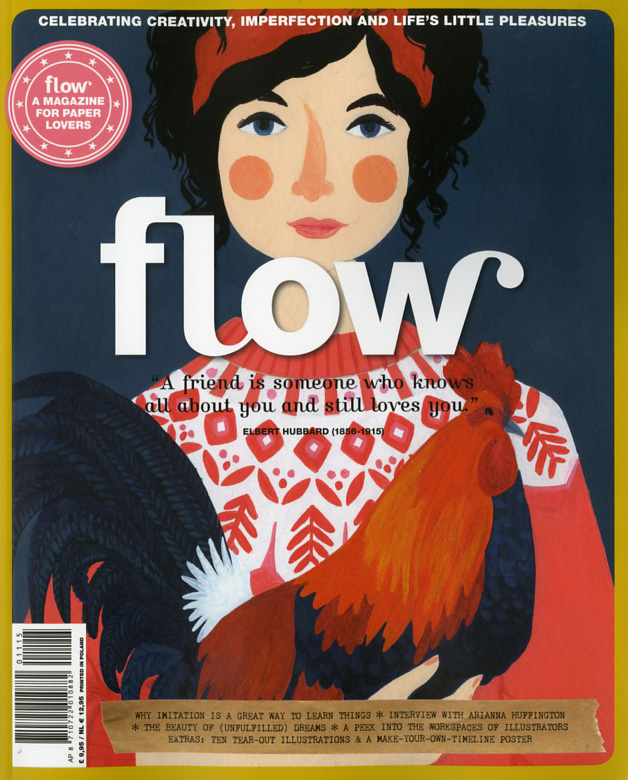
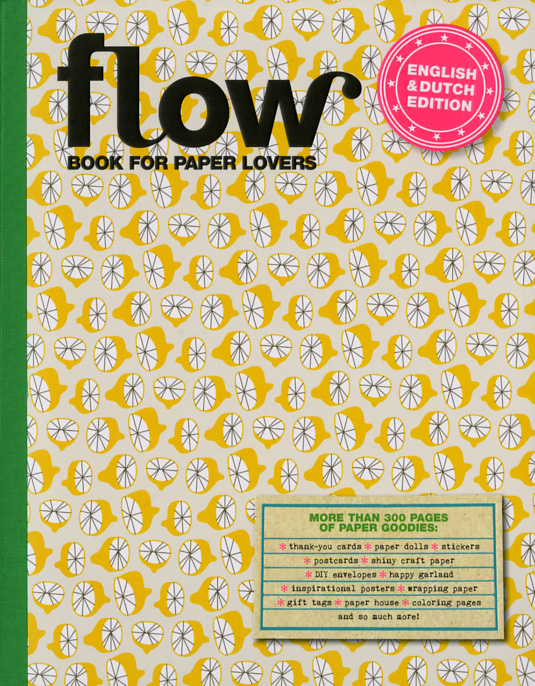
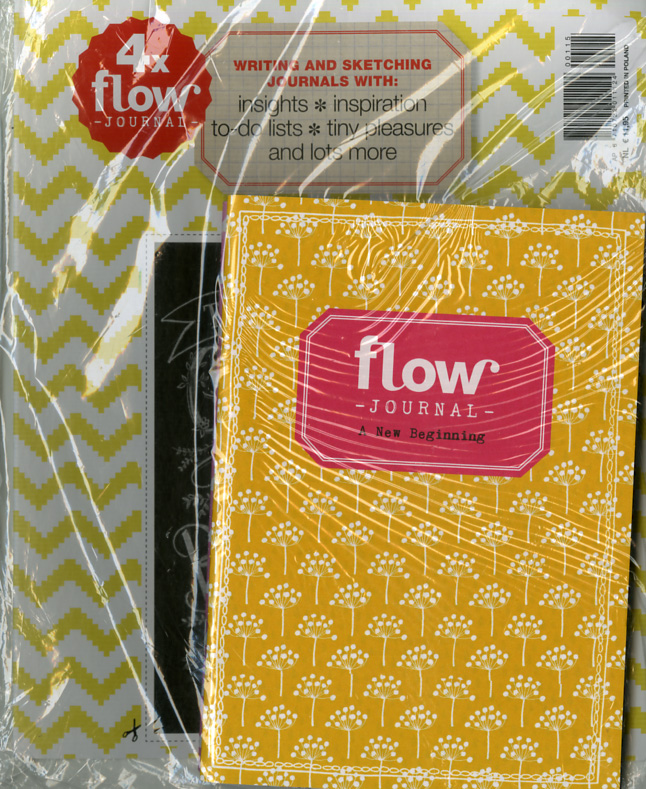
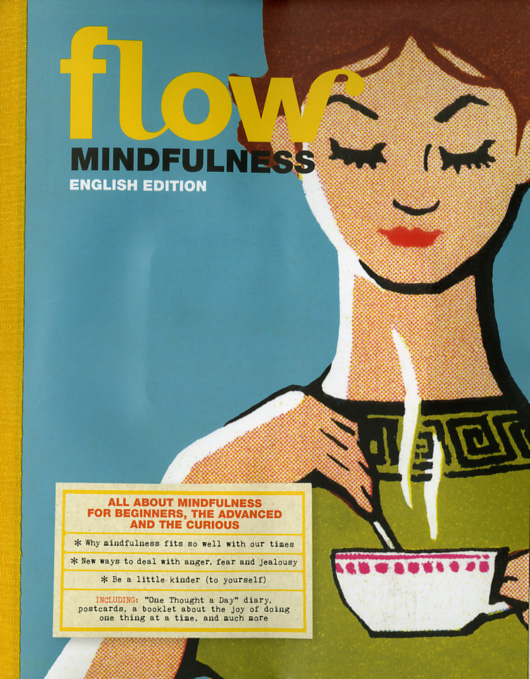
Flow3-2 Flow is a magazine that takes its time; it promotes celebrating creativity, imperfection, and life’s little pleasures. And it does so beautifully. The magazine and all of its special extensions and creative products are a print-lover’s dream. The different papers that are used with each issue are heavenly to the touch and mesmerizing to eye. It has become an international sensation with its many editions across the globe, having started out as a small Dutch magazine at the height of the economic crisis in 2008. It has since proven that if you follow your heart and your passion, anything is possible.

I still have vivid memories of holding that first issue of Flow magazine in my hands, together with its media kit, as the co-founders, flowing with joy (pun intended) presented me that first copy of the magazine. I was visiting the offices of Sanoma in The Netherlands where Joyce Nieuwenhuijs and Irene Smit work. Joyce is the brand director of Flow and Irene is the creative director. Both women have a firm grip on their seven-year-old’s hand and know how to lead it down the long and sometimes very winding road that is today’s magazine media world.

I spoke with Joyce and Irene recently and we talked about the concept of mindfulness and about how the magazine educates and encourages its readers to slow down and be conscious of every minute that they can. It was a look into a lifestyle that is both sought-after and needed in the busy world that we live in today.

So, I hope that you enjoy this respite with Joyce, Irene and Mr. Magazine™ as we take you into a world that will teach you how to go with the “Flow.”

But first, the sound-bites:

Joyce_Nieuwenhuijs On the birth of Flow Magazine (Joyce): Seven years ago we started Flow Magazine. It was 2008 and we got the go-ahead from the Board in July of that year. In September, the crisis began, so it was really a tough time to launch a new magazine. But actually, I think the crisis was a good point for us because everybody, especially Irene, the creative director, found a plan for the new concept, and a new magazine was born that didn’t exist until then.

On Irene’s recollection of the beginning of Flow (Irene):
I was with my Co-Editor-in-Chief, Astrid van der Hulst, and we were sitting with papers all around us, talking about what kind of magazine we would like to read. And we had both brought everything that inspired us with us, wrapping paper, little cards and all of these paper things. That was the time when we found out that we wanted to make a magazine that focused on living mindfully and being inspired.

On Flow presenting itself as the “anti-digital” and its DNA (Joyce): First, I think it’s good to say that we are an example of the fact that print is not dead. And I think that we show the power of print, but I also believe in digital. The goal must not be about the medium, but the consumer’s needs. We started off in print and it’s more a luxury and a passion for women, but we can’t exist and grow fast internationally without digital and social media. So, certainly, we also need digital and not just print.

flow2-1 On the biggest stumbling block she’s faced since the launch of the magazine (Joyce):
I only thought in opportunities in the beginning. But the challenge was Flow is an experience and you can’t just say that you have a new magazine, you have to see Flow before you can believe it’s a good idea. So, from the beginning really, that was a challenge. People get that Flow-feeling, and if they have a Flow Magazine in their hands; they’re in love. And for sure, if you have a brand that people love, you also have some people who don’t like it, but that’s OK, because you have to focus on the people who do love it. And if you’re mainstream; everybody likes you, but you’re not special. And I think that’s why Flow is good; it’s a love brand, but some people, mostly men, don’t understand what the magazine is. And from the beginning, we have to tell the story and that’s why I created the marketing strategy in ambassadors.

Irene Smit On how Irene coped with the economic crisis and the digital explosion in 2008 when the magazine was launched (Irene):
Well, the economic crisis was more of a natural thing that happened, because when we started the magazine it was something that we already felt. Everything was getting bigger, people were not getting happier, and the shift was to more expensive and purer products. So, I think the crisis helped us because the feeling that we wanted to put in the magazine was reflected in the people at that time. A lot of them recognized themselves in our magazine. And that was OK for us, certainly. I mean, the crisis wasn’t good for the sales market, of course, but I do think it helped to grow the magazine. A lot of people felt like there was no more welfare and were looking for new ways of living. And that’s what Flow is all about.

On the ambassador program that she strategized to get the magazine into the hands of people (Joyce):
Physically giving them their magazine to show them Flow, because before we did that, they couldn’t understand the magazine without it being in their hands; you couldn’t tell them the story. I think that’s another secret of Flow; it’s a true experience. It’s not just reading a magazine; it’s much more. And that’s why we’re able to grow the brand quickly.

On any cultural issues the magazine has faced crossing borders (Joyce):
That’s a good point. We thought when we launched Flow that we’d focus on the Dutch market because we didn’t really consider the international market eight years ago. But we received so much feedback from abroad, people who had seen it in airport shelves that we knew that we had to do something internationally, but we had to figure out how. We wondered if we’d need to change our content for something more local or culturally different. But that’s why the prices for us and the changes in the world are so good, because in the world we have the oppressions; everybody is under the same pressures with their jobs or working very hard to balance their daily lives. It’s a worldwide challenge. And digital really helped us because the world is nearby now. Eight years ago it wasn’t so nearby.

flow5-4 On defining Flow Magazine (Joyce): What is Flow? The essence of Flow is that we are a magazine that takes its time. And we help people to learn to do the same. And it helps people look for the imperfections, because we are living in a world of perfections. Flow shows you that life doesn’t have to be perfect.

On the success of Flow (Irene): The success is that we really make the magazine ourselves; it comes from us. And every Wednesday, we still sit together and drink coffee and come up with new ideas and new products. And we have to find time for that. We are creative directors, but we’re magazine makers as well.

On the most pleasant moment for her during the last seven years (Joyce):
When you’ve worked with Flow from the beginning; I think working with such a creative team every day and growing from a small magazine into a big, strong international brand makes each day so very pleasant. Also, the moment that we broke even and the return on our investment became really big was great.

On Irene’s most pleasant moment (Irene):
The best moment for me is that Astrid and I sit together every Wednesday morning in a very nice coffee shop and we drink coffee together and talk about everything that’s going on. New products we want to make; problems we have to deal with, just everything that’s going on.

On anything else she’d like to add (Joyce):
I think we have always had, and I will always have, a big ambition to grow the brand. But I believe it’s good to start small; think big, act small. That’s the secret of how we made Flow such a big brand. Nowadays, you have to learn by doing and you have to be an entrepreneur. More and more in the big challenge that we have as publishers you have to stay innovative with your product. And content is key for sure.

On what motivates her to get out of bed in the morning (Joyce):
Life is good, for sure. You have to claim the energy and look forward to doing things with your family. I love my job and love growing the brand. And being a part of today’s transformation gives me energy.

On what motivates Irene to get out of bed in the morning (Irene):
Truthfully, my children. (Laughs) My family life is still the most important thing to me. And my work life is important as well, and I love what I do. It’s so nice that I can invent new products and think about new products. I get a lot of letters from people worldwide who tell me that the magazine helps them so much. I even received a letter from someone in London who told me that her husband had just died and she read the magazine and it helped her tremendously. And I love these readers; they’re so special to us. Their letters mean so much.

On what keeps her up at night (Joyce):
I learned that if you get up very early and you work very hard, you have to sleep. (Laughs) We can work 20 hours, for sure, there is enough to do. But sometimes you have to take off and I learned that from Flow.

On what keeps Irene up at night (Irene): I never stay up at night. (Laughs) I sleep a lot. I go to bed very early and I’m so tired, I fall right to sleep.

And now the lightly edited transcript of the Mr. Magazine™ interview with Joyce Nieuwenhuijs, Brand Director and Irene Smit, Creative Director, Flow Magazine.

Samir Husni: Joyce, Flow Magazine is your baby.

Joyce Nieuwenhuijs: Yes, it is.

Samir Husni: Recreate that birth moment for me.

Joyce Nieuwenhuijs: Seven years ago we started Flow Magazine. It was 2008 and we got the go-ahead from the Board in July of that year. In September, the crisis began, so it was really a tough time to launch a new magazine. But actually, I think the crisis was a good point for us because everybody, especially Irene, the creative director, found a plan for the new concept, and a new magazine was born that didn’t exist until then.

We actually started Flow Magazine in November, 2008 and now seven years later, it’s growing very fast into a really beautiful, strong brand. The process we used was learning by doing and not starting with big budgets and huge print runs, but as entrepreneurs, with at first, a frequency of just six issues, so that we could grow the brand and surprise the readers.

From the beginning there was a lot of demand from readers in the Netherlands, but also from abroad. They couldn’t read it, but they thought it was amazing. It has grown very fast and now we have eight issues per year and six specials for the Netherlands, but we also have two licenses in Germany, France and the international edition in 20 countries.

So, in seven years and through entrepreneurship, we have 39 products now and we’re really proud of the baby we gave birth to in such chaotic times as it was for media then. Flow is a magazine that will give you rest in your hectic life.

Samir Husni: As the creative director, Irene, can you recall that moment of conception for you?

Irene Smit: Yes, very much. I was with my Co-Editor-in-Chief, Astrid van der Hulst, and we were sitting with papers all around us, talking about what kind of magazine we would like to read. And we had both brought everything that inspired us with us, wrapping paper, little cards and all of these paper things. That was the time when we found out that we wanted to make a magazine that focused on living mindfully and being inspired. We wanted to use four lines to describe the magazine.

So, we came up with those four lines that first day. I can remember vividly we were saying how nice this was or that was, and let’s do this or that. (Laughs) And we both did a mindfulness course, and mindfulness wasn’t as big then as it is now. But we really felt like it brought us so much.

We both finished the mindfulness course together and we learned so much. The idea of life and just accepting it as it is more, and to try and not to struggle so much. And this concept gave so much relief that we decided to use the idea for a magazine.

And I think that’s part of Flow’s success now; the message that you shouldn’t work too hard or try to be happy all of the time, just accept life with its ups and downs and be as happy as you can.

Samir Husni: We live in a digital age, and I don’t think anyone would argue with that statement. However, Flow presents itself as the “anti-digital.” So, what’s the DNA? What’s the philosophy behind Flow and can you describe the magazine a little bit, Joyce?

Joyce Nieuwenhuijs: First, I think it’s good to say that we are an example of the fact that print is not dead. And I think that we show the power of print, but I also believe in digital. The goal must not be about the medium, but the consumer’s needs. We started off in print and it’s more a luxury and a passion for women, but we can’t exist and grow fast internationally without digital and social media. So, certainly, we also need digital and not just print.

But the secret of Flow is we are a perfect fit for women, men too of course, but women lead very busy lives and it’s not only in the Netherlands, it’s worldwide. And I think that’s the secret behind how we have grown so fast. Also from abroad too, because times are changing; everybody has digital products and we all need a break from our hectic lives and Flow gives you the present of staying in the present, and Flow is a tool that they can use as me-time for themselves.

Samir Husni: Irene, when you brought the idea for the magazine to the powers-that-be, what was the initial reaction? Was everyone jumping up and down and telling you what a great idea it was?

Irene Smit: (Laughs) No, no one said what a great idea it was.

Samir Husni: (Laughs too).

Irene Smit: We tried to put it in a magazine format and it was a little bit difficult. And there were a lot of people who had ideas about it; some said we should go this way and some said that way. But we said just believe in us and let us do it how we think we should do it. If not, it will be just another magazine like all of the others out there. If you want to do things differently, you need to skip all of the other people and let us do it. So it was a struggle to get everyone to agree, for sure.

Samir Husni: What about you, Joyce; I remember when I first met you and the magazine was just coming out. A lot of people were happy and excited about the magazine, but some were skeptical and wondered could it really work; there were so many different types of paper; so many different sizes inside the magazine and pullouts. It was and continues to be a very interactive magazine with the readers. What was the biggest stumbling block or challenge that you faced since the launch and how did you overcome it?

Joyce Nieuwenhuijs: I only thought in opportunities in the beginning. But the challenge was Flow is an experience and you can’t just say that you have a new magazine, you have to see Flow before you can believe it’s a good idea. So, from the beginning really, that was a challenge. People get that Flow-feeling, and if they have a Flow Magazine in their hands; they’re in love. And for sure, if you have a brand that people love, you also have some people who don’t like it, but that’s OK, because you have to focus on the people who do love it. And if you’re mainstream; everybody likes you, but you’re not special.

And I think that’s why Flow is good; it’s a love brand, but some people, mostly men, don’t understand what the magazine is. And from the beginning, we have to tell the story and that’s why I created the marketing strategy in ambassadors. So, we started with a small ambassador group and then it grew to a wider reach. I invested a lot, not in big marketing budgets, but just in giving people that Flow-feeling, a sample of Flow.

We didn’t have social media until 2008; can you imagine? (Laughs)

Samir Husni: (Laughs too).

Joyce Nieuwenhuijs: We invest very much in marketing personally to give Flow to people, and now, when we launched in Germany and France, I said we have a very big marketing tool that doesn’t cost anything; we can use social media to spread the word. And we definitely spread the word with social media. So, that’s why social media is so important to us. It helps spread the word of Flow internationally.

Samir Husni: So, the ambassador program is actually having people physically taking the magazine?

Joyce Nieuwenhuijs: Physically giving them their magazine to show them Flow, because before we did that, they couldn’t understand the magazine without it being in their hands; you couldn’t tell them the story. I think that’s another secret of Flow; it’s a true experience. It’s not just reading a magazine; it’s much more. And that’s why we’re able to grow the brand quickly.

From the beginning, the strategy has been to expand the brand and form brand awareness in order to entrepreneur with other products in the magazine, especially products such as stationery. To build the brand and bring awareness is important because the engagement was so strong from the beginning. People love the brand and they want to have more of it. That’s why we now have 39 products, to build the brand. And I think it’s good because with Flow, your readers are really investors, so that’s why we invested a lot in the marketing plan. But that’s also why my strategy is to expand the brand in a healthy way, not too strong as a concept, but give surprises to the reader and encourage them to buy new products.

Samir Husni: Irene, as you were ready to do that first issue, something major was about to take place on the world’s stage.

Irene Smit: Yes, the economic crisis.

Samir Husni: The economic crisis and digital. We had both exploding at that time. So, how did you cope with both of those dramatic happenings during the launch of a brand new magazine that uses – how many types of paper?

Irene Smit: I don’t even know. I think maybe eight or nine every edition. Well, the economic crisis was more of a natural thing that happened, because when we started the magazine it was something that we already felt. Everything was getting bigger, people were not getting happier, and the shift was to more expensive and purer products.

So, I think the crisis helped us because the feeling that we wanted to put in the magazine was reflected in the people at that time. A lot of them recognized themselves in our magazine. And that was OK for us, certainly. I mean, the crisis wasn’t good for the sales market, of course, but I do think it helped to grow the magazine. A lot of people felt like there was no more welfare and were looking for new ways of living. And that’s what Flow is all about.

As for the digital part, we were never opposed to digital; it was just that we love paper so much that we put all of that emotion for paper into the magazine. And when we started Facebook and other social media, it helped us to grow very much. We have so many followers on Instagram and we have illustrators and crafters worldwide that we connect with on Instagram and Flow readers too. Digital helps us a lot to make connections so that we can be in contact with fans and readers all over the world. Also stay in touch with creative people who can help spread the word about Flow.

When we connect with someone like an illustrator from another part of the world, such as Australia, it’s a really great feeling to know they’re reading your magazine and you have that brand awareness.
flow 1-1

Joyce Nieuwenhuijs: That’s a good point. We thought when we launched Flow that we’d focus on the Dutch market because we didn’t really consider the international market eight years ago. But we received so much feedback from abroad, people who had seen it in airport shelves that we knew that we had to do something internationally, but we had to figure out how. We wondered if we’d need to change our content for something more local or culturally different.

But that’s why the prices for us and the changes in the world are so good, because in the world we have the oppressions; everybody is under the same pressures with their jobs or working very hard to balance their daily lives. It’s a worldwide challenge. And digital really helped us because the world is nearby now. Eight years ago it wasn’t so nearby.

We also have a lot of freelancers working internationally with us, we have a really international team, and we work many people from abroad, so that’s also a really nice thing. Also, with our digital and social media, everyone is looking on their emails or mobile devices for us and our videos.

Flow allows you to relax and step out of the busy world and that means that we are for everybody, that concept is universal.

Samir Husni: How does it feel, Irene, seven years later, and Flow being your creation, to see all of the imitations like Flow in the marketplace today? When you came there was nothing like it on the market. But today, almost everywhere I travel, people tell me how much they would love to do a magazine like Flow. Does that fact change anything about the present creation of the magazine; the fact that so many others, either have imitated it or want to? Your feet may be still on the ground, but is your head in the clouds with all of the admiration for the magazine?

Irene Smit: No, our heads are the same as they were in the beginning. (Laughs) We just want to create the most beautiful magazine that we would want to read ourselves. We still put everything from our lives into the magazine. It still feels very much like our baby and all the competitors aren’t real, because to me, some of them don’t come from the heart. And I think a reader can feel that. People may use a different kind of paper and try to do a remake of Flow, but it’s not the same. And that’s why I don’t think they’ll ever be as successful as our magazine.

It feels strange that it’s grown so big, because in daily life we’re still doing the same work. The success is that we really make the magazine ourselves; it comes from us. And every Wednesday, we still sit together and drink coffee and come up with new ideas and new products. And we have to find time for that. We are creative directors, but we’re magazine makers as well.

Samir Husni: What about you, Joyce; if somebody asked you to define Flow today, seven years later, what would you tell them?

Joyce Nieuwenhuijs: What is Flow? The essence of Flow is that we are a magazine that takes its time. And we help people to learn to do the same. And it helps people look for the imperfections, because we are living in a world of perfections. Flow shows you that life doesn’t have to be perfect.

Samir Husni: What has been the most pleasant moment for you during the last seven years?

Joyce Nieuwenhuijs: When you’ve worked with Flow from the beginning; I think working with such a creative team every day and growing from a small magazine into a big, strong international brand makes each day so very pleasant. Also, the moment that we broke even and the return on our investment became really big was great.

But for me, working with a good creative team is what makes every day pleasant and we also love being entrepreneurs. When we are here at FIPP and have become one the growing brands, I will be even more proud of the magazine.

Samir Husni: And Irene, what has been the most pleasant moment for you during the seven years?

Irene Smit: The best moment for me is that Astrid and I sit together every Wednesday morning in a very nice coffee shop and we drink coffee together and talk about everything that’s going on. New products we want to make; problems we have to deal with, just everything that’s going on.

We drink coffee for two hours and then everything feels OK and we come up with a lot of new ideas and those are the best moments of the week. And I think those two hours are some of the most successful hours of Flow. And we have to fight for the time to keep those Wednesday morning coffee sessions.

Samir Husni: Irene, what has been the biggest challenge that’s faced you over the seven years and how did you overcome it?

Irene Smit: The growth is still the most difficult challenge for us. To find a way to grow, but still keep this feeling that you’re a small team with quick decisions. There are more meetings now and more people that we have to inform and who are involved in the magazine.

Also the international teams; it’s difficult for us to tell them how to make the magazine because it’s just something that we do on our intuition. Now, we have to write down or tell them how we do it. (Laughs) How do you tell them when it’s just a feeling that we have? So, it’s a challenge to explain it, to let it grow, and to let it go a bit. Letting go is the most difficult for me.

Samir Husni: We have the Dutch, French and German editions and the English one in 20 different countries. Irene, can anyone actually claim that this is a Dutch thing – that Flow comes from the Dutch mentality?

Irene Smit: I think one of the strengths of Flow is that it’s not your typical Dutch magazine, because the Dutch magazine is now already so international because we work with a lot of illustrators. All our ideas about life and mindfulness, we put them into articles from our daily lives and we get letters from all over the world: Australia, Brazil and Canada. They tell us that we feel like their friends because we all have the same life and the same ideas.

I think this feeling and the things that we write about are so worldwide and that’s why the magazine is such a success. People recognize themselves in the magazine. There is an international vibe throughout the magazine that no matter where you’re from you can relate to it.

Samir Husni: Do you and your Co-Editor-in-Chief, Astrid, live the relaxed Flow-lifestyle and are you very close friends?

Irene Smit: No, we don’t live the relaxed Flow-lifestyle, because if we did we wouldn’t have the inspiration for the magazine anymore. (Laughs) We always say that our lives aren’t perfect and that’s what we write about, the things that come up in our lives. We are very good colleagues, but try not to be real friends. We are in a working relationship and we try not to do anything too personal together. We already spend a lot of time together at the office. And we live in the same town.

We think alike very much; we feel the same vibes when we enter a room. We get along so well together that it makes it very nice to work on the magazine.

Samir Husni: Joyce, is there anything else you’d like to add?

Flow4-3 Joyce Nieuwenhuijs: I think we have always had, and I will always have, a big ambition to grow the brand. But I believe it’s good to start small; think big, act small. That’s the secret of how we made Flow such a big brand. Nowadays, you have to learn by doing and you have to be an entrepreneur. More and more in the big challenge that we have as publishers you have to stay innovative with your product. And content is key for sure. The medium isn’t the goal, but it’s the consumer’s needs that we have to focus on, and growing our brands.

Samir Husni: Irene, is there any message you’d like to give your readers worldwide?

Irene Smit: It’s good to be more conscious of your time. I think that’s one of the biggest problems in the world at the moment. I just received some wonderful articles recently about mindfulness and all the pressures people have on their time. We’re always putting new stuff in our head. We should try to be more conscious of time off and empty our heads. Just be idle for a while. It’s very important to rest your mind.

Samir Husni: Joyce, what motivates you to get out of bed in the morning?

Joyce Nieuwenhuijs: Life is good, for sure. You have to claim the energy and look forward to doing things with your family. I love my job and love growing the brand. And being a part of today’s transformation gives me energy.

Samir Husni: And Irene, what about you?

Irene Smit: Truthfully, my children. (Laughs) My family life is still the most important thing to me. And my work life is important as well, and I love what I do. It’s so nice that I can invent new products and think about new products. I get a lot of letters from people worldwide who tell me that the magazine helps them so much. I even received a letter from someone in London who told me that her husband had just died and she read the magazine and it helped her tremendously. And I love these readers; they’re so special to us. Their letters mean so much.

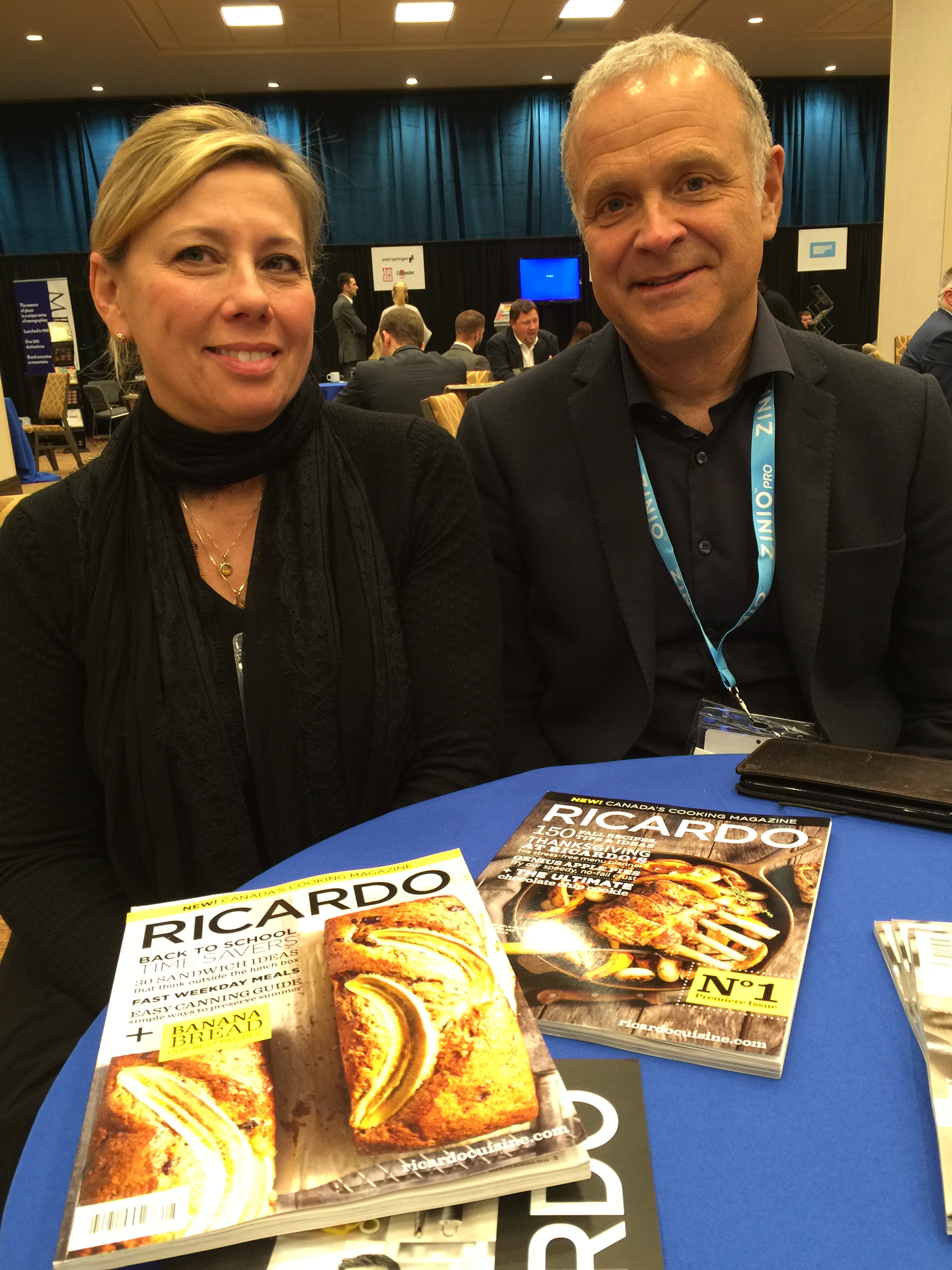
With Joyce at the FIPP Congress in Toronto, Canada.

With Joyce at the FIPP Congress in Toronto, Canada.

Samir Husni: Joyce, my typical last question; what keeps you up at night?

Joyce Nieuwenhuijs: I learned that if you get up very early and you work very hard, you have to sleep. (Laughs) We can work 20 hours, for sure, there is enough to do. But sometimes you have to take off and I learned that from Flow. Sometimes you have to take off and be in the present. A good sleep will help you to grow.

Samir Husni: And Irene; what keeps you up at night?

Irene Smit: I never stay up at night. (Laughs) I sleep a lot. I go to bed very early and I’m so tired, I fall right to sleep.

Samir Husni: Thank you both.

h1

Ricardo: For The Love Of Food, Family, Magazines And Canada… The Mr. Magazine™ Interview With Marie-Josè Desmarais, Publisher & Denis Chamberland, CEO – Ricardo Magazine.

November 5, 2015

From Canada With Love…

“One of the big things that have come out of this is that, perhaps some people thought we were crazy to launch a paper product a year ago; people were looking at us and saying, are you sure you want to do this and we said yes, absolutely. We believe in magazines in the food category and we believe there’s a market and we believe we have something great to offer. And we were confident that it would work and we were right. Actually, people welcome new magazines when you’re doing them the right way, because you’ve seen what’s happened in past years; a lot of publishers have been their own worst enemies, with smaller editorial ratios and decreasing the overall quality of the magazine, such as the paper.” Marie-Josè Desmarais

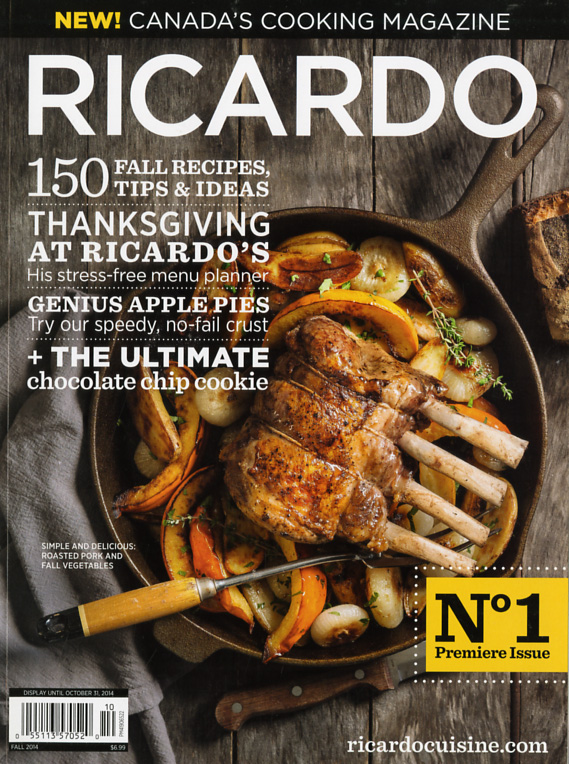
Ricardo 5-6 Celebrity chef, Ricardo Larrivée, brings his highly successful brand to the English/Canadian audience with Ricardo Magazine’s English language version of the 14-year-old French magazine. The launch of the English version of the print publication happened a little over a year ago and according to Marie-Josè Desmarais, Ricardo Magazine’s publisher, the response has been totally positive.

I spoke with Marie-Josè recently and Denis Chamberland, CEO of the magazine, and the conversation served to reinforce the extreme fascination the buying public has with the food category in today’s market even more than the obvious explosion of food titles on newsstands does. It has become the “celebrity” section when it comes to magazine popularity.

We identified several reasons why this phenomenon might be taking place, along with the success of Ricardo’s latest metamorphosis, possible future plans of a more southern expansion for the magazine, and how it was to work with Ricardo himself, because it’s a given, when your brand has a living, breathing persona things can get interesting.

It was an enlightening conversation with two people who value their brand, adore and respect the man it was named for, and have very definitive goals when it comes to the future of the newest addition to the Ricardo family.

So, turn the oven on and get ready to be deliciously motivated as you enjoy the Mr. Magazine™ interview with Marie-Josè Desmarais, Publisher & Denis Chamberland, CEO, Ricardo Magazine.

But first, the sound-bites:


On the genesis of Ricardo Magazine (Marie-Josè Desmarais):
The magazine is new in English, but it’s not new in French, we’re into our 14th year in French, so it has been founded for a while. And Ricardo started the company. As a chef, he started out as a food columnist; he was a TV personality and then he had his own show. So, it’s been like an organic growth that happened with his brand and he is very charismatic.

Ricardo Publisher and CEO On why they decided to launch the English language version of Ricardo in Canada now (Marie-Josè Desmarais):
In order to become a success in English Canada, you really have to be tough because it’s a difficult market. In English Canada we compete against international titles, especially U.S. titles. The distribution process is extremely complex, that’s why we enlist the aid of our Consulting Circulation Executive, Tracey McKinley, who used to head circulation at Rogers Publishing. And you need a lot of money and you need to be very solid as a company, and we’re a private company. We’re not one of those giant companies that have a lot of assets in the market; we have a lot of assets in Québec, but we had to feel that we were very solid in order to do it. And that’s what decided it.

On that “aha” moment when all the planets were aligned and they decided to launch the magazine (Denis Chamberland):
I think Marie-Josè just said it; you have to be financially sound to launch a magazine and it was the right time for us to do so. But we had been thinking about it for years. We were dreaming about being Canada’s cooking magazine. But it was the right time financially to do it and to do it well.

On the most pleasant moment during this magazine journey (Marie-Josè Desmarais):
I’m an ex-editor, so I was publisher on this one. Seeing the first issue is always an amazing moment, when it’s off the printer’s, you know paper still holds its magic. But we did a big launch event on Dundas Square to launch the brand in Toronto. We were all there and we took a train with our clients. We fed people, it was a fun lunch event, and that, for us, was a very natural thing for our company. We love to feed people. And that was the day that we officially launched the magazine.

On the major stumbling block they’ve had to face with the launch of the magazine: That’s a good question. I don’t think there was a massive stumbling block. Obviously, we’re in a market where advertising sales can be a challenge. We’re coming with a big success, and having the success of Fringe behind us opened the door for advertising, so there was really nothing. Everything we’ve heard has been positive. You know, things like, you’re finally launching it or I’m so happy you’re doing it after all these years.

On how it is to work with Ricardo when putting together an issue of the magazine (Marie-Josè Desmarais):
Well, for example, he’ll come into the room where we’re working and entertain us for an hour and a half. He’s just so energetic and there are absolutely no horror stories when it comes to working with Ricardo. The person you see in the magazine or on television is authentic. What you see is what you get. He’s inspiring, dynamic, and full of energy and he tastes everything when he goes around the kitchen.

On the reaction from the English/Canadian market since the magazine has been out (Marie-Josè Desmarais):
Very positive. It was, at last we have a Ricardo magazine. Journalists were all over it; we had very good press I don’t remember seeing anything negative about our magazine. It was all positive and it was gorgeous.

On whether they believe in the future of a print product in this digital age (Marie-Josè Desmarais):
Yes, but we also believe in digital. We invest a lot in in digital. If you look at our website, it’s very, very high-quality and we do invest a lot in our website. We would not invest only in paper. We believe in catching our reader where they want to be. We think that print, for food; our food magazine is like a reference book, a cookbook that’s published six times per year. Nobody ever throws a Ricardo issue away; it’s not for recycling, it’s for consultation. And we believe people go onto the website when they, let’s say, need a quick chicken recipe.

On why they think the food category is so fascinating to audiences right now (Marie-Josè Desmarais):
It’s a cultural phenomenon right now. I think yes, it’s a trend, like there have been lots of trends, but it’s not a fast-moving trend. It’s been slowly building for years and it’s all about connecting people around the meal and the table; it’s not just about eating something delicious. It’s: why do you cook; why do you prepare that? It’s because you want to serve something great to your friends and family. There’s something very generous about that and very calming in these stressful times. We find that food media are like a refuge.

On whether the goal of the magazine is the same as Ricardo’s wish, for everyone who sits down at the table to be at ease and happy (Marie-Josè Desmarais): It is. We want people to sit together and enjoy the meal and that’s the goal. It’s not about competing to make the most complicated dessert; it’s about creating something good for you, delicious, and that will please everyone around the table and also make the cook proud. That’s one of the most important things.

On any future plans to bring Ricardo Magazine further south, across the border (Denis Chamberland):
We would love to see our magazine across the border, so I suppose it’s possible.

On why if expanding across the border is possible, each issue focuses on being “Canada’s Cooking Magazine” (Marie-Josè Desmarais):
Another good question. We want to be noticed because we’re a new title. We also want our audience to know that this is a Canadian magazine that’s tailored to their needs. But the recipes will work in any country. It’s not Canadian food. It’s international-level food, but it’s packaged specially for Canadians.

On her decision to move from a former editor of magazines to the publisher of Ricardo (Marie-Josè Desmarais):
I was an editor-in-chief years ago before I came to Ricardo. I came to Ricardo as a publisher. One of my former bosses, who was the president of Rogers Publishing at the time, Brian Segal, said famously, “You can’t make an editor out of a publisher, but you can make a publisher out of an editor.” And he had started doing that and he was the first in the business who started putting editors in publishers’ positions, and that started around 2007/2008 when the market was really difficult.

On whether she’s more of a content-provider or an experience-maker (Marie-Josè Desmarais):
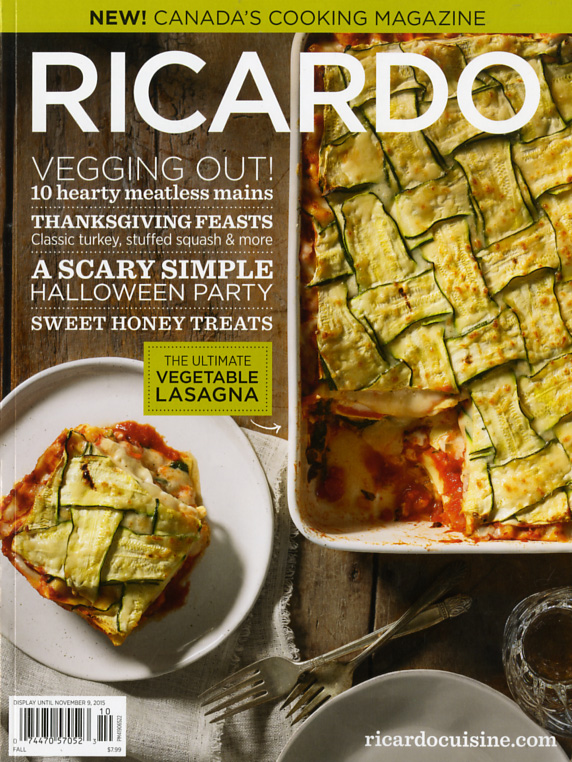
Both. To me it’s the same thing. I don’t see a difference. It depends on the medium. But in Ricardo it’s sitting around the table and everybody is happy eating that lasagna. That’s contentment. That’s what we do.

On what keeps Marie-Josè up at night:
What keeps me up at night is how to get to the next step and just working the new ideas, working them up. And there are so many options; it’s more about where you start. And I reword the puzzle all of the time. A few years ago we didn’t have so many options in the magazine world; it was a very simple, straightforward business. But today, there are so many things you can do.

On what keeps Denis up at night:
Sometimes I would like to go faster, so sometimes I’m thinking about our future and that can keep me up at night because I would like to have our products in other countries and it’s not possible to do too many things at the same time.

And now the lightly edited transcript of the Mr. Magazine™ interview with Marie-Josè Desmarais, Publisher, & Denis Chamberland, CEO, Ricardo Magazine.

Samir Husni: Tell me the genesis of Ricardo Magazine. I know the tagline is New! Canada’s Cooking Magazine, but Ricardo has a history, such as 18 years on television in France and then 8 years in Canada. How did the idea for Ricardo Magazine start?

Ricardo 4-5E

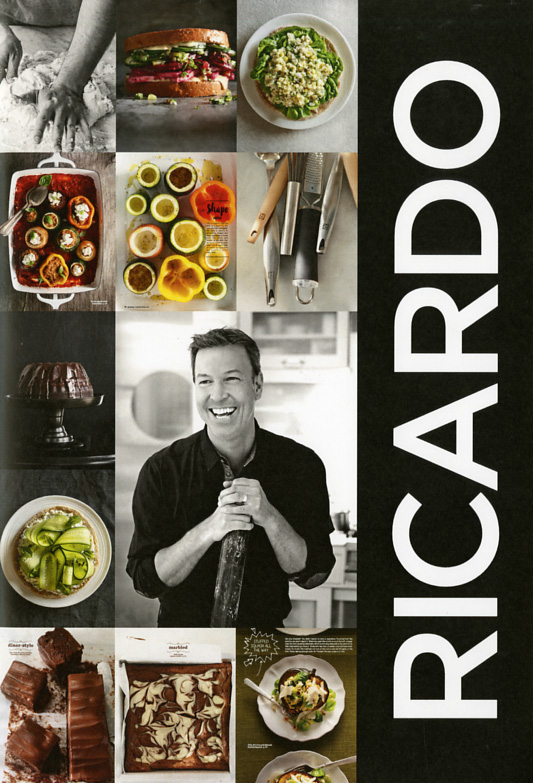
Ricardo 3-3F Marie-Josè Desmarais: The magazine is new in English, but it’s not new in French, we’re into our 14th year in French, so it has been founded for a while. And Ricardo started the company. As a chef, he started out as a food columnist; he was a TV personality and then he had his own show. So, it’s been like an organic growth that happened with his brand and he is very charismatic.

Denis Chamberland: It was natural for Ricardo to launch a magazine because as a columnist, people really liked him and they wanted more content from him than once a week in the paper.

Samir Husni: Why did it take so long for you to launch the English language version of the magazine in Canada, considering that Martha Stewart started this trend about 20 years ago in the States and then Rachael Ray? It would seem that “food” has become the new celebrity when it comes to magazines. So, why did you decide to launch Ricardo in English in Canada now?

Denis Chamberland: We were waiting for somebody as special as Marie-Josè Desmarais to launch a magazine in English.

Marie-Josè Desmarais: (Laughs). We were waiting for the right moment. Launching a magazine in Québec is different. Are you familiar with Québec?

Samir Husni: Yes.

Marie-Josè Desmarais: Business in Québec is very particular. We do have our own system and it’s a place on earth where local magazines sell really well. That’s why we had Elle Québec very early, like 20 years ago.

So, in order to become a success in English Canada, you really have to be tough because it’s a difficult market. In English Canada we compete against international titles, especially U.S. titles. The distribution process is extremely complex, that’s why we enlist the aid of our Consulting Circulation Executive, Tracey McKinley, who used to head circulation at Rogers Publishing. And you need a lot of money and you need to be very solid as a company, and we’re a private company. We’re not one of those giant companies that have a lot of assets in the market; we have a lot of assets in Québec, but we had to feel that we were very solid in order to do it. And that’s what decided it.

Samir Husni: And at that point of conception when you got that “aha” moment and said, let’s do it; can you relive that a little?

Denis Chamberland: I think Marie-Josè just said it; you have to be financially sound to launch a magazine and it was the right time for us to do so. But we had been thinking about it for years. We were dreaming about being Canada’s cooking magazine. But it was the right time financially to do it and to do it well.

Samir Husni: What has been the most pleasant moment in this journey?

Marie-Josè Desmarais: I’m an ex-editor, so I was publisher on this one. Seeing the first issue is always an amazing moment, when it’s off the printer’s, you know paper still holds its magic. But we did a big launch event on Dundas Square to launch the brand in Toronto. We were all there and we took a train with our clients. We fed people, it was a fun lunch event, and that, for us, was a very natural thing for our company. We love to feed people. And that was the day that we officially launched the magazine. We met directly with our future readers.

Samir Husni: What has been the major stumbling block you’ve had to face with this launch and how did you overcome it?

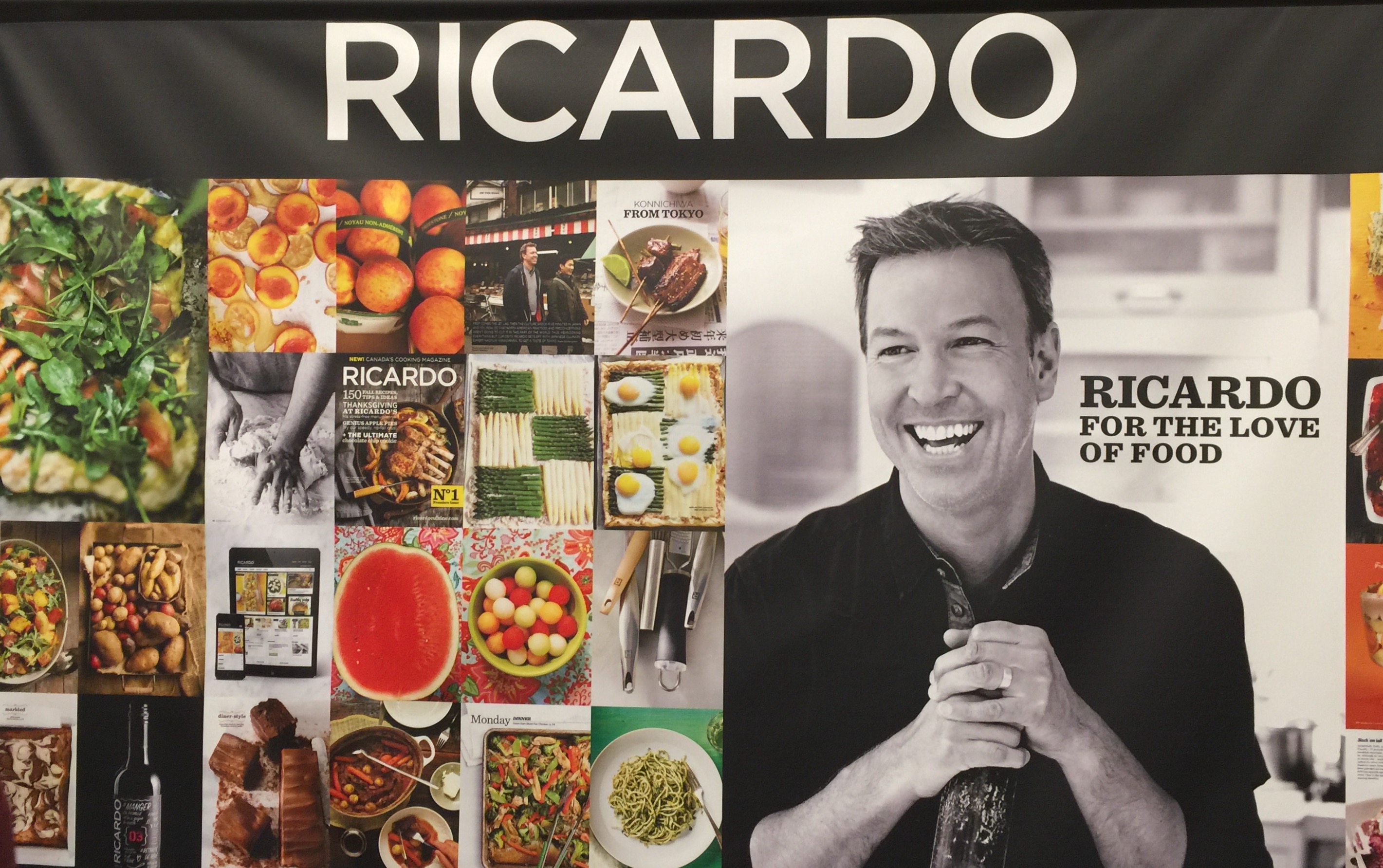
Ricardo poster Marie-Josè Desmarais: That’s a good question. I don’t think there was a massive stumbling block. Obviously, we’re in a market where advertising sales can be a challenge. We’re coming with a big success, and having the success of Fringe behind us opened the door for advertising, so there was really nothing. Everything we’ve heard has been positive. You know, things like, you’re finally launching it or I’m so happy you’re doing it after all these years.

And for the record, we had launched in English years ago, very briefly, when we were with Gesca in France. We launched for about two years and that was around 2007 or so. We were partners with Gesca, it was a soft launch then, with a small circulation. But then Ricardo decided to buy back his shares and become the sole owner of his company.

In that context, it was not sustainable. It didn’t make sense, so Ricardo decided at that time that he wanted to wait and do it big and on his own terms. So, that’s what happened.

Denis Chamberland: And with original content in English. With that first launch, more or less, it was a translation of the magazine. And we don’t want that. We have a magazine for Canadians and it’s great new content for them.

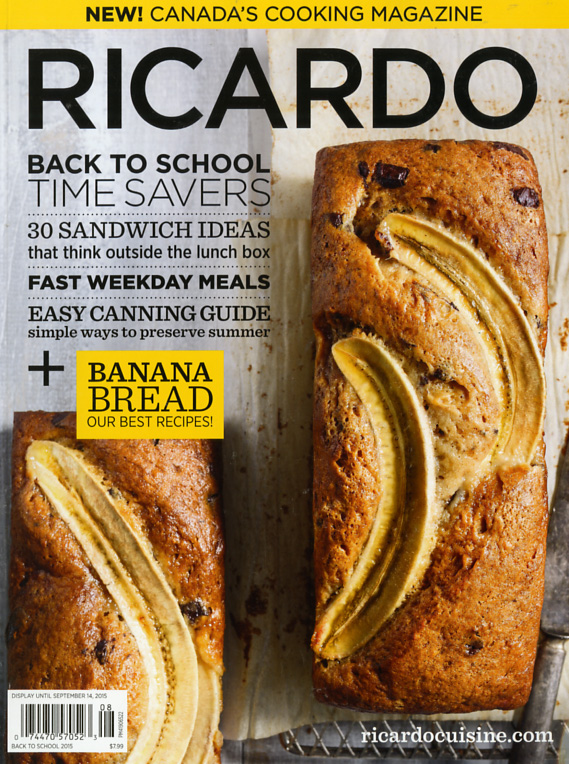
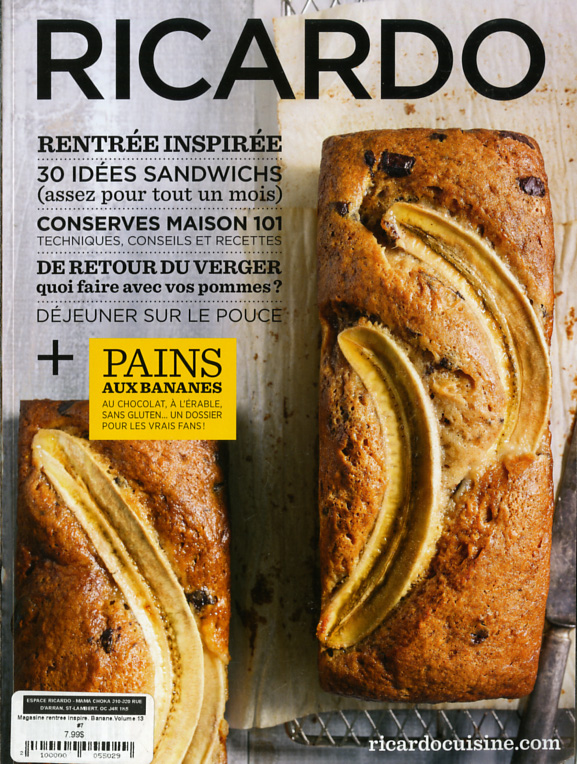
Marie-Josè Desmarais: If you look at the magazine; if you look at it in French and English, you have the same cover and it does look like the same magazine as the French version, but if you look at it more closely, you’ll see that our columnists are English/Canadian for the English/Canadian version of the magazine out of respect for our readers. Not because our columnists aren’t good, but we want to encourage the business here and also we want to have a truly Canadian voice, so we’re adapting to the market. You’ll see that throughout the issue; it’s very important for us to have those columnists. We also adapt the content.

Samir Husni: Sometimes I hear fun stories about working with celebrities when it comes to creating a magazine and sometimes I hear horror stories; describe a typical workday with Ricardo as you’re creating an issue of the magazine.

Marie-Josè Desmarais: Well, for example, he’ll come into the room where we’re working and entertain us for an hour and a half. He’s just so energetic and there are absolutely no horror stories when it comes to working with Ricardo. The person you see in the magazine or on television is authentic. What you see is what you get. He’s inspiring, dynamic, and full of energy and he tastes things when he goes around the kitchen.

Samir Husni: And what has been the reaction coming from the English/Canadian market since the magazine has been out?

Ricardo 1-1 Marie-Josè Desmarais: Very positive. It was, at last we have a Ricardo magazine. Journalists were all over it; we had very good press I don’t remember seeing anything negative about our magazine. It was all positive and it was gorgeous.

One of the big things that have come out of this is that, perhaps some people thought we were crazy to launch a paper product a year ago; people were looking at us and saying, are you sure you want to do this and we said yes, absolutely. We believe in magazines in the food category and we believe there’s a market and we believe we have something great to offer.

And we also believe that the only way we could do this magazine was to go high-quality, very good paper quality and excellent photography; a very high editorial ratio versus advertising, and then do it in a deliberate way, not a desperate way. Our ratio is always 70% editorial, with a high cover price of $7.99. At launch it was $6.99, which is pretty high in this market.

But we decided to go with quality; to do a statement of quality and excellence. And we were confident that it would work and we were right. Actually, people welcome new magazines when you’re doing them the right way, because you’ve seen what’s happened in past years; a lot of publishers have been their own worst enemies, with smaller editorial ratios and decreasing the overall quality of the magazine, such as the paper. And we respect American publishers, everybody works hard, but we really believe we have a good recipe for success.

Samir Husni: So you believe in the future of a printed product in this digital age?

Marie-Josè Desmarais: Yes, but we also believe in digital. We invest a lot in in digital. If you look at our website, it’s very, very high-quality and we do invest a lot in our website. We would not invest only in paper.

Denis Chamberland: We believe in both.

Marie-Josè Desmarais: Yes, we do. We believe in catching our reader where they want to be. We think that print, for food; our food magazine is like a reference book, a cookbook that’s published six times per year. Nobody ever throws a Ricardo issue away; it’s not for recycling, it’s for consultation. And we believe people go onto the website when they, let’s say, need a quick chicken recipe. And they can go onto our website and find it. So, you go to both platforms for different reasons.

Samir Husni: Why do you think the food category, specifically in print magazines, has become the celebrity category of the 21st century, compared to the end of the 20th century when it was actual celebrities and other topics? Now, suddenly, it’s food. In the United States more food titles are published on a weekly basis, whether it’s bookazines or digest-sized, than in any other category. Why do you think there’s such a fascination with food today?

Marie-Josè Desmarais: (Laughs) That’s a big social and cultural question.

Denis Chamberland: I think people have become very health conscious; they want to take care of themselves. Same as running has never been so popular. Food is part of that movement.

Marie-Josè Desmarais: And it’s also a cultural phenomenon right now. I think yes, it’s a trend, like there have been lots of trends, but it’s not a fast-moving trend. It’s been slowly building for years and it’s all about connecting people around the meal and the table; it’s not just about eating something delicious. It’s: why do you cook; why do you prepare that? It’s because you want to serve something great to your friends and family. There’s something very generous about that and very calming in these stressful times. We find that food media are like a refuge.

And I also think that people are more informed now with the speed of communications. You can go and look at a restaurant menu where you can find out exactly what’s being served in Copenhagen or somewhere in Brazil; so it’s part of our world culture.

Samir Husni: I read Ricardo’s editorial in this issue and he wants everyone to feel at ease and happy when they’re sitting around the table. Is that also the goal with the magazine?

Ricardo 2-2 Marie-Josè Desmarais: It is. We want people to sit together and enjoy the meal and that’s the goal. It’s not about competing to make the most complicated dessert; it’s about creating something good for you, delicious, and that will please everyone around the table and also make the cook proud. That’s one of the most important things. And that the recipes are no-fail. And why, you might ask, are they no-fail? It’s because they’re tested to death; we don’t triple-test, we test 12 times if we need to. We test until it’s perfect. This magazine is about making people happy and proud to serve something great to family and friends.

Samir Husni: Are there any future plans to expand Ricardo’s borders, such as going a little more toward the south from Canada?

Denis Chamberland: We would love to see our magazine across the border, so I suppose it’s possible.

Samir Husni: So, why the focus on every issue as “Canada’s Cooking Magazine?”

Marie-Josè Desmarais: Another good question. We want to be noticed because we’re a new title. We also want our audience to know that this is a Canadian magazine that’s tailored to their needs. So, for instance, all of the ingredients that we talk about in our recipes will be available in most Canadian grocers. The wines we talk about are available at wine stores and the novelties, if you’re talking about a cookbook or a jar of jam; it doesn’t matter, everything is easily available. And that’s very highly appreciated by our audience. We’ve gotten a lot of comments that say, at last, a magazine that’s made in Canada and that helps me in my everyday life. You can find everything in it easily.

But the recipes will work in any country. It’s not Canadian food. It’s international-level food, but it’s packaged specially for Canadians.

Samir Husni: We are finding out that identification with the audience is very important. You’re looking for customers who count, rather than counting customers.

Marie-Josè Desmarais: Exactly. I love the way you said that.

Samir Husni: And that’s what grabbed me with Ricardo. I had heard about it before, but I had never seen it until recently. It certainly grabbed my attention.

Marie-Josè Desmarais: Thank you. I’m glad you liked it.

Samir Husni: As a journalist-turned-publisher, how easy or hard was that decision for you? Or was it simply easy because who could better explain the magazine than a journalist or editor?

Marie-Josè Desmarais: I was an editor-in-chief years ago before I came to Ricardo. I came to Ricardo as a publisher. One of my former bosses, who was the president of Rogers Publishing at the time, Brian Segal, said famously, “You can’t make an editor out of a publisher, but you can make a publisher out of an editor.” And he had started doing that and he was the first in the business who started putting editors in publishers’ positions, and that started around 2007/2008 when the market was really difficult. He said that content was the driving force behind the success in magazines and that’s why he decided to put editors in those positions.

Samir Husni: Do you believe it’s the content that drives magazines or is it the experience-making? Are you more of a content-provider or an experience-maker?

Marie-Josè Desmarais: Both. To me it’s the same thing. I don’t see a difference. It depends on the medium. But in Ricardo it’s sitting around the table and everybody is happy eating that lasagna. That’s contentment. That’s what we do.

But it’s not just the thing about circulation strategies, which are very important or advertising sales strategies and all of those business models that you’ve seen in magazines where you would inflate your circulation at a very high cost in order to get more money from advertisers without really caring about your audience. That’s not what we do. We do a great product, a great magazine with great content and great recipes, and the rest comes.

Samir Husni: Is there anything else you’d like to add?

Marie-Josè Desmarais: You’ll see us in paper, but you’ll also see us in digital as well; whatever platform people want to consume their content on.

Denis Chamberland: It’s the same experience and the same great content and the same audience.

Samir Husni: What motivates you to get up in the mornings and say it’s going to be a great day?

Denis Chamberland: Creating great content.

Marie-Josè Desmarais: That’s it.

Denis Chamberland: Make sure people relate to the brand more and more, day after day.

Marie-Josè Desmarais: I agree.

Samir Husni: My typical last question; what keeps you up at night?

Marie-Josè Desmarais: What keeps me up at night is how to get to the next step and just working the new ideas, working them up. And there are so many options; it’s more about where you start. And I reword the puzzle all of the time. A few years ago we didn’t have so many options in the magazine world; it was a very simple, straightforward business. But today, there are so many things you can do. You just want to pick the right path. With a small company we can rewrite that path if we have to and adapt it to the new reality.

Denis Chamberland: Sometimes I would like to go faster, so sometimes I’m thinking about our future and that can keep me up at night because I would like to have our products in other countries and it’s not possible to do too many things at the same time. We’re working on this new product that we launched last year and we want to make sure that it’s a success.

Samir Husni: Thank you.

h1

Butternut: Creating Content That’s Mentally And Physically Nutritious For Young Readers – The Mr. Magazine™ Interview With Jill Colella, Founder, Butternut Magazine.

October 29, 2015

A Mr. Magazine™ Launch Story…

“Having been a teacher, I worked in a school that had no lack of resources. It was a private school in D.C. But whenever I tried to use the laptop cards or bring my kids to one of those free computer labs, we always had trouble. Through the tried-and-true ink on paper; I was never let down, nor were my kids. And just the tactile nature of it and being able to pull it off a shelf and escape into text; it’s just a kind of reprieve that kids need to escape the noise in their lives.” Jill Colella

200px_pumpkin cover A children’s magazine that teaches reading literacy and food literacy; Butternut is a breath of fresh air on a hot sweltering day at the playground. The magazine encourages basic food and reading knowledge by inspiring curiosity about food in young readers, and adult kids too. It’s fun, smart and unique, a new launch that Mr. Magazine™ definitely gives two thumbs up.

Jill Colella is founder of Butternut and also of the five-year-old Ingredient Magazine, a food magazine for young readers 6-12. Jill has been working with kids, both as a teacher and a writer of educational materials, for quite some time. And as a very picky eater who became a chef to get a better understanding of different foods, she also knows a thing or two about nutrition and great recipes

I spoke with Jill recently about her new ‘baby’ Butternut and its targeted audience of 3-6 year-old’s, who not surprisingly, have an innate curiosity about where their food comes from and how it’s prepared. Getting the word out about the magazine is paramount as she moves forward to show that food and reading are connected in more ways than one might think. It’s a concept that has originality and a whole lot of passion behind it from a young woman who is dedicated to the brand and the cause. The magazine is supported by a subscription-base and shipped to many school libraries across the country as teachers all over are discovering the food and words relationship and finding it very beneficial to their students.

So, sit back and get ready to enjoy a conversation with a real entrepreneur and a woman who isn’t afraid to stay true to her own DNA and follow her dreams…the Mr. Magazine™ interview with Jill Colella, Founder, Butternut Magazine.

But first, the sound-bites:


jill_blue.background On where the idea for Teach Kids to Cook media came from:
It really had been simmering for a long time and it came out of my being very unhappy in a job on Capitol Hill more than ten years ago. I took the training to be a personal chef and never actually became a personal chef. And so I used all of the training that I had gotten and started a business giving hands-on cooking lessons for kids. But it mostly meant birthday party entertainment. And I loved it. I loved the direct, hands-on teaching and at that time I was building up a little reputation in the area and I eventually became a spokesperson for a publishing company and most of their authors were in England. It ultimately became a relationship with this publisher where I wrote books for them and did educational writing and all kinds of PR-type stuff and I really loved it. And I had this idea in the back of my mind for a while; why wasn’t there a magazine about food for kids?

On how she came up with the tagline for the magazine and the driving force behind it:
I was invited, probably two years ago now, to speak at a conference that was held by a school of architecture. When I wrote that speech was the first time that food as a lexicon occurred to me and that’s really the root of Butternut, the idea that food literacy can go hand-in-hand with reading literacy. And as a sort of system of language, food and the English language function very similarly. We have parts of speech; they work together in different order to create meaning. And the fundamentals of food work the same way. If you don’t have basic vocabulary, you can’t formulate a sentence. If you don’t have the basic vocabulary of food; if you can’t identify what is a potato, what is a sweet potato, and what is a yam; you can’t create sentences with those.

On how she plans to market Butternut:
The ongoing challenge of independent children’s magazine publishers is how do you make this a business instead of a hobby? And that’s the double-edged sword. I don’t have ambitions of being on the newsstands, unless someone reads this interview and finds a good way for me to make that happen. And for me distribution is about good old-fashioned hustle and individual outreach to those inspired. Subscriptions are available online, because it is a gift-able item, so lots of grandparents, aunts and uncles love to give this to members of their families.

On how she felt when she held the first issue of Butternut in her hands:
The way that you described it is pretty accurate. When I held it in my hand, it made sense; it just made sense. And I felt a sense of satisfaction. It’s making it as a hypothesis when I have the results in my hand and I get to interpret that data. And for me it made sense.

On whether Butternut and Ingredient Magazine will grow together as happy siblings:
Definitely together. Ingredient has five years of content and Butternut can pull from that, where it’s age appropriate and meaningful. In some ways, we don’t have to reinvent the wheel. Of course, it won’t be identical content, but we already know what readers were interested in, where things were interesting and fun for our team of editors and writers.

On why she thinks there has been such a fascination with the food category in magazines, even with young children:
I think the interest in food is in response to the Great Recession. When you don’t get a raise or your job is scaled back or there’s no overtime money, things like dining out go first. And you have to think about where you’re going to invest the money you do have in luxuries and in some ways that put people in the mindset of finding the pleasure in food again. It’s a hobby that you can invest time and energy in. There’s this beautiful alchemy; you can take ingredients that don’t really cost that much and are pretty accessible to most people, and create something amazing and offers a great experience in the creation of it. So, I think that’s really where it comes from.

On the major stumbling block she will face in the future:
It’s always going to be numbers and getting a robust circulation. And the question is what will be the outcome of that? In my case, more than likely, price point. Each magazine, Ingredient and Butternut, is published almost six times per year. And the price for the subscription is $35 to U.S. addresses. And to many people, that’s expensive and it is to some extent. But we’re very different from other magazines. Of course, we look like other magazines, but we’re different.

On what motivates her to get up in the mornings and never quit:
That’s a great question. This business moves me and I need to see what happens with it. I would never have told you in a million years, if this were 10 years ago, that I would be making kids magazines about food. (Laughs) Everything that I’ve really done was all of these weird moments that aligned so that I could see the light on the path that led up to all of this. And nothing else in my life has been that way, even though I’ve written tons of educational material for teachers; I’ve been a teacher myself; I’ve been involved in publishing; there’s just something different here.

On why she thinks there is still a need for ink on paper in a digital world:
Having been a teacher, I worked in a school that had no lack of resources. It was a private school in D.C. But whenever I tried to use the laptop cards or bring my kids to one of those free computer labs, we always had trouble. Through the tried-and-true ink on paper; I was never let down, nor were my kids.

On anything else she’d like to add:
Yes; I’ll get on my soapbox for a minute. I also worked in children’s book publishing and I worked for an imprint that’s based here in Minneapolis. And I did that job to learn a lot about how the publishing world works. Most of that job was a publicity job and so when you have a new book there are protocols for how to get that book reviewed. You have a list of people who expect to get a ton of galleys and books twice a year and their sole purpose is to write about them and then put that out into the world. Magazines don’t have that at all. And I just corresponded with School Library Journal and asked them if they had a protocol for magazine reviews. And they don’t. Even something like Highlights that has been around for a very long time and other great magazines; there’s a new magazine for kids about computers and coding; there’s a great magazine for kids in the military who move all around because of Mom and Dad’s careers, and librarians have no idea that these exist.

On what keeps her up at night:
The easy answer is circulation. It’s really getting the word out there into the world about these magazines. There will be a point where I run out of runway and I see that in my colleagues who also do independent magazines for children. It’s getting these materials into the hands of people who will most benefit from them.

And now the lightly edited transcript of the Mr. Magazine™ conversation with Jill Colella, Founder, Butternut Magazine.

Samir Husni: Congratulations on the first issue of Butternut.

Jill Colella: Thank you.

sm_2015SeptOct Samir Husni: I know you’ve done Ingredient Magazine, but tell me a little about the Teach Kids to Cook media as a company. Where did the idea for Teach Kids to Cook come from?

Jill Colella: It really had been simmering for a long time and it came out of my being very unhappy in a job on Capitol Hill more than ten years ago. I worked in publishing for a large, well-known think tank and I just ultimately wasn’t feeling it there anymore. I had a mentor who retired and was replaced with someone that I just couldn’t see eye-to-eye with and one day I literally quit on the spot, packed up my things and walked out the door. I remember it was 9:30 in the morning when that happened. I was downtown in D.C. after I left wondering what came next. (Laughs)

I had been interested in food and cooking and interestingly enough, Julia Child’s Kitchen exhibit had just opened at the Smithsonian and I hadn’t been to it yet, so I decided since I was downtown anyway, that’s where I was going to go. So, I literally had my bag of personal effects that I had taken when I walked out, and went and just stood in Julia’s Kitchen and thought about what comes next.

At that point, I had been flirting with the idea of becoming a personal chef. So, that is in fact what I did. I went and I took training to do that. I myself had always been a picky eater and that’s’ why I started getting interested in food and cooking.

And it was the job on Capitol Hill that forced that. All of a sudden I was going to executive lunches and the boardroom on the eighth floor, where it was a set menu from caterers, and it was things that I had never eaten before. And as a finicky eater, it stressed me out terribly. Something that seemed as delicious and ordinary to most people, such as salmon, sort of induced panic attacks in me. (Laughs) I realized that I needed to expand my palate, so it was in that position when I began to do that. And that’s when the interest in food came in.

I took the training to be a personal chef and never actually became a personal chef, because I was this girl who’d rather eat grilled cheese than salmon or some sophisticated dish. So, I wondered if I could actually pull it off.

And so I used all of the training that I had gotten and started a business giving hands-on cooking lessons for kids. But it mostly meant birthday party entertainment. You could pay Chef Jill to come do a birthday party for your kid and we would make something to eat and we’d make something that the other kids could take home as a party favor. And I did that for a few years.

And I loved it. I loved the direct, hands-on teaching and at that time I was building up a little reputation in the area and I eventually became a spokesperson for a publishing company and most of their authors were in England. They had a really hard time connecting their cooking authors with American journalists. They would send me the books and I would read them all and I would give interviews about the virtues of kids and cooking. And this was pre-Mrs. Obama, but the kids cooking just started to take off. And I enjoyed that.

It ultimately became a relationship with this publisher where I wrote books for them and did educational writing and all kinds of PR-type stuff and I really loved it. And I had this idea in the back of my mind for a while; why wasn’t there a magazine about food for kids? So, finally I just made one to see what it would look like and that was Ingredient Magazine in 2010 and had been producing those at that point.

Butternut has come along more recently. It was another one of those ideas that sort of poked at me and I just needed to make one and see what it looked like. The other thing that we’re doing as a company is to look through the different content that we have and find ways to identify and fill needs in the market that aren’t being met right now.

There is a large category of kid’s cookbooks, but they don’t necessarily answer how or why or dig more deeply into the more fundamental levels of curiosity. So, we’re in the process of creating e-books to do that and eventually some of those books will be print books as well.

Samir Husni: I noticed on the first issue of Butternut the tagline is: food literacy for young readers and eaters. And somehow you don’t think about literacy when you’re thinking about food. How did you come up with that tagline and what’s the fertilizer behind Butternut that urges it to grow?

200px_whats for lunch bn Jill Colella: Much of the time that I was Chef Jill giving birthday parties on the weekends and also piloting a magazine because it was an idea that I couldn’t get out of my mind, I also had a full-time job and that was as an English teacher. So, I basically viewed the world through the lens of an English teacher. And as much as I liked teaching literature, my skill is teaching writing and that’s what I love more than anything else, kind of skill-building.

I was invited, probably two years ago now, to speak at a conference that was held by a school of architecture. I had to double-check when I got this voice mail that a school of architecture was inviting me to speak at their conference. It just didn’t make sense.

It turned out that this particular college focused on outdoor play spaces, educational outdoor play spaces for children and some of my work had been in kids and gardening and that’s what they were interested in. So, the majority of attendees at this conference were teachers of very young children, ages 3-6. So, I gave my talk and I really had to think about what I was trying to say. I told my story and talked about the virtues of letting kids get hands-on in the dirt.

When I wrote that speech was the first time that food as a lexicon occurred to me and that’s really the root of Butternut, the idea that food literacy can go hand-in-hand with reading literacy. And as a sort of system of language, food and the English language function very similarly. We have parts of speech; they work together in different order to create meaning. And the fundamentals of food work the same way. If you don’t have basic vocabulary, you can’t formulate a sentence. If you don’t have the basic vocabulary of food; if you can’t identify what is a potato, what is a sweet potato, and what is a yam; you can’t create sentences with those. Language acquisition comes very early on; we don’t think anything of talking to babies when they don’t talk back.

It’s funny, magazines exist about poetry, dinosaurs and baby animals, and that’s all well and good, and those publications are wonderful, exciting and educational, but kids have a lot more debate ability and love and curiosity about food, and that’s from day-one, than they do about baby seals, which maybe they’ll never encounter in real life. Or they do occasionally at the zoo or something like that.

For me, there is a fundamental connection between building blocks and learning how to order those to be really empowered. The greatest thing that you can teach children right now for a lifetime of success is reading literacy. That is how to find meaning, how to ask questions, how to be a critical thinker, and food literacy. That’s a running start.

Samir Husni: What are your plans in terms of the distribution of the magazine? Will it be available for subscriptions and on the newsstands, because I noticed with the first issue that there’s no advertising and no cover price. How are you going to market Butternut?

Jill Colella: The ongoing challenge of independent children’s magazine publishers is how do you make this a business instead of a hobby? And that’s the double-edged sword. I don’t have ambitions of being on the newsstands, unless someone reads this interview and finds a good way for me to make that happen. (Laughs) It’s a speculative venture, as you well know. The thought of hundreds of copies being shredded makes me physically ill. (Laughs again) But that’s likely not going to happen, unless I can sell into a major distributor. I send copies of the magazine to Costco and Wal-Mart, to their magazine acquisition arm on a weekly basis. But if they never accept, really my primary audience is schools and libraries.

And for me distribution is about good old-fashioned hustle and individual outreach to those inspired. Subscriptions are available online, because it is a gift-able item, so lots of grandparents, aunts and uncles love to give this to members of their families. Those are the majority of subscribers, families and schools and libraries.

Samir Husni: When that first issue came back from the printer and you held it in your hand; can you describe for me how you felt at that moment? From conception to birth, people often compare the journey of launching a new magazine to pregnancy; how did you feel when you held your new baby in your hand for the first time?

Jill Colella: The way that you described it is pretty accurate. When I held it in my hand, it made sense; it just made sense. And I felt a sense of satisfaction. It’s making it as a hypothesis when I have the results in my hand and I get to interpret that data. And for me it made sense.

Samir Husni: And how is the new ‘baby’ in comparison to Ingredient? Are they going to be growing up steadily together or will one outgrow the other?

Cover.2014.mar.apr Jill Colella: Definitely together. Ingredient has five years of content and Butternut can pull from that, where it’s age appropriate and meaningful. In some ways, we don’t have to reinvent the wheel. Of course, it won’t be identical content, but we already know what readers were interested in, where things were interesting and fun for our team of editors and writers.

The other thing too is that I have been surprised that more middle schools purchased Ingredient than I thought they would. I taught 7th and 8th grade English for a very long time and I know the level of sophistication that kids at that age can read at and what their attention level is and also what topics they might be interested in. So, I’m pleased; I’m very pleased that school librarians are seeing value in Ingredient as a title for middle schools.

And food and cooking is a classic topic, where you can see that kind of high-low subject area where there are cookbooks and it’s not a babyish book or a babyish magazine. So, if you’re in 7th grade and you’re reading this magazine, it doesn’t feel like you’re reading something better-suited to third graders. So, that’s important. It allows us to really run with the age group 3-6 and really dial-in and calibrate age appropriateness in both magazines.

Samir Husni: Almost for the last five years, since Ingredient came onto the marketplace, we’ve seen more food magazines than any other category, aimed at every age group, about every specification and specialization under the sun. Why do you think there’s this fascination with food, even from such young ages as 3-6 year-old’s, which is Butternut’s targeted group?

Jill Colella: I think the interest in food is in response to the Great Recession. When you don’t get a raise or your job is scaled back or there’s no overtime money, things like dining out go first. And you have to think about where you’re going to invest the money you do have in luxuries and in some ways that put people in the mindset of finding the pleasure in food again. It’s a hobby that you can invest time and energy in. There’s this beautiful alchemy; you can take ingredients that don’t really cost that much and are pretty accessible to most people, and create something amazing and offers a great experience in the creation of it. So, I think that’s really where it comes from.

And while piano and Mandarin Chinese lessons and all those things are great for kids, it’s a wonderful thing to realize that we’re standing on this great, sort of uncut diamond with kids and food. We can spend hundreds of dollars on camp and Mandarin Chinese lessons, but we can actually go in our kitchens and have some meaningful time too.

Samir Husni: Now, with two magazines under your belt, what do you think will be your major stumbling block in the future and how will you overcome it?

Jill Colella: It’s always going to be numbers and getting a robust circulation. And the question is what will be the outcome of that? In my case, more than likely, price point. Each magazine, Ingredient and Butternut, is published almost six times per year. And the price for the subscription is $35 to U.S. addresses. And to many people, that’s expensive and it is to some extent. But we’re very different from other magazines. Of course, we look like other magazines, but we’re different.

Recently, I saw a promotion on Facebook that was the price of four magazines and they were Better Homes and Gardens, maybe Food Network Magazine and maybe Rachael Ray, those kinds of magazines, four of them for an entire year for $12. The truth is that I’ll never be able to produce Ingredient and Butternut for that price. We’re just not subsidized by advertisers. That’s not a place that I want to go with kids and food, not that it’s inconsistent with my values, but kids advertising food to kids is a can of worms and that industry is self-regulated. I do know that I don’t want to use that cover to advertise Pop-Tarts. I didn’t grow up on Pop-Tarts and whether I love them or I don’t doesn’t matter. I would rather have the food experience and for it to be truly about curiosity and not about selling kids. So, that’s my stumbling block, helping people see the value in supporting independent magazines for children, because more of us keep showing up and it’s a really tough industry.

Samir Husni: When I was reading the first issue of Butternut; what fascinates me is that combination of eating with purpose, eating for both the brain and the body. You’ve hit on a very unique DNA for a children’s magazine.

Jill Colella: Thank you.

Samir Husni: Now that you’ve moved from D.C. and the corporate world and you’re doing these magazines as an entrepreneur, what makes you tick and click and motivates you to get up each morning and say to yourself, I’m not giving up?

Jill Colella: That’s a great question. This business moves me and I need to see what happens with it. I would never have told you in a million years, if this were 10 years ago, that I would be making kids magazines about food. (Laughs) Everything that I’ve really done was all of these weird moments that aligned so that I could see the light on the path that led up to all of this. And nothing else in my life has been that way, even though I’ve written tons of educational material for teachers; I’ve been a teacher myself; I’ve been involved in publishing; there’s just something different here.

And that to me means that I just need to see it out. And if it hits and clicks and has the same power as Highlights and is around for 50 years that will be amazing. That’s what I want. But if it doesn’t, I still believe this is the truest expression of my DNA. And I just need to put it into the world. And that’s why I get up each and every day.

Samir Husni: Why do you think your audience, the schools and the children, still need an ink on paper publication in today’s digital world?

cover.2015.jan.feb_lowres Jill Colella: Having been a teacher, I worked in a school that had no lack of resources. It was a private school in D.C. But whenever I tried to use the laptop cards or bring my kids to one of those free computer labs, we always had trouble. Through the tried-and-true ink on paper; I was never let down, nor were my kids. And just the tactile nature of it and being able to pull it off a shelf and escape into text; it’s just a kind of reprieve that kids need to escape the noise in their lives.

Samir Husni: Is there anything else you’d like to add?

Jill Colella: Yes; I’ll get on my soapbox for a minute. I also worked in children’s book publishing and I worked for an imprint that’s based here in Minneapolis. And I did that job to learn a lot about how the publishing world works. Most of that job was a publicity job and so when you have a new book there are protocols for how to get that book reviewed. You have a list of people who expect to get a ton of galleys and books twice a year and their sole purpose is to write about them and then put that out into the world.

Magazines don’t have that at all. And I just corresponded with School Library Journal and asked them if they had a protocol for magazine reviews. And they don’t. Even something like Highlights that has been around for a very long time and other great magazines; there’s a new magazine for kids about computers and coding; there’s a great magazine for kids in the military who move all around because of Mom and Dad’s careers, and librarians have no idea that these exist. There’s no outreach arm to this audience, and really no one that I found who specializes in periodicals.

I wish there was a blogger who was a mouthpiece for these magazines. We have wonderful people creating beautiful, much-needed magazines and there’s no way to get the word out about them to the rest of the world to decision-makers who have purchasing power. Just pay a little bit more attention to magazines.

I remember reading a magazine when I was a kid; someone bought me a Barbie magazine. I can still see it in my mind, completely clearly. It’s different in ethos from what I do. But that magazine influenced me and it is a large part of what I do. It’s one of the dots on the path.

There are a bunch of kids reading these magazines and I would love to see some of these outlets get recognition.

Samir Husni: My typical last question; what keeps you up at night?

Jill Colella: The easy answer is circulation. It’s really getting the word out there into the world about these magazines. There will be a point where I run out of runway and I see that in my colleagues who also do independent magazines for children. It’s getting these materials into the hands of people who will most benefit from them. Connecting with the audience and making sure that I have a viable business to do that.

Samir Husni: Thank you.

h1

Cannabis Now Magazine: Bringing A Higher Level Of Conversation And Entertainment To The Cannabis Industry – The Mr. Magazine™ Interview With Eugenio Garcia, Co-Founder & Publisher, Cannabis Now Magazine

October 23, 2015

“How can you be relevant if you’re a print publication when you have to be able to bring all the information together, digest it, make it pretty and distribute it? The print publication is I would say a quarter of our business. The media aspect of it – the web presence, the mobile app, the videos – they all support the now, the immediacy of the information. But the print publication puts it into a medium that is coming back into popularity. I think in the last 10 years for publications there has been a downtrend of desire for print publications. But, specifically for niche focuses and for connoisseurs, having that print medium is a fundamental need in the core business.” Eugenio Garcia

Cannabis Now 1-1 The cannabis industry is booming as the laws begin to change in the United States regarding legalization of the plant for more than just medicinal reasons. Many states are lifting the veil on the usages of cannabis for recreation, while still touting its benefits for assistance with many illnesses, such as epilepsy and cancer. Some people say that within 10 years cannabis will be legal from coast to coast. Whether that’s true or not, remains to be seen. But one truth that never changes is that magazines are the reflectors of our society. And the cannabis industry is no exception as publications about the plant, the lifestyle and the business of growing it, have begun to be plentiful on newsstands across the country.

One that stands out above many of the others is Cannabis Now, which according to co-founder and publisher, Eugenio Garcia, brings cannabis to a higher level in any conversation. I spoke with Eugenio recently about the magazine and he shared with me many interesting facets of the brand, such as Cannabis Now was the first cannabis magazine in the world for sale on iTunes and one of the few distributed in Barnes & Noble. And a little history about how the magazine was started in 2012, when after Montana abruptly made it illegal for marijuana companies to advertise, Cannabis Now quickly shifted into the national market. Eugenio oversaw the expansion, helping Cannabis Now become the first magazine since the 1970s to successfully reach across the nation. In the process, he brought the magazine’s social media reach from 35,000 in August 2013 to 3.5 million followers in August 2015 — and according to Eugenio, made its Facebook page the largest interactive media page about marijuana in the world.

Worthy accomplishments for a young man who has been a long-time advocate for cannabis and an entrepreneur since he began working as a cannabis industry consultant in 2008.

So, I hope you enjoy the Mr. Magazine™ conversation with Eugenio Garcia – even though it isn’t actually 420. It’s always the right time for a great magazine story.

But first, the sound-bites:


Eugenio Garcia On his ‘Aha” moment that gave him the idea for Cannabis Now:
The ‘Aha’ moment came from the fact that I was a political science graduate with a minor in business. I was constantly looking for an opportunity. Here in Montana, I believe it was in 2004, when the laws changed and medical cannabis became legal. In 2010, I was living in San Francisco, and I had a close friend who was doing some growing of cannabis in Montana so I brought him back a publication called the West Coast Leaf, which was a newspaper-type publication that was focused on cannabis. I brought it to him as a gift, and it was he who actually came up with the concept in a moment saying, ‘We should have a medical cannabis journal for the rocky mountain region.’ That was the ‘Aha’ moment and we put out two publications that were focused to be a quarterly for the rocky mountain region.

On his plan to become one of the top 100 magazines in the nation: Well, we built a foundation, a core group of about 10 passionate professionals in our core team that work on the day-to-day, and then we’ve accumulated a group of over 200 to 300 photographers, contributors, activists, politicians, who contribute to our magazine. We’ve developed the core base from which to build upon, and define our brand image, our quality standards, and our tone.

On the DNA of the magazine and its mission statement:
The DNA and editorial mission of the magazine is to educate, enlighten, and entertain. So, it’s really a three-tiered focus, which is fundamentally based on articles to bring education, first and foremost, to the readers. The demand for information is at the highest level. We also want to enlighten, so we want to bring a higher level of understanding about cannabis and the industry to the nation and the world. And we also want to entertain.

On whether he’s trying to reach both the business and consumer communities with the magazine:
Fundamentally, we are going after the end user. The business user, business leader is a natural by-product. Because we are in a very heightened level of transition in this space, there is more focus on the business than will be in the future just because of the acceleration.

On why he thinks Cannabis Now in a print publication is the best resource for immediate information on cannabis:
How can you be relevant if you’re a print publication when you have to be able to bring all the information together, digest it, make it pretty and distribute it? The print publication is I would say a quarter of our business. The media aspect of it – the web presence, the mobile app, the videos – they all support the now, the immediacy of the information. But the print publication puts it into a medium that is coming back into popularity. The print magazine is not the all-encompassing of what Cannabis Now is, but it’s a complement. Sometimes there is immediate, news-breaking stuff happening right now, and we will throw that up on our website right away.

On how Cannabis Now is different from High Times, Skunk and Marijuana Venture magazines:
You bring up three different magazines that actually operate in three different spaces in the larger dynamic, that being cannabis. High Times is a national publication focused on what they call the counter-culture, on what some classify as the aggressive smoker. The differentiation there is that we are looking at a user who is not so committed to that lifestyle, but they are committed to cannabis, which we believe is the greater population right now. The differentiation between Cannabis Now and High Times, the feedback that has been given to us, is that the conversations that we’re having are at a higher level, a more investigative level, and a more mature, for lack of a better word, model. For the other publications like Skunk, it is an international magazine; I believe they are published out of Canada. They are very focused on growing, and also a little bit of that counter-culture. As far as the last publication that you mentioned, that is a trade magazine and falls into the category of free regional publications that are being distributed in force.

On whether maintaining that higher level of conversation makes his job easier or harder:
(Laughs) Well, if you go to McDonald’s, it’s going to be somewhat easy to put the hamburger together and if you go to the Michelin Starred Steakhouse!, the job is going to be harder but more rewarding. Our challenge is how do we put out a high level product, while still keeping the cost down and the price low? A subscription right now for our magazine is $30 per year and $7.99 on the shelf. And our challenge over the next two years is to bring that price significantly down and not only for the magazine subscriptions, but for the apps which we’re going to be launching and our memberships too.

On the 420 Goody Box: The 420 Goody Box is a partner that we have teamed up with; he’s actually a family friend who got into the industry after we started. And we’re actually working together. The 420 Goody Box purchases Cannabis Now, so the magazine is in their Goody Box, and they have a membership service where for a small amount of money you can receive a box full of cannabis-related items every single month that they source at a low cost.

On whether they test out everything in the magazine:
Absolutely. We battle over this all of the time in our meetings. We always come into situations at the most basic level of when we do product reviews. I’m actually on the left-hand side of things; I say, ‘Can’t we review this product without actually reviewing it?’ whether it’s a pipe or an edible or a piece of clothing. And our editorial staff is actually a good checks-and-balance for me as a publisher because they say, ‘Absolutely not.’ Everything needs to be vetted; all the sources need to be crosschecked and we’re not going to review anything that hasn’t been tasted or smoked or used by somebody that has the reference to give us.

On where he sees Cannabis Now and the entire media brand one year from now:
I would say that a year from now I would like to see us with at least a minimum of 400,000 magazines in circulation. I’d like for us to have an interactive online app, which has a minimum of 100,000 members that is able to produce media content that is rich with news and entertainment and video content.

On his most pleasant moment throughout his Cannabis Now journey:
One of the most rewarding long-term is the emotional and loving feedback that we get from readers, whether it’s mothers who are trying to cure their kids of epilepsy with cannabis or individuals who have chronic pain and are treating it with cannabis or just people who want to use it recreationally and have been scared for 10 years because of the laws. They’re all coming to us and saying thank you so much for putting out a magazine that we can actually read. There’s been nothing for us to read ever and thank you so much for it. Getting that kind of love back; that happens every day.

On why Cannabis Now for the title, rather than Marijuana Now:
We actually had a long week of trying to come up with our name. Are you aware of Cannabis Culture magazine? It’s no longer a print publication because Mark Emery was in jail so long, but we were actually not aware of Cannabis Culture when we started our magazine, so we were all excited about having the name Cannabis Culture, but then we quickly realized that it was already taken. So, cannabis is the closest, most accurate word for the plant. We want to bring the readers into what’s happening now with Cannabis Now. We don’t want them to have to spend a week researching it on the Internet or an hour flogging away. We want them to be able to read it right then in our publication.

On anything else he’d like to add:
All that I’d like to add is that we are in the most exciting time that I have witnessed as far as a change. I’ve never seen something like this happening. I look at the tech boom, the industrial revolution, just all of these different paradigm shifts. This is a paradigm shift and maybe only five come around in a century. The Slow Food movement is another paradigm shift. It’s such a pleasure to be a part of it and so rewarding to be able to be accepted. This paradigm shift is only going to happen once and to be involved in it at this level has been a true pleasure and a really humbling honor.

On what keeps him up at night:
Competition. Where there’s opportunity, there’s going to be talented people, thinking about how they can do it better, faster and cheaper. And I like I said; we’re a small fish swimming in a big ocean and I’m not worried about a bigger fish swallowing us up; acquisitions happen, that’s part of business. What I’m worried about is being swept away by the current and not being able to keep up with the school.

And now the lightly edited transcript of the Mr. Magazine™ conversation with Eugenio Garcia, co-founder and publisher of Cannabis Now Magazine.

Samir Husni: Let’s start from the very beginning. You created Cannabis Now almost five years ago. What was the thinking behind your decision? Were you a futurist? Were you seeing things happening in that marketplace? What gave you the idea or that moment of conception where you said ‘Aha?’

Cannabis Now 2-2 Eugenio Garcia: The ‘Aha’ moment came from the fact that I was a political science graduate with a minor in business. I was constantly looking for an opportunity. Here in Montana, I believe it was in 2004, when the laws changed and medical cannabis became legal. In 2010, I was living in San Francisco, and I had a close friend who was doing some growing of cannabis in Montana so I brought him back a publication called the West Coast Leaf, which was a newspaper-type publication that was focused on cannabis.

I brought it to him as a gift, and it was he who actually came up with the concept in a moment saying, ‘We should have a medical cannabis journal for the rocky mountain region.’ That was the ‘Aha’ moment and we put out two publications that were focused to be a quarterly for the rocky mountain region. Subsequently, the laws changed dramatically after our second issue in Montana, causing no cannabis businesses to be allowed to advertise. We lost our entire business overnight. We had to make the decision to accelerate our growth probably four years ahead of schedule and move our offices to Berkeley and go national. We decided to transition quickly to Berkeley and submitted our third publication to Barnes & Noble. Once we were accepted at Barnes & Noble; we saw our sell-through become double the industry average. I would say that was when I said ‘Aha, we have the potential to be a top 100 magazine in the nation.’

Samir Husni: Now, with things changing even more, what is your plan to really become one of those top 100 magazines in the nation?

Eugenio Garcia: Well, we built a foundation, a core group of about 10 passionate professionals in our core team that work on the day-to-day, and then we’ve accumulated a group of over 200 to 300 photographers, contributors, activists, politicians, who contribute to our magazine. We’ve developed the core base from which to build upon, and define our brand image, our quality standards, and our tone. Now we are doing a seed round of investments from which we will start to wrap up our distribution, expand our web presence, develop our app from which to have a platform for not only our publication, but also our multi-media venture for Cannabis Now.

Samir Husni: Lets go a little bit backwards, for people who don’t know about Cannabis Now, tell me about the DNA of the magazine. What are you offering? What is your mission statement? What are you trying to accomplish with this magazine?

Eugenio Garcia: The DNA and editorial mission of the magazine is to educate, enlighten, and entertain. So, it’s really a three-tiered focus, which is fundamentally based on articles to bring education, first and foremost, to the readers. The demand for information is at the highest level. We also want to enlighten, so we want to bring a higher level of understanding about cannabis and the industry to the nation and the world. And we also want to entertain. I think it’s really important to be entertained, not everyone is a scholar. In order to capture attention and to give the opportunity for them to be engaged, you need to put in a medium that is entertaining. That is really what differentiates us, and which has really caused our leaders to gravitate toward our publication. Cannabis Now’s focus is to bring a higher level of conversation and entertainment to the cannabis enthusiast.

Samir Husni: Are you trying to reach both the business community and the consumer community?

Eugenio Garcia: Fundamentally, we are going after the end user. The business user, business leader is a natural by-product. Because we are in a very heightened level of transition in this space, there is more focus on the business than will be in the future just because of the acceleration. We are Cannabis Now and our job is to highlight what is happening now because the business aspect of the space is growing so rapidly you’re going to see a lot more of that in our editorial coverage right now. We are not a trade publication; we are more focused on the end user.

Samir Husni: Your tagline is the future of cannabis is happening now, with the focus on now. Do you think a print publication is the best way to curate all that information? When people can go to the web or their mobile phones and get all that information at their fingertips? What makes a print publication the source for what is happening in Cannabis Now?

Eugenio Garcia: How can you be relevant if you’re a print publication when you have to be able to bring all the information together, digest it, make it pretty and distribute it? The print publication is I would say a quarter of our business. The media aspect of it – the web presence, the mobile app, the videos – they all support the now, the immediacy of the information. But the print publication puts it into a medium that is coming back into popularity. I think in the last 10 years for publications there has been a downtrend of desire for print publications. But, specifically for niche focuses and for connoisseurs, having that print medium is a fundamental need in the core business.

The print magazine is not the all-encompassing of what Cannabis Now is, but it’s a complement. Sometimes there is immediate, news-breaking stuff happening right now, and we will throw that up on our website right away. Then there is also more investigative journalism pieces that not only will we put on our website and make it available digitally through our app, and at the same time will be available in print for people to read in comfort and to archive.

Samir Husni: If you go to an advertiser and are trying to get an ad for the magazine, if somebody asks you, ‘How are you different than High Times, Marijuana Venture or Skunk?’ what is your point of differentiation?

Eugenio Garcia: You bring up three different magazines that actually operate in three different spaces in the larger dynamic, that being cannabis. High Times is a national publication focused on what they call the counter-culture, on what some classify as the aggressive smoker. The differentiation there is that we are looking at a user who is not so committed to that lifestyle, but they are committed to cannabis, which we believe is the greater population right now. The differentiation between Cannabis Now and High Times, the feedback that has been given to us, is that the conversations that we’re having are at a higher level, a more investigative level, and a more mature, for lack of a better word, model.

On the inside of the industry, just to give you some insight, a lot of the feedback we are getting from advertisers is that High Times is not focused on their magazine, it’s not their priority. They are focused on their Cannabis Cups, so a lot of the interactions and relationships that are fundamental between an advertiser and a publisher are not being taken care of or conducted in the spirit at which the industry is at right now. And that’s just the feedback we’re getting from our advertisers. So if an advertiser asks me, ‘Why should we advertise with you?’ not only would I talk about our high level of conversation, but I would also talk about that we are more focused on the advertisers than potentially High Times is right now.

For the other publications like Skunk, it is an international magazine; I believe they are published out of Canada. They are very focused on growing, and also a little bit of that counter-culture. They were actually just purchased, I believe, or acquired by a much larger parent company, so I don’t know if they have the DNA and the spirit and the special sauce at which a publication might need right now to communicate as dynamically as we have the potential too. I have to say I’m a big fan of both High Times and Skunk Magazines. As far as the last publication that you mentioned, that is a trade magazine and falls into the category of free regional publications that are being distributed in force. Also another magazine we are big fans of is Dope Magazine, that’s a Seattle free publication. Culture Magazine is another free publication, which is also going after the counter-culture individual and hasn’t really been able to break through to that higher level of conversation.

What I’m most proud of for our team is that we have been able to tap into that vein of higher level conversation, which nobody else is doing in the world right now.

Samir Husni: Having said that, does that make your job easier or tougher?

Eugenio Garcia: (Laughs) Well, if you go to McDonald’s, it’s going to be somewhat easy to put the hamburger together and if you go to the Michelin Starred Steakhouse! the job is going to be harder but more rewarding.

Our challenge is how do we put out a high level product, while still keeping the cost down and the price low? A subscription right now for our magazine is $30 per year and $7.99 on the shelf. And our challenge over the next two years is to bring that price significantly down and not only for the magazine subscriptions, but for the apps which we’re going to be launching and our memberships too. So for the services that we provide and for that quality to remain high while still not having it cost a lot for the end-user will be our challenge. But that’s the challenge for any business, I believe.

Samir Husni: Would you rather see your competition go up in smoke, no pun intended, or you’d like to join them in the bigger ocean?

Eugenio Garcia: I think there’s a lot of room for media and for publications, but I would like for us to be the leader. I think it’s a responsibility to lead. High Times has been a leader in this space for a long time, but now the space has changed. And with leadership comes a responsibility. And I trust that we are responsible to communicate this message the way that it should be. And we won’t mess it up.

Samir Husni: I see ads in magazines about the 420 lifestyle…

Eugenio Garcia: Pay attention to the 420 because the cultural aspect; you just wouldn’t believe. The 3½ million fans that Cannabis Now has on Facebook is indicative of how passionate this industry is, so the 420 lifestyle and the 420 thought process; pay attention to that because that’s a big part of what’s going on. And also pay attention to what’s happening in Israel, the biochemistry, the science, the medicine; it’s blowing up on both ends. The cultural 420 thing is blowing up, but also the business and medicinal science is going toe-to-toe with it.

Samir Husni: What’s your 420 Goody Box?

Eugenio Garcia: The 420 Goody Box is a partner that we have teamed up with; he’s actually a family friend who got into the industry after we started. And we’re actually working together. The 420 Goody Box purchases Cannabis Now, so the magazine is in their Goody Box, and they have a membership service where for a small amount of money you can receive a box full of cannabis-related items every single month that they source at a low cost. So, they’re able to source the products at a lower cost than when you buy the items traditionally at retail stores. And they also put together the ensemble instead of you having to shop them, so different businesses, not connected, but partners for fun.

Samir Husni: I have to ask this question; is everything in the magazine tested? Do you have like a Good Housekeeping test kitchen?

Eugenio Garcia: Absolutely. We battle over this all of the time in our meetings. We always come into situations at the most basic level of when we do product reviews. I’m actually on the left-hand side of things; I say, ‘Can’t we review this product without actually reviewing it?’ whether it’s a pipe or an edible or a piece of clothing. And our editorial staff is actually a good checks-and-balance for me as a publisher because they say, ‘Absolutely not.’ Everything needs to be vetted; all the sources need to be crosschecked and we’re not going to review anything that hasn’t been tasted or smoked or used by somebody that has the reference to give us.

And I’m glad you brought that up because that’s actually one of the strongest feedback that we get from our readers and our clients, is that you can tell that the information has been vetted and source-checked and properly investigated, which is rare.

Samir Husni: Did you ever lose any of your staff after testing?

Cannabis Now 3-3 Eugenio Garcia: No, they’re the ones who are challenging me not to just push things through, whether it’s a story or a product review or whatever it is; they’re committed to excellence. The brand image of Cannabis Now is that we’re the highest level voice out there and so people need to trust us. You break the trust once; they read something or we say, ‘Hey, this is the best pipe around,’ and they get it in the mail and it’s a piece of crap, we’ve lost that customer for life.

Samir Husni: Where do you see yourself and the magazine or the media brand as a whole one year from now?

Eugenio Garcia: I would say that a year from now I would like to see us with at least a minimum of 400,000 magazines in circulation. I’d like for us to have an interactive online app, which has a minimum of 100,000 members that is able to produce media content that is rich with news and entertainment and video content.

I also see us producing documentaries, publishing books and potentially working on some higher level media like network television, interaction for cannabis; I believe that a demand for video content is extreme.

So a year from now we’re just going to be getting into all that. Right now we’re fundamentally focused on expanding our print publication, but we will be transitioning into the media aspect as we stabilize the print product.

Samir Husni: What’s your print circulation now?

Eugenio Garcia: Right now we have 50,000 in circulation. That’s a combination of the digital downloads of our app and our print magazine at 20,000. We’re just a baby fish swimming in a big ocean.

Samir Husni: (Laughs) But it’s a very beautiful fish.

Eugenio Garcia: Thank you, and a fast, lean fish. (Laughs too) Having a small group of ten, with editorial, sales and everybody included; whenever we have professionals over to our office, they always marvel. We have three in the office space and they always marvel, ‘Wow, we can’t believe you put out this quality product with just limited resources.’ I always say, ‘Yeah, I can’t believe it either.’ (Laughs)

Samir Husni: The major stumbling block for you had to be, as you mentioned, when they changed the laws and you had to move to California. But what has been the most pleasant moment throughout your Cannabis Now journey?

Eugenio Garcia: One of the most rewarding long-term is the emotional and loving feedback that we get from readers, whether it’s mothers who are trying to cure their kids of epilepsy with cannabis or individuals who have chronic pain and are treating it with cannabis or just people who want to use it recreationally and have been scared for 10 years because of the laws. They’re all coming to us and saying thank you so much for putting out a magazine that we can actually read. There’s been nothing for us to read ever and thank you so much for it. Getting that kind of love back; that happens every day.

Being the entrepreneur that I am, I’ll answer your question in a more business way. Being accepted to iTunes was big for us. We were the first magazine in the world to be accepted to iTunes. And I think it was a reflection of the fact that iTunes had rejected cannabis magazines for years and cannabis media for years because of the stigma. And we were able to show them that cannabis can be communicated in a higher level way that’s appropriate for their brand image. So basically, what I got from that was Apple saying that their brand is OK with our brand, which validated what we’re doing. And it was great.

Samir Husni: Forgive my ignorance, why Cannabis Now and not Marijuana Now?

Eugenio Garcia: (Laughs) We actually had a long week of trying to come up with our name. Are you aware of Cannabis Culture magazine?

Samir Husni: Yes.

Eugenio Garcia: It’s no longer a print publication because Mark Emery was in jail so long, but we were actually not aware of Cannabis Culture when we started our magazine, so we were all excited about having the name Cannabis Culture, but then we quickly realized that it was already taken.

So, cannabis is the closest, most accurate word for the plant. Marijuana has a strong history, coming from the Spanish derivation ‘marihuana’ which we actually believe for the historical purposes came into being around the early 1940s and 1950s. It’s a derogatory word from the historical context, but now it’s more mainstream. Most people don’t know the history behind the word has strong connotations that we didn’t want to be associated with and cannabis seemed like a more positive and accurate term for the medium.

We want to bring the readers into what’s happening now with Cannabis Now. We don’t want them to have to spend a week researching it on the Internet or an hour flogging away. We want them to be able to read it right then in our publication.

Samir Husni: Is there anything else that you’d like to add?

Eugenio Garcia: All that I’d like to add is that we are in the most exciting time that I have witnessed as far as a change. I’ve never seen something like this happening. I look at the tech boom, the industrial revolution, just all of these different paradigm shifts. This is a paradigm shift and maybe only five come around in a century. The Slow Food movement is another paradigm shift.

It’s such a pleasure to be a part of it and so rewarding to be able to be accepted. This paradigm shift is only going to happen once and to be involved in it at this level has been a true pleasure and a really humbling honor. I just hope that we can do it at the level of where it should be at. Just appreciation to the community and everyone who has embraced us and we look forward to expanding our reach.

There are a million potential readers out there who haven’t heard of Cannabis Now and I really look forward to growing to a level where we can introduce ourselves to them.

Samir Husni: My typical last question; what keeps you up at night?

Eugenio Garcia: Competition. Where there’s opportunity, there’s going to be talented people, thinking about how they can do it better, faster and cheaper. And I like I said; we’re a small fish swimming in a big ocean and I’m not worried about a bigger fish swallowing us up; acquisitions happen, that’s part of business. What I’m worried about is being swept away by the current and not being able to keep up with the school. I think that’s part of why we’re raising equity capital right now is to be able to make that needed expansion.

Samir Husni: Thank you.

h1

Beekman 1802 Almanac: Two Men & A Magazine – From Farm To Press. The Mr. Magazine™ Interview with Brent Ridge, Co-Founder and Co-Editor-in-Chief.

October 9, 2015

A Mr. Magazine™ Launch Story…

“I also think that there is a way for print magazines to live on, they just have to adapt. We look at some great magazines like Kinfolk Magazine and Sweet Paul Magazine, even Edible Magazine to some degree; these are people who are doing great things with print, but also trying to rejigger the business model of the print magazine. And that’s really what we’re doing with the partnership with Meredith; we wanted to create this really beautiful magazine using amazing paper; a magazine that people would actually want to keep and hold onto, rather than toss it away.” Brent Ridge

1802-1 Most of the time you’ll hear the phrase “I love all magazines equally” flow from the lips of Mr. Magazine™. And that’s because it’s true. Very rarely do I differentiate between my children; I love all of them the same. Every cover, every size and every finish; just every element of ink on paper brings me joy.

However on occasion there have been times, few and far, far between, where I have been overwhelmed by the subtle beauty and the pleasing content of a magazine. So much so that I find myself reading and rereading from front cover to back many times over.

That would be the case with Beekman 1802 Almanac. It’s an original twist on a generational favorite: the Farmer’s Almanac. Modernized, but not to the point that the old-time concept is unrecognizable, the magazine is a breath of fresh air on a hot, sweltering day at the newsstands.

Brent Ridge and Josh Kilmer-Purcell are co-editors-in-chief of this new title. And the two young men practice what they preach when it comes to the content and concept of the magazine. They live on a rural farm that was built in 1802 by Judge William Beekman and they love the farm life and experience it daily; they raise pigs, protect their apple trees from deer and practice the art of soap making. All farm-type things they learned from their neighbors, who are people that always believe in being neighborly. It’s a throwback existence that they enjoy immensely. And it shows throughout the pages of the magazine.

Partnered with the Meredith Corporation, which has assisted them in reaching a much broader audience, the sky (or I better say, Brent and Josh) seems to be the limit for this refreshing magazine.

I spoke to one half of this farm-loving duo recently, Brent Ridge. Brent and I discussed the genesis of the magazine, whether he and Josh had been accused of being crazy for starting a print magazine in this digital age, and we even covered a stumbling block or two that they had to face when getting it off the ground. But hey, for two guys who can muck out a barn, putting together a magazine should have been a piece of cake, right?

Find out the answer to that one as you read and enjoy the Mr. Magazine™ interview with Brent Ridge, co-editor-in-chief, Beekman 1802 Almanac.

But first, the sound bites:

Brent Ridge, co editor-in-chief and co founder, Beekman 1802 Almanac.

Brent Ridge, co editor-in-chief and co founder, Beekman 1802 Almanac.

On the genesis of Beekman 1802 Almanac: We’re always looking at the past and trying to modernize things from the past. So, the idea of doing a modern version of an almanac was something that had always intrigued us. We also felt that just from the people who were on our blog and our social media; there was a hunger for really great content that wasn’t being met.

On whether anyone has asked them yet if they’re out of their minds for starting a print magazine, especially an almanac, in a digital age: As I said, we always try to modernize old things; we do a modern take on very traditional things. So, that was in our wheelhouse. I also think that there is a way for print magazines to live on, they just have to adapt. We look at some great magazines like Kinfolk Magazine and Sweet Paul Magazine, even Edible Magazine to some degree; these are people who are doing great things with print, but also trying to rejigger the business model of the print magazine.

On any stumbling blocks they had to face and overcome during the process of putting the magazine together:
For us the hardest part was figuring out what the architecture of the magazine was going to be. And thinking about the things that were typically in a magazine, such as the letter from the editor and what our take would be on our own letter from the editor. So, that became “Life Lessons” for us. What will be the front-of-book feature in our magazine? And so that became the “Gazette.” And so, really just figuring out what was going to be the hallmark elements of the magazine that was the labor part.

On the most pleasant moment they’ve had throughout the process of the first issue: I think the most pleasant moment was when we saw the layout of the Gazette, which is our front-of-book feature. The theme of the magazine is “cultivate a better life” and that tagline was chosen deliberately, particularly the word cultivate. So many people today talk about living your best life and going after that best life, so that word cultivate has a certain amount of grit to it and the idea that you actually have to work for something in order to get it to grow and flourish. And that’s really what we believe.

On whether he thinks it’s easy to cultivate and duplicate the farm life through a magazine to someone who may be confined to the city limits:
I don’t think living a better life is ever easy; I do think it’s something that you have to work towards. We’re not experts at anything. When we got the farm, we weren’t farmers; we had to learn how to do that. We had to learn how to start our business and we had to learn how to put together a magazine.

On how they go beyond just a content-provider to being an experience maker instead:
What we hope to do as future issues of the magazine come out; we’re aiming to be a quarterly, so each season we would have this almanac guide to enjoying the individual seasons, but we hope to have actual events around the country built around each season of the almanac so that people could come and experience the content and we’ll bring the content of every issue to life and we’ll do that all across the country.

On if someone only had 15 minutes to read the magazine he would suggest reading only the Gazette: Yes, if you only have 15 minutes to sit down and read it, I would start with the Gazette because you’re going to get 20 amazing things to educate yourself and learn about.

On whether the 1802 concept of the magazine will keep me in the past the entire time I spend with it:
No, definitely not. Again, we say that everything that we do is a modern take on traditional life. We think that there are a lot of lessons that can be learned from the way people lived their lives in 1802, in terms of the quality of things that they produced, the level of detail on the things that they produced and the overall craftsmanship of their work.

On the working relationship between him and Josh while creating the magazine:
We are complete opposites. Anybody who has ever spent time with us will realize that. And I think that’s actually very beneficial to us, because we’re opposites and we’re also not afraid to present our viewpoint and to argue our viewpoint and I think that makes everything that we design, whether it’s one of our books or one of our products; I think it makes everything better by the fact that we have differing opinions.

On who the magazine’s audience is:
What we’ve found with our company, Beekman 1802, is that we’re really a mother/daughter brand, which I think very few brands like that exist these days, where you’re getting the moms and grandmothers to show an interest in what you’re doing. But we’re also getting that 22-year-old who’s just starting out their life out of college. And we go to do our book signings and other events; we can sometimes have three generations of people who are there to see us and get their books signed.

On what gives them the most satisfaction out of everything they do:
I think the biggest satisfaction for us comes from building community and finding likeminded people. We call everybody who comes into our realm our neighbors, whether they happen to be right down the street or halfway around the world. We call them our neighbors because we have a collective mindset.

On anything he’d like to add:
I hope that everybody enjoys the magazine as much as you did. We think that it’s different from anything else out there and we’re so lucky to have a great partner like Meredith. We just hope people find enjoyment in it.

On what motivates him to get up each morning:
I am a true Pollyanna. I get up every morning singing and I’m always in a good mood. And even if we’re not on the farm, if we’re traveling some place, I get up every morning and go outside and try to find something beautiful to reflect on.

On what keeps him up at night:
I’m a very good sleeper. Nothing keeps me up. I exhaust myself during the day so that when I hit the pillow I’m ready for sleep. So nothing keeps me up right now.

And now the lightly edited transcript of the Mr. Magazine™ conversation with Brent Ridge, co-editor-in-chief, Beekman 1802 Almanac.

Brent Ridge and Josh Kilmer-Purcell Samir Husni: Congratulations for putting out such a great magazine. I loved it. I found myself looking at every page; I couldn’t put it down.

Brent Ridge: Thank you; I’m so pleased to hear you say that.

Samir Husni: Could you give me a little bit of background about the genesis of Beekman 1802 Almanac – this two men and a magazine dream? When was that conception moment when you both said, “We can do a magazine?”

Brent Ridge: We’re always looking at the past and trying to modernize things from the past. So, the idea of doing a modern version of an almanac was something that had always intrigued us. We also felt that just from the people who were on our blog and our social media; there was a hunger for really great content that wasn’t being met.

That’s really why we decided to do the magazine, because we felt that there was a desire for great content and then we just used the old Farmer’s Almanac as a jumping off point for our design and the concept.

Samir Husni: But has anyone asked either of you yet if you’re out of your minds for starting a print magazine, especially an almanac, when we’re living in a digital age?

Brent Ridge: As I said, we always try to modernize old things; we do a modern take on very traditional things. So, that was in our wheelhouse. I also think that there is a way for print magazines to live on, they just have to adapt. We look at some great magazines like Kinfolk Magazine and Sweet Paul Magazine, even Edible Magazine to some degree; these are people who are doing great things with print, but also trying to rejigger the business model of the print magazine.

And that’s really what we’re doing with the partnership with Meredith; we wanted to create this really beautiful magazine using amazing paper; a magazine that people would actually want to keep and hold onto, rather than toss it away. But in order to do a magazine like that and get it out to a wide audience, we needed the partnership of someone like Meredith, who could help us out with the paper, printing and distribution, so it’s a match made in heaven with Meredith.

Samir Husni: After you and Josh (Josh Kilmer-Purcell, co-editor-in-chief) decided once-and-for-all to do the magazine, tell me about that nine month experience; was it a tough labor or was it a strictly smooth delivery? Were there any stumbling blocks that you had to face and overcome?

Brent Ridge: Obviously, we had never put together a magazine before. I had worked at Martha Stewart, so I had contributed to a magazine, but had never actually sat down and thought about the elements that needed to be in place to make a great magazine.

For us the hardest part was figuring out what the architecture of the magazine was going to be. And thinking about the things that were typically in a magazine, such as the letter from the editor and what our take would be on our own letter from the editor. So, that became “Life Lessons” for us. What will be the front-of-book feature in our magazine? And so that became the “Gazette.” And so, really just figuring out what was going to be the hallmark elements of the magazine that was the labor part. After we got the structure down, it was easy to come up with great stories and pictures and things like that because the world is full of interesting things to talk about. It was just figuring out what was going to be the format.

Samir Husni: What has been the most pleasant moment for you during this process?

Brent Ridge: I want to say being finished with it. (Laughs)

Samir Husni: (Laughs too). But you know there is a second issue coming, so you’re never really finished.

Brent Ridge: Yes, exactly. I think the most pleasant moment was when we saw the layout of the Gazette, which is our front-of-book feature. The theme of the magazine is “cultivate a better life” and that tagline was chosen deliberately, particularly the word cultivate.

So many people today talk about living your best life and going after that best life, so that word cultivate has a certain amount of grit to it and the idea that you actually have to work for something in order to get it to grow and flourish. And that’s really what we believe.

The idea of the Gazette was that in each issue we’re going to give you these 20 themes that will help you to cultivate a better life. And when we saw that feature come together as our front-of-book feature, we said, yes, this clearly states what this magazine is going to be about.

Samir Husni: Do you think it’s easy to cultivate and duplicate your lifestyle, living on a farm, to a mass audience who may fantasize about living the farm life, but are still confined to the city limits?

Brent Ridge: I don’t think living a better life is ever easy; I do think it’s something that you have to work towards. We’re not experts at anything. When we got the farm, we weren’t farmers; we had to learn how to do that. We had to learn how to start our business and we had to learn how to put together a magazine.

So, the approach that we take with both our website and certainly with our magazine is that we’re not experts and we’re not trying to tell you how to live your life, we’re learning how to live and cultivate a better life and we just want to invite other people to learn along with us.

Samir Husni: When you invite people to have that dinner experience with the “Fabulous Beekman Boys,” how do you see your magazine going beyond just a content-provider to being an experience maker instead?

Brent Ridge: I’m glad you said that because we often think of what we’re doing as an experiential thing. Whether it’s our flagship store or our mercantile and shared screens or when people come and tour the farm in Sharon Springs, New York, we’re always thinking about how people can touch it or feel it and experience it; we think that’s so critical.

And what we hope to do as future issues of the magazine come out; we’re aiming to be a quarterly, so each season we would have this almanac guide to enjoying the individual seasons, but we hope to have actual events around the country built around each season of the almanac so that people could come and experience the content and we’ll bring the content of every issue to life and we’ll do that all across the country.

Samir Husni: What are you waiting for to decide about going quarterly? What are the determinates that will tell you it’s a go?

Brent Ridge: It will really depend on how the consumer responds to the magazine. If enough people like the things that we’ve put together here and like the content and spread the word, then that’s what we’ll do. You have to supply the consumer with something that they want. We always say that you can make any number of beautiful things that no one ever sees, so you do have to keep the consumer in mind and give them what they want. Hopefully, we’ve done that and if the consumer says so, then we’ll move forward.

Samir Husni: And do you think that people can replicate or duplicate that experience from the pages of the magazine?

Brent Ridge: That’s our goal and all of the things that we’re going to be talking about are very simple and very easy for the person who is either living on a farm and doesn’t have a lot of time because they’re farming, or that person who lives in the city or the suburbs who just dreams of that life. And so they can bring a little bit of that into their own home.

Samir Husni: If I told you that I only had 15 minutes to spend with your magazine, would you tell me; Samir, read nothing but the Gazette?

Brent Ridge: Yes, if you only have 15 minutes to sit down and read it, I would start with the Gazette because you’re going to get 20 amazing things to educate yourself and learn about.

Samir Husni: I see that we’re in 1802 from the title of the magazine, what will bring me back to the present as I’m reading? Will I need a goat or a donkey or something to kick me back into 2015 from the pages of 1802?

Brent Ridge: (Laughs) No, definitely not. Again, we say that everything that we do is a modern take on traditional life. We think that there are a lot of lessons that can be learned from the way people lived their lives in 1802, in terms of the quality of things that they produced, the level of detail on the things that they produced and the overall craftsmanship of their work.

So, we do think there are a lot of lessons that have been forgotten about when it comes to life in that timeframe, but we also try to put everything in the context of our modern world. For instance, one of the features in every issue is going to be the InstaStory, I don’t know if you noticed the story about the ice harvest, so in every issue of the Almanac there’s going to be an InstaStory taken from Instagram. It’s a story that’s told through our Instagram feed or one of our reader’s Instagram feeds. So, it’s the whole story told in pictures, because that’s so much how the modern consumer looks at life, with their Instagram feed. And we know that’s how people are living their lives, but how does that apply to what we’re trying to say in the Almanac? So, it really is about trying to blend the two worlds.

Samir Husni: Speaking of blending; can you talk a little bit about the working relationship between you and Josh when it comes to creating the magazine?

Brent Ridge: We are complete opposites. Anybody who has ever spent time with us will realize that. And I think that’s actually very beneficial to us, because we’re opposites and we’re also not afraid to present our viewpoint and to argue our viewpoint and I think that makes everything that we design, whether it’s one of our books or one of our products; I think it makes everything better by the fact that we have differing opinions. And sometimes if you can argue your point well enough, it doesn’t change the other person’s mind completely, but it moves the needle a little bit to a place where you may not have landed before and sometimes that’s more interesting.

We’ve been together now for 15 years; we understand how to communicate with one another and I think that’s critical.

Samir Husni: Who’s your audience? Whom do you want to see reading Beekman 1802 Almanac?

Brent Ridge: What we’ve found with our company, Beekman 1802, is that we’re really a mother/daughter brand, which I think very few brands like that exist these days, where you’re getting the moms and grandmothers to show an interest in what you’re doing. But we’re also getting that 22-year-old who’s just starting out their life out of college. And we go to do our book signings and other events; we can sometimes have three generations of people who are there to see us and get their books signed.

They’re all compelled by the story and they’re all really interested in cultivating a better life, they really are. We really don’t try and segment and say this is the audience we’re going after; we just want to provide great content that everybody can learn from.

Samir Husni: From everything you’re doing, the magazine, the blog and the products; what brings you the most joy at the end of the day when you sit down with that glass of wine or warm milk? What gives you that feeling of intense satisfaction?

Brent Ridge: I think the biggest satisfaction for us comes from building community and finding likeminded people. We call everybody who comes into our realm our neighbors, whether they happen to be right down the street or halfway around the world. We call them our neighbors because we have a collective mindset.

So, I think that building that community and finding likeminded people; that’s what we love to do and when you look at our Facebook page and all the people who have bought the magazine in any given week, they’re excited by it. And that’s what we’re honored by; that someone has chosen to bring a little bit of what we’ve done or our lives into their homes and share it with us and that’s an incredible honor. And I don’t think there’s anything better than that.

Samir Husni: Is there anything that you’d like to add?

Brent Ridge: I hope that everybody enjoys the magazine as much as you did. We think that it’s different from anything else out there and we’re so lucky to have a great partner like Meredith. We just hope people find enjoyment in it.

Samir Husni: What makes you tick and click and motivates you to get up each morning?

Brent Ridge: I am a true Pollyanna. I get up every morning singing and I’m always in a good mood. And even if we’re not on the farm, if we’re traveling some place, I get up every morning and go outside and try to find something beautiful to reflect on. And that’s why almost every morning there’s some photo on our Instagram feed or on our Facebook page of something beautiful, because I think it’s so important to start your day off with a beautiful thought. And that’s what gets me started every morning.

Samir Husni: My typical last question; what keeps you up at night?

Brent Ridge: I’m a very good sleeper. Nothing keeps me up. I exhaust myself during the day so that when I hit the pillow I’m ready for sleep. So nothing keeps me up right now.

Samir Husni: Thank you.

h1

Hoffman Media: From A Crafting & Needlework Village To An Epic Women’s Interest Empire – The Mr. Magazine™ Interview With Phyllis Hoffman DePiano & Brian Hart Hoffman.

October 1, 2015

At the Hottest Magazine Launches awards held on Friday Dec. 9, 2016 at the Yale Club in New York City, Phyllis Hoffman DePiano was named the publisher of the year and Bake From Scratch was named the hottest magazine launch of the year. What follows is an interview I did with the hottest publisher of the year Phyllis Hoffman DePiano and Brian Hart Hoffman, the editor in chief of the hottest magazine launch of the year Bake From Scratch, back in October of 2015.  Enjoy the stroll along memory lane…

“…That tactile experience of turning pages and not being glued to a screen is important. I think in the beginning everyone thought digital was going to replace everything, but that quiet restorative experience of sitting down and reading a magazine and marking your favorite page; our readers really enjoy that.” Phyllis Hoffman DePiano

“… In a world where we are consuming digital so often in our day, such as in today’s business and the personal time we spend with our phones and tablets; I think print is still an escape that people love and enjoy. Looking at the indicators in the business and the marketplace, we haven’t seen any reason to abandon introducing new print titles. People love them and they’re selling really well and we’re going to keep delivering that to them based on demand.” Brian Hart Hoffman

Southern Home-4 Everything southern; Hoffman Media publications are the epitome of everything the south stands for: charm, grace, etiquette and delicious food; along with beautiful homes, craftwork and exquisite sewing. The magazines are very much like their owners, down-to-earth and extremely real.

Phyllis Hoffman DePiano and her two sons, Brian Hart Hoffman and Eric Hoffman, along with a team of creative talent, make up Hoffman Media, one of the few remaining family-owned and operated publishing houses around. Starting out very small many years ago, Phyllis took the company and grew it into the women’s interest empire that it is today. From niche titles with frequency to special bookazines that cover diverse topics, Hoffman Media has become a force to be reckoned with when it comes to southern women’s magazines.

And now with her two sons assisting her at the helm, Phyllis sees nothing but growth and success for the future. I spoke with Phyllis and Brian recently and we talked about that very subject: Hoffman Media’s past, present and future. The family connection of passion and dedication to the brand, its readers and the creative people they employ, was vibrant.

Bake from Scratch-3 From Southern Homes to Bake From Scratch to Southern Cast Iron, the Hoffman’s know what it means to be southern and to give their audience the real deal; it’s a total immersion that is both natural and refreshingly authentic.

So sit back and relax, have a mint julep and enjoy the Mr. Magazine™ interview with Phyllis Hoffman DePiano and Brian Hart Hoffman, Hoffman Media.

But first, the sound-bites:

On the history of Hoffman Media and how it went from a small group of needlework and crafting magazines to the empire it is today: (Phyllis Hoffman DePiano) We were in the needlework and craft market for 10 years after we started our company in 1983. And then we sold our business to PJS Publications, which was a bigger business in the craft and needlework space. And after five years, all of us, PJS and all of the subsidiaries, were sold to PRIMEDIA and they went through a series of transitions and changes and moving people around, and they started consolidating their offices and wanted me to move to Denver. My boys were seniors in high school and we were embedded here in Birmingham, so I wasn’t open to a move. Steve Elzy asked me would I like to buy the original magazine back. So, in 1998 we bought our business back and started again as Hoffman Media. Fast-forwarding to where we are today, we have added titles in the cooking and entertaining space. In fact, we recently approved the magazine 10 Years with Paula Deen, and so our company took a big transition once we diversified some of the crafts into the cooking and entertaining space. And that has really been exciting for us.

On why Hoffman is immersed in the idea of producing collectible items with every issue they publish today: (Brian Hart Hoffman) One thing that we’ve never been apologetic about is that we are, what we would consider, a premium publisher. Our readers enjoy beautiful photography, very nice paper and they tell us that they want more of it. And for lack of a better word, it’s trendy right now to be using the wide format, larger publications and readers want the high-quality. They love cookbooks and they also love collector’s editions’ publications. We just really try to do our homework and respond to what consumers and the industry are asking for and are enjoying.

On whether she ever felt any competition with the other Birmingham-based publications: (Phyllis Hoffman DePiano) No, we did not. And Southern Living is what we’re talking about, of course, and what’s so funny is that all of the people who were in the top management years ago are all still good friends of mine today; it’s really a wonderful community here. We wrote our first southern magazine unapologetically geared toward women. And that is something that had not been done in the south because we had the beautiful Veranda, Southern Living and Southern Accents that were geared to the reader period, be it man or woman.

Phyllis shot holding magazines On being a woman at the helm of an operation like Hoffman Media and whether that may have made a difference in her relationship with the readers: (Phyllis Hoffman DePiano) I think so because I believe that they could relate to us as people who are also going home and setting our tables too. It’s funny, because I do speak at a lot of women’s events, and I think it is a good connection, I really do.

On whether Hoffman Media is trying to dominate the southern women’s market with all of its many titles: (Brian Hart Hoffman) I would say that we would absolutely like to dominate the southern publishing space, but by doing it in a very disciplined manner, where our editorial is still very niche-focused. Southern foods, southern lifestyles, southern personalities and southern décor; these are all things that are in our backyard here in the south and we have relationships with so many people in the industry, with home interior design and shops that own restaurants and food brands that make the south just such a wonderful place to be.

On why in this digital age, Hoffman Media is bringing so many print titles to the marketplace: (Brian Hart Hoffman)When I spoke at the ACT 5 conference last year, I referenced this in my presentation; we’ve heard so many people in the last 8 to 10 years telling us that print is dying and it’s all going digital, and all of these alerts and alarms about what’s going to ultimately happen, but we thoroughly see and believe that there’s an audience for multiple forms of media. You have to have the digital components and the social media presence, but people still love holding that high-quality publication in their hands. They take it to the kitchen with them; they curl up on the sofa and read it like a book.

On a new sewing magazine Hoffman Media is introducing: (Phyllis Hoffman DePiano) The reason that we’re bringing this back is all of the magazines in that space have been folded. They have fallen into the hands of companies that are digital-only and so the print magazines have gone away. In tune with those audiences, people want print magazines in that sewing space because of the same reason they want the pictures, to put them on their shelves in their sewing rooms. They want to have the patterns so they can reproduce what is going on. Children’s sewing right now is one of the hottest markets that there is and women today who are sewing still love the visual.

On any major stumbling block she’s had to face and how she overcame it: (Phyllis Hoffman DePiano) Probably in our current days, such as last year with the folding of Source Interlink and the effect it had on the newsstands. That was a huge setback for us, in terms of our distributions; we had to work very, very diligently to overcome that and we did.

On what has been the highlight of Brian’s career so far since joining his mom at Hoffman Media: (Brian Hart Hoffman) In the last eight years, the highlight of learning from mom, the CEO, and the professional development that I’ve been able to experience and tapping into my creative brain that I wasn’t fully aware of, the brainpower and the creative instincts that I had to lead an editorial division of a publishing company; every day is the highlight. We work with such talented people who make the creative process that much more fun. And I get to see my mom and brother, so that’s a pretty good gig.

On anything else they’d like to add: (Phyllis Hoffman DePiano) In our company, like Brian said, we’re committed to growing this company by keeping our eyes and ears opened to what is going on in the market and what the trends and demands are, and through consultants a well. We’re very cautious in that we don’t just completely jump in without testing markets and listening to our advertisers. From that standpoint, that’s why a lot of what we do is not assuming that we have all the answers; we’re very in tune with the people in our industry and the trends that they’re seeing and the wants and needs of the reader.

Brian Hoffman 2014 On anything else they’d like to add: (Brian Hart Hoffman) I think that I would reiterate Mom’s same sentiment; the DNA of our company is to really just look for voids in the marketplace and opportunities for us to be very niched in our approach to magazine publishing, and again, delivering products that are high-quality into a marketplace of people who are seeking out content in that particular genre of titles. We never wanted to be a mass-reach, broad reader service. We’re not trying to take on the multimillion circulation magazines. We’re trying to be the best Hoffman Media we can be.

On what keeps them up at night: (Phyllis Hoffman DePiano) For me, it’s the self-imposed understanding that we’re responsible for our employees, these people who have committed their lives and their professional careers to us. Making sure that we’re making prudent decisions about our business and growth, giving them opportunities and looking down the road, because to me, as I said when I spoke at one of the ACT conferences, our assets walk in and out of our door between 8-5, or whenever they go home, and making sure they have opportunities to be a part of the growth and to have a good foundation is vital.

On what keeps them up at night: (Brian Hart Hoffman) For me personally, new ideas and creativity keep me up at night. I believe I do some of my best thinking when I wake up at 2:00 a.m. with a good idea that I need to jot down or if I’m writing an article, because it comes to me in the night sometimes. I would say that creativity keeps me up at night.

And now the lightly edited transcript of the Mr. Magazine™ conversation with Phyllis Hoffman DePiano and Brian Hart Hoffman, Hoffman Media:

Samir Husni: You’ve been in the publishing business for many years now and a lot has changed. Today, when someone hears the name Hoffman Media, people stop and they listen. Can you take me through that progression from that small group of craft and needlework magazines of yesterday to the “empire” Hoffman Media is today?

Phyllis Hoffman DePiano: Yes, I can. I’ll try to be brief. We were in the needlework and craft market for 10 years after we started our company in 1983. And then we sold our business to PJS Publications, which was a bigger business in the craft and needlework space. That was also a folio company of John Suhler & Associates.

And after five years, all of us, PJS and all of the subsidiaries, were sold to PRIMEDIA and they went through a series of transitions and changes and moving people around, and they started consolidating their offices and wanted me to move to Denver. My boys were seniors in high school and we were embedded here in Birmingham, so I wasn’t open to a move.

Steve Elzy asked me would I like to buy the original magazine back. At the time that I was with them, we had eight magazines, I think it was; we’d started McCall’s Quilting and just a whole McCall’s needlework franchise. And that stayed with them because they were buying up some other quilting titles as well.

So, in 1998 we bought our business back and started again as Hoffman Media. From there we still had a presence in the needlework and craft industry, but we realized that there was a southern market out there for women that was basically untapped, specifically written for women. And so we launched Southern Lady and from that we have launched several other magazines that are now in our portfolio of magazines.

Fast-forwarding to where we are today, we have added titles in the cooking and entertaining space. In fact, we recently approved the magazine 10 Years with Paula Deen, and so our company took a big transition once we diversified some of the crafts into the cooking and entertaining space. And that has really been exciting for us.

Our readers are people who love to do things with their hands, whether it’s cooking or entertaining, flower-showing, you name it; they’re very hands-on, can-do people. They also love to eat out, so restaurants have a great appeal to our readers too and we do a lot in the food space. And Brian can speak to that, because that’s really where all of these meal publications have come in.

Samir Husni: Brian, from the days of Southern Lady and even Cooking with Paula Deen, which were all good magazines, but didn’t necessarily have that collectible feel as the new magazines you’re putting out today do, such as Southern Home or Southern Cast Iron. Why the change in not only the specialization, but in the quality of the paper and the sizes of the magazines; why are you so immersed in producing collectible items with every issue now?

Brian Hart Hoffman: One thing that we’ve never been apologetic about is that we are, what we would consider, a premium publisher. Our readers enjoy beautiful photography, very nice paper and they tell us that they want more of it. And for lack of a better word, it’s trendy right now to be using the wide format, larger publications and readers want the high-quality. They love cookbooks and they also love collector’s editions’ publications.

We just really try to do our homework and listen to what the industry is asking for and what consumers are enjoying. That higher price point, that premium bookazine product is something that our readers and consumers are really embracing right now.

Phyllis Hoffman DePiano: Also, a lot of our magazines are collector’s items. With Southern Lady, we have probably half of our readership that is original and they collect every issue. We treat each magazine as if it were going to be collected because we put things in there specifically that are timeless. We’re trendy, but for example, if we’re doing a feature on Thanksgiving, our recipes and all of the ideas that we have, we try to make them timeless so that these magazines do have value for a long time.

So, the new ones are very exciting to us because they are in the wide format and they do have the matte finish paper which is something people love. Some of our magazines are still on gloss, because that audience likes the glossy, shiny, slick pages. We’re very choosy with our readers because at the end of the day your product has to please your readers and the perceived value a lot of times is in the materials that we use.

It’s funny to me in publishing a magazine on matte finish it’s perceived to be more expensive, more valuable and luxurious than one on a pretty gloss paper. And we’ve seen that coming I don’t know how many times.

Samir Husni: In the beginning when people looked at some of your titles and compared them to the other southern magazines that are based and published in Birmingham, many said yes, they’ll probably be here for a few years, then they’ll be gone. Now, you are a force to be reckoned with; did you ever feel that you were in any competition with your next door neighbors?

Phyllis Hoffman DePiano: No, we did not. And Southern Living is what we’re talking about, of course, and what’s so funny is that all of the people who were in the top management years ago are all still good friends of mine today; it’s really a wonderful community here.

We wrote our first southern magazine unapologetically geared toward women. And that is something that had not been done in the south because we had the beautiful Veranda, Southern Living and Southern Accents that were geared to the reader period, be it man or woman. In fact, it’s funny we have Victoria now, because when Hearst started Victoria magazine years ago, we at Hoffman Media kept saying, why would someone do a magazine for southern women because we have beautiful homes and talented entrepreneurs and no one is really celebrating them? And one of our art directors looked at me, it was so funny, he asked me, why do you think as a publishing company we have to just stick to needlework? And that was kind of a cold, sobering, ice-in-the-face feeling and I thought, you know, he’s right.

And that’s when we did the prototype for Southern Lady, centering on the traditions of the south and the home and places women love to visit. But we did it from a woman’s perspective, written by women, for women. So, it was a different slant. It was funny because when I had the concept; people at Southern Living wanted to hear my presentation and said they’d love to give me their opinion. And I met with them, and when I think about that now, I realize how huge that was. (Laughs) And they all said, oh, my wife would love this magazine.

We knew that we’d never be the size of a machine like Southern Living, but we knew that we had a market if their wives would love the magazine, many women would. So, we did the prototype and put it out there. And we discovered that it had found a place where it was about women and entrepreneur issues, women who had formed businesses and were doing great things in their communities.

So, yes, they are the big southern giant, but we found that we don’t have to have millions of subscribers to be successful. And we have good circulations, large circulations, but we also have targeted audiences and that makes a difference. We’re not marketing to the masses.

It’s really been an amazing ride. And Tea Time, which is all about afternoon tea, is the only magazine in that market space. And we’ve enjoyed being in that niche market.

One by one, Taste of the South, then Cooking with Paula Deen, and Paula Deen is probably the one that put us on the map, where people actually said, oh, that Hoffman Media because it went huge right alongside Rachael Ray, in fact they launched two weeks apart, and neither one knew the other was doing a magazine, so that was kind of amazing. But it was one of the first celebrity magazines and that kind of put us on the map, so to speak. And from there and the titles that we see today, Taste of the South has grown amazingly.

The south is an exciting place and that’s where we and Brian step in to tell people that we’re really in tune with what’s going on throughout the south, be it a small tea room or a huge, gorgeous restaurant or food festivals and I think that’s what separates us. We’re small enough to be nimble. We can move quickly to cover something that’s important and that I think separates us. We’re very involved, from the top down, with our advertisers and our readers. I’m not saying they’re not, don’t misunderstand me, but when you have the readerships that they do, millions of people, that’s a great thing. But we find that the intimacy in the markets that we’re in has great appeal.

Samir Husni: Being a woman at the helm of this operation, like the founder of Veranda; do you think that created or made a difference in your relationship with the southern woman?

Phyllis Hoffman DePiano: I think so because I believe that they could relate to us as people who are also going home and setting our tables too. It’s funny, because I do speak at a lot of women’s events, and I think it is a good connection, I really do. Not so much now as it used to be because as in our foods category, we’ve got a great male editor, Josh Miller… He’s wonderful. Of course, Brian is the editor of Bake From Scratch.

Samir Husni: When is Bake From Scratch going to be on the newsstands?

Phyllis Hoffman DePiano: It won’t be on sale until October. But yes, it was a gutsy move to be honest with you, for a woman to even own a publishing company; to start up a small company amidst the big giants. But we trolled at the more intimate spaces, shops, designers and I think that people could relate to us, I really do, because of that.

Samir Husni: Last time I visited with you both, you were in small, crammed offices where everybody could see everybody. I don’t know how big the offices are now, but…

Phyllis Hoffman DePiano: Much bigger. (Laughs)

Samir Husni: (Laughs too) But as you turn that engine where you are producing one title after another, one SIP after another, one bookazine after another; are you planning to dominate this market, in terms of cooking and decorating? With your latest magazine, Southern Home, and with the specialty bookazines, whether they’re for baking or Christmas Baking, or with Celebrate and Enjoy, just all of these titles; from an editorial point of view, are you trying to cast a huge net over the southern ocean?

Southern Cast Iron-5 Brian Hart Hoffman: I would say that we would absolutely like to dominate the southern publishing space, but by doing it in a very disciplined manner, where our editorial is still very niche-focused. Southern foods, southern lifestyles, southern personalities and southern décor; these are all things that are in our backyard here in the south and we have relationships with so many people in the industry, with home interior design and shops that own restaurants and food brands that make the south just such a wonderful place to be.

We absolutely want to be partners with them and dominate the southern publishing space. We are an authority; we work with experts and our publications are beautiful and respected by readers and continue to grow.

Phyllis Hoffman DePiano: One thing that I think that sets us apart from other magazines and it’s an intentional thing that we do, is our recipes have to be successful in a home kitchen. The ingredients need to be common ingredients that you can find in the grocery stores and I think that’s part of why people love our magazines. When I say common, I don’t mean that in a derogatory way; it’s a celebration of traditional southern foods, with maybe a little twist. But we make an intentional effort that any person in a kitchen can follow our instructions and they’re easy to accomplish recipes. That’s where you have success with readers; when they can relate and when what you publish is relevant.

Samir Husni: Brian, didn’t anyone tell you or remind you that we live in a digital age; why are you bringing all of these print titles to the marketplace?

Brian Hart Hoffman: When I spoke at the ACT 5 conference last year, I referenced this in my presentation; we’ve heard so many people in the last 8 to 10 years telling us that print is dying and it’s all going digital, and all of these alerts and alarms about what’s going to ultimately happen, but we thoroughly see and believe that there’s an audience for multiple forms of media. You have to have the digital components and the social media presence, but people still love holding that high-quality publication in their hands. They take it to the kitchen with them; they curl up on the sofa and read it like a book.

I think in a world where we are consuming digital so often in our day, such as in today’s business and the personal time we spend with our phones and tablets; I think print is still an escape that people love and enjoy. Looking at the indicators in the business and the marketplace, we haven’t seen any reason to abandon introducing new print titles. People love them and they’re selling really well and we’re going to keep delivering that to them based on demand.

Phyllis Hoffman DePiano: We have our digital platforms as well and I think they’re two different leaders, with different audience members. But that tactile experience of turning pages and not being glued to a screen is important. I think in the beginning everyone thought digital was going to replace everything, but that quiet restorative experience of sitting down and reading a magazine and marking your favorite page; our readers really enjoy that.

Samir Husni: Phyllis, following your Facebook page, I’ve noticed that you’re going back to your roots and introducing a new craft magazine.

Phyllis Hoffman DePiano: It’s going to be sewing and the reason that we’re bringing this back is all of the magazines in that space have been folded. They have fallen into the hands of companies that are digital-only and so the print magazines have gone away. In tune with those audiences, people want print magazines in that sewing space because of the same reason they want the pictures, to put them on their shelves in their sewing rooms. They want to have the patterns so they can reproduce what is going on. Children’s sewing right now is one of the hottest markets that there is and women today who are sewing still love the visual. A lot of these women are sewing on $8,000 to $10,000 sewing machines. It’s not a saving-money thing like it used to be years ago. It is an art form for creating beautiful sewn garments and it’s just like painting a portrait to an artist.

So, that’s the market we’re in and it’s a gutsy move; it’s $75 per year. It’s an expensive magazine to produce, but in the market space that these readers are in, it’s not out of line at $18.75 an issue. That’s for the pattern, instructions and there’s also a lot of digital, there’s downloadable designs, downloadable patterns and so it’s a combination of print and digital in one subscription.

Samir Husni: When is the first issue of Classic Sewing coming out?

Phyllis Hoffman DePiano: In December.

Samir Husni: From hearing the two of you talk, people might think your journey has been a path through a rose garden; a highway to magazine heaven. What has been one of the major stumbling blocks you’ve had to face and how did you overcome it?

Phyllis Hoffman DePiano: Probably in our current days, such as last year with the folding of Source Interlink and the effect it had on the newsstands. That was a huge setback for us, in terms of our distributions; we had to work very, very diligently to overcome that and we did.

As far as a major stumbling block, early on in our career when (the national distributor) Select Magazines bellied up, we had just begun putting our magazines on the newsstands and they filed bankruptcy and we had to recover from that.

As with all businesses, I think we have ebbed and flowed with what’s going on with the economy. I can recall two events when we had Desert Storm, that was the first time our country had been at war in modern times; we saw a drying up of people, they were holding on to their incomes, advertisers weren’t advertising, nobody knew what was going to happen. It was a scary time. And we had to weather that slump.

And after 9/11, it was the same thing, the fear in our country and what everyone was going to do. Our readers stayed with us; we weathered the ups and downs of newsstand and advertising and that was a difficult time.

The economics and the economy of newsstand; just like everybody else, those things have been tough. And things that are out of your control, such as paying for postage, you can’t control that. It’s day-to-day things like that. Even Katrina; when it blew away the whole coast, it was the same thing. Our whole southern district was affected. If you’re in the magazine world, you just have to ebb and flow with the national concerns.

Samir Husni: Brian, if you were to select a pivotal moment since you joined the company with your mom, what has been the highlight of your experience so far?

Brian Hart Hoffman: One thing that I always say is I never really knew that I had a dream to be in magazine publishing because my first career in the airline industry was such a big part of my life and my dreams as a child, but I think that I took it for granted growing up in a household where this passion was also in my life, whether I knew it or not.

And in the last eight years, the highlight of learning from Mom, the CEO, and the professional development that I’ve been able to experience and tapping into my creative brain that I wasn’t fully aware of, the brainpower and the creative instincts that I had to lead an editorial division of a publishing company; every day is the highlight. We work with such talented people who make the creative process that much more fun. And I get to see my mom and brother, so that’s a pretty good gig.

Phyllis Hoffman De Piano: It’s a great gig. Eric and Brian were promoted to co-president this year. Eric is the president, chief operating officer and Brian is the president, chief creative officer and I’m the chairman of the board now, because they have moved into areas of responsibilities that I have pushed down to them. As the evolution of a legacy business continues, that’s what has to take place as time moves on, so that was a big event too in their lives. It certainly was in mine because I realized the two kids that I raised are now the presidents of the company I started when they were two-years-old.

Samir Husni: Is there anything either of you would like to add?

Phyllis Hoffman De Piano: In our company, like Brian said, we’re committed to growing this company by keeping our eyes and ears opened to what is going on in the market and what the trends and demands are, and through consultants a well. We’re very cautious in that we don’t just completely jump in without testing markets and listening to our advertisers. From that standpoint, that’s why a lot of what we do is not assuming that we have all the answers; we’re very in tune with the people in our industry and the trends that they’re seeing and the wants and needs of the reader. And when it comes to our young people; they’re retreating more back to their homes; they’re entertaining at home and we become a resource for them and that’s something that we always want to do. When you pay for one of our magazines, you get more than your money’s worth.

Brian Hart Hoffman: I think that I would reiterate Mom’s same sentiment; the DNA of our company is to really just look for voids in the marketplace and opportunities for us to be very niched in our approach to magazine publishing, and again, delivering products that are high-quality into a marketplace of people who are seeking out content in that particular genre of titles. We never wanted to be a mass-reach, broad reader service. We’re not trying to take on the multimillion circulation magazines. We’re trying to be the best Hoffman Media we can be. And I think that’s what guides us every day; we’re not always looking outside the walls of other publishers and asking how we can beat them; we’re looking inside and for opportunities to be the best that we can be. That drives our day-to-day creative engine, and why we put the passion, energy and dedication into each and every one of our publications.

Samir Husni: My typical last question, what keeps you up at night?

Phyllis Hoffman DePiano: For me, it’s the self-imposed understanding that we’re responsible for our employees, these people who have committed their lives and their professional careers to us. Making sure that we’re making prudent decisions about our business and growth, giving them opportunities and looking down the road, because to me, as I said when I spoke at one of the ACT conferences, our assets walk in and out of our door between 8-5, or whenever they go home, and making sure they have opportunities to be a part of the growth and to have a good foundation is vital.

With Eric and Brian, it’s rewarding having your sons onboard, because before I was kind of a solo leader. Now, having Eric and Brian as a team, and each one of us has a different personality and different strengths and talents; it’s good to have that team now working and committed to growing the business so that it does have a great future, for not only us as a family, but our employees that work here as well.

Brian Hart Hoffman: The same thing really. As business owners, that’s something that everyone who owns a business worries about because that’s what drives us every day.

But for me personally, new ideas and creativity keep me up at night. I believe I do some of my best thinking when I wake up at 2:00 a.m. with a good idea that I need to jot down or if I’m writing an article, because it comes to me in the night sometimes. I would say that creativity keeps me up at night.

Samir Husni: Thank you both.

h1

Getting “The Bight” – A Fisherman’s Dream – The Mr. Magazine™ Interview With Brandon Hayward, Publisher, Editor-In-Chief, The Bight magazine.

September 28, 2015

A Mr. Magazine™ Launch Story…


“And I think that no matter what happens people are always going to be thirsty for good reads and information. I know that I have romanticized visions of print because I’ve worked in it for my short career after college, the last 12 years, but I just think that print is the perfect medium for this type of project. I don’t think this same project would work online, with the book type thing going on. I just don’t think people want to read 6,000 word features online or on their phones. They want to read short, punchy things and to not take anything away from a lot of current magazines, but my opinion is that a lot of magazines are trying too hard to be like the web, shortening down their content, making columns that are super, super short and blog-like, using hashtags and @ symbols.” Brandon Hayward

bight_cover_grande A fishing journal that serves its audience with both beauty and information; The Bight is reminiscent of reading one of the literary masters, with its long-form storytelling and vivid imagery. The magazine is named for the waters around Southern California where sport fishing was born in that area, with the word bight defined as a curve or recess in a coastline, for the most part. And with a slight hint of that ultimate fishing experience: getting the first “bight.” The title alone lets you know you’re in for a saltwater fishing expedition unlike any you’ve ever known from a magazine.

Brandon Hayward is the captain aboard this particular boat and admits The Bight isn’t for everyone; it definitely isn’t your run-of-the-mill, how-to-fish, where-to-fish magazine. It’s epic adventure, told in a lengthy way; it’s big, bold photo-essays that show no signs of stressing about how much room they take up within the pages of the magazine and it’s both excitement and relaxation for the reader. It’s the ultimate saltwater experience for that target audience.

I spoke with Brandon recently and we talked about The Bight and his goals for the magazine. And about the charter boat business he also owns that allows him the foundation for his printed dream. It was a fun and interesting discussion about a man, his love for the sea and print magazines, and a concept that involves limited advertising, long flowing journalism and photos that are breathtaking and come alive on the pages.

So, grab your deck shoes and your seafaring ways and climb aboard for a trip around The Bight. The Mr. Magazine™ interview with Brandon Hayward.

But first, the sound-bites:

On how he came up with the idea for The Bight and the reason behind its very upscale look and upscale cover price: I thought there were plenty of publications out there about “how to fish” and “where to fish,” so I wanted to come up with something that was more about the culture of fishing and more about why we fish and the people we meet along the way. And I had written three books on saltwater fishing before, so I thought that my kind of fan base, if you will, would take just fine to a $15 piece of printed material.

On why it’s only biannual and if there’s a plan to increase the frequency:
My plan is in 2017 to go to three per year, and then two years from then in 2019, to go to a quarterly. I have another business too, I own a charter fishing boat and I do, dare I say, not upscale, but I take limited groups on big game fishing trips in Southern California. I do that quite often. I don’t have the staffing or the manpower to do more than two per year.

Brandon Hayward practicing what he preaches...

Brandon Hayward practicing what he preaches…


On why he chose print for The Bight and why he thinks people still enjoy the tactile experience of actually holding a magazine in their hands:
The fishing industry has a smaller, less connected audience; it’s an older demographic. Fishing is actually kind of trendy right now and there are a lot of young people, teenagers and twenty-something’s, doing it. But still, the people who prop up the fishing industry are the baby boomer generation and the ones with resources; they spend time and money on fishing. They’re also the type of people who relate to print products a lot and still like buying fishing magazines.

On that “aha” moment when he decided he wanted to do his magazine similar to The Surfer’s Journal concept: It happened when I went over to The Surfer’s Journal and I talked to its owners and publishers, the Pezman’s, and they said they would help me to get the first issue out the door. We decided to do the first issue together and then we would reassess about whether to do a partnership or whether I would do it by myself. After doing the first issue, Steve Pezman was really looking to work less these days and not more, so I ended up taking it on by myself, but that moment was definitely when Steve and Debbee Pezman said, OK – we’ll partner up on this idea.

On how successful he envisions The Bight to be:
If I could get 20,000 subscribers, I would be very happy, and looking at the competing titles that are out there, and just the pool of West Coast anglers, I definitely think that’s attainable. And you don’t have to be from the West Coast to enjoy this magazine because it’s so high-end. So, I think once I get to 10,000 subscribers, I’ll have something really legitimate and my goal is to carve out 20,000 subscribers.

On where he came up with the name “The Bight” and the whole culture of fishing concept:
The definition of a bight is that curved indenture in the coast. And here in Southern California, we have a bight, it’s called the Southern California bight and it goes from Point Conception to the Mexican border and both of those points are kind of dividing lines in terms of where we catch certain species of fish. It’s a different world north of Point Conception, with cooler water, and down here, we get more of the exotics. But the double meaning part is the bight is an area that fish sort of find irresistible. And it’s a very specific style of fishing in Southern California with the rods and reels and the tackle, so it demands that it have its own kind of title for this area. In terms of the culture of fishing and why I’m into it; I’ve just never had any other job my entire adult life, besides working in fishing. My summer job when I was in high school and in college was being a deckhand on fishing boats in San Diego. Somehow when I got out of college I landed into outdoor writing and this is something that I’d rather do.

On whether he thought of linking his charter business to subscriptions of the magazine and whether he keeps copies of The Bight onboard when he’s booked for a fishing trip:
Yes, I have it on the boat and a lot of my charter customers are people who have followed my outdoor writing over the last 10 years, so they’re familiar with it. I’ve thought about doing the combined charter/magazine approach, but I just didn’t want to force anyone into subscribing. But I definitely think there’s some sort of a play there that could come with it for sure.

On his dream goal for the magazine:
I’ll feel like I’ve made it with The Bight when I, and I wouldn’t even have to hit that 20,000 mark, when I get around that 10,000 number and I start treating The Bight more like my primary source of income versus my charter fishing, that’s when I’ll say I’m happy and I’ve sort of “made it,” if you will.

On what makes him click and tick and motivates him to get up in the mornings:
On the professional front, getting something from a contributor that just blows your socks off. For example, there are a few rafts of photography that we got for the issue that comes out in November, where as soon as I saw them I was just so excited to hook into the words and think about layouts, because it’s really neat, you’ll get these bundles, and it’s like going fishing. A good fishing magazine, in my opinion, or a good fill-in-the-blank magazine that’s about some sort of discipline, should make you feel like you just did that activity. So, I get the same excitement that I get from catching a big fish or putting a client on a big fish when I get one of these incredible groups of photography or when someone hits me with words that are just really wonderful.

On the fact that so far his colors for the magazine have been bright and bold and what the colors for the November issue might be: The color for November is very, very dark and instead of a shot that involves water and fish, it’s a person on the cover this time. And there are also a few tweaks in terms of cover design. I realized that with all of our issues, this fall issue, the two we do a year; the fall issue is the one issue that we don’t sell or release if there’s a big fishing trade show called the Fred Hall Show. So, I wanted to try on something different instead of having something expected, like the real bright color, I wanted to try something a little bit different this time and see how it’s received.

On anything else he’d like to add:
The default with a lot of people anytime you talk about magazines or mention anything about print is that it’s dead and I just think with The Bight there’s something different and that we’re able to do big huge photo-essays, 20-plus pages, long-form journalism, 4,000 to 8,000 word features, and by having this edit well, that has no advertising in it; it’s a real editorial playground.

On what keeps him up at night:
On a professional front, what keeps me up at night is I know that The Bight could hit that 20,000 mark and I know that it could really take hold and be a lot stronger if I had more of my own time and resources to dedicate to it. I do this charter fishing business and sometimes I’m up at 2:00 a.m. and getting home at 8:00 p.m. on those trips or I’m fishing all night for white seabass or lobster and it really takes a lot of my mental and physical bandwidth to run a charter boat.

And now the lightly edited transcript of the Mr. Magazine™ conversation with Brandon Hayward, publisher & editor-in-chief, The Bight.

Samir Husni: Congratulations on the magazine, it’s very well done. Tell me a little about The Bight; how did you come up with the idea for the magazine and why did you decide to go very upscale and very expensive with it?

Brandon Hayward: I’m 35-years-old, so most people in my position, their default plan would most probably be to try and do something online with a digital magazine or something like that. But after college I started working for a weekly newspaper called Western Outdoor News and it was more about how to go fishing and topics like that than anything else.

And a few buildings down from us there was a publication called The Surfer’s Journal, same concept as The Bight, limited advertising, maximum content, and something that was a real evergreen and would live with the reader forever.

I thought there were plenty of publications out there about “how to fish” and “where to fish,” so I wanted to come up with something that was more about the culture of fishing and more about why we fish and the people we meet along the way.

And I had written three books on saltwater fishing before, so I thought that my kind of fan base, if you will, would take just fine to a $15 piece of printed material.

Samir Husni: And why only biannual? Why not four times a year or six times a year; is there a plan to increase the frequency?

Brandon Hayward: My plan is in 2017 to go to three per year, and then two years from then in 2019, to go to a quarterly. I have another business too, I own a charter fishing boat and I do, dare I say, not upscale, but I take limited groups on big game fishing trips in Southern California. I do that quite often. I don’t have the staffing or the manpower to do more than two per year. And I’m not in a financial position where I can just stop my guiding and go all in on The Bight, because it’s a startup and as you can imagine, it costs a lot for buyouts and printing and everything else.

Samir Husni: You’re 35-years-old, and according to your demographic, you should be more absorbed with the digital sphere of consuming content, yet the fishing and the deep-sea fishing activities you’re involved in all require touching and feeling. You can’t have a virtual fishing trip and get the same enjoyment. That said, why do you think people still cherish the print experience, holding that magazine in their hands and relishing the feel of it?

Brandon Hayward: To me it’s a combination of two different things. One is that the fishing industry has a smaller, less connected audience; it’s an older demographic. Fishing is actually kind of trendy right now and there are a lot of young people, teenagers and twenty-something’s, doing it. But still, the people who prop up the fishing industry are the baby boomer generation and the ones with resources; they spend time and money on fishing. They’re also the type of people who relate to print products a lot and still like buying fishing magazines.

And what’s happened with a lot of publications is that ad dollars have gotten kind of snugger and they’ve had a tougher go at it. As you know, there’s not even a line anymore between ads, advertorial and content; there’s a lot of buy-this-ad-and-we’ll-write-a-story-about-you. But we don’t do any of that stuff; we are a real purist publication and we do no more than 14 advertisers or sponsors. I think a lot of the readers out there got tired of the BS reading experience, where they’re just reading advertorials and they know they’re getting something pure with us.

Samir Husni: When you decided to publish The Bight, and you mentioned earlier The Surfer’s Journal, which in fact I have every copy of that magazine in my office, what was that “aha” moment when you saw The Surfer’s Journal and you knew that you wanted to do your own magazine similar to that? What was the genesis of that I-must-do-this-magazine feeling?

Brandon Hayward: It happened when I went over to The Surfer’s Journal and I talked to its owners and publishers, the Pezman’s, and they said they would help me to get the first issue out the door. We decided to do the first issue together and then we would reassess about whether to do a partnership or whether I would do it by myself.

After doing the first issue, Steve Pezman was really looking to work less these days and not more, so I ended up taking it on by myself, but that moment was definitely when Steve and Debbee Pezman said, OK – we’ll partner up on this idea.

But currently, with the issue that’s out now and the one coming out in November and from here on out; I’m the sole owner of the magazine. I own 100%.

Samir Husni: As you look at your competitive set, we all know that even the specialty magazines are having trouble in terms of advertising and ad revenue mainly because of the economy. How big do you envision The Bight to become? For a magazine to have a cover price of $15, immediately you’re saying “I have a very specific audience and they are who I’m after.”

Brandon Hayward: If I could get 20,000 subscribers, I would be very happy, and looking at the competing titles that are out there, and just the pool of West Coast anglers, I definitely think that’s attainable. And you don’t have to be from the West Coast to enjoy this magazine because it’s so high-end. So, I think once I get to 10,000 subscribers, I’ll have something really legitimate and my goal is to carve out 20,000 subscribers. And as I said, that would make me very happy.

The thing about The Bight is it’s not for every fisherman; we cater to, dare I say, kind of a little bit of an affluent, more white-collar type of reader. So, there are a lot of specific things to The Bight that sort of whittles down the potential reader pool: the cover price, as you said, the type of content that we have and the fact that we’re not about where to fish or how to fish. Some people want a publication that’s going to tell them how to tie knots, where to go catch a big fish, that type of thing. And while I know some of that is going to interlace within our content, there are not a lot of how-to fishing articles in it.
But I also know that has already been done and the reader is a little bit bored with some of that.

Samir Husni: For some reason and I don’t really know why, the magazine reminded me of reading Ernest Hemingway’s, “The Old Man and the Sea,” which I read in 7th grade English class in Lebanon. It invoked those same feelings. Tell me where you came up with the name The Bight and that whole culture of fishing. As a 35-year-old man; how did you combine your joy of fishing and taking people on chartered fishing trips, with living the “culture” of fishing from a literary point of view?

The Bight, here we come...

The Bight, here we come…

Brandon Hayward: When I was naming the title, two different names sort of rattled around in my head, but I wanted to have something that kind of had a double meaning and something that not everyone would get, but if you saw it, you’d get it immediately.

The definition of a bight is that curved indenture in the coast. And here in Southern California, we have a bight, it’s called the Southern California bight and it goes from Point Conception to the Mexican border and both of those points are kind of dividing lines in terms of where we catch certain species of fish. It’s a different world north of Point Conception, with cooler water, and down here, we get more of the exotics.

But the double meaning part is the bight is an area that fish sort of find irresistible. And it’s a very specific style of fishing in Southern California with the rods and reels and the tackle, so it demands that it have its own kind of title for this area. And enough of it blends throughout the West Coast that it works for the whole region.

In terms of the culture of fishing and why I’m into it; I’ve just never had any other job my entire adult life, besides working in fishing. My summer job when I was in high school and in college was being a deckhand on fishing boats in San Diego. Somehow when I got out of college I landed into outdoor writing and this is something that I’d rather do.

Even when I had one of my first meetings with the Pezman’s at The Surfer’s Journal, I remember them asking that even if I didn’t make any money at this would I still do it, and I said yes I would; I just love outdoor writing; I love this area and I think there’s something kind of missing in the landscape.

Samir Husni: Have you considered offering the magazine as a combined perk of your chartering business? You book a charter and you get a subscription to the magazine? Have you considered alternative ways of distributing The Bight and putting it into the hands of more readers? And do you have the magazine on the boat when you go out on a charter?

Brandon Hayward: Yes, I have it on the boat and a lot of my charter customers are people who have followed my outdoor writing over the last 10 years, so they’re familiar with it. I’ve thought about doing the combined charter/magazine approach, but I just didn’t want to force anyone into subscribing. But I definitely think there’s some sort of a play there that could come with it for sure.

Samir Husni: When you were asked if you would publish the magazine if you weren’t making any money and you said yes, that’s very noble to say, but at the end of the day we all know that this is a business and if you’re not making money, you can’t afford to just keep on publishing. What’s your long-term goal? Let’s say by next year you have 20,000 subscribers; is that the mark where you’ll say, “I’ve made it, this is it.” Or what’s your dream goal with this magazine?

Brandon Hayward: We’ve done three issues; the third issue is coming out and the other two have been profitable, just based on the model, it’s more like a book than a magazine, so there’s limited advertising, but we’re not cheap; we charge $6,000 for a spread, inside front and back covers, $3,000 for a spread in the book, and $2,500 for a single page.

The reason why there’s only a $500 difference between the inside-book spread and the single page is that my long-term goal is to get all spread advertising in it and get rid of the single pages and the way that I’ve gone about that is to just make it a small bump for a company to go from a single page to a spread.

I’ll feel like I’ve made it with The Bight when I, and I wouldn’t even have to hit that 20,000 mark, when I get around that 10,000 number and I start treating The Bight more like my primary source of income versus my charter fishing, that’s when I’ll say I’m happy and I’ve sort of “made it,” if you will.

Samir Husni: So, the day you retire the boat and become a publisher and editor-in-chief full-time is the day when you believe that you can officially say you’re there?

Brandon Hayward: I’ll never retire the boat until I truly retire from everything. Instead of doing 150 trips per year; when I start doing only 50 trips per year on my boat with my best clients and working on The Bight four days a week, that’s when I’ll say I finally got it right exactly where I want it to be.

Samir Husni: Needless to say; you’ve done a wonderful job with the magazine. I can feel your passion. I don’t know you and I’ve never met you, but I can see you through the pages of the magazine. And I can see the passion on almost every page of the publication. So, what makes you tick and click and motivates you to get up in the mornings and say it’s going to be a great day?

Brandon Hayward: On the professional front, getting something from a contributor that just blows your socks off. For example, there are a few rafts of photography that we got for the issue that comes out in November, where as soon as I saw them I was just so excited to hook into the words and think about layouts, because it’s really neat, you’ll get these bundles, and it’s like going fishing. A good fishing magazine, in my opinion, or a good fill-in-the-blank magazine that’s about some sort of discipline, should make you feel like you just did that activity. So, I get the same excitement that I get from catching a big fish or putting a client on a big fish when I get one of these incredible groups of photography or when someone hits me with words that are just really wonderful.

And I know, not that I’m a person who says this is the best ever or this is going to be the best one, but the current issue that we just sent to the printer, this is sort of the crown jewel of The Bight. It’s the one that just blends everything perfectly; the photography is incredible; it’s written well and we definitely picked it up a notch in terms of the layout and just on every level. This is the issue that really defines The Bight.

So, what makes me tick is waking up in the morning, and aside from eating breakfast with my kids and hanging out with my family; it’s hooking into that second round of proofs and looking at what’s to come. That’s definitely my passion and there’s nothing else that I’d rather do. I work both of my dream jobs and I know that’s kind of cliché and people say that about a lot of stuff, but if someone knocked on my door right now and said that I could have any job in the world, that I could do whatever I wanted; I’d have to say thanks, but I’m already doing it.

Samir Husni: I’ve noticed that you use those extremely bright colors, such as yellow for the issue zero, orange for issue one; can we get a hint of the color for the November issue?

Brandon Hayward: The color for November is very, very dark and instead of a shot that involves water and fish, it’s a person on the cover this time. And there are also a few tweaks in terms of cover design. I realized that with all of our issues, this fall issue, the two we do a year; the fall issue is the one issue that we don’t sell or release if there’s a big fishing trade show called the Fred Hall Show. So, I wanted to try on something different instead of having something expected, like the real bright color, I wanted to try something a little bit different this time and see how it’s received.

The big thing with The Bight on a sidebar is no matter what we do, we always want to be very, very surprising, so after two issues where one was an underwater picture of a fish and the second one was an above water picture of a fish with these bright colors, I wanted to really mix it up on this issue so that when people opened up their envelope and pulled their issue of The Bight out, or they get it from their tackle shop or Barnes & Noble, wherever they go to get their bound and printed magazine, they’ll say wow, this is the new one? And I feel what the cover might lack in terms of action-fishing appeal, whoa, look at that fish, I want to catch it; it’s going to make up for it in terms of people being intrigued.

Samir Husni: Is there anything that you’d like to add?

Brandon Hayward: The default with a lot of people anytime you talk about magazines or mention anything about print is that it’s dead and I just think with The Bight there’s something different and that we’re able to do big huge photo-essays, 20-plus pages, long-form journalism, 4,000 to 8,000 word features, and by having this edit well, that has no advertising in it; it’s a real editorial playground.

And I think that no matter what happens people are always going to be thirsty for good reads and information. I know that I have romanticized visions of print because I’ve worked in it for my short career after college, the last 12 years, but I just think that print is the perfect medium for this type of project. I don’t think this same project would work online, with the book type thing going on. I just don’t think people want to read 6,000 word features online or on their phones. They want to read short, punchy things and to not take anything away from a lot of current magazines, but my opinion is that a lot of magazines are trying too hard to be like the web, shortening down their content, making columns that are super, super short and blog-like, using hashtags and @ symbols.

My point is I think that when people point to magazines and titles and say they failed or went away, it’s probably because they weren’t very good magazines in the first place.

Samir Husni: My typical last question; what keeps you up at night?

Brandon Hayward: On a professional front, what keeps me up at night is I know that The Bight could hit that 20,000 mark and I know that it could really take hold and be a lot stronger if I had more of my own time and resources to dedicate to it. I do this charter fishing business and sometimes I’m up at 2:00 a.m. and getting home at 8:00 p.m. on those trips or I’m fishing all night for white seabass or lobster and it really takes a lot of my mental and physical bandwidth to run a charter boat.

So, to do a job like that where you work minimum 14 hour days and a lot of times 18 hour days, and then come home and expect to create good content and give things a good edit is really difficult sometimes.

And what keeps me up at night is just knowing the fact that I have this really great platform, but I’m not able to dedicate 100% of my own resources to it. So, I would say that’s it, but I fall asleep knowing that I have a good, sort of mini team; we all have our own separate jobs that are all full-time, everyone that works with me on The Bight is really talented. And we piece it together and we make it happen.

Samir Husni: Thank you.

h1

Larry Genkin: The Man Who Wants To Reinvent The Digital Content Reading Experience – The Mr. Magazine™ Interview With Founder & CEO, Of Eleven Media.

September 21, 2015

“Print is not going away. Print is the necessary part of this business because that’s where the lion’s share of revenues comes from, but the big guys who are the innovators in the printing industry; they understand that the publishers want to make money and they need to make money. And I think that we have a model that’s flexible enough for them to really test and figure out what will work in their market.”Larry Genkin
Picture 31 A publishing company that’s determined to set digital content on its ear with its innovative business model software and a plethora of partnered online platforms that are as diverse as the celebrities and people who are joined at the hip with them.

It’s an intriguing concept that Larry Genkin, founder and CEO of the company Of Eleven Media, is exceptionally excited about. The reinvention of the digital realms of magazine media is something that has had publishers thwarted from the beginning. How do you make money from your digital content? The answer so far hasn’t been banner ads or native advertising, but Larry believes strongly that he and his team at Of Eleven Media have found the solution to this profoundly ongoing problem with the software they’ve invented called Ad Einstein. The program is for the advertising dilemma publisher’s face when it comes to making money on their digital ads.

And from a publishing standpoint with the 19 different digital platforms they’ve launched so far with some partners, the company’s other originally designed program called MagTitan, gives digital readers an amazingly astute innovation that is more readable and enjoyable than anything out there today.

I spoke with Larry recently and he demonstrated the software for Mr. Magazine™ through an interactive portal where I could visually see and experience the magnitude of MagTitan’s reader capabilities. It was truly an undeniably pleasant and entertaining foray into the world of digital content. I was suitably impressed and informed.

The interview with Larry was thorough; the demonstration interesting, and the concept totally innovative and creative, but for the record, Larry uses the tagline Reinventing Magazines but I do not. To me, he is reinventing digital and reinventing content on different digital platforms. Remember, a magazine in Mr. Magazine’s™ book must be ink on paper, pure and simple.

So, I hope you will enjoy this lengthy conversation about MagTitan and Ad Einstein with Larry Genkin, Founder & CEO, Of Eleven Media.

But first, the sound-bites:

Larry Genkin - Of Eleven Media (Headshot) On the genesis of his company Of Eleven Media: We’ve been in the publishing business for a while. We love print because it’s readable, it’s portable and it’s a wonderful technology, but the digital stuff in this time period was doing none of that. So, we said OK, there wasn’t a lot of money and we were very limited in what we could do. How could we play in the digital world? Our vision at that point was to be the leading digital magazine publisher in the world and we wanted to launch 100 magazines in all these different niches in three years. We asked ourselves then were there any software programs out there that we could purchase to launch our magazines that would do what we wanted it to do, what we envisioned the technology could do? And when we looked, there was nothing out there. We were publishers, but we needed to be able to build the technology because it didn’t exist in nature.

On how Of Eleven Media’s software, Ad Einstein, makes money for his company and other publishers:
With Ad Einstein what we’ve done is we say to the advertisers, you’re only going to pay when we can verify that somebody has actually read your ad, because that’s our job as publishers; to get a prospect who is interested in your product or service, to look at your ad. The rest is really up to you.

On how he is achieving that scale that other, more established media companies have not:
Here’s what I can tell you from the hundreds of thousands of visitors that we’ve had for our magazines in aggregate so far over these few months. Readers spend good time with our publications. Our content is really good, but I don’t think it’s because of anything more than it’s very readable, even on the smallest devices. From a circulation standpoint; what we do is start by partnering with someone who has a data base. We come to these people and they become our equity partners in a publication and they can distribute the magazines through their email lists and their social media followings.

On how they’re making money if the subscriptions are free and readers are using the ad block apps:
I think you know this as well as I do, there is a lot of experimentation going on with ad block. What I can tell you, and I don’t want to stir up a hornet’s nest here; we’ve figured out a way to have our ads displayed. And what I suspect will happen over time is it’s going to be this cat and mouse game where publishers figure out how to beat the ad blockers; the ad blockers will come back and it’ll be this back and forth gaming.

On his business model, which is still based on free content to the reader, with the advertisers singularly footing the bill: I think the business model that’s going to win and be successful in today’s world is going to be a hybrid model? Money is made off of print; we all know that publishers aren’t abandoning print, because they all know the lion’s share of their revenues and profits are coming from print. I think in this new model you keep all of that; you don’t change it. To abandon that as a publisher would be a silly mistake. What you have to do is then generate add-on revenue from digital. I think what you see publishers doing today are going through all of these gyrations to try and generate needed revenue and that comes from getting into events or doing things that are far-removed from their core content in creating what should be an experience that a reader must read every time that issue is put out. And they’re doing it out of necessity to pay the electric bill.

On why he thinks the titans of the magazine media world haven’t already figured out how to do what he believes his business-model software can do, make money from digital: Well, I think it comes down to a pure question of economics. If you look at economics and you look at the big Titans of this industry, all of the companies that you mentioned, they realize that they have all sorts of financials showing that their print revenues are declining, their print readership is declining; it’s not entirely going away, I don’t think that will ever happen, but it is in decline. The amount that they can get from a per-page basis is declining and digital is increasing. So, they say, Holy Crap, what do we do?

On how he plans to compete with companies like Google, Facebook and Twitter that are basically already using the business model he is proposing for magazines:
If we as publishers give away all of our content to these players, we’re in trouble. I think a publisher needs to be self-sufficient. You can be lured by the traffic numbers. People are using Facebook, so if I put it out there I can get traffic. Well, you know what, they might read your stuff, and that’s OK, but if you can’t monetize that how are you going to pay your staff; how’re you going to pay your printer or your electric bill? I’m very, very concerned about it. So what I come back to as a publisher is this model; you leverage Facebook. And this is a model that I think is a way to leverage what social media can do for us instead of giving them your content.

On what happens if Facebook ever becomes self-contained and providing a link to an online magazine will not open up to the article onsite: I think every publisher has to look at it this way, let’s start with making our business successful with what we’ve got. And what we’ve got is some sort of database and we’ve got some sort of content-creation expertise. And we also hope we have some sort of ad constituency that wants to reach our readers. We’ve got to make money off of that core proposition through print and digital. Now, if we can test and do things with these other platform providers and it proves to be a smart business move, then by all means do it. But I think to sit on your hands and wait for the day that they’re going to come to your rescue…you know, hope is not a business plan.

On whether his business model beliefs have fallen on deaf ears or does magazines and magazine media see him as the knight in shining armor who can save the digital content world: I don’t call myself a knight in shining armor; if you look at this realistically, we have a ragtag group of people; we’re a virtual company; I have people working literally all over the globe who are banded together by the Internet and we’re all working for a cause. And the reality of it is, I wouldn’t be here doing what I’m doing if we hadn’t lost everything once before. But what I think happens when you come out of a place of desperation and you’re forced to think in a different way, is that’s how innovation comes about. It’s cliché, but innovation happens in garages. You’re freer to think in different ways if you don’t have to make payroll; if you have to answer to shareholders, you’re not necessarily in a position to think. So, I think that we, just by accident, stumbled across some things that work and what I can tell you is that you can’t get a client like USA Today by accident. They’ve looked at what we’ve produced and they see the wisdom in it. And for us, that’s a great validation. We have a lot of work left to do, there’s no doubt about that.

On anything else he’d like to add: What we did with the first issue of USA Today with our technology is put it in one-page design as opposed to a two-page spread, because a two-page spread is great for print, but it doesn’t exist in digital. So, why do that? We also reimagined the cover for them using animations and storytelling. The way that the software works is you go left and right between stories and up and down to read them. That way we don’t force you to flip 15 pages past stories you’re not interested in. Most importantly, the content is very readable without zooming, pinching or squinting.

On what keeps him up at night: What keeps me up at night is I don’t want to be Xerox PARC. I think that we’ve developed a number of technologies: MagTitan, Ad Einstein, Infinite Pages; all of these things in and of themselves, any one of them would be great, but if you learn the lesson of Xerox PARC, they had all of these brilliant minds creating transformative technologies and it wasn’t them that ended up being able to bring it to market.

And now the lightly edited transcript of the Mr. Magazine™ interview with Larry Genkin, Founder & CEO, Of Eleven Media.

Samir Husni: Tell me a little about Of Eleven Media.
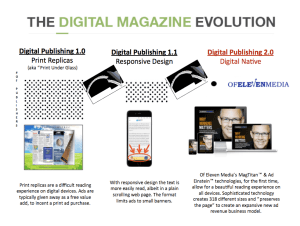
Picture 33 Larry Genkin: We’ve been in the publishing business for a while. I started back in trade publishing, working as an ad sale rep at a company called Phillips Business Information and I ended up starting my own publishing business and doing everything that publishers do, not exclusively with magazines, but everything from trade shows to books.

Eventually, having a couple of different businesses, we started a company called GSG Media and there were a handful of us that launched magazines for this big up and coming thing called social media. And we had magazines on “Facebook in Business,” “Twitter in Business,” LinkedIn in Business” and one on “Google in Business” and it was exciting because it was at a time when social media was really picking up steam and we had the publications and some marketing partners on it.

Long story short, and this was back in 2008/2009, I lost my shirt. I lost everything. You look back in hindsight and you understand that the global economy was going through a horrible time. But when you come out of an experience where you lose everything, and I myself ended up having to go through personal bankruptcy, it’s a very difficult time.

When you go through something like that, at least for me; I started to reflect with the team, a core group of us who were all involved in GSG Media and those social media publications, reflected and thought: what did we do wrong? What could we have done different? We were trying to take something positive from the experience.

And it wasn’t until a little bit later when I worked for a guy from Oklahoma who was formerly the 25th wealthiest person in the U.S. named Bill Bartmann, who is really a brilliant businessman, that I learned a valuable lesson, which I think he sort of meant as a joke, but the team and I really took it to heart. He said in business he believed that it was imperative that you become the market leader. That’s the real path to success. And he said it’s not as hard to be the market leader as people think; all you need to do is figure out where the herds are running to and then just go get out in front of them.

So, I started to really think about what he said and the wisdom of it. I looked at the publishing business through a different lens after that. And one thing that I saw at that time was, and you know all the statistics better than I do, readership was migrating to online media. And advertising was also going through a reflection point where advertising in online media was really taking off. So, we said OK – if this is where readership is going; if this is where advertising dollars are being spent, how do we go get out in front of them? Also, part of it was how do we do it with no money?

All of us at that point in time were working other jobs and yet reinventing magazines became our mantra. Our tagline was sort of: what would magazines be like if they were invented today? If we could forget everything that we’ve learned in the publishing business and we knew about the power, for example, of these digital devices and what they can do; what would we do; and it became obvious.

You talk a lot about innovation and I love that about your work. To us, we thought that what was being done with digital editions of magazines was the equivalent of the early days of television. If you go back to the early days of television, the first shows were the popular radio shows. It wasn’t a digital medium. You had people who would stand on a stage and do vaudeville kinds of things or comedy; really just very static. It wasn’t until a little while later when people like Ernie Kovacs came in and really took advantage of what this new medium of television could offer.

And we kind of looked at magazines and digital in the same way. We said you know what; the only innovation that’s happening with digital publications is Page-Flipper. They’re taking a replica of a magazine that was designed to be beautiful in print and they’re squishing it down for a computer screen and it’s very difficult to read. Then when you get to the tablet, they’re squishing it down even further and now it’s next to impossible to read without zooming or pinching, scrolling or squinting. And then to make it worse, the biggest readership growth is on the Smartphones or mobile devices and you’re taking something that was 8½x11 and squishing it down to fit an iPhone. I mean, forget about it. It’s a terrible, terrible reading experience and it’s static.

We love print because it’s readable, it’s portable and it’s a wonderful technology, but the digital stuff in this time period was doing none of that. So, we said OK, there wasn’t a lot of money and we were very limited in what we could do. How could we play in the digital world? Our vision at that point was to be the leading digital magazine publisher in the world and we wanted to launch 100 magazines in all these different niches in three years.

We asked ourselves then were there any software programs out there that we could purchase to launch our magazines that would do what we wanted it to do, what we envisioned the technology could do? And when we looked, there was nothing out there. We were publishers, but we needed to be able to build the technology because it didn’t exist in nature. So, me being naïve like I was, I figured it would take us maybe three or four months to build our version of the technology.

Well, two years later (Laughs) I finally finished Version 1 of; it was this hard, hard process and what we figured out was a number of really important things. As publishers, what we figured out was how to make digital magazines come alive and be a really great reader experience. We figured out how to make them readable on the biggest devices, such as a 27-inch monitor, to the smallest Smartphones. And we also figured out how to give publishers a business model where they can not only make money in print, but they can actually turn digital into a profit center as well, because what we know today is that most publishers are giving away digital. They’re making all their money on print because all that they can do is replicate issues today, saying to the advertisers, oh yes, Mr. Advertiser, we have a digital edition and if you buy the print, then you get the digital for free.

Publishers are dying the death of a thousand cuts and you see all of these layoffs happening; you can’t give away a product and not expect a day of reckoning later on. So, what we figured out was how to make the technology actually have a viable business model where publishers can now make money from digital as well as print. The technologies are called MagTitan and Ad Einstein.

And one last part of the story just to bring you up to the current day; while we were building the technology, something again that we thought would only take three or four months, I had a small editorial team and we decided to go ahead and launch a magazine so that it would be ready when the software was.

But what happened was we finished the magazine, but the software wasn’t ready. So, we said let’s build another magazine until it’s ready. When we finally finished the software about five or six months ago, we realized that we have 19 magazines that we rolled out on all sorts of different topics; some of them are in partnership with readers and celebrities, for example, we have one called Sharkpreneur Magazine and it’s done with Kevin Harrington of Shark Tank; the famous sports agent, Lee Steinberg, who was the real-life Jerry Maguire; he’s our partner on Game Changer Magazine.

So, we had all of these publications and as we started to release these out to the world; I would get calls on average every other week, and a publisher would say, I just saw your magazine, Small Business Edge, and your technology is really interesting; how much would it cost for me to use it with my magazine? I would have to tell them at that point in time that we were publishers, just like them, and the software was intended for use with our publications only.

Now, I may be slow, but I’m not dumb. You get a number of those types of calls and suddenly you wake up and realize that other publishers see the value in your product and we might have a good business for ourselves in being a software provider to the publishing industry as well as a publisher.

About three months ago we made a major pivot as a company and decided to allow our software to be licensed. But being in that business is a completely different one than publishing and our technology on the backend wasn’t designed for other people to use. It wasn’t user-friendly; it was really designed only for us because we knew how to use it.

So, we had to rebuild some modules of the software to allow for licensing of other people and all of that. We just recently, within the last few weeks, got our first marquee client, USA Today, the magazine group. And we’ve gotten two other publishers who have signed on and now we’re in talks with lots and lots of people, showing and doing what you do out in the world, being an evangelist for magazines and in particular this technology in the business model.

Samir Husni: A lot of the major publishers have moved away from the replicas and they’re doing other things with their apps and still they can’t find a way to make money. If a magazine is making money from digital, it’s doing so maybe from native advertising. And now with the coming of ad block technologies or IOS 9, which will have ad block built in and all of these other ways to avoid ads; are you making money from anyone who is just looking at your digital platforms?

Larry Genkin: Well, there are a couple of different things. Let’s first talk about the business model. We developed this technology called Ad Einstein and the reason we call it Ad Einstein is because it’s brilliant. I say that tongue-in-cheek, but it really is absolutely brilliant for publishers.

To describe the business model, think about it this way, if you’re an advertiser and to make money in advertising right now, if you’re an ad sale rep selling media, it is a very, very hard time. There is lots of competition; the price is being pushed downward toward zero, especially in digital.

We looked at the biggest advertising successes of our lifetimes and figured out how we could bring that to the magazine business, because frankly, we wanted to make it easy for us to sell ads and now easy for our publishers to sell ads. So, what we did was look at Google. I found different research, but with Google approximately one out of every 12 ad dollars on the planet are spent with Google. And part of the reason that they’ve been such a runaway success in my estimation is for two reasons; they pioneered and made popular pay-per-performance advertising and you cannot argue with the fact that advertisers love that they only pay when their little text ad gets clicked on with Google. That’s something that has proven to be successful.

The other thing that Google has done that was a game changer is to allow advertisers to set their own budgets. One of the challenges that every magazine on the planet has and I don’t care if it’s a circulation of 5,000 or a million-five is that we always price people out because we have thresholds of what our fractional ads are or full-page ads and some people can’t afford it. They don’t have the budget. Well in Google, if you can afford $1 you can run $1 worth of ads and when that is used up, they’ll pull you out and put someone else in.

So, with Ad Einstein what we’ve done is we say to the advertisers, you’re only going to pay when we can verify that somebody has actually read your ad, because that’s our job as publishers; to get a prospect who is interested in your product or service, to look at your ad. The rest is really up to you.

It’s up to your ad, your company’s reputation and all of those kinds of things. What we say is if somebody flips past your ad and doesn’t spend much time on it, you shouldn’t have to pay. And we don’t charge those clients. But conversely, if they do one of two things which are: either clicking on the ad, and that could be a link or a video or to buy a product; we actually have technology that allows people to securely buy products with a credit card right within the advertiser’s ad without ever leaving the magazine, then we charge them. Or if the customer spends ten seconds or more on that ad, since we only display full-page ads and since we only display one page at a time, if they spend ten seconds or more on that ad, then they’re either reading it or they’ve fallen asleep. It has to be one of the two.

For our magazines we call it the “verified view” and we’ve set the price at $1. An advertiser can come into our Ad Einstein platform, create or upload their ad, set their budget between $1 and whatever their credit limit is and start or stop whenever they want and only be charged when somebody clicks or views their ad.

So, when you start to look at that model, it’s something that’s easy to sell to an advertiser, and to a publisher the business model is profound. Let’s say you have 25,000 readers for the July issue of your magazine and that reader goes through your digital issue and maybe they flip past 10 ads while they’re reading, but they trigger one. By our metrics, 10 seconds for viewing for clicking.

Well then, that publisher would make $25,000 if they were charging $1 per view, with our software they can set the price, so if they want $5 per view or .20 cents per view, they can do whatever they want. The difference for publishers is that they can actually make real money. Maybe the reader will trigger four ads or ten ads; you can make real money from this and your goal as a publisher becomes creating great content and displaying it in a way that can really be read, not squinting, so that readers will spend time with your publication and they’ll trigger ads as they go through.

The other part of this is as a publisher your job is to keep bringing in more readers to your publication and producing great content so that they’ll stay with you. With our publications we let anybody in who wants to see it, so we don’t put up any barriers. I could go into why I think apps are a foolish mistake for publishers for so many reasons; I’m not surprised in the least that they haven’t been successful, because you’re putting barriers in front of the content. All of our software which is designed to have the performance and look great like an app does, but it’s completely browser-based. So if someone sees a magazine or an article on social media, they can click right from Facebook or Twitter and open up that magazine. Then they’re in and they’re triggering ads and the publishers are immediately making money.

Samir Husni: From all of the titles that you already have on MagTitan now; what’s the largest circulation or viewership that you’ve achieved? How are you getting that scale that established magazine brands have achieved over the years?
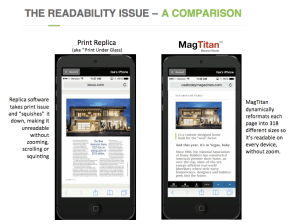
Picture 32 Larry Genkin: There are a couple of ways, but keep in mind that right now we are pivoting as a company. We never planned on becoming a software company too, so all the data and things that I have for this are early.

But here’s what I can tell you from the hundreds of thousands of visitors that we’ve had for our magazines in aggregate so far over these few months. Readers spend good time with our publications. Our content is really good, but I don’t think it’s because of anything more than it’s very readable, even on the smallest devices.

From a circulation standpoint; what we do is start by partnering with someone who has a data base. We come to these people and they become our equity partners in a publication and they can distribute the magazines through their email lists and their social media followings.

We actually just formed a joint venture company that’s going to be a big part of our circulation strategy and our client’s; it’s called Digital Direct. Digital Direct is a partnership with a data firm that has a data base of 110 million records. And we can sort those records by over 300 different demographic, psychographic and geographic criteria.

Let’s say we have a publication or a client of ours has a publication; they can come in and they can specify who their target reader is and that could be everything from title to SIC (Standard Industrial Classification) codes, to household income; all the things that are publicly available through the Experian databases and things like that. And then we’ll go out and we’ll offer those targeted people subscriptions to our publications, in our case, for free. When they opt in they get immediate access to the publications.

Samir Husni: But if they get the subscription for free and at the same time they get ad block; how are you making money? That’s the problem that most of the media industry are facing; every time we figure out a new way to make money on digital, our audience is finding a way to get the information for free.

Larry Genkin: Well, and I think you know this as well as I do, there is a lot of experimentation going on with ad block. What I can tell you, and I don’t want to stir up a hornet’s nest here; we’ve figured out a way to have our ads displayed. And what I suspect will happen over time is it’s going to be this cat and mouse game where publishers figure out how to beat the ad blockers; the ad blockers will come back and it’ll be this back and forth gaming.

Just like what The Washington Post is doing; it’s very easy if someone is using ad block, you can have the approach where you say, we’re not going to let you see the content until you turn off ad block or at least consider it because of this. And I think there will be all sorts of experimentation on this.

I kind of look at it this way; Nordstrom’s, unlike many department stores, doesn’t have a limit as to how many clothing items you can bring into your dressing room. I read a book called “The Nordstrom Way” and I was fascinated by this and one of the Nordstrom family members said in response to the question, don’t you know that you’re going to make it a lot easier for people to steal from you? And he said, of course we know that and that’s factored into our business model, but we don’t believe in punishing the 99.9% of the people and inconveniencing them for the small fraction of people who are going to take advantage of us.

I know that the economics of ad blocks are going to take away business from publishers; it’s going to happen. But the real question becomes can you get enough people in to make the model still work? And you have to just deal with that reality.

Samir Husni: What amazes me is every time that we try to come up with a business model that will compete with the print business model; we are finding all of these challenges dealing with making our customers pay for digital content. And it’s been that way from the beginning. For years I’ve been preaching that we’re in the business of selling content and changing content to become an experience. Do you really think on the future run that we’ll be able to survive in an environment I like to call “The Welfare Information Society,” that all content is free and we have to depend on someone else to foot the bill? That’s what your model is based on; I will get you the eyes; I will get you the content, but you have to pay $1 to me per click or pay for a 10 second view of the ad?


Larry Genkin: From the advertiser; the reader doesn’t pay anything.

Samir Husni: Yes, that’s what I’m saying; it’s still free content to the reader. We’re still creating a business model that’s exactly like the business model of the magazine industry. For years we’ve been in the business of counting customers, rather than in customers who count.

Larry Genkin: I think the business model that’s going to win and be successful in today’s world is going to be a hybrid model. Money is made off of print; we all know that publishers aren’t abandoning print, because they all know the lion’s share of their revenues and profits are coming from print.

Let’s say you have a circulation of 3,000, an ad rate of $5,000 and the publisher is lucky enough to have 30 print ads, which gives them $150,000 per issue, approximately a profit margin of 20. They have $30,000 net profit per issue, with $360,000 per year.

I think in this new model you keep all of that; you don’t change it. To abandon that as a publisher would be a silly mistake. What you have to do is then generate add-on revenue from digital. I think what you see publishers doing today are going through all of these gyrations to try and generate needed revenue and that comes from getting into events or doing things that are far-removed from their core content in creating what should be an experience that a reader must read every time that issue is put out. And they’re doing it out of necessity to pay the electric bill. But if you could take your core product and then generate incremental dollars from it in digital, then you have a winning model.

So, if you look at this model; you keep all of the print revenue and then we know that you can generate more readers than whatever the controlled circulation would be, say if you had 90,000 readers and two ads were triggered, that gives digital revenue $180,000 per issue, physical profit margins are higher, they would be at least 40% and in that particular scenario, they would have a profit of $72,000. So, the publisher basically had a 250% increase in their profits by having the hybrid model. It’s really just a factor of bringing in readers and being able to charge for digital.

And when you see the technology behind it, you can see how it’s compelling for advertisers and how we’ve really created an experience. When you look at the USA Today issue, you’ll see that even in the early stages, this is something that’s, to your point, an experience for readers, much more so than these static, boring replicas.

Samir Husni: And I agree with that, and please forgive the Doubting Thomas in me, but if the possibility of making all of that increase and profit from digital advertising is there; why do you think, and no pun intended, the titans of the magazine media world haven’t already figured it out?

Larry Genkin: Well, I think it comes down to a pure question of economics. If you look at economics and you look at the big Titans of this industry, all of the companies that you mentioned, they realize that they have all sorts of financials showing that their print revenues are declining, their print readership is declining; it’s not entirely going away, I don’t think that will ever happen, but it is in decline. The amount that they can get from a per-page basis is declining and digital is increasing. So, they say, Holy Crap, what do we do?

Imagine if they said instead; let’s just create a superior digital edition. We’re going to make just the most amazing digital software out there. And let’s say that they did it, that they created something that was far better than print. Well, look at the prices that you can get for digital. I’m talking dollars here for this kind of stuff; if you wanted to advertise in any of the Titans’ publications, you better be able to write a check for a $100,000 or you can’t play.

So, what happens if they create that experience and then suddenly their advertisers say I’d much rather spend $10,000 and get into your digital product than $100,000 to be in your print product? If they did that and made a switch, they’re out of business in a nanosecond because of their overhead. They have office buildings, multi-million dollar lease payments due, all of these middle managers getting $200,000 per year, including the top guys who don’t want to jeopardize their salaries. What happens is instead they’re not motivated to innovate like they should. They test around the edges and while this happens they start to die a death of 1,000 cuts.

I don’t think it’s any great secret in my mind why Meredith decided to sell. Meredith has some of the most respected publications in the world. If they truly believed in that, why would they do it? They’re taking the money and they understand that this is going to be a big problem and there is going to be a day of reckoning. You can’t just stay in a state of decline. You have to innovate and I think that’s the main reason that they haven’t experimented as aggressively as they could have because they’re holding onto what they have and they have shareholders to report to and they want to slow the decline as much as they can.

Samir Husni: But on the other side of the coin; Meredith being sold for $2.4 billion is nothing to sneeze at. Media General must have seen there was a value for all of these products, all of the brands that Meredith had, to pay that amount of money.

Larry Genkin: I wouldn’t sneeze at that either. If someone wanted to write me a check for that amount of money, I’d take it. But from what I’ve read about this particular acquisition, from what I understand the premium that they got over the current valuation was a very modest sum, somewhere around 10% is what I heard. And also Media General is going to sell off all the print publications; what they were interested in were the TV assets. But whether that’s true or not, who knows, the rumor mill keeps going.

But be that as it may, what we know is that we have to innovate and I think that you look at digital advertising; you look at how well Facebook and Google are doing and you understand that you can make a business off of digital advertising, with ad blocks and all of those kinds of things.

The key thing is I believe that there are two big mistakes that publishers make today and that’s apps and banner ads.

Let’s take apps first; apps are a replica. You put all of these barriers in front of your content. Somebody has to go to the app store where there are millions and millions of apps. Unless you’re The New Yorker, The New York Times or Time magazine, nobody is going to find your trade publication by accident in the app store. The only way that they’re going to find you is if you are directing them there. You have to do all the marketing to get them there.

Then once you get them there, they have to go in the app store and find your app. They have to download it, typing in a password. And all of us have limited storage on our phones and we’re maxing out all of the time; so now I have to be willing to download hundreds of megabytes or gigabytes onto my phone and take up that storage and I have to download the edition itself once I get the extra storage.

And let’s say I go and do all of that stuff, I’ve given away all of the customer data to the platform providers, so I don’t even know who my customers are anymore, I can’t market to them. And even if they went through and went into the publication; how am I going to get them back to the next issue? I don’t have any mechanisms, other than hoping that they remember me, to do it.

By the way, it’s still a replica. No publishers are inserting new ads and getting new ad dollars from their tablets. And you have to make money off of this stuff; you can’t give it away and expect success. So to me that’s a loser model.

The other big loser model is banner advertising. You think about what publishers are doing; I hear this all of the time, we’re not getting great readership from our digital editions. Well, the reason for that isn’t necessarily because readers don’t like digital editions; they spend hours on Facebook or Flipboard and all of these things. It’s not that they don’t like digital content; it’s that you’re displaying it in a way that’s boring and impossible to read without zooming all in.

And then publishers hope they’ll pull up their websites. And then they use programmatic. I can’t imagine how publishers are not seeing the disaster that’s coming with this, because they’ve commoditized their ad space. If you look at most ads that publishers are running through programmatic, where they’re not selling it themselves, they’re getting less than a $1 per thousands. And it’s because banner ads don’t work; it’s because there is a massive amount of inventory, so that the pressure on banner advertising is not going to change.

If you look at the money that you can make in print, and you’ve now given your audience away and said, well, you can actually get my audience, but that was only through our print product, now you can also get it online for .98 cents per thousands.

If you don’t have Huffington Post, Time Inc. kind of traffic, and you’re a pay publication and you get 100,000 people to your website each month, even if it’s filled to the brim with ads, you can’t make enough to buy dinner for your staff with that. It baffles me. So, I think that’s a loser model.

What publishers have to do is take all of the barriers off of print and they have to turn digital into a premium profit setter and I think that’s where the technology side of what we’re doing with USA Today, for example, and what we’ve developed really gives publishers the opportunity to do that.

Samir Husni: Let me bring a quote from Bob Garfield into this discussion, whom I recently interviewed. “The new media companies in our world today are Google, Facebook and Twitter that are out there.” How are you going to compete with this set of new media companies that are technically doing exactly what you propose to do with magazines, but with a very specific content?

Larry Genkin: I think publishers need to go into working with these platform providers with their eyes wide-opened. We’re going to experience what the newspaper industry experienced with Craig’s List taking away their classifieds and these niche sites taking away car ads and things like that. These guys, in my estimation, are wolves in sheep clothing, because what their motivation is to keep eyeballs on their platforms. And they understand clearly that they need to have great content to get the eyeballs on their content, so that they serve up ads and make all of this money.

If we as publishers give away all of our content to these players, we’re in trouble. I think a publisher needs to be self-sufficient. You can be lured by the traffic numbers. People are using Facebook, so if I put it out there I can get traffic. Well, you know what, they might read your stuff, and that’s OK, but if you can’t monetize that how are you going to pay your staff; how’re you going to pay your printer or your electric bill? I’m very, very concerned about it. So what I come back to as a publisher is this model; you leverage Facebook. And this is a model that I think is a way to leverage what social media can do for us instead of giving them your content.

From our magazine Crushing It, we shared a story on our Facebook page. When a reader, somebody who is getting that feed, clicks on it, they’re not staying on Facebook anymore. The link opens up the magazine and because I shared a specific story, it opens up to that particular page and now I’m in the magazine and I can go and read the story. What happens then is the readers sees ads while they’re in there and we’ve made money from that reader. So instead of giving your content to Facebook, you use Facebook to drive people to your content as a way of making money.

What you don’t want to do is use banner ads because banner ads aren’t going to yield you the revenue. You have to have a better model where you can make more money than that.

Samir Husni: Before I call you the knight in shining armor that has come to save the magazine industry… (Laughs)

Larry Genkin: (Laughs too).

Samir Husni: What will happen if Facebook carries out its threat to have everything on Facebook become self-contained within the site and then you wouldn’t be able to go from a link to an article?

Larry Genkin: As a publisher who makes a living being able to sell to my advertiser base and my client base, I have to control my own destiny. If you are a CEO of a publishing company, to give up your control to Facebook or any other entity, hoping that they’re going to be altruistic and worry about your interests; I wouldn’t trust that. Maybe it’ll be great and they’ll give you a large amount of money, I don’t know; when that happens then I’ll migrate there.

I think every publisher has to look at it this way, let’s start with making our business successful with what we’ve got. And what we’ve got is some sort of database and we’ve got some sort of content-creation expertise. And we also hope we have some sort of ad constituency that wants to reach our readers. We’ve got to make money off of that core proposition through print and digital.

Now, if we can test and do things with these other platform providers and it proves to be a smart business move, then by all means do it. But I think to sit on your hands and wait for the day that they’re going to come to your rescue…you know, hope is not a business plan.

Samir Husni: So, let me ask you the million dollar question; is Larry’s preaching, the knight in shining armor that’s hoping to reinvent digital within the magazine industry; is his preaching falling on deaf ears or does he see victory at the end of the tournament field?

Larry Genkin: I don’t call myself a knight in shining armor; if you look at this realistically, we have a ragtag group of people; we’re a virtual company; I have people working literally all over the globe who are banded together by the Internet and we’re all working for a cause. And the reality of it is, I wouldn’t be here doing what I’m doing if we hadn’t lost everything once before. I felt the pain; I’ve lost my house and had to move. Our staff has taken reduced pay or simply gone without a paycheck; we’ve financed this all ourselves, between my father and me and a couple of angels, with literally just hundreds of thousands of dollars. We haven’t even gotten over a million.

But what I think happens when you come out of a place of desperation and you’re forced to think in a different way, is that’s how innovation comes about. It’s cliché, but innovation happens in garages. You’re freer to think in different ways if you don’t have to make payroll; if you have to answer to shareholders, you’re not necessarily in a position to think.

So, I think that we, just by accident, stumbled across some things that work and what I can tell you is that you can’t get a client like USA Today by accident. They’ve looked at what we’ve produced and they see the wisdom in it. And for us, that’s a great validation. We have a lot of work left to do, there’s no doubt about that.

But the other thing that I can tell you is we are negotiating with a couple of very large printing firms and printing firms are in the position where their revenues and profits are decreasing because the folio sizes are going down, so they need to find a way to serve their client and continue to enhance their bottom line. And the reaction has been very positive from these people. So there’s a distinct possibility in the not too distant future that we can talk again and we’ll have an announcement where some printers are going to bring this technology to their publishers.

Print is not going away. Print is the necessary part of this business because that’s where the lion’s share of revenues comes from, but the big guys who are the innovators in the printing industry; they understand that the publishers want to make money and they need to make money. And I think that we have a model that’s flexible enough for them to really test and figure out what will work in their market.

Samir Husni: Anything else that you’d like to add?

Larry Genkin: What we did with the first issue of USA Today (special edition magazine) with our technology is put it in one-page design as opposed to a two-page spread, because a two-page spread is great for print, but it doesn’t exist in digital. So, why do that? We also reimagined the cover for them using animations and storytelling. The way that the software works is you go left and right between stories and up and down to read them. That way we don’t force you to flip 15 pages past stories you’re not interested in.

Most importantly, the content is very readable without zooming, pinching or squinting. What’s happening behind the scenes is our software is figuring out what device someone is on and serving up one of 318 sizes that are ideal for that particular device. It’s readable and that’s the key takeaway here. The technology is great and it’s getting better every day.

Samir Husni: My typical last question; what keeps you up at night?

Larry Genkin: What keeps me up at night is I don’t want to be Xerox PARC. I think that we’ve developed a number of technologies: MagTitan, Ad Einstein, Infinite Pages; all of these things in and of themselves, any one of them would be great, but if you learn the lesson of Xerox PARC, they had all of these brilliant minds creating transformative technologies and it wasn’t them that ended up being able to bring it to market.

What I and my dedicated team have to do is execute and that means we have to be out there and we have to educate and when publishers say I want an app, we have to explain why that’s not the right way to go. When publishers say they’re really bumping up their websites and they’re basing their model off of banner ads, pennies on the dollar; we have to explain why that’s not a wise approach.

There’s a statement that I love and I’m sure I’m about to butcher it, but it goes something like: all great truths pass through three stages. At first they’re ignored, second, they’re violently opposed and third, they’re regarded as self-evident.

It doesn’t happen automatically. And we have to go out there and tell our story and that’s what keeps me up at night, not being Xerox PARC.

Samir Husni: Thank you.

h1

Quartz: The Power Of Good Journalism To Move Society Forward – The Mr. Magazine™ Interview With Jay Lauf, Publisher and President, Quartz.

September 17, 2015

Mr. Magazine™ at the waterfront in Cape Town.

Mr. Magazine™ at the waterfront in Cape Town.

From South Africa with Love: The Mr. Magazine™ Interview

“It’s not self-help; we’re not a trade vehicle, something that’s designed to help you with the day-to-day running of the business necessarily. But what you have is a lot of people who believe in the power of good journalism to move society forward, to help good ideas rise to the top and to help uncover negative issues when those arise. And I think the cohering DNA of anybody who works at Quartz, whether you are on the editorial, engineering, or marketing teams, is a desire to figure out a way to make high-quality, intellectually rigorous journalism thrive in a digital age.” Jay Lauf

Quartz is an arm of Atlantic Media that is a global business news brand that was launched in September 2012 for people who are excited by change. It serves as a digital guide to the new global economy. Designed for an efficient, mobile reading experience, Quartz serves business professionals who travel the world, are focused on international markets, and value critical thinking.

Jay Lauf is publisher and president of Quartz and is a man who has managed to do what others in the publishing industry haven’t been able to quite master; he has grown the audience of Quartz tremendously and has brought digital revenue to the company, revenue that accounts for more than half of its total dollars. And while Jay refuses to take all the credit for that growth, he knows a little bit about publishing, having 25 years of experience, serving as publisher at both Wired and The Atlantic for many years.

I caught up with Jay recently in Cape Town, South Africa, where we were both speaking at the Media24/Lifestyle Summit. We talked about the global mission of Quartz and the drive to educate and help people all over the world find their place in this often confusing global economy of ours. Jay is a man who is as business savvy as the brand he is so passionate about. We talked about the upcoming three-year anniversary of Quartz and the digital publications’ many achievements and its robust success. And in typical Mr. Magazine™ style, we even talked about the possibility of adding a print component to the mix. No definite answer to that one; I’ll get back to you later on Quartz-in-print.

I hope you enjoy this lively and extremely interesting Mr. Magazine™ conversation with a man who has been in the business long enough to know a winner when he stares one in the face each and every day; the Mr. Magazine™ interview with Jay Lauf, publisher and president, Quartz. Our conversation took place at the beautiful and famous Tea Room at the Mount Nelson Hotel in Cape Town.

But first, the sound-bites:


Jay Lauf In Cape Town with The Lion's Head mountaintop to his right and Table mountain to his left.

Jay Lauf In Cape Town with The Lion’s Head mountaintop to his right and Table mountain to his left.


On some of the most important achievements that Quartz has realized since its inception three years ago in 2012:
I think some of the greatest achievements for Quartz over the last three years have to do with how quickly we’ve scaled. Starting with an audience of zero in September 2012 and ostensibly without any advertising; we achieved 10 million readers globally before we were 2½ years old. And to do that as rapidly as we did, I think is an achievement that we’re really proud of and frankly, a testament to the power of social word-spreading.

On whether he feels the achievements that Quartz has had over the last three years would have been possible or the venture even doable at all without the strong Atlantic brand behind it:
That’s a really great question. Do I think we could have achieved what we have so far? Yes; I think the premise of Quartz and the independence of Quartz stands on its own, but there’s absolutely no question that the brand certainly helped by giving us a strong foundation and instant credibility, being born from a company that produces The Atlantic certainly helped with both, advertisers trusting us from the beginning and readership as well.

On whether or not he immediately jumped on the job at Quartz or took some time to mull it over from all angles: I have navigated most of the last 15 years of my career with my gut and my heart, quite frankly. The Atlantic had been my favorite magazine; I’d been a subscriber for well over ten years before I received the first recruiting call from Justin Smith (then president of Atlantic Media). I went on the original interview for The Atlantic with Justin and David Bradley out of purely a fan-voiced curiosity. I really wanted to see who put The Atlantic together because I loved it and I had never met these guys before. When the Quartz opportunity came about it was the first time that I was less about gut and more calculated, because that for me offered an opportunity to pick your buzz word, jump into a purely digital, social startup, but inside a company I already had equity with and one where I knew the owner and I knew the company and we knew each other.
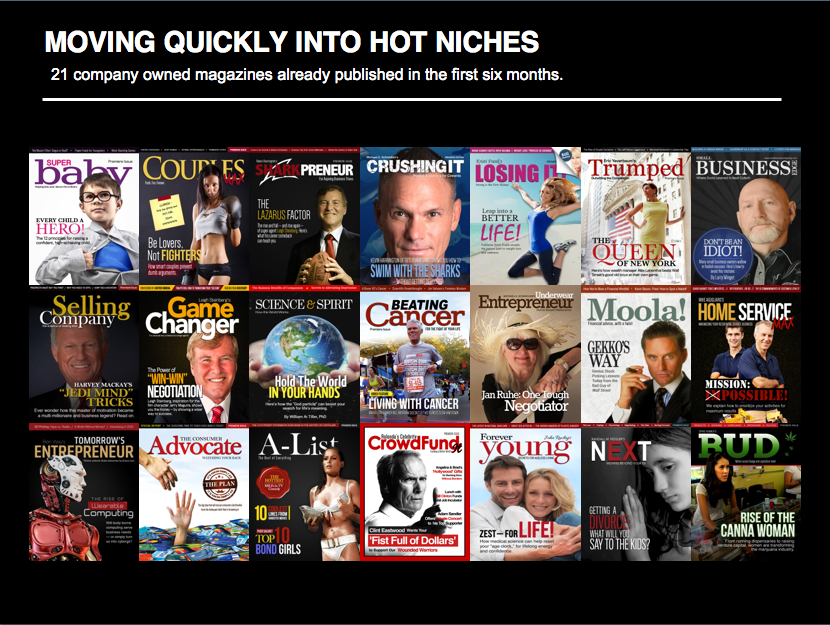
On how Quartz puts the reader first and offers them something different from everything else out there on the digital landscape:
What we try to do every single day whether it’s through the lenses of advertising, content or design is to think about what would we want as users from this proposition? And what you discover is that if you respect the reader first, it’s not only because that’s great for the reader, it’s great for the publisher and the advertiser too. So, “reader-first” is absolutely at the heart of literally everything that we develop at Quartz.

On the moment he knew that he’d made the right decision to take the job with Quartz:
I would say halfway through, maybe toward the end of 2013. The first year of any startup you’re kind of just in a fog. You’re not really stepping back and assessing; you’re in the thick of it 24-7. By the end of 2013 when we really started to see an acceleration of the business side and advertisers were really beginning to jump in and being very positive about what they were hearing from us; you could see in the tea leaves that 2014 was going to be a really strong year.

On whether he believes an endeavor like Quartz would have been possible without the financial backing of David Bradley or was it simply part luck and the other part good-sense:
I think any success that’s as drastic as what we’ve achieved is part luck, and anyone who tells you otherwise is probably a charlatan. But there’s no question that having David’s backing was important. But I think it has as much to do with his support and fresh ideas and a willingness to take risks on those ideas, as it does his money that put us in a position to be as successful as this.

On the global audience of Quartz and how it came about:
The concept was to be global from the beginning; to be distinctly post-national. We try to speak in a post-national voice. What’s amazing to me and just fascinating to observe, is that putting out great content and putting it on the free and open web, and again, without any local promotion in this market or any, actually grew a global audience. The audience found us through the sharing mechanisms that are now networked globally. And it’s pretty amazing.

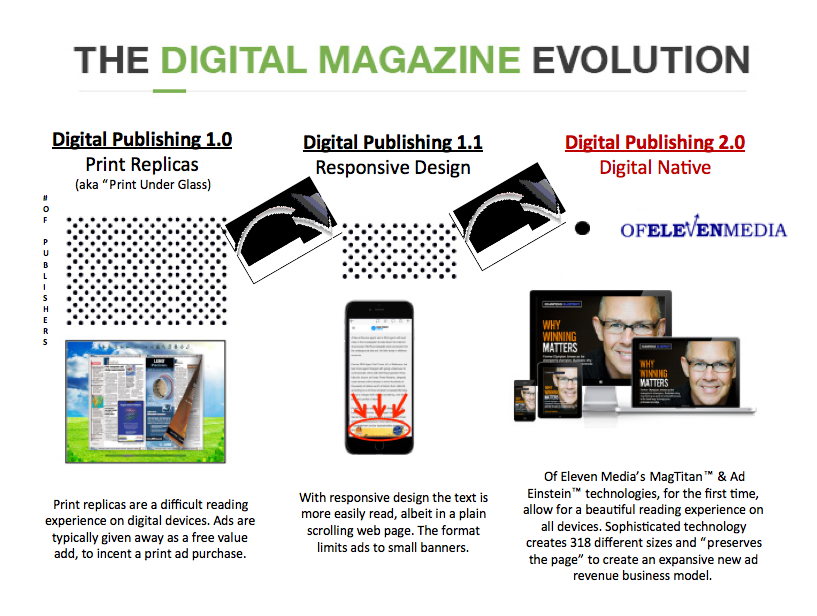
On whether he believes the homepage is dead:
I think in the beginning we were correct and boldly said the homepage was dead and launched as you may remember, without a homepage at all. That level of focus allowed us to really spend our intellectual and financial resources on creating things besides the homepage that were actually going to be bigger drivers of traffic. So, it depends on how one defines “dead.”

On whether or not he can envision a print version of Quartz in the future:
I’m done predicting the future; those of us who predict the future end up contradicting ourselves three or four years later. I will say there is a bunch of people on our team who love beautiful magazines. And a lot of the queues that we do in terms of design and advertising are taken from magazines. So, that’s certainly something that we talk about and have talked about. But there’s certainly nothing in the imminent future.

On anything else he’d like to add:
I think the interesting thing to think about on the inside is we are an institution that recognizes that the economy is now global and increasingly interconnected and the world is getting smaller, but we do not want to come into these locales and tell the same stories that typical western media are telling over and over again.

On the mission of Quartz:
It’s not self-help; we’re not a trade vehicle, something that’s designed to help you with the day-to-day running of the business necessarily. But what you have is a lot of people who believe in the power of good journalism to move society forward, to help good ideas rise to the top and to help uncover negative issues when those arise.

On whether he feels that Quartz is a candle illuminating the darker side of social media and the Internet:
Yes, but I think there are many candles; I can’t claim that we’re the only flickering light in a dark storm. And I don’t think the storm is as dark as people claim it is. I believe that journalism is very alive and vibrant right now. It’s definitely very noisy and confusing, and yes; I think what we try to do is adhere to a certain set of principles that regardless of the noise that’s going on around us, our readers can rely on to get consistent quality from us.

On what makes him tick and click and motivates him to get out of bed every morning:
There are times when I feel like the luckiest guy in media. I was an English and History major in college and if you’d told me then that I would someday be the publisher of Wired and The Atlantic, of all things, and now this thing called Quartz, which if we do it right will be an iconic media property of its time, I would have either laughed you out of the room or said sign me up right now.

On what keeps him up at night:
The main thing that keeps me up at night in today’s ecosystem is finding and retaining great talent, particularly in the publishing business. The biggest resource that we have is our talent: designers, engineers, journalists, thinkers, ad sales people and writers. Without them you can have the most meaningful mission in the world, but you can’t necessarily execute on it.

And now the lightly edited transcription of the Mr. Magazine™ interview with Jay Lauf, president and publisher, Quartz.

Samir Husni: You’ve been president and publisher at Quartz since 2012; can you briefly recap some of the most important achievements you’ve accomplished in the last three years and any stumbling blocks you’ve had to face and how you overcame them?

Jay Lauf: Sure, I’ll try and encapsulate that. I think some of the greatest achievements for Quartz over the last three years have to do with how quickly we’ve scaled. Starting with an audience of zero in September 2012 and ostensibly without any advertising; we achieved 10 million readers globally before we were 2½ years old. And to do that as rapidly as we did, I think is an achievement that we’re really proud of and frankly, a testament to the power of social word-spreading.

But scale isn’t the only attainment; the other thing we’ve achieved that we’re quite proud of is the right demographics. We had a very specific target demographic over the course of these first 2½ years that we were hoping to reach, which was and is global business professionals who are in decision-making roles and when you look at the syndicated research, we have achieved a really high-end audience of those 10 million people. And that’s been a really gratifying piece of the experience.

The other two quick things that I’d cite are one: what was then a novel approach to design, and by design I mean Big D and Small D design, Big D meaning user interface and really thinking about the systems, and Small D referring to aesthetic design, has actually changed the way some of the biggest bellwethers that we were hoping to compete with thought about doing their design, which is the sincerest form of flattery in a way. And those are the things; recognition is a high-quality vehicle, while scaling quickly has been really gratifying.

Lastly, on the business side of the equation, we’ve got over 125 blue-chip companies that have run advertising with us across the three years that we’ve been in existence. We’re doing everything custom, there’s no IAB (Interactive Advertising Bureau) standard advertising units on the page, so despite the fact that there could theoretically be challenges for these advertisers in terms of custom work, a price point that is much higher than your standard banner ad, I’ve got a better than 90%, at this point, renewal rate/retention rate with advertisers. So, clearly we’re doing something really well on that front.

Samir Husni: Do you think you could have achieved or actually done any of those things if you weren’t part of the Atlantic Media group and launched with that solid brand, which has been in business for over a century and a half, behind you?

Jay Lauf: That’s a really great question. Do I think we could have achieved what we have so far? Yes; I think the premise of Quartz and the independence of Quartz stands on its own, but there’s absolutely no question that the brand certainly helped by giving us a strong foundation and instant credibility, being born from a company that produces The Atlantic certainly helped with both, advertisers trusting us from the beginning and readership as well.

So, there’s no question that we had a head start and maybe it helped to accelerate us in the beginning much more quickly, but I think doing Quartz on its own would have been possible, just not nearly as easy.

Samir Husni: When you were offered the job at Ouartz; did you just immediately say yes and jump onboard, or did you step back and look at it from all perspectives? Can you recall your thoughts pre-September 2012 before Quartz actually began?

Jay Lauf: I have navigated most of the last 15 years of my career with my gut and my heart, quite frankly. I got the opportunity at Wired back in 2001 and the brand just got under my skin in a deep way and we were really passionate about the mission we were on.

But The Atlantic had been my favorite magazine; I’d been a subscriber for well over ten years before I received the first recruiting call from Justin Smith (then president of Atlantic Media). I went on the original interview for The Atlantic with Justin and David Bradley out of purely a fan-voiced curiosity. I really wanted to see who put The Atlantic together because I loved it and I had never met these guys before.

And when I did meet them, I realized how serious they were about pivoting The Atlantic to a digital-first position, and how determined they were to really make it a viable business. And I thought, wow, this is never going to come along again in my career and I took The Atlantic job as much out of passion as calculation. And when I did it at the time, people asked: are you crazy? You’re leaving Wired to go to The Atlantic? And people couldn’t understand why one would take what seemed like a step down. It ended up being one of the best moves of my career and I passionately advocated for that magazine and worked on it through the four years that I was there.

So, when the Quartz opportunity came about it was the first time that I was less about gut and more calculated, because that for me offered an opportunity to pick your buzz word, jump into a purely digital, social startup, but inside a company I already had equity with and one where I knew the owner and I knew the company and we knew each other. So, I just thought that an opportunity like Quartz was never going to come along again in my career and that I had to do it.

And three years later I’m as grateful that I made that decision as I was when I chose to go to The Atlantic in 2008.

Samir Husni: You used the phrase “digital-first” which was buzz words a few years back. Now we rarely hear “digital-first” or “print-first” phrases; we’re hearing more of what I mentioned in my new book “Audience First.” How did you approach your customers, whether that’s the advertiser or the reader, in a different way with Quartz than what was already out there, such as the two giants that you went after, FT (Financial Times) and The Economist?

Jay Lauf: The FT and The Economist may say that they do this as well, and perhaps they do, but from the beginning we have been zealous about a reader-first approach. So, if you look at the conventions that Quartz did away with as a reader-first approach, we realized our target audience is using mobile devices more than any other mechanism for reading and discovering the content. We realize that they don’t respond to banner ads and a lot of the commoditized ad units that one has on a website.

And so what we try to do every single day whether it’s through the lenses of advertising, content or design is to think about what would we want as users from this proposition? And what you discover is that if you respect the reader first, it’s not only because that’s great for the reader, it’s great for the publisher and the advertiser too. So, “reader-first” is absolutely at the heart of literally everything that we develop at Quartz.

Samir Husni: So, my reading won’t be preempted by a video that I have to watch first before I receive access to the content, unless I hit “skip ad?”

Jay Lauf: Correct. I’ve said publicly to keep myself honest, you will never see one of those interstitial takeovers that jumps in front of your reading experience and asks you politely to “wait 15 to 30 seconds” before you can read the content. We won’t do that. Kevin Delaney, my co-president, has said publicly that we won’t do pre-roll on Quartz. And sometimes I’m biting the back of my knuckle over that one, but we say that because we know that it’s a lousy user experience and there has to be a better way to have readers experience the advertising on our site.

Samir Husni: In these last three years, and I believe you’re celebrating exactly three years as we speak…

Jay Lauf: Yes, you’re right. Next week will be the actual three-year anniversary of Quartz.

Samir Husni: What has been that “wow” moment for you? That time during those three years when you said, yes, I made the right decision when I took the job at Quartz?

Jay Lauf: I would say halfway through, maybe toward the end of 2013. The first year of any startup you’re kind of just in a fog. You’re not really stepping back and assessing; you’re in the thick of it 24-7.

By the end of 2013 when we really started to see an acceleration of the business side and advertisers were really beginning to jump in and being very positive about what they were hearing from us; you could see in the tea leaves that 2014 was going to be a really strong year.

So, I would say that have to be it. By the Q4 of 2013 I could finally lift up and say, wow, this is actually starting to take off the way we had hoped it would.

Samir Husni: And do you think were it not for the financial backing of David Bradley a project like Quartz could have been started today? For example, could a random person who heard your story do the same thing without some very deep pockets? Does it take a lot of money and capital to achieve what you’ve achieved with Quartz or was it part luck, part good sense?

Jay Lauf: I think any success that’s as drastic as what we’ve achieved is part luck, and anyone who tells you otherwise is probably a charlatan. But there’s no question that having David’s backing was important. But I think it has as much to do with his support and fresh ideas and a willingness to take risks on those ideas, as it does his money that put us in a position to be as successful as this.

And it probably took less money than people might suspect in the first year. I’m not at liberty to discuss what those numbers would be, but the difference is we didn’t have to go out and pull together other shareholders, stakeholders and investors who may or may not have the same level of commitment that somebody like David does and expect a return on that investment far more quickly than he might. And we were liberated from that and I think that gave us the latitude and freedom to create something that was unlike what you had seen before. And that was distinctly reader-first, because sometimes when you’re building reader first, the pathway to monetization is not as direct as a much more commoditized thing.

Samir Husni: In just three short years, you are not only national but Quartz also has an international scope. Today you’re in South Africa, tomorrow you’re going to be in Nairobi, and the next day who knows? You have a network. How did you accomplish that? Was it the concept that attracted the international interest or was it the content? And what came first, the concept, the content or the audience?

Jay Lauf: Probably in the order that you just described. The concept was to be global from the beginning; to be distinctly post-national. We try to speak in a post-national voice. When Kevin Delaney first began to assemble his editorial team, he required that they speak at least two languages fluently and our first team of journalists that were with us at the very beginning spoke over 15 languages fluently and had reported from over 100 different countries in their careers.

So, I think that we achieved both a perspective and a tone of voice that appealed globally. From the first month and you might be surprised to learn this, we were 60% U.S. and the other 40% was outside the U.S. audience. By the end of the first year, we had been accessed in over 170 countries around the world. Today we are closer to something like 56/44 – 56% U.S. – 44% outside the U.S.

What’s amazing to me and just fascinating to observe, is that putting out great content and putting it on the free and open web, and again, without any local promotion in this market or any, actually grew a global audience. The audience found us through the sharing mechanisms that are now networked globally. And it’s pretty amazing.

Samir Husni: I’ve heard talk recently about the death of the homepage; is the homepage dead and do we now depend on social media to spread the word or links to articles? Having achieved what you’ve achieved in three short years; what’s your take on the homepage and its importance?

Jay Lauf: I think in the beginning we were correct and boldly said the homepage was dead and launched as you may remember, without a homepage at all. That level of focus allowed us to really spend our intellectual and financial resources on creating things besides the homepage that were actually going to be bigger drivers of traffic. So, it depends on how one defines “dead.” Eight to ten percent of our traffic comes to the homepage. And with 10 million readers globally, that means somewhere between 800,000 and one million readers come to the homepage.

That begins to change the way that we think about the homepage in the sense that’s a decently robust magazine subscription base. So, we have instituted what you would call a homepage as a way to treat that group of readers differently. We suspect there are two groups that come to the homepage: the real loyalists who want to come every single day and check out what we’re doing and then people who are discovering us for the first time. They may have heard about us and somebody may have said they should try Quartz or check into QZ.com.

So, signaling something different to those folks than you might to the person who discovers you more serendipitously in their feed or has already discovered you and therefore by habit is clicking on your link in their feed, means that you can probably do something different with the homepage.

But speaking in purest terms that the homepage is dead helps you rear-end your thinking around the convention that if not completely dead, then certainly not as important as it once was.

Samir Husni: Being Mr. Magazine™ I have to ask this question, is there a printed magazine in your future?

Jay Lauf: (Laughs) I’m done predicting the future; those of us who predict the future end up contradicting ourselves three or four years later. I will say there is a bunch of people on our team who love beautiful magazines. And a lot of the queues that we do in terms of design and advertising are taken from magazines. So, that’s certainly something that we talk about and have talked about. But there’s certainly nothing in the imminent future. But if we reconvened here ten years from now and it turned out there was a print version of Quartz, I wouldn’t fall off my chair.

Samir Husni: Is there anything else that you’d like to add?

Jay Lauf: I think the interesting thing to think about on the inside is we are an institution that recognizes that the economy is now global and increasingly interconnected and the world is getting smaller, but we do not want to come into these locales and tell the same stories that typical western media are telling over and over again. So, if you’re in Africa it’s pretty straightforward; it’s about political turmoil and crises; it’s about piracy.

But when you come to Africa, what you discover is that there’s vibrancy to the entrepreneurial community and to the business community that’s just beginning to take hold here. And no one is telling those stories; no one is helping Africans understand their place in the global economy or what the impact of the global economy is on them. And this is true not just in Africa, but in places like India, even in Asia, which have markets that have highly evolved media, but a lot of the media is very, sort of myopic and inward-facing. What we’re hoping to do all over the world is help people understand their place in this global economy and help them navigate the challenges and take hold of the opportunities that it presents for them.

So, I think that’s what’s on our mind when we come to places like Africa, is to try and understand what the stories are that no one is telling and that are actually interesting and related to the global economy.

Samir Husni: In the early stages of the 20th century, Professor Ben Patterson defined magazine publishing in America as two groups: the missionaries and the merchants. With the missionaries, they still want to make money and it’s a business, but they want to promote America the Great as well, they had a greater-good mission. And then there were the merchants who were strictly moneymaking and business. You reminded me of the missionaries as you were talking about Quartz; you’re on a mission. There’s that DNA of the whole concept of helping others from an economical and global point of view.

Jay Lauf: Yes; it’s not self-help; we’re not a trade vehicle, something that’s designed to help you with the day-to-day running of the business necessarily. But what you have is a lot of people who believe in the power of good journalism to move society forward, to help good ideas rise to the top and to help uncover negative issues when those arise.

And I think the cohering DNA of anybody who works at Quartz, whether you are on the editorial, engineering, or marketing teams, is a desire to figure out a way to make high-quality, intellectually rigorous journalism thrive in a digital age. And we feel like if we can figure that out, all of us will someday be able to look back on that chapter of our careers and say, wow, we really accomplished something that mattered.

Samir Husni: So, do you feel as though you’re a candle in the midst of this dark side of social media and the Internet? That you feel a social responsibility to journalism as opposed to gossip journalism?

Jay Lauf: Yes, but I think there are many candles; I can’t claim that we’re the only flickering light in a dark storm. And I don’t think the storm is as dark as people claim it is. I believe that journalism is very alive and vibrant right now. It’s definitely very noisy and confusing, and yes; I think what we try to do is adhere to a certain set of principles that regardless of the noise that’s going on around us, our readers can rely on to get consistent quality from us. And hopefully we lead the way sometimes in that.

Samir Husni: What makes you tick and click and motivates you to get out of bed every morning and say it’s going to be a great day?

Jay Lauf: There are times when I feel like the luckiest guy in media. I was an English and History major in college and if you’d told me then that I would someday be the publisher of Wired and The Atlantic, of all things, and now this thing called Quartz, which if we do it right will be an iconic media property of its time, I would have either laughed you out of the room or said sign me up right now.

I feel like I’m in graduate school every day. I’m smarter every day at the end of the day than I was when I came in that morning. And I get paid for that. That gets me up every day; it’s fun and dynamic.

Samir Husni: My typical last question; what keeps you up at night?

Jay Lauf: The main thing that keeps me up at night in today’s ecosystem is finding and retaining great talent, particularly in the publishing business. The biggest resource that we have is our talent: designers, engineers, journalists, thinkers, ad sales people and writers. Without them you can have the most meaningful mission in the world, but you can’t necessarily execute on it. And it’s harder and harder because there are more and more options; we’re in an era where people are not loyal to companies and companies are not loyal to people. And people move around a lot, certainly in this industry space. So that’s what keeps me up at night; it’s how do I find the right people for the Quartz mission and how do we keep them excited about that every day.

Samir Husni: Thank you and until we meet in the States enjoy your journeys…

Sunset at Cape Town, South Africa...

Sunset at Cape Town, South Africa…