h1

“Plugin” To The World Of Electric Cars & The Lifestyles Of Their Owners – The Mr. Magazine™ Interview With Dusan Lukic, Editor-in-Chief, Plugin Magazine

June 25, 2015

“We decided that we had to go with print because if you’re talking about lifestyle and life stories; if you’re talking about photography; you just have to showcase all of that in print. And there are still a lot of people who are willing to pay for that in a print format.” Dusan Lukic (on why he chose ink on paper for Plugin)
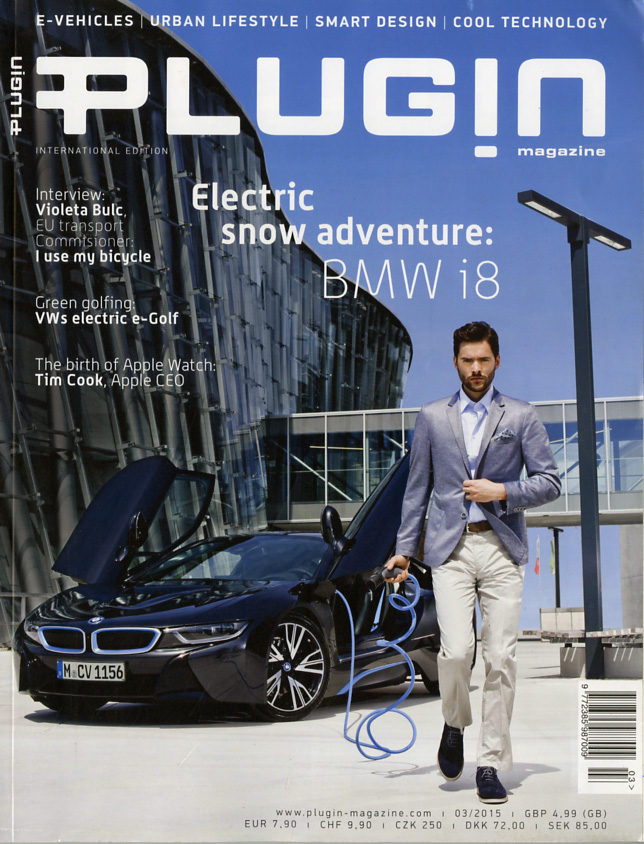
Plugin English-6 Welcome to another installment of the Mr. Magazine™ International Interviews where I had the extreme pleasure of speaking with Dusan Lukic, editor-in-chief, Plugin Magazine, from his office in the beautiful city of Ljubljana, Slovenia.

Dusan is a veteran of magazine publishing and knows his way around the small market, having worked at Adria Media in Ljubljana from the very beginning. Publishing licensed powerhouse titles such as Elle and Cosmo, Dusan and his team are now proudly publishing their first international offering with the new Plugin Magazine. With an English version and a German and Slovenian version as well, the beautifully-done, sleek coffee table collectable is an amazing journey into the eco-friendliness of electric cars and the lifestyles of their owners. It’s certainly what you need to “Plugin” to the world of alternative automotive experiences.

I hope you enjoy the Mr. Magazine™ interview with Dusan Lukic, Editor-in-Chief, Plugin Magazine, as you get a glimpse into the world of magazine publishing from the beautiful country of Slovenia.

But first, the sound-bites:


On the genesis of Plugin Magazine and why it was done in both an English version and a German version:
We came up with the idea of adding a lifestyle element to it and thought about maybe doing it for a chain of hotels, so it would have a controlled distribution. Then we decided to just go national with it and do an English version and a German version because we discussed it with the distributor and they agreed that we should do both because that would be the easiest thing to do with the first issue.

On how the lifestyle element of the magazine is presented:
We’re going to be highlighting the people who are buyers or are thinking about buying electric cars. They’re people who aren’t prepared to give up their freedom of riding around, yet they want to be more environmentally friendly, so they’re considering or have already bought an electric car. On that same note, they also do not want to give up their comfortable home, but they want it to be more eco-friendly. So basically, our target audience is people like that, which usually mean more men than women.

On why the company chose a print component when the magazine deals with the eco-friendly subject of electric cars:
We chose a paper that is quite environmentally friendly. We also have a website; of course, we really started with the website before the magazine. We also have a social media presence too, but we decided that we had to go with print because if you’re talking about lifestyle and life stories; if you’re talking about photography; you just have to showcase all of that in print.

Dusan_Lukic On whether he feels the pendulum is swinging back toward print in Europe the way it is in the United States:
Basically, there is no simple answer to your question. We know what we think; we think that in some markets, print is far from dead and in other markets we have our digital to split the difference.

On the history of Adria Media:
Adria Media is quite an old company; we started with our first magazine in 1996 and I’ve been with the company since the beginning. We started with a car magazine that no longer exists and then we started adding other magazines, either our own or through licensing. We now have 13 magazines and 10 websites, but it’s still a small company, about 120 people.

On the major stumbling block Europe and his company in particular is facing in today’s magazine media market:
In Slovenia, we’ve always been a small market, but we know how to operate in a small market. Of all the countries in this part of Europe, Slovenia was hit hardest by recession. And of course, consumer confidence sank to floor-level and one of the first things that people stopped buying was magazines.

On the hefty cover price and whether that was due to the first issue being ad-free:
It’s like this; we did the first issue without advertising and that was on purpose. What we didn’t want to do was to contact the car industry and the fashion industry without a product on the market. Now we are discussing different ad strategies since we’ve published the first issue.

On what keeps him up at night:
Currently worrying about the future and the stories that we have to do. If you’re a publisher for a small market and you go international, one of the things that you have to do is learn to think like the big international publishers do. I know what I’m doing thanks to my education, but still it’s hard. We know our market here and we know our reader, but we don’t exactly know what would be interesting to our readers outside of this country.
And now the lightly edited Mr. Magazine™ interview with Dusan Lukic, Editor-In-Chief, Plugin Magazine…

Samir Husni: Can you tell me a little about the genesis of Plugin Magazine? Why both an English and German version and why it’s ad-free? And also what’s the mission with this magazine? You say you want people to live smart, drive green and Plugin.

Dusan Lukic: Well, you know that Slovenia is a really small country and of course in Europe, generally print media doesn’t do that well, and that fact is even more obvious here. For example, we have a much distorted advertising market; almost 80% of advertising money goes to television.

We’ve done what we can basically; we have quite a big publishing company; we do a lot of licensed titles; we do Elle, Playboy, Cosmo and others, but we started thinking there’s 2 million in the country and if we only think locally from the beginning, then we’re doomed from the beginning. So we switched and started thinking instead, what else can we do? What is out there that hasn’t been done yet?

We do a car magazine here also, so we’ve sort of found a niche with electric cars and so we started thinking about an electric cars magazine and plugging highways and things like that into it.

But then again, anyone can do a car magazine, so we needed to do something better and different. We came up with the idea of adding a lifestyle element to it and thought about maybe doing it for a chain of hotels, so it would have a controlled distribution. Then we decided to just go national with it and do an English version and a German version because we discussed it with the distributor and they agreed that we should do both because that would be the easiest thing to do with the first issue.

We also have a really good knowledge of the languages here, because Slovenia is close to Austria, so a lot of people speak German and English is a language that is spoken quite a lot here and it wasn’t hard to find people who could write in English or translate.

Samir Husni: Tell me about the concept of Plugin, because the magazine is technically divided into two sections: driving and living. How is the concept of the lifestyle element done? Is it the lifestyle of the electric car owner or driver or the car itself?
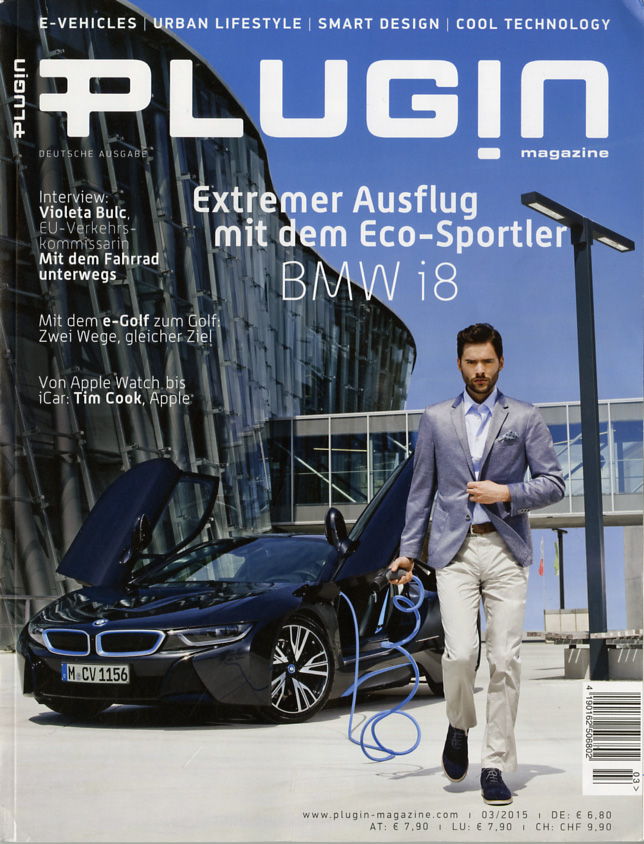
Plugin German-5 Dusan Lukic: We’re adjusting a little bit now with the magazine. All the stories that are in it about electric cars, there are two really big ones in the first issue and there is going to be more, but they’re going to be done in more of a lifestyle-type way. We’re going to be highlighting the people who are buyers or are thinking about buying electric cars.

They’re people who aren’t prepared to give up their freedom of riding around, yet they want to be more environmentally friendly, so they’re considering or have already bought an electric car. On that same note, they also do not want to give up their comfortable home, but they want it to be more eco-friendly. So basically, our target audience is people like that, which usually mean more men than women.

What we want to do is make a very interesting lifestyle magazine and also use it to showcase to those people the electric cars and the Plugin hybrid. This target generation, let’s call it 35-50 years old, affluent enough; they know how to live nicely, yet they’re very environmentally conscious and friendly. They don’t want to read a specialized car magazine; they don’t want to read a specialized architectural magazine, but they do like to read nice stories about all of the areas in Plugin.

Samir Husni: Since one of the focuses of Plugin is environmentally friendly electric cars; why did you decide to go with print when some people say print is not environmentally friendly because it involves the killing of trees?

Dusan Lukic: That’s not true, basically. We chose a paper that is quite environmentally friendly. We have a website; of course, we really started with the website before the magazine. We also have a social media presence too, but we decided that we had to go with print because if you’re talking about lifestyle and life stories; if you’re talking about photography; you just have to showcase all of that in print. And there are still a lot of people who are willing to pay for that in a print format.

Samir Husni: In the United States we’re starting to see the pendulum swinging back toward print. Five years ago everyone was talking about the fact that print was dead; now they’re talking about print’s changing nature or the decline of print. Do you see that happening now in Europe, even though you’re having trouble with advertising, newsstands and single-copy sales? Not the same print that we had before the digital age, but a different print business model that’s on the horizon?

Dusan Lukic: There’s no simple answer to that in Europe. I certainly hope that’s the case. But if you look at our biggest market for our German issue, which is Germany, you’ll find the country still has a really strong print base. If you look at their car magazines, there are about 300,000 different car magazines for a country of 80 million.

And then on the other side we have the U.K. and they don’t really sell a lot of digital issues, percentage-wise, but on the other side of the U.K., the biggest car magazines sell only 50,000, but you’ll find online subscribers at around 15 or 20,000.

Basically, there is no simple answer to your question. We know what we think; we think that in some markets, print is far from dead and in other markets we have our digital to split the difference.

Samir Husni: Tell me a little about Adria Media.

Dusan Lukic: Adria Media is quite an old company; we started with our first magazine in 1996 and I’ve been with the company since the beginning. We started with a car magazine that no longer exists and then we started adding other magazines, either our own or through licensing. We now have 13 magazines and 10 websites, but it’s still a small company, about 120 people.

We started with some really niche products. The first magazine was about Formula One, then a car magazine, one about sports climbing, and then we shifted our focus more toward the women’s side. We have three glossy weeklies; we have Elle, Cosmo; we have a magazine called Sensa, which is about inner well-being. And we’re the first magazine company here in Slovenia to really embrace digital. In 2009, we had about 16 or 18% share of our advertising revenue from digital, which was, even for European standards, quite high then.

We were the first to start doing digital versions of the magazines. But in the last few years we’ve had to really consolidate the company because our revenues went down 30% more. The advertising market shrank, the copies-sold went down and television became all-conquering.

But we’re still alive and we’re the only magazine publisher here. There is another company that went bankrupt and their titles got picked up by another publishing company, but they’re selling it again, so we are basically the only stable magazine publisher here.

Samir Husni: What do you think is the major stumbling block facing your company specifically and magazine companies in general in Europe?

Dusan Lukic: In Slovenia, we’ve always been a small market, but we know how to operate in a small market. Of all the countries in this part of Europe, Slovenia was hit hardest by recession. And of course, consumer confidence sank to floor-level and one of the first things that people stopped buying was magazines.

The other thing was this big shift of advertising money to TV. The problem is we basically have one national TV station. We have two commercial channels, but they’re owned by the same company. We also have the largest Internet portal in Slovenia and they have done deals that are still being investigated by the anti-competition authority. But basically they really lowered prices, they were almost dumping prices and then they gained 75 or 80% of the advertising market.

So there is very little left for everybody else and that includes magazines. In Europe, the normal share for television is 40%, maybe 50%, but not 70 or 80%.

The third thing is a lot people bought magazines in grocery stores before the recession. Now there are chains here that do not sell magazines at all. They have food items cheaper than some of the larger chains that do still sell magazines, so as the consumers started shopping with those for the cheaper food prices, all of the impulse buyers that used to buy magazines on the way out aren’t doing that anymore. We’ve lost a lot of business to the stores that no longer sell magazines.

So, there are three of four factors that figure into it and while each by themselves might not present a big problem; altogether they do.

Samir Husni: What’s the solution?

Dusan Lukic: We didn’t go for the big advertising because once you lower your prices you can never get them back up. We managed to get into contact with some of these retailers and put together special magazine packages for them that they could sell at the cash price. We got some sales there.

We also optimized our own internal structure to cope with the loss of revenue. And we’re trying to get some licensed titles to start publishing and do some smaller titles.

And of course the biggest thing we’ve done is Plugin and going international. International markets are big and they’re different; we have to learn a lot about them, but the opportunities are much bigger than if you just stay close and within your own country’s borders.

Samir Husni: I noticed that you not only went international, but you also went with a hefty cover price, because if there’s no advertising, the magazine needs to sell for almost 8 Euros?

Dusan Lukic: It’s like this; we did the first issue without advertising and that was on purpose. What we didn’t want to do was to contact the car industry and the fashion industry without a product on the market. Now we are discussing different ad strategies since we’ve published the first issue.

It seems to have been a good decision, because in Slovenia we’re not really used to big companies telling us about advertising. And that’s what’s happening to us now. I think it was the right decision to do the first issue ad-free and now we can go all-out.

In fact, in our first Slovenian issue, we had about 25 ad pages. And we’re thinking that the next international issues will be similar.

Samir Husni: So, you’re actually publishing three editions? German, English and Slovenian?

Dusan Lukic: Yes and I’ll say this, financially speaking, the Slovenian edition doesn’t really make much sense, but we are a Slovenian company and we are working in Slovenia and it is a topic important to the Slovenian people, so we felt we had to do it regardless of the amount of money we would make.

Samir Husni: My typical last question; what keeps you up at night?

Dusan Lukic: (Laughs) Currently worrying about the future and the stories that we have to do. If you’re a publisher for a small market and you go international, one of the things that you have to do is learn to think like the big international publishers do. I know what I’m doing thanks to my education, but still it’s hard. We know our market here and we know our reader, but we don’t exactly know what would be interesting to our readers outside of this country.

And just thinking about the next story, who to get for the next interview and how to promote the magazine. Those are some of things that keep me up at night.

Plus, I like to read, so I read magazines long into the night because I don’t have time during the day. And I read about 50/50 print and digital. Some magazines have to be read in print, architecture magazines or car magazines with great photography. I still prefer to read them in print if possible. Some magazines are really good in digital, so it’s different.

Samir Husni: Thank You.

h1

Scintillating & Addictive – Cosmo Spain Holds Its Own With Its American Sister – The Mr. Magazine™ Interview With Ana Ureña, Editor-In-Chief, Cosmopolitan Spain

June 23, 2015

“One of the things on one post-it is “create addiction.” And every time I look at content, because my editors will show me and get my opinion or they’ll show me the finished feature; I’ll look at it and ask myself does this piece create addiction or why would someone want to read more? Or would I want to read more next month? So, that’s one of the messages and if the answer is no, it doesn’t create addiction or that it’s boring; we won’t run it. We don’t run things just to run them. It has to have that special spark.” Ana Ureña (on her use of post-it-notes for inspiration)

ana cosmo spain In a series of Mr. Magazine™ Interviews I’ll be speaking with some of the editors, publishers, CEOs of different magazines and magazine media companies overseas. The first of these interviews is with the editor-in-chief of Cosmopolitan Spain, Ana Ureña. Ana joined the magazine in December 2014 and is an open and entertaining person with firm ideas of how to create and maintain that special spark she believes Cosmopolitan the brand has always had.

Ana’s contention is that Cosmo the brand speaks to all women, from all walks of life and from each and every country of the world. Therefore the content must be translatable to all, from the U.S. to Spain and everything in between and all around.

Our conversation was fun-filled and totally free-spirited, and focused in part on the empowerment of women, something that Ana feels is the most important role Cosmo plays in its audience’s lives. Creating enrichment and positivity with readers using a page-by-page value check is something that she strongly believes in.

Through creativity, such as the Cosmo Pose hashtag promotion she came up with for readers to send in their own Cosmo Power Pose, Ana is bringing fun and vitality to the Spanish arm of the brand.

So, I hope you enjoy this internationally-flavored Mr. Magazine™ interview with a young woman who knows what she wants out of life and is determined to help her readers find their own strength and focus along the way – a conversation with Ana Ureña, Editor-In-Chief, Cosmo Spain.

But first, the sound-bites:

On the difference between Cosmo Spain and its American counterpart: Right now, nothing. (Laughs) No, I’m kidding. I’m a very big fan of the American Cosmo and when I first started at Cosmo in Spain, I did think there was a lot of content that we were missing out on and weren’t using in the same way they were in the American edition. I think that Cosmo as a brand talks to all women, so you could take any content from any Cosmo and it would translate into any country, that’s the beautiful thing about the magazine, because it speaks to all women about women issues and challenges. And it does it in a really fun and happy way.

On using her post-it-note inspiration system:
When you came over a couple of months ago a lot of the things that you said about “common sense” really hit home and I didn’t want to forget what I’d learned, so I thought why not put it on a post-it and put it up on the board where I could see it every day when I went into the office and make those points of interest my own.

Ana_Ureña_ANiv_B On the creation of the hashtag Cosmo Pose:
When I first walked into the offices I started looking at all the Cosmo covers that had been published over the years in many editions, not just the Spanish one. And I noticed that most of the girls on the covers were in a special pose where they had their hands on their hips, either one or both. And I thought wow; almost all of them are doing that on every cover. I didn’t know why, but I thought it was a fun and interesting concept.

On her newspaper background and whether she has found any difference between newspapers and magazines:
Well, the only difference is in newspapers we used to do everything more quickly. (Laughs) The magazine is a monthly so we have more time to think about things. But I think the approach for me is still the same because you still have to think of interesting stories to tell and stories you think the readers are going to want to read and that’s going to enrich their lives.

On the balance between Cosmo Spain’s digital and print presence: I’ve always had Twitter and that’s always been there, that hasn’t changed. So, when I was at the newspaper, I used to Tweet every day about what I was thinking, which was always so interesting. (Laughs) But I have never stopped using Twitter.

On the major stumbling block she’s had to face:
The biggest challenge for me has been the lack of time because you never have enough time to finish everything you have to do. When I was working for the newspaper I was working from home because I was freelancing. I could work at 2:00 a.m. in my pajamas, no problem, but here I have to be in the office and I can’t be in the office in my pajamas at 2:00 a.m. because people would think that I’m a crazy lady, so I have to get things done within the work hours.

On her most pleasant moment:
My most pleasant moment has definitely been interacting with the readers because they reach out and that’s never happened before. I can tell that they’re reading the magazine; I can tell that they’re reading the website or whatever aspect of Cosmo they’re interested in.

On whether or not the magazine would be transformed into herself if she struck it with a magic wand:
No, it would definitely be the whole team. One of the issues that I have personally with magazines is it’s not good if the magazine becomes the editor. The magazine has to be a magazine, it’s the brand. And the brand is Cosmo, it’s definitely not me. But if course I bring a little bit of me to the magazine, but there’s a little bit of me, a little bit of the art director, of the features editor; a little bit of all of us. And that’s what makes it Cosmo.

On what keeps her up at night:
I’m usually a really good sleeper. I’m usually so tired by the end of the day that I just knockout and go to sleep. Maybe the problems of the world bother me, but definitely not my job because it’s something that I really like and enjoy.

And now the lightly edited transcript of the Mr. Magazine™ interview with Ana Ureña, Editor-In-Chief, Cosmopolitan Spain.

Ana_ureña_B Samir Husni: You’re the editor of Cosmopolitan in Madrid, Spain. And you have an American and Spanish background. What would you say is the biggest difference between the American Cosmo and the Spanish Cosmo?

Ana Ureña: Right now, nothing. (Laughs) No, I’m kidding. I’m a very big fan of the American Cosmo and when I first started at Cosmo in Spain, I did think there was a lot of content that we were missing out on and weren’t using in the same way they were in the American edition. I think that Cosmo as a brand talks to all women, so you could take any content from any Cosmo and it would translate into any country, that’s the beautiful thing about the magazine, because it speaks to all women about women issues and challenges. And it does it in a really fun and happy way.

When I first started looking at the Spanish Cosmo, it had lost a little bit of its spark, but I found that the American one was filled with a lot of spark and fun and obviously, it’s about that fun, fearless woman. And I think that’s the DNA of the magazine. So, we’re trying to bring all of that excitement and fun back into the Spanish edition.

Samir Husni: Can you tell me a little bit about your philosophy as an editor? I understand that you use post-it-notes for inspiration?

Ana Ureña: I do. As a matter of fact, when you spoke in Spain few months ago a lot of the things that you said about “common sense” really hit home and I didn’t want to forget what I’d learned, so I thought why not put it on a post-it and put it up on the board where I could see it every day when I went into the office and make those points of interest my own.

One of the things on one post-it is “create addiction.” And every time I look at content, because my editors will show me and get my opinion or they’ll show me the finished feature; I’ll look at it and ask myself does this piece create addiction or why would someone want to read more? Or would I want to read more next month? So, that’s one of the messages and if the answer is no, it doesn’t create addiction or that it’s boring; we won’t run it. We don’t run things just to run them. It has to have that special spark.

Another post-it message is “does it make me feel better?” I always want positive articles in the magazine; I don’t want anything negative or anything that would make the reader feel bad about herself when she sees it or when she reads it.

And I also ask myself would I spend money on this magazine to read its content or can I find it on Google for free? And if the answer is that I can find it on Google for free, we don’t run it because there’s no point. We’re not helping the reader at all.

And the last post-it is “what is the takeaway value for the reader?” Every page has to have takeaway value for our reader. They have to learn something new on every page. Even the contents page, I don’t care, every page has to have something. Maybe a small link to something, or a quote of someone famous or a tip for the day; it just has to have something. The thing about Cosmopolitan, at least for the Spanish edition, is it has two different ways to read it. They can read it very quickly by just reading the titles or the bullet points or they can read it slowly and take in the meat of every article and really enjoy the experience.

Samir Husni: Since you became editor in December 2014, you’ve been introducing even more new and fun things for your audience; for example, I noticed that you have the hashtag Cosmo Pose. Tell me a little bit about that and how you’re putting that into practice.

Ana Ureña: When I first walked into the offices I started looking at all the Cosmo covers that had been published over the years in many editions, not just the Spanish one. And I noticed that most of the girls on the covers were in a special pose where they had their hands on their hips, either one or both. And I thought wow; almost all of them are doing that on every cover. I didn’t know why, but I thought it was a fun and interesting concept.

Then when I was reading a book about body language, there was one pose in the book called the power pose and it was exactly the same as the Cosmo Pose. If you stand with your hands on your hips and you feel powerful, right? The author was saying if you have a job interview, for example, and you’re nervous, go into the bathroom and stand in front of the mirror and do the power pose for a count of 20 and you’ll be able to ace your interview because by doing that pose you’ll begin to feel more powerful.

And I knew that was also the Cosmo Pose and I thought what a great way to empower women; if they practice every morning just doing the Cosmo Pose they will feel better about themselves, which is what Cosmo is all about.

So I started a hashtag called Cosmos Pose and I was encouraging girls to either send us or upload to Instagram or Twitter their Cosmo Poses so we could show the best of our Cosmo communities. I’m hoping people will really get into this and start sending them in because we’re turning 25 this year and we want to do something big with all the Cosmo Poses at the end of the year, like a composite, just something fun.

Samir Husni: My understanding is for the next issue you’re actually giving away a Selfie Stick for someone to use to take their Cosmo Pose?

Ana Ureña: That’s right because sometimes it’s hard to take a selfie of a Cosmo Pose because it’s a very close-up shot and you can’t get your whole body in the picture. But with a Selfie Stick you can actually take a longer distance shot by yourself; you don’t need any help. And you can take the picture and send it to us.

Samir Husni: You came from a newspaper background; how did you make the switch from newspapers to magazines and as a journalist, are you finding any difference between the two?

Ana Ureña: Well, the only difference is in newspapers we used to do everything more quickly. (Laughs) The magazine is a monthly so we have more time to think about things. But I think the approach for me is still the same because you still have to think of interesting stories to tell and stories you think the readers are going to want to read and that’s going to enrich their lives.

When I was in newspapers I used to do a lot of fashion and lifestyle, obviously, but I always used to try and get a human angle to it or something that would pull a reader in. And that’s something that we try to do in Cosmo as well. When we tell a story we always want it to be something with a human side.

Samir Husni: In this digital age where you feel that you have to be in contact with your readers on a second-by-second basis; how are you balancing between your digital presence and your print presence?

Ana Ureña: I’ve always had Twitter and that’s always been there, that hasn’t changed. So, when I was at the newspaper, I used to Tweet every day about what I was thinking, which was always so interesting. (Laughs) But I have never stopped using Twitter. So, the Twitter feed remains a constant and also the Instagram feed.

Samir Husni: What has been the major stumbling block that you’ve had to face since you became editor of Cosmopolitan and how did you overcome it?

Ana Ureña: The biggest challenge for me has been the lack of time because you never have enough time to finish everything you have to do. When I was working for the newspaper I was working from home because I was freelancing. I could work at 2:00 a.m. in my pajamas, no problem, but here I have to be in the office and I can’t be in the office in my pajamas at 2:00 a.m. because people would think that I’m a crazy lady, so I have to get things done within the work hours. And the things that I can take home, I do. But there are some things that I’m still struggling with to get done.

Samir Husni: And what has been your most pleasant moment since you became editor?

Ana Ureña: My most pleasant moment has definitely been interacting with the readers because they reach out and that’s never happened before. I can tell that they’re reading the magazine; I can tell that they’re reading the website or whatever aspect of Cosmo they’re interested in. They ask questions and they reach out to you and that means that someone is out there and someone is listening.

Samir Husni: If I gave you a magic wand that you could strike the magazine with and it would immediately transform itself into a human being, who would that be, Ana?

Ana Ureña: (Laughs) No, it would definitely be the whole team. One of the issues that I have personally with magazines is it’s not good if the magazine becomes the editor. The magazine has to be a magazine, it’s the brand. And the brand is Cosmo, it’s definitely not me. But if course I bring a little bit of me to the magazine, but there’s a little bit of me, a little bit of the art director, of the features editor; a little bit of all of us. And that’s what makes it Cosmo.

Samir Husni: Do you have to be a Cosmo person to work at Cosmo?

Ana Ureña: Definitely. (Laughs) I was a Cosmo girl before I came here. I just realized it.

Samir Husni: What motivates you to get out of bed in the mornings and say it’s going to be a great day?

Ana Ureña: Coffee. (Laughs) Strong coffee.

Samir Husni: (Laughs too) What makes Ana click and tick and gives you that energy from within?

Ana Ureña: I am constantly wondering what’s going to come at me today; the surprise element and I love that. Every day is different.

Samir Husni: My typical last question; what keeps you up at night?

Ana Ureña: (Laughs) I’m usually a really good sleeper. I’m usually so tired by the end of the day that I just knockout and go to sleep. Maybe the problems of the world bother me, but definitely not my job because it’s something that I really like and enjoy.

Samir Husni: Thank you.


And Back In The U.S.A….

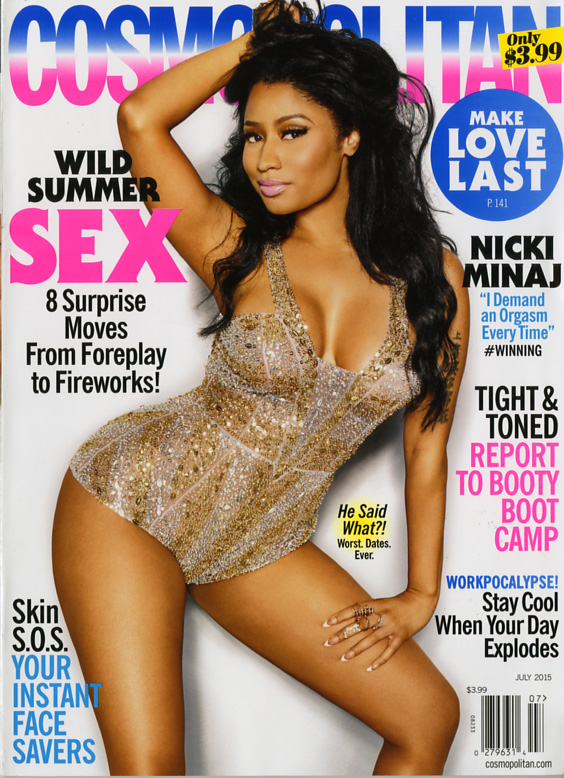
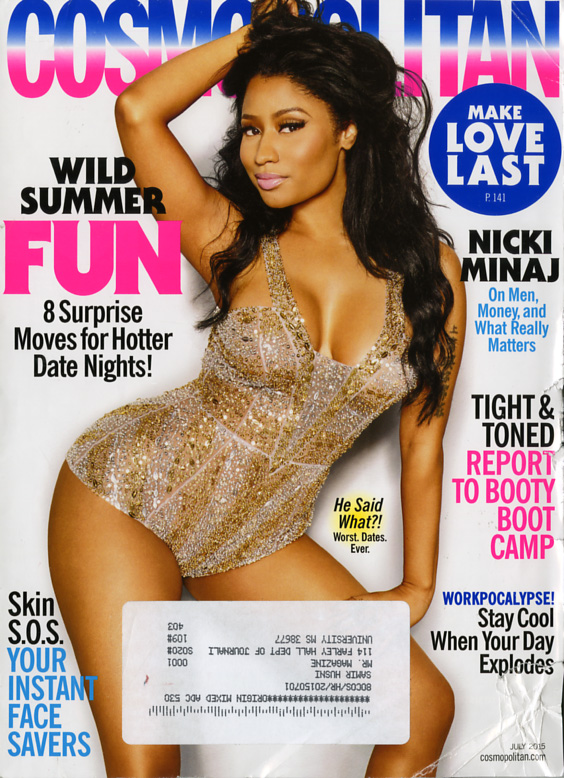
Cosmo 1-1Cosmo 2-2Take note of the differences between the two July covers of the American version of Cosmopolitan – one for subscribers and one for the newsstands.

This isn’t the first time a magazine changes the word “sex” that appears on the newsstand edition to the word “fun” or “love” on the subscription cover. Cosmo is taking a page from its sister publication Redbook which used that approach for years a while back.

The newsstands’ cover reads, “WILD SUMMER SEX 8 Surprise Moves From Foreplay to Fireworks!”

The subscribers’cover reads, “WILD SUMMER FUN 8 Surprise Moves for Hotter Date Nights!”

Gone are the SEX, the foreplay and the fireworks.

So my simple question, what gives? You be the judge and let me know what you think…

h1

The Power Of Print: Mr. Magazine™ Monday Morning Special Issue.

June 22, 2015

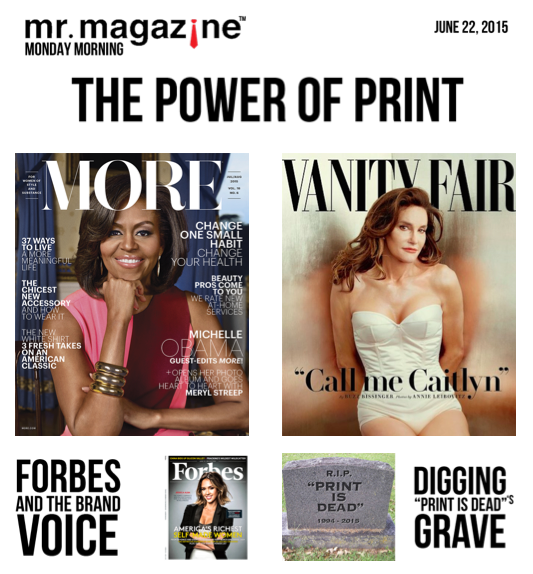
Mr. Magazine™ Monday Morning 6/22 What do MORE, Vanity Fair, and Forbes have in common? All three magazines have illustrated the power of print in a digital age from three different perspectives.

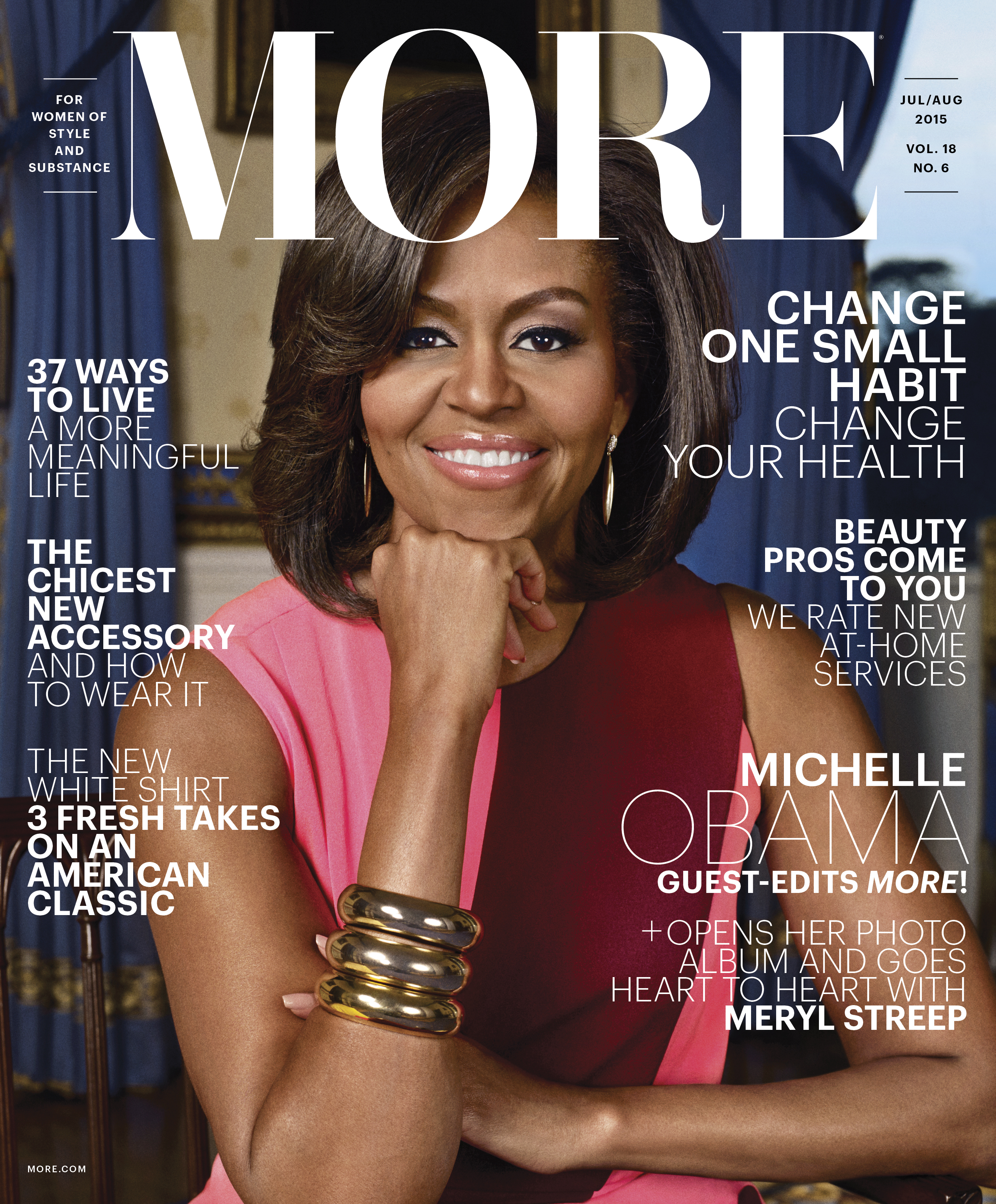
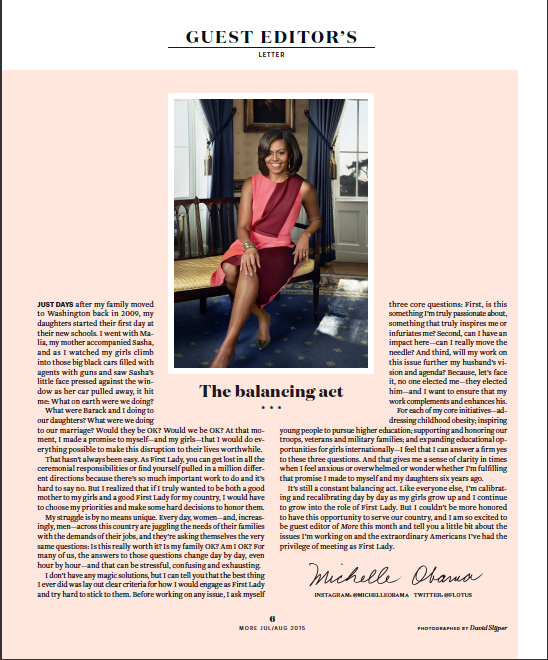
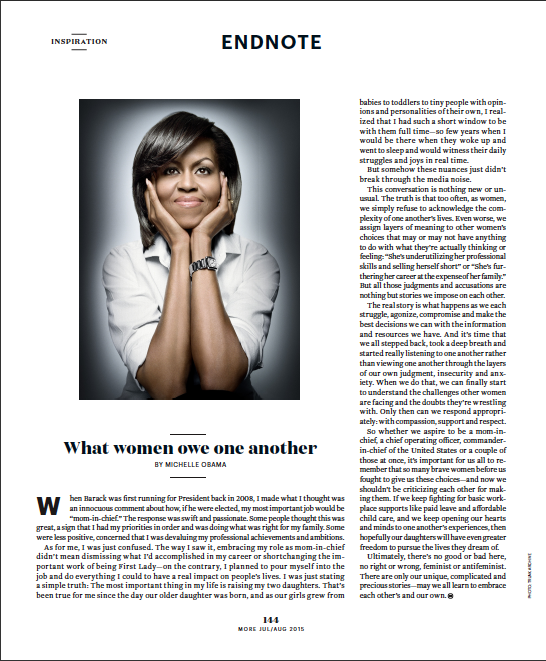
MORE was able to get the First Lady of The United States of America to edit an issue of the magazine, a first in the history of American magazines and the history of a sitting First Lady.

Vanity Fair
was able to generate enough buzz on social media about the Caitlyn Jenner interview, along with amazing photographs taken by Annie Leibovitz, to create a case study which should be copied time and time again on how to best use digital to promote print in today’s marketplace.

Forbes, on the other hand, shows the power of print via its Brand Voice and how to use that brand voice to promote both the advertisers and the content of the magazine.

All in all this past week has been a great reminder about the power of print and to quote Lesley Jane Seymour, editor in chief of MORE magazine, ““Print is not dead; it’s very much alive and if someone hasn’t gotten that message from the recent ink on paper wonders that we’ve had, then they must have been hiding under a rock.”

To read all three exclusive interviews with the editor in chief of MORE, Lesley Jane Seymour, the publisher of Vanity Fair, Chris Mitchell, and the chief revenue officer of Forbes, Mark Howard, subscribe to my Mr. Magazine™ Monday Morning here, or click here to read this week’s issue, and of course you will also find my musing about the power of print and the death of “PRINT IS DEAD.”

Enjoy your week.

h1

Reunion Planning At Its Best – 25 Years Of Family, Military & Class Reunions – The Mr. Magazine™ Interview With Edith Wagner, Founder, Publisher, Reunions Magazine

June 19, 2015

“A decision had to be made in terms of whether or not we could continue to afford to print. At this point with the last several issues, the amount of advertising has covered it, but we’ve really survived for the last 25 years because I’m very passionate about it. A lot of my savings is gone. I’ve never missed a payroll and we pay our bills, but it’s hard.” Edith Wagner

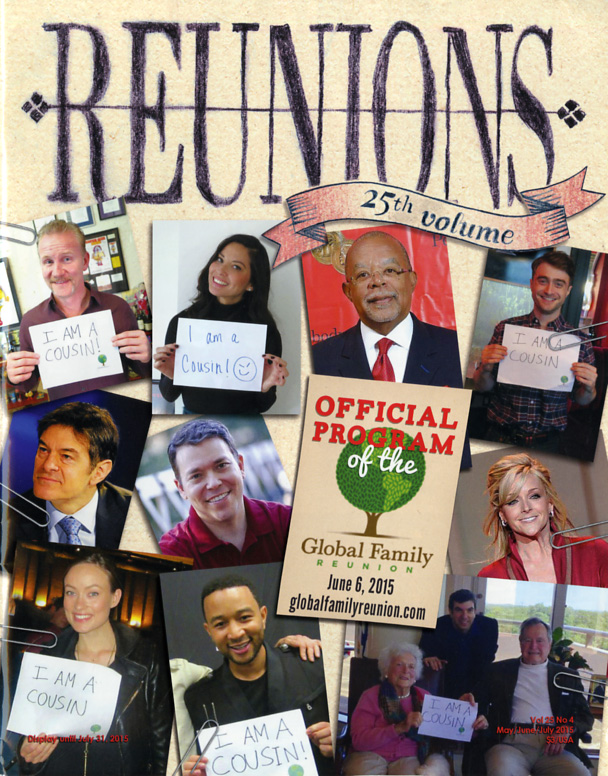
Reunions-18 Reunions Magazine has been around for 25 years and is a small publication that has the backbone of a mammoth. Edith Wagner is the founder and publisher and the glue that has held it together for a quarter of a century. Refusing to give up, Edith has done whatever it took to keep the magazine afloat, even dipping into her own savings. Her passion for the magazine and its subject matter was equaled only by her determination.

Today the magazine is in its 25th year and about to undergo a drastic change by attempting a digital-only format designed to keep Edith’s dream alive and allow the audience to continue its relationship with the brand.

I spoke with Edith recently about the transition and about the history and legacy of the Reunions brand. Her determination and passion is still strong and her faith in what she’s about to do is focused. And for Reunions’ creator and leader, she is as tenacious today as she was 25 years ago.

So, I hope you enjoy the Mr. Magazine™ interview with Edith Wagner, Founder & Publisher, Reunions Magazine and meeting a lady who believes in her passion and her brand.

But first, the sound-bites:

edith_headshot_edited On the genesis of Reunions Magazine: When I started out we were talking about reunions of adoptees and birth parents and I very quickly learned that there was no money in that. I would talk to people about my idea and they would say oh, it could be interesting, and that was my reaction. And this went on for two years before the 25-year-ago beginning of the actual magazine. But with the family, class, military and other reunions we found a market.

On just who the Reunion audience is: For the audience, our audience is reunion planners. And the magazine has become reader-driven; we get almost all of our material from our readers. I think what happens with a lot of reunions is that they love to see their story in a magazine. And I make it clear that there has to be something special about the reunion.

On the fact that after 25 years, Reunions is going digital-only: A decision had to be made in terms of whether or not we could continue to afford to print. At this point with the last several issues, the amount of advertising has covered it, but we’ve really survived for the last 25 years because I’m very passionate about it. A lot of my savings is gone. I’ve never missed a payroll and we pay our bills, but it’s hard.

On whether she believes the legacy of the brand can survive without a print component: Your guess is as good as mine, but we do have a huge presence on the web. We have a very large webpage. I have about 12 years’ worth of content that I haven’t even forced onto the webpage yet. We don’t date things because frankly reunions aren’t dated. And that fact has been a real serious advantage for us. Every now and then there’s news. But what I hear from readers a lot is that they just collect the magazines and when they’re getting ready to plan their next reunion they sit down and they read them all.

On the major stumbling block that she’s had to face over the last 25 years and how she overcame it: It’s always been money. How did we overcome it? We just sort of knuckled down and every now and again we’d come up with a new idea for a special thing we could do and sell.

On her most pleasant moment: Travel writing and traveling to represent companies was a couple of things that were a bonus and just fell into my lap over the years and made it a lot of fun.

On what keeps her up at night: I don’t have a lot of trouble sleeping. (Laughs) Right now it would have to be the transition. There are a lot of people who have to be notified and I’m not talking about sending out a form letter. What I’ve been agonizing and losing sleep over is exactly how to tell people what we’re doing. So far, the response has been amazing because we’ve been talking to advertisers first.

And now the Mr. Magazine™ interview with Edith Wagner, Founder and Publisher, Reunions Magazine…

Samir Husni: Congratulations on staying in business for 25 years.

Edith Wagner: Thank you.

Samir Husni: Tell me the story of Reunions magazine and its quarter-century history.

Edith Wagner: When I started out we were talking about reunions of adoptees and birth parents and I very quickly learned that there was no money in that. I would talk to people about my idea and they would say oh, it could be interesting, and that was my reaction. And this went on for two years before the 25-year-ago beginning of the actual magazine.

At that time Phil Donahue and Oprah Winfrey were on television. And people could relate to those types of programs, of course, but they were always telling me about their military reunions or their family or class reunions. So, I quickly realized that if I used the title Reunions my idea could be expanded to cover all of those things and that’s when we got out of just the adoptee and birth parent part.

But with the family, class, military and other reunions we found a market. But we started out in a slightly down-market in the 90s. It was the early 90s that a lot of businesses started pulling their salespeople back, because then they were on the road all the time and that was becoming very expensive, people were doing a lot more work over the phone. And the hotels needed to fill up their rooms on the weekend; if they had all the business during the week, they could have a skeleton staff on Saturday and Sunday and get by, but all of a sudden they weren’t having as much business during the week and they needed to fill up on weekends and what better way to fill up on weekends than with reunions? And there began the basis for our being able to support ourselves.

Our primary advertisers are convention and visitors bureaus and hotels. Our big problem now, obviously, is advertising. Who have you not heard that from? Now, we’re much more into the convention and visitors bureaus than we are hotels, some resorts and one time a year we have a big feature on ranches; ranches are great places for family reunions.

We’ve worked out some of the problems, but there’s not enough in it consistently right now for the cost of printing and postage. And that’s one of the reasons that we’re making some changes.

Samir Husni: Who is the Reunion audience?

Edith Wagner: For the audience, our audience is reunion planners. And the magazine has become reader-driven; we get almost all of our material from our readers. I think what happens with a lot of reunions is that they love to see their story in a magazine. And I make it clear that there has to be something special about the reunion.

One of the things that I discovered very early on was a very substantial part of our audience is African Americans. And in terms of the advertisers, most of the advertisers that we have are appealing, to a great extent, if you look at the images they use, to African American families. Certainly, in proportion to the overall population, I would say that the percentage of African American families who have family reunions is a little bigger than any of the other percentages. And these reunions are usually the most well-organized and best put together of any.

Samir Husni: And how has that fact impacted the magazine over the years? Since African Americans are a substantial part of your audience, can Reunions now be classified as an ethnic magazine?

Edith Wagner: No, not at all. I think what it impacted was family reunions in general. African American families have taken the family reunion to another level and have demonstrated to other ethnic groups that there are all of these wonderful things that you can do with family reunions.

When we first started out, reunions were just really moving into being a three-day event, with people having to travel to reunions. Prior to that, reunions had been a Sunday picnic. People may have gone to reunions, but they were usually going home, back to the home place or back the farm where everyone grew up. And that still happens, but not as much as it did 25 years ago.

People had begun to travel for reunions and they had turned into more of a Friday, Saturday and Sunday-type event. And now with many reunions, people travel Tuesday through Thursday and make the reunion even longer, in part because if you’re going to travel, you don’t want to picnic just on Sunday afternoon, you have to make the travel worthwhile.

Another trend that has begun to happen is large groups of people will take their vacations together. It takes some planning; you obviously have to be some place that can accommodate everybody. And a lot of these kinds of things are what we include in the stories that go into the magazine and online.

Samir Husni: I read your letter from the last issue and in it you said that would be the last of Reunions regularly-scheduled print edition for now. Is it 25 years and now it’s over?

Edith Wagner: A decision had to be made in terms of whether or not we could continue to afford to print. At this point with the last several issues, the amount of advertising has covered it, but we’ve really survived for the last 25 years because I’m very passionate about it. A lot of my savings is gone. I’ve never missed a payroll and we pay our bills, but it’s hard.

But I didn’t want to give it up. I haven’t aggressively tried to sell it; I can think of people who I wish would consider buying it, but the people I have talked to want to turn it into a travel magazine. And while we have travel information in the magazine; I don’t want it to be a travel magazine. We have a substantial following.

Convention and visitors bureaus frequently have family reunion planning workshops and it’s usually either a half or an all-day Saturday and often I’m invited to come and speak. Recently, I was in Newport News, Virginia, and the way most of them get their audience is through the magazine. We don’t sponsor it and we have nothing to do with it other than I’m the speaker. And at this point, I only do it for advertisers. It’s an added value.

Samir Husni: Do you think the legacy of the magazine will be able to survive without a print edition?

Edith Wagner: Your guess is as good as mine, but we do have a huge presence on the web. We have a very large webpage. I have about 12 years’ worth of content that I haven’t even forced onto the webpage yet. We don’t date things because frankly reunions aren’t dated. And that fact has been a real serious advantage for us. Every now and then there’s news. But what I hear from readers a lot is that they just collect the magazines and when they’re getting ready to plan their next reunion they sit down and they read them all.

And as I said, we have a huge webpage and a very active Facebook page. And some people are impressed by our numbers and others aren’t, we’re a very small business. But the reasons we can attract advertisers is our readers, our webpage visitors and we also have a huge Pinterest page and all of these people are reunion planners.

If you’re a Convention and Visitors Bureau, a hotel or a rancher or even a cruise line looking to book reunions; we’re the ones who can deliver the reunion planners. That’s certainly what has kept us going all of these years.

Plus, a lot of the CVB’s that we work with have been with us for a long time. We know them well and they know us well. I wish we had a lot more. And a lot more say they are doing reunions and are recruiting them.

The other thing is that reunions travel. A lot of families, military groups and even class reunions are beginning to travel more and more. For class reunions we always include information, but it isn’t of particular interest to our advertisers because if they do class reunions they’re right there; they’re generally in the same city where the people went to school.

Samir Husni: What has been the major stumbling block that you’ve had to face in this 25-year journey and how did you overcome it?

Edith Wagner: It’s always been money. How did we overcome it? We just sort of knuckled down and every now and again we’d come up with a new idea for a special thing we could do and sell.

Samir Husni: And what has been the most pleasant moment in these last 25 years?

Edith Wagner: The people who are with me today have all pretty much been here for at least 24 of those 25 years and we’re all neighbors.

There are a couple of things that have happened that I could have certainly never predicted and are pretty cool. First of all there were a number of summers that I stayed on the phone doing interviews and talking about reunions, which I loved because I love talking about reunions. And this was probably in the late 1990s or early 2000s.

Then I was hired by a series of companies to travel around the country and do mostly early morning or late afternoon local TV shows to talk about reunions. And my job was to slip in the name of the company during an interview. I did Kentucky Fried Chicken, Hebrew National and a folding furniture company that I promoted as a furniture people would want for their reunion picnic.

Samir Husni: So, you were basically doing native advertising before native advertising was a topic of conversation? (Laughs)

Edith Wagner: (Laughs too) Yes, yes. One summer I did 23 cities and that wasn’t in a straight line; I kept coming back home. And that was the summer I also wrote a book called “The Family Reunion Source Book.” It was 1998 or 1999.

But then about the same time I started getting invitations to go on press trips and do travel writing. And I did a lot of that, some foreign travel, not very much, but some. And I really limited myself to the kinds of places that reunions would go to. Every now and then I’d get an invitation that was a bit of a stretch, where I knew it was too expensive for a reunion or a place that was just not somewhere a reunion would be held.

Travel writing and traveling to represent companies was a couple of things that were a bonus and just fell into my lap over the years and made it a lot of fun.

Samir Husni: My typical last question; what keeps you up at night?

Edith Wagner: I don’t have a lot of trouble sleeping. (Laughs) Right now it would have to be the transition. There are a lot of people who have to be notified and I’m not talking about sending out a form letter. What I’ve been agonizing and losing sleep over is exactly how to tell people what we’re doing. So far, the response has been amazing because we’ve been talking to advertisers first. And advertisers are interested in supporting us online. I’m hoping that our advertisers are going to follow us online. We’ve come up with a whole web-based rate sheet for them and some ideas of what we want to do online, adding things like video. So, the transition keeps me up a bit at night.

Samir Husni: Thank you.

h1

A Legacy Brand That Knows How To Innovate & Create – There’s Nothing “Old” About This Old House – The Mr. Magazine™ Interview With Scott Omelianuk, Editor-In-Chief, This Old House Magazine

June 17, 2015

“Given what our print circulation is right now and the revenue that comes from it, which to me suggests that there is an audience who wants it, I don’t think it’s anytime soon. My biggest concern is the post office problems at this point. (Laughs) It’s not the audience; we have the audience. We’re doing really well with renewal rates and like I said, I think a lot of that has to do with the fact that we have this dialogue with the consumer that lets us give them what they want.” Scott Omelianuk (on if he can ever envision This Old House without the print component)

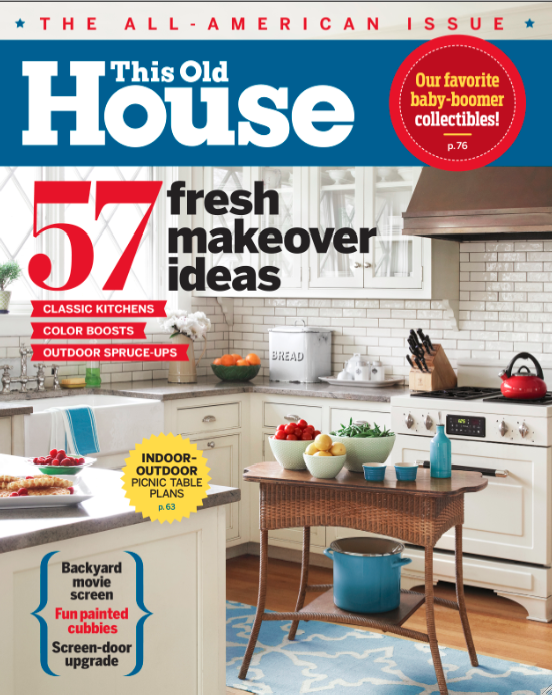
Screen shot 2015-06-16 at 9.07.47 PM From television to print, from digital to an all-new Spanish-speaking television show; This Old House has been binding its many platforms together almost from the beginning to bring its audience the best of what the brand has to offer. The renovation champion of the space is one legacy brand that knows how to adapt to change while continuing to provide outstanding content on each and every platform it masters.

Scott Omelianuk is editor-in-chief of This Old House brand and is a man who knows his way around a hammer himself, since he was working after school as a carpenter’s gopher at the age of 15. I spoke with Scott recently and we talked about the brand in all of its many formats. From the print product to the new TheSnug.com, the mobile-first site that was built on a next generation digital publishing platform, that delivers premium, highly functional sites with sophisticated community participation and native advertising built in, the brand is moving forward to grow its audience with the latest technology and quality print content possible.

TheSnug.com is the first independent website developed by Time Inc. to appeal to millennials and is projected to have a combined social reach of more than 30 million across its partners. It will be driven by community participation and syndicated content with original content, including video, being rolled out in the near future.

It’s an exciting time for This Old House and an exciting time for its Editor-In-Chief, Scott Omelianuk. So I hope you enjoy this interesting interview and if you feel the urge to redo a room in your house, grab a copy of This Old House, I’m sure you’ll find all the help you need between its covers.

But first, the sound-bites:

On whether he’s seeing a change in his audience for the better or worse: Overall our audience has grown pretty significantly over the last couple of years. I’d like to verify these numbers before I actually commit to them of course, but I think MRI put the print audience at 6.6 million and our television audience is up a little bit; our digital audience is growing, particularly on mobile obviously. And the new things that we’ve done have also grown the audience.

On any duplication of the brand’s print and digital audience: Yes, there definitely is and we’ve made a significant effort to do value-added content digitally, things that we can’t get in the print pages, everything from more photos of a house, which we might also include in our tablet edition, to downloadable or printable templates to help with a craft or a DIY project.

Screen shot 2015-06-16 at 10.24.11 PM On reaching a new audience with a legacy brand like This Old House without removing the word “old” from the title: We’re reaching out with new efforts such as The Snug.com, which is looking at a younger audience and in this case, a female millennial audience, showing them content that comes from This Old House as well as other places, but essentially stripped of its legacy branding. Say, the byline is This Old House, but that’ll be about it. And it’s done in a much more contemporary, mobile-first responsive design, hyper-social interface platform that they’re looking at the content on.

On when there might be a printed issue of The Snug.com: There’s no question that as soon as we started filling the buckets with content on The Snug we realized that there was a print opportunity. When it happens, I’m not so sure. It’s a matter of just making sure the economics word out and I think The Snug’s audience could be a little bit larger before we do that. The plan isn’t immediate, but it’s there.

On being the first legacy brand to utilize user-generated content for a magazine and why they haven’t done it again: We have actually, when I reference the reader remodel contest, that’s also the user-generated issue. The recognition for that was I’m very fortunate to have had a multimedia background before I arrived at This Old House; I worked in magazines at GQ and Esquire and other places. I’ve done web and television work and it was very clear to me that the boundaries we liked and the hierarchy of our industry liked wasn’t nearly as important to the consumer. (Laughs) They didn’t care whether someone on a web team or a print team was producing content for either of those things; they wanted good content period.

On whether he thinks a brand can survive without all of its extensions: The damaging thing for a brand to do is not to look at the new opportunities because you don’t know where the audience is going to go. Every place the audience goes, they do need good content. At a certain point you might decide this or that program or this or that utility, whatever the offering is, doesn’t provide enough of an ROI. And I don’t even mean that financially; I just mean in terms of audience engagement. So, you might let tings drop off at a certain point. But I think to not explore where we’re going with technology at every opportunity is a troubling thing.

On being one of the first legacy brands to integrate their staff and platforms and why others haven’t followed their example: (Laughs) I don’t know. I guess I’m not a good evangelist. (Laughs again) I think that part of what you just said is the answer and that is that we’re the most creative people in the world, right? There’s a difference between being very passionate and very creative about the way you design this feature story. Or you write this 7,000-word profile, which is going to be art when you’re done with it. And having editors who are passionate enough about what you do to help you achieve those things. And then having people who are able to take a step back and look broadly at what’s happening.

On if he can ever envision a day there won’t be a print component of This Old House: Given what our print circulation is right now and the revenue that comes from it, which to me suggests that there is an audience who wants it, I don’t think it’s anytime soon.

On what keeps him up at night: No one likes change and I don’t particularly like it either, but we don’t have a choice. The pace of change that we’re experiencing now is as slow as it will ever be in our lifetimes. It’s about making sure I stay ahead and have that next thing. I want to keep being first for my brand. I want us to keep having those firsts.

And now the lightly edited transcript of the Mr. Magazine™ interview with Scott Omelianuk, Editor-In-Chief, This Old House…

Samir Husni: It’s amazing to see how many of the younger generation are interested in the subject of renovation and see it as more of a challenge and a great experience. Are you seeing a change in the audience with This Old House and the entire brand and if so, is it a change for the better or a change for the worse?

Scott Omelianuk: Overall our audience has grown pretty significantly over the last couple of years. I’d like to verify these numbers before I actually commit to them of course, but I think MRI put the print audience at 6.6 million and our television audience is up a little bit; our digital audience is growing, particularly on mobile obviously. And the new things that we’ve done have also grown the audience.

But I think one of the interesting stories is the amount of attention we receive on social and how that audience is sometimes very different from what you would imagine. We do really well on two opposite ends of what I think the social spectrum is in some respects. One is Google+ where you would think more male, nerdy, tech-savvy kind of people are and we have a really significant resize, I think maybe a 600,000 Goggle+ audience. And then on the opposite end of the scale is Pinterest where we have the same size audience, almost 600,000.

To me, the exciting thing about that is it proves the value of the content that we’re doing and that’s what it all comes back to is creating content that consumers want, whether they buy a subscription or they’re going to find us on social media and then find their way back to one of our digital properties.

Samir Husni: Do you see any duplication between the print and digital audiences?

Scott Omelianuk: Yes, there definitely is and we’ve made a significant effort to do value-added content digitally, things that we can’t get in the print pages, everything from more photos of a house, which we might also include in our tablet edition, to downloadable or printable templates to help with a craft or a DIY project.

In that respect, we really make an effort to drive back and forth between the two platforms; most of our large franchises are in both print and digital, such as our reader remodel contest. In print, you can use your Smartphone with a Blippar app on it to enter the sweepstakes or you can go to the website and enter that way. So these are all things that we’ve made an effort to do to keep the audience in both places.

Now a huge amount of our online traffic comes from Search regardless. And those folks we presume to be new to the brand and if we can make them repeat customers, that’s great. I think that’s one of the reasons that the footprint has grown a little bit is because people search for a problem and they actually find good content that’s trustworthy and vetted for them and they know that they can come back to us next time.

Samir Husni: How are you benefiting from the power of the brand, while at the same time having to respond to some people who might say how can you have a powerful brand today with the word “old” in it?

Scott Omelianuk: (Laughs) Well, there’s no question that the greatest strength, which is this very recognizable name that started with the television show 35 years ago and has people watching it today with their children who watched it themselves with their parents, which in some cases gives us three generations of viewers; there’s no question that “old” is a little bit of a liability, but we’ve done a number of things I think to minimize the impact.

One is not to be embarrassed by it; that is who we are. We fully know that not all of our readership, viewers or online users live in old houses. And so the content we present to them I would describe as Americana and that might be the kind of thing you imagine in a 100-year-old farmhouse, but would also be something in a newly-constructed cottage somewhere.

We try to remove age or remove any date at all from any of the content we present. We always talk about new technology. The story of the home really matches to the story of broader technology, in many ways.

We have a Smart Home issue, our second, coming out in September. I don’t think anyone wants to live in a museum, so for us we want to take these houses, houses that are of quality; houses that were nicely made, and make them useful for people who live in them today.

That’s one thing. Another is reaching out with new efforts like we are with The Snug.com and that is looking at a younger audience and in this case, a female millennial audience, showing them content that comes from This Old House as well as other places, but essentially stripped of its legacy branding. Say, the byline is This Old House, but that’ll be about it. And it’s done in a much more contemporary, mobile-first responsive design, hyper-social interface platform that they’re looking at the content on.

So, again it comes back to what I said about social; it’s the content that’s really what’s valuable, not a particular delivery. All of the deliveries are valuable.

At The Snug.com we see us reaching a much younger audience, a much more female audience; our general audience by the way is about 50/50, male/female. The Snug.com is more female and younger. And it echoes a little bit of something that we see when we run things like the user-generated contest, which is that the most active group of people generally for us is on the younger side of our median and that makes sense, right? You’re buying your first house or you’re upgrading to your second house that’s big enough for the family or just whatever. So you’ve not really settled in yet or thought about downsizing. You’re not doing any of those things; you’re much more active in the space.

So even though we have readers who span from 18 to 80, I think the most active portion of our audience is the younger half.

Samir Husni: When are we going to see the first printed issue of Snug?

Scott Omelianuk: (Laughs) When we set about creating The Snug.com our first intention was to put a stake in the ground for reaching a millennial audience in a way that we could extend the franchise basically beyond that particular content. So, you could imagine that there would be a Snug Table and that would be about entertaining or food or cooking, or a Snug Buddy would be about pets; a Snug Dollar might be a finance site that you could extend this franchise into an ecosystem but move traffic back and forth across it and provide a broad ad opportunity.

There’s no question that as soon as we started filling the buckets with content on The Snug we realized that there was a print opportunity. When it happens, I’m not so sure. It’s a matter of just making sure the economics word out and I think The Snug’s audience could be a little bit larger before we do that. The plan isn’t immediate, but it’s there.

I think the really interesting thing about The Snug is the engagement of the audience. We’ve been live for four full months and in that first four months we’ve registered 13,000 contributors of all stripes: blogger, individuals, brands, and altogether they’ve contributed more than 40,000 pieces of content to the platform. And that’s pretty astonishing to me and really exciting.

We’re building on that. We want to make sure that the platform is a stable and viable entity basically, but then I do think that there’s an opportunity for a slick SIP model for the content on there.

Samir Husni: You were one of the early legacy magazines that adapted to user-generated content; you published, if I’m not mistaken, the very first user-generated content magazine in the states.

Scott Omelianuk: Yes, that’s true.

Samir Husni: Why haven’t you done it again?

Scott Omelianuk: We have actually, when I reference the reader remodel contest, that’s also the user-generated issue. The recognition for that was I’m very fortunate to have had a multimedia background before I arrived at This Old House; I worked in magazines at GQ and Esquire and other places. I’ve done web and television work and it was very clear to me that the boundaries we liked and the hierarchy of our industry liked wasn’t nearly as important to the consumer. (Laughs) They didn’t care whether someone on a web team or a print team was producing content for either of those things; they wanted good content period.

So, very early on I tried to integrate the staff of This Old House so that there were no significant silos between who was contributing content to what platform. And as we did that, one of the responsibilities was to participate in the TOH.com community and we realized what a vibrant community we had and how much good information users were exchanging. That’s when we decided that it was valuable and that we should take advantage of it and use the content in print. And we did that; it was Ad Age’s idea of the year, I think it was 2008.

And we’ve done it every year since and it’s been a little bit different, but I think the thing that’s really terrific about having done it is every year it creates an ongoing multi-month, as we ask users to upload content; we create sort of a dialogue between the editors and those people. I think we have a profound understanding of who our consumer is in a way that a lot of other places don’t because they’re showing us what they’ve done; they’re showing us how we may have influenced or inspired them in their own projects. They’re calling and telling us or mailing and telling us what their challenges have been or what their proudest moments are.

And we include those and not just in the user-created issue, which is a sort of wholesale slab of that content, but in every issue there are two or three stories that had their genesis in conversations with our consumer.

So I believe that binds them more tightly to us. It also allows us to give them the kind of content that they want even better. It’s something that I would encourage everyone to do, particularly as research dollars get tighter and tighter, it’s just a really great way to have a dialogue with your consumer and create content. And it’s almost a little distasteful to say consumer at that point, because really what you’ve done is created a community with them. And that’s really important and that’s something that magazine media, whether it’s print or not, can do really well with, if we keep that in mind.

And to be perfectly frank, that’s what we’ve done in extending the idea of home improvement to this all new Spanish-language television show. The stuff we learned such as the emotional connections of the home, the importance of creating this safe place for people and a comfortable place.

We’ve extended to the Hispanic market now and so instead of being purely DIY kind of content on “SOS: Salva Mi Casa” there are family stories as well because; the fact of the matter is that’s why we do these things anyway.

Now we might not go back and change the flagship This Old House show from what it is, but we have new opportunities with new audiences on new platforms to do that, to recognize our ongoing realization of how people interact with our content. So, when you see “SOS: Salva Mi Casa” on Telemundo, you don’t have to speak Spanish to recognize it. You will see that there’s a family component, an emotional component, something really strong and primal about making the simplest improvements to the house that make a huge difference to people.

Samir Husni: Television and magazines have been with us for a long time, magazines longer than television. We now have social media and digital; do you think a brand can survive if we lose any of the brand extensions?

Scott Omelianuk: I honestly think, I don’t know about losing, but I think you have to take the opportunity. Whenever a new platform comes out and people start talking about it, we have a discussion here at our brand about how we might take advantage of it.

We had a Tumblr best-of pick in 2014 for This Old Apartment Tumblr, which actually influenced our creation of The Snug, because it performed so well for itself. We’re also talking about Meerkat and Periscope now; who knows what’s next. We’re talking about how to reinvent the tablet edition of the magazine, so that maybe it’s not the same linear experience that the print edition of the magazine is, even if it has the same content because I want to take advantage of the habits and native technology that’s in the tablet, more than I want to recreate a print edition.

The damaging thing for a brand to do is not to look at the new opportunities because you don’t know where the audience is going to go. Every place the audience goes, they do need good content. At a certain point you might decide this or that program or this or that utility, whatever the offering is, doesn’t provide enough of an ROI. And I don’t even mean that financially; I just mean in terms of audience engagement. So, you might let tings drop off at a certain point. But I think to not explore where we’re going with technology at every opportunity is a troubling thing.

And I do think that for us television is really important because it’s a very cost-effective way of creating digital video. You basically have assets that are paid for and then exploited again digitally at low cost. Whenever we can get the opportunity to create a new television show it allows us to augment our video library, which is already quite large and does really well for us. I think we total about a million plays a month in video and that’s not so bad.

Samir Husni: With the whole integrated staff and integrated creation of what you’ve done; your brand was one of the first to learn that print and digital can and do work together and complement each other very well. Why do you think it took the industry at least five years, six years now, to learn that? To go from print is dead to print is in decline to, who knows five years from now, maybe it will be the power of print again. If we are the most creative people on the face of the earth, why did it take us so long to learn that the two integrated is the only thing that makes sense? Why didn’t people learn from your example?

Scott Omelianuk: (Laughs) I don’t know. I guess I’m not a good evangelist. (Laughs again) I think that part of what you just said is the answer and that is that we’re the most creative people in the world, right? There’s a difference between being very passionate and very creative about the way you design this feature story. Or you write this 7,000-word profile, which is going to be art when you’re done with it. And having editors who are passionate enough about what you do to help you achieve those things. And then having people who are able to take a step back and look broadly at what’s happening.

But then you’re running a business too, so it becomes the founder’s dilemma. You see that the audience is changing and that they might be going in this direction, but you’re making your money here. So how do you find the time to band with the resources or investments to carve out and move when the vast majority of revenue is coming from that other spot.

I think we benefit from the fact that we’re a mid-sized brand and when we dip into a new technology, it’s not devastating to our bottom line. We don’t risk a lot by taking the time to explore that new opportunity.

It’s actually quite hard for people to get out of their swing lanes and take a broader look and to not just be afraid because no one likes change. Or to not be afraid because you don’t know what these things are going to do to the P&L. And to not be afraid because it just might be a waste of time and you’ll embarrass yourself. You know, there are things we’ve done that we stopped doing because we thought they were going to be great, but didn’t work. And that’s OK, but it all depends on the stage you’re on I think. If you’re on a quieter stage you can get away with more, I guess. (Laughs)

I really think that’s the answer and again, I was fortunate in that I had for better or worse a career experience, and I think it was ultimately for the better, where I bounced between a couple of different jobs in media. And that allowed me to see the connections between the people who might have been in one place at a time, and they couldn’t see them. And that made it a little easier.

Samir Husni: Being this, and as much as I hate the phrase I’m going to use it, this multimedia practitioner, do you envision a day when we will not have a print edition from This Old House?

Scott Omelianuk: Given what our print circulation is right now and the revenue that comes from it, which to me suggests that there is an audience who wants it, I don’t think it’s anytime soon. My biggest concern is the post office problems at this point. (Laughs) It’s not the audience; we have the audience. We’re doing really well with renewal rates and like I said, I think a lot of that has to do with the fact that we have this dialogue with the consumer that lets us give them what they want.

I think we’ll be in print for some time; I don’t know about forever, because to say that is just foolish. Given our financials for now, there will be a print edition of This Old House continued, yes. And maybe Snug too, at least quarterly. (Laughs)

Samir Husni: My typical last question; what keeps you up at night?

Scott Omelianuk: (Laughs) I have a four-year-old that doesn’t always sleep. So, that’s one thing. Just thinking about what’s next and having the bandwidth to do all of the exciting things that are coming and trying to be there when they are.

No one likes change and I don’t particularly like it either, but we don’t have a choice. The pace of change that we’re experiencing now is as slow as it will ever be in our lifetimes. It’s about making sure I stay ahead and have that next thing. I want to keep being first for my brand. I want us to keep having those firsts. And that’s what makes it exciting and that’s what makes it exciting for people to come to work here. And why I get the opportunity to talk to people like you.

Samir Husni: Thank you.

h1

Mr. Magazine Exclusive™: More Magazine’s Editor-In-Chief Lesley Jane Seymour Discusses Michelle Obama’s Editing Debut & Shares The Play-By-Play Scoop Of The First-Ever First Lady Of The United States Magazine Editing Inauguration.

June 14, 2015

“This is what print can do. Print is so different. Print is something that lives on forever. It’s not a commercial; it’s not a webpage; it’s not a posting; it lives on and it’s a document. And I think that’s what’s so lovely about it.” Lesley Jane Seymour (on Michelle Obama guest editing an issue of More magazine)

“Print is not dead; it’s very much alive and if someone hasn’t gotten that message from the recent ink on paper wonders that we’ve had, then they must have been hiding under a rock. (Laughs)” Lesley Jane Seymour

MORE JulyAugust Cover For the first time in the history of the White House and American magazines a first lady guest-edits an issue of a magazine and not just any magazine either, but one that reflects the style and substance of the first lady herself. There are a lot of “firsts’ in that sentence, but each and every one of them are well-deserved and true.

More magazine has obtained the coup of a magazine’s lifetime in guest editor Michelle Obama. For the July/August issue, the first lady moves in and takes over the reins, proving that the American magazine dream can be realized. I recently spoke with the editor-in-chief who wove this magical chimera, who tossed the golden glitter into the air and watched it materialize into reality, Lesley Jane Seymour.

Lesley, who was in Italy when we spoke, was amazed, overjoyed and quite stunned truthfully when the first lady and her team accepted her offer of becoming guest-editor for the July/August issue of More. More than a coup to Lesley, this achievement not only provides a wonderful surprise for her readers, it also showcases who she believes the “More” woman is; one of style and substance, such as the lovely Michelle Obama.

We talked about the behind-the-scenes actions that led up to the historic issue and we also hit on many of the interesting and fun things that happened along the way. Our interview was nothing short of amazing itself.

So, I hope you enjoy this Mr. Magazine™ exclusive on the play-by-play of the first lady’s debut as editor-in-chief of More, because it’s a given you’ll definitely discover “more” than you ever knew before about our first lady in the White House and our first lady of More magazine, Lesley Jane Seymour.

But first the sound-bites:

First Lady Michelle Obama participates in a photo line at the U.S. Embassy in Seim Reap, Cambodia, March 22, 2015. (Official White House Photo by Amanda Lucidon)

First Lady Michelle Obama participates in a photo line at the U.S. Embassy in Seim Reap, Cambodia, March 22, 2015. (Official White House Photo by Amanda Lucidon)

On the coup of a lifetime, having Michelle Obama guest-edit an issue of More magazine: I said, OK, what’s the craziest thing that I could ask Mrs. Obama to do? What would be crazy? Ask her to edit the issue, right? So, I did. And I thought, of course, they’re going to say no, she’s the first lady. But they said yes.

Guest Editor, More Magazine, The First Lady of the United States

Guest Editor, More Magazine, The First Lady of the United States

On whether Michelle Obama knew that she would be the first matriarch of the White House to ever guest-edit a magazine: That was not why she did it. She did it because they were starting to think about legacy. The reason why and one of the points that nobody has made yet is this is what print can do. Print is so different. Print is something that lives on forever. It’s not a commercial; it’s not a webpage; it’s not a posting; it lives on and it’s a document. And I think that’s what’s so lovely about it.

On the power of print and what it will take to prove that strength to the critics:
I’m here in Italy and I look at books from the Florentine ages which are preserved in churches and I’m constantly reminded of the fact that print really does matter. It’s an extraordinary medium that cannot be surpassed. And as trendy as all the other stuff gets, there are things that print can do that nothing else can. Recently, it’s been incredible. We’ve been showing the world what print can do.

On the power of print and what she believes it will take to finally prove that point to critics:
There are certain things, as we know; I’m here in Italy and I look at books from the Florentine ages which are preserved in churches and I’m constantly reminded of the fact that print really does matter. It’s an extraordinary medium that cannot be surpassed. And as trendy as all the other stuff gets, there are things that print can do that nothing else can. Recently, it’s been incredible. We’ve been showing the world what print can do.

On the process of the reinvention of More magazine:
Again, as I said, you have to keep evolving, especially in print. And the speed with which we have to evolve has increased. In the old days, you could evolve your print product once every five or ten years, or whatever, and we’ve all watched as it began to move faster and faster.

Lesley Jane Seymour, Editor in Chief, More magazine

Lesley Jane Seymour, Editor in Chief, More magazine

On broadening the demographics of More from just the over 40 group: And that was terrifying. To take More out of that box that it was born in, those are the words that make editors cry. When your management comes to you and says take the baby out of the box that it was born in, that’s when you take out your tissues and start crying and begging them to not make you do that. (Laughs)

On the major stumbling block that she’s had to face in her seven years at More:

The major stumbling block has been the general contraction in print. It’s a tough time. This is not like editing back in the 90s; it’s not. Every day it’s scary out there. I think the thing that you really have to do is you have to be creative; you have to keep moving forward no matter what happens and no matter what cuts people make, no matter what’s going on around you; you just have to keep moving forward.

On whether she believes Mrs. Obama captured the readers with her guest-editing debut:
Yes, I mean, you’ll see. She brought in so many of her own ideas. She wrote two editor’s letters, she wasn’t happy with just one, she wrote an end letter also. You’ll have to see all the great stuff that it’s in there. It is very, very her.

On whether she could see Michelle Obama launching her own “Michelle” magazine after she leaves the White House:
What’s funny is I don’t think she would, but I have to tell you, it crossed my mind because I thought what is she going to do after the White House? I don’t know what she’s going to do; I can’t guess.

On her most pleasant moment:
Traveling with her (the first lady) and learning everything, I’d have to say was the most amazing time at More so far.

On what keeps her up at night:
What keeps me up at night? Well, we have the event; we have a whole social commerce thing that’s going to be launched at the event, which will be on the 29th. So, I have to make sure that goes well. And a lot of the funds are going to go to the “Let’s Ensure That Every Girl Can Learn” program which is very, very needed.

And before you read the lightly edited Mr. Magazine™ exclusive behind-the-scenes conversation with Lesley Jane Seymour, Editor-In-Chief, More magazine, click below on the video to watch the making of the July/August cover of More magazine.

Samir Husni: Tell me about this coup. This is the first time in the history of American magazines and the White House that a first lady has ever guest-edited a magazine.

Lesley Jane Seymour: I know, isn’t it exciting? This is how it went, Samir. When I first came to More, I was looking around for a woman who was not necessarily a Hollywood celebrity who would embody what the More woman would be.

And Michelle Obama was sort of on the scene, in the background of her husband running for office and she just seemed like the exact person of who the More woman would be in my mind when I took over the job seven years ago, which was somebody incredibly accomplished, very intelligent and intellectual, stylish and who was going to have or was already having some kind of major impact on the world.

I asked her then if she would do the cover and at that point she was just the senator’s wife and luckily they agreed. My deal was if her husband received the nomination, she would go on the cover, if not, she would be inside anyway. We hired a wonderful writer from the Wall Street Journal and it was a fabulous piece. It was very serious and it looked at both sides of who she was.

So, we went and we photographed her in Chicago in a hotel room and I have to tell you, from that day-one, she was a big hugger. It was really funny because at the last minute my photographer asked did I want to have a picture taken with her and I hadn’t planned on it. I’m about 5ft. 3in. and I just sort of ran in to the photo and stood there and I was literally in her armpit. (Laughs)

Samir Husni: (Laughs too).

Editor's Letter Lesley Jane Seymour: So the photographer ran to get a box for me to stand on and I felt this rubbing on my back. And I looked around to see who was rubbing my back and it was her. She’s just an incredibly warm and down-to-earth person.

The funny thing is that happened again after our interview in the White House for this issue; we finished our interview, finished going through all her photos and I got up to shake her hand and she gave me this big hug. She’s just a warm and interesting person and she is so More. She’s just exactly who this woman is.

And then the second time, she of course went on to become first lady. But I ran her before she was first lady. I gave her that first national magazine cover. Then when she became first lady, everybody put her on the cover.

The cover we did two years later, when she was first lady, was a knockout bestseller. So, what do you do when you have a bestseller? You look at all the ratings from consumers about the first lady. And in one poll that centers on the most admired women in the world, she’s been the number two the entire time she’s been in the White House. People really, really love her and all the things she does.

So I had this bestseller, what was I going to do? I couldn’t go back and repeat what I just did which was a story all about her mentoring in the White House. You need a scoop, right? We’re journalists, you can’t just go back and put a pretty face on the cover and hope somebody is going to buy the magazine.

I’m kind of a kooky person and always have been. When I was at Marie Claire and Redbook, I used to have these meetings which I called “Crazy Idea Meetings” and the idea was: bring your biggest and most fantastic, crazy idea that you think a consumer would want to see or read. Don’t worry about the expense; don’t worry about whether it’s logical or not. And I used to give them the example of, let’s say, an idea about putting someone on an airplane and sending them to China to do something; we’ll talk about it and if it’s a great idea I’ll figure out a way to sell it somehow.

So, along with those crazy ideas come my own ideas. And I said, OK, what’s the craziest thing that I could ask Mrs. Obama to do? What would be crazy? Ask her to edit the issue, right? So, I did. And I thought, of course, they’re going to say no, she’s the first lady. But they said yes.

And I remember, I came back from having lunch with her team and I called Jeannine Shao Collins, who was my publisher, and I told her, don’t say anything, but I think we have the scoop of a lifetime, but it can’t be true. They’re going to go back to their offices, they’re going to think about it and they’re going to say, oh no, we can’t do this.

And I made her sit on it for three months. Of course, she’s a great partner and she was excited and saying, I want to call everybody; I want to get everything set. And lo and behold, no one changed their minds and once we got started on it, it was a reality.

The hilarious part is Tina Tchen, who is Mrs. Obama’s chief of staff, as we were doing the photography in the White House, originally they give you a half hour to shoot a cover, we usually take a day, but she was enjoying herself so much it went on for like a whole hour, and Tina was in the background and we were talking and watching it go on and she turned to me and said, you know, if we’d had any idea how hard this was going to be, we wouldn’t have done it. (Laughs) And I was thinking, I know and that’s why I’m glad you had no idea. (Laughs again)

Samir Husni: (Laughs too).

Lesley Jane Seymour: And when I would see her at parties, month after month, she’d keep saying to me, so much detail, so much detail. (Laughs) And I was like, you thought I had a hard job; I do have a hard job. (Laughs again) So, it’s really become a running joke between us.

But here we are and it’s all worked out. The hardest part was we were going to release it a week earlier and then we had to sit on it for another week and we were afraid everything was going to pop out. That’s a really interesting managerial thing when you’ve got a magazine shipping and you’re trying to sit on something really big.

They were incredible to work with. I backed up the production of the issue by four months because I thought this would be crazy, everything we do will have to be seen by 25,000 people and it’s going to take forever. But we were done a month early. And we worked with their staff; we didn’t bring in any extra help. It was really incredible; they run such a tight ship. And we also run a really tight ship.

I have to say, I’m here in Italy and I forgot, after waiting and waiting all year practically; I forgot that it was releasing finally and then all of these emails started coming in and I said, oh right, that’s why I’m Italy; I’m fried, completely fried. (Laughs)

Samir Husni: Did she know that she would be the first of the first ladies ever to guest-edit a magazine?

FLOTUS Guest Editor Lesley Jane Seymour: That was not why she did it. She did it because they were starting to think about legacy. The reason why and one of the points that nobody has made yet is this is what print can do. Print is so different. Print is something that lives on forever. It’s not a commercial; it’s not a webpage; it’s not a posting; it lives on and it’s a document. And I think that’s what’s so lovely about it.

She didn’t know and I didn’t know; none of us knew that this was a first really until the very end and we started talking about PR and somebody said, I don’t even remember who it was, but I believe it was somebody on my team, and they said this is the first time a first lady has ever done this before. And I remember responding, what, really? And then we started researching and they researched and indeed, it turned out to be true. But none of us went into it thinking that.

The way my team and I look at magazines, and I’ve done this for so many years with so many teams, is I’m always looking to surprise my reader. I feel very much like it’s a marriage, especially with the people who subscribe. And what I always say to my team is every now and then you have to show up at the front door naked except for the Saran Wrap, just to keep it sexy. And you always have to look for something that is interesting and different. And how do you surprise them?

So, I was really looking to surprise and they were looking for new things that she could do that would be fun, interesting and would fit with who she is. She remembered very well our first cover together, which she loved. And she loved the second cover. And then they dove in. Obviously, way before they understood what they were getting into. (Laughs)

Samir Husni: (Laughs too).

Lesley Jane Seymour: But they are so happy. In fact, everyone is very happy with it. She Tweeted it out. I don’t know if you saw it on her Instagram? We didn’t go into this thinking that we were doing a “first.” If you sit down as an editor and try to come up with something historic; you’re never going to do it. You have to back into it. (Laughs) That’s the lesson I guess. Sometimes you back into these things; you can’t plan it.

Samir Husni: Obviously, you’ve hit the jackpot. When you mentioned the power of print, recently with Vanity Fair’s cover of Caitlyn Jenner and now the first lady guest-editing More; what more do you think, no pun intended, it’s going to take to get this message that if you really want to be permanent; if you really want to be a “document,” print is the only way?

Lesley Jane Seymour: We didn’t know about the Caitlyn release, of course, hilariously, right? And so the two, I think, go together in an amazing way for all of us in the print industry to say you cannot do this without print. There are certain things you cannot do. You cannot create history, and in a way, Caitlyn is history too; you just can’t create history without print. The closest thing you have is a documentary film, but you have to run it every time you want to see it. You can’t just pick it up and leave it on your coffee table.

There are certain things, as we know; I’m here in Italy and I look at books from the Florentine ages which are preserved in churches and I’m constantly reminded of the fact that print really does matter. It’s an extraordinary medium that cannot be surpassed. And as trendy as all the other stuff gets, there are things that print can do that nothing else can.
Recently, it’s been incredible. We’ve been showing the world what print can do.

And the first lady can have this and that’s what I said to them. She’ll have this fabulous document and they have something that goes back and talks about all of their programs and there’s fun stuff in there, and in a way, it is part of the legacy. It’s something that they can look back at. It can be passed down to their children.

Print is not dead; it’s very much alive and if someone hasn’t gotten that message from the recent ink on paper wonders that we’ve had, then they must have been hiding under a rock. (Laughs) I think it’s been an amazing time for magazines. If you look at our recent weeks; it’s been amazing for print journalism and for showing how muscular and how relevant we are.

Samir Husni: You’ve been at More now for seven years and this year you’ve reinvented More. Tell me about the process that took the magazine from what it was to what it is today. And by the way, it was a good magazine then, but you’ve created a better magazine now; tell me about that process.

Lesley Jane Seymour: Again, as I said, you have to keep evolving, especially in print. And the speed with which we have to evolve has increased. In the old days, you could evolve your print product once every five or ten years, or whatever, and we’ve all watched as it began to move faster and faster.

The irony is, and the weirdest thing for me is, to get to seven years and you can clearly see what this product needs to be and because of who the consumer is, I mean it could have always been this thing, but nobody was ready and it wasn’t the right timing for jumping forward and just going for that very upscale, luxury consumer.

We have a very high-household income; we have the highest household income of any woman’s magazine out there period. But the way that the magazine fit into the Meredith constellation; it had to be a part of the Meredith sisterhood, so it had to be a service magazine and it always was. It was always a better service magazine.

What’s wonderful is that now we’re allowed to walk away from the old heritage, partly because of Jeannine Shao Collins, who’s my new publisher, she came on in May 2014, and we can say we’ve tried all the other things and the evolution of the woman that we own and nobody else owns is this highly-educated, high-household income, high-influencer person, if you look at all the MRI, and it’s time to give her the package that she wants. So, let’s try it.

And the wonderful thing is Meredith was game. It’s seven years later and in many ways, it was a lesson in hanging in there. You never know what your product can be in the end. It can keep evolving. And we’re not trained to do that as editors; we’re trained to think when we walk in that first day we’re going to make our changes, we’re going to have an imprint and that’s it. And I think it has to do with our time and what’s happening in print. I think that there’s an interesting message in that things keep evolving and if you are an intelligent, forward-looking editor and you keep pushing ahead, people will follow you.

And so we finally got a broader format; we got better paper and better advertisers and hopefully Michelle Obama will catapult us right to where we want to be, which is with our own kind of little signet in many ways. Does that make sense?

Samir Husni: Oh yes, it makes a lot of sense. I am really amazed with the revival of More. Rather than focusing on women who are over 40, you have broadened that style and substance demographic.

Lesley Jane Seymour: And that was terrifying. To take More out of that box that it was born in, those are the words that make editors cry. When your management comes to you and says take the baby out of the box that it was born in, that’s when you take out your tissues and start crying and begging them to not make you do that. (Laughs)

And the really interesting thing is, I think we’ve done it. There are some women who miss the over-40 box, but the subtext of the magazine from day-one has always been a smarter, more intelligent magazine for women who cared about the world. That was always there and became a layer for women over 40. Now, if we’d had no substance other than the 40 moniker, we would have been dead. But because we always had that, it was terrifying, I won’t say that it wasn’t, but because of our substance we were able to tear away the top layer and be left with the subtext, which is a smarter, more intelligent magazine for women 30, 40, 50-plus.

If you look at the magazine as really all of me in there, because as someone pointed out to me, who only did the redesign, I had forgotten that it has my Women’s Wear memory in there, which was we used our best of the best opening pages, which are just beautiful photos, but they have deep captions and serious merchandising research from the industry. We talk to retailers and people like that, and the designer said oh, that’s a Women’s Wear Daily thing and I had forgotten.

But that’s what’s great; you can take all of your history and you can apply it, once you know who the consumer is. And my consumer has said to me since we went with the style and substance; I’ve had people who write in and say I picked up the magazine because I’m a woman of style and substance. And it grabbed them.

Samir Husni: I love the style and substance tagline, it’s wonderful. Lesley, tell me, what has been the major stumbling block through these seven years that you’ve had to face and how did you overcome it?

Lesley Jane Seymour: The major stumbling block has been the general contraction in print. It’s a tough time. This is not like editing back in the 90s; it’s not. Every day it’s scary out there. I think the thing that you really have to do is you have to be creative; you have to keep moving forward no matter what happens and no matter what cuts people make, no matter what’s going on around you; you just have to keep moving forward. And your vision has to be really strong. If you waver at all right now; if your focus is mushy or bounces back and forth or bounces all around, you just can’t do that.

I can tell you one thing through the whole seven years, even when we did our first small renovation, the voice that I started with is the same voice. And I’ve always spoken to my reader as if she was me and I have never spoken down to her at all. I always speak to her as if she were intelligent and as if she gets everything. We use big words and we use long articles when we want to, when it’s the right item. I have never looked down on my consumer and I think that’s why she’s stayed with me. I respect her intelligence and I respect her hard work. She doesn’t have to agree with me, but we talk to her like that woman who we respect.

And we also don’t fall for a lot of the stuff. One of the hardest things for new people coming to the magazine to realize, and it’s funny because I have someone as a beauty director now that I’ve hired for the fourth time and she came from Real Simple. And she was being so nicey-nice, everything was just nicey-nice and she was always telling nice things about the products that we were reviewing. And I was like no-no; you have to tell them what you think about the product too. She said really? And I was like yes, you have to tell them both sides or they’re not going to believe you. We have to be frank with our audience and tell them the truth. The BS meter is so high and you can’t try and pull the wool over their eyes. You have to be really honest.

And if you read my editor’s letter which is the best-read thing in the magazine; the reason why they like it is I don’t talk about what’s in the magazine, I talk about my life and what’s going on with me. I might hook it into something that’s going on in the magazine. The only times that I do is like with the Michelle Obama issue; I talked about following her to Asia and how that all worked in.

My whole thing has always been brutal honesty, even when I started at YM. You have to be brutally honest and if you can’t tell the reader the truth about your life and if you can’t reflect the truth about your life with her, you’re not going to connect. Just recapping the table of contents there; who needs it?

Samir Husni: Do you feel Mrs. Obama, the first lady, was able to capture that channeling and conversation with the readers in this issue?

Lesley Jane Seymour: Yes, I mean, you’ll see. She brought in so many of her own ideas. She wrote two editor’s letters, she wasn’t happy with just one, she wrote an end letter also. You’ll have to see all the great stuff that it’s in there. It is very, very her.

And that’s what is cool about it too. The other two issues we did with her were about her, this is from her point of view. That’s part of the surprise, Samir, is that it’s not just about her. She does a lot of magazines and it’s an interview with her. This is from her point of view; what’s important and interesting to her. Who are interesting writers and storytellers; who are the people on her staff that she cares about when she wants to talk. It’s interesting and different.

She and I sat down and did a long conversation about her favorite photos from her time in the White House and when her husband was running for office and it was phenomenal. You may have seen some of these photos, but you don’t know the real stories. And that was what was so interesting. At the end of that conversation I said to her, you have to explain this to me, how do you live in this house, because we were in the White House; how do you stay so grounded? She is the most grounded person. I know people in the fashion business that don’t live in the White House, but have so many airs, just because they’re working for some fancy designer or something like that.

And she is so, so much herself. And she said to me, living here makes you more of whoever you were in the first place. And that was a very interesting thing. And that is really the core of who my reader is and that’s in many ways the core of More, in view of its audience. It’s real women doing amazing things. We do one celebrity; we don’t focus only on celebrities and it’s really about real women doing amazing things in real life. And it has fashion and beauty and all that. We want to be a full lifestyle magazine for our reader.

Samir Husni: This may be a crazy question…

Lesley Jane Seymour: Go ahead. I’ve asked crazy and people have said yes.

FLOTUS EndnoteSamir Husni: (Laughs) Do you ever envision the first lady after her experience guest-editing; do you see her, after leaving the White House, launching Michelle Magazine?

Lesley Jane Seymour: What’s funny is I don’t think she would, but I have to tell you, it crossed my mind because I thought what is she going to do after the White House? I don’t know what she’s going to do; I can’t guess. But I wouldn’t be surprised to find her doing something with the “Let Girls Learn” initiative that I know is very important to her and why I followed her to Asia when she launched “Let Girls Learn” and to watch her in action and in how she related to the kids and how they related to her. Or maybe something in the fashion industry; the fashion industry loves her.

She is very much my consumer, Samir. She is really a woman of substance and style because when you watch her get off a plane, I have to tell you that was such an extraordinary experience. You really see because she is so stylish, attractive, and smart and she does so much; when she comes down those stairs, there is pixie dust in the air. It’s a little Disney. She has something that not everyone has. So, I’m going to be really interested to see what she does.

Samir Husni: What has been your most pleasant moment in these seven years at More?

Lesley Jane Seymour: It doesn’t get any better than this. I have to say traveling with her was amazing. I didn’t travel on her plane; I had to chase her around, which was even more fun. I love getting out of my skin and I love learning.

Traveling with her and learning everything, I’d have to say was the most amazing time at More so far.

Samir Husni: My typical last question; what keeps you up at night?

Lesley Jane Seymour: What keeps me up at night? Well, we have the event; we have a whole social commerce thing that’s going to be launched at the event, which will be on the 29th. So, I have to make sure that goes well.

And a lot of the funds are going to go to the “Let Girls Learn” program which is very, very needed. If you have access to my editor’s letter that I wrote; you’ll see that the program is all about putting girls into school so that they can get an education and don’t end up in young marriages or violent marriages or sex trafficking, any of that stuff.

The day after we were done traveling, I had a day for myself in Cambodia and so I jumped in a Tuk-Tuk to go to what’s called the floating market. And I went to see this school and I write about it in my editor’s letter, and this was right after watching Mrs. Obama and the first lady of Cambodia talk to these young girls who wanted to get an education and were at a government boarding school. And I was taken by the kids who drive the boats to the school and they want you to pay money and give to the school as a charity.

This young little girl, maybe five-years-old, grabbed my finger, my pinky, and she was wearing a nightgown, this beautiful young child, and it’s a floating school, it’s on pontoons. She walked me around to the back and like in America, you thought she was going to show you a pet or her bedroom or her books, something like that.

Instead, she turned to me when we got to a private spot and pointed to the ground and said, for a dollar I give love. At which point I nearly fell apart and I said excuse me. And she said it again. She’d been trained. I guess if she was five, she didn’t see the difference between a woman and a man or maybe it didn’t matter.

And you went really just said oh my God, this is why we need this program. Those kinds of things to me are important. The fact that I get to do that being an editor is so amazing. I mean, who gets to do that? That’s pretty amazing.

And then to go out there and to help raise funds to change that. The power of words, as you know, there is nothing like the power of words. It changes worlds.

Samir Husni: Thank you.

Photos and video courtesy of More magazine.

h1

Ruling Her Editorial Kingdom With Focus, Dedication & Humor – The Reigning Queen Of Magazine-Making Bestows Everything Her Subjects Need For The Good Life – The Mr. Magazine™ Interview With Ellen Levine, Editorial Director, Hearst Magazines

June 12, 2015

“No, I can’t see that. I don’t think that will happen. There may be some transition in people’s personal needs, but no, we will continue to do print. I do remember reading how excited everyone was when they looked at the first printed Bible and how excited people were when they found, I think it was in Israel, some original writings in a cave. They wouldn’t have been as excited if they’d found somebody’s laptop back then.” Ellen Levine (on if she can ever envision a day print will not exist.)

If there’s one thing that Oprah Winfrey knows, it’s that Ellen Levine is the queen of magazine-making. And Mr. Magazine™ is in total agreement with Ms. O on that statement. From making publishing history in 1994 as the first woman to be named editor-in-chief of Good Housekeeping since the magazine was founded in 1885 to her current position as editorial director for all of the Hearst brands, Ellen is a woman who deserves the moniker launch queen of magazines.

She is devoted to the audience and believes in the innate ability of her staff to reflect the reader’s likes and needs sometimes before they even know what they are and she uses that confidence in her team to the audience’s benefit. She is the preeminent regent of providing print experiences for her readers that they can’t get from the virtual world.

I spoke with Ellen recently about her life today as the reigning queen of magazine-making and how that role had changed over the years. It was, as usual, a lively, fun and totally absorbing discussion that I always hate to see end. Ellen’s personality of strength, good-humor and dedication to her brands is something that can’t be ignored. She is without a doubt an amazing professional.

So, I hope you enjoy this engaging conversation with Ellen Levine as she talks about all of her many subjects, from Oprah to Dr. Oz The Good Life; she is a continuous source of guidance and focus for all of them.

But first, the sound-bites:


HCI On a day-in-the-life of the queen of magazine-making:
Oh my goodness, the queen? Thank you for that compliment. The days, I have to admit, are different. So, on a normal day in the office I will be spending time reading ideas, seeing editors-in-chiefs, seeing art directors, looking at pages, tossing out ideas on what might be a good assignment for one of their reporters and it would be a good assignment because the audience would particularly like that idea, and trying to figure out what’s a new way to approach those ideas.

On the transition from brand to brand that she has to make mentally as editorial director of Hearst Magazines:
Do you remember how in high school you had to go from class to class; you went from Algebra to English Poetry? I kind of think about it in those terms. It’s just the way of the day. You just move on to something else, and actually I think it’s extremely exciting and interesting.

On whether she has ever saw an article or design in one brand that she felt would be better suited to another:
Generally, our editors are pretty good at understanding what’s right for them and what images are right for them. But what does happen is I will have calls from people I know that are, let’s say, in Washington D.C. and they may in fact be in charge of pushing stories from different points of view, so I will get a call from an important person on the Republican side and they will share a story and I’ll say that’s a good story, I want to have one of our magazines follow that, so I have to think which magazine would be right for that story and then I’ll speak to the editor.

On when Hearst bought Hachette and Woman’s Day came “home” whether the brand held a special place in her heart over the other titles: I really did. I mean, that was the first big magazine that I ever had the opportunity to be editor-in-chief of and it has been a while ago, to say the very least, but I was there when Hachette bought it from CBS.

On whether her past experience at Woman’s Day, which was a newsstand-only publication at first, had anything to do with the newsstand success brands such as Food Network and HGTV are having:
I don’t think it was my experience from back then that had anything to do with that. Of course, if you throw in Oprah and that launch, we did go out on newsstands with Oprah and she sold out in five minutes. But what that tells us is that we have a strong brand and obviously we pitched then for subscribers and the steadiness of the subscriber base.

On whether she believes magazine makers are more than content providers; they’re experience makers:
An experience maker; I like that. I’m going to steal that. (Laughs) I like to think that here at Hearst we focus on originality, but there remains a vertical past to original. When we were first outlining Oprah, she is an original; she has done so well and there’s nobody like her. There is no one that women feel more attached to and respect, even though they may have never met her personally. She is part of their heart.

On the major stumbling block she had to face during her career at Hearst and how she overcame it: I don’t feel like I’ve had a major stumbling block. I do think it was quite a rough time when there was a shutdown of a major distributor; you know the bankruptcy. It was very difficult for everybody to cope with and it was an issue that had to be solved by the top executives here. So, I think that was one of the things that I never expected we would see in people who we had depended so strongly on.

On her most pleasant moment so far:
I’ll give you moments. I think when you get a great story, a great feature or a great photo shoot; those pleasant moments are knowing that whatever it is you were looking for has just clicked. I can feel that every day when I see something that comes in and it makes me just say, “Wow!”

On what she looks for today when hiring new people:
First of all, I look for somebody who loves journalism. I still use the old-fashioned words journalism, stories, and features, as opposed to content. And they need to know that they’re going to have to work hard and that they appreciate working with smart people. And one of the things that I really like is when they understand that the goal of this is to tap into a part of themselves and pull that part out so that they are also the reader.

On whether she believes magazines and magazine media are in better shape today than in the 1980s when it comes to morality issues:
I personally think that we’re a lot better off, but I think there are thousands of miles to go. Certainly, on the pornography commission the attitude then was that anything you read that was sexy would lead you into crime of one kind or another and that’s what they wanted to prove so that they could repress publication of books, magazines, etc.

On whether she can ever envision a day there will be no print: No, I can’t see that. I don’t think that will happen. There may be some transition in people’s personal needs, but no, we will continue to do print.

On anything else that she’d like to add: I love what I get to do; I just love it. I was born this way. I drove people crazy with questions. There was a certain point in my house where they would say, enough with the questions.

On what keeps her up at night:
When my husband doesn’t put the air conditioning on? (Laughs) I don’t actually wake up with that kind of stuff. If I was thinking about something, it would probably be in the shower instead. I get ideas in the shower.

And now the lightly edited transcript of the Mr. Magazine™ interview with Ellen Levine, Editorial Director, Hearst Magazines.

Samir Husni: From a creative side, tell me about a day-in-the-life of the queen of magazine-making?

Ellen Levine: Oh my goodness, the queen? Thank you for that compliment. The days, I have to admit, are different. So, on a normal day in the office I will be spending time reading ideas, seeing editors-in-chiefs, seeing art directors, looking at pages, tossing out ideas on what might be a good assignment for one of their reporters and it would be a good assignment because the audience would particularly like that idea, and trying to figure out what’s a new way to approach those ideas.

Women in particular, there are certain subjects that they really love, but you don’t want to feed them the same kind of story this year that you may have fed them two years ago. It has to be original and these days it needs to be shorter than it used to be, and certainly there has been a lot of talk about that.

And then if I’m lucky, I have lunch. And that’s usually in the middle of the day. Actually, I’m sitting here with some tuna fish now; I’m not eating while we’re talking though. (Laughs)

Samir Husni: (Laughs too).

Ellen Levine: But you do stay at your desk and because we read so many things about staying strong and healthy and we’re interested in new ideas, a lot of us are walking around in the office during the day, script in hand and I find standing actually helps me think. It’s a very different kind of day than it was 10 years ago, but I find it even more exciting.

Samir Husni: I know that almost everything that’s created throughout the Hearst building comes across your desk before it goes to the printer, so that’s a lot of different content. How do you keep your thoughts straight between reading Good Housekeeping, then you’re looking at Town & Country and suddenly it’s Dr. Oz The Good Life in front of you; how do you make those transitions in your mind?

Ellen Levine: Do you remember how in high school you had to go from class to class; you went from Algebra to English Poetry?

Samir Husni: Yes.

Ellen Levine: I kind of think about it in those terms. It’s just the way of the day. You just move on to something else, and actually I think it’s extremely exciting and interesting. You know how Olympic swimmers have those ropes between one swimmer and another; that’s not how it is. We’re not in one lane at all times. We’re moving and this would be true of a lot of the editors as well, we move from one lane to another.

Let’s say you are a general interest lifestyle magazine; while you’re talking about fashion in one moment, you might be talking about emotional stories in another, and then you’re in a situation where you have to check out the food pages, so it’s an athletic exercise for your brain, but basically it’s extremely engaging.

Samir Husni: And have you ever stopped and said that article or that design would look or fit much better in House Beautiful or Veranda or vice versa?

Ellen Levine: Generally, our editors are pretty good at understanding what’s right for them and what images are right for them. But what does happen is I will have calls from people I know that are, let’s say, in Washington D.C. and they may in fact be in charge of pushing stories from different points of view, so I will get a call from an important person on the Republican side and they will share a story and I’ll say that’s a good story, I want to have one of our magazines follow that, so I have to think which magazine would be right for that story and then I’ll speak to the editor.

So that does happen. And it also happens in the health world, but it’s not only an Oz theme, so many of our magazines, if not almost all of them, have health coverage and when you have an incredibly positive story coming out of a hospital in the country or an advance that the NIH (National Institutes of Health) is sharing, you have to decide what is the best brand for that particular story and call the editor.

As a matter of fact, we have a couple of different things going on right now in the mental health arena. Then I have one sitting right in front of me where I had gotten a great idea from an institution that treats young children. So, you can sit around and think all night: alright that probably won’t fly with one of the fashion magazines because it’s for kids. It might be interesting for a magazine that’s more adult-oriented, however. And then it’s like you’ve struck gold because you find an editor who is interested in the story and who knows his/her readers will be getting positive information and guidance from that particular piece.

Samir Husni: So, the magazines have to be like your children and you don’t differentiate between your children. I know you have two sons and if someone asked you which you loved more; I’m sure you’d say you loved them equally.

Ellen Levine: Oh no, that varies day-to-day; don’t use that comparison.

Samir Husni: (Laughs).

Ellen Levine: (Laughs too).

Samir Husni: When Hearst bought Hachette and Woman’s Day came home, did it feel like a reunion for you since it was such a big part of your earlier career? Did you have a special place in your heart for Woman’s Day, compared to the rest of the magazines?

Ellen Levine: I really did. I mean, that was the first big magazine that I ever had the opportunity to be editor-in-chief of and it has been a while ago, to say the very least, but I was there when Hachette bought it from CBS. And with the transition of the magazines coming over from Hachette to Hearst, I actually met a lot of old friends, some of them were in circulation, some had been editors and it was a little bit like a college reunion.

Samir Husni: With the launch of new magazines such as Food Network, HGTV and Dr. Oz The Good Life, do you think the newsstand skills that you learned at Woman’s Day since it was for a while a newsstand-only publication, did those newsstand skills help you at all in the creation of the new magazines, because those titles especially, are bucking the trends and doing very well on the newsstands?

Ellen Levine: While I was still there they were switching because part of the financial reason they were newsstand-only was because the food stores gave free racks to those two brands. And then when they decided they could no longer give the free racks was when those brands pushed for subscriptions. So, that was happening while I was still there.

As for our newer titles that are doing so well on the newsstands; I don’t think it was my experience from back then that had anything to do with that. Of course, if you throw in Oprah and that launch, we did go out on newsstands with Oprah and she sold out in five minutes. But what that tells us is that we have a strong brand and obviously we pitched then for subscribers and the steadiness of the subscriber base.

And Food Network, our tests generally start with newsstand racks and seeing how we go, but very shortly, even sometimes during that first issue, we are mailing to a subscriber base. The fact is Food Network and HGTV are doing so well with newsstand is because those are both brands where women just can’t resist them on the newsstand. They have to have it. They are both fulfilling unique needs that women may not have known that they even had.

And that’s what we go for, putting something out there that’s different from everything else and newsstand buyers have a strong sensibility about what’s unique. After they buy it once, they stay with it for a while, and then they move on to a subscription. And we have incredible covers on those and the cover lines are terrific too and the editors of those are fabulous.

Samir Husni: Do you believe that you, as a magazine maker, are much more than just a content provider; you’re in actuality an experience maker?

Ellen Levine: An experience maker; I like that. I’m going to steal that. (Laughs)

Samir Husni: (Laughs too).

Ellen Levine: I like to think that here at Hearst we focus on originality, but there remains a vertical past to original. When we were first outlining Oprah, she is an original; she has done so well and there’s nobody like her. There is no one that women feel more attached to and respect, even though they may have never met her personally. She is part of their heart.

In terms of Food Network, Maile Carpenter essentially invented a new way to appeal to women who love to cook. And HGTV is similar, so they do have in a way the personality of who they are on television, but it morphs when you put it into print.

And in terms of an experience maker; I will credit you for the first five days with the phrase, and after that it’s mine. (Laughs)

Samir Husni: (Laughs too).

Ellen Levine: You asked me earlier about what kind of changes editors have had to make today; are the scales the same ones that we needed yesteryear when we launched Food Network and HGTV? Food Network launched in the fall of 2008 when the financial crash had happened. And we were thinking oh no, this is not the best time to launch anything and oh no, it’s rough spending money these days. As it turned out people had stopped going to restaurants as often as they had been before and they wanted to eat at home. And so we hit the hotspot unknowingly. But we have expanded them now so it’s broader.

And ditto on HGTV. We’re inviting the need for fun in the pages of these magazines and change is good. And I would say really speaking to the women out there; most of the editors on these brands have a sense of who that person is because inside of them they can tap into that as well. And that is a good thing. Consequently, I think that’s why they’re having such wonderful success right now on the newsstand and in subs and of course, in monthly sales. Generally, they’re in the top five if not higher in newsstand sales on a monthly basis. And really, they’re babies.

Samir Husni: In the last five years, Hearst has doubled in size, from all the new titles they acquired and by adding new magazines. During your career at Hearst, what has been the major stumbling block that you’ve had to face and how did you overcome it?

Ellen Levine: I don’t feel like I’ve had a major stumbling block. I do think it was quite a rough time when there was a shutdown of a major distributor; you know the bankruptcy. It was very difficult for everybody to cope with and it was an issue that had to be solved by the top executives here. So, I think that was one of the things that I never expected we would see in people who we had depended so strongly on.

So, that was rocky. And of course 9/11, which was another moment in time that had really shutdown things in a way that we didn’t expect either. Americans were stopped from what had normally been a wonderful time in reading.

I’m looking at major changes; I can’t really say to you that there was an unusual stumbling block. I would say everybody is absorbing and being very smart about it in the switch to digital. Our magazines remain very, very strong.

I think one of the hardest things for all of us is the search for great talent because the people who run our magazines, the editors and yes, the publisher; it’s extremely important for them to have the people who get it and who know how to create change themselves.

Samir Husni: And what are the criteria for the phrase “to get it?” What do you look for today when you’re hiring new people?

HCI Ellen Levine: First of all, I look for somebody who loves journalism. I still use the old-fashioned words journalism, stories, and features, as opposed to content. And they need to know that they’re going to have to work hard and that they appreciate working with smart people. And one of the things that I really like is when they understand that the goal of this is to tap into a part of themselves and pull that part out so that they are also the reader. But they’re not solely reading it as who they are; they’re reading it as though a part of them reflects the readership base and that they will direct what they’re doing toward that meter they have in mind.

Samir Husni: What has been the most pleasant moment in your career so far?

Ellen Levine: I’ll give you moments. I think when you get a great story, a great feature or a great photo shoot; those pleasant moments are knowing that whatever it is you were looking for has just clicked. I can feel that every day when I see something that comes in and it makes me just say, “Wow!” Or, “That’s it. Women are going to love that.” Or, “Men are going to love that,” “Car-drivers are going to love that.” And we just hit it, dead-center.

I was in Washington not too long ago, listening to the newly-appointed attorney general and she had mentioned something that I can’t share right now, but I thought that story was head-on for one of our magazines. And the editor was going to love that idea and the story.

So, it’s like hitting a homerun. And since I’m not very athletic, it’s a homerun in your brain.

Samir Husni: See, I knew you were an experience maker, not just a content provider. I could feel it.

Ellen Levine: Oh good, thank you. I’m flattered.

Samir Husni: You mentioned the attorney general; I remember a while back, you serving on the Meese Commission on pornography.

Ellen Levine: You’re right, I did.

Samir Husni: Do you think we’re in better shape today than in the 1980s when it comes to moral issues? Or are things worse with the Internet and digital, where anything is available to anyone anywhere?

Ellen Levine: I personally think that we’re a lot better off, but I think there are thousands of miles to go. Certainly, on the pornography commission the attitude then was that anything you read that was sexy would lead you into crime of one kind or another and that’s what they wanted to prove so that they could repress publication of books, magazines, etc.

I think America has grown a lot. You can see the weddings that are now allowed, marriages that are now allowed for gay couples. I think we’re much better than we had been and I believe we will continue to hope for more change in areas that need change.

On a wide national front, I believe that we are in a better position than we were back then, but there are definitely miles to go. We’re in the middle of it right now with the issue of the number of shootings of Americans, the difficulty that police officers have in maintaining the law. There is just so much. I was a poli sci major in college; there is just so much that needs improving. Prejudice has to go away.

But I do think media is much more open than it used to be. And that’s wonderful. And in a lot of situations, media is leading the way.

Samir Husni: You have all these printed magazines, all the brands that are available now; can you envision a day in your lifetime that we won’t have print? That all these experiences we create through the printed magazine, we can replicate through the virtual?

Ellen Levine: No, I can’t see that. I don’t think that will happen. There may be some transition in people’s personal needs, but no, we will continue to do print.

I do remember reading how excited everyone was when they looked at the first printed Bible and how excited people were when they found, I think it was in Israel, some original writings in a cave. They wouldn’t have been as excited if they’d found somebody’s laptop back then.

Samir Husni: (Laughs).

Ellen Levine: There is just something about when you see the handwriting, you see the person; it visualizes things for you. Being on television, when we were trying to talk to Oprah about launching the magazine, she said I’m on television all the time; why in the world would I need a magazine? And I said it just came to me because it’s the printed word. And the printed word can be held in your hand and I continue to believe that now. Not that I don’t use online a lot for communication, that’s cool, that’s fine. I love it for certain things, but it’s not necessarily for the things that I want to keep forever.

Samir Husni: Is there anything else that you’d like to add about the creative process of magazine-making?

Ellen Levine: I love what I get to do; I just love it. I was born this way. I drove people crazy with questions. There was a certain point in my house where they would say, enough with the questions. I was one of those kids who were doing this in sixth grade and then I was editor of my high school newspaper and ended up editing it with the boys. So that was a great group because they generally had the guys doing it. Of course, when I went to an all-girls college, I got to be the girl who did it.

The main thing for me is those kinds of people that I worked with were the kind of people who I liked and I continue to like. And they’re people who like to ask questions and want answers. To me, that’s the best thing that you can do. Ask that question; get that answer, because it may be an answer that will change your life or someone else’s. And right now I am more dedicated to getting information out to women and men about things that are going to make them maybe see their lives in a different way; something that will help them and their children, their whole family.

I just love it. My husband gets a little tired of it, since I ask him questions all day long, he’s a physician and he’s responsible for letting me know if anything new is happening in his office. I love my job, although, I would have been a prosecutor or a cop if I could have done something different.

Samir Husni: My typical last question; what keeps you up at night?

Ellen Levine: When my husband doesn’t put the air conditioning on? (Laughs) I don’t actually wake up with that kind of stuff. If I was thinking about something, it would probably be in the shower instead. I get ideas in the shower.

Samir Husni: Thank you.

h1

Taking “AIM” On Success With Innovation & Diversification – The Mr. Magazine™ Interview With Andrew Clurman – Chief Executive Officer and President, Active Interest Media

June 11, 2015

“I think the path to victory these days is opening your mind to what kind of businesses you can be in that may be obvious or not so obvious. And I also think to not being overly fixated quite honestly on digital as the singular path to prosperity for, call it, traditional media companies. I’ve seen a lot of people overspend and over-focus on digital and it’s grown their audience and in some case may have grown their revenue, but I haven’t seen a company transformed by just basically saying we’re going to go from print to print plus digital.” Andrew Clurman

“In our world we’ve got a lot of incredible loyalists and people of all ages who like the aesthetic of print, they like the print medium. And our print is profitable, it’s not the highest margin business that we have, but it’s profitable. I would say that it would be hard for me to imagine us getting out of print and just being event services and digital.” Andrew Clurman

andy Active Interest Media is a company that is as diversified as it is innovative when it comes to its business model and approach. With more than 50 internationally distinguished print, digital and social media brands, a video production company and first-in-class events, AIM is keeping its finger on the pulse of what’s important to today’s magazine audience.

In an exclusive survey published in 2014 and conducted by AIM’s Research Insights on the two types of newsstand buyers: Newsstand-Only Buyers, and Newsstand Buyers Who Also Subscribe to Magazines, there were some very interesting preliminary results, one showing that print magazines were the #1 choice of media formats that AIM readers said they would still be reading 2-3 years from now, bringing the company to conclude that print is clearly a magazine’s brand identity, and all other platforms build from the magic of print. A conclusion Mr. Magazine™ definitely agrees with.

Recently I spoke with Andrew Clurman, CEO and President of AIM, about how magazine-making had changed over the years and how the focus had changed from the traditional advertising-driven business model. We looked back to the infancy of AIM, checked in with today’s adult-aged business and also perused the company’s future seasoned years; from past, present and to its future, AIM’s evolvement has been and will continue to be highly innovative and interesting.

So, if you’re wondering where to ‘AIM’ your next ten or fifteen minutes, try sitting down, relaxing and enjoying the Mr. Magazine™ interview with Andrew Clurman, CEO & President, Active Interest Media.

But first, the sound-bites:

Clurman Headshot On how he thinks magazine-making has changed over the years: It used to be the way that you monetized an audience was by selling ads to people who wanted to, in turn, sell their products to that audience. That’s still true today, but to a smaller degree. Of course, there are exceptions to every rule. But relying on advertising as a way to build a business around that audience, and particularly a growing business, isn’t that viable anymore, in terms of any scale.

On how AIM actually brings forth magazines from ideas: First we start with the traditional filter of who’s the audience; how big is it; who’s the competition; what’s unique about this idea that’s going to win in the marketplace. It’s very, very rare that you have an idea for a magazine in an unserved market. The magazine that we launched, The Box, really had no competition and we thought fine, that’s pretty unique.

On whether he believes a magazine today can’t be created and stand-alone without the benefits of other platforms: I would say that we can survive; I don’t however think we will necessarily thrive. Launching a magazine is a lot easier than sustaining a magazine. The first issue sometimes is the easiest because everyone is all excited by this great story you have to tell. But by the second issue or the sixth issue or the 24th issue; you settle into some kind of normal state.

On the major stumbling block that he’s had to face over the years and how he overcame it: When it came to seeing all the changes in the marketplace and how we needed to create a much more diversified business, some of it was just keeping a very open mind about what is interesting and possible and what fits.

On his most pleasant moment: We opened our Boulder office in December 2013 with about 200 people. We have offices elsewhere, but we brought almost 50 magazine brands, other parts of the company and everybody here and we had a celebration of that. It was gratifying to see it and to say we’ve built a great company with incredibly passionate people and great brands and really interesting and different lines of businesses that we’re in, with a clear path to grow in the future, after struggling through the really challenging parts of getting up to a decent size and the incredibly challenging years of 2008 through 2010.

On whether he believes traditional media companies can exist without print: In our world we’ve got a lot of incredible loyalists and people of all ages, who like the aesthetic of print, they like the print medium. And our print is profitable, it’s not the highest margin business that we have, but it’s profitable. I would say that it would be hard for me to imagine us getting out of print and just being event services and digital.

On where he sees the company one year from now: We have three things that we launched this year and we’re hoping that they will become even bigger and more important next year.

On what motivates him to get out of bed in the mornings and say it’s going to be a great day: I’ve always been excited by ideas, whether they’re mine or someone else’s. And I love the power of taking an idea and bringing it to life and building a team and a business around it. So, I’m constantly thinking about the great ideas we have and how we can turn them into something real

On what keeps him up at night: (Laughs) It’s not coffee; I gave up drinking coffee. We’ve worked very hard to build a diversified, defensible, growing business, but you still just have to acknowledge at the end of the day that there are many things beyond your control. And not obsess about those things that may go bump-in-the-night.

And now the lightly edited transcript of the Mr. Magazine™ conversation with Andrew Clurman, CEO & President, Active Interest Media.

Samir Husni: Based on your experience, how do you think magazine-making has changed over the years?

Cover_BP_JUN15_Final Andrew Clurman: I think it starts with a much broader view of what is possible and necessary. At the core of magazine media and magazine-making, as you call it, is the fact that you still have to find a sizeable audience of people, a category of people, who share an interest, a passion and a pastime. People are always amazed at the number of magazines out there and they ask why there are so many sometimes. Just like they might ask, why there are so many gas stations or banks; as long as you can find a viable market and an audience then you deserve a place in magazine land.

It’s amazing that there are always people who find a different point of view or find an emerging interest and the best way to serve that interest and point of view is with a magazine. It’s hard to find a better medium that artfully combines the visual, aesthetic and written experience, or intellectual experience, that people get from the way that they consume magazines. It’s all the good things about magazines; the immersive way that people consume them, which is very different from almost any other media. It’s really hard to think of something other than a long-form or even some kind of service piece where you’re packaging information about complex subjects that works better than a magazine.

I think the basic form exists and has its own powerful place. It isn’t easily substituted, for certain genres of things, with any other media. And that’s what we look to do with our brand.

Samir Husni: Technically though, that’s the same way that we’ve always created magazines. Without an audience; there would be no magazines. So, how is today’s magazine-making different? One of your quotes from the presentation you gave at the IMAG conference in Boulder was: “We used to produce magazines for the advertisers.” How has this focus changed?

Andrew Clurman: All of the things that I just said speaks to the audience product and the way that you can command an audience. It used to be the way that you monetized an audience was by selling ads to people who wanted to, in turn, sell their products to that audience. That’s still true today, but to a smaller degree. Of course, there are exceptions to every rule. But relying on advertising as a way to build a business around that audience, and particularly a growing business, isn’t that viable anymore, in terms of any scale.

At this point when we look at a new magazine or an existing magazine, and ask what other things do the people who are in this audience need or want, and what can we deliver that is compatible with what we do and is complementary to what we do, so that those things would seem like a natural extension of our brand? And they have to be things that would be sizeable enough and able to rise above what used to be your ancillary revenue streams.

It could be that, and there have been cases of this over the years, you may have an event business that is powered by the magazine that’s actually financially bigger than the magazine, even if the magazine from a brand and audience standpoint is larger.

Samir Husni: You’ve been publishing new magazines, launching new titles, whether it’s about the practice of CrossFit with The Box magazine or Anglers Journal. When one of your team members comes to you and says that they have an idea for a magazine, do you have any criteria or any set of rules such as, if it meets A, B and C you go ahead with it? How do you actually bring forth a magazine from ideas?

Screen shot 2015-06-10 at 11.32.10 PM Andrew Clurman: First we start with the traditional filter of who’s the audience; how big is it; who’s the competition; what’s unique about this idea that’s going to win in the marketplace. It’s very, very rare that you have an idea for a magazine in an unserved market. The magazine that we launched, The Box, really had no competition and we thought fine, that’s pretty unique.

With Anglers Journal, there are probably hundreds of fishing magazines, if you count every local, regional and national one. I think the more crowded the marketplace, the more compelling the idea has to be, in terms of its uniqueness.

So, we start with that and then we ask the second question: what is the business model for this and how do we build a business around it? For example, with Anglers Journal we said there are legions of fishing magazines out there; this is a great idea for something that is about the art of fishing and why people fish, not about how to fish, so that carves out a unique place in that category. But we said none of these look like they’re really growing. The magazine business is not a really growth business for that category, so what else can we do?

Then we looked at the fishing tournament business. There is actually a very big fishing tournament business across a lot of different species of fish and we just bought a four-leg fishing tournament in the Bahamas called the Bahamas Billfish Tournament, and that business is already bigger than the magazine economically. We’re also now looking at a television show around the brand.

I think the difference is if I go back many, many years; we’re always looking for ways to build events, television or whatever, as extensions of the brand, but in this case we start with saying it has to be core to what we do because there is just not enough advertising as there was in the old days to grow and continue to grow something like this in the magazine business.

Samir Husni: Are you saying then that without these other extensions such as events and television, that technically we can’t just create a magazine that can survive on just being a magazine?

Andrew Clurman: I would say that we can survive; I don’t however think we will necessarily thrive. Launching a magazine is a lot easier than sustaining a magazine. The first issue sometimes is the easiest because everyone is all excited by this great story you have to tell. But by the second issue or the sixth issue or the 24th issue; you settle into some kind of normal state.

We do have quite a few magazines that stand alone as a print product, but very few of those are growing or have a very exciting growth path if they don’t have some other avenue that they’re actively chasing.

For example, we have a magazine called The Trail Rider, which is a nice little magazine that speaks for itself; it’s about people who trail ride their horses and the majority of ways that they participate in riding those trails. And for a while it was nicely profitable, with a specifically-focused audience. The advertising is made up of small, Mom & Pop outfitters and products. But it hasn’t really grown in spite of everything they’ve tried. And the cost side continues to creep up ever so slightly, so you look at the P&L and you find it’s on a downward trajectory. So, we went through this big discussion around what else we could do with it.

We looked at whether there was a Trail Riding Association that we could buy. Or could we start one. We own this program called USRider, which is our Triple-A program for horse-people and we have about 40,000 members. So, we came up with this obvious or maybe not too obvious idea.

People who are USRider members for the most part are people who go trail riding and they’re paying about $150 per year to be a member so they have towing insurance for their truck and their trailer. So let’s make The Trail Rider the official magazine of USRider, raise the price of the membership and everybody gets a subscription to the magazine and we increase the content to include some more information about their membership and benefits.

We did that going through a full year renewal cycle and it appears that’s going to really transform The Trail Rider magazine to a much, much better business.

Samir Husni: You’ve been in the business a long time and technically, with almost the same team, which is one of those rare things in the industry. As the business transformed, what was the major stumbling block that faced you and how did you overcome it?

LHL0815cover Andrew Clurman: I give Skip (Efrem “Skip” Zimbalist III) a lot of credit in this and I give Brian (Brian Sellstrom) who’s one of my other partners, credit as well; neither of them came from magazine publishing the way that I did. Literally, my second job out of college was in special interest media, but they came from different arenas. Skip worked at McKinsey & Company in strategic planning and Brian had different experiences, so they were not as steeped in the traditional business model of magazine publishing.

When it came to seeing all the changes in the marketplace and how we needed to create a much more diversified business, some of it was just keeping a very open mind about what is interesting and possible and what fits.

For example, when we were looking at USRider; we have private equity partners who have been fantastic, great and incredibly supportive and have given us all the capital we’ve needed to build the business. When we brought this one forward and said we want to buy this towing company, we don’t own the tow trucks, we have a service bureau that does it, but our partner’s reactions were that doesn’t fit with your business. You guys are publishers and that just doesn’t make any sense.

It took a fair amount of convincing and us saying just trust us and it does make sense; it’s a subscription business and a membership business. And it’s been wildly successful.

I think the path to victory these days is opening your mind to what kind of businesses you can be in that may be obvious or not so obvious. And I also think to not being overly fixated quite honestly on digital as the singular path to prosperity for, call it, traditional media companies. I’ve seen a lot of people overspend and over-focus on digital and it’s grown their audience and in some case may have grown their revenue, but I haven’t seen a company transformed by just basically saying we’re going to go from print to print plus digital.

Samir Husni: That’s why I refer to digital as the seductive, beautiful mistress roaming the streets looking for her next victim. (Laughs)

Andrew Clurman: (Laughs too). That’s a bit darker view, but there are a lot of false prophets out there of digital.

Samir Husni: Do you think traditional media companies can exist without print?

Andrew Clurman: As in phasing out their print?

Samir Husni: Yes. Phasing it out and saying that they’re saving so much money on ink, paper, distribution and mail that they’re just going to go full-blown digital.

Andrew Clurman: I think it depends on what kind of print they have. There are certainly many cases in the B to B world of B to B print businesses that have gone completely digital or mostly digital. In our world we’ve got a lot of incredible loyalists and people of all ages who like the aesthetic of print, they like the print medium. And our print is profitable, it’s not the highest margin business that we have, but it’s profitable.

I would say that it would be hard for me to imagine us getting out of print and just being event services and digital.

Samir Husni: What has been the most pleasant moment in your career that you can recall?

Andrew Clurman: When we started AIM and we literally came up with the idea in Skip Zimbalist’s kitchen, talking about what it might be and we started with a small acquisition of five, very disparate small magazines and it seemed a long, long way from our previous company which had world famous national special interest brands, so it felt like we kind of stepped way off the track.

We opened our Boulder office in December 2013 with about 200 people. We have offices elsewhere, but we brought almost 50 magazine brands, other parts of the company and everybody here and we had a celebration of that. It was gratifying to see it and to say we’ve built a great company with incredibly passionate people and great brands and really interesting and different lines of businesses that we’re in, with a clear path to grow in the future, after struggling through the really challenging parts of getting up to a decent size and the incredibly challenging years of 2008 through 2010. And sort of hitting a point where we had created what we thought was a great business; we had a great team and an exciting plan to go forward.

Samir Husni: Talking about going forward; if you would put your futuristic cap on for just a second and take us one year into the future, what would you expect to tell me different from today?

Andrew Clurman: We have three things that we launched this year and we’re hoping that they will become even bigger and more important next year and they fall into the category of one is film, video, production and sales. You were at the IMAG conference, so you heard Scott (Schulman) from Rodale talking about their ‘Rodale U’ and we have our own AIM Healthy U, so we have launched an online education platform where we’re producing and selling classes right now for everything from the business of yoga for people who are opening their own yoga studios, to gluten-free cooking and eating.

We do a lot of seminars and classes now in different categories; we’re doing Log Home University, where people come for a full day to hear about how to build and manage a log home’ we have a TrawlerFest University, where people come for two or three days to learn about boat maintenance and management.

I think we have a lot of class curriculum content that we can move to an online education format and sell it, frankly, for at least what we’re charging offline, if not in some cases, more because we can add more elements to the curriculum. So, that’s number one.

Number two is we’re growing our event business and have acquired a couple of event businesses this year and are looking at acquiring more. I expect that to be meaningfully bigger than it is right now and broader, in terms of a couple of exciting new categories.

And the third is that we’ve kind of taken a page out of the business to business generation model, which B to B companies have been doing that for years, which is content marketing to drive customer acquisition and we’ve launched a program to do that in our home category very successfully and we see that working in some of the other verticals where we have big-ticket items like boats, horses and ski vacations. Those are three things that I think we have good momentum on and I can see them as drivers across a lot of our categories next year.

Samir Husni: What motivates you to get up in the morning and say it’s going to be a great day?

Andrew Clurman: I’ve always been excited by ideas, whether they’re mine or someone else’s. And I love the power of taking an idea and bringing it to life and building a team and a business around it. So, I’m constantly thinking about the great ideas we have and how we can turn them into something real. That’s what has kept me in this business and also keeps me going.

Samir Husni: My typical last question; what keeps you up at night?

Andrew Clurman: (Laughs) It’s not coffee; I gave up drinking coffee. We’ve worked very hard to build a diversified, defensible, growing business, but you still just have to acknowledge at the end of the day that there are many things beyond your control. And not obsess about those things that may go bump-in-the-night.

But even given that, you’re constantly worrying or on the lookout for anything that can go wrong. I guess it’s like the old Spiro Agnew or Richard Nixon quote: if you’re not paranoid, you just don’t know whose out to get you. Just trying to live in an enlightened state of paranoia, I’d say, would be what keeps me up at night.

Samir Husni: Thank you.

h1

Vanity Fair Personifies The Power Of Print & Digital At Its Best: Covers That Impact & Stories That Do No Less – The Mr. Magazine™ Interview With Chris Mitchell, Publisher, Vanity Fair

June 9, 2015

“I think the bigger surprise is that in this day and age there’s so much of the world that somehow believes that the rise of digital media has undermined the importance of print media and I think we’ve proven that not only is that false, but it’s really the exact opposite. If you harness it correctly, digital media only enhances the power of print media because it gives you so many different pipes to tell the story.” Chris Mitchell

“I’m a believer in the power of beautiful production quality and in telling that story, especially where there is a visual element, as only ink on paper can do.” Chris Mitchell

xeyqffdecqgbr9m9dyzz-2 From “Deep Throat” to a pregnant Demi Moore; Vanity Fair covers have given us much to talk about and consider over the years. The magazine’s impactful way of presenting its stories through masterful writing and spectacular visuals has always left its audience breathless and sometimes speechless with intriguing wonder at the artful and articulate way the magazine reflects society.

And with the latest Caitlyn Jenner cover and breaking story; Vanity Fair carefully and meticulously unfolded the content and visuals through a combined and consummate print and digital effort that was nothing short of a masterpiece.

Chris Mitchell came onboard as publisher of Vanity Fair in September 2014 from GQ and has proven he is as adept as the brand at staying on top of the game when it comes to innovation in advertising and execution of the brand’s many facets. With over 20 years of magazine experience, Chris is no stranger to the intricacies of magazine media and guides the legacy brand with a succinct and steady hand.

I spoke to Chris recently about the dynamic effect Vanity Fair, across all its platforms, and especially print, has on its audience and his belief that digital doesn’t undermine print, that in fact, it only reinforces it. His unwavering deference to the power of a magazine cover and how it can still, even in this digital age, have a gripping and moving reaction on all who see it, in fact more so than any other form of media, is something that he takes very seriously. The conversation was inspiring and riveting as we talked about the brand’s past, present and future and the lasting and memorable impression that good storytelling can still leave with readers. It was a fascinating discussion.

So, please enjoy the Mr. Magazine™ interview with a man who believes in the power of the printed page and the importance of digital to keep it flourishing, Chris Mitchell, Publisher, Vanity Fair.

But first, the sound-bites:


Chris Mitchell_headsh#25C0D On the impact of Vanity Fair covers:
Vanity Fair has a track record for impactful covers. No one else is in its league when it comes to finding those cultural moments that become iconic or the subject matter that everyone is talking about; what we used to call the “watercooler moments” as it related to TV.

On what he believes makes Vanity Fair stand out from the rest of the magazines out there:
I’ve been an avid reader and subscriber for 20-plus years. And like you, in some respects, I’ve been a student of magazines for much longer than that. To me what has always been the uniqueness of Vanity Fair, and I think that this applies especially to the 20-something-years that Graydon Carter has been at the helm, is that it’s the perfect mix of being an incredibly commercial vehicle and incredibly intelligent; it’s the perfect mix of art and commerce.

On what he would say to the doubters and media critics out there who believe print is in decline or dying:
These misnomers are ultimately created by even our own industry. Many times entities like Women’s Wear Daily want to talk about ad pages alone as an indication of a brand’s relevance and that’s perpetuating an outdated metric, in my opinion.

On how the magazine-making business model has changed before 2007 and after 2007:
With a story such as the Caitlyn Jenner piece; the way that we harnessed the website as well as our social media partners and outlets to make the story even bigger than it would have been in 2007 is not a small thing. With a story this big in 2007, even in 2010 frankly, we would have had a very different press and social media case. We would have released the issue on the newsstands and there would have been a lot of press that followed. But it wouldn’t have received anywhere near the “watercooler moment” that we achieved because we used our site to feed stories over a period of time.

On what he would like to say a year from now about Vanity Fair’s accomplishments:
I don’t think it’ll even take a year because when I look at the type of projects we have in the pipeline in front of our advertisers now, I know one thing to be true; if we can change the nature of the conversation with our advertisers to be one of a marketing partnership and if they can see us as someone who can deliver content for them; what I know is that increases the size of the advertising deals that you do with these partners; it increases it because they get excited about the work and the more excited they get about the work, the more that they want to run it in bigger quantities and the more that they want to see it live on all of these different platforms.

On the power and ability of a magazine cover to sustain the audience’s attention long after other media platforms:
We have all these formats to increase video and that makes us a more interesting and robust way to tell the story across all platforms. And then we get that beautiful synergy that shows how the print product enforces or memorializes a story in a very different way than you’re telling it socially or in video.

On whether he can ever envision a day without a printed Vanity Fair:
No. I’m a believer in the power of beautiful production quality and in telling that story, especially where there is a visual element, as only ink on paper can do.

On the major stumbling block he’s had to overcome during his career: There was a point where I was debating about whether I should be on the editorial side or the business side. And I saw that as a real fork in the road and it was only as the business became more dynamic and I learned a lot along the way that I realized that our job and the editor’s job are wonderfully cooperative and collaborative. And that makes it more fun for us and I think it makes it more successful for them. And I think it can be done in a way that doesn’t violate the quality or the ethics of great journalism.

On his most pleasant moment:
I found a home at Condé Nast a long time ago and I’m incredibly fortunate to have had that home for as long as I have and to have experienced so many different, great brands and properties that Condé Nast owns. To be able to work at one company, but have eight or nine different jobs over 20 years is really a lucky thing.

On what keeps him up at night:
What keeps me up at night has always been the same thing: we have the blessing and the curse of being a periodical. And with that comes the fact that you have a goal that you have to hit and when you finish one month, or a day, or a quarter of your digital or however you measure it, there’s always another one right behind that you have to hit. So you’re never done.

And now the lightly edited transcript of the Mr. Magazine™ conversation with Chris Mitchell, Publisher, Vanity Fair.

Samir Husni: When you were appointed publisher at Vanity Fair from GQ in September 2014; did you ever expect something as impactful as the Caitlyn Jenner cover to happen?

Chris Mitchell: I didn’t and I should have if you look at it in one way. Vanity Fair has a track record for impactful covers. No one else is in its league when it comes to finding those cultural moments that become iconic or the subject matter that everyone is talking about; what we used to call the “watercooler moments” as it related to TV.

And so breaking the Watergate “Deep Throat” story, having the first pictures of Tom Cruise’s daughter; obviously, the Demi Moore cover when she was pregnant; these are amazing watershed moments.

But I didn’t expect this because you don’t quite know when they’re going to find another one.

Samir Husni: When Bob Sauerberg made the announcement that you were being appointed publisher, he said, “Vanity Fair is one of Condé Nast’s – if not the industry’s – most significant and profitable brands.” Why do you think the entire American psyche, if not the world’s, has been impacted so heavily by Vanity Fair? In your opinion, what’s Vanity Fair’s uniqueness among all the other magazines out there?

Chris Mitchell: I’ve been an avid reader and subscriber for 20-plus years. And like you, in some respects, I’ve been a student of magazines for much longer than that. To me what has always been the uniqueness of Vanity Fair, and I think that this applies especially to the 20-something-years that Graydon Carter has been at the helm, is that it’s the perfect mix of being an incredibly commercial vehicle and incredibly intelligent; it’s the perfect mix of art and commerce.

It doesn’t shy away from the commercial side, as is evidenced in each and every cover, and it does it in a way that makes it such a wonderful business. That’s true in terms of its circulation too; it provides that home for advertisers and makes it special for them. Advertisers can see themselves in this environment.

As publishers we’re always selling the quality of our audience and the uniqueness of our demographics, but the reality is we all have something unique and that’s something that everybody has. But Vanity Fair has created an environment for advertising that makes the advertisers easily see themselves and their brands in the pages. And that’s made it super-successful.

Then it also has the depth of reporting and the depth of writing that gives it the engagement factor that to me is the perfect mix. It’s no surprise that the magazine is so tremendously successful.

I think the bigger surprise is that in this day and age there’s so much of the world that somehow believes that the rise of digital media has undermined the importance of print media and I think we’ve proven that not only is that false, but it’s really the exact opposite. If you harness it correctly, digital media only enhances the power of print media because it gives you so many different pipes to tell the story.

And it’s something that we’ve been preaching to advertisers for years. We’ve said the bigger your website gets, the bigger your magazine circulation gets and the more opportunities you have to go to advertisers and really be marketing partners because you have so many more strong platforms to harness and do that.

To me that’s the greater story. I think hopefully after the impact of the Caitlyn Jenner story, people will realize that magazines become even more powerful because of their digital counterparts.

Samir Husni: As you reign in and gather the responses from all over the world regarding the Caitlyn Jenner cover; what could you still relate to those prophets of doom and gloom, those doubters, the ones that keep telling us that the power of magazines, the power of engagement is in decline? “Print is dead” isn’t as prevalent as before, but now, instead, they’re saying it’s in decline.

Chris Mitchell: I was in Europe maybe four weeks ago. It was soon after Women’s Wear Daily had come out with yet another article, which they do, I think every spring and fall, that says here’s what the magazine sold on the newsstand and they made their sort of ritualized prediction that newsstand circulation was going to fall.

And what was interesting was I found myself having to explain to a lot of clients, because the story was picked up in some of the papers, that it was not an indication of the health or vitality of magazine companies as a business, because of the obviously shrinking importance of the newsstand and the small percentage of an overall circulation level that the newsstand has. And that’s a larger issue that has more to do with newsstand distribution, wholesalers and points of sale, than it does the desirability or vitality of magazines. And in fact, the overall circulations are maintaining record high levels or growing, in most cases. At the same time, the digital audiences are also growing.

What this says to me is these misnomers are ultimately created by even our own industry. Many times entities like Women’s Wear Daily want to talk about ad pages alone as an indication of a brand’s relevance and that’s perpetuating an outdated metric, in my opinion.

Obviously, we run a business today where our digital revenue becomes a bigger piece of our overall revenue every year, which becomes a bigger percentage of the revenue. And I for one, never wanted to be a publisher who was trying to push pages on someone, instead of selling them a bigger partnership in whatever advertising form factor it takes. And I believe most publishers think like I think that my job is to bring you my audience and create a program or a partnership that works for you, the advertiser. And I don’t care if you buy 100% print or 100% digital or put it somewhere in the middle. But that’s at odds still to this day with some of these outlets that just want to record ad pages or that are using newsstands’ increase or decline as an indication of how healthy your magazine is. And these things are so silly and outdated and don’t reflect the way the business and the world has changed.

Samir Husni: Talking about change; if you were to compare and contrast magazine-making pre-2007 to after 2007, how do you think the business-making model has changed?

Chris Mitchell: I think in two really important ways. With a story such as the Caitlyn Jenner piece; the way that we harnessed the website as well as our social media partners and outlets to make the story even bigger than it would have been in 2007 is not a small thing. With a story this big in 2007, even in 2010 frankly, we would have had a very different press and social media case. We would have released the issue on the newsstands and there would have been a lot of press that followed.

But it wouldn’t have received anywhere near the “watercooler moment” that we achieved because we used our site to feed stories over a period of time. We had a very deliberate strategy for how we released additional parts of the story over time using our website and even through the press and helped to make it the story that it became.

From an advertising standpoint, and this is another one where you’re running contrary to what the naysayers say, but there has never been a more exciting time for us to be in the advertising business with our advertisers because we have so many ways that we can help them tell their story.

And when I look back at what we did in 2007, it was easier in the sense that people made a greater percentage of their pledges to print, but it was also less interesting because that’s all you had really was to sell someone advertising pages. And today we fully see ourselves more like an agency than anything else. And I impress this to people on our team, that I don’t want to be in the media-selling business; I don’t want the relationship that I have with my client to be primarily a media-selling relationship. I want to be really an idea-driven, access-driven agency partner of theirs, who can deliver them an idea and deliver them custom content that they can use across their platforms, our platforms and frankly if it’s a big enough idea; it’ll be bigger than just what I can sell them in the media. That’s the new model that I’m really excited about.

Samir Husni: I can feel the passion and intrigue that these new changes bring to you, so if you and I were talking again a year from now and I asked you what you had accomplished in that year; what would you tell me?

Chris Mitchell: I don’t think it’ll even take a year because when I look at the type of projects we have in the pipeline in front of our advertisers now, I know one thing to be true; if we can change the nature of the conversation with our advertisers to be one of a marketing partnership and if they can see us as someone who can deliver content for them; what I know is that increases the size of the advertising deals that you do with these partners; it increases it because they get excited about the work and the more excited they get about the work, the more that they want to run it in bigger quantities and the more that they want to see it live on all of these different platforms.

So the best way that you can achieve a marketing partnership where you have a print component and a digital component and a shared social component and a mobile component is to create something for these advertisers that they want to see living on all those platforms. The selfish part of it is, and to your point, in 12 months or six months, what you’re going to see is even more of these multifaceted, multiplatform deals that we’re doing where we have a significant stake in the game and are using our assets to create the content and that advertiser feels like they’re an engaged part of the process and in true partnership with a brand like Vanity Fair, which in many ways I think, is a money-can’t-buy opportunity.

Samir Husni: What do you think it will take to change the minds of some of the media reporters or critics, and as you stated so well, these outdated ways of predicting the future for the magazine industry? When Caitlyn Jenner appeared on ABC, there was talk about it for maybe an hour or two or three on social media and then it was over. Yet when Vanity Fair ran the cover; the story stayed on the tongues of everyone as though it had just been broke. What more evidence do media critics need to see to believe magazines are not a dying industry?

Chris Mitchell: Half-kidding and half-seriously, I think the up fronts this year changed that conversation for us. Most people acknowledged, thanks to the rise of Internet video and thanks to what I think you see companies like ours at the forefront doing, which is getting very ambitious about creating that kind of video content; we become magazines in less the traditional sense and more magazines in the broader sense. We become magazines in the way that TV news magazines are magazines. We have all these formats to increase video and that makes us a more interesting and robust way to tell the story across all platforms. And then we get that beautiful synergy that shows how the print product enforces or memorializes a story in a very different way than you’re telling it socially or in video.

The short answer to your question is we don’t become the story that people are talking about being irrelevant anymore; I think that traditional television has become the story that people are jumping on as being a lot less interesting, sexy and probably as relevant as it used to be and that’s a good thing. Let them take some of the brunt of that. Now people are questioning its relevance and let them figure it out just like we did. In all fairness, we had to figure out in the changing media landscape how we ourselves could change so that we were taking advantage and leaning into the use of these different platforms, instead of simply going with the flow.

I don’t think we will ever win by insisting that traditional magazines done in traditional ways can remain unchanged and our business factors can’t remain unchanged either. It’s when we adapt to the new landscape, both in how we go to market the client, which is what I’m focused on, and how we roll out a story or tell a story beautifully, that you win.

Samir Husni: Has anyone ever approached Vanity Fair and said I would like my picture to be on your website or do most want to be featured on the cover of the magazine?

Chris Mitchell: I honestly think that conversation is changing. And that’s even true with regards to our writers and photographers now. That has been an education process for all of us. In the past, it was certainly the cover that gleaned all of the prestige and I think that there is something wonderful about the fact that that will always be a hugely significant thing. But I think the more that we all see the power of the website, the more a writer wants to break his/her story there.

Certainly, Graydon is at that place where he believes the power to break a story on Vanity Fair.com, maybe it’s a different kind of story than you would break in the magazine, or you would do it in a different way or you might do it in conjunction with both print and digital, the way we did the Caitlyn Jenner story.

So it’s educating every one of the stakeholders in that process, from the photographer to the writer to even the editors themselves, the importance of using different mediums and that one is not subservient to the other. Breaking Caitlyn online showed that.

Think back to the days when Internet place was shovel-ware or brochure-ware and what we proved was that by breaking the story online and really telling the story for a full week online did something really powerful that the magazine then reinforced and it wasn’t the other way around.

Samir Husni: Can you ever imagine a day when there isn’t a printed Vanity Fair?

Chris Mitchell: No. I’m a believer in the power of beautiful production quality and in telling that story, especially where there is a visual element, as only ink on paper can do.

I think that there will certainly be some magazines that will have frequency changes. I think that there were some magazines who tried some circulation changes. I can see a day, whether this is 10 years or 50 years down the road, where your subscription cost is a lot higher, your production values are even higher than they are today. Your size; your form factors may be higher; my wife is editor of Condé Nast Traveler and it’s a great example of that, I think.

And if that means you end up with a more expensive, smaller circulation magazine, you’ll just have to see what the economics of that magazine will be. But I don’t think you’ll ever see a world where beautiful, glossy magazines that are telling a lifestyle story or telling a visual story the way we do will ever go away.

Samir Husni: What has been the major stumbling block that you’ve had to face during your career of magazine-making and how did you overcome it?

Chris Mitchell: I’ve worked in magazines my entire career and I’ve been following you the whole time and I knew that I wanted to work in magazines when I started one in college. So, I never did anything else and I never looked back. I don’t really have a huge stumbling block.

But I’ll tell you there was a point where I was debating about whether I should be on the editorial side or the business side. And I saw that as a real fork in the road and it was only as the business became more dynamic and I learned a lot along the way that I realized that our job and the editor’s job are wonderfully cooperative and collaborative. And that makes it more fun for us and I think it makes it more successful for them. And I think it can be done in a way that doesn’t violate the quality or the ethics of great journalism.

Samir Husni: And what has been the most pleasant moment?

Chris Mitchell: I found a home at Condé Nast a long time ago and I’m incredibly fortunate to have had that home for as long as I have and to have experienced so many different, great brands and properties that Condé Nast owns. To be able to work at one company, but have eight or nine different jobs over 20 years is really a lucky thing. And I get to do it working for the same great, bright people and with the same bright colleagues, but I’ve had a wonderful time reinventing myself when it comes to the way in which we go to market with these brands.

Samir Husni: My typical last question; what keeps you up at night?

Chris Mitchell: What keeps me up at night has always been the same thing: we have the blessing and the curse of being a periodical. And with that comes the fact that you have a goal that you have to hit and when you finish one month, or a day, or a quarter of your digital or however you measure it, there’s always another one right behind that you have to hit. So you’re never done. And what keeps me up at night is the same thing that kept me up 20 years ago; how are you going to make your numbers, your day, your week, your month, your quarter, your year. But that’s the business we’ve chosen. (Laughs)

Samir Husni: Thank you.

h1

Hearst Magazines: Twice the Size In Five Years — Success Through Teamwork & Great Leadership – The Fifth Anniversary Of A Man As Unpretentious And Modest As He Is A Tremendous Leader – The Mr. Magazine™ Interview With David Carey, President, Hearst Magazines.

June 8, 2015

“We’ve never believed print is dead. We hope to launch in the U.S., as I said, new print magazines every 24 months.” David Carey

“First and foremost our print is a very good business all around the world. We have profits that we want to generate for our parent company and we’re good at publishing magazines. And so we believe in them; we have a portfolio of titles. In any given year we’ll have brands like Town & Country and Woman’s Day that are having terrific years and then sometimes you have others that have an off year.” David Carey

What do you say about a man whose leadership has brought about so much tremendous organic growth through acquisitions and launches that his company is now twice the size it was five years ago when he first came onboard, and yet, he genuinely gives all the credit to his creative staff and senior leadership teams for their hard work and dedication? You would most likely say: if we had more David’s, we could conquer more Goliath’s.

David Carey is a man who believes that through a true team camaraderie and aggregation of experience and wisdom, any problem that arises can be resolved. And these words aren’t lightly-spoken; they are powerfully succinct. While David Carey may be at the helm of Hearst Magazines; he reiterates strongly that it’s himself and a host of hundreds that have brought the company to the forefront of the magazine media industry and helped to prove that print is alive and kicking in New York, the United States and globally as well and that the Hearst brand, across all its platforms, is very much hale and hearty.

I spoke with David recently about his upcoming fifth anniversary as president of Hearst Magazines and we talked about some of his most important successes, which he shared totally with his team, and about a particular failure that he assumed complete responsibility for. It was a conversation that looked back on his early years at Hearst, checked in with his present situation, and also expanded into the future of the globally-growing company. His focus is clear; while he’s very proud of his team’s accomplishments over the last five years, he’s also ready to move forward and see them meet and exceed more expectations.

Get ready to meet a man who is as dedicated to his brand and his teams as he is humble about his own accomplishments – get ready to enjoy the Mr. Magazine™ interview with David Carey, President, Hearst Magazines.

But first-the sound-bites:

David Carey, president, Hearst Magazines.

David Carey, president, Hearst Magazines.

On a brief overview of his first five years at Hearst: Keep in mind, and I want to be very clear about this; when I say “my” most successful accomplishments, the hard work is done by a great leadership team. The things that we’re most proud of have been done by a group of very talented individuals. By no means did David Carey do these things alone. It was David Carey and a cast of hundreds. There are many things that Hearst Magazines can be proud of over the last five years. At the top of the list I would certainly put our global acquisition four years ago of Hachette.

On any particular failure he encountered over the years:
This one was my idea, so I’ll take full responsibility for this failure. About three or four years ago, thinking about the strength of our Super brand in Cosmo and how it could be extended, we thought we would create a digital-only magazine called Cosmo for Guys.

On his strategy of keeping print at the forefront while exploring the digital possibilities:
It’s obvious; first and foremost our print is a very good business all around the world. We have profits that we want to generate for our parent company and we’re good at publishing magazines. And so we believe in them; we have a portfolio of titles. In any given year we’ll have brands like Town & Country and Woman’s Day that are having terrific years and then sometimes you have others that have an off year. We talked about being unbound and we live those words and the way we think of unbound is a deep commitment to print, but a deep commitment to the other businesses we are developing off of these legendary print titles.

On any doubts he may have had regarding the “unbound” formula:
We never had any doubts in totality. At any given time we might have a brand or two around the world, but that’s fine; that’s a different decision. That would be a brand business decision, but we never had any doubts about the medium itself. I sleep very well at night running a company that has substantial print revenues and growing digital revenues. We have to execute well, but we never had any core doubts about the business. We’ll be publishing our fashion brands ten years from now, twenty years from now and thirty years from now without a doubt.

On why he believes Hearst magazines, such as Dr. Oz The Good Life, HGTV and Food Network are still defying the odds on newsstands: The newsstand is a very complex environment and you have multi layers of issues affecting the channel. I’m not surprised that our new brands have done so well; people like new media brands. There’s obviously a strong interest in the new. People like new TV shows, new films, new books and new recorded music. And magazines are all a part of that.

On whether he can ever envision the United States without newsstands:
In airports and bookstores and places like that, absolutely not. However with the bookstores, I’m not going to make a prediction about them; I’ll let you do that. But especially in transportation areas; people find that magazines are a very popular way of entertaining themselves while traveling. So certainly, magazine-buying will always be a part of the travel experience.

On Hearst’s bookazine future:
I can say our bookazine strategy has probably been the least developed. That said, give us another 90 days and you will see an announcement of our bookazine strategy which will be more ambitious going forward than it has been in the last couple of years. Stay tuned.

On the reasoning behind the freemium magazine TrendingNY:
As you know we have a global business and in the U.K. these freemium magazines occupy a really lively part of the marketplace, where they have ShortList, Stylist, and Time Out New York is in that space. And these are handsome products that are well-supported by advertisers. Trending is our way of winging into that and getting a sense of how that market operates. And how we can build ad support and physically get magazines out into people’s hands. So, we’re very happy with it.

On whether he believes the advertising pendulum is swinging back toward print: I think it goes by category and if you look at the PIB data, you’ll find some categories that have done very well and have been strong, but then some that have been weak. I would say that we do find areas for our print business where our titles have done great year over year.

On the power of the magazine cover:
There’s no denying the power of a magazine cover. They are coveted by newsmakers, film stars and others that have important stories to share. We think the Vanity Fair, Caitlyn Jenner coup is a triumph for the entire magazine industry. I’m pleased for my former colleagues at Condè Nast, but it’s a genius move for the whole business by showing the power of a single magazine cover which convened a very large audience. It’s nice to see this validated in such a public way.

On the major stumbling block he’s faced in the last five years:
The only thing that frustrates me is we are blessed with having a broad, complex global business and time is extremely valuable. By the end of the week, I’ve probably only gotten 70% completed of what I wanted to get done in any given week. What is my frustration? It’s that we have greater ambitions and more things that we want to do than our senior leadership has time to get done in any given week or month.

On his most pleasant moment: I’m blessed. For me, working with our creative staff is the very best part of my job. Being close to the creative process and watching what they do, supporting what they do and protecting what they do, that’s what I get the most satisfaction from.

On anything else he’d like to add:
I’m just so grateful for everything the organization has done in a relatively short period of time. Doing a billion dollar acquisition, buying two business-to-business companies; we have both our iCrossing digital marketing agency, as well as in September 2014 we added an adjacency to our CDS business called Kubra, another payments company, and the magazines that we’ve launched, along with the digital innovations that we’ve done; I’m just very grateful for our growth. While I’m part of the process; it is brought about by the people who implement these great moves and I couldn’t be happier with them.

On what keeps him up at night:
I don’t want to come across as cavalier, but nothing. It’s not that in any given day or week we’re not without our problems, of course we have them. But my experience has shown that a group of executives, aggregating their experience and wisdom have a pretty good track record when it comes to solving problems.

And now the lightly edited transcription of the Mr. Magazine™ exclusive conversation with David Carey, President of Hearst Magazines.

The Hearst Tower (Headquarters of Hearst Magazines) on 8th Ave. in New York City.

The Hearst Tower (Headquarters of Hearst Magazines) on 8th Ave. in New York City.

Samir Husni: This month, June, is your fifth anniversary with Hearst. My first question is can you give me a five-year report, maybe the three most successful accomplishments you’ve had and, just to keep it on the humble side, one failure?

David Carey: Keep in mind, and I want to be very clear about this; when I say “my” most successful accomplishments, the hard work is done by a great leadership team. The things that we’re most proud of have been done by a group of very talented individuals. By no means did David Carey do these things alone. It was David Carey and a cast of hundreds. I always hate it when I hear senior executives say, “I did this” or “I did that,” the right answer here is “we” with our senior leadership team. We are partners in the great innovation of this business.

There are many things that Hearst Magazines can be proud of over the last five years. At the top of the list I would certainly put our global acquisition four years ago of Hachette. We acquired 100 businesses in ten countries with 5,000 employees. So, you talk about a real Herculean integration task, integrating them into the Hearst culture to add value to their businesses. Our global team did simply an amazing job of that. I would say 90 days in everyone was just totally a part of the group.

If you would have asked me the day before we closed about what was ahead of us, I would have admitted to some anxiety. All over the world it was lots of people that we didn’t know and we just leaped headfirst into that first 100 days and I have to say, not only in terms of the cultural integration, but the business performance with the businesses that we acquired when Hachette owned them, were lackluster within the U.S. structure. These businesses now are just doing great; I can’t share the financials, but I can tell you it has been a grand slam homerun with these businesses. And that’s at the top of the list. And really, great credit to our integration teams all over the world, because there is a certain style at Hearst where we respect the individuals, so going through that was quite tricky.

I am very proud of what the team and our organization have done with our digital strategy, of course. We operate now with a single, global digital strategy. We’ve seen explosive audience growth; we’ve launched new digital businesses in Nigeria and other places that we’ve never existed before. And we’re very proud of that.

And of course, our continued commitment to new magazines, which during the five years, Food Network was launched by Cathie (Black) and Michael (Clinton) and is of course a great star. HGTV has been a terrific business, and we’re a year or so into Dr. Oz; now we’re thinking about what comes next. All of those we’re very proud of and the teams have done a spectacular job with them.

But not everything has worked. As you’ve reported before, we believe in failing fast. We’ve tried things and we don‘t go out of our way to publicize our failures, but there have been some and there should be some.

This one was my idea, so I’ll take full responsibility for this failure. About three or four years ago, thinking about the strength of our Super brand in Cosmo and how it could be extended, we thought we would create a digital-only magazine called Cosmo for Guys, Kate White had created it; you subscribed to it online. Where a guy would never go up and buy Cosmo on the newsstand, if there was a magazine that kind of explained women that would be very appealing to men.

So, we must have published either seven or eight editions and I thought it was a great, creative product, but it failed to find an audience. Then we shut it down. We failed fast; we had an interesting concept; we thought it was going to win and we did some clever promotion around it, but it didn’t scale and by its first anniversary we shut it down. And I can tell you, my clever idea did not work.

Samir Husni: (Laughs) I think they actually published the whole year, otherwise they would have refunded my money. They published 12 issues; I still have them on my iPad. (Laughs again)

David Carey: (Laughs too) Maybe they did. Sadly, you were among the small population of people who subscribed to it.

Samir Husni: (Laughs) I really wasn’t the audience, but…

David Carey: Our audience was under 10,000. It was not enough to have a business. It was clever and fun and it was also a part of the experimentation that we did within the ad space, so I’m proud we did it; we lost a little bit of money, but that also credits our ability to shut something down that isn’t working and move on. Not everything you’ll do within a company is going to work, so I certainly don’t mind talking about that being a miss.

Samir Husni: You and the team are investing in print, but still exploring digital by entering and creating so many digital initiatives. Five or six years ago everyone in our business was saying print is dead and the future is digital or the future is the tablet. Now we’re hearing the reverse; we’re hearing tablets are dead; the homepage is dead and now everything is mobile. But you and your team had the foresight to never ignore print, instead you continued to enhance print and continued to launch new magazines, all the while keeping digital in the forefront as well. What made you and your team go with that strategy?

David Carey: It’s obvious; first and foremost our print is a very good business all around the world. We have profits that we want to generate for our parent company and we’re good at publishing magazines. And so we believe in them; we have a portfolio of titles. In any given year we’ll have brands like Town & Country and Woman’s Day that are having terrific years and then sometimes you have others that have an off year.

We like our portfolio approach across geographies, across audiences and across ad categories. So we recognize, as I say, the key to being a successful publisher today is to have a great deal of dexterity. And so we know that we have to be incredibly skilled at digital publishing and incredibly skilled at print publishing and to do so simultaneously. And that requires having the right teams in place.

Our print teams on the new magazines are led by Ellen Levine, who’s such a genius at creating these new products and then we brought in a group of digital entrepreneurs like Troy Young to lead our digital efforts. We don’t see these two platforms as opposing, we see them as complimentary businesses and they require the right executives to be in charge of them.

We’ve never believed print is dead. We hope to launch in the U.S., as I said, new print magazines every 24 months. And we have ideas that we could do it more often, but we want to make sure that we can devote sufficient corporate attention for at least two years before we bring on the next business, so we pace ourselves to make sure that our management focus isn’t diluted. And we’re looking at new print magazines all over the world.

I know that it’s easy for a pundit to write the “Print is Dead” headline, but we love the fact that you’re reading and you’ve been reporting a number of digital brands that are now launching print components, such as C/Net and others. We recognize for marketers and for these brands the value of this physical media that lives alongside television and digital and other forms of communication. So, we get it. Our strategy is as committed as it can be and we refer to it, and you saw the debut of this position four years ago when we bought Hachette. We talked about being unbound and we live those words and the way we think of unbound is a deep commitment to print, but a deep commitment to the other businesses we are developing off of these legendary print titles.

Samir Husni: Did you ever have any doubts that the “unbound” formula would work as opposed to what other media companies were doing by placing all their bets on digital?

David Carey: We never had any doubts in totality. At any given time we might have a brand or two around the world, but that’s fine; that’s a different decision. That would be a brand business decision, but we never had any doubts about the medium itself. I sleep very well at night running a company that has substantial print revenues and growing digital revenues. We have to execute well, but we never had any core doubts about the business. We’ll be publishing our fashion brands ten years from now, twenty years from now and thirty years from now without a doubt.

Samir Husni: Even on the newsstands, David, with the three new titles from the last five years, Food Network, HGTV and Dr. Oz The Good Life, your newsstand sales are bucking the trends. When we hear that there’s a decline of 50%, yet Dr. Oz The Good Life sold out on the newsstands, and Food Network and HGTV when they were launched and until now, I think Food Network is presently the second largest-selling monthly magazine on the newsstands; why do you think those magazines did so well and are still doing well and also why do you think the industry doesn’t promote these success stories?

David Carey: The newsstand is a very complex environment and you have multi layers of issues affecting the channel. I’m not surprised that our new brands have done so well; people like new media brands. There’s obviously a strong interest in the new. People like new TV shows, new films, new books and new recorded music. And magazines are all a part of that.

We’re not surprised in any way to see these brands go from zero to two or 300,000 virtually overnight. The consumer appetite for new magazines is high. And we’ve certainly built nice businesses against that.

Samir Husni: And all of these new businesses that you’ve started were actually begun on the newsstands.

David Carey: In some cases, it’s a hybrid. For Oz, we had some issues that were bagged with First magazines, but the newsstands are a very important piece of it. We were testing direct mail solicitations at the same time, so that we could get a wide census.

For all of our new magazines we publish two issues and these are live tests; we put copies out on the newsstands and we also do a lot of direct mail. So that we can replicate what it might look like as a real business. We only budget two issues and then we stop, look at the results and go from there.

Samir Husni: Can you ever envision America without newsstands?

David Carey: In airports and bookstores and places like that, absolutely not. However with the bookstores, I’m not going to make a prediction about them; I’ll let you do that. But especially in transportation areas; people find that magazines are a very popular way of entertaining themselves while traveling. So certainly, magazine-buying will always be a part of the travel experience.

Samir Husni: What about bookazines? I interviewed Tony Romando of Topix Media Lab recently and of course all he publishes are bookazines. He’s putting three bookazines on the newsstands every week; Time Inc. is putting three to four bookazines each week; Meredith is also doing that; are we going to see Hearst jumping onto the bookazine bandwagon en masse?

David Carey: I can say our bookazine strategy has probably been the least developed. That said, give us another 90 days and you will see an announcement of our bookazine strategy which will be more ambitious going forward than it has been in the last couple of years. Stay tuned. We have several that are underway, but I can’t reveal yet how we’re going to launch them.

Samir Husni: After testing four issues, your latest launch is TrendingNY, the freemium magazine. Can you tell me a little bit about the reasoning behind the magazine?

David Carey: As you know we have a global business and in the U.K. these freemium magazines occupy a really lively part of the marketplace, where they have ShortList, Stylist, and Time Out New York is in that space. And these are handsome products that are well-supported by advertisers.

Trending is our way of winging into that and getting a sense of how that market operates. And how we can build ad support and physically get magazines out into people’s hands. So, we’re very happy with it.

It is an R&D project for us, let’s be clear, but we like the way we’re learning the physical street distribution. It’s really developing new skills for the whole company. And it’s skills that we see in other markets. In the U.S., this freemium market isn’t as well-developed, but in the U.K. in a matter of years, it became a really acknowledged and normal part of the media ecosystem. We’re hoping to explore Trending and it’s our way of playing in that space.

Samir Husni: We hear about advertisers leaving print and that you can’t depend on advertising anymore to support your print product, yet we see Hearst launching Trending where all the revenue is strictly coming from advertising. If we visualize advertising as the pendulum of a clock; is the pendulum swinging back toward print a little bit or it’s still stuck in the digital time warp?

David Carey: I think it goes by category and if you look at the PIB data, you’ll find some categories that have done very well and have been strong, but then some that have been weak. I would say that we do find areas for our print business where our titles have done great year over year. Luxury and high-end have been especially robust in every way. And that’s a category that has strongly supported print and our product business is much stronger now than it has been. So, we’re happy about that.

But there are other categories where we have faced questions where magazines have struggled in the media mix, sometimes the digital and sometimes the television. I think you have to break it down into different ad categories overall. So we have ad categories that we think are performing great and then we have others that we think we can still improve.

Samir Husni: We all have seen what happened recently with the Caitlyn Jenner story.

David Carey: Yes and what a great endorsement for the power of a magazine cover.

Samir Husni: And that’s my next question to you, David; in this day and age where everybody tells us that we live in a digital age, and believe me I know it too, my Apple watch is around my wrist now; why do you think her being on the cover of a print magazine, Vanity Fair, created such a powerful impact, as opposed to the interview she gave on ABC?

David Carey: Well, there’s no denying the power of a magazine cover. They are coveted by newsmakers, film stars and others that have important stories to share. We think the Vanity Fair, Caitlyn Jenner coup is a triumph for the entire magazine industry. I’m pleased for my former colleagues at Condè Nast, but it’s a genius move for the whole business by showing the power of a single magazine cover which convened a very large audience. It’s nice to see this validated in such a public way.

Samir Husni: What has been the major stumbling block for you in the last five years and how did you overcome it?

David Carey: The only thing that frustrates me is we are blessed with having a broad, complex global business and time is extremely valuable. By the end of the week, I’ve probably only gotten 70% completed of what I wanted to get done in any given week. What is my frustration? It’s that we have greater ambitions and more things that we want to do than our senior leadership has time to get done in any given week or month. So that’s always our focus; how do we manage that to our resources?

We, the organization, have accomplished a great deal in five years. We’ve doubled the size of the magazine company through organic growth, through acquisitions and launches. The company is twice the size today than it was five years ago.

But we have a long list of things that we want to accomplish, so that’s the only stumbling block. If I look back over the last five years, I’m very proud of what we’ve gotten done, but we know we still have so much more to do.

Samir Husni: And if you could pen the most pleasant moment in those five years; what would it be?

David Carey: I’m blessed. For me, working with our creative staff is the very best part of my job. When I see one of our teams, editorial teams, create a new product or create an issue, these are kind of like TV shows; they have 10 or 12 times per year that they get to enter their creativity. And I love it when people take creative risks and they’re validated by the marketplace and they get a real hit.

Being close to the creative process and watching what they do, supporting what they do and protecting what they do, that’s what I get the most satisfaction from.

Samir Husni: Anything else that you’d like to add?

David Carey: I’m just so grateful for everything the organization has done in a relatively short period of time. Doing a billion dollar acquisition, buying two business-to-business companies; we have both our iCrossing digital marketing agency, as well as in September 2014 we added an adjacency to our CDS business called Kubra, another payments company, and the magazines that we’ve launched, along with the digital innovations that we’ve done; I’m just very grateful for our growth. While I’m part of the process; it is brought about by the people who implement these great moves and I couldn’t be happier with them.

Samir Husni: And my typical last question; what keeps you up at night?

David Carey: I don’t want to come across as cavalier, but nothing. It’s not that in any given day or week we’re not without our problems, of course we have them. But my experience has shown that a group of executives, aggregating their experience and wisdom have a pretty good track record when it comes to solving problems.

I know sometimes if we do have a challenge, we don’t get it solved in one day, but given enough time, you get it to the right place in the majority of situations. Again, I sleep well at night because I know that there’s always an answer there some place, sometimes it’s not as immediately inherent as you’d like it to be, but it’s always there. I’m just lucky to be a part of a team that has accomplished so much.

Samir Husni: Thank you.