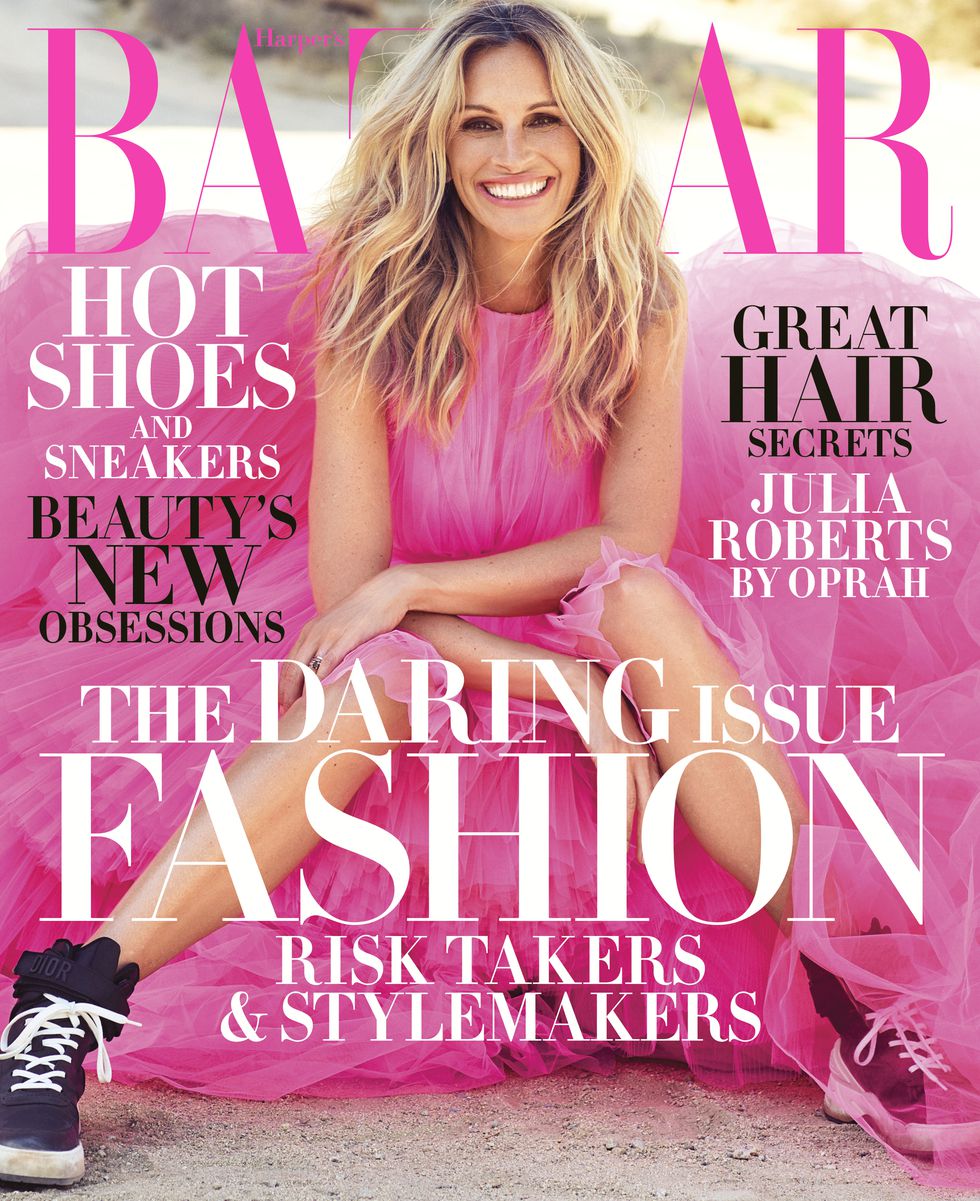
Once a year March 8 arrives, and once a year Mr. Magazine™ celebrate his birthday. This year, Mr. Magazine™ decided to celebrate in a different way. Click the video below to join Mr. Magazine™ in celebrating his birthday.

Once a year March 8 arrives, and once a year Mr. Magazine™ celebrate his birthday. This year, Mr. Magazine™ decided to celebrate in a different way. Click the video below to join Mr. Magazine™ in celebrating his birthday.
A Mr. Magazine™ Musing…
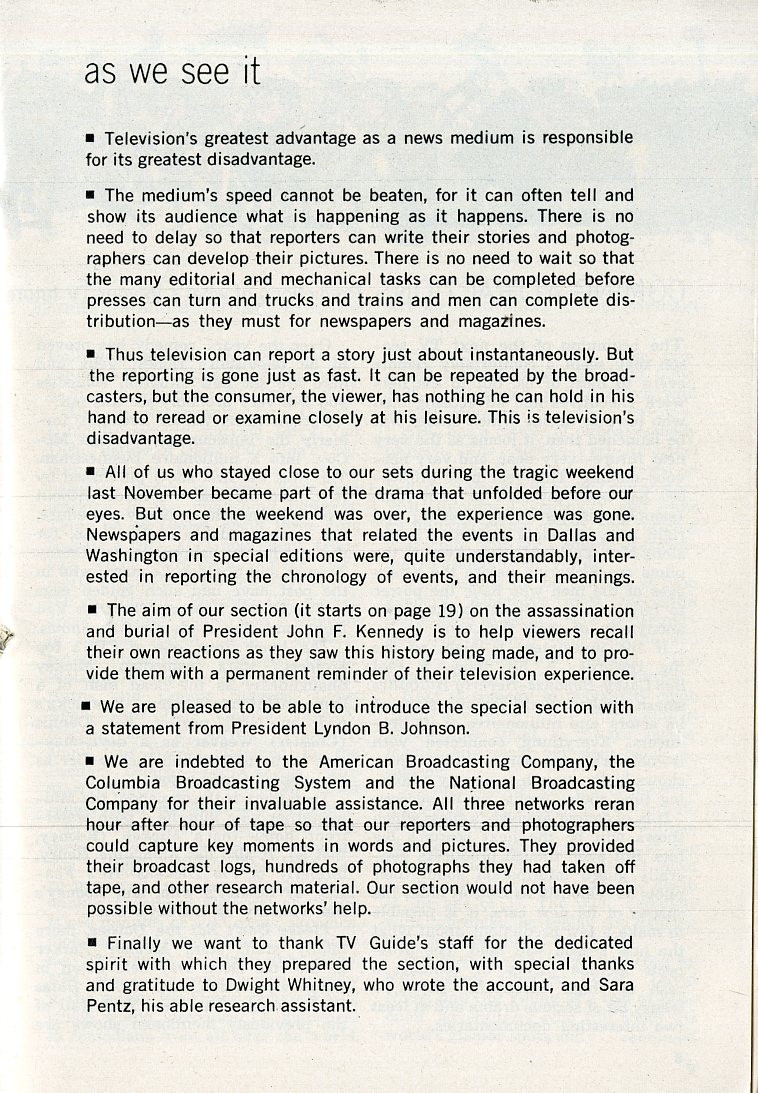
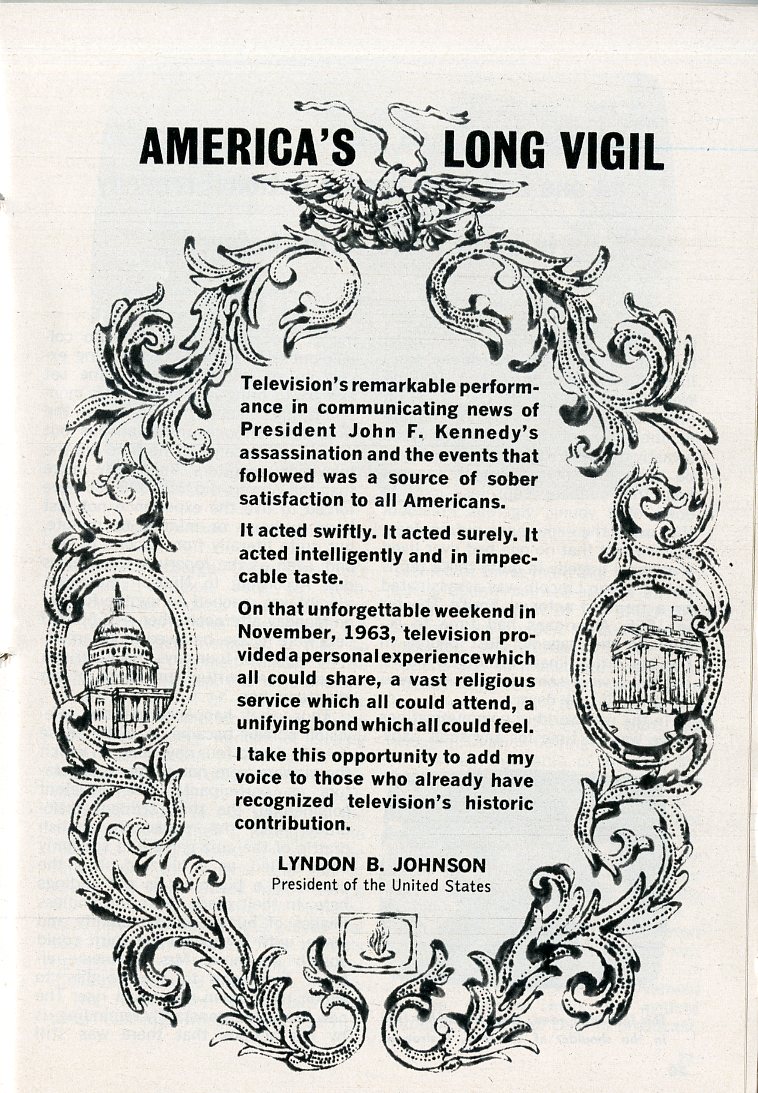
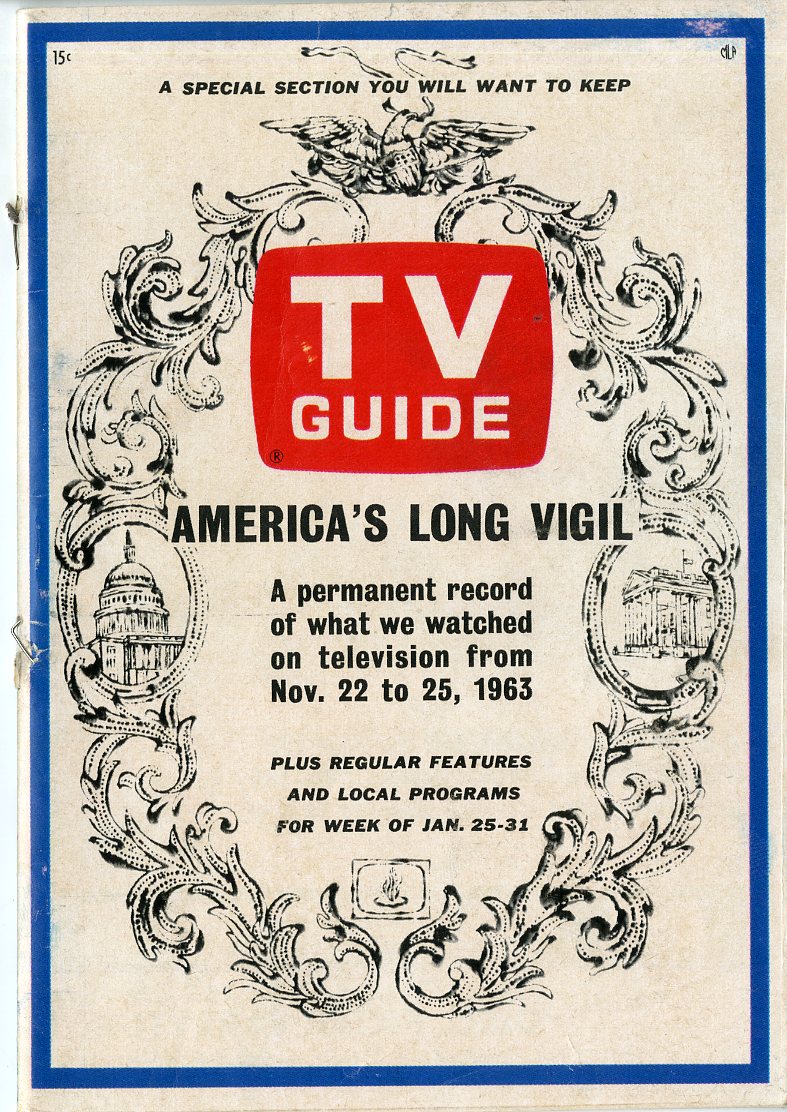 As I was doing some research for my upcoming presentation at The Sixth Floor (JFK) Museum in Dallas, Texas on the power of the magazine cover, I stumbled upon an article in a January 25-31, 1964 edition of TV Guide where they devoted a major section of the magazine, including an introduction by President Lyndon B. Johnson, to the four days following the assassination of President John F. Kennedy.
Leading into that special section, the magazine editors created a wonderful one-page comparison between television and print back then and the power of each medium, noting the speed in which television could present something as tragic and moving as JFK’s funeral.
It’s amazing to me that what was true in 1964 is still true today, only using a different medium rather than television. Television in the 1960s was a powerful unification tool for the United States and the world, when 180 million people watched the funeral of President Kennedy on the then three TV networks, before the fragmentation of cable television wreaked havoc on the communal spirit of television and the United States of America. And after Cable came Satellite Television and then ultimately, the Internet, eliminating the community of television altogether.
 The country moved from a melting pot, with those three television networks and the host of magazines that were out there, to what’s now more like a cafeteria style information buffet, where you can find any number of networks that will provide you information that’s not related to the country as a whole, but rather to one’s tiny areas of interest and in most cases areas that support one’s own beliefs and theories. That unifying aspect of television is no longer there.
Some may say the same thing is happening with magazines, with the degree of specializations in many current titles, but yet we continue to see the growth of magazine audiences through all of the many platforms that the brands utilize. Whether it’s the printed magazine or the continuous outreach from the brands through other social media and digital extensions, audience growth for magazines is flourishing. And as I wrote in an article a few years ago and recently republished on my blog: magazines were the original social media and they continue to be the original social media, one that creates community and permanency such as the 1964 TV Guide article referred to when talking about television.
Here are a few points from that editorial that would still hold up today, only with the Internet replacing Television’s role. You be the judge:
• Television’s greatest advantage as a news medium is responsible for its greatest disadvantage. (Substitute Television with the Internet)
• The medium’s (imagine Internet as the medium) speed cannot be beaten, for it can often tell and show its audience what is happening as it happens. There is no need to delay so that reporters can write their stories and photographers can develop their pictures. There is no need to wait so that the many editorial and mechanical tasks can be completed before presses can turn and trucks and trains and men can complete distribution – as they must for newspapers and magazines.
• Thus television (Internet) can report a story just about instantaneously. But the reporting is gone just as fast. It can be repeated by the broadcasters, but the consumer, the viewer, has nothing he can hold in his hand to reread or examine closely at his leisure. This is television’s disadvantage.
• All of us who stayed close to our sets during the tragic weekend last November became part of the drama that unfolded before our eyes. But once the weekend was over, the experience was gone. Newspapers and magazines that related the events in Dallas and Washington in special editions were, quite understandably, interested in reporting the chronology of events, and their meanings. ( Emphasis mine. Proving once again that permanence of print and its collectability aspect).
As I’ve said before, there is nothing new under the sun. What goes around comes around, just usually in a different guise. So, where the television of the “50s, ‘60s, and ‘70s unified us as a society, the television of the ‘80s, ‘90s and beyond, divided us, along with that ever-reaching, never-ending, all-consuming thing we all call the Internet. Today we are such a fragmented information society that we do not know where or what to turn to, where to actually get, as the late, great Paul Harvey would say, “The Rest of the Story.”
But it’s out there…somewhere…among the fragments.
Until the next time…
See you at the newsstands…
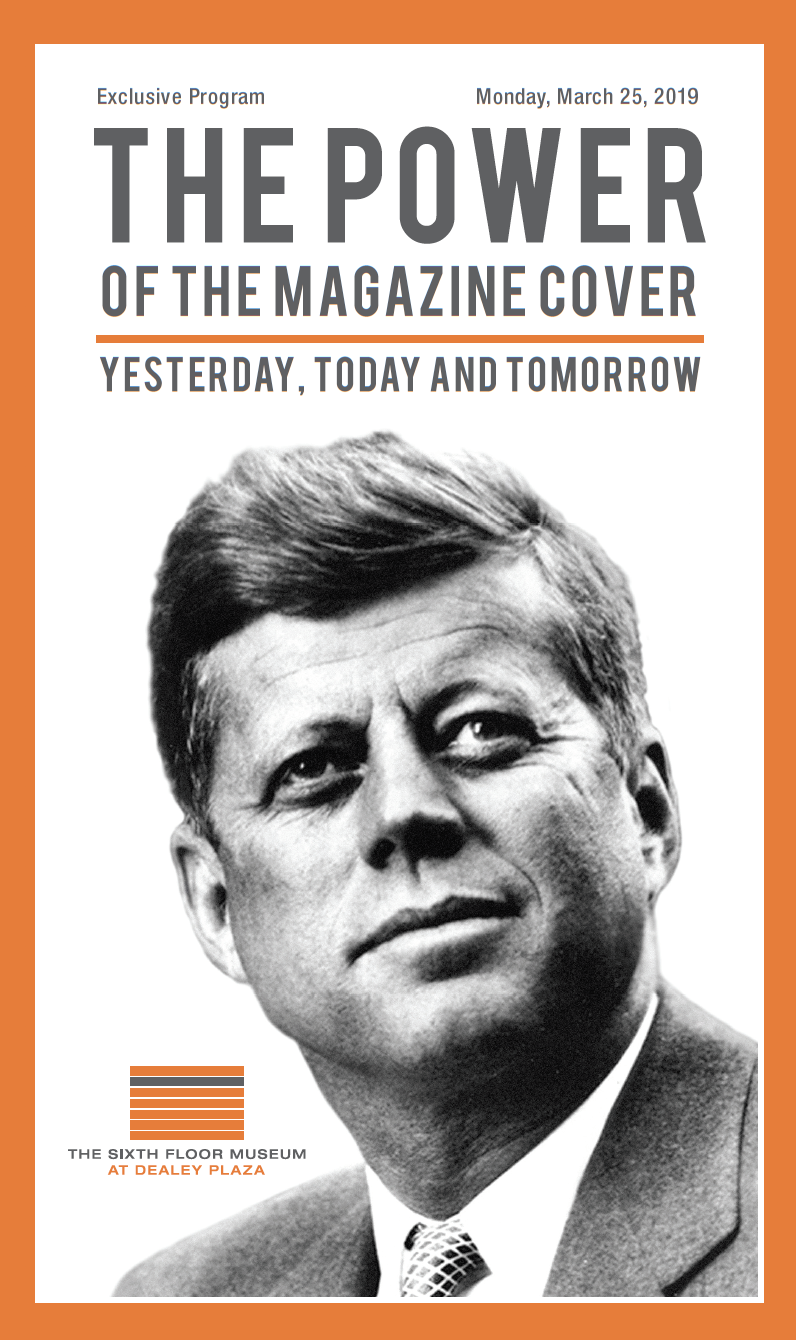 Humbled and honored to be presenting and engaged in an “animated conversation” about the Power of the Magazine Cover at the Sixth Floor Museum (The John F. Kennedy museum in Dallas, Texas) in conjunction with the museum’s temporary exhibit “55 Years.” My presentation takes place on Monday March 25, at 7 pm.
Here is the invitation mailed by the museum to its members and friends:
Join us for an animated conversation with Dr. Samir Husni at this special program associated with the Museum’s temporary exhibit 55 years. Known as Mr. Magazine ™ and regarded as one of the nation’s foremost experts on print journalism, Dr. Husni will take us on a fascinating journey through the history of American magazines, including the role magazine covers played in cementing the enduring mystique and legacy of President Kennedy.
To register and attend the event March 25 at 7 pm, please click here.
A Mr. Magazine™ Musing…
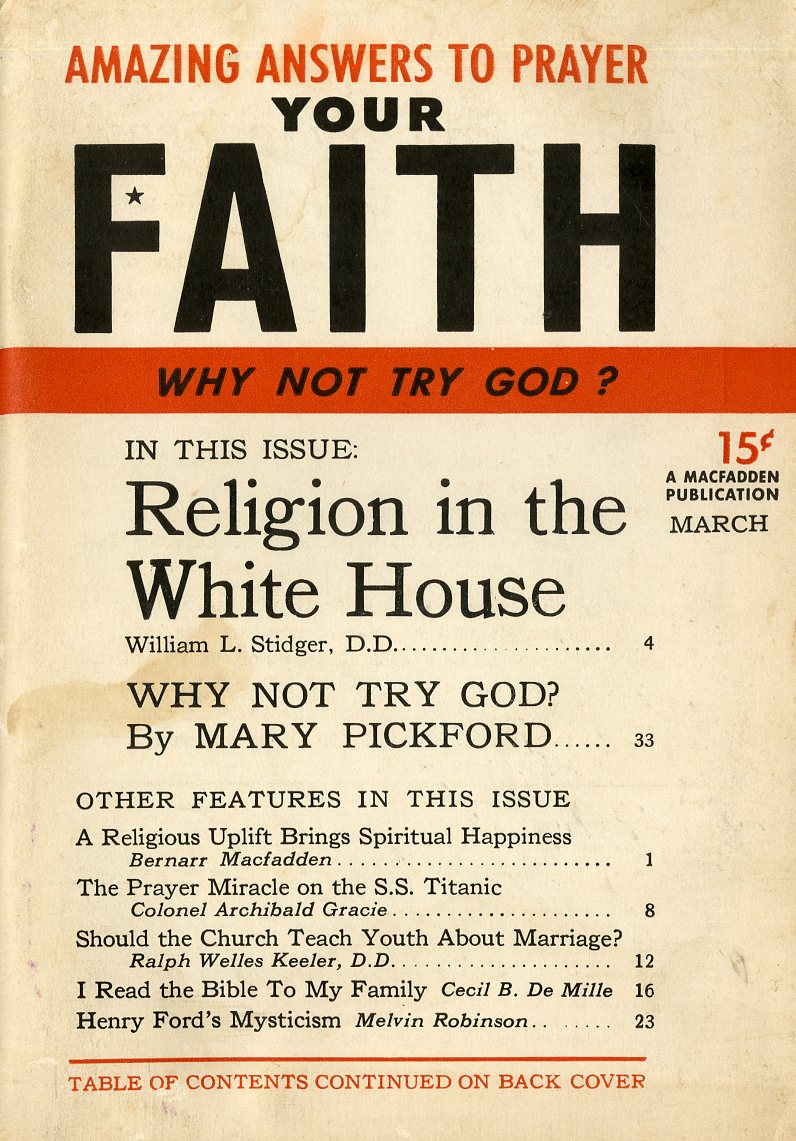 In March 1939, 80 years ago, the first issue of Macfadden-published “Your Faith” magazine came out. The idea was “Why Not Try God?” In the first editorial by Bernarr Macfadden himself, he wrote: A Religious Uplift Brings Spiritual Happiness. He talks about solving the mysteries of the universe and the impossibility of that without God. The magazine is an important part of Macfadden’s view on society and another example of magazines reflecting culture.
Mr. Magazine™ discovered this little nugget from his vault and took note of the amazing difference this magazine had from Macfadden’s other physical fitness and “true-fiction” type publications. And on the 80th anniversary of Your Faith magazine, as Bernarr Macfadden said himself in the first issue: This is a magazine for all who have an ear to hear.
And hear, Macfadden did. Some are just not sure what exactly he was listening to. But as any good entrepreneur would, Mr. Magazine™ believes he was listening to his passions and his own gut feeling. You be the judge.
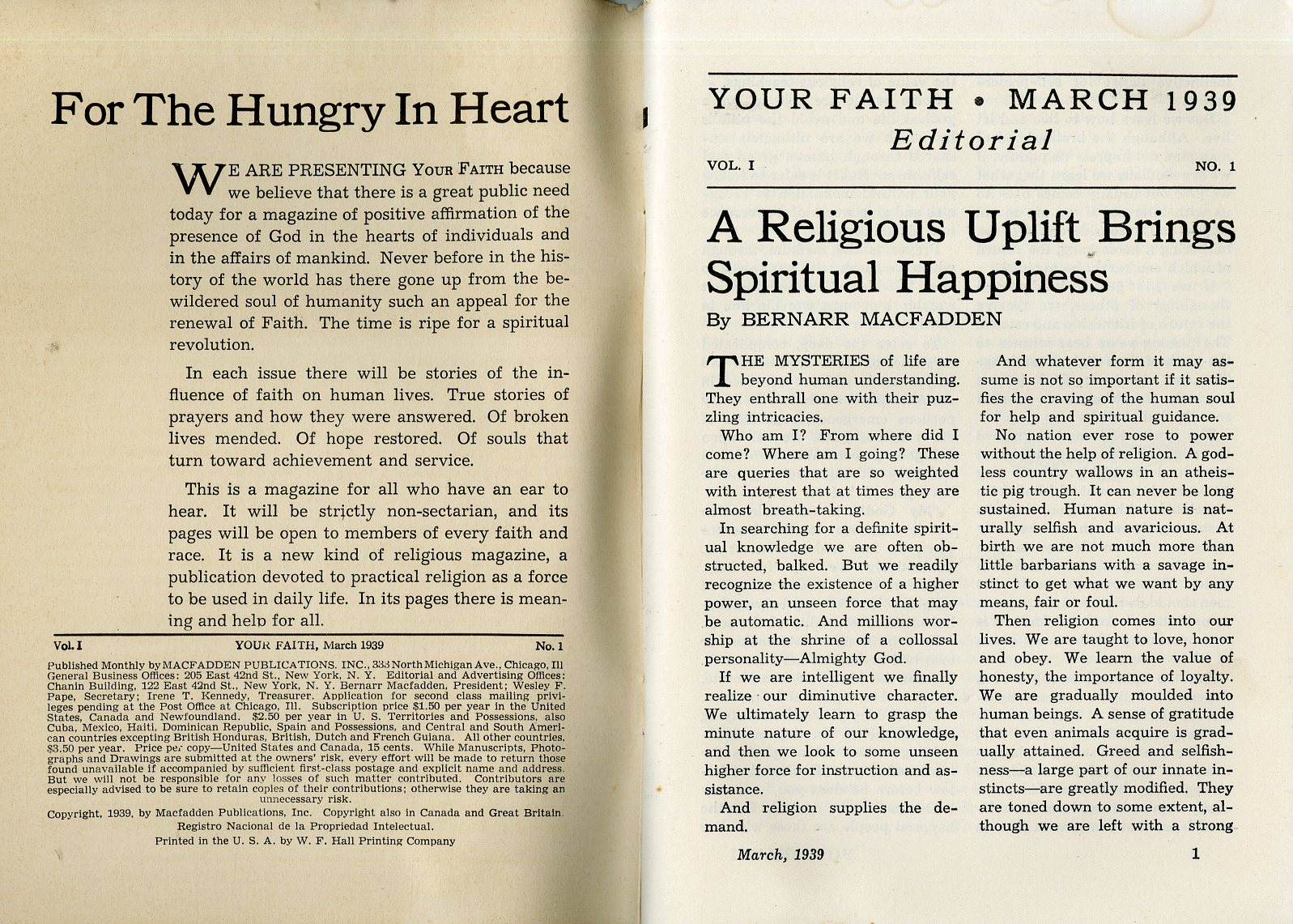 Bernarr Macfadden is known as the “Father of Physical Culture.” What is “Physical Culture” you might ask. In its simplest definition, Physical culture is a health and strength training movement that originated during the 19th century in Germany, England, and the United States. But how did this topic find its way into a Mr. Magazine™ Musing, you might also ask. And of course, the answer in its simplest form would be: magazines.
Macfadden himself was an American proponent of physical culture. He was the predecessor of Charles Atlas and Jack LaLanne, and has been credited with beginning the culture of health and fitness in the United States.
But life was not always so kind to Mr. Macfadden. He changed his name from Bernard McFadden to “Bernarr Macfadden” in order to give himself an aura of strength and vitality. It seems that he was a very sickly and weak child who was an orphan by the time he was 11-years-old. But as fate would have it, Macfadden was placed with a farmer, leaving the life of an orphan behind, and soon began a regiment of hard work and wholesome food. His health improved and soon he became strong and hale again.
 There is an entire website dedicated to the memory of this millionaire publisher, who many called a “kook” and a charlatan, and who Time Magazine referred to as “Body Love” for his lifelong advocacy of physical fitness, natural foods, outdoor exercise and the natural treatment of diseases.
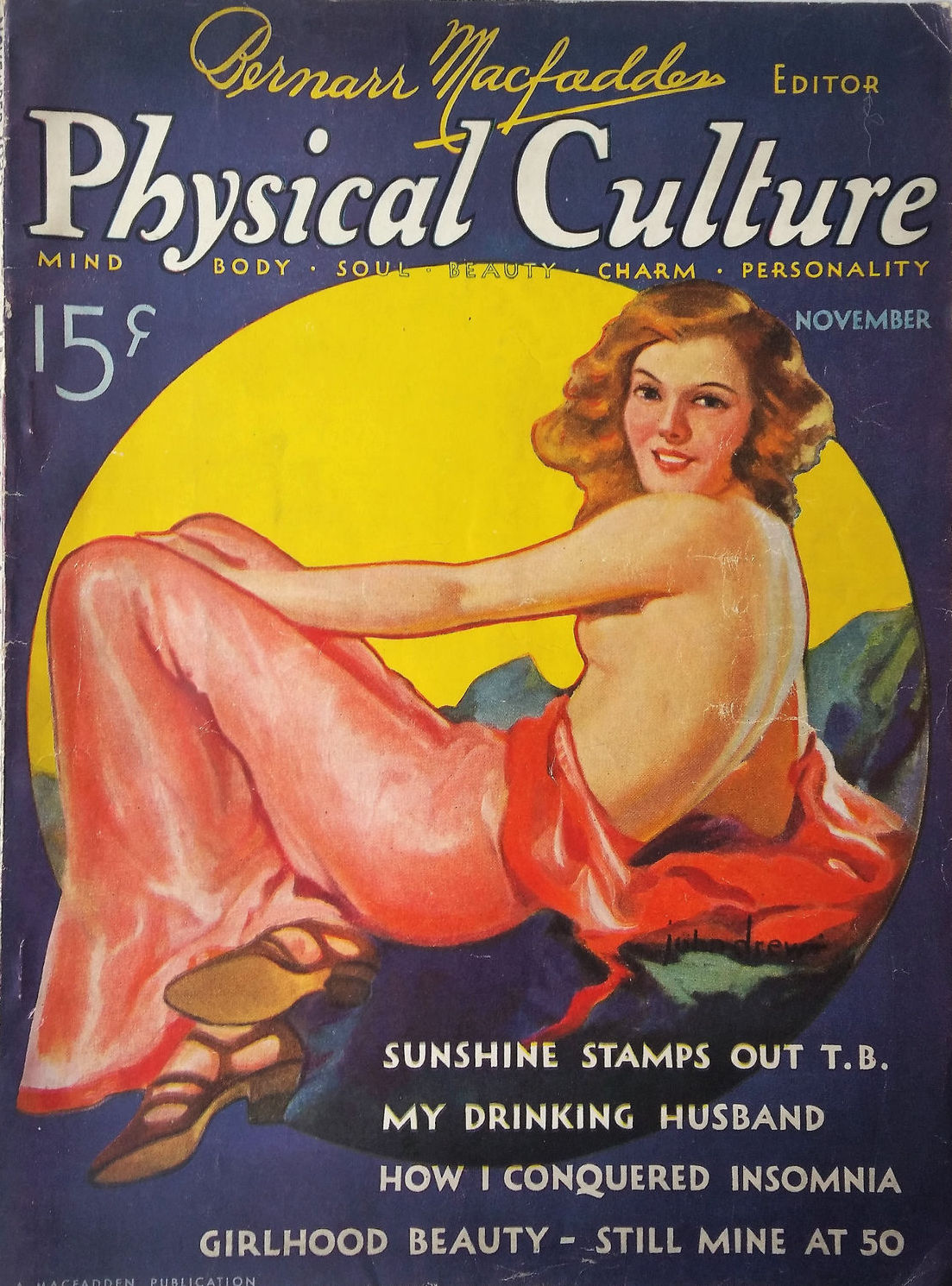
In 1899, Macfadden, after a successful, national lecture tour and after founding Physical Culture “clubs” in several cities across the country, decided to publish a monthly magazine called “Physical Culture.” He tried unsuccessfully to find a publisher for his title and so decided to publish it himself, along with his own books about health and wellness (during his lifetime he wrote over 100 books). Physical Culture magazine remained in publication for over 50 years, and was the forerunner of today’s health and bodybuilding publications. Oh, and the magazine carried his name on the cover as well – the height of narcissism or just good business acumen? Either is possible.
Eventually Macfadden Publications was born and his company turned into an empire, with titles such as Liberty, True Detective, True Story, True Romances, Dream World, Ghost Stories, the once-familiar movie magazine, Photoplay, and the tabloid newspaper, The New York Graphic.
 Macfadden even sought the Republican nomination for president in 1936, albeit losing the nomination to Kansas Gov. Alf Landon, who went on to lose to Franklin D. Roosevelt in the November election. But he was the first to propose that the President should have a National Secretary of Health on his cabinet ( he had originally wanted to be that person, but instead decided to run for office himself), all the while never giving up his love of physical health and his tendency to admire younger females, whether he was married or not.
Much of the basis of Physical Culture was religious in nature. And during his lifetime Macfadden also attempted to launch his own religion: Cosmotarianism, which combined physcultopathy with the Bible.
In an Esquire article written by Bruce Watson in 2013, Cosmotarianism was described as something that blended Macfadden’s bizarre theories on physical fitness with the Bible. Watson writes:
And some of his theories were, indeed, bizarre: convinced that baldness could be cured by tugging on one’s hair, he wore a towering pompadour; believing that physical contact with the “magnetic currents” of the earth could inspire feats of sexual prowess, he often went barefoot; furious at the fashion industry, he would wear his suits until they fell off his body.
Macfadden certainly seemed to fit the bill of an eccentric millionaire. Indeed, it’s a given. Bernarr Macfadden was an eccentric, a reputed womanizer, a multimillionaire publisher, a father of eight and a husband of four, a fitness guru who was before his time, who died in 1955 from a urinary tract infection that he refused to be medically treated for. And a part of American magazine history that should not be forgotten.
Until the next time…
See you at the newsstands…
Background information from:
http://money.com/money/4074103/wackiest-millionaire-ever-run-president/
http://www.bernarrmacfadden.com/
https://en.wikipedia.org/wiki/Bernarr_Macfadden
https://www.esquire.com/news-politics/news/a23610/strange-tale-historic-fitness-guru-bernarr-macfadden/
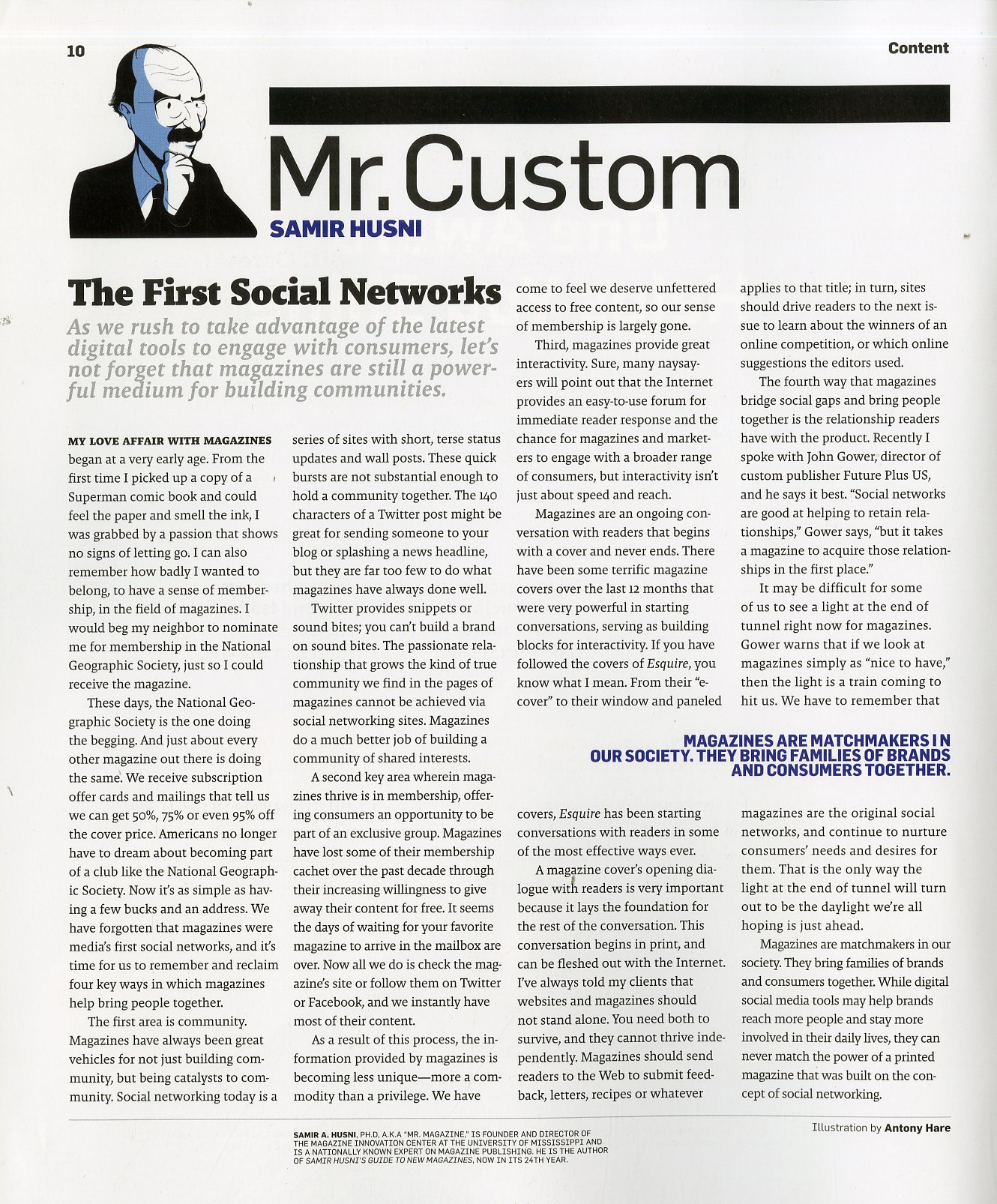
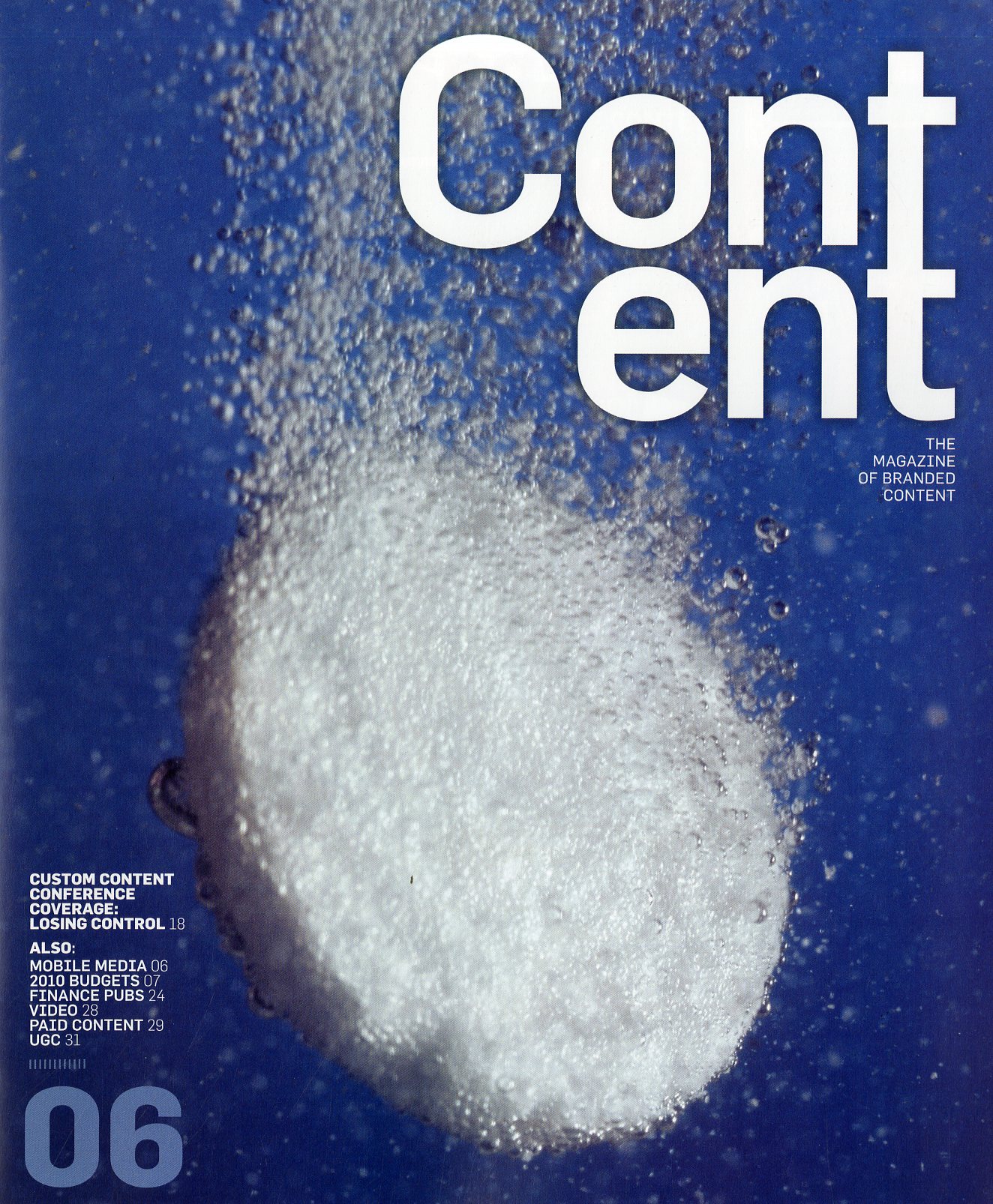 (In 2009, in the summer issue of Content, the magazine of branded content, I wrote a column under the heading of Mr. Custom, that I feel is as valid today as it was ten years ago… I hope you will enjoy).
As we rush to take advantage of the latest digital tools to engage with consumers, let’s not forget that magazines are still a powerful medium for building communities.
MY LOVE AFFAIR WITH MAGAZINES
Began at a very early age. From the first time I picked up a copy of a Superman comic book and could feel the paper and smell the ink, I was grabbed by a passion that shows no signs of letting go. I can also remember how badly I wanted to belong, to have a sense of membership, in the field of magazines. I would beg my neighbor (in Lebanon, my home country) to nominate me for membership in the National Geographic Society, just so I could receive the magazine.These days, the National Geographic Society (and a lot of other magazine publishers are) the ones doing the begging. And just about every other magazine out there is doing the same. We receive subscription offer cards and mailings that tell us we can get 50%, 75% or even 95% off the cover price. Americans no longer have to dream about becoming part of a club like the National Geographic Society. Now it’s as simple as having a few bucks and an address. We have forgotten that magazines were media’s first social networks, and it’s time for us to remember and reclaim four key ways in which magazines help bring people together.
The first area is community. Magazines have always been great vehicles for not just building community, but being catalysts to community. Social networking today is a series of sites with short, terse status updates and wall posts. These quick bursts are not substantial enough to hold a community together. The 140 characters of a Twitter post might be great for sending someone to your blog or splashing a news headline, but they are far too few to do what magazines have always done well.
Twitter provides snippets or sound bites; you can’t build a brand on sound bites. The passionate relationship that grows the kind of true community we find in the pages of magazines cannot be achieved via social networking sites. Magazines do a much better job of building a community of shared interests.
A second key area wherein magazines thrive is in membership, offering consumers an opportunity to be part of an exclusive growth. Magazines have lost some of their membership cachet over the past decade through their increasing willingness to give away their content for free. It seems the days of waiting for your favorite magazine to arrive in the mail box are over. Now all we do is check the magazine’s site or follow them on Twitter or Facebook, and we instantly have most of their content.
As a result of this process, the information provided by magazines is becoming less unique – more a commodity than a privilege. We have come to feel we deserve unfettered access to free content, so our sense of membership is largely gone.
Third, magazines provide great interactivity. Sure, many naysayers will point out that the Internet provides an easy-to-use forum for immediate reader response and the chance for magazines and the marketers to engage with broader range of consumers, but interactivity isn’t just about speed and reach.
Magazines are an ongoing conversation with readers that begins with a cover and never ends. There have been some terrific magazine covers over the last 12 months that were very powerful in starting conversations, serving as building blocks for interactivity. If you have followed the covers of Esquire, you know what I mean. From their “e-cover” to their window and paneled covers, Esquire has been starting conversations with readers in some of the most effective ways ever.
MAGAZINES ARE MATCHMAKERS IN OUR SOCIETY. THEY BRING FAMILIES OF BRANDS AND CONSUMERS TOGETHER.
A magazine cover’s opening dialogue with readers is very important because it lays the foundation for the rest of the conversation. This conversation begins in print, and can be flashed out with the Internet. I’ve always told my clients the websites and magazines should not stand alone. You need both to survive, and they can not thrive independently. Magazines should send readers to the Web to submit feedback, letters, recipes or whatever applies to that title; in turn, sites should drive readers to the next issue to learn about the winners of an online competition, or which online suggestions the editors used.
The fourth way that magazines bridge social gaps and bring people together is the relationship readers have with the products. Recently I spoke with John Gower, director of custom publisher Future Plus US, and he says it best. “Social networks are good at helping to retain relationships,” Gower says, “but it takes a magazine to acquire those relationships in the first place.”
It may be difficult for some of us to see a light at the end of tunnel right now for magazines. Gower warns that if we look at magazines simply as “nice to have,” then the light is a train coming to hit us. We have to remember that magazines are the original social networks, and continue to nurture consumers’ needs and desires for them. That is the only way the light at the end of tunnel will turn out to be the daylight we’re all hoping is just ahead.
Magazines are matchmakers in our society. They bring families of brands and consumers together. While digital social media tools may help brands reach more people and stay more involved in their daily lives, they can never match the power of a printed magazine that was built on the concept of social networking. Content magazine, Number 6, Summer 2009
“That’s what I love about magazines, they’re such an intimate form of communication. When a magazine is done very, very well, I think that the reader feels an intimate connection with the writer, the editor, and the art director, and they have a beautiful experience. It’s a deep, rich experience.” Anne Alexander…
Mindful is a mission-driven non-profit brand, dedicated to inspiring, guiding, and connecting anyone who wants to explore mindfulness—to enjoy better health, more caring relationships, and a compassionate society. Anne Alexander is editor of the magazine and knows her way around multiplatform brands and content strategies. Anne is a New York Times bestselling author, she was editorial director for the National Geographic Society and also editorial director for the then Rodale’s Prevention brand, among many other leader positions.
And being editor of a brand that she is so very passionate about is a role that fits her perfectly. The field of mindfulness is one that is growing and proving to be a very important factor that many people are looking for in their hectic lives these days. And Anne is a firm believer in the brand’s signature mantra: Healthy Mind, Healthy Life. She believes the mind is a valuable resource that people are starting to realize needs protecting from the everyday stress and reflections of the past and the future that they’re often forced to think about. And she feels that Mindful is the voice of this emerging mindfulness community and the place to go for insight, information, and inspiration to help us all live more mindfully.
Anne thinks mindfulness is a unique and profound approach to social change, and the work a social innovation initiative. And that mindfulness is entering the mainstream and presents an historic opportunity to transform society.
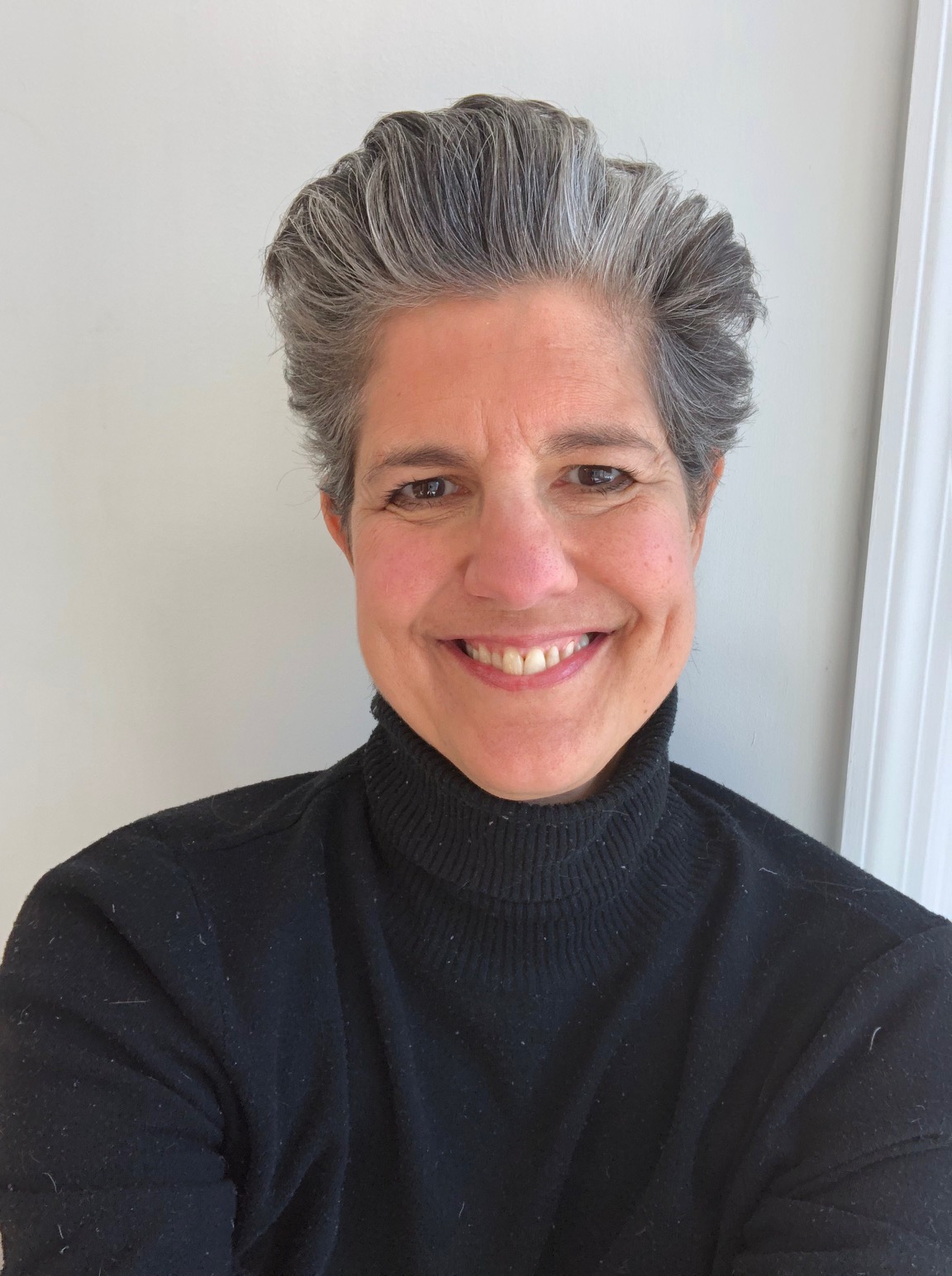 From conferences and collaborations, Mindful is a contributing factor to the Mindfulness movement and keeps the integrity and expertise throughout the brand, relying on experts and researchers who have been in the field for years. It’s a fascinating topic and one that is exploding all over the country.
So, sit back in your favorite relaxed position and come into the moment as you become “Mindful” of the Mr. Magazine™ interview with Anne Alexander, editor, Mindful Magazine.
But first the sound-bites:
On how she became editor of Mindful magazine: I had been at Rodale, and I had done a lot of consulting too, I’d had a whole series of fantastic consulting projects, and then I just really wanted to find a group of good people who were doing good work, work that was really meaningful. And so I just reached out to my network, and somebody I knew who knew somebody who knew somebody put me in touch with Barry Boyce and Jim Gimian, and we had a very lengthy conversation about mindfulness and editorial, and all sorts of things. So, really over a long period of time, we just decided there was a fit.
On why now for this huge public interest in mindfulness: I think the “why now” is because we’re experiencing a tremendous confluence of events, and stress is epidemic and mindfulness is one of those things that can help people destress. The instantaneous payoff is that mindfulness can help relieve stress, but over a longer period of time mindfulness is so important because we’re all involved with multitasking and our attention is being eviscerated by all of the technology that we have. So, our attention is constantly being drawn from our devices to all of the things that pull it away, so mindfulness is a way to bring our attention back, to enable us to regroup and to focus.
On what she thinks when some people tell her the future is for AI and there will never be an artificial mindfulness, that it still has to be part of the human being: Whether or not there’s an artificial AI version of mindfulness, or whether AI instruments develop their own form of mindfulness is something for other folks to ponder. I think that the human mind is such a valuable property that mindfulness enables us to reclaim that beauty and whether or not we want to develop that in some artificial way; I’m sure there are other ways to artificially stimulate ourselves, but I think that mindfulness is something that is inherently human.
On whether when she asks her readers to engage with the brand, will there be a need to put their devices down, or does she feel the role of the printed magazine has also changed: What I would love to do is ask them to try each of those things, because the online experience is wonderful for many reasons. The online experience with our articles, we can help inform people and empower them in some ways. But what I love about the magazine is it’s also sort of the antithesis of that. It’s the best of slow media, if you will, because it helps people to focus, to slow down, to savor the moment. In some ways our articles are old-fashioned, almost artisanal compositions. We have art directors and editors who really focus on the nuance of what we’re trying to say. I think that’s one of the reasons that readers are responding to it.
On whether it makes a difference she is working for a nonprofit, such as Mindful, or a for-profit entity: The nice think about mindfulness, or Mindful, is that the good work that we’re doing, the benefits that we’re accruing, we’re trying to put that back out and to benefit the wider audience. And in some ways it’s a more direct approach than what we were doing at Rodale, and certainly some of the benefits at National Geographic were going back out to help the environment and various things. With Mindful, because it’s such a small organization, you can actually see the benefits and where the revenues are going, to which cause. So, it’s very specific. You can see it on almost a one-to-one basis.
On whether she sees herself as a content provider or an experience maker in this world of editing: I believe that when content is done well, you are delivering an experience to people. When you have the beauty of combining visuals, you’re always creating an experience. To me, that’s the beauty of the work. That’s what I love about being an editor. You’re seeing the content isn’t just the words, it’s the words and how they’re presented and how they’re visually presented. And in order to be successful, I truly believe that has to be an experience for people.
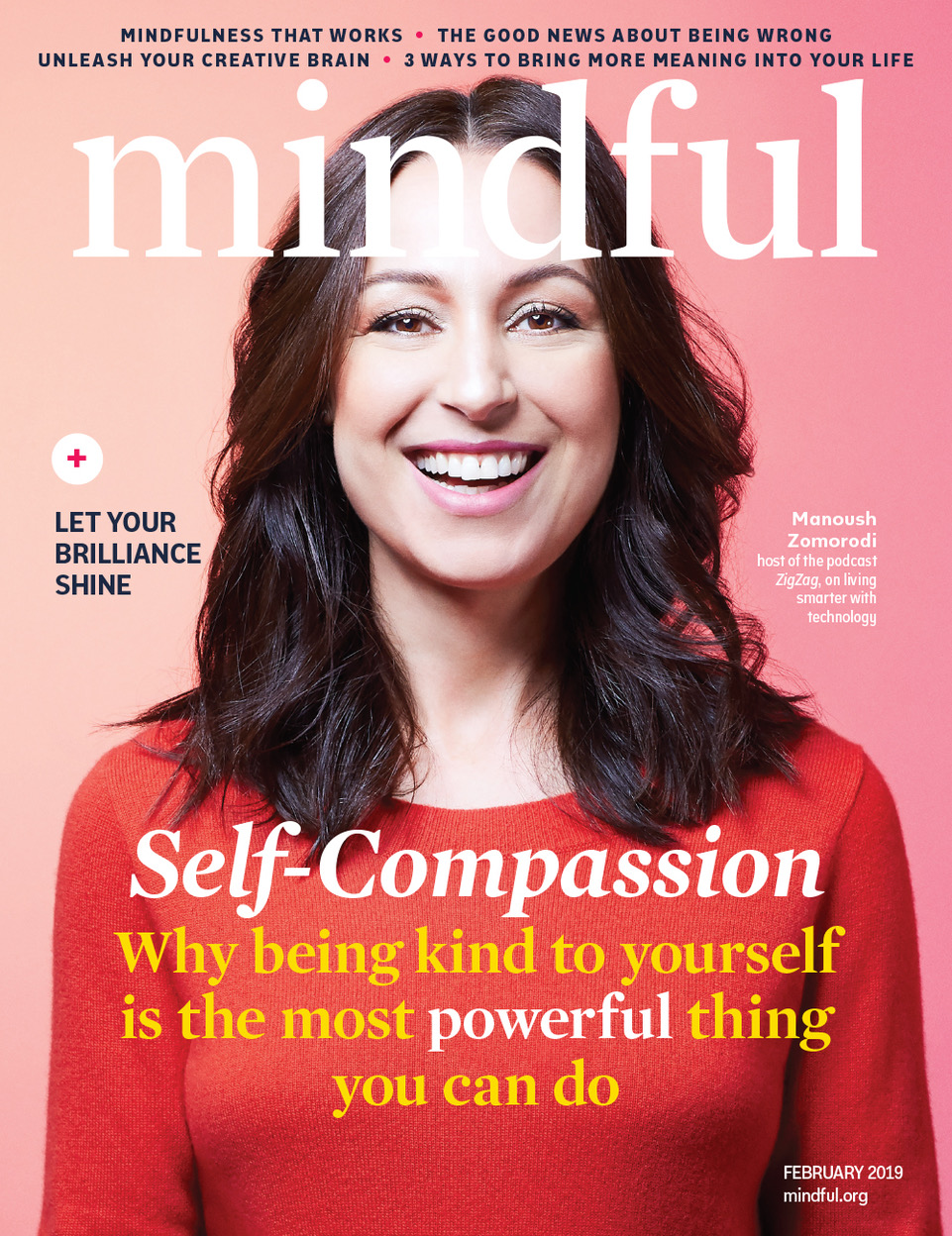
On whether there will be any changes with the magazine since she has become the editor or will she just stay the course: We’re definitely staying the course because it’s been a very successful brand. But actually you will see changes or you could spot changes because I started consulting and working with them in August. You can start to see it in the covers. One of the things that we did with the cover for the January/February issue is we did a beautiful cover with Manoush Zomorodi on self-compassion. I love to try and have a photograph of somebody who just looks so natural and appealing and so authentic.
On her passion for the subject matter: Mindful is something that’s really important to me, and it’s important not just on an individual basis, but it’s important from a community, social and logical standpoint. We’re all so isolated now from a community, sociological point of view. And it’s important to see other people as humans in order to connect and engage with them and to care.
On whether she ever feels that she’s swimming against the current and that audiences have been brainwashed so much and then she has to de-brainwash them: I think people need to be reminded and given permission to slow down and to pause. And that’s where, if there’s a brainwashing that needs to be undone, that’s where mindfulness is coming in, and that’s part of what’s driving the growth of mindfulness. We’ve been going faster and multitasking, thinking it’s cool to have more than one device, and I think that we’re coming to a sense that our attention is a resource that needs to be guarded; it needs to be nurtured and protected and cared for. And the idea of slowing down and pausing is actually something that’s our human right. To do that is something that is important for us and for the community.
On what she would hope to tell someone she had accomplished in one year with Mindful magazine and the entire brand: There are so many growth areas. I would love to see the magazine engage with more people. I would love to see the website engage; we’re reaching like 1.2 million people on a regular basis through the different formats. And there is such a need for mindfulness in the healthcare community and the educator community. And we’re doing work with Aetna and Harvard Pilgrim and Kaiser Permanente, in terms of developing content about mindfulness in healthcare.
On working with Bryan Welch, the new CEO of Mindful: I’m inspired. I love Bryan, because I think Bryan thinks big. And Bryan brings a perspective on strategic growth and opportunity that will really help boost this brand and the company to the next level. He has the street cred to not only believe it, but to help make it happen. So, I am looking forward to working with him. And I think that tremendous things are possible and Bryan will help get the brand there and he’ll do it with his own tremendous integrity.
On anything she’d like to add: I think it’s a great group and I’m delighted to be working with them. They’re really smart and this field is growing. One of the things with Barry Boyce, and Jim Gimian who is the founder, they are really committed to carrying a message and the information about mindfulness in a way that’s really responsible. I was recently on the phone with Amishi Jha, who is one of the top leading neuroscientists in the field of mindfulness, and we were talking about how do we grow and maintain that level of integrity and commitment. To not overpromise or oversell.
On the biggest misconception she thinks people have about her: I think sometimes people can be intimidated and I try to be really, really nice and really human and fun.
On what she would have tattooed upon her brain that would be there forever and no one could ever forget about her: Leader.
On what someone would find her doing if they showed up unexpectedly one evening at her home: I’m such a creative at heart. I love cooking. I love to try and throw together a meal that my kids will actually eat. I’m the mother of three teenagers. And to me, I enjoy cooking and it’s such an accomplishment. I love it if I can make a meal and they all actually eat it and it disappears. And everybody is happy and we all have a sense of contentment.
On what keeps her up at night: There are so many things that need to be done. There are so many great ideas, concepts that need to be developed and launched. When I was in high school I used to row on the rowing team and we would row on the Potomac, down in Washington D.C. And all these planes would land every 30 seconds, and it’s this incredible experience being out on the Potomac at night and you see all these planes that are lined up, and I often feel like that. There are so many ideas that are just waiting out there. Sort of an ether, that are waiting for their time to come in and land. What keeps me up at night is how to land all of those planes. (Laughs)
And now the lightly edited transcript of the Mr. Magazine™ interview with Anne Alexander, editor, Mindful Magazine.
Samir Husni: Congratulations on the new job. You’re now editor of a magazine that’s entering its sixth anniversary, Mindful Magazine.
Anne Alexander: Thank you.
Samir Husni: How did you become editor of Mindful?
Anne Alexander: I had been at Rodale, and I had done a lot of consulting too, I’d had a whole series of fantastic consulting projects, and then I just really wanted to find a group of good people who were doing good work, work that was really meaningful. And so I just reached out to my network, and somebody I knew who knew somebody who knew somebody put me in touch with Barry Boyce and Jim Gimian, and we had a very lengthy conversation about mindfulness and editorial, and all sorts of things. So, really over a long period of time, we just decided there was a fit.
I had actually been consulting with them since August, so it’s been kind of an evolution of a role and I had literally just posted my business cards because they had just arrived, but I’d actually been working with them for quite some time, since August.
Samir Husni: The last time I interviewed the CEO of Time Inc. when we had a Time Inc., he told me the largest selling bookazine they had ever produced was on the topic of mindfulness. And when Mindful magazine was started six years ago, it was sort of the early entrant into the marketplace; why do you think it took so long for the population to realize that it’s important to be mindful? Why now?
Anne Alexander: That’s a great question. I think the “why now” is because we’re experiencing a tremendous confluence of events, and stress is epidemic and mindfulness is one of those things that can help people destress. The instantaneous payoff is that mindfulness can help relieve stress, but over a longer period of time mindfulness is so important because we’re all involved with multitasking and our attention is being eviscerated by all of the technology that we have. So, our attention is constantly being drawn from our devices to all of the things that pull it away, so mindfulness is a way to bring our attention back, to enable us to regroup and to focus.
Personally, I draw some parallels with how there was an explosion of interest in sugar; I wrote the “The Sugar Smart Diet,” which turned out to be nice because it was a New York Times bestseller. But in the same way that sugar had become so ubiquitous in our diet, I think we’re experiencing the same thing with all of these things that call our attention away from other things and dilutes our experience of being alive and feeling that we’re present in the moment. We’re worried about the past; we’re worried about the future; our attention is being drawn to what’s on the news, what’s on our devices, what’s on the radio; just all of these things. What’s happening on Instagram and Twitter.
All of these things are splintering our ability to concentrate and to focus, and the beautiful thing about mindfulness is that it’s the antidote to that in so many ways, because it enables you to just focus on what’s going on in the present moment and to feel more alive and more awake actually while you’re in that moment instead of worrying about the future or the past. So, it’s something that’s very easy; it’s very accessible, and it delivers an ability to feel alive and awake in the moment in ways that we don’t really feel right now.
Samir Husni: What do you think when some people tell us the future is for AI and there will never be an artificial mindfulness, that it still has to be part of the human being?
 Anne Alexander: Whether or not there’s an artificial AI version of mindfulness, or whether AI instruments develop their own form of mindfulness is something for other folks to ponder. I think that the human mind is such a valuable property that mindfulness enables us to reclaim that beauty and whether or not we want to develop that in some artificial way; I’m sure there are other ways to artificially stimulate ourselves, but I think that mindfulness is something that is inherently human.
Samir Husni: In that “me” moment, when you want someone to pick up your magazine and engage with it or go to the website, are you going to ask them to drop their Smartphones, close their computers, and sit down and enjoy the moment, or do you see the role of the printed magazine as changing too?
Anne Alexander: What I would love to do is ask them to try each of those things, because the online experience is wonderful for many reasons. The online experience with our articles, we can help inform people and empower them in some ways. We have a whole podcast series that’s going gangbusters, and those are audio practices that enable people to experience mindfulness through meditation. And oftentimes that happens on their devices, and in that case you would want to be tethered to your device. You would want to be experiencing the meditation or practice using your device.
But what I love about the magazine is it’s also sort of the antithesis of that. It’s the best of slow media, if you will, because it helps people to focus, to slow down, to savor the moment. In some ways our articles are old-fashioned, almost artisanal compositions. We have art directors and editors who really focus on the nuance of what we’re trying to say. I think that’s one of the reasons that readers are responding to it. It really gives them that ability to savor and come together on a topic.
That’s what I love about magazines, they’re such an intimate form of communication. When a magazine is done very, very well, I think that the reader feels an intimate connection with the writer, the editor, and the art director, and they have a beautiful experience. It’s a deep, rich experience.
So, I would answer that question in multiple ways. I think there is a role for the digital version and a role for the print magazine. One of the really nice things about Mindful is all of these different growth areas. The print magazine serves in a very traditional and what I call, slow media way, which is to just give people that ability to pause and enjoy something and to absorb it. And to be visually delighted and to be stimulated through that word. And again, it’s a very intimate connection.
And I think that our online version can do that as well or our podcasts can do that. We’re also doing these community-based Facebook Live posts, where you get to interact with other people. We’re doing Mindful30, which is a video course. So, there are so many different aspects of the brand and our goal is to meet people where they are and to serve them in whatever ways we can.
Samir Husni: In your mission statement you say that you’re mission-driven but not for profit. And this isn’t new for you, you’ve worked with the National Geographic Society when they were not for profit. How does that differentiate your look or your approach to editing? Does it make a difference whether you are working for a nonprofit or a for-profit entity in your experience?
Anne Alexander: In my experience it’s funny, I tend to be somebody who is always drawn to the sort of do-gooder enterprises. That’s just my passion, trying to help empower people to live happier, healthier lives. And there is a purity about that, in terms of trying to provide people with information that is truly empowering for them. It gives them the tools that they need to live a happier, healthier life. Or in the Mindful case, we like to think of it as living a well-balanced, meaningful life. So, we’re giving people the tools to do that.
 With Mindful, part of the nonprofit status and the mission-driven status is to bring the message to as many people as we possibly can. So, there are a whole group of initiatives that we’re undertaking, such as Mindful30, which is an invitation to anybody to sign up and to get 30 days of really good mindfulness information. And part of the proceeds then go to supporting educators in the field who are bringing mindfulness to various institutions and educators. So, I think that’s one of the benefits.
The nice think about mindfulness, or Mindful, is that the good work that we’re doing, the benefits that we’re accruing, we’re trying to put that back out and to benefit the wider audience. And in some ways it’s a more direct approach than what we were doing at Rodale, and certainly some of the benefits at National Geographic were going back out to help the environment and various things. With Mindful, because it’s such a small organization, you can actually see the benefits and where the revenues are going, to which cause. So, it’s very specific. You can see it on almost a one-to-one basis.
Samir Husni: Do you see yourself as a content provider or an experience maker in this world of editing?
Anne Alexander: That is a great question. I believe that when content is done well, you are delivering an experience to people. When you have the beauty of combining visuals, you’re always creating an experience. To me, that’s the beauty of the work. That’s what I love about being an editor. You’re seeing the content isn’t just the words, it’s the words and how they’re presented and how they’re visually presented. And in order to be successful, I truly believe that has to be an experience for people.
Samir Husni: As you take over the helm of the magazine; you’ve been consulting with them since August, but now you’re the editor. Are we going to see any changes with the magazine or are you going to stay the course?
Anne Alexander: We’re definitely staying the course because it’s been a very successful brand. But actually you will see changes or you could spot changes because I started consulting and working with them in August. You can start to see it in the covers. One of the things that we did with the cover for the January/February issue is we did a beautiful cover with Manoush Zomorodi on self-compassion. I love to try and have a photograph of somebody who just looks so natural and appealing and so authentic.
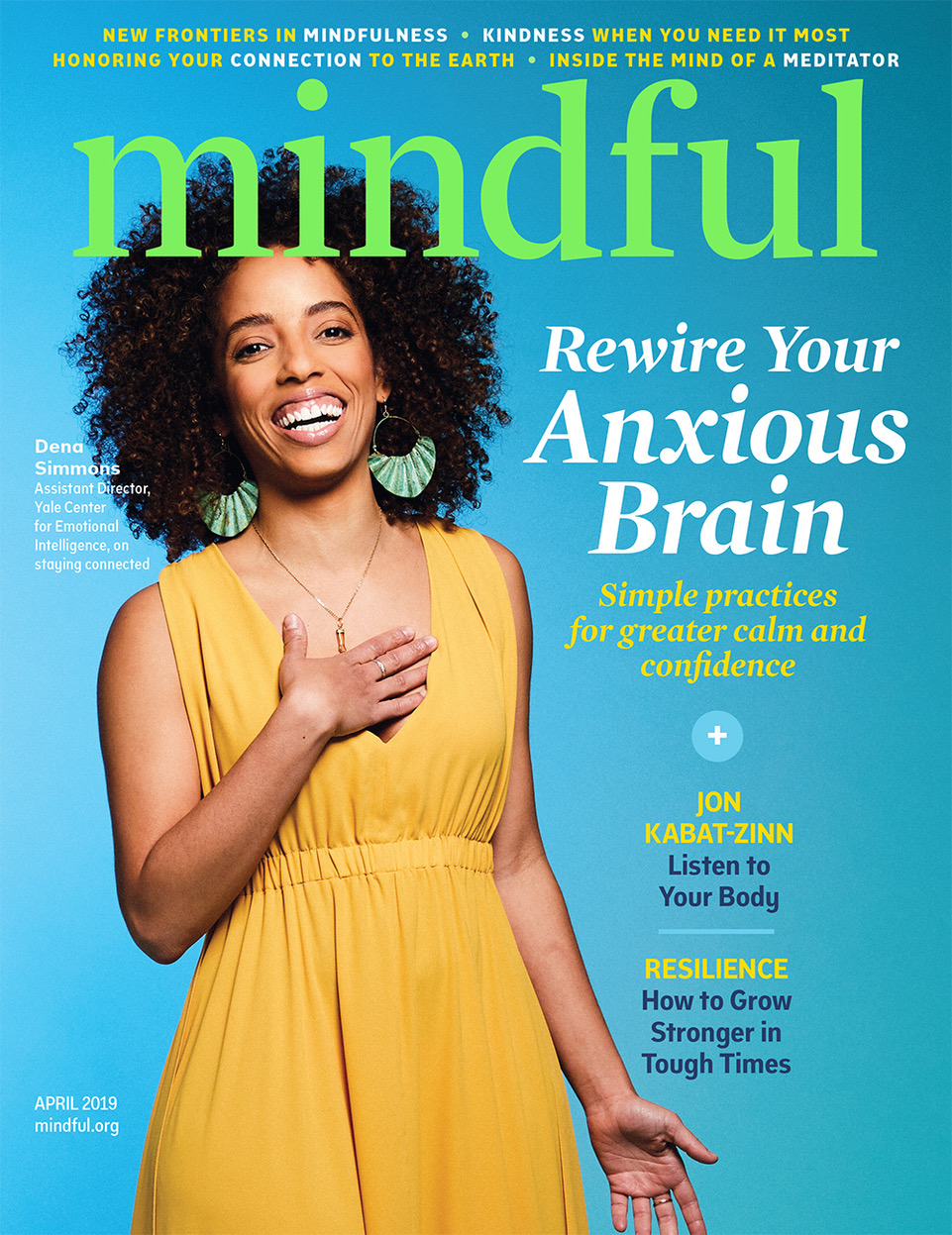
And our April cover is with Dena Simmons, who is the assistant director at the Yale Center for Emotional Intelligence. And again, I just think there is a beautiful authenticity to her on the cover, and I’m so excited as I look at other folks for the cover to cover on the inside.
Everybody has their work that they bring; to me I really want to make the magazine feel that you’re communing with it to bring out the humanity of it and to show the leading experts in mindfulness and the tremendous work that they’re doing. The April issue coming out has an amazing story from Mark Coleman who is a wilderness meditation expert. He leads a lot of meditations in the wilderness and it’s a beautiful piece, because it’s so heartfelt about climate change.
We used to think of going to nature as just this sort of restorative experience, the beauty of nature fills us with awe and all of these things. And now of course, with climate change, sometimes when we’re experiencing nature we have this deep sense of sadness and grief at what’s going on. And Mark talks about that, he talks about mindfulness and this ability to hold a paradox in your mind, to hold the beauty of nature and to hold your grief at the same time. What I loved about this article was it’s very emotional.
And again, to your question about whether content should be an experience, I believe it should be an experience. The words that he’s written are an experience. And the art is an experience, because you can’t help but look at the art and have your heart moved by seeing these polar bears, by seeing what we’re doing. And yet there’s also hope in the piece.
I guess what I try to bring to everything I do is a sense of connection. In order to move people to action or to inspire people, you have to touch them; you have to have them feel that they’re a part of something and that they’re emotionally moved. So, I would like to think that the art, the stories, are going to have a very strong emotional connection. I think that’s one of the things that we’re looking for quite frankly.
Samir Husni: We’ve chatted before and we’ve corresponded, but I have never felt you so passionate about a subject matter. When you launched National Geographic History, you were passionate about the subject, but you weren’t beaming like you are about Mindful.
Anne Alexander: I actually think the secret sauce of that History magazine was and is, in some ways, being able to put people into historical perspective. Being able to put them on the beach in those Roman outfits; what’s it like to march 60 miles a day?
And in some ways it’s the same. It’s creating a visceral reaction and that’s what I love to do. So in some ways it was so funny for me to work on a history magazine, because that’s my true calling, is to try and move people. And to emotionally engage with them. So yes, I was excited about that, but I was excited about that because I felt like I was somebody bringing a very different skillset for a very different subject.
Mindful is something that’s really important to me, and it’s important not just on an individual basis, but it’s important from a community, social and logical standpoint. We’re all so isolated now from a community, sociological point of view. And it’s important to see other people as humans in order to connect and engage with them and to care.
Samir Husni: Do you ever feel that you’re swimming against the current? That the audiences have been brainwashed so much and then you have to de-brainwash them?
Anne Alexander: I think people need to be reminded and given permission to slow down and to pause. And that’s where, if there’s a brainwashing that needs to be undone, that’s where mindfulness is coming in, and that’s part of what’s driving the growth of mindfulness. We’ve been going faster and multitasking, thinking it’s cool to have more than one device, and I think that we’re coming to a sense that our attention is a resource that needs to be guarded; it needs to be nurtured and protected and cared for. And the idea of slowing down and pausing is actually something that’s our human right. To do that is something that is important for us and for the community.
So, do I feel like I swimming against the current? I don’t know if I’m swimming against the current, but I think Mindful as a brand is sending out a very important message. There’s a reason why this brand and this concept is growing. It’s a message that people need to hear and need to be reminded of.
Samir Husni: If you and I are chatting a year from now, what would you hope to tell me you had accomplished with Mindful Magazine and the entire brand?
Anne Alexander: There are so many growth areas. I would love to see the magazine engage with more people. I would love to see the website engage; we’re reaching like 1.2 million people on a regular basis through the different formats. And there is such a need for mindfulness in the healthcare community and the educator community. And we’re doing work with Aetna and Harvard Pilgrim and Kaiser Permanente, in terms of developing content about mindfulness in healthcare.
I would love to be able to feel that we have enabled even more people, whatever would be a tremendous growth, but enable people to connect with themselves, with the present moment, and for them to feel a sense of relief. If we could provide those tools for more people, I think that would be a tremendous accomplishment. And to do it with integrity.
Samir Husni: Bryan Welch is now the new CEO of Mindful. And Bryan comes from a not for profit business that he started before and before that Mother Earth News. How is the new team going? Can you give us a glimpse of working with Bryan?
Anne Alexander: I’m inspired. I love Bryan, because I think Bryan thinks big. And Bryan brings a perspective on strategic growth and opportunity that will really help boost this brand and the company to the next level. He has the street cred to not only believe it, but to help make it happen. So, I am looking forward to working with him. And I think that tremendous things are possible and Bryan will help get the brand there and he’ll do it with his own tremendous integrity.
Samir Husni: Is there anything else you’d like to add?
Anne Alexander: I think it’s a great group and I’m delighted to be working with them. They’re really smart and this field is growing. One of the things with Barry Boyce, and Jim Gimian who is the founder, they are really committed to carrying a message and the information about mindfulness in a way that’s really responsible. I was recently on the phone with Amishi Jha, who is one of the top leading neuroscientists in the field of mindfulness, and we were talking about how do we grow and maintain that level of integrity and commitment. To not overpromise or oversell.
This is a field that’s growing. Time magazine is in this market, and lots of people are in this market. But one of the things that really makes Mindful stand apart is this tremendous commitment to getting the information right and not overselling.
Samir Husni: And it’s not just one book, it’s really living it.
Anne Alexander: Yes, and really being in league with the top researchers who are doing this. We take tremendous pride in working with people like Amishi Jha and Pat Rockman, with the people who have been in this field for years and years, and take it seriously and do incredible research. They aren’t just doing things fly-by-night. You can find apps and all sorts of things claiming to be mindfulness and that claim all sorts of benefits, which their research hasn’t really been out. There are tremendous benefits with mindfulness, but we want to stick with things that are truly credible.
Samir Husni: What’s the biggest misconception people have about you?
Anne Alexander: I think sometimes people can be intimidated and I try to be really, really nice and really human and fun.
Samir Husni: If you could have one thing tattooed upon your brain that no one would ever forget about you, what would it be?
Anne Alexander: Leader.
Samir Husni: If I showed up unexpectedly at your home one evening after work, what would I find you doing? Having a glass of wine; reading a magazine; cooking; watching TV; or something else? How do you unwind?
Anne Alexander: I’m such a creative at heart. I love cooking. I love to try and throw together a meal that my kids will actually eat. I’m the mother of three teenagers. And to me, I enjoy cooking and it’s such an accomplishment. I love it if I can make a meal and they all actually eat it and it disappears. And everybody is happy and we all have a sense of contentment.
And then we watch something on TV together. It’s usually a debate between “Chopped” or “Locked Up Abroad” or something. I just like hanging out with my kids. We have a dog and two cats and two goats. I’m taking my yearly teacher training right now, and if I can get my kids to agree for me to teach them yoga and be my stand-in class, that would be fantastic. My son is 16 and he wants to join the Marines, and so we’re doing this marvelous piece about mindfulness in the military. And he kind of thinks this mindfulness stuff is a bit softy-softy, but when I started telling him why and how it benefits the Marines and the Army, I love seeing his ears perk up and he says, “Oh really?” So, he takes a little more interest in what his mom is doing.
Samir Husni: And my typical last question; what keeps you up at night?
Anne Alexander: There are so many things that need to be done. There are so many great ideas, concepts that need to be developed and launched. When I was in high school I used to row on the rowing team and we would row on the Potomac, down in Washington D.C. And all these planes would land every 30 seconds, and it’s this incredible experience being out on the Potomac at night and you see all these planes that are lined up, and I often feel like that. There are so many ideas that are just waiting out there. Sort of an ether, that are waiting for their time to come in and land. What keeps me up at night is how to land all of those planes. (Laughs)
You’re grabbing the ideas from the ether and you’re bringing them together with other people. Deepak Chopra talks about it as pure potentiality and that’s exactly it. You’re bringing these ideas in and working with people to create them. And being this sort of brand mama, you give birth to them and then see whether people like them. And it’s an amazing experience.
Samir Husni: Thank you.
“The magazine is a different experience. Each issue of the magazine is just a beautifully curated product that stands on its own, so we craft our lineups for every issue to feel cohesive and interesting, to be this great mix of information that will stand the test of time.” Amy Conway (On the difference between finding answers on Google and the magazine)…
“When we reach out to them, we ask them to be on the cover and being on the cover of a magazine is still a really powerful thing for people. So yes, in terms of that, being on the cover of a magazine, there is no substitute for that. It’s a permanent thing, so to speak, that you’re creating. And it’s a beautiful object. It’s a living entity, and there is no substitute for that.” Amy Conway (On when they reach out to people about being on the cover of the magazine, do they specify it’s for the printed magazine)…
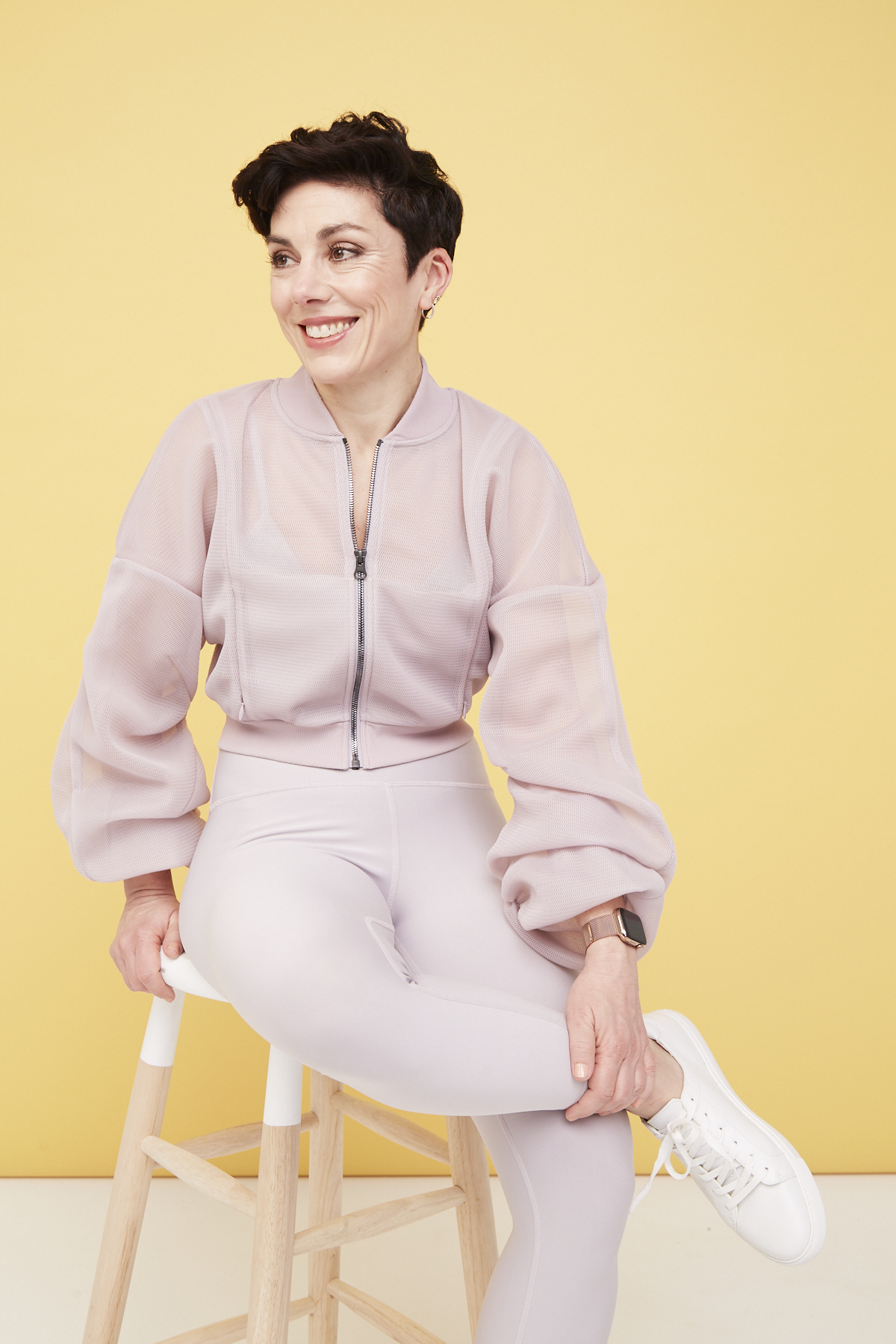
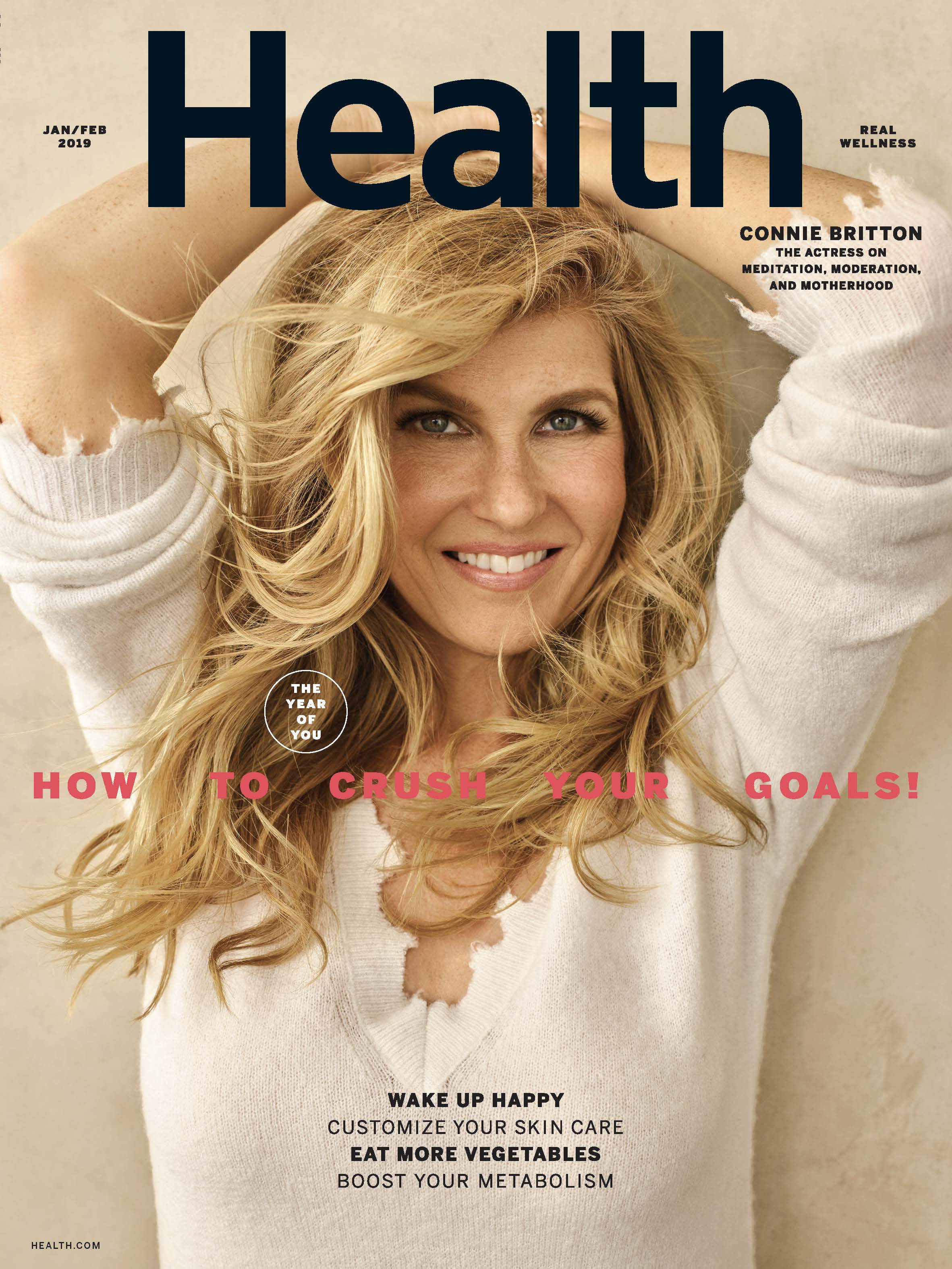
Health magazine has been a trusted authority in wellness for almost forty years. The January/February issue marks the debut of an updated design with a cleaner look and bolder typography. Editor in Chief Amy Conway has led the brand’s creative team to provide the magazine’s audience with inspiring and empowering information that speaks to the way people think about wellness today, and the redesign is an offshoot of that, her belief in the way health and wellness are reflected in today’s society: clean, simple, fresh, and modern.
I spoke with Amy recently and we talked about the redesign and the infusion of streamlined simplicity that it gave the magazine. Amy defined Health as the handbook for living well in every way. She added that the magazine was staying true to its roots in giving readers smart, science-backed health content they can trust. And with the redesign, that same trusted content is showcased in a much fresher and more modern design.
Amy’s belief in the power of the printed cover is also deep. The cover of the magazine is a powerful tool and Amy believes it still holds the key to credibility and that there is no substitution for that credibility. The cover of the magazine still holds permanence and integrity as nothing else does.
So, I hope that you enjoy the Mr. Magazine™ interview with Amy Conway, editor in chief of Health magazine. It’s a refreshing conversation that will have you seeking good “Health” at the newsstands.
But first the sound-bites:
On her first few months at Health magazine: It’s definitely been an evolution since I got here. What I always tell people is that I was a subscriber to Health and a fan of the magazine before I was the editor. I love working out and I’m very interested in food and nutrition and in living well longer. So, I am a reader. Lucky for me, this is really a dream job for me. And again, as a reader of the magazine, I knew when I came on that this brand had a lot of talented people creating great content. It’s really solid, trusted information, this magazine has been around, and people really rely on it. But at the same time, I knew that I wanted to refresh it, both visually and in terms of the tone. So, that’s what we’ve been working on for the last several months.
On how her job as an editor today has evolved or changed over the years: To be an editor you have to be curious and you have to be thinking all the time about what’s happening in our industry, about what our readers want, and you have to be really, really agile. It’s a very dynamic environment. Certain things stay the same. You mentioned that I used to work for Martha Stewart Weddings in particular, right before I came over here, and the two brands might seem really different, but in fact they’re both about quality, authority, and authenticity. So, there are qualities that you can bring, values that are a part of you professionally that you can really bring to any brand and any job once you’ve been in this industry for a while.
On some of the changes she has seen taking place in the health and wellness magazine category: People are just very interested in taking care of themselves, but the shift that I’m really interested in is this idea of health infusing your entire life. And that’s something that we’re bringing to the magazine. Positivity, the sense of motivation, and we’re really empowering our readers to take good care of themselves.
On the value proposition for people to pick up a copy of Health magazine rather than Googling something: If they’re Googling something they have a specific concern and they’re going to find information on it online. And they’ll most likely end up on health.com, which is great because we have a ton of amazing content there. So, we don’t need people to stop doing that. Instead, the magazine is a different experience. Each issue of the magazine is just a beautifully curated product that stands on its own, so we craft our lineups for every issue to feel cohesive and interesting, to be this great mix of information that will stand the test of time.
On whether she tries to do things differently than other health and wellness magazines in the marketplace, such as Women’s Health or Shape: It used to be a much more crowded marketplace in this area, and many areas in our industry. Our publisher always says that there’s been a little bit of a natural selection that’s happened, so the magazines that you just mentioned are the big ones in this area. And of course Shape is one of our sister brands, they sit right next to us here at Meredith. The thing that’s nice is that because there are fewer brands out there, there’s really room for all of us. There are certain things that we cover where there will be overlap. Sometimes I’ll read those magazines and discover that we were going to do that same topic, but then we pivot and do something a little bit different.
On her unique selling proposition when it comes to Health magazine: Health is the handbook for living well in every way. We are staying true to our roots in giving readers smart, science-backed health content they can trust, whether about physical or mental health, fitness, beauty, or food and nutrition. We geek out over the details and love going deep into topics. We don’t just tell you WHAT to buy, we tell you WHY. So if we say a certain beauty product should be in your arsenal, we explain how it works.
On why today she thinks we see health magazines for men or women, but we don’t really have anything for both anymore: I think a lot of the health concerns are different for men and women, and frankly as I’m sure you know, this is a business and the advertisers are definitely going to be different for men and women. So, from a practical standpoint, that’s the way it is. And there’s a lot of content in our magazine; you can do a lot of mental health, emotional health, and relationship health that could be that a man would find interesting. And certainly I’m sure that men are picking up the magazine as well when they see it in their house, But yes, you do need to target a little bit, both from an editorial standpoint and a business standpoint.
On whether she has a specific reader in mind when she assigns articles or stories: We are creating content for a woman who is an adult; she’s not a kid, she’s probably in her 30s, 40s, or 50s and so that’s a pretty big range, there are going to be certain commonalities in that area. But we are creating content that should be applicable and of interest to women in that range. So, when we’re thinking about articles, and that’s the fun part of the job, there are so many different, amazing things that we can cover. We’ll sometimes get excited about something and think well that’s probably a bit too narrow or that’s not going to appeal to everyone, so we try to come up with story ideas and packages that are going to appeal to, again, this woman who is looking for information that will help her live her life now and as she gets older and looks at these different stages in her life.
On whether she ever hits a stumbling block where ideas are scarce: Definitely not. We wish we had more and more pages. There is an infinite number of topics that we can cover, and literally one of the most challenging parts of the job is editing down all of the things that we are excited about here at Health, editing them down to fit into an issue of the magazine.
On what she would hope to tell someone that she had accomplished at Health in 2019: I would say that we would have created a year’s worth of beautiful magazines; the cover is something that we’re really focusing on, of course, it’s a “welcome to the magazine” for every issue. So, we would have created a year’s worth of beautiful magazines with really enticing covers, working with amazing subjects for those covers and great creative teams, photographers as well, to really set the tone that we’re looking for with Health. And the magazine would be robust; we’d be getting great feedback from readers and advertisers, and we’d really be a part of the conversation out there in a big way, in terms of the health and wellness space.
On what she thinks the role of the cover is today, and is that role different today than it was when she first started in the industry: Covers definitely used to be more of a selling vehicle, you needed to scream at readers on the cover to stand out on the newsstand. And it’s a little bit different now for Health. When we’re looking at our covers, for us, we want to stand out by being a little bit quieter and when we were thinking about January/February, the first cover of the redesign, it has Connie Britton on the cover, we were really thinking of it almost as if it were a poster. And we wanted it to look beautiful on its own. We feel like that’s what’s going to make it stand out, and that’s what’s going to make people happy to have it in their home.
On whether that description of the cover fits the majority of magazines today or just Health: I was just speaking about Health, but I do think it’s pretty incredible what we’re seeing in covers out there. People are being less formulaic and they’re looking more to catch your attention with something different and something interesting. So, it’s really fun to look at the newsstand and see what people are doing, because I think a lot of the formulas are going out the window. Their old conventional wisdom, the rules that you were supposed to follow, people are breaking those rules all of the time. And it’s really fun to see.
On whether she thinks the power of print is that you can’t get that same emotional reaction from humans if they just see it or read it online: I do think there is something very special about print and holding a magazine in your hand and looking at these beautiful pictures of her, but certainly you can get an emotional reaction from reading something online as well. They’re different experiences, but what I think is exciting about the time where we are right now, is that there are so many different ways to reach a reader. The fact is when you have a strong brand you can reach your reader in many different ways. You have print and digital; you have social, and there are just new things coming all the time. You just have to have a strong brand and then you can reach your reader in all the places where they are.
On when she reaches out to people to be on the cover, if they ask is it for the cover of the magazine, or does it matter to them if it’s print or digital: When we reach out to them, we ask them to be on the cover and being on the cover of a magazine is still a really powerful thing for people. So yes, in terms of that, being on the cover of a magazine, there is no substitute for that. It’s a permanent thing, so to speak, that you’re creating. And it’s a beautiful object. It’s a living entity, and there is no substitute for that.
On anything she’d like to add: With the redesign, we wanted to give the magazine a much fresher, cleaner, and modern feeling, which really reflects the way people feel about health and wellness today. Our design team is amazing and they worked to give the magazine a cleaner, more streamlined and simple design. It’s inviting and a little bit more elevated. So, we really redesigned the magazine from the covers right on through.
On what grade she would give the redesign project if she were a professor grading a class project: I have to give us an A, but I will say there’s always room for improvement. You do the redesign issue, and anyone who’s worked at a magazine knows this, you do the redesign, it feels like you’re working so hard on this one issue and then you can breathe for about a second and then you’re working on the next one. And you can always make it better. The redesign is not an endpoint, it’s a beginning. And then you have to keep going from there.
On what she would have tattooed upon her brain that would be there forever and no one could ever forget about her: This question of yours, Samir, I always think of as: what’s your mantra? And that’s the language that we use over here at Health. So, I would say be kind, work hard, appreciate the little things, and hug your kids.
On what keeps her up at night: Sleep is something that I am absolutely working on. I’m trying to sleep more and sleep better, that’s definitely a goal of mine. It’s a work in progress, the sleep thing.
And now the lightly edited transcript of the Mr. Magazine™ interview with Amy Conway, editor in chief, Health magazine.
Samir Husni: It’s been a little over six months since you took over Health magazine, has it been like a walk in a rose garden for you? Describe your first few months at Health.
 Amy Conway: It’s definitely been an evolution since I got here. What I always tell people is that I was a subscriber to Health and a fan of the magazine before I was the editor. I love working out and I’m very interested in food and nutrition and in living well longer. So, I am a reader. Lucky for me, this is really a dream job for me. And again, as a reader of the magazine, I knew when I came on that this brand had a lot of talented people creating great content. It’s really solid, trusted information, this magazine has been around, and people really rely on it. But at the same time, I knew that I wanted to refresh it, both visually and in terms of the tone. So, that’s what we’ve been working on for the last several months.
The first couple of issues that I worked on; there were a few little tweaks that I made, but really things had been in progress already and I kind of just went with that for a couple of issues. But then we started working in earnest on the January/February issue, where we did the redesign and a bit of a refresh of the brand overall. So, that’s what we were working on and now we’re well underway with that. It’s been fun and it’s been hard work and both of those things are continuing.
Samir Husni: Before Health, you were the editor of a wedding magazine and editor of Martha Stewart’s books; if someone asked you what qualifies a person to be an editor today, compared to five or ten years ago, what would you tell them? How has your job evolved or changed over the years?
Amy Conway: To be an editor you have to be curious and you have to be thinking all the time about what’s happening in our industry, about what our readers want, and you have to be really, really agile. It’s a very dynamic environment. Certain things stay the same. You mentioned that I used to work for Martha Stewart Weddings in particular, right before I came over here, and the two brands might seem really different, but in fact they’re both about quality, authority, and authenticity. So, there are qualities that you can bring, values that are a part of you professionally that you can really bring to any brand and any job once you’ve been in this industry for a while.
Samir Husni: As you look at the industry, specifically the health and wellness category, being an avid reader, a marathon runner and an exercise enthusiast; what are some of the major changes that you see taking place in the health and wellness magazine category?
 Amy Conway: The health and wellness world is really exploding right now. People are so interested in taking good care of themselves, which is amazing. And some sort of poke fun at it a little bit, because certainly having specific workout clothes or gear or going to certain classes is a bit of a new status symbol. So, you could make fun of that a little bit, but at the same time, if going to a great yoga class becomes a status symbol, that’s a lot more positive than some things that people could be doing.
People are just very interested in taking care of themselves, but the shift that I’m really interested in is this idea of health infusing your entire life. And that’s something that we’re bringing to the magazine. Positivity, the sense of motivation, and we’re really empowering our readers to take good care of themselves.
It wasn’t too long ago that when people thought about health and particularly media and the stories that were out there, it was about quick fixes and about losing five pounds in a week, and it’s really not about that. For me, what we’re trying to do is just help women be the very best that they can be, to reach their own goals that they want to set. We’re not going to tell them exactly what they should do, we’re going to give them ideas and we’re going to give them inspiration and they should feel really good and strong and empowered after reading our magazine, and have it be a positive experience. And then use it to make the changes that they want to make in their own lives.
So, we’re not going to tell them what’s wrong with them, we’re going to tell them how to be the best person that they want to be for themselves. To live well, to feel good, to eat well, and to just bring all of these positive changes about in their lives.
Samir Husni: In a digital age, where the first thing a lot of people do is Google if they have a question about something, how do you show them the importance of Health magazine, whether in print or digital? What is the value proposition for people to pick up a copy of Health magazine rather than Googling something?
Amy Conway: If they’re Googling something they have a specific concern and they’re going to find information on it online. And they’ll most likely end up on health.com, which is great because we have a ton of amazing content there. So, we don’t need people to stop doing that. Instead, the magazine is a different experience. Each issue of the magazine is just a beautifully curated product that stands on its own, so we craft our lineups for every issue to feel cohesive and interesting, to be this great mix of information that will stand the test of time.
So, when you come to our magazine, you’re going to be surprised and delighted we hope by what you find in each issue. You’re going to be informed, inspired and you’ll find things that are relevant to your life because we know our reader and what she wants. And again, it’s a different experience. You’re going to go online and search for something more likely and you’ll come to us and you’ll get this mix that we’ve created for you and hopefully feel that it really enhances your life.
Samir Husni: Being a health enthusiast and an avid reader of Health even before you were the editor, when you’re looking at the entire health and wellness magazine spectrum out there, do you feel you need to do things differently? For example, Health magazine needs to do this differently that Women’s Health or Shape or other magazines in the same category? How do you conceive your new issues of Health and do you take into consideration what’s already on the marketplace?
 Amy Conway: It used to be a much more crowded marketplace in this area, and many areas in our industry. Our publisher always says that there’s been a little bit of a natural selection that’s happened, so the magazines that you just mentioned are the big ones in this area. And of course Shape is one of our sister brands, they sit right next to us here at Meredith. The thing that’s nice is that because there are fewer brands out there, there’s really room for all of us. There are certain things that we cover where there will be overlap. Sometimes I’ll read those magazines and discover that we were going to do that same topic, but then we pivot and do something a little bit different.
There are certain topics that we definitely have in common, but we each have our own vibe, so I feel like a reader could read all three of us, or could just come to one of us. There is room for all of us out there right now.
Samir Husni: But for you, how do you decide on that point of differentiation? What is your unique selling proposition?
Amy Conway: Health is the handbook for living well in every way. We are staying true to our roots in giving readers smart, science-backed health content they can trust, whether about physical or mental health, fitness, beauty, or food and nutrition. We geek out over the details and love going deep into topics. We don’t just tell you WHAT to buy, we tell you WHY. So if we say a certain beauty product should be in your arsenal, we explain how it works.
Some of the other brands out there go deeper into fashion and lifestyle, and that works for them. But we keep it more focused on what women—largely in their 30s to 50s—can do to feel and look great as they move into and out of different life stages, to live better, longer.
We want all women to feel welcomed by our brand. Inclusivity is important. Real, relatable advice is crucial–no false promises or unattainable goals. No more rock hard abs! Health means many things, and it comes in many shapes and sizes. All are welcome.
Samir Husni: At one stage when Health magazine was American Health, or actually it was a competitor before they merged, American Health magazine was published for both men and women. Why do you think today we see health magazines for men or women, but we don’t really have anything for both anymore?
Amy Conway: I think a lot of the health concerns are different for men and women, and frankly as I’m sure you know, this is a business and the advertisers are definitely going to be different for men and women. So, from a practical standpoint, that’s the way it is. And there’s a lot of content in our magazine; you can do a lot of mental health, emotional health, and relationship health that could be that a man would find interesting. And certainly I’m sure that men are picking up the magazine as well when they see it in their house, But yes, you do need to target a little bit, both from an editorial standpoint and a business standpoint.
Samir Husni: As you mentioned targeting, health is as general interest as it can be. As you are assigning stories, assigning articles, do you have a specific reader in mind? Do you think in terms of Amy is a reader and she’s 35-years-old and loves working out, or do you cast a wider net?
Amy Conway: We are creating content for a woman who is an adult; she’s not a kid, she’s probably in her 30s, 40s, or 50s and so that’s a pretty big range, there are going to be certain commonalities in that area. But we are creating content that should be applicable and of interest to women in that range. So, when we’re thinking about articles, and that’s the fun part of the job, there are so many different, amazing things that we can cover. We’ll sometimes get excited about something and think well that’s probably a bit too narrow or that’s not going to appeal to everyone, so we try to come up with story ideas and packages that are going to appeal to, again, this woman who is looking for information that will help her live her life now and as she gets older and looks at these different stages in her life.
Samir Husni: Do you ever hit a stumbling block where you seem to be running out of ideas?
Amy Conway: Definitely not. We wish we had more and more pages. There is an infinite number of topics that we can cover, and literally one of the most challenging parts of the job is editing down all of the things that we are excited about here at Health, editing them down to fit into an issue of the magazine.
And our website is really incredible and of course they can cover a much broader group of topics; they can cover a lot of newsy things. We have a great team on the web as well, so there’s great info there, some things that we can’t cover in the magazine because they’re just too specific, but they can do them online and they may perform really well there.
Samir Husni: If you and I are chatting a year from now, what would you hope to tell me that you had accomplished at Health in 2019 and how happy are you with that accomplishment?
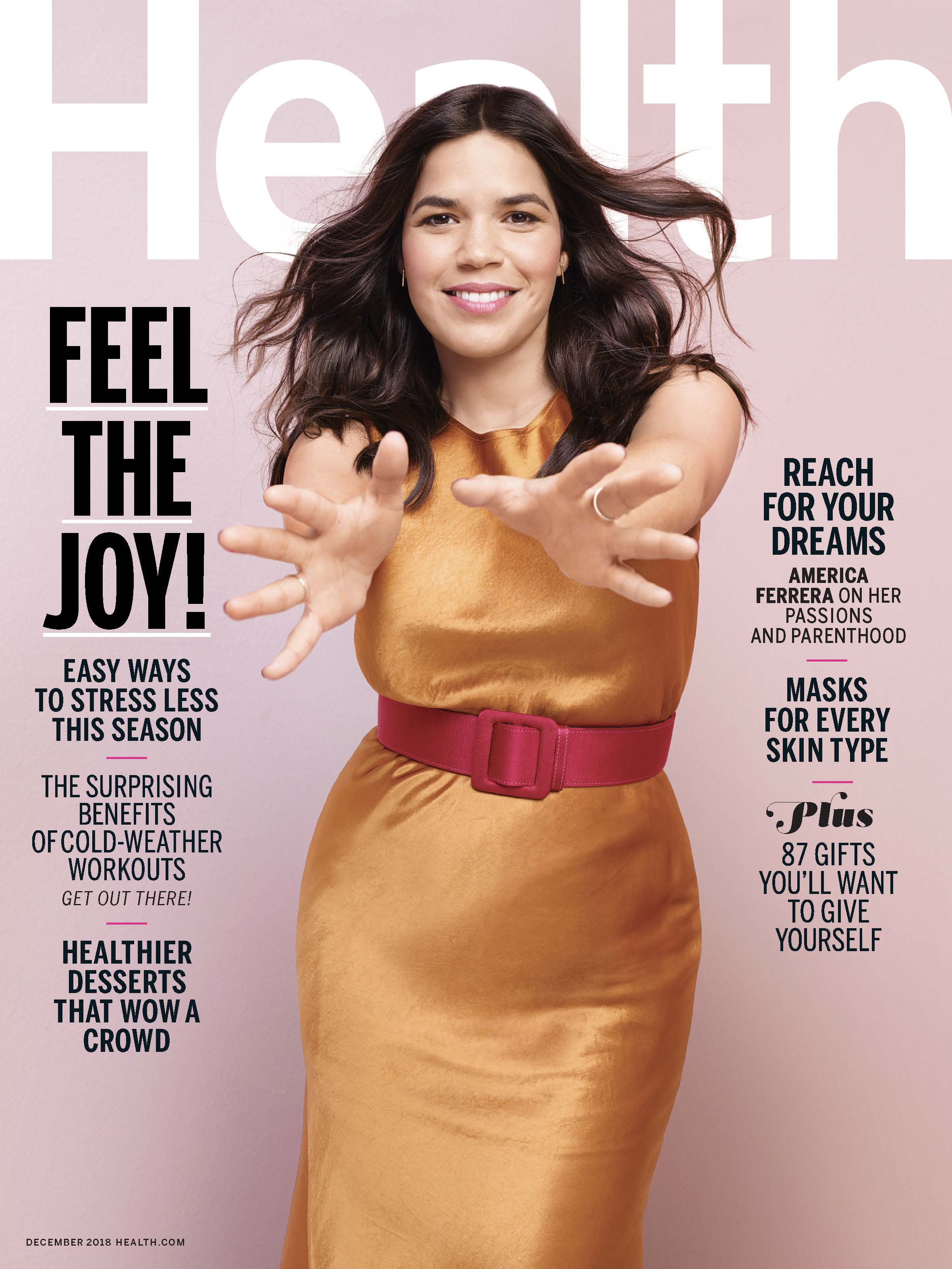 Amy Conway: I would say that we would have created a year’s worth of beautiful magazines; the cover is something that we’re really focusing on, of course, it’s a “welcome to the magazine” for every issue. So, we would have created a year’s worth of beautiful magazines with really enticing covers, working with amazing subjects for those covers and great creative teams, photographers as well, to really set the tone that we’re looking for with Health. And the magazine would be robust; we’d be getting great feedback from readers and advertisers, and we’d really be a part of the conversation out there in a big way, in terms of the health and wellness space.
Samir Husni: You mentioned the cover, and I’m giving a speech soon about the role of covers in today’s magazine media landscape. What do you think the role of the cover is today, and is that role different today than it was when you first started in the industry?
Amy Conway: Covers definitely used to be more of a selling vehicle, you needed to scream at readers on the cover to stand out on the newsstand. And it’s a little bit different now for Health. When we’re looking at our covers, for us, we want to stand out by being a little bit quieter and when we were thinking about January/February, the first cover of the redesign, it has Connie Britton on the cover, we were really thinking of it almost as if it were a poster. And we wanted it to look beautiful on its own. We feel like that’s what’s going to make it stand out, and that’s what’s going to make people happy to have it in their home. So, we’re going for something a little bit simpler and we want to sell it in that way, instead of really screaming at our reader with cover lines.
Samir Husni: Do you think that description of the cover fits the majority of magazines today, or specifically just Health?
Amy Conway: I was just speaking about Health, but I do think it’s pretty incredible what we’re seeing in covers out there. People are being less formulaic and they’re looking more to catch your attention with something different and something interesting. So, it’s really fun to look at the newsstand and see what people are doing, because I think a lot of the formulas are going out the window. Their old conventional wisdom, the rules that you were supposed to follow, people are breaking those rules all of the time. And it’s really fun to see.
Our March issue is on sale now. And we have Shannen Doherty on the cover and that was really interesting because she is obviously someone people are interested in, in general as an actress, but she also has a real health story to tell. She had breast cancer, she’s now in remission, and she just went through reconstructive surgery. So, she gave us this beautiful, really open, really raw interview, and that’s something that definitely sets this issue apart in a really special way. To see someone who is a personality who people know and want to read about, but she actually had something very powerful and resonant to share with us about Health.
Samir Husni: Do you think that is the power of print, that you can’t get that same reaction from humans if they just see it or read it online?
Amy Conway: I do think there is something very special about print and holding a magazine in your hand and looking at these beautiful pictures of her, but certainly you can get an emotional reaction from reading something online as well. They’re different experiences, but what I think is exciting about the time where we are right now, is that there are so many different ways to reach a reader. The fact is when you have a strong brand you can reach your reader in many different ways. You have print and digital; you have social, and there are just new things coming all the time. You just have to have a strong brand and then you can reach your reader in all the places where they are.
Samir Husni: When you reach out to those people to be on the cover, do they ask is this for the cover of the magazine, or does it matter?
Amy Conway: When we reach out to them, we ask them to be on the cover and being on the cover of a magazine is still a really powerful thing for people. So yes, in terms of that, being on the cover of a magazine, there is no substitute for that. It’s a permanent thing, so to speak, that you’re creating. And it’s a beautiful object. It’s a living entity, and there is no substitute for that.
Samir Husni: Is there anything else you’d like to add?
Amy Conway: With the redesign, we wanted to give the magazine a much fresher, cleaner, and modern feeling, which really reflects the way people feel about health and wellness today. Our design team is amazing and they worked to give the magazine a cleaner, more streamlined and simple design. It’s inviting and a little bit more elevated. So, we really redesigned the magazine from the covers right on through.
Samir Husni: So, you’re a professor, Amy, and you’re going to grade this project. What grade would you give it, an A, B+, an A-, a C?
Amy Conway: I have to give us an A, but I will say there’s always room for improvement. You do the redesign issue, and anyone who’s worked at a magazine knows this, you do the redesign, it feels like you’re working so hard on this one issue and then you can breathe for about a second and then you’re working on the next one. And you can always make it better. The redesign is not an endpoint, it’s a beginning. And then you have to keep going from there. They’re always evolving, always changing, and you can always keep improving.
Samir Husni: If you could have one thing tattooed upon your brain that no one would ever forget about you, what would it be?
Amy Conway: This question of yours, Samir, I always think of as: what’s your mantra? And that’s the language that we use over here at Health. So, I would say be kind, work hard, appreciate the little things, and hug your kids.
Samir Husni: What’s the biggest misconception people have about you?
Amy Conway: I have absolutely no idea how to answer that one. But now I’m intrigued. I may have to pull my colleagues aside and figure that one out. But I hope that I’m pretty much just myself with people, so I don’t think in those terms, but now you’ve really got me thinking.
Samir Husni: Last time you and I talked, you were the editor in chief of Martha Stewart Weddings and now you’re at Health; so, are you sleeping better or is there something keeping you up at night?
Amy Conway: (Laughs) Sleep is something that I am absolutely working on. I’m trying to sleep more and sleep better, that’s definitely a goal of mine. It’s a work in progress, the sleep thing.
Samir Husni: Thank you.
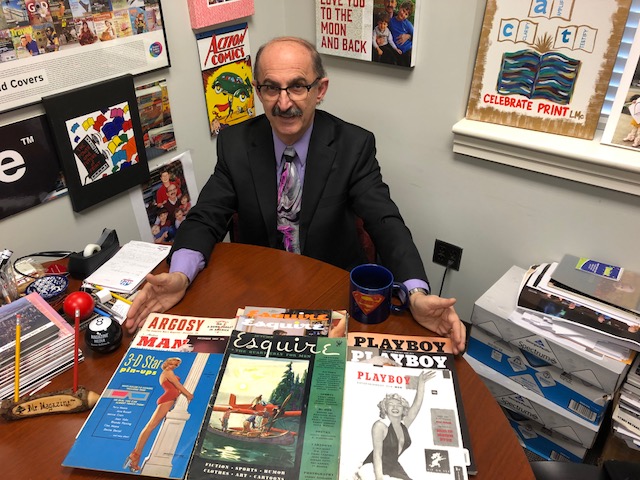
A Mr. Magazine™ Musing…
Lately, Esquire and Playboy have been in the news; Esquire for having a white, teenaged boy on the cover of its March issue, and Playboy for becoming a quarterly magazine with no advertising. It’s amazing how these two magazines share a lot of common history. And I thought it would be a good idea to go back in time, dig into my collection of magazines, and see how these two publications revolutionized the men’s magazine market, from as far back as 1933 when the first issue of Esquire was published.
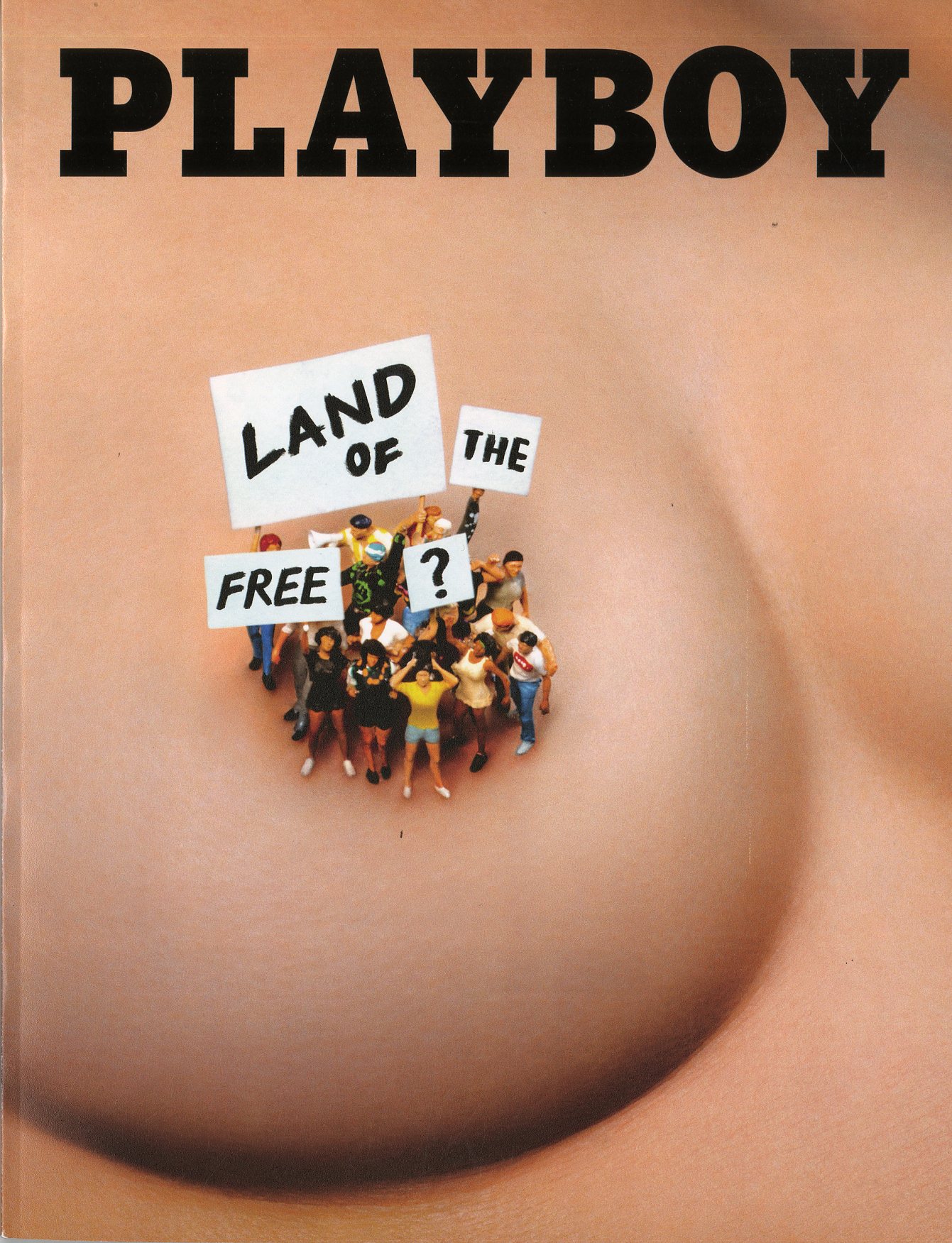
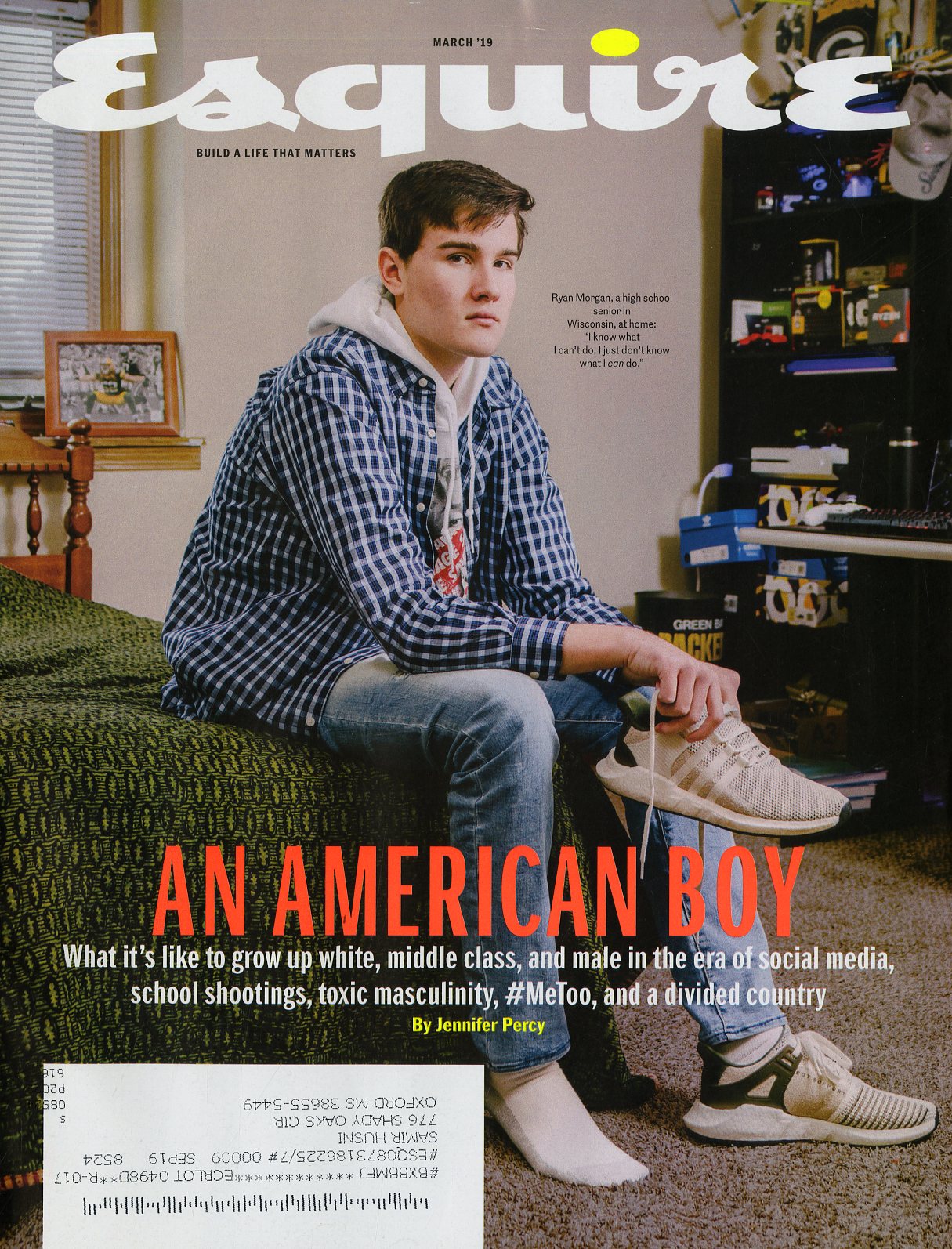
If you read the editorial statement for the first issue of Esquire you can immediately tell that it was a rebel magazine. It was a magazine that was founded in rebellion of what was going on in the marketing and advertising world as it relates to the magazine publishing field. Here are a few comments from that editorial in the first issue of the magazine (keep in mind, the year is 1933):
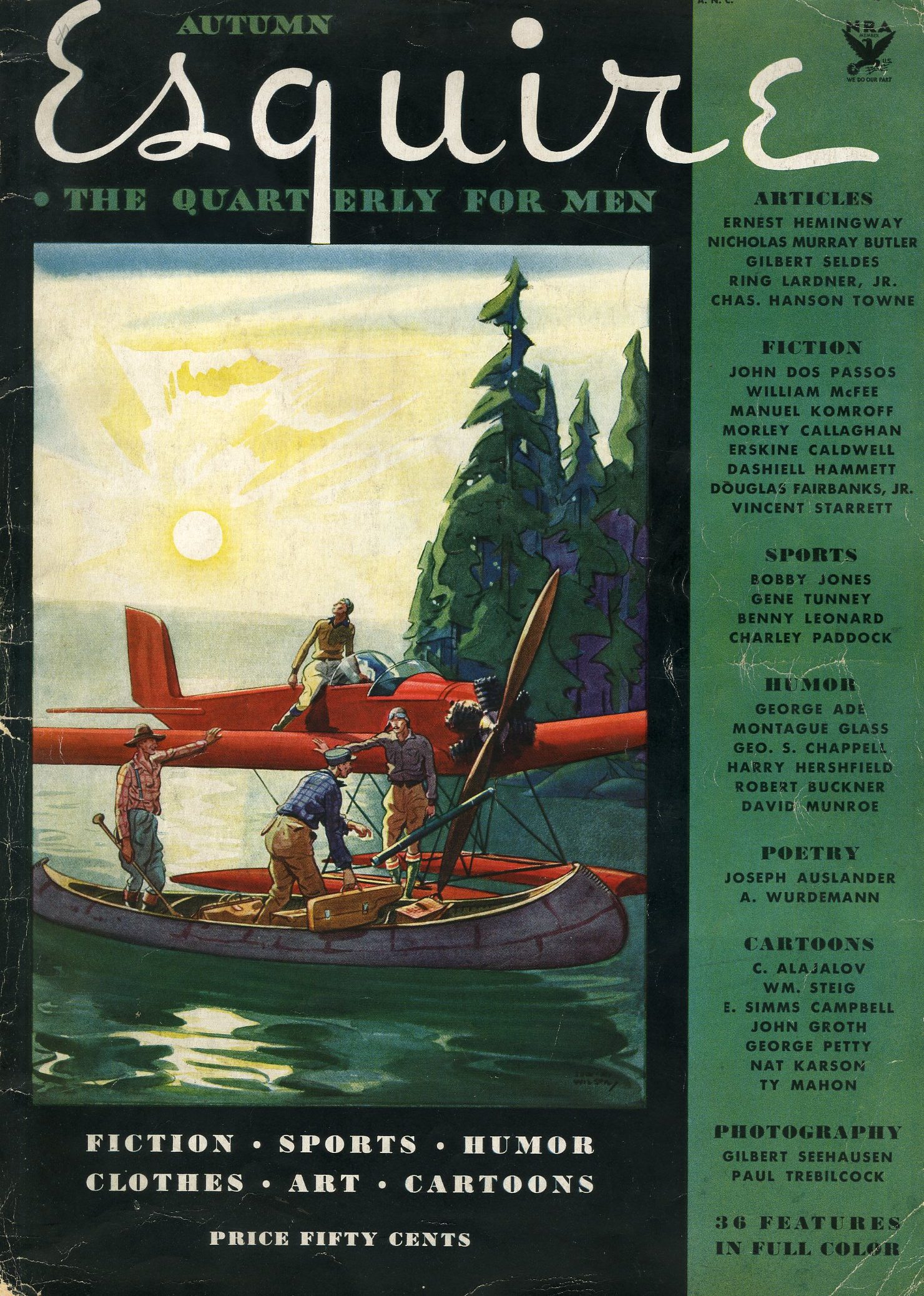
It is our belief, in offering Esquire to the American male, that we are only getting around at last to a job that should have been done a long time ago – that of giving the masculine reader a break. The general magazines, in the mad scramble to increase the woman readership that seems to be so highly prized by national advertisers, have bent over backward in catering to the special interests and tastes of the feminine audience. This has reached a point, in some of the more extreme instances, where the male reader, in looking through what purports to be a general magazine, is made to feel like an intruder upon gynaecic mysteries. Occasionally, features are included for his special attention, but somewhat after the manner in which scraps are tossed to the patient dog beneath the table.
Twenty years later, Hugh Hefner, who was working in the accounting department at Esquire, left his job at the magazine and decided to start a magazine that would compete with Esquire. Whether that was his intention or not, I don’t know, but I do know one thing for sure, there are a lot of similarities between the Playboy of the ‘50s and the Esquire of the ‘50s. Check out Hefner’s message to the reader in the first issue:
If you’re a man between the ages of 18 and 80, Playboy is meant for you. If you like your entertainment served up with humor, sophistication and spice, Playboy will become a very special favorite. We want to make clear from the very start; we aren’t a “family magazine.” If you’re somebody’s sister, wife or mother-in-law and picked us up by mistake, please pass us along to the man in your life and get back to your Ladies Home Companion.
Most of today’s “magazines for men” spend all their time out-of-doors – thrashing through thorny thickets or splashing about in fast flowing streams. We’ll be out there too, occasionally, but we don’t mind telling you in advance – we plan on spending most of our time inside. We like our apartment. We enjoy mixing up cocktails and an hors d’oeuvre or two, putting a little mood music on the phonograph, and inviting in a female acquaintance for a quiet discussion on Picasso, Nietzsche, jazz, sex.
Just take a look at the first issue of Playboy from 1953 and look at the December issue of Esquire 1953. They shared many similarities, from the Magazine for Men to Entertainment for Men, the nudity, the centerfold, which actually was in Esquire as the Esquire’s Lady Fair, and then later in Playboy as the Playboy Centerfold or Playmate.

However, if you take a look at the content of those two magazines from December 1953, you will notice that Esquire had almost 280 pages with a cover price of 50 cents, while Playboy had the same cover price, 50 cents, but only 44 pages.
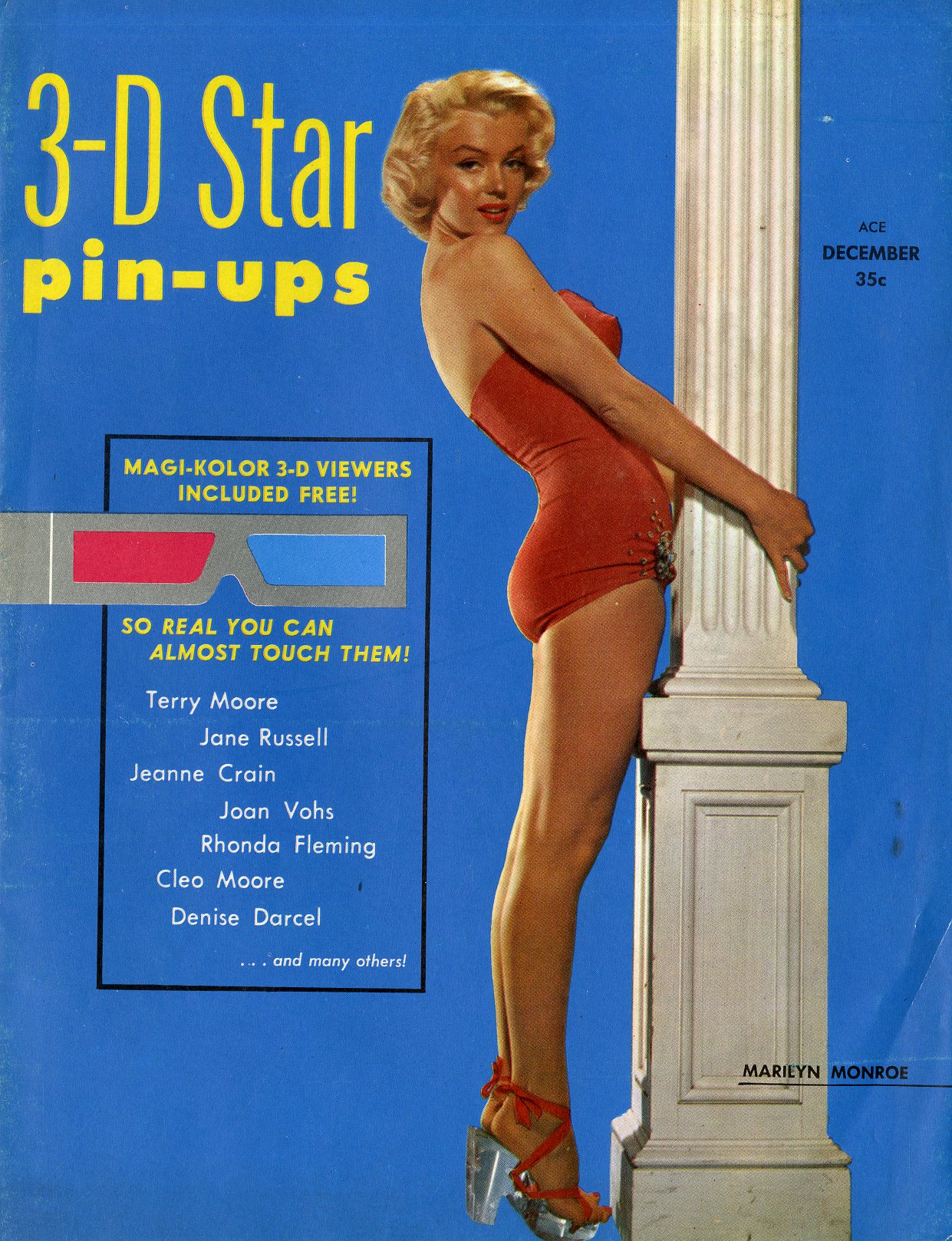
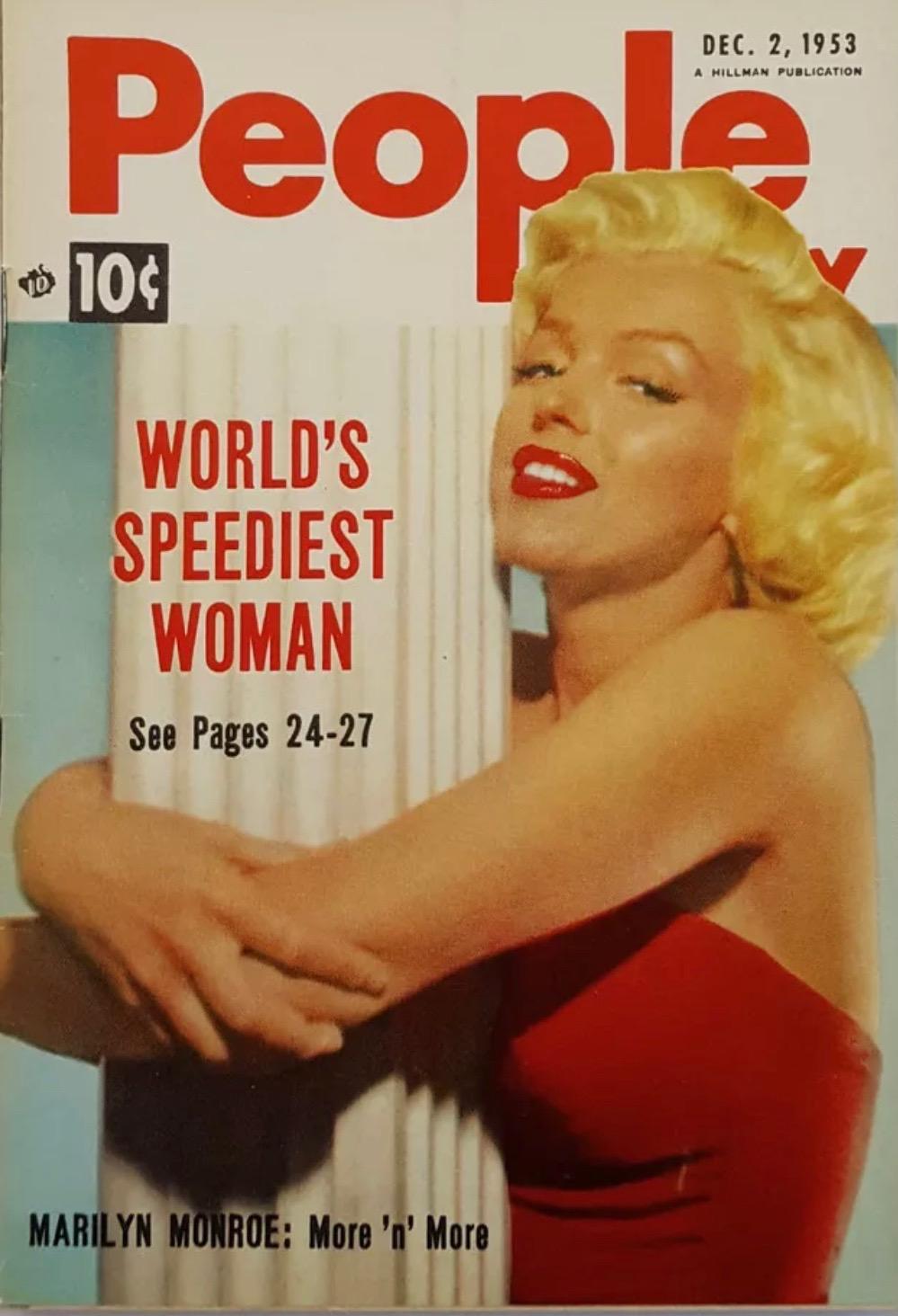
And not only those two magazines, there were plenty of magazines out there for men, but they didn’t have the same sophistication that Esquire had or that Playboy would later have. Look again at the cover, which has been hailed by some as the reason for Playboy’s famous status among men’s magazines, the sensual Marilyn Monroe gracing that cover with a reprinted nude Monroe pin up inside taken from a calendar page. However, more December 1953 magazines had Marilyn Monroe on the cover, 3-D Star Pin-Ups came with 3-D glasses for the inside pictures. The magazine People Today, a pocket-sized magazine, had Monroe on the cover, plus a series of pictures where she was specifically posing for that magazine. And there was Modern Man, Argosy, Real, the exciting magazine for men, Man to Man, and Flirt, just to name a few.
So, you wonder what was it really that gave Playboy that later advantage? From its humble beginnings, it exceeded Esquire’s circulation in the ‘60s and ‘70s, reaching as high as 7.2 million copies, where Esquire peaked in 1972 at 1.25 million. Maybe it was the Playboy Interview or maybe the millions of men who will “get the magazine for the articles.”
Of course, if we take a deeper look at those two titles, you will notice that both the sophistication and the presentation were and continue to be an essential part of those two magazines. In fact, a lot of people referred to that era of men’s magazines in the ‘60s, ‘70s and ‘80s as the men’s sophisticate magazines. Maybe that was a code word for sex, which Esquire was not known for after the early ‘60s, but Playboy definitely was.
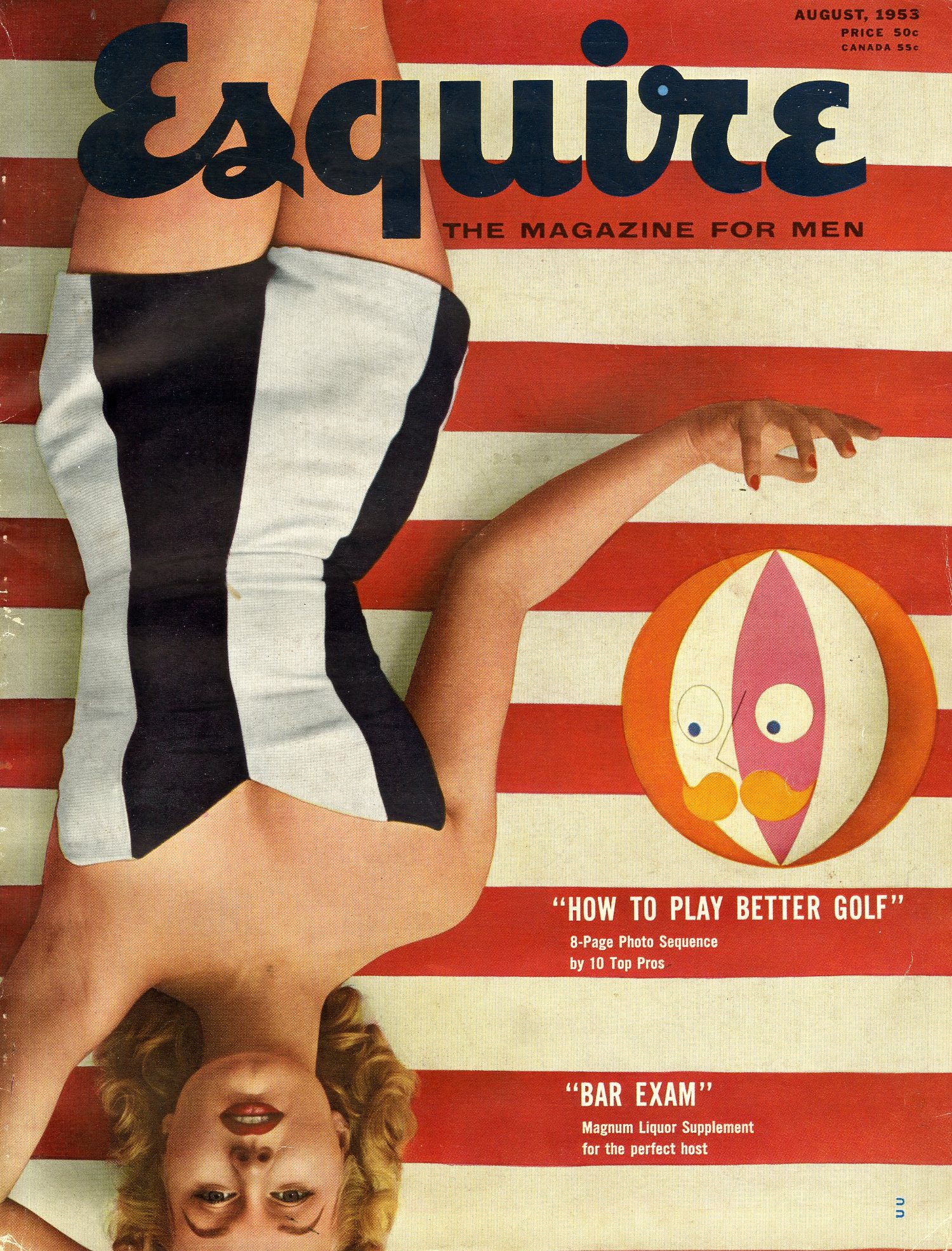
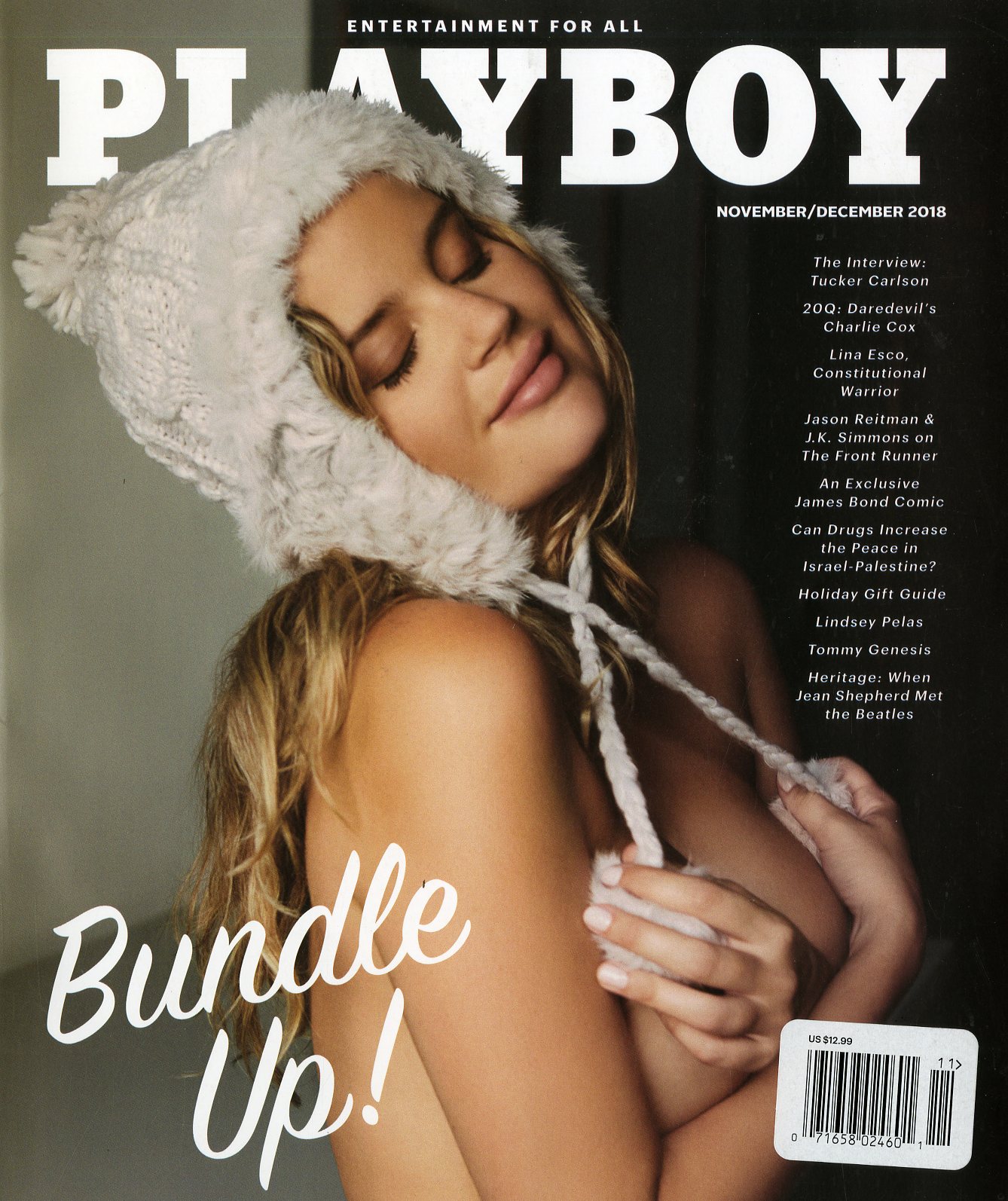 With all of the changes in the editorial direction, in the editorial content, in the social fabric of society, in the type of nudes or no-nudes in those magazines, it could easily be deduced that neither Playboy nor Esquire are today what they used to be back in those early years of men’s magazines, but they still have the same fighting DNA that one can see if they follow the magazine issue after issue and don’t just look at one cover or one story as a separate entity.
Esquire moved from just being “The Magazine for Men,” to “Man At His Best,” to “Build A Life That Matters,” which is the tagline on its latest cover. And Playboy moved from “Entertainment For Men,” “To Entertainment For All,” to no tagline at all.
Esquire continues to be a very sophisticated publication that still offers a mixture of literary giants, celebrities, and also has its finger on the pulse of the American man’s magazine culture.
While Playboy has become a shadow of what it used to be in terms of circulation, advertising and frequency, with very limited circulation and no advertising, and a quarterly frequency rather than monthly. Even a cover price of $24.95, which can easily buy you two years of Esquire today and used to get two years of the monthly Playboy.
However, the fact that these two magazines are still making waves in the news today, after all of these years, is just a reminder to all who follow the magazine industry, as I mentioned earlier, that the DNA of those titles is still there and remains the foundation. One is still a rabble-rouser and the other is still offering sophistication for men in a completely different way than that sophistication appears in the other.
In fact, Playboy has gone from sending women off to the kitchen to cook and read their Ladies Home Companion as it advised in the premier 1953 issue, to its 65th anniversary issue being produced by an editorial staff that was more than 50 percent women. Yes, quite the change from 1953.
Either way, whether you want to pick up a copy of Esquire or you want to pick up a copy of Playboy, you’re certainly going to be in the middle of this raging firestorm that is taking place, where some are accusing both magazines of doing things that are not appropriate or not right.
The sad thing about some social media postings and other media outlets and commentators is that they apparently have never studied, or took the time to study, or have any institutional memory of what those two magazines have offered our society and pop culture over the years. Magazines are a living entity and the whole magazine is larger than the sum of its issues. And that’s one reason I am never quick to jump to conclusions, but I will be quick to remind people that before you judge, study your subject matter, study your magazines. And I’m sure you’ll see how these two great magazines have survived through all of these years, winning too many wars to give up the battle just yet.
Until the next Mr. Magazine™ Moment…
See you at the newsstands…
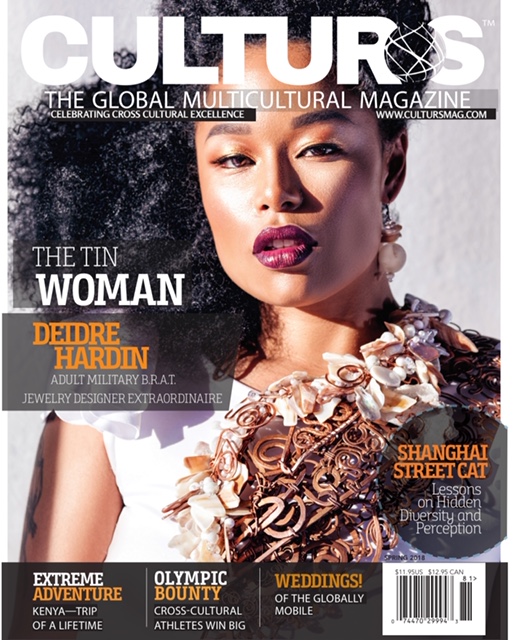 “We were actually digital first. We’ve been online for five years, print just happened last year. And with the print we started…we had the online magazine first, the digital magazine, which includes a mobile magazine for the iPad and handheld devices. So, we were digital first, I feel in this era you have to be digital, there’s no question. You have to have an online presence. But to me, print takes it to the next level. Our stature has grown a thousand percent by going into print. People are mistaken in thought when it comes to print being dead. Teaching at university I see that. Print is growing more than ever. If you go to any newsstand you’ll see that there are more magazine titles now than ever before.” Donnyale (Doni) Ambrosine (On why she is doing a print magazine in this digital and global age)…
A globally mobile Afro-Latina and first-generation American who has lived on five continents and identified with seven cultures by the age of 19, Donnyale Ambrosine, or Doni as she is called, is passionate about creating community for cross-cultural populations. She has presented around the globe as a Keynote, at conferences, universities and in media as a lifestyle expert focused on entrepreneurship, marketing, branding and cross-cultural identity. With this background, she developed university curricula for global culture identity at Colorado State University, where she is on faculty.
 And Doni has also created a brand that includes Culturs, a global multicultural magazine that intends to celebrate the unique perspectives of cross-cultural people. Global Nomads, Third Culture Kids, and racially-blended and culturally-blended people can read lifestyle articles and research from their point of view. One that shows a new-world order — a new normal that affects not only our lives, but the lives of those around us.
I spoke with Doni recently and we talked about the digital-first, print publication brand that she is so passionate about. Doni uses her global, multi-cultural background, academic training, and career experience in media, management and business to position Culturs as the first-ever, digital-first print publication and product marketplace of its kind – one that addresses global and mobile cultural identities, with emphasis on hidden diversity. And it’s that hidden diversity that gave Doni the spelling of the name of her brand – hiding that last “e” as many diversities are hidden.
So, I hope that you enjoy this very delightful and informative interview about a woman and her brand – two very diverse and captivating individuals that will definitely get you thinking about true understanding of global distinctiveness – the Mr. Magazine™ interview with Donnyale (Doni) Ambrosine, Founder & Publisher, Culturs Magazine & Faculty Staff Member At Colorado State University.
But first the sound-bites:
On why she decided to do Culturs: I grew up internationally and when most Americans hear that, they hear privileged. And there were parts of that which were very privileged and there were parts that weren’t. When you think of people in globally-mobile situations, often they could be refugees, immigrants, military brats, missionary kids; so there are very nuanced reasons for people to grow up in a global situation. In my case, it was four continents and an isthmus or five continents if you want to call Central America a continent. So, five continents and seven countries or seven cultures that I grew up with. And that formed who I am and how I see the world. There are 288 million-plus people who live outside of their passport countries today, and a number of them fit the category, actually all of them fit the categories that we talk about in Culturs. And then beyond that we have people who straddle race and ethnicity every day. It is one country, one culture. So, that’s why I created the magazine, because I wanted to have a community for those people who don’t really have others or feel like they have others who understand them and sometimes feel like the outsiders.
On why she left a letter out of the logo and spells the brand’s name Culturs: Everything we do has a meaning. Our colors; our logo; the fonts we use. Culturs is spelled without the normal “e” toward the end. The “e” is hidden and that stands for the hidden diversity of our population. We are a population of people who straddle or are in between culture, race, ethnicity, nations and locations.
On why she is doing a print magazine in this digital and global age: We were digital first, I feel in this era you have to be digital, there’s no question. You have to have an online presence. But to me, print takes it to the next level. Our stature has grown a thousand percent by going into print. People are mistaken in thought when it comes to print being dead. Teaching at university I see that. Print is growing more than ever. If you go to any newsstand you’ll see that there are more magazine titles now than ever before.
On whether this journey has been a walk in a rose garden for her or there have been challenges along the way: I have to say that I planned a lot of it out, so it was easier than most people would imagine. But it’s a very large operation with a lot of people; it takes a lot of people. And once you get into the distribution of it; we’re in Whole Foods and Barnes & Noble, Sprouts, Books-A-Million, independent bookstores, and university bookstores. And that’s a lot. My intention actually was to next go into airport kiosks and airport bookstores, but I decided to slow down a little bit, because that’s been the most daunting part.
On that that bright, shining moment when she knew she was making a difference: When I started the digital I felt like I was doing something. And I continued that for four years and we have thousands of articles, they’re all free. Even articles in the print edition are also on digital, so anyone can read those. Again, there’s a different experience when go to print. Just the photos were very visual in the print magazine. And it was just such a great experience to feel the paper, it’s such high quality paper with a soft touch to it. So, I felt like I made a difference when I went digital, and then I started to feel like I wasn’t. Going to print, I felt like I was making a difference.
On her link with Colorado State University: I teach in the Department of Journalism. I actually teach a course called Media and Global Cultural Identity. I have to give props to the Department of Journalism and Media Communications because the head of that department was the first one to really get this. To really see the value of what we’re doing and understand the difference it can make in the world, and who was championing it from the beginning. And he’s offered to do a number of things, and so I developed the curriculum for that class.
On anything she’d like to add: I’m excited to see large corporations understanding what a difference this makes. I told you about the show “I Am the Night” on TNT. I was impressed with them and Turner Network and Warner Brothers, I was a consultant on the show. And it’s about someone who is a friend of mine, she is culturally fluid. She’s a white woman and she grew up thinking she was black. There’s a lot to that story; a lot of layers there. They brought me in as a cultural consultant because of our connection and to make sure that they were hitting the cultural note right. And that’s what a lot of corporations are missing.
On what she would have tattooed upon her brain that would be there forever and no one could ever forget about her: I’m going to say something that came to me recently. Building this, I get so focused on how important it is, that often I forget along the way to enjoy it. And not let the pressure get to me. So recently, I said that I want to bring the best of myself to everyone around me, because I don’t feel like I’m giving them my best at all times right now. I want to bring out the best in the people around me by giving them the best of me.
On the biggest misconception she thinks people have about her: (Laughs) Let me find just one. I’ll encapsulate them all into I’m not what people expect. I still haven’t figured that out; I’ve figured it out to a level, but I’m not sure what people see when they see me. They expect me to be much more intense than I am. They expect me to be, I think, more hysterical than I am. (Laughs) Now, can I be that way? Of course, and maybe that’s what they see. They look at me, depending on the situation, how I’m dressed, or how I present; someone said once, how I show up, because I mentioned I’m an introvert and she said that I show up as an extravert.
On what someone would find her doing if they showed up unexpectedly one evening at her home: You would probably find me lifting weights and then coming home and having a hot bath in the Jacuzzi tub. Then sitting by the fire and reading a magazine.
On what keeps her up at night: Nothing really keeps me up at night. (Laughs) I’m that tired. I think what keeps me up at night; again, back to the wanting to do it so right. Doing it like it is so important and doing it like it can make a difference for so many. So, with limited resources, sometimes I feel like I made the wrong decision. And that’s only a recent thing, I never really had that happen to me before, because I would make a decision and then I would move on.
And now the lightly edited transcript of the Mr. Magazine™ interview with Donnyale (Doni) Ambrosine, Founder & Publisher, Culturs Magazine & Faculty Staff Member At Colorado State University.
Samir Husni: Why did you decide to do Culturs?
 Donnyale (Doni) Ambrosine: I grew up internationally and when most Americans hear that, they hear privileged. And there were parts of that which were very privileged and there were parts that weren’t. When you think of people in globally-mobile situations, often they could be refugees, immigrants, military brats, missionary kids; so there are very nuanced reasons for people to grow up in a global situation. In my case, it was four continents and an isthmus or five continents if you want to call Central America a continent. So, five continents and seven countries or seven cultures that I grew up with. And that formed who I am and how I see the world.
My mother is Trinidadian and my father is Costa Rican; I’m very proud of that. And proud that they gave me such a wealth of experience and background by the day I was born, just by being who I was and having them as my parents. So, growing up in all of these places: Turkey, London, Spain; I went to the University of Germany and of course many places in the U.S., it really affected how I see the world.
There are 288 million-plus people who live outside of their passport countries today, and a number of them fit the category, actually all of them fit the categories that we talk about in Culturs. And then beyond that we have people who straddle race and ethnicity every day. It is one country, one culture. So, that’s why I created the magazine, because I wanted to have a community for those people who don’t really have others or feel like they have others who understand them and sometimes feel like the outsiders. Who feel like they need a place, especially if they have a number of the dimensions that I’ve mentioned.
If you’re globally-mobile or even if you’re domestically-mobile as well as race, culture or ethnicity, every one of those layers adds more complexity to your personality, to your identity. And when you mix those moves as you’re forming your identity as a child, then that makes a difference in who you are. You can understand all of the people with whom you share those dimensions, but not everyone of those people can understand you because you contain all of those dimensions at once. So, that’s why I formed Culturs.
Everyday has been a gift and every time I think that this is such a long and daunting road, why did I choose it, that doesn’t last 10 minutes, because I get calls and emails from people, crying and telling me what a difference we’ve made in their lives and how they finally feel that somebody gets them. How they feel like they have community. Someone texted me recently and said it was the first time in their life that they felt seen. I’ve heard from so many people who just don’t talk about it, because no one cares. And when they talk to me, they’re shocked that not only does someone care, a lot of people care. And there are a lot of people who share the same experience.
Samir Husni: What’s the reason behind the logo? You’ve left a letter out of the logo and spell it Culturs; can you tell us why?
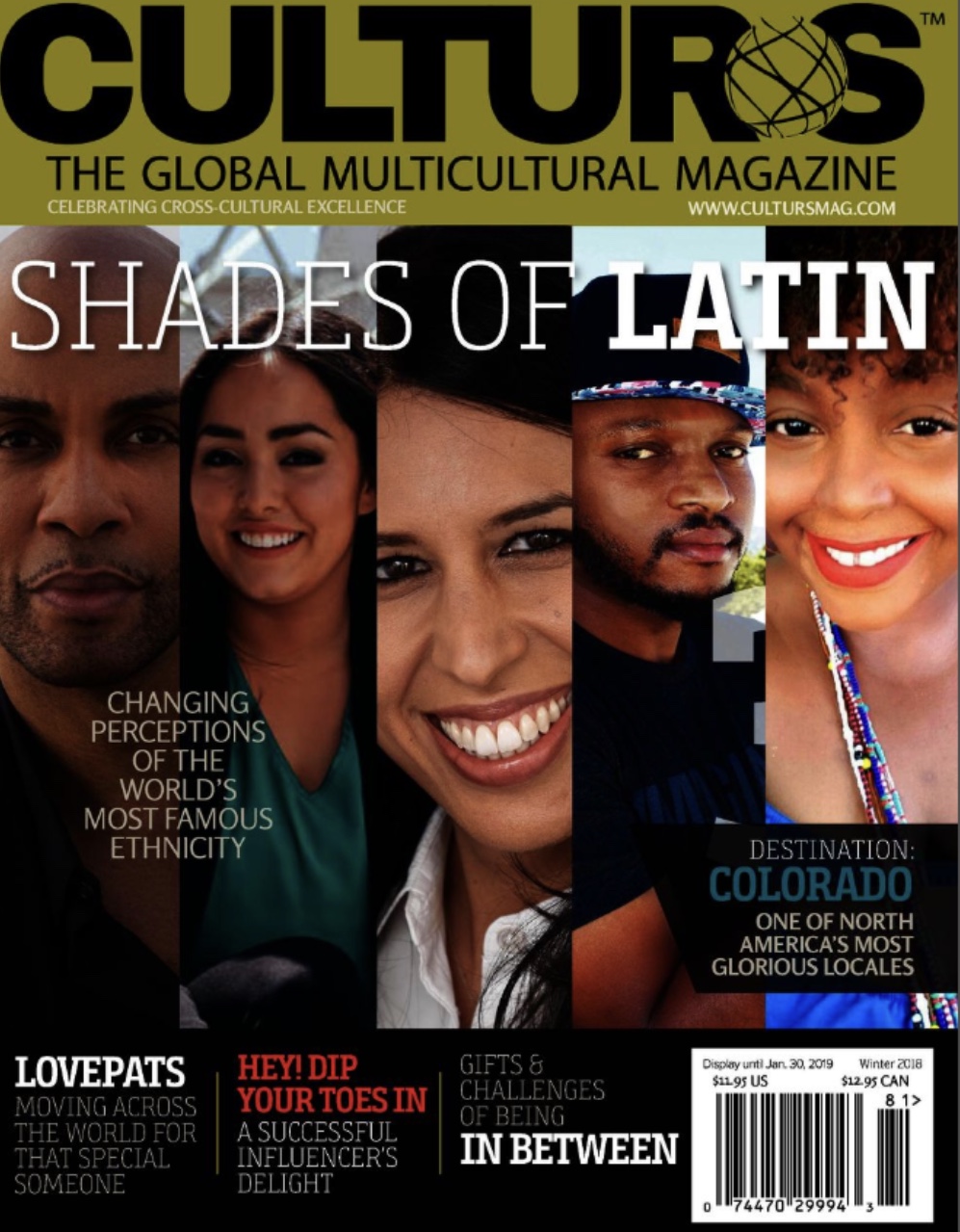 Donnyale (Doni) Ambrosine: (Laughs) Yes, sure. Everything we do has a meaning. Our colors; our logo; the fonts we use. Culturs is spelled without the normal “e” toward the end. The “e” is hidden and that stands for the hidden diversity of our population. We are a population of people who straddle or are in between culture, race, ethnicity, nations and locations.
So, those combinations , those dimensions provide a hidden diversity where what you see isn’t always what you get, so people look at you and when they look at me they think I’m African American. They listen to me speak and they think I’m African American. But I’m a little bit different; there is something wrong with me. (Laughs) I’m not quite what they pictured, because I’m not African American. I’m an Afro-Latina and Caribbean American. And that makes a difference, knowing my background and my culture.
It’s still going to be confusing, because I have so many of those dimensions. What you expect to happen with me, to come from me, is really unexpected. You can’t have any expectations because I didn’t grow up in one place, so that’s the hidden diversity of it. So, the missing “e” stands for that hidden diversity.
Samir Husni: Here you are creating a global magazine about global people, and yet you chose print as your vehicle. Why are you doing a print magazine in this digital age and in this global age?
Donnyale (Doni) Ambrosine: (Laughs) We were actually digital first. We’ve been online for five years, print just happened last year. And with the print we started…we had the online magazine first, the digital magazine, which includes a mobile magazine for the iPad and handheld devices. So, we were digital first, I feel in this era you have to be digital, there’s no question. You have to have an online presence. But to me, print takes it to the next level. Our stature has grown a thousand percent by going into print. People are mistaken in thought when it comes to print being dead. Teaching at university I see that. Print is growing more than ever. If you go to any newsstand you’ll see that there are more magazine titles now than ever before.
What you’ll notice is the ones that are thick, the ones that are large, the ones that are growing are the ones that have a niche population that they pay attention to. The ones that are shrinking are general magazines that try to hit everyone. So, there is a place for print. And the experience for print is completely different.
Now, first of all, digital is great; I love my tech and I love my digital, but I need some downtime. When I want downtime, I might play some games, but I’m not going to grab my phone and curl up with it. I might go get some tea and a magazine, something in print that I can put my hands on and that feels good, that creates an experience for me and that calms me down. And I think most people are like that.
We have so much information coming at us, I can’t remember exactly, but I think the data is that in one day now we have as much information as someone in the 15th century did in their entire lives, or some astronomical sum like that. But we have so many things to distract us, and so much information coming at us and so many things to remember, it really is important for us to take that time, pick up something tactile, something that makes you feel good. And something that makes you slow your brain down a little bit and come back to who you are. And I think print does that.
Samir Husni: Since you started this project five years ago and this being your first anniversary for the print edition, has it been a walk in a rose garden for you or have you had some challenges along the way? And if so, how did you overcome them?
Donnyale (Doni) Ambrosine: It is our first anniversary for the print edition. Thank you for recognizing that. I have to say that I planned a lot of it out, so it was easier than most people would imagine. But it’s a very large operation with a lot of people; it takes a lot of people. And once you get into the distribution of it; we’re in Whole Foods and Barnes & Noble, Sprouts, Books-A-Million, independent bookstores, and university bookstores. And that’s a lot. My intention actually was to next go into airport kiosks and airport bookstores, but I decided to slow down a little bit, because that’s been the most daunting part.
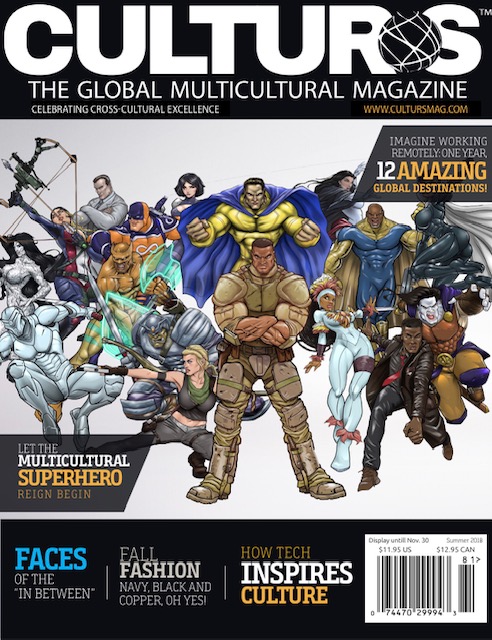 The industry itself is changing daily. People are consolidating, companies are being bought out, censors and distributors, and there are different levels of that, from local to regional to national and international. So, every time there is a change, it changes almost everything with the industry, especially if you’re international. That’s been the toughest part.
Same with our printers. The printers are consolidating and buying each other out. And every time that happens that makes a difference with your print order. And then you have to get it to them sooner, every day’s delay is almost like a week’s delay to get to the newsstand. And those days count, especially when you have big marketing budgets, or in my case, I think I mentioned to you that the director of Wonder Woman and her family are on the next cover, and you always want to be timely with your magazine coming out. But you also have these plans for marketing, digital marketing, traditional marketing, and every time something changes that changes a number of other things as well. So, no, it hasn’t been a walk in a rose garden. (Laughs)
But my passion takes me through. We’re a philanthropic organization; I’m not doing this to line my pockets. I’m doing this to make a difference; I’m doing this for the people who need community or who may be finding themselves or who is just now maybe seeing that there is something different about themselves and they’ve figured it out.
When I interviewed the director of Wonder Woman and her family about this new show on TNT – “I Am The Night” that came out recently, we talked about her upbringing as a military brat. And it turned out that her husband is a cross-cultural kid, in terms of his upbringing as well. And then the two of them together have a son who is growing up in London and in Los Angeles because of Wonder Woman, which was filmed in London. So, they’re a family of cross-cultural people.
And it turned out her mother is a military brat as well, so that’s three generations of cross-culture. And you would expect that, because when you look at them they look like they’re a regular American family and they’re not people of color. But what makes the difference is how they see the world because of how they were brought up. And that’s what we talk about in this next issue.
Samir Husni: When was that bright, shining moment when you knew you were making a difference? Was it when that first issue came out or when you started the digital magazine?
Donnyale (Doni) Ambrosine: When I started the digital I felt like I was doing something. And I continued that for four years and we have thousands of articles, they’re all free. Even articles in the print edition are also on digital, so anyone can read those. Again, there’s a different experience when go to print. Just the photos were very visual in the print magazine. And it was just such a great experience to feel the paper, it’s such high quality paper with a soft touch to it. So, I felt like I made a difference when I went digital, and then I started to feel like I wasn’t. Going to print, I felt like I was making a difference.
And then in between there’s so much work that happens and people remind me that we’ve done so many things. We just came back from the Sundance Film Festival and being able to cover films about refugees and immigrants and the sectionalism of different people. There was a movie called “Hala” about a Pakistani girl who is merging her Pakistani parents’ wishes and culture with her American self.
There was another one called “Luce” that has Octavia Spencer in it and it’s about an African child who is adopted and used to be a boy soldier, and he’s adopted by a white couple from America and as he’s coming of age he’s getting these incendiary thoughts that are shocking everyone around him because he’s an A student and he’s an athlete. He’s looked up to by everyone and his teacher is the only one who saw something brewing inside of him.
So, these are the things that happen to us as we’re forming our identity. We’re growing and they come out, so I’m happy to champion all of these stories that other people are bringing to life. And every time that that happens, I realize I’m making a difference. And it’s important. People bring me back to that, because I’m so busy doing the work that sometimes I forget that we’re actually doing something great.
Samir Husni: What’s the link with the university? I know you’re the director of marketing at Colorado State University at the student center.
Donnyale (Doni) Ambrosine: Yes, and I teach in the Department of Journalism. I actually teach a course called Media and Global Cultural Identity. I have to give props to the Department of Journalism and Media Communications because the head of that department was the first one to really get this. To really see the value of what we’re doing and understand the difference it can make in the world, and who was championing it from the beginning. And he’s offered to do a number of things, and so I developed the curriculum for that class.
And it’s made a difference actually in quite a few students’ lives. It’s been interesting too. It’s been an interesting teaching assignment for me because there are some students who have a hard time grasping the information, because if you grew up in a home without this situation; you’ve never really moved anywhere; you haven’t been around people who are too much different than you, it’s difficult to think outside of that box. And it’s really interesting to watch people want to do it, they like it and they like the information and they really want to get it, but they have a hard time grasping it.
So many come to my class and they learn so much about themselves. Every issue has a major global destination that we feature. And this last one we had London, and one of my former students is a master’s student in London and she wrote the intro about what that city means to her and what it feels like. She’s from Shanghai. Students like her, I have a number of them, and they find out about themselves, question their answers for them. Again, that’s another milestone for me, because that is the purpose of the magazine.
Samir Husni: Is the magazine separate from the university or is it part of the university?
Donnyale (Doni) Ambrosine: It is separate from the university. The university is just a great partner. The Department of Journalism and Media Communications is our major partner. The President’s Office, Enrollment and Access, and Adult Learner and Veteran Services and External Relations, they also have been great supporters.
Samir Husni: Is there anything you’d like to add?
Donnyale (Doni) Ambrosine: I’m excited to see large corporations understanding what a difference this makes. I told you about the show “I Am the Night” on TNT. I was impressed with them and Turner Network and Warner Brothers, I was a consultant on the show. And it’s about someone who is a friend of mine, Fauna Hodel, she is culturally fluid. She’s a white woman and she grew up thinking she was black. There’s a lot to that story; a lot of layers there. They brought me in as a cultural consultant because of our connection and to make sure that they were hitting the cultural note right. And that’s what a lot of corporations are missing.
A lot of places, and the universities are one; they’re starting to get it. It’s not just about visual diversity, what we see, even though that’s important. It’s also other diversities that a number of people have that needs to be seen in people. So, I am very excited about that.
Recently, Amazon reached out for me to work with them. We’ve been working with the World Bank and the United Nations, and Coca-Cola. So, I’m really excited to see this making a difference, to see that people are getting onboard.
Samir Husni: If you could have one thing tattooed upon your brain that no one would ever forget about you, what would it be?
Donnyale (Doni) Ambrosine: That’s a good question. I’m going to say something that came to me recently. Building this, I get so focused on how important it is, that often I forget along the way to enjoy it. And not let the pressure get to me. So recently, I said that I want to bring the best of myself to everyone around me, because I don’t feel like I’m giving them my best at all times right now. I want to bring out the best in the people around me by giving them the best of me.
Samir Husni: What’s the biggest misconception people have about you?
Donnyale (Doni) Ambrosine: (Laughs) Let me find just one. I’ll encapsulate them all into I’m not what people expect. I still haven’t figured that out; I’ve figured it out to a level, but I’m not sure what people see when they see me. They expect me to be much more intense than I am. They expect me to be, I think, more hysterical than I am. (Laughs) Now, can I be that way? Of course, and maybe that’s what they see. They look at me, depending on the situation, how I’m dressed, or how I present; someone said once, how I show up, because I mentioned I’m an introvert and she said that I show up as an extravert.
I think the biggest misconception is people think they get where I’m going with something or what I want to do, or who I am. And I think 95 percent of the time, people are wrong. And I said that to my classes. I told them not to try and anticipate what they think that I want. Give me what you want, because if you try and guess what I want to hear from you, I guarantee you that you’ll be wrong.
Samir Husni: If I showed up unexpectedly at your home one evening after work, what would I find you doing? Having a glass of wine; reading a magazine; cooking; watching TV; or something else? How do you unwind?
Donnyale (Doni) Ambrosine: You would probably find me lifting weights and then coming home and having a hot bath in the Jacuzzi tub. Then sitting by the fire and reading a magazine.
Samir Husni: My typical last question; what keeps you up at night?
Donnyale (Doni) Ambrosine: Nothing really keeps me up at night. (Laughs) I’m that tired. I think what keeps me up at night; again, back to the wanting to do it so right. Doing it like it is so important and doing it like it can make a difference for so many. So, with limited resources, sometimes I feel like I made the wrong decision. And that’s only a recent thing, I never really had that happen to me before, because I would make a decision and then I would move on.
But recently I made a huge decision where we were placed in a slot in the Barnes & Noble stores and I had to do some big things to get that. And it came at a great personal sacrifice. Then I thought I made the wrong decision, because it didn’t work out as I expected. One night I was up all night, kind of kicking myself and asking myself what I was thinking. And whether I had thought it through. But I got over it.
And I kept asking myself what was wrong, because I never do that. But again, it’s just that I believe it is so important. I really feel like this is the direction that the globe is going and that people need to pay attention. So, I want to do everything that I can to get there so that I’m ready for the ones who need us.
Samir Husni: Thank you.
“That’s what I thought. I’m ready for this. And I was excited. I had spent five years in digital; I was excited to be able to return to the media I had fallen in love with, which was print. That was the thing that defined my decision to become a magazine person in the first place. I had been a maniacal print obsessive for my whole childhood. And spending those years in digital really helped me have perspective on consumers and consumer behavior. That instant feedback that you get from digital is extraordinarily valuable, and I felt like that this would be a great chance to bring the things that I had learned there to bear on print and to see if we could help engagement and connectivity to readers in print as well.” Kate Lewis (On her reaction when she was first offered the position of chief content officer at Hearst Magazines)…
Hearst Magazines stands almost unrivaled in its array of successful and engaging magazine titles, both nationally and internationally. And no one does it better that Hearst when it comes to the marriage of print with digital. So, it stands to reason that the person who would be in charge of this massively engaging kingdom would have to be as inspiring and creatively expressive as the portfolio of content they reign over. And as connected to both print and digital as the company is.
Kate Lewis would be that professionally protective ruler of the kingdom, with her scepter in both the print and digital realms. Kate joined Hearst Magazines Digital Media in 2014 as vice president, content operations and editorial director, and was promoted to senior vice president in 2016. In her current role as chief content officer of Hearst Magazines, she directs content strategy for Hearst Magazine brands in print and digital, overseeing all editors in chief and digital directors in the U.S., and liaise with the company’s international network to maximize global content opportunities. In other words, Kate has a full plate and is enjoying the plentiful fare immensely.
On a recent trip to New York, I sat down with Kate and we talked about her palate for everything Hearst, and her vision for the brands that she oversees. While the number of titles she oversees may sometimes seem a bit overwhelming, she has a knack for seeing the positive in everything, the opportunities in challenges and the potential of each and every brand. That’s why her upbeat and energetic take on the creative and business side of the organization is so palpably filled with optimism and spot-on truth. And why Mr. Magazine™ thoroughly enjoyed this conversation.
I hope you do the same as you read along with Kate and myself as we discuss the success of Hearst Magazines and the future of magazines and magazine media. So, without further ado, the Mr. Magazine™ interview with Kate Lewis, chief content officer, Hearst Magazines.
But first the sound-bites:
On whether she feels the industry has given up on connecting print to Generation Z and millennials:I don’t think that we’ve given up on them. I think discoverability with that generation is very hard. I grew up as a kid reading every magazine under the sun, because I walked by 15 newsstands on my way to school every day. They were very much in my face. And kids today, even if they do walk by a newsstand, of which there are very few, you have to go all the way to 55th and Third to find yours. And even if they are walking by a newsstand, they have their faces in their phones anyway. So, I don’t think giving up on them is the right phrase, because I think they have an appetite for this kind of content packaged in this way, but I think we have work to do around how they discover it.
On some tricks that she has in her bag to reach that particular audience:I think this is one of the things that we’re really thinking about with Cosmopolitan; Cosmo has now united print and digital under Jessica Pels and she should definitely be your next interview, she’s amazing. We have such a huge audience of readers for Cosmo in digital, she’s been thinking a lot about how do we use digital to help those readers to connect and understand that there is more from this brand, that you can get print from them. And I think it’s something that Brian Madden, who is our head of consumer marketing, is also really focused on.
On why she thinks the industry has done so much when it comes to bringing people from print to digital, as if it were a one-way street, but has not done as much in taking people from digital to print:I think both are hard, to be honest. I don’t know how much we have done, bringing people from print to digital. I think society has just moved there. I think we have as much Google, Facebook, Yahoo, AOL; all of those things in a day to thank for making people digital. But I don’t think we’ve done enough work and I think we need to so that we can remind people of print. And the fact that there’s a different way of receiving a different slant on this information that’s extremely rewarding. And to sell that to them through their phones.
On how a trusted medium, a trusted brand, can use information about the audience, which today seems very free, but at the same time protect the audience’s privacy:We do that now, because the content that we deliver to them digitally is not overly personalized and that’s true in what we print too. But I bet if you give us 10 years that readers will seek more personalized deliverables, so the people that I know, the characters that I’m interested in, the trends that I’m interested in, and the topics that I’m interested in; I would like for that to be curated for me by the brands that I trust. So, I bet overtime you will see us use that information in ways that are more productive for the reader.
On the power of the brand and what differentiates Harper’s Bazaar or Good Housekeeping from a blog or Facebook:We have learned a lot from bloggers in how we produce magazines, and I think we’ve learned a lot in terms of consumers wanting there to be voice in the things that they see and even in the way that things are packaged. You think about food blogs and consumers seem to like step-by-step, so there have been things we’ve learned from bloggers. But at the end of the day, there is a kind of expertise and authority and breadth of a brand like Good Housekeeping that is just really different from what a blogger is doing. For the most part, a blogger has a niche and they’re sticking to that niche; it’s parenting, cooking, autos, just whatever it is, and they’re delivering in depth their point of view and their point of view alone.
On whether she feels the legacy print business has surrendered a lot of its brand power due to a fascination of this digital mistress it now has:I don’t think we’ve surrendered our power at all. The difference for me between influencers and media brands is that influencers have usually one platform on which they exist. So for example, if we put a YouTube star on Instagram or an Instagram star onsite, it doesn’t translate. They have a platform that is their natural habitat and that’s where they belong. A brand can traverse any platform. You can have a brand be executed across any of the places that we publish and be pretty darned successful in those places with the right ambition. So, I think that’s one way in which we are really different than influencers.
On how she goes through her day wearing so many brand’s hats as chief content officer:First and foremost, I am extremely lucky because the people who individually run these brands, they are the people. Travis Okulski, who runs Road & Track, I don’t need to know about cars, Travis knows about cars. But I can help Travis be a leader; I can help him be a strategist; I can help connect him to his peers. Even last night, we were back and forth on a story; I can edit with him, there’s so much I can offer him, but I can’t offer him car expertise. (Laughs) He’s teaching me. It’s been a slow process, I’m trying.
On whether we will see her fingerprints throughout all of the brands or each brand is going to continue to have its own identity:I really hope that’s the case. I worry about that a lot, and that’s such a good question, because I do strongly feel that in this moment of saturated media, being unique and having a distinction is the best thing you can do for a brand. So, I really do worry and fret about that a lot and some of the decisions that I have made here have been a reflection of that.
On whether she is a believer in audience first:Yes, I am. That statement I need to credit to Kristine Brabson, who runs content strategy for us. She’s a genius. We often hear if you look at top-performing content that’s spiking on any given day; recently it was Adam Levine’s tank top because it was the Super Bowl. And you have to be really careful not to look at the things that spike or the things that are common denominators as being a reflection of what our brands are or being a reflection of what our audience loves. We must go audience first, but it has to be a mix of the things that are a daily habit for them, that gets them reading. We’re all talking about Adam Levine’s tank top, then we should write about it, if it’s within the wheelhouse of our brand.
On whether she feels her editors are still editing with the same rigor or has the rigor been diluted due to the speed and daily necessity of the content:I think we’re doing both. And I think that there are groups of people who excel at both. We had a features team in digital that could take, over the course of a year they would produce maybe six stories. Those people are as valuable as the person who is covering “This Is Us” and writing five stories every Tuesday, because they just watched the show. You really need to make sure, and this is why I would say that we lead with audience, you really need to make sure that you’re hitting every interest that a reader might have and that includes really carefully honed crafted multilayered content. And that includes the light touch.
On how they are utilizing data about their many audiences:I actually had a big editor’s meeting recently and we were talking about some of the ways that data works for us. And I think for the editors, data is not a new word, every year for the past five years has been the year of data for us. I think as a company, we’ve gotten far more extraordinary in the way that we produce it and make it accessible and make it a part of the daily life of people. But editors have always known how to hunt down the information that they need to help them decide what to write, how to write it, when to publish it, where to publish it. And all of those decisions have always been influenced by what our audience is doing on any given day and what the data tells us about that.
On her reaction when she was first offered the position of chief content officer:There were so many complicating factors, but what I thought was, I’m ready. That’s what I thought. I’m ready for this. And I was excited. I had spent five years in digital; I was excited to be able to return to the media I had fallen in love with, which was print. That was the thing that defined my decision to become a magazine person in the first place. I had been a maniacal print obsessive for my whole childhood.
On the biggest challenge she’s had to face:My biggest challenge honestly is the thing that you pointed to before, which is that there are so many brands, so excellent each in their own way, and I am just one human. So, how do I manage this incredibly big organization with all of these talented people that allows me to get smarter from just spending time with them. I hope that they get smarter from spending time with me too. Then, how do I build that connectivity and collaboration across the org. We’re doing good so far, but I definitely have not solved it. (Laughs)
On what she would hope to tell someone that she had accomplished as chief content officer in 2019:I want there to be a complete continuity between all of the creators in this building. I want everyone who is on the creative team in this building to let their ideas go where they may. And not be challenged by: I’m in this bucket, I work for this person, I think this way. But instead, to say: I have a great idea, now where can it live? And then to be able to call upon on all of the right people to help them do that. So, for me, it’s both the freedom to think of creation in any media, reaching the audience in any media, and then the ability to collaborate with the right people to make it happen.
On anything she’d like to add:The only thing I would add is that I hope one year from now that I feel like I’m having as much fun as I am right now. I think the environment in my editorial team is trepidatious, because we see what is happening to media companies around us, but actually it’s full of joy. To me that’s extraordinarily important, that we delight in our work, because it shows up on the page. And you can really tell when you’re reading a magazine or a post, looking at an Instagram post, whatever it is, that the person who did it took pride in it and felt happy doing it. And that is really important to me.
On what she would have tattooed upon her brain that would be there forever and no one could ever forget about her:We’ve always said that my tombstone is going to read “Enter Smiling.” And that is definitely my approach, which is that I look at challenges and opportunities with optimism. So, that’s what I would want tattooed on me.
On what someone would find her doing if they showed up unexpectedly one evening at her home:Probably working. I’m so bad to admit that. I have two extraordinary kids, but they’re teenagers, so they have a ton of homework. And we have really fun dinners, but I’d say after dinner, you might find us all working.
On the biggest misconception she thinks people have about her:I feel like I’m such an open book, that I’m not sure how many misconceptions there are, but that’s maybe just what I think of my own delivery. The biggest misconception about me may be, it’s either one thing or the other, but they’re opposites. It would either be that I’m sophisticated or that I’m basic. And the truth is I’m a combination of both, so I feel like some people see me as being incredibly basic, because I really do understand that mass market audience in the U.S. and I really subscribe to it and I love trashy culture. Probably more than I should. My avatar in social media is Taylor Swift, she’s my favorite person on earth, even though I have never met her. But one can dream.
On what keeps her up at night:My to-do list; again, because I feel quite overwhelmed by the number of people that I want to touch base with and connect with every day. And quality. It goes back to that thing of do we still craft features the way we always did? I think that I have a team that is incredibly good at scale and I think that I have people on my team who are very good at quality. And how do you make sure when you have more people working on scale and less people working on quality that the quality has a voice and a seat at the table.
And now the lightly edited transcript of the Mr. Magazine™ interview with Kate Lewis, chief content officer, Hearst Magazines.
 Samir Husni: I read your interview with WWD and I saw where your own son is an avid magazine reader, whether it’s Road & Track or Car and Driver. And I’m about to speak as an educator, someone who teaches 18-year-olds; do you feel that the industry has given up on Generation Z and millennials when it comes to print or is that a myth that no one knows how to correct?
Kate Lewis: I don’t think that we’ve given up on them. In fact, a couple of meetings ago I was talking to our editor of Seventeen, where we’re actually making some changes to what the next issue will be. With that brand we’re very focused on a single topic, a single theme, because I think that will speak to those girls in a more specific way.
But, you were saying this before, I think discoverability with that generation is very hard. I grew up as a kid reading every magazine under the sun, because I walked by 15 newsstands on my way to school every day. They were very much in my face. And kids today, even if they do walk by a newsstand, of which there are very few, you have to go all the way to 55thand Third to find yours. And even if they are walking by a newsstand, they have their faces in their phones anyway. So, I don’t think giving up on them is the right phrase, because I think they have an appetite for this kind of content packaged in this way, but I think we have work to do around how they discover it.
Samir Husni: Besides reinventing Seventeen, what are some other tricks that you have in your bag to try and reach out to that audience?
Kate Lewis: I think this is one of the things that we’re really thinking about with Cosmopolitan; Cosmo has now united print and digital under Jessica Pels and she should definitely be your next interview, she’s amazing. We have such a huge audience of readers for Cosmo in digital, she’s been thinking a lot about how do we use digital to help those readers to connect and understand that there is more from this brand, that you can get print from them. And I think it’s something that Brian Madden, who is our head of consumer marketing, is also really focused on.
Because the daily habit that we’ve established with our readers now is through digital. This is the potentially “new” newsstand. So, how do we turn that into a way to say, “Hey look, you can see us in different packages.” We’re good at getting people to move from following us on Instagram to YouTube to reading us onsite, so this is just another thing that we should try and connect with them on.
Samir Husni: You were quoted once, “We don’t judge the audience. We want to go where the audience is and not judge them.” Why do you think that the industry has done so much when it comes to bringing people from print to digital, as if it were a one-way street, but has not done as much in taking people from digital to print?
Kate Lewis: I think both are hard, to be honest. I don’t know how much we have done, bringing people from print to digital. I think society has just moved there. I think we have as much Google, Facebook, Yahoo, AOL; all of those things in a day to thank for making people digital. But I don’t think we’ve done enough work and I think we need to so that we can remind people of print. And the fact that there’s a different way of receiving a different slant on this information that’s extremely rewarding. And to sell that to them through their phones.
Samir Husni: It seems today’s audience, in general, are less concerned about their privacy and are willing to give you more information than ever before. How can a trusted medium, a trusted brand, use that information about the audience, but at the same time protect their privacy?
Kate Lewis: We do that now, because the content that we deliver to them digitally is not overly personalized and that’s true in what we print too. But I bet if you give us 10 years that readers will seek more personalized deliverables, so the people that I know, the characters that I’m interested in, the trends that I’m interested in, and the topics that I’m interested in; I would like for that to be curated for me by the brands that I trust. So, I bet overtime you will see us use that information in ways that are more productive for the reader.
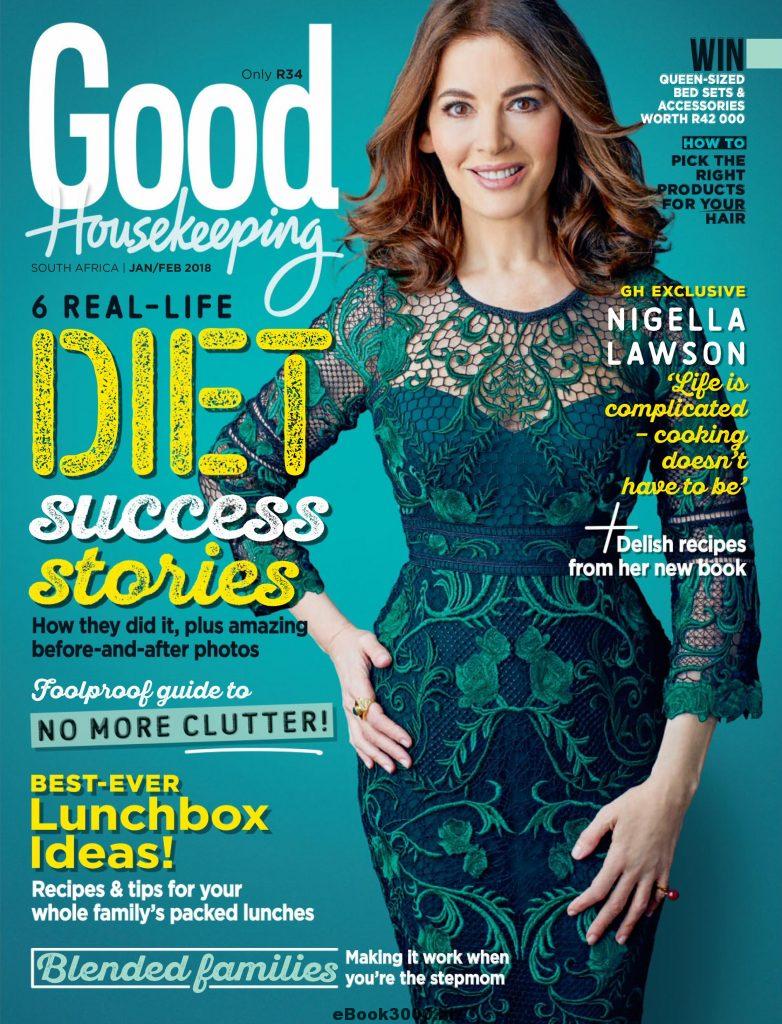 Samir Husni: Tell me a bit more about the power of the brand and what differentiates, let’s say, Harper’s Bazaar or Good Housekeeping from a blog or Facebook?
Kate Lewis: First, let me go back to how we now feel less sad about how we’re targeted. And I totally agree with that. But I think the one risk with that, and I think this is where printed magazines can help set us free in a way, is you’re often delivered digitally the thing that you already knew you wanted.
So, I know that I’m interested in new lights, but I find a billion new lights. And if I looked at one that had a white bulb, then I’m going to be shown all the lights with the white bulbs. But there is one with a red bulb, but I’ll never be shown that one. And the nice thing about print is that it does draft off consumer interest, but it also injects a kind of authority and expertise that helps me go somewhere I might not have gone. It helps bring inspiration. Digital delivery can often be extraordinarily targeted to the point where you are never exposed to new ideas. And I think print can allow people to be exposed to things they wouldn’t have known before.
Now, how do I think that Good Housekeeping is different than a blog? (Laughs) I don’t even know where to begin. We have learned a lot from bloggers in how we produce magazines, and I think we’ve learned a lot in terms of consumers wanting there to be voice in the things that they see and even in the way that things are packaged. You think about food blogs and consumers seem to like step-by-step, so there have been things we’ve learned from bloggers.
But at the end of the day, there is a kind of expertise and authority and breadth of a brand like Good Housekeeping that is just really different from what a blogger is doing. For the most part, a blogger has a niche and they’re sticking to that niche; it’s parenting, cooking, autos, just whatever it is, and they’re delivering in depth their point of view and their point of view alone.
And I think a brand like Good Housekeeping delivers an array of subjects about which they have an array of experts who have opinions that are vetted and have been honed over the years. I gives you a much bigger cornucopia of intelligence than you’re getting from a single blog. Both have value, but they’re strikingly different.
Samir Husni: Michael Clinton told me that somehow the business was mistaken in thinking that the bloggers were the influencers, when in reality the brands are the bigger influencers. And you’ve been in the business since the ‘90s, so do you feel that the print business as a whole, not just Hearst, the legacy print business has surrendered a lot of its brand power due to a fascination of this digital mistress it now has?
Kate Lewis: I don’t think we’ve surrendered our power at all. The difference for me between influencers and media brands is that influencers have usually one platform on which they exist. So for example, if we put a YouTube star on Instagram or an Instagram star onsite, it doesn’t translate. They have a platform that is their natural habitat and that’s where they belong. A brand can traverse any platform. You can have a brand be executed across any of the places that we publish and be pretty darned successful in those places with the right ambition. So, I think that’s one way in which we are really different than influencers.
And I would say that the other way that we’re different is that influencers are often really admired by women, because they want to be them. So, I want to be Jane Doe because I look at her and I see her life and I want to be her. Brands are something that I am. I am an Elle woman; I am. I am in the tent; I am part of the club. And I don’t want to be an Elle woman because that’s not a human, it’s a thing, it’s a feeling, it’s a spirit; it’s a state of mind. And so I think that’s another way in which we differ.
Influencers are inspiring, I’m not besmirching them. They have motivated women to make purchasing decisions in all the ways that brands do, but I don’t want to be them. I want to be friends with them and I want to know them because I’m inspired by them. But with the brand, I can wake up in the morning and say, “Okay, I’m a Cosmo girl. That’s who I am.”
So, I think that’s a big difference between how influence is wielded from an influencers point of view and how influence is wielded from a brand point of view. We do sometimes do the same things. We help them make decisions, but in really different ways. And I would like to think of our way as being super-inclusive.
Samir Husni: Between the platforms and between your job, you’ve been in this position now for almost six months. You’ve humanized the brands, as you referred to the Cosmo Woman or the Elle Woman, so how do you go through your day wearing so many brand’s hats? Are you the Popular Mechanics expert or the Seventeen Girl; are you the HGTV person?
Kate Lewis: First and foremost, I am extremely lucky because the people who individually run these brands, they are the people. Travis Okulski, who runs Road & Track, I don’t need to know about cars, Travis knows about cars. But I can help Travis be a leader; I can help him be a strategist; I can help connect him to his peers. Even last night, we were back and forth on a story; I can edit with him, there’s so much I can offer him, but I can’t offer him car expertise. (Laughs) He’s teaching me. It’s been a slow process, I’m trying.
In some ways I think I would be best-served in this job if I was actually none of the brands, that I don’t particularly identify with any of them more or less than the other. There are obviously ones that speak to me. I own a house, so all of the shelter brands are interesting to me. I am a woman, so all of the women’s brands are interesting to me. But so are all of the men’s brands, and so are all of the specialty brands.
My job is to help editorial leadership, which at this company is so excellent in its own category. Our editors in chief are the most impressive people I have ever worked with. They really understand their beats, and my job is to help them be excellent editors and excellent leaders. And so that frees me up from having category expertise across all of these many brands (Laughs), because I would be very much in trouble.
Samir Husni: And what about the brand dillusion? Will we see Kate’s fingerprints throughout all of the brands or each brand is going to continue to have its own identity? Good Housekeeping will never look like Food Network.
Kate Lewis: I really hope that’s the case. I worry about that a lot, and that’s such a good question, because I do strongly feel that in this moment of saturated media, being unique and having a distinction is the best thing you can do for a brand. So, I really do worry and fret about that a lot and some of the decisions that I have made here have been a reflection of that.
When I came, the shelter group had a bunch of shared teams and I split them back up, so now Elle Décor and House Beautiful and Veranda all have their unique teams. We did that on digital too; we kept the teams separate. I would rather have a small team. People should come to work here because they want to work at Veranda, or House Beautiful or Elle Decor. And so I’m looking for people who have that kind of passion and affinity for a brand to work on it, and hopefully that will help steer that brand to be its own unique execution.
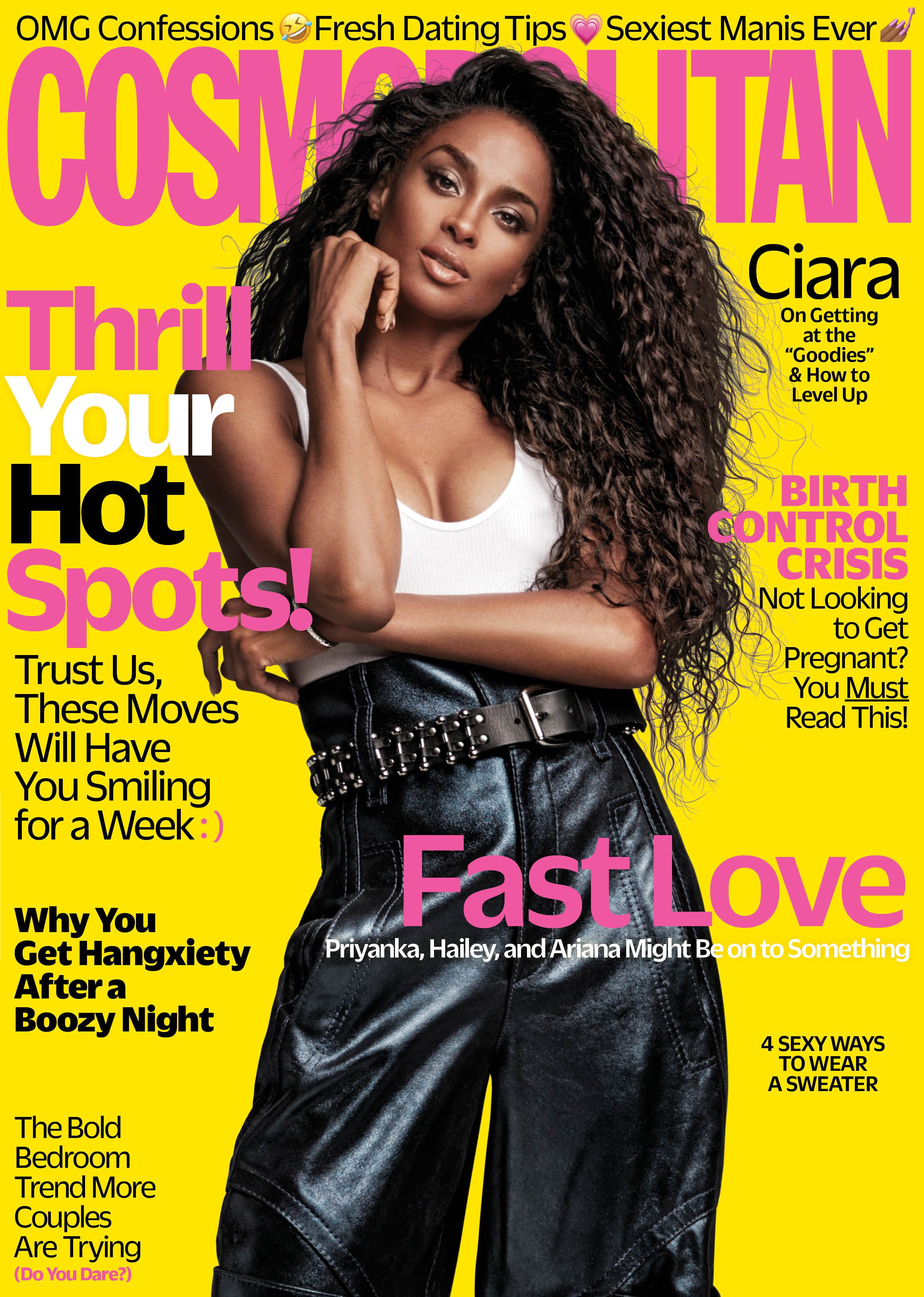 Samir Husni: How do you translate that to your statement about you don’t judge the audience? Is it audience first, rather than platform first, rather than digital first, rather than print first? Are you a believer in audience first?
Kate Lewis: Yes, I am. That statement I need to credit to Kristine Brabson, who runs content strategy for us. She’s a genius. We often hear if you look at top-performing content that’s spiking on any given day; recently it was Adam Levine’s tank top because it was the Super Bowl. And if you think that’s what your audience is and that’s all you wrote about that day, and you look at our top-performing stories and there are five of them that are about Adam Levine’s tank top, you would think what a bunch of uninteresting content they produced today or how can Americans only care about his tank top? There’s so much in the world that we could be writing about.
And you have to be really careful not to look at the things that spike or the things that are common denominators as being a reflection of what our brands are or being a reflection of what our audience loves. We must go audience first, but it has to be a mix of the things that are a daily habit for them, that gets them reading. We’re all talking about Adam Levine’s tank top, then we should write about it, if it’s within the wheelhouse of our brand.
And then also to make sure that we infuse into every day, content that will surprise them and inspire them, take them to someplace new. So, that content mix feels really critical to me to keep our audiences engaged.
Samir Husni: Are you seeing any difference in your editors, where they used to have the luxury of producing a magazine once a month, now they have to create on a daily basis.
Kate Lewis: We’re all running around like crazy. (Laughs) For sure.
Samir Husni: But do you feel that you’re still editing with the same rigor or has the rigor been diluted due to the speed and daily necessity of the content?
Kate Lewis: I think we’re doing both. And I think that there are groups of people who excel at both. We had a features team in digital that could take, over the course of a year they would produce maybe six stories. Those people are as valuable as the person who is covering “This Is Us” and writing five stories every Tuesday, because they just watched the show. You really need to make sure, and this is why I would say that we lead with audience, you really need to make sure that you’re hitting every interest that a reader might have and that includes really carefully honed crafted multilayered content. And that includes the light touch.
Samir Husni: In this digital age where it’s much easier to collect the data about your audience, how are you benefiting from that? How are you using that data? When I asked Michael Clinton what would be the one word to define 2019, he said data. Last year it was audio; the year before it was video. Do you spend your time crunching data?
Kate Lewis: No. I actually had a big editor’s meeting recently and we were talking about some of the ways that data works for us. And I think for the editors, data is not a new word, every year for the past five years has been the year of data for us. I think as a company, we’ve gotten far more extraordinary in the way that we produce it and make it accessible and make it a part of the daily life of people. But editors have always known how to hunt down the information that they need to help them decide what to write, how to write it, when to publish it, where to publish it. And all of those decisions have always been influenced by what our audience is doing on any given day and what the data tells us about that.
There was a great example that our editor from Country Living dotcom, Michelle Profis, gave recently, which I may bungle, but basically she decided to go hard after “The Voice,” the TV show, this year. And they wrote a lot of content around it and it was very popular with her audience.
And they did so many polls in that content that they actually knew who the winner would be. It wasn’t even polls. What they did was related links. So, if you were reading a story that was about two contestants, at the bottom there would be: for more information on Contestant A, click here. For more information on Contestant B, click here. And they started to track who was going where and what it was, and they ended up knowing before it was over basically who was going to win.
And that kind of thing helps them have a content strategy. They obviously need to write more stories about the person who is the bigger hit. And it’s been interesting to see editors use data in those kinds of ways. It doesn’t change so much instinct about what people like. The first instinct was to go hard after “The Voice” this year, because they thought it would be a big season. That’s just a thing, and then you begin to understand how to craft that narrative in a way that will connect more deeply with people. And data helps to do that.
Samir Husni: Where do you find those people who still have that gut feeling?
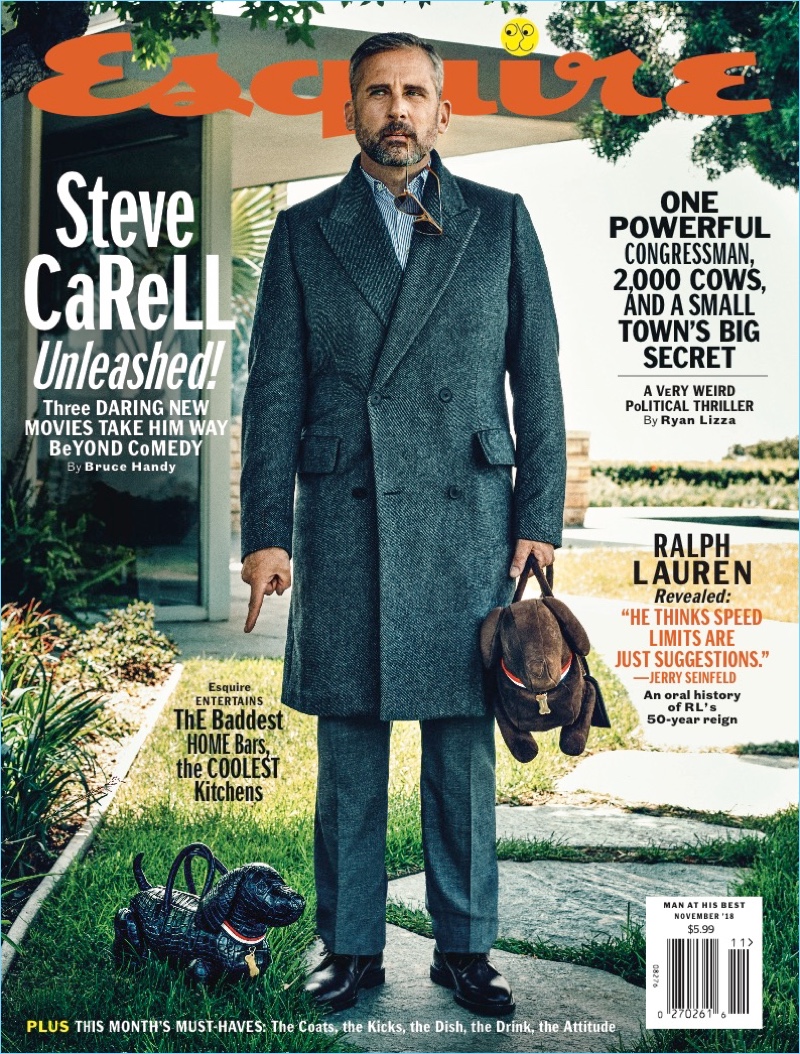 Kate Lewis: I find them everywhere. I think the instinct of editors is the thing that makes them want to do this. Anyone who is applying for a job here already has that instinct, because they understand how media affects people and they have sort of a gut about it.
Samir Husni: When you were asked by WWD, you said that only in your dreams did you ever think you would be here, where you are today.
Kate Lewis: Yes.
Samir Husni: In the large span of being a magazine editor, you have had a short lifespan, you haven’t been in this business for 50 years or so before you achieved this position. If you can recall that moment when you were offered this job, what was your reaction?
Kate Lewis: There were so many complicating factors, but what I thought was, I’m ready. That’s what I thought. I’m ready for this. And I was excited. I had spent five years in digital; I was excited to be able to return to the media I had fallen in love with, which was print. That was the thing that defined my decision to become a magazine person in the first place. I had been a maniacal print obsessive for my whole childhood.
And spending those years in digital really helped me have perspective on consumers and consumer behavior. That instant feedback that you get from digital is extraordinarily valuable, and I felt like that this would be a great chance to bring the things that I had learned there to bear on print and to see if we could help engagement and connectivity to readers in print as well.
Samir Husni: What was the biggest challenge that you had to face and how did you overcome it?
Kate Lewis: I’m not sure I have overcome it yet. (Laughs) My biggest challenge honestly is the thing that you pointed to before, which is that there are so many brands, so excellent each in their own way, and I am just one human. So, how do I manage this incredibly big organization with all of these talented people that allows me to get smarter from just spending time with them. I hope that they get smarter from spending time with me too. Then, how do I build that connectivity and collaboration across the org. We’re doing good so far, but I definitely have not solved it. (Laughs)
Samir Husni: If you and I have this conversation a year from now, what would you hope to tell me that you had accomplished as chief content officer in 2019?
Kate Lewis: I want there to be a complete continuity between all of the creators in this building. I want everyone who is on the creative team in this building to let their ideas go where they may. And not be challenged by: I’m in this bucket, I work for this person, I think this way. But instead, to say: I have a great idea, now where can it live? And then to be able to call upon on all of the right people to help them do that. So, for me, it’s both the freedom to think of creation in any media, reaching the audience in any media, and then the ability to collaborate with the right people to make it happen.
Samir Husni: Is there anything you’d like to add?
Kate Lewis: The only thing I would add is that I hope one year from now that I feel like I’m having as much fun as I am right now. I think the environment in my editorial team is trepidatious, because we see what is happening to media companies around us, but actually it’s full of joy. To me that’s extraordinarily important, that we delight in our work, because it shows up on the page. And you can really tell when you’re reading a magazine or a post, looking at an Instagram post, whatever it is, that the person who did it took pride in it and felt happy doing it. And that is really important to me.
Samir Husni: If you could have one thing tattooed upon your brain that no one would ever forget about you, what would it be?
Kate Lewis: We’ve always said that my tombstone is going to read “Enter Smiling.” And that is definitely my approach, which is that I look at challenges and opportunities with optimism. So, that’s what I would want tattooed on me.
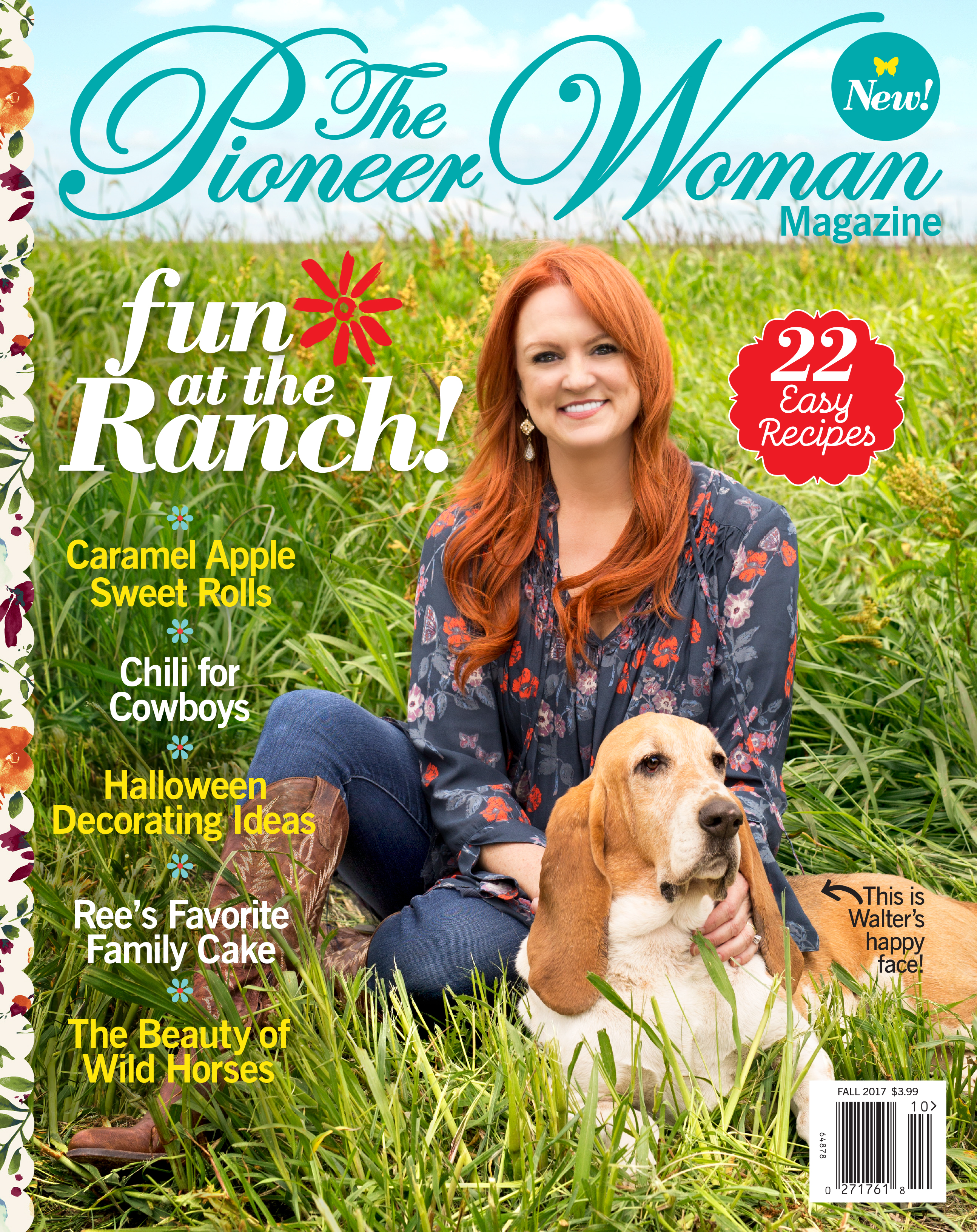 Samir Husni: If I showed up unexpectedly at your home one evening after work, what would I find you doing? Having a glass of wine; reading a magazine; cooking; watching TV; or something else? How do you unwind?
Kate Lewis: Probably working. I’m so bad to admit that. I have two extraordinary kids, but they’re teenagers, so they have a ton of homework. And we have really fun dinners, but I’d say after dinner, you might find us all working.
Samir Husni: What’s the biggest misconception people have about you?
Kate Lewis: I feel like I’m such an open book, that I’m not sure how many misconceptions there are, but that’s maybe just what I think of my own delivery. The biggest misconception about me may be, it’s either one thing or the other, but they’re opposites. It would either be that I’m sophisticated or that I’m basic. And the truth is I’m a combination of both, so I feel like some people see me as being incredibly basic, because I really do understand that mass market audience in the U.S. and I really subscribe to it and I love trashy culture. Probably more than I should. My avatar in social media is Taylor Swift, she’s my favorite person on earth, even though I have never met her. But one can dream.
But on the other hand, as you know, I have this big fancy office and this big fancy job and I think that one assumes that to be in this position you have to be fairly sophisticated.
Samir Husni: My typical last question; what keeps you up at night?
Kate Lewis: My to-do list; again, because I feel quite overwhelmed by the number of people that I want to touch base with and connect with every day. And quality. It goes back to that thing of do we still craft features the way we always did? I think that I have a team that is incredibly good at scale and I think that I have people on my team who are very good at quality. And how do you make sure when you have more people working on scale and less people working on quality that the quality has a voice and a seat at the table.
Samir Husni: Thank you.
You are currently browsing the archives for the News and Views category.