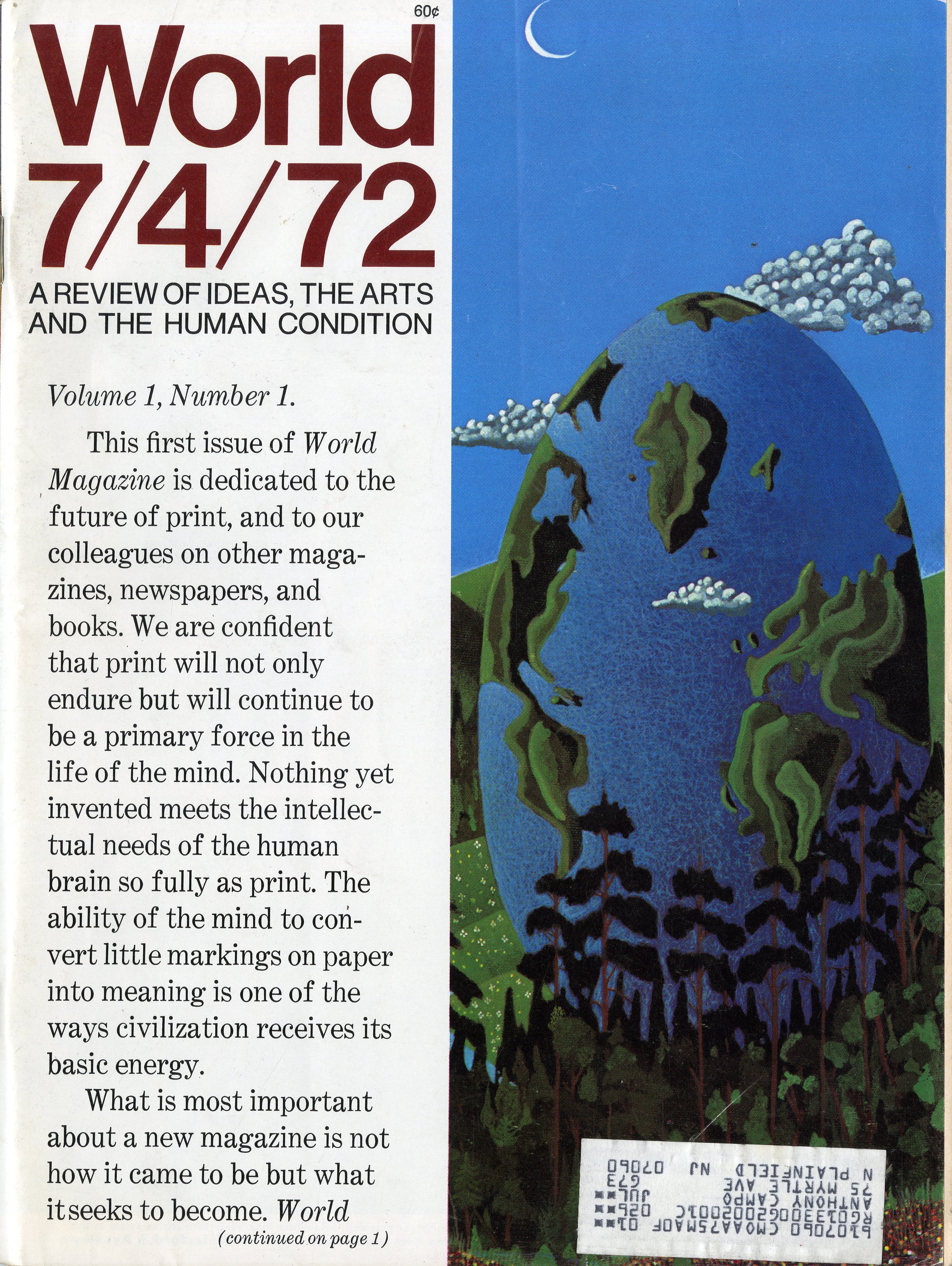
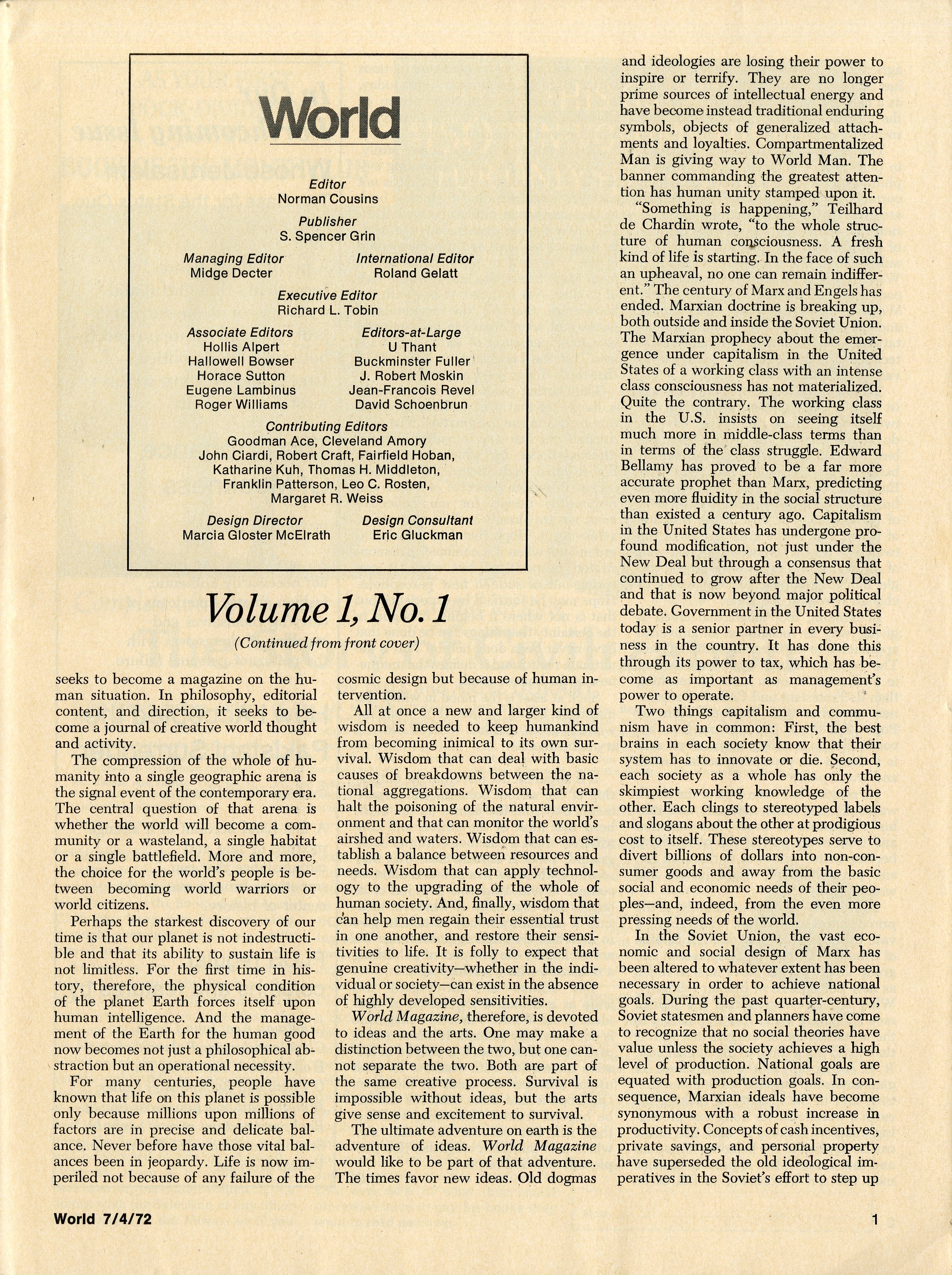
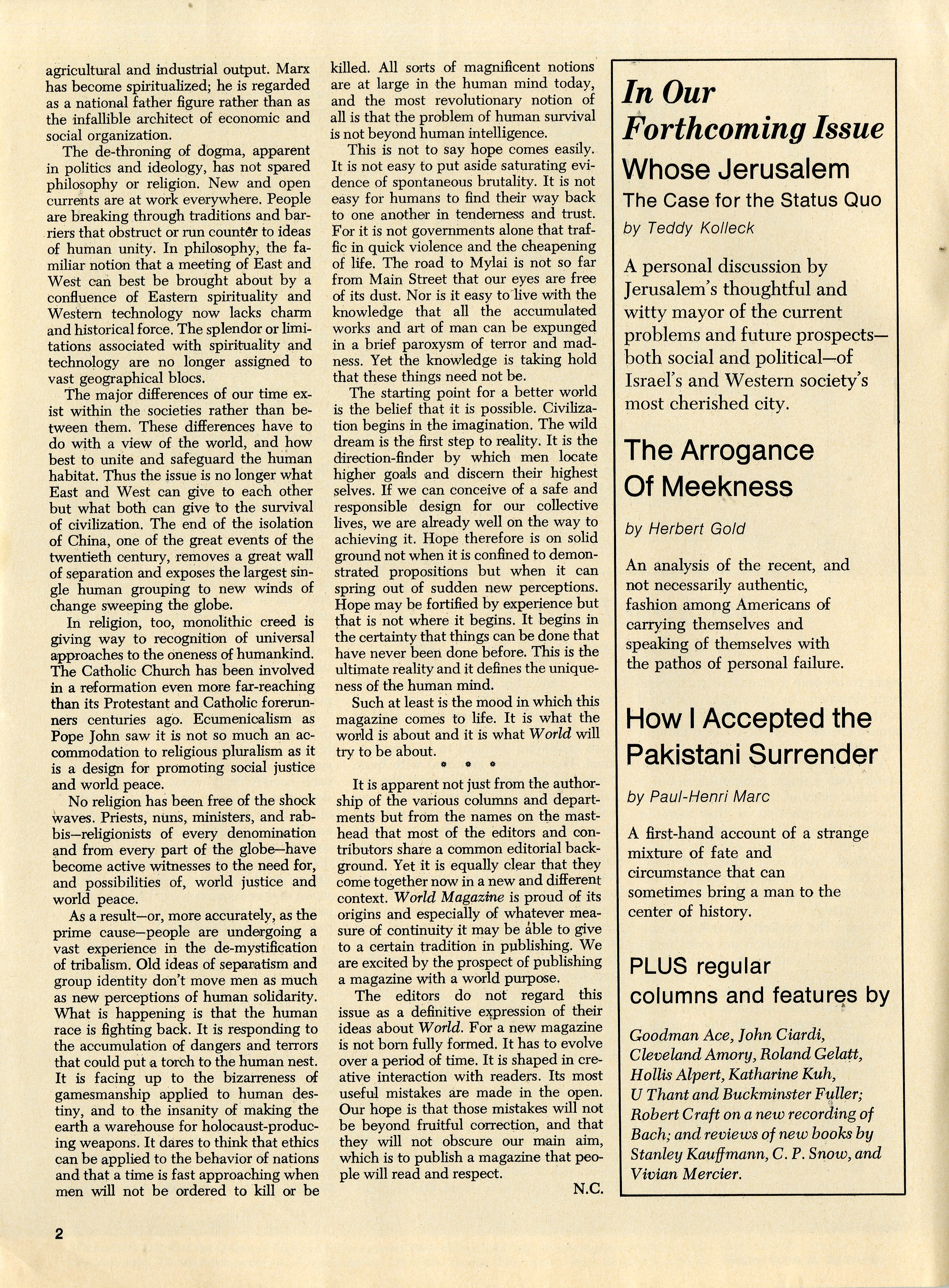
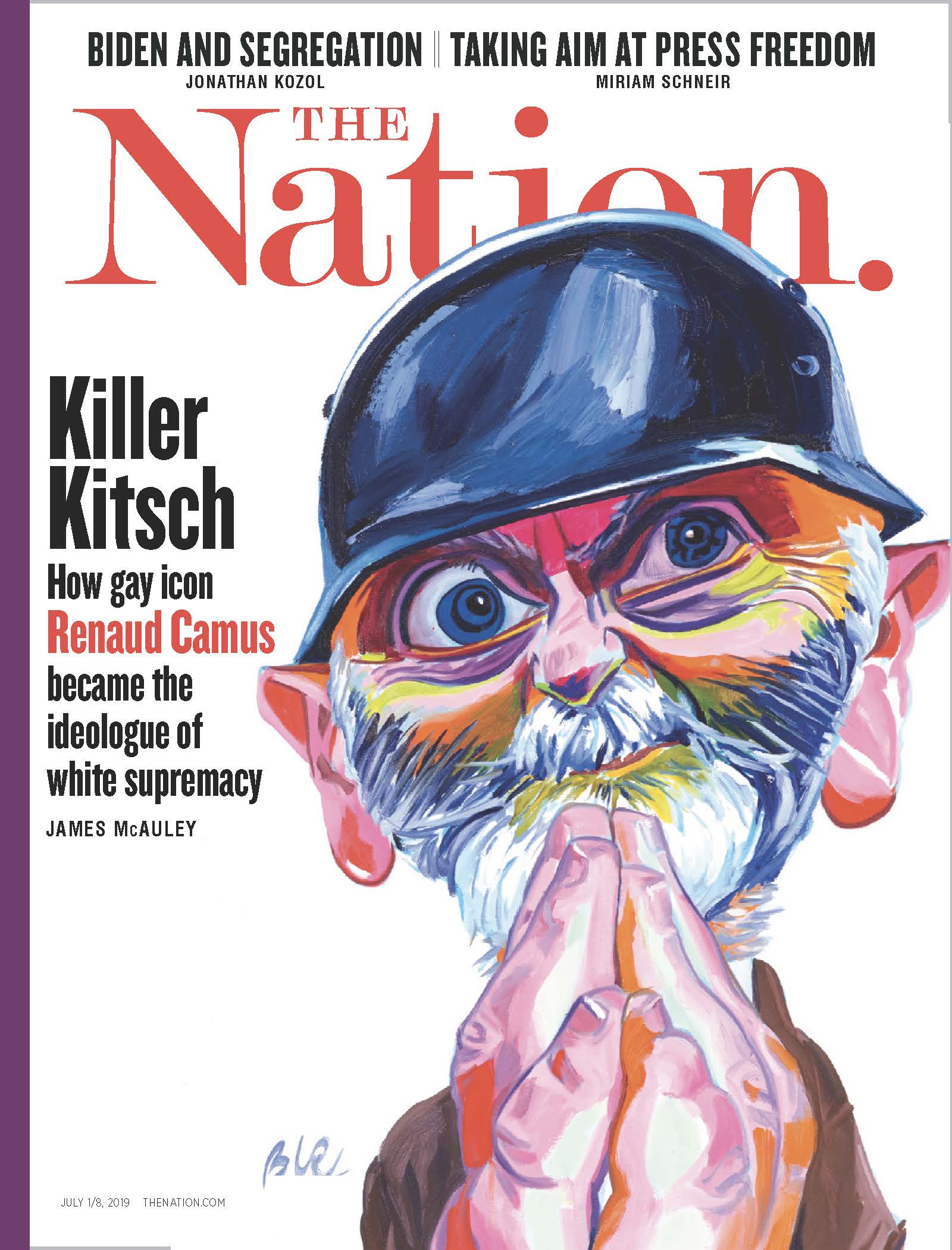
 “I feel that there is a reflectivity; there’s a chance to persuade; there’s a chance to sit with an idea that print gives you that you don’t get anywhere else. But I have to say that I assigned myself the task, and because I’ve been a reporter for 40 years, the way I think about things is to write about them and report them, so I’m in the middle of, I haven’t finished writing a story about the future of print. My tentative findings though is that print is durable and it’s going to be around for a long time.” Don Guttenplan (On what he feels the role of the print edition of The Nation plays today)….
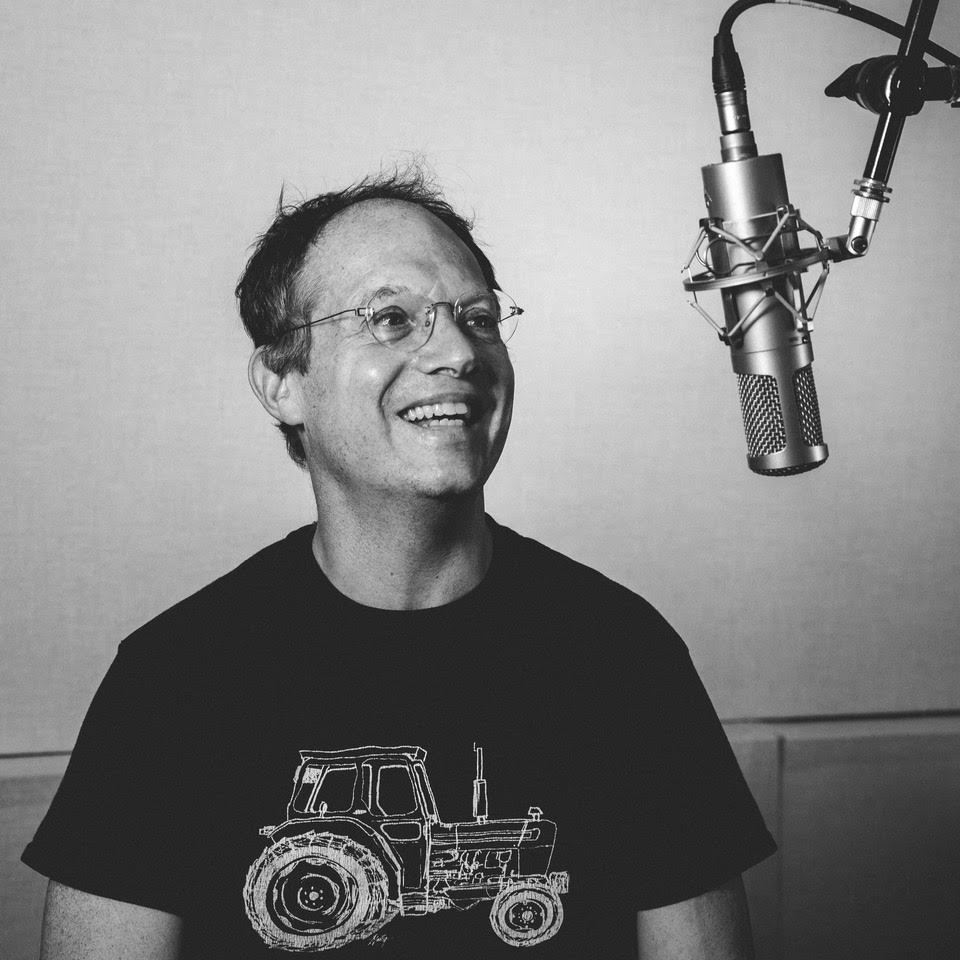
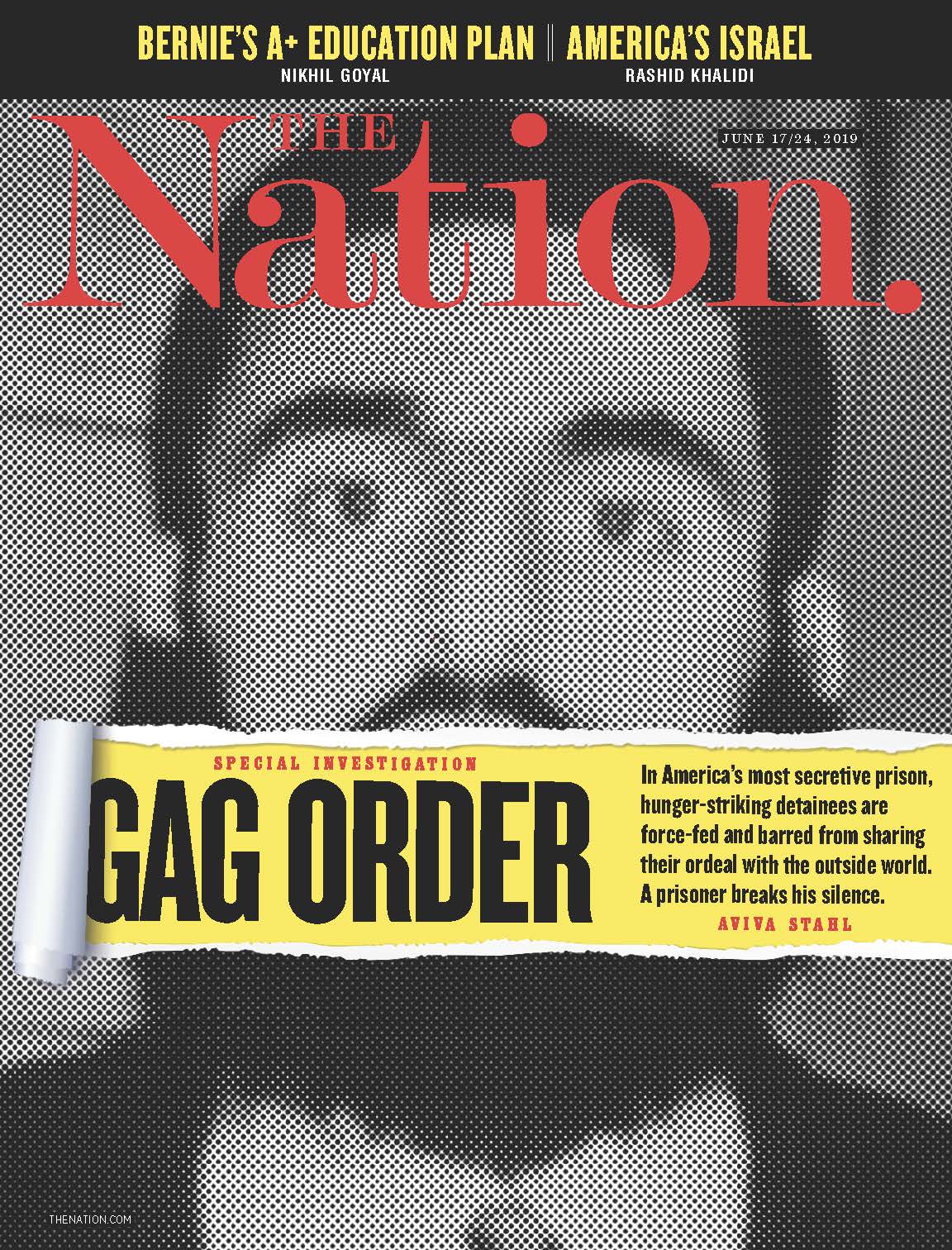
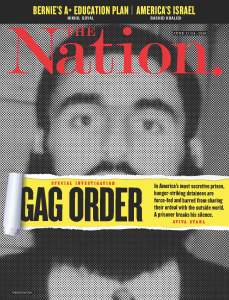
As the oldest continuously published weekly magazine in the United States, The Nation covers progressive political and cultural news, opinion, and analysis. Just recently the magazine named journalist and author Don D. Guttenplan as its editor. Don has a long and robust history with The Nation, having been its London correspondent, not to mention writing the publication’s biography up to the present: “The Nation. A Biography” (The First 150 years). So I think it’s safe to say the man knows a thing or two about his work environment.
I spoke with Don recently and we talked about this legacy publication that according to him has always been a beacon and a voice for progressive ideas. So, bringing his deep sense of The Nation’s history and its democratic politics with him as he moves into his New York office and the magazine’s editor’s chair, Don is ready to go to work.
And his first self-assigned task has been to think about print, the relation of print, and what The Nation is doing in print, because he has often felt that the magazine hadn’t really fully thought that through. Don feels there is a reflectivity with print, a chance to persuade; a chance to sit with an idea that print gives you that you don’t get anywhere else. Needless to say, Mr. Magazine™ would wholeheartedly agree.
Reaching true audience potential with The Nation’s print component, while enjoying a vibrant and alive web presence are two things that are on Don’s radar, as well as consistently bringing a sensibility and an awareness of the role that The Nation plays in the world of political journalism that nobody else plays.
So, I hope that you enjoy the Mr. Magazine™ interview with Don D. Guttenplan, editor of The Nation as he talks about his passion for politics and shares his wealth of knowledge on the subject.
But first the sound bites:
On his relationship with Memphis, Tenn.: My relationship with Memphis is that my parents lived there when I was in high school, so I went to high school there. My father was an itinerant social worker, so he traveled around a lot. When I lived in Memphis I couldn’t wait to leave. I skipped years and scrambled to escape early and went to New York, which was the center of the universe to me then. But I realized fairly soon, first of all that I had been lucky and I had really gotten an excellent education from my public high school in Memphis, Tenn.
On his reaction when he was offered the job of editor of The Nation: I wasn’t expecting him (Trump) to win the election. I was as surprised and devastated as probably anybody else. But I woke up the next morning in my hotel room, because by the time they called the election it was two-something in the morning and I was too tired to feel safe driving down to New York City, so I just checked into a hotel, and I got up and I wrote an editorial which became The Nation’s lead editorial the next day. And the last line of it was: “Welcome to the Fight.” So, I suppose that’s how I felt. That’s what went through my mind when Katrina asked would I take over The Nation. If I’m welcoming other people to the fight, this is really not something that I can duck. To have this platform at this time in our country’s history and to have a platform with the lineage and the leverage of The Nation is both an incredible opportunity and also a heavy responsibility, which does weigh on me and which I take seriously.
On what role he thinks the print edition of The Nation plays with all of the different platforms it exists upon now: That’s the $64,000 question, isn’t it? When Katrina offered me the job and it became clear that I was going to accept it and we were going to find a way to make this happen, because I was in England at the time, the first task that I set myself was to think about print, the relation of print, and what The Nation is doing in print, because I’d often felt and said that we hadn’t really fully thought that through. We’d entered all of these other platforms and we’re enthusiastic on them and have a great website and we have millions of unique readers, so the magazine’s reach and voice is extensive and that’s terrific, but there were some people who felt that print was over and I definitely didn’t feel that. And not just because I love print. My daughter loves print so much that works as a typesetter, so we’re a print-focused family in many ways.
On what he will bring to The Nation’s extensive legacy: I’m glad you mentioned the extensive legacy because, of course, one of the things that I bring to The Nation and I think one of the reasons that Katrina asked me to do this is because I have a deeper sense of The Nation’s history perhaps than anyone since I wrote it. I wrote the book The Nation: A Biography in 2015 for the magazine’s 150th. So I’m quite aware of both the failings and the achievements of my 15 successors in this chair as editor. And I’m quite aware of what The Nation has been over time. And one of the things that has been over time is a voice for progressive ideas, for ideas that move toward a vision of justice, to try and bend the arc of the universe toward justice, whether it was 40 acres and a mule for freed slaves, literacy training for freed slaves, or whether it was workers’ rights. And one of the earlier editors of The Nation was one of the founders of the NAACP. So The Nation has been a voice for progress for a long time. And I think having an awareness of that is important.
On how important he feels journalism is to the future of our country: I don’t think you can have a democracy without a functioning press. I think it’s absolutely crucial and we are actually blessed in America with a really good press, particularly with what were our legacy print publications, such as The New York Times, for example. It’s funny because I worked at the Village Voice for three years and when I worked there, The New York Times was our enemy. Every day we would roll our eyes at some horrible sell-out, commercial, terrible headline or a failure to understand the true politics behind some event. And it’s not that I disavow any of that, but on the other hand I feel we are so lucky in America to have a good daily journal that is a good source of daily news, daily journalism, where the reporters go deep and you can often, not always, but often, you can believe what they print.
On which of his many journalistic skills: writing, editing, reporting, is dearest to his heart: I think they all shape each other. “American Radical,” which is my biography of I. F. Stone , The Nation’s long-time Washington correspondent, and then founder of I. F. Stone’s Weekly, that was a 20 year book. (Laughs) I had been living with that for a long time. And that probably left a pretty deep mark on me. But I took a break in the middle to write “The Holocaust on Trial,” which really wasn’t a book that I wanted to write. I’m Jewish and I’m aware of the Holocaust. My father’s best friend was a Holocaust survivor, but it wasn’t something that I had been immersed in.
On the biggest challenge he could face and how he plans to overcome it: Editorially, I think the challenge is in fact the challenge that any editor faces, which is selection. There is so much happening and there is so much going on and it’s a signal to noise question. How do you filter out what matters? How do you decide? We’re not the Huffington Post or The Intercept. We don’t have an enormous staff or vast, multimillionaire backing. We have an incredibly hardworking, not tiny, it’s not a skeleton staff, we have a very good staff and we have a very large universe of writers who are delighted to write for us. But still we can’t chase everything. We certainly don’t have room in print for everything that we’d like to say, which is one of the reasons why it’s wonderful that we have a website. And it’s so active and so full of interest. But it’s still the question of figuring out what to pay attention to; picking your fights; picking your issues, and focus.
On anything he’d like to add: One of the experiences you have editing a magazine that everybody knows about but not everybody reads, (Laughs) is you’re meeting people who say they used to read The Nation or they used to subscribe to The Nation. And my message to those people is take another a look. We have a new editor; we have new energy; we have I think a really important understanding of our responsibility and we are going to work very hard to live up to that responsibility. I say that not as a sense of duty, but I feel like our responsibility is not just to parse out what’s happening politically and provide cogent and trenchant analysis, which I think we do every week, but also to give people sources of delight and encouragement and energy.
On the biggest misconception he thinks people have about him: I don’t think people have any conception about me because I don’t think that I’m that well-known. I’ve left a very long record, people can look at what I’ve written on all sorts of things. It’s all out there. My views are no secret. I suppose to the extent that there is a conception about me and that it’s a misconception, which I’m not sure either of which is true, I suppose that it’s I’m an entirely political creature. I am passionate about politics, and particularly about “small d- democracy,” but I care a lot about other things too. I care about music and food and all those things. And poetry and the natural world. So, I would say that if there is a misconception of me it’s that I only care about politics.
 On what someone would find him doing if they showed up unexpectedly one evening at his home: That’s a good question because I only moved to New York recently and I still haven’t moved into my apartment. So, you’d catch me cooking for the friends who are putting me up. (Laughs again) If you were to catch me relaxing in the evening, I suppose you’d catch me talking to friends or maybe reading. I read lots of novels. Every night before I go to bed I usually read some of a novel. The problem is if it’s one I can’t put down, it ends up keeping me up too late, so I find I do my literary reading at the end of the day because most of those demand a kind of stillness and thought that I can still muster, but they also don’t keep me awake.
On what keeps him up at night: It’s nice of you to call me Dr. Don and it’s true that I have a Ph.D., but nobody calls me that. What keeps me up at night is my three children. They’re grown up, the youngest is 20. He’s a Jazz musician; my daughter lives in New York and she works in publishing, in small press publishing; and my oldest son is in The Netherlands and he’s a scientist. What keeps me up at night are their trials and tribulations, which like any parent, I think about. I suppose I could say the world we’re leaving to them. I don’t actually think in such grandiose terms really, most of the time. What keeps me up at night is the personal, rather than the political.
And now the lightly edited transcript of the Mr. Magazine™ interview with Don D. Guttenplan, editor, The Nation.
Samir Husni: I see from your bio that you went to Memphis Public Schools.
Don D. Guttenplan: Yes, I did.
Samir Husni: So, what’s the relationship with Memphis?
Don D. Guttenplan: My relationship with Memphis is that my parents lived there when I was in high school, so I went to high school there. My father was an itinerant social worker, so he traveled around a lot. When I lived in Memphis I couldn’t wait to leave. I skipped years and scrambled to escape early and went to New York, which was the center of the universe to me then.
But I realized fairly soon, first of all that I had been lucky and I had really gotten an excellent education from my public high school in Memphis, Tenn. I remember one of my professors at Columbia asking me – I had asked a question about “The Iliad” – and everybody at Columbia where I went to college had to read “The Iliad,” and I had already read it in high school, and she asked me where I did that, where did I go to high school. I told her in Memphis, Tenn. So, people have a lot of stereotypes about the South. One of my college professors used to tease me – he seemed surprised that I came to class wearing shoes. (Laughs)
But I realized that Memphis particularly was a good place to be from, mainly because of the incredibly rich musical culture, which still influences me as a source of delight. “The Waterboy” is playing London and I went to see it a couple of weeks ago, and their keyboard player played a song called “My Soul Is In Memphis, But My Ass Is In Nashville, Tenn.” (Laughs) Memphis is a little bit like that for me. I don’t go back very often; my family moved when I went to college. I went back for my 20th high school reunion and I’m going soon for my 45th. I think I may have been a couple of other times in the intervening years.
I used to say that the Delta was the landscape of my dreams because I often used to dream that I was somewhere in a very flat, very hot landscape with a big river. So, it an effect on me.
Samir Husni: You’re now the new incoming editor of one of the country’s oldest magazines, The Nation.
Don D. Guttenplan: America’s oldest weekly, as we say.
Samir Husni: So tell me, when you were offered the job of editor of America’s oldest weekly, what was your first reaction?
Don D. Guttenplan: Well, it was a conversation that we’d been having for a long time. My predecessor, Katrina vanden Heuvel, was editor for 25 years and she is now the editorial director and remains as publisher. And 25 years is a long time, and I think she was looking for someone to hand off to, that’s her side of it. And my side of it is, on November 9 or 10th, 2016, whatever the day was after the election, I had spent election night in upstate New York watching Zephyr Teachout lose her congressional race, basically. And I remember saying to the office that I was going to Zephyr’s headquarters because she’s probably not going to win, but if she does win it’ll be really interesting because I think she’s a significant thinker and activist and somebody who if her voice came into Congress it would be amazing. And I added, besides if she loses I have plenty of time to get down to Times Square to see Trump’s concession speech. (Laughs)
Although, I will say that I was one of the few journalists early on to say that we needed to take the possibility of Trump’s winning seriously. And if you look it up, in September 2015 at the very first Republican debate, that was the debate where they had the kid’s table and the grownup’s table because they had so many candidates, that was held in Cleveland, I wrote that there was nobody on that stage who could beat Trump, because that’s what I thought. That was also the debate where the moderator said that if there was someone who didn’t promise to support the eventual Republican nominee, hold up your hand. And Trump held up his hand. And I thought surely they would find a way to exclude him from the primaries. But I underestimated the venality of the Republican Party. (Laughs) As a candidate, he was potentially much more skillful than anyone else I saw that evening.
But anyway, I wasn’t expecting him to win the election. I was as surprised and devastated as probably anybody else. But I woke up the next morning in my hotel room, because by the time they called the election it was two-something in the morning and I was too tired to feel safe driving down to New York City, so I just checked into a hotel, and I got up and I wrote an editorial which became The Nation’s lead editorial the next day. And the last line of it was: “Welcome to the Fight.”
So, I suppose that’s how I felt. That’s what went through my mind when Katrina asked would I take over The Nation. If I’m welcoming other people to the fight, this is really not something that I can duck. To have this platform at this time in our country’s history and to have a platform with the lineage and the leverage of The Nation is both an incredible opportunity and also a heavy responsibility, which does weigh on me and which I take seriously.
Samir Husni: As you look forward, weeklies in print have struggled. What role do you think the print edition of The Nation plays with all of the different platforms it now exists upon?
Don D. Guttenplan: (Laughs) That’s the $64,000 question, isn’t it? When Katrina offered me the job and it became clear that I was going to accept it and we were going to find a way to make this happen, because I was in England at the time, the first task that I set myself was to think about print, the relation of print, and what The Nation is doing in print, because I’d often felt and said that we hadn’t really fully thought that through.
We’d entered all of these other platforms and we’re enthusiastic on them and have a great website and we have millions of unique readers, so the magazine’s reach and voice is extensive and that’s terrific, but there were some people who felt that print was over and I definitely didn’t feel that. And not just because I love print. My daughter loves print so much that works as a typesetter, so we’re a print-focused family in many ways.
But I also feel that there is a reflectivity; there’s a chance to persuade; there’s a chance to sit with an idea that print gives you that you don’t get anywhere else. But I have to say that I assigned myself the task, and because I’ve been a reporter for 40 years, the way I think about things is to write about them and report them, so I’m in the middle of, I haven’t finished writing a story about the future of print. My tentative findings though is that print is durable and it’s going to be around for a long time. And it does things that you can’t do online. And not just that you can’t read it in the bathroom.
It’s a much better place for intellectual debate; it’s a much better place to try and persuade someone; it’s a much better place to hear somebody’s voice. On the other hand, it’s a much worse place to break news. It’s a much worse place to be right-up-to-the-minute. I will confess to having an addiction to reading a newspaper in the morning with my coffee. I was paying a lot of money to The Guardian, when I was in London, to have it delivered every morning and I would be terribly upset on the few mornings that the delivery service would fail and it wouldn’t be there because I really like spreading out a newspaper and reading it while I’m having my coffee. But that’s a generational thing and I don’t actually know whether that will persist.
I don’t know whether younger people will want to get their news from dead trees that leave ink stains on their hands. I do and I love it and I love everything about it. I love the headlines, the feel of the paper, the smell of the ink, all of that. But that may not be the future of print. In fact, the first person that I knew I wanted to interview was Katharine Viner, who is the editor of The Guardian and an old friend, and who has thought about journalism, print, and the Web more deeply than anybody else I know. And she had lots of interesting things to say about that, which you’ll have to read my piece when I finish it to find out. (Laughs)
But in terms of magazines, I hadn’t seen your slogan until recently, if it’s not in print, it’s not a magazine, I am with you on that.
Samir Husni: What’s your vision for The Nation is this new century? Everyone says that we live in a digital age and no one can argue with that, but what will you bring to The Nation’s extensive legacy?
Don. D. Guttenplan: I’m glad you mentioned the extensive legacy because, of course, one of the things that I bring to The Nation and I think one of the reasons that Katrina asked me to do this is because I have a deeper sense of The Nation’s history perhaps than anyone since I wrote it. I wrote the book The Nation: A Biography in 2015 for the magazine’s 150th. So I’m quite aware of both the failings and the achievements of my 15 successors in this chair as editor. And I’m quite aware of what The Nation has been over time.
And one of the things that has been over time is a voice for progressive ideas, for ideas that move toward a vision of justice, to try and bend the arc of the universe toward justice, whether it was 40 acres and a mule for freed slaves, literacy training for freed slaves, or whether it was workers’ rights. And one of the earlier editors of The Nation was one of the founders of the NAACP. So The Nation has been a voice for progress for a long time. And I think having an awareness of that is important.
I don’t really mean to dis another publication, but I remember there was a period where The New Republic was abandoning print and they were calling themselves a multimedia platform, because they were bought by this guy that was a former Facebook founder. And I thought, that’s not what you do with a legacy like that. You don’t just write it off, so I’m not going to write off our legacy.
But I think what I bring to the job aside from its sense of history are two things. One is sensibility and that sensibility is an awareness that the role that The Nation plays that nobody else plays, and nobody else has played since The New Republic started its leaning toward the right under Marty Peretz, which was a long time ago, is we are the place where liberals and radicals argue with each other and where they meet and contest ideas.
We are the place that exposes liberals to radical ideas and we are the place that exposes radicals to a, maybe a sort of tempering, of their passions that define liberal thought or the awareness of complexity that maybe liberals would say keeps them from being radicals. We are the space where those Venn diagrams overlap. And I think that’s a really important function on both sides. There is no progress without radicals, and on the other hand in democracy, which I am deeply committed to, you don’t make change without convincing the majority. And the majority by definition are never going to be radicals. It’s that process; it’s that, to use the outdated but to me essential term, it’s that dialectic that defines one of The Nation’s most important rules. So, I think I bring an awareness of and a sympathy for both sides of that dialectic that is going to be useful.
And the other thing is that although I’m an election junkie and it says so on my Twitter profile (Laughs), and I’ve been involved in politics for a long time and I’ve been involved in journalism and daily journalism from New York Newsday to the International Herald Tribune, those are not the limits of what interests me. I shipped 82 orders of books from London to my office here, to mostly put on the shelves in my office. And a lot of them were poetry.
The idea that magazine editors have a vision, some of them do and maybe that’s a good thing, but I’m not sure that I have a vision. I have a sensibility and I have some things that I want to do. I feel like we have a lot of work to do, both at this magazine and in this country. And I’m going to put my shoulder to that work, but in doing so, I want our readers to have a lot more pleasure from the experience reading The Nation. And for it to be a source of regular surprise and delight to them. That’s something that is easy for us to neglect in the kind of grim slog of exposing Trump’s daily depredations, which is a very important part of what we do.
But I don’t want that to be the limit of what we do. And I think that’s both a sensibility question and also maybe a political question. I’m very fond of quoting, and it made a big impression on me, the founder of Breitbart’s dictum, that politics is downstream of culture. I think that’s really true. One of the things that has happened in America is that the right has understood that. And understood it in a much deeper way than we have on the left.
At The Nation, we’ve always had an incredibly stimulating, engaging and penetrating back of the book, which in some ways has also been traditionally independent of the front of the book, but I want to break that wall down a little bit and have more room for culture up front as well as in the back.
Samir Husni: Talking about culture, journalism and democracy, in today’s society is journalism still necessary for the survival of democracy or are we seeing true journalism fading away and giving place to fake news and alternative facts? How important is journalism to the future of this country?
Don. D. Guttenplan: I don’t think you can have a democracy without a functioning press. I think it’s absolutely crucial and we are actually blessed in America with a really good press, particularly with what were our legacy print publications, such as The New York Times, for example. It’s funny because I worked at the Village Voice for three years and when I worked there, The New York Times was our enemy. Every day we would roll our eyes at some horrible sell-out, commercial, terrible headline or a failure to understand the true politics behind some event.
And it’s not that I disavow any of that, but on the other hand I feel we are so lucky in America to have a good daily journal that is a good source of daily news, daily journalism, where the reporters go deep and you can often, not always, but often, you can believe what they print. (Laughs) I spent 20 years living in Europe, where all you have except for maybe the Financial Times is a partisan press. And you have to filter everything through the ideological filter of the paper.
I understand that centrism and objectivity are all ideological filters of their own, and I understand that there are things that you exclude by them that are maybe essential to the conversation and that The Nation needs to restore and to lift that into the spotlight, but still there is an awful lot that is reported and that you can know if you want to just by reading the papers in America. And I think that’s a great thing.
But I also think that it’s tricky, because part of Trump’s strategy is to attack the press and to devalue the press and to basically convince his listeners that they’re all crooked, they’re all as bad as each other. That Fox News is not an outlier, but is what all journalism is, it’s just that on Fox maybe it’s more obvious from one side. And I hate that. It’s one of the things that I hate about television news, this increasing sense of polarization.
And also the increasing sense that you can pretty much say anything because nobody is going to check. We at The Nation, we fact check what we run. You can’t do that in a daily newspaper, but then when I worked in daily journalism it was definitely widely understood that if you got it wrong more than a couple of times you were going to get fired. (Laughs) So, it had its own powerful fact check.
This is sort of a looping answer to your question, but I think journalism is essential and I think that the kind of journalism that The Nation does has become much more important even than it was in say, the George W. Bush era when we were alone and lonely and the brave voice of sanity.
Samir Husni: You’re an author, you have a few books under your belt; you’re an editor and you’ve been a correspondent; you’ve worked with big, major newspapers and smaller newspapers; from all of these manifestations of your journalistic skills, what is dearest to your heart? Is it being an author, an editor, or is it the last job that you’re doing?
Don. D. Guttenplan: I think they all shape each other. “American Radical,” which is my biography of I. F. Stone , The Nation’s long-time Washington correspondent, and then founder of I. F. Stone’s Weekly, that was a 20 year book. (Laughs) I had been living with that for a long time. And that probably left a pretty deep mark on me. But I took a break in the middle to write “The Holocaust on Trial,” which really wasn’t a book that I wanted to write. I’m Jewish and I’m aware of the Holocaust. My father’s best friend was a Holocaust survivor, but it wasn’t something that I had been immersed in.
What attracted me to it was my interest in British libel laws and because the libel laws in Britain are different. In America the burden of truth is on the person who is suing, the claimant. In Britain the burden of proof is on the defendant. Rich people and powerful interests use British courts to suppress information that they want to suppress. And it was in the course of being interested in that this trial came to my attention and I ended up writing a book about it.
In writing the Stone biography, I spent a lot of time reading the newspaper that Stone wrote for in the 1940s, which was called “PM.” And I don’t know if you know very much about it, but it was really a very revolutionary thing for print in America. It was a very intelligent left wing tabloid. It revolutionized the way papers looked, because it had, for example, Margaret Bourke-White as a photographer. It had Dr. Seuss as a cartoonist; it had a childcare advice columnist named Benjamin Spock, and it had I.F. Stone as its Washington correspondent.
The manifesto of the paper was written by its publisher and founder, a guy called Ralph Ingersoll. And it was “We don’t like people who push other people around.” And I feel like that’s kind of a thread that runs through pretty much everything I’ve written: how do you deal with people who push other people around and how do societies organize themselves; how can people who have been pushed around defend themselves the way the defendant in “The Holocaust on Trial” defended herself.
And it’s not just because it was my last book, it is in some ways the thing that is most pertinent to, certainly, my sense of politics, which is my most recent book, “The Next Republic,” which is partly a series of hysterical essays about what you might call the Rise of the Populist Left in America, which is something we don’t hear very much about these days. And also a series of profiles of activists from organized labor, from racial justice, from the environmental movement, and the last chapter is about Zephyr Teachout, which is about monopolies and corporations and how to control huge corporations. So it’s essentially about people fighting back and doing it successfully. And whether you can build a political movement out of that. It’s an open question, but it’s a question that I certainly want to lend my support to as editor of The Nation.
Samir Husni: As you look at this new position and contemplate the future, what do you think will be the biggest challenge that you’re going to face and how do you plan to overcome it?
Don. D. Guttenplan: There are lots of challenges. There are business challenges and I’m not the business side, that’s the publisher and the president’s side. But I’ve been in this business long enough to know that you can’t ignore that and you can’t not pay attention to it. So, I think one big challenge is to ensure that the magazine flourishes. That we reach our full print audience potential of paying subscribers and that they’re happy to pay what it costs to keep The Nation in business. That’s a business challenge.
Editorially, I think the challenge is in fact the challenge that any editor faces, which is selection. There is so much happening and there is so much going on and it’s a signal to noise question. How do you filter out what matters? How do you decide? We’re not the Huffington Post or The Intercept. We don’t have an enormous staff or vast, multimillionaire backing. We have an incredibly hardworking, not tiny, it’s not a skeleton staff, we have a very good staff and we have a very large universe of writers who are delighted to write for us.
But still we can’t chase everything. We certainly don’t have room in print for everything that we’d like to say, which is one of the reasons why it’s wonderful that we have a website. And it’s so active and so full of interest. But it’s still the question of figuring out what to pay attention to; picking your fights; picking your issues, and focus.
I read a piece earlier on in the Trump administration about chaff, I don’t know if you saw it. Chaff was the term the British used for their defense against missiles and bombing during World War II. And it was essentially we’re using thousands and thousands of little pieces of metal, sort of like aluminum foil in order to deflect and confuse radar. It’s a radar defense tactic. And I was saying that’s kind of Trump’s tactic, that he says all of this stuff all the time and sometimes he means it and sometimes he doesn’t. Sometimes he just says it. And if we spend all of our time tracking that, then we’re going to be exhausted and demoralized and we’re not going to have any time to think strategically.
So, I guess my biggest challenge is figuring out what really matters. And that’s not my personal biggest challenge, it’s the biggest challenge of any editor in this environment.
Samir Husni: Is there anything else you’d like to add?
Don. D. Guttenplan: One of the experiences you have editing a magazine that everybody knows about but not everybody reads, (Laughs) is you’re meeting people who say they used to read The Nation or they used to subscribe to The Nation. And my message to those people is take another a look. We have a new editor; we have new energy; we have I think a really important understanding of our responsibility and we are going to work very hard to live up to that responsibility. I say that not as a sense of duty, but I feel like our responsibility is not just to parse out what’s happening politically and provide cogent and trenchant analysis, which I think we do every week, but also to give people sources of delight and encouragement and energy.
There’s a wonderful book and all I’m going to do is nod to the title. The book is about the cultural survival of Native Americans and their culture, but it’s called “Radical Hope” by Jonathan Lear. It’s an amazing book, but my point is that I feel that’s one of the things that we have to offer people, radical hope.
Our columnist, who is also a Guardian columnist and also a friend of mine, Gary Young, said about my book, which is called “The Next Republic,” he said it’s optimistic but not delusional. And I feel like that’s the space that I want to be in. Optimistic, but not delusional. It’s very easy for anybody who is engaged in political struggle to kid themselves and spend a lot of time just reinforcing their own prejudices and preconceptions. We’re not going to do that. We are going to tell people the truth and we are going to believe in the radical power that comes from telling people the truth.
Samir Husni: What’s the biggest misconception you think people have about you?
Don. D. Guttenplan: (Laughs) I don’t think people have any conception about me because I don’t think that I’m that well-known. I’ve left a very long record, people can look at what I’ve written on all sorts of things. It’s all out there. My views are no secret. I suppose to the extent that there is a conception about me and that it’s a misconception, which I’m not sure either of which is true, I suppose that it’s I’m an entirely political creature. I am passionate about politics, and particularly about “small d- democracy,” but I care a lot about other things too. I care about music and food and all those things. And poetry and the natural world. So, I would say that if there is a misconception of me it’s that I only care about politics.
Samir Husni: If I showed up unexpectedly at your home one evening after work, what would I find you doing? Having a glass of wine; reading a magazine; cooking; watching TV; or something else? How do you unwind?
Don. D. Guttenplan: (Laughs) That’s a good question because I only moved to New York recently and I still haven’t moved into my apartment. So, you’d catch me cooking for the friends who are putting me up. (Laughs again) If you were to catch me relaxing in the evening, I suppose you’d catch me talking to friends or maybe reading. I read lots of novels. Every night before I go to bed I usually read some of a novel. The problem is if it’s one I can’t put down, it ends up keeping me up too late, so I find I do my literary reading at the end of the day because most of those demand a kind of stillness and thought that I can still muster, but they also don’t keep me awake.
Samir Husni: My typical last question; what keeps Dr. Don up at night?
Don. D. Guttenplan: (Laughs) It’s nice of you to call me Dr. Don and it’s true that I have a Ph.D., but nobody calls me that. What keeps me up at night is my three children. They’re grown up, the youngest is 20. He’s a Jazz musician; my daughter lives in New York and she works in publishing, in small press publishing; and my oldest son is in The Netherlands and he’s a scientist. What keeps me up at night are their trials and tribulations, which like any parent, I think about. I suppose I could say the world we’re leaving to them. I don’t actually think in such grandiose terms really, most of the time. What keeps me up at night is the personal, rather than the political.
Samir Husni: Thank you.

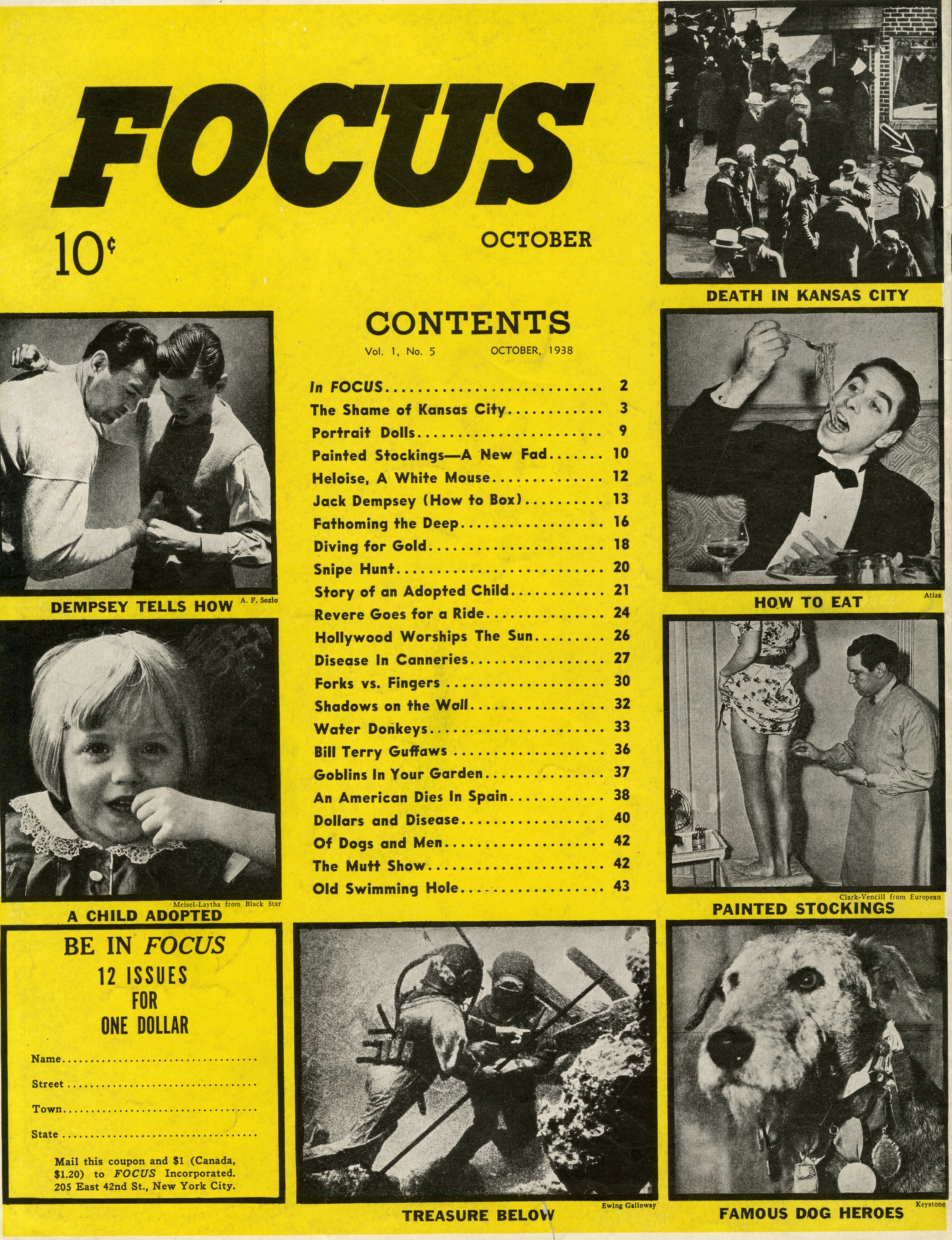
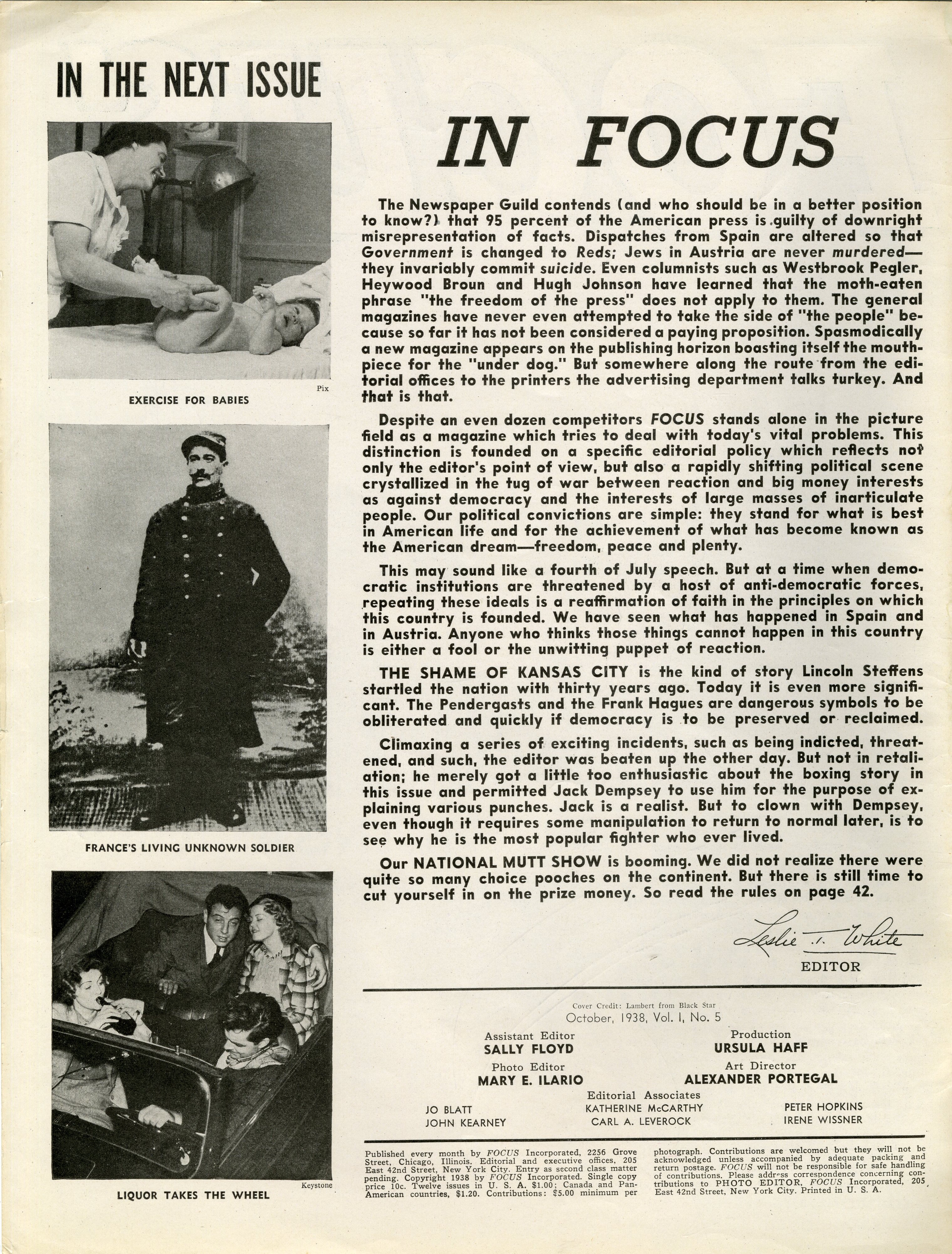
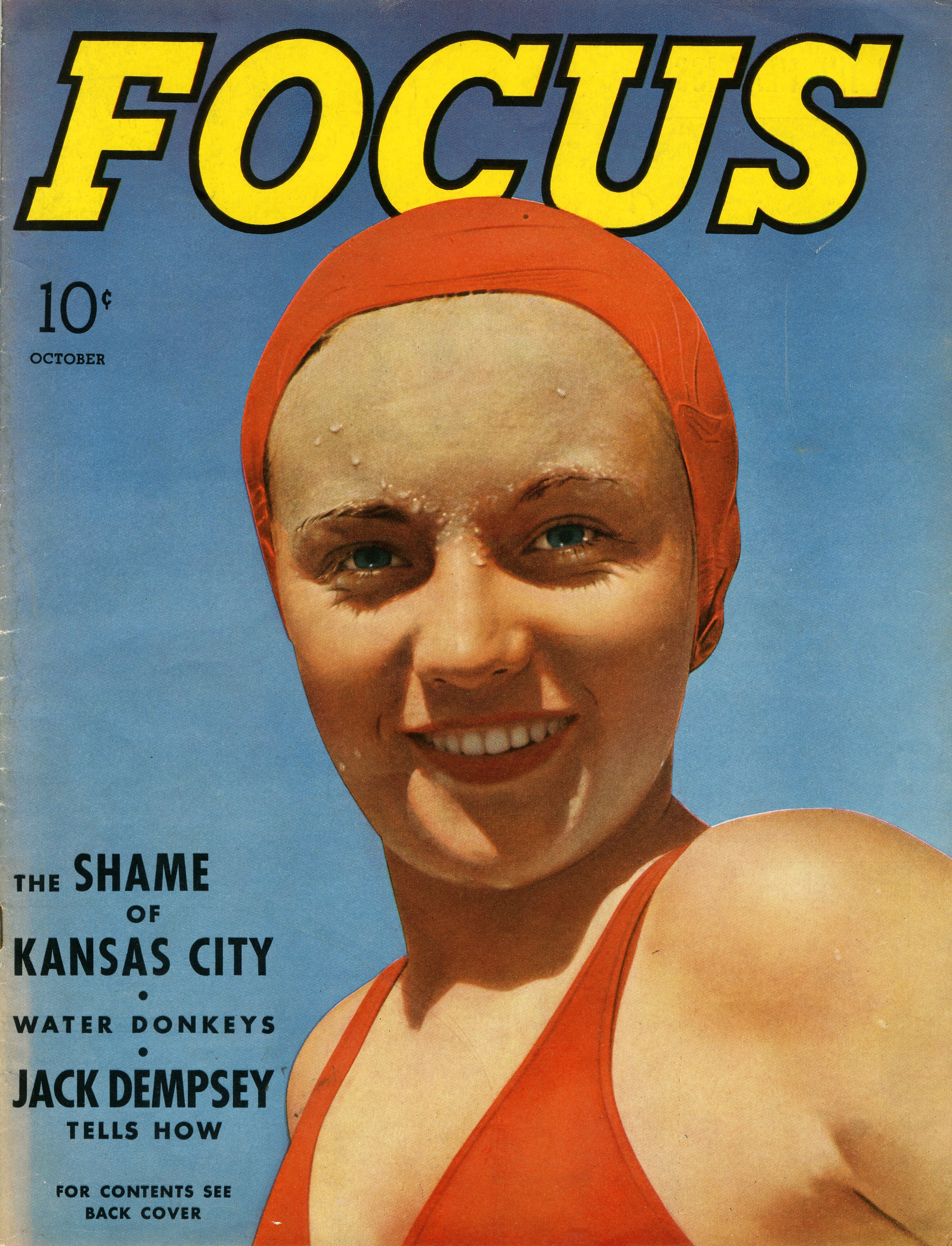 Our current president’s repeated remarks that today’s press grinds out “fake facts” is really nothing new. For generations the American press has been accused of producing biased information – we’ve all heard the phrase “Freedom of the Press belongs to those who own the Press.” That being said, Mr. Magazine™ delved into his Classics Vault and brought up the October 1938 issue of Focus magazine. The editor’s letter centered on a contention made by the Newspaper Guild that 95 percent of the American press, at that time in journalistic history, were guilty of misrepresentation of facts, reporting on the statement that Jews in Austria were never murdered, they committed suicide and that the dispatches from the Government in Spain altered and changed to read “Reds” when written about.
Despite an even dozen competitors Focus stands alone in the picture field as a magazine which tries to deal with today’s vital problems. This distinction is founded on a specific editorial policy which reflects not only the editor’s point of view, but also a rapidly shifting political scene crystallized in the tug of war between reaction and big money interests as against democracy and the interests of large masses of inarticulate people. Our political convictions are simple: they stand for what is best in American life and for the achievement of what has become known as the American dream – freedom, peace and plenty.
Climaxing a series of exciting incidents, such as being indicted, threatened, and such, the editor was beaten up the other day. But not in retaliation; he merely got a little too enthusiastic about the boxing story in this issue and permitted Jack Dempsey to use him for the purpose of explaining various punches. Jack is a realist. But to clown with Dempsey, even though it requires some manipulation to return to normal later, is to see why he is the most popular fighter who ever lived.