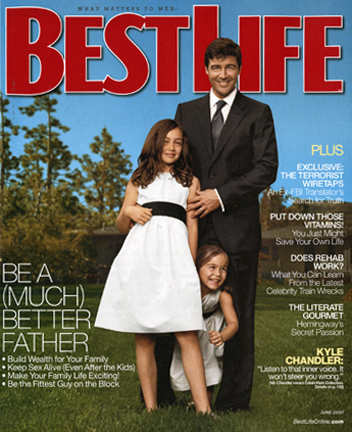
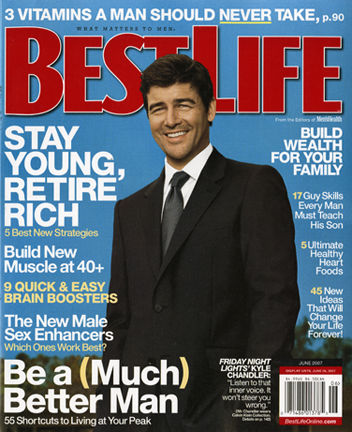
Remember Redbook and how they change the word sex from the newsstand covers to the word love on the subscriptions cover, well Best Life magazine does something similar every father’s day issue (the June issue). This month Kyle Chandler, of Friday Night Lights fame, is the cover subject of Best Life. On the newsstands he shares the cover with no one and the type screams “Be a (Much) Better Man.” No such screaming on the subscribers’ cover, but Kyle is pictured with his two daughters on the cover and the cover line whispers, “Be a (Much) Better Father.” So the question of the day is: do single men buy more magazines on the newsstand than married men with children? If you answer no, why then Best Life treat “man with children” as if they have newsstand leprosy? Just checking!

Subscriber = Father, Newsstand = Man, but both are Best Life
May 30, 2007Is SEX making a come back on magazine covers?
May 29, 2007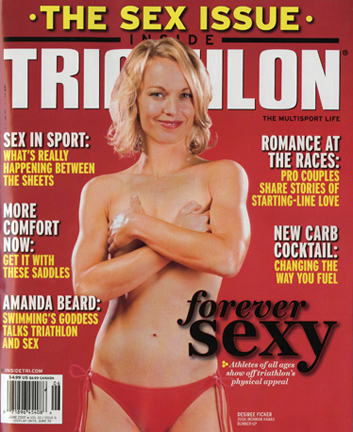
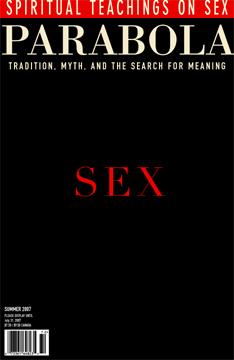
So it seems. You expect to see the three-letter word on the covers of Cosmo and Maxim, but how about on the covers of Inside Triathlon and Parabola. The first is a magazine dealing with biking, running and swimming. Yes, you’ve guessed it, sex is not one of the three sports, yet the magazine offers its readers “The Sex Issue” making good on its tagline promise “The Multisport life.” Moving one step further, from the physical to the spiritual, the second magazine Parabola, with a less, much less revealing cover offers the readers its SEX issue dealing with the “Spiritual Teachings on Sex.” Grab both magazines and you have it made both physically and spiritually. Who can ask for more? Definitely not the editors at Texas Monthly.
When a Single Mother is not a Single Mother (Hot and New this Week, take 8)
May 28, 2007Once a week, I highlight three new magazines on my web site Mr.Magazine™. This week the three new magazines are American Driver, Single Mother and Ty Pennington At Home. Read here about these new launches. To be considered for review on my web site, please send a copy of your first issue to Samir “Mr. Magazine™” Husni, Department of Journalism, The University of Mississippi, University, MS 38677.
Newspaper industry: bloated, lazy and arrogant
May 28, 2007
Those are the exact words Will Lewis, editor of the British Daily Telegraph used to describe the current status of the newspaper industry. “If the newspaper industry took a beating, it deserved one. It took readers for granted and continued to make assumptions about them that no longer held true,” he added according to an article by Matt Wells in The Guardian newspaper. However there is hope for the newspapers, if and only if, they listen to Mr. Lewis’ advice, or anyone’s advice for that matter. “The tough times of the past few years have been very useful in many ways. We now know as an industry what we are not good at, be it IT, distribution, customer service. We also have extreme clarity about what we are good at – the story,” Mr Lewis said. Read Matt Well’s article here.
Wallpaper* reaches a milestone, but…
May 26, 2007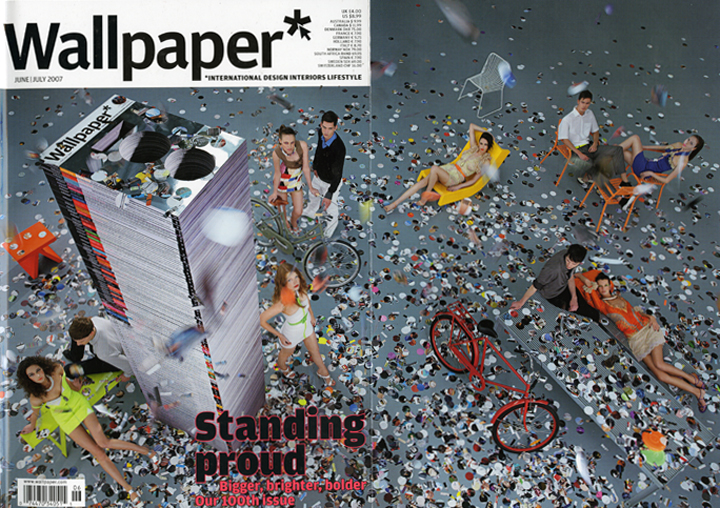
First things first. I do agree with the intro to the 100th issue of Wallpaper* magazine. The editors wrote in the June/July issue of Wallpaper*, “All great magazines shift, shuffle, find space and re-shape to survive and prosper and Wallpaper* is no exception.” Well, that is where my agreement with the editors end. The cover promises a Wallpaper* “Standing proud, Bigger, brighter, bolder…” and it is indeed standing tall, but bigger, brighter and bolder is a little of a stretch. I remember Wallpaper* when it launched. I remember buying not one, but two copies of the first issue. The magazine was indeed standing proud, bigger, brighter and bolder. But in the last two to three years the issues of the magazine have been “hit and miss.” No longer the magazine that introduced cutting edge design to the 90s and beyond. Most of the issues became “yet another magazine issue.” The 100th issue is a step in the right direction. Maybe a dose of memory (a great free poster of all 100 covers is included with this issue) will help the shift in direction and every issue starting with this one will be a hit. I am looking for my Wallpaper*, please bring my Wallpaper* back.
Nico is the magazine, Interviews and Fashion are the subject matter
May 25, 2007
A welcomed surprise arrived in my mailbox today. The first international issue of Nico magazine published by my friend Mike Koedinger of Colophon 2007 and the We Love Magazines conference in Luxembourg. Mike and his Fashion Editor Angelina A. Rafii wrote the intro to the first issue. In it they wrote, “Some say that the best thing about magazines is creating them…The result is a 252-page magazine that will be distributed all over Europe and exported to Australia, South Africa, USA, Tokyo and Hong Kong… The reason why we’ve created this bi-annual is simple: we deeply love magazines. We still get excited discovering new titles, flipping through their endless pages and reading the features. This is our contribution to your excitement. Enjoy!” Well my friend, the excitement spills all over the pages and the love is evident in every page. Mike, I know you love magazines and so does Andrew Losowsky; Angelo Cirimele; Samir Husni (that’s me); Jeremy Leslie; Horst Moser; and David Renard. Thanks for giving us space in your first issue of Nico to share the love. To get your copy of the first issue click here.
Thinking outside the box: Canada’s 2 magazine
May 24, 2007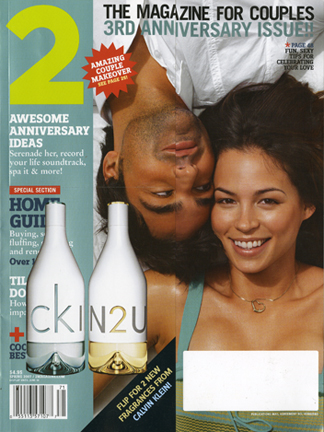
Neil Morton, editor-in-chief and associate publisher of 2 magazine (the one from up north and not the U.S. [2] magazine, click here to refresh your memory) expanded a little bit on what I wrote about their usage of ads on the cover flap. He expalined to me via e-mail their cover flap program. Here it goes, “Yes, we’re one of only (few) magazines to my knowledge doing this in North America. Advertisers have loved it; aside from CK on current cover, we’ve had RBC (Royal Bank of Canada), Lipton Tea and FujiFilm, and an insurance company next issue. We’re trying to think outside the box, offer advertisers more creative ways to engage readers in magazines. We also do product integration promotions in the mag, including a popular Couple Makeover each issue — and we’ve recently introduced a web TV version of that.” They are indeed thinking outside of the box.
LA has its Fashion, and Hot Wheels have their magazine (Hot and New this Week, take 7)
May 23, 2007Once a week, I highlight three new magazines on my web site Mr.Magazine™. This week the three new magazines are Fashion LA, Hot Wheels and The Sopranos. Read here about these new launches. To be considered for review on my web site, please send a copy of your first issue to Samir “Mr. Magazine™” Husni, Department of Journalism, The University of Mississippi, University, MS 38677.
Better Covers and 9 other great commandments from Evan Smith, editor of Texas Monthly
May 21, 2007
“Why Content Drives Our Future as a Business,” was the title of the speech that Evan Smith, editor of Texas Monthly magazine, gave this afternoon at Morris Communications Company in Augusta, GA. Evan joined Texas Monthly 15 years ago and ascended to the editor’s job seven years ago. I met Evan for the first time in the early 90s. He was a student of my friend Abe Peck at the Medill School of Journalism at Northwestern. He impressed me then and he continues to impress me now. He was able to make a good magazine great and continues to do so. In his speech he gave the 10 elements that matter to create a great magazine. Here they are, in the order he presented them.
1. Better covers
2. Compelling storytelling
3. Public interest journalism
4. Great profiles
5. Provocative essays
6. The very best service journalism
7. Non-traditional narratives
8. Nerve
9. Humor, and
10. Self-awareness
If you want to understand fully the meaning and the implementation of the above, pick up a copy of Texas Monthly and it will be all clear to you. Yes, I said pick up a copy, any copy and you will not go wrong. Evan Smith has the passion for the industry and for the magazine he edits, and it shows. If we have more of the likes of Evan Smith, our industry will be in great hands. Thank you Evan, on a job well done.
A transparent Wired with not so transparent audience
May 20, 2007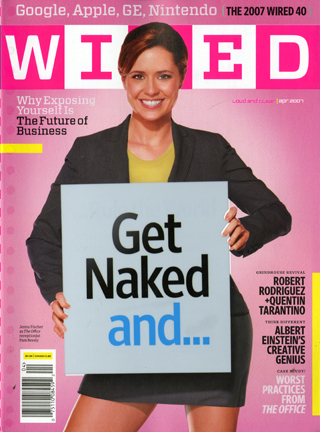
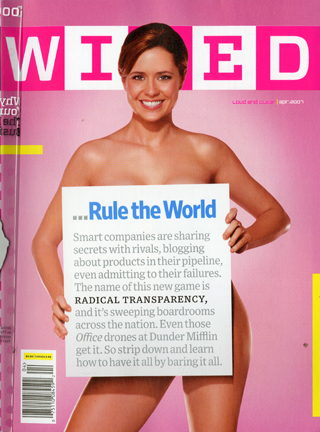
The April cover of Wired was definitely a very creative cover that raised more than one-eye brow. Art directors loved it, journalist praised it and branded it innovative, yet it seems readers had a completely different reaction. In the June issue the editors wrote about the readers’ comments, “Your criticism stings, but it makes you look, you know, evolved: As always, your standards are impeccably high. When you pick up Wired, you expect something that appeals to what’s in your head, not what’s in your pants. Which, we like to think, is mostly what you get.” I wonder which was more insulting to the readers, the transparent cover or the “transparent” comments from the editors responding to their readers’ comments? Just another example that we (editors, writers, designers, etc. are NOT the readers). To read my detailed comments on this subject click here.


