Archive for the ‘News and Views’ Category

h1

It’s A Bird, It’s A Plane – No, It’s A Drone! The Skies & Newsstands Are Making Room For The Latest Buzz – The Mr. Magazine™ Interview With Tim Kidwell, Editor-In-Chief, Drone 360

January 22, 2015

“I am not one of those people who think print is dead; I think print has a place and a role in publishing.” Tim Kidwell

Drone360 cover They are an unknown quantity in so many ways, yet becoming more and more used each and every day. From law enforcement to agriculture, photographers to a fascinated public; drones are captivating common interests all across the country.

Drone 360 is a new launch from Kalmbach Publishing, the company that brings us the science-based magazine Discover and a host of hobbyist magazines. Drone 360 pays tribute to the compelling world of multirotor aircraft and attempts to assist in answering some of the tougher issues about the flying machines, such as how the FAA plans on regulating their commercial use. While the magazine is only scheduled for this premiere issue, Editor-in-Chief Tim Kidwell is hopeful the special interest ink on paper product does well and he’s given the green light to fly his drone again, many times. But for now, the first issue will land on the nation’s newsstands on March 24.

I reached out to Tim recently to talk about the engaging world of drones and we discussed the many facets of the aircraft. From the hobbyists whose enthusiasm comes from a different level of curiosity, to the commercial world that would love to uncover the vast array of possibilities drones offer; Tim talked with an enthusiasm of his own about the aircraft.

So, sit back, relax and enter a world of alternative flight as you enjoy the Mr. Magazine™ conversation with Tim Kidwell, Editor, Drone 360.

But first, the sound-bites:

On the genesis of Drone 360: I guess by now drones have become a part of everyday life. They’re affecting our culture and pushing technology. They’re becoming a part of our businesses as people try and figure out how they can use them for all sorts of commercial and scientific efforts. They’re everywhere.

On the concept behind the magazine:
Right now it’s a special interest publication that we’re putting out in conjunction with Discover. We really thought that it was the perfect time for us to get in there and talk about a lot of the issues.

On the intended audience of the magazine:
The people that this (magazine) will probably interest the most are men, aged 18 to 39; I think that’s probably where the sweet spot is. However, when we were putting the magazine together I told our team that while 18 to 39 year old men might be where the sweet spot is, I want this magazine to be easily read by anyone who is interested in tech and gear.

On the major stumbling block he faces in launching the magazine:
Our biggest challenge to me is just making sure that we get market penetration and eyes on the magazine. If we can get eyes on the magazine I think that it will go.

On why print was the best format for the magazine’s message:
I am not one of those people who think print is dead; I think print has a place and a role in publishing. I believe there are ways to still get information out there on the internet, but I think the internet is very good at disseminating information but it’s all up to the reader when it comes to trying to cull down and decide what’s good and what’s bad.

On the most pleasant moment he had when putting the magazine together:
The coolest thing so far, I think, has been when we came up with the feature story list. We said the stories on that list were what we wanted to see happen. And what we started to see were these threads, these concerns and comments that were linking all of these stories together and it really made the entire magazine gel.

On what keeps him up at night:
If I had to pick one thing; I really love tech, but I worry about how tech is used. And that’s what keeps me up at night.

Screen shot 2015-01-21 at 7.14.47 PM And now the lightly edited transcript of the Mr. Magazine™ interview with Tim Kidwell, Editor, Drone 360…

Samir Husni: My first question to you is why did you decide to launch your magazine now? Do you believe drones are going to be a more integral part of our near future? Tell me about the genesis of Drone 360.

Tim Kidwell: I guess by now drones have become a part of everyday life. They’re affecting our culture and pushing technology. They’re becoming a part of our businesses as people try and figure out how they can use them for all sorts of commercial and scientific efforts. They’re everywhere.

And as far as whether it’s a fad or not, I don’t think that drones are a fad in the sense that I believe we’re going to see them used more frequently for law enforcement and in commercial endeavors. I think maybe we’ll see a drop off in their popularity as something that the hobbyist would use. What we’re seeing right now is, especially with quadcopters, they’re a lot easier to fly than fixed wing or traditional helicopters in RC circles. So, we’re seeing this surge of, “Wow, I too can fly something and it doesn’t take very much for me to get it into the air.”

We’re seeing a real fervor behind that, but I also think that will die back a little. I’m not saying it’s going to disappear, but I don’t think it’s going to remain as hot and as trendy for hobbyists as it is right now. Something else will come along and take that up. But for the foreseeable future, drones, multirotor aircraft, these sorts of things are here to stay.

Samir Husni: What is the vision behind Drone 360.

Tim Kidwell: Well, right now it’s a special interest publication that we’re putting out in conjunction with Discover. We really thought that it was the perfect time for us to get in there and talk about a lot of the issues, not only on the hobby side, because I think there is some space there for us to talk about beginning hobbyists and how they can get into multirotor aircraft and how they can fly safely, those sort of things.

But we also thought that, again, there is so much going on with the science end of tins and culturally with law enforcement that we really needed to get in there and touch on these different topics.

The other thing that really spurred us was the FAA was coming out with rules in 2015, so we thought this was the perfect time to get in there and start really talking about them and giving balanced coverage. You can get a lot of rhetoric on both sides, where they are extremely pro or extremely against, and I thought what we needed to do was come in and give a balanced approach and say there are some valid opinions on both sides and let’s explore both as we move along.

Samir Husni: Who is the intended audience; whom are you trying to reach with the printed magazine?

Tim Kidwell: If we’re going to be honest, the people that this will probably interest the most are men, aged 18 to 39; I think that’s probably where the sweet spot is. However, when we were putting the magazine together I told our team that while 18 to 39 year old men might be where the sweet spot is, I want this magazine to be easily read by anyone who is interested in tech and gear and RC, even casually, and who just want to find out what is going on with the drones. We wanted it to be open and accessible to everyone, but we do understand that our target audience is men, 18 to 39.

Samir Husni: Tim, what do you anticipate to be the major stumbling block when it comes to the launch of the magazine and how are you planning to overcome it?

Tim Kidwell: The major stumbling block is where magazine publishing and publishing in general is right now. It’s going to be penetration into the market and getting seen that will be our biggest challenge. I think the content and subject matter is great and I believe it’s pertinent and exciting. So, our biggest challenge to me is just making sure that we get market penetration and eyes on the magazine. If we can get eyes on the magazine I think that it will go.

Samir Husni: Do you think print is the best vehicle to reach that audience today?

Tim Kidwell: I am not one of those people who think print is dead; I think print has a place and a role in publishing. I believe there are ways to still get information out there on the internet, but I think the internet is very good at disseminating information but it’s all up to the reader when it comes to trying to cull down and decide what’s good and what’s bad, whereas I think a magazine like what we’re doing here, you have to be very judicious in putting together what stories we do. We only have so many pages; in this case, we have 92. We only have 92 pages, so we have to make sure those stories are as concise and as good as we can possibly do them. And a printed magazine is a great way to get that information out.

Samir Husni: As you were putting this magazine together; what was the most pleasant moment that you had? Or the “aha” moment as you were putting this first issue together.

Tim Kidwell: The coolest thing so far, I think, has been when we came up with the feature story list. We said the stories on that list were what we wanted to see happen. And then we began getting them assigned and as they started to come back in and we were reading through them, we started to notice common threads developing. And that was the neatest thing.

On one of the initial stories it was maybe just a reference or two to something like situational awareness. Then we see in another story that situational awareness come up again, but somebody else has a different take on it. And what we started to see were these threads, these concerns and comments that were linking all of these stories together and it really made the entire magazine gel.

Samir Husni: How often do you plan to publish Drone 360?

Tim Kidwell: We hope that there are going to be more of these. Like I said earlier, it’s a special-issue publication that we’re doing in conjunction with Discover. So, right now this is the one, this is our premiere; we hope we’ll get the green light to do more. But right now this is the only one that’s planned currently. We’ll see how well it does and if it does well, then we will consider what we can do next.

Samir Husni: Looking at the cover; this magazine is rooted in science; it’s rooted in Discover and it’s rooted in a company known in the field of special interest publications, connectivity to its audience and hobbyists in different realms of things.

Tim Kidwell: Yes, we’re pushing it in conjunction with Discover, so it’s going off of Discover’s bipad. However, we aren’t necessarily targeting just Discover’s audience. We’re looking at a broader mix of hobbyists and general interest, people who are interested in drones or people who are interested in the tech of drones or those interested in getting into the hobby of quadcopters or multirotor aircraft. So, we’re looking at a much broader audience than just the science end, which would be more of an interest for the Discover audience.

Samir Husni: Anything else you’d like to add about Drone 360? Is it going to be delivered via drone? (Laughs)

Tim Kidwell: (Laughs too) It will not be delivered via drone because we’re still waiting on the FAA decision on how to use them commercially. (Laughs) All I want to say is that we’ve been extremely excited about this project. We put it together and turned it around very fast and it’s been a great experience for all of us. Drones are here to stay and they are something that we’re going to have to live and cope with and figure out just where they fit in when it comes to our everyday life.

Samir Husni: My typical last question; what keeps you up at night?

Tim Kidwell: What keeps me up at night? (Laughs) I have a lot of things that keep me up at night. I have a new baby on the way, so worrying about that keeps me up. (Laughs)

If I had to pick one thing; I really love tech, but I worry about how tech is used. And that’s what keeps me up at night.

Samir Husni: Thank you.

h1

Made With INK (Globally): Five New Magazines Landing At An Airplane Near You! The Mr. Magazine™ Interview With Michael Keating, CEO & Co-Founder, INK

January 14, 2015

Content In The Sky Has Never Looked Or Read Better


“Our particular niche, which is inflight magazines, bucks trends because more and more people are traveling each year, so in fact, where you might have a decline in newsstand titles, we’re actually getting more readers.” Michael Keating

Picture 24 The sky’s the limit, or so we’ve been told and in the case of Michael Keating and Ink, Keating’s company that is today’s global leader in travel media, this statement couldn’t be truer.

Michael is responsible for establishing new business relationships and partnerships with airlines and railways and began his career in radio and television, working for the BBC, ITV, Channel 4 and MTV. He went on to co-found Pacific, an independent television production company and co-founded Ink with Simon Leslie in 1994.

Today, with a staff of more than 400 people, Ink creates award-winning media and builds innovative technology to provide more than 100 differentiated products across airlines and rail partners.

I spoke with Michael recently about this pie-in-the-sky publishing empire of his and how the success of inflight magazines, from content to advertisement, is a positive outlook and statement to all print publishers. We talked about his beginnings, the present, and the future of Ink Global. Having just won the American Airlines contract recently; the company’s future certainly looks brighter than ever.

So sit back, fasten your seatbelts please, and get ready to enjoy the Mr. Magazine™ conversation with Michael Keating, CEO and Founder, Ink Global.

But first the sound-bites:


michaelkeating On the expansion of his print empire in a digital age:
Our particular niche, which is inflight magazines, bucks trends because more and more people are traveling each year, so in fact, where you might have a decline in newsstand titles, we’re actually getting more readers.

On his strategy to continue the upward trend of inflight magazines:
It’s true; you do have to vie for people’s attention, but just because someone may be watching a movie on their own device doesn’t mean they don’t read the magazines. You know, TV screens have always existed on the long-haul flights, so I don’t believe that people only do one thing.

On the significant differences between all the magazines Ink publishes:
We never recycle the editorials; they’re really written for their own specific brand with that particular magazine’s audience in mind.

On the advertising outlook with inflight magazines:
Our advertisers get a very good response; otherwise they wouldn’t keep coming back.

On expanding the presence of Ink Global in the United States: When we won American, part of the terms of the contract was to have a local presence in Dallas because their headquarters are here.

On his move from broadcast journalism to print: I went to Lebanon to do this news item and I met a gentleman who was starting a new airline called British Mediterranean Airways.

On the major stumbling block he’s had to face:
Not every single magazine we’ve undertaken has been a success. In some instances, when we found it very difficult to sell advertising in a particular market, that was a big stumbling block.

On what keeps him up at night:
What keeps me up at night is often what happens around a launch period. If you think about at the first of January we have to have American Way on the planes and we have to have Ronda and Excelente on the planes as well, launching three major titles in exactly the same week causes me a few sleepless nights.

And now the lightly edited transcript of the Mr. Magazine conversation with Michael Keating, CEO and Founder, Ink Global…

The global network of INK...

The global network of INK…

Samir Husni: I was recently on your website and I saw the new magazines that have been launched. In launching those titles what were you thinking about, simply trying to expand your print empire of travel-related titles in an age where everyone else is saying print is in decline?

Michael Keating: Our particular niche, which is inflight magazines, bucks trends because more and more people are traveling each year, so in fact, where you might have a decline in newsstand titles, we’re actually getting more readers. In the case of American Airlines, with the recent merger with U.S. Airways, their annual passenger numbers will reach around 200 million, so inflight readership is growing.

Samir Husni: We used to say that the inflight magazines were read by a captive audience, but now in a digital age, where people are bringing their iPads or their smartphones or tablets that is no longer apropos of the situation. So, what’s your strategy to continue this upward trend with inflight magazines?

Ronda-3 Michael Keating: It’s true; you do have to vie for people’s attention, but just because someone may be watching a movie on their own device doesn’t mean they don’t read the magazines. TV screens have always existed on the long-haul flights, so I don’t believe that people only do one thing. They’ll get on a flight and have a nice meal, a glass of wine, read a book or a newspaper that they brought with them or watch a movie, but they’ll still pick up the magazine. We actually have a head of insight called Kevin Miller who is very experienced in doing research having worked for JC Decaux Airport,and we know that readership is exceptionally high.

Of course, I would like to think it’s just for excellent high-quality editorial, but people also love looking at the route maps and there is certain essential information that’s also in the magazines. And with low-cost carriers, when they’re selling food or drink onboard, they’ll often put a lot of the menu information into the magazine as well.

Despite the fact that I would love to think that every single passenger is picking it up only because of the entertaining features, sometimes they want simply to know how much a cup of coffee is or a sandwich and they’ll pick it up.

But once the magazine is in people’s hands, of course then it’s the job of our creative teams to make sure that passengers engage with it. Once in their hands they’ll have a flip-through or want to read the features that are presented. And in some instances, destination guides, like an EasyJet magazine, for example, there are more than 30 pages of city information in the back, so some of that is practical information, like really good restaurants and bar advice. Those destination guides are written by locals who live in each city. We have over 130 freelance writers on the easyJet network who all reside in those cities so it really is good local information.

Samir Husni: One of the things I’ve noticed is that American Way is completely different than Ronda; Ronda is different than Excelente and the same with the other magazines that you publish. Tell me about Ink Global, which you’re celebrating the 21st year of starting the company and what’s your strategy of growth and your plan for conquering the travel market?

Michael Keating: Yes, the magazines are completely different for every single airline. The first thing that we have to do is consider that particular brand, and clearly even the way in which we approach writing about a city would be completely different. For example, we do the Eurostar, which is the premium train between London, Paris and Brussels. And it’s bilingual, English and French. So, if we were writing a story on Paris for the Eurostar magazine, where there is an awful lot of Parisians traveling on the train, clearly the story would be differently positioned than if writing for American Way. What Americans want to do when visiting Paris is quite different to a local.

Again that would be different to easyJet from Iberia, for example. What might Spanish passengers want to do in Paris? Everything is completely tailored for the audience. I have a dedicated editorial team for each publication, so with any contract we’ll go out and hire dedicated editors, art directors to only work on that magazine. It’s not a shared resource. We never recycle the editorials; they’re really written for their own specific brand with that particular magazine’s audience in mind.

Samir Husni: What about the advertising market? I heard an agency executive last month on our National Public Radio saying that she doesn’t see anyone coming to her offices and asking to advertise in print. What’s your reaction to such a statement?

Michael Keating: Our advertisers get a very good response; otherwise they wouldn’t keep coming back. You just have to look at the number of series advertisers, those that will take multiple issues or in some instances annual contracts with the magazine. They wouldn’t be spending the money if they weren’t getting a good response.

In fact, we had a real estate advertiser form Spain who had taken space in the EasyJet magazine and they got a better response from easyJet Traveller than the Sunday Times, a big national newspaper in the U.K.

Why, because the people who may actually want to buy a second home in Spain; they’re more likely to get a response from people who are actually flying on an airplane to Spain than someone sitting in their armchair at home. It’s putting the right message in front of the right people at the right time.

Samir Husni: I noticed that you’re opening offices in Dallas and Miami…

Michael Keating: Yes, I’m talking to you from our Dallas office now.

Samir Husni: Are you expanding the presence of Ink Global in the United States?

Michael Keating: The expansion has been very recent because we won the contract for American Airlines. We’ve had offices for the last six years in New York, in Dumbo, Brooklyn and Atlanta. Atlanta is a sales office and New York is editorial. We placed the editorial staff in New York because there is great creative talent in the city.

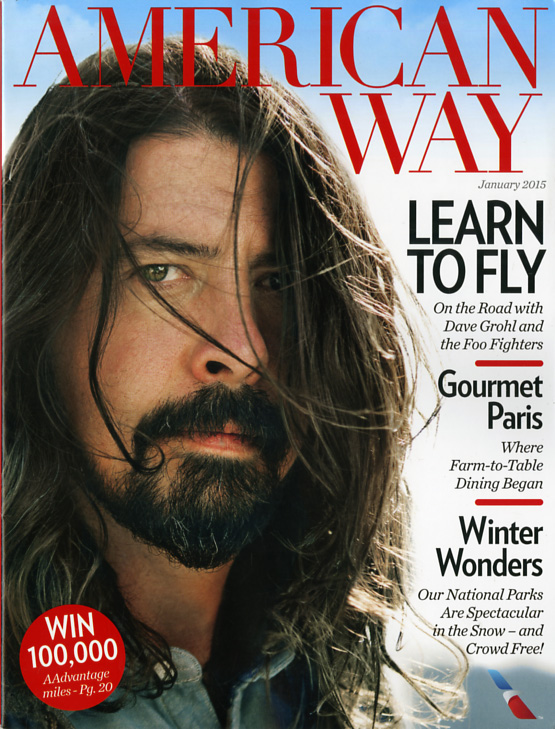
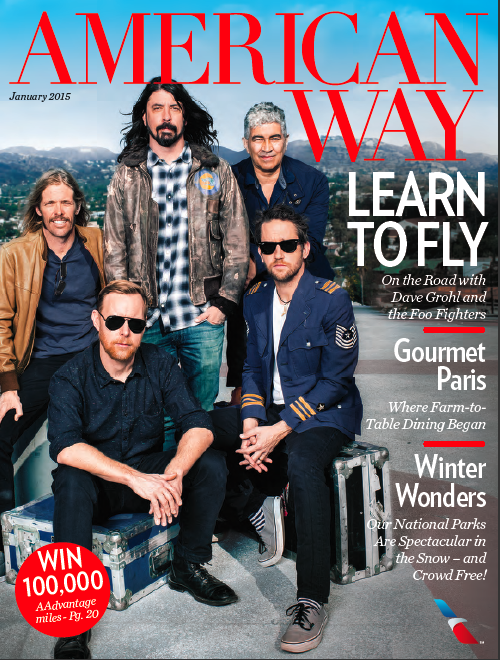
American way-1Picture 23

When we won American, part of the terms of the contract was to have a local presence in Dallas because their headquarters are here. And we had to take on some of the existing staff because American Airlines has been published in-house for the past 48 years. So, this is really quite a departure for them to outsource it. And part of the deal was that we would take on some of their existing staff and would supplement that staff base with some exciting new talent.

We decided to open in Miami because one of the American Airlines publications is called Nexos and is bi-lingual, Spanish and Portuguese. The whole South American market is hugely important to the airline, that’s why they have a Spanish and Portuguese publication. So we needed to have some Spanish-speaking staff and Miami is a great place to recruit

Samir Husni: In 1994 when you co-founded Ink Global, your background was in broadcast; if you can recall that moment where you and Simon Leslie decided to found Ink Global, what made you move from broadcast journalism to print?

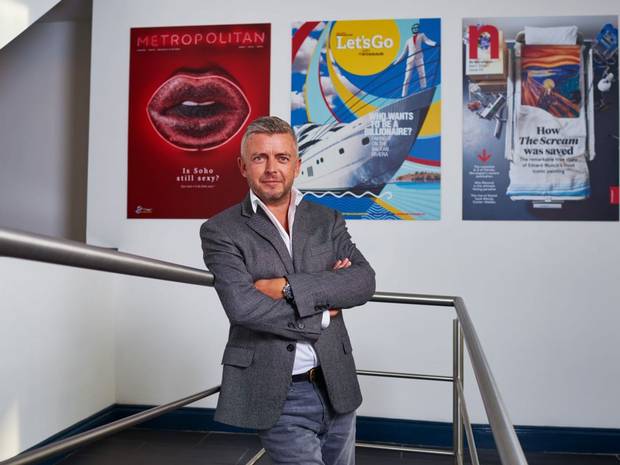
Michael Keating  in a picture from The (British) Independent newspaper

Michael Keating in a picture from The (British) Independent newspaper

Michael Keating: Michael Keating: What actually happened was there was a very good friend of mine who was Lebanese and his father worked in tourism in Lebanon. After the Civil War tourism was on its knees in the country and I was working for a TV news show called “London Tonight” and his father offered us free tickets to bring a TV news crew over to Beirut to do what I call an “And Finally” story on “Londoners are Booking Package Holidays to Lebanon Once Again.” It was an unusual idea at that time given that what people had been seeing about Lebanon on the news for many, many years was bombs and bullets. So, the idea of going there on vacation was almost laughable at the time.

I went to Lebanon to do this news item and I met a gentleman who was starting a new airline called British Mediterranean Airways. They started with one plane and one route, which was London to Beirut. He was there and he said, “Oh, you know about television; I’m going to need someone to do my inflight entertainment.”

We had a discussion and sure enough, I starting licensing movies and producing some audio/visual content for the airline. I knew Simon Leslie at the time because I was doing some writing for him, and I said to him “There is this start-up airline that I’m doing the inflight entertainment for and they need a magazine. Shall we go into business together? And that was the start of Ink Global. Such humble beginnings from a bar in Beirut!” A city obviously close to your heart.

Samir Husni: Indeed. You just took the words out of my mouth, being originally from Lebanon. (Laughs) That’s a perfect story for me.

Michael Keating: And then the airline expanded. It started operating to Amman, Damascus and Alexandria and the commercial director of that airline went on to be the commercial director of Branson’s then-European operation, Virgin Express. He called me and asked, “Do you want to do this Belgium-based airline, Virgin Express?” And I said, yes, please. So, I got that one as well.

And then we also did the magazine for an African airline called Alliance Air which doesn’t exist anymore. That was an alliance between the governments of South Africa, Uganda, Rwanda and Tanzania. So, you can probably take a guess why that airline doesn’t exist anymore.

So, we did Alliance Air, picked up easyJet and just kept adding more and more airlines. I really like the vertical. There is an argument that if you’re doing well in a particular field, then keep going and replicate success. Travel has always been a passion and being able to turn that into a career, has been a joy. The way we carved up the workload was that I focused on the creative side of the business and Simon Leslie would look after advertising sales.

Samir Husni: One thing that I’m interested in knowing is what was the major stumbling block? Your story can’t be all one success after the other; what was your major stumbling block and how did you overcome it?

Michael Keating: Not every single magazine we’ve undertaken has been a success. In some instances, when we found it very difficult to sell advertising in a particular market. Many people probably have the idea that airlines take out a nice, big, fat checkbook and pay us a huge amount of money to produce these publications. The reality is different in that they have to be 100% funded through advertising. That’s why I also think that the quality of the editorial and the design has dramatically changed over the decades in the sense that a long time ago the airlines would pay and these publications were completely created by a marketing department. They weren’t particularly commercial and they may not have been so nicely designed.

These days they have to be as good as or even better than newsstand-quality publications because the advertisers demand it. It’s also what passengers expect.


Samir Husni: From the magazines that I’ve seen it’s really great work, both editorially and in the design. My typical last question; what keeps Michael up at night, besides the time difference now?

Michael Keating: Michael Keating: (Laughs) That is often the problem with running a global operation because you literally can be chatting with one of the offices at all times of the day and night.

But what keeps me up at night is often what happens around a launch period. If you think that on the first of January American Way, Ronda and Excelente, all had to launch on the same day, that caused a a few sleepless nights. But I was delighted with the results.

Excelente-2

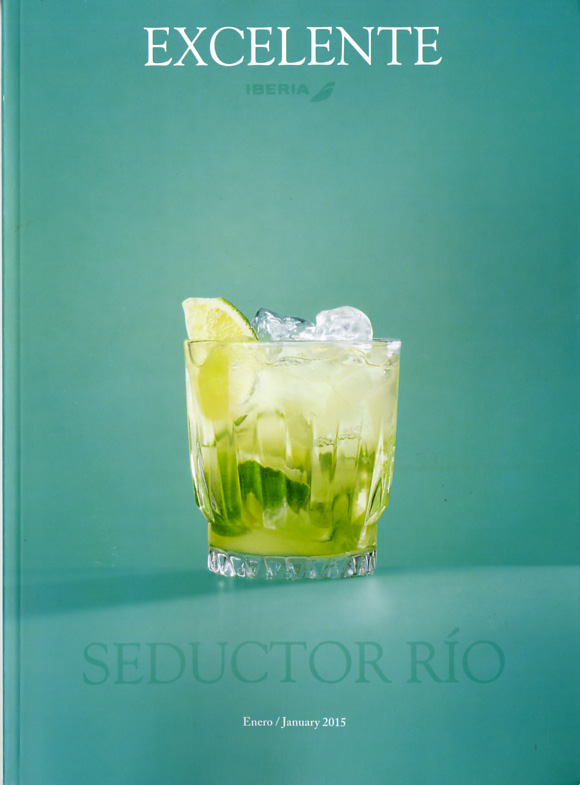
I think in the case of Ronda and Excelente, the team has produced something that’s really quite different and it’s a great accolade to them; the fact that they’ve created something very unique. Especially with Excelente, as it’s not like any other inflight magazine that I’ve ever seen before. I think there are some really clever ideas in there.

Samir Husni: Thank you.
h1

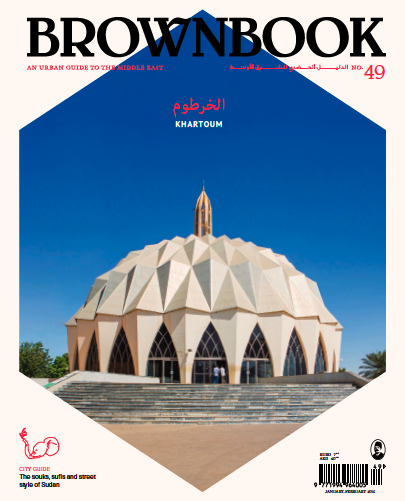
“I Love Magazines…” BROWNBOOK Magazine’s Interview with Mr. Magazine™

January 13, 2015

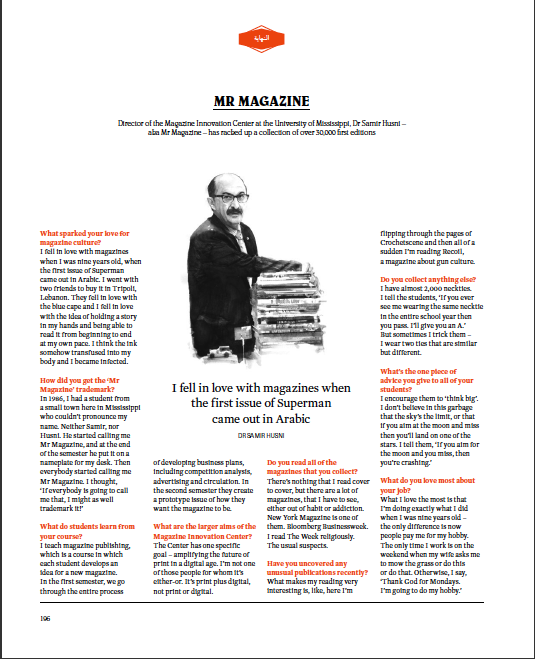
The Dubai-based BROWNBOOK magazine describes itself as “An Urban Guide To The Middle East.” John Burns, a writer at the magazine, interviewed me for the Jan./Feb. issue. The interview appeared in the “Bookend” department, which is the last page of the magazine. What follows is a reprint (with permission) of the interview as it appeared in the magazine.

Picture 25

Mr Magazine
Director of the Magazine Innovation Center at the University of Mississippi, Dr Samir Husni – aka Mr Magazine – has racked up a collection of over 30,000 first editions


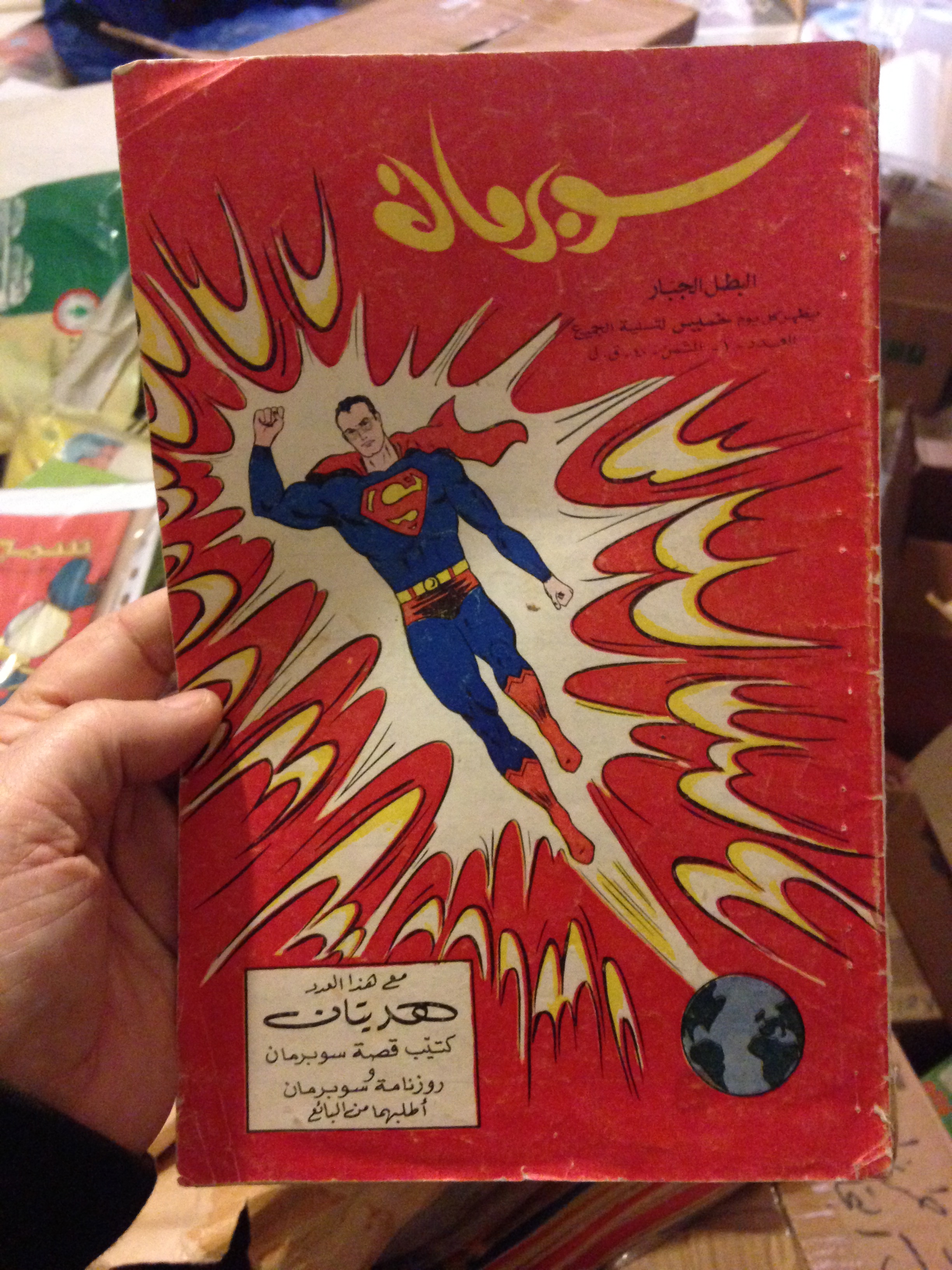
I fell in love with magazines when the first issue of Superman came out in Arabic. DR Samir Husni

Picture 26 What sparked your love for magazine culture?
I fell in love with magazines when I was nine years old, when the first issue of Superman came out in Arabic. I went with two friends to buy it in Tripoli, Lebanon. They fell in love with the blue cape and I fell in love with the idea of holding a story in my hands and being able to read it from beginning to end at my own pace. I think the ink somehow transfused into my body and I became infected.

How did you get the ‘Mr Magazine’ trademark?
In 1986, I had a student from a small town here in Mississippi who couldn’t pronounce my name. Neither Samir, nor Husni. He started calling me Mr Magazine, and at the end of the semester he put it on a nameplate for my desk. Then everybody started calling me Mr Magazine. I thought, ‘If everybody is going to call me that, I might as well trademark it!’

What do students learn from your course?
I teach magazine publishing, which is a course in which each student develops an idea for a new magazine. In the first semester, we go through the entire process of developing business plans, including competition analysis, advertising and circulation. In the second semester they create a prototype issue of how they want the magazine to be.

What are the larger aims of the Magazine Innovation Center?
The Center has one specific goal – amplifying the future of print in a digital age. I’m not one of those people for whom it’s either-or. It’s print plus digital, not print or digital.

Do you read all of the magazines that you collect?

There’s nothing that I read cover to cover, but there are a lot of magazines, that I have to see, either out of habit or addiction. New York Magazine is one of them. Bloomberg Businessweek. I read The Week religiously. The usual suspects.

Have you uncovered any unusual publications recently?
What makes my reading very interesting is, like, here I’m flipping through the pages of Crochetscene and then all of a sudden I’m reading Recoil, a magazine about gun culture.

Do you collect anything else?

I have almost 2,000 neckties. I tell the students, ‘If you ever see me wearing the same necktie in the entire school year then you pass. I’ll give you an A.’ But sometimes I trick them – I wear two ties that are similar but different.

What’s the one piece of advice you give to all of your students?
I encourage them to ‘think big’. I don’t believe in this garbage that the sky’s the limit, or that if you aim at the moon and miss then you’ll land on one of the stars. I tell them, ‘If you aim for the moon and you miss, then you’re crashing.’

What do you love most about your job?

What I love the most is that I’m doing exactly what I did when I was nine years old – the only difference is now people pay me for my hobby. The only time I work is on the weekend when my wife asks me to mow the grass or do this or do that. Otherwise, I say, ‘Thank God for Mondays. I’m going to do my hobby.’

h1

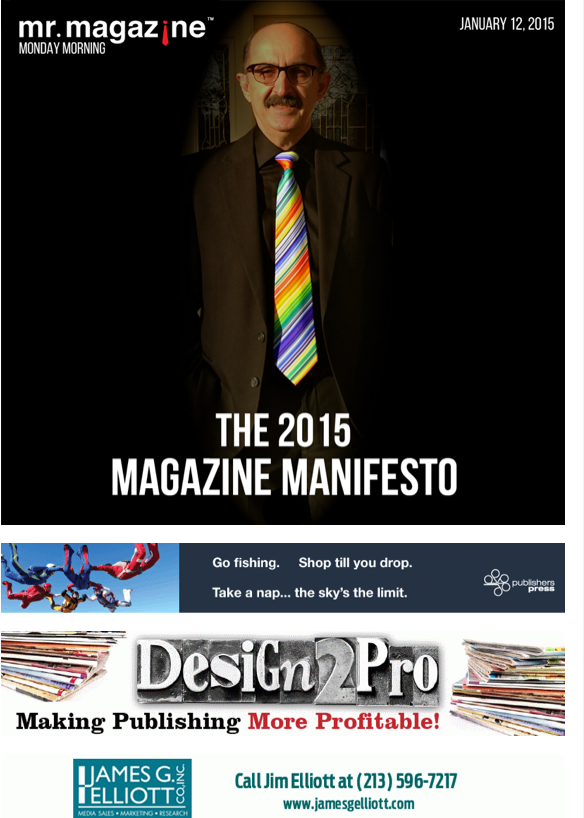
The Mr. Magazine™ 2015 Manifesto… A special issue of Mr. Magazine™ Monday Morning…

January 12, 2015

The new issue of the weekly Mr. Magazine™ Monday Morning is out. It is a special issue featuring the Magazine Manifesto for 2015.

Click here to read the issue.
Picture 13

For a free subscription delivered to your inbox every Monday morning click here
.

h1

The Mr. Magazine™ Manifesto 2015: Audience First…

January 6, 2015

The Mr. Magazine™ Manifesto 2015

The Mr. Magazine™ Manifesto 2015

We live in a digital age. It’s a fact that no one can argue. However, during the dawn of this digital age a few other articulations are also true.

So, for the 2015 Mr. Magazine™ Manifesto, I opted to remind folks of some other thoughts to consider.

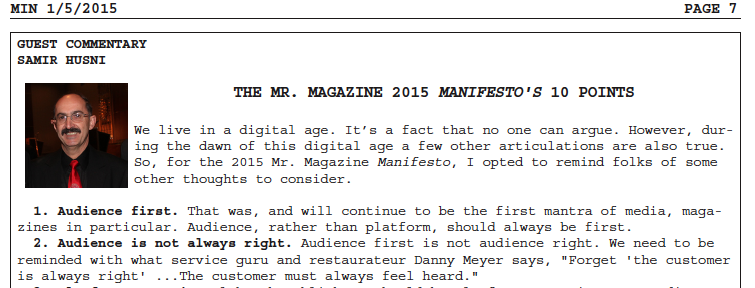
1. Audience first. That was, and will continue to be the first mantra of media, magazines in particular. Audience, rather than platform, should always be first.

2. Audience is not always right. Audience first is not audience right. We need to be reminded with what service guru and restaurateur Danny Meyer says, “Forget ‘the customer is always right’ …The customer must always feel heard.”

3. Platform agnostic. Although publishers should be platform agnostic, your audience is not. Readers have their preferred platforms and they are attached to them. So don’t fall in love with the platforms; rather, fall in love with the audience. Make each and every platform content complete.

4. Technology does not kill print. It’s neither technology nor its digital components that threatens the survival of printed magazines. The perpetrators are the people behind print, its content and the investment or lack thereof. Remember the old adage, “Guns don’t kill people; people kill people.”

5. Advertisers are not departing print. Some magazines in 2014 published their largest issues since their inception. More ad pages mean bigger magazines than ever. When you hear some ad agency folks declaring that “we have no customers walking into our office and asking to place their ads in print,” ask them who their clients are and what about those pages and pages of ads in print? Are they representing the wrong clients?

The Mr. Magazine™ Manifesto 2015 as it appeared in min:media industry newsletter Jan. 5, 2015

The Mr. Magazine™ Manifesto 2015 as it appeared in min:media industry newsletter Jan. 5, 2015

6. New printed magazines are thriving. Since the dawn of the digital age (desktop publishing) in 1984, more print magazines have started. Did you know that some of the most successful magazines in the country are less than 30-years old? Men’s Health, InStyle, Marie Claire, Food Network magazine, O The Oprah Magazine and ESPN are just a few.

7. Without new magazines, the industry is dead. Any industry that fails to introduce new products is a dying industry. We should pay more attention to the business of new print launches and cherish and celebrate their arrivals. The industry must also focus on the fact that these infants always give us hope and a reason to believe in the future.

8. Learn from digital. More digital and online companies have discovered print in the last few years. From Web MD to Cnet, they’ve all have opted to produce print magazines in addition to their digital presence. Those digital companies are in the business of “no customer left behind.” A good mantra to follow.

9. Rediscover print and its power. If digital is discovering print and its power, the magazine industry should do the same. Rediscovering print means investing, on both the physical and content side. Leave speed and disposability to digital and create and produce a product with lasting collectability. Ensure that your content is right and your paper is great.

10. Statistics lie, numbers don’t. When you hear the statistics and percentages of increases or decreases in a particular publishing area, please do me a favor. Ask for numbers, real numbers. One percent of a billion-dollar industry is larger than fifty percent of a thousand-dollar industry.

Last but not least, it gives me great pleasure to mention that the same people who promoted and used the phrase the death of print from 2009 to 2014 have revised their phrase and predictions. Their new slogan is now the decline of print. Give them five more years and they will swallow their pride, admit they were wrong not once, but twice, and their new phrase will be the power of print.
_______________________________________________________________________________________________________________________________
Screen shot 2015-01-04 at 2.21.28 PMEditor’s Note: The Mr. Magazine™ Manifesto 2015 was first published in the Jan. 5 issue of min: media industry newsletter: The authoritative media/marketing newsletter since 1947. In the Dec. 22 of min, the editor in chief Steve Cohn wrote, “This issue, min’s last for 2014, extends our 28-year tradition of magazine launch reviews with Dr. Samir Husni. When we return on January 5, 2015, Husni will present his fifth Mr. Magazine Manifesto of New Year’s resolutions. He knows which titles have been naughty or nice.” For more about min newsletter click here.

h1

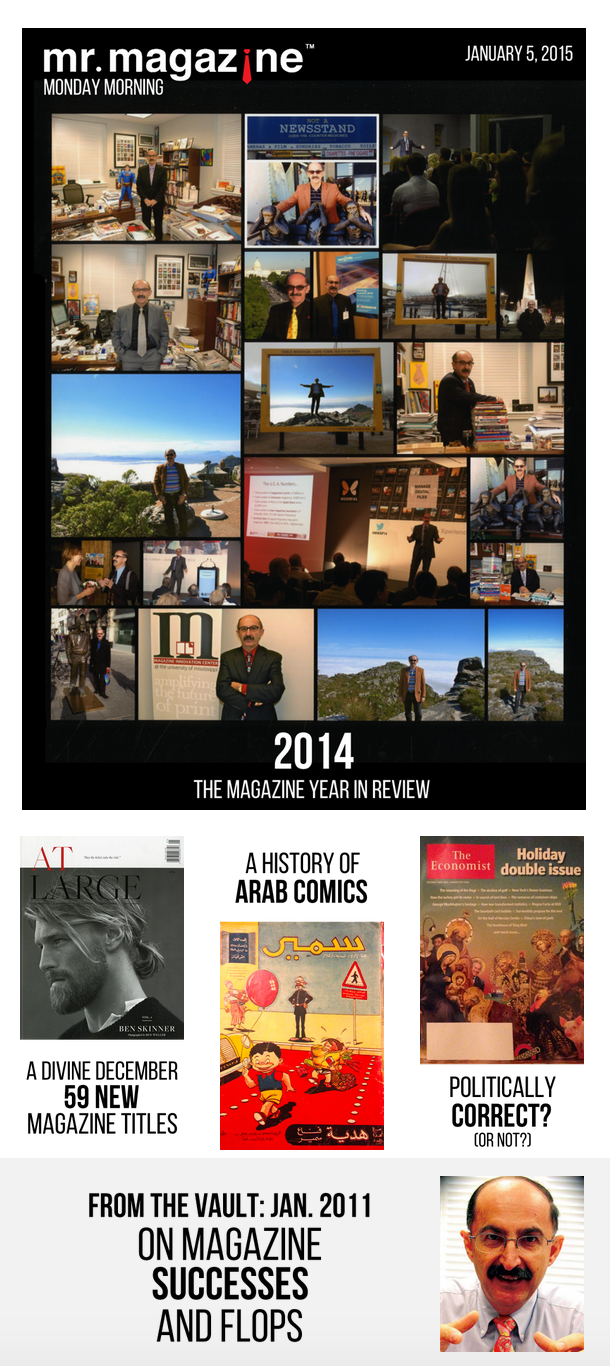
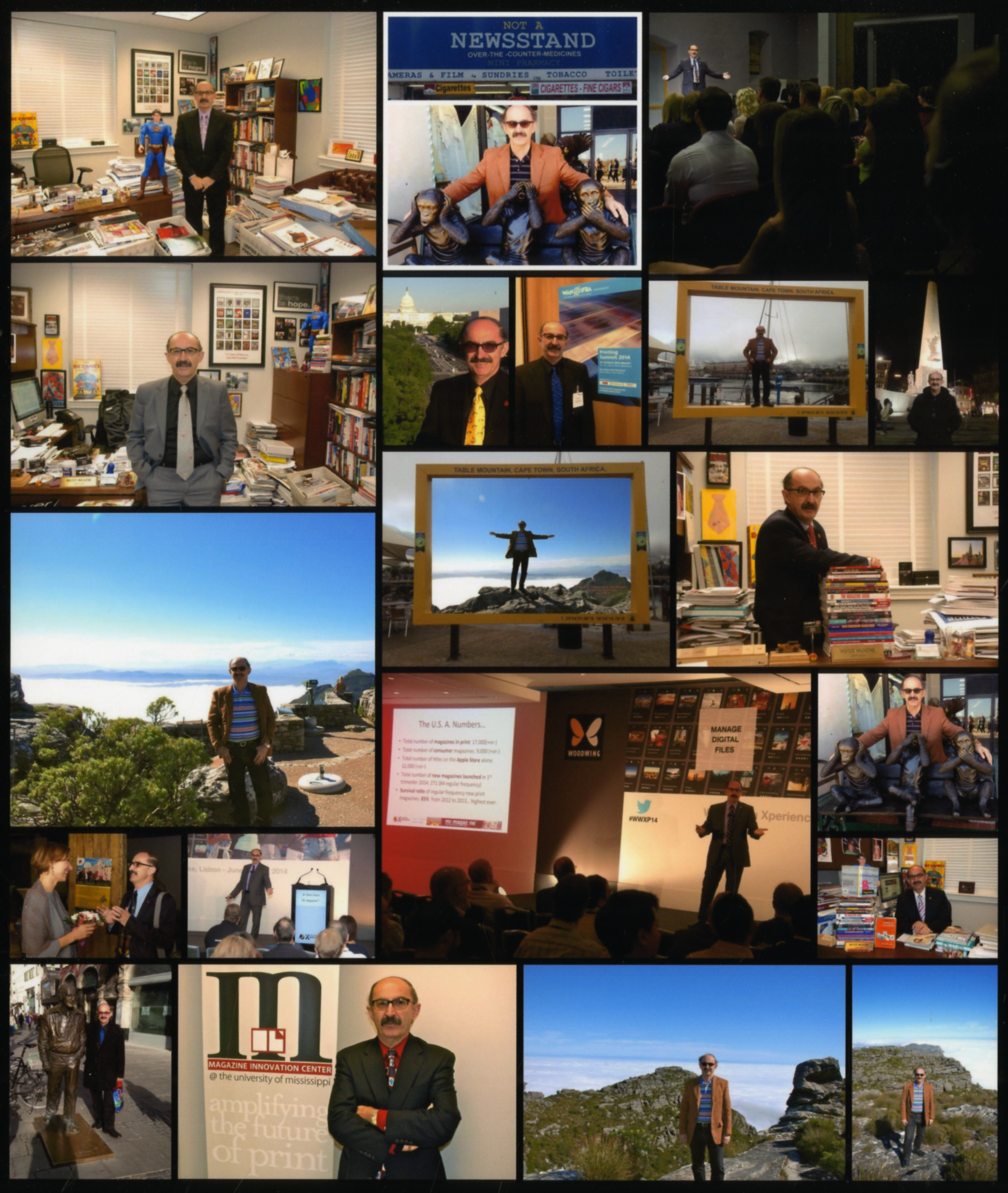
Happy New Year: 2014 in Review. The Mr. Magazine™ Monday Morning

January 5, 2015
Mr. Magazine™ Monday Morning  Jan. 5, 2015

Mr. Magazine™ Monday Morning Jan. 5, 2015

The first issue of 2015 of Mr. Magazine™ Monday Morning is out.

The issue contains the year of new magazines in review and an interview with Mr. Magazine™ explaining the methods behind the numbers.

Mr. Magazine™ Monday Morning is a free digital weekly platform that contains the best of the Mr. Magazine™ blog.

It is published every Monday Morning and emailed free to subscribers.

To start receiving your free copy every Monday morning click here to subscribe.

To read this week’s issue click here.

h1

2014 Was A Great Year For New Magazines. The Mr. Magazine™ Interview With Mr. Magazine™…

January 1, 2015

“With all the troubles on the newsstands, 2014 proved to be a great year for new magazines. In fact 234 new magazines published with a regular frequency, putting this year’s numbers at 21% more titles then 2013.” Samir “Mr. Magazine™” Husni.

Mr. Magazine™ 2014:  Traveling the World Preaching the Gospel of Magazines, Magazine Media and the Power of Print in a Digital Age.

Mr. Magazine™ 2014: Traveling the World Preaching the Gospel of Magazines, Magazine Media and the Power of Print in a Digital Age.

First ever Mr. Magazine™ interview with Mr. MagazIne™[/caption] As we usher in a new year, the numbers are in and the totals look phenomenal. In customary Mr. Magazine™ style, new titles are lovingly collected and meticulously counted in order to bring the most accurate set of numbers of available new magazines to the world of magazine media and people interested in the industry.

Striving throughout the year to locate as many new magazine titles that are attainable through my extensive travels, I bring to the table some of the best reasons in the world for our industry to look forward to a very bright future. And while my endeavors aren’t a mystery to anyone that is familiar with Mr. Magazine™; I felt an interview with the man himself was necessary to clarify a few of the rules and regulations that lead up to the annual year-end publishing of the new launch numbers.

And who better to interview Mr. Magazine™ than Mr. Magazine™ himself. Why not? 2015 is a brand new year and we journalists are nothing if not innovative and willing to cultivate new ideas for the New Year.

Up first, the numbers for 2014 and the comparisons to its predecessor, 2013, and in the words of the inimitable Frank Sinatra: It was a very good year…

The Numbers of New Magazines

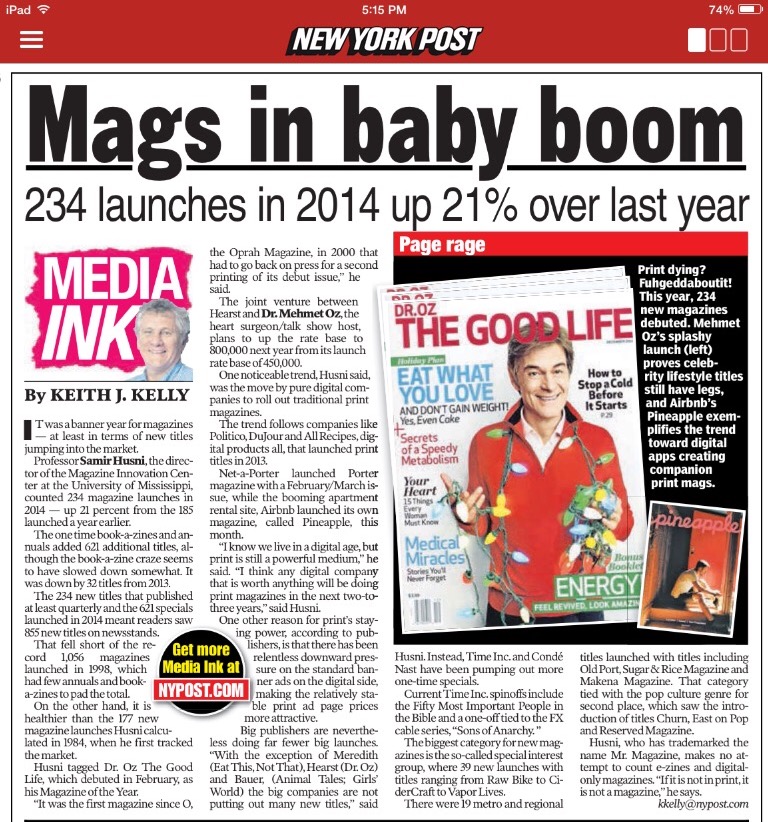
2014 by the numbers: There were a total of 855 new magazines published in 2014. The new crop of magazines was divided into 234 magazines with an intended frequency and 621 specials, annuals and book-a-zines.

2013 by the numbers:
There were a total of 838 new magazines published in 2013. The new crop of magazines was divided into 185 magazines with an intended frequency and 653 specials, annuals and book-a-zines.

The total number of magazines published in 2014 with a frequency represents an increase of 49 titles which is an increase of 21% in the number of new titles compared to those published in 2013. The total number of specials and book-a-zines decreased by 32 titles.

By the categories: The top ten categories among the magazines published with a regular frequency in 2014 are:

The interview with Samir "Mr. Magazine™" Husni as it appeared in the New York Post.

The interview with Samir “Mr. Magazine™” Husni as it appeared in the New York Post.

o Special Interest Publications: 39 – Examples: Raw Bike, CiderCraft and Vapor Lives

o Metro and Regional: 19 – Examples: Old Port, Sugar & Rice Magazine and Makena Magazine

o Pop Culture: 19 – Examples: Reserved Magazine, Churn and East on Pop

o Crafts and Hobbies: 15 – Examples: Knit Purl, Mollie Makes (U.S. Edition) and Hoop-la

o Children’s: 10 – Examples: Peppa Pig, Bible Fun for Children and Animal Tales

o Sports: 9 – Examples: All Things Sports, Maroon and Chicago Football

o Art and Antiques: 9 – Examples: Acrylic Artist, Artists & Makers and Art on Cuba

o Fashion: 7 – Examples: Porter, Eyelash and No Tofu

o Gay and Lesbian: 7 – Examples: Lei, Winq. and Men Addicted

o Health and Wellness: 7 – Examples: Mantra, Naturally, Danny Seo and Dr. Oz The Good Life

And now the Mr. Magazine™ exclusive interview with Mr. Magazine™… please enjoy!

The Story Behind the Numbers

Samir Husni: How do you know that you have every new magazine?

Mr. Magazine™: I don’t… these numbers are for the titles that I was able to acquire and have in my possession. I only include in the numbers the magazines that I have physical copies of. I am sure there are some local and regional magazines that I did not find or acquire. Also, when I hear about a new magazine that is not available on the newsstands, I do not include it in the count. For example, the new travel magazine Pineapple was published in Dec. but I do not yet have a physical copy of the magazine, so it is not included in the numbers. So, needless to say my numbers are the minimum number of magazines published.

SH: What magazines are included in your numbers?

MM: First and foremost my definition of a magazine is a printed product. It must be a print entity to be included in the numbers. The numbers are then divided between those magazines that are published with the intention to appear four or more times on the stands, and those that are specials or a one time publication. All the magazines included in my numbers are distributed on the nation’s newsstands with a U.S. bipad and UPC code.

SH: Where can we find a list of all the magazines?

MM: I publish a monthly update on my http://www.launchmonitor.wordpress.com blog where the cover of each and every new title I acquire is presented.

SH: How long have you been tracking the new magazines?

MM: It started as a hobby in Lebanon at a very young age. I used to buy every new magazine and every possible issue afterward of the new magazine. When I arrived in the United States in 1978 to pursue my graduate studies, I immediately knew that on a student’s budget I couldn’t buy every issue of every magazine, so I opted for collecting only first editions. In 1985, I published my first Guide to the new magazines, and since then I never stopped.

Of course, now with a little better budget than I had as a student, I can buy more magazines and I can add to my collection of more than 30,000 new titles that I currently own.

SH: Magazines are becoming more and more expensive. How much do you spend on magazines annually?

MM: You know people think that I must receive my magazines for free and I do receive a lot of them gratis. But in addition to the free magazines, I still manage to spend close to $28,000 a year buying magazines… Well, at least those numbers reflect the magazines that I have receipts for…

SH: Besides being your hobby turned profession, why do you do this?
MM: Well, I am a firm believer in print and the power of print. I know we live in a digital age and all the digital gadgets that I own (plenty of them) are a testament to that. Yet, I also believe that there is something unique about print and its power and how it relates to human beings… As long as we have human beings we are going to have print.

nypost SH: What’s next for Mr. Magazine™?

MM: Well, putting my money where my mouth is, I am working on a new book/event that will celebrate the 30 most notable launches of the last 30 years. Some of those new magazines that were launched in the last 30 years have added life and longevity to the magazine and magazine media industry. It is yet more evidence that any industry that does not give birth is a dying industry. The magazine industry, with all its problems, is NOT a dying industry. New magazines are the life’s blood of the industry and this new book and event will celebrate those 30 titles and their stories of beating the odds and thriving in a digital age.

I also finished a new book with two of my colleagues that will be published this summer. The book, Audience First, covers all the media and aims to introduce new theories and practices for both professionals and students of the news media industry.

And of course, I will continue nourishing my hobby of buying, receiving and reading magazines… let the good life continue.

Happy New Year to all. Keep on magazine reading…

SH: Thank you. Same to all.

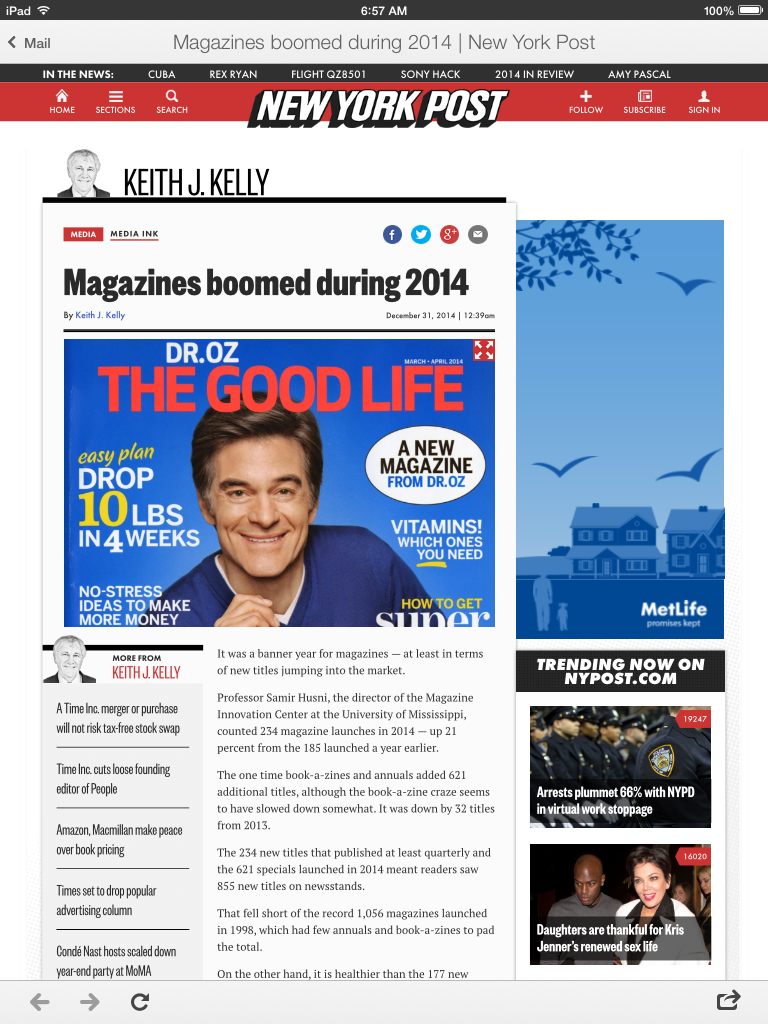
Editor’s Note: The numbers of new magazines were released exclusively in the New York Post in Keith Kelly’s Media Ink column yesterday, Dec. 31, 2014. Click here to read Keith’s column on the 2014 Magazine Boom.

h1

From Lebanon With Love: Preserving A Cultural History & Capturing The Joys Of Arabic Childhood Through Comic Books – The Mr. Magazine™ Interview With Henry Matthews, Collector & Comic Book Historian…

December 30, 2014

“I want to publish books and histories, which is really most important to me. And I do hope eventually, if I get funding, to start a center to preserve all children’s books and comic books in the Arab world.” Henry Matthews

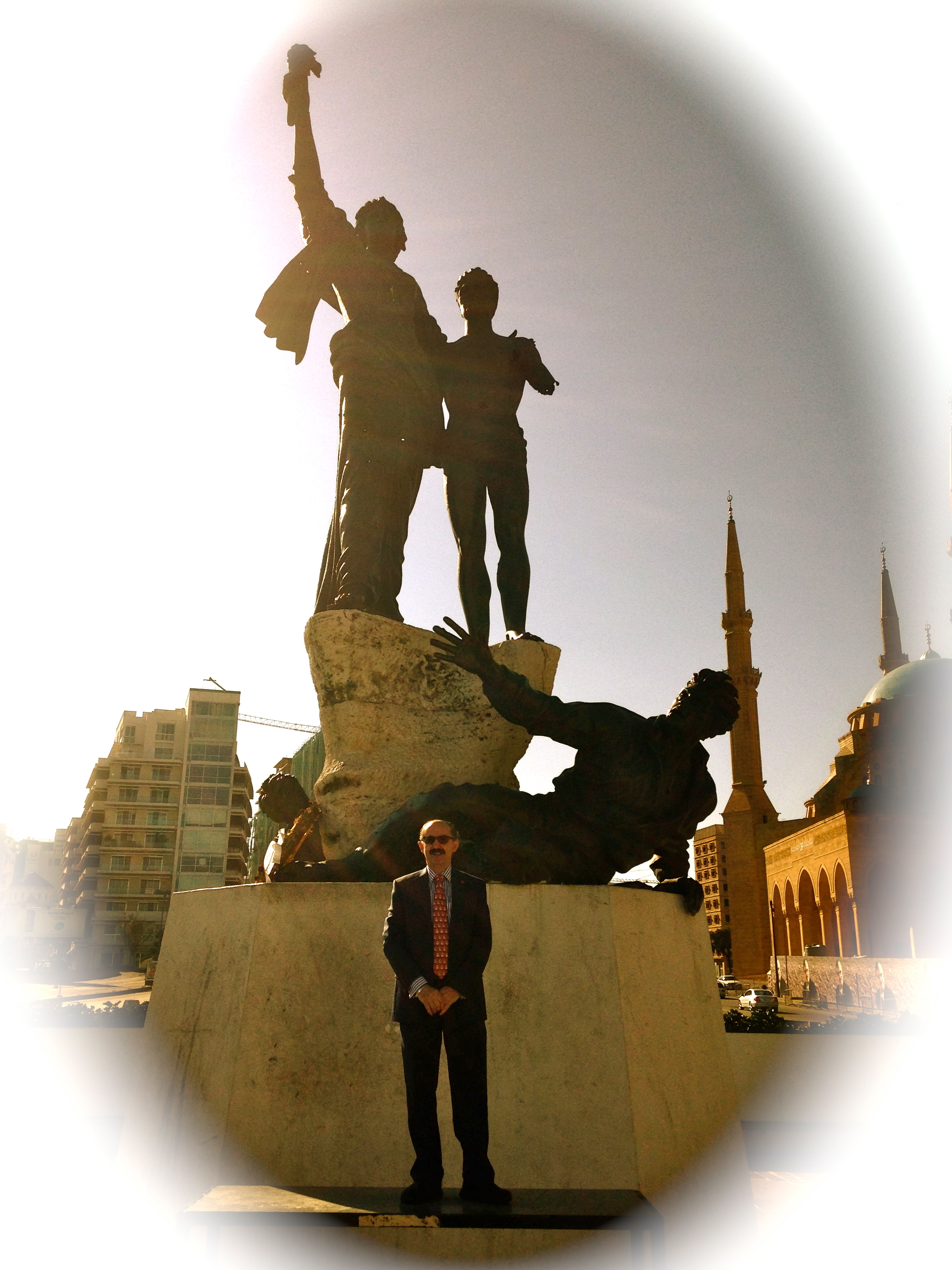
At Martyrs' Square in Downtown Beirut... Mr. Magazine™ Reporting...

At Martyrs’ Square in Downtown Beirut… Mr. Magazine™ Reporting…

Imagine a man who collects tens of thousands of comic books – can you envision such a person? And then can you imagine that person NOT being related to me? No, I couldn’t either.

Henry Matthews is a historian and collector of a multitude of Arab, French and American comic titles and also my cousin. A few years younger than Mr. Magazine™, Henry is the first person in my family that I’ve had the pleasure of “magazine-infecting.” His passion is palpable when he talks about preserving the Arab world’s culture through comic books.

On a recent trip back home to Lebanon, I visited with Henry and we talked about his ardor for comics and children’s books in general. The zeal for anything in magazine or book form certainly runs in the blood. Henry’s vision is to document each one of the comics and books in his collection and ultimately see the day when documentation centers for other countries and their cultures are erected so that children’s publications can be preserved for future generations. It’s a noble cause and certainly within the realm of possibility.

Our discussion was tightly focused around that possibility and the history of comics in the Arab world. I hope you enjoy our family conversation.

And now the Mr. Magazine™ interview with Henry Matthews, Collector & Comic Book Historian…

But first the sound-bites:


Henry Matthews

Henry Matthews

On how he began collecting comic books: My mother got me issue no. 7 of an Arabic comic book called Bissat El-Reeh, which is flying carpet in English. This magazine turned my life upside down. It was so beautiful that it was painfully beautiful.

On the progression his comic passion took him from day one until now: Eventually, with the comics, I decided that I wanted to keep them and ultimately preserve every single book for children, written books too that weren’t necessarily comic books. I think this was really a natural progression for me.

On the comic market in Lebanon and whether it is mainly a children’s genre there: It’s changing, but of course, it’s not as quick as in the Western world. But nowadays here, adults are reading comic books. But it is still, generally speaking, a genre for children.

On the most influential type of comic book in Lebanon:
If you want to look at what the reader wants, the young reader of comic books in the Arab world wants to be thrilled, to enjoy what they’re reading. This is what made Superman and Little Lulu in Arabic such great successes.

On Lebanon and whether it’s the center of comic publishing in the Arab world: Lebanon and Egypt were always neck-in-neck in the comics publishing competition. The beginning was with Egypt in the early 50s, well, even before that.

On how large his collection is: I have around 20,000 or 30,000 American comics and a similar number of Lebanese comics and I also have French comics and a limited number of other languages, like German and Japanese.

On what his plans are for his collection after he documents them:
I want to publish books and histories, which is really most important to me. And I do hope eventually, if I get funding, to start a center to preserve all children’s books and comic books in the Arab world, because there are no other kinds like we have.

On his thoughts for the future of comics and children’s publications in the Arab world:
I’m more optimistic than I was last year or the year before about comics. Of course, it will not be a widespread phenomenon like in the past, say the 60s or 70s, but we will have at least a small but solid contingent of comics’ readership and publications in the Arab world.

And now the lightly edited transcript of the Mr. Magazine™ interview with Henry Matthews, Collector & Comic Book Historian…

Samir Husni: Tell me a little bit about your beginnings. How did you start in the business of collecting comics?

Henry Matthews: My mother got me issue no. 7 of an Arabic comic book called Bissat El-Reeh, which is flying carpet in English. This magazine turned my life upside down. It was so beautiful that it was painfully beautiful. On the cover it had Aladdin riding high in the sky on a flying horse. I still remember the blue sky in the background and the stars; it was a beautiful cover. And it made me love comics in a passionate way. I started collecting then.

Samir Husni: The similarities between you and I are incredible. I fell in love with Superman at an early age, but I fell more in love with ink on paper than with the actual comics. You took the comic route and became an historian of Arabic comics in Lebanon and the rest of the Arab world. Describe that progression from day one when you fell in love with comics until today.

Henry Matthews: When I was a kid, I was always hearing about you. This very, for lack of a better word, eccentric guy who was my cousin, and collected all sorts of papers and magazines. (Laughs) I was becoming like you and everyone was telling me that I was the new Samir of the family. And of course, I loved it.

Indeed, I started only with comics, but I always wanted to collect other magazines, but it wasn’t possible because they were always getting thrown away. I had to just concentrate on comics because the other magazines were for grownups that my family received every week. My father was a good reader and loved his magazines. I always wanted to keep them, but they never let me. So, I was not very different from you.

Eventually, with the comics, I decided that I wanted to keep them and ultimately preserve every single book for children, written books too that weren’t necessarily comic books. I think this was really a natural progression for me.

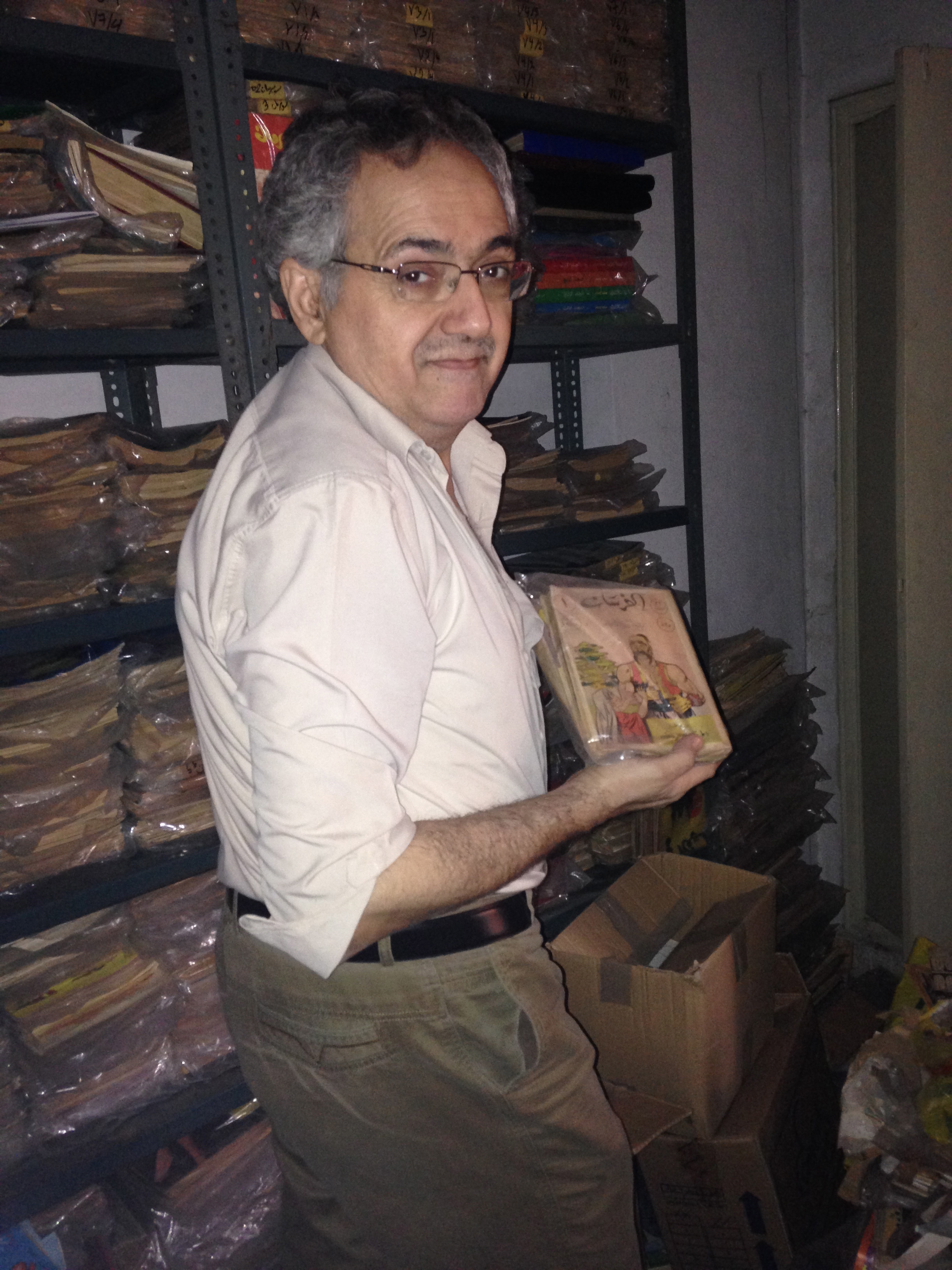
With Henry Matthews and his collection of comics.

With Henry Matthews and his collection of comics.

Samir Husni: You’ve published a few books and histories of specific magazines; how and what impact do you think preserving the comics in Lebanese and in the Arabic world, how does it reflect the culture and the changing atmosphere for children’s magazines since as far back as your collections go, which is the 1940s? How do you see this progression going and in the United States and Europe, a lot of the comics are read by adults; in Lebanon is the genre still mainly a children’s market or do you see a change in that market?

Henry Matthews: It’s changing, but of course, it’s not as quick as in the Western world. But nowadays here, adults are reading comic books. But it is still, generally speaking, a genre for children.

But you see new experiments, new publications of comic books that are just for adults. These are being published all around. But it is still a very limited change; it’s going to take some time to establish itself.

Samir Husni: What do you think, throughout history, say, the last century; what do you think has been the most influential comic books started? Because we have two types of comic books in the Middle East: we have those that were translated from the West, from France, Belgium or the States, and we have those that were founded in this region.

Henry Matthews: This has really been a continuing dilemma for every publisher because in the beginning, especially in the 50s and 60s, they always wanted to boast that their comics were homegrown. But the homegrown comics were not always of good quality or very well drawn.

If you want to look at what the reader wants, the young reader of comic books in the Arab world wants to be thrilled, to enjoy what they’re reading. This is what made Superman and Little Lulu in Arabic such great successes.

So it depends. If you’re trying to sell your comic books and you’re not funded by any party or government, you’ll have to find a way to interest young readers in your magazine. And the most interesting have always been the ones translated from the West, made in the U.S., Superman, Batman etc. the Superheroes.

Samir Husni: As you know, the magazine that ignited my passion and love for all magazines was Superman. But in your case, you concentrated more on the homegrown magazines…

Henry Matthews: Well, not really. When my passion started it was a mixture of homegrown comics and the translated comics from Belgium.

All through the history of comics in the Arab world, the homegrown comics were not really the issue. Typically, you had a lot of competition between translated comics that were started in the U.S. and French comics. Basically, this is where the real competition lay, because readers wanted something really enjoyable to read. And at the time the locally-made comics were not really made to the standards. So it was really a duel between the American comics on one side and the French and European comics on the other side. And the Americans won. (Laughs)

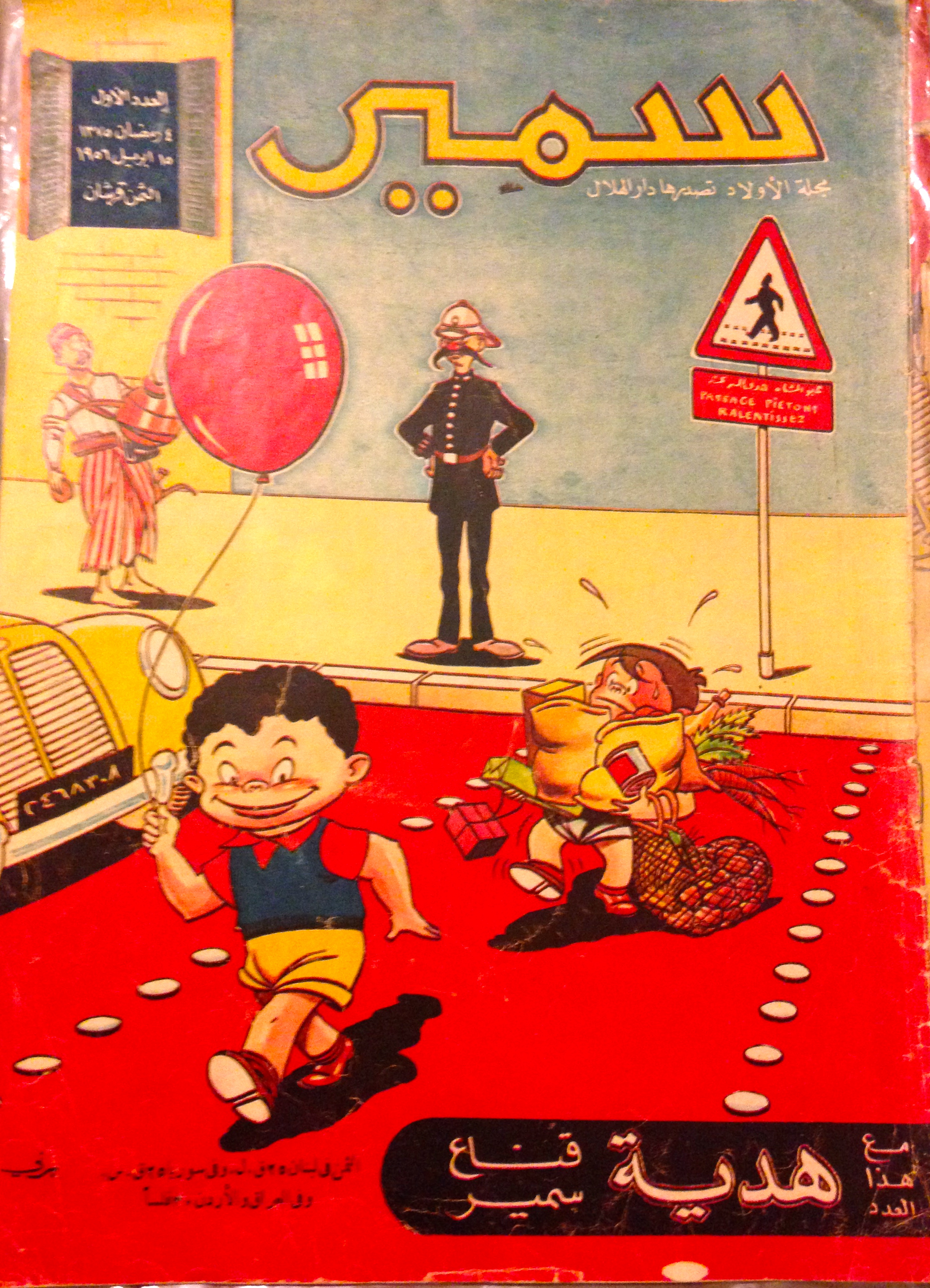
The first issue of Samir, the Egyptian comic magazine...

The first issue of Samir, the Egyptian comic magazine…

Samir Husni: What about the homegrown Egyptian comics? When I was growing up there was one called “Samir,” definitely named after me. (Laughs) And one called “Mickey” which was a Disney licensee. What was the first comic book that you can recall being published in the Arab world?

Henry Matthews: There was “Sinbad” which started even before “Samir.” And there were other experiments that didn’t last long. For example, there was “Ali Baba” and even comics which tried, in Egypt, to use stories from the movies. They would take a cowboy movie, run a summary of it and put pictures of the movie along with the comics they were including. These comics could have been “The Phantom” or war comics, for example. So this happened even before “Samir” started publishing. I’m talking about around the 1940s or early 1950s.

When I saw the first comic book in the Arab world, “Samir” was the first one to have great success and that was a great advantage for it. And it continues to this day.

“Samir” and the period we’re talking about included a mixture of locally-made comics and translated American comics. “Flash Gordon” for example. And there was one guy who drew comics in “Samir” that were superbly beautiful “Flash Gordon” comic strips and you would have thought they came straight from the States. But he was a local artist who did them. And in “Samir” you had guys drawing comic strips from Western and American heroes, but they were locally-made. This is one of the interesting points of history.

Samir Husni: “Samir” was published in Egypt. Did Lebanon ever become the center for comic publishing?

Henry Matthews: Lebanon and Egypt were always neck-in-neck in the comics publishing competition. The beginning was with Egypt in the early 50s, well, even before that. They started “Sinbad” magazine in Egypt in 1952 and it was quite a successful experiment. It lasted for 9 years.

It was “Sinbad” I think that affected publishers in Lebanon. In 1955, you had publisher, Laurine Rihani in Lebanon, who started doing Dunia Al-Ahdath. It was the first Lebanese comic book and it was the same format as “Sinbad,” and a little bit like it.

Just like with “Sinbad”, it took a few issues to get things started with comic strips in Lebanon. Their main problem was, in Egypt and in Lebanon, they wanted to convince schools that these publications were good for the children, so they had to include something like grammar, dictation and curriculum material with the comic books to make them palatable for the schools’ administrations. And this is what happened with Al-Ahdath.

So, in the beginning you only had a few pages of actual comics and many pages of text.

Samir Husni: Tell me about your collection. I see boxes and boxes and boxes. (Laughs) It’s a scary reminder of my own office.

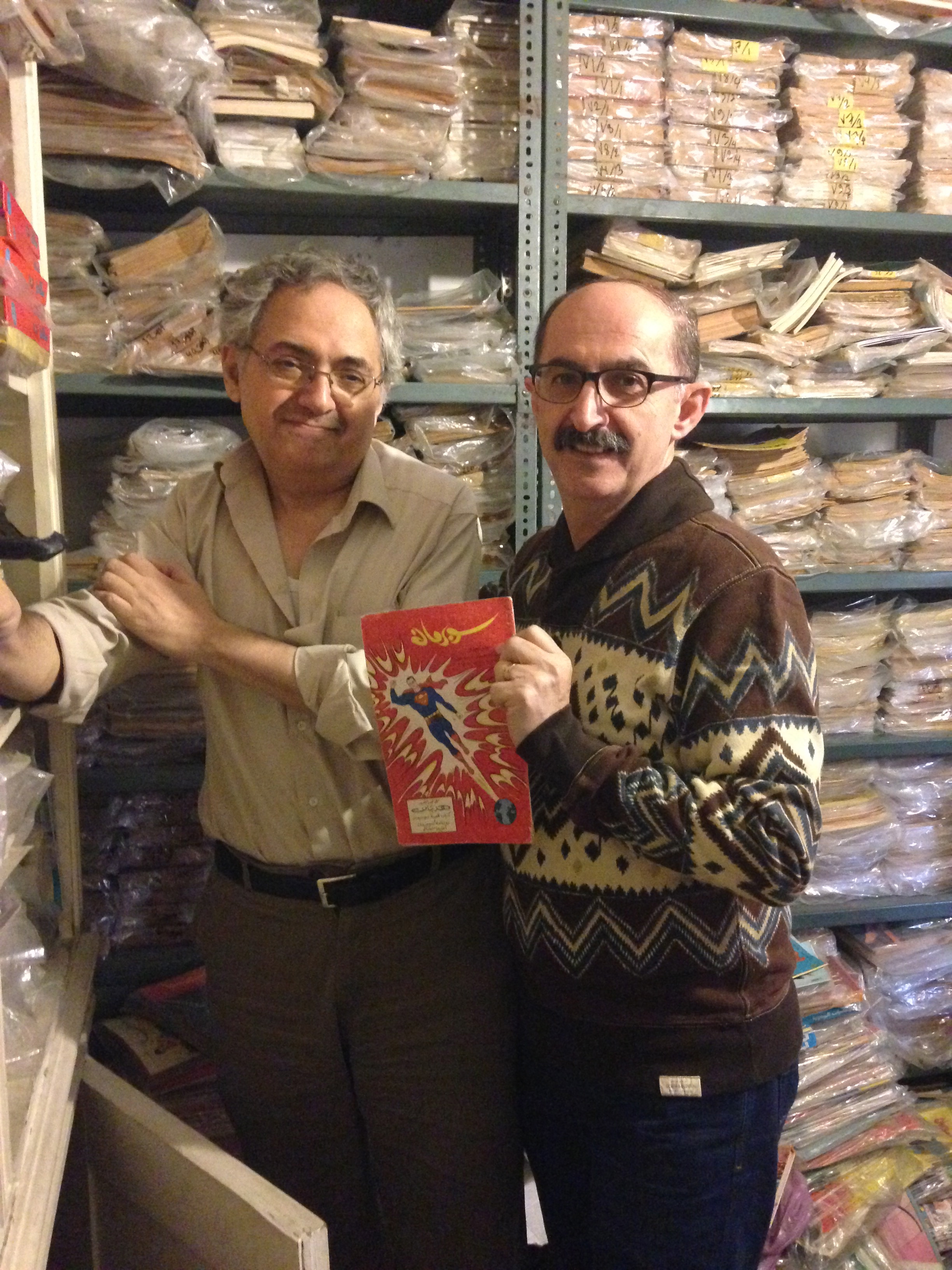
The first issue of Superman in Arabic, one of Henry Matthews prized possessions...

The first issue of Superman in Arabic, one of Henry Matthews prized possessions…

Henry Matthews: Let me put it this way, I’m determined and passionate and I’m also stubborn and this effort of classifying my collection has been going on for 7 or 8 years. I’ve been collecting for 50 years and no matter what I do, I have to do the classification myself. So, it takes a lot of time and effort. But it has to be done.

Basically, I concentrate on comics and children’s books, but I also have other collections of stories. For example, you know Arsène Lupin, a very famous French gentleman thief, was such a popular character in the Arabic publications that you have thousands and thousands of titles about Arsène Lupin in Arabic, much more than what was published about him in France.

In Egypt and then later in the Arabic world, every single publisher had to start a line for Arsène Lupin if they wanted to have some kind of success. And sometimes I think they even got stories that were not originally starring Arsène Lupin and they made him the hero anyway.

So, although we did not have Arsène Lupin in Arabic comic books, every week, even during WWII, we had Egyptian publishers producing at least 10 or 12 issues for Arsène Lupin. So, this is the history that I’m trying to preserve. Not just the comics, but also those imaginary heroes of stories which really were attractive to the Arab masses in the mid-twentieth century.

Samir Husni: How large is your collection?

Henry Matthews: It’s not as large as I want it to be. (Laughs) I want it to be as large as possible. I have around 20,000 or 30,000 American comics and a similar number of Lebanese comics and I also have French comics and a limited number of other languages, like German and Japanese.

Samir Husni: What’s your most prized possession among all of your comics?

Henry Matthews: I’m not thinking of monetary value. I don’t have any very rare American comic, that’s not what I’m thinking of, but what I am thinking of is how easy it is to find a comic. For example, if you have the right amount of money you can always find the American comics that you want to buy. You have to pay a lot, but you can get them.

The first issues of Superman and these are really my prized possessions, if you lose an issue of colors, you cannot find it anymore, because no one really bothered to preserve them. This is the main difference between the Arab world and the Western one, especially in the U.S. There they preserve the comics and have an industry based on buying old comics and collecting them. Here it’s a fairly new trend. So, a lot has been lost and I’m trying to document all this.

Samir Husni: And what’s your plan after you finish documenting all of them? What do you want to do with them then?

Henry Matthews: Well, I want to publish books and histories, which is really most important to me. And I do hope eventually, if I get funding, to start a center to preserve all children’s books and comic books in the Arab world, because there are no other kinds like we have. And what I really hope, of course this is fantasizing, I really think what should be done is every country and every culture should preserve its publications for children. And this should be adopted by UNESCO (United Nations Educational, Scientific and Cultural Organization) so that in every country there will be a UNESCO documentation for children’s publications, from past to present.

You would end up around the world with many UNESCO centers for documenting children’s publications in their native languages.

Samir Husni: We live in a digital age; do you think the digital revolution is going to help that preservation or hurt it?

Henry Matthews: Let me put it this way, in Lebanon there was a time when we felt that there was nobody reading anymore, but recently they had an Arab book fair in Beirut, it ended a few days ago, and I was amazed when I discovered that people were flocking to it and buying books, even more than before. I think now the trend is changing, people are buying books again.

Last year was different, the year before that it was absolutely zero almost. But now people are buying books and magazines and also buying a lot of comics. You would be amazed at how people sort of compete to buy what they want. This was unheard of in the past. Now people just want to buy beautiful magazines and books, especially children’s books. Everybody is printing in the best, most colorful way, with very attractive covers and artwork. I think it’s a booming business in Lebanon now.

Samir Husni: What do you think the future holds for children’s magazines and books?

Henry Matthews: I’m more optimistic than I was last year or the year before about comics. Of course, it will not be a widespread phenomenon like in the past, say the 60s or 70s, but we will have at least a small but solid contingent of comics’ readership and publications in the Arab world.

And my hope, for example, is to establish a comic’s documentation center. It will not just be to preserve the comic books, but to digitize them and that way someone could be sitting in their home, for example, and could go to the website of the center and access the old magazines, maybe 70 years old, that you want to look at and see it all on the website. This is what I hope to achieve.

Samir Husni: As they told me in Russia, the problem with digitizing material now is that every few years you have to update the whole computerized system. While you have books and magazines from hundreds of years ago that still exist and do not need to be updated.

Henry Matthews: Of course, it was much simpler then. If you think of the possibilities, a virus attack for example, you could end up losing all of your material. Even if you back everything up, it’s still a scary thought.

Samir Husni: What’s your current position; what’s your real job? (Laughs)

Henry Matthews: (Laughs too) I’m editor in the information office of the American University of Beirut (A.U.B.) and I’ve been there since 1985. And I love it. Even during the war, I’d risk my life to go there and I remember the shells falling and I’d still want to stay. I’d document all as a journalist and publish it in the University newsletter. And I’m still working there as an editor. It’s always been one of my passions.

I tried to convince them to start a history office, an office of A.U.B history, much like NASA History Office, for example. I wanted A.U.B to have a history office documenting just A.U.B.

My other passions are space exploration and aviation and I also paint. I’m a painter. And if I have anything left during the day, I use it to organize my collections.

Samir Husni: Thank you.
h1

It Is The Season…

December 24, 2014

It is the season… for weekly magazines to offer double issues combining the last week of the current year with the first week of the coming year.

The European Christmas edition vs. The American Holiday edition

The European Christmas edition vs. The American Holiday edition


But, it seems that naming the season remains a “politically correct” issue. Whilst we’ve seen plenty of magazines in the United States returning to use the word “Christmas” on their covers rather than “Holiday,” the folks at The Economist would rather stay politically correct with their American readers.

The “Christmas Double Issue” arrived at our shores edited to read the “Holiday Double Issue.”

Well, here’s to all, a wish from Mr. Magazine™: Merry Christmas, Happy Holidays and the best of the New Year.

h1

Maria Rodale, Randall Lane and Some From the Vault Mr. Magazine’s™ Manifestos… All In This Week’s Mr. Magazine™ Monday Morning…

December 22, 2014

72bcbe4a-fc48-43d0-9044-8939edc89d83
The new double issue of the Mr. Magazine™ Monday Morning is out. Click here to read the issue.