There is a sign that has hung over my office for many, many years. Its message is simple and straightforward: There is hope.
And if you have a modicum of positivity beating within your chest at all, you’ll agree that there is always hope in every situation.
Unless you’re just absolutely convinced that the world and everything in it, including yourself, is irrefutably lost, there is always hope.
And even in that particular case, if you dig deep enough and reach beyond your negativity to that inner light that was placed inside you the moment you took your first breath, you’ll find that tiny “thumbs-up” that always promises a better day ahead.
When it comes to magazines and magazine media, never in my 30-plus years of experience has that statement ringed more true.
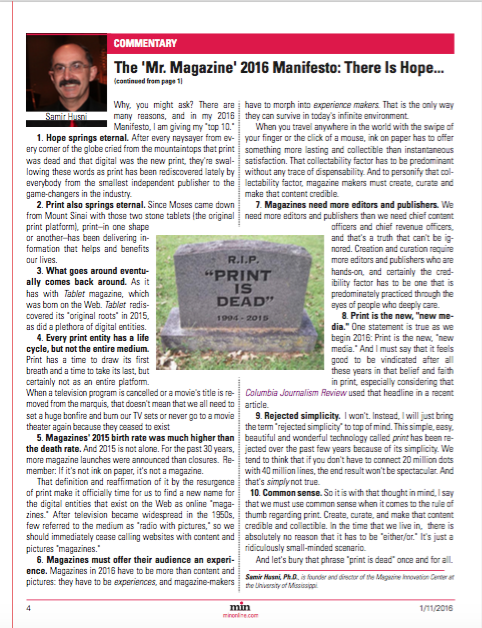
Why, you might ask? There are many reasons, and in my 2016 Manifesto, I am giving my “top 10.”1. Hope springs eternal. After every naysayer from every corner of the globe cried from the mountaintops that print was dead and that digital was the new print, they’re swallowing these words as print has been rediscovered lately by everybody from the smallest independent publisher to the game-changers in the industry.
2. Print also springs eternal. Since Moses came down from Mount Sinai with those two stone tablets (the original print platform), print–in one shape or another–has been delivering information that helps and benefits our lives.
3. What goes around eventually comes back around. As it has with Tablet magazine, which was born on the Web. Tablet rediscovered its “original roots” in 2015, as did a plethora of digital entities.
4. Every print entity has a life cycle, but not the entire medium. Print has a time to draw its first breath and a time to take its last, but certainly not as an entire platform. When a television program is cancelled or a movie’s title is removed from the marquis, that doesn’t mean that we all need to set a huge bonfire and burn our TV sets or never go to a movie theater again because they ceased to exist
5. Magazines’ 2015 birth rate was much higher than the death rate. And 2015 is not alone. For the past 30 years, more magazine launches were announced than closures. Remember: If it’s not ink on paper, it’s not a magazine.
That definition and reaffirmation of it by the resurgence of print make it officially time for us to find a new name for the digital entities that exist on the Web as online “magazines.” After television became widespread in the 1950s, few referred to the medium as “radio with pictures,” so we should immediately cease calling websites with content and pictures “magazines.”
6. Magazines must offer their audience an experience. Magazines in 2016 have to be more than content and pictures: they have to be experiences, and magazine-makers have to morph into experience makers. That is the only way they can survive in today’s infinite environment.
When you travel anywhere in the world with the swipe of your finger or the click of a mouse, ink on paper has to offer something more lasting and collectible than instantaneous satisfaction. That collectability factor has to be predominant without any trace of dispensability. And to personify that collectability factor, magazine makers must create, curate and make that content credible.
7. Magazines need more editors and publishers. We need more editors and publishers than we need chief content officers and chief revenue officers, and that’s a truth that can’t be ignored. Creation and curation require more editors and publishers who are hands-on, and certainly the credibility factor has to be one that is predominately practiced through the eyes of people who deeply care.
8. Print is the new, “new media.” One statement is true as we begin 2016: Print is the new, “new media.” And I must say that it feels good to be vindicated after all these years in that belief and faith in print, especially considering that Columbia Journalism Review used that headline in a recent article.
9. Rejected simplicity. I won’t. Instead, I will just bring the term “rejected simplicity” to top of mind. This simple, easy, beautiful and wonderful technology called print has been rejected over the past few years because of its simplicity. We tend to think that if you don’t have to connect 20 million dots with 40 million lines, the end result won’t be spectacular. And that’s simply not true.
10. Common sense. So it is with that thought in mind, I say that we must use common sense when it comes to the rule of thumb regarding print. Create, curate, and make that content credible and collectible. In the time that we live in, there is absolutely no reason that it has to be “either/or.” It’s just a ridiculously small-minded scenario.
And let’s bury that phrase “print is dead” once and for all.
Archive for the ‘News and Views’ Category

There Is Hope: Samir “Mr. Magazine™” Husni’s 2016 Manifesto. Published In min: Media Industry Newsletter 1/11/2016 Issue.
January 10, 2016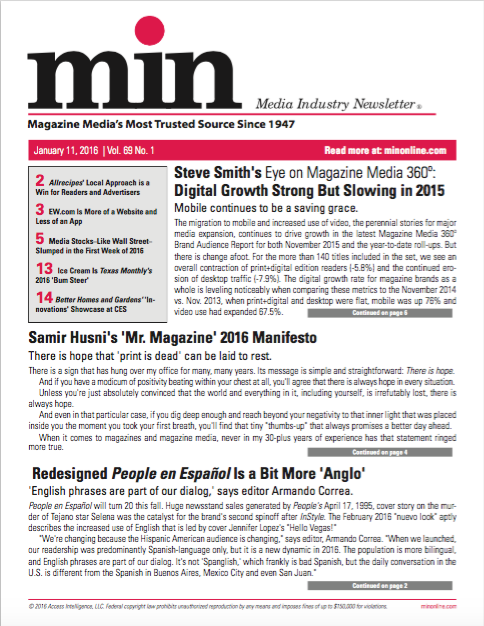
The Power and Future of PRINT…Part IX As told by Magazine and Magazine Media Makers…
January 9, 2016A Mr. Magazine™ “Quotable” Retrospective…
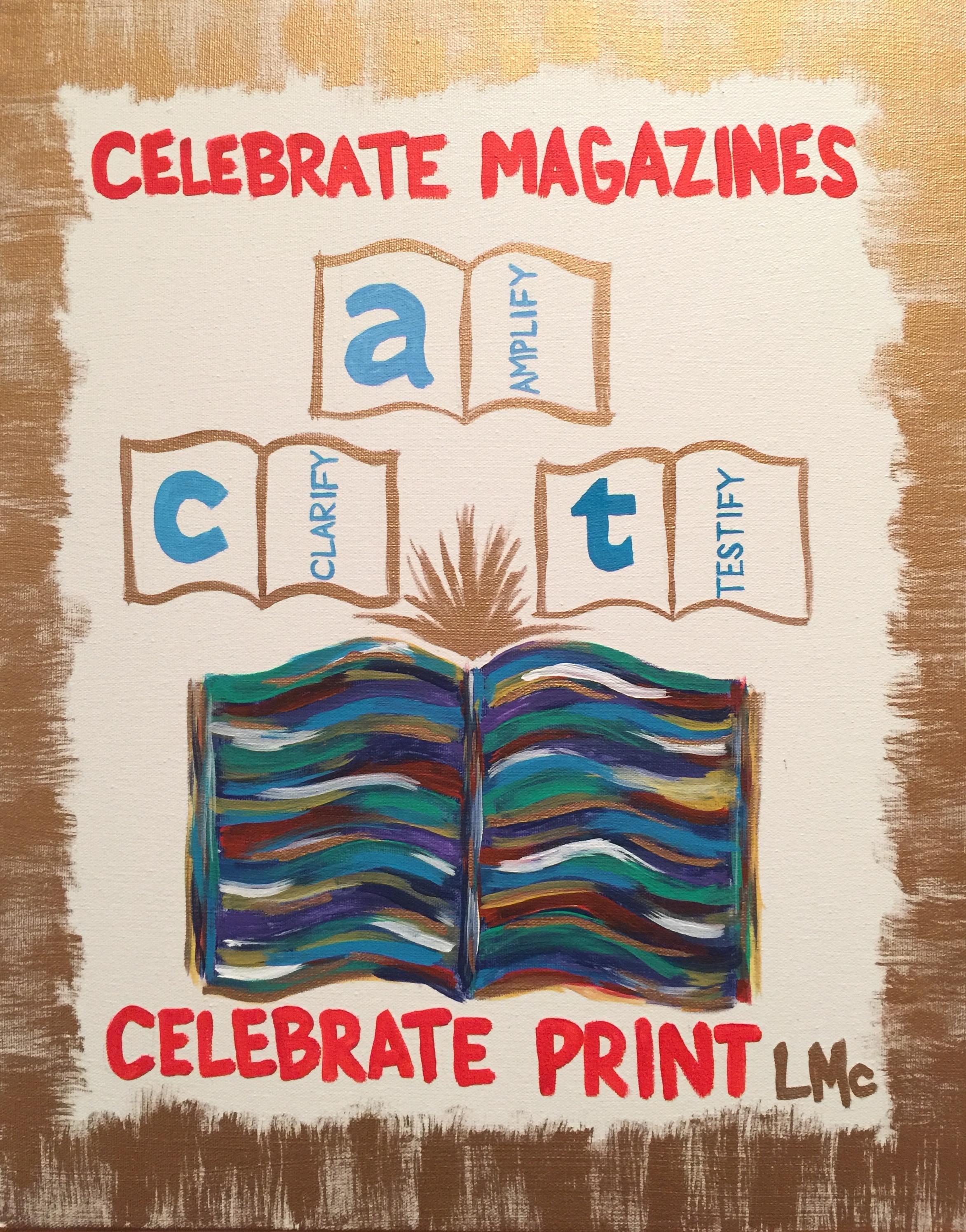
Celebrate Magazines Celebrate Print. The theme for ACT 6 Experience that takes place April 20 to 22, 2016. Painting by and © Laura McCrory.
For information about the ACT 6 Experience email me at samir.husni@gmail.com
I have been a firm believer in print and its power even when many doubted its future and even its role in today’s media world. I have been quoted as saying, “As long as we have human beings, we will have print.” And that quote stands firm and true as we enter into a brand New Year.
Of course, I’m not oblivious to the fact that we live in a digital age…just check the many devices you and I are using on a daily basis, even the platform that you’re reading this on now as we connect. Yet that did not deter my belief in the role and future of print. Nor, will it ever.
However, as an academic and a professor of journalism, I’d rather share with you what others from the field say about the future and the role of print in today’s media world and tomorrow’s; that way it isn’t just my word you’re hearing and reading. Never would I yearn to be lumped in with others who pontificate to high heaven with their opinions and speculations for the condition of magazines and magazine media; be it print or digital or any other platform that may arise before I can finish writing this. The blah-blah-blah disease spreads pretty fast on its own, without any help from Mr. Magazine™
And so without any further ado, here is the ninth installment of the 136 quotes (in random order) that Mr. Magazine™ has accumulated over the last two years through the wonderfully informative conversations I have had with the game changers and the passionate entrepreneurs in the magazine industry.
129. “The excitement that comes and builds on Instagram and all of the posts that we re-Gram, the day the issue arrives; these consumers stage little photo shoots the day their magazine gets there because it is their time, when they’re online looking for recipes, that’s not me-time, that’s family-prep time. They’re working. When they sit down to go through Southern Living magazine that is time that they’ve decided to set aside for them every single month. They really lose themselves in the pages of Southern Living and I can’t think of a better time for advertisers to reach them than during their me-time.” (on the advantage of having a printed magazine in this digital age) Ron King, Publisher, Southern Living.
130. “I think magazines are different; there’s a different creative concept; a different mix of text and graphics. Something that makes one plus one equal more than two and that’s something that maybe magazines can’t do as fast as electronic media can do, but there are things that magazines can do that aren’t just replicated online. And then there’s the more basic answer; you get better writing.” Jack Kliger, Publisher, Tablet magazine.
131. “I think that print has been wildly underestimated. The Internet came along and people imagined that it was a tool to be used for every single thing in their lives. But it’s not a tool for everything in their lives; it’s a tool for some very important things in our lives like news or information, information that we need for our daily lives, but I don’t necessarily know that the Internet is the right medium for deeper reads.” Alana Newhouse, Editor-In-Chief, Tablet magazine.
132. “And how not to burn out at it, if you’re small, just one or two people, how do you keep it fresh? I think that is one of the big challenges with digital media. It reminds me of going to a sushi place, where they have these little rivers and they do their California rolls and put them on floating plates and you sort of grab the little bites as they go by; to me digital media often feels like that. It’s just not sustaining from a reader’s standpoint. And that was a lot of the impetus for wanting to do print, because the relationship between the reader and the words is different. It feels like it sates you and fills you up better.” Steve Casimiro, Founder, Adventure Journal Quarterly.
133. “I am a big believer that there is this turning point now or in the very near future where people are being reminded of the luxury of reading offline. I know that myself, because when I’m online I have this low level of anxiety that comes with reading online because I feel like I can never get to the end of what’s ahead. There’s just endless information and I’m forever bookmarking things and saying I’ll come back to that later. And I do think there is this return to print and what that brings is you’ve invested some money, say $15, it’s not cheap, you’ve invested the money so you’re going to stop and make some time.” Rick Bannister, Co-Founder, Pallet magazine.
134. “We’re also not interested in objects that are just throwaways. We’ve spent so much time in this content and so much of ourselves; the idea of putting that in a magazine that people would toss and not keep around for a long time as something that they cherished just didn’t sit right.” (on why they wanted the magazine’s production values of the highest quality) Nadia Saccardo, Co-Founder, Pallet magazine.
135. “We see the website as just growing into a community for the people who believe in the magazine and in craft beer and who want to find each other. And that’s why I love the fact that the website isn’t just regurgitated content that we expect people to be holding in their hands; it’s something complementary to that content.” (on the magazine’s content and the website’s content being totally different) Sam Calagione, Founder & President Dogfish Head Brewery & Pallet Executive Editor.
136. “I think they both (print and digital) have their own advantages, but with print you feel more relaxed and I have to tell you the truth; I only read news digitally, but I really don’t have the time to read long stories onscreen. It’s nice, but I don’t have the time; it’s tiresome. But in print, I love to read the longer stories. And I think that’s the advantage of print; you just relax. I know that sounds cliché, but it’s true. I’m more relaxed when I have a hard copy; it’s so tactile.” Fermin Albert, Founder, Sabor magazine.
These 136 quotes are from some of the most notable leaders in the industry, who lead some of the most prestigious publishing companies around today. There are also quotes from up and coming leaders whose talent and passion for magazines (ink on paper, of course) knows no boundaries. And that’s why their vision is so important to the industry’s future. Supporting them and the print platform is an obligation that’s paramount to those of us who love the medium.
Until next time – Happy 2016 and remember to Celebrate the Power of PRINT …
All the best,
Mr. Magazine™
The Power and Future of PRINT…Part VIII As told by Magazine and Magazine Media Makers…
January 8, 2016A Mr. Magazine™ “Quotable” Retrospective…
Celebrate Magazines Celebrate Print. The theme for ACT 6 Experience that takes place April 20 to 22, 2016. Painting by and © Laura McCrory.
For information about the ACT 6 Experience email me at samir.husni@gmail.com
I have been a firm believer in print and its power even when many doubted its future and even its role in today’s media world. I have been quoted as saying, “As long as we have human beings, we will have print.” And that quote stands firm and true as we enter into a brand New Year.
Of course, I’m not oblivious to the fact that we live in a digital age…just check the many devices you and I are using on a daily basis, even the platform that you’re reading this on now as we connect. Yet that did not deter my belief in the role and future of print. Nor, will it ever.
However, as an academic and a professor of journalism, I’d rather share with you what others from the field say about the future and the role of print in today’s media world and tomorrow’s; that way it isn’t just my word you’re hearing and reading. Never would I yearn to be lumped in with others who pontificate to high heaven with their opinions and speculations for the condition of magazines and magazine media; be it print or digital or any other platform that may arise before I can finish writing this. The blah-blah-blah disease spreads pretty fast on its own, without any help from Mr. Magazine™
And so without any further ado, here is the eighth installment of the 136 quotes (in random order) that Mr. Magazine™ has accumulated over the last two years through the wonderfully informative conversations I have had with the game changers and the passionate entrepreneurs in the magazine industry.
113. “I recently returned from England where I had the opportunity to interview the owner of the best manufacturer of large scale model automobiles on the planet. Their models are highly detailed works of art that are custom made for automobile enthusiasts, car manufacturers and race teams. It was during my interview when I asked him what else he had done, to which he replied he had also built industrial scale models of everything from drilling platforms to office buildings for one of the largest commercial architectural firms in the U.K. He then paused and flippantly said that in the design phase, the firm’s customers really preferred his scale models over the 3D digital renderings. He went on to explain that these models were something tangible that the client could touch and feel and see and therefore felt they could trust. I laughed and told him it sounds a lot like the magazine business.” Ron Adams, Founder & Publisher, Via Corsa magazine.
114. “We kind of struggled with that in the beginning, because obviously our age demographic is a digital age group: 18-39. They’re engaging with mobile more than anything, but what we wanted to start with was something really tangible. So, at the base level we wanted it to be something that when you’re in a waiting room, you could find it on the table and you could see it, experience it and actually hold it in your hand.” (on why they decided on a print publication instead of digital-only), Sarah Hubbard, Marketing Director, Out Living It magazine.
115. “A lot of people say that print is declining and digital is the thing these days, but I think there’s still a huge demand for print and I think because the barrier of entry to digital is so low there’s just so much stuff out there that a lot of people like the fact that we have a real print magazine that’s 150 pages and it’s in real bookstores. That could be the one thing, there are competitors out there and there is very little barrier to entry for digital magazines, but I think if we just continue to put out a really good publication and focus on business, we’ll be fine.” Greg James, Publisher, Marijuana Venture magazine.
116. “Could the magazine exist without a print edition? Yes, I guess so. But I know that our readers love the tactile experience of getting a bound magazine in their mailboxes every month. And our subscription sales have been strong. But beyond that, just seeing how our Real Women Style Award winners circled back to our September issue and are on the cover of the magazine is enough to convince you of how much print matters. We unveiled it to one of the winners the other day and she had tears in her eyes and couldn’t believe she was on the cover of a magazine. I think that sums up why print is still an incredibly special medium.” Meredith Rollins, Editor-in-Chief, Redbook magazine.
117. “I think print is the most powerful medium. I think it’s an engagement opportunity for consumers to be hands-on (no pun intended) and connected with the content. I’ve been a magazine fan since high school; I believe in print and always will believe in print. It’s something that you can take with you and have an intimate experience with. The photography is bold; the typography is modern and continues to change. It’s something that you can take with you no matter where you are, from the beach to the boardroom, onboard a boat or onboard a plane; it can go with you everywhere. There’s no place that you can’t take a magazine.” Louis Coletti, Associate Publisher, Luxury Advertising, ShowBoats International magazine.
118. “We enter our 120th year in 2016. The reason House Beautiful has been successful for that many years is because of the stories. This is what you can still turn to print magazines for; you have the luxury of dealing with experts, in fact-checking articles, in creating a photo shoot whole cloth, something brand new to show the reader. This is indulgent in this day and age. Content moves fast and there’s great demand in the digital space to do more and more and more. And I’m sitting here asking: how do I do less better? I want to create the richest, most indulgent experience. This is a chocolate mousse; this is a special treat. And our readers recognize that. I think a great deal about every inch, every page of that magazine. I want to make sure it’s the best that it can be.” Sophie Donelson, Editor-in-Chief, House Beautiful magazine.
119. “Looking at the realities of the business now, I can’t imagine the print product going away in the next 10 years, because frankly too many people want it and it makes too much money. It’s such a gigantic part of our business and just based on consumer demand; I don’t think it’s going to go away.” Jess Cagle, Editorial Director, People magazine.
120. “I believe that magazines will never die. I really do believe that. I think that they will transform and continue to evolve, as they have forever. I believe that black magazines will continue. I think that we will continue to have unique challenges, but also unique successes. Again, as long as the black experience remains a distinctly unique one from the “American” experience, per se, there will be a market for a particular lens. There will be a market for a particular perspective. And I think when you understand that; you understand that black magazines will always have a certain impact. And as you said, the reason there was such a reaction (to the August cover of Ebony) may very well be in part due to the fact that this statement was made on paper.” Kierna Mayo, Editor-in-Chief, Ebony magazine.
121. “In the day and age of “print is dead” we really feel that there’s still a place for print. I work with a group of very young editors who still love print and who still value print. We still believe that if you create something that is well done and artfully put together and you produce it with good, high-quality, there is still a place for print. Print is not dead exclamation point.” Pamela Jaccarino, Editor-in-Chief, Luxe Interiors + Design magazine.
122. “It’s exciting to see your work in both formats, (print & digital) but in different ways. Having said that; I’m not sure how to describe to you how it’s different. I guess the web is more immediate and it generates that immediate, sort of social media response. But seeing your byline in print, on the printed page, it’s like your work is going into a permanent record. And I would think a lot of writers would say the same thing. It’s thrilling in both places for those different reasons.” Lauren Clark, Editor-in-Chief, Take magazine.
123. “The biggest challenge has been, with certain people, to counter this belief that print is on its way out, rather than saying that print is evolving. In our Kickstarter video and with people who have these mindsets, we sort of describe ourselves as being the modern magazine. And that what’s going to be interesting is not whether it’s print or digital. We have a print edition and an online edition that work together. You can get certain information from our online source that doesn’t translate into print, like video and audio, and you can get information through our print edition, such as really beautiful photography, stories that demand to be on the printed page, that doesn’t translate digitally. And that’s where this industry is going; print is not going away.” Michael Kusek, Publisher, Take magazine.
124. “And I think that no matter what happens people are always going to be thirsty for good reads and information. I know that I have romanticized visions of print because I’ve worked in it for my short career after college, the last 12 years, but I just think that print is the perfect medium for this type of project. I don’t think this same project would work online, with the book type thing going on. I just don’t think people want to read 6,000 word features online or on their phones. They want to read short, punchy things and to not take anything away from a lot of current magazines, but my opinion is that a lot of magazines are trying too hard to be like the web, shortening down their content, making columns that are super, super short and blog-like, using hashtags and @ symbols.” Brandon Hayward, Publisher & Editor-in-Chief, The Bight magazine.
125. “Print is not going away. Print is the necessary part of this business because that’s where the lion’s share of revenues comes from, but the big guys who are the innovators in the printing industry; they understand that the publishers want to make money and they need to make money. And I think that we have a model that’s flexible enough for them to really test and figure out what will work in their market.” Larry Genkin, Founder & CEO, Eleven Media.
126. It’s not self-help; we’re not a trade vehicle, something that’s designed to help you with the day-to-day running of the business necessarily. But what you have is a lot of people who believe in the power of good journalism to move society forward, to help good ideas rise to the top and to help uncover negative issues when those arise. And I think the cohering DNA of anybody who works at Quartz, whether you are on the editorial, engineering, or marketing teams, is a desire to figure out a way to make high-quality, intellectually rigorous journalism thrive in a digital age.” 127, Publisher & President, Quartz.
127. “We have taught audiences to get content for free and to expect it for free. And in a way, it’s not only bad strategic decisions made 20 years ago when digital technology first began having its impact; if you think about it and go back 300 years, that was the offer then; the quid pro quo. Free or subsidized content in exchange for people’s grudging attention to advertising. It wasn’t so easy to ignore back then. And then when the digital revolution came around and publishers decided to attract an audience first and then figure out how to monetize it through digital advertising, not realizing that CPM’s were going to go down, down, down to the vanishing point, it was then that we reinforced the notion that content was free. So, it’s going to be really hard to retrain audiences to pay for what they’re using.” Bob Garfield, Columnist, Critic, Broadcaster, Author and Lecturer.
128. “No, I don’t see that day in my lifetime. I think that the bond that we have with our audience is really extraordinary. It’s remarkably strong. And don’t get me wrong; we have a very diverse business and we’re being very aggressive about what we’re doing in the digital space and what we’re doing in terms of video and in brand extensions and new businesses and in books. But our readers love the print magazine and we hear from them all of the time asking us to never do anything to the print magazine.” (on whether he can envision a day when Southern Living does not have a printed magazine)Sid Evans, Editor-In-Chief, Southern Living.
Stay tuned for Part IX of the Mr. Magazine™ “Quotable” Retrospective…
Naomi Baron: Millennials Love Digital, But They Also Love Print, Despite Rumors To The Contrary – The Mr. Magazine™ Interview With Naomi Baron, Executive Director, Center for Teaching, Research and Learning, World Languages and Cultures, American University.
January 7, 2016“Now if you ask over 400 students from 5 different countries if costs were the same, and we’re talking about reading materials for schoolwork; would you prefer to read in hard copy or digital, if costs were the same, overall for schoolwork 87% said I’d rather read hard copy.” Naomi Baron
“What’s the easiest medium for them (students) to concentrate on, and they had a choice of hard copy, computer, tablets, or e-readers or mobile phones. And 92% said it was easiest for them to concentrate when they read on hard copy. And to me that’s an astounding figure from this generation.” Naomi Baron
 Are critical thinking and comprehension and retention impaired when we or our children read onscreen? Are we doing them and ourselves a disservice by encouraging digital devices when it comes to actually reading and doing their schoolwork or their for-pleasure entertainment online?
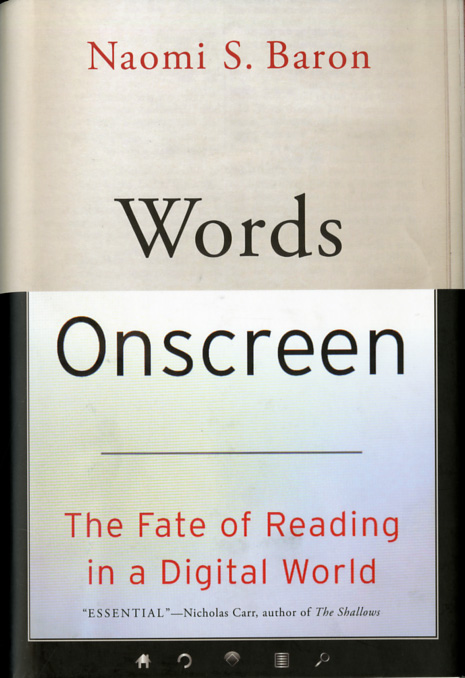
These are questions that Dr. Naomi Baron, Executive Director, Center for Teaching, Research and Learning, World Languages and Cultures, American University, asked and answered in her latest book “Words Onscreen.”
Naomi is interested in electronically-mediated communication, writing and technology, the history of English, and higher education. A former Guggenheim Fellow and Fulbright Fellow, she has published seven books. Her book, Always On: Language in an Online and Mobile World, won the English-Speaking Union’s Duke of Edinburgh English Language Book Award for 2008. Her latest book, Words Onscreen: The Fate of Reading in a Digital World came out in early 2015.
I spoke with Naomi recently and we talked about the pros and cons of both print and digital and about the opportunities both offer our children and ourselves today. As an educator, Naomi has many concerns about the cost of print versus digital, especially when her research has shown that other than the cost, overall students would prefer their reading both for school and pleasure to be in print. It was a highly informative and eye-opening discussion.
Just don’t believe everything you hear about what millennials prefer and don’t prefer when it comes to their choice for media consumption.
So, without further ado, the Mr. Magazine™ interview with Dr. Naomi Baron.
But first the sound-bites:
On what she based the alarm on that she has sounded about the detriments to comprehension and critical thinking when it comes to reading online: Based on over 400 university student responses from five countries to a questionnaire that I administered. And the results surprised me enormously in terms of their understanding of what works well for them in print and what works well for them about digital media.
On why media companies are missing the boat and focusing only on digital when trying to reach millennials: What we see happening, and I talk a little bit about this at the end of my book, and it’s become increasingly true, is that people would like to be able to choose their medium depending upon their needs of the moment; depending upon their interests in particular genres, so there are enough people who are saying I want both digital and print. I’ll use my son for example. He’s in economics. So, he wants the hard copy, the book, for studying, reading, whatever, but when he goes to class he wants the digital version because he has his computer with him. And that’s true of a lot of people even reading novels. While I’m on the road I’m happy to read and willing to read on my portable device, but when I get home I want to curl up with a good book.
On whether she’s worried about our younger generation and the future in general when it comes to reading comprehension and retention: Every once in a while I get hopeful that, at least in some places, that’s not quite the case. I do have a lot of concerns about, instead of faculty members teaching to the test, faculty members are increasingly teaching to what they think students will do. So the project that I’m just about to launch is to look at the kinds of assignments that faculty members are making now, as opposed to what they made five or ten years ago. And in part our college population is changing. I understand that it’s not one simple variable.
On whether a new media project proposed by a major media company today could survive without a print component: What is relevant is what do people do in their spare time? If I read magazines in my spare time, I can read them in print or I can read them on a screen. But my question is, what is that age cohort reading, and obviously it’s a broad range. You look at the enormous growth in comic books and in graphic novels. To my knowledge, in the United States those are heavily done in print. In Japan, as you may well know, the growth in E-reading is overwhelmingly from comics. Not for books. So, there are some cultural issues as to what one accesses how.
On what someone would find her doing if they showed up unexpectedly to her house: The first thing that you’d see, and this is largely due to my husband, is probably about 30,000 books in the house. You would probably see me sitting at my computer and either working on the computer itself or reading from print. I do an awful lot of my writing by hand; “Words Onscreen is probably half written by hand and the other half on the computer, it depends on my mood and what I have handy.
On what keeps her up at night: Regarding my research, that educators from K through graduate school are sufficiently naïve about the consequences of their well-meaning actions in terms of what they’re recommending to students and in terms of the medium for reading and what to do with what they read, that are causing harm to the next generation. And that does keep me up at night.
 And now the lightly edited transcript of the Mr. Magazine™ interview with Naomi Baron, Executive Director, Center for Teaching, Research and Learning, World Languages and Cultures, American University.
Samir Husni: Do you think that you’re too late in sounding the alarm about online reading and comprehension, that not only is it hurting our ability to retain information and utilize critical thinking, but we also may be pushing our audiences, whether they’re students or readers of magazines or books, in the wrong direction? What are we doing wrong when it comes to reading online and why are you sounding the alarm now and based on what?
Naomi Baron: Based on over 400 university student responses from five countries to a questionnaire that I administered. And the results surprised me enormously in terms of their understanding of what works well for them in print and what works well for them about digital media.
We tend to assume that because these are university-aged students – 18 to 26, and I now have more countries included than were in my book; we’ve added Slovakia and India, to the United States, Germany and Japan, but you see how much this age cohort is on digital media. They sit in our classes with computers; they’re taking notes right? Wrong. They’re purchasing items; they’re checking out Facebook posts; they’re just doing many things. They’re texting on their phones in our classrooms; we know this because they admit this to us if you ask them not in front of the professor whose class it is.
And they run out of power on their phones from being on them all day and what do universities do; they have power stations everywhere so they can recharge their devices. So, you would assume that they are really interested in doing as much as possible digitally.
But what my surveys show and the interviews that I’ve done and the class lectures, guest lectures and so forth; what they all show is an understanding as to what it is people find really useful about reading on digital media and what it is they find less so.
For example, the major attraction on digital media is cost. That by and large, if you’re talking about new materials, cost is lower for the kinds of course materials that you use in an university course or that you buy for pleasure reading; it’s lower for digital than it is for print. So, we’re not talking about secondhand print; we’re not talking about three people going in and buying the book together; we’re talking about buying individual copies.
And there are a lot of students, especially in the United States, for whom money is a very major issue. We’re working very hard in the United States to make universities open to a broader cohort economically, that has been the case. And whether it’s a community college, where textbooks cost more than your tuition does, or a medium-sized private university, such as American University, where there are students who say I wait until the middle of the semester to see if I really have to buy a book because if I don’t have to, I don’t have the money to buy it. Or if I have the money, we don’t even use the book enough to buy it; I’m going to use my money for something else.
So, finances are the major stumbling block as far as I can see, in terms of the future of print versus digital. And I think we have to be aware of that in a way that we haven’t been before.
Now if you ask over 400 students from 5 different countries if costs were the same, and we’re talking about reading materials for schoolwork; would you prefer to read in hard copy or digital, if costs were the same, overall for schoolwork 87% said I’d rather read hard copy.
Samir Husni: Wow.
Naomi Baron: And if costs were the same when it comes to reading for pleasure, 81% said they’d rather read hard copy. These are millennials. And this is what they’re telling us.
Samir Husni: So why do you think all of these media people, supposedly some of the most creative people on the face of the earth, are missing the boat when they’re focusing on digital when it comes to reaching millennials? And free digital, at that. There’s no cost.
Naomi Baron: I’ll answer that in just a moment, but let me give you one more statistic and this is the other major finding from my research as far as I’m concerned. And this number didn’t change when they added in more countries. The question was: what is the medium on which it is the easiest for you to concentrate when you read? And I did not separate out reading for pleasure versus reading for school. What’s the easiest medium for them to concentrate on, and they had a choice of hard copy, computer, tablets, or e-readers or mobile phones. And 92% said it was easiest for them to concentrate when they read on hard copy. And to me that’s an astounding figure from this generation.
So, going back to your question; what do I think is going on with the media companies? A couple of strands, first the Internet became easily accessible, relatively speaking not expensive and readily searchable. So, they began to put a lot of stuff onto the Internet, this is back in the old fashioned days when, at least in the United States, we were doing most of our work on computers.
Then in late 2007 the Kindle comes along. And because Bezos is a real marketer, he priced the books as loss leaders, almost everything with a digital book was a loss leader for him; he was paying the publishers more than he was taking in for sale. It was all $9.95. It’s the same thing that happens at the grocery store when you want to bring people in and you say, oh by the way, you can also buy some of this or that while you’re here. It’s a marketing tool, right?
Then what happens is the iPad comes along in 2010; Smartphones become increasingly ubiquitous, so I think the statistics are two-thirds of adults in the United States have Smartphones. And billions are selling internationally.
We now have lots and lots of devices that are increasingly mobile and that make it easy to access stuff. And stuff is from soup to nuts; the entire range of things, whether it’s information or amusement or work-related; it’s all because of the device in your hands. So, media producers are attempting to figure out how they follow a revenue stream. And if sales are going down on newspapers, well maybe they’ll ready digitally. When you look at the transition for how many people are reading digitally versus how many people are reading print newspapers, there is a shift.
And part of the shift isn’t because of people who like print; it’s your standing in line and you’re waiting for the bus or whatever, and I read The New York Times on my phone; I get the paper medium at home and I love it, but if I’m standing and waiting for something or at an airport, I want to use my time in a way that’s meaningful for me. And once I can do that; how are you going to keep them down on the farm once they’ve seen Gay Paree as the song used to go. It becomes harder to say that you’re going to wait until you get home to read the print.
I can do it online; I can print it out; I can save it. When I do research, it’s funny. I save my article in a newspaper in print, or in a magazine in print. I go to my computer; I look it up online because I want to save it for research purposes or I want to send it to somebody. And the digital component becomes convenient. What we see happening, and I talk a little bit about this at the end of my book, and it’s become increasingly true, is that people would like to be able to choose their medium depending upon their needs of the moment; depending upon their interests in particular genres, so there are enough people who are saying I want both digital and print.
I’ll use my son for example. He’s in economics. So, he wants the hard copy, the book, for studying, reading, whatever, but when he goes to class he wants the digital version because he has his computer with him.
And that’s true of a lot of people even reading novels. While I’m on the road I’m happy to read and willing to read on my portable device, but when I get home I want to curl up with a good book. And that’s why a lot of the marketing now is charging just a smidge more and you get both.
And it’s the same thing with audio books. People are not saying that it has to be audio; I think the recent statistics that came out from the Association of American Publishers in Washington; they came out with sales for 2015 and audio books went down this year. They really shot up in 2014, but they fell comparatively speaking in 2015. And that probably depends on what’s the bestseller. Print sales went up because of Harper Lee’s books; digital sales went up because of 50 Shades of Grey and Twilight. So these numbers are not always reflections of the complexity that goes into people’s decision-making.
Samir Husni: Are you worried about our future as a country, as a young generation that the more we dive into digital; the more we may suffer in the areas of comprehension and retention? Our education system from the very beginning trains our children to answer the questions, don’t think. Just give me the answers.
Naomi Baron: Every once in a while I get hopeful that, at least in some places, that’s not quite the case. I do have a lot of concerns about, instead of faculty members teaching to the test, faculty members are increasingly teaching to what they think students will do. So the project that I’m just about to launch is to look at the kinds of assignments that faculty members are making now, as opposed to what they made five or ten years ago. And in part our college population is changing. I understand that it’s not one simple variable.
In part, the students are changing not just in terms of what their aspirations are, but also in what kinds of other extracurricular activities that they have. When I was in college a million years ago, people didn’t have internships. We weren’t supposed to do volunteer work; we were supposed to go and study. And we studied a lot of hours per week.
The students at those same institutions now have fewer hours available to devote to what they’re doing; we didn’t have a job 10 hours a week. We didn’t have a job 30 or 40 hours per week, plus go to school full time as many students do now.
So, what’s pretty clear to me anecdotally, but I’m looking to document it, is that we’re changing the sorts of things that we’re asking of students because students weren’t doing the things we were asking when we were asking more. We now have opportunities to, instead of them having a written research paper, to have a video. If there’s a lot of research with the video and you do the writing somewhere else, that may be OK. But we’re assigning articles and chapters, rather than full books because people weren’t reading them.
At my university we were encouraged to put as much material as we could online in case we had to close the university, we and Cambridge closed for the plague way back when. (Laughs) And it was not clear whether we would have to close the university from month to month; were we still going to have education, whereas if you put materials online, you could do that.
To some extent we’ve changed our patterns, sometimes for good reasons, sometimes because we knew our students weren’t doing the work anyway, maybe through no fault of their own, maybe their fault, and as a result we change our goal structure. I don’t think we’re looking to make students dumb; I think we haven’t figured out what we want to accomplish and how to make it happen.
And the same I’m sure goes for K-12, in particular, attempts to figure out three things. First, how do you have enough money when the state legislatures are not funding public schools? Or the county legislatures aren’t funding public schools? How do you have enough money to buy course materials? And if digital materials are less expensive than print texts; guess what’s going to happen? Arnold Schwarzenegger started this in California back in 2007 at the beginning of the Great Recession because it hit California first in some ways. Finances are real and you can’t deny them.
The second issue is with the attempts to build a Common Core curriculum, which makes a certain amount of sense if you know what should go into it. People are trying to figure out how to get students engaged and one of the ways that you get them engaged is by not having to read whole books apparently. (Laughs) That’s part of the plan with the Common Core from what I have seen.
The third issue is parents and teachers should ask themselves what kind of skills their children have and how much is knowing something digital going to be important to them? Should they know everything digital or just some things digital? The really smart teachers, and there are bunches of them, are writing books on such things as a book called “Connected Reading” by Kristen Hawley Turner from Fordham University.
And what she’s looking at doing as a co-author is asking how do we intelligently mix digital and print? And I’ve read most of the book now and I met her at a conference a few months ago. She’s a smart woman. And she herself has been a teacher in the middle school level, I believe. And she lays out a number of really intelligent ways to take advantage of the good things that digital can do that print doesn’t and the good things that print can do that digital doesn’t.
The reason that I haven’t totally despaired is there are at least some people who are seriously asking the question: how do we learn best and how do we learn what’s best? One of the discussions that hasn’t taken place yet seriously; the research has not been done, is to ask are there some subjects and some materials that are best done in print? Or are there some things that can work very well digitally?
If I wanted to show you how the double helix works, to see that move; that’s something that you can’t do in print. If I want to look at meaningful videos of ecological disasters; a video is actually a good thing to have and to be able to embed that in textual material is not a dumb idea. But we haven’t figured out what is best learned how. We haven’t done research on this and we haven’t even asked ourselves the question to sit and ponder over. That’s what I’m meaning to do in my coming research.
Samir Husni: That’s what I think even the industry is starting to discover, that they saw what I call this beautiful seductive mistress named digital walk up onto the scene and they jumped in for a one night stand that ended up being a love affair and then they discovered that our faithful spouse print was and is still making the money. And now we’re trying to get our spouse and our mistress to talk to each other.
Naomi Baron: Right.
Samir Husni: My question to you is, if you were to be hired by a media company, whether it’s Time Inc. or Hearst Magazines or Meredith, and they tell you they have this idea for a new media project, whether it’s a magazine or something else, and the age group is 18 to 30 years old. Can I survive without print or do I still need that print component, if the costs are the same whether it’s print or digital?
Naomi Baron: That is a big issue. For example, I can now go into The New York Times digitally and get their full archives without paying a penny, once I know how to do it. I have a print subscription and on one of my devices, with that subscription, I can get unlimited articles and on another I get five a month, or whatever it is. But I can give anyone in my family my login information, or my friends, or a thousand different people. Take The Atlantic, Harper’s; I don’t need a subscription to get everything from them.
So money actually is an issue because I just wrote my check for renewing my Harper’s and Atlantic; it’s not a huge amount of money, but I paid for it. I don’t think money is going to go away as an issue and it’s not going to go away as an issue in students’ minds in the 18 to 35 range.
What is relevant is what do people do in their spare time? If I read magazines in my spare time, I can read them in print or I can read them on a screen. But my question is, what is that age cohort reading, and obviously it’s a broad range. You look at the enormous growth in comic books and in graphic novels. To my knowledge, in the United States those are heavily done in print. In Japan, as you may well know, the growth in E-reading is overwhelmingly from comics. Not for books. So, there are some cultural issues as to what one accesses how.
If you were to ask me what’s happening on your campus; do you see people reading magazines; I don’t see them reading magazines, either digitally or in print. And our campus store has shrunk the number of magazines that it has available just because they don’t sell.
But we have to figure out what are the things that people would read. And I’m not the expert on that. I’m really interested to learn what people are reading. What I do know is that sometimes we get surprised as to media habits. I don’t have the data now, but I heard probably two years ago that a fairly large number of teenagers or young adults listen to the radio. Who knew?
Samir Husni: That’s one reason my latest book was called “Audience First.” Before you determine whether it’s going to be digital or print or TV or radio, you have to know who your audience is. Who are those people and what do you know about them? And I think that’s why your statistics are so important and essential for the media industry to understand. When you tell me that 87% or 91% can concentrate more when they’re reading print that’s important. And if we really want to take people off of that Welfare Information Society that we put them on, it’s a good argument. I read your book “Words Onscreen” and I read the part about nobody wants to be reading tea leaves about the future of print, but you give the example of Jeff Bezos buying the Washington Post.
Naomi Baron: You have to read the tea leaves if you want to plan. (Laughs) It’s as dangerous as it’s always been, but that doesn’t make it unnecessary. What is my own take on all of this? Digital is not going away anytime soon and there is a lot of encounter. You can call it reading, and sometimes it actually is, but sometimes it’s just an encounter to get information or to check sports scores or restaurant reviews. And to me reading those five-line restaurant reviews does not count as reading.
But that’s not going to die away. Therefore, the smart thing as far as I’m concerned is for us to figure out what kind of people do we want to be? How do we want to educate people; what kinds of values do we want them to have; are contemplation and analysis among those values? And we have to ask: what’s the best way to accomplish this today? There are all sorts of technologies, print is a technology. We have all sorts of technologies; what are the best ones?
One of the reasons, and I think I spoke a little bit about this in a chapter of the book; one of the reasons in Japan that people don’t read a lot of novels on phones is the books themselves are small enough to carry around and they have discreet covers that doesn’t tell everyone what the person is reading. So there is already a cultural artifact, namely a small book that makes it unnecessary to take some of the affordances of a digital device and read digitally on it. It’s all of these things that we have to think about.
The French have had livre du poche for over a century, probably more. But they’re small books. And they’re easy to carry around. And that’s probably one of the reasons, in addition to other aspects of books in France and prices of books, all the pieces of the book culture being small and portable contributes to reading habits. I’m guessing, but to me it’s worth asking.
Samir Husni: If I show up unexpectedly at your house and I knock on your door, what will I find you doing? Reading a magazine? Your iPad? Watching television?
Naomi Baron: The first thing that you’d see, and this is largely due to my husband, is probably about 30,000 books in the house. You would probably see me sitting at my computer and either working on the computer itself or reading from print. I do an awful lot of my writing by hand; “Words Onscreen is probably half written by hand and the other half on the computer, it depends on my mood and what I have handy. You’d see me printing a lot of stuff off and reading from hard copy if it’s something that I actually want to be serious about. And you’d see me shuffling stuff back and forth.
Samir Husni: My typical last question; what keeps you up at night?
Naomi Baron: Regarding my research, that educators from K through graduate school are sufficiently naïve about the consequences of their well-meaning actions in terms of what they’re recommending to students and in terms of the medium for reading and what to do with what they read, that are causing harm to the next generation. And that does keep me up at night.
Samir Husni: Thank you.
The Power and Future of PRINT…Part VII As told by Magazine and Magazine Media Makers…
January 7, 2016A Mr. Magazine™ “Quotable” Retrospective…
Celebrate Magazines Celebrate Print. The theme for ACT 6 Experience that takes place April 20 to 22, 2016. Painting by and © Laura McCrory.
For information about the ACT 6 Experience email me at samir.husni@gmail.com
I have been a firm believer in print and its power even when many doubted its future and even its role in today’s media world. I have been quoted as saying, “As long as we have human beings, we will have print.” And that quote stands firm and true as we enter into a brand New Year.
Of course, I’m not oblivious to the fact that we live in a digital age…just check the many devices you and I are using on a daily basis, even the platform that you’re reading this on now as we connect. Yet that did not deter my belief in the role and future of print. Nor, will it ever.
However, as an academic and a professor of journalism, I’d rather share with you what others from the field say about the future and the role of print in today’s media world and tomorrow’s; that way it isn’t just my word you’re hearing and reading. Never would I yearn to be lumped in with others who pontificate to high heaven with their opinions and speculations for the condition of magazines and magazine media; be it print or digital or any other platform that may arise before I can finish writing this. The blah-blah-blah disease spreads pretty fast on its own, without any help from Mr. Magazine™
And so without any further ado, here is the seventh installment of the 136 quotes (in random order) that Mr. Magazine™ has accumulated over the last two years through the wonderfully informative conversations I have had with the game changers and the passionate entrepreneurs in the magazine industry.
97. “We’ve never believed print is dead. We hope to launch in the U.S., as I said, new print magazines every 24 months.” David Carey, President, Hearst Magazines.
98. “First and foremost our print is a very good business all around the world. We have profits that we want to generate for our parent company and we’re good at publishing magazines. And so we believe in them; we have a portfolio of titles. In any given year we’ll have brands like Town & Country and Woman’s Day that are having terrific years and then sometimes you have others that have an off year.” David Carey, President, Hearst Magazines.
99. “The types of content pieces that are created in the magazine, the opportunities that it affords us from an editorial perspective to continue to celebrate the entrepreneurs and entrepreneurial capitalism around the world that the world is increasingly moving to a place where those are the types of people that do tell the stories of business; it gives us access in a way that we would not have with just digital.” Mark Howard, Chief Revenue Officer, Forbes magazine.
100. “How it all worked out was we were seeing so many dynamic people and so many amazing creations and these great efforts in curation and sharing, but we thought, it’s still not enough. We wanted to propagate it further in a way that was almost sacred to people and we thought that magazines were in that category.” Blake Brinker, Publisher, Creativ magazine.
101. “I get motivated every day when people come up to us and say, creativity is the most important thing we have and you’re putting it into this beautiful print publication that I can get on a monthly or bimonthly basis. Just wow; what you’re doing is so inspiring and the world needs this, with the things that are happening in the world today, we need something like this to give people hope and optimism. With all the negativity that we hear every day, this is an incredible amount of positivity showcasing people doing absolutely amazing things.” Brad Thomas, Editor-in-Chief, Creativ magazine.
102. “The industry has gone through some peaks and valleys. I can remember when some of the people, where I serve on the board; some of the people there would say well, print is dead. We have to shift to digital; we have to get out because of postage and paper and all of these kinds of things. We don’t have to do that anymore. People understand that there is a very valuable role for print. And people like the tactile feel. In my view, print is never going to go away. It’s never going to go away.” John Temple, President & CEO, Guideposts.
103. “The print magazine was the foundation by which we brought the brand back, so even the savviest digital people on our team know how important the print vehicle is. No, I don’t think we could have brought it back without print; I mean that’s what people knew and loved and adored. And frankly, people don’t necessarily know that we’re back online, but they know that we’re back in print.” Beth Fuchs Brenner, Chief Revenue Officer, Domino Media Group.
104. “Growing up, I always had a knack for physical things and I was never that great when it came to technology, so for me the printed product was a natural choice when I chose to make the magazine. For a magazine that’s mission is to ignite the renaissance of this area of the world; I don’t think digital-only can achieve that; people need to feel the tangible aspect of things.” Ibrahim Nehme, Founder & Editor-in-Chief, The Outpost magazine.
105. “I know that magazines have always been and continue to be a really rare and wonderful thing. I think, especially with a magazine like ours, it is a uniquely, immersive experience. It’s such a pleasure to have this beautifully curated collection of stories, ideas, sometimes quizzes, exercises; things that have been put together to challenge readers and to lift them up and get them to see their own life in a new way.” Lucy Kaylin, Editor-in-Chief, O, The Oprah Magazine.
106. “I suppose it could, simply because there are so many other ways to express one’s ideas. There are obviously so many formats and platforms out there today. But I wouldn’t love that; I wouldn’t think that would be a positive thing. O, as a print publication is incredibly special and it’s lush and beautiful and it’s tactile and something that is very well-enjoyed in bed, in a hammock, on the couch or in the tub. The physical nature of it is one of the very special things about it.” (on whether the magazine could exist without the print component), Lucy Kaylin, Editor-in-Chief, O, The Oprah Magazine.
107. “I still feel like the magazines are a core part of people being in that community and we know from our own data that our magazine subscribers are the most loyal buyers when it comes to art e-commerce store. Those people are very committed to following the pursuit of their art and they look to us to provide instruction in a lot of different formats. I would say the magazines are still a core part of the communities, whether they are Watercolor Artist or Acrylic Artist or somebody who likes to draw.” Jamie Markle, Group Publisher, Acrylic Artist magazine.
108. “Despite the fact that some people may be saying, oh, print is dead or it’s challenged, it’s encouraging to me that as a corporation, we understand our customers’ needs, this magazine is something they want, they want a print product. Our results are double what we expected.” Patty Craft, Community Leader & Content Creator/Editor, Acrylic Artist magazine.
109. “I think the future is incredibly bright for print and I think that if you just look at what we’ve been doing at Hearst, which is Food Network and HGTV as partners, you can also see Esquire and Elle partnering on cross-content things. Diversity is key. We have a very diverse portfolio at this company. I think the successful print publishers are going to be the ones who are innovative, but whether it’s print, digital or TV, everything is really all about content and that’s what print does so well.” Dan Fuchs, Publisher & Chief Revenue Officer, HGTV magazine.
110. “I think that every major publisher would tell you that the newsstand is a major factor in launching a publication. So they need it there for that. It may certainly be smaller and carry less titles, but for the major publishers launching new titles it will remain necessary to maintain it in some way.” John Harrington, editor-in-Chief, The New Single Copy.
111. “I’m such a firm believer in print. I think one big mistake magazines make is they start looking to cut corners and they denigrate the actual physical print product and in this case Modern Farmer is a luxury item with a high cover price and the actual object looks and feels luxurious. And at the end of the day, the print is the legitimizer of everything that flows from it. Yes, we have a great website; we have a fantastic digital director running it and we’re all over social media, but the print is the true legitimizer and the hub from which everything else flows. And there’s just no substitute for sitting down with a magazine and a glass of wine or a cup of coffee, whatever your poison is, and flipping through it.” Sarah Gray Miller, Editor-in-Chief, Modern Farmer magazine.
112. “I think the brands are strong. As a long-time editor, I am very much attached to print. But I would say that my title over the past couple of years hasn’t been editorial director; it’s really been brand manager. I’m a brand steward and it’s about the brand. And I can see that in certain areas maybe print would provide better and in other areas maybe a digital-only aspect of that brand would exist.” (on whether the many brands could exist without a print component), Kim St. Clair Bodden, Senior Vice President/Editorial Director, Hearst Magazines International.
Stay tuned for Part VIII of the Mr. Magazine™ “Quotable” Retrospective…
The Power and Future of PRINT…Part VI As told by Magazine and Magazine Media Makers…
January 6, 2016A Mr. Magazine™ “Quotable” Retrospective…
Celebrate Magazines Celebrate Print. The theme for ACT 6 Experience that takes place April 20 to 22, 2016. Painting by and © Laura McCrory.
For information about the ACT 6 Experience email me at samir.husni@gmail.com
I have been a firm believer in print and its power even when many doubted its future and even its role in today’s media world. I have been quoted as saying, “As long as we have human beings, we will have print.” And that quote stands firm and true as we enter into a brand New Year.
Of course, I’m not oblivious to the fact that we live in a digital age…just check the many devices you and I are using on a daily basis, even the platform that you’re reading this on now as we connect. Yet that did not deter my belief in the role and future of print. Nor, will it ever.
However, as an academic and a professor of journalism, I’d rather share with you what others from the field say about the future and the role of print in today’s media world and tomorrow’s; that way it isn’t just my word you’re hearing and reading. Never would I yearn to be lumped in with others who pontificate to high heaven with their opinions and speculations for the condition of magazines and magazine media; be it print or digital or any other platform that may arise before I can finish writing this. The blah-blah-blah disease spreads pretty fast on its own, without any help from Mr. Magazine™
And so without any further ado, here is the sixth installment of the 136 quotes (in random order) that Mr. Magazine™ has accumulated over the last two years through the wonderfully informative conversations I have had with the game changers and the passionate entrepreneurs in the magazine industry.
81. “We wanted to make it easy for publishers to communicate to their customers where their magazines were available for purchase; not only via a traditional website, but also making it available via mobile, so that when people are actually in the store, they can get information about what’s available to help facilitate that spur-of-the-moment decision. We want to take off the “mobile blinders”, and put a “mobile spotlight” on our brands.” Joshua Gary, Senior Vice President, MagNet.
82. “Country Living had never dipped its toes fully into the country music waters, but if that audience is going to read a shelter decorating magazine, I think Country Living is the magazine for them. So, we talked about how to be very deliberate about penetrating that world without alienating our core readership, because I’m realistic; I know not all of our readers are country music fans and they don’t come to our magazine for celebrities and/or music.” Rachel Barrett, Editor-in-Chief, Country Living magazine.
83. “One of the results of living on your Smartphone is you crave a break and people like me and my friends; our readers, I think increasingly, new magazines bring a breath of fresh air and a treat. Although, like you, it’s my job to read magazines and keep up with everything that’s going on, I still favor them and bring them on vacation with me, because you read a magazine very differently on a long commute or a flight or in a beach chair than you do at your desk.” Emily Cronin, Editor-in-Chief, Trending NY magazine.
84. “In my case, I guess you could say it’s like putting a beggar in charge of a bank. (Laughs) I turned my passion, my addiction; my love for shoes into a business. I guess it’s part of my African background, take every opportunity possible for survival. It’s just a way of life for us.” Tinu, Publisher, Shoeholics magazine.
85. “I believe that tablet access for all brands has kind of flattened out a bit; if you look at two or three years ago when we all believed that tablets were going to soar and some believed they would replace print, but that hasn’t been the case. The paper format is still the primary vehicle that women want to engage with. They curl up with it, take it with them, and tablets have pretty much plateaued in the marketplace.” Daren Mazzucca, Publisher, Martha Stewart Living magazine.
86. “If you look at travel media; travel media has had a growth of 37% in the last three years and the research team says that because of two reasons. One: because travel is luxury, and two: because we’re all so attached to our desktops, tablets and phones; at some point in time, people actually want to put those devices away and have a lean-back experience and dream a little bit and plan a trip; do something for themselves.” Jay Meyer, Publisher, Travel + Leisure magazine.
87. “What we’re seeing from the business community is that obviously, from a brand awareness and storytelling perspective, print is still a really important tool for us and that’s also partially because we’re living in the luxury space. And luxury advertisers have really seen that print still works for them from that perspective.” Nathan Lump, Editor-in-Chief, Travel + Leisure magazine.
88. “I believe magazines will always be there and being strong financially and being a decent size, but not too big gives some companies an advantage in the marketplace… I think trying to figure out this business and what works is challenging and exciting. Putting together a nice group of folks, along with some good strong content, whether it’s editorial or art, and finding out this really helps sales is exciting.” Nick Singh, President, Engaged Media Inc.
89. “One of the things on one post-it is “create addiction.” And every time I look at content, because my editors will show me and get my opinion or they’ll show me the finished feature; I’ll look at it and ask myself does this piece create addiction or why would someone want to read more? Or would I want to read more next month? So, that’s one of the messages and if the answer is no, it doesn’t create addiction or that it’s boring; we won’t run it. We don’t run things just to run them. It has to have that special spark.” (on her use of post-it-notes for inspiration), Ana Ureña, Editor-in-Chief, Cosmopolitan Spain.
90. “Given what our print circulation is right now and the revenue that comes from it, which to me suggests that there is an audience who wants it, I don’t think it’s anytime soon. My biggest concern is the post office problems at this point. (Laughs) It’s not the audience; we have the audience. We’re doing really well with renewal rates and like I said, I think a lot of that has to do with the fact that we have this dialogue with the consumer that lets us give them what they want.” (on if he can ever envision This Old House without the print component), Scott Omelianuk, Editor-in-Chief, This Old House magazine.
91. “This is what print can do. Print is so different. Print is something that lives on forever. It’s not a commercial; it’s not a webpage; it’s not a posting; it lives on and it’s a document. And I think that’s what’s so lovely about it.” (on Michelle Obama guest editing an issue of More magazine), Lesley Jane Seymour, Editor-in-Chief, More magazine.
92. “No, I can’t see that. I don’t think that will happen. There may be some transition in people’s personal needs, but no, we will continue to do print. I do remember reading how excited everyone was when they looked at the first printed Bible and how excited people were when they found, I think it was in Israel, some original writings in a cave. They wouldn’t have been as excited if they’d found somebody’s laptop back then.” (on if she can ever envision a day print will not exist), Ellen Levine, Editorial Director, Hearst Magazines.
93. “I think the path to victory these days is opening your mind to what kind of businesses you can be in that may be obvious or not so obvious. And I also think to not being overly fixated quite honestly on digital as the singular path to prosperity for, call it, traditional media companies. I’ve seen a lot of people overspend and over-focus on digital and it’s grown their audience and in some case may have grown their revenue, but I haven’t seen a company transformed by just basically saying we’re going to go from print to print plus digital.” Andrew Clurman, CEO & President AIM (Active Interest Media).
94. “In our world we’ve got a lot of incredible loyalists and people of all ages who like the aesthetic of print, they like the print medium. And our print is profitable, it’s not the highest margin business that we have, but it’s profitable. I would say that it would be hard for me to imagine us getting out of print and just being event services and digital.” Andrew Clurman, CEO & President AIM (Active Interest Media).
95. “I think the bigger surprise is that in this day and age there’s so much of the world that somehow believes that the rise of digital media has undermined the importance of print media and I think we’ve proven that not only is that false, but it’s really the exact opposite. If you harness it correctly, digital media only enhances the power of print media because it gives you so many different pipes to tell the story.” Chris Mitchell, Publisher, Vanity Fair magazine.
96. “I’m a believer in the power of beautiful production quality and in telling that story, especially where there is a visual element, as only ink on paper can do.” Chris Mitchell, Publisher, Vanity Fair magazine.
Stay tuned for Part VII of the Mr. Magazine™ “Quotable” Retrospective…
The Power and Future of PRINT…Part V As told by Magazine and Magazine Media Makers…
January 5, 2016A Mr. Magazine™ “Quotable” Retrospective…
Celebrate Magazines Celebrate Print. The theme for ACT 6 Experience that takes place April 20 to 22, 2016. Painting by and © Laura McCrory.
For information about the ACT 6 Experience email me at samir.husni@gmail.com
I have been a firm believer in print and its power even when many doubted its future and even its role in today’s media world. I have been quoted as saying, “As long as we have human beings, we will have print.” And that quote stands firm and true as we enter into a brand New Year.
Of course, I’m not oblivious to the fact that we live in a digital age…just check the many devices you and I are using on a daily basis, even the platform that you’re reading this on now as we connect. Yet that did not deter my belief in the role and future of print. Nor, will it ever.
However, as an academic and a professor of journalism, I’d rather share with you what others from the field say about the future and the role of print in today’s media world and tomorrow’s; that way it isn’t just my word you’re hearing and reading. Never would I yearn to be lumped in with others who pontificate to high heaven with their opinions and speculations for the condition of magazines and magazine media; be it print or digital or any other platform that may arise before I can finish writing this. The blah-blah-blah disease spreads pretty fast on its own, without any help from Mr. Magazine™
And so without any further ado, here is the fifth installment of the 136 quotes (in random order) that Mr. Magazine™ has accumulated over the last two years through the wonderfully informative conversations I have had with the game changers and the passionate entrepreneurs in the magazine industry.
65. “I really can’t imagine Real Simple without a print product. I mean, we are thrilled to see the growth that we’ve experienced in other areas, but I can’t imagine us never being a magazine. And I happen to know that you define a magazine as something that exists on paper.” Kristin van Ogtrop, Editor-in-Chief, Real Simple magazine.
66. “When we first put up the website for GX, I had a Mom call me and she said, hey, can you print this story, because I want to keep it. So, I printed it out for her on nice paper and mail it to her. I printed it and mailed it to her and she told me she ended up framing it. People want to physically hold it; they want to see it and share it that way. It legitimizes everything when it’s in print.” Keith Kawasaki, Vice President, Client Services, iostudio.
67. “It is such a beautiful print product and I think to be inspired to make real changes in your life, and some of them may be small, such as a lip gloss that’s moisturizing, and some of them are big, like you’re going to think differently about your life, and then some are medium, such as taking the stairs instead of the elevator, but for those kinds of inspiring changes I think print is a great medium for them. It tells a story and it tells it so completely.” Laura Frerer-Schmidt, Publisher, Women’s Health magazine.
68. “The whole idea of this one-to-one; she (Helen Gurley Brown) used to say that she wanted to have a one-to-one conversation with millions of women at the same time. So that whole idea of community, which is now what everyone is talking about, that’s something that Cosmo has always had. We’ve always said that we were the first interactive medium. Before there was an internet, there was Cosmo.” Donna Kalajian Lagani, Senior Vice President, Publishing Director & Chief Revenue Officer, Cosmopolitan magazine.
69. “Print is not dead for us; it’s thrilling. Of course, I hear it in other magazines and it scares me to death because I’m such an old print horse that I never want it to go away. And so it’s really exciting for me to be at a magazine where there’s never talk of not doing print anymore. Yes, it’s doing well.” Diane Anderson-Minshall, Editor-in-Chief, Plus magazine.
70. “When I’ve worked at legacy publications, we’d create this content that was basically designed to be an adjacency to advertising. Whatever, fine. Then the advertising disappears. Advertising definitely comes and goes; you have to make sure that you have a product at the end of the day that your readers actually care about, because the advertising dollar today will disappear tomorrow.” Adi Ignatius, Editor-in-Chief, Harvard Business Review magazine.
71. “By creating My Smart Newspaper, with its 16 pages, the reader will be able to spend 10 or 15 minutes to get a summary of everything that’s in the market today through a small, compact newspaper, and at the same time has the feel and look that only print can deliver. You are getting all the information with no waste whatsoever. No waste in paper and no waste of the readers time… it is a win-win situation.” Faisal Salem Bin Haider, CEO, Printing & Distribution Sector, Dubai Media Inc.
72. I’m very excited about this part of our business. I was brought up in print and I do believe that it’s the role of print and how it plays in the overall world of our media. You see it as much as I do; now we’re seeing digital-only plays that want to get into the print business and so, isn’t it right that we should actually start with the median and grow it the other way? That’s where I see the future going, creating content that can be deeper and articulated in different ways in the world of publishing.” Steve Giannetti, Publisher, Smithsonian Journeys magazine.
73. “I believe very much in the importance of the commercial side. I don’t feel successful without being successful.” Victoria Pope, Editor-in-Chief, Smithsonian Journeys magazine.
74. “There is something very particular about the act of physically holding a magazine in one’s hand and flipping through it slowly, then placing it aside onto your nightstand or coffee table or kitchen counter and returning to that same thing that you placed aside an hour later or even a few days later. The way that our minds and indeed our bodies interact with printed matter, it’s simply not the same.” James Oseland, Editor-in-Chief, Organic Life magazine.
75. “I think that the pendulum always swings back and forth and I think the pendulum, which had swung pretty much to digital, now may swing, while not all the way back, certainly somewhat toward starting the comeback a bit, because there is a recognition that audiences do like their magazine products.” Lewis DVorkin, Chief Product Officer, Forbes magazine.
76. “People think that print has gone away because they don’t understand what they’re hearing about the decline of newsstand sales. But newsstand is only a small portion of magazines and the idea that, in the case of Parents and American Baby, thousands of them a day are raising their hands and inviting print products into their home, which to me says this is still a really robust area.” Dana Points, Editor-in-Chief & Content Director, Parents group, Meredith.
77. “And these tributaries (collector’s editions) are how I think print will stay around because it’s specialized. I can go to any dot com or any digital platform and get all of my news for every facet of my life right then on the spot. But we don’t want to do that. We just want to do one very specific brand of news, for one very specific customer and that’s it.” Tony Romando, CEO & Co-founder, Topix Media Lab.
78. “We’re not surprised that digital brands are launching publishing products; it’s the most powerful level of engagement, whether it’s a book, newspaper, or a magazine; there is no higher level of engagement than when a consumer is reading a printed product. We’re in for the long-haul.” Scott Dickey, CEO, TEN (The Enthusiast Network).
79. “We will not pull the plug on the print edition. It does too well with advertisers; it does too well with people who like print, and not just people of a certain age, but across a whole stretch. So, I can’t foresee it.” Bruce Kelley, Editor-in-Chief, Prevention magazine.
80. “The number two media channel that the entire pharmaceutical industry spends in is print. Consumers are hungry for this information and they want to make great choices.” Lori Burgess, Publisher, Prevention magazine.
Stay tuned for Part VI of the Mr. Magazine™ “Quotable” Retrospective…
At Least 236 Magazines Launched in 2015, 4 More Than 2014… All Other Published Numbers And Reports Are Dead Wrong!
January 4, 2016The news of the decline of magazine launches has been greatly exaggerated…
This is a post that I did not want to publish, but the professor of journalism in me is what forced me to publish it… This is not a Mr. Magazine™ blog post, but rather a Dr. Samir A. Husni, Ph.D. blog post. Even in a digital age, the truth must always be told and reporting should continue to be held to the same rigor regardless what some may call Speed First, Truth Second. So, here it goes:
When it comes to MediaFinder’s number of new magazine launches the numbers reported are dead wrong. Media reporters who publish the numbers based on the MediaFinder numbers are also dead wrong. Both MediaFinder and the reporters who promote their numbers are doing nothing but a disfavor to truth first and the media industry second. Without any research and questioning of such numbers (which I have called reporters and researchers to pose questions to) I have seen more articles written about the sad status of new magazines. Media Post, Quartz, Folio.com, Crain’s New York Business… all reported the 35% decline in new magazine launches according to the press release from MediaFinder. No questions or fact-checking whatsoever…
Here is one such article:
Books and newspapers will do just fine in 2016. Magazines? Not so much By Amy X. Wang
http://qz.com/584744/books-and-newspapers-will-do-just-fine-in-2016-magazines-not-so-much/
The fact is I have collected and recorded 236 new magazines this past year compared to 232 from the previous year. MediaFinder numbers says 96 (some reported 113) titles were launched compared to 148 (some reported 190) in 2014. My numbers show an increase of 4 magazines. MediaFinder numbers show a decrease of 35% (depends on which numbers reporters opted to use). I have each and every one of those magazines. If I do not have a physical copy of the magazine, I do not include it in my numbers. The reason I say at least, because I know I may have missed some regional and city magazines that I could not reach or visit. My numbers are based on my field research on the newsstands first, media research second, and requesting first editions if I miss one here or there.
I publish monthly on the Mr. Magazine™ Launch Monitor the numbers of new magazines, bookazines, and specials and annuals. All you have to do is look and count the titles.
And so you will have a feel of what magazines launched in Dec. 2015, here is the post from my Mr. Magazine™ Launch Monitor (which by the way is open and free to anyone who bothers to check the facts and record the numbers…
The reason for this post is obvious – numbers – true reported and researched numbers – don’t lie…
And now the Launch Monitor:
It was a very Merry Christmas indeed with a total of 68 new titles, 32 with promised frequency. From the Neue Journal with a stellar cost of $35 to more coloring and activity magazines for adults; the month of December was filled with gifts for everyone. From the array of beautiful covers below, one can tell that diversity was relevant as several digital entities such as Tablet, SwimSwam, Gear Patrol, and Pure Times stepped out to join the ranks of print as 2016 has been declared, by Mr. Magazine™ at least, as the year to Celebrate Print!
Welcome to the New Year of print as we revel in our new December launches…and stay tuned for a magnificent January!
Up first our frequency titles:




And now our specials:











The Power and Future of PRINT…Part IV As told by Magazine and Magazine Media Makers…
January 4, 2016A Mr. Magazine™ “Quotable” Retrospective…
Celebrate Magazines Celebrate Print. The theme for ACT 6 Experience that takes place April 20 to 22, 2016. Painting by and © Laura McCrory.
For information about the ACT 6 Experience email me at samir.husni@gmail.com
I have been a firm believer in print and its power even when many doubted its future and even its role in today’s media world. I have been quoted as saying, “As long as we have human beings, we will have print.” And that quote stands firm and true as we enter into a brand New Year.
Of course, I’m not oblivious to the fact that we live in a digital age…just check the many devices you and I are using on a daily basis, even the platform that you’re reading this on now as we connect. Yet that did not deter my belief in the role and future of print. Nor, will it ever.
However, as an academic and a professor of journalism, I’d rather share with you what others from the field say about the future and the role of print in today’s media world and tomorrow’s; that way it isn’t just my word you’re hearing and reading. Never would I yearn to be lumped in with others who pontificate to high heaven with their opinions and speculations for the condition of magazines and magazine media; be it print or digital or any other platform that may arise before I can finish writing this. The blah-blah-blah disease spreads pretty fast on its own, without any help from Mr. Magazine™
And so without any further ado, here is the fourth installment of the 136 quotes (in random order) that Mr. Magazine™ has accumulated over the last two years through the wonderfully informative conversations I have had with the game changers and the passionate entrepreneurs in the magazine industry.
49. “But the reality is, to actually create a beautiful, curated, well-edited printed magazine; it’s not an easy process. And when we really looked at the space and thought about who our reader and customer was and what she’s really interested in right then, which is having some me-time, we felt the reader was looking for a publication where she could actually turn off her phone or the TV and have an appointed reading time with a tangible product that she can hold in her hands and go through page by page.” Danny Seo, Naturally Danny Seo magazine.
50. “The biggest challenge, and it’s a daily one, is to listen to the readers. You know, I put my personal email address in Reminisce and Reader’s Digest. I read every consumer letter and I respond to every one of them. That engagement with the audience is so very important.” Liz Vaccariello, Editor-in-Chief, Reader’s Digest magazine.
51. “I’m a firm believer in print; I love print and my kids love print. My eight-year-old daughter asked for magazines on her Christmas list, which I think is a good sign. But I think every media finds its place in our lives.” Maria Rodale, CEO & Chairman, Rodale Inc.
52. “We’re having our biggest print magazine readership in our 97-year history right now. You just have to listen to your readers and understand the medium that you’re working in and not try to make it something it doesn’t want to be. If you try to make a magazine like a website, it’ll be a bad magazine.” Randall Lane, Editor-in-Chief, Forbes magazine.
53. “In fact, our new magazines plus digital, now account for 32% of the profits of our U.S. companies. These are businesses that 5 years ago either did not exist or were in a loss position.” David Carey, President, Hearst Magazines.
54. “We believe print is a really unique way to experience content and a really unique way to engage with our readers. The tactile quality of the paper that we’re producing the magazine on, the photography; all of it, really comes to life on paper in a way you can’t necessarily get on a digital screen.” Christopher Lukezic, Publisher, Pineapple magazine.
55. “We keep hearing: print is dead, print is dead. Well, no, print is not dead. What’s happening is it’s shifting and the people who are on the internet, it’s in their best interests to promote the internet over print and they’re saying it as loud as they can.” Buzz Kanter, Publisher, TAM Communications.
56. “I love print magazines and I will never give up the fight or the belief that I have in their value. I was just at the beach with my family and everyone that I saw there had a print magazine. I mean, you just don’t read on an iPad when you’re at the beach.” Ryan Waterfield, Co-founder & Editor-in-Chief, Big Life magazine.
57. “Our particular niche, which is inflight magazines, bucks trends because more and more people are traveling each year, so in fact, where you might have a decline in newsstand titles, we’re actually getting more readers.” Michael Keating, CEO & Co-founder, INK Global.
58. “When I deal with the Internet, I don’t feel there’s a sense of accomplishment necessarily or permanence with it; it’s so fleeting. And I wonder if that’s something that my generation is responding to, in terms of something tangible. When I finish reading a book or a magazine; I can look at it and say, I finished that, rather than just moving on to the next click or page.” Seth Putnam, Editorial Director, Collective Quarterly magazine.
59. “We had a very successful website, but we felt that the engagement with the material was superficial. People were only spending a few minutes, even less than a minute, on an article and not really thinking deeply about the topics we were raising.” Sam Hine, Publisher, Plough Quarterly magazine.
60. “The magazine is an outlet. We all need something to inspire us and if it’s going to inspire other people, so much the better. I get emails from people telling me they cry when they look through the magazine or they tense up. And when I read that I say, wow, it’s not just me. There are other people who appreciate what I’m doing.” Jimon Aframian, Editor-in-Chief, Jimon magazine.
61. “Now that digital media are around, print hasn’t disappeared, but it has changed. And it’ll continue to change and I would expect it to. It would probably be very boring living on this planet if things didn’t change.” Mariette DiChristina, Editor-in-Chief & Senior Vice President, Scientific American magazine.
62. “We may change the (publishing) model in different ways; we may become more sophisticated about printing and delivering content by zip code or by ways in which our readers define themselves, but I think that there’s still a robust market for print having had such a long tradition of creating content.” Norman Pearlstine, Executive Vice President & Chief Content Officer, Time Inc.
63. “I do believe there will continue to be an audience for a printed product who will be willing to pay for that delivery system.” Norman Pearlstine, Executive Vice President & Chief Content Officer, Time Inc.
64. “Having to figure out how to make a story a compelling one, but where a desire for fairness really forces you to understand what people do; why they do it, and to really seek out that kind of balance, I think doesn’t come automatically. And that’s one of the things that I always worry about.” Norman Pearlstine, Executive Vice President & Chief Content Officer, Time Inc.
Stay tuned for Part V of the Mr. Magazine™ “Quotable” Retrospective…
The Power and Future of PRINT…Part III As told by Magazine and Magazine Media Makers…
January 3, 2016A Mr. Magazine™ “Quotable” Retrospective…
Celebrate Magazines Celebrate Print. The theme for ACT 6 Experience that takes place April 20 to 22, 2016. Painting by and © Laura McCrory.
For information about the ACT 6 Experience email me at samir.husni@gmail.com
I have been a firm believer in print and its power even when many doubted its future and even its role in today’s media world. I have been quoted as saying, “As long as we have human beings, we will have print.” And that quote stands firm and true as we enter into a brand New Year.
Of course, I’m not oblivious to the fact that we live in a digital age…just check the many devices you and I are using on a daily basis, even the platform that you’re reading this on now as we connect. Yet that did not deter my belief in the role and future of print. Nor, will it ever.
However, as an academic and a professor of journalism, I’d rather share with you what others from the field say about the future and the role of print in today’s media world and tomorrow’s; that way it isn’t just my word you’re hearing and reading. Never would I yearn to be lumped in with others who pontificate to high heaven with their opinions and speculations for the condition of magazines and magazine media; be it print or digital or any other platform that may arise before I can finish writing this. The blah-blah-blah disease spreads pretty fast on its own, without any help from Mr. Magazine™
And so without any further ado, here is the third installment of the 136 quotes (in random order) that Mr. Magazine™ has accumulated over the last two years through the wonderfully informative conversations I have had with the game changers and the passionate entrepreneurs in the magazine industry.
33. “I believe that you have to be the reader. You can’t try and force the reader to be you. So you have to give them what they want and understand it emotionally, understand the voice and the need.” Ellen Levine, Editorial Director, Hearst Magazines.
34. “The whole world doesn’t tip over to online or digital and there’s something about holding that magazine with the content and the experience you have with it in your hands that clearly consumers still enjoy.” Debra Janssen, President & CEO, CDS Global.
35. “I think that it would be Pollyannaish to say that print will never disappear. I do think that someday print will not be around, but I’ll have to say that it’s much farther into the future than many of us were talking about four years ago. And I don’t see it coming in the near future at all. Print is stronger than ever.” Bob Cohn, Co-President & COO, The Atlantic magazine.
36. “Print is coming back. It has credibility and it’s deeper; it just has so many attributes to it that the digital world lacks.” Greg Sullivan, Co-Founder and CEO, Afar Media.
37. “There’s something people like, whether you’re fifteen or fifty, about the printed product. You don’t have to charge it, no worries if it gets sandy or wet at the beach; you don’t panic if you leave it on a plane and that’s not changing. I don’t think digital will ever fully replace that.” Jason Wagenheim, Publisher, Teen Vogue magazine.
38. “I think there is an incorrect belief that younger readers aren’t reading print. And I think that belief has largely been because so many people are watching the shifts in the industry that are happening that have made it more challenging for some of the huge mass market titles to be successful in the same way they were in the past.” Will Pearson, Co-founder, Mental Floss magazine.
39. “It’s not one or the other. True success lies in the complimentary nature of digital and print, this is where we see customers deliver and increase their business and brand value.” Roel-Jan Mouw, CEO, WoodWing software.
40. “I’m fully behind magazines and magazines have lived through television, they have lived through radio and they’ll live through the Internet, but we have to adapt and make our magazines a little bit easier to read, such as with smaller stories.” Jeff Greif, Publisher, Chilled magazine.
41. “I don’t think digital will be the demise of print at all; in fact, I don’t know why we keep talking about the death of print because I don’t think it’s happening.” Bruce Sherbow, Senior Vice President, Penny Publications.
42. “I absolutely think that the social conscience of Marie Claire is as important today as it was 20 years ago. And I believe that has a great deal to do with our present success.” Anne Fulenwider, Editor-in-Chief, Marie Claire magazine.
43. “I’ve been very clear; I think print is around for the next 25 years. Print will be around for a long time. It’s in a slow decline. There’s always going to be room for someone to sit down with a magazine on a cozy afternoon and read a great magazine. That is always going to go on.” Joe Ripp, CEO & Chairman, Time Inc.
44. “High Times is not a magazine; it has always been a cause from the beginning. It was founded by Tom King Forcade, who was part of the Underground Press Syndicate. His goal from the very beginning was the legalization of marijuana and this was 40 years ago.” Mary McEvoy, Publisher, High Times magazine.
45. “I think the biggest challenge is going to be to grow print, not just maintain it. This idea of maintaining print or maintaining a slow decline; no, I’m not down with that. I think it’s going to be about growing our print audience and growing our digital audience.” Hunter Lewis, Editor-in-Chief, Cooking Light magazine.
46. “The Internet and print are not in competition and the way we work here at The Fader is when we’re pitching stories for web or for the print magazine, we do it in the same way.” Naomi Zeichner, Editor-in-Chief, The Fader magazine.
47. “A lot of the changes were designed to do two things: create a contemporary magazine, because readers are used to getting their information from a variety of media, particularly from contemporary, sophisticated magazines and we wanted to make our mission very obvious and clear.” Ellen Kampinsky, Editor-in-Chief, Consumer Reports magazine.
48. “What this does is make us the first-ever media to capture as an industry, basically the cross-platform demand by brand. No other industry does this.” Mary Berner, President & CEO, MPA (The Association of Magazine Media).
Stay tuned for Part IV of the Mr. Magazine™ “Quotable” Retrospective…


 Mr. Magazine