A century ago, we were more culturally and artistically advanced. Magazines in the 1920s shined a very bright light on art and culture. One such magazine, albeit short lived, Art Lovers’ Magazine, is but one example of a cultural and artistic publication from 100 years ago when magazines ruled the media world. Here is its story:
Image generated by AI
Chapter 1
Setting the stage:
Justifying Nudity in the Art magazines of the 1920s
An editorial in the September 17, 1926, Arts and Vanities magazine sums the status of art and beauty magazines that were sprouting like mushrooms amid what was once called The Roaring Twenties. Besides the hundreds of mass titles, some of which are still published today, such as The New Yorker, Reader’s Digest, TIME, and Better Homes and Gardens, there was a host of specialized magazines aimed at Art Students and Artists. However, the irony of those magazines is, with few exceptions, are also sold on the newsstands, defying the laws and regulations of the many ethics and obscenity commissions that were set by the states to insure lewd and obscene material is neither distributed on the newsstands nor sent by mail.
One of the earliest art magazines of the 1920s was the Edwin Bower Hesser’s ARTS Monthly Pictorial that was founded in 1922. E. B. Hesser was a famous photographer in Hollywood, CA. He launched the magazine with tag line of, “The Magazine of Pictures for Artists and Art Students.”
“While primarily a magazine of art for artists in every line of creative endeavor – to whom its great value is obvious –” wrote E.B. Hesser in the editorial of the May 1925 issue. He continued, “the publication of “ARTS MONTHLY PICTORIAL” is based on an appeal that is shared by everyone – the appeal of pictures.”
He was quick to add, ““ARTS MONTHLY PICTORIAL” opens to everyone, everywhere, the gates leading to beauty and art, bringing to many a joy they have never had open to them before.”
Defending Nudity
Hesser concluded his editorial by stating, “ARTS will not be guided by prudery in the selection of its subjects. But nothing will ever be published in it which could not be safely shown to young people. The nude – long recognized as inseparable from art – will of course be represented in its pages, but always in such a delicate manner that the magazine may enter any enlightened home, promoting higher ideals and a truer understanding of art.”
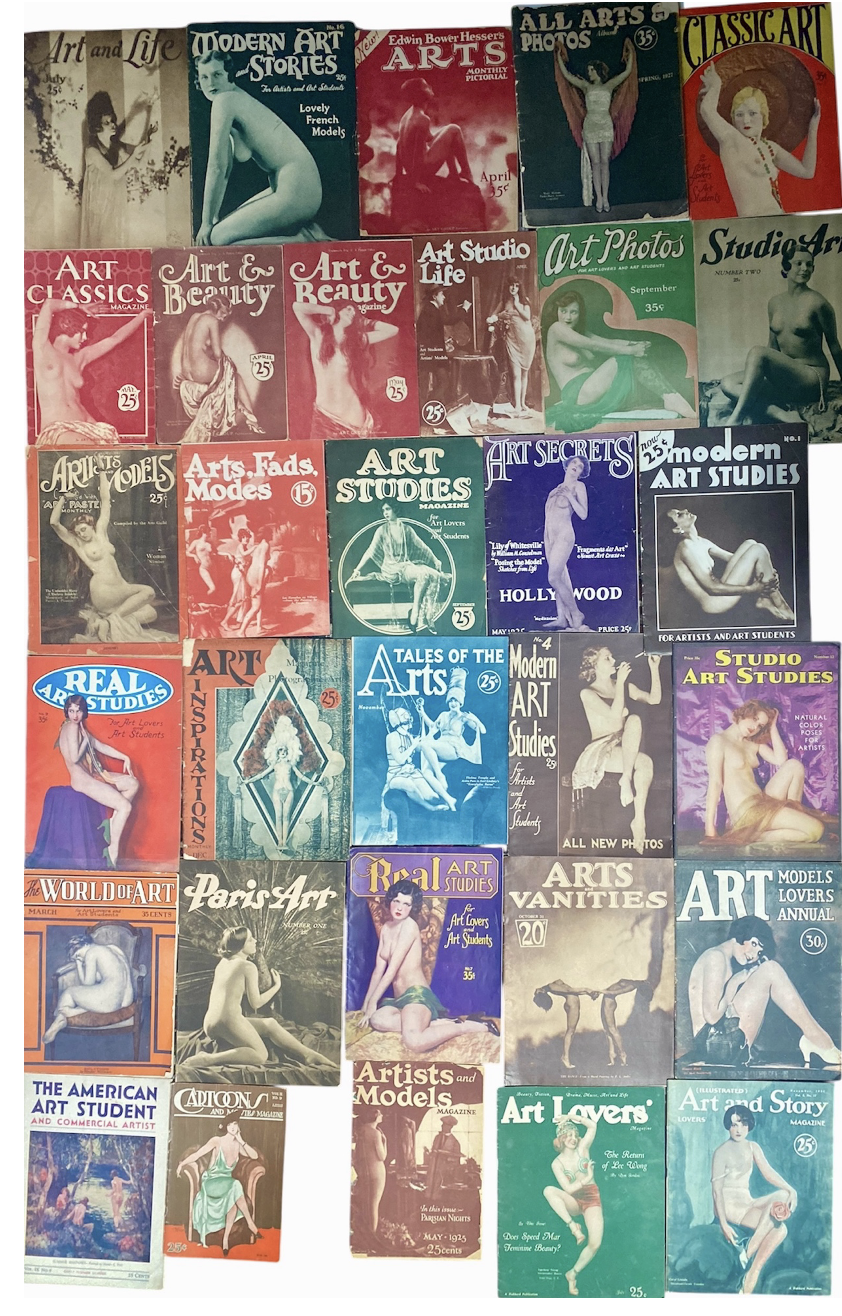
However, Hesser’s magazine was not the only one. There was a slew of art titles in the 1920s almost all claiming to be for artists and art students. Some of those magazines include, but not limited to,
All Arts & Photos Album
American Beauties
Art & Beauty
Art and Life
Art Classic
Art Inspirations
Art lovers’
Art Photos
Art Secrets
Art Studies
Art Studio Life
Art Visions
Artists and Models
Arts and Vanities
Arts, Fad, Modes
Fine Arts Quarterly
Modern Art & Stories
Modern Art Studies
Original Artists and Models
Paris Art
Real Art Studies
Sex Monthly
Tales of the Arts
The American Art Student and Commercial Artist
The World of Art
True Tales Of The ARTS
A sample of the art magazines on the newsstands of the 1920s
Almost without exception these magazines were not intended for the public, but rather for “Art Students, Art Lovers and Artists.” Some stated that they accept no subscriptions, so probably they were either sold on the newsstands or delivered by bulk to art schools and studios.
To clarify the point that the majority of these magazines were not aimed at the general public, the editors of Art and Vanities wrote, “The magazine is a strictly technical publication and aims to giver the artists the best art studies available. We know full well that for many artists, it is almost impossible to work directly from the model. This is due to the fact that models are demanding more for their time now, than heretofore, and also because the services of really good models are in demand at so many of our current Broadway productions.”
The following statement from Arts and Vanities applied to most of the art magazines that carried nudity within its pages. Art and Vanities “is not intended for general circulation. It is a text book for those who are striving to master the fundamental principles of Art.”
However, the magazine was very aware that non art students and artists are going to see the magazine, thus they wrote, “To those of the laity who glance through these pages, we must make one plea. Try to understand that this magazine is a text for artists. Perhaps you do not understand that nudity in art is as indispensable to art classes as food and drink to you. The nudity which you do not understand is fully revealed to the artist. To him, this expression of art is absolutely necessary. Without it he could do nothing.”
Art & Beauty magazine in its April 1927 issue wrote, “The studies in this magazine are photographs of paintings which appear in galleries the world over. They are pictures which any right thinking American citizen would be proud to exhibit in his home. They tend to acquaint young Americans with the fact that there is nothing mysterious or surreptitious about the nude and the sooner this is realized the sooner will there be an understanding of what is rank and what is beautiful.”
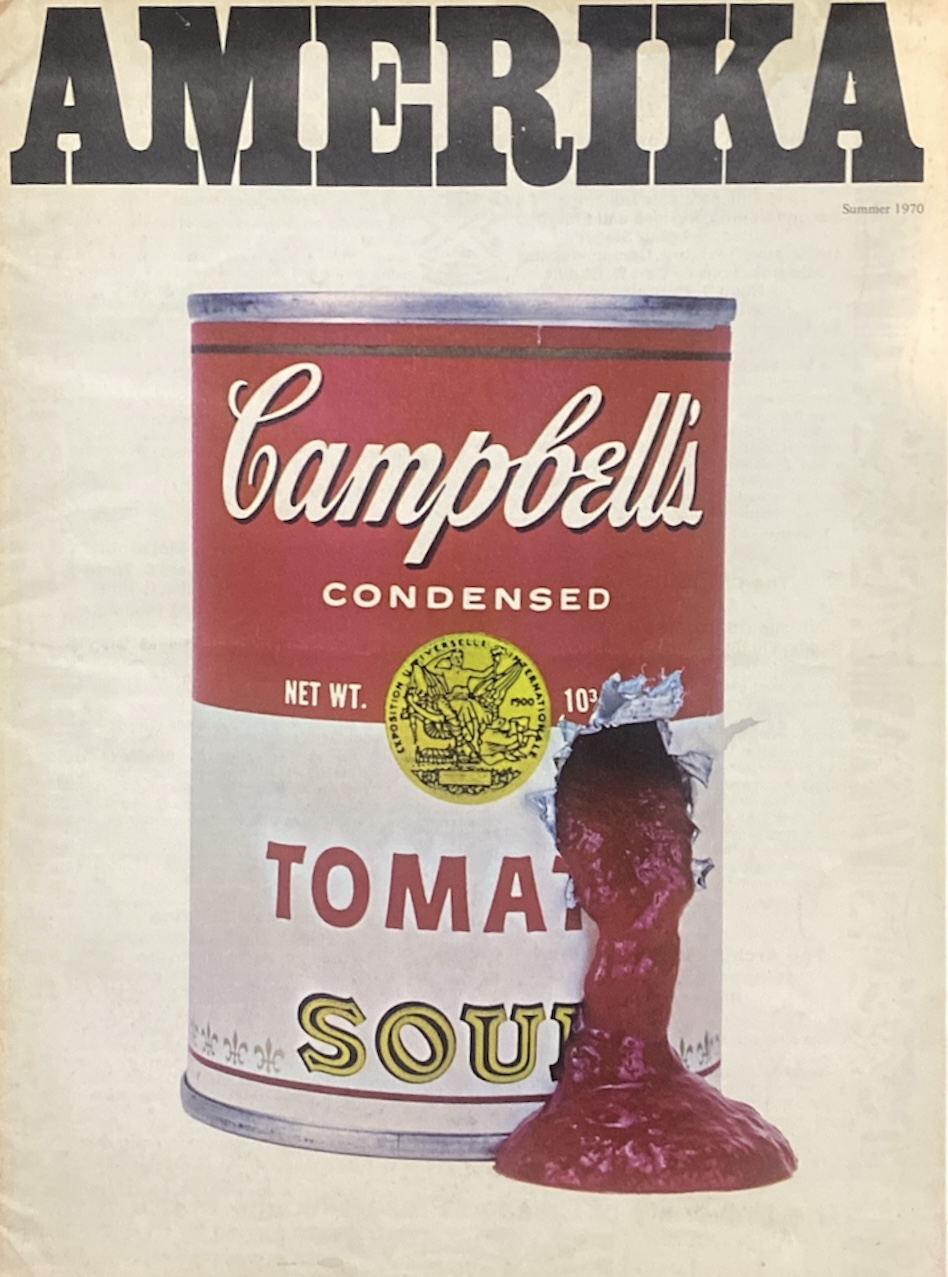
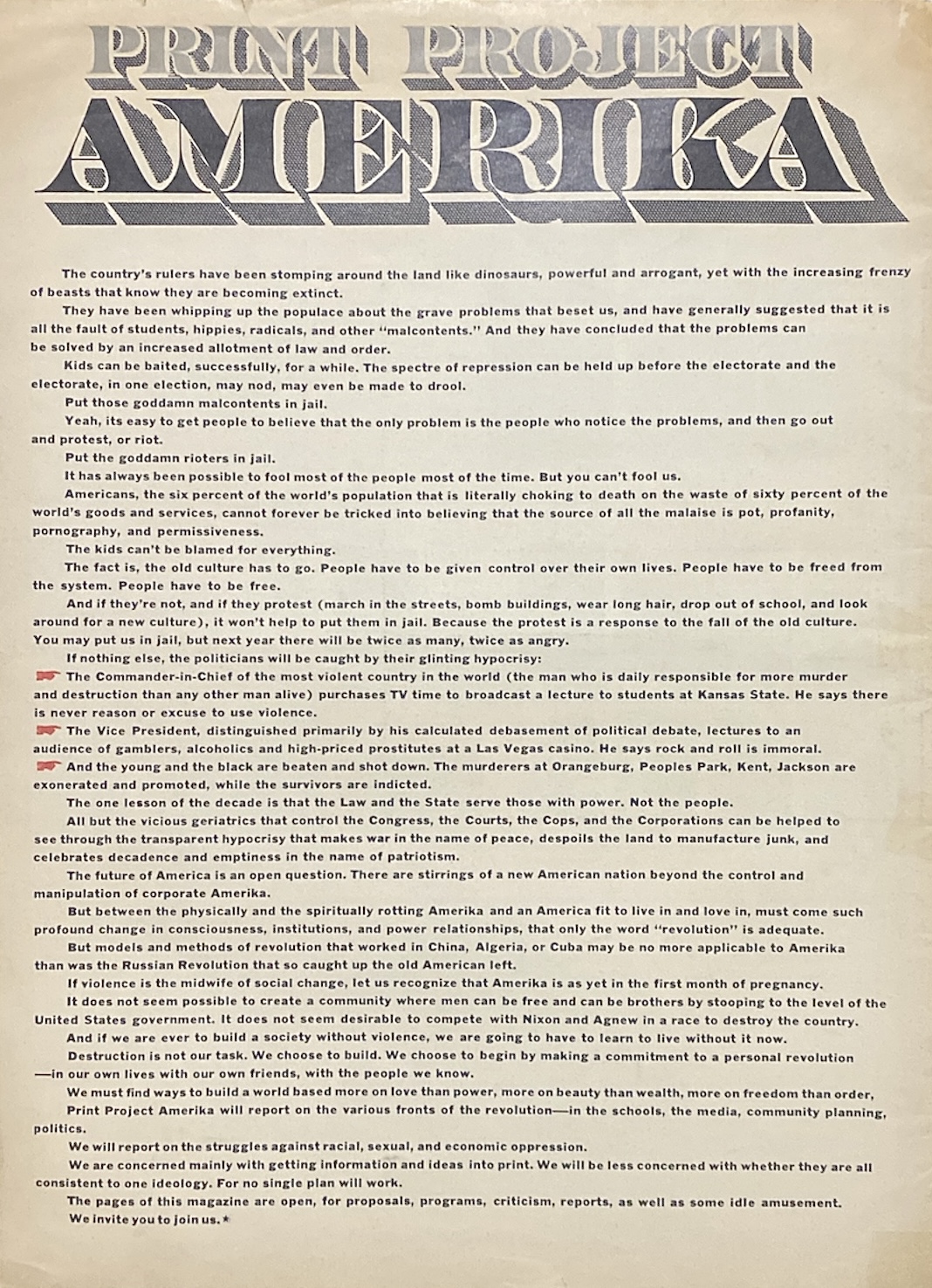
“This is a hard time to start a magazine. The country shaking like an old drunk. Who knows he has to give up the hoosh. Does not provide a climate of reason and ease that magazines thrive on. There is a recession.Magazines are collapsing left and right,” wrote Roger Black in his role as Editor of a magazine called AMERIKA in 1970.
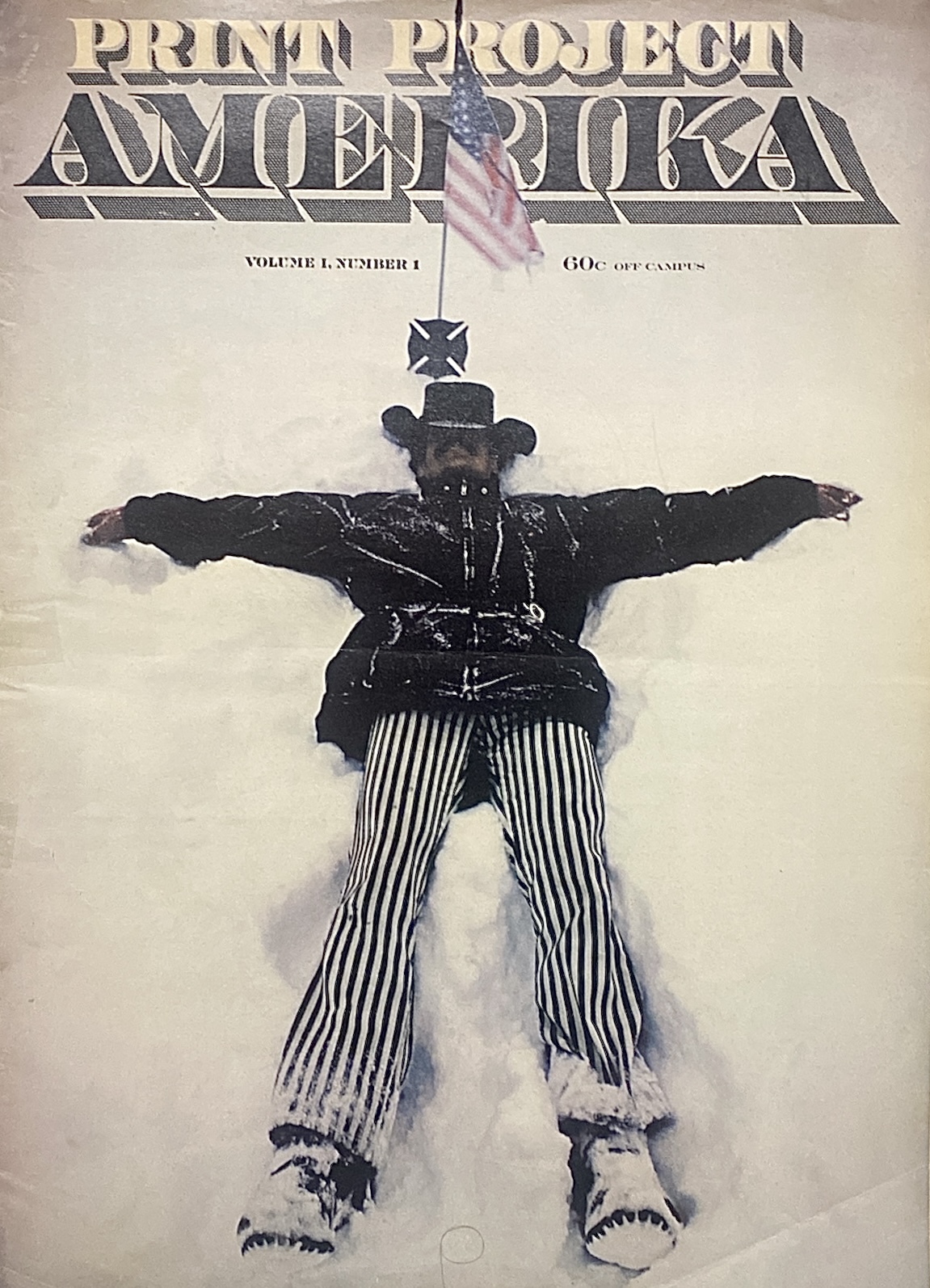
Mr. Black was a student at the University of Chicago and editor of the students’ newspaper, The Maroon. AMERIKA was forced to change its name after the dummy issue was published and the first and only issue published was called PRINT PROJECT AMERIKA.
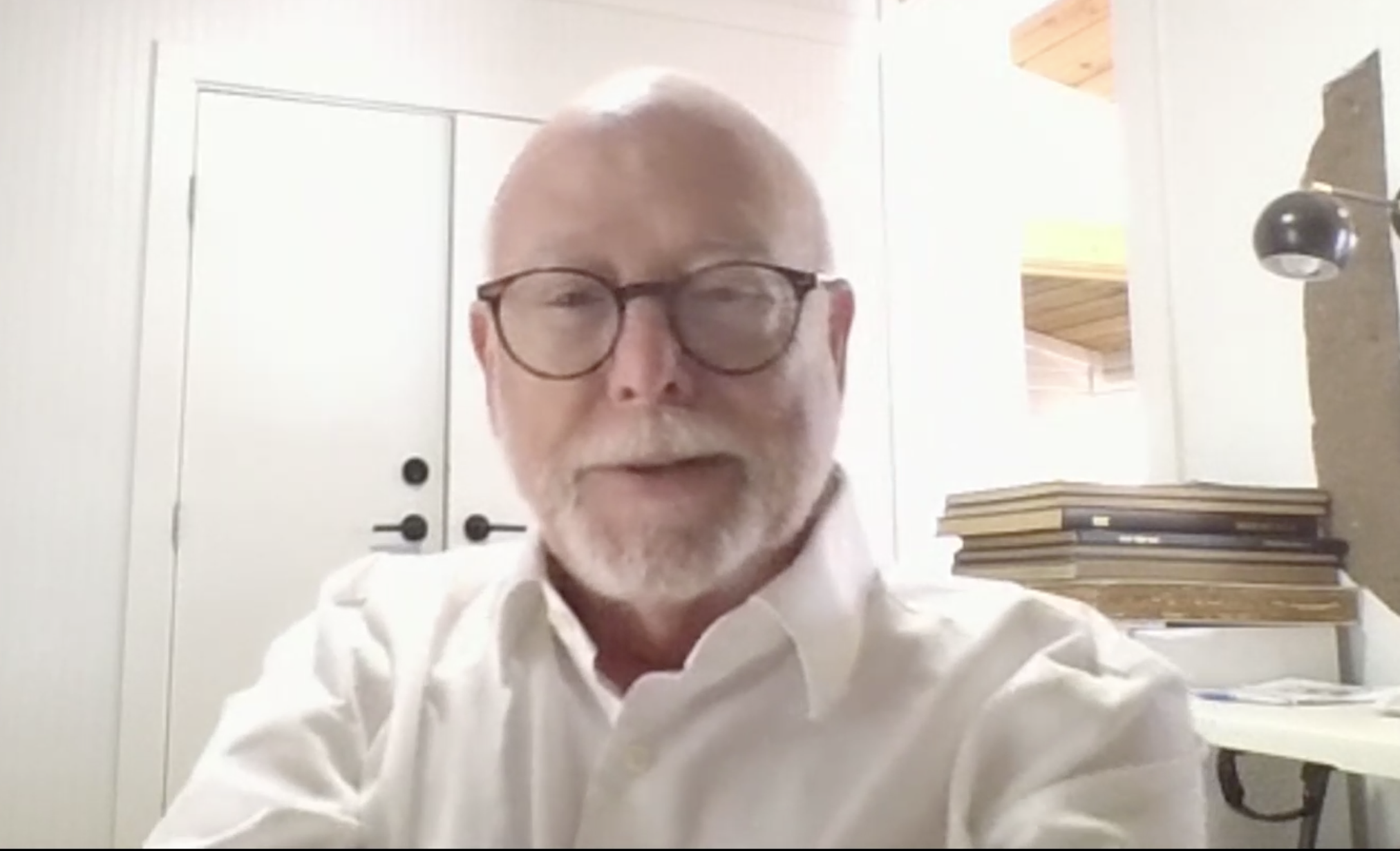
I reached out to Mr. Black to talk about the story of AMERIKA and to get an update on what he is up to these days. He told me that he’s “back actually doing a publication. And this is an urgent time for magazines and newspapers. We must find a way of keeping them going, keeping them independent.”
In fact, Roger Black wrote this week on his Facebook page under the heading “ROGER BLACK’S FAREWELL TOUR?” Join me at Big Bend Sentinel, where a team of innovative journalists is redefining local news. We’re testing two old ideas. In the video (that accompanied the post) watch for the key words: “fact” and “art.”
Mr. Black continued, “I started this tour in 1973 as art director of LA (1973). Now, as acting Art Director and non-profit chair, I’m back to weekly newspapers! The real work is done by a small energetic band of editors led by Rob D’Amico, Sam Karas, Mary Etherington, and Ariele Gentiles.”
He adds, “Can weekly newspapers survive and flourish? Can we hold onto local journalism?”
I reached out to Mr. Black to ask him about his original work on newspapers and magazines. I was mainly interested in the very first magazine, “AMERIKA” he edited while still a student at the university. Needless to say, he is a wealth of information and he has left his thumb print on many national and regional publication throughout his career. I hope you will enjoy this lightly edited conversation with a person who for years I called “a genius creative art director.”
Samir Husni: You ask Chat GPT about Roger Black and it tells you, “Very influential in magazine and newspaper design,” but no mention that you were an editor of a magazine back in 1970 while you were still a student at the University of Chicago.
Roger Black: Yes.
Samir Husni: And the magazine was called America with a K: AMERIKA
Roger Black: Well, that was the dummy. Later, it was PRINT PROJECT AMERIKA. There were only the dummy issue and the one and only first issue.
Samir Husni: So, tell me about your journey with AMERIKA.
Roger Black: AMERIKA was envisioned as Parade magazine (The Sunday newspaper supplement) for student newspapers.
In 1968, I was the editor of the Maroon, the student paper of the college at the University of Chicago. I must tell you, that was a very good year to be a student editor. And particularly in Chicago.
We had a lot of news. It was a big time for change. We started putting out a weekly magazine called Gray City Journal, which ultimately became its own publication.
So we started thinking that many student papers don’t have that kind of content. Harvard, Yale, and other elite schools do.
But in terms of magazine style, both entertainment and serious stuff, photojournalism and drawings, they didn’t really exist. If you go back and look at the 1960s’ student newspapers they were pretty dry.
A guy in the business school at the university, named Mark Brawerman, who is from California, came up with the idea.
A very sharp guy who just started school. He didn’t really have any business experience.
He thought that we could do this. One of the things that he did, and with my involvement, I thought it was a good idea, too, he started writing all the student newspaper editors and publishers saying, we have this idea.
Would you be interested in taking it? And we’re going to print a prototype, and you can decide. That was the reason for the prototype; we had to get the circulation.
I was interested in design. I had started doing some publication work before I got to college. I had a wonderful teacher named Robert Gothard, a famous typographer, who did student, alumni magazines, and other publications for universities and colleges and did other things, too. He was a great designer.
So, I got interested. He was the first art director of Print magazine, for example. I was really interested in magazines from really as a young kid. My mother worked for magazines.
We had written all these people, and we got enough responses that if we could print 200,000, we could have distributed them.
So I started working on the prototype. And it’s funny because my girlfriend at the time is listed as the art director. I don’t even remember her name now.
There you go. The prototype cover came from Kent State. It was from an art student there who did this kind of Andy Warhol homage after the Kent State shooting. And there’s more stuff of that inside. Anyway, I thought I could be a designer.
I looked at a lot of magazines. How hard can it be? So, I did this issue, this prototype. And by some wild set of coincidences, Sam Antupit, who is a great art director, the art director of Esquire at that time.
George Lewis did the covers, but he did the inside. And it was beautiful. He was doing a special issue of Print Magazine about magazines.
And he put this in a box called Hopeful Upstarts. We realized we were going to leave Chicago and move operation to New York. So, I got to New York and I looked him up.
And we had gotten some funding. We were starting to sell ads. But I couldn’t find an art director.
That was the funny thing. There weren’t a lot of people, if you think about it, Rolling Stone and New York Magazine only started in 1967. And before that, there were art directors at Esquire or at Town and Country or the fashion magazines, and Holiday magazine.
There were certain kind of visual magazines that had art directors. But National Geographic didn’t have an art director. Life Magazine didn’t have an art director.
It was not really one of those job descriptions that people, their mom said, you can be an art director. No one, no one really was thinking about that. And I couldn’t find any.
But Sam had this fantastic studio on, I’m going to say, East 52nd Street in a brownstone building. Later, the previous Citicorp Village was built there. But he was doing a bunch of different magazines out of the studio or doing designs, and redesigns.
He had a famous magazine artist, Richard Hess, who was his partner in that. So, it was called Hess and Antupit.
It was the name of the studio. And they were on the top floor. I was totally blown away how great it all was.
He did have student aides from SVA or Pratt or Cooper Union students working part time or as interns for him. What he couldn’t really recommend any other kids to be art directors. I finally came back and asked him if he would do it.
And by some miracle he said yes. And agreed to our price, which included all the type setting, all the illustrations and photos, the whole art project. He said he would do it for a fixed price.
I probably lost my shirt on it. He took over in that first real estate number one. It was really the designer’s Hess and Antupit.
I got to be the editor. So that was fun.
Samir Husni: The dummy issue was called AMERIKA, and the first issue PRINT PROJECT AMERIKA, why did you change the name?
Roger Black: I’ll tell you the story why we changed the name.
We got a letter from the Catholic Church. They sent us an official letter saying that they have a magazine called America and we have the trademark, so you can’t use America even with changing the C to a K.
Of course, I knew even at age 20 that you can’t trademark a place name. You can’t put a trademark on America. So I wrote back saying, you can’t trademark a place name.
So, I’m ignoring their letter. They wrote back and said, well, how many lawyers do you have? Basically, I said, these people are going to give us a hard time. I’m going to just add a qualifier.
We added the phrase PRINT PROJECT AMERIKA. We made it more experimental, new media feeling.
Samir Husni: The State Department didn’t send you a letter saying we have a magazine aimed to the Soviet Union called America.
Roger Black: Well, their magazine was only circulating in Russia. And we weren’t going to Russia. They are not allowed to distribute it here.
Samir Husni: In this digital age, where do you see print role?
Roger Black: Print magazines had a very good run. I like to say it was a hundred-year run. If you look at the magazines, like the late 19th century, magazines that started running art, photo engraving had come in.
They were impressive. And then you had with the invention, of rotary presses and linotype typesetting and all that. Magazines followed the newspapers in increasing press runs.
So you had the concept of mass magazines. That whole business model kept morphing. Everyone forgets about this, you know, like in 1995, the commercial web appeared and everybody said, oh, everything’s over.
But I don’t think the commercial web was much more of a kick in the head than the television. And before that, there was a similar abrupt change with radio. The idea that entertainment could just sit in your chair and not have to think and just listen.
Magazines like The Saturday Evening Post were really hurt by that. Because that was their position, at home after they were reading entertaining stuff. But they survived and they adapted.
I think that the biggest challenge for a contemporary magazine, and that also includes online, is the attention span problem and the way that the kind of addiction to the constant scroll, just going vertically with dozens of different things that you’re barely aware of what it is. You stop on a cat or whatever you want to look at.
That has changed dramatically in the last 10 years. We didn’t even know about TikTok 10 years ago. And Facebook seems for people my age now.
All that keeps morphing. Instagram had its moment in the sun. And everything, everything is always moving. My feeling is that print offers a new kind of respite for that.
In the way that radio seemed like a respite for reading. Print, going back to reading, is a relief from that addictive scrolling that everyone’s doing. Or just that very short attention span, you look at one thing, you look at another thing, you look at another thing.
That kind of short attention span gets tiresome after a while. And why can’t I say that with any confidence? It’s because the long form media, like books or movies, are blasting ahead fun. I mean, movie says, the movie, the Hollywood studio business is once again in convulsions. With every year, there’s a headline that says, Hollywood is no longer the same. It will never be the same.
We don’t recognize it anymore. And they’ve been saying that since about 1920 since talkies came in. So that long form sitting in a movie theater or watching it on Netflix is a very compelling experience.
And people enjoy it. It’s still, there is a business model in the same way that music kind of changes business model from the time of the record business. Movies are too, but also books.
It’s very interesting to me to see things like the eBooks for the digital side, but also bookstores are coming back. There are new bookstores everywhere. And there are very niche bookstores.
Bookstores about cooking or bookstores about architecture. All over the place. It’s fairly like Marfa, Texas, where I am right now, it’s just a few thousand people, right? It has an extremely good bookstore that also has a quite a good art collection.
Now, Marfa may be a special town, they just finished a new library or a big addition to this little library in Marathon, Texas. Population 400. And every time I’ve been by it, it’s full.
A lot of kids. Why is that? Because there’s something very pleasant about holding a book and reading it. And getting it, one of the advantages that books have and movies have over the endless internet is that you finish the book.
I’ve read the magazine. I’m done. I finished The New Yorker.
Almost nobody can say that online. There is a real feeling of accomplishment. And of course, The New Yorker’s secret that Howard Gossage, the advertising man, pointed out when he was doing their advertising.
The cartoons in The New Yorker are the guilt reliever. Because you can go, page all the way through, get a few chuckles. You might read a talk piece or one or two other things.
And then you sit the magazine down and somebody says, and you mentioned something that you saw in The New Yorker. I read it in The New Yorker. I read The New Yorker every week.
That’s a definite feeling of accomplishment. From a psychological point of view, there is satisfaction that comes from the phenomenon of the edition. This is a magazine.
This is the September issue of our magazine. Or this week’s magazine. Whatever.
And the same thing. You get to feel like you finished it. You go through it.
The online newspapers, you never finish. The digital crowd is very surprised that people like the PDF replicas of newspapers. Like The Dallas Morning News now presents that first.
If you go to their website, you get the replica first. Then you get the actual website. Because people know how that navigates.
They know where their stuff is. Everything’s in a familiar place. And things like PressReader made it increasingly easy to read on different devices.
The feeling about sessions, session time, completing an edition, very important. I think that magazines, in the same way that I think anthology, television like 60 Minutes will go on despite everything else. Now we still must work on the business model.
The numbers are much smaller than they used to be. We’re not doing mass magazine. But I think that quite a few people, we see people getting in and surviving.
And it’s delightful.
Samir Husni: Mr. Black, if someone comes to you and says, I want to start a new magazine, what do you tell them?
Roger Black: I really ask them, who’s your reader? I think it all starts with the reader.
Who is it you’re trying to talk to? Have you talked to them? You communicate with them. And I think that’s the way that we all got in the media have gotten in trouble over the years, is that we think that we’re the media. And it’s a two-way thing.
Reading is interactive. And I continue to find, maybe it’s because of my extreme age, I find reading the most effective kind of communication. It’s faster, it’s cheaper, and it’s inexpensive, as opposed to a video that you do on TikTok or YouTube.
That’s an effort. It’s a production. Maybe we don’t have a TV station like we used to.
And we’re relying a lot on Apple and the others to fix our video for us. But I think that having a group of people just writing, taking pictures and putting them together into a magazine, is very low cost compared to what the big guys are trying to do. And I think you can, if you make it good.
If you connect with the reader, it can work. And it doesn’t have to be high art. It doesn’t have to be the kind of level of journalism you’d expect in The New York Times or something else.
But if it can be good and readable, and is hitting a chord that people like, I think you can make it. One example you mentioned, Arena, the Santa Fe magazine, which is two old, French, encrusted print guys. One, John Miller, worked with me.
Owen Lipstein, somewhat controversial publisher from New York, who was the publisher of Smart Magazine, which I did in the late 90s with Terry McDonnell, only 13 issues ever published. Anyway, they got the idea of doing a big fat real estate magazine in Santa Fe, which of course, people in Marfa would say that Santa Fe is a real concoction of the real estate salespeople, which it may or may not be. But what they did to get the content, because they didn’t have a huge budget, and none of this stuff, no one is paying what Vanity Fair is paying.
I don’t think even Vanity Fair’s paying what they used to pay. But what John Miller, the editor there, and designer, did was to just do a lot of interviews. He had video, and some of the interviews were trimmed to just be the answers.
It was like a first-person article. Sometimes they would have a lot of pictures of their home, or they would go there. Sometimes it was just pick up what they could provide, the decorator, the designers, pictures of the house or whatever, or their potters, and they had stuff on their website.
Just thinking about it carefully and making it interesting with interesting people.
Basically, it’s all about the people in magazines. So you start with the reader, but then you give them stories about people to read.
That’s basically the core of every good magazine.
Samir Husni: Before I ask you my typical two last questions, is there any question I failed to ask you you’d like me to ask?
Roger Black: I sort of expected you to say, why are you still doing this? Which is funny, I don’t know what else I would do. It’s like somebody says, why do you have this place in Texas out in the desert? And my answer is, I can’t think of anything, any other place I’d rather be.
I can’t think of anything else I would rather do than try to work with typography. We have Type Network, I’m chairman of Type Network, and we’re doing a wonderful collaboration with 100, more than 100 type designers and type founders with special custom design projects. Some of it is consulting, and some of it is type design.
I’m not a type designer, but I can connect them to the market. It’s a very small operation, but quite fun. I want to keep working.
My father worked till he was 80. And then, even later, he said, I never should have quit. So, the next question is, what are you doing now? As well as Type Network, I’ve come out to Marfa, and I’ve taken over by starting a new non-profit with Don Gardner from Austin, and Gonzalo Garcia Bautista from Mexico City.
We have started a non-profit, and we are now publishing this paper, which you can go to at BigBenSentinel.com. You can join and get the PDF, or we’ll mail it to you. For 60 bucks, we’ll mail it to you.
Folks, that price is going up, so act now.
Samir Husni: If I come unannounced to your house…
Roger Black: In Marfa, now? Well, it’s a marathon. I also hang out in Florida. We’re still repairing from the hurricane last year.
And I have an apartment with my husband in Oslo, Norway. So, I kind of am nicely balanced.
Samir Husni: So, if I come unannounced one evening, what do I catch Roger Black doing to rewind from a busy day?
Roger Black: Reading. I’m still old-fashioned.
Samir Husni: And what keeps you up at night?
Roger Black: I don’t stay up at night. I am a great sleeper.
I don’t know why. I go to bed early. I go to bed by 11 or so.
In the old days, I’d stay up late. My peace of mind results from, as you get older, you realize you must let things go and become balanced, or you’re always anxious. The other thing that helps me, has helped me in my whole life, is I have a colossally developed ego.
It doesn’t occur to me until years later that I could be wrong. It’s like later people point out, that was a complete disaster. And I say you’re right.
I was completely unaware of that at the time. And I still, you know, it’s like I tried to do that thing, Screensaver, I thought we could do a technology solution for reading digitally. And it turned out that it didn’t work beautifully.
It turned out that the publishers didn’t have a business model for that. So, I do find myself waking up sometimes and thinking about those things. But I go right back to sleep.
I’m not what you’d call a troubled old man.
Samir Husni: Thank you. Take care. Have a great day.
I have always been an advocate for a strong editorial letter in the first issue of any magazine. It is essential to introduce the magazine to your audience and to ensure the fact that they understand its mission statement and the role it is going to play in their life. Magazines that launch without such an introduction, to me, are a sign of laziness and lack of care of their audience.
What follows is the launch editorial of Digest Of Treatment that its first issue appeared on the nation’s newsstands in July 1937 and was aimed mainly at doctors. Under the heading “We Begin,” the editorial went on to say, “First issues, to almost everyone, are an exciting curiosity. To the collectors, they have intrinsic value; to the critics, they have a dissecting table value; and to the editors, authors, and publishers, they have a deep sentimental value.”
It continued, “Our purpose in presenting a monthly periodical, “Digest of Treatment,” free from any suggestion of advertising bias, is three-fold: first, to bring to the practitioner, in brief form, the newer developments in the technic of treatment; second, to stimulate an interest in the worthwhile current medical literature today; and third, to bring to those physicians who have become defined as specialists, a well-rounded viewpoint regarding branches of medicine other than their own.”
The editorial added, “Each month, Medical Editors, every one a clinical practitioner, carefully select, from over two hundred journals, material to be condensed. In their selections they choose both the favorable and unfavorable reports, realizing that the physician is keenly interested in the unbiased evaluation of the therapy he contemplates trying. The digests and condensations, selected and made by men of clinical experience, fill a need expressed by physicians many times.”
Digest of Treatment continued, “No physician engaged in practice has available the complete current literature of the medical profession, nor does he have the time to look over thoroughly more than three or four periodicals. The presentation of outstanding articles in this convenient form, “Digest of Treatment,” saves the practitioner many hours of research.”
The editorial concluded by stating that, “The editors will always welcome suggestions and criticisms from their fellow workers. They invite a hearty participation in the enterprise through which they serve the interests of medicine. All communications will find a receptive ear.”
It’s a known fact that the average sell-through (number of copies sold from the copies sent to the newsstands) is at best 30% and at its worst less then 20%. That is to say that from every ten magazines sent to the newsstands, only 2 or 3 magazines are sold, and the rest are returned to “the shredder.” You will say, this is a lot of waste in this environmentally conscience world we live in.
However, it is also known that if you reduce the number of copies you place on the newsstands, you will reduce the number of copies you will sell. This dilemma is not new; it dates back as far as magazines were placed on the newsstands.
So how do we solve this problem? One solution comes from the United States government: No returns are accepted. Yes, that was the solution of the issue of returns in 1918, more than a century ago.
In an editorial titled “Roycroft on News Stands” dated September 19, 1918, in the October 1918 issue of Roycroft magazine, the editors wrote, “We have always tried to give ROYCROFT a very thorough distribution on all the News Stands throughout the country, and in doing so, of course, have had to be generous in the matter of returns from the dealers.”
The editorial continues, “The Government now asks all publishers to restrict these returns. This means that practically every News Dealer will order only such quantities of ROYCROFT as he has advance orders for. He cannot take chances on being stuck with a bunch of unsold copies. There should be no unsold copies, anyway, but occasionally there are.”
The editors came up with a solution to this problem by suggesting to “all readers of ROYCROFT who have been purchasing the Magazine on the News Stands, that it will be necessary for them to order the Magazine – NOW—from their dealer, or else they may be unable to get it on the Stand.”
Another option the editors offered the readers of Roycroft magazine, “If, for any reason you would rather not place a definite order with your local News Dealer, send in your subscription to us. This will insure your getting the Magazine every month.”
The editorial ends up with a plug about the magazine, “ROYCROFT will present to its readers a series of articles each month, touching upon vital things and viewed from the unusual standpoint. It will continue to be of vital interest, and we want you with us for all time.”
So, here you have it, a solution from 1918 only preserved in print where history comes alive on every page of the printed magazine. Print preserves history and history needs print to be preserved.
To find out more of the golden olden gems from magazines please visit the Samir Husni Magazine Collection at The University of Missouri-Columbia by clicking here.
I am holding in my hands a copy of Life magazine from March 26, 1925. Yes, you read that right, a copy of a magazine published 100 years ago. The magazine feels, looks, and reads like many magazines published today. A nice cover, good content, plenty of illustrations, and a promise for the future, “While there is Life There’s Hope.” And hope is what I see and feel every time I pick up a copy of a magazine from a century or two ago.
Print is permanent. A magazine, once printed, is permanent. You can’t change a thing, not even a comma. There is no backspace or delete button. What you see is what you get: yesterday, today, and tomorrow. You can own it and you can proudly say it is mine. That sense of ownership satisfies the human need in all of us to own things, lots of things (Just look at your house or apartment and see how many things you have, even those you do not need).
Flipping through the pages of this issue of Life, I am transformed to a simpler, calmer world where, I can “select colors and upholstery,” for my “custom Cadillac,” or enjoy my Wrigley’s chewing gum “after every meal.”
I am also reading the prize winner’s answer to the question, “Is Democracy a Success?” H.W. Davis won the $50 prize for the following answer: “ Democracy is a rip-roaring success. If you don’t believe so, say out loud that it isn’t – and run for your life. Democracy pats the greatest number of people on the back and makes the most promises. Of course it seldom delivers. But what of that? We live and are made happy by promise, not performance.
And happiness is success, for all that anybody has been able to prove to the contrary. Ergo, democracy is a success.
There! The pup has his tail in his teeth.”
So, here you have it. I am reading and flipping the pages of a magazine from 100 years ago, exactly like I read and flip the pages of a magazine from March 26, 2025. I wonder if I can say the same thing about any of my digital devices? Heck, I can’t even use my camcorder from 20 years ago, yet I can look at my printed pictures from 50 years ago.
Long live print and long live permeance. Print will be here long after I am gone, the same it was here long before I was born.
One final note, there is nothing permanent about digital, even a PDF can be changed and altered. You can’t do that to a magazine. It is permanent.
Enough of that, I have some reading to do…the first issue of Art Lovers magazine from January 1925…To be continued.
PS: If you want to journey through thousands of magazines from yesteryears, check The Samir Husni’s Magazine Collection at my Alma Mater The University of Missouri-Columbia here.
Magazine making is an art. It was, is, and always will be. However, there is great art, mediocre art and just plain bad ugly art. To each its own. Continuing my journey into the magazines from years gone by, let alone a century, I happened to come across the first issue of Horizon magazine from September 1958. It is a hard back that is encyclopedic in look and content.
The editors wrote in the foreword (two full pages) to the first issue: “We take for our title the word horizon because it is here, where earth and sky meet, that one may observe those jagged interruptions in the landscape that are the words of man: the squat mud houses of ancient Sumer;” The editors continued, “the gleaming statuary of the isles of Greece; the stately sky line of Venice when “she did hold the gorgeous East in fee”; a perfect bridge in Peking; our own soaring, protean civilization; all that moved Milton to write that
Towered Cities please us then,
And the busie humm of men.
I wonder if today’s reader would need a translation of the above. Remember, this is just part of the foreword of the magazine. The editors continue, “Culture, the concern of this new magazine, is both achievement and dream, a work of hands and a movement of the spirit, the special property of man since the great miracle of the Sixth Day – since Darwin’s hairy quadruped dropped from his tree and (how many millennia later?) first lifted up his gaze to seek something beyond mere food and drink.”
If that’s not enough of pure excellent prose, read on and say how magazines were made and how they were meant to be. The editors of Horizon continued, “ Culture is art and ideas, past and present, taken in sum as a guide to life. It is history too, the science which Dionysius tells us is “philosophy teaching by examples,” with philosophy suspended between the I-believe of theology and the I-know of science.”
The editors added, “ This magazine in any case is commenced in the belief that some better guide than now exist in America is needed to the house of culture, with all its thousands of rooms.” In conclusion, the editors wrote, “We invite all those whose interests lie in this broad field, whether as contributors or readers, to join us in this venture.”
When was the last time you read something like this? Something that makes the magazine a piece of art to keep and collect? Are the magazines of today worth keeping? Are they a “better guide than” what exists in America today? You be the judge and the jury.
Would love to read your comments. As always keep in mind that if you would like to take a dive into the “oldies but goldies” magazines of the past, feel free to reach to John Henry at the Specia Collections division of The University of Missouri Libraries and ask for the Samir Husni Magazine Collection.
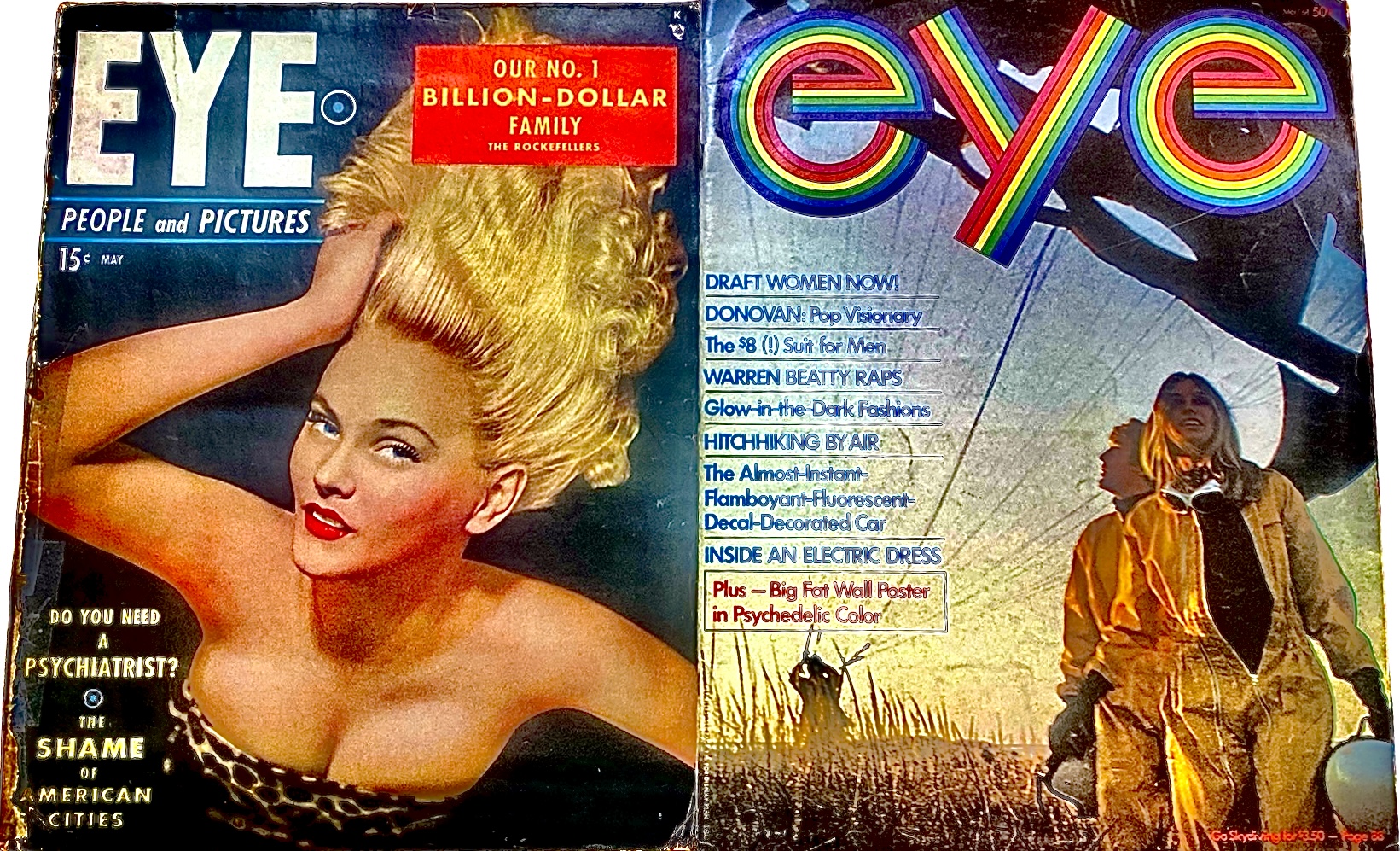
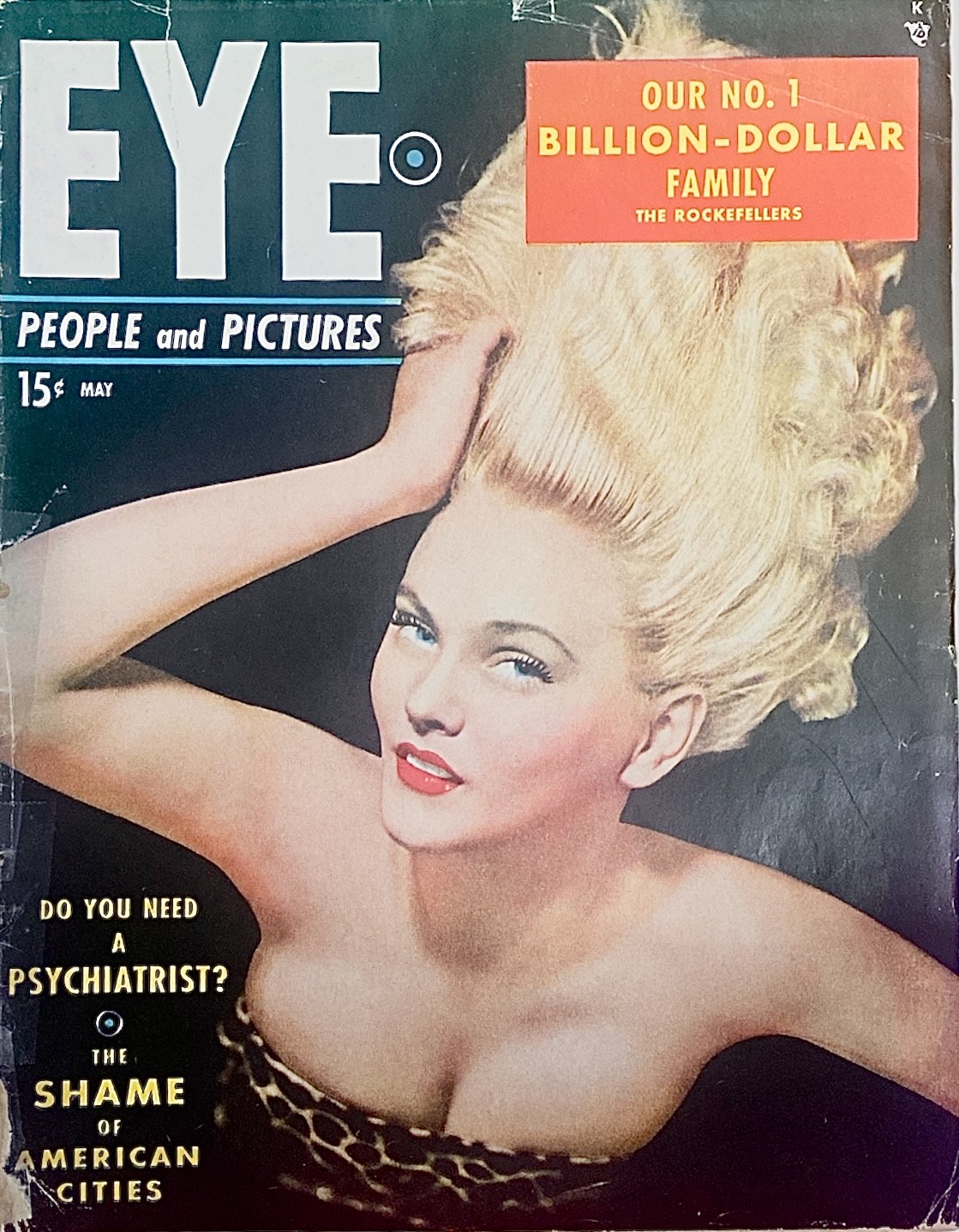
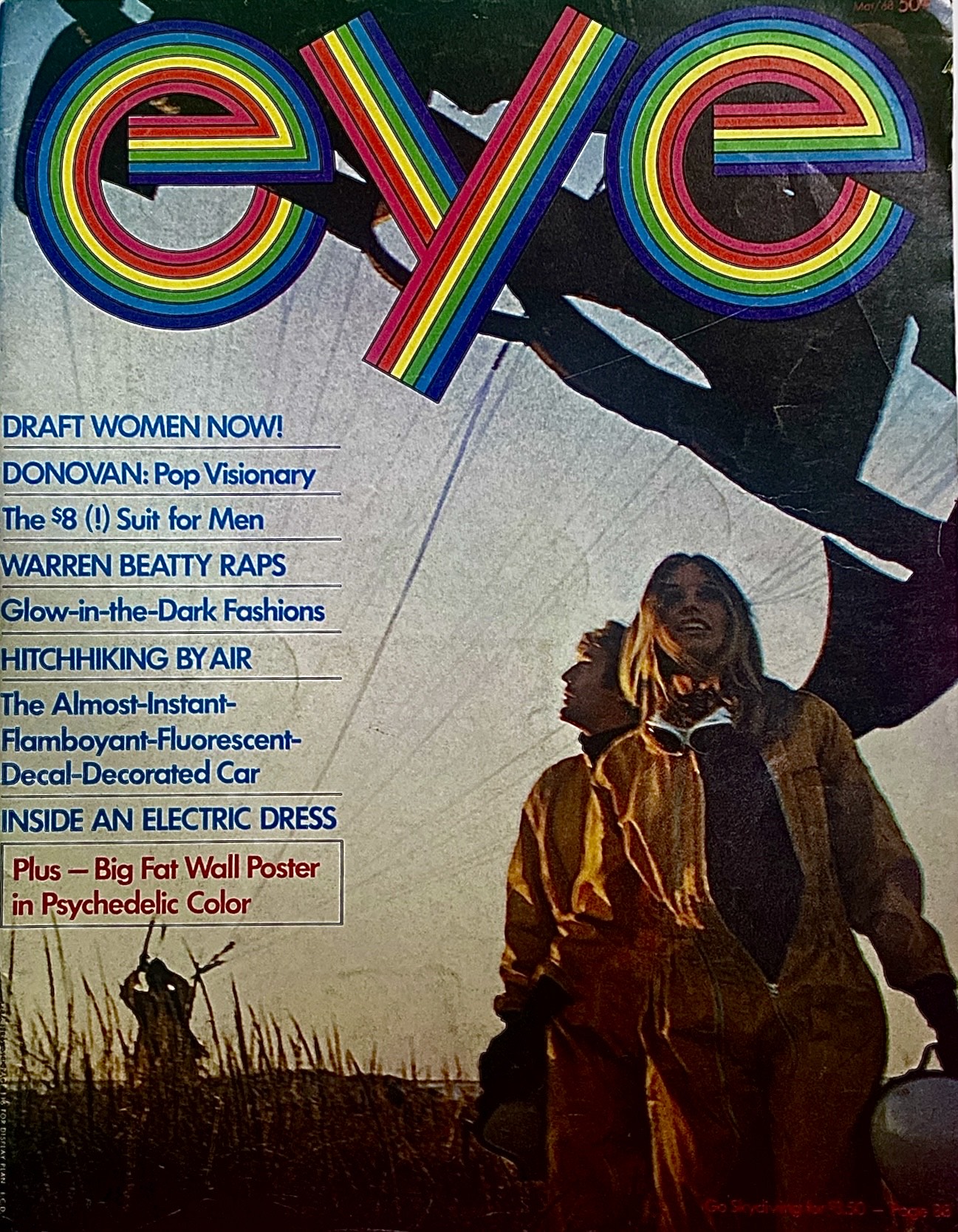
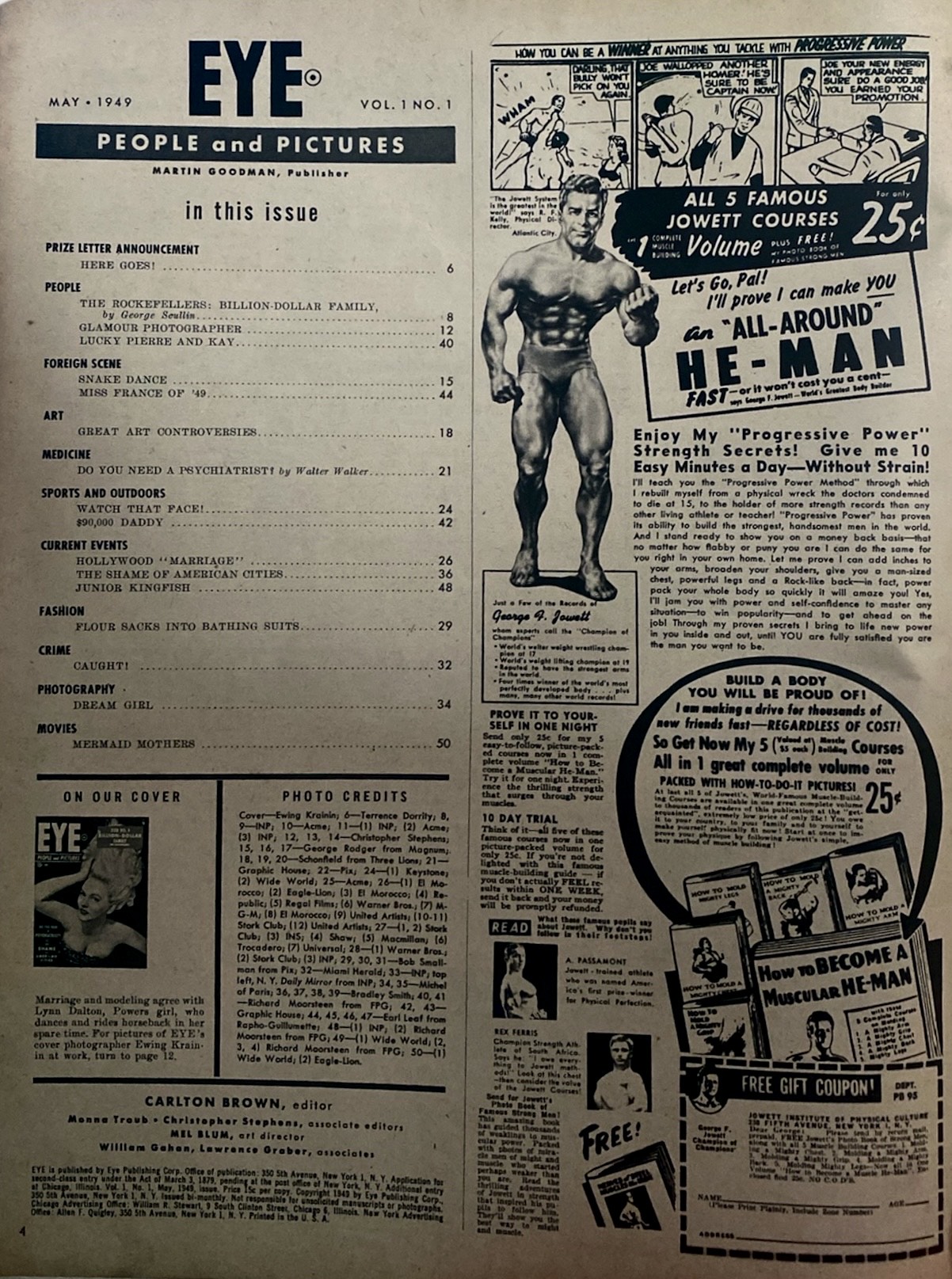
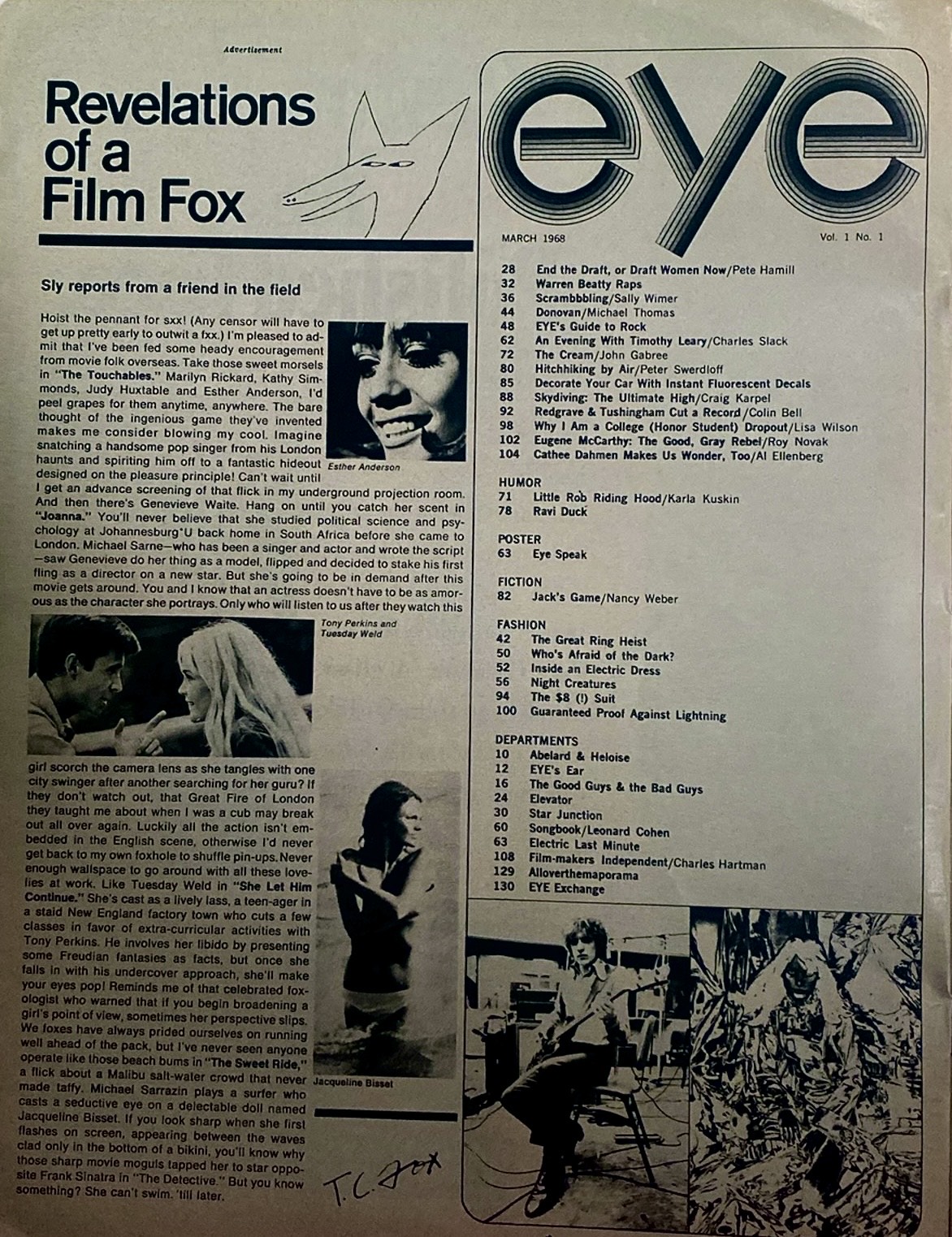
That is two Eye magazines. One from the days before I was born, and the other when I was a 13-year-old teenager. However the two Eyes have a lot in common and few good lessons to learn if you ever thought or think of going into the magazine business. And by magazine, I mean the ink on paper publication that is published on some regular frequency.
So without any further ado, here are the lessons I have found in those two Eyes that are still applicable in the year 2024, some 75 years after the first EYE was born:
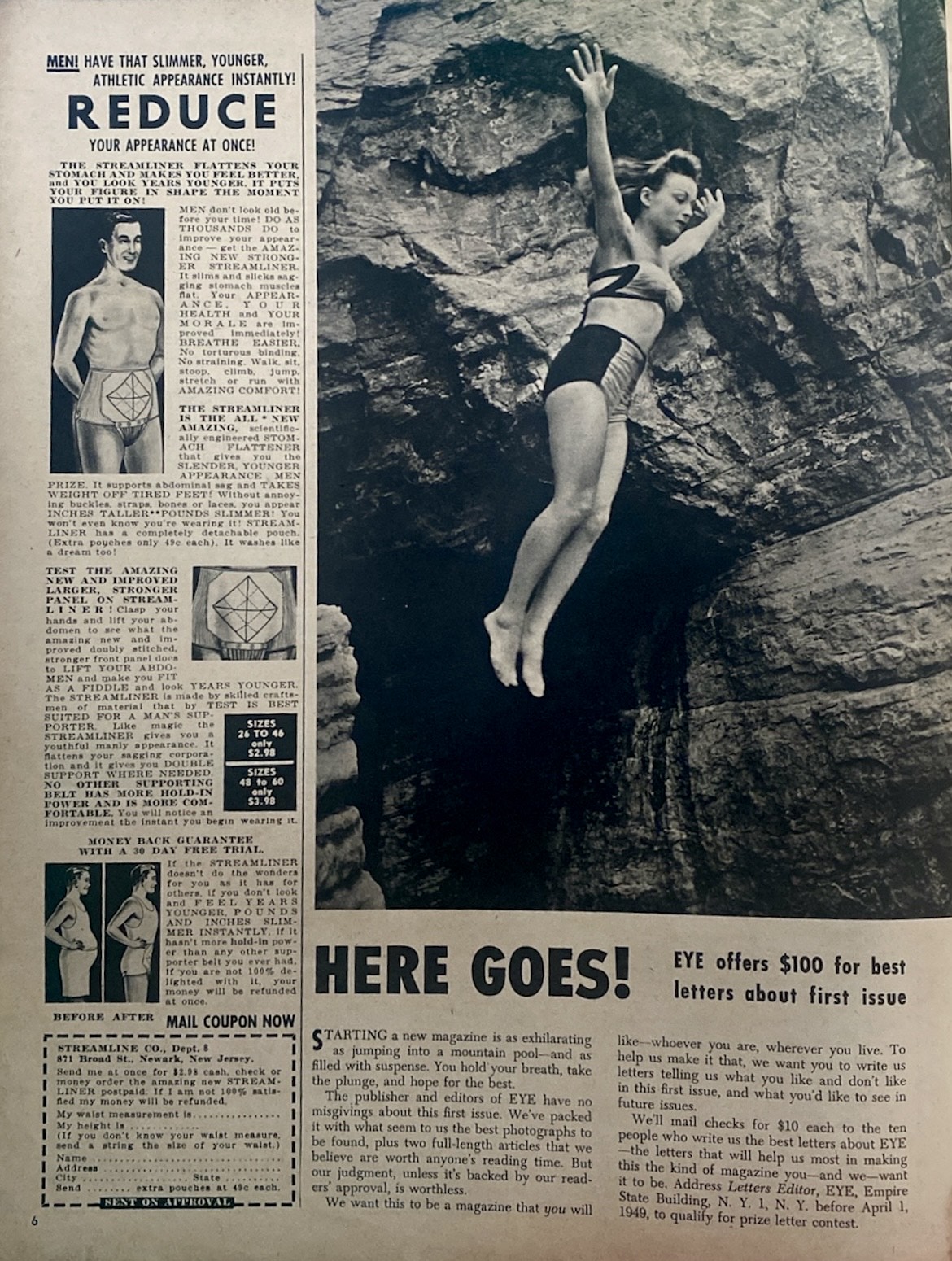
Lesson number 1: Magazine publishing is not for the faint of heart. In 1949 when the first EYE ( Martin Goodman, publisher and Carlton Brown, editor) was published, magazines were the only mass medium available to the public nationwide. This EYE was first published in May 1949 with the tag line “People and Pictures.” The editors wrote in the first letter to the readers, “Starting a new magazine is as exhilarating as jumping into a mountain pool – and as filled with suspense. You hold your breath, take the plunge, and hope for the best.”
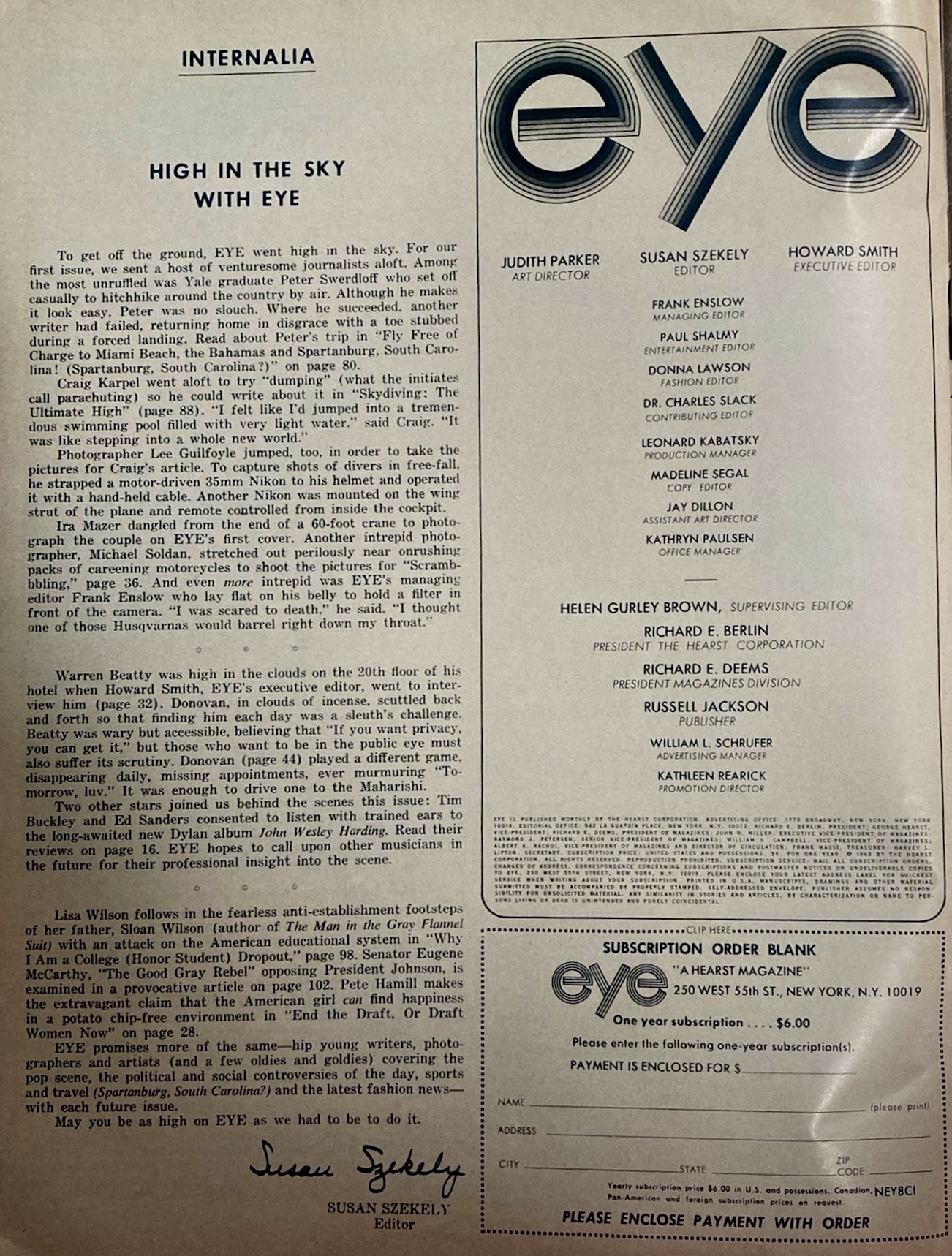
In March of 1968 editor Susan Szekely, wrote in the first issue of the Eye published by the Hearst Corporation (Helen Gurley Brown was the supervising editor), “ To get off the ground, EYE went high in the sky. For our first issue, we sent a host of venturesome journalists aloft. Among the most unruffled was Yale graduate Peter Swerdloff who set off casually to hitchhike around the country by air. Although he makes it look easy, Peter was no slouch. Where he succeeded, another writer had failed, returning home in disgrace with a toe stubbed during a forced landing.”
Both magazines took calculated risks and knew that magazine publishing, even in the 40s and 60s of the last century was not for the faint of heart.
Lesson number 2: Plea for help from the audience.
Without your readers, the magazine is not going anywhere. Readers input is essential. EYE of 1949 offered readers money for the best letters about the first issue. “We want this to be a magazine that you will like – whoever you are, wherever you live. To help us make it that, we want you to write us letters telling us what you like and don’t like in this first issue, and what you’d like to see in future issue,” the editors wrote. They continued, ‘We’ll mail checks for $10 each to the ten people who write us the best letters about EYE – the letters that will help us most in making this the kind of magazine you – and we – want it to be.”
Hearst’s eye was more on the wishful side of things with the audience. “May you be as high on EYE as we had to be to do it,” wrote the editor.
Lesson number 3: Great content was and will always be king and queen.
The importance of good quality content is as important as it was in 1949. For magazine content goes beyond good writing to include good photography, design, and the art of packaging a coherent and pleasing publication both for the eye (pun intended) and the brain. “The publishers and editors of EYE, have no misgivings about this first issue. We’ve packed it with what seem to us the best photographs to be found,” EYE’s editors wrote, “plus two full-length articles that we believe are worth anyone’s reading time.” The editors were humble enough to admit, “But our judgment, unless it’s backed by our readers’ approval, is worthless.”
As for the May 1968 Hearst’s eye, the editor wrote, after paragraphs of introducing the writers and photographer for the volume 1, number 1 issue, “EYE promises more of the same—hip young writers, photographers and artists (and a few oldies and goldies) covering the pop scene, the political and social controversies of the day, sports and travel (Spartanburg, South Carolnia?) and the latest fashion news—with each future issue.”
Publishing a magazine, a good magazine still depends on those three premises stated above. Recognizing it is not for the faint of heart, engaging your audience from the very beginning, and providing excellent content that can’t be found any other place.
If you would like to take a dive into the “oldies but goldies” magazines of the past, feel free to reach to John Henry at the Special Collections division of The University of Missouri Libraries and ask for the Samir Husni Magazine Collection
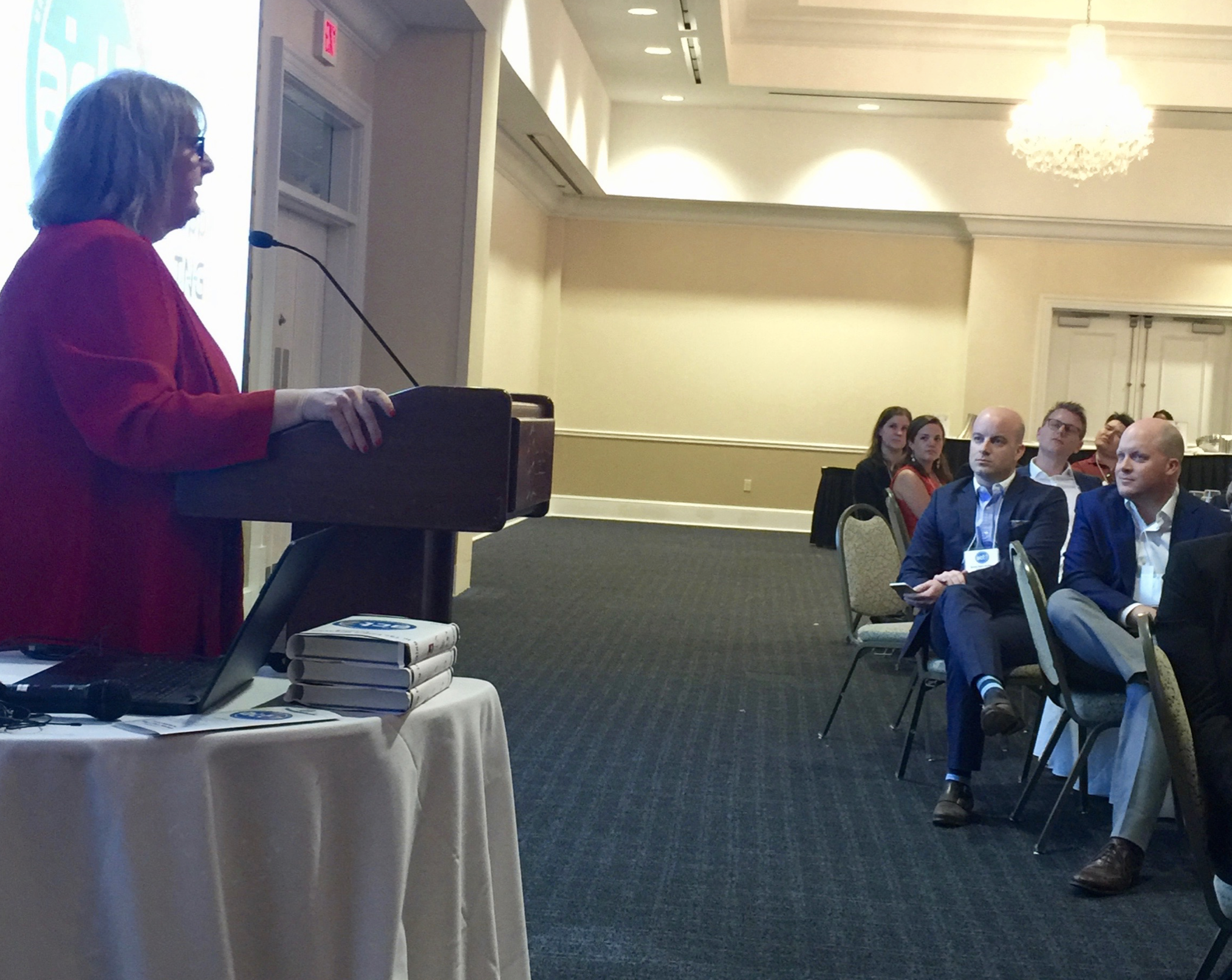
A great magazine founder and publisher died yesterday July 10, 2023. Phyllis Hoffman DePiano died yesterday leaving her publishing company, Hoffman Media (the little engine that could), to her twin sons who loved, adored, and worked with their mom. In 2017 Phyllis and her two sons spoke at one of my magazine conferences and my friend Linda Ruth was able to sum and write up their presentation. What follows is a tribute to a great lady and her story.
Phyllis Hoffman DePiano presents with son’s Brian Hart Hoffman and Eric Hoffman
In publishing, founder Phyllis Hoffman began, there are no rules, no manual on how to be a successful publisher. “When we started in 1983 I was clueless,” she told the audience. “I knew that needlework was huge; I knew there were not magazines. And that was pretty much all I knew.” Hoffman was laughed out of every printer but one. They had no concept of direct mail. “What we did was printed up little brochures for shipowners to put into customer bags, inviting the people to be a charter subscriber. We went to Atlantic Media show with nothing but a single poster. We knew our break-even—it would be 3500 subscribers, paid in full up front, and that’s how many we got for the first issue. So we knew we could go one year.” Additional subscribers began to trickle in, till one day, Phyllis remembered, that she went to the post office with her two-year old sons, and the box was empty. Her heart sank—until the postal clerk invited her to retrieve the sacks of mail in the back, too much to fit into her box. By end of first year they had 100,000 subscribers, a 95% renewal rate—and they were turning down advertisers. That’s right—with a 68 page magazine, 70% content, 30% advertising, there just wasn’t room in the book.
Brian Hoffman, one of the two-year-olds at the post office that day in 1983 and now a co-president of the company, took up the story with Southern Lady magazine, Hoffman’s first magazine to branch out from craft to lifestyle. “Our company’s growth has followed our conversation with our customers,” he explained. “We listen to what they want, what they need, and then we work to give it to them.” An important lesson that Brian shared was to be patient. “Creativity is important, and it’s exciting,” he said. “But don’t change for the sake of change. Readers don’t feel the need for constant change; they are looking to you for consistency, to give them what they need and love. It’s easy to get off course, but listening to your readers will put you back on.” Creativity is important, innovation is important, but Brian emphasized the need for creative constraint as well, and for listening to the readers and acknowledging what they want. “Put your content out there. You’ll soon know if it’s a success,” he said. “The readers will tell you.”
Eric Hoffman—the other twin boy, the other co-president—wound up with advice to the students in the audience. “I asked my young children what they would advise,” he said. “Be patient. Try hard. Work as a team. Help each other figure things out. It’s good advice,” he said. “Here at the ACT Experience, we’re a team, and we’re figuring out some big problems.” The lessons that Hoffman Media can bring include a belief and dedication to quality, in circulation, in editorial, in product, in audience. Hoffman runs each of its revenue streams as stand-alone profit centers—each has to make sense on its own, each must be a strong component of the whole. “The gimmicks built into the magazine business have caused a lot of problems,” he said. “We don’t give stuff away. Not to our subscribers, not to our advertisers. We work with our advertisers and prospects—the ones we believe belong in the mags. Just because they spend money doesn’t mean they belong with us. It keeps our business focused.” It is this focus, this understanding that they cant be all things to all people, that has guided Hoffman Media to a double-digit growth in a down market.
“This is an amazing business,” Eric finished. “All the dot coms are jealous of what we do. This is what we want to be doing 30 years from now.”
Magazines: United We Stand; Television, Internet, And Social Media: Divided We Sit. Part Three
Lessons from the past for today’s magazine editors and publishers… “Whoever has ears, let them hear.” Matthew 13:9
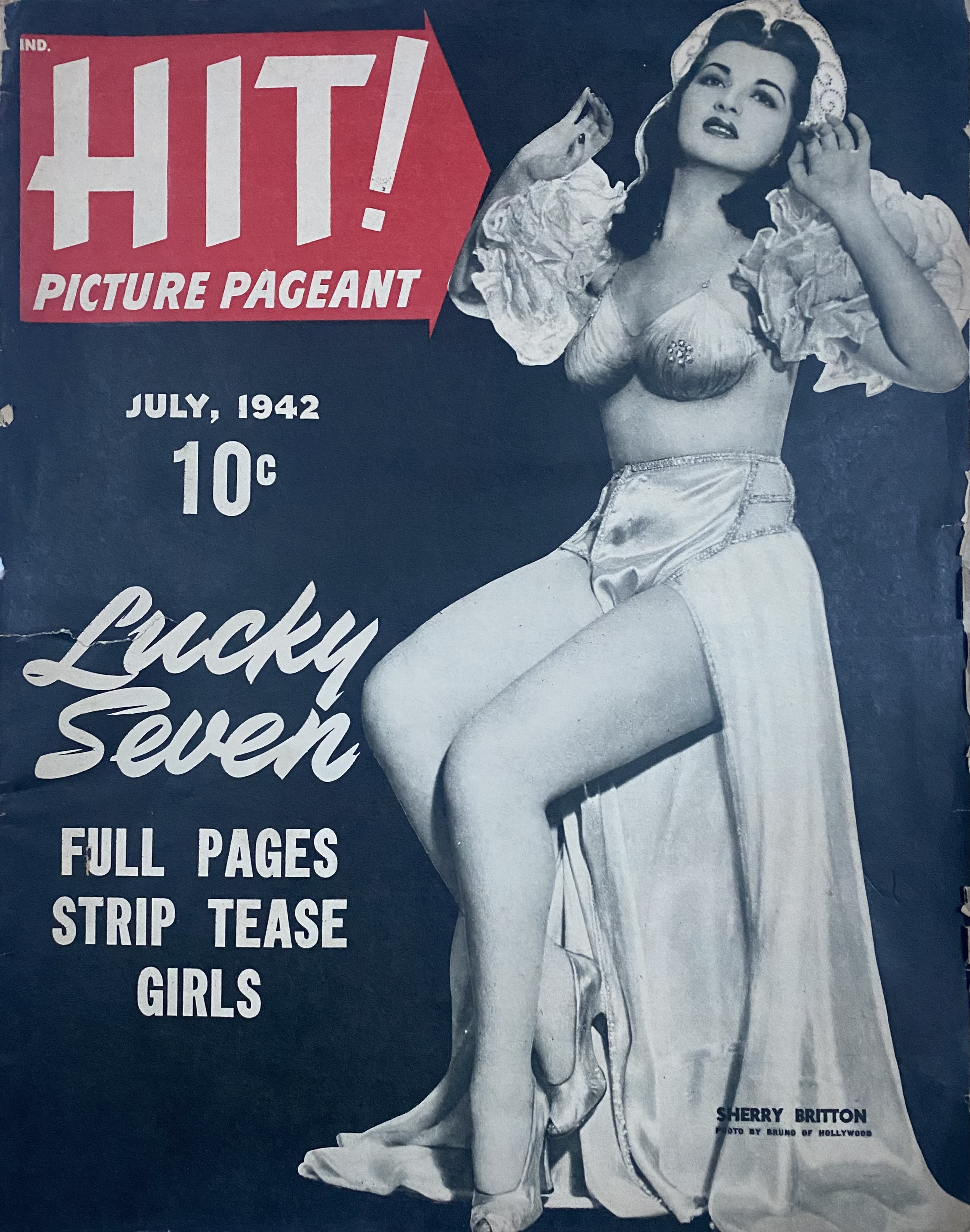
Not all the magazines of July 1942 carried the American flag on the cover, however each magazine, in its own way, paid tribute to the United We Stand campaign and the war efforts. In this third installment of Magazines: United We Stand, Social Media: Divided We Sit, we look at three magazines from 1942, Hit!,Liberty Laughs, and Liberty. To read part one click here and to read part two click here.
Hit! magazine, July 1942
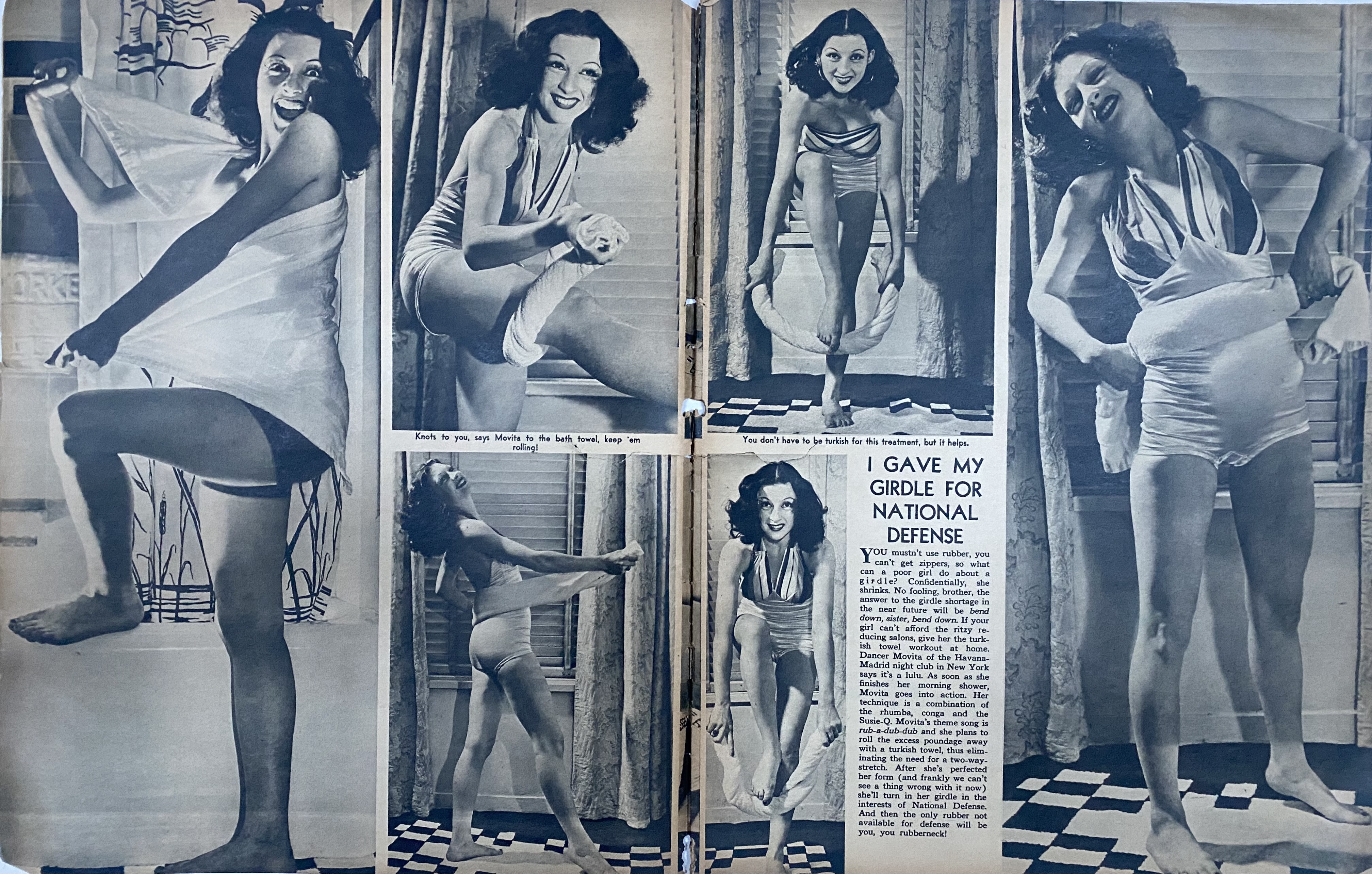
In what reads like dry humor today, Hit magazine, in an article on pages 4-5 about the model displayed on that spread, wrote:
I GAVE MY GIRDLE FOR NATIONAL DEFENSE
You mustn’t use rubber, you can’t get zippers, so what can a poor girl do about a girdle? Confidentially, she shrinks. No fooling, brother, the answer to girdle shortage in the near future will be bend down, sister, bend down. If your girl can’t afford the ritzy reducing salons, give her the turkish towel workout at home. Dancer Movita of the Havana-Madrid night club in New York says it’s a lulu. As soon as she finishes her morning shower, Movita goes into action. Her technique is a combination of the rhumba, conga and the Susie-Q. Movita’s theme song is rub-a-dub-dub and she plans to roll the excess poundage away with a turkish towel, thus eliminating the need for a two-way-stretch. After she’s perfected her form (and frankly we can’t see a thing wrong with it now) she’ll turn in her girdle in the interests of National Defense. And then the only rubber not available for defense will be you, you rubberneck!
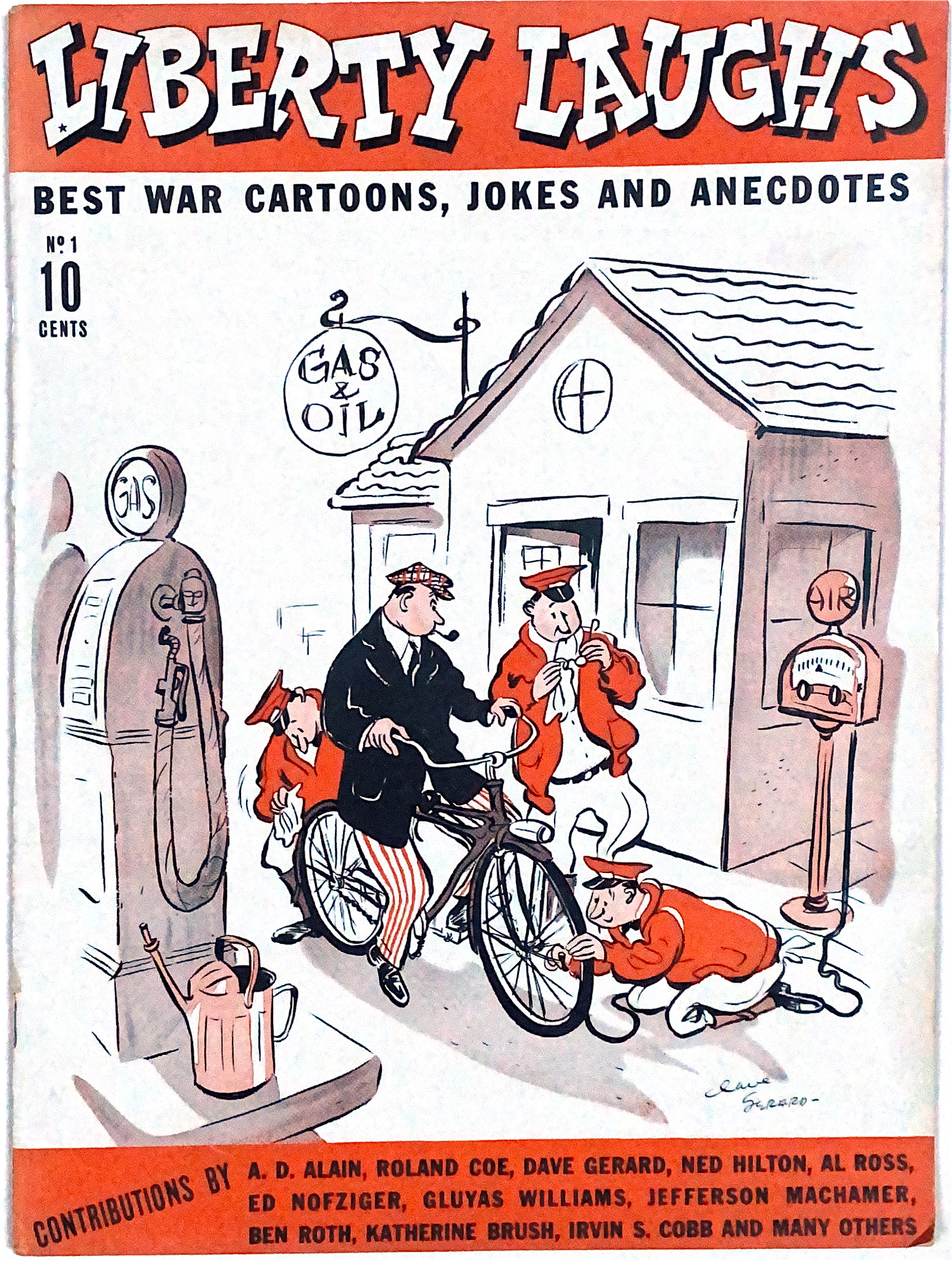
Liberty Laughs magazine, December 1942
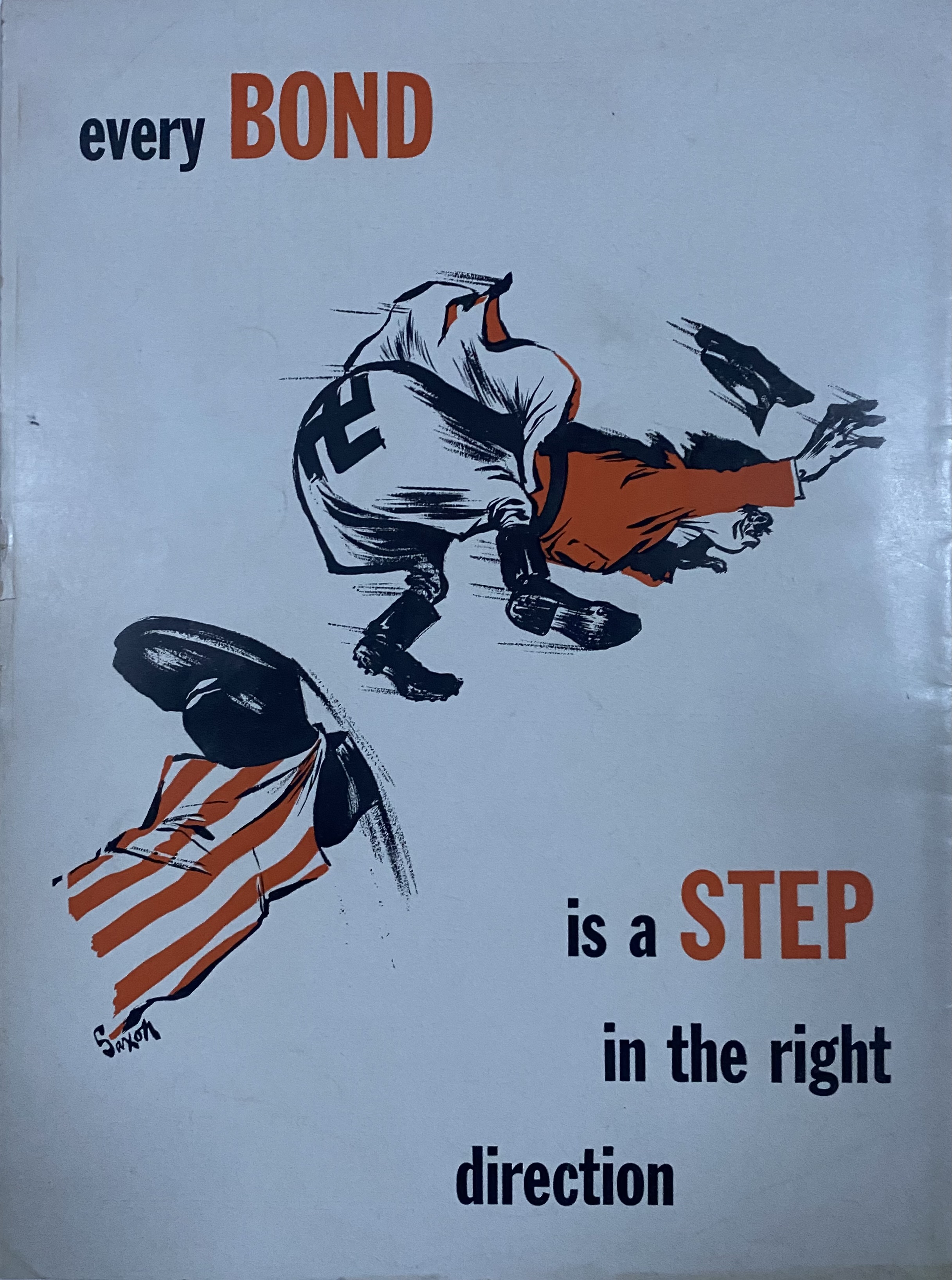
This brand new magazine with a tag line Best War Cartoons, Jokes and Anecdotes premiered with its December issue with a back cover cartoon supporting the United We Stand campaign and screaming “every BOND is a STEP in the right direction.” The magazine published by Dell Publishing Co., was the brainchild of Frances Cavanah and Ruth Cromer Weir, who were listed as the Compilers of the content.
Liberty Laughs first issue started with AN OPEN LETTER
Members of the Chicago North Shore Alumnae Chapter of Theta Sigma Phi, National Honorary and Professional Fraternity for Women In Journalism, have compiled this magazine as a contribution toward the war effort. We pledge to turn over all the royalties from its sale to Army Emergency Relief.
We believe that a nation that can laugh is a nation that can take it, and we have attempted to bring together some of the best war humor published to date.
Without the generous cooperation of AMERICAN, COLLIER’S, ESQUIRE, NEW YORKER, PARADE, SATURDAY EVENING POST, THIS WEEK and other magazines and newspapers, this project would not have been possible. We are grateful to the artists and authors who have allowed us to use their material without fee. No one represented in this magazine has received one cent of compensation…
Liberty magazine, February 14, and October 3, 1942
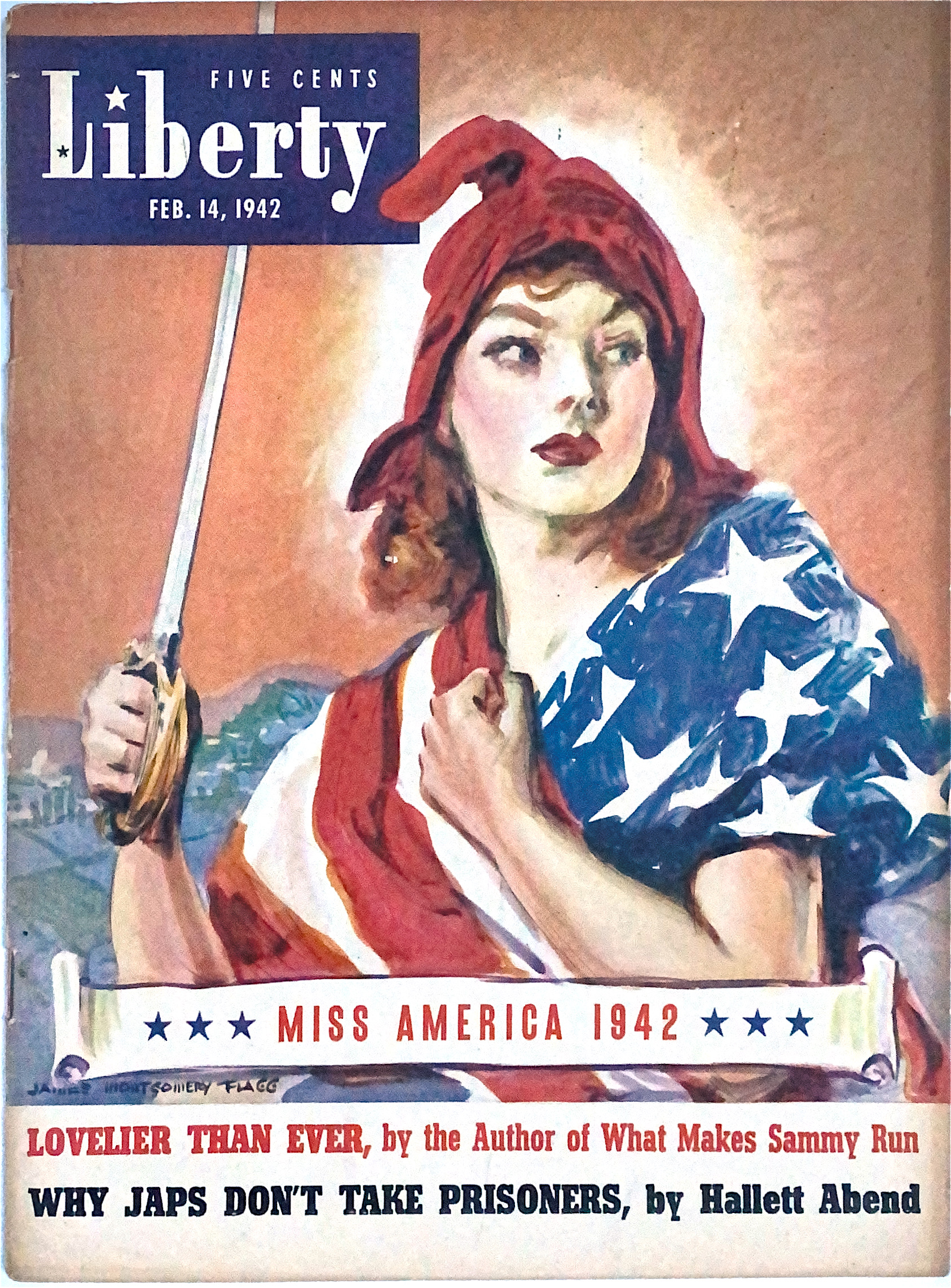
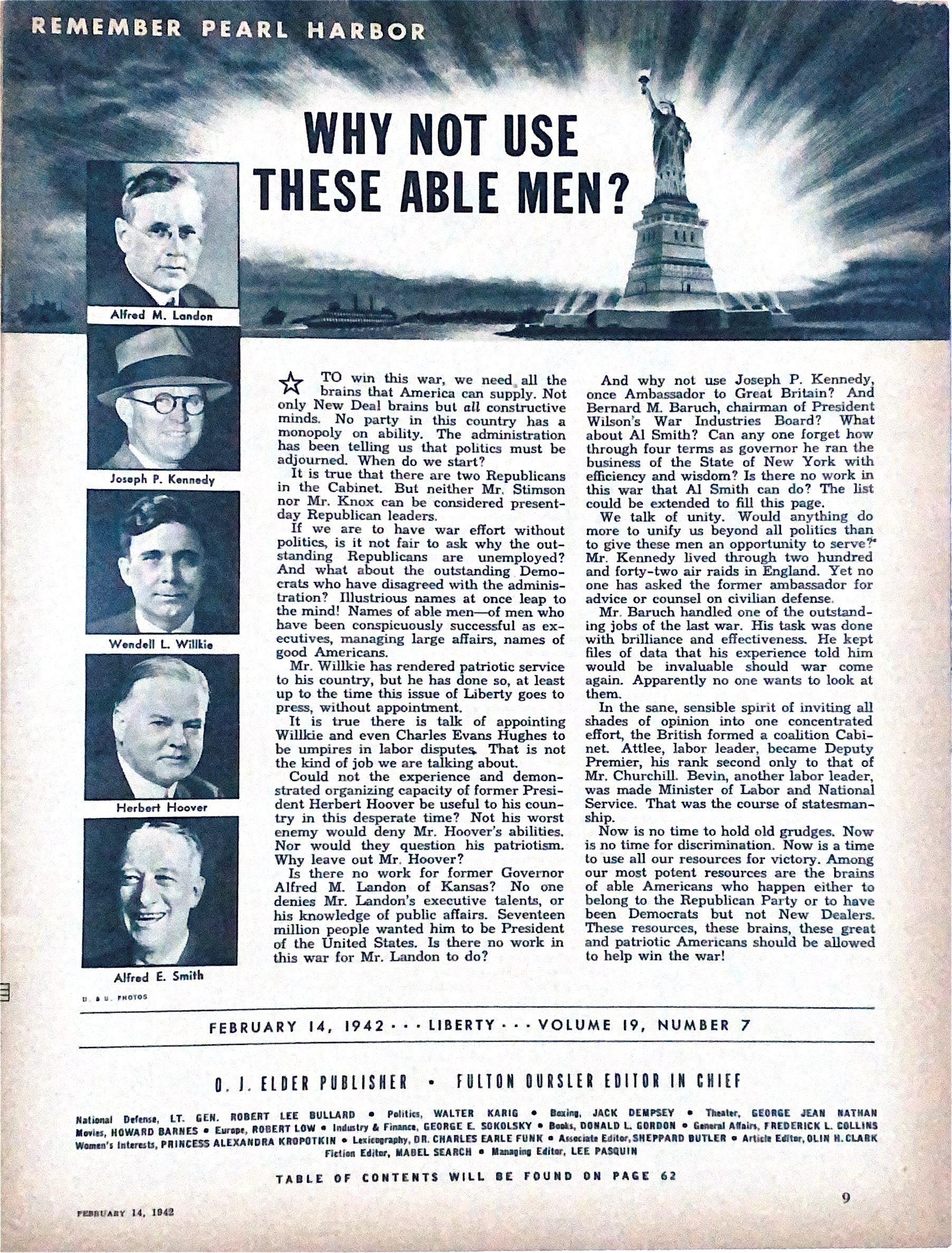
The Macfadden publication, in its Feb. 14 issue, had a painting of Miss America 1942 draped with an American flag adoring the cover of the issue. In an editorial under the heading of Remember Pearl Harbor the magazine asked WHY NOT USE THESE ABLE MEN? And went on to answer:
TO win this war, we need all the brains that America can supply. Not only New Deal brains but all constructive minds. No party in this country has a monopoly on ability. The administration has been telling us that politics must be adjourned. When do we start?…
Now is no time to hold old grudges. Now is no time for discrimination. Now is a time to use all our resources for victory… These resources, these brains, these great and patriotic Americans should be allowed to help win the war!
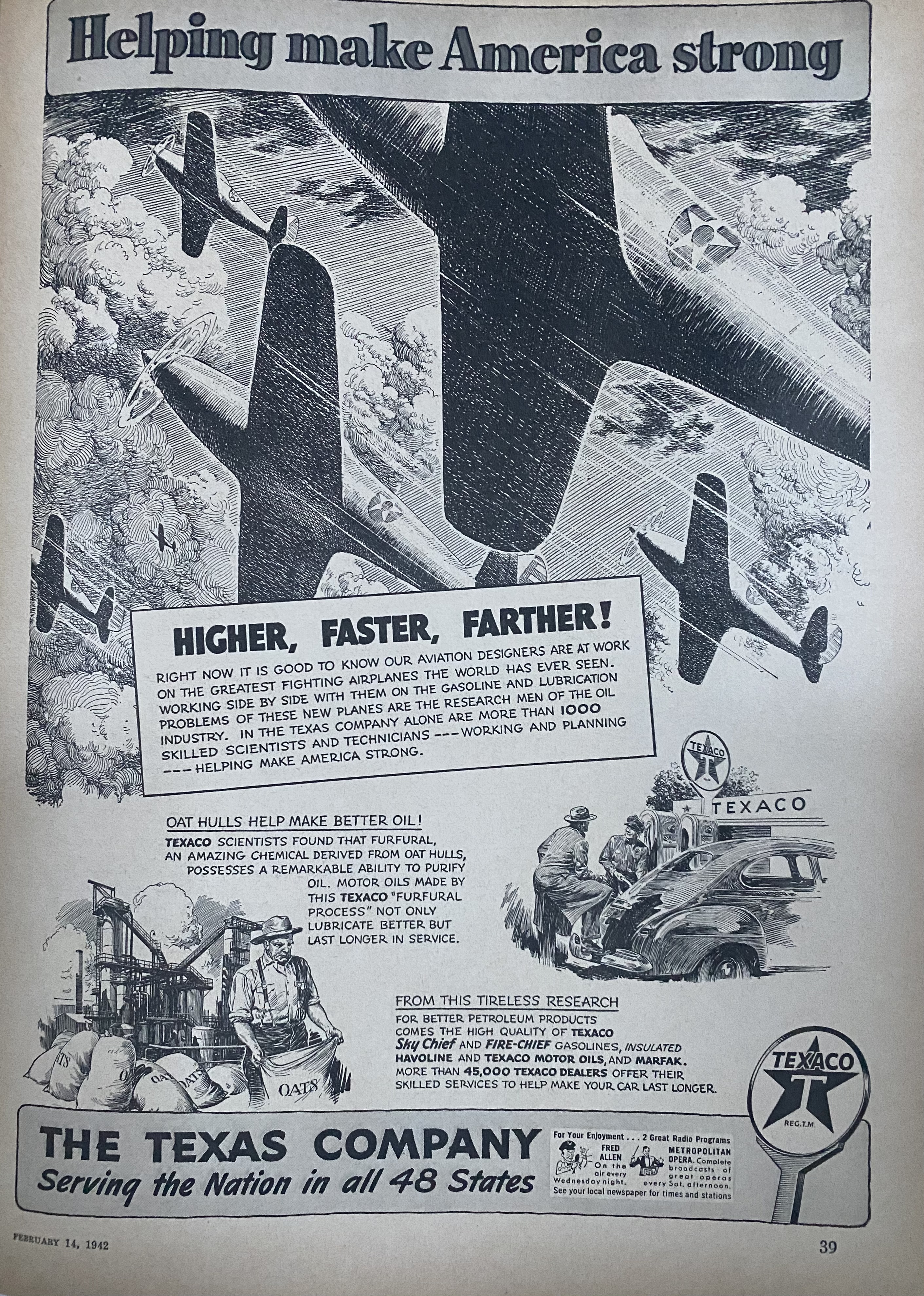
In the same issue of Liberty magazine an advertisement for Texaco read: Helping make America strong:
HIGHER, FASTER, FARTHER!
Right now it is good to know our aviation designers are at work on the greatest fighting airplanes the world has ever seen. Working side by side with them on the gasoline and lubrication problems of these new planes are the research men of the oil industry. In the Texas company alone are more than 1000 skilled scientists and technicians — working and planning — helping make America strong.
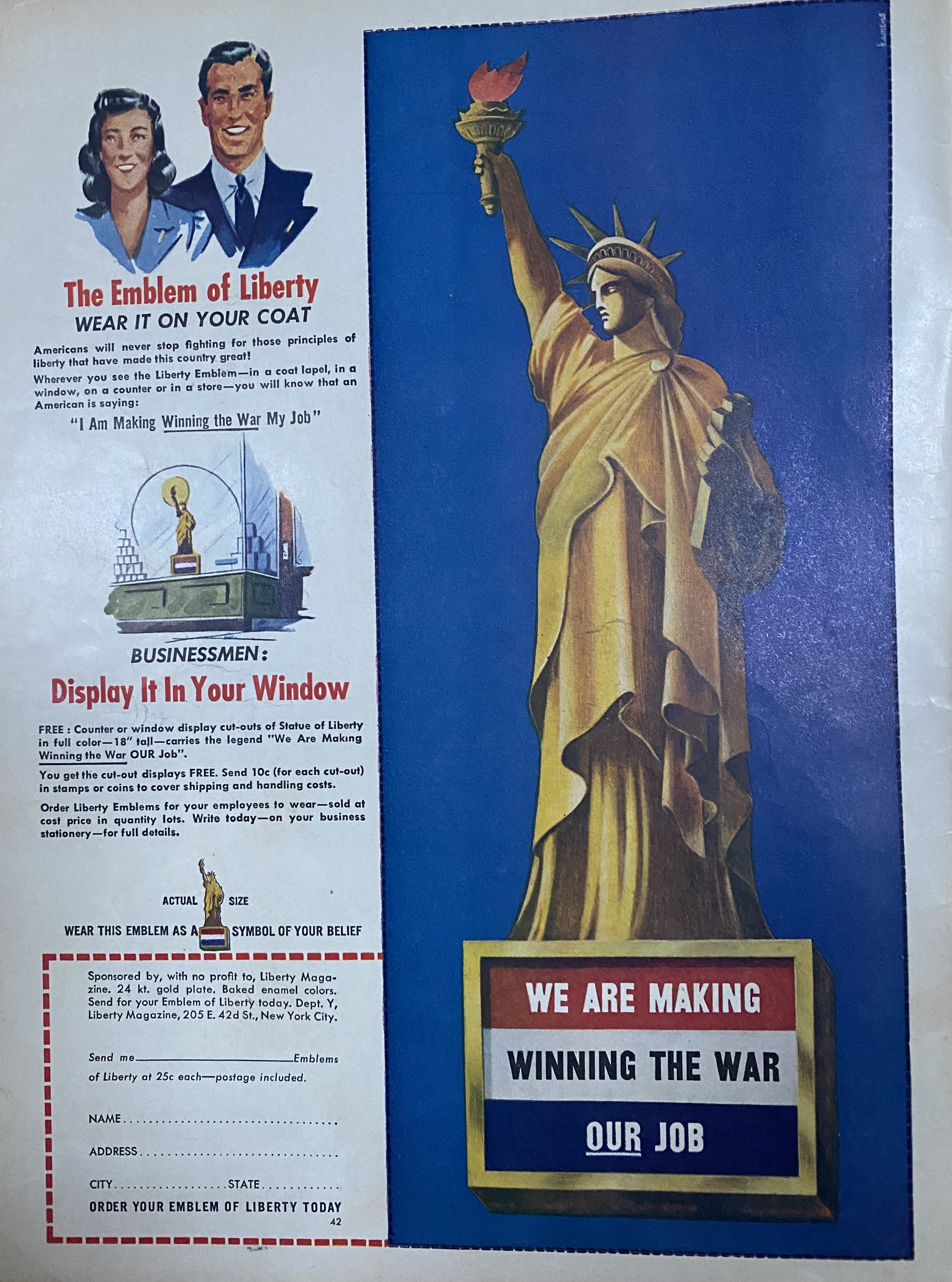
An ad on the inside front cover of the October 3 issue, Liberty magazine offers an Emblem of the Statue of Liberty with the words WE ARE MAKING WINNING THE WAR OUR JOB.
The ad goes on to state: The Emblem of Liberty WEAR IT ON YOUR COAT Americans will never stop fighting for those principles of liberty that have made this country great!
Wherever you see the Liberty Emblem – in a coat lapel, in a window, on a counter or in a store – you will know that an American is saying: “I Am Making Winning The War My Job”
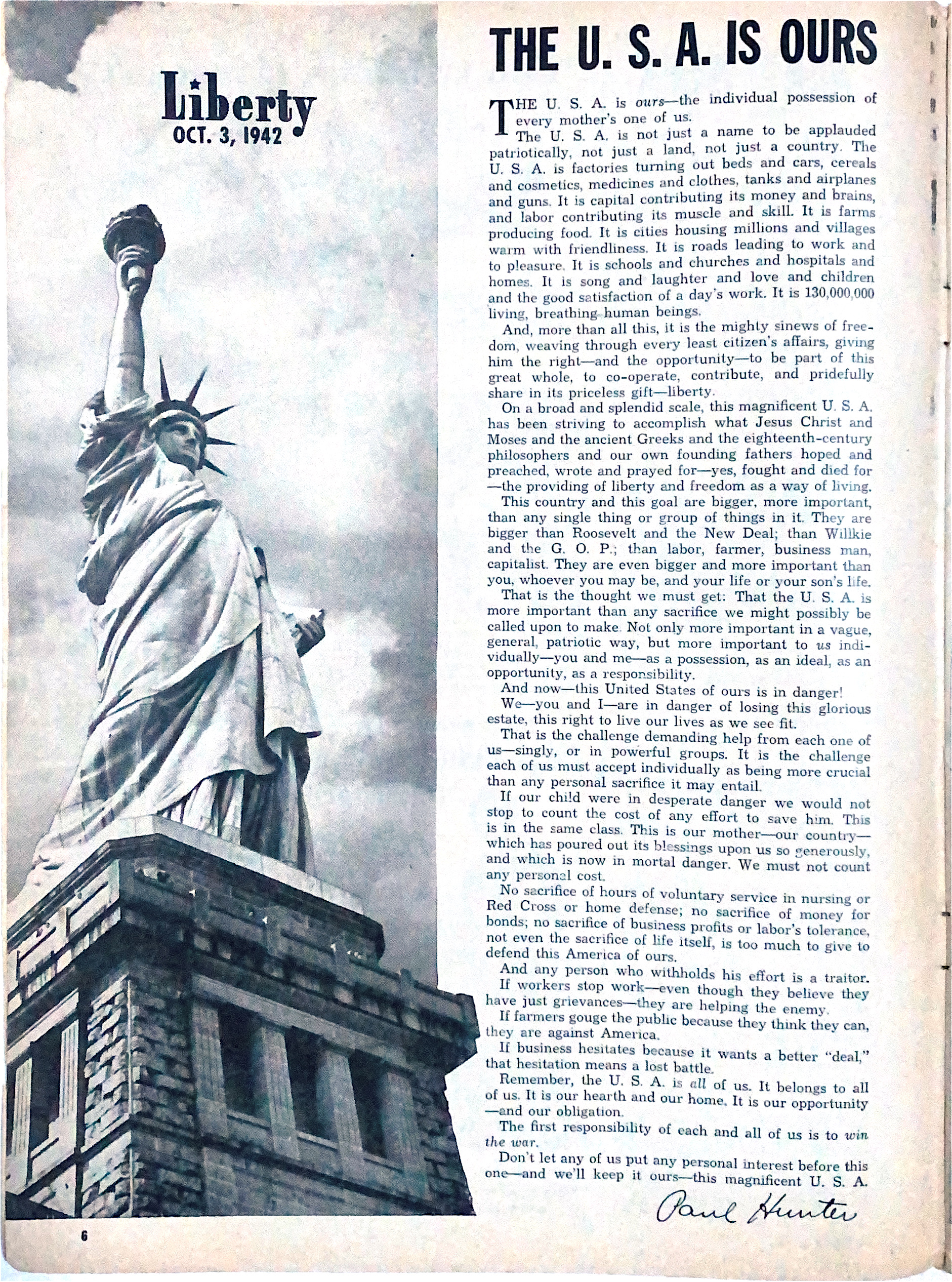
An editorial in the aforementioned issue under the title THE U.S.A. IS OURS reads:
THE U.S.A. is ours – the individual possession of every mother’s one of us.
THE U.S.A. is not just a name to be applauded patriotically, not just a land, not just a country. The U.S.A. is factories turning out beds and cars, cereals and cosmetics, medicines and clothes, tanks and airplanes and guns. It is capital contributing its money and brains, and labor contributing its muscle and skill. It is farms producing food. It is cities housing millions and villages warm with friendliness. It is roads leading to work and to pleasure. It is schools and churches and hospitals and homes. It is song and laughter and love and children and the good satisfaction of a day’s work…
And, more than all this, it is the mighty sinews of freedom, weaving through every least citizen’s affairs, giving him the right – and the opportunity – to be part of this great whole, to co-operate, contribute, and pridefully share in its priceless gift – liberty…
Remember, the U.S.A. is all of us. It belongs to all of us. It is our hearth and our home. It is our opportunity – and our obligation…
Don’t let any of us put any personal interest before this one – and we’ll keep it ours – the magnificent U.S.A.
To be continued…
Samir “Mr. Magazine™” Husni, Ph.D.
Founder and Director
Magazine Media Center
Preserving the Past, Present, and Future of Magazine Media
Magazines: United We Stand; Television, Internet, And Social Media: Divided We Sit. Part Two
Lessons from the past for today’s magazine editors and publishers… “Whoever has ears, let them hear.” Matthew 13:9
October 1942, 80 years ago, Harper’s Bazaar was celebrating its 75th anniversary. On page 32 of that issue there was an ad for Hearst Magazines, publisher of Harper’s Bazaar and seven other magazines back then. The ad read:
“Looking backward takes history
For three-quarters of a century, Harper’s Bazaar has brilliantly chronicled, year-by-year, step-by-step, the expanding life of a great nation, the more or less intimate details of burgeoning frontiers in many fields of thought and expression. In similar capacities these seven other magazines of the Hearst Group have reflected in their turning pages, the living history of a people – what they saw and wanted and liked, what they ate and wore and did for a living, what they reasoned and argued about and cared for deeply – as no single historian will ever be able to write it down. These magazines are an integral portion of the past in the country. No complete picture of that past can really be obtained without consulting them. For they are history.”
“Looking forward makes history
These gratifying records of years of continuous publication and esteemed public service are rooted primarily in the determination and the capacity of these magazines to set the pace. They have made and continue to make history because they accept the challenge of the future – accept it and forecast it and help to shape it. Longevity in magazines is no happen-so, but the carefully considered and earnestly dedicated efforts of their publishers to give them a useful and valiant purpose to contribute workable material to the lives of their readers, to make them an instrument for good in the hands of the people they seek to serve.” Harper’s Bazaar, October 1942, Page 32.
And all what I can add to the above ad is a quote from the Good Book, “Whoever has ears, let them hear.”
In the first part of this blog I wrote (if you read part one of this blog, you can skip down to Cosmopolitanmagazine, October 1942):
“In 1788, George Washington wrote a letter to Philadelphia publisher Matthew Carey in which he expressed the hope that American magazines would succeed because he considered them “easy vehicles of knowledge” that are “more happily calculated than any other, to preserve the liberty, stimulate the industry and meliorate the morale of an enlightened and free people.”
John Tebbel, in his book The Magazine In America, commenting on Washington’s letter, noted that magazines were incomparably better purveyors of knowledge than the newspapers of Washington’s time. I agree and would add that magazines are incomparably much better purveyors of knowledge than the internet and social media which, together with television, are becoming the major source of news and information for the people, according to a recent study by the Pew Research Center.
80 years ago, in 1942, American consumer and trade magazines led a campaign titled “United We Stand.” Almost every magazine in the country carried the American flag on its July cover and continued with the slogan “United We Stand” until the end of WWII. This was a coordinated effort by the collective body of magazine publishers of that time. Unlike today’s internet and social media, magazines back then were attempting to unite the country, while social media, the internet and television now are allowing the country to live a “virtual civil war” with no end in sight.
Some of those magazines from 1942 are still alive and kicking. They are still promoting the good things in life, nurturing the many changes that took and are taking place in the country. For better or worse, magazines and their brands have contributed to the betterment of the country and its people regardless of the prevailing trends. They were and are innovators, influencers, and educators at the same time. This is a far cry from what social media is today or what it will be tomorrow. Indeed, social media, with all its platforms, could be said to be united under one term, “Divided We Sit.” The majority of magazines adhered to their roles, both social and financial, with great responsibility, unlike today’s social media that only carries the name “social” without any responsibility. In fact, social media is as unsocial as unsocial can be.
I truly believe that the war of the 1940s was much less dangerous to our country than the “virtual civil war”we are witnessing today. The magazines of the 1940s united together to help the country stay united and to help the American public survive and thrive in every aspect of its lives. What follows are a few randomly selected examples, from the Samir “Mr. Magazine™” Husni magazine collection, from 1942 of how magazines and their advertisers supported the war effort and helped keep our country united. The contents and magazine experiences, both in editorial and advertising, were much more than a slogan (“United We Stand”),but rather a way of life and a call to action.
May the editors and publishers of today’s magazines look at the history of American magazines and discover how magazines served their customers first–both advertisers and readers–and never veered from their mission of editing and publishing for that intended subscriber or newsstand buyer…”
In addition to the aforementioned ad from Harper’s Bazaar above, here is the second set of examples starting in alphabetical order and based on the magazines that I own:
Cosmopolitan, October 1942
In an article by Ralph Barton Perry on page six of the October 1942 issue, he writes, “AN ARMY sergeant remarked after hearing a friend of mine explain where Hitler got his ideas, “That Machiavelli certainly was no cream puff.” He was beginning to see that something was fundamentally wrong with the present state of the world. As long as two years ago a New Hampshire farmer of my acquaintance, who had been reading the newspapers, said, “Well, I suppose that sooner or later we’ve got to lick that man Hitler; and the sooner we get at it the better. I’ll be seeing you on the other side.”
“Mr. Average American doesn’t regard war as a picnic or a great adventure: he can think of lots of things he’d rather be doing. But once he is convinced that there’s a job to be done, he’ll do it and he’ll see it through…”
“So when I am asked what sort of world we want, and I try to speak for other Americans as well as for myself, I say that we want a safe world, and a free world, and a just world. We want safety, freedom and justice; we want them for others, as well as for ourselves and we have come to see that we cannot have them for ourselves unless we share them with others in a common world, All who would live in such a world must fight for it together along the hard road that ascends through the valley of war to the heights of victory.”
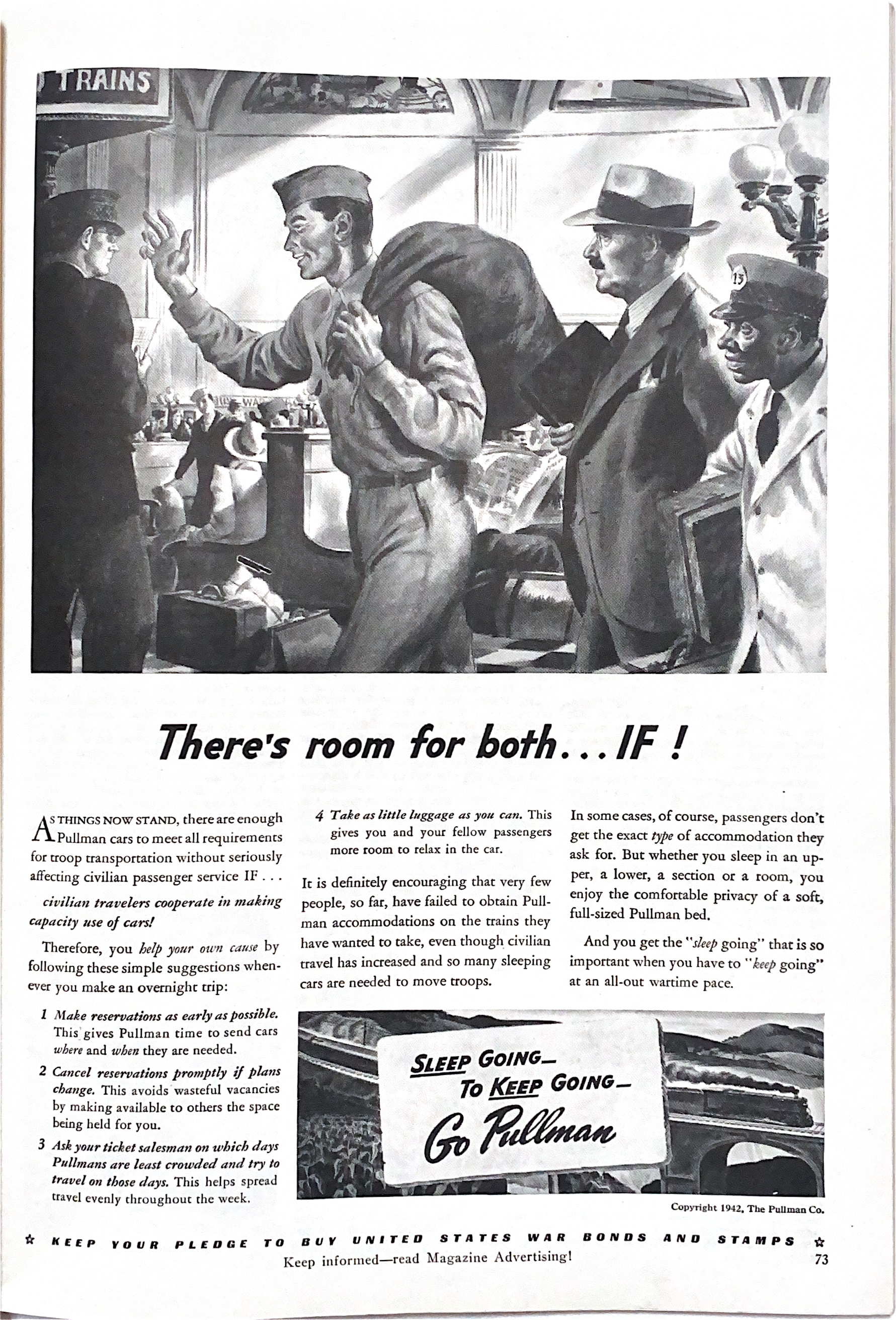
As for the ads, the “United We Stand” could easily be seen in the majority of the ads including this one for Pullman (The Greyhound of the 1940s)… The ad reads:
“There’s room for both…IF !
AS THINGS NOW STAND, there are enough Pullman cars to meet all requirements for troop transportation without seriously affecting civilian passenger service IF… civilian travelers cooperate in making capacity use of cars!
Therefore, you help your own cause by following these simple suggestions whenever you make an overnight trip:
Make reservations as early as possible.
Cancel reservations promptly if your plans change.
Ask your ticket salesman on which days Pullmans are least crowded and try to travel on those days.
Take as little luggage as you can.
And you get the “sleep going” that is so important when you have to “keep going” at all-out wartime pace.”
On final note, every ad page in the magazine had a sentence in the folio of the ad-page, “Keep informed – read Magazine Advertising!”
Esquire, July and October 1942
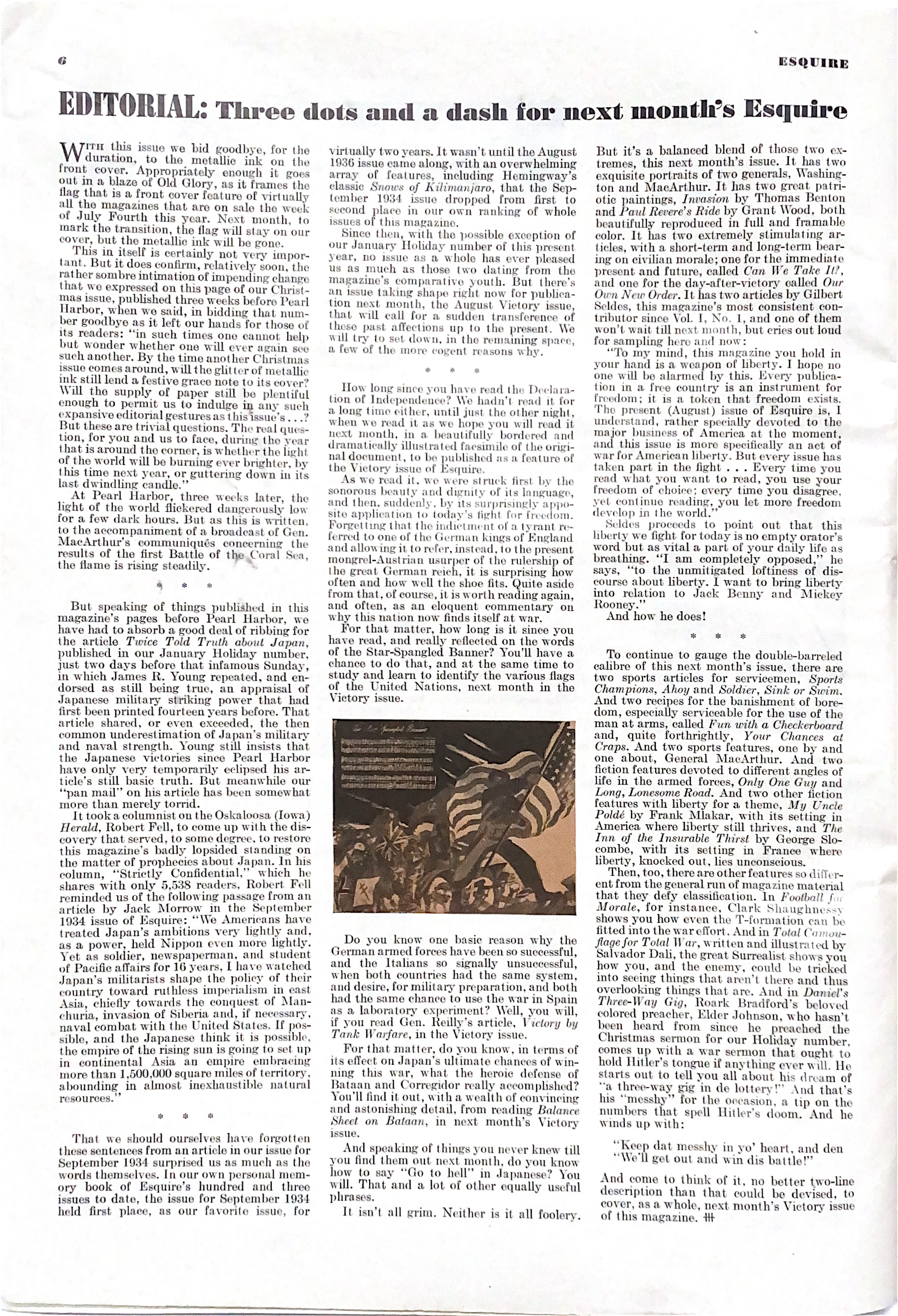
The July 1942 issue of Esquire had not one, not two, but three American flags on the cover. The main flag appeared on the traditional metallic ink section that was a trademark of Esquire’s right hand side of the cover with a list of the contents of that issue on it. In an editorial on page 6 of this issue, the editors wrote, “WITH this issue we bid goodbye, for the duration to the metallic ink on the front cover. Appropriately enough it goes out in a blaze of Old Glory, as it frames the flag that is a front cover feature of virtually all the magazines that are on sale the week of July Fourth this year. Next month, to mark the transition the flag will stay on our cover, but the metallic ink will be gone…”
“At Pearl Harbor… the light of the world flickered dangerously low for a few dark hours. But ss this is written, to the accompaniment of a broadcast of Gen. MacArthur’s communiqués concerning the results of the first Battle of the Coral Sea, the flame is rising steadily.”
And in October 1942, Esquire, “The Magazine for Men”, and “the largest selling fifty cents magazine in the world,” continued its United We Stand campaign and Old Glory draped the content on the cover sans the metallic ink. Old Glory continued to appear on the cover one more issue and it was retired with the December 1942 cover.
As for the advertisers, and there were plenty, they played their role in the United We Stand campaign. Here is one example from the October issue from the United States Rubber Company.
“Thanks for the Rubber that Saved his Life!”
“Already in America any one of a million mothers might have written that line. Planned is an army of six million, many of them destined for overseas.
On every transport there is life-saving equipment for every man… on every plane that flies far over the water there is a rubber boat. Such essential protection must not be skimped. It is unthinkable…
Precious life will be sacrificed unless each one of us helps. Will you do your part to the utmost limit? Will you take watchful care of your tires and every other rubber product you own so that they will last for the duration of the war?
Field & Stream, July 1942
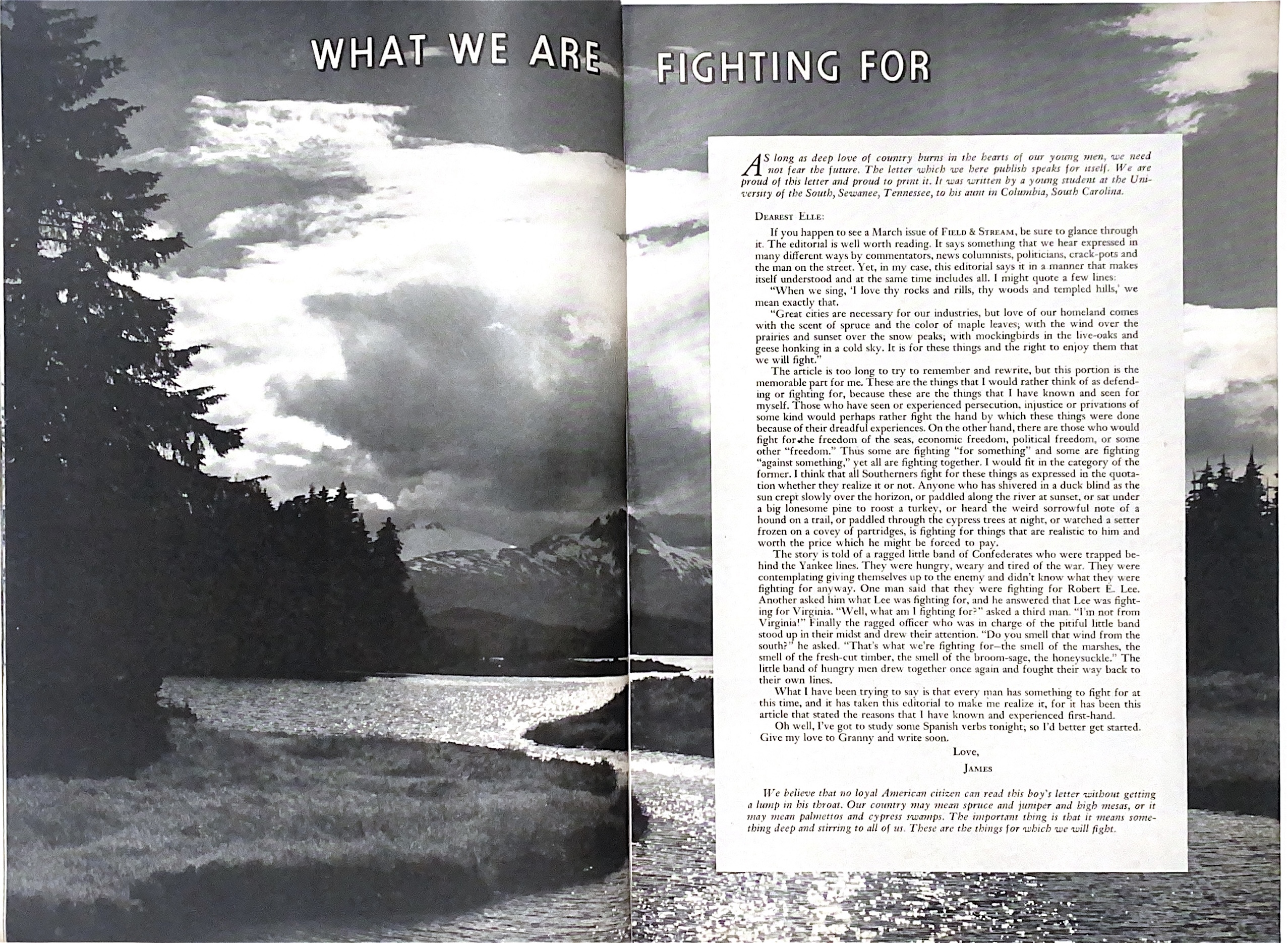
Field & Stream, like the majority of the magazines, had a painting of the American flag on the cover together with “United We Stand” and “Buy United States War Savings bonds And Stamps.” What was unlike the rest of the magazines was a spread headlined WHAT WE ARE FIGHTING FOR :
“AS long as deep love of country burns I the hearts of our young men, we need not fear the future. The letter which we here publish speaks for itself. We are proud of this letter and proud to print it. It was written by a young student at the University of the South, Sewanee, Tennessee, to his aunt in Columbia, South Carolina.”
The magazine published the letter and followed it with,
“We believe that no loyal American citizen can read this boy’s letter without getting a lump in his throat. Our country may mean spruce and juniper and high mesas, or it may mean palmettos and cypress swamps. The important thing is that it means something deep and stirring to all of us. These are the things for which we will fight.”
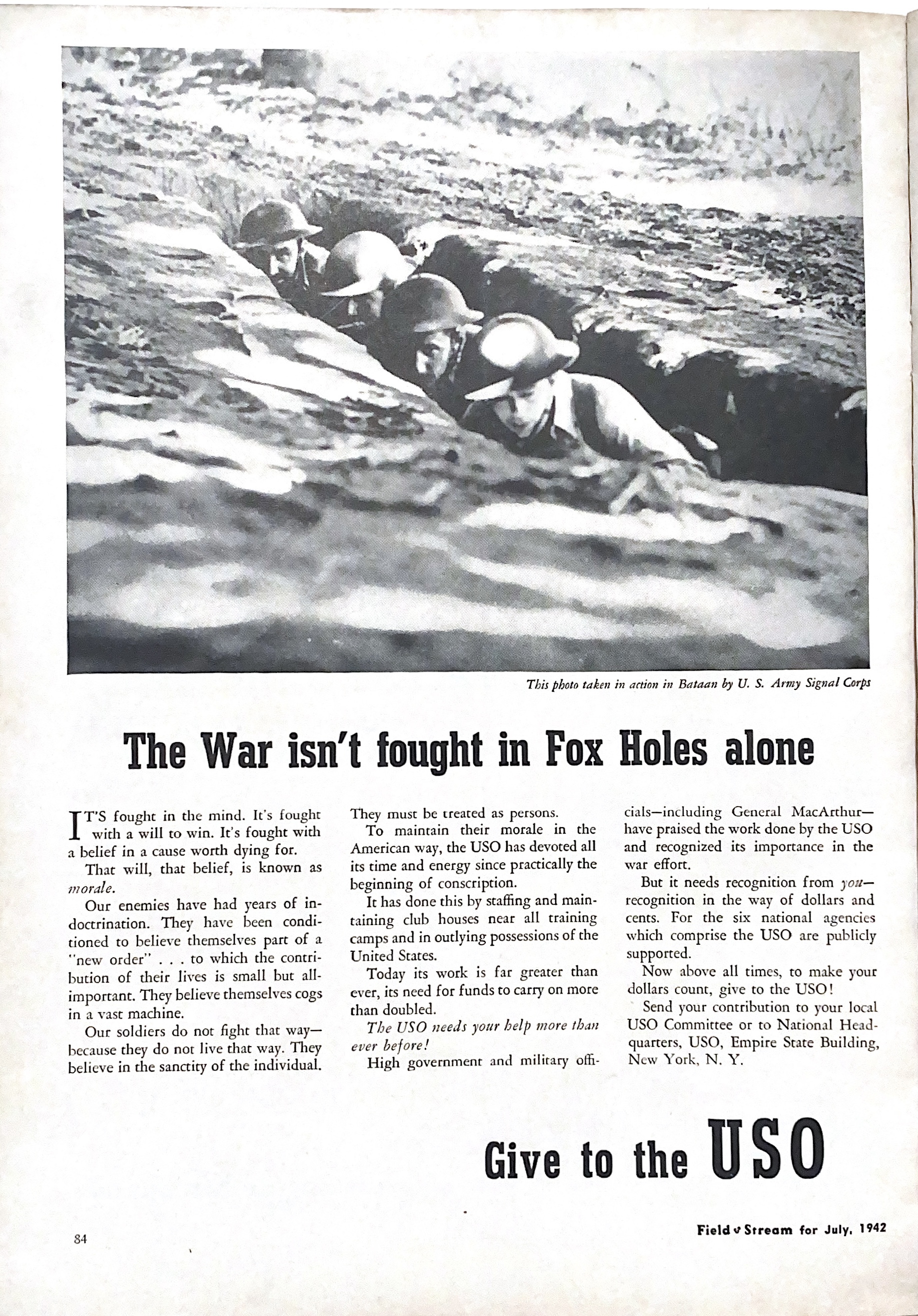
On the ad front, an ad on page 84 asking readers to Give to the USO. Under the heading The War isn’t fought in Fox Holes alone
“It’s fought in the mind. It’s fought with a will to win. It’s fought with a belief in a cause worth dying for.
That will, that belief, is known as morale.
Our enemies have had years of indoctrination. They have been conditioned to believe themselves part of a “new order”… to which the contribution of their lives is small but important. They believe themselves cogs in a vast machine.
Our soldiers do not fight that way – because they do not live that way. They believe in the sanctity of the individual. They must be treated as persons…
Now above all times, to make your dollars count, give to the USO!
Harper’s Bazaar, October 1942
It’s the 75th anniversary issue of the magazine that was launched in 1867. An ad on pages 16 f and 16 g for the New York Dress Institute sums the state of the magazine during the United We Stand efforts. The ad reads:
“A Woman’s Right of Choice”
“IN TEN SHORT MONTHS we have been hurled into a strange new world – a world battling to determine whether freedom of choice shall survive. As a people, we have cheerfully chosen to restrict our freedoms nowthat freedom itself might live.
ENTHUSIASTICALLY, we are investing our savings in the greatest cause I history. Eagerly, we have entered into various war works. Willingly, we have chosen to share our riches with those who share our hopes. For ours is a land of plenty in a very empty world.
IN MAKING SUCH A CHOICE, we have deliberately limited the quantity of many times essential to the war effort. This is as it should be. But, there are other goods and many workers which cannot be absorbed into war industries. These industries must be kept earning that they, too, can contribute their share to the war economy in taxes and bonds…”
And the ad concludes,
“SO BUY YOUR FULL QUOTA OF WAR BONDS – more if you can. Then, erase every doubt that you are being unpatriotic when you choose fashions to keep you lovely.”
To be continued…
Samir “Mr. Magazine™”Husni
Founder and Director
Magazine Media Center
Preserving the Past, Present, and Future of Magazine Media










 Mr. Magazine