Archive for the ‘A Launch Story…’ Category

h1

There Is Nothing Basic About BASIC Magazine And The Woman Behind It: Viktorija Pashuta. The Mr. Magazine™ Interview.

October 10, 2024

Viktorija Pashuta, the founder, CEO,  and editor in chief of  BASIC magazine, left her home country, Latvia, with a little book that she started writing her ideas in it at age 11. Her dream was that one day she would create all the ideas in that book.  One of the ideas must have been BASIC magazine: an upscale magazine that is anything but basic.

Also an award-winning director and film maker, Viktorija Pashuta launched BASIC magazine seven years ago in Los Angeles as “a print platform for artists from all over the world to express themselves and give them the opportunity to share their artwork and their passions on the pages of the print magazine.”

I was so impressed by the quality of the magazine and the way it has progressed since its launch. Flipping through the pages of BASIC was like taking a first-class trip around the world, luscious photography accompanied by imaginative design and complemented by beautiful typography. It is a delight for both the eye and the brain.

A photographer by profession, Ms. Pashuta is also a writer who combines the art of audio-visual writing to her editorials that introduce every issue of the magazine.  She is a dreamer and she is more than willing to share her dreams with you. When I asked her what she would be doing if I stop by unannounced, she told me that, “sometimes you could catch me doing something weird like I imagine I’m a batman and I’ll go outside in the dark streets and just walk around at night and there would be someone who needs my help randomly.”

It was hard to separate her drive for life and adventure from her passion and zeal for BASIC magazine.  So, please join me with this wonderful conversation with Viktorija Pashuta, founder, CEO and editor in chief of BASIC magazine.  But first, the soundbites:

On why print: “I’m really proud that BASIC is actually in print, not in digital…It was really important to create a physical product, a magazine that has the presence in the physical world.”

On how to do print today: “The idea was to invest in the quality of the paper, invest in the quality of binding, invest in talent, create content that is timeless and you wouldn’t easily find online.”

On the challenges of creating a magazine: “If I knew then what I had to go through, I’d probably think twice if I should start a print magazine…it’s not enough just to have the funds. You also have to be extremely passionate about it and live with it.”

More on challenges of creating a magazine: “There were definitely challenges creating content that would resonate online and also would be relevant in print because these are two complete different platforms.”

On sources of revenue: “I created different avenues with the product placement that we utilize the smaller brands and provided them additional value by creating unique organic content for them within the pages of the magazine.

On appearing on the cover of the magazine: “That actually was very unplanned and I’m a person that would never put myself on a cover because I thought that’s sort of abusing your power.”

More on appearing on the cover of the magazine: “I thought if you use yourself as the main inspiration I think it will give inspiration for other people to believe in themselves and keep going with whatever ventures they enter.”

On finding the BASIC DNA: “We’re trying to shape our own voice which I think was the hardest thing and I think for any brand it’s really hard to stand out in the crowd so that’s kind of our goal been to find our DNA, to find BASIC  DNA and to really stick to it and be authentic.”

On her life’s philosophy: “The most talented people are very humble and they don’t really want to push themselves. The loudest people on social media are usually the least talented.”

More on her life’s philosophy: “I’m a hardcore fan of the cat woman, so I believe being behind the scenes and being that savior for those who cannot speak for themselves and elevate people. I would love to do more charity work. I would love to help more people.”

And now for the lightly edited conversation with Viktorija Pashuta, founder and editor in chief of BASIC magazine:

Samir Husni: As I told you in my email BASIC is anything but BASIC. Tell me the elevator pitch. What is BASIC magazine?

Viktorija Pashuta: Well, BASIC, first of all, it’s my passion project.

This is something I’ve been craving and wanted to do since I was in high school. And pretty much it’s a platform that provides opportunity for artists from all over the world to express themselves and to give them that opportunity to share their artwork and their passions on the pages of print magazine. And I’m really proud that BASIC is actually in print, not in digital.

So we take pride creating such a publication that became sort of a coffee table book and collectible edition. So yeah, like you said, absolutely right. BASIC is everything but BASIC.

Samir Husni: You wrote that while others are abandoning print and are going digital, and with the high increase of paper costs, mailing costs, you name it. Why is this print drive that you have?

Viktorija Pashuta: Well, I think I believe that nowadays there is such a high demand for interpersonal connections, for physical products, for physical touch, especially in our modern age of technology and of desensitization of the society, of people not being willing to connect in person or they really craving to have personal interpersonal experiences. So for me, it was really important to create a physical product, a magazine that has the presence in the physical world.

Besides that, I believe that the pages transcend the experiences that we go through creating the magazine. What’s really important is being on set, creating a community, working with passionate people with the same interests and sharing those passions with the world through the print publication. I’ve noticed that trend, especially being myself constantly on social media, that you have those two, three seconds to look at the post, like the post and you forget about it.

But the beauty about print publication, it’s something you look through, but then you put it in a shelf, you can get back to it later. You can look through it and you have this connection that digital can never substitute.

I always have a comparison. Would you like to have a digital kiss or a physical, actual kiss? And the same with print. We want that interpersonal connection. It’s very similar to the luxury sector where we want to have luxury products, luxury experiences, and the same with print.

The idea was to invest in the quality of the paper, invest in the quality of binding, invest in talent, create content that is timeless and you wouldn’t easily find online. So that was the goal. And for me, it was extremely important to create a physical product and have basic in print.

Samir Husni: It sounds like you have had in the last seven years since you launched BASIC, a walk in the old garden, or was there some challenges, there were some thorns across the road?

Viktorija Pashuta: Oh, absolutely. I mean, every step of the way, there was a challenge starting from the fact that when I was getting myself into print, I had zero knowledge in publishing, zero knowledge in printing, zero knowledge in logistics.

All I knew is photography since I started to be a fashion photographer and experience in writing since I was writing back in my country for another smaller magazine. That’s all I had. And then if I knew then what I had to go through, I’d probably think twice if I should start a print magazine.

I thought, oh my God, it’s so easy. I’m going to do it. But then once you start doing it and you realize how huge of an undertaking it is from looking for clients and advertisers, looking for cover stars, being on top of current affairs and finding the budgets for the productions and finding the right team, the passionate, loyal team that would have the same vision as you have or be willing to bring your vision to life.

So all of these things are very, very complex. Even people and companies with unlimited budget would consider having a print magazine quite an undertaking. So it’s not enough just to have the funds.

You also have to be extremely passionate about it and live with it. So I live BASIC. I live 24-7 with the publication, with the ideas, with the concepts, with the things we need to do with the project.

Definitely there were some challenges. There were challenges on many levels, on the production level, to really build the team, to have the right team to support me, to support the vision, to find the funds to run the publication since the magazine is fully self-funded. And I can talk a little bit more about that,  and different avenues, how we monetize the publication, how we keep it alive.

There were definitely challenges creating content that would resonate online and also would be relevant in print because these are two complete different platforms. And something that goes for print would necessarily go viral online and vice versa. If you take an influencer that has millions of followers online and put them in print, it’s going to completely contradict itself and not going to resonate with the audience who loves the fresh print, who loves to read something more meaningful and in-depth with the in-depth research.

Those are two different things were really hard to blend, but I managed to do it. I started it with the viral project, blending my photography and having a concept that resonated both online and in print. That concept was what if cars were supermodels.

I took different types of cars like a Tesla, a Toyota,  and a Ferrari. I imagined what they would look like if they were supermodels. So that concept went viral right away. We got so many, like almost billion impressions online and so many different magazines picked it up and translated to different languages. And for print, it also was a really good artistic series. So things like that are used to sort of be relevant in the digital time, but also print relevant, you know, in modern times.

Samir Husni:  How do you monetize BASIC?

Viktorija Pashuta: Very interesting question, because in my mind, the traditional advertising didn’t work. Something that worked maybe 10, 15 years ago when you have a full page of  a luxury brand, it wouldn’t work for BASIC because  we didn’t have the right numbers for the advertisers.

We didn’t have the right quantities in the beginning. We didn’t have enough celebrity power at the time. So in order to survive, we had to be creative. We had to be resourceful.  I created different avenues with the product placement that we utilize the smaller brands and provided them additional value by creating unique organic content for them within the pages of the magazine.

So we started to get that product and integrate the product within our editorials, within our articles, within the special projects that we were creating, at the same time, giving the brand so much more value than they would have gotten in a digital, I mean, in the traditional media, just having a one page ad, they would get traction, they would get word of mouth, they would get new original content that they in turn would use on their social media pages.

That was one of the things that we utilize is the product placement.
Secondly, we started to create specific targeted projects for brands that would increase the brand awareness and create content that will resonate with the image of the brand. So we take a suitcase company brand and we create a series of imagery that would support that brand.

For example, we work with a Taiwanese brand of suitcases called Desenio and their series were based on the Marvel Comic-Con heroes like Hulk and Captain America and Black Panther. We took those suitcases and I reimagined them as a female superheroes because traditionally in the Comic-Con world, all these characters were played by male characters. So I took a female Black Panther, I took a female Hulk, I took a female Captain America and then we utilized through fashion a series of works for them holding the suitcase in the photo shoot series that also became viral and we actually got the word of the ads of the world website for that campaign also printed and that both got viral digitally.

In addition, we diversified our revenue streams by utilizing additional activations that supported the magazine non-directly like organizing events, creating a production company that would create social media content for brands. We created a fashion showroom that represents fashion designers and provide press placements for those designers.

We had different revenue streams also connected to entertainment, fashion and content creation but non-directly they all were supporting BASIC magazine and all under the Basic Media Company umbrella and that really helped us to keep going and help us to succeed. That doesn’t mean we don’t want traditional advertising, we want it but at the same time that challenge pushed us to be more creative and find new non-traditional ways to monetize our operations.

Samir Husni: It sounds like more than a love affair with BASIC for you,  yet at the same time it’s one of the rare moments that I see the editor-in-chief herself on the cover of the magazine. Tell me about that.

Viktorija Pashuta: Yes, that actually was very unplanned and I’m a person that would never put myself on a cover because I thought that’s sort of abusing your power.  But for that specific issue it was very challenging to find a cover star.  It was the 20th issue of BASIC. The stars that were suggested to us from publicists didn’t really match my aesthetic or they didn’t really were in line with the grandeur of the matter because it was a 20th issue. I wanted to do something special, none of the stars really kind of match that idea .My sister suggested, “that since it’s our 20th issue why don’t you put yourself on a cover and have your team inside of the magazine.”

I said no.  I mean that would be too much. I would never really do that.  Why would I do this? She said well it makes sense because you  are the only photographer and the editor in chief. You are the visioner of the magazine that’s out there.  Even Anna Wintour editor in chief of Vogue didn’t invent Vogue but you did. So I thought maybe that is something interesting to explore and also with my own story I can inspire other people specifically other women because I do have a quite big female following that always admire my journey and admire my tenacity and they know how difficult it is so that was a testament to the team and to myself.  I thought okay if you cannot inspire yourself how can you inspire the world.  I thought if you use yourself as the main inspiration , it will give inspiration for other people to believe in themselves and keep going with whatever ventures they enter.

Samir Husni: Well, your sister was right.

Viktorija Pashuta: I hope so. She’s always my secret advisor and, to have a little confession, most of the time she helps me with my editor’s letter.  She has a very interesting perspective on things.

Samir Husni: You and I are having the same conversation in 2025. What would you tell me you’ve accomplished in the 24-25 year for BASIC?

Viktorija Pashuta: I think we made such a huge leap even right now. Look back at the first issues of the magazine. I’ve seen how different we’ve transformed since issue one and I also think it’s deeply connected to my own personal transformation. Certain things that interested me seven years ago no longer interested me now. As far as I grow personally and I transform personally so does the magazine. I feel we’ve done so much but also so little in my mind within the seven years. I always had these grand goals. I thought by this time we would become such a huge media company with huge following and it would have a very huge impact, but we’re not there yet. At the same time

I learned that no matter how big you become or no matter how successful you become you will never truly be satisfied with what you have and I think that’s a good thing that will always keep you pushing because once you feel like you’ve done it all and if you accomplish it all this stagnation period starts and you kind of start degrade and I always say the same about Oscar winning actors I feel like when DiCaprio won that Oscar he kind of slowed down. I always kind of wanted him not to win that Oscar because you know he’s going to push more, do more movies, do something more mind-blowing and keep growing as an actor so the same thing for me. I feel like even though I’m so close of being big but at the same time it always keeps pushing me to do better.

Looking back if we’re talking in 2025  I think we’ve done some really great accomplishments. We had quite a few renowned stars from Megan Fox to David Guetta to Michelle Rodriguez to Bebe Rex. All these really amazing personalities in music, film, and art world. So it’s been really great to have those celebrities.

I think we did quite a shift, especially for the past few issues, having more written content as before. In the beginning stages of BASIC we started highly as a visual publication. We had a lot of editorials, a lot of artworks, but we didn’t have a lot of articles. Right now we started to have more in-depth interviews. A little more articles, a little more research, a little more data, that we’re trying to get a little bit more a point of view, and trying to shape that BASIC identity.

We’re trying to shape our own voice which I think was the hardest thing and I think for any brand it’s really hard to stand out in the crowd so that’s kind of our goal been to find our DNA, to find BASIC  DNA and to really stick to it and be authentic

 I have a lot things to share but looking back I think we’ve done a lot of immersive projects, a lot of interesting events, which right now is my priority. My goal is to not also have a beautiful publication, but to create a community outside of the magazine, and that’s been my focus.  As of right now I want to involve more projects supporting artists, supporting female founders, supporting emerging musicians, emerging student designers. For me I really want to be the voice for those who cannot really speak.

The most talented people are very humble and they don’t really want to push themselves. The loudest people on social media are usually the least talented. I want to shift that dynamic and give the platform for the truly talented people who don’t really have crazy presence on social media but they have something to say and they have some beautiful artwork that they’ve been working the whole life.

That’s my goal, that’s my passion, and looking back I feel we’ve done a lot, but I want to do more.

Samir Husni:  Before I ask my typical last two questions is there any question I failed to ask  or anything you would like to add.

Viktorija Pashuta: Interesting question. If you allow me just to kind of philosophize, I always feel that I want to judge myself . I feel, as any artist, there is always an internal struggle and sometimes people became too much consumed by consuming things right there’s so much choice and there’s so much pressure to be successful and to create, create, create and sometimes we kind of lose ourselves in that process and we lose ourselves. Why are we doing these things, what’s the purpose?

For me, it’s been a continuous journey to find myself and to find my voice, but also to be silent and listen more to those who have something to say so with the magazine. Maybe the question would be how individuals, who stand behind this smaller passionate project, how do they really keep that positive mindset that allows them to keep motivating themselves every day and keep continuing doing what they do because it’s not easy.  

It’s always challenging. You always have this black and white stripes every day, you want to give up one day and the another day like no I’m doing something right. I want to continue because you feel there’s a feedback, and another day just like why am I doing all this.  There’s so much already out there I just might just stop and get an eight to five job and just be happy and travel.  But this is what I think really makes it so different for BASIC because despite all these challenges and the pains and the hurts you still persevere and still keep moving, still keep creating, because you know that’s through these pains you create something new, you make a difference, you inspire someone else and keep the planet going.

You keep grinding that wheel and you are not willing to settle and just take the easy path. I guess that would be my comment to your question,

Samir  Husni:  If I come to visit Viktorija one evening unannounced, what do I catch you doing cooking, watching tv, reading a book, reading a magazine?

Viktorija Pashuta: A good question. It depends on the day. I taught myself on the thought that I do live in my own bubble. I don’t know if it’s a good or bad thing to be so disconnected from the rest of the world.  If you come into my house you probably will see me doing either two things: one either watching a super dark bloody thriller or a documentary. I really love dark documentaries and research about unsolved crimes and cold cases.  I’m really passionate about that mystery and that enigma of those cases and trying to find what happened and who done it.

The second thing you may find me doing is spending time in silence. Having some candles on, having some essential oils, and just maybe dancing in the dark. I love dancing, I love connecting to myself through movement and I think it’s very important to move in general in your life with your mind physically emotionally being out there.

Sometimes you could catch me doing something weird like I imagine I’m a batman and I’ll go outside in the dark streets and just walk around at night and there would be someone who needs my help randomly. It happened to me a few times.  I just was at the right place at the right time to help somebody like an older person falling. Minor little things where I was just there at the right time to help them.

Samir Husni: Were you fascinated with the black cat back home in Latvia?

Viktorija Pashuta: Oh yeah.  I’m a hardcore fan of the cat woman so I believe being behind the scenes and being that savior for those who cannot speak for themselves and elevate people. I would love to do more charity work. I would love to help more people.  I’ve been trying to find something meaningful that connect with me, especially in the long term. I want to work more with kids and do more of the educational talks where I can inspire young people to find their passions.  I was really grateful having really great mentors in my life and I want to pass it on and give back and be that mentor for someone else down the line.

Samir Husni: My typical final question is what keeps Viktorija up at night these days?

Viktorija Pashuta: What keeps me up at night usually some obsessive idea that I will never do. I had so many obsessive ideas that I see them so vividly but they never come to life. I roll them over back and forth in my head and I’m just thinking yes that’s exactly what I’m going to do but at the end of the day never do them, so that keeps me up at night.

Some kind of concepts,visions, and dreams that I feel stuck in my brain but would never materialize and that really drives me crazy I want this magic one where, well,  maybe like a utopia thing where one day I would be like saying Viktorija, you have all the wealth in the world now, you can do anything you want. I actually had a little notebook that I’ve been writing since age 11. It contains all of the amazing cool concepts and ideas I want to do one day. Right now, that little book is full with ideas from books, shows, and restaurants.

I mean anything in the world that I could have created in that little book. So one day maybe if I have so much free time and unlimited wealth probably will bringing my crazy ideas to life.

Samir Husni: May all your wishes come true and thank you.

h1

Ray Seebeck , The Twenty Something Young Person* Behind The Unique Print Magazine “Magazine TM” The Mr. Magazine™ Interview

September 28, 2024

“There’s something different about holding something in your hand and looking at it to actually create that experience that we want to create.” Ray Seebeck, Founder and Editor

They say Gen Z is the digital generation, and print is their parents and grandparents’ medium.  However, one twenty something young person from Chicago begs to differ from that adage. They are the founder and editor of  the print “Magazine TM” which they launched last year. 

The oversized, accordion bound magazine, is a beauty to view and a delight to flip through its pages. Ray wants the magazine to be an experience for artists and the audience. An experience it is. It is a very pleasant experience that ends with a series of pages that looks like a wall mural.

To say Ray is passionate about print, would be an understatement, but they are also very digitally oriented.  They use online for their research and searches for anything and everything beautiful. They hope to invest in that passion to create a profitable magazine that will hopefully make a living for them and those who work with them.

So please enjoy my conversation with a print fanatic, Ray Seebeck, founder and editor of “Magazine TM,” but first the soundbites:

On the role of print in a digital age: “For me the end solution is print. Part of what I’m trying to do is make that finished product.”

On the binding method for Magazine TM: “I wanted to do something that was memorable, that was unique for the first issue. We settled at the accordion bound method.”

On the magazine audience: “Right now, it’s mostly people in the art community is who I want to reach.”

On their vision of the magazine: “It’s more an experience of actually viewing art through how it’s designed.”

On their goal for the magazine: “I’m trying to make a model where it’s positive for the artists. It’s building community for the artists.”

On their aim to help artists: “It’s really important for the artists to have their work published. It’s huge. And then just to be doing something that I love is hopefully showing people and inspiring them in a small way.”

On the TM in Magazine: “The answer is no. It’s a play on letters… it’s not actually a trademark, but what it means is TM stands for The Magazine. So it’s basically Magazine, The Magazine is what it stands for.  And TM is like abbreviation.”

On what keeps them up at night: “It’s just the idea of the keeping the magazine running. That’s a big one.”

And now for the lightly edited conversation with Ray Seebeck, the founder and editor of Magazine TM:

Samir Husni: My first question to you is, you’re a young man in his 20s, and you launched and produced a print magazine unlike any other print magazine that I’ve seen in a long time. What’s your fascination with print?

Ray Seebeck: It probably started when I was a young kid. I did collect some magazines. I collected National Geographic, and we had Life Magazine running around the house, and Sports Illustrated.

I was a big Sports Illustrated fan, but I really got into print as an art form in college at the School of the Art Institute of Chicago. I had some really great experiences there where I learned from teachers screen printing, lithography, and letterpress as well. So I really just developed. It was a great opportunity where I was able to chart my own education, and so I studied in the print media department at SAIC, where you were able to take the classes you want to take, and I was able to take a lot of classes related to printmaking and try to develop a lot of skills in that field.

Samir Husni: People will tell you we live in a digital age. What makes print so attractive to you? You’re so passionate about print, you produced a magazine called Magazine. What’s in you that makes you feel print is essential today as it was yesterday?

Ray Seebeck: It’s kind of a tough question to answer, but I feel print is just the answer, it’s the solution.

There’s no other solution for me. There’s no other possible route, like the end product. For me the end solution is print. Part of what I’m trying to do is make that finished product. There’s something different about holding something in your hand and looking at it to actually create that experience that we want to create. So printing is sort of a solution for that.

Samir Husni: Why did you choose this format for magazine? It opens up like an accordion and it becomes like a mural.

Ray Seebeck: I worked with, I worked with a few people to make it.

We had five meetings as we were preparing to make the magazine and as I was gathering submissions. And so one friend from New York, one of my classmates from college, and a friend’s friend from college. We had a few Zoom meetings.

My friend Christiaan, who’s a designer, the print designer, who works with me to design print, put together this like Pinterest board with different print and different binding ideas. We talked through what were the design details we wanted to have for the magazine. We discussed different binding formats.

We all kind of came to a decision together. I wanted to do something that was memorable, that was unique for the first issue. We settled at the accordion bound method. That opened up so many possibilities for the actual design of it, which was really exciting.

Then one of the people who I was working with asked what size we wanted to make it and we decided large format would also be very memorable. We went by the 11X17 size. Those are the two key elements as we decided accordion bound and large format.

Christiaan and I  had some book binding skills from our college days, so we were able to figure out how to do that.

I definitely want to turn it into a business and hopefully make a living off it and help other people make a living off it.

Samir Husni: Who’s your audience? Who do you want to reach with this magazine?

Ray Seebeck: Right now, it’s mostly people in the art community is who I want to reach.

I would love to reach art collectors. It is an audience I want to grow to. Anyone who’s like interested in art and artists. So I’m hoping to expand the audience. But right now it’s mostly people in our community.

Samir Husni: Give me the elevator pitch the magazine?

Ray Seebeck: I would say there’s a few things that are really important: I’m really trying to create a different kind of publication, something that’s different than what most people have seen before. A magazine that’s more an art experience. It’s a simple magazine. It’s more an experience of actually viewing art through how it’s designed. That’s one huge aspect is trying to do something really creative.

The second aspect is that I’m trying to create a better experience for the artists. So there are a few art magazines they make artists pay them to get involved in their magazine. I’m trying to make a model where it’s positive for the artists. It’s building community for the artists. And it’s something that artists want to be a part of and they can themselves grow through being involved in it. So those are the two key probably aspects, I would say.

Samir Husni: Is the magazine a mirror reflection of you? Are you the magazine?

Ray Seebeck: I would say yes and no. I put so much of myself into it. So in one way, it’s a lot of the artists in the magazine are artists, that I’ve had the pleasure of experiencing at art shows or events. I’m kind of reinterpreting the art that I’ve taken in through the magazine. So in that way, it’s sort of a reflection of me. And then also, I would say, being it’s not meant to be super loud. It’s not meant to be super loud and showy.

It’s meant to be reserved. Once you start looking at it, it’s kind of an amazing experience. In that way, it’s maybe a reflection of my personality maybe kind of a reach. I definitely put a lot of myself into it. But at the same time, I feel like it is something totally different. Just like an end product of a lot of hours of work.

Samir Husni: It sounds like you have a love affair with this publication. Do you ever or would you consider it to be also a business? Is your dream to make money from this or just to do a magazine and say, hey, I have a magazine?

Ray Seebeck: No, I definitely want to turn it into a business and hopefully make a living off it and help other people make a living off it.

That’s the dream. So I’m trying to take small steps every month to achieve that. So in terms of  producing the magazine, I have to figure out how much each issue costs and how much I’m selling each issue.

And then packaging and mailing is a huge thing I’m working on trying to reduce the cost of. Then just trying to create more revenue by expanding to new areas such as a podcast I started, which is basically just interviews for the next issue of the magazine.

I’m trying to create new ways to maybe make money off it. I have some like possible goals for the future. But right now it’s a passion project.

So I work on it whenever I can. A lot of times late nights and things like that. But my dream is to definitely turn into business.

Samir Husni: Good luck on that.

Ray Seebeck: Thank you.

Samir Husni: What are you looking for to work in print?

Ray Seebeck: I’m really looking to just to keep the magazine going. That’s the main goal.

So if I can keep it afloat, and not losing money on it. At the end of the day, if I’m what’s most important to me, is to put something out into the world and to have it mean something to people. That’s a big part of it.

It’s really important for the artists to have their work published. It’s huge. And then just to be doing something that I love is hopefully showing people and inspiring them in a small way.

Samir Husni: So Because you have limited distribution, how can people get the magazine?

Ray Seebeck: So I did, with the first issue and also will do with the second issue coming out next March, a presale for them, probably the month of February. I’ll have a presale online and that determines how big the edition is going to be for the next issue. Basically print however many copies we sell for the limited edition.

Samir Husni: And your website is?

Ray Seebeck: It’s rayseebeck.com backslash magazine dash tm.

Samir Husni: Okay. Were you able to register magazine as a trademark?

Ray Seebeck: That’s a good question. The answer is no. It’s a play on letters.  So it’s slightly misleading, which I understand because it’s not actually a trademark, but what it means is TM stands for The Magazine. So it’s basically Magazine, The Magazine is what it stands for.  And TM is like abbreviation.

Samir Husni: Is there any question that I should ask you that I didn’t ask you? Or anything you would like to add.Ray Seebeck: I would say I have done a lot of market research, not necessarily market research, but read research on different publications and podcasts that has really informed me in the evolution of the magazine, the design evolution for especially for this next issue. So I could talk about that a little bit, if you wanted me to.

So have you ever heard of Esopus magazine? It’s no longer published.

There was a show at the Colby College Museum of Art about Esopus magazine. I learned about it because of that show. I actually found a copy at a bookstore in Chicago. That was really cool to see that magazine because they do a lot of similar things in terms of creatively, making creative layouts, interviewing artists, and having different formats in the magazine. That was pretty cool. It’s something to look up to.

But it’s definitely not the perfect model of what I’m trying to do. But it was cool to see. I’ve gained a lot of research by going to libraries and looking through old magazines, or print design inspirations.

I also have gotten a lot of inspiration from different art books, too. I just wanted to share that I’ve done a lot of research of looking through magazines and also art podcasts. I’ve been listening to a lot of art podcasts in the last year or so.

Samir Husni:  Let me ask you my typical last questions. If I come uninvited to visit you one evening at your home or apartment, what do I catch Ray doing? Watching TV, cooking, having a glass of wine?

Ray Seebeck: So to be honest, most nights, what I’m doing is after I’ve done everything I need to do that day, I’m generally pretty busy.

I generally will like take a shower, change into like a comfortable t-shirt and shorts and make dinner. I will turn on the TV basically every night. I watch a lot of different television shows.

Right now I’m watching like the Great British Bake Show. And RuPaul’s Drag Race is a big show that I like.  I watch a lot of TV shows. I’m currently watching Only Murders in the Building.

I like to decompress. I know the  magazine is very print oriented, but I’m also a very digitally oriented person. So I do a lot of online research and look through a lot of photographs all the time. That’s generally what I’m doing at night.

Sometimes I’ll… If I have something to work on for the magazine, I will work on that at night. That’s kind of my exception is that because I love doing it. If I have like if I have a submission from an artist, I will like organize all the content or work on the design layout at night.

Samir Husni: My typical last question is what keeps you up at night these days?

Ray Seebeck: I’m worried about the magazine falling apart. I would say that keeps me up. It’s just the idea of the keeping the magazine running. That’s a big one. There’s a lot of things that goes into that. Making money for the magazine also sometimes will keep me up. And just like diversifying.

Samir Husni:  Thank you and good luck.

  • Ray is a non-binary and they use they/them pronouns.
h1

Model Cars: The Hobbyist Magazine Celebrates 25 Years.  The Mr. Magazine™ Interview With Gregg Hutchings, Editor & Publisher Extraordinaire.

September 22, 2024

“Print is forever… With magazines, its there. It’s permanence. It’s always there.” Gregg Hutchings

Those who read my blog know that I don’t use adjectives such as extraordinaire, or incredible, or outstanding and such.  But after my conversation with Gregg Hutchings, editor and publisher of Model Cars magazines, I felt the urge and the need to use such adjectives.  The one-man band has been at it for more than two decades, with the last 15 years dedicated to Model Cars magazine.

To quote his bio, “My name is Gregg Hutchings, and I grew up in Kailua, Hawai’i, on the windward side of the island of Oahu. I graduated from Kalaheo High School in 1979 majoring in hot rods and girls, and went into the automotive industry as a mechanic. Around 1984, I hurt my back working at a Porsche/VW/Audi dealership, and had three back surgeries during the 1985-1987 time frame. To help pass the time, I got into building model cars, a hobby I grew to be a part of locally.”

Hurting his back was just the beginning of his journey with pain and surgeries.  He was rear-ended twice in car accidents which only enhanced the pain and introduced more surgeries, that as you will read in my conversation with Gregg, forces him to work on the magazine laying on his back.  The pain is so severe at sometimes, he can’t sit down to work. “Because I fall a lot. My head gets knocked up from the falls,” Gregg tells me, “my back will just seize up and I lose all feeling and everything. And it’s not a good way and it’s not a fun way to live life.”

With at least six surgeries so far, and a host of screws and pins in his back, Gregg refuses to give up and is so happy to announce that this coming October the magazine will celebrate its 25 anniversary. 
The first issue of Model Cars was published in October 1999.

So please join me as you read this incredible story of an extra-ordinary man, wishing him a very happy anniversary and all the best for his health.

But first the sound bites from the conversation with Gregg Hutchings, editor and publisher, Model Cars magazine:

On getting published in the magazine: People must have “done something good to get in print, because anybody can get on the web. But to get in print is something else.”

On whether the magazine is a hobby or a business: “It pays my bills, it pays my monthly bills. And I’m able to travel to shows all over the country whenever I can because my wife and I actually caregivers for her mom. So that’s my full-time job.”

On the usage of digital and online: “We’re getting a lot of our content from online. So it’s a lot of accumulating what we see online and finding new people that want to be in print and are tired of their internet fame, because it is so fleeting.”

On his pain and physical health: “I can’t sit up. My whole desk is elevated. I can stand up and work. Or I actually lay down here. This is where I do a lot of work too, just laying down.”

On the audience reaction to him: “It’s like, here’s this guy from Hawaii that’s done something he loves to do. And people all across the country and the world just love to talk to him.”

On the plans for the 25th anniversary celebration: “I’d love to have a social media blitz going. Just to say, it has been 25 years. It’s the only magazine out there that’s lasted this long. I want to get more new people. Because one thing with COVID, I had 247 dealers, which gave me a lot. It did really well for my bottom line. After COVID, I’m down to 146. Now, I’m down to 129.”

On working on model cars: “I can’t work on cars anymore. I can’t build cars. I was an incredible mechanic. But with this hobby, it’s just every day I can work on cars.”

On what keeps him up at night: “Pain. Besides pain, it is the next project, I think, it’s always the next thing. It’s what do people want to see? Because they trust me.”

And now for the lightly edited conversation with the incredible Gregg Hutchings, editor and publisher, Model Cars magazine:

Samir Husni: My first question Gregg, you are approaching the 25th anniversary of Model Cars, and you’ve been the owner for the last 10 years. What’s the attraction to a print publication, a specialized print publication in this digital age?

Gregg Hutchings: Somebody gave me that word: eternity. It’s permanent. Because digital, you have to know where you’re looking. With magazines, it’s there. It’s permanence. It’s always there.

That’s what everybody likes, because everybody can put their self in or on a website or whatnot. But to get yourself into a magazine, to be in print, that means something to all these people. It’s self-acknowledgement.  They’ve done something good to get in print, because anybody can get on the web. But to get in print is something else. Print is forever.

You can go ahead, and if you did a mistake, you are not going to reprint the magazine. I always call my mistakes, I spell them M-I-S and then steak, like eat a steak. That’s how I spell my mistakes. I said, oops, I made a mistake. No backspace in the magazine. No control alt V or what.

Samir Husni: Give me your elevator pitch for Model Cars, for people who don’t know the magazine. You’re based in Hawaii, but the magazine is distributed in the entire country and internationally.

Gregg Hutchings: It’s the hobbyist magazine. It’s the magazine for the model car hobbyists. I got into it as therapy. A lot of the people I talked to have had health issues and whatnot, and that’s why they get into the hobby or got back into the hobby mostly. It’s always been that way. I think that’s why it’s not corporate, it’s down grassroots, that’s the word. It’s the grassroots magazine.

And the fact that I was able to do something really smart when I had Plastic Fanatic magazine, when I bought it, I think the circulation was about 2,500 or 3,000 and it was okay. But then I come up with this idea to sell directly to the hobby shops. That’s the core, that’s the key, billing the hobby shops directly. That’s why I’ve lasted 25 years, because I don’t have to worry about advertisers or circulation or doing renewals. Every issue I send out invoices and it pays for the printing.

Samir Husni: You mentioned, besides being therapy and hobby, that it’s your life, it’s your business. You’re not doing this for charity work or anything. You said that through this distribution system, it pays the bill for the printing. How about for the publisher, for the editor-in-chief?

Gregg Hutchings: It pays my bills, it pays my monthly bills. And I’m able to travel to shows all over the country whenever I can because my wife and I actually caregivers for her mom. So that’s my full-time job.

She’s 92 years old and she’s got major health issues. We are caregivers for her. I watch her during the day and my wife watches her at night, which is when I get to do my work that I need to.

Samir Husni: Describe for me, what’s a day in the life of Gregg? I mean, when you are putting this magazine together.

Gregg Hutchings: One thing I do like about what you did mention about the digital part is we’re getting a lot of our content from online. So it’s a lot of accumulating what we see online and finding new people that want to be in print and are tired of their internet fame, because it is so fleeting. Once they get in print, it’s forever.

Finding the people, making sure they’re a good fit, because like you said before, in your book, you got to keep that lighthouse going of what you’re actually about. And that’s what I think has kept me different from everybody else is I love this hobby. I love the people.

My best friends are model car builders, and I wouldn’t have it any other way. I was a mechanic for many years. I ran one of the biggest firms here for 10 years, all while doing the magazine too.

But the people with the hobby are just fantastic. I think that’s what makes these niche magazines so great, because it’s not a huge corporation. It’s a bunch of guys I can call up any time of day, say, hey, how are you doing? What are you building? What are you doing? Or if I need help, they’ll come and help me here. I couldn’t ask for something better. I really couldn’t. It makes good money because I can live here comfortably. It pays all the bills, but I have to chase the money. That’s the only thing I don’t like. I have to chase the money. That’s the hard part.

Because I can’t sit up. My whole desk is elevated. I can stand up and work. Or I actually lay down here. This is where I do a lot of work too, just laying down. And I always said, if I was 100%, I’d probably have this magazine at 20,000 circulation.

But it’s just hard to chase it. Right now, I’m at 5,500. And when I was with Source Interlink and Ingram we were at about 7,500 with a 63% sell-through. That’s unheard of.  The Atlanta group recently approached me to be back on the newsstands. A lot of people are asking for it. But because I’m so behind all the time, I’m about two months behind schedule. It’s just really hard to get back up to speed and being able to have a solid publication schedule. Still trying to do six issues a year. I started at six, went to nine.

Then when I got hurt in 2016, I went back to six. But when we’re doing nine issues a year, it was doing really good.

Samir Husni: You’re the publisher and the editor-in-chief.

Gregg Hutchings: Yeah, everything. Accounting, taxes, subscription, renewal.

Samir Husni: Which hat do you like more? The publisher or the editor-in-chief?

Gregg Hutchings: That’s a tough one. I kind of like the incognito guy, if that makes sense. Because if I go to shows and stuff, sometimes I won’t wear my shirts or my uniform, and people don’t know me.

I’ll just walk up behind them and talk to them, and they find out who I am. It’s like they met their idol or something. And it’s an incredible feeling. It really is. It’s like, here’s this guy from Hawaii that’s done something he loves to do. And people all across the country and the world just love to talk to him.

It’s not egotistical. That’s one thing about Hawaii. We don’t really have egos and all that stuff.

A couple of quick stories. When I go to shows, nine times out of 10, the person’s wife is the one that comes up to me and thanks me. Because it’s made such a difference in the husband’s life for doing the model cars. That’s what I like. I just think it’s unreal to be able to touch that many people. I know it sounds corny.

Samir Husni: No, it is your passion, love, and work all in one and one in all. So tell me, when Larry Bell retired and said, okay, here’s the magazine, in 2015, can you describe that moment? Can you describe your feeling?

Gregg Hutchings: Well, back up to 1999 when I went to the mainland and got hooked up with Golden Bell Press. I was co-owner with Larry Bell from the start of 1999.

And then about a year or two later in 2001, I was in a serious rear-ended accident in Denver. The back of the Honda Civic I was in, the bumper hit my seat. The back bumper hit the back of my seat.

I was the passenger. So I was extricated from that. And I came back to Hawaii and then Larry said, instead of being co-owner, he just paid me a straight salary.

So that way I didn’t have to worry about, I had strict income, I didn’t have to worry about percentages or whatnot. So he took over complete ownership and I was paid a salary or 1099.  I’m on heavy medications too. You became more like a freelance. You became on a set salary.

I became the editor instead of just the co-publisher. But he always considered me the publisher because I did everything still. It was just the financial part of it was it was safer for me because I had to go.

I went, I had three surgeries before that. Then after the accident, I had two more. And then it worked out great. We went up to nine issues a year. And then in 2015, he wanted to retire. And so he just gave me everything.

At that time, I had started another magazine called Slot Cars Magazine. And that one was doing really good. But the problem with that is when he gave me that magazine, he didn’t give me. The needed paperwork for the periodical mailing.

It’s terrifying. My wife, Kelly, and I went through the whole schooling process of that. But when he gave me Model Cars Magazine, he didn’t give me all the original paperwork.

So, I didn’t have the original requesters, all the copies of everything they had and whatnot. So, I could not get my periodical permit.

The post office really tried to help me out. They came to the house. They did the audits and everything. But I didn’t have the original paperwork. So, that was… I just gave up. And then in 2016, December, I was hit again.

I was rear-ended. My wife hates it because I drive by the rearview mirror. She’s like, what are you looking at? I said, I’m just watching, just watching. If I get hit again, I’ve got so much rods and screws in my back, it would be… This time, my next surgery is going to go through the front, break two ribs, fuse the front of it, flip me over, take out all six levels of rods and screws and go all the way up.

So, it’s not going to be fun.

Samir Husni: I wish you the best.

So, tell me, what are the plans for the 25th anniversary?

Gregg Hutchings: I don’t know. I’d love to have a social media blitz going. Just to say, it has been 25 years. It’s the only magazine out there that’s lasted this long. I want to get more new people. Because one thing with COVID, I had 247 dealers, which gave me a lot. It did really well for my bottom line. After COVID, I’m down to 146. Now, I’m down to 129.

So, I lost a lot of shops, a lot of hobby shops. I want to find more. Either go back to Barnes & Noble or find other ways to find other retail shops. Because that’s what does it for me. They pay the bill within 30 days. And it is about chasing the money.

I mean, the advertising revenue is not that high. I think I’m at 6.5%. But with my printing schedule,  I don’t have the reputation of being timely. Most of these people know me. And they know that,  he’ll be down for a week if something happens. Because I fall a lot. My head gets knocked up from the falls. My back will just seize up and I lose all feeling and everything. And it’s not a good way and it’s not a fun way to live life.

Samir Husni: Yeah, it’s not. So tell me, if I come uninvited to your house, not that I’ve been to Hawaii before, but let’s say I come to see you one evening, what do I catch Gregg doing? Reading a book, watching TV, or laying on the floor?

Gregg Hutchings: Probably the last one. Laying on the floor. I’ve got what I call the squirrel syndrome. I’ll see something shiny and I’ll just jump right on it and I’ll forget about what I was working on. And I’ll have so many projects going on.

I guess with the specialized part of the hobby, I’m always building something. I’m always working on something. I added the projects I am working on now on a spreadsheet. I’ve got 157 projects like that started. And it’s always something going.

I can’t work on cars anymore. I can’t build cars. I was an incredible mechanic. But with this hobby, it’s just every day I can work on cars. And then I got into computers.  I just met so many unreal people with the magazine. I’m just such a small little guy that has been able to do such unreal things.

Samir Husni: And what keeps Greg up at night these days?

Gregg Hutchings: Pain. Besides pain, it is the next project, I think, it’s always the next thing. It’s what do people want to see? Because they trust me.

Samir Husni: Is there anything you would like to add or I failed to ask you?

Gregg Hutchings: One thing I’ve always said is I don’t do reviews on something I haven’t had in my hands. So if a company sends something a PR piece, I’ll say, no, no, no, you got to send me the actual thing. Because people trust that.

Because they know that if I’ve looked at it, if I read it, if I wrote about it, so it’s either thumbs up, thumbs down, or like we say, a shocker or a no shocker. But I love the business side of it.

I really do. Because it’s got the potential to be really well. I used to tell Kelly, if I hit 20,000, that’s a million bucks a year for one guy.

That’s pretty good. So I mean, it can be done. And it’s just physically being able to do it.

It’s just, I wish I could. But I’m not going to give up. That’s the one thing people ask me with the pain and stuff.

How do you keep on doing it? I don’t know. I’ve got too much junk to pass on to my wife that I’ve got to keep on looking forward. And it’s just, I love the magazine industry too much.

Samir Husni:  Thank you.
h1

I Have Two Eyes…. A Mr. Magazine™ Musing

September 16, 2024

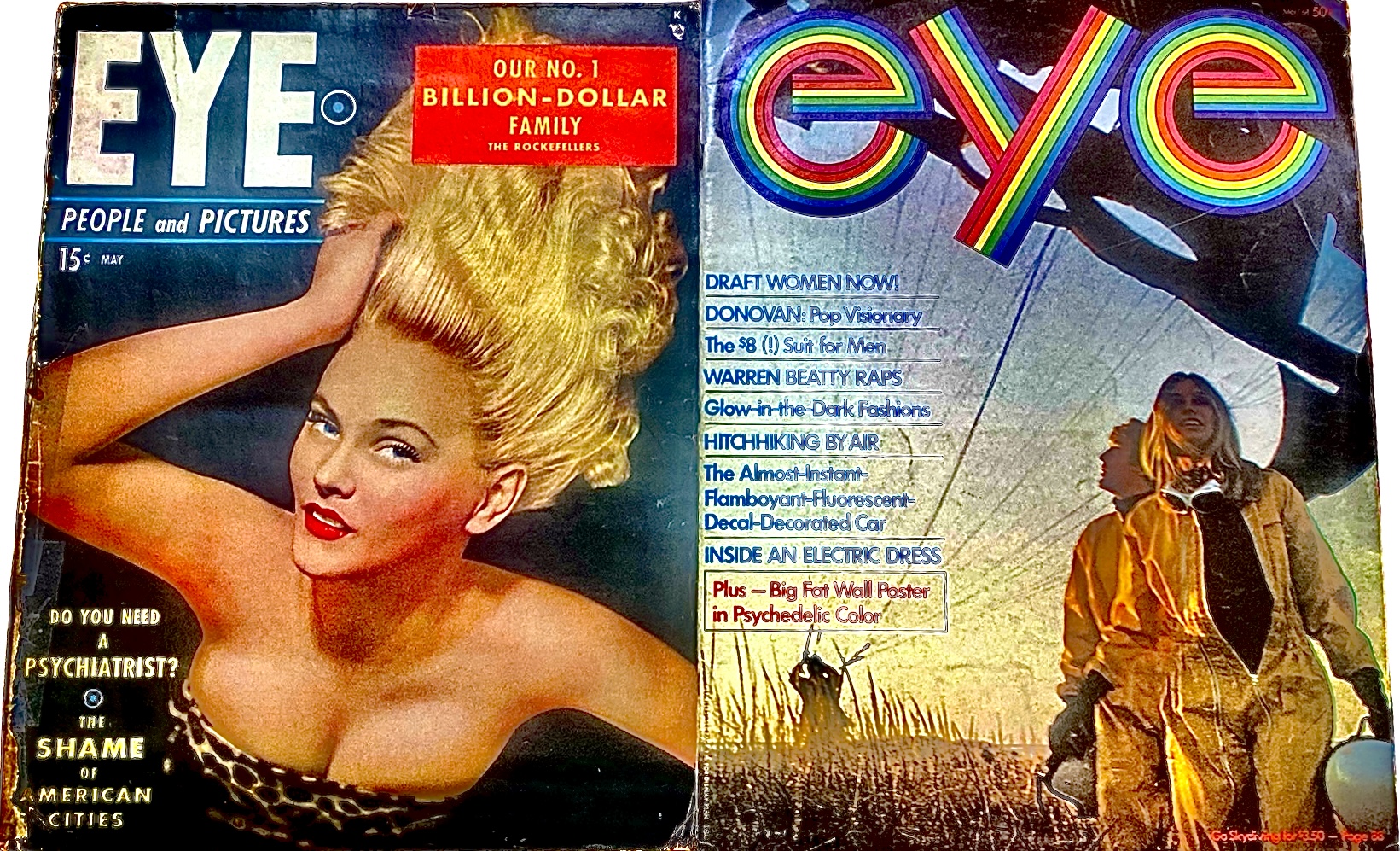
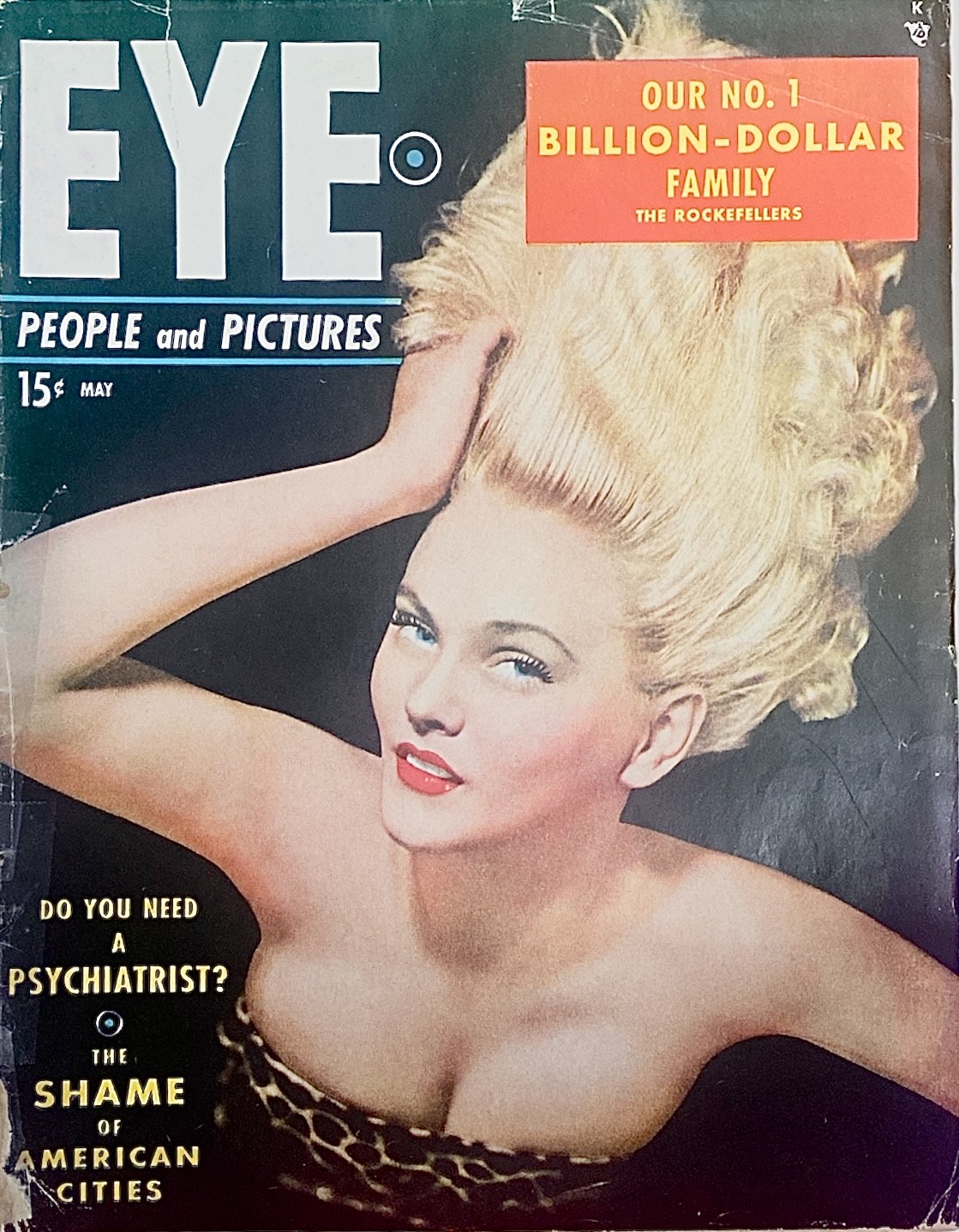
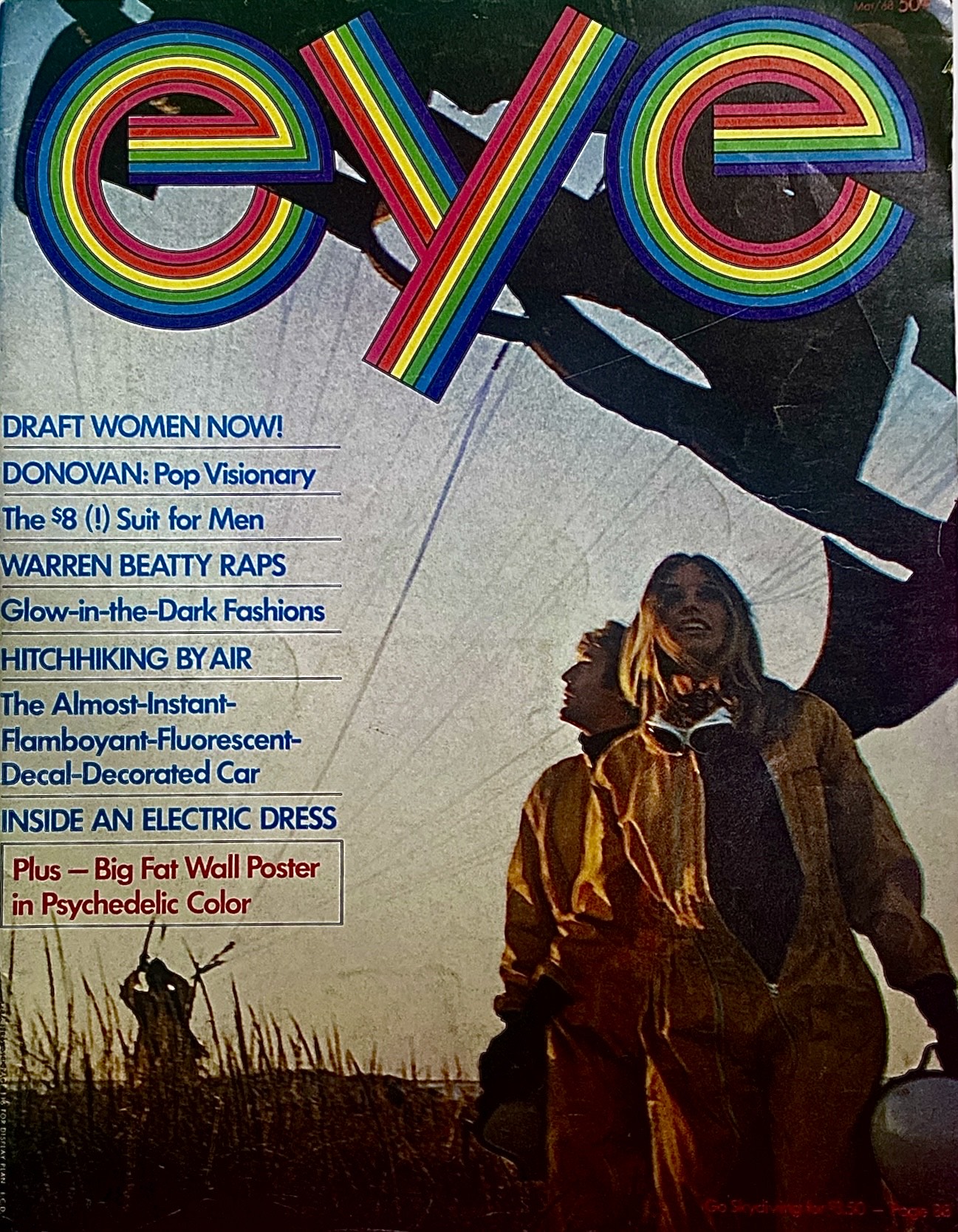
That is two Eye magazines.  One from the days before I was born, and the other when I was a 13-year-old teenager.  However the two Eyes have a lot in common and few good lessons to learn if you ever thought or think of going into the magazine business.  And by magazine, I mean the ink on paper publication that is published on some regular frequency.

So without any further ado, here are the lessons I have found in those two Eyes that are still applicable in the year 2024, some 75 years after the first EYE was born:

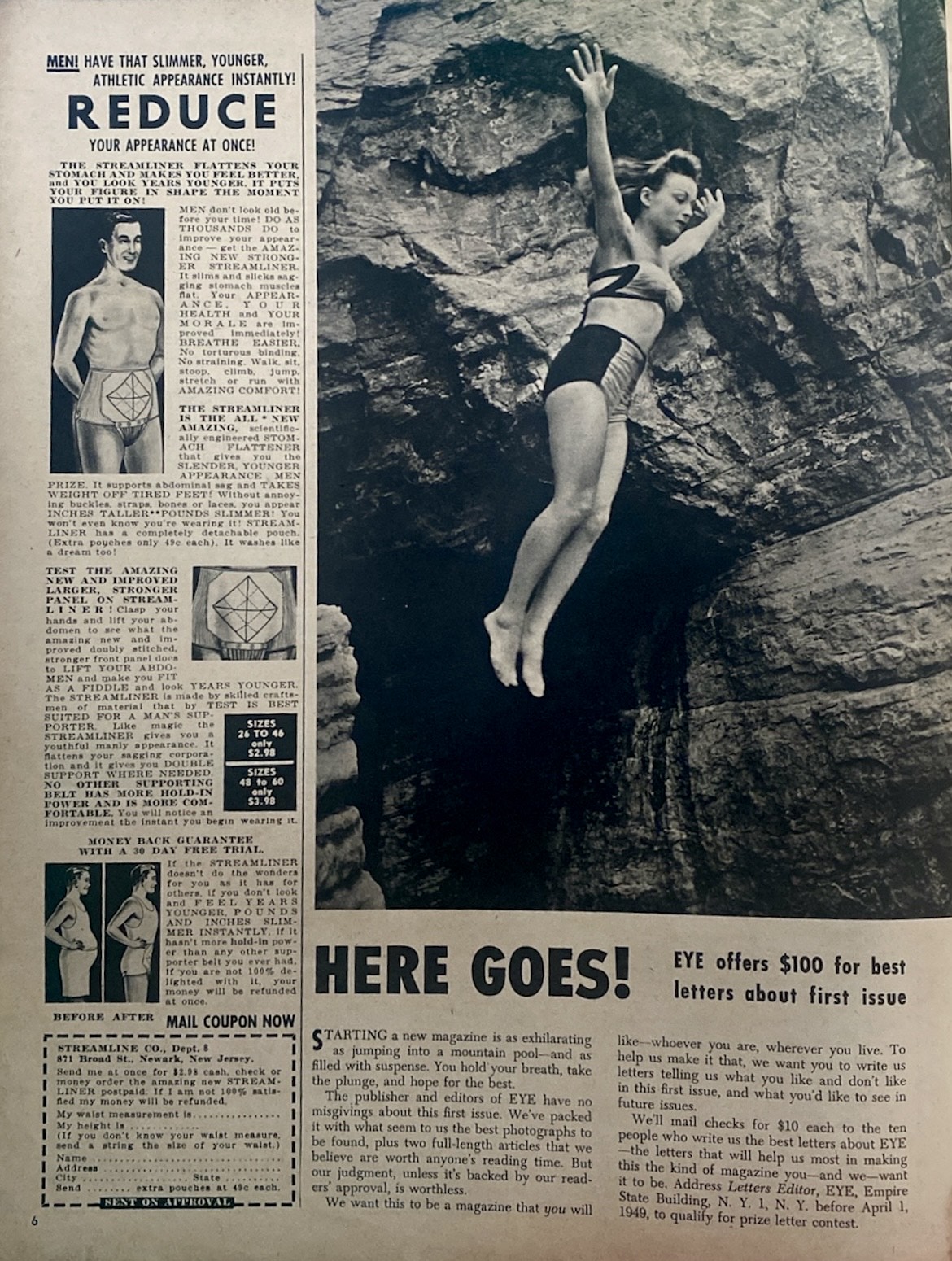
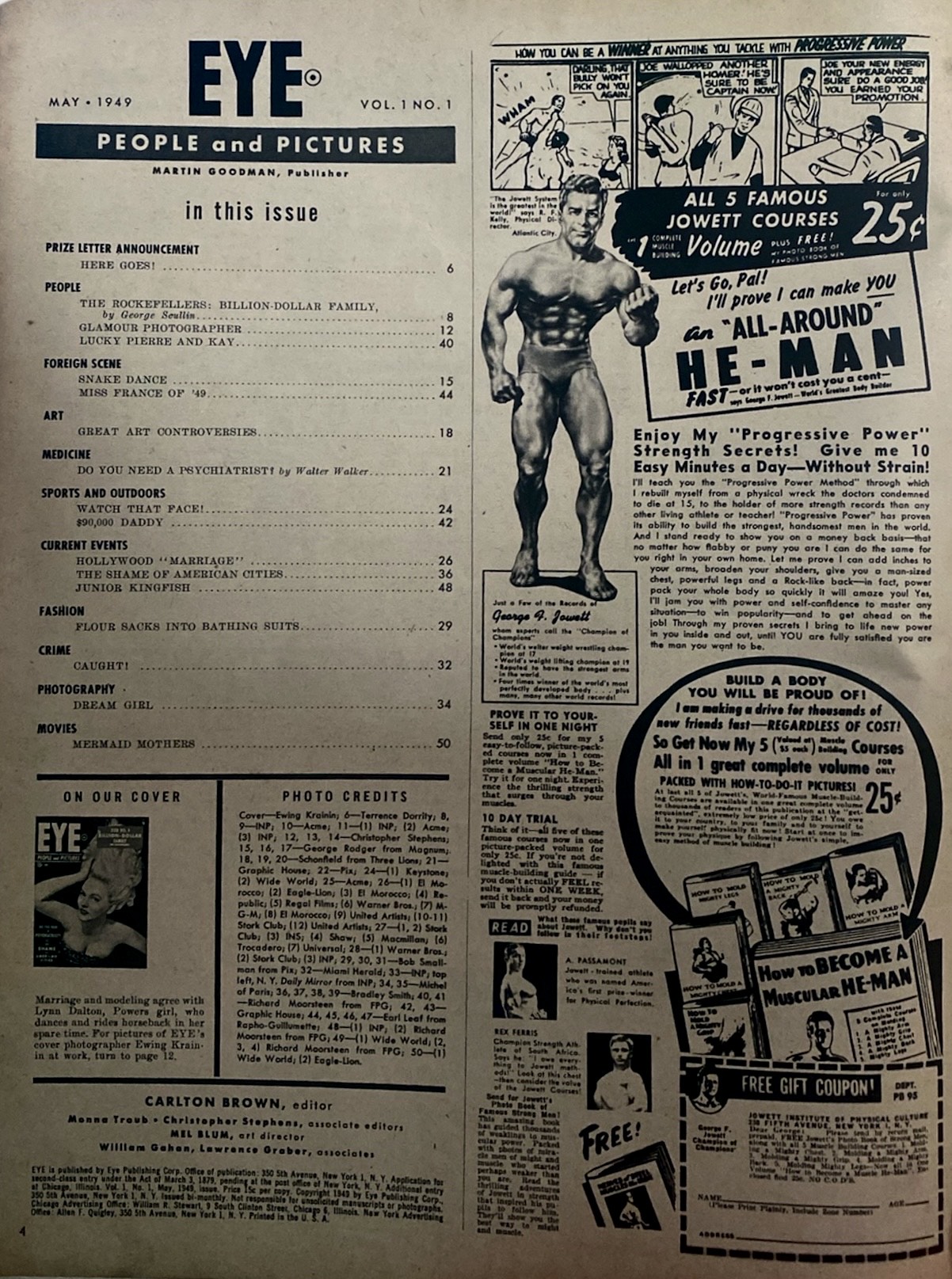
Lesson number 1:  Magazine publishing is not for the faint of heart.  In 1949 when the first EYE ( Martin Goodman, publisher and Carlton Brown, editor) was published, magazines were the only mass medium available to the public nationwide.  This EYE was first published in May 1949 with the tag line “People and Pictures.” The editors wrote in the first letter to the readers, “Starting a new magazine is as exhilarating as jumping into a mountain pool – and as filled with suspense. You hold your breath, take the plunge, and hope for the best.”

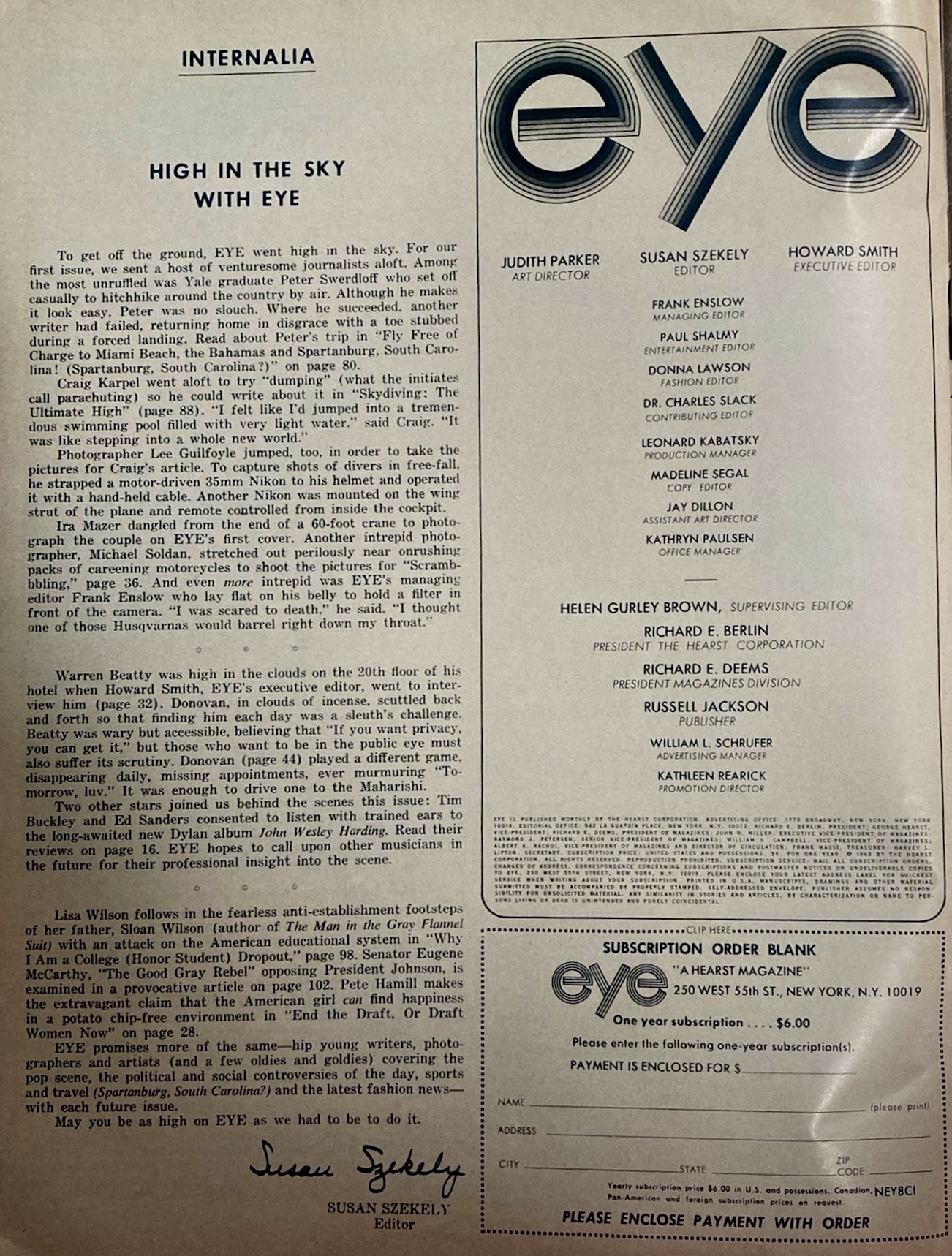
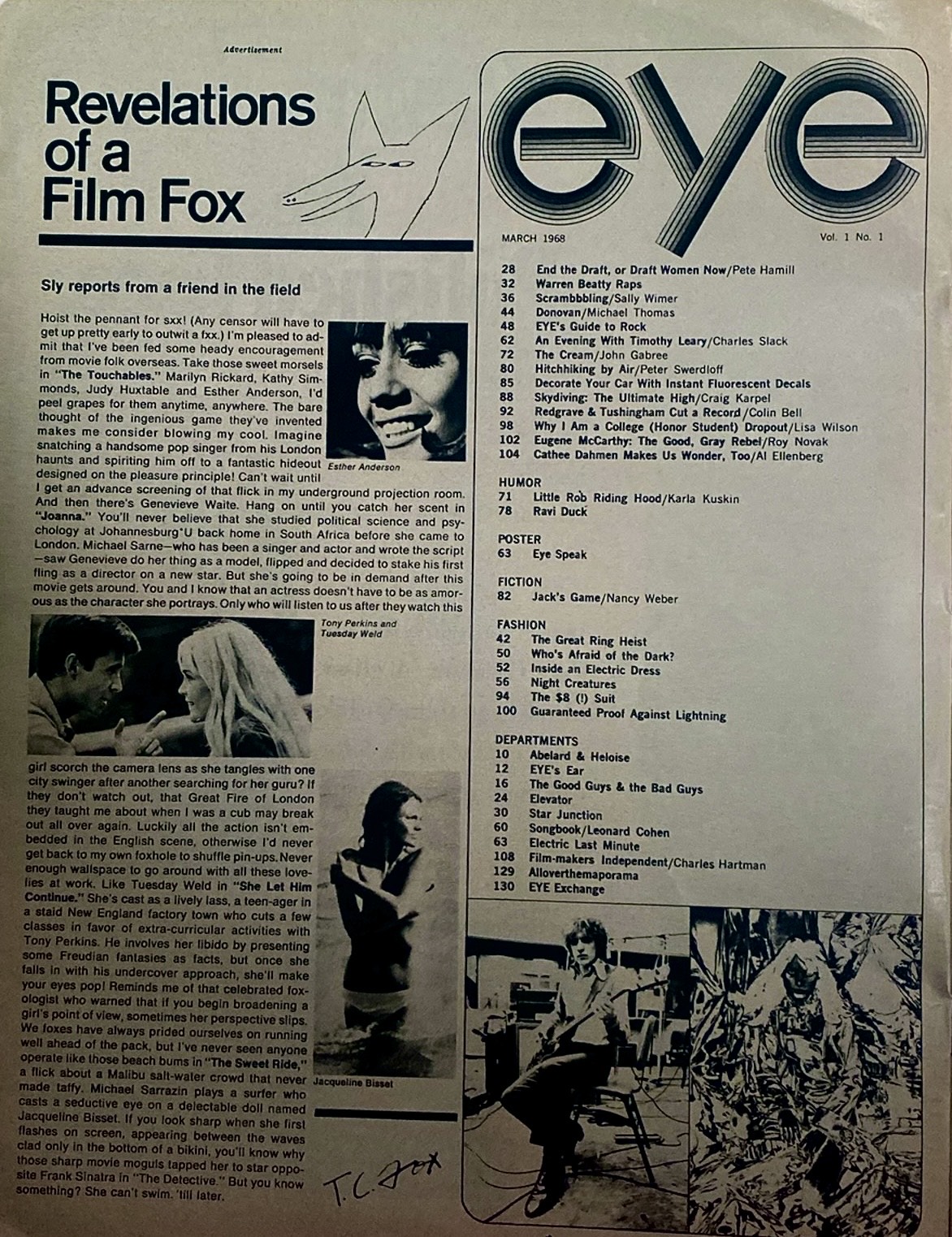
In March of 1968 editor Susan Szekely, wrote in the first issue of the Eye published by the Hearst Corporation  (Helen Gurley Brown was the supervising editor), “ To get off the ground, EYE went high in the sky.  For our first issue, we sent a host of venturesome journalists aloft. Among the most unruffled was Yale graduate Peter Swerdloff who set off casually to hitchhike around the country by air. Although he makes it look easy, Peter was no slouch. Where he succeeded, another writer had failed, returning home in disgrace with a toe stubbed during a forced landing.”

Both magazines took calculated risks and knew that magazine publishing, even in the 40s and 60s of the last century was not for the faint of heart.

Lesson number 2:  Plea for help from the audience.

Without your readers, the magazine is not going anywhere.  Readers input is essential. EYE of 1949 offered readers money for the best letters about the first issue. “We want this to be a magazine that you will like – whoever you are, wherever you live. To help us make it that, we want you to write us letters telling us what you like and don’t like in this first issue, and what you’d like to see in future issue,” the editors wrote.  They continued, ‘We’ll mail checks for $10 each to the ten people who write us the best letters about EYE – the letters that will help us most in making this the kind of magazine you – and we – want it to be.”

Hearst’s eye was more on the wishful side of things with the audience.  “May you be as high on EYE as we had to be to do it,” wrote the editor.

Lesson number 3:  Great content was and will always be king and queen.

The importance of good quality content is as important as it was in 1949.  For magazine content goes beyond good writing to include good photography, design, and the art of packaging a coherent and pleasing publication both for the eye (pun intended) and the brain.  “The publishers and editors of EYE, have no misgivings about this first issue. We’ve packed it with what seem to us the best photographs to be found,” EYE’s editors wrote, “plus two full-length articles that we believe are worth anyone’s reading time.”  The editors were humble enough to admit, “But our judgment, unless it’s backed by our readers’ approval, is worthless.”

As for the May 1968 Hearst’s eye, the editor wrote, after paragraphs of introducing the writers and photographer for the volume 1, number 1 issue, “EYE promises more of the same—hip young writers, photographers and artists (and a few oldies and goldies) covering the pop scene, the political and social controversies of the day, sports and travel (Spartanburg, South Carolnia?) and the latest fashion news—with each future issue.”

Publishing a magazine, a good magazine still depends on those three premises stated above.  Recognizing it is not for the faint of heart, engaging your audience from the very beginning, and providing excellent content that can’t be found any other place.

If you would like to take a dive into the “oldies but goldies” magazines of the past, feel free to reach to John Henry at the Special Collections division of The University of Missouri Libraries and ask for the Samir Husni Magazine Collection

Until the next musing, stay tuned…

All the best

Samir “Mr. Magazine™” Husni

h1

An Upscale Magazine For The Masses. The Story Of The Launch Of hiii: “The Vanity Fair For Weed.”  The Mr. Magazine™ Interview With Rob Hill, Co-Founder And Editor In Chief, And Pam Patterson, Co-Founder And Creative Director.

September 12, 2024

“We love magazines. We’re finding out that a lot of other people who didn’t know they love magazines, love magazines. I’m feeling really buoyant and positive. You say, “Will this be a business? Yes, we are very, very confident. This is not a vanity project. We’re here to make money. The universe is conspiring such a thing.” Rob Hill

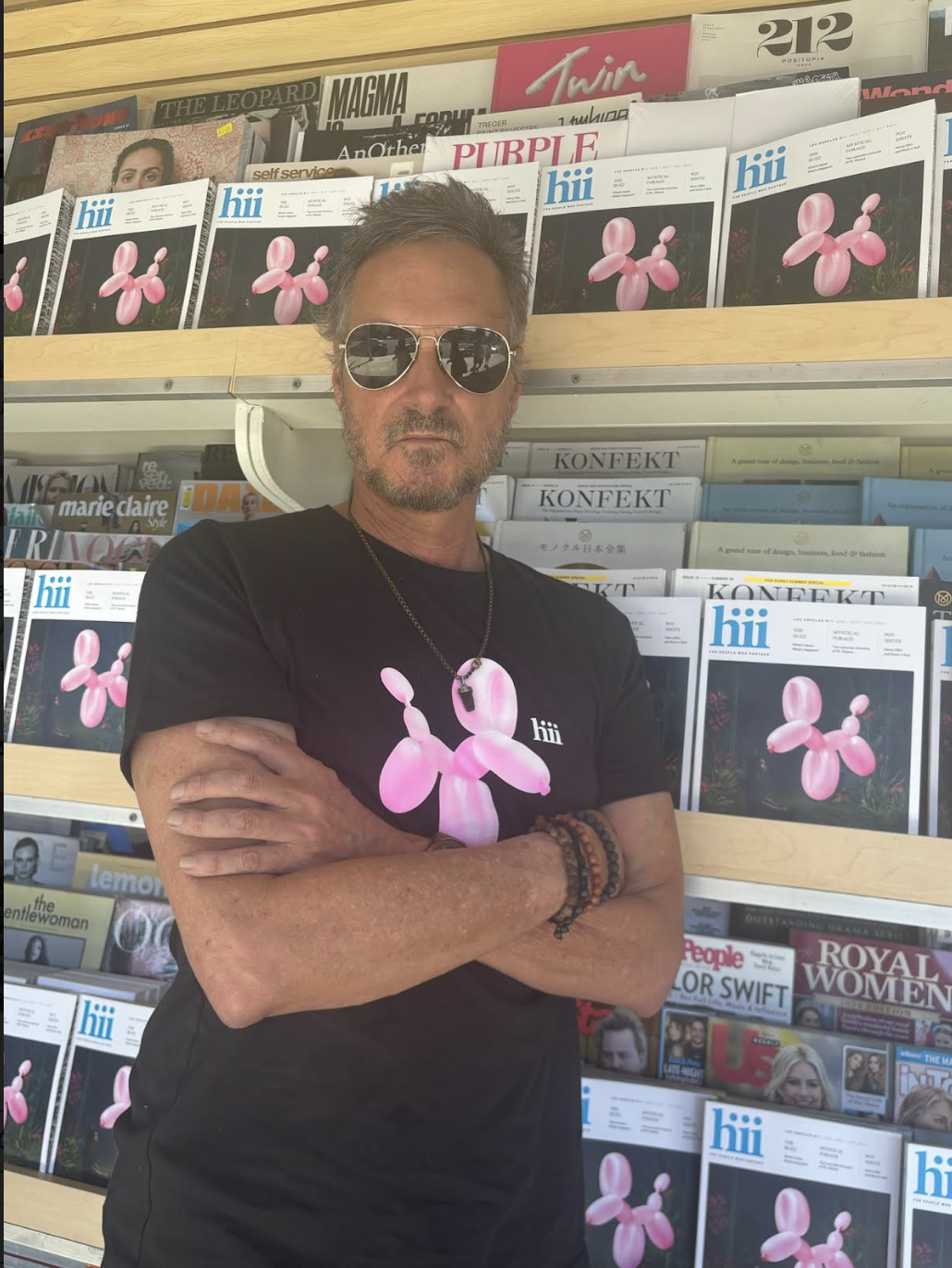
An upscale magazine for the masses “who partake.” A “Vanity Fair for weed.” A new twist on marijuana magazines. Elegant in design and even more elegant and sophisticated in writing and photography.  The brainchild of Rob Hill and Pam Patterson, hiii magazine arrived on the newsstands in the city of Los Angeles and at all its dispensaries.

The lifestyle magazine utilizes every inch of space to channel messages to its readers and advertisers.  From the margins to the spine and the front edge of the magazine, there is content, a very specific message to the audience.

To say the magazine is well done will be an understatement.  Rob and Pam poured their heart and soul into this new publication that goes beyond the ink on paper magazine.  To find out about this hiii adventure I reached out to Rob and Pam and had a delightful conversation about the magazine and the entities surrounding the publication. 

Please enjoy this conversation with Rob Hill, co-founder and editor in chief, and Pam Patterson, co-founder and creative director,  that is sure to give you a hiii whether you partake or not.  But first for the soundbites:

On the genesis of the magazine idea: “My thinking was that the industry had nowhere to brand. And there are about 2800 potential advertisers in this city. So I just saw it as a numbers game. But it also had to bring a new and veneer to the industry. A new take for a new time.”

On the mission of the magazine: “Because what this industry didn’t need was another rag that was basically looking backwards and not forwards, actually propelling the stereotypes. We’re totally anti that. We don’t believe that. I think 64% of people use cannabis in this country.”

On scoring an ad from Porsche: “We don’t all live in a silo. We buy Porsches. I hope you saw the ad. We booked Porsche, which has never been done in a cannabis magazine. They booked it for the full year and paid. So we’re going after car companies, we’re going after mainstream brands.”

On expanding beyond Los Angeles: “We’re getting calls from Vegas, NYC, and Detroit, etc, to bring the magazine there. It’s just been so exciting. I don’t want to say we’re saving print, but I think we’re part of a resurgence of print. Nylon is back, Spin is back, Creem is back, Life is back, Playboy is back. There is a digital fatigue that has set in.”

On the role the magazine aims to play: “One of the things that makes this audience so much different is we really are a lifestyle magazine. It’s a tool for connection between people. I think people who don’t smoke wouldn’t completely understand it.”

On the flipbook in the margins: “When I heard that Mickey Mouse came into public domain, at least Steamboat Willie, we took a look at it. He’s driving the boat and it’s just begging for a joint in his mouth. “

On the distribution model: “The thinking is to conquer the country through cities rather than the traditional way of printing half a million magazines and putting them on newsstands all over the country.”

On the creation of the magazine: “We just felt we were the best people to redefine, update, and package it in a way that made sense to everyone. Concentrate on the positive, creative, and medicinal parts.”

On the content: “We’re going to always have some really good stories in there too. Like the prison story we did. People don’t know that there are people still rotting in jail for selling three joints in 1975. It’s crazy.”

On the audience: “The audience is very broad, but it’s like the coolest people in all of those sort of segments smoke weed.”

On young folks reaction to the magazine: “We have a lot of young people that work in our office who are in their twenties and a lot of people that come through here who are millennials that treat the magazine like it’s a jewel. It’s an exotic thing to them that they’re liking. What’s not to like?”

And now for the lightly edited conversation with Rob Hill, Co-founder and editor in chief, and Pam Patterson, Co-founder and creative director of hiii magazine:

Samir Husni:  In this digital age, you are launching a print magazine, and not any print magazine, a print magazine for people who partake.”  What’s the reasoning behind it? What were you thinking? Are you out of your mind?

Rob Hill: Well, during COVID, I was sitting home alone a lot. I kind of fell back in love with cannabis. I’ve had an on and off love affair with it.

I was coming from a business to business cannabis magazine called MG, which was the biggest cannabis business to business magazine with a very different model. It was a subscription only model. It went out to CEOs and owners of companies.

I would go down to the Malibu newsstand before they locked us all down. Even when they did, and just kind of, buy magazines and bring them home. I started to make a collage on my wall and started to just envision it.

My thinking was that the industry had nowhere to brand. And there are about 2800 potential advertisers in this city. So I just saw it as a numbers game. But it also had to bring a new and veneer to the industry. A new take for a new time.

I thought if we could bring it into the 21st century, and give it a splashy, fun, and modern take, that it would work.  That was kind of the thinking behind it.

We’re going to make money. We spent the first 18 months after we developed the idea and got it where it needed to be.

I think what’s really broken in the magazine industry is the distribution model and the fact that if you don’t love magazines don’t launch one. Anyone can have a blog and a website but not everyone can have a magazine.

In addition the print pages, we sold eight activations at our launch party, which means that a company brings their product, sets up a table, has their signage, while educating consumers and handing out samples.

Samir Husni: hiii is unlike any of the cannabis magazines that were launched even as back as the 70s. We had a lot of magazines like High Times, Inside Dope, Head, Kush,  you name it. hiii is more like an upscale magazine, yet it’s a mass magazine. Tell me the thinking behind combining upscale and mass at the same time.

Rob Hill: I think that’s the target we needed to hit to be successful. Because what this industry didn’t need was another rag that was basically looking backwards and not forwards, actually propelling the stereotypes. We’re totally anti that. We don’t believe that. I think 64% of people use cannabis in this country.

We don’t all live in a silo. We buy Porsches. I hope you saw the ad. We booked Porsche, which has never been done in a cannabis magazine. They booked it for the full year and paid. So we’re going after car companies, we’re going after mainstream brands.

Our hope is by this time next year, a third of the magazine is going to have advertising in it that has nothing to do with cannabis. We’ll get Levi’s and Doc Martens and Bentley and Range Rover. Porsche plowed the road for us, so to speak. They parked their cars at our party to out in front of Woody Harrelson and Bill Maher’s cannabis lounge/garden The Woods in West Hollywood which was really cool.

Porsche’s whole marketing team came and it’s a really big deal.  Ad Age or Adweek should really do an article on that.

We were hoping to have 15 ads and we booked 26. And the Porsche ad, goes above and beyond what they paid. It’s not even about the money with Porsche. It’s about having that real estate for the full year in the magazine

Samir Husni: That’s not your first venture editing a magazine. You’ve been there, done that. What’s the difference? You and Pam are now owners and publishers. Does it feel any different that just being an editor?

Rob Hill: The last time we spoke we were  launching Treats magazine. That was pretty exciting. Hugh Hefner tried to buy it the day after we launched it. He invited us up to the mansion.

But this is different. Pam and I purposely put our emails in our editor’s letters because we wanted people to email us. We didn’t want to do info@ or editorial@. And we’re getting about a dozen a week of just people that are saying things like, “I saw your magazine at the dispensary. I picked it up. I commute to work on a bus. I read it cover to cover.”

We’re getting calls from Vegas, NYC, and Detroit, etc, to bring the magazine there. It’s just been so exciting. I don’t want to say we’re saving print, but I think we’re part of a resurgence of print. Nylon is back, Spin is back, Creem is back, Life is back, Playboy is back. There is a digital fatigue that has set in. People are tired of being on their phones and all ages are looking for more tangible experience. This is why we spent lavishly on our paper stock, size, and design. And it’s paying off.

Samir Husni: The design of the magazine from printing on the edge of the magazine or having an edgy design. Tell me about the creative design of  hiii.

Pam Patterson: I’m the creative director and I’ve been a weed smoker since I was 13.

One of the things that makes this audience so much different is we really are a lifestyle magazine. It’s a tool for connection between people. I think people who don’t smoke wouldn’t completely understand it. But when you’re part of this community, there’s a bond there that we channel when we’re concepting the magazine.

We wanted to create a toy, something where people could relate to it in a lot of different ways. We could have a story of substance, and then have a story that speaks to the tools of the trade and whatnot. Also where they could have a little passage from some novel that someone may see in a new light. 

We want to be fun like Bob Marley’s quote on the edge printing. It’s just a fun way. I think it’s kind of a wink to our audience that we get it. Weed smokers are thinkers. We’re creative thinkers.

Samir Husni: What about the flipbook? I mean, the images that run in the margins?

Pam Patterson: When I heard that Mickey Mouse came into public domain, at least Steamboat Willie, we took a look at it. He’s driving the boat and it’s just begging for a joint in his mouth.  We wanted to do a flipbook for some time, and that was kind of a thing we devoted that real estate, the right hand margin to, in addition to a literary passage and the edge-printing. People were like, oh, advertisers are not going to like you getting into that space. But it’s been just fine.

Samir Husni: It looks like you have a love affair with the magazine and with print. But my question to you how is hiii as a business? Are you going to spend your savings or are you going to make money out of this?

Rob Hill:  Absolutely. We’re going to make money. We spent the first 18 months after we developed the idea and got it where it needed to be. We have a CFO who was CFO from Hard Rock Cafe and other companies. We did talk to a lot of people. But what we found was the investors didn’t get it as much as the advertisers did. So our business development consultant said, “Well, your advertisers are your investors. So just go start selling and don’t worry about all of this other stuff.”

We were hoping to have 15 ads and we booked 26. And the Porsche ad, goes above and beyond what they paid. It’s not even about the money with Porsche. It’s about having that real estate for the full year in the magazine and being able to go to other brands like Woody Harrelson, Whiz Khalifa, Snoop, Jay-Z, Willie Nelson etc., and say, “Hey, your ad is going to be after Porsche.” They like that.

We just started to knock down some barrier to entry and it was difficult in the very beginning. People were saying cannabis isn’t the hottest thing right now and magazines aren’t the hottest thing right now. But we didn’t believe that. And Samir, I think what’s really broken in the magazine industry is the distribution model and the fact that if you don’t love magazines don’t launch one. Anyone can have a blog and a website but not everyone can have a magazine.

I think we’ve come up with a way to do distribution right. In fact, last night, I went after dinner to go check the markets in Studio City and Laurel Canyon, where we distribute the magazine on the racks outside the markets. And there we put 25 on each and they’re gone in three days. There are 128 dispensaries and cannabis lounges that also carry the magazine in their stores and half a dozen that we have partnered with to deliver the magazine right to their door of their VIP customers with their cannabis.

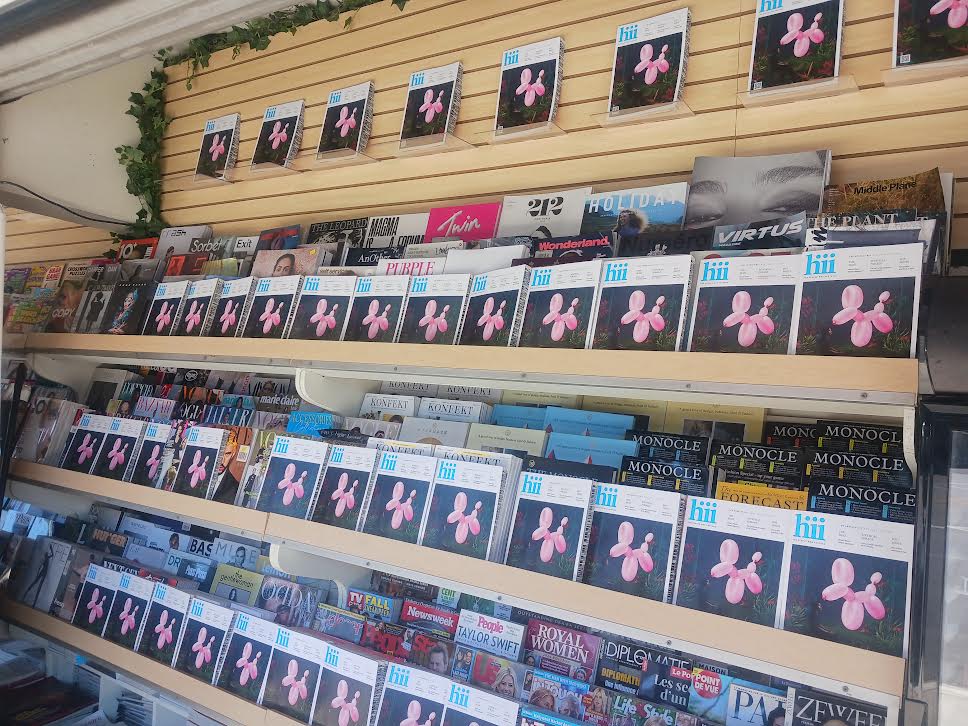
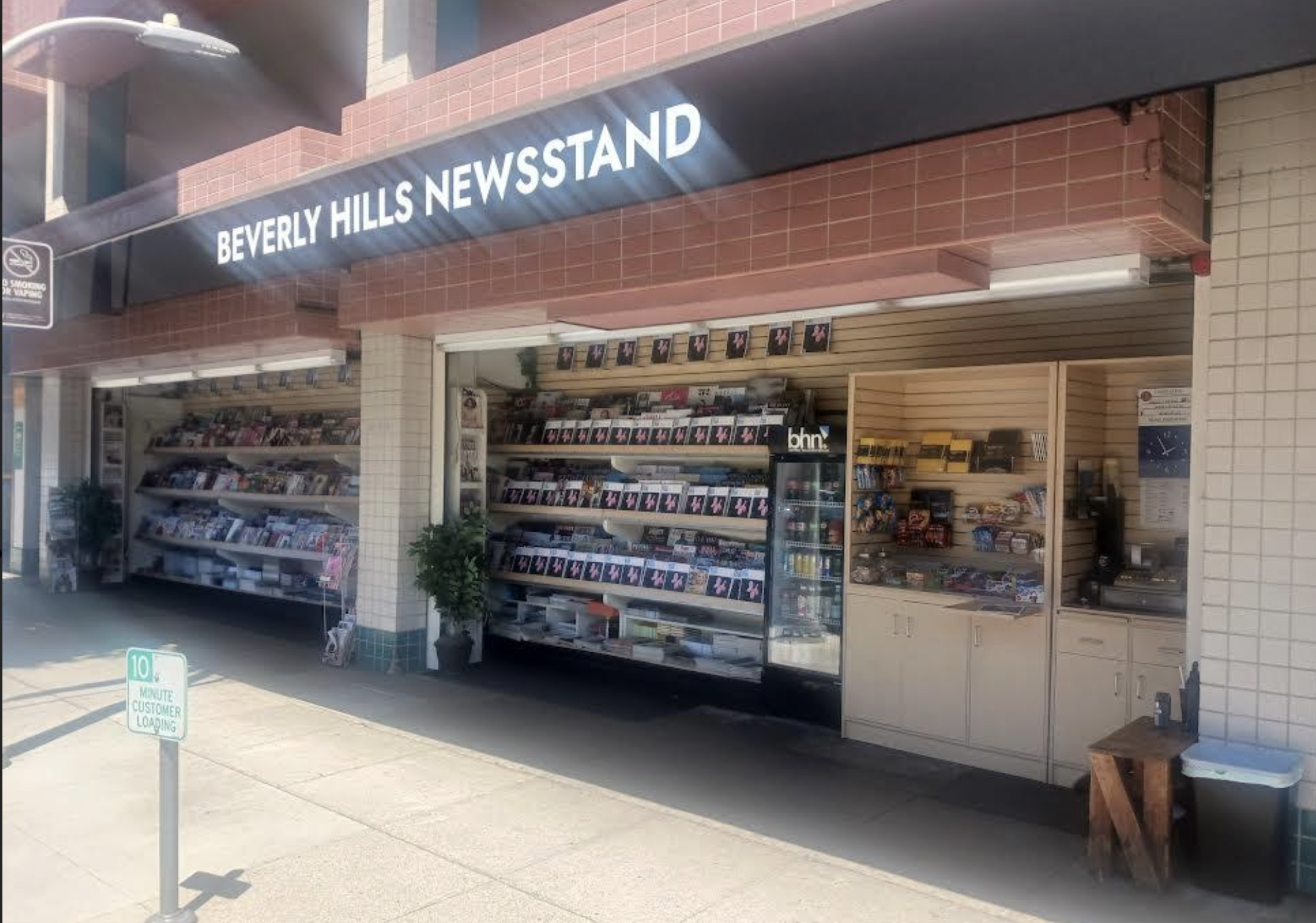
And that’s all over the city. That’s Erewhon, Vons, Ralphs, Whole Foods. And then we do have a paid model. We’re distributed through Mader News. We took over the Beverly Hills newsstand for the month of August! Never been done before by a cannabis magazine. The first day David Lynch sent his assistant to buy the magazine. The next day it was Quentin Tarantino.

They put us right next to Monocle, which was really cool because Tyler (Brule) is one of my heroes. I think we figured out distribution, and the model is to take this to the next city in second quarter 2025.

The thinking is to conquer the country through cities rather than the traditional way of printing half a million magazines and putting them on newsstands all over the country. We’re sort of doing what Cigar Aficionado does married with what Departures did, with a dollop of traditional newsstand and the whole National Geographic in the dentist office thing.

Once Cigar Afficionado got distribution in the thousands of cigar lounges, the advertisers were like, What more could we want? If you’re an advertiser, you have a guy or a woman that’s in a cigar shop, hanging out, having a good time, talking with their friends and then they pick up Cigar Aficionado and spend 20 minutes enjoying it. It’s a warm audience. That’s hiii in the lounges and dispensaries.

The other unique and singular thing hiii does is reach not only consumers but also the budtnders, buyers, and owners of cannabis dispensaries who are all reading the magazine. The competition is fierce for foot traffic and for space on the shelves. Yesterday I got two calls from buyers who saw ads in the magazine of products that they would like to carry. Both brands scored over a 1000 unit order. That will be 10x what they paid for the ad. Needless to say, they called and asked to book for the rest of the year. Smart. Happy advertisers make my day.

Samir Husni:  You wrote that you’re going to change the perception and the veneer of the industry.” What do you mean?

Rob Hill: I think that so much of this world is about perception and whether that perception is real or not, it is your reality. If you are a person that is perceiving cannabis users as criminals and low-lifes, then that’s not good for our industry. I always felt if we don’t define it, someone else will, and they have tried their darndest. Even magazines like Rolling Stone and The Atlantic have begun to take pot shots at the industry.

We just felt we were the best people to redefine, update, and package it in a way that made sense to everyone. Concentrate on the positive, creative, and medicinal parts.

Pam Patterson: Not everyone’s asleep on the couch. I think some of the highest performing individuals, and especially in the creative fields, are smoking pot all the time.

Rob Hill: You know what I’m most proud of? I’d say 80% of our advertisers have never done a print ad before. They’ve never done any marketing. This is a brand new industry, so to speak. And it’s hitting another phase because the genie can’t be put back in the bottle.

They’ve tried to slow it down and that’s not working either because humans are very malleable, flexible, and we figure stuff out. So one of the good things that happened to us right when we were getting out to sell ads, a law was passed that’s going to allow cannabis companies to write off their marketing and their advertising like every other industry. And that kind of gave us a little bit of a tailwind where we were coming from a headwind.

That changed a lot right there. Right after that, we went to the biggest cannabis expo and met with over 400 companies and started selling ads. Started telling them, “You can now write this off, like a beer company or a clothing company.”

Samir Husni: So here’s my question to you. What can you do in print that you could not do on the digital portal?

Rob Hill: Well, I was going to make a comment that because the industry is not federally legal, it makes a lot of media vehicles unwilling to do any advertising with cannabis. So things like radio, TV, much of print, etc. is off limits to cannabis companies. Also you can’t trade across state lines. So it’s all very regional play. There are some very unique, specific things to this industry that make hiii something that the community really needs.

They need an advertising vehicle. They need a place to brand. We can’t be shadow banned. We can’t be censored. We feel good. And we are something that the industry can be proud of. Every revolution needs a magazine, right?

I like the idea that we’re not going to wake up in the morning and have our Instagram taken down. I mean, like a lot of people wake up in the morning, have their Instagrams just taken down. That just happened to the biggest guy in our industry who had 8 million followers. He just woke up and it vanished. The disruption to people’s businesses who depend on that for a product that’s locally legal it’s kind of crazy.

We’re finding that print done well, like the paper that Pam picked and the size of the magazine, she’s so good at just packaging things and understanding what’s good and what catches the zeitgeist.

Print is a tangible object, people are buying vinyl albums again, and magazines are back in vogue. Are there going to be 2 million circulation magazines launching weekly? No. Those days are over.

Life magazine is coming back as a quarterly. Not a bad idea. I think quarterly is where these magazines are finding their sweet spot. Mader News told us what’s working right now are quarterlies with high quality and a high cover price. That’s why we’re charging $20 for that because they said you will get that at these newsstands.

Samir Husni: To me, this year is the year of the relaunches. But you are the year of the launch. You are launching something from scratch and using all the experience that you had for year. It’s manifested in hiii. The goal now is quarterly and LA. What next?

Rob Hill: Well we may change our minds. We talk about telepathy every night when I’m in my bed and she’s in her bed, 25 miles away. We started  thinking the same. It’s been interesting.

One of the things I do want to say that’s very important to our business and unique to this business is the trade shows and the events. This industry will write big checks, 50,000, 70,000, 150,000 to have booths at these trade shows. They’ve been doing it for about a decade now.

So they’re very comfortable writing those checks. What they haven’t been comfortable with or what they haven’t been doing is writing checks for magazine advertising because there hasn’t really been that vehicle. So we wanted to combine the two.

 In addition the print pages, we sold eight activations at our launch party, which means that a company brings their product, sets up a table, has their signage, while educating consumers and handing out samples.  We had 500 people at our launch party We’re packaging this with, You get the goodie bag, which they all want because they want these products in people’s homes very badly.

They want the activation to basically give samples away and to educate the consumer. They all fell in love with the magazine too. That’s going to be a big revenue generator for us.

We have an event space here that’s 12,000 square foot that’s outside that can fit 500 people. For every issue we’ll do a party. So we’re selling a 360 product because our newsletter has a 67% open rate.

We’ve curated a newsletter that’s like triple or double what you’d hope to have—a 67% open rate. We’ll be able to, as we grow that, monetize it. Digital is obviously really important, but we want the magazine to drive ROI and traffic to the stores. And so far after a month the ROI is tangible.

Digital doesn’t really do that well, but a magazine that you pick up and put in your car that when you go pick up your girlfriend and her friends after class or whatever, and they all see it and begin passing it around and gawking at the ads, does that really well. There’s something happening right now and it’s totally counterintuitive, but it’s happening. I’ve never been more excited in my life. We had to throw caution to the wind. We’ve had to just jump in.

I really do feel it. We have a lot of young people that work in our office who are in their twenties and a lot of people that come through here who are millennials that treat the magazine like it’s a jewel. It’s an exotic thing to them that they’re liking. What’s not to like?

Pam Patterson: It pays off. People who take the time to open the magazine, get rewarded. And that is an essential quality. One thing I wanted to mention, too, is that weed smokers are of all different ilks, all ages, highly diverse, from all different kinds of communities including LGBTQI+. The audience is very broad, but it’s like the coolest people in all of those sort of segments smoke weed.

There’s a common thread. It’s intentionally made to relate to a broad section of people, to be a unifying factor among everyone, and something everyone can be proud of. People who are in this industry are in it because they love it. It’s still very much a mom and pop industry.

Rob Hill: You know, it’s very difficult to be a big Coca-Cola type brand when you can’t sell your product in many states and almost all countries. That’s going to start changing pretty rapidly. Japan, Thailand, Germany, and Israel are opening up. We’re probably going to have to think about some licensing deals here because it looks like globally this thing is just on fire and I think is very interesting.

I liked what Imbibe did for the alcohol industry and they rallied behind it and they have stuck with it. It’s a good magazine. They have big brands in there and we actually really feel like we’re going to get a lot of those alcohol brands at some point. You only lose when you run away from the internet or run away from the things that you know are coming. Well, and in LA I think that there are more dispensaries than McDonald’s now.

Pam Patterson: And it’s outselling wine. There’s a lot of really big categories that cannabis is marching past.

Samir Husni: So before I ask you my typical last questions, is there any question I failed to ask you or is anything you would like to add.

Rob Hill: No, think you covered it. You totally understand the magazine.

I’ve always had a lot of respect for you and follow your blog and did my favorite interview with Treats with you. And, you know, it’s great to be endorsed. You love magazines.

We love magazines. We’re finding out that a lot of other people who didn’t know they love magazines, love magazines. I’m feeling really buoyant and positive. You say, “Will this be a business? Yes, we are very, very confident.

This is not a vanity project. We’re here to make money. The universe is conspiring such a thing.

Samir Husni: I know you are playing on the word high and hi. What was the thinking about the Hii?

Rob Hill: Well, we really liked the sing-song because it’s when you see somebody that you like, or maybe you’re flirting with, it’s kind of like, hiii. And so we thought that that was a sweet way to do it.

You got to be careful in this industry to not be too obvious. A lot of those like really obvious brands get into that realm of just showing pictures of flower and stuff like that. We wanted to be something fresh, new,  and friendly.

It just made a lot of sense in that regard. We trademarked the whole thing. “hiii: For People Who Partake.”

Pam put on the spine “The Third Eye,” which is referring to our pineal gland, our antenna to other dimensions, etc. There’s evidence that cannabis, CBD, and mushrooms help to decalcify the gland which has been corroded with Fluoride, etc.

Pam Patterson: We’re going to always have some really good stories in there too. Like the prison story we did. People don’t know that there are people still rotting in jail for selling three joints in 1975. It’s crazy. Not many. Lots of them have been pardoned, but it’s pretty crazy.

Samir Husni: If I come to visit you one evening unannounced, what do I catch you doing? Reading a book, smoking a joint, watching TV?

Rob Hill: At six pm we’re still at work. We’ll probably have people dropping in and probably smoking a pre-roll, but we’re not watching TV. We’re talking about issues.

We’re talking about the magic of the plant. Our office and event compound has a neighborhood clubhouse feel; hundreds and hundreds of people flow through here every month. The word is out. Frogtown and hiii are the place to be.

We’re the center of the community. We have this event space. We have the magazine that people are rallying behind.

We just hired the woman that used to work for Bob Guccione Jr. at Spin. She also worked at Cosmo too. She’s on our ad sales staff; we have now five ad sales people.

I just really feel like the ads are going to go from 26 to 40 to who know how many pages. Our main competitor, who’s not really a competitor, but he’s more of a newsstand magazine, he’s doing consistently 176 pages six times a year.

He’s doing pretty well. He has a different audience than us and a different business plan, but it’s good. We see that as a good thing.

Samir Husni: My typical last question is what keeps you up at night?

Pam Patterson: We’re hitting our stride. We have a lot of fun stories.

Rob Hill: There’s a difference when you can’t sleep at night because you’re freaking out and stressed out. Then there’s this other side that for me, it’s just excitement, almost like I don’t want to go to bed.  I know I have to, because the rocket’s taken off. There’s so much to do in so many fantastic ways. It’s really a playground over here. The timing is perfect.

I think we’ve caught lightning in a bottle.

Samir Husni: Thank you both and good luck.

h1

Kat Craddock Loved SAVEUR Magazine So Much She Bought The Company.  The Mr. Magazine™ Interview With The CEO & EIC Who Relaunched The Print Edition of SAVEUR.

April 25, 2024

Kat Craddock is to SAVEUR magazine what Victor Kiam was to Remington Shavers in the late 1970s.  The famous salesman who said, “ I liked the razor so much I bought the company.”  And so did Kat Craddock who liked SAVEUR magazine so much, she bought the company.

Kat Craddock by Grace Ann Leadbeater.

A restauranteur who fell in love with the magazine at a very young age and was sad to see it halt printing in 2020 decided to do the unthinkable, buy the magazine from its current owners and relaunch its print edition without ignoring the digital space that the magazine enjoys among its faithful readers and followers.

In an all-encompassing conversation with Kat, I had the opportunity to ask her about the relaunch of the magazine in print, the role of print in today’s digital world, and how she is going to achieve success.  Her answers were down to earth, passionate and unpretentious.  She knows what she is facing and what are the challenges in store for her and the magazine, but, together with her team, she is determined to prove the theory of “print is dead” is wrong.

Kat told me that,  “Since we stopped printing in 2020, our readers have been telling us that they wanted the magazine to come back. I knew that enough people loved it and enough people would buy it that we could make it work. Maybe not in the old school distribution models, but I knew that there were enough people out there that wanted the publication that we could deliver something that they were excited about and that we were proud of.” 

So, please enjoy this Mr. Magazine™ conversation with Kat Craddock, CEO & EIC of SAVEUR magazine.  But first for the soundbites…

On SAVEUR’s mission: SAVEUR is such a particular type of publication with original recipe content,  original photography, recipe testing, and travel. It’s so core to our identity.  Those are all really expensive things.

On the magazine revenue model: . A lot of the advertising revenue that we are generating is built into these larger packages that are a combination of digital content or experiential and print. Our print magazine is $25 now. We’re not doing discounts for subscriptions.

On the myth of digital vs. print: I guess I’m being a little defiant about it. I don’t like hearing from the industry that since people want digital now, they by default aren’t going to want print.  I feel like I have this kind of personal mission to prove that theory wrong.

On what print can offer that digital can’t:  There are a lot of different types of storytelling through photography, through different story type, through different story lengths, through design that just don’t translate to digital.

On the role of events in her business model:  I want events to become more a part of our business model and our marketing model.

On selling out of the relaunch issue: we sold out, which is a great problem to have. It’s nice to be in a position of going back to our printer who was so wonderful to work with and say, okay, next time we’re going to be doubling our print run.

On what keeps her up at night: I’m a year into basically owning a startup. So probably the, the day-to-day business side of things and making sure that my team is happy and feels supported.

And now for the lightly edited conversation with Kat Craddock, CEO and EIC, of SAVEUR.

Kat Craddock by Grace Ann Leadbeater.

Samir Husni: Well, congratulations on the relaunch of SAVEUR.

Kat Craddock: Thank you so much, we’re very excited.

Samir Husni: You’re one of the few who not only relaunched the print magazine, but also have a relaunch party and also sold out of the relaunch issue. What’s going on?

Kat Craddock: Well, a lot’s going on, I guess. We bought the magazine out from our former owner last April. So it’s also our anniversary.

It’s a big anniversary this year. It’s our 30th anniversary as a publication. This month is our first anniversary since being an independent publication.

We relaunched the print magazine last month. We spent the last year working towards the relaunch. That was the first order of business that I really wanted to make sure we were able to do.

Since we stopped printing in 2020, our readers have been telling us that they wanted the magazine to come back. I knew that enough people loved it and enough people would buy it that we could make it work. Maybe not in the old school distribution models, but I knew that there were enough people out there that wanted the publication that we could deliver something that they were excited about and that we were proud of.

We’re starting slow. We’re only going to be doing two a year to get off the ground. So right now we’re working towards our fall/winter issue, which will launch in September and kind of pivoting our team, who largely had done only digital before, to the print mindset.

Getting out of the kind of quick turnaround cycle and working on assigning and shooting some seasonal content for next spring and next fall, which is it’s nice to be back on that rhythm again.

Samir Husni: I see you’re holding, to use a cooking phrase, two pots at the same time. You’re editor-in-chief and you’re a CEO. How are you balancing the job of your love for editorial and being a businesswoman at the same time?

Kat Craddock: Some days are better than others. It’s really exciting. I came from the restaurant world, so I’m used to kind of spinning a lot of plates or holding a lot of pots.

I do wish I had some more time for editorial. There are certain things that I had no idea would take as long as they did, like working through our employee handbook or our terms of use for our website, that sort of thing. I spend a lot more time looking at contracts than I ever thought I would.

But  it’s exciting and we’re learning very fast.  I have an incredible team, in particular, an incredible operations person who’d worked as our managing editor previously when we were owned by Bonnier. We’re learning very quickly together.

Having her insight into how print publishing and print operations worked in the old method has made it a lot easier for us to kind of pick and choose which systems are going to work for us as an independent pub and which ones we want to kind of reinvent.

Samir Husni: Do you think  independent publications are the future of print in this digital age?

Kat Craddock:  I can’t really speak for everybody else. SAVEUR is such a particular type of publication with original recipe content,  original photography, recipe testing, and travel. It’s so core to our identity.  Those are all really expensive things. I think that if we were trying to do a more kind of mass high volume sort of publication rather than something so niche, a lot of what we’re doing wouldn’t necessarily work. But since we know that we have a pretty loyal, devoted niche audience, we can kind of rejigger how our spending works and what we’re spending time on and what we’re not.

Samir Husni: The print editions are not cheap. Are you going more toward consumer revenue model rather than advertising revenue model?

Kat Craddock:  All the revenue is important. I’m really trying to get out of putting all of our eggs in one basket.  Advertising revenue is still part of the equation. Obviously, print advertising is not this king’s ransom that it used to be. A lot of the advertising revenue that we are generating is built into these larger packages that are a combination of digital content or experiential and print.

Our print magazine is $25 now. We’re not doing discounts for subscriptions. We’re doing a little bit of wholesale direct to retailers.  And in those cases, we’re not doing returns. We want to sell out of all these magazines. We don’t want to be throwing a bunch of copies away.  The consumer purchase is really at the forefront of what is funding the print product.

Samir Husni:  I’ve seen quite a few interviews with you.  You’re so passionate about print. Why?

Kat Craddock:  I don’t like being told that nobody wants it (print) because I don’t think that’s true.  I think that I went into food because I read SAVEUR.  I hear that from so many people in the food and beverage industry.  After we stopped printing, every single day, somebody told us that they wanted it to come back. And on some level, I guess I’m being a little defiant about it. I don’t like hearing from the industry that since people want digital now, they by default aren’t going to want print.

I feel I have this kind of personal mission to prove that theory wrong.

Samir Husni:  What do you think print can offer that digital cannot?

Kat Craddock:   That’s a really good question. There are a lot of different types of storytelling through photography, through different story type, through different story lengths, through design that just don’t translate to digital.

And obviously, there’s a lot that print can’t do that digital does really well. And I think that they both complement each other really nicely. We’re not looking to get rid of our website or anything like that.

But if we’re going to be investing in beautiful photography, long form storytelling, and more playful, short form storytelling that leans a lot more heavily on design, why not present that on the most beautiful paper that you can get and give people the opportunity to lean back and look at that content without ads and flash and video and all of this kind of distraction popping up in your face. And I think that people find that really relaxing. It’s a lot more of a pleasure and a luxury to consume media that way.

That’s why we’re not printing 12 of these a year. This is meant to be kind of a slow, leisurely experience to read a print magazine that we’re putting out.  But I think that, you know, that different experience is something that print does really well that you just don’t get from consuming media on your phone.

 Samir Husni:  You’ve opted to bring back the magazine the same dimensions as 2020 and before because you said you have the whole collection on your bookshelf and you don’t want to.

Kat Craddock:   It’s right up there.  (Pointing to the magazines on her bookshelf).  The same cut size, yes. It is significantly longer. It’s 160 pages.

If we’re going to be on stands, or available for six months, we want people to be able to take some time with those stories. We did consider going to a larger cut size. I think that some of the relaunched print magazines are going really big and it is delicious and wonderful to open up like Bitter Southerner or  Field and Stream might be going bigger also.

That said, when I unpacked my bookshelves or when I packed my new bookshelves and I got all of the archives up in one beautiful line and I realized how perfectly they all lined up. There are a lot of collectors out there. A lot of people that kept all of their SAVEURs. It’s not just me, the crazy SAVEUR lady that has every issue.

It seemed like it would be a shame for the new issues not feel like they were in the same family. The width had kind of gone up and down over the years a little bit, but the height is exactly the same.

Samir Husni:  It has been years since I’ve heard of a magazine launch or relaunch party. It’s

like even if people are relaunching the magazine, they are just doing it like hush hush. It’s like they are ashamed of relaunching it, but you went all out. Based on what I’ve seen on your website you had a great relaunch party.

Kat Craddock:   Well, a big part of the reason is that back in 2020 we still had a brick and mortar space in New York City. The whole team was based here. That’s not the case anymore.  About half of our team is in New York, but we’ve got editors in Spain and Nashville and Boston and Florida, and everyone worked so hard on this together.  I thought it was really important that we had an opportunity to come together to celebrate. We also just really like throwing a party.

Like I said, I came from the restaurant world when we did have our Test Kitchen space. We loved doing events there. I want events to become more a part of our business model and our marketing model.

So it was important to me that we kind of kicked off this important moment for us in person. It was also a great opportunity for a lot of people who worked on SAVEUR over the years to come together. So there were people who have been writing for, contributing to SAVEUR in some way, shape, or form all the way back to the 90s were in attendance.

And to see that level of support from people that worked on a brand that I loved all those years ago was really wonderful. It was nice to see everybody coming together and talking together, too, because these aren’t necessarily people that knew each other at all. But kind of being able to celebrate over something that everyone sort of shares this love for was really nice.

Samir Husni:  Tell me a little bit about your audience. People are saying print is more of a nostalgic thing, who is reading SAVEUR?

Kat Craddock:   I think about this a lot. I started reading SAVEUR when I was pretty young. My mom got it when I was 10 or so, and I started reading it a couple of years later.

I would love to find young people that are interested in cooking. It’s important to me that we’re developing relationships with the culinary schools in New York City and beyond for that reason. Yes, we have a lot of readers who have been reading us since the 90s.

They’re very valuable and very important to us, and we want to make sure that we’re giving them what they love about SAVEUR, but it is also important that we’re reaching out to that next generation. I think that it gets harder and harder to find print magazines and buy print magazines, but that makes them a little rarer and a little bit more special. We do see young people buying up vinyl records left and right, and I think that nostalgia is valuable to everybody.

It’s not just people that necessarily remember buying print magazines back in the day. I have spoken to a number of journalism students who are excited about print and see the value in it. I don’t think it’s going to get back to the volume again that it once was doing, but people are really appreciating the luxury of buying a print magazine.

Samir Husni: Can you tell me what has been the most pleasant surprise since you acquired the magazine and since you relaunched it?

Kat Craddock:   When we announced that we were coming back into print and opened up our presale, I had no idea if people were going to be comfortable with the price point. So I wouldn’t say that’s like the biggest surprise, but I was like the biggest relief that people seem to be okay with it.

I know that some folks balked a bit at the price, but by and large, I think that the readers that really saw the value, they came out. As you mentioned, we sold out, which is a great problem to have. It’s nice to be in a position of going back to our printer who was so wonderful to work with and say, okay, next time we’re going to be doubling our print run.

Hopefully that is a trajectory that we get to stay on moving forward.

Samir Husni: And what was the most challenging moment?

Kat Craddock:   Half of our team hadn’t touched print at all.  So I wouldn’t say it was a huge challenge, but it was definitely a learning curve for everybody to shift over to.  Deadlines in print are a very different thing than deadlines in digital publishing and getting people to kind of shift gears a little bit while still working on digital publishing, editing and writing new content for digital. I know that was hard for everybody. It was even hard for me and I had worked on print before, but just coming out of four years of not thinking that way is definitely a shift.

Samir Husni: Is there any question I need to ask you that I failed to ask you?

Kat Craddock:   I would love to talk about  our distribution model.  I don’t want to be working in a distribution model where a bunch of magazines are going in the trash. We spent a lot on these magazines. They’re very precious to us.  And we designed them so that they last for another 30 years on the shelf. They’re not intended to go in the garbage. There is one distributor that that we found that is willing to work with us on a no returns basis.

They’re on the West Coast. They’re Small Changes. They’re lovely.

I don’t know as many bookstores in like the Northwest area. So they were able to kind of help us coordinate with them. Other than that, all of our retail partners are stores that we know and love that we reached out to directly, and they’re buying directly from us.

Bookstores, wine shops, cheese shops, kitchenware stores. These are just shops that we know where the SAVEUR reader is or is likely to be or find us. It’s a lot more plates to spin.

Our brand partnerships person got that program off the ground. And one of our other employees is taking it over now so we can grow our list. You’re not going to find us in, big box bookstores or national supermarket chains at this point.

Samir Husni:  My typical last two questions are, if I come uninvited one evening to your house, what do I catch doing? Are you cooking, reading a book, watching TV?

Kat Craddock:   I am not cooking as much as I used to. And I really miss that. And I kind of have to force myself to do that because it’s a big part of who I am and why I do this.

But right now the business has definitely taken over my brain space in life. Most nights I’m after the Zoom influx ends, I eat quickly and then I’m back in front of my laptop, usually streaming some television while I answer emails until I crash.

Samir Husni: And what keeps you up at night these days?

Kat Craddock:   I’m a year into basically owning a startup. So probably the, the day-to-day business side of things and making sure that my team is happy and feels supported.

Samir Husni:  Thank you.
h1

Good Journalism, Thoughtful Passion, And A Solid Business Are What “Connect” Gia Miller & Justin Negard “to Northern Westchester.” The Mr. Magazine™ Interview.

March 20, 2024

“It’s a nice feeling, working together. We’re both very creative, and we bounce ideas off of each other really well. When one of us is stuck on something, the other one can really jump in to help that idea form and get it to the right place. It’s been a really nice partnership in that way.” Gia Miller

“We’re telling real stories and we’re putting in quality-level journalism into it. We’re fact checking everything. We’re finding as many experts as we can, so the story is being told correctly. And I think a big point that’s worth touching on is that we don’t do pay to play. Obviously, we have advertisers, and we’re happy to have them. But we don’t allow that to affect our editorial, and people really have noticed that.” Justin Negard

Journalism, quality journalism, passion, thoughtful passion, business, solid business, are the major cornerstones of Connect to Northern Westchester.  Cornerstones that are rapidly disappearing from the worlds of journalism, passion, and business.  Until you meet Gia Miller and Justin Negard, and you see clearly that quality journalism, thoughtful passion, and good solid business thinking are all manifested through the two of them and their magazine that they founded to serve the area of Northern Westchester, New York.

A good read and a better display of visual photography, typography, and illustrations that “connects” you to an area of our country which brings the term local to a national level. 

A job so very well done that I thought I should have a chat with Gia and Justin, mainly for selfish reasons, to show me that good quality journalism is not dead and that there are good story tellers who believe in the value of printed magazines and what they have to offer.

My conversation with Gia Miller, the co-founder, co-publisher and editor-in-chief,  and Justin Negard, co-founder, co-publisher and creative director was as delightful as the magazine itself.  So please enjoy this conversation with two entrepreneurs who still believe in the power of print in a digital age. 

But first for the soundbites:

On why print: (Gia Miller) The problem is when you try to connect digitally, your feed is really curated. You’re only getting news and information about people that you’ve chosen to get news and information about. 

On the early days: (Gia Miller) We originally started as a website towards the beginning of the pandemic. And it was literally just for our small town of Katonah. So, when we ended up deciding that we were going to print a magazine, we went back and forth with the name, and we chose to keep it as Katonah Connect, even though we were mailing to a larger audience than just Katonah, because that name had name recognition.

On their feeling today about the magazine: (Justin Negard) I think everything we’ve done has been kind of a surprise. The very first edition, we had that beautiful feeling that, hey, we put out our first magazine. And that hasn’t gone away yet. We’ve put out our second, our third, and now we’re over a dozen. And each time it’s special. It’s an amazing thing. But we don’t really notice it as we’re going along. We sort of step back, and we think about the fact that this started with a conversation at a coffee shop. And now we are covering so much of our region.

On the business model: (Gia Miller) From a business model perspective, we pay for the publication with advertising. I actually remember in journalism school learning how much money subscriptions suck from your business. So, we decided that we would do direct mail and just directly mail into homes and businesses in our area and support the publication via advertising.

On the most pleasant moment: (Gia Miller) I always say I’m living the dream I never knew I had.

On teamwork: (Justin Negard) I love calling the shots creatively. I’m very lucky that we work so well together because we each stay in our lane and we’re each very good at what we do…And we both have great taste, so it’s easy.

On keeping it local: (Gia Miller) You can find 25 stories online about how to put on your makeup or the latest fitness craze, but you can’t find 25 stories that are local, that are about the people in your community. I think the positivity is a part of it, and then, honestly, it’s the community piece. Knowing who your neighbors are, who the business owners are and what they’re up to. We take a lot of national stories, and we make them local. We only interview local experts. We bring it back to our community in whatever way we can.

On the status of journalism: (Justin Negard) We are at a point where journalism is a very loose word and it’s become weaponized and co-opted by the wrong people on both sides of the political spectrum or possibly even in other countries. My hope is that the younger generations are smarter to these things, and they know what they are reading and where it’s coming from, whereas maybe older generations don’t pay attention to that as much.

On their mission and vision: (Justin Negard) We’re not trying to influence anybody, but we want to at least establish quality journalism wherever our footprint is.

And now for the lightly edited conversation of Gia Miller & Justin Negard, founders of Connect to Northern Westchester magazine:

Samir Husni: Why did you decide to connect via a print magazine? 

Gia Miller: That’s a great question. It kind of just happened, honestly. I think the problem is when you try to connect digitally, your feed is really curated. You’re only getting news and information about people that you’ve chosen to get news and information about.  In order to really know who’s in your community, that’s what the media is for; that’s what newspapers and magazines exist for.

Justin Negard: There was a real void in our community. The numbers are showing also that local publications are actually thriving. So even though some magazines are switching to digital, for a lot of reasons, my opinion is that people don’t necessarily care about having an actual paper news feed. They just want to get that hard hitting quick news or whatever it may be, wherever they are. But when it comes down to a local level, people like having an actual, ‘this is our town, this is my business’ publication.

To Gia’s point, there was a void in our community that needed to be filled. 

Gia Miller: We previously had a really nice local magazine in our area. I used to write for them occasionally.  At the beginning of the pandemic, it was sold to a family who chose to recreate it into what they envisioned. And it lost that local feel. It lost that feeling of community, of knowing who your neighbors are.

Justin Negard: Also, we are fortunate we live not too far from Manhattan. We have a lot of very interesting and talented and artistic people in our neck of the woods. There were tons, and there’s still a ton of stories to tell. 

Samir Husni: What drives you to this trust in print, especially on the local level? 

Justin Negard: Well, there are two sides of it:  Our personal preference, which, I know, you can’t run a business around personal preference, but it does matter. So, I am a designer, and I was a journalism graduate. And Gia is an accomplished journalist herself. In both of our worlds, we appreciate paper. We love paper. When we’re putting this magazine together, one of the fun things was laying out all these magazines in front of us, different samples from our printer, and touching each page and figuring out which paper stock we prefer.

It’s a pleasure now to see it laid out in the way that it is. We’ve designed our spine so there would be a rainbow; these little details matter to us. But even on the business side, if you look at our model right now, the print is skyrocketing. We’re doing great. And that’s been the focus of our income.

Gia Miller: We get a lot of feedback because we’re local. We actually see our readers and talk to them just when we’re shopping or whatever. Everybody tells us how much they like print, regardless of their age–younger than us, older than us. They all want to touch and hold and feel something. Very oddly to me, we get tons of compliments on our paper, on the quality of our paper.

Justin Negard: Another thing we did, that leans into that, is since our very first issue, we decided to put artwork on the back cover. We don’t sell that real estate. This is for local artists, which we are blessed to have so many talented local artists in our community. This is probably our highest profile one, a man named Ed Giobbi. In the beginning, we were wondering if we’re going to have enough stories to fill our pages, and now we’re laughing, because I found out that three blocks down the street from where both of us live is a man named Ed Giobbi, who is a bit of a recluse, but he’s a master painter who’s in the MoMA, the Tate, the Chicago Art Institute, the Whitney, and many other places.

So, we featured his artwork, and we feature a variety of artists in our area. Because it’s a print publication, the artwork extends the shelf life of this magazine. Because when you’re done looking at our covers, you can flip it over and leave this on your table. Now you have some beautiful artwork as well, which people have appreciated. 

Gia Miller: Yeah, it works. We hear from people all the time. 

Justin Negard: I design all the covers. As such, we keep that very simple as well. We don’t put local celebrities and subheadings and all this to clutter up the page. We keep it very clean for that exact same reason. We want this to look beautiful on people’s tables for some time to come. So even if the issue is a year old, it still holds up. 

Samir Husni: Great.  Since you started the magazine in 2022, you moved from zero circulation to over 21,000. Tell me about the business model. Tell me about that growth.  How does it feel to see this growth going on? 

Gia Miller:  Honestly,  everything has been a pleasant surprise as we’ve gone along. We’ve grown because the demand is there, and we’ve been able to support it financially. Even our name change was a surprise.

We originally started as a website towards the beginning of the pandemic. And it was literally just for our small town of Katonah. So, when we ended up deciding that we were going to print a magazine, we went back and forth with the name, and we chose to keep it as Katonah Connect, even though we were mailing to a larger audience than just Katonah because that name had name recognition.

Our thought was that we’d get a good four or five years out of that name before we had to change it. And it came quickly. It was about a year and a half.

Justin Negard: Yeah, it was much quicker than we thought. So, everything we’ve done has been kind of a surprise.

We had that beautiful feeling when we put out our first issue, and that hasn’t gone away yet. We put out our second, our third, and now we’re over a dozen, and each time it’s special. We’ve been growing and we’ve been so busy, and we haven’t paid attention.

We pay attention to every little detail, but we don’t always necessarily step back and really reflect on where it is. So, to answer your question, it’s an amazing thing, but we don’t really notice it as we’re going along. We sort of step back, and we think this started with a conversation in a coffee shop, and now we are covering so much of our region.

Gia Miller: And from a business model perspective, we pay for the publication with advertising. I actually remember in journalism school learning how much money subscriptions suck from your business. So, we decided that we would do direct mail and just directly mail into homes and businesses in our area and support the publication via advertising. So that’s the business model we’ve chosen.

Samir Husni: How does it feel to actually own the magazine?

Gia Miller: I always say I’m living the dream I never knew I had.

Justin Negard: How does it feel for me personally? Most of my career has been as a designer and a photographer, and that, of course, branched out into the worlds of branding, website design, brochures. I mean, you name it. So many different problems you’d have to solve. And for me, this is the epitome of all my skill sets. Everything that I’ve learned to do over the last decade plus of my career as a designer, I do every single day now and a whole lot more.

I love calling the shots creatively. I’m very lucky that we work so well together because we each stay in our lane and we’re each very good at what we do.  I’ve said if I can continue making money and paying our bills doing this, it’s the absolute dream, 100 percent. We don’t have to really answer anybody but ourselves. And we both have great taste, so it’s easy.

Gia Miller: I’m trying to think of the best way to answer that question: how does it feel still? We very intentionally did not want investors. We didn’t want to have to report to someone who would tell us, “that’s not a good idea,” or “that’s a little risky.”

It’s a nice feeling that we have; we’re both very creative and we bounce ideas off of each other really well. When one of us is stuck on something, the other one can really jump in and help that idea form and get it to the right place. And it’s been a really nice partnership in that way.

And there have been a number of articles that we’ve published that I’m pretty positive if we had financial backing, we would have been told no. And they were very well received in our community. 

Justin Negard: Our very first issue, when it came out, we met with a wonderful person who was an editor at a previous magazine at some point.  She gave us some advice on the visual side. She said, this is lovely, but maybe have a local celebrity and have those subheadings and all that sort of thing. I mean, these are opinions that are perfectly well grounded. And there’s a lot of marketing and research behind making some of those decisions or turning down a certain article, whatever it may be.  We have been able to avoid that.

And I think our instincts have been good. If you have a local magazine, your inclination is to write about the local soccer game or to write about the local celebrity. We have a little bit of that, but we have leaned into more just interesting stories. They’re going to be interesting wherever you go, locally or nationally. And that’s what we’ve been able to do.

And if I can add one little detail to it, maybe because of the pandemic and various factors in our life, but humbly, Gia and I are probably far enough along in our careers and in our skills that we could work in Manhattan and work for an agency or work for a publication somewhere down there. But for circumstances in our life, we are local. And so, we have what I hope are national skills that we’ve brought to this local level. So that makes us more unique than other publications.

One of the things that I heard a lot is the reason there’s a rise in the city and local and regional magazines is that the need for that positive feeling, that you feel good as opposed to everything you’re bombarded with around you.

Samir Husni: Do you apply that to your magazine?

Justin Negard and Gia Miller (in unison):  Yes.

Gia Miller: But also, no, we’re not negative. We don’t feel the need to bash anybody. We come out every other month. We’re not hard news.  So that isn’t there. But I also think there’s a need for knowing what’s going on in your community and knowing local stories. On a national scale, magazines like Glamour, Cosmo and Marie Claire, they tell very similar stories. And you can also find 25 stories online about how to put on your makeup or the latest fitness craze or whatever.  But you can’t find 25 stories that are local, that are about the people in your community.

I think the positivity is a part of it, too. And, honestly, the community piece, knowing who your neighbors are, who the business owners are and what they’re up to. And we take a lot of national stories, and we make them local. We only interview local experts. We bring it back to our community in whatever way we can.

Justin Negard: I think the quality we bring to it as well. There are so many 24-hour news channels. And now, these days, without putting politics in the conversation, people are getting their medical opinions and their political opinions from, with all due respect to the Joe Rogans of the world, for example, or these 24-hour news channels that don’t always have the most credible journalists on the station. 

I think people are also hungry to read quality journalism. It doesn’t have to revolve around who’s running for president right now. There are other stories to tell. So, we certainly do put a positive spin on most of our stories, which is a consequence of the stories we’re telling.

We’re telling real stories and we’re putting quality level journalism into it. We’re fact checking everything. We’re finding as many experts as we can. So, the story is being told correctly. We have very strong opinions on a variety of things in our world today, but we keep that out as well.

And I think a big point that’s worth touching on is that we don’t do pay to play. Obviously, we have advertisers and we’re happy to have them, but we don’t allow that to affect our editorial. We did that in the beginning just for our own passion and our own our standards, our own morals . But we were also surprised that people really have noticed that in our area. And there are other publications in our region, and God bless them, but when you talk to people, they say, “yeah, that’s been paid for, and that’s also been paid for.” And they like the fact that we don’t do any of that. 

Samir Husni: Do you think, is it passion that’s going to drive the future of good journalism, the future of good magazines, as opposed to chain ownership or venture capitalists or people who have no idea what journalism is all about? 

Gia Miller: I hope so.  There are several chain publications in our area and the larger area around us who don’t know a lot about journalism, and it shows.  I think it is a skill set that you develop. You can study it in school or not, but you have to learn the skills to develop it. And I think from what we’ve seen, we’ve very quickly achieved respect in the community, and it’s because that’s our background.

Justin Negard: I think I would say yes.  There is definitely a difference. I think we are at a point where journalism is a very loose word and it’s become weaponized and co-opted by the wrong people on both sides of the political spectrum, or possibly even in other countries. My hope is that the younger generations are smarter to these things and they know what they are reading and where it’s coming from, whereas maybe older generations don’t pay attention to that as much. I hope, this is all big hope, that the younger generations will be smarter than that and this will eventually level out and they’ll realize what’s BS and what’s actually coming from a credible news source.

All we can do, though, is continue to sort of push back on that. There was another local publication that had been looking to sell and they did face sort of this onslaught of larger companies that were trying to push more of an agenda in the region. They’re trying to influence people on a more local level. We’re not trying to influence anybody, but we want to at least establish quality journalism wherever our footprint is.

Gia Miller: I want to know what you think about that question.

Samir Husni: You can tell that there is some good quality journalism in here. This is not like somebody got an article from a PR agency and then published it. And so, I congratulate you on that, because I’m one of those people who, before I retired, I told my students that journalism is dead. But I’m first-generation Presbyterian, so I believe in life after death. So, folks like you are bringing journalism, good quality journalism back. Because I learned in journalism school years ago that when a journalist gives his or her opinion, he or she is no longer a journalist. And we have nothing but opinion these days, and I wish it was good opinions or opinions based on facts.

Justin Negard: And I would tell anyone seeing this or reading this, whatever, it’s not just passion, I mean it definitely is passion for us. We’re doing this as a labor of love, but there are financial dividends. Neither of us are driving Rolls Royces today, but there’s a hunger for this. So, if there’s anyone on the fence thinking, “journalism is dead, I shouldn’t do it, I should do something else, I should just sell out and work for the big company that’s blah blah blah,”– nope, don’t do that.

There’s a lot of hunger for good quality journalism. People are ready to have a good organic meal.

Samir Husni: A more personal question, if I come visiting you one evening, unannounced, what would I catch you doing? Reading a book, watching TV, listening to music?

Gia Miller: Working!

Justin Negard: One hundred percent, working. 

Gia Miller: And calling each other on the phone about this page or that story or whatever. 

Justin Negard: We have started doing almost like a day in the life of a publisher sort of thing, which is almost laughable because I think our typical day is not standard for most, even most publishers, although we have a lot of respect for the busy schedule of any publisher.

But we’ve branched out now as well. And we haven’t needed to, but we wanted to. So, we branched out into a lot of video work. We have a heavy digital footprint. We are very involved in social media. We even launched an app recently.

I mean, we have a lot of plates spinning at once. The magazine is still probably our main event, but videos have picked up tremendously.

So, every single day, if you look at our calendar, we have a chunk of time where we are reaching out to advertisers, where we are working on layouts, where we are writing stories, where we are going to local events, where we are filming videos. I mean, it’s nonstop, truly, truly nonstop to the extent, and I say this with a lot of humor, that people in our region recognize us now, which is kind of kind of flattering and weird.

Sometimes, we eat in other towns where our magazine doesn’t mail to because people recognize our faces. They know us from social media, from me running around with the camera everywhere we go. It’s a lot.

We also have interns, collaborators. So, we’re juggling a million things, and then we’re talking to someone like yourself.

Samir Husni: So, my typical last question is what keeps you up at night these days?

Gia Miller:  Trying to get everything done. I’m thankful we’re not a monthly because we would not be functioning humans if we were. 

But what keeps us up? You know, on my end, now we have a lot of writers who freelance for us. And so, it’s where is this story and when do I need to get that one in? People missing deadlines, that stuff keeps me up.

And advertising, which is the part of the business I hate the most, selling ads. That’s not my skill set. 

Justin Negard: I personally have so many things in front of me. What keeps me up is definitely working. Gia and I are texting each other until sometimes one, two, three in the morning, depending on what we’re working on. So literally, that’s what keeps us up.  Working on the magazine itself. But as soon as that’s done, I have videos to work on. We’re working on the app.  We’re running. There’s just so much to juggle. But it’s rewarding.

We’re proud of the results. And that’s something that I think is worth mentioning. It definitely feels like work. I’m not someone who says it doesn’t feel like it feels like work, but we’re so proud of it.

We’re building something. We’re not just working.

Samir Husni: Congratulations and a job well done. Keep up the good work.

Gia Miller: Thank you.
h1

Ori Magazine: “An Antidote To What We’ve Been Seeing In The Travel Industry,” Kade Krichko, Founding Editor, To Samir “Mr. Magazine™” Husni.  The Mr. Magazine™ Interview

March 1, 2024

“I think there’s a lot of red flags when it comes to starting a print publication right now, but I would almost argue that not as many as three or four years ago,” Kade Krichko

Ori “is a word that started out of convenience, but it’s really turned into something very representative of what we’re trying to do with the magazine, which is connecting east, west, north, south, all of it. And it shows. I mean, I glanced through the first issue, and you get that global feeling within the pages, which I can call like a coffee table magazine.” Kade Krichko

Kade Krichko, Founding Editor, Ori magazine

Call it love of print, love for travel, love for storytelling, love for going national and global… or, for short, call it Ori. The new magazine for travel from the source.

Kade Krichko is the man behind Ori. His love for print, travel, storytelling, and going global is manifested in the first issue of a beautiful coffee table type magazine.

I reached out to Kade and chatted about Ori, its origin, its concept, and its roadmap for the future. What follows is the lightly edited interview with Kade, but first the soundbites:
On the name Ori: That was our travel from the source idea that we built this magazine on, and then Ori, the name is kind of funny, but Ori is short for origin, also for original, for orient, all these ideas of direction, right?

On role of print in a digital age:  For us, it was the idea of, again, this antidote of this digital scrolling world that we live in, where everything moves so fast. And we, even magazines, are moving so fast.

On what else besides the magazine they are doing: But, yeah, we want this to be a community that’s represented. And so, part of that is having some merchandise that people can wear and that will, you know, bring up some questions at the dinner party. Like, oh, what is Ori? That’s interesting.

On the action the magazine will generate: When that curiosity is piqued, people want an action step. So, when they’re excited about traveling and they like the way that we see the world and travel the world, why not travel with us and go have these experiences with us?

On the biggest challenge he is facing:  So I think, you know, establishing a path forward, not being afraid to adjust that path, and then explaining and bringing people along that journey with you has been the biggest challenge, but also one of the greatest creative challenges I’ve had in my career.

On the most pleasant moment: I think hearing from creatives and their feedback has been the most rewarding element of my career, maybe even my life.

On his expectations for 2025: I hope that we have launched one to two more trips that are associated with some of our content and that we have a group of curious travelers that are not only reading our magazine but are offering feedback and that are letting us know what parts of the world they want to know more about.

On what keeps him up at night: Besides typos? I go to bed at night full of ideas and anxious to wake up the next day and implement them or explore them.

And now for the lightly edited conversation with Kade Krichko, founding editor, Ori magazine:

Screenshot

Samir Husni: First, congratulations on the new magazine. 

Kade Krichko: Thank you so much.

Samir Husni: Are you out of your mind to start a print publication in a digital age? 

Kade Krichko: I am the right kind of out of my mind, I think. Yes, I think there’s a lot of red flags when it comes to starting a print publication right now, but I would almost argue that not as many as three or four years ago. So, yes, there were some warning signs, and obviously some of these bigger companies have had a very, very tough time of late. And I think what we’re seeing is a rebirth, or maybe a safety valve that is the independent magazine. So, in that respect, I feel like I have entered a completely different lane than some of these other publications that are struggling right now.  But, yeah, obviously a little bit scary to start a print publication in the age of digital, right? 

Samir Husni: So, tell me a little bit more about Ori. I mean, it’s a travel from the source and the name, the origin. How did you come up with this idea to have a travel from the source magazine? 

Kade Krichko: I think you kind of nailed it a little bit in the question. Because Ori, for me, not only did I never think I’d start a print publication, I never thought I’d start a travel print publication. But what Ori is, is kind of an antidote to what we’ve been seeing in the travel industry, which is this idea of, we are a travel magazine, but I’m almost explaining as we are a magazine for travelers, because the travel magazines of old were going to these places, they were talking about their experiences, and they were coming home and explaining what these places were like, but really from the perspective of parachuting in and then parachuting out.

So, this idea of traveling from the source is actually reaching out to the source, being the people who live in these destinations, the people who live in these countries, the people who live in these towns, that work as journalists, that work as storytellers, that work as teachers, that work in restaurants, and having them explain what makes their home so great, or so interesting, or so dynamic. So, in that sense, it’s not a total shift, but a little bit of a pivot, and the idea of getting stories from the people who are living it.

That was our travel from the source idea that we built this magazine on, and then Ori, the name is kind of funny, but Ori is short for origin, also for original, for orient, all these ideas of direction, right? Originally, I started with Origen, I like speaking Spanish, I’ve spent a bunch of time in Spanish-speaking countries, and all of my friends told me they wouldn’t read my Spanish travel magazine.

I was like, come on guys, humor me a little bit, but ultimately they won out, and I decided, you know what, you’re right, Origen only represents part of the world.  If we cut that in half, we have a base word, Ori, which is Latin, which, you know, Origem is Portuguese, I’m not sure what origin is in Italian, so I’m not going to mispronounce it, but it also starts with Ori.  And we have all these Latin words that Ori itself means to begin, to rise, to appear.

But then we look at Japanese and we have origami, and Ori there means opportunity. So, that was beautiful and something that I was like, wow, that’s potent,  that’s, you know, east to west crossing over.  And then I had another friend tell me that, wow, I didn’t know you spoke Hebrew, and I said, well, I don’t.  And he’s like, well, Ori means light in Hebrew.  I was like, oh, wow, now we’re connecting, you know, this is a word that’s connecting.  And I was at an event this weekend in Brooklyn, we had a magazine launch party in Brooklyn, New York, and I had someone come up to me and be like, did you know Ori in Nigeria is actually a very important metaphysical force that is associated with destiny? And this idea that when your Ori is in line that you are living your best life and this whole thing that I had no idea about, you know.

So, it’s a word that started out of convenience, but it’s really turned into something very representative of what we’re trying to do with the magazine, which is connecting east, west, north, south, all of it. And it shows. I mean, I glanced through the first issue, and you get that global feeling within the pages, which I can call like a coffee table magazine.

But at the same time, I mean, it’s like you said, it’s travel from the source. 

Samir Husni: So, tell me, when you came up with the idea and finally determined on the name of Ori, and why twice a year?

Kade Krichko: That was another creative risk we took. We have some modeling with other publications that have done this recently, especially in the independent space.

You have, you know, the Mountain Gazette, which is a mountain lifestyle magazine. You have some more niche mountain and sports publications that are doing a victory journal in Brooklyn, New York. There’s Sports Culture Magazine.

For us, it was the idea of, again, this antidote of this digital scrolling world that we live in, where everything moves so fast. And we, even magazines, are moving so fast. You see The New Yorker, which is ultimately the pinnacle of a lot of what we do as journalists.

And they’re publishing so frequently that people don’t have time to finish that magazine before the next one shows up. And for us, we really wanted people to sit with our magazine. We wanted them to read it cover to cover, hopefully because they enjoy it, but if not, because they have the time to do it at the very least.

And maybe they find enjoyment when they actually have to slow down and read it.  So, we figured, you know, people are going to get angry either way. And if people get a little frustrated that there’s not another magazine for them to read, we’re creating our own demand in that sense.

We want people to be excited for the next magazine and have it show up and then be ready to consume and to learn and to experience what we’ve been putting together.

Samir Husni: And I’ve noticed not only you launched a magazine, but you launched also like a store with goods that people can order and buy. And tell me about the whole brand.

I mean, what’s the goal in 2024?

Kade Krichko: I think, yeah, in 2024, you need to offer a little bit more than just the publication. And if we’re not, we aren’t releasing anything digitally. We do have a blog that will have, you know, useful travel information and fun stories.

But, yeah, we want this to be a community that’s represented. And so, part of that is having some merchandise that people can wear and that will, you know, bring up some questions at the dinner party. Like, oh, what is Ori? That’s interesting.

And then also, yeah, just that idea of representation.  And then also something we’re doing recently is we’ve launched trips that are in association with the magazine. Because we feel like the magazine is about piquing curiosity.

When that curiosity is piqued, people want an action step. So, when they’re excited about traveling and they like the way that we see the world and travel the world, why not travel with us and go have these experiences with us? So, we have kind of tied this into the full circle experience. Read with us, then come see the world with us idea.

So, in the spring, we’re going to Basque Country, Spain, a place that I lived for a number of years, connecting with some friends there. And kind of living this mantra that we’re pushing in the magazine, this idea of going to the source to learn about things. We’re going and interacting with local businesses, with local wineries, with local restaurants, with local guides, and trying to emulate what we do in the pages out in the real world.

And, you know, I think the shop connects with the magazine, connects with the trips. We want to create this ecosystem, this community, rather, that once you’re kind of bought into it, you really can be a part of it. And you can help, you know, you can help us spread the word, but you can also use it to connect with other folks, including the people who put the magazine together.

Myself, I’m an email away. I mean, we’re super small.  Our staff is two, maybe three, depending on the day, because sometimes our designer is working with us, but most of the time he has a real job. Good for him. But yeah, we want this to be approachable.  And we thought that having, you know, some merchant some connection to the product was part of that.

Samir Husni: So tell me, Kade, what was the most challenging moment you faced from the moment you came up with the idea to the launch of the magazine?

Kade Krichko: Well, that is a great question, because it all kind of molds into one massive mountain that I’ve been climbing. I think the challenge has been turning. The vision is very clear for me of what I would like to do with Ori and what we would like to do as a community.

But it has been hard to translate that in today’s landscape, that I feel like there’s a set of boxes that people are comfortable with, and we rest comfortably outside of that box. So trying to show people that there are multiple ways to consume this information, to enjoy this experience, has been the most difficult. These conversations help. I think you and I getting to talk, you know, helps you understand what we’re doing and hopefully some others to understand what we’re doing. But I don’t, I’m not able to have that conversation with everybody every day. So I think, you know, establishing a path forward, not being afraid to adjust that path, and then explaining and bringing people along that journey with you has been the biggest challenge, but also one of the greatest creative challenges I’ve had in my career.

Something I really enjoy. Get me talking and I won’t stop, because I really do believe in this product, but I also believe in this platform. I think what we’re doing is somewhat innovative in our space, as far as, you know, supporting storytellers and yeah, something I can go on and on about.

That’s been the challenge, is doing something a little bit different, believing in it and then translating it.

Samir Husni: And what was the most pleasant moment you had?

Kade Krichko: I think hearing from creatives and their feedback has been the most rewarding element of my career, maybe even my life. And when I say creatives, I mean writers, I mean photographers, I mean illustrators and artists. I’ve had so many people that I’ve worked with in just the short amount of time reach out and say thank you, and that this was something that they’ve been waiting for, and that they never thought it would come, and that they wish us the best. When somebody wishes you the best, you feel a responsibility to keep going and to make sure that you make them proud. So when the magazine did come out this past November, our first issue, to then get a second round of thank yous and wows and this is better than we imagined, that’s a great feeling. And part of the thank you is this creative grant that we’ve built into our magazine, which again, when I speak of innovation, I didn’t think this was something innovative, and it’s not innovative in the nonprofit space, but perhaps in the publishing space.

Every subscription we get, we take a portion of that subscription revenue and we put it into a safe bank account, and we watch that grow as we gain subscribers. And then once our issue comes out, we go back to our subscribers, folks like you and me, who have read the magazine, and we ask them, what was your favorite piece from this magazine? What really resonated with you? And we basically have a vote, and when that vote is tallied, we award that money that we’ve been saving to a creative team, so a photographer and a writer, to fund their next project.

We don’t ask them what their next project is, we don’t tell them it has to be with us, we give it to them and we say, we believe in you. And to have that belief, I’ve been on the other side as a writer, to have that belief from an editorial staff, you feel like you can move mountains. You feel like you can do anything if somebody’s like, I believe in you. It’s not just me saying that, it’s all of our subscribers saying, we believe in you, your storytelling, and we want to see what you do next, and we’re following along. And so as far as gratification goes, we just awarded our first creative grant, and actually you’re one of the first people to officially know this, but we awarded it to a creative team out of Mexico City, a female writer and a female photographer,  Tamara de Anda and Eunice Adorno. And so they will be receiving our first creative grant this week, and we’ll be able to use that for whatever they want moving forward.
And we’re excited to see where they go, and I think a lot of people will be following along now because they want to see where their money goes, right?

Samir Husni: That’s great. So you and I are talking in January of 2025, what would you tell me you’ve accomplished in 2024?

Kade Krichko: I love this. We should hire you on our business side of things to keep us focused. By 2025, I hope we have three magazines out the door. I hope that our creative grant has grown into something that people in the media industry cannot ignore, that this is a new way of doing things in publishing, that at this point, I hope multiple magazines are copying us because I don’t want to be the only one that’s rewarding creatives in our small space. I hope that we have launched one to two more trips that are associated with some of our content and that we have a group of curious travelers that are not only reading our magazine but are offering feedback and that are letting us know what parts of the world they want to know more about.

Hopefully that’s not just in the U.S. and North America, we hope that that is all over the world. Our first issue went to 13 different countries. We’ve only really done marketing in the U.S. and very limited marketing. Marketing being reach out to my friends and say, hey, this is pretty cool. t’s something we’ve been working on. You should check it out.

So, yeah, to be a little more global as a global magazine, I think would be absolutely amazing.

As a pipe dream of mine is to offer this in different languages. But that might be a 2026 conversation.

Samir Husni: If I come unannounced to visit you one evening at home, what would I catch you doing?  

Kade Krichko: I would probably be trying to put my laptop down, but I would be doing so while cooking  and listening to music. I think those are the two things that help me recenter myself in the evening time and also continue learning while relaxing. I think cooking and music are both really fluid and imperfect, similar to language, similar to some kinds of storytelling.

So yeah, I’d probably be playing some music from some part of the world that I hadn’t heard yet and cooking a dish with what I have in the kitchen, hopefully with more than one person in the apartment, but I’ll do it for myself and for a new friend too.

Samir Husni: Excellent. And what keeps Kade up at night these days?

Kade Krichko: Do we really want the answer to that?  Besides typos? I think that Ori has ignited an energy in me that I haven’t felt in a long time.

I go to bed at night full of ideas and anxious to wake up the next day  and implement them or explore them. I wish I was getting more sleep because it does keep me up at night, but that is a fire I feel really gifted to have, that every day I wake up very motivated to make this thing better and to see where it can go. And I’m sure you get that a lot from, especially like self-starters and people in the independent space, but I do think it’s true.

I think the people who hang around the longest have that. And I think finding satisfaction in that is often the hard part, but when you do align those two things, it’s intoxicating. It’s an incredible feeling.

Samir Husni: Thank you and good luck on the future of Ori.

h1

TV Guide, TV Insider magazine and tvinsider.com President Tony Frost & Group Editorial Director, Michael Fell Bring Television Coverage In Print To A Razor-Sharp Level – The Mr. Magazine™ Exclusive Interview…

January 5, 2024

“Customers committing to longer term subscriptions and positive customer feedback. So they’re telling us that they want TV Insider, this is the magazine that they’ve been waiting for. We just have to market it on a larger scale and we have to promote it better…” Tony Frost

“You want to give people real content. There was a lot of lists online, but I think the curation is the key. We’ll pick each of the major streamers and other smaller streamers that our readers are interested in and give them an in depth amount of shows and reporting…” Michael Fell

When you think of the name TV Guide, your mind might go back about 40 years to the heyday of television and its printed cohorts, such as the aforementioned golden phoenix. And I call it a phoenix purposely because the frequency print magazine has definitely risen from the digital age’s ink ashes, along with two more great magazines from parent company NTVB Media:  TV Weekly and  now TV Insider (also frequency). While their accompanying websites are very complimentary and, in the case of tvinsider.com, going strong, you can’t emphasize enough that the print version of the magazines are just as prominent, if not more, than their pixels on a screen.

I spoke with Tony Frost, president and Michael Fell, group editorial director of the titles recently and we talked about the need for a printed streaming magazine that focused and curated television information for the readers. Tony and Michael are firm believers in print, much like yours truly. They see a definite want and need for this print magazine, along with the others. It was a refreshing discussion on something we all three love and have in common: print.

So please enjoy the Mr. Magazine™ exclusive interview…

But first the soundbites:

On what he was thinking in launching a monthly print magazine (Tony Frost): As I told you earlier in the year, Samir, Michael Fell, our group editorial director and editor in chief of TV Guide, carried out a very extensive survey of readers. And we got the response that there was a need for significantly more streaming-focused content. So we decided that we would give it a go.

On whether focused curation is the future of print (Tony Frost): Curation is a very  good word; we have experts – TV Guide’s complete editorial team  – who know TV from the inside out. The same team has brought that expertise to TV Insider. Over the whole year, the 12 issues will give you the most comprehensive guide on what to stream and why you  should watch the editors’ recommendations. The choices are carefully curated.   

On cornering the market on TV magazines and the synergy the publications are producing (Tony Frost): TV Weekly, produced out of NTVB’s Troy, Michigan HQ,  is a double issue and TV Guide is a content-laden triple. Both carry grids for regular channels  – in TV Guide’s case they have been doing this for 70 years. And we launched  TV Insider as a monthly for streamers. We’re covering all bases.

On cornering the market on TV magazines and the synergy the publications are producing (Michael Fell): You ask about synergy, I was thinking about how complementary the magazines are. I’ve always found this fascinating since Andy (DeAngelis) and Larry (MacKenzie) came on board; TV Weekly, as far as the grids and listings go are distributed regionally like TV Guide used to be.

On any changes coming up in 2024 (Michael Fell): A lot of 2023 was just seeing what works. Now we know that something like this can be successful and I think we’re going to be a little more focused on our cover choices.

On how the future magazine material might be decided (Tony Frost): In 2023, the emphasis was on what was the biggest show coming out from which streamer during the month that we went on sale. That’s where we started and continued during  2023. And now it might be that instead of doing the biggest show, we’ll still do a big show, but focus on a specific genre. 

On any predictions on streaming (Michael Fell): The reporting really settled into a certain groove post-strike about the contraction of the streaming services, such as not spending as much money, not going crazy with sequels, and being really focused. But we’re all about the consumers. And to me that’s a great thing, because streaming is THIS big and so if it becomes just THAT big, it becomes easier to handle for the consumers and we can in turn be more focused and curated for them.

On what they’d like to say that they had accomplished within the year (Tony Frost): We’re looking to extend our reach; we’re looking to make the magazine more visible; we’re looking for twice as many subscribers, and we’re seeing very encouraging early renewal indicators.

On what keeps them up at night (Michael Fell): I’m sleeping pretty well. (Laughs)

On what keeps them up at night (Tony Frost): There’s not much that keeps me awake at night, let me tell you. (Laughs too) 
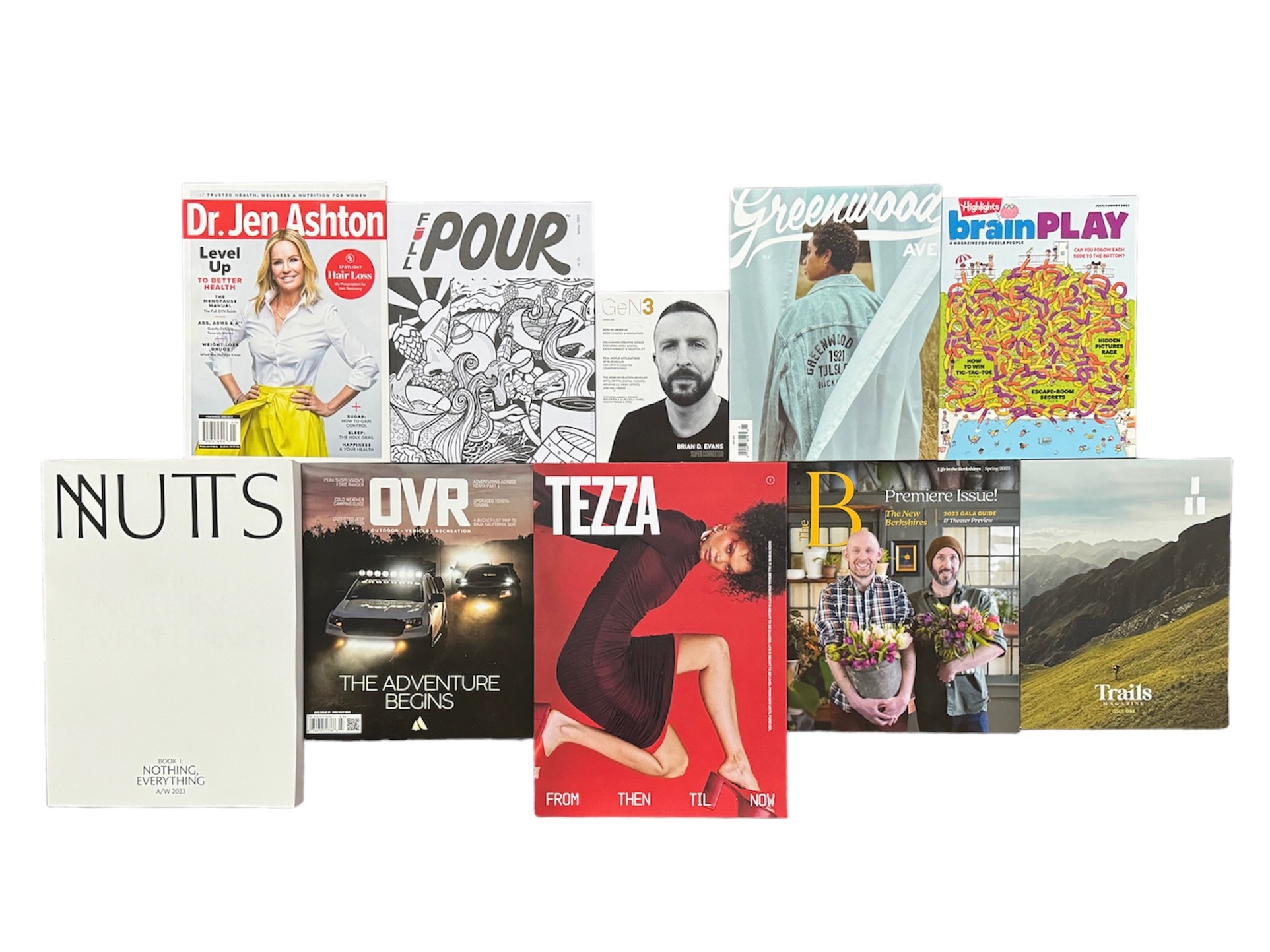
And now the lightly edited transcript of the Mr. Magazine™ interview with Tony Frost, president TV Insider, & Michael Fell, group editorial director and editor in chief, TV Guide. 

Samir Husni: I’m calling 2023 the year of bookazines. We have more than 1,000 bookazines published and less than 100 regular frequency magazines. It may be closer to 50, I haven’t had a chance to count mine yet. Yet, if my memory serves me right, you are the only publisher launching a monthly magazine in 2023. Almost all of the new magazines that came out in 2023 are either quarterlies, bimonthlies, or twice a year. But you have launched a monthly. What were you thinking?

Tony Frost: As I told you earlier in the year, Samir, Michael Fell, our group editorial director and editor in chief of TV Guide, carried out a very extensive survey of readers. And we got the response that there was a need for a significant amount of  streaming-focused content. So we decided that we would give it a go.

And so far, it’s been an exciting challenge. We’re undoubtedly producing a very good magazine, getting a lot of praise from the industry and support from subscribers. And a decent number of them have signed up for a two-year deal, not just one. The numbers aren’t huge, but they are very encouraging. Our first subscription issue  was in April and after eight months we hit our first 12 months subs’ target. That is impressive. And we’re going to build on that in 2024.

We recognize the challenges of print magazine economics in the current climate, so we did take a cautious approach with marketing spend. And we decided that we had to make every test dollar count. The same with newsstand; we’ve been very cautious with our retail presence. But we feel there is support for this title. We used 2023 as an experiment  to see what works on the cover. We’ve gone from the launch issue with Kiefer Sutherland in March and his then new action series, to costume drama with Bridgerton. We’ve done the final season of Billions and  Arnold Schwarzenegger’s first  TV role in Fubar. By the way, Arnold,  loved the magazine – he complimented us big time on it. Plus we’ve tested Sci-Fi on the cover with Marvel’s Loki.

They’ve all sold similar amounts at newsstands, but Bridgerton and Loki seem to be the most solid. So we’ve been learning as we go along – in 2024 we aim to put pedal to metal. For instance, I believe we have a new Bridgerton in the spring, is that right, Michael?

Michael Fell : Yep, May is the next season.

Tony Frost: So we’ll be all over that for our readers. And we have The Walking Dead as well!

Michael Fell: Yes, Rick and Michonne are coming back at the end of February. So we’re looking at that as a possible March issue. And if I could add something to Tony’s response to your original question, the why of it all has to do with the volume of programming.

You can go back a year ago and go online and find television guidance, and some of this is still true today. There are a lot of lists where people will recreate the publicity release list of stuff coming up in a particular month. It’ll just be a list of titles with no information. Or a little plot info. You often find 50 best shows on Netflix to watch now. And I’m looking at that list and I’m thinking I know those aren’t the best shows; I can see they’re just adding a few lines to the press release from the titles. I think there was a need that we saw. A curated, focused, structured need for reviews and guidance where we report on the shows. 

You want to give people real content. It wasn’t there online. We’ll pick each of the major streamers and other smaller streamers that our readers are interested in and give them an in depth amount of shows and reporting. But it’s still something that they can understand and appreciate and take hold of, as opposed to the massive lists and surface reporting that was online. I really think curation is the key.

Samir Husni: So do you think focused curation is the future of print in 2024?

Tony Frost:  Curation is a very  good word; we have experts – TV Guide’s complete editorial team  – who know TV from the inside out. The same team has brought that expertise to TV Insider. Over the whole year, the 12 issues will give you the most comprehensive guide on what to stream and why you  should watch the editors’ recommendations. The choices are carefully curated.   

Michael Fell: The services? It doesn’t stop. It keeps coming up. We cover 10 to 12 of the premier streamers. Our readers will often request info about smaller services like Acorn and Britbox. A big part of what the magazine does is provide the library material. Going back, there’s so much volume on television, is a monthly magazine that has a fair amount of library content; is that worth it to the reader? And we decided internally that it was. 

I told Tony this once; just before we were launching the magazine, I was in Tucson, Arizona visiting my brother and we were talking… do you know Mike Flanagan, Samir? He does a lot of shows on Netflix, like The Haunting of Hill House and Bly Manor. We were talking about some of his series and my brother mentioned how Mike Flanagan reuses some of his actors on different shows.

We were talking about Bly Manor and Midnight Mass and I asked him what about The Haunting of Hill House, which was Mike Flanagan’s first big Netflix series. He was like – what! I never even heard of it. And I was staring at my brother who subscribed to TV Guide magazine, was married and had two kids, one in college and one about to go to college, and I told him that his statement was proof to me that a monthly magazine with as much news stuff as we can, which also has a fair amount of library material, would be of major use to readers. He didn’t know anything about The Haunting of Hill House – and he liked Mike Flanagan’s other shows. I told him that I had a magazine for him that would be launching soon. 

Tony Frost: There’s 82 networks, 42 streamers, and 26 production studios currently. Plenty for us to write about. (Laughs) There’s also a bit of reverse engineering here, which I told you about earlier. First we had our well-established website, tvinsider.com, which has 10 million page views per month, so a lot of the work that Michael’s team does is repurposed on the website creating a natural synergy between the two. Also, tvinsider.com has proved to be a valuable source for new subscribers. So one supports the other and that has been a success.

Next year, apart from putting to use what we learned this year editorially and going deeper into that, we will continue drawing in subscriptions through traditional methods, reach new external audiences by direct mail and we’ve taken on a new digital marketing agency, named  salestube, based in Warsaw, Poland, to optimize paid search and social media efforts across all platforms for an even broader reach. That’s very important. 

As exciting as the material is that Michael’s team creates, we need more visibility; we have to get out there. And our website helps with the visibility. It’s very hard to make an impression at newsstand.  As you said Samir, there are so many SIPs out there. We have a small draw at newsstand which we use to really test covers and   editorial content,  as opposed to bringing in any real revenue. Ultimately, we see TV Insider as a subscription model, but that doesn’t mean in 2024 we won’t attempt some bold moves at newsstand.

Samir Husni: Let me ask you about your company, not only TV Insider. You’ve cornered the television magazine market. You have TV Guide, TV Weekly, and now you have TV Insider. In its heyday, TV Guide used to have 18 million in circulation, when there were no digital guides or anything. Is there any synergy in all of these guides you are producing?

Tony Frost: In this day and age, TV Guide magazine has a million subscribers And is jam-packed with content. That number is still very impressive. TV Weekly is doing well and in TV Guide we’ve just launched  “Extra” –  for subscribers to get digital access to a newsletter and grids updated every 24 hours. We are not standing still!

Michael Fell: In our 2024 preview issue we’re launching a newsletter service called “TV Guide Magazine Extra.” This service is just for subscribers and it’s a weekly newsletter serving two purposes. One is to give them access to online grids and listings, which are being updated every single day.

There is still a lot of appointment viewing, watching network and cable television, so we want to make sure that their literal day-to-day guidance is accurate. So this newsletter is going to provide online links to daily updated grids that are substantial with programming information and plot information that you won’t find anywhere else. Even on websites that already have online grids, the detail that will be provided is amazing. 

And also we’ll update them with new news items and articles within the newsletter for programming information, story information that we may not have been on top of in the previous magazine. So we want to make sure they’re completely updated with story and programming information.

Tony Frost: Last year when paper costs were sky high and most other chargesws were going through the roof, we had to make adjustments. The triple issue is a very robust magazine with a lot of content. 

Michael Fell: Going back to your question, you asked about synergy, I was thinking about how complementary the magazines are. I’ve always found this fascinating since Andy (DeAngelis) and Larry (MacKenzie) came on board; TV Weekly, as far as the grids and listings go are distributed regionally like TV Guide used to be. It’s almost ironic that the guys who came and took over TV Guide had their own guidance products which were being delivered regionally, which we know in publishing and printing, the paper and postage end is extremely difficult. But they are able to put Channel 2 for CBS because they’re locally delivered,

Tony Frost: TV Weekly is a bi-weekly listings magazine,  with regional editions just like TV Guide used to have. It is a valuable tool for many traditional TV users.

Michael Fell: Yes, so we take care of that customer who’s looking for really local information.

Samir Husni: Yes, such as mine is the Memphis area.

Tony Frost: Exactly. So TV Weekly is a double and TV Guide is now a triple. And we have TV Insider as a monthly for streamers. We’re covering all bases. 

Samir Husni: As we look forward toward 2024, will there be any major change coming up in the New Year? As compared to 2023?

Michael Fell: A lot of 2023 was just seeing what works. Now we know that something like this can be successful and I think we’re going to be a little more focused on our cover choices. If you look at all the covers, they’re certainly very broad, covering your hit Netflix dramas, Marvel Sci-Fi’s, maybe we’ll think about DC, I don’t know. (Laughs) I try, I really do try with DC and Zack Snyder, but it’s on and off. The biggest star in the world, Arnold Schwarzenegger, a great serial drama coming from Showtime; we’ve covered all kinds of shows. And I can’t tell you what it is right now, but I think what we’re going to be able to do in 2024 is be more focused on the covers. And really drill down on what’s going to work.

Samir Husni: How do you decide what you’d like for the material to be?

Tony Frost: In 2023, the emphasis was on what was the biggest show coming out from which streamer during the month that we went on sale. That’s where we started and continued during  2023. And now it might be that instead of doing the biggest show, we’ll still do a big show, but focus on a specific genre.

Samir Husni: Do you have any predictions about streaming? Will it continue to go up or is it hitting its status quo?

Michael Fell: The reporting really settled into a certain groove post-strike about the contraction of the streaming services, such as not spending as much money, not going crazy with sequels, and being really focused. But we’re all about the consumers. And to me that’s a great thing, because streaming is THIS big and so if it becomes just THAT big, it becomes easier to handle for the consumers and we can in turn be more focused and curated for them. 

There’s still going to be an amazing amount of overwhelming television and if the reporting from the industry says the sky is falling, we’re still thinking more about the consumers’ point of view. Such as number one: they’re not going to notice and two: it’s around the edges. And now streamers are focusing on, hey, maybe we shouldn’t do that fancy show that no one watched but we got to work with this great director. They’re like, let’s make some more shows that people are going to watch. And that’s all good for the consumer, the watcher, the viewer and that’s our audience. We’re not really industry-focused, we cover the industry, but always from the consumer point of view.

So, there will be some contraction, but I think it’s all good for the viewers. There will be plenty to watch. I’m just not crazy about the people feeling overwhelmed, especially if they’re reading our magazine.

Samir Husni: Let’s imagine that we’re in December 2024, what would you like to tell me you had accomplished throughout the year?

Tony Frost: We’re looking to extend our reach; we’re looking to make the magazine more visible; we’re looking for twice as many subscribers, and we’re seeing very encouraging early renewal indicators. Customers committing to longer term subscriptions and positive customer feedback. So they’re telling us that they want TV Insider, this is the magazine that they’ve been waiting for. We just have to market it on a larger scale and we have to promote it better. 

Samir Husni: My typical last question; what keeps you up at night?

Michael Fell: I’m sleeping pretty well. (Laughs)

Tony Frost: There’s not much that keeps me awake at night, let me tell you. (Laughs ,too)

I did want to say that one of our biggest successes over the past couple of years has been Yellowstone. We covered it from the beginning. TV Guide was the first  magazine to put  Yellowstone on its cover. Our  Yellowstone articles have been repurposed for our website tvinsider.com and we did three SIPs under the TV Guide logo. Obviously, the show has been featured in TV Insider magazine on a regular basis. In November we completed our fourth Yellowstone SIP in a partnership with a360, under the subhead The Complete Story – All Four Seasons. It has sold well in a short time with a cover price of  $13.99. We are happy with the results so far – and so are a360. I use this as an example of how important it is for a company like ours to be nimble and smart … always looking for the next opportunity.

Samir Husni: Thank you.

h1

Mr. Magazine™ Names TV Insider Magazine 2023 Launch of the Year + 10 Most Notables

January 2, 2024

More Than 1,200 Bookazines And At Least 71 Magazines Were Launched Last Year.

Dr. Jen Ashton,  Full Pour, GeN 3, Greenwood Ave., Highlights Brain Play, Nuts, OVR, The B,Tezza, And Trails Are The 10 Most Notable Launches…

2023 could easily go down in history as the year of the bookazine. More than 1,200 titles were launched last year covering every subject or personality under the sun (dead or alive, may I add). However, in the midst of this ocean of bookazines, there were also some brave souls who decided to buck the trend and publish magazines with frequency.

This image has an empty alt attribute; its file name is tv-insider-first-issue.jpg

Leading the pack was the publisher of TV Guide magazine , which in March brought the only monthly new title in 2023, TV Insider, a magazine for those who want to know what to stream next. That daring monthly launch and the need for a television streaming guide in the midst of all the streaming platforms available , made it easy for Mr.Magazine™ to name TV Insider the 2023 launch of the year. (Look for my interview with the president of TV Insider Tony Frost and its group editorial director Michael Fell on Friday).

And the 10 most notable launches of 2023, with quotes from their first editorial, in alphabetical order are:

Dr. Jen Ashton:  “ From menopause to mental health, from sleep to sugar control, from thinning hair to skin rejuvenation, from weight loss meds to workouts that work – I’ve covered health topics you’ve told me are important to you.  I hear you, and I am fluent in women’s health.” Dr. Ashton, Editor- In-Chief.

Full Pour: “Here at Full Pour, we love a good glass as much as anyone.  Whether it be wine or beer, a spirited sip, an infused creation, a zero-proof selection or even a great cup of coffee or tea, we’re into it all – true beverage lovers through and through.” Lauren Buzzeo, Editor and Publisher.

GeN 3: “ While well on its way to becoming an overused buzzword, Web3 is more than just passing hype.  The fundamental concepts behind this arguably overused term are enduring and impactful… While developers continue to create and build, GeN3 steps forward to showcase the latest developments and innovations as they happen.  We are here to tell the story of Web3.” Sarah Block, Editor

Greenwood Ave.: “We seek to uplift entrepreneurs standing on the shoulders of those who came before us and, in doing so, inspire the next generation of Black makers, doers, and dreamers not just in Tulsa, but around the world.  Greenwood Ave. is everywhere.” Trey Thaxton, Founder.

Highlights Brain Play:  “Are you mad about mazes, loco for logic puzzles, and bonkers for board games? If you’re like us, you will love them all.  As “puzzle people,” we are not afraid to take on a challenge. We know that every problem has a solution, and we are determined to figure it out.” The Editors

Nuts:  “ Fashion magazines have traditionally sold dreams. The mood of Nuts is anxiety and malaise—the abortive night out, the workout gone wrong, the branch of Footlocker about to get looted.  Yet there’s something else deep within it, too: for one, the hope that the 21st -century angst expressed by the anonymous voices haunting these monochrome pages might one day be dispelled.” Alex Needham.  (Nuts editor and creative director is Richard Turley).

OVR: “ OVR is about getting out there in our vehicles to responsibly explore and discover the world around us.  Whether we’re forging ahead into the backwoods or taking a well known route on a favorite road trip, it’s all about getting out and enjoying the ride as well as the destination.” Jerry Tsai, Editorial Director.

TEZZA:  “The app started with the two of us, following a passion and building something together just because we love it. The fact that it has grown so much and is used by millions of creators around the world is just as humbling as it is invigorating… And with that we give TEZZA MAGAZINE Issue 01.  This will be the first of many and we can’t wait to feature more artists and creators in the years to come.” xx Tezza & Cole, The Founders.

The B: “ Perhaps you are visiting for the first time, or maybe you attended summer camp or college nearby and now have property in the surrounding area.  Or you’re lucky enough to be a local.  Whatever the case, I expect you relish our creative culture, outdoor pursuits, and good living. The Berkshires speaks to you.” Michelle Thorpe Petricca, Publisher

Trails: “ This magazine is a return to the established route – quality journalism, printed in a real magazine, with a focus on the adventures that encourage us all to get outside – and our chance to improve on it.”  Ryan Wichelns, Editor-In-Chief.

And there you have the cream of the crop from 2023. Looking forward to a healthy and prosperous new magazine year in 2024. Remember, if it is not ink on paper, it is not a magazine.

All the best

Samir “Mr. Magazine™” Husni