Archive for the ‘A Launch Story…’ Category

h1

In-Depth Conversation With Roger Black: From AMERIKA To Big Bend Sentinel… The Mr. Magazine™ Interview With A Genius Art Director

December 18, 2025

 “This is a hard time to start a magazine. The country shaking like an old drunk. Who knows he has to give up the hoosh. Does not provide a climate of reason and ease that magazines thrive on. There is a recession.Magazines are collapsing left and right,” wrote Roger Black in his role as Editor of a magazine called AMERIKA in 1970.
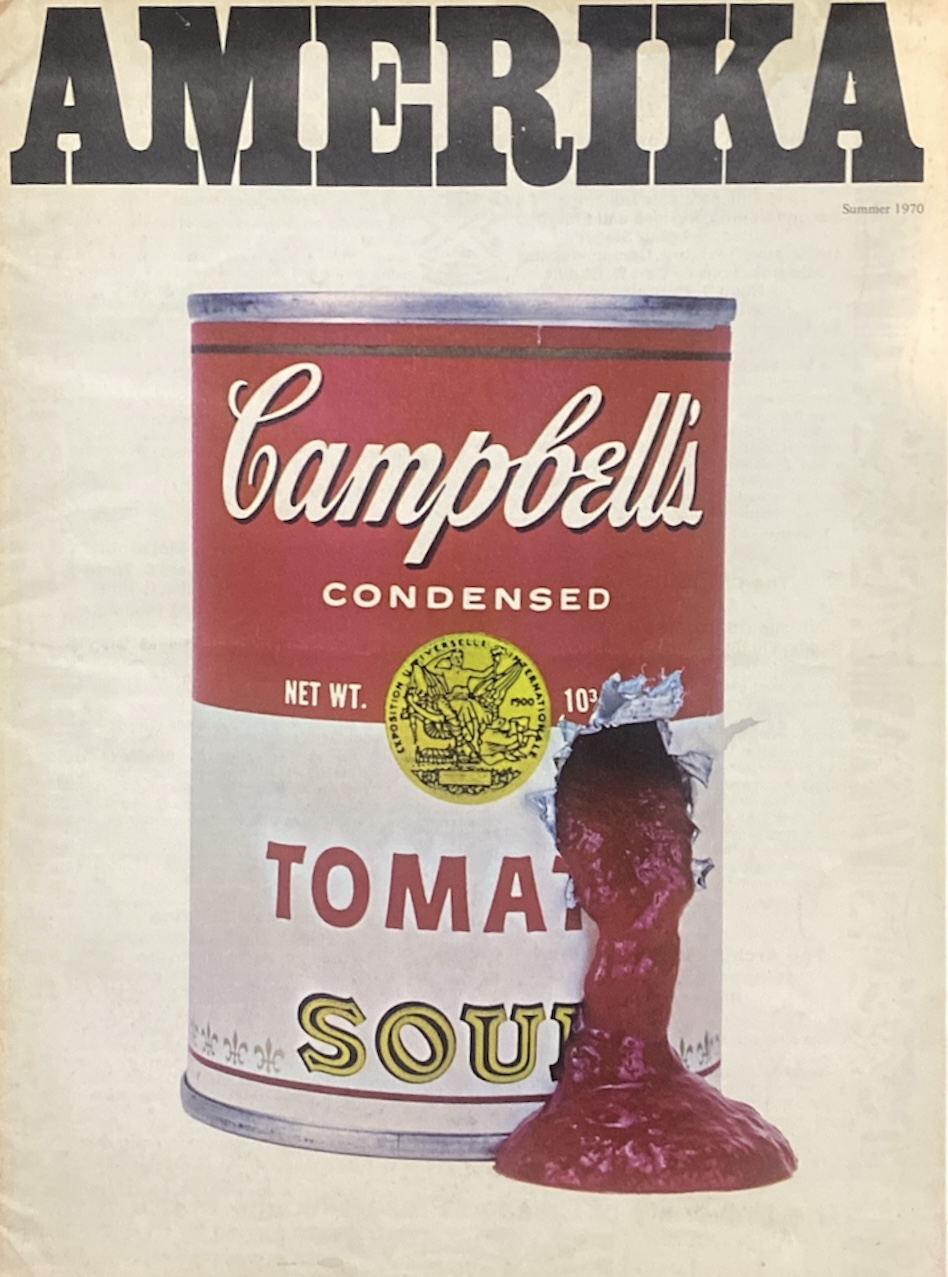
Mr. Black was a student at the University of Chicago and editor of the students’ newspaper, The Maroon.  AMERIKA was forced to change its name after the dummy issue was published and the first and only issue published was called PRINT PROJECT AMERIKA.

I reached out to Mr. Black to talk about the story of AMERIKA and to get an update on what he is up to these days.  He told me that he’s “back actually doing a publication. And this is an urgent time for magazines and newspapers. We must find a way of keeping them going, keeping them independent.”

In fact, Roger Black wrote this week on his Facebook page under the heading “ROGER BLACK’S FAREWELL TOUR?” Join me at Big Bend Sentinel, where a team of innovative journalists is redefining local news.  We’re testing two old ideas. In the video (that accompanied the post) watch for the key words: “fact” and “art.”

Mr. Black continued, “I started this tour in 1973 as art director of LA (1973). Now, as acting Art Director and non-profit chair, I’m back to weekly newspapers! The real work is done by a small energetic band of editors led by Rob D’Amico, Sam Karas, Mary Etherington, and Ariele Gentiles.”

He adds, “Can weekly newspapers survive and flourish? Can we hold onto local journalism?” 
I reached out to Mr. Black to ask him about his original work on newspapers and magazines. I was mainly interested in the very first magazine, “AMERIKA” he edited while still a student at the university.  Needless to say, he is a wealth of information and he has left his thumb print on many national and regional publication throughout his career.  I hope you will enjoy this lightly edited conversation with a person who for years I called “a genius creative art director.”

Samir Husni:  You ask Chat GPT about Roger Black and it tells you, “Very influential in magazine and newspaper design,”  but no mention that you were an editor of a magazine back in 1970 while you were still a student at the University of Chicago.

Roger Black: Yes.

Samir Husni: And the magazine was called America with a K: AMERIKA

Roger Black: Well, that was the dummy. Later, it was PRINT PROJECT AMERIKA. There were only the dummy issue and the one and only first issue.

Samir Husni: So, tell me about your journey with AMERIKA.

Roger Black: AMERIKA was envisioned as Parade magazine (The Sunday newspaper supplement) for student newspapers.

In 1968, I was the editor of the Maroon, the student paper of the college at the University of Chicago. I must tell you, that was a very good year to be a student editor. And particularly in Chicago.

We had a lot of news. It was a big time for change. We started putting out a weekly magazine called Gray City Journal, which ultimately became its own publication.

So we started thinking that many student papers don’t have that kind of content. Harvard, Yale, and other elite schools do.

But in terms of magazine style, both entertainment and serious stuff, photojournalism and drawings, they didn’t really exist. If you go back and look at the 1960s’ student newspapers they were pretty dry.

A guy in the business school at the university, named Mark Brawerman, who is from California, came up with the idea.

A very sharp guy who just started school. He didn’t really have any business experience.

He thought that we could do this. One of the things that he did, and with my involvement, I thought it was a good idea, too, he started writing all the student newspaper editors and publishers saying, we have this idea.

Would you be interested in taking it? And we’re going to print a prototype, and you can decide. That was the reason for the prototype; we had to get the circulation.

I was interested in design. I had started doing some publication work before I got to college. I had a wonderful teacher named Robert Gothard, a famous typographer, who did student, alumni magazines, and other publications for universities and colleges and did other things, too. He was a great designer.

So, I got interested. He was the first art director of Print magazine, for example. I was really interested in magazines from really as a young kid. My mother worked for magazines.

We had written all these people, and we got enough responses that if we could print 200,000, we could have distributed them.

So I started working on the prototype. And it’s funny because my girlfriend at the time is listed as the art director. I don’t even remember her name now.

There you go. The prototype cover came from Kent State. It was from an art student there who did this kind of Andy Warhol homage after the Kent State shooting. And there’s more stuff of that inside. Anyway, I thought I could be a designer.

I looked at a lot of magazines. How hard can it be? So, I did this issue, this prototype. And by some wild set of coincidences, Sam Antupit, who is a great art director, the art director of Esquire at that time.

George Lewis did the covers, but he did the inside. And it was beautiful. He was doing a special issue of Print Magazine about magazines.

And he put this in a box called Hopeful Upstarts. We realized we were going to leave Chicago and move operation to New York. So, I got to New York and I looked him up.

And we had gotten some funding. We were starting to sell ads. But I couldn’t find an art director.

That was the funny thing. There weren’t a lot of people, if you think about it, Rolling Stone and New York Magazine only started in 1967. And before that, there were art directors at Esquire or at Town and Country or the fashion magazines, and Holiday magazine.

There were certain kind of visual magazines that had art directors. But National Geographic didn’t have an art director. Life Magazine didn’t have an art director.

It was not really one of those job descriptions that people, their mom said, you can be an art director. No one, no one really was thinking about that. And I couldn’t find any.

But Sam had this fantastic studio on, I’m going to say, East 52nd Street in a brownstone building. Later, the previous Citicorp Village was built there. But he was doing a bunch of different magazines out of the studio or doing designs, and redesigns.

He had a famous magazine artist, Richard Hess, who was his partner in that. So, it was called Hess and Antupit.

It was the name of the studio. And they were on the top floor. I was totally blown away how great it all was.

He did have student aides from SVA or Pratt or Cooper Union students working part time or as interns for him. What he couldn’t really recommend any other kids to be art directors. I finally came back and asked him if he would do it.

And by some miracle he said yes. And agreed to our price, which included all the type setting, all the illustrations and photos, the whole art project. He said he would do it for a fixed price.

I probably lost my shirt on it. He took over in that first real estate number one. It was really the designer’s Hess and Antupit.

I got to be the editor. So that was fun.
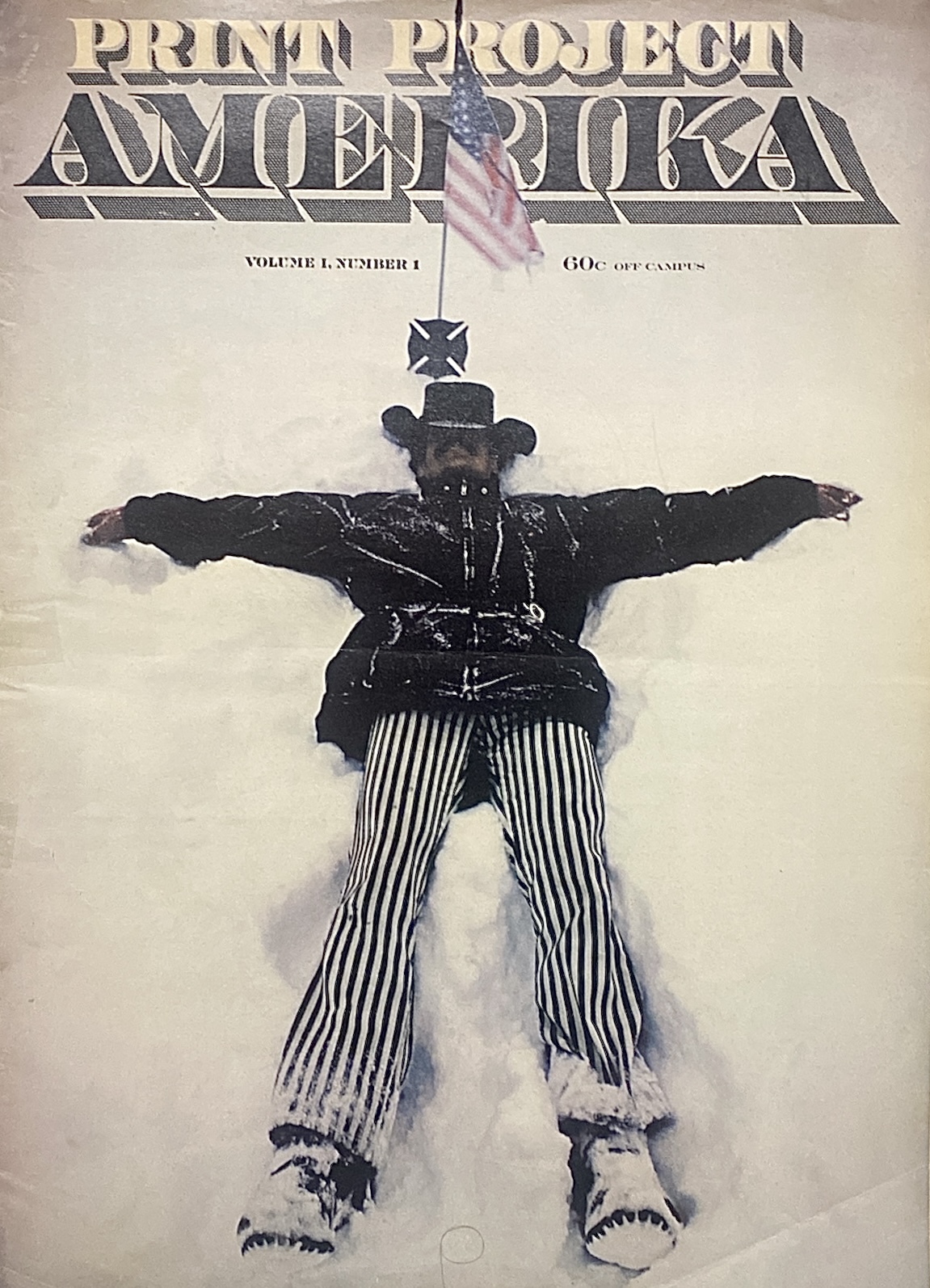
Samir Husni:  The dummy issue was called AMERIKA, and the first issue PRINT PROJECT AMERIKA, why did you change the name?

Roger Black: I’ll tell you the story why we changed the name.

We got a letter from the Catholic Church. They sent us an official letter saying that they have a magazine called America and we have the trademark, so you can’t use America even with changing the C to a K.

Of course, I knew even at age 20 that you can’t trademark a place name. You can’t put a trademark on America. So I wrote back saying, you can’t trademark a place name.

So, I’m ignoring their letter. They wrote back and said, well, how many lawyers do you have? Basically, I said, these people are going to give us a hard time. I’m going to just add a qualifier.

We added the phrase PRINT PROJECT AMERIKA.  We made it more experimental, new media feeling.

Samir Husni: The State Department didn’t send you a letter saying we have a magazine aimed to the Soviet Union called America.

Roger Black: Well, their magazine was only circulating in Russia. And we weren’t going to Russia. They are not allowed to distribute it here.

Samir Husni: In this digital age, where do you see print role?

Roger Black: Print magazines had a very good run. I like to say it was a hundred-year run. If you look at the magazines, like the late 19th century, magazines that started running art, photo engraving had come in.

They were impressive. And then you had with the invention, of rotary presses and linotype typesetting and all that. Magazines followed the newspapers in increasing press runs.

So you had the concept of mass magazines. That whole business model kept morphing. Everyone forgets about this, you know, like in 1995, the commercial web appeared and everybody said, oh, everything’s over.

But I don’t think the commercial web was much more of a kick in the head than the television. And before that, there was a similar abrupt change with radio. The idea that entertainment could just sit in your chair and not have to think and just listen.

Magazines like The Saturday Evening Post were really hurt by that. Because that was their position, at home after they were reading entertaining stuff. But they survived and they adapted.

I think that the biggest challenge for a contemporary magazine, and that also includes online, is the attention span problem and the way that the kind of addiction to the constant scroll, just going vertically with dozens of different things that you’re barely aware of what it is. You stop on a cat or whatever you want to look at.

That has changed dramatically in the last 10 years. We didn’t even know about TikTok 10 years ago. And Facebook seems for people my age now.

All that keeps morphing. Instagram had its moment in the sun. And everything, everything is always moving. My feeling is that print offers a new kind of respite for that.

In the way that radio seemed like a respite for reading. Print, going back to reading, is a relief from that addictive scrolling that everyone’s doing. Or just that very short attention span, you look at one thing, you look at another thing, you look at another thing.

That kind of short attention span gets tiresome after a while.  And why can’t I say that with any confidence? It’s because the long form media, like books or movies, are blasting ahead fun. I mean, movie says, the movie, the Hollywood studio business is once again in convulsions. With every year, there’s a headline that says, Hollywood is no longer the same. It will never be the same.

We don’t recognize it anymore. And they’ve been saying that since about 1920 since talkies came in. So that long form sitting in a movie theater or watching it on Netflix is a very compelling experience.

And people enjoy it. It’s still, there is a business model in the same way that music kind of changes business model from the time of the record business. Movies are too, but also books.

It’s very interesting to me to see things like the eBooks for the digital side, but also bookstores are coming back. There are new bookstores everywhere. And there are very niche bookstores.

Bookstores about cooking or bookstores about architecture. All over the place. It’s fairly like Marfa, Texas, where I am right now, it’s just a few thousand people, right? It has an extremely good bookstore that also has a quite a good art collection.

Now, Marfa may be a special town, they just finished a new library or a big addition to this little library in Marathon, Texas. Population 400. And every time I’ve been by it, it’s full.

A lot of kids. Why is that? Because there’s something very pleasant about holding a book and reading it. And getting it, one of the advantages that books have and movies have over the endless internet is that you finish the book.

I’ve read the magazine. I’m done. I finished The New Yorker.

Almost nobody can say that online. There is a real feeling of accomplishment. And of course, The New Yorker’s secret that Howard Gossage, the advertising man, pointed out when he was doing their advertising.

The cartoons in The New Yorker are the guilt reliever. Because you can go, page all the way through, get a few chuckles. You might read a talk piece or one or two other things.

And then you sit the magazine down and somebody says, and you mentioned something that you saw in The New Yorker.  I read it in The New Yorker. I read The New Yorker every week.

That’s a definite feeling of accomplishment. From a psychological point of view, there is satisfaction that comes from the phenomenon of the edition. This is a magazine.

This is the September issue of our magazine. Or this week’s magazine. Whatever.

And the same thing. You get to feel like you finished it. You go through it.

The online newspapers, you never finish. The digital crowd is very surprised that people like the PDF replicas of newspapers. Like The Dallas Morning News now presents that first.

If you go to their website, you get the replica first. Then you get the actual website. Because people know how that navigates.

They know where their stuff is. Everything’s in a familiar place. And things like PressReader made it increasingly easy to read on different devices.

The feeling about sessions, session time, completing an edition, very important. I think that magazines, in the same way that I think anthology, television like 60 Minutes will go on despite everything else. Now we still must work on the business model.

The numbers are much smaller than they used to be. We’re not doing mass magazine. But I think that quite a few people, we see people getting in and surviving.

And it’s delightful.
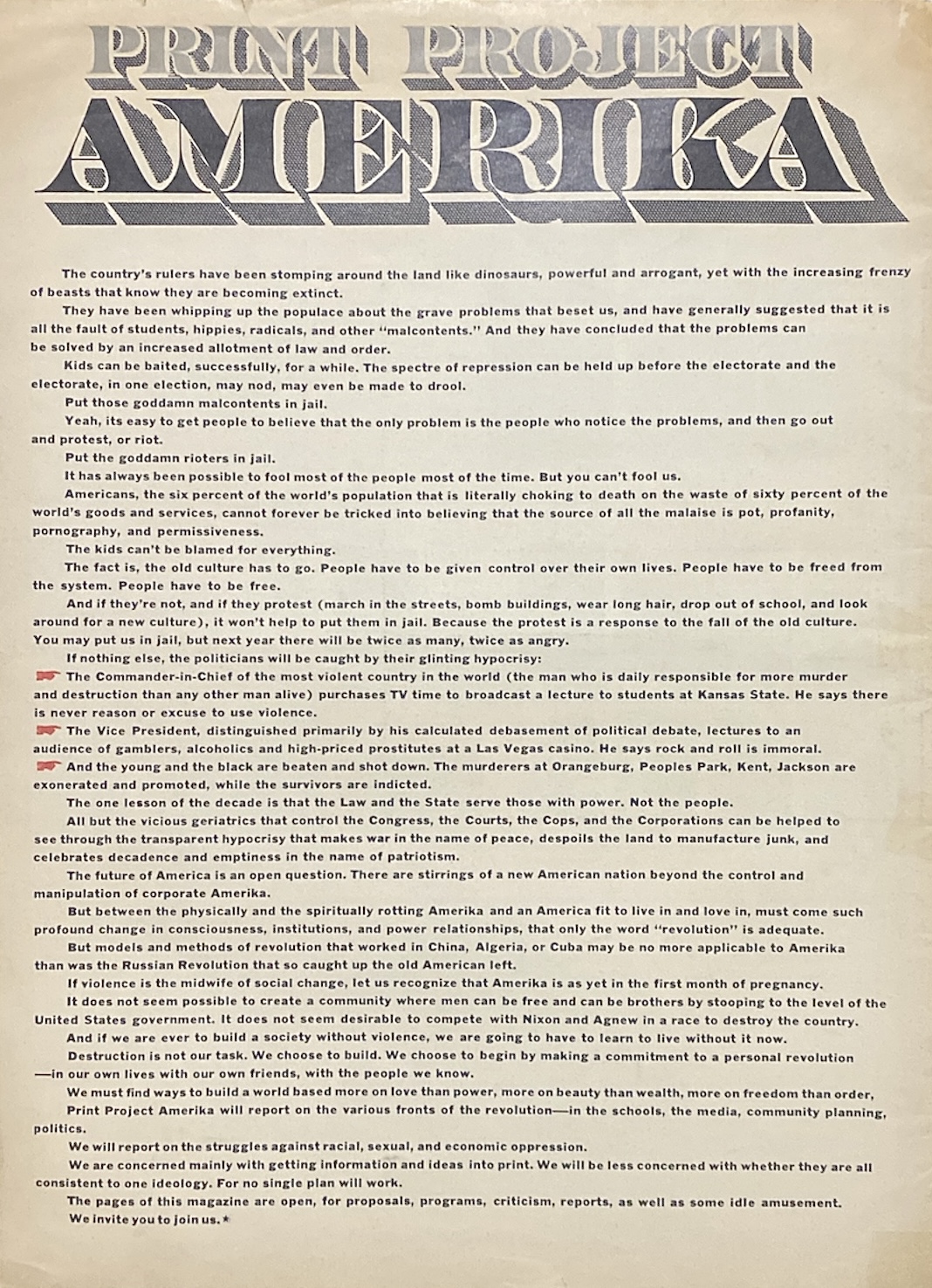
Samir Husni: Mr. Black, if someone comes to you and says, I want to start a new magazine, what do you tell them?

Roger Black: I really ask them, who’s your reader? I think it all starts with the reader.

Who is it you’re trying to talk to? Have you talked to them? You communicate with them. And I think that’s the way that we all got in the media have gotten in trouble over the years, is that we think that we’re the media. And it’s a two-way thing.

Reading is interactive. And I continue to find, maybe it’s because of my extreme age, I find reading the most effective kind of communication. It’s faster, it’s cheaper, and it’s inexpensive, as opposed to a video that you do on TikTok or YouTube.

That’s an effort. It’s a production. Maybe we don’t have a TV station like we used to.

And we’re relying a lot on Apple and the others to fix our video for us. But I think that having a group of people just writing, taking pictures and putting them together into a magazine, is very low cost compared to what the big guys are trying to do. And I think you can, if you make it good.

If you connect with the reader, it can work. And it doesn’t have to be high art. It doesn’t have to be the kind of level of journalism you’d expect in The New York Times or something else.

But if it can be good and readable, and is hitting a chord that people like, I think you can make it. One example you mentioned, Arena, the Santa Fe magazine, which is two old, French, encrusted print guys. One, John Miller, worked with me.

Owen Lipstein, somewhat controversial publisher from New York, who was the publisher of Smart Magazine, which I did in the late 90s with Terry McDonnell, only 13 issues ever published. Anyway, they got the idea of doing a big fat real estate magazine in Santa Fe, which of course, people in Marfa would say that Santa Fe is a real concoction of the real estate salespeople, which it may or may not be. But what they did to get the content, because they didn’t have a huge budget, and none of this stuff, no one is paying what Vanity Fair is paying.

I don’t think even Vanity Fair’s paying what they used to pay. But what John Miller, the editor there, and designer, did was to just do a lot of interviews. He had video, and some of the interviews were trimmed to just be the answers.

It was like a first-person article. Sometimes they would have a lot of pictures of their home, or they would go there. Sometimes it was just pick up what they could provide, the decorator, the designers, pictures of the house or whatever, or their potters, and they had stuff on their website.

Just thinking about it carefully and making it interesting with interesting people.

Basically, it’s all about the people in magazines. So you start with the reader, but then you give them stories about people to read.

That’s basically the core of every good magazine.

Samir Husni: Before I ask you my typical two last questions, is there any question I failed to ask you you’d like me to ask?

Roger Black: I sort of expected you to say, why are you still doing this? Which is funny, I don’t know what else I would do. It’s like somebody says, why do you have this place in Texas out in the desert? And my answer is, I can’t think of anything, any other place I’d rather be.

I can’t think of anything else I would rather do than try to work with typography. We have Type Network, I’m chairman of Type Network, and we’re doing a wonderful collaboration with 100, more than 100 type designers and type founders with special custom design projects. Some of it is consulting, and some of it is type design.

I’m not a type designer, but I can connect them to the market. It’s a very small operation, but quite fun. I want to keep working.

My father worked till he was 80. And then, even later, he said, I never should have quit. So, the next question is, what are you doing now? As well as Type Network, I’ve come out to Marfa, and I’ve taken over by starting a new non-profit with Don Gardner from Austin, and Gonzalo Garcia Bautista from Mexico City.

We have started a non-profit, and we are now publishing this paper, which you can go to at BigBenSentinel.com. You can join and get the PDF, or we’ll mail it to you. For 60 bucks, we’ll mail it to you.

Folks, that price is going up, so act now.

Samir Husni: If I come unannounced to your house…

Roger Black: In Marfa, now? Well, it’s a marathon.  I also hang out in Florida. We’re still repairing from the hurricane last year.

And I have an apartment with my husband in Oslo, Norway. So, I kind of am nicely balanced.

Samir Husni: So, if I come unannounced one evening, what do I catch Roger Black doing to rewind from a busy day?

Roger Black: Reading. I’m still old-fashioned.

Samir Husni: And what keeps you up at night?

Roger Black: I don’t stay up at night. I am a great sleeper.

I don’t know why. I go to bed early. I go to bed by 11 or so.

In the old days, I’d stay up late. My peace of mind results from, as you get older, you realize you must let things go and become balanced, or you’re always anxious. The other thing that helps me, has helped me in my whole life, is I have a colossally developed ego.

It doesn’t occur to me until years later that I could be wrong. It’s like later people point out, that was a complete disaster. And I say you’re right.

I was completely unaware of that at the time. And I still, you know, it’s like I tried to do that thing, Screensaver, I thought we could do a technology solution for reading digitally. And it turned out that it didn’t work beautifully.

It turned out that the publishers didn’t have a business model for that. So, I do find myself waking up sometimes and thinking about those things. But I go right back to sleep.

I’m not what you’d call a troubled old man.

Samir Husni: Thank you. Take care. Have a great day.

h1

The Fabulist:  A New Speculative Literature Magazine With A Print First Business Model. The Mr. Magazine™ Interview With Josh Wilson, Editor & Publisher

December 1, 2025

Born from the womb of the web, The Fabulist launches its first print issue in 2026 after being a web only platform since 2007.  To quote Josh Wilson, the magazine’s editor and publisher, in his letter to the readers accompanying issue zero of the magazine, “In a world that’s glutted with disposable digital ephemera, we love working with print: It is a tactile, tangible, dynamic, and long-lasting medium that transforms your experience as a reader, and celebrates the meaning and value of the works we publish.

Issue zero of The Fabulist, art by Glenn Buack

And Mr. Magazine™ can’t but 100% agree with Mr. Wilson.  There is no better place to combine “amazing stories, rich illustrations, and wild art,” than print.  The Fabulist publishers believe so much in print that they make their business model print first.

Intrigued by the concept and the business plan, I reached out to Mr. Wilson to ask him more about the inception of The Fabulist, the plans and the reason for the print magazine after being a web only platform.  We had a lovely conversation and learned the secrets behind the transformation from digital to print.

So, without any further ado, please join me in this lovely conversation with Josh Wilson, editor and publisher of The Fabulist.

But first, the soundbites:

Josh Wilson, editor and publisher, The Fabulist

On the reason for print: “I realized that print really was something people were attracted to and aspired to be a part of.”

On the background history of The Fabulist: “For several years we printed chapbooks, short 20, 30, 40, 50 pages, saddle stitched, single story publications. Then we began to think through our model and what we could do with it, which brought us around to this print magazine. I’m surprised to see that it’s really gaining traction.”

On his background: “I started out in print in the 1993 – 1995 period. I’m a journalist who worked at SF Gate in San Francisco and never went back to print until now. And it’s been a pleasure. I’m also amazed to find that readers and writers and everybody else is thrilled to see print happening.”

On The Fabulist elevator pitch: “We’re a literary, a speculative literature magazine. We publish fantasy and science fiction.”

On the business model: “I find that digital monetization is very, very hard, and it’s amazing to me that print from the previous millennium, the previous century, turns out to be a viable business model.”

On the zero issue: “It is a viable standalone issue. But we wanted to just see what we could do with print.”

On the art of curation in print: “There are space considerations in print, which makes the curation process more interesting. What order do the stories go in? What’s the effect of reading them in order? Each piece of art and its positioning, the layout.”

More on the art of curation in print: “I find it a much more interesting and creative medium to curate for that the constraints produce innovation and fun. Whereas on the Internet, every page is the same. It’s a template.”

On the future: “We want to continue to develop work in print and on the web. But we want to lead with print as a beautiful standalone document.”

On what keeps him up at night: “Worrying about the magazine and its success. There’s always something to worry about.”

The first issue of The Fabulist, art by Sergiu Grapa.

To learn more about The Fabulist or to order a subscription please click here.

And now for the lightly edited conversation with Josh Wilson, editor and publisher, The Fabulist:

Samir Husni: First, congratulations on the new magazine.

Josh Willson: Thank you.

Samir Husni: Anybody that launches a print magazine today deserves to be congratulated.

Josh Wilson: Thank you.

Samir Husni: Tell me, what’s the story of The Fabulist?

Josh Wilson: The story of The Fabulist

Well, way back in 2007, I kept getting my stories declined by magazines, and I decided to start a little blog, just a website where I could put my stories and those of my friends. About six months later, we began getting submissions, which was very strange because I never posted a submissions link.

People would just email us their stories. It turned out that we had been listed in a writer’s market called Duotrope. I don’t know who put us there, but we ended up in this writer’s market, and the submissions have been coming constantly since then, far more than we can deal with, and usually better than my own stories.

I took down all my stories and, for a long time, posted new work whenever we could get around to it. I would say about the mid-teens, 2015, 2016, 2017, we were at a reading event in San Francisco, where we live. I was approached by Elizabeth Gonzales James, who went on to become a novelist. She has two novels out, The Bullet Swallower and Mona at Sea. The Bullet Swallower is being developed for a feature film. She approached me before her first book contract and said, Do I need any help?

I remember being overwhelmed by submissions. I said, I could really use a hand managing all the submissions. She read a gigantic backlog of hundreds of submissions and said, You could do a story a week. Why don’t you?

I said, OK. We went with that. At that point, I realized we really should have a contract.

I contacted other publishers I know and asked them for advice. We made a writer contract. There are a few other steps to this.

One is that I realized there is a big difference between genre and literary journals. We were kind of in both places. The literary journals, you often pay a reading fee and don’t get paid for your work, to the extent that I would send a submission’s call to creative writing and MFA programs and get the department chairs sending me their work for this blog.

But the genre magazines, Fantasy & Science Fiction magazine, Asimov’s magazine, these all came out of the pulp era. There was a very strong writer’s advocacy movement. A lot of that business was pretty fast and loose. In the genre world, you don’t pay reading fees. You always pay the writers.

We decided we should at least do an honorarium. We grew that from $25 to $100 per story. Still operating at a loss. All digitally.

Finally, the final chapter for this evolution, in 2023, in the depths of the COVID pandemic, we were, I guess at the end of the worst of it. A colleague of mine here in San Francisco, Jennifer Joseph from Manic D Press, a great local imprint that has their work collected in the Library of Congress, their LGBTQ work, said that she’s going to AWP, the Association of Writers and Writing Programs conference. This was in Seattle.

Did I want to share a table, an exhibitor table at the book fair? I thought, yes, why not? I did that rashly because I didn’t have anything to sell because it was all digital, but I realized the contract that we had been using enabled us to make books. So I got an $80 color printer and began making chapbooks. And my colleague, our art director, Adam Myers, is a gentleman of very high production values.

We produced some beautiful books and they sold. They almost sold out. And I realized that print really was something people were attracted to and aspired to be a part of.

For several years we printed chapbooks, short 20, 30, 40, 50 pages, saddle stitched, single story publications. Then we began to think through our model and what we could do with it, which brought us around to this print magazine. I’m surprised to see that it’s really gaining traction.

This is after months of agonizing and product development. We got a small grant from CLMP, Community of Literary Magazines and Presses, to hire a digital marketing specialist. Lots of thoughts about how to convert from a weekly digital blog to an issue-based periodical.

I started out in print in the 1993 – 1995 period. I’m a journalist who worked at SF Gate in San Francisco and never went back to print until now. And it’s been a pleasure. I’m also amazed to find that readers and writers and everybody else is thrilled to see print happening.

So that’s where we are. I guess that’s a little bit of a long intro.

Samir Husni: In 2025, it looks like a lot of independent publishers, like yourself, are rediscovering print and bringing print magazines to the market.You were born from the digital womb, bringing The Fabulist to print. Tell me, if you are going to give an elevator pitch about what The Fabulist is, what would you tell people?

Josh Wilson: My elevator pitch for The Fabulist is that we’re a literary, a speculative literature magazine. We publish fantasy and science fiction.

But with a literary bent, a magic realist bent, there’s a lot of interest in what’s been called new weird and new fabulism. And we feel that there’s a lot of terrain that is undeveloped for speculative fiction and speculative literature, poetry and art that doesn’t quite fit in genre. Genre has a lot of straight expectations.

We feel that there’s a lot more room to develop this stuff, that we don’t want to be constrained by the expectations of the market, that certainly there’s no limit to the work being produced — the fantastical work that’s not realist fiction, that’s not straight genre, that sometimes sits in between. And it needs a place, a beautiful home. We tried to develop that beautiful home on the Internet, and it worked.

We have a brand. We’re an established presence. But we didn’t have a business model.

I find that digital monetization is very, very hard, and it’s amazing to me that print from the previous millennium, the previous century, turns out to be a viable business model. I guess that’s longer than an elevator pitch.

Samir Husni: It’s a very tall building.

Josh Wilson: Yes. We’re on the way up.

Samir Husni: Your business model is based on giving subscribers, a free complimentary zero issue or a dummy copy. So what’s the idea behind this business model, giving the one issue free for people who subscribe and then billing them technically per issue?

Josh Wilson: Yes. Two reasons.

First, the per issue billing was something I observed and we observed in Patreon. It’s a creator’s platform. It’s like Kickstarter, but you make your contributions serially over time. And musicians and artists and so on use it and every month you pay $2 or $10 or whatever and you get a new song or a new story or a new piece of art. So, that seemed like a really viable model.

It’s been of interest in the journalism world as well, this monthly income. Rather than having it all happen at once in a cluster annually, it gives the reader a lot of flexibility to exit without having to make a full commitment. So, we decided, we tried a Patreon account and it did work, but we get double hit with fees.

Patreon takes 3% or 5% and the credit card company takes a percent, and we really wanted to reduce that friction. So, we are selling subscriptions without Patreon. We are going with a bimonthly for now and we hope to increase to monthly. So that’s why we’re billing per issue.

And the free issue was our marketing consultant, a gentleman named Neal Gorenflo. He is a marketing guy. He started a publication himself called Shareable, Shareable.net and it covered the sharing economy when that was first coming up.

He’s a very astute and accomplished marketing person who said, you got to have a free offer. You got to have a no risk trial. And we already knew we were going to forge ahead with the print periodical and had made this issue zero.

You called it a dummy. It is a viable standalone issue. But we wanted to just see what we could do with print.

I had a whole bunch of those, you know, in a box on our shelf in our spacious corporate offices here. I thought, okay, let’s do it. Let’s use these.

I had to do another print run. We ran out. It’s been so popular.

I’m going down to San Jose to a printer a little later today to pick up another 150 copies.

Samir Husni: One of the things about print is you must do more curation than digital. As an experienced journalist, how is your curation takes place or the difference between accepting something for digital or accepting something for print?

Josh Wilson: We remain really concerned about quality control the whole way through. So, we did not and we never wanted to treat the Internet as a disposable medium where we could just throw stuff.

We always had a long review process. How will this look in our pages? How much work does the story need? It starts with whether we love it and we want to see it flourish. And if we love it, we’ll commit to it.

I would not say that we’re treating the Internet as more of an easy medium to throw stuff into.

There are space considerations in print, which makes the curation process more interesting. What order do the stories go in? What’s the effect of reading them in order? Each piece of art and its positioning, the layout.

I find it a much more interesting and creative medium to curate for, because the constraints produce innovation and fun. Whereas on the Internet, every page is the same. It’s a template.

We try to make it beautiful and we’re going to do a design refresh and get that website up to speed. But, although it is a boundless medium, it is ironically much more constrained, I think, than print. Because you can’t do an interesting layout.

For all its dynamism, it’s much harder to make it an art piece. And with this print magazine, we want to make an art piece. This is collectible.

Samir Husni: When’s your first issue coming out?

Josh Wilson: January. We had to push it back because of the two holidays, there’s no way we can get the proof back. And then everybody’s going out of state at the end of December.

So mid-January, we aim to have that out and then bi-monthly afterwards. I was just looking at the new cover and it’s great. It’s quite different, too.

Samir Husni: Is there any question I’m supposed to ask you, that I did not ask you?

Josh Wilson: I suppose you could ask me about the state of genre and literary publishing in print and online. I find that fascinating and something I’ve gone deep into over the summer, although I might talk a little bit.

Samir Husni: So tell me about the competition. Who’s out there?

Josh Wilson: The interesting thing is a realization that the folks here aren’t competing. The audience for written-text genre fiction, fantasy and science fiction mostly, and the stuff that spills out over into the literary edges of that, is substantial and undiscovered and undeveloped.

There are a lot of conventions and conferences that happen nationally and globally, science fiction and fantasy conventions and comic book and movie conventions and the ones that are game conventions. And there’s some overlap, some Venn diagram overlap, but the literary conferences are tiny. The World Science Fiction Convention, where they give out the Hugo Awards, it’s one of the highest awards in genre fiction, only gets about 8 to 10,000 attendees, whereas Comic Con in San Diego or Dragon Con in Atlanta, Georgia gets tens of thousands or hundreds of thousands of attendees.

These people do read books, maybe not a full percentage of them. But a lot of people are genre fans without ever knowing that they’re genre readers. They watch movies, they watch TV, they love Star Trek, they love Star Wars. They’ll follow the movies and the characters.

The same is true in the literary world. When I was at AWP, the Association of Writers and Writing Conferences conference in LA, we covered all our expenses, including travel and conference registration and housing.  We covered all our costs.

A lot of it was these young MFAs walking up to our table and realizing that they could do genre, that they weren’t stuck in a realist, forgive the term, a realist ghetto. There was a lot of room for them to follow their interest and desires.

We broadly feel that the audience is vast and undeveloped. And there isn’t a national, there aren’t national scale, mass media scale consumer magazines. They’re more literary journals.

So, we’re all working together. And there’s a lot of great ones. Asimov’s Science Fiction magazine, Fantasy & Science Fiction magazine, Analog are all the warhorses from the pulp era.

There’s a host of amazing online magazines that sometimes have print as well. Clarkesworld, Lightspeed, Nightmare magazine, Strange Horizons, and Uncanny magazine are really sort of among the top tier of these online magazines that do issues in e-books. And sometimes audio books as well.

But also release all the stories for free on the web. So, there’s this freemium model. And then they’ll do print on demand for print.

I think we may be distinct in really going, switching hard to print first. The editor of, publisher of Clarkesworld, Neil Clarke, who’s an analyst of the industry and an accomplished publisher, pointed out that he goes where the readers are. He has an audio book version.

The people who listen to audio books are different from the ones who read online or who read e-books even. They’re all distinct. And he has a print on demand magazine.

We may be, The Fabulist, may be taking a risk on going so hard on print first. But we are at break-even. We, in about three or four weeks, we sold more than 100 subscriptions with an online ad campaign.

And it’s very interesting to realize that we have such a latent audience. We were getting one to five subscriptions every day. And the subscription drive ends tomorrow.

We’re going to assess, redesign it, redeploy it around our issue one with the new cover. The fact that you must go where the readers are is, as Neil (Clarke) says, is absolutely true. And we want to do audio books.

We can do e-books. And we want to continue to develop work in print and on the web. But we want to lead with print as a beautiful standalone document. This is a distinction.

There’s another magazine, Reckoning magazine, that also does a beautiful print document. And then eyedroppers out their content for free. I feel that that’s an exciting approach that you can do because audiences don’t overlap. Digital is a loss leader. And digital content enters social media and the Internet as a sort of promotional mechanism for your publication.

The print people who are repeatedly exposed to it, they realize they want the magazine. Although there’s a specific strategy we did. We have a landing page.

We show off all the interiors. We boast about the contributors. Try to showcase our production values.

Samir Husni: My typical last two questions. If I come uninvited to your home one evening, what do I catch Josh doing? Cooking, having a glass of wine, watching TV, reading a book?

Josh Wilson:  I’m cooking. I love to cook. I’m feeding other people. I want them all to eat, so I try to do a good job.

And I’m usually listening to an audio book while I’m cooking, because I can’t read it. Right now, I’m listening to Barbara Tuchman, the historian.

She’s got a great book called The March of Folly about governments doing stupid things over time. After dinner, ideally, everybody else cleans up and I go back to work.

Samir Husni: And what keeps you up at night these days?

Josh Wilson: Worrying about the magazine and its success. There’s always something to worry about. But I have been sufficiently exhausted that I usually fall asleep quickly.

I’m reading a great book that is keeping me up. It’s a new version of The Tempest, Shakespeare’s Tempest. It’s called Kalivas by the author Nick Mamatas, who is one of our book reviewers.

And it’s in the future. And there’s been a cataclysm. And Caliban/Kalivas lives on the Farallon Islands off San Francisco.

His mother was a nanotech Sycorax. The witch was a nanotech engineer. And Prospero is a techno magnate in this post-human society who invades the island and colonizes it.

And it’s a romp. It’s a great read. That’s been keeping me up a little too late.

Samir Husni: Excellent. Thank you and good luck.

h1

The Week Junior: The UK Successful Magazine That Is Meant To Be Read.  The Mr. Magazine™ Interview With Anna Bassi, Editorial Director

November 21, 2025

Ten years ago, a new magazine was born in the UK: The Week Junior. A news weekly for children that saw a “proper return to things being print-first, magazines being print-first, and not just a vehicle for a toy.”  Anna Bassi is the editorial director of the magazine. She has been at the magazine since its launch and is still as passionate about The Week Junior as she was on day one.

Anna Bassi’s work with children’s magazines started over 30 years ago.  After 20 years of editing such magazines, she got disillusioned with children’s magazines. She left the field of children’s magazine publishing because “I had a growing realization that we were spending more money on the cover mounts, and less and less money on the content,” Ms. Bassi told me.

She added, “I’d see children, grabbing their magazines, tearing the toy off the front, chucking the magazine on the floor, and it couldn’t even be looked at. And it was just, and we spent so much time talking about the packaging for the toy, it had to look as though it could be shop-bought. And then the budget for the editorial content would be halved and halved again every year.”

Then, something like magic happened.  She was recruited to launch The Week Junior magazine, “a great thing to be involved in.” She told me, “It’s a joy to be working on something where the investment actually is in the content and nothing else. It’s a real privilege.”

To read the story of this privilege, please join me in this conversation with Anna Bassi, editorial director, The Week Junior, in the UKbut first, the soundbites:

Science & Nature, Science, Nature, Lab, staff, employees, the week junior

On reading on paper: “The experience of reading on paper is so very different to reading on a screen, and it’s increasingly the case now, so perhaps we’re a little bit ahead of ourselves back in 2015.”

On the role of the magazine: “We can create news that is made for children, and that didn’t mean that we wouldn’t address important or complicated or serious issues, it just meant that we would do it in a way that was very clear for our readers, like a conversation with them.”

On the tone of the magazine: “One of the principles of the magazine is not to be a teacher, it’s a conversation. We’re trying to have a conversation with the child, we’re trying to meet them where they are, and if anything, we’re the slightly smarter, older sibling of our average aged 10-year-old reader.”

On the content of the magazine: “There’s something around the way a print magazine is curated, that thought that goes into which story goes where, which picture goes where, how a child experiences a page, which is very different to the on-screen experience.”

On launching during a crisis: “There’s something about launching into an adverse situation. It pulls teams together, and it clarifies the purpose of the magazine.”

On her ten-year journey: “There have been loads of challenges, but it’s been, I should say it’s been great fun more than anything else. It’s just an honor and a privilege to do something like this, to create a magazine for children.”

On the many extensions of The Week Junior: “We have a lot of extensions. We’ve been very busy. The first extension was the launch of The Week Junior Science and Nature magazine in 2018.” 

On more extensions: “We launched a podcast in 2019 called The Week Junior show, which is still released every week, we just recorded our 10th birthday episode this morning.”

On her advice to someone launching a magazine: “Do your research, know your audience, respect your audience, I think is key.”

On the design of the magazine: “We needed to do to be different, but also to be useful, was to make a magazine that was genuinely accessible. So, it is designed to be read. The way the pages are laid out is very deliberate. It’s about being able to navigate that page easily. You know where it begins and where it ends.”

On what keeps her up at night: “Not so much these days.  Sometimes the news keeps me up at night, I do worry.”

And now for the lightly edited conversation with Anna Bassi, editorial director, The Week Junior, in the UK.

Samir Husni: You just celebrated 10 years of The Week Junior, tell me about the genesis of the magazine. Why would you start a print news weekly for children in this digital age?

Anna Bassi: It seems like a crazy idea, doesn’t it? The origin of The Week Junior dates back more than 10 years, in fact even before my time with it.  I was the launch editor here in the UK, but there has been around a year’s worth of development work on the idea prior to me joining. It had been born from the realization that The Week magazine, which obviously is also a UK publication, had many schools subscribing to it for their secondary school age pupils, so these are kids who are 12 years and over, and it became increasingly clear that perhaps there was an opportunity there to bring news to a younger audience, and to do so in print, which seemed counterintuitive at the time, but all of us who work on the magazine, and all of those who are involved in the development of it, appreciate that tangible quality of a paper magazine.

The experience of reading on paper is so very different to reading on a screen, and it’s increasingly the case now, so perhaps we’re a little bit ahead of ourselves back in 2015. Parents now are realizing that screen time is addictive, that it can be counterproductive. It doesn’t have to be an either-or situation, but that there are real benefits to children not spending quite so much time on screen, so we felt they would appreciate that offer of an alternative to the screen.

For children, because most of us readers are subscribers, it’s something they own, when you look at something on screen, you don’t own it, it’s fleeting, it’s gone, and you can get lost quite easily as well. Also, you are not experiencing the same depth. Finally there’s something around the way a print magazine is curated, that thought that goes into which story goes where, which picture goes where, how a child experiences a page, which is very different to the on-screen experience, which is good in its own right and has many benefits, but this idea of something being put together with real care and thought as to how a child will read and see and experience what we’re giving to them.

Samir Husni: When you launched the magazine, when the first issue came out, was it an instant success?

Anna Bassi: Well, we had about 5,000 subscribers before we launched, we’d marketed it exclusively through The Week magazine in the UK, and when we launched, we thought that most of our readers would be the children of  The Week readers, but as it turned out, it was a bit of a word-of-mouth success, those early subscribers were real advocates for the magazine and shared it with their friends who bought it for their parents.

The first issue was a launch into the unknown, because there was a lot of rhetoric around kids not loving print and why would they want to know about the news, that’s just for adults.  But that was also part of the reason why we launched, that there was an assumption that news is just for grown-ups, but actually children do see and hear the news, whether it’s an overheard conversation or they might have heard something on the radio or on the TV, and sometimes having that partial information is worse than having no information, so our thought was we can take control of this and we can create news that is made for children, and that didn’t mean that we wouldn’t address important or complicated or serious issues, it just meant that we would do it in a way that was very clear for our readers, like a conversation with them.

One of the principles of the magazine is not to be a teacher, it’s a conversation. We’re trying to have a conversation with the child, we’re trying to meet them where they are, and if anything, we’re the slightly smarter, older sibling of our average aged 10-year-old reader.

Our first issue put us to the test.  We planned a wonderful celebration launch issue, and in fact the week before we launched the magazine, there were a series of terrible terror attacks in Paris.  We had to tear up our plans and lead with that as our cover story, which was very difficult to do, but it also meant that we very quickly had to live up to the promise that we’d made to ourselves and to our new subscribers, that we wouldn’t shy away from the difficult stuff.

We quickly were able to establish the blueprint for telling those sorts of stories, which we’ve unfortunately had to use many times since, but it’s been enormously helpful.

Science & Nature, Science, Nature, Lab, staff, employees, the week junior

Samir Husni: There are similarities between the launch of The Week Junior in the UK and The Week Junior in the US that was ready to launch when Covid hit…

Anna Bassi: Terrible echoes of it. The same thing happened, we were working away, preparing for that first issue to launch. We wheeled out the celebration cover that we planned for the UK launch, and again, it all had to be torn up and started all over.

There’s something about launching into an adverse situation. It pulls teams together, and it clarifies the purpose of the magazine. Many parents here in the UK and then obviously later in the US were incredibly grateful to The Week Junior for being that voice of calm and clarity in a somewhat kind of chaotic and catastrophic environment.

Samir Husni: So those 10 years, has it been a walk in a rose garden or you had some challenges?

Anna Bassi: There have been loads of challenges, but it’s been, I should say it’s been great fun more than anything else. It’s just an honor and a privilege to do something like this, to create a magazine for children.

There have been many challenges and obviously the news agenda has been difficult around the world. There have been conflicts, pandemics, and political upheavals. I don’t think there’s ever a week when there isn’t a story that we really have to sit quietly with before we can begin to tell it.

Covid was both a challenge and an opportunity because we all had to retreat to our homes with our laptops and find a new way of working, we’d always worked together in an office prior to that, we also had to rip up all the plans we had for content that we planned around live events and interactive experiences and places that kids could go to and completely redraw our planning for the whole year and base that around what can you do from your home or within a very small local environment.

One of the things that we launched in 2020 was our summer of reading campaign, which we knew that that summer many kids were not going to be going anywhere much further than their back garden or the local park, there would not be holidays, experiences would be limited, and books present that opportunity to escape the everyday, to get out of your world, to meet new people, to find new places.

We launched a summer of reading campaign encouraging children to read through the summer and tell us about what they’ve been reading. That was a challenge that became an opportunity that became a success. We ran it for four years here in the UK, I think it’s still running in the US. The only reason we stopped running it here in the UK is because we launched our own children’s book awards and that then took the place of the summer of reading challenge.

Samir Husni: You had so many extensions, you’re not limited just to the weekly magazine, can you tell me about those extensions?

Anna Bassi:  We have a lot of extensions. We’ve been very busy. The first extension was the launch of The Week Junior Science and Nature magazine in 2018.  That’s a monthly magazine here in the UK that was born out of the revelation from research that we’d done with our readers that what they really wanted more of was more science and more animals, so we thought why not launch a magazine that’s just all about science and animals, so that’s now entering its seventh year.

We launched a puzzle magazine in late 2019, unfortunately that didn’t survive the pandemic, it wasn’t a subscription magazine, it was run on newsstands sales and that collapsed during the lockdowns. We launched a podcast in 2019 called The Week Junior show, which is still released every week, we just recorded our 10th birthday episode this morning.

We have a book publishing deal with Bloomsbury in the UK and internationally.  We’ve so far published five books with them. We’ve published two novelty gift books.  We’ve published two guides so far; a guide to the environment and a guide to politics, and we’ve got money and sports coming out next year.

We launched our book awards which we’ve been running now since 2023. We held our third book awards event at the end of September this year and that’s become a huge industry gathering now. That’s a children’s book publishing world here in the UK, and it’s been enormous fun to develop and launch it with the help of the events team at Future (The Week Junior’s publisher).

What else is there? Of course, we launched in the US in 2020. We have newsletters, we have endless ideas, we have a digital edition, we’re still playing around with social media and seeing what more we can do there with video and so on.  There’s still plenty more to come.

Samir Husni: You sound very positive on the future.

Anna Bassi: I am.

Samir Husni: Do you think we are seeing an increase in print? We’ve seen a lot of print magazines coming to the marketplace more than last year and the year before.  Suddenly people are rediscovering print. Do you think that trend will continue or is just a nostalgic fad?

Anna Bassi: I think it will continue.  I feel very positive about it.

There’s a return to valuing, to go back to what I was saying in the beginning, something that’s tangible. You see the same thing happening with music. The sales of vinyl and CDs are going up. My own children like collecting vinyl and CDs and they like paper as well, so I feel positive about it.

Although the magazine market, and I don’t know what the situation is in the US, but certainly here in the UK, the number of magazines is fewer. Several companies have closed and a lot of titles have closed over the years. Those that are left, there’s a passion for them and there’s a recognition that if you can produce something that’s of a high quality, which The Week Junior is, and you invest in making something that is genuinely worth having, people will be prepared to pay for it and they will value it. There’s a renaissance coming. I’m very excited about it.

Samir Husni: If somebody comes to you and said, Anna, I want to start a new magazine. What advice would you give them?

Anna Bassi: Do your research, know your audience, respect your audience, I think is key.

Think about what they care about, make sure that you’re really feeding their interests, make sure that what you do can be trusted. Trust is a big and important thing these days, especially in the time of fake news and AI and all the rest of it. So do it well.

If you’re a publisher, be prepared to invest in it. These things aren’t cheap. And if you’re going to do it well, you have to be prepared to spend money to do it well and it will pay back.

Samir Husni: Excellent. So, tell me, is there any question I needed to ask you that I didn’t ask you so far?

Anna Bassi: I can tell you a little bit about the way The Week Junior has been designed, which is interesting and important and has been a factor in our success as well.

When we launched here in the UK, we launched into a very busy marketplace. At that time there were many, many children’s magazines. The newsstands were an absolute riot of color.

Many magazines had cover mounts with plastic toys and characters, Disney magazines, Thomas the Tank Engine. So a very crowded place. And we launched with a very simple magazine with no cover mounts, which didn’t have a brand that was recognizable to kids.

And it wasn’t a kind of a riot inside, in the same way as many of those magazines are. Many of them, their design, they look beautiful. They’re very appealing.

They’re obviously very brand led as well. And what we knew we needed to do to be different, but also to be useful, was to make a magazine that was genuinely accessible. So, it is designed to be read.

The way the pages are laid out is very deliberate. It’s about being able to navigate that page easily. You know where it begins and where it ends.

There are also multiple entry points to every single article. There are fun facts, and there are sidebars, and there are boxes. And all of those are there to help lure in the child who may be the reluctant reader.

The child that doesn’t want to read something long, but they might read something that’s short and funny. And then maybe that will tempt them to read something else and get more involved.

We also consulted guidelines around designing printed materials for people who are dyslexic. So we chose the fonts very carefully.

And the fact that most of our type is black on white, or a very light tinted background, is also led by that set of guidelines. So everything that we’ve done, every word is obviously incredibly carefully thought about. Every picture is very carefully thought about.

The layout itself is fundamental. That’s the secret sauce.  It might look plain to eyes that are accustomed to other children’s magazines, but it’s read.

It has been read since day one by kids whose parents will tell us, my child doesn’t like reading, or my child has always struggled with reading. They love reading Junior.

I’ve been working in children’s magazines for almost 30 years now. I’ve been through all of that I’ve done, I’ve made those magazines that are a riot of color with crazy typography, and things splattered all over the place. I look back at it now, And I think, I thought I was doing the right thing. But I wasn’t helping any children to read.

Samir Husni: If I come one evening to your home unannounced, what do I catch Anna doing, reading a book, watching TV, cooking, having a glass of wine?

Anna Bassi: All the above.

But also, two years ago, I moved into the house that I’m in now. And it’s been an enormous renovation job. So you’d probably find me if I’m not cooking, eating, drinking wine, or watching TV, or reading a book, which I don’t really do enough of. I’m usually scouring auction sites and eBay, and furniture recycling schemes for pieces of furniture that I can pick up and place in my house.

Samir Husni: And what keeps you up at night these days?

Anna Bassi: What keeps me up at night? Not so much these days.  Sometimes the news keeps me up at night, I do worry.

Whenever a big and upsetting news story breaks, I wonder, how are we going to do this? How are we going to tell it? Are we going to tell it? That will keep me awake at night. And then in a positive way, I guess I can be kept awake with ideas, new ideas for doing new things in new ways.

Samir Husni: Thank you.

h1

The Birth Of A Dummy… Magazine, That Is.  The Mr. Magazine™ Interview With John Kelly, Publisher And Editor of Dummy Magazine.

September 19, 2025

John F. Kelly fell in love with comics at age 10. He was so fascinated by Air Pirates Funnies that he dedicated the second issue of his new magazine, Dummy, to the Air Pirates. His story reminded me a lot of my own childhood in Lebanon, when I first discovered Superman at the same age that he discovered Air Pirates Funnies.

John went on to become a writer, a marketer, an educator, and later in life, an editor and publisher of a new magazine he aptly named Dummy. In the magazine industry, the term “dummy” refers to a prototype edition of a publication. He had originally been showing the prototype of his magazine and referred to it as the Pee-Wee Playhouse zine prototype—essentially, the dummy issue. And thus, Dummy magazine was born.

As a comics historian, John uses Dummy to explore comics history one subject at a time. In addition to the magazine, he also hosts a YouTube channel called DummyZine. I had the pleasure of interviewing John, where we talked about his love for print, his views on comics and their history, the impact of new technologies such as AI, and the reasons many are returning to print as independent publishers in this digital age.

So, without any further ado, please join me in this pleasant conversation with an editor and publisher that reminded me of myself falling in love with comics and transitioning to magazines.  

Enjoy the Mr. Magazine™ Interview with John Kelly, publisher and editor of Dummy magazine.  But first, the soundbites:

On what is Dummy magazine: “It’s a comics history publication that I focus on one particular topic for each issue.”

On why he launched Dummy: “I missed the printed magazine, holding something in my hand that had something that I spent a long time writing about and researching.”

On naming the magazine Dummy: “I was taking out this Pee-Wee’s Playhouse zine and showing it to them and saying, here’s the dummy of my new zine, my new Pee-Wee’s Playhouse zine. And that’s just what I was calling it because I started in printing and publishing, and that was just a term that I was familiar with.”

On the resurgence of print in this digital age: “There’s an analog movement for different people in this country and in the world. We consume so much information online. Print is like taking a break medium. I think that’s part of it.”

On the difference between issue one and two: “It was very important to me to have it look like a real magazine, so that there was a much more of a disciplined approach to it than my, let’s just throw this thing together, first issue. The second issue, which took a lot longer, in part was also tracking down the art.”

On his love for Air Pirates Funnies since he was a kid: “I opened Air Pirates Funnies number one and looked inside and saw, ah, this is not Mickey Mouse. This is not the Mickey Mouse that I know. They’re doing something very different here. And so from that point on, I’ve been really puzzled and fascinated by the Air Pirates. This was my chance to explore that deeper.”

On his view about AI: “I don’t really consider any technology a foe. I think things can be misused. Anything can be misused, and AI certainly misuses a lot of things.”

More on his views on AI: “Most of my friends are cartoonists or artists or writers. I’m a writer myself. The threat of AI stealing the intellectual property of artists and other people, plus other issues beyond that, makes it extremely dangerous and something that is theft.”

On his advice to start a new magazine: “It’s very difficult and very expensive, but that’s not a reason not to do it, right?”

On what he does to rewind: “I don’t really rewind.  I’m working all of the time.”

On what keeps him up at night: “Nothing. I sleep great. I take care of myself. I eat well. I exercise.  I’m doing something I absolutely love to do.  I’m completely content with everything.”

And now for the lightly edited Mr. Magazine™ Interview with John Kelly, publisher and editor of Dummy magazine:

Samir Husni: Give me the elevator pitch of this new magazine, Dummy.

John Kelly: Well, it’s a funny story. The elevator pitch, I guess, would be that it’s a comics history publication that I focus on one particular topic for each issue, and the guideline for what that topic is, is that it’s something that I’m extremely interested in, maybe I know something about it, but I want to know a lot more.

So by doing the research in the writing and putting it all together, I do a very deep dive on that topic so that I educate myself about it. And as a result, when it’s printed, others can also learn what I’ve learned.

Samir Husni: What’s the genesis of the magazine and why did you decide to call it Dummy?

John Kelly:  It’s a funny backstory because I was not planning on doing this at all.

I’ve been writing about comics history for many years. I’ve been writing for The Comics Journal magazine since the late 1980s or early 1990s, but more than 35 years. And I’ve written many, many pieces for that publication.

In recent years, as magazines, the printed magazines, have mostly disappeared, including, for the most part, The Comics Journal. They do a print publication occasionally. Most of my pieces have only existed online, and I was just kind of getting sick of that.

I missed the printed magazine, holding something in my hand that had something that I spent a long time writing about and researching. I’d written many pieces, and they only existed somewhere out there on the internet. I love printed materials.

I certainly am of the age that I grew up with them, and I wanted to put together something for myself. I chose to do that first issue on the Art of the Pee-Wee’s Playhouse show because I knew the people who were involved in that process, and I had seen all their archival material many times. So, I put together, really just for myself, a printed publication about that story, and I brought it to a friend’s house.

He had a color copy machine, and I had laid it out in InDesign and quickly put it together, brought over some flats to his house. We printed out the pages, folded, stapled them, and there it was. I held it in my hand, and I was very happy, and I thought that would be it.

I thought that I was making one copy just for myself because it was something that I wanted to do. Then people started seeing it. I was showing it to them, and I was saying, you know the term dummy in printing? It refers to a prototype publication. I was taking out this Pee-Wee’s Playhouse zine and showing it to them and saying, here’s the dummy of my new zine, my new Pee-Wee’s Playhouse zine. And that’s just what I was calling it because I started in printing and publishing, and that was just a term that I was familiar with.

More and more people wanted copies of it, so I thought I would print up a couple of them. I wanted to give a copy to the people who I had interviewed, to Gary Panter and Mark Newgarden and Kaz and Wayne White and Ric Heitzman. I wanted to send them copies for their own, and I thought I would print up 10 copies of it.

But more people learned about it and they wanted copies, so I, reluctantly, decided that I would print up a hundred copies of it. And the last thing that I did before I sent the files to the printer was, I thought, well it’s got to have a name, you know? I just don’t want to call it the Pee-Wee’s Playhouse zine? I wanted to call it something, and I liked the name Dummy. It was stupid and it had a secondary meaning to it, so I thought it was kind of funny to call a magazine Dummy.

Very quickly, maybe in 90 seconds, I composed the logotype for that name for the masthead title and just slapped it on to the magazine at the last moment. I was printing a hundred copies thinking that it would take me 10 years to get rid of them, that they would be in boxes in my basement forever. Then I posted one little thing on my Facebook page saying, hey, I made up some copies of this.

If you want one, just contact me. And they sold out in two hours. They were all gone immediately.

I was like, wow. Then the money from selling those copies allowed me to print 300 more, and those sold out immediately too. Then since then, I’ve just been reprinting them and still today, I still get orders for that copy.

That’s basically how it all started, but it was not something that was planned. I’m extremely happy that there are people out there who want it, who want a printed publication. I didn’t realize that there as many people out there, like me, who missed print and the printed matter. I’m happy that they exist.

Samir Husni: Why do you think is this resurgence of the independent return to print?

John Kelly: There’s an analog movement for different people in this country and in the world.

We consume so much information online. Print is like taking a break medium. I think that’s part of it. There’s a novelty aspect to it too, that people are not expecting a printed publication that’s well printed, produced, and designed as possible.

I want it to be a beautiful piece that people can look at. I can only say personally, I absolutely hate reading long things online. I’m getting older, maybe that has something to do with it.

My eyesight is failing and the chore of reading something online that is extremely long and complicated. I just won’t do it, and that includes my own work. I still write for The Comics Journal, and I tend to write very long pieces, one of the things that prompted me to really embrace doing a publication again, myself, was that I would say I wouldn’t even read my pieces online because they’re too long.

Not that because they’re bad, but just because there’s too long, and you get distracted. You get pulled away from something and you think, well, I’ll go back to that. Then you’re bombarded with 9 million other things that take you away from it.

You end up two years later thinking, oh, there was something that I wanted to read. If you have the printed thing, you can read part of it, put it down, read it again. And if you like it, you can save it and read it years from now.

Samir Husni: Your journey from issue one to issue two, has it been a walk in a rose garden or you had some issues?

John Kelly: No, no, no, no, no. With the first issue, since I wasn’t expecting it to exist, I probably designed that issue very quickly. I have rudimentary InDesign skills and layout skills.

I can get by to do like a mock-up of something. I’ve been using Adobe products since they came out, so I know how to use them. Also the subject matter for that first issue, the looseness of the art of the Pee Wee Herman program really worked well with my somewhat laissez-faire design for that issue, right? Once I was going to do a second issue, I wanted to really step it up and make it as beautiful as I possibly could.

All the images in the second issue are scanned at very high resolution from primary sources, so either the original art or usually a very rare, printed publication. There’s a lot of work that goes into cleaning up those images and having them color corrected and presented on the page so that they look like the actual artifact, like you could reach down and pick it up off the page.

That’s what I was going for, at least. It was very important to me to have it look like a real magazine, so that there was a much more of a disciplined approach to it than my, let’s just throw this thing together, first issue. The second issue, which took a lot longer, in part was also tracking down the art.

There were specific pieces of art that I wanted for that issue that took a long time to find, like who owned the originals for this piece, who had the original piece or who had a copy of this thing that there’s maybe three copies in existence. Getting that and then scanning it and working with the it took a long time, but in the end, it was worth it. Also, the Air Pirates story is a very complicated story.

It’s an extremely complicated story that I don’t think has been captured in the way that I’ve done in this issue. So, there were a lot of moving parts and a lot of people that I was talking to from the Air Pirates and around the Air Pirates for that issue. I wanted to make sure that I said that story as well as I possibly could.

Samir Husni: Judging by the poster above your chair, you’re an Air Pirates fan?

John Kelly: Oh yeah, sure. The Air Pirates have been very important to me since I was a little boy. I first saw copies of Air Pirates one and two when I was 10 years old and I was over a friend’s house. This friend had an older brother who was a junior or senior in high school.

He had a stash of underground comics hidden in his room that I knew about. When I would be over their house and when the brother wasn’t around, I would sneak into his room and go through the comics and look at them. I was way younger than I should have been looking at those things. But mixed in with the guy’s copies of Zap and Freak Brothers and some other underground comics were these like Mickey Mouse comic books.

At first, I didn’t know what they were. To me, they were just like regular Mickey Mouse comic books. That’s what they look like to me.

I paid no attention to them. But I wondered why those were there? Why were these Mickey Mouse comic books in there with these dirty comic books? And eventually I opened Air Pirates Funnies number one and looked inside and saw, ah, this is not Mickey Mouse. This is not the Mickey Mouse that I know.

They’re doing something very different here. And so from that point on, I’ve been really puzzled and fascinated by the Air Pirates.

This was my chance to explore that deeper.

Samir Husni: We live in a digital age and AI is everywhere now. Do you consider AI a friend or a foe of the printed matter?

John Kelly: I don’t really consider any technology a foe. I think things can be misused. Anything can be misused, and AI certainly misuses a lot of things.

Most of my friends are cartoonists or artists or writers. I’m a writer myself. The threat of AI stealing the intellectual property of artists and other people, plus other issues beyond that, makes it extremely dangerous and something that is theft.

I agree with those friends of mine who absolutely hate it and don’t want it in their lives. They don’t want their artwork stolen and reconfigured and used for other purposes without their permission. I completely understand that, and I support that.

That said, AI is a lot more than just that. That’s a bad side of what it does. I don’t think we were recording this, but when we first started, you were talking about how you do your transcriptions and that’s an AI process. That’s helpful.

That’s extremely helpful. There are other things that AI can do that is beneficial.

So, I am not 100 percent against it, because in theory it can be a very useful tool. I remember when desktop publishing was first starting, that was a threat to people who were publishing in the earlier, more traditional ways.

Society adapted to the new technology and now it’s what’s used. I still love the old methods of printing. I print a lot of things on a letterpress machine.

I love the fact that I have access to a letterpress, not just one, access to several letterpress machines. And I take advantage of that, and I print things with that technology.

I love the way that they look. It’s not efficient for me to be printing an entire issue of Dummy on a letterpress machine these days. And so it’s offset printed in Chicago and then mailed to me.

I would love it if I had a letterpress machine or some other old-fashioned printer in my basement that I could crank it out whenever I wanted a new copy and do it myself. But, logistically, I’m not able to do that.

So, that’s how I view AI.  It can be a very bad thing. In some ways it is a very bad thing. In a lot of ways, it’s a very bad thing.

In other ways, it’s something that we all use, whether we know it or not.

Samir Husni: If someone came to you and says, John, I have this idea of a new magazine, should I go ahead, and do it? Would you tell them, yes? Or you would tell them forget about it.

John Kelly:  It’s very difficult and very expensive, but that’s not a reason not to do it, right? It would depend on what their idea was. I hope that because of Dummy and a couple of other newer publications that I really love, I hope a lot more people start doing their own, whatever it is, their own printed thing.

I was just at the Small Press Expo this past weekend in Bethesda, Maryland, and I ran, along with Gary Hallgren, a member of the Air Pirates, we ran a workshop for younger artists on how to make mini-comics, Tijuana Bibles, and how to print your own little publication. We had a jammed session. The session was sold out, and it was great to see all these artists making their own little comics and holding them up and showing them. They were coming up to me afterwards and showing me what they did, and I loved that. I think people should explore whatever channels they can to have their expression created, whether that’s digital, whether it’s printed, whether it’s music, whether it’s painting, anything that they have a passion for.

I would say that I think one of the reasons Dummy is doing well is that it’s really a pure labor of love on my part. I think that’s very important. I’m not doing it because this will, I’m thinking, oh, this is going to make me money, because that’s probably not going to happen. My goal is that it makes enough money that I can keep doing it.  So far it is.

The reason to do it is because it’s something I want to do. Each issue of Dummy so far there’s only been two, but subsequent issues, they’re all going to be based on, here’s something that I wish existed, you know, here’s something that I don’t know enough about. As a writer, the only way that I learn, truly learn about something, is through the process of writing about it, through the process of researching it, to talking to the people who were involved in it, and writing the story, and then rewriting, and rewriting, and rewriting, and rewriting, and talking to more people, and then it comes together for me. I’m doing it as, because my focus, my target audience is one person, that’s me.

I’m the target audience. It’s something that I wish that existed, that if I walked into a store and I saw, or if I saw somebody posting about it, I would say, I need that, I’ve been waiting my whole life for that thing, and now it exists. So, if other people feel the same way, that’s great, but I’m doing it for myself, and that’s important for people, and especially doing a printed thing like this, it’s just because you got to really do it, because it’s something that you’re just motivated to do, because you want it to exist.

Samir Husni: Well, John, before I ask you my typical last two questions, is there any question I should have asked you I did not? John Kelly:  No, I think you’ve hit all of them so far. I’m having a lot of fun doing this. It’s a lot of work.

It’s a tremendous amount of work. I would say one thing that I wasn’t expecting, I hadn’t really thought about was the amount of work.  I sell a lot of copies of the magazine as a result, I’m going to the post every single day, dropping off stuff at the post office to mail out, sometimes two times a day, sometimes three times a day, bringing piles of mailers stuffed with Dummys to the post office, and that’s great. It’s a lot of time.

It’s a lot of time to stuff them into the envelope to get them to look the way that they want to. All the mailers are hand stamped. You know, they have a little note in there.

There’re some extra items. It’s very time consuming. There’re issues with mail delivery at times, especially right now, international mail delivery is really a nightmare.

You take a lot of questions from people about their orders.  I also sell t-shirts and other related merchandise. Somebody orders the wrong color or the wrong size.  What do you do then? There’s a lot of customer service stuff that takes a lot of time away from the actual writing.

I wasn’t expecting that because I wasn’t expecting any of this. It’s been a real learning experience.

Samir Husni:  If I come to visit you one evening, unannounced, what do I catch John doing? Reading a book, watching TV, cooking, having a glass of wine? What do you do to rewind at the end of the day?

John Kelly: I don’t really rewind.  I’m working all of the time.

The only I leave the house is I go to the gym every day, early in the morning. I get up really early. I get up around 4, 4:30 in the morning and I start working on Dummy at that point.

I’ll go to the gym around 7:00 or 8:00 am and then I’m working on Dummy or something for The Comics Journal or some other project until my wife and I usually watch about an hour of non-traditional television. It’s like a movie or a documentary or something, maybe an hour and a half of that before I, I usually start falling asleep about 10 minutes into it. Then we’re in bed at 10 or 9 pm.

Samir Husni: What keeps you up at night?

John Kelly: Nothing. I sleep great. I take care of myself. I eat well.

I exercise.  I’m doing something I absolutely love to do.  I’m completely content with everything.

I’m a very happy person at this point in my life. I don’t think there’s anything that keeps me up at night.  Everybody’s life has issues and concerns, and you just deal with them as they come.

I’m like powerless over most things. Usually, I figure out a way to make things work.

Samir Husni:  Thank you and good luck.

h1

We Begin:  The Launch Editorial Of A New Magazine Circ. 1937

September 11, 2025

I have always been an advocate for a strong editorial letter in the first issue of any magazine.  It is essential to introduce the magazine to your audience and to ensure the fact that they understand its mission statement and the role it is going to play in their life.  Magazines that launch without such an introduction, to me, are a sign of laziness and lack of care of their audience.

What follows is the launch editorial of Digest Of Treatment that its first issue appeared on the nation’s newsstands in July 1937 and was aimed mainly at doctors.  Under the heading “We Begin,” the editorial went on to say, “First issues, to almost everyone, are an exciting curiosity. To the collectors, they have intrinsic value; to the critics, they have a dissecting table value; and to the editors, authors, and publishers, they have a deep sentimental value.”

It continued, “Our purpose in presenting a monthly periodical, “Digest of Treatment,” free from any suggestion of advertising bias, is three-fold: first, to bring to the practitioner, in brief form, the newer developments in the technic of treatment; second, to stimulate an interest in the worthwhile current medical literature today; and third, to bring to those physicians who have become defined as specialists, a well-rounded viewpoint regarding branches of medicine other than their own.”

The editorial added, “Each month, Medical Editors, every one a clinical practitioner, carefully select, from over two hundred journals, material to be condensed.  In their selections they choose both the favorable and unfavorable reports, realizing that the physician is keenly interested in the unbiased evaluation of the therapy he contemplates trying. The digests and condensations, selected and made by men of clinical experience, fill a need expressed by physicians many times.”

Digest of  Treatment continued, “No physician engaged in practice has available the complete current literature of the medical profession, nor does he have the time to look over thoroughly more than three or four periodicals. The presentation of outstanding articles in this convenient form, “Digest of Treatment,” saves the practitioner many hours of research.”

The editorial concluded by stating that, “The editors will always welcome suggestions and criticisms from their fellow workers. They invite a hearty participation in the enterprise through which they serve the interests of medicine. All communications will find a receptive ear.”

h1

Quiltfolk & homecooked: Two Successful Ad-Free Magazines Led By Publisher Michael McCormick. The Mr. Magazine™ Interview.

September 2, 2025

Cooking and quilting—two hobbies that require a lot of love and patience—find their match in homecooked magazine and Quiltfolk magazine, each providing that same love and patience to their audiences every quarter. These two beautiful, ad-free publications bring a tactile experience to two tactile crafts.

Michael McCormick is the young man behind both magazines. He started Quiltfolk nine years ago and launched homecooked just last year. You may ask, why would a young man start two print magazines in this digital age? His answer is simple: “I love magazines, and I believe in the business model.” It’s a model that has served him well with Quiltfolk and now with homecooked: 164 pages, no advertising, and excellent content. Each issue carries a premium price—$22 on the newsstand, or $16 per issue by subscription.

Michael is quick to credit his success to the art of storytelling and the tactile nature of his products. His passion for these topics is evident in every issue of both magazines. He is constantly on the road, searching for stories to tell, and focuses on one region at a time. As one Facebook ad for homecooked puts it: “You’ll read it like a magazine. And keep it like a cookbook.”

I had a fascinating interview with Michael, where we discussed both magazines, his love for print, and the challenges of owning a small business. Without further ado, please join me on this journey with Michael McCormick, publisher of homecooked and Quiltfolk magazines.

But first, the soundbites:

On the reasons he is publishing printed magazines: “I’ve always loved magazines, I believe in the business model fundamentally, and we like storytelling. I think the combination of storytelling, the tactile nature of what we’re producing, and just an underlying belief in the business.”

On why “Live to eat and not eat to live”: “It would make sense that we wouldn’t just do it just to live. It’s not just like breathing or whatever, it’s an outlet. I would say the same thing for quilting.”

On whether the ad free business model is working: “Yes, it’s working. If you a single issue, it is $22. And when you join us with a subscription, you get a discount plus you get a free issue. It works out to be about $15 or $16 an issue for your first year.”

On the challenges of owning a business: “Owning a business, no matter what it is, it’s just never a straight path. It’s never a straight line.”

On using Facebook for marketing the magazines: “That’s pretty much our number one paid platform would be Facebook and Instagram.”

On the reason for regional coverage of each issue: The “reason why that makes sense for us is that both Quilts and Food, you do have regional differences and curiosities and different pockets of the world that you get to explore.”

On what he does to recharge at the end of the day: “I would say right now in this stage of my life, there’s not a lot of recharging, relaxing. It’s sort of we’re going 100 miles an hour from usually 5:30 in the morning till 8:30 at night.”

On what keeps him up at night: “The answer is always, at least for me, it’s always cash flow.”

 And now for the lightly edited interview with Michael McCormick, publisher, Quiltfolk and homecooked magazines:

Samir Husni: My first question to you is, why would a young guy like you start a print magazine in this digital age?

Michael McCormick: Actually, I don’t know if you know this, but I have another magazine called Quiltfolk that we started about nine years ago that’s very similar to homecooked. It’s very similar format, 164 pages, no ads, we travel around.

And why? I’ve always loved magazines, I believe in the business model fundamentally, and we like storytelling. I think the combination of storytelling, the tactile nature of what we’re producing, and just an underlying belief in the business, I think, why not? I mean, there’s not as many people doing it. I feel like in a way it’s a little bit less competition, we get to go out there and make the thing that we really want to make, and we love doing it.

Samir Husni: Both magazines deal with tactile issues, Quiltfolk and homecooked. Are the printed magazines a reflection of the concept of the two magazines?

Michael McCormick: I think so. I think especially for quilters, that’s the space that I know the best.

They are tactile, and they’re getting that joy and that pleasure from feeling their materials and sitting down in quiet time and producing something that means a lot to them. Quilts hold a lot of stories in them. And then food, it’s amazing, the similarities between food, cooking and quilts in that way.

A lot of times it’s something you’re making for somebody else, it’s creative, it’s traditional, but you can also put a new spin on it. So, there’s a lot of overlap there, and I think the audience is to your point, appreciate being able to hold something in their hands and pass it around, and even enjoy it in a quiet setting.

Samir Husni: I read an article in the first issue of homecooked, “Live to eat and don’t eat to live.” What do you mean by live to eat, but don’t eat to live?

Michael McCormick: It was a quote from somebody in the article, but I think just on the topic we’ve been discussing, There are things we do every day, like as an example, eating and preparing food, that you can put a little bit more care into, a little bit more creativity, elevate those things into something that expresses who you are and what you love a little bit more deeply. And especially with cooking and food, we’re doing it multiple times a day, all the time, all around the world. We’re doing it with people that we love in the spaces that are the most intimate to us.

So, it would make sense that we wouldn’t just do it just to live. It’s not just like breathing or whatever, it’s an outlet. I would say the same thing for quilting.

You could just have a blanket, but in the case of quilting, that thing is with you when you’re sleeping on your bed and again, in the places that are the most used. So, as humans, we find ways of adding our own personal spin and our passion and our creativity into the things that we spend the most time with. I think that’s one of the uniquely fun things about being human.

Samir Husni: You utilize an advertising free model and even no sponsorships, nothing. 164 pages of editorial and a hefty cover price of $22.  Why do you believe this business model works or is it working for you?

Michael McCormick: Yes, it’s working. If you a single issue, it is $22. And when you join us with a subscription, you get a discount plus you get a free issue. It works out to be about $15 or $16 an issue for your first year.

I don’t think it’s astronomically more than a lot of other newsstand prices. It does catch people off guard the first time that you see a magazine that’s priced at that price point. But we believe in the model because in the end of the day, people will pay for stories and content, they love and that they enjoy that inspire them.

So, for me, it’s not so much will the customer pay, it’s can we produce the kind of magazine that they really, truly love and that has the potential of transforming their lives? Because if that’s the case, whether it’s $15 or $20 or whatever that price point is, it’s still a small price to pay for, what in a perfect world, they’re getting back from us.

Samir Husni: Since you started Quiltfolk like nine years ago and now homecooked, has your journey been a walk in a rose garden or there have been some challenges?

Michael McCormick: Owning a business, no matter what it is, it’s just never a straight path. It’s never a straight line.

Sometimes maybe for a selected few people, but most people, it’s full of ups and downs. That’s certainly been my experience. I tend to always be overly optimistic about how long it’s going to take us to hit certain goals.

On one hand, that’s frustrating because I always feel like we’re sometimes missing the mark. On the other hand, I think that optimism is probably why I felt we could start a print magazine in 2024. But I would say the education of the customer, in terms of what we really are, is difficult because when you say the word magazine, particularly now, people have a specific idea of what comes to mind.

It’s usually thinner and there’s ads and whatever that is, what we expect from a magazine.  The process of trying to educate the audience is what we’re trying to and this is what makes us different It can take a lot longer than we anticipate. It’s been a slow but pretty steady climb, I think for us in terms of subscriptions.

We’ve been fortunate. But it’s always something, if it’s not selling things and whatnot, it’s something else, it’s paper costs or shipping costs or whatever it might be, there’s always something going on.

Samir Husni: How are you marketing the magazines? I first saw it on Facebook…

Michael McCormick: That’s pretty much our number one paid platform would be Facebook and Instagram. And then we are on newsstand for homecooked, which we think more as a marketing value to us just to get us out in the world.

It’s really word of mouth. I would say paid Facebook, Instagram to kind of amplify that message.

Samir Husni: With homecooked, with every issue you concentrate on an area, either a region or a city, why is that?

Michael McCormick: Well, it’s two reasons.

And they’re very different, but they come together, which is great. The first reason is, it’s just more cost effective to, because, let me back up. One of the things that’s different is we send photographers and writers on the road for these issues that we produce.

So, I just got off the road from Kentucky a week before that we were in Coeur d’Alene, Idaho. And so, we’re in their homes, in their spaces, in their studios, on the road for two weeks at a time at the bare minimum to produce these issues. It’s very difficult logistically.

And from a cost standpoint, if we were doing that, across the country, across the world. So just logistically, it allows us to do what we want to do, which is be on the ground in person with our crew.

The second reason why that makes sense for us is that both Quilts and Food, you do have regional differences and curiosities and different pockets of the world that you get to explore.

So one thing we like to do is say, hey, look, there’s this through line of people who are passionate about cooking as an example. And there are things that they do that are the same. There are values that they share that are the same.

But also, when you’re doing that in Louisiana versus the Pacific Northwest where I’m from, you’re working with different ingredients, you’re working with different cultural things that add a little spice and a little bit of uniqueness to those home cooking dishes. So for us why not celebrate that? Why not lean into it and just make that both logistically make sense and editorially provide like a backbone for the way we do storytelling.

Samir Husni: If somebody comes to you and say, Michael, I want to start a new magazine, what do you tell them today?

Michael McCormick: I would say, well, the piece of advice I give people for starting anything is if it takes twice as long as you think, and it’s twice as expensive as you think, and you still want to do it and can afford to do it, then you’re in the right framework for kind of tackling that.

It’s just starting stuff is difficult no matter what it is, whether it’s a magazine or an app or anything like that. So just going in with the right mindset of knowing it’s going to be like a lot of pushing and a lot of getting that flywheel spinning. I think that’s important.

But from a magazine specific standpoint, I would say, make the thing that you really want to make. Don’t worry a lot about what’s out in the market or what people have done before. Just try to make the thing that really excites you that you believe other people will find valuable.

Then you just must have a crazy conviction for that. And you must be willing to adjust and pivot as time goes on. And that’s exactly what we did with homecooked.

We had the core of the idea, but I would say this first year has been a lot of trial and error, a lot of learning. So, the North Star remains where it’s always been. We know the product we want to make, but the whole team has worked hard to try to figure out how to get there.

So, it’s not, again, been a straight road. It’s a lot of trial and error and you must be kind of prepared to go on that journey.

Samir Husni: Can you pinpoint a major challenge that you faced and then you’ve overcome and how?

Michael McCormick: The initial marketing launch of homecooked was slower than I thought it was going to be.

It took probably four to six months to really figure out the messages that were resonating with folks online. So, you can imagine during that first four to six months, you got a lot of cash burn. There’s a lot of frustration because we’re producing this great product.

Everyone likes it. We believe in it. And you have enthusiasm on one hand, is at an all-time high, because you just launched something, but you’re not seeing things necessarily respond that way in the market when you first start.

That was very difficult. Thankfully, our team kept going, kept working on that. Now we’re in a good spot, six, nine months later, we’ve found our voice a little bit and settled in and things are coming along much better.

Samir Husni: Is there a question that I failed to ask you you’d like me to ask?

Michael McCormick: I don’t think so. Hopefully those answers are okay.

Samir Husni: My typical last two questions are, one, if I come uninvited to your house one day in the evening, what do I catch you doing to rewind from the busy day?

Michael McCormick: If you came to my house right now, I would be chasing my three children.

They’re six, four and two. And then my wife’s also pregnant with our fourth. She’s due in a couple of months.

I would say right now in this stage of my life, there’s not a lot of recharging, relaxing. It’s sort of we’re going 100 miles an hour from usually 5:30 in the morning till 8:30 at night. My wife and I get a half hour or so to catch up on the day.

Then we’re usually in bed and trying to get ready for the next day. So that’s sort of what it’s like right now.

Samir Husni: And my typical last question, what keeps you up at night?

Michael McCormick: It’s a small business. The answer is always, at least for me, it’s always cash flow. We bootstrap everything and we’re always constantly working on sales and managing costs and trying to balance what we can build and how fast we can go with what we have. I’m always paranoid about that. I’m always working on sales, and the team knows like Monday morning when I got off here, we’ll have a marketing call.

We’ll review our numbers. I’m pretty dialed into that. I would say around the clock, even when I’m sleeping.

Samir Husni: Thank you and all the best.

h1

Summit Journal: For The Love Of Climbing And Print.  The Mr. Magazine™ Interview With Michael Levy, Editor-in-Chief

August 12, 2025

“Print Only,” says the ad promoting subscriptions to Summit Journal magazine. There is no waste in its business model: “We only print the exact number of copies as our subscribers.” There are no newsstand sales, and every issue is printed with two different covers—one of which is sent randomly to each subscriber. If you want both covers, you’ll need two subscriptions. And for how much? Two subscriptions will cost you a hefty $120. Print-only is expensive, but it is permanent and lasting. It is yours, and you can prove it by holding the oversized magazine in your hands.

The person behind the resurrection of Summit magazine—now Summit Journal—after a 27-year dormancy is Michael Levy, a journalist, photographer, writer, and editor who is both a climber and a lover of ink on paper. I reached out to Michael to ask him about Summit Journal—why a young man would bring a magazine back to print, and not just print, but print only in 2025—and about the role he most enjoys in creating this beautiful publication, in which every issue is a collector’s item for today, tomorrow, and forever.

Michael Levy by Kiran Kallur

Surrounded by framed covers of both the old and new editions, Michael and I had a fascinating conversation about the magazine, print, art, digital, and climbing. I hope you enjoy reading it as much as I enjoyed having it. So, without further ado, here’s my lightly edited conversation with Michael Levy, founder and editor-in-chief of Summit Journal.

But first the soundbites:

On why print only: “With online it’s just like drinking from a fire hose. There’s too much stuff, a lot of good stuff but you get lost in the noise.”

More on why print only: “There’s an audience who really appreciates a boutique well-made and well-designed product and something you can hold in your hands and put on your shelf and come back to.”

Even more on why print only: “I love print.  I used to work at a couple other climbing magazines, so my dream was to start a print magazine and that’s how it goes.”

On picture curation: “Then the curated photos, I see so much good photography these days, being able to choose exactly what we want to put in a magazine, there’s a lot of intentionality to it.”  

On more reasons why print only: “Big part of that is to protect the value proposition of the printed magazine. If you can read it online it undermines the value of someone subscribing to print.”

On the reason for two covers with each issue: “It’s treating it as a novelty item, it’s closer to a coffee table book than a magazine.”

On his love of climbing: “I have been a climber for 15 years.  I’m obsessive rock climber and mountain climber.  For people who know climbers we tend to be very obsessive about it.”

On his biggest competitor: “The closest competitor I have is a magazine called Alpinist which is focused on highly technical mountaineering and alpinism and icy snowy peaks.”

On the magazine model:Mountain Gazette for sure was the model I based it off.  Summit, same as, Mountain Gazette is an old property that’s resurrected and just like Mountain Gazette you hold in your hands a beautiful magazine.”

On what keeping him up at night: “Basically, how the magazine, which is a climbing magazine, can be a vehicle with an interesting mode to tell human stories, interesting characters, and consider things in the world through different lenses.”

And now for the lightly edited interview with Michael Levy, founder and editor-in-chief, Summit Journal:

Samir Husni: My first question to you is 27 years after Summit magazine folded you decided to bring it back in 2023 as a print only publication. I guess you did not notice all the changes that took place in the digital world since 1996. Why print only?

Michael Levy: There are a few reasons:

One, with online it’s just like drinking from a fire hose. There’s too much stuff, a lot of good stuff but you get lost in the noise.

It’s the curation that is an important thing has gotten lost with the ability to have everything at your fingertips at once. So, in a print magazine you only get so many pages that you can only put so much in it, so, it forces, by design, to curate and let the cream rise to the top unless you want to put out a bad product. So that’s one.

And then another reason I would say like vinyl. There’s an audience who really appreciates a boutique well-made and well-designed product and something you can hold in your hands and put on your shelf and come back to. It’s this kind of an effect, kind of cool, a little bit counter cultural to what you know the general mainstream is doing, same as vinyl.

Number three, the reading experience is just different.  When I find myself reading a book or The New Yorker or whatever, you’re forced to sit down, and you don’t have the distractions of online. You can’t go check your social media and you can’t go see what the headlines are on the other site. You’re making an intentional decision to spend time with this piece of writing and print forces you to do that.

I love print.  I used to work at a couple other climbing magazines, so my dream was to start a print magazine and that’s how it goes.

Samir Husni: On your website www.summitjournal.com you say the magazine carries crafted stories and curated pictures. Explain.

Michael Levy: Yes, like what we’re just talking about with online, there’s a need, a compulsion to feed the beast.  You always got to churn out the next thing, even for longer things when you hit publish these editors and publishers they must fill the quota for the next day. You can only spend so much time.  I’ve published two magazines a year, which is not a lot, but I’m looking for the stories that I want to tell or that people send to me, and then we’re really drilling down on them and going through many rounds of edits, many rounds of reporting and research, and completely turning them inside out changing structure. These aren’t spit out onto a page; they’re really labored over, crafted like that.

Then the curated photos, I see so much good photography these days, being able to choose exactly what we want to put in a magazine, there’s a lot of intentionality to it.  Some of the pictures are not necessarily the flashiest photos but they’re saying something and they’re in conversation with the other articles and the issue, so yes, just obsessing over it and figuring out what photos will bring the issue alive.

Samir Husni: Why did you decide on print only? No online magazine?

Michael Levy: Big part of that is to protect the value proposition of the printed magazine. If you can read it online it undermines the value of someone subscribing to print. They’re like well, why do I need it. It’s simple; I like print; I wanted to do print and so by not having it online it forces people, if they want to read it, you got to subscribe. It’s simple.

Samir Husni: You publish two covers every issue and if you want to get both covers you must have two subscriptions: instead of paying 60 bucks you must pay 120 bucks.

Michael Levy:  Yes, it’s not cheap, but there’s not a lot of people who do that.  There are a few. It’s treating it as a novelty item, it’s closer to a coffee table book than a magazine.  Unlike magazines with thin paper that’s not perfect bound, the ones you might see on the magazine rack at the airport, there’s lots of great writing and photography, but they’re not as much tactile items that you’ll savor, so you read it, put on the back of the toilet, throw it out, whatever, Summit Journal is meant to be displayed or put on a shelf and really savored. For the collectors they might want both covers. Some people might say why don’t you let people choose which cover they want, the simple answer is it becomes much more complicated logistically and from a forecasting and business perspective.  I print the two covers in a50/50 split and the shipping is random, that way one cover is not more or less equally popular.

Samir Husni: You appreciate your covers so much that you sell limited prints of the cover art.

Michael Levy: I do.  One of the great things about the old Summit magazine, which was started in 1955 by two women Jean Crenshaw and Helen Kilness, is that they had incredible aesthetic artistic sensibility, so, there’s avant-garde art deco bright colored covers that mix illustration and photos and people climbing and beautiful mountains. With the new covers we’re both trying to capture a bunch of that spirit and honor the original magazine from the 50s 60s 70s. We are also pushing into new territory, so the covers are minimal and the goal with each cover to be iconic. We want people to look at the covers and go whoa I haven’t seen that before, as a climber or as a not a climber, and so with that in mind the covers make great cover they make great wall art as you can see; I have a few of them behind me the old ones in the middle and these are two of the new ones and they’re very graphic and very geometric.

Samir Husni: You are a writer, photographer, climber and now publisher and editor.  Are you putting all your eggs in one basket Summit Journal?

Micheal Levy: I have been a climber for 15 years.  I’m obsessive rock climber and mountain climber.  For people who know climbers we tend to be very obsessive about it. It’s one of those things it gets in your blood, and you can’t stop thinking about it and what are you going to climb next.  It’s a wonderful lifestyle sport.

Then about 10 years ago, I started writing about climbing. I worked for two other climbing magazines Rock and Ice magazine and Climbing magazine, which were the two largest print climbing magazines in America, probably the world.  Neither of which is in print any longer which is sad.  They were great magazines.

So, as I’ve gotten older, I still love climbing, but it’s not quite enough to sustain me as my creative outlet. The storytelling has given me a new connection to the sport and arguably more important to me than actual climbing right.  I was an English major in college and I’m a big fan of novels and narrative non-fiction. I tear up The New Yorker every time I get it.  With that in mind, and the media landscape for other climbing publications is shrinking and trying to think about what I wanted to do with my time, energy and effort I decided it seemed like there was an appetite for this kind of magazine or I hoped that there was. I might as well take a crack at it and this, in in my perfect world, is how I was going to be spending my time and luckily, it’s working out enough that I can do it.

Samir Husni: Who is your main competitor today?

Michael Levy: The closest competitor I have is a magazine called Alpinist which is focused on highly technical mountaineering and alpinism and icy snowy peaks. They do some great stuff, but Summit Journal has a bit of a wider mandate. I cover all kinds of climbing from bouldering which is climbing on small rocks, to climbing on El Capitan, to climbing the snowy mountains. We’re just doing things a little bit differently.

 Beyond that the magazine I used to work for Climbing magazine no longer exists in print, but it exists online so they’re technically a competitor. They have a much bigger audience, but they are doing more of what I was talking about before, news coverage and quicker things, which is all great and useful. There’s nothing wrong with that but what we’re offering is carefully crafted stories and long form journalism. This takes more time and is a different beast. So, even though we’re all kind of competing with Climbing, Alpinist, and Summit Journal I think there’s room for all of us.

Samir Husni: I know you wrote for Mountain Gazette. Did it give you the inspiration to be that unique in terms of print only?

Michael Levy: I’m not sure if you’ve ever talked with Mike Rogge at Mountain Gazette. Mike Rogge is certainly a mentor to me for sure. I met him when I wrote something for Mountain Gazette and then when I was thinking about relaunching Summit as Summit Journal, I sent him an email. I was like I would love to pick your brain, and he was very kind with his time. I think he has too many people reaching out to him these days asking about that. But Mountain Gazette for sure was the model I based it off.  Summit, same as, Mountain Gazette is an old property that’s resurrected and just like Mountain Gazette you hold in your hands a beautiful magazine. I was like this is what I want to do.

Samir Husni: Tell me what makes Michael tick and click every morning? What makes you get out of bed?

Michael Levy: I get excited when I come up with a cool story idea that I want to have someone write that I know will make a great story, but I don’t know exactly where it’s going to go.  I know that I don’t want to write it myself because it’s going to be too stressful. I much prefer finding those writers who I think are brilliant and good at what they do and letting them loose on this idea. Trying to come up with these ideas that are going to be great is both a painful process, because I only have so many ideas, but then hitting on them and getting really excited about them and having a writer and photographer go and execute it. Seeing the finished product come back is exciting. I would say I’m a better editor than I am businessman. I overspend my budgets for the issues because I have so much fun putting them together.

Samir Husni: You mentioned pain, has your journey with three issues under your belt, and the fourth issue comes out next week, has it been a walk in a rose garden or you had some challenges that you had to overcome?

Michael Levy: No, it’s not. I’m an editor by training, the idea of launching a magazine a print magazine two years ago in 2023 and learning how to be a publisher, was a steep learning curve for me. There are all sorts of things I didn’t know.  Basically, at every turn I had to figure out distribution, profits and losses, and how to print it. That was a process for me, and are things are going well? It’s a viable business and I have so much fun working on it.  It’s not like I’m getting rich. No one who wants to get rich starts a print magazine in 2025. It’s just figuring out ways to keep the business healthy enough so that I can keep making the magazine. That’s not it’s a super existential crisis at every moment, but it takes a little bit of elbow grease to make things and find new ways to keep people subscribing and other revenue streams and stuff that kind of thing.

Samir Husni: Before I ask you my final two personal questions, is there any question I need to ask you I did not ask?

Michael Levy: Why I resurrected a title versus starting a new one? I knew I wanted to start a magazine and Summit magazine had been on my radar for a good while. I had read some things about it in the past and seen some of these cool covers and like Mountain Gazette I started thinking about the benefits of potentially resurrecting an old property versus starting a new one. I bought the rights to the magazine for very little money because it wasn’t worth much. It hasn’t been printed since 1996. The hardest part was tracking down the guy who owned it.  

I bought the name and the old covers. I didn’t the subscriber list or whatever. At the same time being able to tap into that history, the legacy of, and have the imagery of this old magazine that Gene and Helen built. Basically, this magazine that for 35 years told the story of North American climbing seemed invaluable to me. You can lean on that history and use it as you want while building a new brand. Not everyone is going to be able to resurrect new an old type of title.  There are only so many you could probably buy. In the case of Summit, it did not feel cheating, but rather a head-start which is cool.

Samir Husni: My typical last questions, if I come to visit you one evening unannounced what do I catch Michael doing to rewind? Cooking, having a glass of wine, watching tv, or reading a book?

Michael Levy: I’m having a beer and hanging out in the backyard with my 11-month-old son.  My wife is the cook.  I’m not a great cook and then he goes to bed we might watch a tv show. Then I go and read whatever book I’m reading and try to avoid the doom scrolling of the state of the US.  During the day, if I can sneak away, I go for a climb.

Samir Husni: So, you do still go climbing?

Michael Levy:  Oh yes, every week.

Samir Husni:  What keeps Michael up at night these days?

Michael Levy: The state of the world. The rise of fascism in the US and the genocide in Gaza and all this stuff.

Climbing is a nice escape. Basically, how the magazine, which is a climbing magazine, can be a vehicle with an interesting mode to tell human stories, interesting characters, and consider things in the world through different lenses.

Samir Husni:  Thank you.

h1

A Trio of Youngsters Launch A New Craft Magazine: “Craftwerk.” The Mr. Magazine™ Interview with Chloe Harthan, Eli Clayton, and Ayla Hayes

June 14, 2025

Nothing brings more joy to the heart of Mr. Magazine™ than seeing three young people publishing a print magazine.  When I heard about Craftwerk magazine, I thought it is, yet another magazine aimed at old folks who enjoy arts and crafts at their later years.  And wrong I was.  Craftwerk is not for old folks and nor it is published by old folks.  It is the brainchild of two young graduates from the School of the Art Institute of Chicago assisted with a third graduate from the same school.  Even combining all their ages will not give you one old person’s age.

Smart, driven and determined those three young people are adamant on making a difference in the art and crafts word.  In their issue one, that they labeled “The Manifesto,” they write: “We believe that there is a new American craft movement in hyper-contemporary art.”

The manifesto continues, “The distinction between what has occurred previously versus now is the combination of late-stage capitalism, abundant internet usage, complete globalization, and digital archive accessibility. Culturally, there is an emphasis on individuality in conflicting tandem with mass-production and the search for “one of a kind” objects while impersonal plasticity rules over the maker.  We are divided from our things while being collectors of masses.”

It was my pleasure to sit down for a zoom interview with all three of them and we talked about Craftwerk, print in this digital age, and whether they are out of their minds doing this.

What follows is the Mr. Magazine™ interview with Chloe Harthan, Eli Clayton, and Ayla Hayes, founders and creators of Craftwerk.  But first the soundbites:

Chloe Harthan, Eli Clayton, and Ayla Hayes

On starting a new print magazine: Yeah, probably so. We, since we’re all artists, do a lot of things that are difficult to start, and we see it through anyways. I think that’s kind of in all our natures.

On why Craftwerk with an E and not an A: “In switching the E instead of an O, it’s pop-cultural and very in tune with queer culture to change “work” to being that. It’s also the German ending to change to “werk.

On trying to create a new manifesto on crafts: “It would be cool if people read it and identified with it. But it isn’t really a specific agenda, I would say, for future generations. I think it’s responding to the people that we’re around and the community that we’re in in Chicago.”

On why Chicago and why crafts magazine: “We talked about Chicago in the manifesto being in the center geographically. And then craft is also in a center of an arts practice. There’s craft as in little, tiny projects like knitting, or there’s craft on the total other end, like Renaissance craft. So contemporary craft is in the middle.”

On the Craftwerk team: “Eli and I are the creators; Ayla is the editor. And so, Eli and I first had the idea for a project with jeans, and that was our passion. But before doing that, we wanted to decide what we were doing entirely. That’s why we did the manifesto.”

 On Craftwerk audience: “A lot of artists, creatives, people in our network or in people we know network. Since it is such a small starting project, it’s really all about connecting and getting people to learn about it through other people.”

And now for the lightly edited interview with Chloe Harthan, Eli Clayton, and Ayla Hayes, founders and creators of Craftwerk. 

Samir Husni: For a group of young folks like you, are you out of your mind starting a new print magazine?

Chloe: Yeah, probably so. We, since we’re all artists, do a lot of things that are difficult to start, and we see it through anyways. I think that’s kind of in all our natures.

But it’s been a learning process, and we’re continually learning as we’re doing it. It’s been very fun thus far.

Samir Husni: Why did you decide on craft and Craftwerk spelled with an E instead of an O?

Chloe: All of us being in art school, we saw a trend happening of people returning to craft and the importance of craft in their work. A lot of different things, like fibers work or really anything that is displayed in the manifesto, we saw becoming more popular. And so, we wanted to investigate that and highlight younger artists that were also investigating it.

In switching the E instead of an O, it’s pop-cultural and very in tune with queer culture to change “work” to being that. It’s also the German ending to change to “werk.” But it’s not just about changing the word but contextualizing where we’re thinking of. So, if we changed it and it was just Kraftwerk as in the German spelling, that wouldn’t be accurate to what we’re doing.

Craft” and then “werk” puts in all the different parts of coming from queer culture, coming from an internet culture, being younger. That’s why we changed that.

Samir Husni: As you look at the first two issues, you had the manifesto in the first issue, then you had the jeans issue. What’s behind the theme? Are you like trying to put a new manifesto on crafts for the future generation?

Eli: It would be cool if people read it and identified with it. But it isn’t really a specific agenda, I would say, for future generations. I think it’s responding to the people that we’re around and the community that we’re in in Chicago. I think being in Chicago is a unique place.

Chloe: We talked about Chicago in the manifesto being in the center geographically. And then craft is also in a center of an arts practice. There’s craft as in little, tiny projects like knitting, or there’s craft on the total other end, like Renaissance craft. So contemporary craft is in the middle.

In the manifesto, we were really trying to get our bearings. In the first one, we were working hard to figure out what we wanted to do. It’s more of a guideline for us, because we started with jeans. Eli and I are the creators, Ayla is the editor. And so, Eli and I first had the idea for a project with jeans, and that was our passion. But before doing that, we wanted to decide what we were doing entirely. That’s why we did the manifesto.

Samir Husni: And why print in this digital age? Why ink on paper?

Ayla:  I’ve always been really drawn to analog ways of making.

I like analog in terms of music, and when I’m looking for reading. And there’s such a power to being able to print things yourself. There’s a whole culture of zines, and magazines, and artists making that.

It’s a very countercultural medium, to be able to do it as an individual, to take on something that seems so daunting, like making a magazine. Yeah, I think that’s why we print. And there’s something so great about having a physical object, too.

I think as makers, it really lends to craft, using physical medium. If it was digital, I just don’t think it would feel as tangible as us as artists and makers.

Samir Husni: And how easy has it been? Is it a walk in the rose garden, or have there been some obstacles?

Chloe:  Not easy at all.

We’re getting better. Eli and I started with the Manifesto, and Ayla informally edited that one by just looking for grammatical errors and small formatting errors. The second one, we brought Ayla on fully to do editing for the whole process. And we figured out, being such a tiny team, how long it takes us to do it, what our goals are visually and physically. Of course, you can see we changed our binding, going from the first one to the second one.

We changed where we got them printed at. We might even change where we get them printed again. Being able to go from one to the other and have the physical version has really been helpful for making it better. And if we didn’t print it, going back to your previous question, I don’t even know how our formatting would look because it’s so different. But it’s a challenge.

Even though it’s more work, there is so much fun stuff to get to change with printing. Even just what type of paper you use is another aspect of it to have fun with. It lends to the theme.

Samir Husni: And who’s the audience?

Ayla: Going back to it not being a walk in the rose garden, we’re all so busy with other things. This is for all of us a side project that is more out of a passion and less from a business or financial standpoint.

It’s a break-even project. That both puts pressure on it but also relieves some pressure in a sense.

But it was a lot of learning, and it was not easy. Still isn’t easy. Still a lot like learning a lot, but for me, it’s worth it at least.

Samir Husni: And who’s your audience?

Eli: I don’t know. I’ll be frank. Anyone that sees it and is interested in picking it up. Mainly right now it’s Chicago based.

A lot of artists, creatives, people in our network or in people we know network. Since it is such a small starting project, it’s really all about connecting and getting people to learn about it through other people.

Chloe: I don’t think it’s a specific group of people. Part of why we’re able to have flexibility within our audience is because we get all the artwork through an open call. We release it online and ask artists to respond to the theme.

For the denim theme, it was much more specific, but through open calls we get lots of eyes on it. People have a free ability to participate in something that will be printed, which is something that many artists are interested in. And then it blooms from that because each person has people that they want to share it with.

That also changes the way that it looks. It’s unpredictable when we put out the open call, but it makes all the work accessible. Everything is different in the denim issue even though it’s based on one thing. All of the pieces have something unique about them that caters to people’s individual interests. So, if you enjoy looking at art, you know, there’s something for everybody, which I like.

Samir Husni: Looking forward, what will be the theme of issue three?

Chloe: We haven’t decided. We have some ideas that we’ve kind of thrown around. We haven’t landed on one specifically.

We all have such different tastes. So, it makes it hard to pick a theme too. But that tension between the things that we all like, whenever it coalesces into something, it’s something that’s able to be responded to by many people, which is great.

Samir Husni: So, you and I are having this conversation a year from now. What would you tell me you’ve accomplished in 2025? Do you want to do another edition by the end of this year?

Chloe: By a year from now, we’ll have another edition, I think.

Eli: Since the second one was put out in 2025, the third might not be put out by the end of 2025. No, it’ll be 2026.

I think it’d be cool to investigate local printing, and being able to be more involved in that process would be cool.

Chloe: Doing something with inserts, just a little texture in the magazine would be something I’m interested in. We’ve talked about having takeaways on the inside, things that are practical, like instructions to make something. We were talking about having instructions on how to mend jeans but didn’t end up having time to do that in this one. Having something that you can use instead of just going through it and reading, something that can impact day-to-day life would be interesting. We’d like to be selling it at local shops and magazine stands, or even non-local places.

Ayla: I’d like to do something that’s more involved and less of us-specific but revolving around the theme instead of just releasing the magazine. That could be much more involved within the community as well.

Samir Husni: So, tell me, how far are you in school?

Chloe: Ayla and I graduated. We both recently graduated this past fall.

Eli: I have two weeks left, and then I’m also graduating from The School of the Art Institute.

Samir Husni: My typical last two questions are, one, what do you do to unwind at the end of the day?

Chloe:  That’s a good question. I don’t know if I do unwind. Right now, I can’t afford to unwind.

While we were working on the magazine, I was doing a lot of the editing in very, very late hours of the night because that was when I had the time to work. When I was unwinding at that time, I was shutting my laptop computer when I was done, opening my window because it was the winter, so super cold air would come in.

Things that weren’t screens was good for me, like doing my laundry. Random things that weren’t related to looking at or typing on something. I recently have done lots of gardening on my patio, and that has been nice. Yeah, I think when working on digital projects like this, once you’re doing such small changes, you must just change environment.

Ayla: I tend to just go outside or read.

But reading is hard because your kind of reading when you’re doing this. So, it’s like, what reading is fun reading and what reading is like, working. Painting helps. I’m a painter.

Chloe: I am also a painter.

With that, I can shut my brain off in a different way and activate different parts. So, I think the painting really helps me too. While I was working on this, I wasn’t painting much. And then I was able to dive back into that, which was like an explosion of reward at the end to just be able to paint again.

Eli: I would say for me, that would be sewing. I do a lot of hand sewing and machine sewing.

And it can be such a tedious, monotonous task that I’m able to just kind of let go. I unwind by doing something physical, which I think kind of circles back to the importance of craft that we were exploring.

Ayla: I listen to music a lot at home. My roommate and I have a turntable. We like to sit and do that a lot.

Samir Husni: My last question is what keeps you up at night?

Chloe: Well, here we’re in an art space. Ayla and I run this space. It’s a small art gallery and we do a handful of events also. This place keeps me up at night and is another huge thing that we’ve bitten off together. But planning for shows and thinking about the future, thinking about our space and where we want to go and what our goals are. That keeps the gears turning for sure.

Eli: The future. The unknown of the future.

Samir Husni: Well, is there any question that I should have asked you? I didn’t ask you…

Samir Husni: What are your magazine inspirations?

Ayla: Recently, over the past summer, I took a class on artist books. And taking that was really, really inspiring to get involved in making books in some way. The school has a great resource, a library of artist books. They bend and twist the medium of a book so much.

It’s so inspiring. That made me want to get into it. And I’ve always liked magazines – like fashion and skateboarding magazines, all that kind of stuff. I think they are so fun.

Eli: Also took that artist books class. And so that was interesting to me. It is the main reason why I have an interest in print and publishing. Books, magazines, stuff like that. My grandma was a librarian, so I would always learn from the things that she got from being a librarian. I feel that also made me interested in print and publishing.

Chloe: I’m very unfamiliar with print media, so I learn from these two all the time. Especially in digital design, I learn from Ayla. She spits out so many examples of magazines to look at because she’s so in touch with it.

And then Eli, he is a printmaker. Eli knows how to do the different types of binding. When we were physically making the first edition, we were going over the most cost-effective options. We were looking at paperweights. We were looking at the finishes. Eli knows so much more about that than I do. So, I think my answer is them because I’m less familiar.

Samir Husni: Thank you and best of luck on your venture.

h1

Michael Simon And The Magazine Coalition Are Working On Changing AI Companies From Content Shoplifters to Content Shoppers… The Mr. Magazine™ Interview

April 26, 2025

Michael Simon, of Publishers Press fame, is on a new mission in life:  make AI companies pay for the content that their LLMs (large language models) scrape from the digital sphere and breach the copyrights of the original magazine content creators.  He refers to those creations as “ink-worthy” content and he hopes to “amalgamate hundreds of magazines, small magazines, in order to address the breach of copyright that the AI companies have done.”

The Magazine Coalition is the name of the new adventure he co-founded with Gavin Gillis, the former CEO of Michael’s earlier adventure, The Magazine Channel. While Michael assumes the role of chairman, Gavin assumes the role of CEO of the new venture.  The two of them have assembled a great team devoted to this mission and are more than prepared to launch this new venture.

Michael presented The Magazine Coalition to the audience of the Niche Media Conference in Las Vegas (more than 375 magazine publishers and editors) where I was in attendance to deliver a keynote speech about the future of print in a digital age.  I was so impressed by the idea, the mission, and the vision of The Magazine Coalition that I added a slide to my presentation to give them an additional plug. 

And I was able to sit with Michael for a Mr. Magazine™ interview for the blog.  So please sit back, relax and enjoy this wonderful new venture that aims to help magazine publishers enhance and increase their revenues from their “ink-worthy” content.

And now for the lightly edited conversation with Michael Simon, Chairman and Co-Founder of The Magazine Coalition:

But first the soundbites:

On the mission of The Magazine Coalition:  “We are going to amalgamate hundreds of magazines, small magazines, in order to address the breach of copyright that the AI companies have done, as well as license content moving into the future.”

On the significance of ink on paper magazines: “The great thing about magazines, especially niche publications and special interest publications, business to business publications, scientific medical publications, is that before you can put ink on paper, because that’s permanent, you can’t backspace that away.”

On the morphing of The Magazine Channel into The Magazine Coalition: “If we had The Magazine Channel today with a thousand magazines underneath that umbrella, the AI companies would be very interested in talking to us about licensing that content to them so that their LLMs, (large language models), could learn from that ink-worthy content that was printable.”

On whether AI is a friend or foe of the publishing industry: “I don’t know if it’s an either or, I do think the AI companies are responsible for copyright breach. And I do think that they owe the publishing industry and the content creators compensation for what they’ve learned.”

On his fears from AI companies: “I don’t have any fears of the AI companies. I think we solve a problem for the AI companies. I don’t think that they like being viewed as thieves.”

On where he sees The Magazine Coalition a year from now: “I think we’ll have a thousand magazines in the coalition by the end of this year. And that represents a significant volume of content that the AI companies will be forced to pay attention to as we represent that thousand titles.”

On what he does to unwind at the end of the day: “I like reading. I like reading books, and I like reading older books.”

On what keeps him up at night: “Michael sleeps very well. I do read at night. My last reading is The Good Book, and in the evening, right before I go to sleep, I’ll get 15 to 20 minutes of the Bible in. I sleep very soundly.”

And now for the lightly edited conversation with Michael Simon, Chairman and Co-Founder of The Magazine Coalition:

Samir Husni: What’s your elevator pitch about The Magazine Coalition?

Michael Simon: We are going to amalgamate hundreds of magazines, small magazines, in order to address the breach of copyright that the AI companies have done, as well as license content moving into the future.

Samir Husni: What gave you the idea?

Michael Simon: So about 15 years ago, I was looking at a workflow on a whiteboard.  I just put a spigot on the workflow and said, we want it. We can exhaust all of this content. We were printing a thousand magazines a month.

And I said, what if we exhausted out the digital content besides going to a printing plate to print? What if we just exhausted it into a format which we could put on phones and iPads and computers? And we developed some flip technology. We had text mining. We did a lot of tagging.

We were indexing magazine articles with tags for the purpose of search. And the idea was to have a grand umbrella of special interest publications, very vertical, vertically deep content across a broad spectrum of topics. So that one could perform a search and come up with very specific content that had been written and edited by humans.

And it had been fact checked. We I’ve always discovered that what’s on Google, not everything is factual. It’s not been edited. It’s not been fact checked. The great thing about magazines, especially niche publications and special interest publications, business to business publications, scientific medical publications, is that before you can put ink on paper, because that’s permanent, you can’t backspace that away.

So the benefit to the general population, I thought, would have been to have a subset, really not necessarily a competitor of Google, but to have a separate, The Magazine Channel is what we called it. And it was all edited. It was ink worthy.

It was everything that you searched for and discovered out of The Magazine Channel was ink worthy, meaning it had been edited. It had been fact checked. And there was no question as to whether or not what you were reading was true.

15 years ago, you go on Google and find a lot of things that weren’t true. Hopefully, that maybe less now, but it’s still. I thought it was going to be a nice companion to other search tools was to have The Magazine Channel available to the general population. And then I was going to sell advertising to that and share that revenue back with the publishers.

Samir Husni: And how did the idea of The Magazine Channel morphed into The Magazine Coalition?

Michael Simon: My son, Jackson, was working at The Magazine Channel. I’m a fifth generation printer. Both of my sons were in at Publishers Press when we unfortunately had to sell in 2017.

My older son, Michael, was working much closer to the press room. And Jackson was very interested in the digital side of things. And he went to work for The Magazine Channel.

When I separated that out of Publishers Press, I hired a different CEO. We had it down in Austin. We had a group of programmers in Austin that were developing the programs around The Magazine Channel.

Jackson was down in Austin working with Gavin Gillis, the new CEO of The Magazine Coalition, who is the former CEO of The Magazine Channel. Late last year, my son Jackson started reminding me that if we had The Magazine Channel today with a thousand magazines underneath that umbrella, the AI companies would be very interested in talking to us about licensing that content to them so that their LLMs, (large language models), could learn from that ink-worthy content that was printable. It was not just information that someone puts out with their opinion, but it had gone through an editor.

It’s gone through a thought checker. And it’s finally ink on paper, which is very permanent.

Samir Husni: So do you think AI is a friend or a foe?

Michael Simon: I think I can hold both thoughts in my head at the same time.

It’s very obvious and evident that the magazine publishing industry can and is using artificial intelligence tools to aid and assist them in producing good content. At the same time, artificial intelligence LLMs, maybe because there wasn’t a mechanism by which they could amalgamate magazine publishing into one funnel, which is what we hope to provide, and nobody told them they couldn’t search the web for everything that they’ve done until recently. And people started saying, you’re using my content without attribution, you’re using my content without compensation.

So I look at it as really, I don’t know if it’s an either or, I do think the AI companies are responsible for copyright breach. And I do think that they owe the publishing industry and the content creators compensation for what they’ve learned. And I do think it would be appropriate that we license our content from publishing industry to AI companies for them to continue to learn and learn correctly and to give proper citation and proper attribution and proper remuneration for that content.

Samir Husni: So if I am a magazine publisher, how do I join the magazine coalition?

Michael Simon: Actually, you just go to magazinecoalition.com, you sign up, and we will get you the information. We will enter into a licensing agreement that is non-exclusive, and it’s voidable. It’s exclusive only in terms of my right to use that content . It is only for the purpose of dealing with the AI companies.

So I need the archives in order to do research on what, how much, how often, with what frequency that the LLMs have touched that content. Every time they touched it, there needs to be some compensation afforded that. Also, I want to license that content moving forward with the AI companies.

So if you just visit magazinecoalition.com, all the information is available for you to sign up and for us to get back in touch with you.

Samir Husni: And what’s in it for me as a magazine publisher?

Michael Simon: Oh, as a magazine publisher, it really provides a very nice opportunity to bring in additional revenue, obviously. There’s cases and settlements and deals that have already been created and settled.

Several big companies, large publishing companies have settled with AI companies to the tune of significant money on an annual ongoing basis to license that content. We feel like if we can bring hundreds, maybe a thousand or more magazines to the table, that we can settle on copyright breach for a pretty significant sum. And we can also entice them to pay a reasonable fee moving forward with licensing arrangements.

51% of all the net revenue that comes into The Magazine Coalition will be redistributed back to our licensors. We guarantee the majority of the money will go back to the publishing community.

Samir Husni: Are you going to accept or get into deals with only ink on paper magazines or also the so-called digital publications?

Michael Simon: We would certainly be open arms with publications which are only just in digital format.

We feel like they’re presenting content. Their content has been scrapped. They’ve been touched by the LLMs and they’re still producing good original content moving forward, which could be licensed to the AI companies.

Samir Husni: And Michael, what’s your biggest fear from AI companies?

Michael Simon: I don’t have any fears of the AI companies. I think we solve a problem for the AI companies. I don’t think that they like being viewed as thieves.

We can provide them with a single portal for magazines by which they can legally, and following copyright laws, have access to a wealth of archives and guaranteed fresh content moving forward. Our premise is win-win-win all the way around. We think the AI companies will embrace rather than resist our overtures at settlement and having a deal moving forward.

The AI companies, I think, are anxious to put this. They have the resources by which they can pay for having searched the archives and they have the resources to pay for the licensing moving forward. I personally hope that this will be a collaborative effort.

Although we have hired a substantial, significant law firm, Goodwin Proctor, and we’ve also got a company called Sim IP that has assured us of $10 to $20 million in funds to litigate, if necessary. This case, we hope to have one grand case that we’re going to bring to the AI companies, of which there’s 8 or 10, so we’ll have to sit down with each of them individually and work out an arrangement that’s amenable to our publishers and to the AI companies.

Samir Husni: So you and I are having the same conversation a year from now. What would you tell me The Magazine Coalition accomplished in 2025?

Michael Simon: I think we’ll have a thousand magazines in the coalition by the end of this year. And that represents a significant volume of content that the AI companies will be forced to pay attention to as we represent that thousand titles. I don’t know that we’ll have settlements within 12 months.

I think that could occur over 15, 24, maybe even 36 months. I’m not sure. I’m hoping it’s sooner. I hope it doesn’t take years and years. I hope it doesn’t get to litigation. I’d much rather it not be litigated, but if that’s what it comes to, we’re prepared for that battle.

We have the right attorneys. We have the right funds to move forward aggressively, if need be. But in a year’s time, this time next year, I hope we’ve got some deals already settled with one or two AI companies.

There may be one or two cases of litigation filed by that time as well.

Samir Husni: Before I ask you my typical last two questions, is there anything I should have asked you I did not ask you?

Michael Simon: I’ve got a really good team that I’ve put together. We’ve got the background of asking for licenses for the purpose of data distribution.

It used to be in a consumer-facing product. Now it’s in a data brokerage arrangement with fighting AI companies for copyright breach and licensing. No, I think we’ve covered the waterfront pretty well.

Samir Husni: Excellent. If I come uninvited one evening to your house, what do I catch Michael doing? Reading a book, watching TV, having a glass of wine? What do you do to unwind at the end of the day?

Michael Simon:  I like reading. I like reading books, and I like reading older books.

I prefer to read first editions from 1800s, early 1900s. Right now I’m reading a first edition T.S. Lawrence, 7 Pillars of Wisdom, and it’s a first edition, leather-bound. I love the beauty of a book, especially a sample that’s 100 years old, that’s been very, very well taken care of.

I like actually reading that, and I like to pass those on to my children.

Samir Husni: What keeps Michael up at night this year?

Michael Simon: Michael sleeps very well. I do read at night.

My last reading is The Good Book, and in the evening, right before I go to sleep, I’ll get 15 to 20 minutes of the Bible in. I sleep very soundly. I have had an extremely, exceedingly blessed life, and so every day I’ll look at it as a blessing, and it’s a bonus.

I’m very, very blessed in so many ways that I try not to have any worries or concerns. To me, life’s too short to have that, so I don’t allow anything. Maybe a little concern for one kid or another at some time or another, but for the most part, even that, that’s life, letting it have its due, and nothing’s perfect, so I sleep very soundly.

Samir Husni: Thank you very much, and I wish you all the best in your new venture.

Michael Simon: Thank you. I appreciate it.

h1

Envoy: A New Magazine Shedding A Positive Light On The United Nations And Its Organizations. The Mr. Magazine™ Interview With Razi Canikligil, Managing Editor, Envoy Magazine.

April 21, 2025

They say you can’t judge a book by its cover, but in the case of Envoy magazine, you easily can.  One of the smartest covers that I have seen in a long time, Envoy magazine’s first issue cover tells it all.  “What we don’t know is blurry for all of us…” says the major cover line that is accompanied by a blurry picture of a dove.  Once you open the cover a stunning and clear picture of the dove welcomes you to the inside of the magazine and the back of the cover declares, “…everything becomes clearer as we learn.”

The brainchild of Razi Canikligil and a group of United Nations based journalists, Envoy magazine was launched in the Spring of 2024. In the first issue Mr. Canikligil writes, “Enovy is more than just a publication; it is a platform for dialogue, engagement, and advocacy.  Through our pages, we seek to illuminate the vital work of the United Nations and its agencies, shedding light on the efforts to address climate change, promote peace and security, and advance sustainable development goals.”

Envoy is published by UNEMAG,  a non-profit 501 (C)  (3) organization and is headquartered in the United Nations in New York City. Razi Canikligil is the founder and president of the organization and is the managing editor of Envoy magazine.

I had the pleasure to interview Mr. Canikligil and to talk about the birth of a new magazine celebrating its first anniversary this Spring.  The conversation was as lovely and intriguing as the magazine itself.  So without any further ado, please enjoy this lively conversation with Razi Canikligil, managing editor, Envoy magazine:

But first the soundbites…

On why Envoy magazine:  “To give opportunity to NGOs to be seen. Give opportunity to UN reports to be published in detail in a magazine. And not just UN, also international affairs, but mostly related to UN issues.”

On the mission of the magazine: “We are creating a new style of current affairs magazine. I might say it’s like a mix of current Foreign Affairs and National Geographic magazines.”

On the magazine’s drive: “We are trying to put the good things happening, positive things, like when we cover the oceans or climate change. We are focusing on the things and process, things that are trying to be done, focus on this, in a positive mode.”

On the current status of the magazine: “We are selling good now. And the ads started to come in. We are happy, very excited.”

On what if Envoy became a huge success: “If we are really doing good, then we will sponsor and support the journalist. We will help, we will give fellowships, we will send reporters to cover all the international issues around the world.”

On what keeps him up at night: “When we start preparing the pages, I’m nervous. I focus on every detail. And sometimes we can’t decide how to cover one issue or what to put on the cover.”

And now for the lightly edited conversation with Razi Canikligil, managing editor, Envoy magazine:

Samir Husni:  Why Envoy?

Razi Canikligil: Let me tell you briefly, we are a group of journalists at the United Nations headquarters in New York. And we thought that we should create a non-profit organization and publish a magazine.

The reason behind this is we used to have almost 600 journalists covering the United Nations, UN correspondents. Now they are down to 200. The reason behind this is big media corporations, they can’t support correspondents anymore, they can’t pay in full.

They rather like to work on a freelance basis. CNN just retired its correspondent and CBS did the same. The New York Times shut down its office at the UN.

Voice of America recently shut down its operations. And big newspapers, from the British, The Times, and The Guardian, to Turkey’s Hürriyet newspaper or the French Le Monde, they don’t have full-time reporters at the UN anymore. Most of our colleagues are laid off and they are having trouble finding a job.

They are freelancers now and their income is low. The UN is now mostly one person wire news agencies, most of the time. They can’t cover the UN fully. UN is not just Security Council. UN has a lot of other stuff. There is a lot of stuff happening at the UN. There are many agencies. There are 11,000 NGOs, registered NGOs to the UN. They come and do some events at the UN. But nobody is covering them. They want the coverage. But the few remaining journalists don’t have time.

We don’t have manpower. As individual journalists, most of us, cover the Security Council meetings. But the UN has provided a lot of content. They release reports every day on every agenda.

So we thought, why don’t we create this foundation and publish a magazine and a website so we can create a new platform for the resident journalists. They can have new income, and they can cover the UN in detail.

Most issues we cover only up to 300 words or 500 words, like a short article. We thought that we should go in-depth. We should cover deep interviews, deep analysis of these reports. And NGOs.

So that’s what we do now.

Samir Husni: And is that the reason you decided on an ink on paper magazine? To provide that in-depth coverage? In-depth coverage of the UN…

Razi Canikligil: … And give opportunity to NGOs to be seen. Give opportunity to UN reports to be published in detail in a magazine. And not just UN, also international affairs, but mostly related to UN issues.

From climate change, sustainable development goals, diplomacy, human rights, the oceans, AI, immigration, those things. And we also give a new platform to the young journalists. Because when I go to the bookstores to see the magazines, to check the magazines and Barnes & Noble or Hudson News, I see beautiful interior decoration magazines, beautiful women’s magazines, health or car, the garden magazines.

But when I look at the current affairs section, they are almost the same we’ve seen past 50 years. Same magazines. They are afraid to change their style, their coverage, because they have existing readers.

They don’t want to lose them, so they want to do something new, but they are afraid that they don’t want to lose their current readers. But we said, okay, we are beginning, we are new, so we can start new. But most of our colleagues are well-experienced journalists.

We thought that we should mix it with the young journalists. We give chance to all the young journalists coming in from Columbia University, from journalism schools, or international affairs schools, from around the country and the world, not necessarily from New York city only. They contribute, they write for us, and we will give fellowships to these people.

We’re going to mix the real professional journalists and the young journalists. We are creating a new style of current affairs magazine. I might say it’s like a mix of current Foreign Affairs and National Geographic magazines.

There’s a lot of pictures, data, graphics, and maps, along with long articles. It’s very well done.

Samir Husni: Tell me, you just published Issue 4.  Has your journey with Envoy, since you were the founding publisher and the one that came up with this idea, has your journey with Envoy been a trip in a rose garden, or you had quite a few stumbling blocks, and how did you overcome them?

Razi Canikligil: It was difficult. The reason is that: most people were asking, who’s behind this? Who’s paying for this?  The permanent missions of countries and the UN agencies, wanted to see what you publish, and see what you do.

At the beginning, they were shy to give us interviews. We told them, look, we are not politicized, we are focused on the positive things, good things happening. We are not looking to expose things.

We are trying to put the good things happening, positive things, like when we cover the oceans or climate change. We are focusing on the things and process, things that are trying to be done, focus on this, in a positive mode. We needed to get, of course, donations from NGOs and foundations, and they were shy at the beginning.

But now, the donations are coming in. Ads are coming in. We didn’t have any database, any profile or a media kit.  We created the first issue, and we thought that we should just give it away for free. We gave the first issue of the magazine to the UN missions, the NGOs, and the delegates at the United Nations. We printed 5,000 copies and the people loved the magazine so much.

They said, why don’t you just sell this magazine, try to distribute. And we said, okay, let’s try. Many people turned us down.

But one big national distributor, Disticor, said they loved the magazine, they want to distribute it, and they talked with Barnes & Noble. Barnes & Noble loved the magazine, and they started selling it all across the country, and Canadians loved it. So we started distributing in Chapters and in Nego in Canada.

They loved it. And then the third issue came, and Hudson News started distributing it. Hudson News is a big one, because Hudson News, has the train stations and airports.

They are a big seller, and they love the magazine. They distributed the third and fourth issues of our magazine. They placed it as a hot read among all the other magazines.

We are selling good now. And the ads started to come in. We are happy, very excited.

Last night we celebrated our first anniversary, with the fourth issue release. It was good.

More journalists will contribute to us, not just from the UN. We are open to all the freelance journalists around the world, also young journalists who are passionate about our issues. They give us ideas, they send us some pictures, they think they can write about this, and we talk with them. And we give them a chance.

So far, we are happy with the results.

Samir Husni: Excellent. If you and I are having this conversation a year from now, as you celebrate your second anniversary, what can you tell me you’ve accomplished in 2025?

Razi Canikligil: We started subscription now, we started taking subscriptions.

We want to reach out to a high number of subscribers. It’s a challenge for us because we don’t know how to publish, we don’t know how to market. We are all journalists.

We never published a magazine before, but we are getting a lot of help. We are all investigators, we understand, we talk, we learn.

Another issue is half of our journalists corresponds at UN are TV reporters, broadcasters. We should have a YouTube channel on the web for webcasts, Podcasts, etc. I think we’re going to start this because many of our journalists are having difficulty because they don’t write, they just do TV stuff. More TV, the webcasts will be available, I think, next year when we talk.

Also, next year, the next summer issue will be distributed in Europe.

We have a great distributor in London. They will put us in London, Geneva, Brussels, and Vienna. And then hopefully by fall, we’ll go to other capitals in Europe, Paris, and Istanbul and other places.

Then maybe next year we’ll be in Asia. Envoy is not an American magazine; it’s an international global magazine.

Samir Husni: So, Razi, tell me, is there any question I should ask you I did not ask you?

Razi Canikligil: Well, what happens if this magazine becomes big and you guys make enough money?

If we are really doing good, then we will sponsor and support the journalist. We will help, we will give fellowships, we will send reporters to cover all the international issues around the world. We will have a powerful group to support journalists around the world to have really excellent coverage. Expert journalists, experts diplomats, and UN people.

We don’t go into the country’s political issues. We are just going into how it affects all the other countries.

If something is happening in America or other countries, how it affects, side effects.

Samir Husni: My typical last two questions that I ask always in my interviews. If I come to your home unannounced one evening, what do I catch Razi doing to unwind from a busy day? Reading a book, watching TV?

Razi Canikligil: Trying to sleep. I go to bed early and get up like 5 a.m. in the morning because the time difference. I don’t have much of an evening. I go to bed 9 p.m. and get up like 5 or 4:30 a.m. in the morning. Do a lot of reading about publishing, marketing, it’s a new field for us. We are learning about AI. How can we use AI to help us or how can we teach AI to our colleagues? Because everything is expensive in the publishing. And we are trying to find out ways. This magazine really doesn’t cost that much.

Samir Husni: And what keeps you up at night these days?

Razi Canikligil: When we start preparing the pages, I’m nervous. I focus on every detail. And sometimes we can’t decide how to cover one issue or what to put on the cover.

Of the magazine, I get stressed out. They prepare a lot of graphics for us, a lot of alternatives. It’s hard. And I think the cover, it’s hard to choose the cover. We have a lot of ideas, and we get conflict among us which cover should be best for the magazine. At the end, I make the final decision.

That’s very difficult for me. But I think this fourth cover, this new cover, I think we all like it. We were on the same page with this cover.

We had confusion with other covers in the past. But this cover, everybody loved it. Nobody had any other idea, had other options, everyone loved this cover.

So that’s a first. Because the cover tells the reader who we are.

We are a new magazine.

It’s important, especially in the first couple of years. It was a little bit political cover also. It gave us some stress, but so far everybody loved it.

Samir Husni: Thank you very much and congratulations on your first anniversary.