Archive for April, 2025

h1

Michael Simon And The Magazine Coalition Are Working On Changing AI Companies From Content Shoplifters to Content Shoppers… The Mr. Magazine™ Interview

April 26, 2025

Michael Simon, of Publishers Press fame, is on a new mission in life:  make AI companies pay for the content that their LLMs (large language models) scrape from the digital sphere and breach the copyrights of the original magazine content creators.  He refers to those creations as “ink-worthy” content and he hopes to “amalgamate hundreds of magazines, small magazines, in order to address the breach of copyright that the AI companies have done.”

The Magazine Coalition is the name of the new adventure he co-founded with Gavin Gillis, the former CEO of Michael’s earlier adventure, The Magazine Channel. While Michael assumes the role of chairman, Gavin assumes the role of CEO of the new venture.  The two of them have assembled a great team devoted to this mission and are more than prepared to launch this new venture.

Michael presented The Magazine Coalition to the audience of the Niche Media Conference in Las Vegas (more than 375 magazine publishers and editors) where I was in attendance to deliver a keynote speech about the future of print in a digital age.  I was so impressed by the idea, the mission, and the vision of The Magazine Coalition that I added a slide to my presentation to give them an additional plug. 

And I was able to sit with Michael for a Mr. Magazine™ interview for the blog.  So please sit back, relax and enjoy this wonderful new venture that aims to help magazine publishers enhance and increase their revenues from their “ink-worthy” content.

And now for the lightly edited conversation with Michael Simon, Chairman and Co-Founder of The Magazine Coalition:

But first the soundbites:

On the mission of The Magazine Coalition:  “We are going to amalgamate hundreds of magazines, small magazines, in order to address the breach of copyright that the AI companies have done, as well as license content moving into the future.”

On the significance of ink on paper magazines: “The great thing about magazines, especially niche publications and special interest publications, business to business publications, scientific medical publications, is that before you can put ink on paper, because that’s permanent, you can’t backspace that away.”

On the morphing of The Magazine Channel into The Magazine Coalition: “If we had The Magazine Channel today with a thousand magazines underneath that umbrella, the AI companies would be very interested in talking to us about licensing that content to them so that their LLMs, (large language models), could learn from that ink-worthy content that was printable.”

On whether AI is a friend or foe of the publishing industry: “I don’t know if it’s an either or, I do think the AI companies are responsible for copyright breach. And I do think that they owe the publishing industry and the content creators compensation for what they’ve learned.”

On his fears from AI companies: “I don’t have any fears of the AI companies. I think we solve a problem for the AI companies. I don’t think that they like being viewed as thieves.”

On where he sees The Magazine Coalition a year from now: “I think we’ll have a thousand magazines in the coalition by the end of this year. And that represents a significant volume of content that the AI companies will be forced to pay attention to as we represent that thousand titles.”

On what he does to unwind at the end of the day: “I like reading. I like reading books, and I like reading older books.”

On what keeps him up at night: “Michael sleeps very well. I do read at night. My last reading is The Good Book, and in the evening, right before I go to sleep, I’ll get 15 to 20 minutes of the Bible in. I sleep very soundly.”

And now for the lightly edited conversation with Michael Simon, Chairman and Co-Founder of The Magazine Coalition:

Samir Husni: What’s your elevator pitch about The Magazine Coalition?

Michael Simon: We are going to amalgamate hundreds of magazines, small magazines, in order to address the breach of copyright that the AI companies have done, as well as license content moving into the future.

Samir Husni: What gave you the idea?

Michael Simon: So about 15 years ago, I was looking at a workflow on a whiteboard.  I just put a spigot on the workflow and said, we want it. We can exhaust all of this content. We were printing a thousand magazines a month.

And I said, what if we exhausted out the digital content besides going to a printing plate to print? What if we just exhausted it into a format which we could put on phones and iPads and computers? And we developed some flip technology. We had text mining. We did a lot of tagging.

We were indexing magazine articles with tags for the purpose of search. And the idea was to have a grand umbrella of special interest publications, very vertical, vertically deep content across a broad spectrum of topics. So that one could perform a search and come up with very specific content that had been written and edited by humans.

And it had been fact checked. We I’ve always discovered that what’s on Google, not everything is factual. It’s not been edited. It’s not been fact checked. The great thing about magazines, especially niche publications and special interest publications, business to business publications, scientific medical publications, is that before you can put ink on paper, because that’s permanent, you can’t backspace that away.

So the benefit to the general population, I thought, would have been to have a subset, really not necessarily a competitor of Google, but to have a separate, The Magazine Channel is what we called it. And it was all edited. It was ink worthy.

It was everything that you searched for and discovered out of The Magazine Channel was ink worthy, meaning it had been edited. It had been fact checked. And there was no question as to whether or not what you were reading was true.

15 years ago, you go on Google and find a lot of things that weren’t true. Hopefully, that maybe less now, but it’s still. I thought it was going to be a nice companion to other search tools was to have The Magazine Channel available to the general population. And then I was going to sell advertising to that and share that revenue back with the publishers.

Samir Husni: And how did the idea of The Magazine Channel morphed into The Magazine Coalition?

Michael Simon: My son, Jackson, was working at The Magazine Channel. I’m a fifth generation printer. Both of my sons were in at Publishers Press when we unfortunately had to sell in 2017.

My older son, Michael, was working much closer to the press room. And Jackson was very interested in the digital side of things. And he went to work for The Magazine Channel.

When I separated that out of Publishers Press, I hired a different CEO. We had it down in Austin. We had a group of programmers in Austin that were developing the programs around The Magazine Channel.

Jackson was down in Austin working with Gavin Gillis, the new CEO of The Magazine Coalition, who is the former CEO of The Magazine Channel. Late last year, my son Jackson started reminding me that if we had The Magazine Channel today with a thousand magazines underneath that umbrella, the AI companies would be very interested in talking to us about licensing that content to them so that their LLMs, (large language models), could learn from that ink-worthy content that was printable. It was not just information that someone puts out with their opinion, but it had gone through an editor.

It’s gone through a thought checker. And it’s finally ink on paper, which is very permanent.

Samir Husni: So do you think AI is a friend or a foe?

Michael Simon: I think I can hold both thoughts in my head at the same time.

It’s very obvious and evident that the magazine publishing industry can and is using artificial intelligence tools to aid and assist them in producing good content. At the same time, artificial intelligence LLMs, maybe because there wasn’t a mechanism by which they could amalgamate magazine publishing into one funnel, which is what we hope to provide, and nobody told them they couldn’t search the web for everything that they’ve done until recently. And people started saying, you’re using my content without attribution, you’re using my content without compensation.

So I look at it as really, I don’t know if it’s an either or, I do think the AI companies are responsible for copyright breach. And I do think that they owe the publishing industry and the content creators compensation for what they’ve learned. And I do think it would be appropriate that we license our content from publishing industry to AI companies for them to continue to learn and learn correctly and to give proper citation and proper attribution and proper remuneration for that content.

Samir Husni: So if I am a magazine publisher, how do I join the magazine coalition?

Michael Simon: Actually, you just go to magazinecoalition.com, you sign up, and we will get you the information. We will enter into a licensing agreement that is non-exclusive, and it’s voidable. It’s exclusive only in terms of my right to use that content . It is only for the purpose of dealing with the AI companies.

So I need the archives in order to do research on what, how much, how often, with what frequency that the LLMs have touched that content. Every time they touched it, there needs to be some compensation afforded that. Also, I want to license that content moving forward with the AI companies.

So if you just visit magazinecoalition.com, all the information is available for you to sign up and for us to get back in touch with you.

Samir Husni: And what’s in it for me as a magazine publisher?

Michael Simon: Oh, as a magazine publisher, it really provides a very nice opportunity to bring in additional revenue, obviously. There’s cases and settlements and deals that have already been created and settled.

Several big companies, large publishing companies have settled with AI companies to the tune of significant money on an annual ongoing basis to license that content. We feel like if we can bring hundreds, maybe a thousand or more magazines to the table, that we can settle on copyright breach for a pretty significant sum. And we can also entice them to pay a reasonable fee moving forward with licensing arrangements.

51% of all the net revenue that comes into The Magazine Coalition will be redistributed back to our licensors. We guarantee the majority of the money will go back to the publishing community.

Samir Husni: Are you going to accept or get into deals with only ink on paper magazines or also the so-called digital publications?

Michael Simon: We would certainly be open arms with publications which are only just in digital format.

We feel like they’re presenting content. Their content has been scrapped. They’ve been touched by the LLMs and they’re still producing good original content moving forward, which could be licensed to the AI companies.

Samir Husni: And Michael, what’s your biggest fear from AI companies?

Michael Simon: I don’t have any fears of the AI companies. I think we solve a problem for the AI companies. I don’t think that they like being viewed as thieves.

We can provide them with a single portal for magazines by which they can legally, and following copyright laws, have access to a wealth of archives and guaranteed fresh content moving forward. Our premise is win-win-win all the way around. We think the AI companies will embrace rather than resist our overtures at settlement and having a deal moving forward.

The AI companies, I think, are anxious to put this. They have the resources by which they can pay for having searched the archives and they have the resources to pay for the licensing moving forward. I personally hope that this will be a collaborative effort.

Although we have hired a substantial, significant law firm, Goodwin Proctor, and we’ve also got a company called Sim IP that has assured us of $10 to $20 million in funds to litigate, if necessary. This case, we hope to have one grand case that we’re going to bring to the AI companies, of which there’s 8 or 10, so we’ll have to sit down with each of them individually and work out an arrangement that’s amenable to our publishers and to the AI companies.

Samir Husni: So you and I are having the same conversation a year from now. What would you tell me The Magazine Coalition accomplished in 2025?

Michael Simon: I think we’ll have a thousand magazines in the coalition by the end of this year. And that represents a significant volume of content that the AI companies will be forced to pay attention to as we represent that thousand titles. I don’t know that we’ll have settlements within 12 months.

I think that could occur over 15, 24, maybe even 36 months. I’m not sure. I’m hoping it’s sooner. I hope it doesn’t take years and years. I hope it doesn’t get to litigation. I’d much rather it not be litigated, but if that’s what it comes to, we’re prepared for that battle.

We have the right attorneys. We have the right funds to move forward aggressively, if need be. But in a year’s time, this time next year, I hope we’ve got some deals already settled with one or two AI companies.

There may be one or two cases of litigation filed by that time as well.

Samir Husni: Before I ask you my typical last two questions, is there anything I should have asked you I did not ask you?

Michael Simon: I’ve got a really good team that I’ve put together. We’ve got the background of asking for licenses for the purpose of data distribution.

It used to be in a consumer-facing product. Now it’s in a data brokerage arrangement with fighting AI companies for copyright breach and licensing. No, I think we’ve covered the waterfront pretty well.

Samir Husni: Excellent. If I come uninvited one evening to your house, what do I catch Michael doing? Reading a book, watching TV, having a glass of wine? What do you do to unwind at the end of the day?

Michael Simon:  I like reading. I like reading books, and I like reading older books.

I prefer to read first editions from 1800s, early 1900s. Right now I’m reading a first edition T.S. Lawrence, 7 Pillars of Wisdom, and it’s a first edition, leather-bound. I love the beauty of a book, especially a sample that’s 100 years old, that’s been very, very well taken care of.

I like actually reading that, and I like to pass those on to my children.

Samir Husni: What keeps Michael up at night this year?

Michael Simon: Michael sleeps very well. I do read at night.

My last reading is The Good Book, and in the evening, right before I go to sleep, I’ll get 15 to 20 minutes of the Bible in. I sleep very soundly. I have had an extremely, exceedingly blessed life, and so every day I’ll look at it as a blessing, and it’s a bonus.

I’m very, very blessed in so many ways that I try not to have any worries or concerns. To me, life’s too short to have that, so I don’t allow anything. Maybe a little concern for one kid or another at some time or another, but for the most part, even that, that’s life, letting it have its due, and nothing’s perfect, so I sleep very soundly.

Samir Husni: Thank you very much, and I wish you all the best in your new venture.

Michael Simon: Thank you. I appreciate it.

h1

Envoy: A New Magazine Shedding A Positive Light On The United Nations And Its Organizations. The Mr. Magazine™ Interview With Razi Canikligil, Managing Editor, Envoy Magazine.

April 21, 2025

They say you can’t judge a book by its cover, but in the case of Envoy magazine, you easily can.  One of the smartest covers that I have seen in a long time, Envoy magazine’s first issue cover tells it all.  “What we don’t know is blurry for all of us…” says the major cover line that is accompanied by a blurry picture of a dove.  Once you open the cover a stunning and clear picture of the dove welcomes you to the inside of the magazine and the back of the cover declares, “…everything becomes clearer as we learn.”

The brainchild of Razi Canikligil and a group of United Nations based journalists, Envoy magazine was launched in the Spring of 2024. In the first issue Mr. Canikligil writes, “Enovy is more than just a publication; it is a platform for dialogue, engagement, and advocacy.  Through our pages, we seek to illuminate the vital work of the United Nations and its agencies, shedding light on the efforts to address climate change, promote peace and security, and advance sustainable development goals.”

Envoy is published by UNEMAG,  a non-profit 501 (C)  (3) organization and is headquartered in the United Nations in New York City. Razi Canikligil is the founder and president of the organization and is the managing editor of Envoy magazine.

I had the pleasure to interview Mr. Canikligil and to talk about the birth of a new magazine celebrating its first anniversary this Spring.  The conversation was as lovely and intriguing as the magazine itself.  So without any further ado, please enjoy this lively conversation with Razi Canikligil, managing editor, Envoy magazine:

But first the soundbites…

On why Envoy magazine:  “To give opportunity to NGOs to be seen. Give opportunity to UN reports to be published in detail in a magazine. And not just UN, also international affairs, but mostly related to UN issues.”

On the mission of the magazine: “We are creating a new style of current affairs magazine. I might say it’s like a mix of current Foreign Affairs and National Geographic magazines.”

On the magazine’s drive: “We are trying to put the good things happening, positive things, like when we cover the oceans or climate change. We are focusing on the things and process, things that are trying to be done, focus on this, in a positive mode.”

On the current status of the magazine: “We are selling good now. And the ads started to come in. We are happy, very excited.”

On what if Envoy became a huge success: “If we are really doing good, then we will sponsor and support the journalist. We will help, we will give fellowships, we will send reporters to cover all the international issues around the world.”

On what keeps him up at night: “When we start preparing the pages, I’m nervous. I focus on every detail. And sometimes we can’t decide how to cover one issue or what to put on the cover.”

And now for the lightly edited conversation with Razi Canikligil, managing editor, Envoy magazine:

Samir Husni:  Why Envoy?

Razi Canikligil: Let me tell you briefly, we are a group of journalists at the United Nations headquarters in New York. And we thought that we should create a non-profit organization and publish a magazine.

The reason behind this is we used to have almost 600 journalists covering the United Nations, UN correspondents. Now they are down to 200. The reason behind this is big media corporations, they can’t support correspondents anymore, they can’t pay in full.

They rather like to work on a freelance basis. CNN just retired its correspondent and CBS did the same. The New York Times shut down its office at the UN.

Voice of America recently shut down its operations. And big newspapers, from the British, The Times, and The Guardian, to Turkey’s Hürriyet newspaper or the French Le Monde, they don’t have full-time reporters at the UN anymore. Most of our colleagues are laid off and they are having trouble finding a job.

They are freelancers now and their income is low. The UN is now mostly one person wire news agencies, most of the time. They can’t cover the UN fully. UN is not just Security Council. UN has a lot of other stuff. There is a lot of stuff happening at the UN. There are many agencies. There are 11,000 NGOs, registered NGOs to the UN. They come and do some events at the UN. But nobody is covering them. They want the coverage. But the few remaining journalists don’t have time.

We don’t have manpower. As individual journalists, most of us, cover the Security Council meetings. But the UN has provided a lot of content. They release reports every day on every agenda.

So we thought, why don’t we create this foundation and publish a magazine and a website so we can create a new platform for the resident journalists. They can have new income, and they can cover the UN in detail.

Most issues we cover only up to 300 words or 500 words, like a short article. We thought that we should go in-depth. We should cover deep interviews, deep analysis of these reports. And NGOs.

So that’s what we do now.

Samir Husni: And is that the reason you decided on an ink on paper magazine? To provide that in-depth coverage? In-depth coverage of the UN…

Razi Canikligil: … And give opportunity to NGOs to be seen. Give opportunity to UN reports to be published in detail in a magazine. And not just UN, also international affairs, but mostly related to UN issues.

From climate change, sustainable development goals, diplomacy, human rights, the oceans, AI, immigration, those things. And we also give a new platform to the young journalists. Because when I go to the bookstores to see the magazines, to check the magazines and Barnes & Noble or Hudson News, I see beautiful interior decoration magazines, beautiful women’s magazines, health or car, the garden magazines.

But when I look at the current affairs section, they are almost the same we’ve seen past 50 years. Same magazines. They are afraid to change their style, their coverage, because they have existing readers.

They don’t want to lose them, so they want to do something new, but they are afraid that they don’t want to lose their current readers. But we said, okay, we are beginning, we are new, so we can start new. But most of our colleagues are well-experienced journalists.

We thought that we should mix it with the young journalists. We give chance to all the young journalists coming in from Columbia University, from journalism schools, or international affairs schools, from around the country and the world, not necessarily from New York city only. They contribute, they write for us, and we will give fellowships to these people.

We’re going to mix the real professional journalists and the young journalists. We are creating a new style of current affairs magazine. I might say it’s like a mix of current Foreign Affairs and National Geographic magazines.

There’s a lot of pictures, data, graphics, and maps, along with long articles. It’s very well done.

Samir Husni: Tell me, you just published Issue 4.  Has your journey with Envoy, since you were the founding publisher and the one that came up with this idea, has your journey with Envoy been a trip in a rose garden, or you had quite a few stumbling blocks, and how did you overcome them?

Razi Canikligil: It was difficult. The reason is that: most people were asking, who’s behind this? Who’s paying for this?  The permanent missions of countries and the UN agencies, wanted to see what you publish, and see what you do.

At the beginning, they were shy to give us interviews. We told them, look, we are not politicized, we are focused on the positive things, good things happening. We are not looking to expose things.

We are trying to put the good things happening, positive things, like when we cover the oceans or climate change. We are focusing on the things and process, things that are trying to be done, focus on this, in a positive mode. We needed to get, of course, donations from NGOs and foundations, and they were shy at the beginning.

But now, the donations are coming in. Ads are coming in. We didn’t have any database, any profile or a media kit.  We created the first issue, and we thought that we should just give it away for free. We gave the first issue of the magazine to the UN missions, the NGOs, and the delegates at the United Nations. We printed 5,000 copies and the people loved the magazine so much.

They said, why don’t you just sell this magazine, try to distribute. And we said, okay, let’s try. Many people turned us down.

But one big national distributor, Disticor, said they loved the magazine, they want to distribute it, and they talked with Barnes & Noble. Barnes & Noble loved the magazine, and they started selling it all across the country, and Canadians loved it. So we started distributing in Chapters and in Nego in Canada.

They loved it. And then the third issue came, and Hudson News started distributing it. Hudson News is a big one, because Hudson News, has the train stations and airports.

They are a big seller, and they love the magazine. They distributed the third and fourth issues of our magazine. They placed it as a hot read among all the other magazines.

We are selling good now. And the ads started to come in. We are happy, very excited.

Last night we celebrated our first anniversary, with the fourth issue release. It was good.

More journalists will contribute to us, not just from the UN. We are open to all the freelance journalists around the world, also young journalists who are passionate about our issues. They give us ideas, they send us some pictures, they think they can write about this, and we talk with them. And we give them a chance.

So far, we are happy with the results.

Samir Husni: Excellent. If you and I are having this conversation a year from now, as you celebrate your second anniversary, what can you tell me you’ve accomplished in 2025?

Razi Canikligil: We started subscription now, we started taking subscriptions.

We want to reach out to a high number of subscribers. It’s a challenge for us because we don’t know how to publish, we don’t know how to market. We are all journalists.

We never published a magazine before, but we are getting a lot of help. We are all investigators, we understand, we talk, we learn.

Another issue is half of our journalists corresponds at UN are TV reporters, broadcasters. We should have a YouTube channel on the web for webcasts, Podcasts, etc. I think we’re going to start this because many of our journalists are having difficulty because they don’t write, they just do TV stuff. More TV, the webcasts will be available, I think, next year when we talk.

Also, next year, the next summer issue will be distributed in Europe.

We have a great distributor in London. They will put us in London, Geneva, Brussels, and Vienna. And then hopefully by fall, we’ll go to other capitals in Europe, Paris, and Istanbul and other places.

Then maybe next year we’ll be in Asia. Envoy is not an American magazine; it’s an international global magazine.

Samir Husni: So, Razi, tell me, is there any question I should ask you I did not ask you?

Razi Canikligil: Well, what happens if this magazine becomes big and you guys make enough money?

If we are really doing good, then we will sponsor and support the journalist. We will help, we will give fellowships, we will send reporters to cover all the international issues around the world. We will have a powerful group to support journalists around the world to have really excellent coverage. Expert journalists, experts diplomats, and UN people.

We don’t go into the country’s political issues. We are just going into how it affects all the other countries.

If something is happening in America or other countries, how it affects, side effects.

Samir Husni: My typical last two questions that I ask always in my interviews. If I come to your home unannounced one evening, what do I catch Razi doing to unwind from a busy day? Reading a book, watching TV?

Razi Canikligil: Trying to sleep. I go to bed early and get up like 5 a.m. in the morning because the time difference. I don’t have much of an evening. I go to bed 9 p.m. and get up like 5 or 4:30 a.m. in the morning. Do a lot of reading about publishing, marketing, it’s a new field for us. We are learning about AI. How can we use AI to help us or how can we teach AI to our colleagues? Because everything is expensive in the publishing. And we are trying to find out ways. This magazine really doesn’t cost that much.

Samir Husni: And what keeps you up at night these days?

Razi Canikligil: When we start preparing the pages, I’m nervous. I focus on every detail. And sometimes we can’t decide how to cover one issue or what to put on the cover.

Of the magazine, I get stressed out. They prepare a lot of graphics for us, a lot of alternatives. It’s hard. And I think the cover, it’s hard to choose the cover. We have a lot of ideas, and we get conflict among us which cover should be best for the magazine. At the end, I make the final decision.

That’s very difficult for me. But I think this fourth cover, this new cover, I think we all like it. We were on the same page with this cover.

We had confusion with other covers in the past. But this cover, everybody loved it. Nobody had any other idea, had other options, everyone loved this cover.

So that’s a first. Because the cover tells the reader who we are.

We are a new magazine.

It’s important, especially in the first couple of years. It was a little bit political cover also. It gave us some stress, but so far everybody loved it.

Samir Husni: Thank you very much and congratulations on your first anniversary.

h1

Culturs Magazine: Helping Its Members Discover Their Cultural Identity . The Mr. Magazine™ Interview With Elleyne Aldine, Founder, Publisher & CEO, Culturs Global Media

April 12, 2025

Culturs magazine, and yes it is not a typo, Culturs (intentionally without the e) is the print component of Culturs Global Media that is the brain child of Elleyne (Doni) Aldine.

Aldine is on a mission and so is her team, company, and all the media and products they produce.  Her audience is a reflection of herself.  In her new ad campaign, she defines her intend for Culturs’ audience.  She writes,  “My intent for my audience is that they don’t feel defined by what the world says that they should be, that they understand who they are, and they fully embrace and immerse themselves in that, and defy what society tells them they should be, and just be themselves.”

Transformation is the word that defines her current world today.  Everything is in the state of transformation, personally, as well as all the media and products related to the Culturs Global Media: from the magazine, to the podcasts, video, website, and last but not least the immersive experience she is providing her audience, now her members.

So, join me on this Culturs journey as I revisit Ms. Aldine and discover all the progress that she was able to achieve since she started Culturs eight years ago.

So without any further ado, here is the lightly edited conversation with Elleyne Aldine, founder, publisher, and CEO of Culturs Global Media:

But first the soundbites:

On 2025 for her and Culturs: “It is the year of transformation for me personally and for the magazine.”

On the meaning of transformation: “The transformation is the way we do things, which ironically, is the way we’ve always wanted to do things. And so many publishers are starting to do it the way that we’ve envisioned since the beginning.”

On exploring all the media and products for her VIP members: “Of course, we have the magazine that has the destination, the history, the story of the place. In addition, we have the podcast and the videos, and then a playlist for that destination. So fully immersive sensory experience.”

On why print?: “To me, print had its place. It is your luxury experience. It is being grounded.”

More on why print: “It is sitting and spending time for self-care with yourself with a cup of tea or in the tub or out in nature or laying on the couch, really experiencing what you’re doing instead of rushing through a million pieces of content on your phone.”

On the misspelling of Culturs: “It’s so funny, actually, now that you say that. People haven’t done that recently. In the beginning, they would always try to add the E, or even when I would spell it, I wouldn’t say the name. I’d spell it first, and I’d say, no E, Culturs with no E.”

On Culturs audience: “The world may try to define you. But, you know better.  Culturs is the place where culturally fluid people who crew up meaningfully experiencing different countries or cultures can feel seen, heard and understood.” 

On her intend for her audience: “My intent for my audience is that they don’t feel defined by what the world says that they should be, that they understand who they are, and they fully embrace and immerse themselves in that, and defy what society tells them they should be, and just be themselves.”

On why she changed her name: “I received a certification in Kabalarian philosophy, I knew the philosophy of names are important, it depends on when you’re born, and the energy of the name, and how it affects you.”

On what keeps her up at night: “Doing right by my team and my community.”

And now for the lightly edited conversation with Elleyne Aldine, founder, publisher, and CEO of Culturs Global Media:

Samir Husni: As you start your eighth year with Culturs, a lot has changed in the magazine, in your life, and in the digital. You said this is the year of transformation. Tell me about it.

Elleyne Aldine: It is the year of transformation for me personally and for the magazine. I definitely don’t want to do things the way we’ve done it in the past. It’s time. As organizations and as people grow, you should do things differently, right? If you want to continue growing, you can’t do it the same as you have.

One of the biggest lessons I learned in having this magazine, at each stage, I had to let go of people who weren’t going to work for the next stage. And I remember that was the one of the hardest things for me when I started. Because when I started and we were a philanthropic organization.

We didn’t really turn into a company until a couple of years ago. It was really about getting this message out to the people, and I funded it myself. We had a lot of supporters, but everybody worked for free. You can imagine the guilt when we were getting to the next stage, and I was going to have to let go of some of those people.

Because my pitch to them was, imagine being able to do this into the future and be part of this. And then, not even two years later, I’m like, I don’t think this is working.  I don’t think I said it to them like that.

But in my head, that’s what it felt like. So I had to get over that. And of course, I’ve done that two or three times since then. As we get to the next level, certain people aren’t going to be appropriate for the next level you’re going to, and so on and so on.

My team right now is amazing. And I am changing how we work as a team. If the team cannot work that way, they won’t be able to go to the next stage with me.

Samir Husni: What are the practical steps you are doing with this transformation?

Elleyne Aldine: I was considering going back into stores. So we were in stores until two years ago. Two years ago, we had a lot of things go wrong.

We had a severe bot attack on our website. It ate up our email list, which had half a million people on it. In the end, we had to scrap the whole site, everything we did, every cyber company we worked with,  the site never got clean.

So we had to just trash it all and start over. And we’ve never quite recovered from that. But it’s taken a long time.

We’re just now launching the new version of the site. And at that same time, we stopped being on newsstands. We’d pay to be at the front of the newsstand. We’d pay to be in a premium position. And I would get all these calls and emails from people, we can’t find the magazine.

I went to this store and this store and this store, because we had a list on our website. And it wasn’t there, or they said it was sold out, or they didn’t know what I was talking about. So I thought I’m tired of wasting all this money. We pulled out of stores.

I was told that the newsstands are not the gold standard, but I think the reason I was thinking of it, you know, we had, as you saw, the writer producer of Captain America Malcolm Spellman, CEO Emil Pinnock, and Jimmy Chris on this last cover, and they expected us to be in stores. And I’m like we’re in some stores, but we’re not widely distributed in stores. I think the public still expects that’s what’s profitable, or that’s what’s means you’ve made it.

The transformation is the way we do things, which ironically, is the way we’ve always wanted to do things. And so many publishers are starting to do it the way that we’ve envisioned since the beginning.

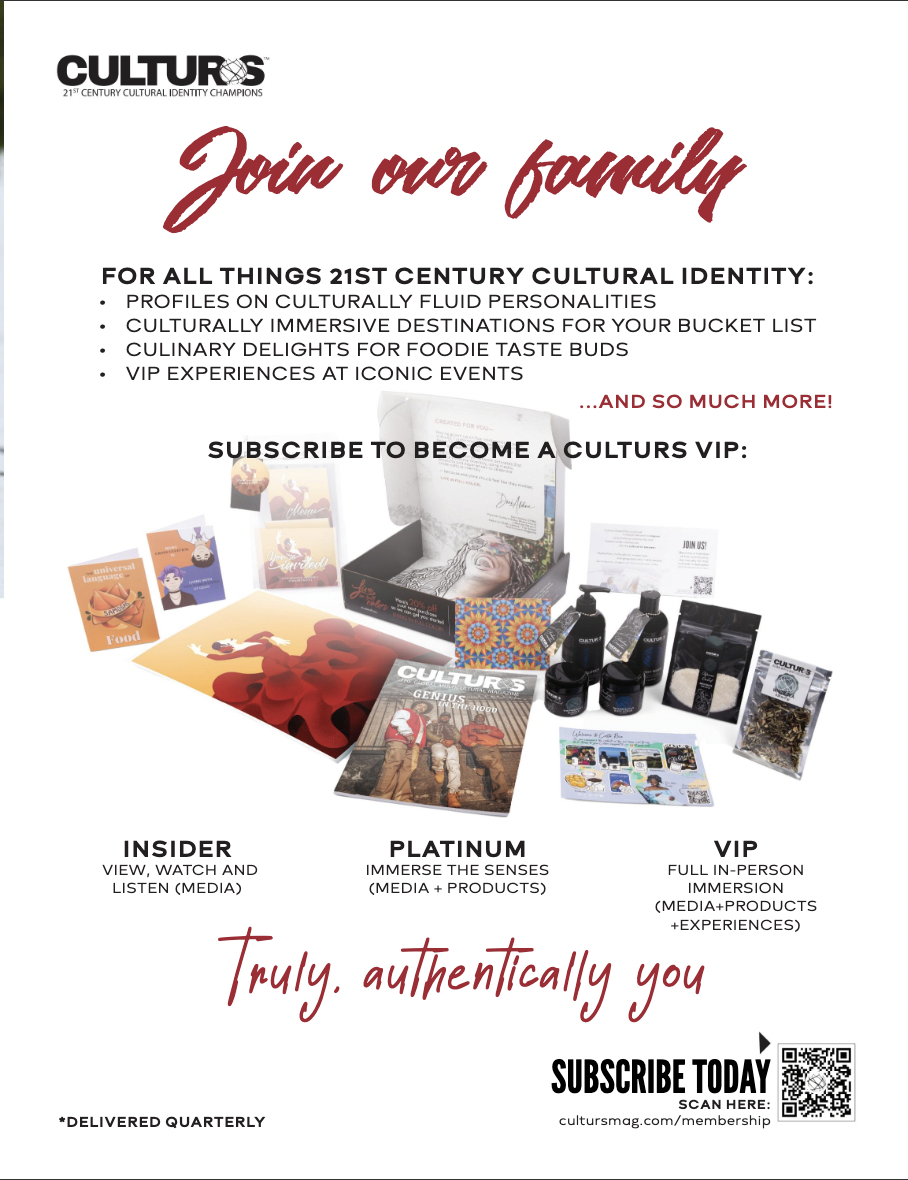
Which is, we have a membership with three packages. They’re all we call them our Insider, Platinum, and VIP packages.

The Insider package is all media.

Members have access to our new podcast, our beautiful video channel, our digital experience, our print magazine, and our web experience. So this year, part of that transformation is every single one of those experiences is different.

You go to read the same story, but you have a different experience on every platform. The photos might tell the story on one platform. And the story angle may be different on the web. On digital, it might be an immersive experience. But each one of those for the same story is very different. So we have our Insider package.

Our second package is our Platinum package, which is media and products. Every quarter our members get a physical package to their door to immerse their senses in global culture.

So every single issue, we have a destination that we focus on. The next one is Jordan. And I’m super excited about that. In that package, we have an award winning dinner party kit. In every location, we work with professional chefs, we just had Michelin star chefs out here in Colorado in December for one of our experiences.  We work with the chefs and create a dinner party kit that gives you the invitations, thank you notes, the menus, the recipes, everything to throw a dinner party for five people, except for the food.

Then we create a sense of global bath and body that emulates the location that we went to. So it’s reminiscent, if I were there, this is what it would smell like. And we do a set of greeting cards for that location.

Of course, we have the magazine that has the destination, the history, the story of the place. In addition, we have the podcast and the videos, and then a playlist for that destination. So fully immersive sensory experience.

That’s the media and the products. That’s the Platinum membership.

When you get to our VIP plus experience, which is the third package, it actually pays for itself. It’s our most expensive memberships, the packages go from around $350 to almost $1,000 a year.

The VIP plus members get the media, get the products, and they get our experiences. So for each quarter, we go to a new destination that will be featured in the next year magazines. We invite up to 10 of our audience to come with us.

And in the VIP plus package, you get a 10% discount off of those experiences. So one trip could pay for it for your entire subscription. So now all through the year, you get to experience every single destination.

You might just go to one or to multiple experiences. This year will be in Fiji, Morocco, and South Africa. We’re doing three this year.

So yes, those are part of the transformation. It’s how we deliver what we do. It’s how we talk about what we do.

And then internally, it’s how the team views what we do. You know, I just had a team meeting yesterday. And I said to them, you do social to bring more people into our community. You do design to bring more people into our community. You do editing and storytelling to make sure people feel one in our community.

Instead of focusing on the tasks that people do daily, it’s really about the key performance indicators (KPIs) and what are they delivering? Because if we don’t deliver for our community, and if we don’t make sure our community stays vibrant, and continue to bring in members, then we won’t be able to design or do social or video or writing. So that’s part those are all parts of the transformation.

Samir Husni: Excellent.  So tell me, let me go back eight years ago, when everybody was falling in love with digital, you decided to produce an ink on paper magazine. Why?

Elleyne Aldine: For the same reason as what people are seeing now. I got to tell you, it’s been very, very satisfying to see that what I was trying to say to people then, they’re starting to realize now? It’s the same as these packages I’m telling you about.

This has been the vision from the beginning. The only thing that’s added is the podcast. I didn’t think of podcasts back then. We’ve always been about the products. We’ve always been about the places. Same with print.

To me, print had its place. It is your luxury experience. It is being grounded.

It is sitting and spending time for self-care with yourself with a cup of tea or in the tub or out in nature or laying on the couch, really experiencing what you’re doing instead of rushing through a million pieces of content on your phone. People are starting to realize that. As you know, at the time I was teaching at university, and I’m sure you saw as well, Gen Z and now Gen Alpha, they were embracing print.

It was funny. I thought, okay, I’ll go to digital. We’ll do all the syllabi and everything in digital. Every semester the students will say, are you going to give us a copy? Give me a copy, please. Or we went to a digital book, and they went to the store to buy the print, right?

I had firsthand experience, my own lived experience in this is a tactile sensory grounding experience that you can’t get with digital. Digital will overload your nervous system. It will give you more content than your brain really can consume, add to anxiety instead of remove it. Print was a no brainer for me. I love paper.

To this day, we just had our launch in Beverly Hills for the last issue, and there was a printer there. We launched the magazine, and we only had a few copies of the magazine that we gave out to specific people. This gentleman walked up and he said, may I feel your magazine? I said, you must be a paper person.

He said, I’m a printer. I said, well, I’ll warn you, everyone says this is glorious when they put it in their hands. He put it in his hands, and he felt it, and he said, is this coated? I said, yes, it is.

He said, is this UV coating? I said, yes, it is. He really enjoyed it, but what’s interesting is he’s a connoisseur, but the everyday public has the same experience. They may not know the terms.

They may not know how we did the printing, but they have the same reaction he had, and that’s why I did print back in the day.

Samir Husni: So how important is the quality of printing and paper?

Elleyne Aldine: I won’t say the name of the magazine. It’s something that I enjoyed when I was a child, and I was disappointed at the quality of the paper, the quality of the design. Of course, the writing is still excellent, but there’s some magazines I subscribe to, that I still love, but how they squish the editorial into these little spaces, and so there’s really not that experience for the beautiful design and the airy feel that actually helps your brain be more open and relaxed, right? So, and it’s a big name, I was disappointed to see that that’s how it is now.

Samir Husni: You’re transforming, and a year from now, you and I are having this conversation. How would you tell me this transformation have gone?

Elleyne Aldine:  Ayear from now, I will tell you. Okay, so our goal is to add 100,000 new print subscribers this year.

I will say that we have surpassed that goal, and I will say that we have more people thriving in our community than ever, meeting up in person, going on these experiences. I had mentioned experiences. It’s not only the travel, but it’s the launch that we had in Beverly Hills where 200 people came to a theater and listened to a fireside chat with the cover stars, where we had our celebrity global ambassador, Yara Shahidi, where we introduced her to the public, where we announced the Alchemist Awards, which will be the cross-cultural awards.

There’s nothing else like it, and we gave our first three awards to launch the awards, which will actually happen in November in Colorado. I will tell you that because of experiences like that in our cooking experiences and our travel experiences, that people are coming together more than ever, that they are understanding other people more than ever. It’s a good thing.

I was reading a recent article in The New York Times about five fashion magazines that are indies and thriving. Three out of the five have similar content to Culturs. They’re talking about fashion, which is a piece of what we do, but one of them had an African bent to it, and another one had an international bent, and I said, well, look at this. So, in a year, I’ll say that even more people understand the value of why what we do is so important.

Samir Husni: Did anybody ever tell you misspelled Culturs?

Elleyne Aldine: It’s so funny, actually, now that you say that. People haven’t done that recently. In the beginning, they would always try to add the E, or even when I would spell it, I wouldn’t say the name.

I’d spell it first, and I’d say, no E, Culturs with no E, and their brains couldn’t, it was like, what? And even as they typed it, and I’d say, no, it doesn’t have an E, and they’d say, I didn’t put one, and then I’d look and say, oh, okay, and they’d take it back out. So, in the beginning, yes, but no, I haven’t had anyone say that recently.

Samir Husni: With this new transformation, with this new membership opportunities that are out there, whom are you trying to reach?

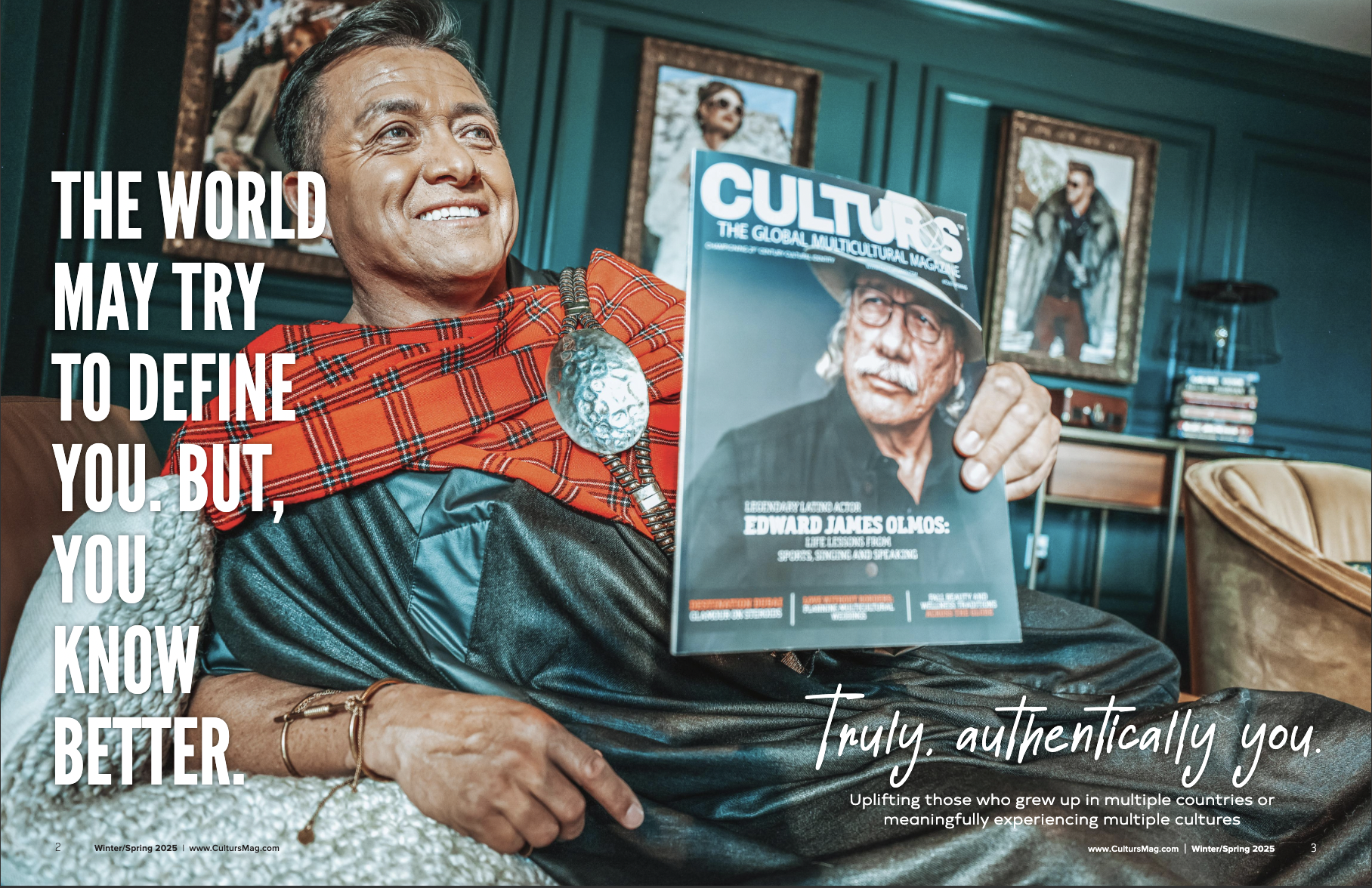
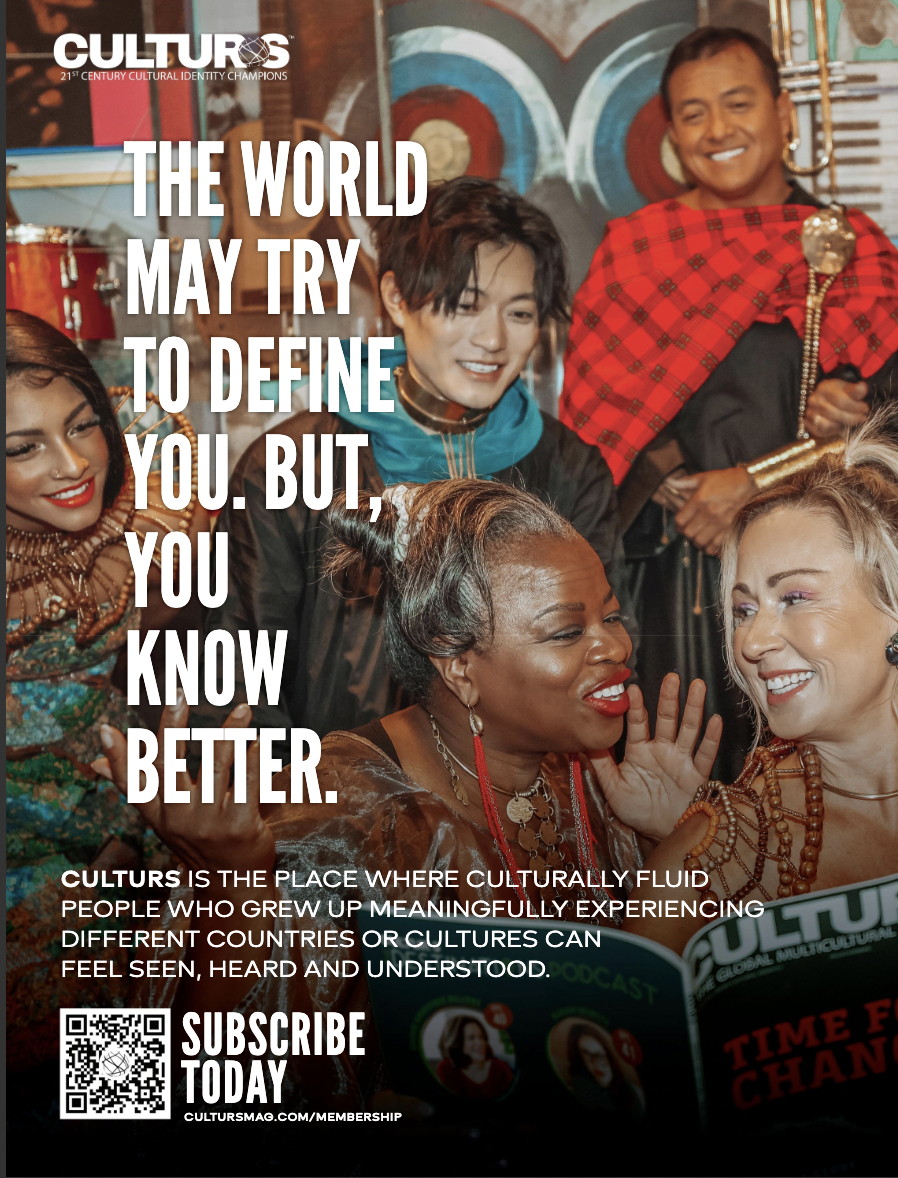
Elleyne Aldine: As we continue in the process of transformation, we have a new ad campaign that focuses on our intended audience.  As you can read on the back cover of the magazine and in the inside front cover, we define our audience as, “The world may try to define you.

But, you know better.  Culturs is the place where culturally fluid people who crew up meaningfully experiencing different countries or cultures can feel seen, heard and understood.”  That in short is our audience. Those are our people, that’s who we’re trying to reach.

Samir Husni: Is there any question I should ask you, I didn’t ask you, you would like me to ask?

Elleyne Aldine: What’s your intent for your audience with my story?

Samir Husni: Okay, what’s your intent for your audience with your story?

Elleyne Aldine: My intent for my audience is that they don’t feel defined by what the world says that they should be, that they understand who they are, and they fully embrace and immerse themselves in that, and defy what society tells them they should be, and just be themselves.

Samir Husni: So tell me, being yourself, you changed your name. Why?

Elleyne Aldine: There’s a couple of practical reasons, one being that another person with a similar name doesn’t have great credit, and I got tired of getting intertwined with them. But also in 2000 I discovered the Kabalarian philosophy, and it talks about the energy of names.

When I got married, which was that time, that’s why I discovered it, I changed my name two years later, and instantly felt the effect of it, and didn’t like the effect that I felt. And then I remembered back when I was young, my name changed when my mom, after my parents were divorced, and I had a similar experience where my life changed overnight. In that time, it changed for the better.

In my married time, it changed for the worse. Once I received a certification in Kabalarian philosophy, I knew the philosophy of names are important, it depends on when you’re born, and the energy of the name, and how it affects you. But it took me until now to really lean in and say, I’m tired of… Actually, it’s similar to what I’m saying about Culturs.

I don’t want to be defined anymore by what society says. I got tired of people mispronouncing my real name, messing up my old name, telling me what my name should be, because people would shorten my name all the time. I absolutely loved my birth name, but everyone would shorten it.

So eventually, I went by Doni, because I thought, okay, they’re going to shorten it to D-O-N-N-Y. I will shorten it to something that’s a little more exotic that I love. So I went with D-O-N-I.

But I’ve never liked that name. I can’t stand that name. So I decided I would have a name that I love, and if anyone didn’t like it, they could kick rocks.

Samir Husni: My typical last two questions are, one, if I come to visit you unannounced, what do I catch you doing to unwind at the end of the day?

Elleyne Aldine: To unwind at the end of the day? You catch me studying Spanish.

You catch me leafing through a magazine. You catch me meditating or sitting on the bed or on the couch and staring at the fire or staring at the wall.

Samir Husni: And my last question is, what keeps you up at night these days?

Elleyne Aldine: You know, nothing ever keeps me up.

No problem sleeping. That’s what happens when you run really fast. What keeps me up? Actually, doing right by my team and my community.

I really wanted to fill a space for people who didn’t have anyone paying attention to them. So I want to make sure that we keep our promises.

Samir Husni: Well, you’re doing a great job and you are keeping your promises. Thank you.

h1

The Very Successful The Week Junior, Celebrates Five Years Of Publishing & Enjoys Being The Fastest Growing Magazine In The United States.  The Mr. Magazine™ Interview With Andrea Barbalich, Editorial Director, The Week Junior Magazine

April 6, 2025

If you would have told Andrea Barbalich, editorial director of The Week Junior, when the magazine was launched in 2020, that the magazine will become the fastest growing magazine in the United States, she probably would have responded, “you are out of your mind.”

Launched on the outset of a pandemic that shut down the country and most of the world, followed by social unrest, worldwide demonstrations, two very contentious general elections, a war in Ukraine, and a war in the Middle East, most observers will have given the magazine no chance of surviving.  Under normal circumstances the average survival rate for new magazines is less than 20% after four years of publishing.

What are the odds of swimming against the trends, celebrating five years of publishing, and being named the fastest growing magazine in the United States.  Notice how I did not say fastest growing children’s magazine, I said, fastest growing magazine followed by The Atlantic and New York magazines in the second and third places respectively.

So, what is the secret for the success of The Week Junior and why is it one of two newsweeklies (the other being The Week) still published weekly year-round?  To answer this question and others about the secret sauce used to make The Week Junior successful, I reached out to Andrea Barbalich, the editorial director of The Week Junior, looking for answers.

The enthusiast and passionate editorial director answered my questions and more cheerfully.  Without any further ado, here is the lightly edited conversation with Andrea Barbalich, editorial director of The Week Junior magazine. 

But first the soundbites:

On The Week Junior’s success: “The quality is outstanding in terms of the editorial and the visuals and its appeal to children and the trust it’s generated among adults.”

On what makes the magazine special: “To have a news magazine coming into the home every week that is timely and topical and based on the news that happened that week, engaging and age-appropriate and fun, is something special.”

On the children as her audience: “So they’re really a dream audience and they really respond to the fact that it’s print.”

On the content of the magazine: “The most important thing of all is that we create something that’s interesting and it’s exciting to read.”

More on the content of the magazine: “The kids want to read it and there’s a really special editorial mix and really magical quality to this magazine that kids respond to.”

On the importance of the trust factor: “We’ve worked very hard over the years to build that trust with parents and show them that we can be a non-partisan, unbiased resource for their kids that helps break stories down into a format that children can understand and that helps them form their own opinion about it.”

On why they survived as a new weekly where others didn’t: “It’s because of the way we present the news and the fact that our business model is based on subscriptions.”

On why the magazine resonates with its audience: “The Week Junior is created in such a careful, thoughtful, exciting, and fun way that really is engaging.”

On being the number one fastest growing magazine in the U.S.A.: “The number two and number three magazines in terms of growth are The Atlantic and New York. So we’re delighted to be in such excellent company.”

On the usage of AI: “We have not used AI very much at all. We don’t use it at all in our editing or our writing or even our research. It’s all done by the talented staff that we have.”

On the creation of the weekly magazine: “It’s created by human beings who really care to create the best quality product that they can every single week. And it’s read by an audience of children who really care. So it’s an absolutely wonderful proposition.”

On being a community: “Because in addition to publishing a magazine, we really see ourselves as building a community. We’ve built something very powerful with this brand that I hope will continue to evolve.

On children spending more time on the screen and less on magazines: “Maybe we’ve proven that theory wrong. Children who read this magazine really do feel that they’re part of a community of like-minded children. We went into this launch believing in the power of Generation Alpha and believing that this was a really incredible generation of kids who care about the world and are curious and knowledgeable and want to make a difference and want to have their voices heard.

On her hope for the future: “It’s vital for children to have this sense of hope and strength and I hope the Week Junior can continue to help with that.”

And now for the lightly edited conversation with Andrea Barbalich, editorial director of The Week Junior magazine. 

Samir Husni: Congratulations on surviving five years. Less than 20 percent of new magazines survive four years, let alone five. Tell me, what’s your secret?

Andrea Barbalich: Well, first I’d like to say thank you for inviting me to talk to you.

I looked back on our interview from four years ago and remembered that great conversation that we had. So you’re checking in with us really at an exciting moment for The Week Junior.  As you said, we just passed our fifth anniversary. We’re also currently the fastest growing magazine in America.

We have a devoted readership of amazing children across the country who absolutely love this magazine. We’ve launched some very successful brand franchises and had some amazing PR successes since we last spoke. I think we’ve really changed the whole concept of creating news for children in this country.

So we’re really thrilled with where we are. As to our secret, I think there are so many reasons why this magazine is resonating. One is that the quality is outstanding in terms of the editorial and the visuals and its appeal to children and the trust it’s generated among adults.

In our business model, the core product really comes first always above everything else. It’s a business model primarily based on subscriptions. We charge a decent price and the purchasers repeatedly tell us in surveys that we’ve conducted, that they feel it’s a fair price and a good value.

So the magazine has to deliver on this value proposition every single week and it does. Our renewal rates are very high and our mailbox is overflowing with letters from kids and parents telling us how much they love it. Another factor is the magazine is doing something no one has ever done in the United States and parents and children have recognized how positive that is not only for the children reading it but for the whole family.

To have a news magazine coming into the home every week that is timely and topical and based on the news that happened that week, engaging and age-appropriate and fun, is something special. Children are truly engaged in reading it and what parent doesn’t want that? They don’t just read it, they love reading it, they can’t wait to read it. Then it sparks conversations around the dinner table and in the car and so it’s a benefit for the whole family.

My team is so brilliant and they make my job a joy. But also to have the opportunity of a lifetime to speak to this incredible generation of children every week.

Also to have the opportunity of a lifetime to speak to this incredible generation of children every week. They love The Week Junior, it helps them feel informed and confident and happy. It’s incredibly rewarding work for me and they are such amazing people and they give me hope for the future.

Samir Husni: So when people tell you that the screen agers, i.e. the children, spend  eight or nine hours on an average on a screen while they spend few minutes on a magazine. Why are you the exception?

Andrea Barbalich: Before we launched the magazine (in 2020) we were told exactly what you just said, that children are not interested in the news for one thing and also that children only care about screens and they don’t want to read on paper.  We believe that that was wrong and it turned out that we were right. When we launched this magazine, if you think back to that time and our launch date was in March 17, 2020, precisely when the world was shutting down from the pandemic, children’s entire world was on a screen.

They were going to school on a screen, they were meeting with their friends and their family on a screen and so the magazine came in as a nice alternative to that and that’s still the case. There is really something special about having a product that you can hold in your hand that comes into the home, it has the child’s name on it, it feels special, it feels like a gift, it’s not homework.

Kids read it, they take it into their treehouse, they read it upside down on the monkey bars, they read it to their pet chicken and their baby brother and they take it on vacation. They have their favorite covers and they save their copies and refer back to them. So they’re really a dream audience and they really respond to the fact that it’s print.

We do have a subscription option where people can purchase both a print and a digital edition as a bundle and some people do take advantage of that, mainly the digital subscription is read by someone outside the home, such as a grandparent who wants to read along with the child, but overwhelmingly the subscriptions are print and I think that the medium is important for the reasons I just cited, that the children love having it. I also think that the most important thing of all is that we create something that’s interesting and it’s exciting to read.  The kids want to read it and there’s a really special editorial mix and really magical quality to this magazine that kids respond to.

Samir Husni: You launched back in March of 2020, the world shut down that month, so my question to you, after that major obstacle, has your journey been a walk in a rose garden in those five years or you had other major obstacles and how did you overcome them?

Andrea Barbalich: Well, as you said, there really were some obstacles in the beginning.

We couldn’t have some of the in-person events that we wanted and we had to completely rethink our school strategy because school wasn’t taking place. But as of the year after that, kids were back in school and we could resume some of those plans. Producing a news magazine every week is its own challenge.

It’s a demanding schedule and a demanding pace and the news itself poses a challenge every week. The news environment itself is both a great challenge as well as a great opportunity. It’s very challenging for all of us right now, including adults, and it has been that way since our launch in 2020.

So much of the news is worrisome, frightening, it changes at a rapid pace. The biggest news story in the first thing in the morning is not always the biggest news story at the end of the day. Many parents are struggling to address current events with their kids.

Children are seeing the news, they’re hearing about the news, they’re exposed to it in school and from their friends and from social media. The Week Junior provides a real service in explaining the news in a calm, factual way that kids can understand and is age-appropriate. We’ve worked very hard over the years to build that trust with parents and show them that we can be a non-partisan, unbiased resource for their kids that helps break stories down into a format that children can understand and that helps them form their own opinion about it.

And in terms of the greatest challenges, I would say some of the biggest challenges have been some of the actual news stories themselves. If you think back on the past five years, we’ve had a pandemic. We had the murder of George Floyd in the summer of 2020, two months after we launched, and worldwide demonstrations after that, two very contentious general elections, a war in Ukraine, a war in the Middle East.

Those are difficult events to explain and to understand. But it actually turns out for us that they wind up being our greatest opportunities because we’re able to, because of the way that we address the news, gain the trust of children and their parents. And we really become an incredible resource.

And we’ve also established our authority within the media beyond The Week Junior as an authority on this generation of children. And we’ve been interviewed many times on the topics of how to explain difficult news events to children. That has also helped with our growth.

Samir Husni: The Week Junior and The Week are the only two news magazines published weekly in the United States on a year round basis? All the other news weeklies have become 17 times a year, 20 times a year, but nothing left as a news weekly. Why do you think that’s the case?

Andrea Barbalich: It’s because of the way we present the news and the fact that our business model is based on subscriptions.

We do, of course, accept advertising and we’re grateful for our advertisers, but the business model is based on creating a quality product and delivering on the promise. We found with The Week Junior, and the same with The Week before us, people want to read what we’re publishing. The Week Junior is created in such a careful, thoughtful, exciting, and fun way that really is engaging.

And that resonates. We’re very fortunate with The Week Junior that it’s a gift title. So it’s always a gift because it’s not the child who’s paying for it, so it’s either a gift from the parent or from someone outside the home, a grandparent or an aunt or an uncle or a friend.

We found that as time has gone on, The Week Junior has become a very in-demand gift. We see sometimes that a grandparent will subscribe for all of their grandchildren or an aunt or uncle will subscribe for all of their nieces and nephews or the parent will give The Week Junior subscription as a gift for all of the birthday parties that the child attends during that year. That’s another way that we’ve grown and that the magazine has been able to develop quite a strong word of mouth following.

Samir Husni: Can you give me a percentage why you said The Week, Junior is the fastest growing magazine in America?

Andrea Barbalich: We had a 23% increase in circulation for the second half of 2024, as measured by the Alliance for Audited Media. But then if you measure the growth year over year, instead of just for that six-month period, the percentage is even higher. We just had our highest ever subscription month just this past January, just a few months ago.

The number two and number three magazines in terms of growth are The Atlantic and New York. So we’re delighted to be in such excellent company.

Samir Husni: Everybody is talking these days about AI. Is AI a friend or a foe to The Week Junior?

Andrea Barbalich: We have not used AI very much at all. We don’t use it at all in our editing or our writing or even our research. It’s all done by the talented staff that we have.

We have used it in a limited way in our art department. There are some capabilities in terms of Photoshop, for example, that have enhanced their work. But for right now, we’re being very cautious and judicious and we’re taking a wait-and-see approach.

Samir Husni: So in an age of AI and digital, print has no backspace, has no delete. It’s permanent. Right?

Andrea Barbalich: And it’s created by human beings who really care to create the best quality product that they can every single week. And it’s read by an audience of children who really care. So it’s an absolutely wonderful proposition.

Samir Husni: In the midst of all this digital land, if you and I are having the same conversation a year from now, what would you tell me The Week Junior accomplished in 2025?

Andrea Barbalich: I would hope is that our ambition, our editorial excellence, our subscriptions, and revenue growth have continued to climb. I want as many children as possible to have the opportunity to read this magazine and be part of our community. We have some creative ideas for growth that I hope we can make happen.

And they really center on finding new ways to connect with our audience and having them connect with one another. Because in addition to publishing a magazine, we really see ourselves as building a community. We’ve built something very powerful with this brand that I hope will continue to evolve.

Samir Husni: Why do you think we’ve allowed digital to steal the word community from magazines? You said The Week Junior is building a community. We don’t hear that much in the magazine world anymore. It’s like all the communities are on the digital sphere?

Andrea Barbalich: Maybe we’ve proven that theory wrong. Children who read this magazine really do feel that they’re part of a community of like-minded children. We went into this launch believing in the power of Generation Alpha and believing that this was a really incredible generation of kids who care about the world and are curious and knowledgeable and want to make a difference and want to have their voices heard.

We believe in those kids. Those kids believe in themselves, and we believe in them. That’s what creates the community.

We have also created a brand extension called Junior Council, which is 12 children who are chosen every year to be part of the council. They spend four months with us learning from our editors and guest speakers that we bring in. Then they choose a cause that they’re interested in, and they research and write stories that are then published in the magazine.

When they graduate from Junior Council, they become what we call junior journalists. They have opportunities to cover stories for us and have their work published. They’ve done everything from attending red carpet premieres to interviewing prominent people such as Michelle Obama and the head of the FDA.

They’ve been featured on NBC Nightly News Kids Edition with Lester Holt. They’ve done all that, but then they’ve also done things in their own individual schools and communities. That spark was ignited in them during their time on the Junior Council.

We’ve heard from so many children and parents about how this program has changed their life. I think there’s a sense of that community and strength and hope and optimism running through the whole magazine every week, not on Junior Council, but also on the magazine itself.

Samir Husni: Before I ask you my typical last two questions, is there any question I should have asked you and I did not, or anything you would like to add?

Andrea Barbalich: I would be remiss if I didn’t mention some of the amazing PR successes that we’ve had over the past five years.

Just in the past 12 months, we’ve had significant partnerships with the Today Show and the Drew Barrymore Show and NBC Nightly News Kids Edition with Lester Holt that have really helped raise awareness of the brand and elevate our authority and our excellence. So that’s a big part of our growth also, that’s a significant part of our growth.

In terms of anything else I’d like to add, really just how grateful I feel to be leading this magazine at this moment in time.

First, to have such an incredible team working beside me at a company that values our work. Every person who ever dreams of becoming an editor-in-chief has a dream team list in the back of their head of who they would want to assemble if they ever got the chance, and I was lucky enough to have that opportunity. There’s something very special about launching a magazine as opposed to relaunching or refreshing or reinventing.

When you go through that experience together, it’s very powerful for everyone. My team is so brilliant and they make my job a joy.

Also to have the opportunity of a lifetime to speak to this incredible generation of children every week. They love The Week Junior, it helps them feel informed and confident and happy. It’s incredibly rewarding work for me and they are such amazing people and they give me hope for the future.

Samir Husni: Excellent.  So if I come to visit you one evening unannounced, what do I catch you reading a book, having a glass of wine, watching TV?

Andrea Barbalich: First of all, Samir, you’re welcome to stop by anytime. I love to cook and I would certainly make something special for you. I also have a wonderful family and a close-knit group of friends and so maybe you would walk in on an interesting conversation or some healthy and respectful debate and a lot of laughter.

Samir Husni: And what’s keeping Andrea up at night these days?

Andrea Barbalich: Many things actually. But at the top of the list for me would be that our nation is extremely divided right now and amid all the challenges that we face, I want children to be able to hold on to their optimism and their hope, to maintain their desire to be engaged with the world no matter what happens, to learn to be critical thinkers and form their own opinion, to continue to care as they do very much right now, to realize their view and their voice matters.

It’s very easy for all of this to get drowned out, but it’s vital for children to have this sense of hope and strength and I hope the Week Junior can continue to help with that.

Samir Husni: Thank you very much.