Magazine making is an art. It was, is, and always will be. However, there is great art, mediocre art and just plain bad ugly art. To each its own. Continuing my journey into the magazines from years gone by, let alone a century, I happened to come across the first issue of Horizon magazine from September 1958. It is a hard back that is encyclopedic in look and content.
The editors wrote in the foreword (two full pages) to the first issue: “We take for our title the word horizon because it is here, where earth and sky meet, that one may observe those jagged interruptions in the landscape that are the words of man: the squat mud houses of ancient Sumer;” The editors continued, “the gleaming statuary of the isles of Greece; the stately sky line of Venice when “she did hold the gorgeous East in fee”; a perfect bridge in Peking; our own soaring, protean civilization; all that moved Milton to write that
Towered Cities please us then,
And the busie humm of men.
I wonder if today’s reader would need a translation of the above. Remember, this is just part of the foreword of the magazine. The editors continue, “Culture, the concern of this new magazine, is both achievement and dream, a work of hands and a movement of the spirit, the special property of man since the great miracle of the Sixth Day – since Darwin’s hairy quadruped dropped from his tree and (how many millennia later?) first lifted up his gaze to seek something beyond mere food and drink.”
If that’s not enough of pure excellent prose, read on and say how magazines were made and how they were meant to be. The editors of Horizon continued, “ Culture is art and ideas, past and present, taken in sum as a guide to life. It is history too, the science which Dionysius tells us is “philosophy teaching by examples,” with philosophy suspended between the I-believe of theology and the I-know of science.”
The editors added, “ This magazine in any case is commenced in the belief that some better guide than now exist in America is needed to the house of culture, with all its thousands of rooms.” In conclusion, the editors wrote, “We invite all those whose interests lie in this broad field, whether as contributors or readers, to join us in this venture.”
When was the last time you read something like this? Something that makes the magazine a piece of art to keep and collect? Are the magazines of today worth keeping? Are they a “better guide than” what exists in America today? You be the judge and the jury.
Would love to read your comments. As always keep in mind that if you would like to take a dive into the “oldies but goldies” magazines of the past, feel free to reach to John Henry at the Specia Collections division of The University of Missouri Libraries and ask for the Samir Husni Magazine Collection.
“Print is forever… With magazines, its there. It’s permanence. It’s always there.” Gregg Hutchings
Those who read my blog know that I don’t use adjectives such as extraordinaire, or incredible, or outstanding and such. But after my conversation with Gregg Hutchings, editor and publisher of Model Cars magazines, I felt the urge and the need to use such adjectives. The one-man band has been at it for more than two decades, with the last 15 years dedicated to Model Cars magazine.
To quote his bio, “My name is Gregg Hutchings, and I grew up in Kailua, Hawai’i, on the windward side of the island of Oahu. I graduated from Kalaheo High School in 1979 majoring in hot rods and girls, and went into the automotive industry as a mechanic. Around 1984, I hurt my back working at a Porsche/VW/Audi dealership, and had three back surgeries during the 1985-1987 time frame. To help pass the time, I got into building model cars, a hobby I grew to be a part of locally.”
Hurting his back was just the beginning of his journey with pain and surgeries. He was rear-ended twice in car accidents which only enhanced the pain and introduced more surgeries, that as you will read in my conversation with Gregg, forces him to work on the magazine laying on his back. The pain is so severe at sometimes, he can’t sit down to work. “Because I fall a lot. My head gets knocked up from the falls,” Gregg tells me, “my back will just seize up and I lose all feeling and everything. And it’s not a good way and it’s not a fun way to live life.”
With at least six surgeries so far, and a host of screws and pins in his back, Gregg refuses to give up and is so happy to announce that this coming October the magazine will celebrate its 25 anniversary. The first issue of Model Cars was published in October 1999.
So please join me as you read this incredible story of an extra-ordinary man, wishing him a very happy anniversary and all the best for his health.
But first the sound bites from the conversation with Gregg Hutchings, editor and publisher, Model Cars magazine:
On getting published in the magazine: People must have “done something good to get in print, because anybody can get on the web. But to get in print is something else.”
On whether the magazine is a hobby or a business: “It pays my bills, it pays my monthly bills.And I’m able to travel to shows all over the country whenever I can because my wife and I actually caregivers for her mom. So that’s my full-time job.”
On the usage of digital and online: “We’re getting a lot of our content from online. So it’s a lot of accumulating what we see online and finding new people that want to be in print and are tired of their internet fame, because it is so fleeting.”
On his pain and physical health: “I can’t sit up. My whole desk is elevated. I can stand up and work. Or I actually lay down here. This is where I do a lot of work too, just laying down.”
On the audience reaction to him: “It’s like, here’s this guy from Hawaii that’s done something he loves to do. And people all across the country and the world just love to talk to him.”
On the plans for the 25th anniversary celebration: “I’d love to have a social media blitz going. Just to say, it has been 25 years. It’s the only magazine out there that’s lasted this long. I want to get more new people. Because one thing with COVID, I had 247 dealers, which gave me a lot. It did really well for my bottom line. After COVID, I’m down to 146. Now, I’m down to 129.”
On working on model cars: “I can’t work on cars anymore. I can’t build cars. I was an incredible mechanic. But with this hobby, it’s just every day I can work on cars.”
On what keeps him up at night: “Pain. Besides pain, it is the next project, I think, it’s always the next thing. It’s what do people want to see? Because they trust me.”
And now for the lightly edited conversation with the incredible Gregg Hutchings, editor and publisher, Model Cars magazine:
Samir Husni: My first question Gregg, you are approaching the 25th anniversary of Model Cars, and you’ve been the owner for the last 10 years. What’s the attraction to a print publication, a specialized print publication in this digital age?
Gregg Hutchings: Somebody gave me that word: eternity. It’s permanent. Because digital, you have to know where you’re looking. With magazines, it’s there. It’s permanence. It’s always there.
That’s what everybody likes, because everybody can put their self in or on a website or whatnot. But to get yourself into a magazine, to be in print, that means something to all these people. It’s self-acknowledgement. They’ve done something good to get in print, because anybody can get on the web. But to get in print is something else. Print is forever.
You can go ahead, and if you did a mistake, you are not going to reprint the magazine. I always call my mistakes, I spell them M-I-S and then steak, like eat a steak. That’s how I spell my mistakes. I said, oops, I made a mistake. No backspace in the magazine. No control alt V or what.
Samir Husni: Give me your elevator pitch for Model Cars, for people who don’t know the magazine. You’re based in Hawaii, but the magazine is distributed in the entire country and internationally.
Gregg Hutchings: It’s the hobbyist magazine. It’s the magazine for the model car hobbyists. I got into it as therapy. A lot of the people I talked to have had health issues and whatnot, and that’s why they get into the hobby or got back into the hobby mostly. It’s always been that way. I think that’s why it’s not corporate, it’s down grassroots, that’s the word. It’s the grassroots magazine.
And the fact that I was able to do something really smart when I had Plastic Fanatic magazine, when I bought it, I think the circulation was about 2,500 or 3,000 and it was okay. But then I come up with this idea to sell directly to the hobby shops. That’s the core, that’s the key, billing the hobby shops directly. That’s why I’ve lasted 25 years, because I don’t have to worry about advertisers or circulation or doing renewals. Every issue I send out invoices and it pays for the printing.
Samir Husni: You mentioned, besides being therapy and hobby, that it’s your life, it’s your business.You’re not doing this for charity work or anything. You said that through this distribution system, it pays the bill for the printing. How about for the publisher, for the editor-in-chief?
Gregg Hutchings: It pays my bills, it pays my monthly bills.And I’m able to travel to shows all over the country whenever I can because my wife and I actually caregivers for her mom. So that’s my full-time job.
She’s 92 years old and she’s got major health issues. We are caregivers for her. I watch her during the day and my wife watches her at night, which is when I get to do my work that I need to.
Samir Husni: Describe for me, what’s a day in the life of Gregg? I mean, when you are putting this magazine together.
Gregg Hutchings: One thing I do like about what you did mention about the digital part is we’re getting a lot of our content from online. So it’s a lot of accumulating what we see online and finding new people that want to be in print and are tired of their internet fame, because it is so fleeting. Once they get in print, it’s forever.
Finding the people, making sure they’re a good fit, because like you said before, in your book, you got to keep that lighthouse going of what you’re actually about. And that’s what I think has kept me different from everybody else is I love this hobby. I love the people.
My best friends are model car builders, and I wouldn’t have it any other way. I was a mechanic for many years. I ran one of the biggest firms here for 10 years, all while doing the magazine too.
But the people with the hobby are just fantastic. I think that’s what makes these niche magazines so great, because it’s not a huge corporation. It’s a bunch of guys I can call up any time of day, say, hey, how are you doing? What are you building? What are you doing? Or if I need help, they’ll come and help me here. I couldn’t ask for something better. I really couldn’t. It makes good money because I can live here comfortably. It pays all the bills, but I have to chase the money. That’s the only thing I don’t like. I have to chase the money. That’s the hard part.
Because I can’t sit up. My whole desk is elevated. I can stand up and work. Or I actually lay down here. This is where I do a lot of work too, just laying down. And I always said, if I was 100%, I’d probably have this magazine at 20,000 circulation.
But it’s just hard to chase it. Right now, I’m at 5,500. And when I was with Source Interlink and Ingram we were at about 7,500 with a 63% sell-through. That’s unheard of. The Atlanta group recently approached me to be back on the newsstands. A lot of people are asking for it. But because I’m so behind all the time, I’m about two months behind schedule. It’s just really hard to get back up to speed and being able to have a solid publication schedule. Still trying to do six issues a year. I started at six, went to nine.
Then when I got hurt in 2016, I went back to six. But when we’re doing nine issues a year, it was doing really good.
Samir Husni: You’re the publisher and the editor-in-chief.
Samir Husni: Which hat do you like more? The publisher or the editor-in-chief?
Gregg Hutchings: That’s a tough one. I kind of like the incognito guy, if that makes sense. Because if I go to shows and stuff, sometimes I won’t wear my shirts or my uniform, and people don’t know me.
I’ll just walk up behind them and talk to them, and they find out who I am. It’s like they met their idol or something. And it’s an incredible feeling. It really is. It’s like, here’s this guy from Hawaii that’s done something he loves to do. And people all across the country and the world just love to talk to him.
It’s not egotistical. That’s one thing about Hawaii. We don’t really have egos and all that stuff.
A couple of quick stories. When I go to shows, nine times out of 10, the person’s wife is the one that comes up to me and thanks me. Because it’s made such a difference in the husband’s life for doing the model cars. That’s what I like. I just think it’s unreal to be able to touch that many people. I know it sounds corny.
Samir Husni: No, it is your passion, love, and work all in one and one in all. So tell me, when Larry Bell retired and said, okay, here’s the magazine, in 2015, can you describe that moment? Can you describe your feeling?
Gregg Hutchings: Well, back up to 1999 when I went to the mainland and got hooked up with Golden Bell Press. I was co-owner with Larry Bell from the start of 1999.
And then about a year or two later in 2001, I was in a serious rear-ended accident in Denver. The back of the Honda Civic I was in, the bumper hit my seat. The back bumper hit the back of my seat.
I was the passenger. So I was extricated from that. And I came back to Hawaii and then Larry said, instead of being co-owner, he just paid me a straight salary.
So that way I didn’t have to worry about, I had strict income, I didn’t have to worry about percentages or whatnot. So he took over complete ownership and I was paid a salary or 1099. I’m on heavy medications too. You became more like a freelance. You became on a set salary.
I became the editor instead of just the co-publisher. But he always considered me the publisher because I did everything still. It was just the financial part of it was it was safer for me because I had to go.
I went, I had three surgeries before that. Then after the accident, I had two more. And then it worked out great. We went up to nine issues a year. And then in 2015, he wanted to retire. And so he just gave me everything.
At that time, I had started another magazine called Slot Cars Magazine. And that one was doing really good. But the problem with that is when he gave me that magazine, he didn’t give me. The needed paperwork for the periodical mailing.
It’s terrifying. My wife, Kelly, and I went through the whole schooling process of that. But when he gave me Model Cars Magazine, he didn’t give me all the original paperwork.
So, I didn’t have the original requesters, all the copies of everything they had and whatnot. So, I could not get my periodical permit.
The post office really tried to help me out. They came to the house. They did the audits and everything. But I didn’t have the original paperwork. So, that was… I just gave up. And then in 2016, December, I was hit again.
I was rear-ended. My wife hates it because I drive by the rearview mirror. She’s like, what are you looking at? I said, I’m just watching, just watching. If I get hit again, I’ve got so much rods and screws in my back, it would be… This time, my next surgery is going to go through the front, break two ribs, fuse the front of it, flip me over, take out all six levels of rods and screws and go all the way up.
So, it’s not going to be fun.
Samir Husni: I wish you the best.
So, tell me, what are the plans for the 25th anniversary?
Gregg Hutchings: I don’t know. I’d love to have a social media blitz going. Just to say, it has been 25 years. It’s the only magazine out there that’s lasted this long. I want to get more new people. Because one thing with COVID, I had 247 dealers, which gave me a lot. It did really well for my bottom line. After COVID, I’m down to 146. Now, I’m down to 129.
So, I lost a lot of shops, a lot of hobby shops. I want to find more. Either go back to Barnes & Noble or find other ways to find other retail shops. Because that’s what does it for me. They pay the bill within 30 days. And it is about chasing the money.
I mean, the advertising revenue is not that high. I think I’m at 6.5%. But with my printing schedule, I don’t have the reputation of being timely. Most of these people know me. And they know that, he’ll be down for a week if something happens. Because I fall a lot. My head gets knocked up from the falls. My back will just seize up and I lose all feeling and everything. And it’s not a good way and it’s not a fun way to live life.
Samir Husni: Yeah, it’s not.So tell me, if I come uninvited to your house, not that I’ve been to Hawaii before, but let’s say I come to see you one evening, what do I catch Gregg doing? Reading a book, watching TV, or laying on the floor?
Gregg Hutchings: Probably the last one. Laying on the floor. I’ve got what I call the squirrel syndrome. I’ll see something shiny and I’ll just jump right on it and I’ll forget about what I was working on. And I’ll have so many projects going on.
I guess with the specialized part of the hobby, I’m always building something. I’m always working on something. I added the projects I am working on now on a spreadsheet. I’ve got 157 projects like that started. And it’s always something going.
I can’t work on cars anymore. I can’t build cars. I was an incredible mechanic. But with this hobby, it’s just every day I can work on cars. And then I got into computers. I just met so many unreal people with the magazine. I’m just such a small little guy that has been able to do such unreal things.
Samir Husni: And what keeps Greg up at night these days?
Gregg Hutchings: Pain. Besides pain, it is the next project, I think, it’s always the next thing. It’s what do people want to see? Because they trust me.
Samir Husni: Is there anything you would like to add or I failed to ask you?
Gregg Hutchings: One thing I’ve always said is I don’t do reviews on something I haven’t had in my hands. So if a company sends something a PR piece, I’ll say, no, no, no, you got to send me the actual thing. Because people trust that.
Because they know that if I’ve looked at it, if I read it, if I wrote about it, so it’s either thumbs up, thumbs down, or like we say, a shocker or a no shocker. But I love the business side of it.
I really do. Because it’s got the potential to be really well. I used to tell Kelly, if I hit 20,000, that’s a million bucks a year for one guy.
That’s pretty good. So I mean, it can be done. And it’s just physically being able to do it.
It’s just, I wish I could. But I’m not going to give up. That’s the one thing people ask me with the pain and stuff.
How do you keep on doing it? I don’t know. I’ve got too much junk to pass on to my wife that I’ve got to keep on looking forward. And it’s just, I love the magazine industry too much.
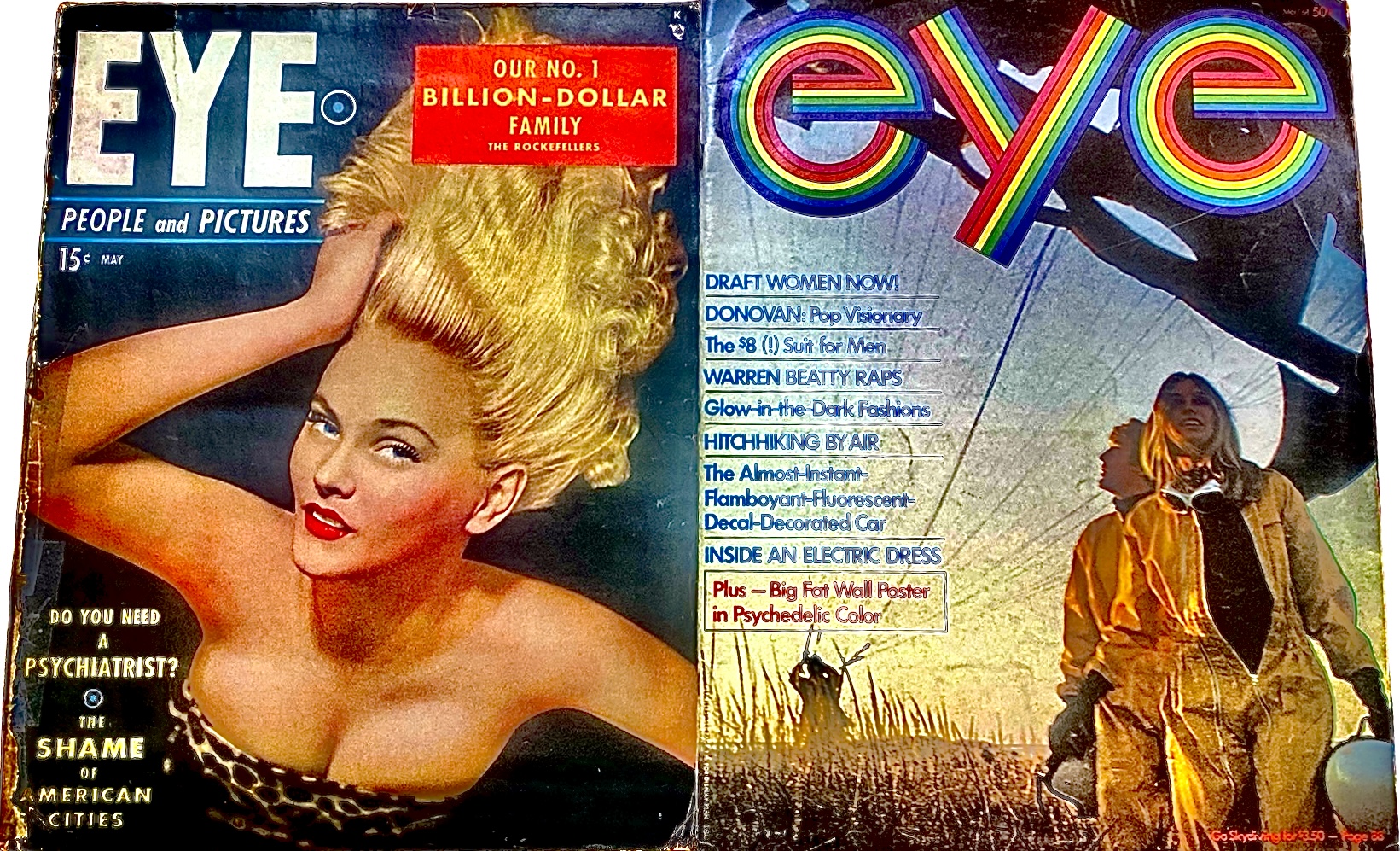
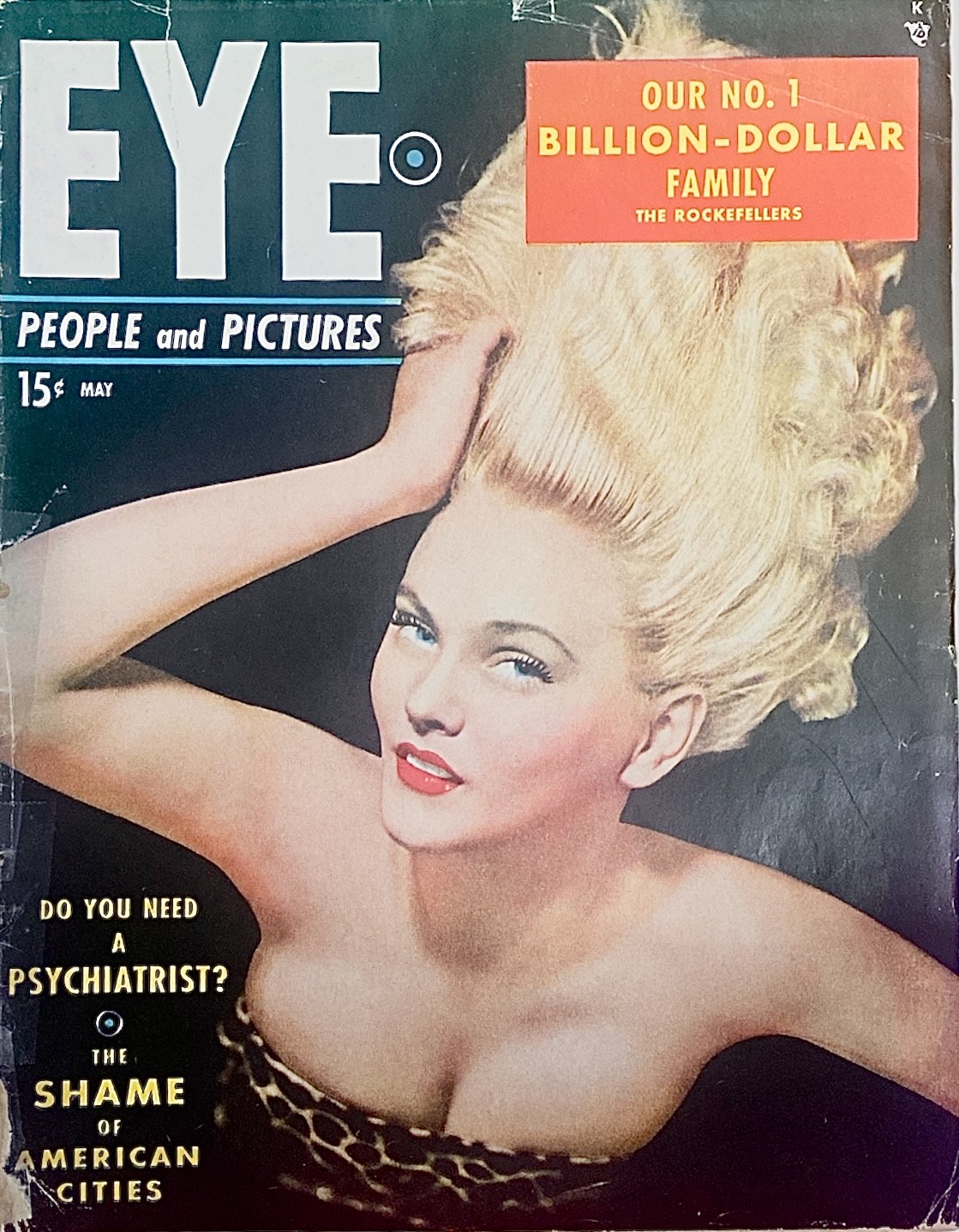
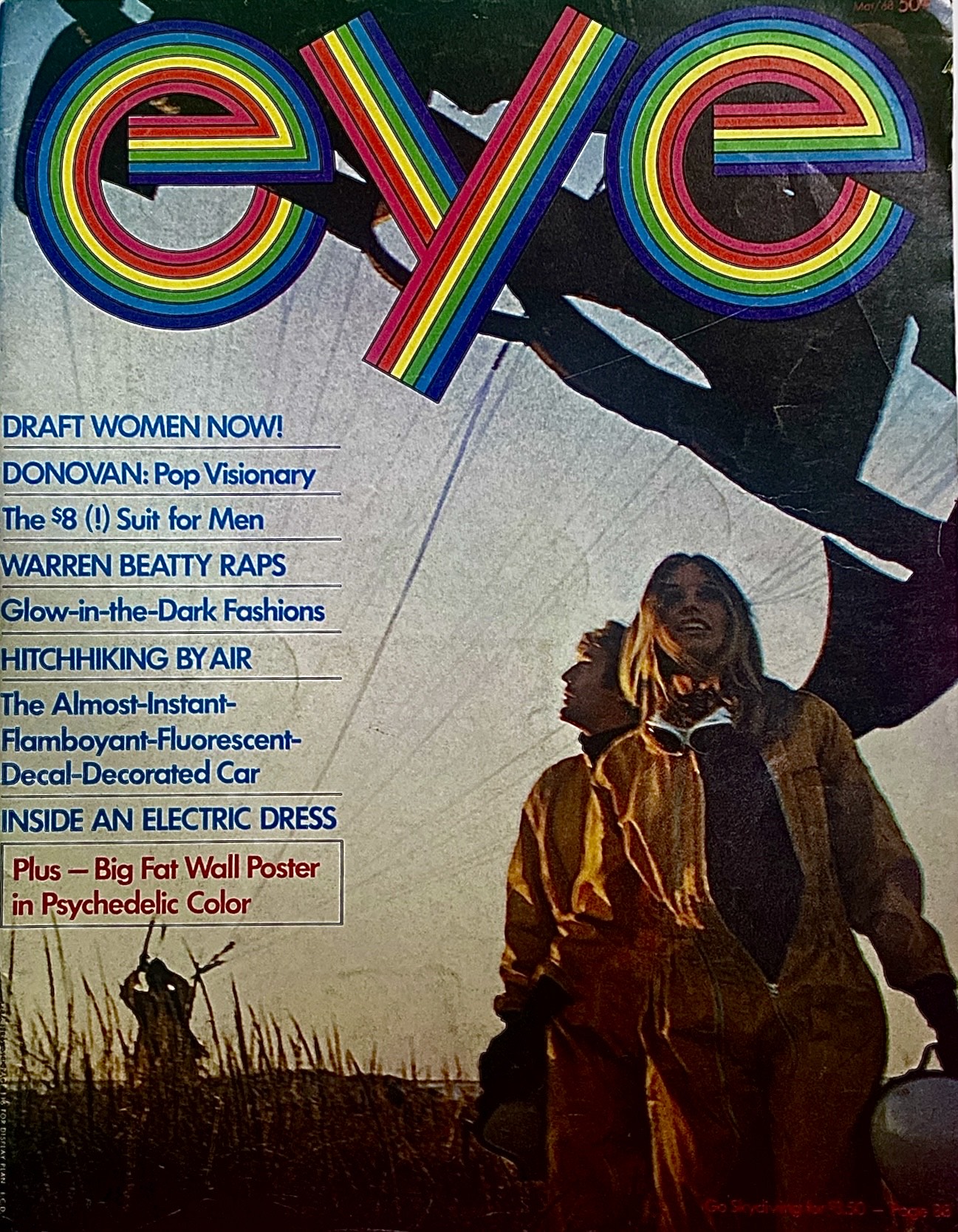
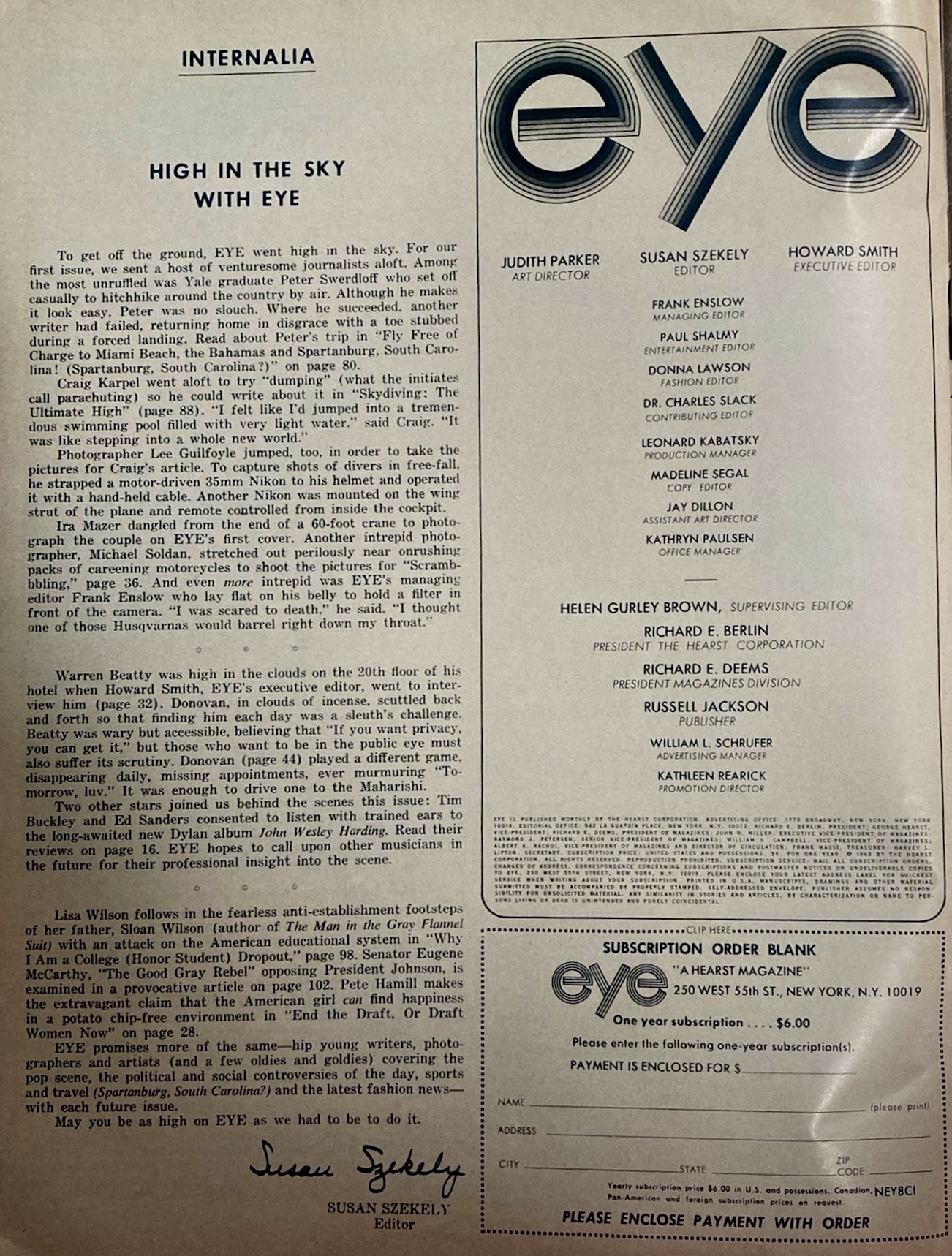
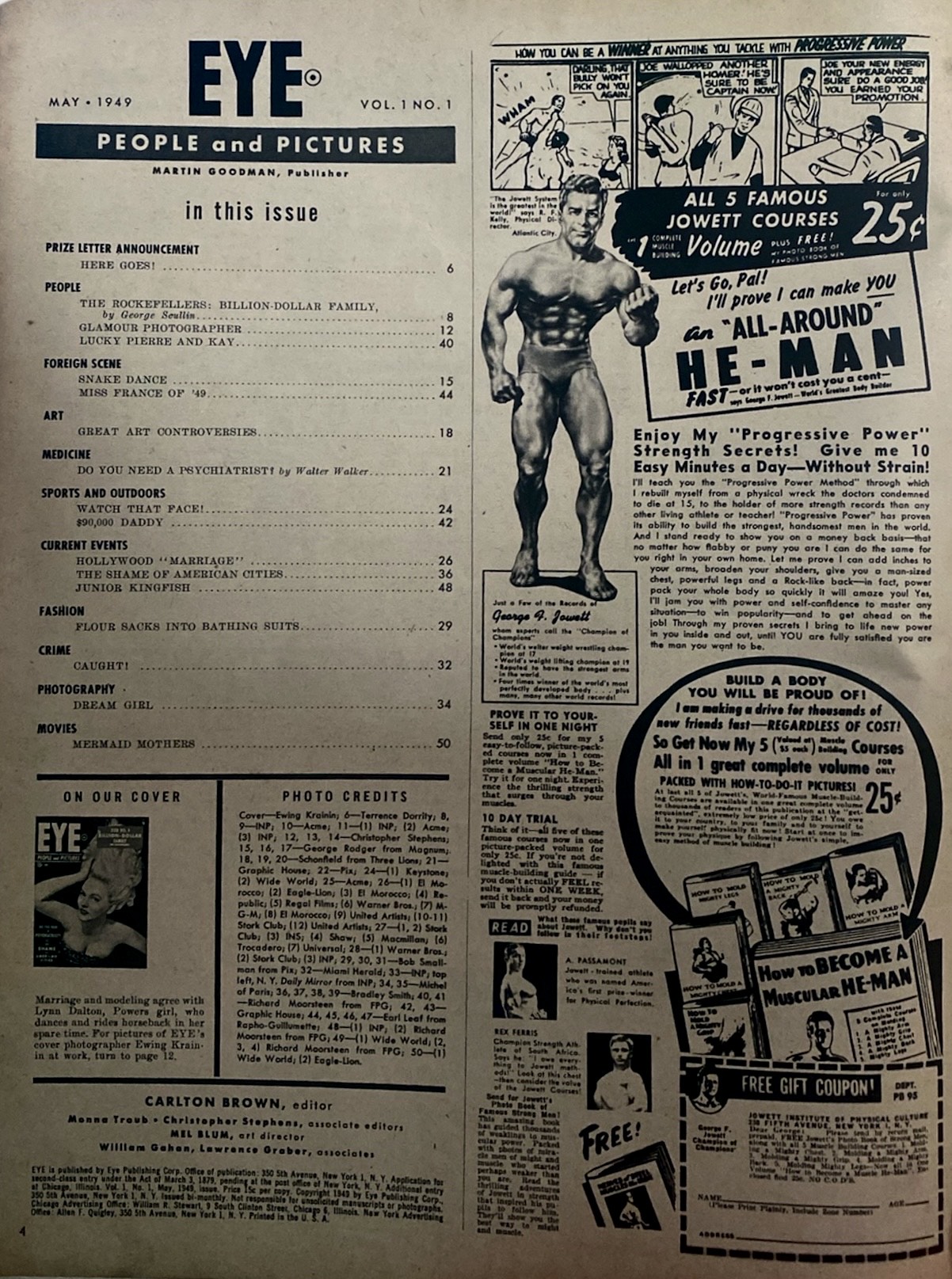
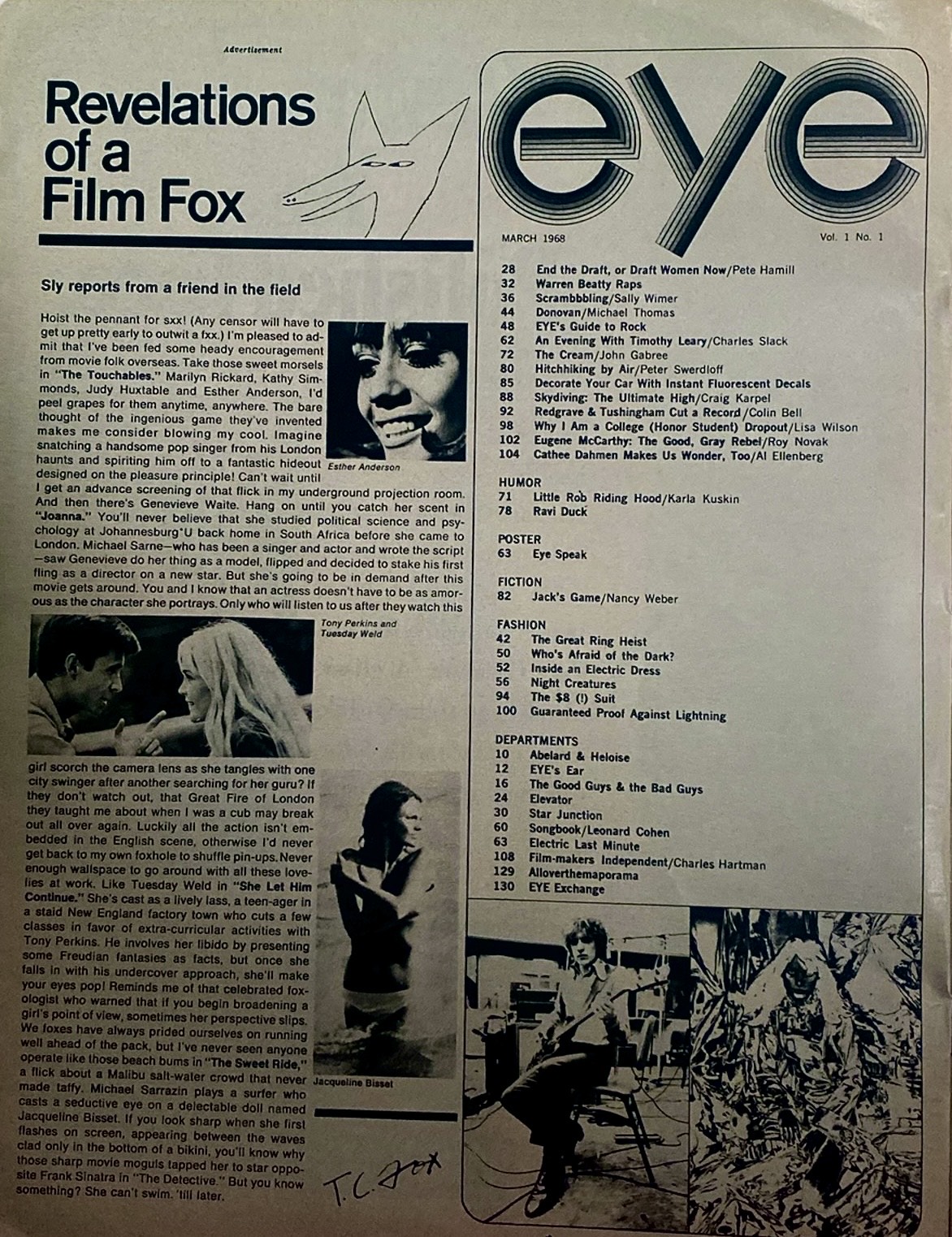
That is two Eye magazines. One from the days before I was born, and the other when I was a 13-year-old teenager. However the two Eyes have a lot in common and few good lessons to learn if you ever thought or think of going into the magazine business. And by magazine, I mean the ink on paper publication that is published on some regular frequency.
So without any further ado, here are the lessons I have found in those two Eyes that are still applicable in the year 2024, some 75 years after the first EYE was born:
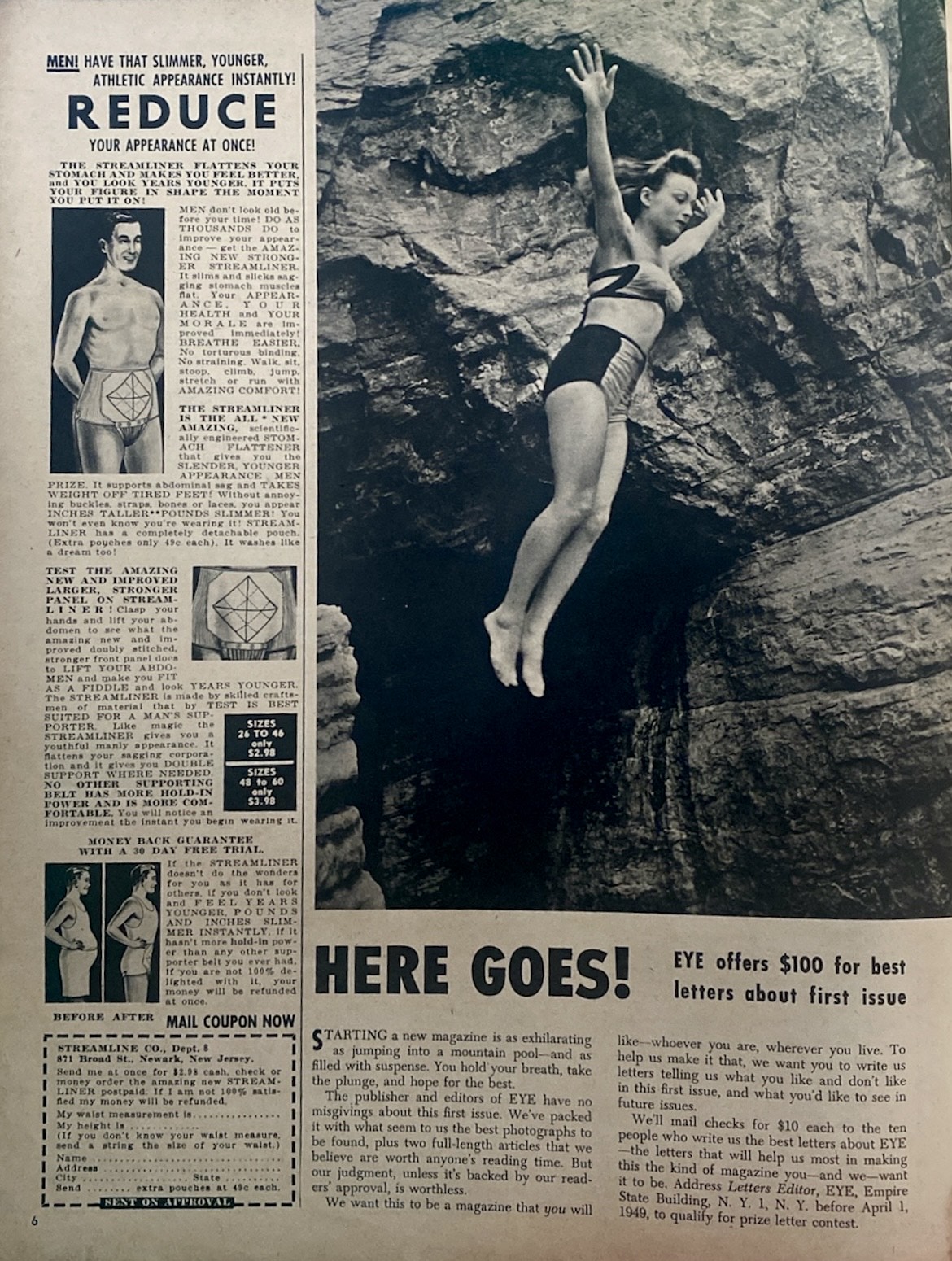
Lesson number 1: Magazine publishing is not for the faint of heart. In 1949 when the first EYE ( Martin Goodman, publisher and Carlton Brown, editor) was published, magazines were the only mass medium available to the public nationwide. This EYE was first published in May 1949 with the tag line “People and Pictures.” The editors wrote in the first letter to the readers, “Starting a new magazine is as exhilarating as jumping into a mountain pool – and as filled with suspense. You hold your breath, take the plunge, and hope for the best.”
In March of 1968 editor Susan Szekely, wrote in the first issue of the Eye published by the Hearst Corporation (Helen Gurley Brown was the supervising editor), “ To get off the ground, EYE went high in the sky. For our first issue, we sent a host of venturesome journalists aloft. Among the most unruffled was Yale graduate Peter Swerdloff who set off casually to hitchhike around the country by air. Although he makes it look easy, Peter was no slouch. Where he succeeded, another writer had failed, returning home in disgrace with a toe stubbed during a forced landing.”
Both magazines took calculated risks and knew that magazine publishing, even in the 40s and 60s of the last century was not for the faint of heart.
Lesson number 2: Plea for help from the audience.
Without your readers, the magazine is not going anywhere. Readers input is essential. EYE of 1949 offered readers money for the best letters about the first issue. “We want this to be a magazine that you will like – whoever you are, wherever you live. To help us make it that, we want you to write us letters telling us what you like and don’t like in this first issue, and what you’d like to see in future issue,” the editors wrote. They continued, ‘We’ll mail checks for $10 each to the ten people who write us the best letters about EYE – the letters that will help us most in making this the kind of magazine you – and we – want it to be.”
Hearst’s eye was more on the wishful side of things with the audience. “May you be as high on EYE as we had to be to do it,” wrote the editor.
Lesson number 3: Great content was and will always be king and queen.
The importance of good quality content is as important as it was in 1949. For magazine content goes beyond good writing to include good photography, design, and the art of packaging a coherent and pleasing publication both for the eye (pun intended) and the brain. “The publishers and editors of EYE, have no misgivings about this first issue. We’ve packed it with what seem to us the best photographs to be found,” EYE’s editors wrote, “plus two full-length articles that we believe are worth anyone’s reading time.” The editors were humble enough to admit, “But our judgment, unless it’s backed by our readers’ approval, is worthless.”
As for the May 1968 Hearst’s eye, the editor wrote, after paragraphs of introducing the writers and photographer for the volume 1, number 1 issue, “EYE promises more of the same—hip young writers, photographers and artists (and a few oldies and goldies) covering the pop scene, the political and social controversies of the day, sports and travel (Spartanburg, South Carolnia?) and the latest fashion news—with each future issue.”
Publishing a magazine, a good magazine still depends on those three premises stated above. Recognizing it is not for the faint of heart, engaging your audience from the very beginning, and providing excellent content that can’t be found any other place.
If you would like to take a dive into the “oldies but goldies” magazines of the past, feel free to reach to John Henry at the Special Collections division of The University of Missouri Libraries and ask for the Samir Husni Magazine Collection
“We love magazines. We’re finding out that a lot of other people who didn’t know they love magazines, love magazines. I’m feeling really buoyant and positive. You say, “Will this be a business? Yes, we are very, very confident. This is not a vanity project. We’re here to make money. The universe is conspiring such a thing.”Rob Hill
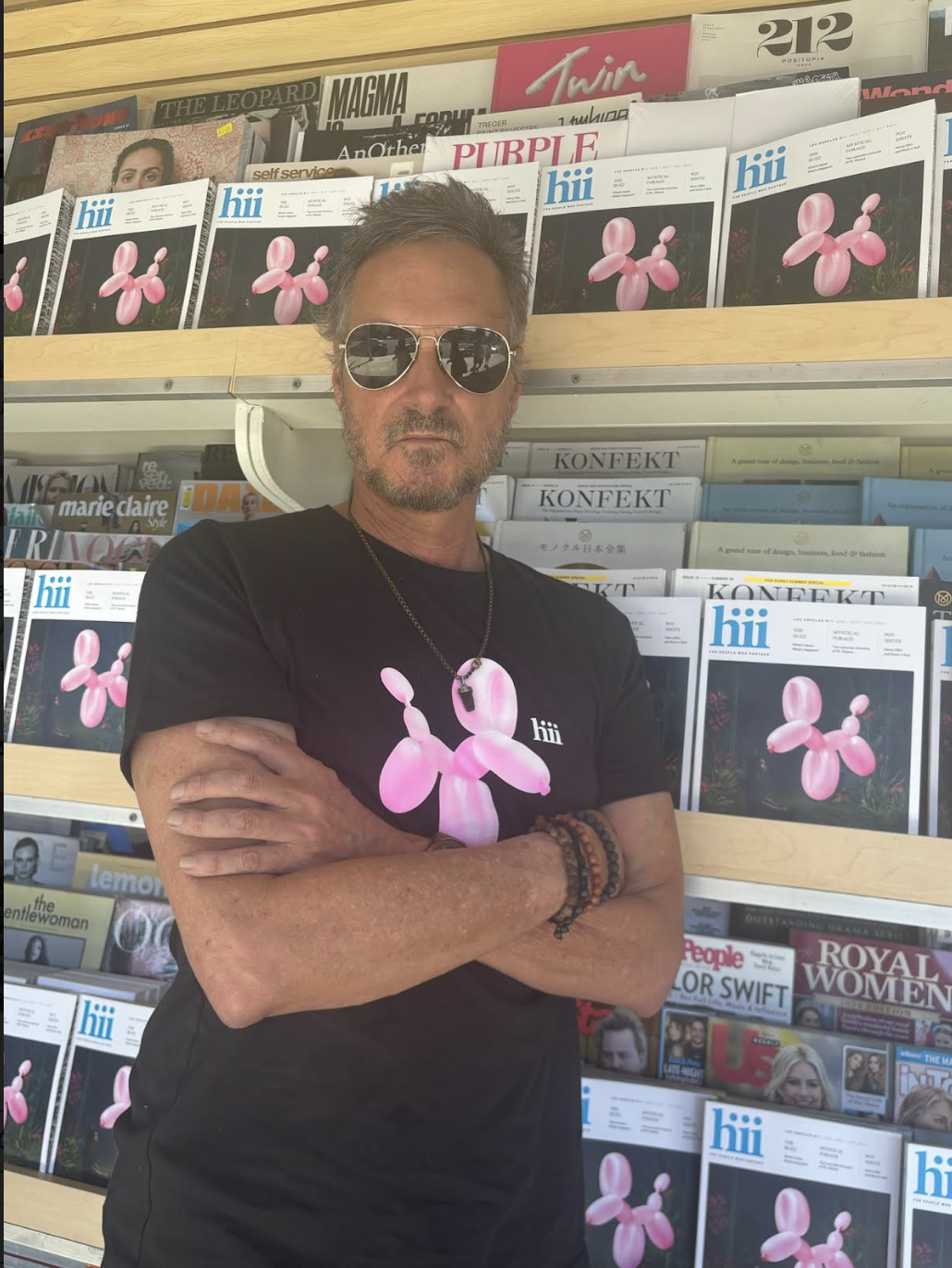
An upscale magazine for the masses “who partake.” A “Vanity Fair for weed.” A new twist on marijuana magazines. Elegant in design and even more elegant and sophisticated in writing and photography. The brainchild of Rob Hill and Pam Patterson, hiii magazine arrived on the newsstands in the city of Los Angeles and at all its dispensaries.
The lifestyle magazine utilizes every inch of space to channel messages to its readers and advertisers. From the margins to the spine and the front edge of the magazine, there is content, a very specific message to the audience.
To say the magazine is well done will be an understatement. Rob and Pam poured their heart and soul into this new publication that goes beyond the ink on paper magazine. To find out about this hiii adventure I reached out to Rob and Pam and had a delightful conversation about the magazine and the entities surrounding the publication.
Please enjoy this conversation with Rob Hill, co-founder and editor in chief, and Pam Patterson, co-founder and creative director, that is sure to give you a hiii whether you partake or not. But first for the soundbites:
On the genesis of the magazine idea: “My thinking was that the industry had nowhere to brand. And there are about 2800 potential advertisers in this city. So I just saw it as a numbers game. But it also had to bring a new and veneer to the industry. A new take for a new time.”
On the mission of the magazine: “Because what this industry didn’t need was another rag that was basically looking backwards and not forwards, actually propelling the stereotypes. We’re totally anti that. We don’t believe that. I think 64% of people use cannabis in this country.”
On scoring an ad from Porsche: “We don’t all live in a silo. We buy Porsches. I hope you saw the ad. We booked Porsche, which has never been done in a cannabis magazine. They booked it for the full year and paid. So we’re going after car companies, we’re going after mainstream brands.”
On expanding beyond Los Angeles: “We’re getting calls from Vegas, NYC, and Detroit, etc, to bring the magazine there. It’s just been so exciting. I don’t want to say we’re saving print, but I think we’re part of a resurgence of print. Nylon is back, Spin is back, Creem is back, Life is back, Playboy is back. There is a digital fatigue that has set in.”
On the role the magazine aims to play: “One of the things that makes this audience so much different is we really are a lifestyle magazine. It’s a tool for connection between people. I think people who don’t smoke wouldn’t completely understand it.”
On the flipbook in the margins: “When I heard that Mickey Mouse came into public domain, at least Steamboat Willie, we took a look at it. He’s driving the boat and it’s just begging for a joint in his mouth. “
On the distribution model: “The thinking is to conquer the country through cities rather than the traditional way of printing half a million magazines and putting them on newsstands all over the country.”
On the creation of the magazine: “We just felt we were the best people to redefine, update, and package it in a way that made sense to everyone. Concentrate on the positive, creative, and medicinal parts.”
On the content: “We’re going to always have some really good stories in there too. Like the prison story we did. People don’t know that there are people still rotting in jail for selling three joints in 1975. It’s crazy.”
On the audience: “The audience is very broad, but it’s like the coolest people in all of those sort of segments smoke weed.”
On young folks reaction to the magazine: “We have a lot of young people that work in our office who are in their twenties and a lot of people that come through here who are millennials that treat the magazine like it’s a jewel. It’s an exotic thing to them that they’re liking. What’s not to like?”
And now for the lightly edited conversation with Rob Hill, Co-founder and editor in chief, and Pam Patterson, Co-founder and creative director of hiii magazine:
Samir Husni: In this digital age, you are launching a print magazine, and not any print magazine, a print magazine “for people who partake.” What’s the reasoning behind it? What were you thinking? Are you out of your mind?
Rob Hill: Well, during COVID, I was sitting home alone a lot. I kind of fell back in love with cannabis. I’ve had an on and off love affair with it.
I was coming from a business to business cannabis magazine called MG, which was the biggest cannabis business to business magazine with a very different model. It was a subscription only model. It went out to CEOs and owners of companies.
I would go down to the Malibu newsstand before they locked us all down. Even when they did, and just kind of, buy magazines and bring them home. I started to make a collage on my wall and started to just envision it.
My thinking was that the industry had nowhere to brand. And there are about 2800 potential advertisers in this city. So I just saw it as a numbers game. But it also had to bring a new and veneer to the industry. A new take for a new time.
I thought if we could bring it into the 21st century, and give it a splashy, fun, and modern take, that it would work. That was kind of the thinking behind it.
We’re going to make money. We spent the first 18 months after we developed the idea and got it where it needed to be.
I think what’s really broken in the magazine industry is the distribution model and the fact that if you don’t love magazines don’t launch one. Anyone can have a blog and a website but not everyone can have a magazine.
In addition the print pages, we sold eight activations at our launch party, which means that a company brings their product, sets up a table, has their signage, while educating consumers and handing out samples.
Samir Husni: hiii is unlike any of the cannabis magazines that were launched even as back as the 70s. We had a lot of magazines like High Times, Inside Dope, Head, Kush, you name it. hiii is more like an upscale magazine, yet it’s a mass magazine. Tell me the thinking behind combining upscale and mass at the same time.
Rob Hill: I think that’s the target we needed to hit to be successful. Because what this industry didn’t need was another rag that was basically looking backwards and not forwards, actually propelling the stereotypes. We’re totally anti that. We don’t believe that. I think 64% of people use cannabis in this country.
We don’t all live in a silo. We buy Porsches. I hope you saw the ad. We booked Porsche, which has never been done in a cannabis magazine. They booked it for the full year and paid. So we’re going after car companies, we’re going after mainstream brands.
Our hope is by this time next year, a third of the magazine is going to have advertising in it that has nothing to do with cannabis. We’ll get Levi’s and Doc Martens and Bentley and Range Rover. Porsche plowed the road for us, so to speak. They parked their cars at our party to out in front of Woody Harrelson and Bill Maher’s cannabis lounge/garden The Woods in West Hollywood which was really cool.
Porsche’s whole marketing team came and it’s a really big deal. Ad Age or Adweek should really do an article on that.
We were hoping to have 15 ads and we booked 26. And the Porsche ad, goes above and beyond what they paid. It’s not even about the money with Porsche. It’s about having that real estate for the full year in the magazine
Samir Husni: That’s not your first venture editing a magazine. You’ve been there, done that. What’s the difference? You and Pam are now owners and publishers. Does it feel any different that just being an editor?
Rob Hill: The last time we spoke we were launching Treats magazine. That was pretty exciting. Hugh Hefner tried to buy it the day after we launched it. He invited us up to the mansion.
But this is different. Pam and I purposely put our emails in our editor’s letters because we wanted people to email us. We didn’t want to do info@ or editorial@. And we’re getting about a dozen a week of just people that are saying things like, “I saw your magazine at the dispensary. I picked it up. I commute to work on a bus. I read it cover to cover.”
We’re getting calls from Vegas, NYC, and Detroit, etc, to bring the magazine there. It’s just been so exciting. I don’t want to say we’re saving print, but I think we’re part of a resurgence of print. Nylon is back, Spin is back, Creem is back, Life is back, Playboy is back. There is a digital fatigue that has set in. People are tired of being on their phones and all ages are looking for more tangible experience. This is why we spent lavishly on our paper stock, size, and design. And it’s paying off.
Samir Husni: The design of the magazine from printing on the edge of the magazine or having an edgy design. Tell me about the creative design of hiii.
Pam Patterson: I’m the creative director and I’ve been a weed smoker since I was 13.
One of the things that makes this audience so much different is we really are a lifestyle magazine. It’s a tool for connection between people. I think people who don’t smoke wouldn’t completely understand it. But when you’re part of this community, there’s a bond there that we channel when we’re concepting the magazine.
We wanted to create a toy, something where people could relate to it in a lot of different ways. We could have a story of substance, and then have a story that speaks to the tools of the trade and whatnot. Also where they could have a little passage from some novel that someone may see in a new light.
We want to be fun like Bob Marley’s quote on the edge printing. It’s just a fun way. I think it’s kind of a wink to our audience that we get it. Weed smokers are thinkers. We’re creative thinkers.
Samir Husni: What about the flipbook? I mean, the images that run in the margins?
Pam Patterson: When I heard that Mickey Mouse came into public domain, at least Steamboat Willie, we took a look at it. He’s driving the boat and it’s just begging for a joint in his mouth. We wanted to do a flipbook for some time, and that was kind of a thing we devoted that real estate, the right hand margin to, in addition to a literary passage and the edge-printing. People were like, oh, advertisers are not going to like you getting into that space. But it’s been just fine.
Samir Husni: It looks like you have a love affair with the magazine and with print. But my question to you how is hiii as a business? Are you going to spend your savings or are you going to make money out of this?
Rob Hill: Absolutely. We’re going to make money. We spent the first 18 months after we developed the idea and got it where it needed to be. We have a CFO who was CFO from Hard Rock Cafe and other companies. We did talk to a lot of people. But what we found was the investors didn’t get it as much as the advertisers did. So our business development consultant said, “Well, your advertisers are your investors. So just go start selling and don’t worry about all of this other stuff.”
We were hoping to have 15 ads and we booked 26. And the Porsche ad, goes above and beyond what they paid. It’s not even about the money with Porsche. It’s about having that real estate for the full year in the magazine and being able to go to other brands like Woody Harrelson, Whiz Khalifa, Snoop, Jay-Z, Willie Nelson etc., and say, “Hey, your ad is going to be after Porsche.” They like that.
We just started to knock down some barrier to entry and it was difficult in the very beginning. People were saying cannabis isn’t the hottest thing right now and magazines aren’t the hottest thing right now. But we didn’t believe that. And Samir, I think what’s really broken in the magazine industry is the distribution model and the fact that if you don’t love magazines don’t launch one. Anyone can have a blog and a website but not everyone can have a magazine.
I think we’ve come up with a way to do distribution right. In fact, last night, I went after dinner to go check the markets in Studio City and Laurel Canyon, where we distribute the magazine on the racks outside the markets. And there we put 25 on each and they’re gone in three days. There are 128 dispensaries and cannabis lounges that also carry the magazine in their stores and half a dozen that we have partnered with to deliver the magazine right to their door of their VIP customers with their cannabis.
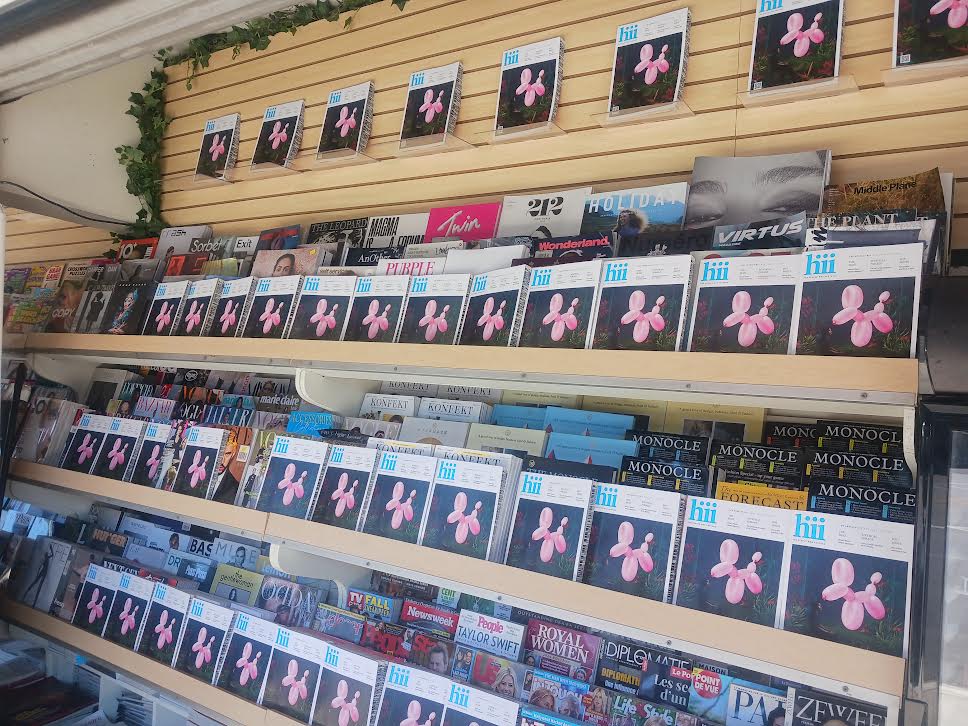
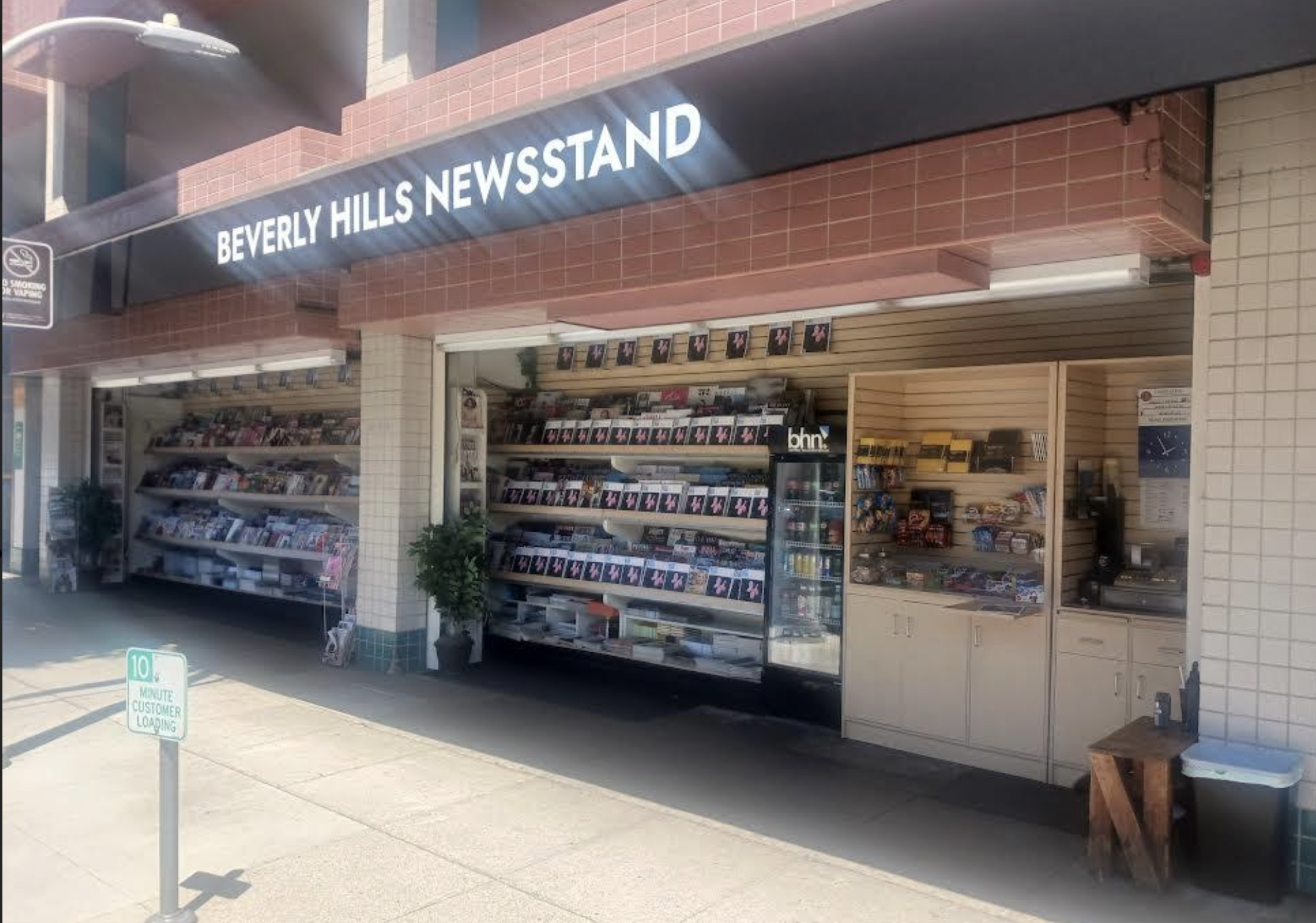
And that’s all over the city. That’s Erewhon, Vons, Ralphs, Whole Foods. And then we do have a paid model. We’re distributed through Mader News. We took over the Beverly Hills newsstand for the month of August! Never been done before by a cannabis magazine. The first day David Lynch sent his assistant to buy the magazine. The next day it was Quentin Tarantino.
They put us right next to Monocle, which was really cool because Tyler (Brule) is one of my heroes. I think we figured out distribution, and the model is to take this to the next city in second quarter 2025.
The thinking is to conquer the country through cities rather than the traditional way of printing half a million magazines and putting them on newsstands all over the country. We’re sort of doing what Cigar Aficionado does married with what Departures did, with a dollop of traditional newsstand and the whole National Geographic in the dentist office thing.
Once Cigar Afficionado got distribution in the thousands of cigar lounges, the advertisers were like, What more could we want? If you’re an advertiser, you have a guy or a woman that’s in a cigar shop, hanging out, having a good time, talking with their friends and then they pick up Cigar Aficionado and spend 20 minutes enjoying it. It’s a warm audience. That’s hiii in the lounges and dispensaries.
The other unique and singular thing hiii does is reach not only consumers but also the budtnders, buyers, and owners of cannabis dispensaries who are all reading the magazine. The competition is fierce for foot traffic and for space on the shelves. Yesterday I got two calls from buyers who saw ads in the magazine of products that they would like to carry. Both brands scored over a 1000 unit order. That will be 10x what they paid for the ad. Needless to say, they called and asked to book for the rest of the year. Smart. Happy advertisers make my day.
Samir Husni: You wrote that you’re “going to change the perception and the veneer of the industry.” What do you mean?
Rob Hill: I think that so much of this world is about perception and whether that perception is real or not, it is your reality. If you are a person that is perceiving cannabis users as criminals and low-lifes, then that’s not good for our industry. I always felt if we don’t define it, someone else will, and they have tried their darndest. Even magazines like Rolling Stone and The Atlantic have begun to take pot shots at the industry.
We just felt we were the best people to redefine, update, and package it in a way that made sense to everyone. Concentrate on the positive, creative, and medicinal parts.
Pam Patterson: Not everyone’s asleep on the couch. I think some of the highest performing individuals, and especially in the creative fields, are smoking pot all the time.
Rob Hill: You know what I’m most proud of? I’d say 80% of our advertisers have never done a print ad before. They’ve never done any marketing. This is a brand new industry, so to speak. And it’s hitting another phase because the genie can’t be put back in the bottle.
They’ve tried to slow it down and that’s not working either because humans are very malleable, flexible, and we figure stuff out. So one of the good things that happened to us right when we were getting out to sell ads, a law was passed that’s going to allow cannabis companies to write off their marketing and their advertising like every other industry. And that kind of gave us a little bit of a tailwind where we were coming from a headwind.
That changed a lot right there. Right after that, we went to the biggest cannabis expo and met with over 400 companies and started selling ads. Started telling them, “You can now write this off, like a beer company or a clothing company.”
Samir Husni: So here’s my question to you. What can you do in print that you could not do on the digital portal?
Rob Hill: Well, I was going to make a comment that because the industry is not federally legal, it makes a lot of media vehicles unwilling to do any advertising with cannabis. So things like radio, TV, much of print, etc. is off limits to cannabis companies. Also you can’t trade across state lines. So it’s all very regional play. There are some very unique, specific things to this industry that make hiii something that the community really needs.
They need an advertising vehicle. They need a place to brand. We can’t be shadow banned. We can’t be censored. We feel good. And we are something that the industry can be proud of. Every revolution needs a magazine, right?
I like the idea that we’re not going to wake up in the morning and have our Instagram taken down. I mean, like a lot of people wake up in the morning, have their Instagrams just taken down. That just happened to the biggest guy in our industry who had 8 million followers. He just woke up and it vanished. The disruption to people’s businesses who depend on that for a product that’s locally legal it’s kind of crazy.
We’re finding that print done well, like the paper that Pam picked and the size of the magazine, she’s so good at just packaging things and understanding what’s good and what catches the zeitgeist.
Print is a tangible object, people are buying vinyl albums again, and magazines are back in vogue. Are there going to be 2 million circulation magazines launching weekly? No. Those days are over.
Life magazine is coming back as a quarterly. Not a bad idea. I think quarterly is where these magazines are finding their sweet spot. Mader News told us what’s working right now are quarterlies with high quality and a high cover price. That’s why we’re charging $20 for that because they said you will get that at these newsstands.
Samir Husni: To me, this year is the year of the relaunches. But you are the year of the launch. You are launching something from scratch and using all the experience that you had for year. It’s manifested in hiii. The goal now is quarterly and LA. What next?
Rob Hill: Well we may change our minds. We talk about telepathy every night when I’m in my bed and she’s in her bed, 25 miles away. We started thinking the same. It’s been interesting.
One of the things I do want to say that’s very important to our business and unique to this business is the trade shows and the events. This industry will write big checks, 50,000, 70,000, 150,000 to have booths at these trade shows. They’ve been doing it for about a decade now.
So they’re very comfortable writing those checks. What they haven’t been comfortable with or what they haven’t been doing is writing checks for magazine advertising because there hasn’t really been that vehicle. So we wanted to combine the two.
In addition the print pages, we sold eight activations at our launch party, which means that a company brings their product, sets up a table, has their signage, while educating consumers and handing out samples. We had 500 people at our launch party We’re packaging this with, You get the goodie bag, which they all want because they want these products in people’s homes very badly.
They want the activation to basically give samples away and to educate the consumer. They all fell in love with the magazine too. That’s going to be a big revenue generator for us.
We have an event space here that’s 12,000 square foot that’s outside that can fit 500 people. For every issue we’ll do a party. So we’re selling a 360 product because our newsletter has a 67% open rate.
We’ve curated a newsletter that’s like triple or double what you’d hope to have—a 67% open rate. We’ll be able to, as we grow that, monetize it. Digital is obviously really important, but we want the magazine to drive ROI and traffic to the stores. And so far after a month the ROI is tangible.
Digital doesn’t really do that well, but a magazine that you pick up and put in your car that when you go pick up your girlfriend and her friends after class or whatever, and they all see it and begin passing it around and gawking at the ads, does that really well. There’s something happening right now and it’s totally counterintuitive, but it’s happening. I’ve never been more excited in my life. We had to throw caution to the wind. We’ve had to just jump in.
I really do feel it. We have a lot of young people that work in our office who are in their twenties and a lot of people that come through here who are millennials that treat the magazine like it’s a jewel. It’s an exotic thing to them that they’re liking. What’s not to like?
Pam Patterson: It pays off. People who take the time to open the magazine, get rewarded. And that is an essential quality. One thing I wanted to mention, too, is that weed smokers are of all different ilks, all ages, highly diverse, from all different kinds of communities including LGBTQI+. The audience is very broad, but it’s like the coolest people in all of those sort of segments smoke weed.
There’s a common thread. It’s intentionally made to relate to a broad section of people, to be a unifying factor among everyone, and something everyone can be proud of. People who are in this industry are in it because they love it. It’s still very much a mom and pop industry.
Rob Hill: You know, it’s very difficult to be a big Coca-Cola type brand when you can’t sell your product in many states and almost all countries. That’s going to start changing pretty rapidly. Japan, Thailand, Germany, and Israel are opening up. We’re probably going to have to think about some licensing deals here because it looks like globally this thing is just on fire and I think is very interesting.
I liked what Imbibe did for the alcohol industry and they rallied behind it and they have stuck with it. It’s a good magazine. They have big brands in there and we actually really feel like we’re going to get a lot of those alcohol brands at some point. You only lose when you run away from the internet or run away from the things that you know are coming. Well, and in LA I think that there are more dispensaries than McDonald’s now.
Pam Patterson: And it’s outselling wine. There’s a lot of really big categories that cannabis is marching past.
Samir Husni: So before I ask you my typical last questions, is there any question I failed to ask you or is anything you would like to add.
Rob Hill: No, think you covered it. You totally understand the magazine.
I’ve always had a lot of respect for you and follow your blog and did my favorite interview with Treats with you. And, you know, it’s great to be endorsed. You love magazines.
We love magazines. We’re finding out that a lot of other people who didn’t know they love magazines, love magazines. I’m feeling really buoyant and positive. You say, “Will this be a business? Yes, we are very, very confident.
This is not a vanity project. We’re here to make money. The universe is conspiring such a thing.
Samir Husni: I know you are playing on the word high and hi. What was the thinking about the Hii?
Rob Hill: Well, we really liked the sing-song because it’s when you see somebody that you like, or maybe you’re flirting with, it’s kind of like, hiii. And so we thought that that was a sweet way to do it.
You got to be careful in this industry to not be too obvious. A lot of those like really obvious brands get into that realm of just showing pictures of flower and stuff like that. We wanted to be something fresh, new, and friendly.
It just made a lot of sense in that regard. We trademarked the whole thing. “hiii: For People Who Partake.”
Pam put on the spine “The Third Eye,” which is referring to our pineal gland, our antenna to other dimensions, etc. There’s evidence that cannabis, CBD, and mushrooms help to decalcify the gland which has been corroded with Fluoride, etc.
Pam Patterson: We’re going to always have some really good stories in there too. Like the prison story we did. People don’t know that there are people still rotting in jail for selling three joints in 1975. It’s crazy. Not many. Lots of them have been pardoned, but it’s pretty crazy.
Samir Husni: If I come to visit you one evening unannounced, what do I catch you doing? Reading a book, smoking a joint, watching TV?
Rob Hill: At six pm we’re still at work. We’ll probably have people dropping in and probably smoking a pre-roll, but we’re not watching TV. We’re talking about issues.
We’re talking about the magic of the plant. Our office and event compound has a neighborhood clubhouse feel; hundreds and hundreds of people flow through here every month. The word is out. Frogtown and hiii are the place to be.
We’re the center of the community. We have this event space. We have the magazine that people are rallying behind.
We just hired the woman that used to work for Bob Guccione Jr. at Spin. She also worked at Cosmo too. She’s on our ad sales staff; we have now five ad sales people.
I just really feel like the ads are going to go from 26 to 40 to who know how many pages. Our main competitor, who’s not really a competitor, but he’s more of a newsstand magazine, he’s doing consistently 176 pages six times a year.
He’s doing pretty well. He has a different audience than us and a different business plan, but it’s good. We see that as a good thing.
Samir Husni: My typical last question is what keeps you up at night?
Pam Patterson: We’re hitting our stride. We have a lot of fun stories.
Rob Hill: There’s a difference when you can’t sleep at night because you’re freaking out and stressed out. Then there’s this other side that for me, it’s just excitement, almost like I don’t want to go to bed. I know I have to, because the rocket’s taken off. There’s so much to do in so many fantastic ways. It’s really a playground over here. The timing is perfect.
“One of the things I really was adamant about when we started the relaunch of Spin was just do it with quality. Even more quality than we had the first time around.” Bob Guccione, Jr., Editor in Chief, Spin magazine
Passionate and a die-hard believer in print and its role in society, Bob Guccione Jr., founder (in 1985) and editor in chief of the relaunched Spin magazine (2024) has a lot of good observations and advice for folks who are, or want to be, in the magazine field. He is shrewdly honest about the role of magazines, their place in the marketplace, and the reason some magazines stopped publishing.
Bob is not afraid to ruffle some feathers and friends when he squarely places the blame on the demise of many magazine on the publishers themselves, “Publishing was suicidal. It wasn’t homicidal. Nobody killed publishing, but publishers killed themselves,” he told me during our chat that brought back memories of him teaching a class with me and sharing lectures during the many conferences that I have hosted.
Without any further ado, please enjoy this pleasant conversation with Bob Guccione Jr., but first the soundbites:
On the role of magazines: “We’re not in the need business. I don’t know a single magazine in the history of the world that anybody needed, except maybe TheOld Farmer’s Almanac, that might be the only one that could actually claim to be needed.”
On reuniting with his first love Spin: “It was, in some ways very strange. And in some ways like riding a bike.”
On his relationship with the current owners of Spin: “We molded a relationship. And it’s been a great relationship with Jimmy (Hutcheson, Spin’s CEO). I’ve been happy to stay here and help. Sometimes I don’t help, and sometimes I hit it out of the park.”
On the role of Spin: “Today, there’s far too many different ways to absorb media and get information, to the point that a lot of it is very bad information and fake information. But it’s not the way someone’s going to discover music.”
On the mission of Spin: “We wanted that great balance of music, good solid reporting, irreverent reporting, have fun with it, tweak a few noses, but also bring in something of the world around.”
On print and its future: “Never thought it was dead. It has certainly hurt itself critically. I think the fault lies almost 100% with the publishers. There are shifting times, but there are always shifting times.”
On the reason many titles stopped publishing: “Publishing was suicidal. It wasn’t homicidal. Nobody killed publishing, but publishers killed themselves.”
On the major problem with magazines today: “I think the economic model of ownership was a problem.”
On his advice to publishers: “It’s important for publishers to recognize they’ve got to make a competitive product and not just cut costs and try to compensate for a tougher market.”
On seeing many magazines return to print: “It’s great to see this resurgence in print. It’s fantastic. It’ll make it a little harder sometimes to get printing time, but that’s good. You’ll see paper mills come back. You’ll see printing presses come back.”
On the greatest invention of all times: “Oh, it’s the printing press, without a doubt. Because it was the first time humanity could actually mass communicate. It led to mass communication.”
And now for the lightly edited interview with Bob Guccione Jr., founder and editor in chief of the relaunched Spin magazine:
Samir Husni: First, congratulations on the return of Spin to print.
Bob Guccione Jr.: Thank you.
Samir Husni: This is a step back to your first love from some 40 years ago. Can you tell me how does it feel to you personally, like going back to edit the magazine you launched 40 years ago?
Bob Guccione Jr.: That’s a great question. It was, in some ways very strange. And in some ways like riding a bike. I don’t ride a bike, but they say you pick up riding a bike, you never lose it.
In some ways, it was totally natural. I’ve been out of print for quite a while. The last time I was in print was in the bookazine era.
I’ve been doing digital for most of the last 10 years. I had to reacquire certain, I wouldn’t say skills, but techniques and different ways of doing things. Whereas you might be used to something effortlessly online, you suddenly find yourself restricted to the dimension of a page and the number of pages in a magazine again.
Actually, it was a fun experience. It was stimulating, and it was, somewhat discombobulating at first. But at the end of the day, it’s all the same thing. You produce a collection of stories that hopefully intrigue and stimulate. That instinct never went away.
I used the analogy of bikes, was more like sex, that doesn’t go away and you quickly get back to where you were. So it was a fascinating experience. It was weirder, actually, the first time I came to work with Spin as a consultant, still a consultant, because I was returning to a publication that I hadn’t thought of for 10 years or more, many more, 20 years almost.
So that was actually weirder, being back involved, but it wasn’t the same thing. You know, Spin, when I had it was my magazine. And it was one thing. Once it was somebody else’s magazine, it became another thing. I was helping another magazine the same way I helped other people who I consulted as well. They had a set of problems, and I had a set of suggestions. Some of them worked, some of them didn’t, some of them weren’t right at all.
We molded a relationship. And it’s been a great relationship with Jimmy (Hutcheson, Spin’s CEO). I’ve been happy to stay here and help.
Sometimes I don’t help, and sometimes I hit it out of the park.
Samir Husni: Tell me about Spin now and tell me about Spin then.
Bob Guccione Jr.: Well, that’s another great question. Because right at the outset, I said to Jimmy, it can be very similar to what Spin was.
And it can be excellent. I think it is excellent, actually. I’ll say that.
But it can’t be the same, because the times are so different.
Then, back in 1985, when I started Spin, magazines like Rolling Stone, Crawdaddy, Creem, and Circus were the ways that people found out about music. Some could import New Music Express, NME, and some of the other English magazines. Otherwise, you couldn’t.
MTV was nascent. It had happened by then. But go back a couple of years to the early 80s, there was no MTV even.
It was very important for a music fan, or a young person trying to absorb where they were going in this new world of adulthood, to read a magazine they trusted. They didn’t trust Time or Newsweek, because they knew that was for their parents and that they had agendas. It was corporate media. They didn’t trust that.
But they trusted the underground magazines and what I used to call slightly aboveground Rolling Stones and Spins. And that was the importance we had then.
It was a magnified importance. Today, there’s far too many different ways to absorb media and get information, to the point that a lot of it is very bad information and fake information. But it’s not the way someone’s going to discover music.
Except one of the things I did with Spin was I went back to the old format of like, that sounds interesting. Let’s put it in. And so, in fact, you can find out about things because they wouldn’t appear on any algorithm. They wouldn’t appear in the normal discourse. They’re not going to have the promotion behind it to make sure they’re in the media. Their social media is going to be narrow. We found things and wrote about people in a very eclectic way. That was always the spirit of the magazine. The other thing that was always the spirit of the magazine was the non-music coverage.
As you well know we always had strong non-music reporting. My view is that nobody in the world, nobody, not a single person, is obsessed with music 24 hours a day. There are other things they care about. And there are things they don’t know they care about, like forces around them that are influencing their lives that they haven’t identified.
We identify those. We wanted that great balance of music, good solid reporting, irreverent reporting, have fun with it, tweak a few noses, but also bring in something of the world around. As I said, one of those great forces that you don’t know them, can’t identify them, but they influence how you live.
And we’ll continue to do that. As a quarterly, I think it is a great economic opportunity, because you don’t have the expenses of producing a magazine monthly and hoping that everybody’s always there to buy it, or advertisers are always supporting it. So quarterly, it can be more, you know, introspective.
We can take our time with stories, we’re working on stories now that we started back in March. You can’t do that online. You can, but it’s rare.
We’re going to produce a magazine that’s a little more thoughtful, a little more deep, and hopefully, well, easily much better written than most of what’s online, because most of what’s online is drek.
So that’s the difference between the two times and that’s where I leave it.
Samir Husni: What type of lure does print has in this digital age? They brought Spin back to print, and so did Creem, Surfer, Powder, Field & Stream, and Saveur to name a few. What does this return to print mean? I call 2024 the year of the relaunches.
Bob Guccione Jr.: Again, it’s a fabulous question, and takes a moment to answer. I think the lure is multitudinal. There are many levels.
One is, and you and I are the apostles of print. I mean, when print was going down the tubes in 2008, 9 and 10, you and I were saying, it’s not over, it’s not over. You know, we said it together in one of your interviews, we said it in school, where I co-taught that class for a semester with you.
We never thought it was dead. It has certainly hurt itself critically. I think the fault lies almost 100% with the publishers. There are shifting times, but there are always shifting times. There was a time when television came in, magazines survived and prevailed. There was a time when video and home video and video cassettes and Laser discs were going to kill us, they didn’t.
Then cable television proliferation didn’t kill us, streaming didn’t kill us. None of these things killed publishing. Publishers killed publishing.
So the lure has always been holding a physical property and being able to engage with it in the way you want to rather than the way you’re forced to. When you’re reading online, you’re forced to sit a certain way because the computer or the device has to determine how you sit or lie. You have to appreciate it in this sort of monotonous way.
And it is what it is. It’s convenient, but it’s also convenient access, not necessarily convenient or enjoyable to read. With a magazine, you have the greatest flexibility of enjoying it your own way. I think there’s a different rhythm to reading a magazine, I guess what I’m saying. So there’s the physical appeal, but also it’s psychologically a pause in the rushed digital age. It’s like pulling off a car in traffic.
It’s like I can sit here in traffic or I just pull off and daydream, go for a walk, come back. I’m going to get there same time. You know, I’m going to let traffic go past, crawl past. I’m going to let that happen. So there’s a digital pause of the madness and the rush.
You can be reading the newspaper and you have a text and you have an email. So you stop the newspaper, answer the text, read the email, go back to the newspaper, another notification, a phone call. We never get time to rest. But with a magazine, you sort of stop everything. The world blurs out of the picture. The sound goes away. You just take your own time, your own rhythm.
The other thing is people write differently for magazines and they pay differently for magazines. They pay better. So they do a better job.
The reader gets a better product. I think there’s a great value in magazines. Now, the other thing I’ll say, the last thing I’ll say, is that everything you just named is a niche magazine.
It’s a niche interest. Now, Spin’s a little more wider niche, music and pop culture and life around you. But what you didn’t name, general interest magazines, though most of them are still around, like Time and Newsweek, but they’re the ones in trouble because all that information is stale at the time it’s printed.
I did an interview with Bill Maher in the first issue. Great interview, phenomenal interview. One of the things we were talking about was would Biden step aside? And the interview was concluded and went to press before he stepped aside.
So we didn’t know. And I said in the interview, we’re not going to know if he stepped aside in the time between ending the interview and publishing the magazine. I think both Bill and I thought he wouldn’t step aside, which would have been a big mistake. And I think it was great that he did step aside. But there is that difference. But it meant, in effect, had I not made that reference, we would have looked very stale. You know, certainly if you’re covering the news, you’re covering the Trump assassination. Well, everybody was on it 15 minutes after the attempt.
The event in print about it a week later, a month later is obviously stale. So it’s alternating the currents of your current time. You know, we live in a world we live in.
The magazine has to be cognizant of that and reflective of that. But it can bring its own values, which the internet can’t provide. The one of physical expansion almost sort of surrounds you when you read a magazine. You’re lost in your imagination. You’re left alone in your imagination, which is very, very hard to achieve online.
Samir Husni: Let’s look forward. In 2025, Spin will be 40 years old. What are the plans for the 40th anniversary? Are you going to look back? Are you going to look to the future? Or you’re going to stick to the present?
Bob Guccione Jr.: Well, isn’t that a million dollar question? All of it. To be honest, can’t not look back, 40 years and they’ve been really a tremendous part of history. It’s almost half a century.
Look at that time, what a span of time, in 1985, when we started 40 years took us back to the end of the Second World War and the whole of the evolution of Western civilization, particularly Western, the Western Hemisphere, particularly from 1945 to 1985, including and during which we landed on the moon. That’s the kind of span we’re looking at from 1985 to 2025. A very great historical coverage. So we will have some fun with it, most importantly.
We’ll look back, we’ll do some obvious articles, and we’ll look forward, which won’t be as obvious. But that’s the fun of it.
Imagine that online, it won’t quite work online, because it’s too linear. Everything about a magazine is you flip a page, you get bored halfway, read that later or never, maybe find something else, and it’s that physical aspect to which is a pleasure. And we’re in the pleasure business. A lot of publishers don’t think like that.
We’re not in the need business. I don’t know a single magazine in the history of the world that anybody needed, except maybe the Old Farmer’s Almanac, that might be the only one that could actually claim to be needed. We’re actually in the wants business. With the exception of the Old Farmer’s Almanac, the rest of us are in the want business, i.e. the pleasure business. You give us money, we give you pleasure.
Samir Husni: You have been doing digital entities for more than 10 years, so please tell me, in your opinion, what is the biggest invention of those two: the internet or the printing press?
Bob Guccione Jr.: Oh, it’s the printing press, without a doubt. Because it was the first time humanity could actually mass communicate. It led to mass communication.
It wasn’t in the beginning, of course, mass. The internet is an extension of that. It’s a technological evolution of that. Without a doubt, the printing press was far more significant. People will wonder why I’m saying that. The technology for the internet is phenomenal. But the technology at this time with the Gutenberg press was more phenomenal. In those days, monks hand wrote and translated books. That was pretty much the height of communications in those days.
So the printing press, without a doubt.
Samir Husni: Before I ask you a few personal questions, is there any question I failed to ask or anything you would like to add?
Bob Guccione Jr.: I want to add to a comment earlier, which won’t endear me to friends in the business or colleagues, but publishing was suicidal. It wasn’t homicidal. Nobody killed publishing, but publishers killed themselves. Because of a number of factors. I’ll give you what I think are the main ones. One is the wrong people own most publishing:
Venture Capitalists. Now, it’s great that they invest, but they’re not the operators. The operators have a skill set that needs to be allowed to work, because that’s how they work.
Venture Capitalists buy things with operators who have proven themselves to be tremendously good. Then they start to slice up the resources and the infrastructure of what the skilled people were using to make it good. That becomes a conflict, that becomes a problem.
In 2008, at the outset of the recession, the largest publisher in the world was J.P. Morgan. That surprised people when they found that out. They had defaulted so many publications, they actually owned more than anybody else. I think the economic model of ownership was a problem.
But the greater problem, it is always the greater problem, is that people get scared. People get scared for their jobs, and they started playing it safe. They produced a product that was kind of amorphous, generic and not very interesting.
Then advertising, which always, like a magpie goes to the shiniest new object, went to the internet. A lot of advertisers pulled away from magazines, went to the internet. What did publishers do? Instead of producing a better product, instead of getting back into shape, like an old guy who’s got a little out of shape, so I better start going to the gym again.
No, they just reduced the product. They reduced the number of pages, reduced the weight of the paper, the quality of the paper, and the quality of the printing. They diminished the amount of journalism that went into it and how much they spent on it. Certainly didn’t take any provocative position because they were afraid of losing the few advertisers they retained. And instead of just saying, no, no, this is a great product.
It’s wonderful the internet’s there, and we’re going to publish on that as well. We’re going to become three-dimensional from two to three. We’re going to become extra dimensional. No, they were scared of it.
First of all, as you know, ignored it. Believed it would go away, hoped it would go away, and then complained it didn’t go away. So we’re to blame.
One of the things I really was adamant about when we started the relaunch of Spin was just do it with quality. Even more quality than we had the first time around. We had nice paper up until the time I sold it.
I don’t know what happened after that. But now we have great paper because you have to be a product. You have to physically be a worthwhile, attractive product.
We went the opposite direction. We didn’t look to cut costs. We actually incurred more costs to get a better quality product to the newsstand.
So that’s what I want to say. I just want to take the opportunity to say I think publishers tended to go in the wrong direction. I look at a lot of magazines on the newsstand now, and they’re still doing it wrong.
You pick up a copy of the gossip weeklies, and they’re 40 pages, and they’re thin as toilet paper. They print on toilet paper. You go, why would anyone pick this up? You’re not giving me any value here.
Plus, I get the same stuff online instantly. I can read the checkout magazine on my phone before I check out? So there are a number of problems. I think it’s important for publishers to recognize they’ve got to make a competitive product and not just cut costs and try to compensate for a tougher market.
But it’s great to see this resurgence in print. It’s fantastic. It’ll make it a little harder sometimes to get printing time, but that’s good.
You’ll see paper mills come back. You’ll see printing presses come back.
Samir Husni: That’s great. Now, let me ask some personal questions. If I come unannounced to visit you at home one evening, what do I catch Bob Guccione Jr. doing? Reading a book, watching TV, cooking, or drinking some fine red wine?
Bob Guccione Jr.: Well, now we’re talking. First of all, you’d be invited to dinner, which I’d be cooking, and we’d be drinking the wine while I cooked. You know, that’s kind of my relaxation is to cook and to drink a bottle of wine. Well, not all on my own, but to open a bottle of wine.
And the very simple pleasures, you know, read, watch TV with Liza. Liza and I together have been for 21 years. We have a quiet and simple life. We really just can be happy doing nothing. We can be happy going out for dinner. So if you do come unannounced, you better call me because I might be out. But yeah, I still read books. I love to read books.
Samir Husni: What do you like to read? Is it fiction, nonfiction, or everything?
Bob Guccione Jr.: I enjoy a bit of everything, of course. But I mainly read detective novels because it is such a great escape from the work life, which is so involved, partly travel, partly, music and Spin. I’m starting a science site. That’s getting me in the science world again.
Samir Husni: My final typical question is what keeps Bob up at night?
Bob Guccione Jr.: Ah, indigestion. What keeps me up? Blessedly, nothing. Nothing keeps me up. Maybe it’s age. Maybe I’ve got to a point in my life where I’m just smart enough to realize nothing should keep you up. The one thing that keeps us up sometimes is the dog. The dog is old and has problem. But other than that, really nothing. I mean, I’m very lucky.
I used to have insomnia, so everything kept me up and I slept very intermittently. But that’s because I lived in New York. When I moved out of New York, to Milford, Pennsylvania, honestly, it was about a month later, I realized I hadn’t had insomnia.
Samir Husni: Great. Congratulations again and all the best with the relaunch. Thank you for your time.
“Best Magazine Relaunch Ever, Bar None…” Samir “Mr. Magazine™” Husni
Field & Stream is back in print. Let me start by telling you that, editor in chief Colin Kearns and his team, with this relaunch issue, not only captured the essence of the past of Field & Stream, but also presented it in such a modern way for the present with a solid foundation for the future. I’ve been following the magazine industry for almost like 45 years and I have seen some good relaunches over the years, starting with relaunch of Life magazine in 1978, and a few good ones in the last few years such as Creem, Saveur, Nylon, to name a few, but “I’ve never seen a relaunch like what you’ve done,” I told Colin in an in-depth interview I did with him two weeks ago.
The relaunch is the brainchild of two celebrity country music stars, Eric Church and Morgan Wallen, who Colins credits, “They are both lifelong outdoorsman, and they grew up with Field & Stream. They take a lot of pride being a part of it.”
The goal of the relaunch is to honor the “legacy and tapped into what Field & Stream once was and used to be, but also like what it can be going forward to a new generation of hunters, fishermen, hikers, and campers,” Colin told me.
And now for my interview with Colin Kearns, editor in chief, of Field & Stream. But first the sound bites:
On naming the owners Eric Church and Morgan Wallen “Legacy Steward”: To their credit, that was their idea to take that.I can’t remember what the other suggestions or ideas for titles that we threw their way, but none of them quite fit right. And, and we settled on legacy stewards, because the two of them really do take this very seriously: The Field & Stream brand and their stake and role within it.
On the first order of business for the new owners: And sure enough, the first kind of order of operations, we’re bringing back the magazine. It’s going to be a biannual coffee table style book, premium as can be, nice paper, oversized format. And I was like, really, we’re doing this.
On the power of print in this digital age: There’s no distractions, there’s no screens. They just get to lose themselves in the outdoors. And I like to think that with the stories we’re telling in print, that we can come close to replicating that.
On the relationship with the audience: Field & Stream always had a very strong communal essence to the brands. A lot of our readers feel they know our writers. They’re the kind of household names and they’ve come to know them very well.
On the creation of the 1871 club: Hunting and fishing are communal activities. They’re very family oriented. They are pursuits that you do with friends and family. We’d like to kind of replicate that with Field & Stream as a brand and to create this 1871 club. It’s something our audience will want to be a part of.
On his expectation of the first issue: I’d like to think that we either met or exceeded expectations with this first issue and that when they see it or, or they get their hands on it, this is something I want to own and keep forever.
On readers reaction to the first issue: I put my email address in my editor’s letter, hoping that people would reach out directly to me. And they have. I’ve had one person said when they saw their first issue, they started crying because they were so happy.
On the Legacy Stewards: They’re both great storytellers. They’re artists and musicians. That’s how they make their living, but they’re really good storytellers.And that goes a long way in my book. So I’m happy that they’re part of the team and have new stories to share.
And now for the lightly edited my in-depth interview with Colin Kearns, editor in chief of Field & Stream:
Samir Husni: I’ve seen a lot of relaunches. There were good relaunches, but this takes the cake.
Colin Kearns: Thank you very much. It means the world to me.
There was a lot of pressure to get this right. We felt that every step along the way of relaunching the magazine.
Samir Husni: How does it feel working for celebrity owners? I noticed they are referred to as “Legacy Stewards.”
Colin Kearns: To their credit, that was their idea to take that.I can’t remember what the other suggestions or ideas for titles that we threw their way, but none of them quite fit right. And, and we settled on legacy stewards, because the two of them really do take this very seriously: The Field & Stream brand and their stake and role within it.
They are both lifelong outdoorsman, and they grew up with Field & Stream. They take a lot of pride being a part of it. But just like myself, I think they felt the pressure to get this launch just right. To make sure that we not only honored the legacy and tapped into what Field & Stream once was and used to be, but also like what it can be going forward to a new generation of hunters, fishermen, hikers, and campers.
In terms of working for them it’s been fantastic, because they’re kind of staying out of the way. I mean when they came into it, I don’t think they had any ambitions or aspirations of this being the Eric Church journal or the Morgan Wallen journal. They don’t have these egos where it’s like, this has to be all about me.
They just wanted to put everyone else within the company, within Field & Stream, in a place to succeed. They’re helping with guidance, or direction, or however they’re needed. But they’re being, especially on the magazine, and from a content standpoint, they’re being pretty hands off, because they have a lot of trust in the editorial staff and in me to know that, ‘they’re the experts on this. We’ll let them do their thing.’ We’re here for them when they need us.
Samir Husni: You’re not new to Field & Stream. You’ve been there 16 years and you wrote about that this issue was like coming home to you. Can you expand a little bit?
Colin Kearns: I can take a step back and say around this time last year, when we were with Recurrent, I wasn’t in a great place with my career, if I’m being perfectly honest, I didn’t love my job. I can’t say I even liked my job. We had gone far away from where Field & Stream was. The Field & Stream that I fell in love with, the Field & Stream that I had enjoyed working for pretty much my entire professional career.
When Recurrent acquired us in 2020, one of the first decisions they made was to sunset the print magazine, not just for us, but Outdoor Life, Popular Science, and Saveur, plus the other titles that they acquired at that time. I understood that. I didn’t begrudge them, I knew that print was not part of their business.
At the time, it kind of made my peace. I had a great run with this magazine. The last issue we printed in 2020 was our 125th anniversary issue, which was, at the same time, 125 years and now it’s gone.
So that was kind of bittersweet. I felt like the last issue we went out swinging. And I was like, if this is the last print issue of Field & Stream, we did our best. We can be proud of that. And for a while there Recurrent was good. They were investing in staff, and we had a lot of momentum going.
But then, maybe two years into that part of Field & Stream’s history, things just changed very gradually. It seemed like one day, I woke up and looked at fieldandstream.com. And I saw nothing but clickbait stories or commerce stories about products that had nothing to do with Field and Stream. We were doing stories about skiing boots, and we don’t cover skiing.
We were doing stories about different animal poop, because it’s like, this is what people are searching for. These are the kind of SEO terms we could go after. And it was just like what’s happened to Field & Stream? Where have we gone? This is so far away from, from the Field &Stream that I grew up loving, the Field & Stream that I’d loved working for over a decade.
All the great storytelling , we were known for, was nowhere to be found on the site. And I just felt like I’d gone so far away from the Field & Stream that I loved, and was so near and dear to me, and also to our audience. I was just like what am I doing here? This is not a place I want to be.
And then, lo and behold, there was a meeting last October, where the new investors approached us, and I had a meeting with my boss, and the CEO of the company. This meeting was on a Monday morning, and it was put on my calendar at the last minute. When I saw that the CEO was on the call, I was like, I might be losing my job here.
Calls like this don’t typically happen. As the call went on, it dawned on me that Recurrent was in the process of selling Field & Stream to what is now our new owners. As I learned more about the new direction that the new owners wanted to take, they kept bringing up the print magazine, and getting back to our heritage.
It’s like, this all sounds great, but part of me was very skeptical. This is too good to be true. They’re not serious about bringing back the magazine, no way that’s going to happen.
The sale went through, we came over to the new company at the end of last year. And sure enough, the first kind of order of operations, we’re bringing back the magazine. It’s going to be a biannual coffee table style book, premium as can be, nice paper, oversized format. And I was like, really, we’re doing this.
Eventually it became clear; this isn’t too good to be true. This is happening. Once I started to get back into that work with the rest of the edit team, it felt like a homecoming.
All of a sudden we were able to tell the stories that we’d love to tell, we were starting to be more ambitious, we could take a story that might only be 3000 words and give it 12 pages, because the photography was so spectacular. As we were working on his first issue, I’d almost forgotten how much I love this work and how meaningful it is to me. When I was working on my letter for this first issue, this theme of homecoming just came to me because it felt like a family reunion with all the writers and photographers that we used to work for and getting to work with them again.
The readers that love Field & Stream had missed getting it in their mailbox. Just working on print and seeing these stories in this format felt like coming home again. It was really special.
Samir Husni: What do you feel is the role of print in today’s digital age?
Colin Kearns: It’s an experience that you can’t get digitally. There’s a lot to be said for what we can do with our digital content. We take that very seriously. That’s where our audience comes for the latest reviews and recommendations for gear. That’s where they come for, for seasonal how-to stories, whether it’s hunting or fishing or camping, or the latest outdoor news, whether it’s about hunting or fishing or conservation.
I think that all fits within the digital realm of what we’re doing, but where print, there’s a lot to be said for just logging off and getting away from screens and sitting down with the magazine and enjoying these stories at a slow pace and immersing yourself in them where you’re not getting distracted. Something we say about the magazine is that we like to think it’s the next best thing to being outside. I think a lot of what our audience, our readers, a huge thing they enjoy about getting outside and hunting and fishing is, is they get to get away from everything.
There’s no distractions, there’s no screens. They just get to lose themselves in the outdoors. And I like to think that with the stories we’re telling in print, that we can come close to replicating that.
We’re telling stories that are aspirational, that are inspirational that allow you to escape. Reading them in a print format is the only way to truly experience those stories.
Samir Husni: You created the 1872 Club membership as part of the relaunch. Do you feel that is part of the essence of print these days is that you have to be part of not only the ownership of the magazine, but also the membership to feel that you belong to a group?
Colin Kearns: I think it’s a really nice thing. Field & Stream always had a very strong communal essence to the brands. A lot of our readers feel they know our writers. They’re the kind of household names and they’ve come to know them very well.
Hunting and fishing are communal activities. They’re very family oriented. They are pursuits that you do with friends and family. We’d like to kind of replicate that with Field & Stream as a brand and to create this 1871 club. It’s something our audience will want to be a part of.
I think the magazine is what everyone’s most excited about and getting that. But in addition to that this is a new era for the brand and we don’t want people to be just subscribers to a magazine. We do obviously want but we also want them to feel they’re a part of something because, not to sound cheesy, but this is a new era for the brand.
We want to bring our audience in with it and make them feel part of it, because for three and a half years there was no magazine coming to people’s homes. A lot of them felt betrayed by that because just overnight the magazine went away and they never got it and they never really got a reason why.
A huge challenge with this first issue when we made the announcement that print was coming back was that we had to kind of re-earn their trust. No one knew what this first issue was going to be when we made the announcement back in January that Field & Stream was coming back in print. I’d like to think that we either met or exceeded expectations with this first issue and that when they see it or, or they get their hands on it, this is something I want to own and keep forever. Field & Stream is something I want to be a part of.
Samir Husni: What was the most challenging moment in putting this issue together?
Colin Kearns: Back in January, I flew to Nashville where we had a team meeting, a company meeting, and I essentially pitched my concept for the magazine from the structure and the themes that I wanted to do for this year and the stories I wanted to tell.
I pitched my budget for what this was probably going to cost. I’ll never forget it when I was done. I guess I was pretty impassioned when I was sharing this and really trying to, to get everyone behind me.
When I was done, everyone applauded, in the conference room, they’re like, this is great: Go. And Doug McNamee, the boss, the president said, great, now go do it.
I was elated when he said that, but on the flight home, I was like, oh shit, we’ve got to do this now. It was on a quick timeframe. I mean we got approval to start going forward in January. We had to be done with this thing in March and it’s a 160 page issue that we started from scratch. So getting everything done on a short time was very challenging. These were like muscles, editorial muscles that I hadn’t exercised in a long time. Three and a half years is a long time to go without publishing a magazine.
Now, obviously in that time we were doing a digital version of the magazine at Recurrent, but it’s not the same at all. I’d just forgotten how hard it is to produce a magazine and how much work it is. Every time I told that to people, I made sure I’m not complaining because this is the most fun I’ve had at work and the most fulfilled I’ve felt in a long time, but it is hard work putting out a magazine.
Also the pressure that we’ve all put ourselves on. We took the magazine away from readers and now here we bringing it back and asking for a significant investment. It’s not an inexpensive magazine. We wanted to make sure that what we were producing would be worth it.
Samir Husni: And what was the most pleasant moment?
Colin Kearns: We’re obviously all work remote,. In the old days at Field & Stream, when we were working on an issue pages would be passed around the office and you’d edit on paper.
Now obviously that’s not how it is. We’re editing on PDFs sending them via Slack or email. And it’s like, all right, it’s your turn.
So even though I knew every single page of the issue, like the back of my hand, I’ve read all the stories probably a dozen times. I knew what the issue was. I had no idea how impactful and how big it would be when, when I first held it.
When the box of issues arrived at my house and when I opened that first box of issues and held in my hands, no one was here to see me, but I was, I just kept saying, holy shit, holy shit, holy shit. And it was like, this is enormous. This is so big and makes such an impact. I thought I knew this issue was so well. And it took even me by surprise.
I think we did something special here. And it was great.
Samir Husni:Is there anything I need to ask you that I didn’t ask you?
Colin Kearns: That’s a good question. I can’t think of anything, honestly. I just want to follow up on what I just said. It’s been really fantastic to hear feedback from readers as well. I put my email address in my editor’s letter, hoping that people would reach out directly to me. And they have. I’ve had one person said when they saw their first issue, they started crying because they were so happy.
People have been so pleasantly surprised and delighted to have the magazine back and to see it in this new format. That’s really been rewarding because we had a tall task on us to make good and regain our readers trust with bringing back the magazine. And I don’t think we’ve nailed it. We’ve still got work to do, but I do think we’ve at least made a good first impression we’re taking this very seriously and hopefully only going to get better from here.
Samir Husni: One of my typical personal questions at the end is if I come to visit you one evening and I knock on your door, what do I catch you doing? I mean, cooking, reading a book, watching TV or taking care of?
Colin Kearns: I’ve got my wife and I have a 20 month old son. So if you came over you’d be warmly welcomed.
Of course you’d probably find me either cooking a dinner for them or sharing dinner with the two of them. That’s typically what we do.
After that it’s either story time or play time with, with Leo. On the rare nights where he goes to bed at a decent hour I might treat myself to 30 minutes of an old movie before I go to bed.
Samir Husni: I’venoticed you introduced Leo to the magazine.
Colin Kearns: Yes. It was really special. When the first issue arrived, there was not a photo of me with the editor’s letter. There’s this beautiful sketch portrait, done by an artist named Frederick Stivers which he did it from a photo that I sent him of, of me on a trout fishing trip.
I showed it to my son, Leo and said, Leo, do you recognize who is that? And he looked at it and he said, dad, dad. That was really cool.
It means a lot to me, whether he grows up and enjoys, fishing or hunting. That remains to be seen. He will grow up with Field & Stream in his house, on the coffee table, or on the bookshelves. I did, I know a lot of our readers did. It’s an important presence in a lot of people’s homes. It makes me happy and warms my heart that’ll be true for him too.
Samir Husni: My last typical question is what keeps up at night these days?
Colin Kearns: A lot of things. How do I be a better father? How do I be a better husband? How do I be a better writer and editor? And how do I be a better fly fisherman? That’s it.
Those are, those are four things that I think about. I don’t have to be the best at any of them. I don’t expect to be the best, but how can I be better at each thing each day? And that’s what I think about. That’s what keeps me up.
Samir Husni: One more question I have to ask. Are you now a country music fan?
Colin Kearns: I’m getting there slowly but surely. I’m more of a talking heads type of fan. But I will say this about Eric and Morgan, another reason they fit so perfectly within the Field & Stream brand and families.
They’re both great storytellers. They’re artists and musicians. That’s how they make their living, but they’re really good storytellers. And that goes a long way in my book. So I’m happy that they’re part of the team and have new stories to share.
Samir Husni: Thank you for your time. And all the best.
“Keeping the readers engaged issue after issue has really been the key to our success.” Terry Duffy
Terry Duffy is the proud group publisher of the Palm Beach Media Group based in South Florida. In less than five years the group has expanded its reach in South Florida from 16 titles to 30, and is still growing.
Terry believes that he is fortunate to live and work in a part of the country that “is still very magazine-centric,” with an audience who is “still very engaged with print.” In fact that engagement also extends to the advertisers who help the Palm Beach Media Group generates more than 90% of its revenue.
Part of the Hour Media magazine group, the South Florida operation, in addition to tens of city and regional magazines, also publishes a “super regional,” as Terry called it, referring to Florida Design magazine that is distributed along the east coast, Canada, Europe, and South America.
I had the chance to have a conversation with Terry the day after he was leading an interview session with Hal Rubenstein the founder of Egg magazine and former editor of InStyle. To say Terry was elated from that interview will be an understatement. “ I was a fan of Hal’s first editing assignment at Egg magazine back in the early 1990s. And I held on to those magazines as kind of a reference of things to do being inspired.” Terry told me. He added, “So having the opportunity last evening to interview Hal, to talk about his editorial process, how he approaches projects, those interviews and those interactions are the things that drive what we do.”
A very pleasant conversation with a person who is a firm believer that, if you stay true to your mission and always focus on your audience, success will follow. What follows is my, conversation with Terry Duffy, the group publisher of the Palm Beach Media Group, but first for the sound bites:
On his revenue model: We are generating more than 95% of our revenues from print.
On being based in Florida: We are fortunate to live in a part of the country that is still very magazine-centric. People that are moving to South Florida from other parts of the country are still very engaged with print.
On the secret of success: We have stayed true to our editorial messaging, and editorial drives the train at Palm Beach Media… Keeping the readers engaged issue after issue has really been the key to our success.
On his role at Palm Beach Media Group: My role is primarily revenue drive, making sure that revenue dollars are coming in, making sure that our sales initiatives are successful while at the same time trying to balance events, event execution, marketing activities…
On the growth of the group: We were 13 magazines, custom and monthly in 2016. Now we are 30 magazines and 60 employees.
On his most pleasant moment: I think it’s the feedback that we get.
On the flagship Palm Beach Illustrated: Palm Beach illustrated is celebrating 73 years. We’re coming up on 75. I look forward to that anniversary. It is unusual to have a monthly regional title survive that long and thrive.
On what makes him come to work: Every day is a challenge. So it’s never the same job twice, two days in a row. There’s always a unique challenge that pops up and that’s what makes it exciting and interesting for me.
On what keeps him up at night: The changes in the print industry, the paper industry, those consolidations, and the lack of continuity in those industries. We want and support a healthy print industry, a healthy paper industry. But with the changes that we’ve seen over the last five years, with consolidation, that’s just less.
And now for the lightly edited conversation with Terry Duffy, group publisher, Palm Beach Media Group:
Samir Husni: Thank you for taking the time to chat with me. My first question to you, Terry, is that the Florida Magazine Association used to refer to publishing in Florida as publishing in paradise. Are you still living in paradise or things have changed?
Terry Duffy: We are fortunate to live in a part of the country that is still very magazine-centric. People that are moving to South Florida from other parts of the country are still very engaged with print. We’ve had a very fortunate run over the last 10 years or so, even through the challenges during COVID.
Samir Husni:You oversee so many magazines; how is your job today securing advertising, selling advertising is different from what it was like five years ago?
Terry Duffy: Like most magazine publishers, particularly city regionals and smaller regional publishers, we have been creative in our approach, expanding offerings beyond the like. Again, we’re a bit unique in the market.
We are generating more than 95% of our revenues from print. Our audience is still very engaged with the print products that we produce and across the 30 or so magazines that we produce both for consumer and for custom publishing clients, print is still dominant as our revenue base.
Samir Husni: And why do you think that’s the case?
Terry Duffy: We have stayed true to our editorial messaging, and editorial drives the train at Palm Beach Media. And we are very fortunate, the editorial team, that our editorial director, Daphne Nikolopoulos, has assembled over the years delivers content that remains engaging to our readership. I was at an event last night over in Palm Beach where many people came up to me talking specifically about her contribution to the work that we do, her engagement in the community, and that pays dividends. Staying true to that is key because it’s easy to be distracted by a new special section or a new initiative. Keeping the readers engaged issue after issue has really been the key to our success.
Samir Husni: You sound so positive in terms of what’s going on with the Palm Beach Media group. Has your job been a walk in the rose garden?
Terry Duffy: I made a couple of changes personally over the last couple of years.
We lived in Miami previously, even though our offices are based in West Palm. So I had a long distance commute for 14 years, but I have a great job. I have a great opportunity here at Palm Beach Media.
So I stuck with that commute. And then in 2019, my wife and I moved up here full time. That has allowed me to dedicate more focus onto the titles that we’re doing.
The job has changed, it’s still a very competitive market here in Palm Beach, in Naples, where we operate as well. We just had a new launch in our Vero Beach market, a competitive launch, I should say. Now we have three local glossy magazines in the Vero Beach market.
We have about six in the Naples market and a dozen or more in the Miami market. So it’s always competitive. It forces us and requires us to stay focused on our game and making sure that we’re delivering the best product possible.
Samir Husni: How do you differentiate? Do you have a mind shift when you are dealing with Florida Design, which is more of a national title than the city and regional titles? Or you still treat Florida Design as a regional title?
Terry Duffy: We view Florida Design as a super regional. Florida Design is distributed up and down the East Coast nationwide to Canada, Europe, South America. The goal there is to serve the audience that is focused on what’s happening in the state of Florida.
Even if they’re picking up a copy at LaGuardia (airport) or on the newsstand in Boston, that audience want to know what’s happening in the design world in the state of Florida. And by focusing on that messaging, what’s happening in the design community, how Florida is influencing design evolution, that allows us to stay focused without being distracted by what may be happening in California or Texas. The focus is exclusively on the local, if you will, Florida market, even though it happens to be one of the biggest markets in the country.
Samir Husni: So since you became the group publisher, what has been the most challenging stumbling block that you had to attack or address and overcome?
Terry Duffy: My role is primarily revenue drive, making sure that revenue dollars are coming in, making sure that our sales initiatives are successful while at the same time trying to balance events, event execution, marketing activities, things that surround special advertising sections that we do, be it a realtor’s profile section, a top doctor section, those sorts of things.
So staying focused on a project from initial concept through final execution, that has been my largest challenge in this responsibility. As we grew, we were 13 magazines, custom and monthly in 2016. Through 2019, 2020 and 2022, we acquired a number of companies and now we are 30 magazines and 60 employees. So that demand on our management group’s time is just that much greater.
We have lots of great ideas and lots of things that we would love to do. Seeing those through to fruition is our largest challenge right now.
Samir Husni: What’s the most pleasant moment that you had since 2016?
Terry Duffy: I think it’s the feedback that we get. I had the opportunity last night to interview Hal Rubenstein, the former editor of InStyle magazine. Totally coincidentally, I was a fan of Hal’s first editing assignment at Egg magazine back in the early 1990s. And I held on to those magazines as kind of a reference of things to do being inspired. So having the opportunity last evening to interview Hal, to talk about his editorial process, how he approaches projects, those interviews and those interactions are the things that drive what we do.
As I mentioned earlier, staying true to our editorial message and our editorial mission is really, really important. And to have an interaction like that with an expert, an industry veteran, someone that I have looked up to for 30 years with his career and his influence in the industry, that was really special. That was a great night. I’m very, very fortunate to have those types of opportunities.
Samir Husni: Excellent. Terry, is there a question that I need to ask you that I failed to ask you?
Terry Duffy: I don’t know what makes Florida different. We have conversations and you opened with publishing in paradise. We live a charmed life. We are very, very fortunate in South Florida.
Our flagship title Palm Beach illustrated is celebrating 73 years. We’re coming up on 75. I look forward to that anniversary. It is unusual to have a monthly regional title survive that long and thrive. So what makes South Florida different is, again, that engaged audience and people who are moving here want to know about their neighbors. They want to know how to live like a Floridian, how to live like a Palm Beacher. We have that, audience engagement which is a great place to find ourselves after 73 years.
Samir Husni: Let me ask you some personal questions. When you wake up, what makes you say, Oh, I can’t wait until I come to work.
Terry Duffy: Well, that that’s an easy one. I used to drive 135 miles round trip every day to work, and I was always happy when I got out of the car and walked into the office every morning. I still am. The excitement and the every day is different. Every day is a different opportunity whether it’s hosting our Florida Design sea glass awards last Thursday night, the interview last night that I mentioned, being on press at three o’clock in the morning with a new title like our newly launched Florida Design Sarasota edition.
Being hands-on and at the same time being surrounded by extremely creative and talented people. We are very fortunate to have people on our team that predate me. I’ve been here for 19 years. Our creative director is 25. We have an account manager, our associate publisher in Palm beach, 30 plus years with the organization. The dedication, the level of creativity, makes every day different.
Every day is a challenge. So it’s never the same job twice, two days in a row. There’s always a unique challenge that pops up and that’s what makes it exciting and interesting for me.
Samir Husni: If I come to visit you one evening unannounced, what do I catch Terry doing at home, reading a book, watching TV, cooking?
Terry Duffy: I am the cook of the house. So I am either roasting a chicken for my wife.
That’s a secret to our successful 30 year marriage. I’m in charge of roasting the chicken and she’s in charge of enjoying it. You are most likely to find my wife and I enjoying dinner at one of our local restaurants in West Palm Beach, observing and identifying what’s happening in the community, digesting our day and better understanding our community.
Samir Husni: My typical last question is what keeps Terry up at night these days?
Terry Duffy: The yellow pad of to do’s. In our industry right now, the changes in the print industry, the paper industry, those consolidations, and the lack of continuity in those industries. We want and support a healthy print industry, a healthy paper industry. But with the changes that we’ve seen over the last five years, with consolidation, that’s just less.
When I started as a print buyer 30 years ago, there were a dozen companies knocking on my door, soliciting my business. We had a wide variety of different grades and sheets to print on. And that’s become narrower and narrower over the years.
So it doesn’t keep me up at night, but that the challenge that our production team and our creative team face with some of those limitations, is a hurdle for us, for sure. However, I remain very optimistic about regional print based on the success we’ve had launching new products over the last two years, expanding our frequency in our Miami market with Florida Design, Miami edition. We had our highest page count with Palm Beach Illustrated this year, in almost 15 years since the great recession.
I remain very optimistic at the local level. I guess it’s the larger, the macro industry trends that are a concern right now.
Kat Craddock is to SAVEUR magazine what Victor Kiam was to Remington Shavers in the late 1970s. The famous salesman who said, “ I liked the razor so much I bought the company.” And so did Kat Craddock who liked SAVEUR magazine so much, she bought the company.
Kat Craddock by Grace Ann Leadbeater.
A restauranteur who fell in love with the magazine at a very young age and was sad to see it halt printing in 2020 decided to do the unthinkable, buy the magazine from its current owners and relaunch its print edition without ignoring the digital space that the magazine enjoys among its faithful readers and followers.
In an all-encompassing conversation with Kat, I had the opportunity to ask her about the relaunch of the magazine in print, the role of print in today’s digital world, and how she is going to achieve success. Her answers were down to earth, passionate and unpretentious. She knows what she is facing and what are the challenges in store for her and the magazine, but, together with her team, she is determined to prove the theory of “print is dead” is wrong.
Kat told me that, “Since we stopped printing in 2020, our readers have been telling us that they wanted the magazine to come back. I knew that enough people loved it and enough people would buy it that we could make it work. Maybe not in the old school distribution models, but I knew that there were enough people out there that wanted the publication that we could deliver something that they were excited about and that we were proud of.”
So, please enjoy this Mr. Magazine™ conversation with Kat Craddock, CEO & EIC of SAVEUR magazine. But first for the soundbites…
On SAVEUR’s mission: SAVEUR is such a particular type of publication with original recipe content, original photography, recipe testing, and travel. It’s so core to our identity. Those are all really expensive things.
On the magazine revenue model: . A lot of the advertising revenue that we are generating is built into these larger packages that are a combination of digital content or experiential and print. Our print magazine is $25 now. We’re not doing discounts for subscriptions.
On the myth of digital vs. print: I guess I’m being a little defiant about it. I don’t like hearing from the industry that since people want digital now, they by default aren’t going to want print. I feel like I have this kind of personal mission to prove that theory wrong.
On what print can offer that digital can’t: There are a lot of different types of storytelling through photography, through different story type, through different story lengths, through design that just don’t translate to digital.
On the role of events in her business model: I want events to become more a part of our business model and our marketing model.
On selling out of the relaunch issue: we sold out, which is a great problem to have. It’s nice to be in a position of going back to our printer who was so wonderful to work with and say, okay, next time we’re going to be doubling our print run.
On what keeps her up at night: I’m a year into basically owning a startup. So probably the, the day-to-day business side of things and making sure that my team is happy and feels supported.
And now for the lightly edited conversation with Kat Craddock, CEO and EIC, of SAVEUR.
Kat Craddock by Grace Ann Leadbeater.
Samir Husni: Well, congratulations on the relaunch of SAVEUR.
Kat Craddock: Thank you so much, we’re very excited.
Samir Husni: You’re one of the few who not only relaunched the print magazine, but also have a relaunch party and also sold out of the relaunch issue. What’s going on?
Kat Craddock: Well, a lot’s going on, I guess. We bought the magazine out from our former owner last April. So it’s also our anniversary.
It’s a big anniversary this year. It’s our 30th anniversary as a publication. This month is our first anniversary since being an independent publication.
We relaunched the print magazine last month. We spent the last year working towards the relaunch. That was the first order of business that I really wanted to make sure we were able to do.
Since we stopped printing in 2020, our readers have been telling us that they wanted the magazine to come back. I knew that enough people loved it and enough people would buy it that we could make it work. Maybe not in the old school distribution models, but I knew that there were enough people out there that wanted the publication that we could deliver something that they were excited about and that we were proud of.
We’re starting slow. We’re only going to be doing two a year to get off the ground. So right now we’re working towards our fall/winter issue, which will launch in September and kind of pivoting our team, who largely had done only digital before, to the print mindset.
Getting out of the kind of quick turnaround cycle and working on assigning and shooting some seasonal content for next spring and next fall, which is it’s nice to be back on that rhythm again.
Samir Husni: I see you’re holding, to use a cooking phrase, two pots at the same time. You’re editor-in-chief and you’re a CEO. How are you balancing the job of your love for editorial and being a businesswoman at the same time?
Kat Craddock: Some days are better than others. It’s really exciting. I came from the restaurant world, so I’m used to kind of spinning a lot of plates or holding a lot of pots.
I do wish I had some more time for editorial. There are certain things that I had no idea would take as long as they did, like working through our employee handbook or our terms of use for our website, that sort of thing. I spend a lot more time looking at contracts than I ever thought I would.
But it’s exciting and we’re learning very fast. I have an incredible team, in particular, an incredible operations person who’d worked as our managing editor previously when we were owned by Bonnier. We’re learning very quickly together.
Having her insight into how print publishing and print operations worked in the old method has made it a lot easier for us to kind of pick and choose which systems are going to work for us as an independent pub and which ones we want to kind of reinvent.
Samir Husni: Do you think independent publications are the future of print in this digital age?
Kat Craddock: I can’t really speak for everybody else. SAVEUR is such a particular type of publication with original recipe content, original photography, recipe testing, and travel. It’s so core to our identity. Those are all really expensive things. I think that if we were trying to do a more kind of mass high volume sort of publication rather than something so niche, a lot of what we’re doing wouldn’t necessarily work. But since we know that we have a pretty loyal, devoted niche audience, we can kind of rejigger how our spending works and what we’re spending time on and what we’re not.
Samir Husni: The print editions are not cheap. Are you going more toward consumer revenue model rather than advertising revenue model?
Kat Craddock: All the revenue is important. I’m really trying to get out of putting all of our eggs in one basket. Advertising revenue is still part of the equation. Obviously, print advertising is not this king’s ransom that it used to be. A lot of the advertising revenue that we are generating is built into these larger packages that are a combination of digital content or experiential and print.
Our print magazine is $25 now. We’re not doing discounts for subscriptions. We’re doing a little bit of wholesale direct to retailers. And in those cases, we’re not doing returns. We want to sell out of all these magazines. We don’t want to be throwing a bunch of copies away. The consumer purchase is really at the forefront of what is funding the print product.
Samir Husni: I’ve seen quite a few interviews with you. You’re so passionate about print. Why?
Kat Craddock: I don’t like being told that nobody wants it (print) because I don’t think that’s true. I think that I went into food because I read SAVEUR. I hear that from so many people in the food and beverage industry. After we stopped printing, every single day, somebody told us that they wanted it to come back. And on some level, I guess I’m being a little defiant about it. I don’t like hearing from the industry that since people want digital now, they by default aren’t going to want print.
I feel I have this kind of personal mission to prove that theory wrong.
Samir Husni: What do you think print can offer that digital cannot?
Kat Craddock: That’s a really good question. There are a lot of different types of storytelling through photography, through different story type, through different story lengths, through design that just don’t translate to digital.
And obviously, there’s a lot that print can’t do that digital does really well. And I think that they both complement each other really nicely. We’re not looking to get rid of our website or anything like that.
But if we’re going to be investing in beautiful photography, long form storytelling, and more playful, short form storytelling that leans a lot more heavily on design, why not present that on the most beautiful paper that you can get and give people the opportunity to lean back and look at that content without ads and flash and video and all of this kind of distraction popping up in your face. And I think that people find that really relaxing. It’s a lot more of a pleasure and a luxury to consume media that way.
That’s why we’re not printing 12 of these a year. This is meant to be kind of a slow, leisurely experience to read a print magazine that we’re putting out. But I think that, you know, that different experience is something that print does really well that you just don’t get from consuming media on your phone.
Samir Husni: You’ve opted to bring back the magazine the same dimensions as 2020 and before because you said you have the whole collection on your bookshelf and you don’t want to.
Kat Craddock: It’s right up there. (Pointing to the magazines on her bookshelf). The same cut size, yes. It is significantly longer. It’s 160 pages.
If we’re going to be on stands, or available for six months, we want people to be able to take some time with those stories. We did consider going to a larger cut size. I think that some of the relaunched print magazines are going really big and it is delicious and wonderful to open up like Bitter Southerner or Field and Stream might be going bigger also.
That said, when I unpacked my bookshelves or when I packed my new bookshelves and I got all of the archives up in one beautiful line and I realized how perfectly they all lined up. There are a lot of collectors out there. A lot of people that kept all of their SAVEURs. It’s not just me, the crazy SAVEUR lady that has every issue.
It seemed like it would be a shame for the new issues not feel like they were in the same family. The width had kind of gone up and down over the years a little bit, but the height is exactly the same.
Samir Husni: It has been years since I’ve heard of a magazine launch or relaunch party. It’s
like even if people are relaunching the magazine, they are just doing it like hush hush. It’s like they are ashamed of relaunching it, but you went all out. Based on what I’ve seen on your website you had a great relaunch party.
Kat Craddock: Well, a big part of the reason is that back in 2020 we still had a brick and mortar space in New York City. The whole team was based here. That’s not the case anymore. About half of our team is in New York, but we’ve got editors in Spain and Nashville and Boston and Florida, and everyone worked so hard on this together. I thought it was really important that we had an opportunity to come together to celebrate. We also just really like throwing a party.
Like I said, I came from the restaurant world when we did have our Test Kitchen space. We loved doing events there. I want events to become more a part of our business model and our marketing model.
So it was important to me that we kind of kicked off this important moment for us in person. It was also a great opportunity for a lot of people who worked on SAVEUR over the years to come together. So there were people who have been writing for, contributing to SAVEUR in some way, shape, or form all the way back to the 90s were in attendance.
And to see that level of support from people that worked on a brand that I loved all those years ago was really wonderful. It was nice to see everybody coming together and talking together, too, because these aren’t necessarily people that knew each other at all. But kind of being able to celebrate over something that everyone sort of shares this love for was really nice.
Samir Husni: Tell me a little bit about your audience. People are saying print is more of a nostalgic thing, who is reading SAVEUR?
Kat Craddock: I think about this a lot. I started reading SAVEUR when I was pretty young. My mom got it when I was 10 or so, and I started reading it a couple of years later.
I would love to find young people that are interested in cooking. It’s important to me that we’re developing relationships with the culinary schools in New York City and beyond for that reason. Yes, we have a lot of readers who have been reading us since the 90s.
They’re very valuable and very important to us, and we want to make sure that we’re giving them what they love about SAVEUR, but it is also important that we’re reaching out to that next generation. I think that it gets harder and harder to find print magazines and buy print magazines, but that makes them a little rarer and a little bit more special. We do see young people buying up vinyl records left and right, and I think that nostalgia is valuable to everybody.
It’s not just people that necessarily remember buying print magazines back in the day. I have spoken to a number of journalism students who are excited about print and see the value in it. I don’t think it’s going to get back to the volume again that it once was doing, but people are really appreciating the luxury of buying a print magazine.
Samir Husni: Can you tell me what has been the most pleasant surprise since you acquired the magazine and since you relaunched it?
Kat Craddock: When we announced that we were coming back into print and opened up our presale, I had no idea if people were going to be comfortable with the price point. So I wouldn’t say that’s like the biggest surprise, but I was like the biggest relief that people seem to be okay with it.
I know that some folks balked a bit at the price, but by and large, I think that the readers that really saw the value, they came out. As you mentioned, we sold out, which is a great problem to have. It’s nice to be in a position of going back to our printer who was so wonderful to work with and say, okay, next time we’re going to be doubling our print run.
Hopefully that is a trajectory that we get to stay on moving forward.
Samir Husni: And what was the most challenging moment?
Kat Craddock: Half of our team hadn’t touched print at all. So I wouldn’t say it was a huge challenge, but it was definitely a learning curve for everybody to shift over to. Deadlines in print are a very different thing than deadlines in digital publishing and getting people to kind of shift gears a little bit while still working on digital publishing, editing and writing new content for digital. I know that was hard for everybody. It was even hard for me and I had worked on print before, but just coming out of four years of not thinking that way is definitely a shift.
Samir Husni: Is there any question I need to ask you that I failed to ask you?
Kat Craddock: I would love to talk about our distribution model. I don’t want to be working in a distribution model where a bunch of magazines are going in the trash. We spent a lot on these magazines. They’re very precious to us. And we designed them so that they last for another 30 years on the shelf. They’re not intended to go in the garbage. There is one distributor that that we found that is willing to work with us on a no returns basis.
They’re on the West Coast. They’re Small Changes. They’re lovely.
I don’t know as many bookstores in like the Northwest area. So they were able to kind of help us coordinate with them. Other than that, all of our retail partners are stores that we know and love that we reached out to directly, and they’re buying directly from us.
Bookstores, wine shops, cheese shops, kitchenware stores. These are just shops that we know where the SAVEUR reader is or is likely to be or find us. It’s a lot more plates to spin.
Our brand partnerships person got that program off the ground. And one of our other employees is taking it over now so we can grow our list. You’re not going to find us in, big box bookstores or national supermarket chains at this point.
Samir Husni: My typical last two questions are, if I come uninvited one evening to your house, what do I catch doing? Are you cooking, reading a book, watching TV?
Kat Craddock: I am not cooking as much as I used to. And I really miss that. And I kind of have to force myself to do that because it’s a big part of who I am and why I do this.
But right now the business has definitely taken over my brain space in life. Most nights I’m after the Zoom influx ends, I eat quickly and then I’m back in front of my laptop, usually streaming some television while I answer emails until I crash.
Samir Husni: And what keeps you up at night these days?
Kat Craddock: I’m a year into basically owning a startup. So probably the, the day-to-day business side of things and making sure that my team is happy and feels supported.
Joe Berger has been at it since the early 1980s. He understands and knows the single copy and subscription magazine distribution channels inside out. He is too humble to call himself president or founder of Joe Berger Consulting and prefers to be referred to as a “Magazine Marketing Consultant.”
In that capacity, he offers service and advice to magazine publishers both big and small. He is also will to chat with you about your magazine for an hour or two before “going on the clock.”
A realist and a firm believer that in a digital age, the platforms out there don’t meet the definition of a what a real magazine is, but he knows how expensive doing a print today, even if it is only 5,000 copies.
I asked Joe about his job and whether it is a walk in a rose garden, his answer, “Well, Samir, I look at it this way. Roses are pretty, right? They smell nice. They’re nice to look at. It’s great to sit in a rose garden. But if the chair collapses and you fall into the rose bush, you’re going to get stuck with a lot of thorns. Magazines aren’t easy. They’re not an easy thing to love. They’re not an easy thing to get into.”
So without any further delay, please enjoy my conversation with Joe Berger. But first the soundbites:
On the changes in the magazine distribution industry: The first is you had the consolidation of magazine publishers through the leveraged buyouts of the 80s and 90s, carrying through to the private equity purchases in this century.
On another major change: When I got in the business in 82, there were probably about 11 national magazine distributors. Over time they were winnowed down till now, in 2024, we have one.
And one more change: The next set of changes came in subscription marketing. The advent of auto renew is a pretty big deal for both print and digital publishers. It can make life both a blessing and a curse for publishers.
On the cup half full or half empty: I’m generally an optimistic person. It comes down to what are you willing to deal with? Nostalgia is a very powerful emotion, but it doesn’t really do anything other than give you a desire for the way things were.
On his advice for someone launching a magazine: The advice that I give to everybody is, let’s look at your business plan, but just as important, maybe even more so, read your contracts and understand them.
On the biggest stumbling block launching a magazine: Money is a stumbling block, even for somebody who just wants to do something small, 5,000 copies, because press runs at that price are very pricey per copy. And then, how are you going to get them out to your audience?
On digital platforms: At the end of the day, I’m inclined to agree with you that if it’s just a website with a bunch of news articles, that’s not a magazine, that’s a website with news articles. The reality is that all these different things over the years were supposed to save magazines: tablets, pivot to video, pivot to subscriptions. Now, we’re pivoting to AI.
On his job as a walk in a rose garden: Well, Samir, I look at it this way. Roses are pretty, right? They smell nice. They’re nice to look at. It’s great to sit in a rose garden. But if the chair collapses and you fall into the rose bush, you’re going to get stuck with a lot of thorns.
On bookazines: As far as bookazines go, they exist because the newsstand market does not work anymore. It doesn’t work very well for mass merchandise titles and it doesn’t work so great for specialty and niche titles.
On whether the newsstands will continue to exist: So long as Barnes & Noble exists, we will have large-scale magazine racks.
On what he misses most: As far as the newsstand industry goes, the newsstand industry conferences that we used to have, it was nice to see people. The one-on-one meetings were worthwhile.
And now for the lightly edited conversation with Joe Berger, Magazine Marketing Consultant:
Samir Husni: So you have been in this business since, what, the 80s?
Joe Berger: Since June of 1982. I graduated from college. I had a job offer from a small, actually the smallest national distributor at the time, a company called Capital Distributing. Capital was owned by a publishing house called Charlton Press.
They published magazines, comics, and books. Most everything they had were the number two, three or four in their category. And they had offered me a job post-graduation on the terms that I got out to Chicago in early June for training.
And if you recall, back then, there was a pretty bad recession going on. So, I was happy to have a job offer. And that’s when it all kind of began for me.
Samir Husni: That’s great. And in those 40 plus years, I’m sure you’ve seen a few things. Can you name three major things that you think have changed?
Joe Berger: I can come up with nine divided into three different areas, all things that I’m involved in currently. Starting in newsstand distribution, three big things happened there.
The first is you had the consolidation of magazine publishers through the leveraged buyouts of the 80s and 90s, carrying through to the private equity purchases in this century. You also had the consolidation of the wholesaler side of the business. That was due, in many cases, to the owners fear of being charged by the FTC with collusion. Remember, the business came into being because of the FTC breaking up the old American News monopoly in the 1950’s. Many of the businesses were family owned and on their second, third, or fourth generation, and the new generations just didn’t want to have anything to do with all the changes the retailers wanted. And then the last thing that happened was the consolidation and collapse of national distributors.
When I got in the business in 82, there were probably about 11 national magazine distributors. Over time they were winnowed down till now, in 2024, we have one.
The next set of changes came in subscription marketing. The advent of auto renew is a pretty big deal for both print and digital publishers. It can make life both a blessing and a curse for publishers. The advent of email marketing is a big deal as well. And lastly, the fact that the post office has gone from kind of a pain in the neck to a giant pain in the neck, culminating in the difficulties we’ve seen arise even in the past six months.
Finally, in the magazine houses themselves consolidation has also been a really big deal. A number of very large magazine publishers and an even greater number of medium-sized publishers have just gone away. Secondly, the rise of digital publishers, who are is turning back to print to use as a brand extension. And lastly, the consolidation of major printers who will do magazines has affected everybody.
Samir Husni: Are you seeing the cup as half full or half empty?
Joe Berger: I’m generally an optimistic person. It comes down to what are you willing to deal with? Nostalgia is a very powerful emotion, but it doesn’t really do anything other than give you a desire for the way things were. You can’t go back, and in many cases they weren’t that way to begin with. I’d rather look to the future.
Samir Husni: Let me put you on the spot. If somebody today says, Joe, I want to start a new magazine, do you say like, get out of here? Or do you say, oh, come on and let me give you some advice?
Joe Berger: It would depend. I have said, go away. I give anybody who contacts me an hour or two of my time for free. And then after that, if they’re serious, we start the clock.
The advice that I give to everybody is, let’s look at your business plan, but just as important, maybe even more so, read your contracts and understand them. And for the love of God, don’t take them to your cousin Gerald, who does real estate on the side, because he’s not going to be able to understand these things and point you in the right direction.
About two years ago, I had a guy come to me. He had a really cool-looking alternative art magazine. I liked it a lot. And I liked him, but it became readily apparent that this guy didn’t have much money. And the contract that he was under with a very small distributor was not going to do him any good. He was never going to see any money.
There was really nothing that could be done for him unless he was willing to blow his rent money for the next few years. So I told him: here’s a couple things you might try to do and good luck. On the other hand, I’ve had people come to me who have a decent amount of money in the bank ready to invest in this. And if they have a halfway decent business plan I’ll work with them.
Money is a stumbling block, even for somebody who just wants to do something small, 5,000 copies, because press runs at that price are very pricey per copy. And then, how are you going to get them out to your audience?
Samir Husni: You think that’s the reason people go digital?
Joe Berger: I think so, sure, because there’s less cost involved. And theoretically, you can get to your audience quicker.
At the end of the day, I’m inclined to agree with you that if it’s just a website with a bunch of news articles, that’s not a magazine, that’s a website with news articles. The reality is that all these different things over the years were supposed to save magazines: tablets, pivot to video, pivot to subscriptions. Now, we’re pivoting to AI. So far, none of it has actually done very much except for the very largest publishers that still have a bankroll that they can afford to lose.
Samir Husni: You’ve worked with some big publishers, and continue to consult with some major publishers. Has it been a walk in the rose garden through those years? Or have you had to pick a lot of thorns?
Joe Berger: Well, Samir, I look at it this way. Roses are pretty, right? They smell nice. They’re nice to look at. It’s great to sit in a rose garden. But if the chair collapses and you fall into the rose bush, you’re going to get stuck with a lot of thorns. Magazines aren’t easy. They’re not an easy thing to love. They’re not an easy thing to get into.
And honestly, as I’ve discovered, they’re not an easy thing to get out of. I have a really weird skill set. I’ve had many employers, potential employers, kind of look at me and go, I don’t know what to do with you. You’re an interesting guy and you seem nice, but I can’t fit you into that. So that’s at least been my experience.
Samir Husni: No, it’s not. Magazines aren’t easy. That’s for sure.
Joe Berger: On the other hand, to get back to them looking nice and smelling pretty, that’s very true. There’s been a lot of things about being in this business that I’ve really enjoyed. And there’s also things in this business at times that wake me up at two in the morning and keep me up until the sun comes out.
Samir Husni: Tell me, as you look at the field of magazines today, this is one thing you didn’t mention in terms of the changes that are taking place. We’ve seen a huge drop in the number of new magazines coming into the marketplace. I mean, the height of almost 500, 700 magazines back in the 80s and 90s to less than a hundred in the last two or three years.
But the market has exploded with bookazines. What’s your thoughts about this bookazine phenomenon? Are they magazines?
Joe Berger: Funny that you asked that question because in my newsletter on Tuesday, I’ll answer that question. But I’ll premiere it for you and you can tell me what you think about it.
As far as bookazines go, they exist because the newsstand market does not work anymore. It doesn’t work very well for mass merchandise titles and it doesn’t work so great for specialty and niche titles. Bookazines exist because the traditional newsstand market collapsed along with the titles that supported and made the newsstand distribution system exist in the first place. TV Guide, Cosmo, People, the women’s general service titles at checkout, adult publications, which was one of the big legs of a traditional magazine wholesaler’s profit center. All of that’s gone and nothing came that could take its place.
In the 90s and the early aughts, the industry was held up and supported to some degree because there was a decent number of medium-sized publications that still made the market possible. Titles like ones that I worked with, Computer Shopper, Low Rider, those types of publications. And that was a big part of what made it work. When that stopped working, it cleared the path for bookazines.
The only people who can really do bookazines effectively and with enough volume to make it worthwhile though still are very, very large publishers. So are they magazines? Again, if you go to the fact that a magazine is something that’s metered, that has frequency and that sort of thing, no. They’re basically annuals. They’re special interest publications. Back in the day when I worked at Outside, we had an Outside annual, with a different BiPAD and UPC code from Outside magazine.
Bookazines are using what’s left of the newsstand distribution business. There’s nothing wrong with them. They’re something that at the moment is continuing an industry and making it possible for the industry to exist in some form. If you took bookazines away from what’s left of the newsstand marketplace, the market would shrink probably another 50 to 60 percent.
Samir Husni: Do you think we will see the day that there will be no newsstands in this country?
Joe Berger: No. Just like will we see a day when there’s going to be no record stores? There are still record stores. There’s not very many of them, but they’re still here.
Barnes & Noble, so long as Barnes & Noble exists, we will have large-scale magazine racks. Now, we are seeing in their new stores, that are smaller than their old full-service stores, that the rack is about half the size of what it used to be, which means they can carry fewer titles. So we might see something like that happen.
And we obviously see in mainstream stores, Walgreens, Walmart, CVS, that the mainline rack has shrunk. In many cases, some stores I used to haunt on a pretty regular basis, they’ve gone from 12 running feet down to two. Sometimes you see checkouts, sometimes you see the checkouts pulled out.
I don’t think we’ll see the newsstand go away, but I think the newsstand will continue to shrink. And the other side of that equation, though, Samir, and I think this is good, is that we will see a lot of publishers who still want to sell their magazines via retail find other markets and places to sell them, if they’re clever enough.
Samir Husni: Can you give me an example of those other places?
Joe Berger: Sure. Go to a magazine like Kinfolk, for example, and look at their stockist list, and they’re in stores that have nothing to do with traditional newsstand distribution.
Samir Husni: Do you consult with Kinfolk?
Joe Berger: I do not, but there’s a lot of indie magazines that I track. You might find them in clothing stores, they can be in record stores, they can be in all kinds of different alternative outlets, generally not mainstream retail. So long as some of that exists, there’s hope out there.
Samir Husni: Tell me, if you reflect back on those 40 years, what was the most pleasant moment, pleasant surprise, like, wow, I’ve made it.
Joe Berger: I don’t know if I’ve ever actually had that feeling.
Samir Husni: The opposite of that, what was the most challenging moment? You said, why am I doing this?
Joe Berger: That’s an easy one. First, let me answer your first question. In 1995, when the industry started to consolidate, it became very apparent that the industry as I knew it wasn’t going to exist anymore. Things were chaotic for several years, and when the dust began to settle, I realized that if I could survive that I could survive anything. Around 2002 I worked out a deal with the Athlon Sports Company, to bring my consulting practice in house with them and join with a colleague of mine, who I knew quite well and respected highly, and spent a number of years working with him, and with a gentleman who ran their newsstand department, and I really enjoyed that.
Maybe that’s when I thought I had made it?
In 2009, when the whole economy pretty much collapsed, Athlon exited our agreement and I was back on my own. They tried to do it with some dignity and respect, which were the words they used. But honestly, the feeling of betrayal that I felt at that time was very, very intense.
That was a pretty dark moment. Over the next decade we had Source Interlink collapse, we had a couple of other fairly large specialty wholesalers collapse, we had Kable go out of business, Curtis go out of business, all of that. It became apparent to me that I needed to change my focus and add some skill sets, which is what I’ve done since then.
So now, I’d say I feel more like a seasoned veteran. A survivor. And I still work with some very good people. That’s a nice feeling.
Samir Husni: What do you miss most? I mean, do you miss the face-to-face meetings that you used to do visiting the wholesaler? Do you miss the conferences, the conventions that are all gone?
Joe Berger: Yeah. As far as the newsstand industry goes, the newsstand industry conferences that we used to have, it was nice to see people. The one-on-one meetings were worthwhile.
The thing I enjoyed most about the newsstand side of the business were the people. There were a lot of characters in the business, and some really, really good people. Some of them are now doing other things. Many of them have passed away. And that’s a shame. A lot of deep knowledge about how to do things has been lost over the years.
On the other hand, I mean, I still have a lot of face-to-face meetings like this, like you and I are having right now. And again, I’m doing other things as well. And so, I get together with those people and have meetings with them.
And I try to keep as many scheduled meetings with clients as I can.
Samir Husni: Before I ask my typical last two questions, is there anything I failed to ask you that you’d like to ask and answer?
Joe Berger: Good lord, I don’t know. I guess it’s, if I have any real regret or sadness about the magazine industry here in the States, it would be the fact that we don’t really have any good organizations right now. A lot of it, so much of it has sort of gone off into very niche directions.
There is the Niche Conference, there’s CRMA, there’s IRMA, but none of them are really nationally oriented. Companies like Mequoda have some meetings. There’s a subscription e-commerce service bureau company here in Chicago that has meetings for their clients. But there isn’t a really large-scale organization. And I think that’s a shame. I see it as something that’s hurting this business.
You have FIPP and Distripress in Europe. I love what the International Magazine Conference has created. Many good things could come out of that organization. I would love it if there was some way we could get their footprint here, stateside, bigger, so we could start doing IMC meetings here. Maybe at some point that’ll happen.
Samir Husni: If I come to visit you one day unannounced, what do I find you doing? Packing boxes these days?
Joe Berger: In the next two weeks, for sure. And then probably the two weeks after that, you’d see us unpacking boxes. But on a typical night, if Samir dropped in, you’d probably find me walking the foster dog, getting her ready for her evening. Then we’d be cooking some dinner, and then we’d have some dinner. And then we might play some games or read. At some point, we might all wind up on the couch, watching a little bit of TV. And then the dog would get her last walk of the night, and that would be that. Which I think is pretty much what a lot of people do.
Samir Husni: What keeps you up at night? I know you said sometimes you wake up at two in the morning until the sun comes up.
Joe Berger: Right now, the thing that will be waking me up at night and keeping me up for an hour or two would just simply be going through the list of everything we need to do as we prepare for this move to a new home and a new way of living.
But if you press me as far as magazine-related things, I guess it would be the usual list of things that need to be done: Run the gap list, compare e-commerce results, look at a newsstand trial galley, edit the newsletter. Do I have the headspace for all of this?
As far as the rest of it goes, you can’t really worry too much about what’s going to happen in the future because no matter how prepared you are, you never know exactly what’s going to happen.
Thank you, Samir. I appreciate the opportunity. We’ll talk to you soon.
A pioneer in the field of single copy distribution, Linda Ruth, president of PSCS Inc., has been one of a very few women working in the newsstands’ distribution channel of the magazine business. She started in the 1980s when the single copy industry was comprised of at least eight major national distributors and almost 400 wholesalers and too many to count retailers. Things have changed, and they changed a lot, to say the least.
I had the opportunity to chat with Linda about the many changes taking place in an important sector of the magazine industry, a sector that is rarely talked about, and we went down through memory lane, the present, and of course the future. What is going on now, and what to expect in the future. The role of print and bookazines in a digital world and the advice she gives to newcomers to the magazine world.
A very frank and down to earth discussion with a woman who has seen it all and is still at it, with the same spirit and passion she had when she first started. At no loss of words, she tells you the status of the industry as it is without any sugar coating and she is quick to caution you that, “We’re in a situation now where we’re all on the same ship, all the distribution channel partners, and we don’t want it to sink, but we’ve really got to work together to keep that ship afloat. We can’t be fighting over the lifeboats.”
So please enjoy my conversation with Linda Ruth, president, PSCS Inc. But first the soundbites…
On a major change in the single copy distribution business: When I got started, there were plenty of women in publishing, in editorial and even in subscription circulation, but very few in newsstand sales in magazines. That’s one thing that has changed to some extent.
On another major changein the distribution channel: We’re down to a small handful of companies, with one large company, Accelerate 360, dominating national distribution; wholesaling; data; retailer racking; and even have their own not-insubstantial publishing arm.
On a third major change in the distribution business: Publishers used to have a lot more power in the distribution business. They could negotiate discounts; they could pick and choose what retailers got the display allowance. Now they feel powerless.
On the status of single copy sales today: We’re in a situation now where we’re all on the same ship, all the distribution channel partners, and we don’t want it to sink, but we’ve really got to work together to keep that ship afloat. We can’t be fighting over the lifeboats.
On new magazines arriving to the marketplace: Some of the most successful ones have gotten a good online start before they came to print, they started an online community, and they developed a really great level of interest in what they had to say.
On magazine categories that are doing well: The craft space is still doing well, and the mindfulness space. I have a new title in the architecture space, and it’s taking a little bit of a quirky, different angle on it, and I’m really optimistic about it.
On the current bookazine scene: It’s great. You get these publications with fewer issues, higher quality, higher price points. The reader gets something of real value and they’re paying for what they get. The publisher sells at higher efficiencies and is able to monetize circulation.
On young people working in this industry: As long as this business is seen as declining, we’re not going to attract a lot of young people to it. I would like to see that change.
On the power of print in a digital age: I mentioned the print publishers who’ve come to me from digital. And of course you have publishers that start in print and then migrate partially or totally to digital. That’s not always a complete disaster, but sometimes a publisher is not expecting the loss of authority that can come from that change.
And now for the lightly edited conversation with Linda Ruth, president, PSCS Inc:
Samir Husni:Hello, Linda, and thank you for chatting with me. We’ve known each other for years. There’s a lot of talk in the industry about magazines and the future of magazines, but very few talk about magazine distribution, whether on the subscription side or the newsstand. So my question to you, you’ve been in this business on the circulation side for many years.
Linda Ruth: That’s right, I got started in the 1980s working for BYTE, a McGraw Hill magazine, in Peterborough, New Hampshire.
Samir Husni: Over those years, what do you see as the major changes? ‘
Linda Ruth: When I got started, there were plenty of women in publishing, in editorial and even in subscription circulation, but very few in newsstand sales in magazines. That’s one thing that has changed to some extent.
Back then, there were roughly 400 wholesalers. Most of those wholesalers or even most of them were family-owned. Their companies were passed down from generation to generation.
They used to have conventions several times a year. And I remember talking to one of the women at a convention one evening, and she was expressing what it was like to be part of a wholesaler family. “We’re a group,” she told me, “a special group of people who have been involved with magazines as part of a family tradition. And in some ways it feels like we’re royalty.”
Of course that is very much changed. The independent retailers are mostly gone, the chain stores have taken over, and the wholesalers have vanished. We’re down to a small handful of companies, with one large company, Accelerate 360, dominating national distribution; wholesaling; data; retailer racking; and even have their own not-insubstantial publishing arm. This was a road down which we began marching decades ago, and it may have been unavoidable, but it leaves publishers in a place where they have no choices. Distribution costs rise and they don’t have any recourse. A publisher recently said to me, “I trust the people who are working there on our behalf, but as for their owners, the big money interests, it feels like they’re not working with us to keep us all in business. They’re just picking over the carcass of the newsstand industry.”
Samir Husni: So do you think the wholesalers changed from royalty to beggars?
Linda Ruth: Not beggars, because the power resides with them. That’s a third big change: publishers used to have a lot more power in the distribution business. They could negotiate discounts; they could pick and choose what retailers got the display allowance. Now they feel powerless. Every year they are being asked for more in terms of more fees, more discounts, more commissions; even promotions are being set up and billed back to them without their say-so. And while publishers in the past had money to burn (another change we could discuss—the parties alone back then!), many publishers today are running on a very tight margin. There isn’t a lot to play with, and every successive change makes them feel like they are moving closer to the brink of doom.
Samir Husni: What do you think can be done about that?
Linda Ruth: We’re in a situation now where we’re all on the same ship, all the distribution channel partners, and we don’t want it to sink, but we’ve really got to work together to keep that ship afloat. We can’t be fighting over the lifeboats. We’ve got to be doing what’s best for every member in this business. We have a lot of conversations about what the distributors need to stay in business; and from a publisher’s perspective it’s important to keep them in business. But it would be good to also ask the publisher, hey, what can we do to help you stay in business? We know that you’re creating the product, you’re paying your editors, you’re paying your printers, your shippers. How can we help keep you in business? And once those questions are asked, maybe we can find some answers that don’t endanger the entire supply chain.
Samir Husni: I agree, that’s one of the important things that we have to keep in mind. What about somebody who wants to start a new magazine today, and they come to you and said, Linda, I need your help. What would you tell them? Forget about it?
Linda Ruth: Not at all. Every year I have a few publishers who come to me and say, I want to start a print magazine. And some of them survive, and some thrive. I have a couple of really promising ones right now that I’m very excited about. I work with them to minimize the risk at the same time we’re developing a print audience.
Some of the most successful ones have gotten a good online start before they came to print, they started an online community, and they developed a really great level of interest in what they had to say. They’ll have a strong website, a strong list, good social media presence. They know they have a message that people want to hear. The messages tend to be fairly vertical nowadays, and that’s a good thing.
So I help them get a start in the bookstores and any appropriate specialty outlets.
That reduces their risk, because publishers nowadays are coming with very high quality publications, ones that cost a lot to put together in print, and they don’t want to blow out a couple of hundred thousand copies and take the risk that they won’t sell. Years ago you got a nice sales pop just for launching a magazine; the first issue would be higher than the subsequent two or three, and then you could build back to that launch level. That doesn’t happen anymore. You’ve got to get in there, find your space, find your category, and then build more organically. Where there is sufficient interest, there will always be room to grow.
Samir Husni: You mentioned you’re seeing more vertical new magazines, like they have to be in a vertical space. Is there any specific space you are seeing more than the others?
Linda Ruth: The craft space is still doing well, and the mindfulness space. I have a new title in the architecture space, and it’s taking a little bit of a quirky, different angle on it, and I’m really optimistic about it. And I have a couple of thought leader magazines. Historically, opinion hasn’t been the easiest category. But that’s changing a bit. There’s so much noise in the online communication channels, so much misinformation, disinformation, AI, that people are looking for more fact-based, reasoned views and opinions.
Samir Husni: You mentioned crafts, and you’ve represented some of the largest craft publishers, like Stampington, and you also represent the Old Farmer’s Almanac and their publications; so you work across a variety of categories. With all these existing clients, I mean, have your journeys with them been a walk in a rose garden?
Linda Ruth: Not always a walk in the rose garden, but for the most part, it’s been really satisfying. Working on a magazine, I won’t say it’s like raising a kid, because it’s not. But it has this element that you’re really putting something of yourself into it, and you’re creating something and growing something. You’re working with some of the most creative people there are, who want to reach out to like-minded readers, who take great pride in what they’re doing. Who are creating whole worlds for themselves and their readers. Who are, especially in today’s climate, very brave. It’s a privilege.
Samir Husni: You mentioned creating new worlds, and we have a world of bookazines that are out there. What is this doing to the magazine category?
Linda Ruth: It’s great. You get these publications with fewer issues, higher quality, higher price points. The reader gets something of real value and they’re paying for what they get. The publisher sells at higher efficiencies and is able to monetize circulation.
Samir Husni: And what do you think about the power of print in this digital age?
Linda Ruth: I mentioned the print publishers who’ve come to me from digital. And of course you have publishers that start in print and then migrate partially or totally to digital. That’s not always a complete disaster, but sometimes a publisher is not expecting the loss of authority that can come from that change. The loss of advertisers, the greater difficulty in getting samples, interviewees, and various kinds of contributions.
Samir Husni: Can you imagine a print magazine wholly made for advertising (MFA) only like what’s happening with Forbes.com?
Linda Ruth: Actually, yes. Remember Computer Shopper?
Samir Husni: In your career, 40 plus years, can you name a particularly challenging time; and can you name a special moment or a pleasant surprise?
Linda Ruth: I can, and the two go hand in hand. In the 1990s, I was working for a big consultant and we were building a company together and he fired me. It felt like a huge betrayal. I didn’t know what to do, and I had always heard that after you’ve been fired, you were poison in this business and no one would have anything to do with you.
And I started getting calls, from client publishers, from wholesalers and national distributors and even a couple of retailers, and they said, Linda, we don’t know what happened with you, but you can count on us. One of my publishers told someone, “If Linda wants a job, she can come work for us. And if she wants to be a consultant, we’re going to be her first client.” A distributor hired me for a year’s worth of consulting. And a wholesaler group asked me to continue managing their retail program.
It was a wonderful, uplifting experience for me to have such an outpouring of support from all corners of the industry. It made me feel like this industry was home to me. And some of those people are gone now, but a lot of them are still here, and I have so much appreciation for them to this day.
Samir Husni: Is there a question I didn’t ask you and you’re dying to ask yourself and answer it?
Linda Ruth: I think the question would be, where is the next generation in this industry? Where is the next generation of people in magazine distribution, magazine sales and distribution? One of the reasons that I know so many people in this industry is we grew up in the industry together. Now they’re in charge of things. They’re running the national distributor and in high level positions at the wholesaler and at the retail chains. I do have younger people in their thirties who work in my office. But I am not seeing people in their generation for them to work with and talk to and learn side by side with. As long as this business is seen as declining, we’re not going to attract a lot of young people to it. I would like to see that change.
Samir Husni: I don’t want to take a lot of your time, but my typical last two questions is, if I come uninvited one evening to your house without a notice, what would I catch you doing? Reading a book, watching TV, cooking?
Linda Ruth: All of the above, or maybe playing a video game, up until about nine o’clock. I like to front load my days, so although you are always welcome, you don’t want to show up too late, Samir.
Samir Husni: And what keeps Linda up at night these days?
Linda Ruth: Not much–I sleep really well.
Well, I really appreciate you taking the time and. I’m so pleased that I got this opportunity. It’s always great to spend a little time with you, Samir.