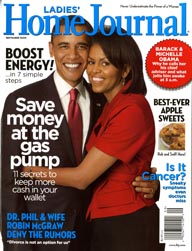
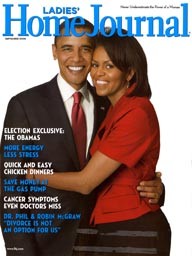
Ladies’ Home Journal’s Sept. issue sports an interview with Michelle and Barack Obama with the picture of both sharing the cover of the magazine. Single copy buyers get an extra inset picture, with not so subliminal message, of an apple pie that readers can “rub and sniff” and the smell of the apple pie sends a wow through the senses of the customers. What can be more American than an apple pie? Well, you do not have to be a genius to add one plus one and the entire cover package is smelling like an apple pie. The subscribers of Ladies’ Home Journal have to be satisfied with the smell of ink on paper (and as much as I love the smell of ink on paper, I can’t write that the smell of ink on paper is as American as an apple pie…)
In my previous blog, I have asked the question about the coverage both Obama and McCain are receiving from the American magazines, well you can add this one to the Obama camp and you can keep on counting… My guesstimate is the score is at least 4 to 1 in favor of Obama. Have a different theory, please do not hesitate to comment.

As American As An Apple Pie…
August 7, 2008Reader’s Digest Takes a Page From Obama’s Campaign, and Who Landed on More Magazine Covers…Obama or McCain?
July 29, 2008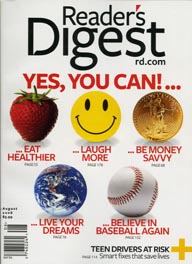
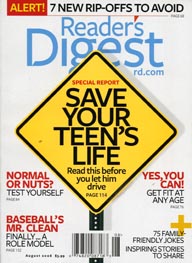
In yet another magazine example of offering different single copy covers in different areas of the country, Reader’s Digest in its August issue took the Obama’s campaign slogan “Yes, You Can” and used it on one of the two covers being sold on the newsstands. I wish I can say the other cover is a page from the McCain’s campaign, but by its looks I doubt that.
Which brings me to a completely different academic topic, have you noticed how many covers Senator Obama has been on compared with Senator McCain. It will make a nice academic study to compare the two senators and the number of times they have appeared on magazine covers. Whether on the cover of American magazines or European magazines, my theory is that Senator Obama has appeared on more magazine covers than Senator McCain. It is just a hypothesis for now, but I bet you it will not be hard to accept after some research. A graduate student waiting in the wings for a master’s thesis topic can take this challenge and start the research. Please keep me posted, or just let me know whether you agree with my hypothesis or not…
MagCloud: The Future of Magazine Publishing? An interview with Derek Powazek
July 18, 2008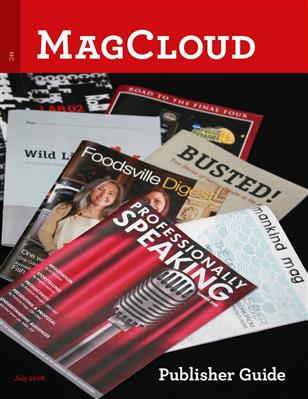
Remember the old saying, “the freedom of the press belongs to those who own the press!” Well, the folks at MagCloud want you, not only to own the press, but to write, edit and design your own press. A product of years of research at the HP Labs, MagCloud wants to “ease the pain” of magazine publishing and give the opportunity to everyone with an idea, any idea, to become a magazine publisher. MagCloud’s own take on things is as such,
“MagCloud is an HP Labs research project evaluating new web services that will provide small independent magazine publishers, online content owners, and small businesses the ability to custom publish digitized magazines and economically print and fulfill on demand.”
Derek Powazek, whom I first interviewed when he helped launch JPG magazine, serves as a consultant to HP Labs on this project. I have asked him few questions regarding MagCloud. After a brief intro, Derek answered my seven questions regarding this new venture that wants to make YOU a magazine publisher overnight…
He wrote, “Before I begin, I want to stress that MagCloud is a project by HP Labs, currently in beta, to which I am a consultant. It was not my idea – it’s been percolating for years within HP, actually – but it happened to dovetail wonderfully with my interests, and I came on board to help guide it forward. The core members of the team are Udi Chatow, Andy Fitzhugh, and Andrew Bolwell – all brilliant HP Labcoats. I can introduce you if you like. With that in mind, here are some thoughts….”
1. MagCloud promises to make magazine publishing as easy as
photocopying at Kinko’s. Is this the future of magazine publishing or
the return to old memo-graphed underground publications?I’ve run a magazine out of Kinko’s. It’s not that easy!
My personal hope is that MagCloud kickstarts a new generation of zinesters, people raised on the ease of publishing on the web, but who still hunger for the beauty and permanence of print. The last creative explosion in zines was kicked off by copy machine. The next will be powered by print-on-demand coupled with the internet.
2. Do you view MagCloud as a publisher, printer or distributor?If I had to pick one of the three, MagCloud would have to be a distributor, because we partner with printers, and our goal is to enable our members to become publishers themselves.
But, really, MagCloud is is a connector. We connect publishers to their audiences, printers with magazines, readers with magazines, etc. We see an enormous opportunity to breathe new life into the magazine biz, if only publishing was as easy and accessible as the web.
3. When would a magazine produced by MagCloud reach the status of a
real magazine (i.e. mass distributed magazine)?We’ve got a pretty loose definition of what a magazine is. But, in general, if you print on paper, on a schedule, to subscribers, we think you’re a real magazine.
The whole idea of mass distribution comes out of embedded expectations about the economy of magazines. You can only make money in traditional magazines at scale, because it’s just not cost-effective to do small print runs. But that’s a technology problem – traditional offset printing is just too expensive to do in small batches. But what if it wasn’t?
If you look at the cost per page of printing, traditional offset printing is actually getting more expensive because of rising paper costs, but the cost per page of print-on-demand is getting cheaper/better/faster ever year. As price points merge, and it will cost just as much/little to print a single copy as a thousand. That change is happening now, and the industry is just beginning to notice.
4. After your experience with JPG and moving it from lulu.com to a
regularly published magazine, are you looking for an encore with the
titles coming through the pipe line at MagCloud?Absolutely, only this time, we want to empower other people’s magazines. The math here is simple: If it was easier to make magazines, more people would do it. More magazines means more potential breakout hits. Too many great magazines don’t get made today because the business of printing and distribution is so hampered by inefficiency.
5. How do you view the future of magazine publishing and what is the
biggest challenge you think it is facing?Young people are abandoning print magazines for the web – they have been for years. The way to bring them back is to put them in charge and see what they make. It’s easy for the pros to scoff at this idea, but remember that groups of amateurs have made some pretty amazing things online (insert inevitable Wikipedia reference here).
And remember, MagCloud is not just for the amateurs. The pros are bound by the same difficulties. Show me a dozen editors and I’ll show you a hundred magazine ideas that would exist if only it was a little easier. Not to mention all the content remixes and short-run editions professional publishers could put together on a system like MagCloud.
6. Will technology help print and add more printed products to the
marketplace or technology will replace print?I think that we’re still figuring out what kind of stuff belongs in print, and what doesn’t. Remember that, for years, if you wanted to find out what the weather was like in a certain place, you bought a book. A Farmer’s Almanac. Putting that kind of variable data on paper seems crazy now, because we have a better way to do it.
So, yes, technology will drive some print products to their grave. Personally, I would not want to be running a traditional news weekly right now.
But I we both know that print is not dead. There’s content that really belongs in print. Look at the success of Make Magazine, photography journals, recipe books. We just need to figure out how print and web can stop competing and start collaborating.
7. What do you consider the single most important selling feature of MagCloud?That someone who’s fanatically into a topic area could create a magazine, build an audience, and actually make money selling it, without ever having to stuff envelopes. Hasn’t that always been the dream of independent publishing?
So, magazine dreamers of the world there is no need to unite anymore for each and every one of you can have his own “cake” and eat it too… you are indeed on cloud nine with your ideas now, or should I say you are on MagCloud.
Two Trend Setting Magazines…
July 10, 2008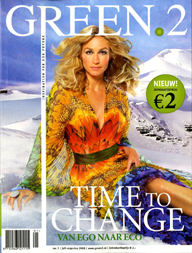
Two magazines have captured my attention lately and neither are published in the United States of America. The first one is brand new and the first issue is barely two weeks old. The name is Green.2 and the tag line is “Inspiration for the Future” and bills itself in its ads as “The first green glossy in the world.” The first issue was published June 25, and dated July/August 2008, in Amsterdam, The Netherlands. The magazine brings its cover story Time to Change to reality through the different stories and quotes inside the magazine. A well designed publication with a host of quotes including this one from Robert Redford, yes The Robert Redford: “Whatever you today, think what it means seven generations down the line.”
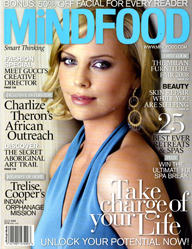
The other magazine just published its fourth issue dated July 2008 is MindFood and its tag line is “Smart Thinking.” And, smart thinking it is. It has been some time since I have seen a magazine with Food in the title and is not aimed at the lower part of the body but rather at the upper part, and specifically the Mind. Published in New Zealand on a monthly basis the magazine is a great example of 360 publishing. It is a well written, well designed glossy; it is online; it is tv; it is podcast; it is newsletter; it is gallery; it is puzzles; it is recipes; and it is shopping. I have been using MindFood in all my recent presentations both in Europe and the United States as yet another example of a great magazine utilizing the power of print and beyond. Talk about innovation in print, on line and off line. The total MindFood experience will leave you breathless. Check it here.
As long as we can create magazines such as Green.2 and MindFood, there is no fear or doubt about the future of print—not today and not tomorrow. I said it before and it is worthy of repeating time and time again: our problem is not in our medium, it is in our message.
Innovation in Print: Wallpaper* and the Magic Ink
July 8, 2008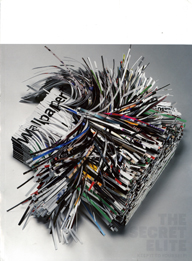
The subscribers to Wallpaper* magazine received a treat unlike any that I have seen in a long long time. Their limited edition subscribers’ cover came with a cover that you can barely see the name of the magazine, the prices and the main cover line as you can see in the picture above. The issue is on The Secret Elite and in keeping with the theme of the issue the magazine opted, as a treat to their subscribers, to provide them with a secret only the sun will help them reveal. Inside the magazine readers were told “As we are in a secretive mode, the special ink on this month’s limited edition cover will only reveal itself in sunlight…” Of course, being me, I tried the light form my lamp, the scanner light and any other source but the sunlight. Nothing happened. I have kept my magazine in the dark for three days until I was able to scan it before venturing outside to the sunlight. Wow! Instant magic. The secret areas instantly turned to purple and I was able to read the name, the prices, the cover line and the secret code on the spine. However the magic did not last long enough before the colors faded back. It took two trips to the sunlight before we were able to barely scan the cover showing some of the magic ink as the first image below shows… The digital camera came to the rescue and a picture of the cover basking in the sun is shown next to the scanned one.
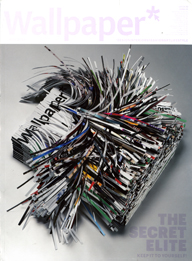
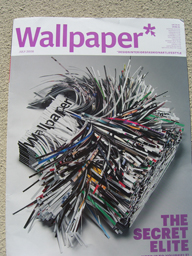
Talk about the power of print and the need for more innovative means interacting with our readers/customers. Yet another example of the VIP factor, i.e., the visual impact of print.
An Answer to a 42 Year-Old Question?
July 7, 2008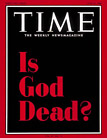
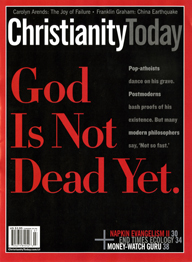
“Is God Dead?” was the question on the cover of the April 8, 1966 Time magazine. My late brother Khalil was three years ahead of me in our high school, Tripoli (Lebanon) Boys School. Time was required reading for the 11th and 12th grade students at the school. When I saw his copy of the magazine I could not wait for him to finish reading it so I can read it. (I was not allowed to touch it until he is done with it). That issue and that cover left quite an impact on me back then.
Well, last week, visiting the newsstands in Memphis, I had a big flash back to 1966. I saw what looked like the cover of Time from 1966, but it was, in fact, Christianity Today (another magazine I got to know during my high school years in Lebanon thanks for a visiting pastor from America to our Presbyterian church in Tripoli). The cover of the July 2008 CT had the answer for the 42 year-old question Time magazine asked in 1966. In a similar take on Time 1966 cover (same color and design) the CT cover answered the burning question Is God Dead? CT’s answer “God Is Not Dead Yet.” Issue settled for now… but that “Yet” may make room for a more definitive answer in the future, so stay tuned…maybe for another 42 years. At least we are making progress.
First Six Months New Launches Report: June to the Rescue
July 6, 2008

June came to the rescue of the total numbers of the new magazine launches with a total of at least 57 titles hitting the newsstands, two short of last June 07 and 20 more May of this year. The total number of new magazines launched so far this year stands at 291, still short 75 titles from the 366 titles published in the same period last year. However, the biggest drop this year comes in the regularly published magazines with a frequency of four times or more. The first six month of 2007 saw the launch of 132 magazines with the intention to publish at least four times or more. This year the numbers are a mere 78 titles. That is a drop of almost 40% than the previous year. This is a first since I have started tracking the magazine industry over 30 years ago.
The specials continue to match the numbers of last year with a total of 193 this year compared to 197 for the same period of last year. The annuals on the other hand saw an increase from 12 titles last year to 18 this year. The remaining titles were those published two or three times a year.
As I have written earlier, this is going to be the second year out of three that we are going to have a decrease in the number of new launches. It is part of the life cycle of new magazines. The reason I believe June witnessed the launch of 15 new magazines with a frequency of four times or more is the old-aged belief in the fact that launching a magazine during hard times (think Fortune, Esquire, Entertainment Weekly) is often better for the survival of a new magazine than launching it during good times. It will take a year or two for the magazine to establish itself and the hope is that the economy will rebound and the new magazine will be ready for the marketplace.
Some great magazines have been published during the first six months of 2008 that adds to my belief that the problem is not with our medium, but rather in the message we carry. Check my reviews on what’s hot and what’s not here and take a peek at every magazine I was able to locate for the first six months of 2007 here.
In my attempt to make sure that every new magazine is properly added and coded I make every effort to locate the first issue of the magazine. If yours is not here please feel free to send me a copy of the first issue to: Samir Husni, Box 2906, 105 Farley Hall, University, MS 38677.
More on the dual covers trend…
July 3, 2008My friend Rex Hammock has promised on his blog today that he is going to offer his opinions on the issue of split covers between single copies and subscribers copies of the same magazine. Just for the sake of giving him more examples and points of reference for his comments, here are the two editions of Harper’s Bazaar for July. A stunning and sexy Gwyneth Paltrow image graces the subscribers’ cover that jumps from every mailbox and coffee table (always keeping subscribers on their toes, so to speak), and a run-of-the-mill single copy cover that reflects the habitual look of the magazine so newsstands’ buyers will not be confused whether it is the same magazine they buy every month (Think Cosmo, same cover design for how many years now?)…
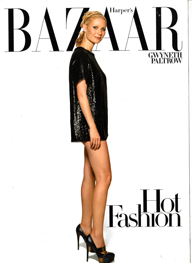
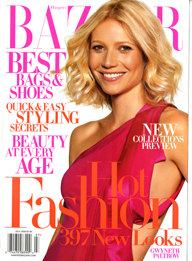
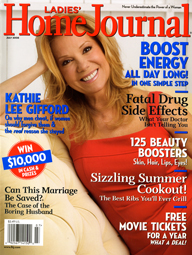
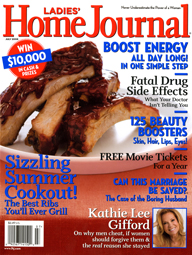
However this ever expanding trend is not only limited to the newsstands vs. the subscribers, but also continues to spread among different newsstands’ geographical locations testing different covers and different images. Ladies’ Home Journal’s July issue offers a split newsstands distribution with two cover photos, that of the celebrity Kathie Lee Gifford and the hot and sizzling summer cookout. It is fun to note that the ribs image did not make it to the Gifford cover, but Ms. Gifford was able to make it, albeit, in a very small inset on the ribs cover…go figure!
Time to Relax… Dream It, Live It…
July 1, 2008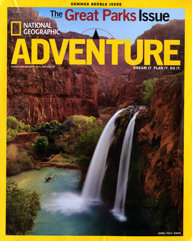
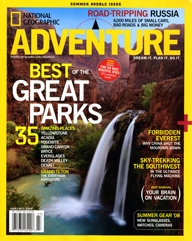
The summer double issue of National Geographic Adventure lives up to its tag-line: Dream It, Plan It, Do It. The subscribers’ cover is a relaxing beauty to look at; an invite without words to get you into the magazine. The newsstands’ cover, with its usual cover lines, maybe un-relaxing in its design and typography, but extremely relaxing with the choice of topics. Whether you are a single copy buyer or a subscriber this issue of NG Adventure is a must to have, to enjoy, to relax and to live it up. It also adheres to the basics of human memory recall skills: people see and remember color first, pictures second and type third… That is why I always tell my clients not to change the color and pictures when having a split edition between the single copy and subscribers’ editions so the readers will not be confused….as for the type, by the time our memory cells are at work, the color and the photo image already tell us it is the same magazine, so there is no room for confusion.
The U.S. Presidential Elections on Magazine Covers…
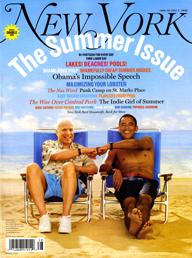
June 30, 2008Some magazines have declared the winner when it comes to the presidential elections and some are still waiting for the public to decide. Others have decided on their dream team working together. Here is a quick snap shot of some magazines and the way they treated the Democrat and Republican candidates.
For Rolling Stone there is no question about their choice (and no cover lines, as in what more can we say?) Barack Obama is the choice and for the first time in a long long time RS has a cover with no cover lines… (last that I can remember are the John Lennon and Yoko Ono cover in 1981, the Demi Moore cover in 1995, and George Harrison in 2002. As in the Obama cover, there was nothing but the name of the magazine, the date and the picture…not even a caption identifying the pictures.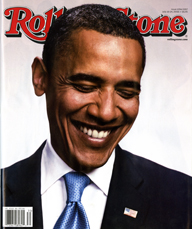
Fortune magazine on the other hand opted for giving the people the choice between the candidates. A split cover on newsstands offers readers the two candidates (each on his own cover) with the coverline How I’ll Fix The Economy. The editors at Fortune told min newsletter that they will let us know the result of the single copy vote at a later date.
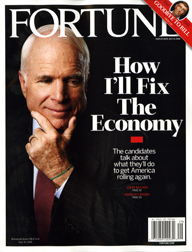
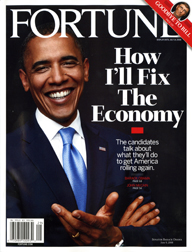
Newsmax magazine opted for the person who is ready when the Red Phone rings at 3:00 am. With the Red Phone being the big picture on the cover, the coverline informs readers that McCain is ready to take that call.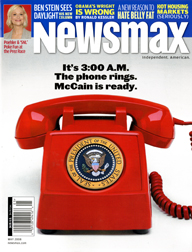
My choice of the presidential election covers is that of New York magazine (which, by the way, has become my favorite magazine of late). Why decide when you can have the dream team…McCain and Obama joining hands and working together…Maybe that will be the dream team for the future…but wait a second, who will be the Presidential Candidate and who will be the VP? Oh, well, just a minute detail…
Enjoy the summer and look for more presidential covers coming soon…


