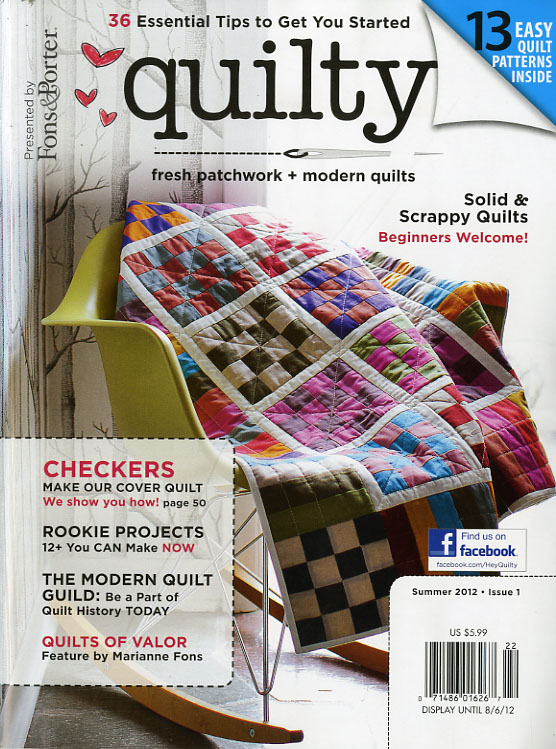
In the sea of new magazines, almost 60 new titles arrive at the newsstands every month, it is always a delight when one magazine stops you in your tracks and demands attention, much more attention than the rest of its siblings. Quilty is the new magazine for “fresh patchwork + modern quilts.” However, it was not the cover that demanded that attention nor the cover price. It was the editorial written by Mary Fons, Quilty’s editor.
Ms. Fons’ love of magazines and the media is in her blood. Her grandmother ran her town’s newspaper, her mother co-created Fons & Porter’s Love of Quilting magazine and both of her sisters are busy bees in the world of media. Ms. Fons starts her letter from the editor by the profound confession, ” I adore magazines.” She goes on to write,
If they are made of paper, I bend them, fold them, dogear them. I tack torn-out pages on the walls of my office; I rip out images to stick on my fridge. My magazines get wet, get crinkled, get read.
If I’m reading a magazine on a screen — which happens more and more, I notice — I click with wild abandon. I gleefully bookmark. I zoom in, I zoom out. I forcibly close the nine shopping carts I open. (Usually.)
As I mentioned earlier, Mary Fons comes from a family of “image and word people. Idea people. And a magazine is the perfect vehicle for timely, consumable ideas.”
A great maiden-voyage editorial and a great maiden-voyage issue of a great new magazine: Quilty. Add to that a very smart-named web site http://www.heyquilty.com
Indeed, magazines are all about ideas, consumable ideas that go beyond good content to great experiences. Pick up one today and enjoy!
Since my arrival to America I was told I must learn about baseball if I am to learn about America. “If you know baseball, you know America– and its favorite past time.” Well, needless to say that magazines were and still are my best educators, and when it came to the subject of baseball, Baseball Digest was the magazine to go to. The magazine has been covering the game for almost 70 years now. Norman Jacobs has been the owner/publisher of Baseball Digest since 1969. Over the years he has started and sold many titles: Football Digest, Hockey Digest, Basketball Digest and Inside Sports. With Baseball Digest’s 70th anniversary rolling around in September, Mr. Jacobs takes us to the ballpark- the new and improved ballpark he has planned for the re-launch of Baseball Digest. I talked with him recently as he explained the improvements and increased circulation he has planned for the title.
And as is with every Mr. Magazine ™ Interviews, first the video, followed by the sound-bites and the very lightly edited transcript of the entire interview.
So, sit back, relax, and watch the video interview with Norm Jacobs.
The Sound bites:
On the history of Baseball Digest: Well, back in 1969 I had sold my publishing company, at that time we were publishing business and trade magazines. I looked around to find some kind of publishing property to buy and develop. Lo and behold, I found in my hometown of Highland Park, not more than a mile from me, Baseball Digest Magazine published in someone’s home.
On the plan for the magazine’s future: And furthermore, we’re talking about developing within the magazine; the pro-scouting information, this is data never available before and developed by an outside company, to drop in possibly as an insert and re-launch this magazine, hopefully with our 70th anniversary, which is in September of this year, 2012.
On whether or not he believes there is hope for baseball, since the entire country seems addicted to football: Well, I certainly do, because as we all know, baseball attendance is zooming. And the baseball fan has always been thirsty for information and knowledge, particularly for statistics and the kind of information that may not be in other publications.
On where he will be a year from now: Well, I would hope that we’d be…well, we’re thinking of launching with a 100,000 on the newsstand, hopefully we’d be at 200, or somewhere around that point, 250 even.
On what keeps him up at night: Mostly cash flow. We all know that publishing today is so different than it was in the old days.
And now for the full, lightly edited, transcript of the interview with Norman Jacobs, owner and publisher of Baseball Digest magazine:
Samir Husni: Baseball Digest is a legend. It’s going to be 70-years-old this coming September. Tell us a little bit about the history of the magazine, and what the plan for the future is. What do you tell folks who say, “Baseball Digest, is it still being published?”
Norm Jacobs: Well, back in 1969 I had sold my publishing company, at that time we were publishing business and trade magazines. I looked around to find some kind of publishing property to buy and develop. Lo and behold, I found in my hometown of Highland Park, not more than a mile from me, Baseball Digest Magazine published in someone’s home. I, personally, had not been to a baseball game in twenty years. But it did excite me that this magazine was for sale because the publisher had passed away. It excited me because it only had about 10,000 in circulation and even I figured with all the millions of baseball fans in the country, this title should be much more than that. So I went ahead and purchased it, and working for the first time with the agents and direct mail, we quickly got the circulation up to over 200,000. At which time, I decided to go forward with Football Digest and then later on, hockey, basketball, and all the sports titles. But Baseball Digest was always known to the baseball fan, they always liked the magazine and we traded on that. Originally, I tried to get involved with the little leagues, selling Baseball Digest as a fund raiser, but on the staff there was myself and my secretary and that was it. We didn’t go too far with that. So the years went on and the circulation grew, but I got very involved in our other titles, particularly with Inside Sports when I bought that and re-launched it. So really there wasn’t all that much attention paid to it. And over the years as I grew to a point where I was publishing 20 magazines, I started selling some of them off and a few had to be closed down and so forth. And so that brings us up-to-date; right now I am left with or only have 2 titles in my publishing group, Baseball Digest and another magazine called Cruise Travel. However, we are now talking to people about really, quote “re-launching” the title and making it a lot more than it is today. And by that I mean, to give some detail, we’re only distributing 10 or 12,000 copies on the newsstand, so we’re talking about going to a 100,000 or more. And we’re talking about going from a news print publication to a very slick, beautifully-designed baseball magazine. And furthermore, we’re talking about developing within the magazine; the pro-scouting information, this is data never available before and developed by an outside company, to drop in possibly as an insert and re-launch this magazine, hopefully with our 70th anniversary, which is in September of this year, 2012. So there is a lot of work to do, it’s very, very exciting; the Baseball Digest brand is well-known, it’s just that we need to get it out there again so all of the people who have known Baseball Digest over the years will realize that we’re back in business, but with a much bigger and better package.
Samir Husni: Someone once said that you can’t know America without knowing baseball. Do you think you can re-create a magazine that will help people fall in love again with baseball? Do you think that people have lost their first love, and football is now everywhere and everybody talks about football; do you think there is hope for baseball?
Norm Jacobs: Well, I certainly do, because as we all know, baseball attendance is zooming. And the baseball fan has always been thirsty for information and knowledge, particularly for statistics and the kind of information that may not be in other publications. Now, with Baseball Digest as practically the only frequency-type of publication available, mostly the other titles are annuals. But I do think, yes, that because it has been around for so many years and so many people that I’ve talked to say, “Oh, I remember. I read Baseball Digest when I was five, seven, or ten-years-old.” I think that if we develop the product, bring it up-to-date and have a magazine that has some nostalgia to it, as it always has, but new and current ideas, and articles and features, plus getting involved in the digital era with all kinds of websites and iPads, iPhones and databases and everything like that. So, I’m very hopeful for the future of the title.
Samir Husni: If we’re here having this discussion a year from now, what’s your hope? Where will you be a year from now?
Norm Jacobs: Well, I would hope that we’d be…well, we’re thinking of launching with a 100,000 on the newsstand, hopefully we’d be at 200, or somewhere around that point, 250 even. Our subscriber base would go from 70,000 to hopefully several 100,000, I don’t know if that’s ambitious or not, but with the proper promotion and the effort behind it, a year from now would be a much different picture than it is today, for sure.
Samir Husni: You’ve been a publisher for years and years, and I ask this question to almost everyone I interview: What keeps Norm Jacobs up at night?
Norm Jacobs: Mostly cash flow. We all know that publishing today is so different than it was in the old days. I remember when I wanted to start a new magazine, I’d pick up the phone and call Curtis and say that I’m starting Hockey Digest and I want to distribute 70,000 copies and that was it. I’d have a sell sheet and it was done. Today it doesn’t work that way. Unfortunately, there’s a lot more to it and it’s a lot more expensive. And a re-launch of this title, this brand that we’re talking about, we’re talking about quite a bit of an investment. And I think that would keep me up a few nights along the way.
Samir Husni: If someone came up to you and said, “Mr. Jacobs, I want to start a new magazine today.” What advice would you give them?
Norm Jacobs: Well first of all, I think that I would say, call Samir. You need to talk to the consultants, the people who really know the industry; particularly those who are up-to-date with what’s going on. Because it’s more than just a magazine today, there’s got to be everything that’s surrounding it in the digital era. And secondly I’d say, you better have a lot of money. And thirdly I’d say, you need a lot of luck. And fourthly, you know, there’s really a lot of work that has to be put into any new title. I guess that’s what I’d say.
Samir Husni: Thank you.
(Full Disclosure: I guess Mr. Jacobs followed his own advice. Few weeks after my interview with him, I was asked to join the team as a publishing consultant. I have accepted that invite and joined the team as a publishing consultant for the relaunch of the magazine).
Before he founded GoSPORTn Inc. and hooked us with “The Year in Fishing” via GoFISHn’s new iPad magazine app, Ned Desmond was the head of Time Inc. Interactive, and also served as TIME magazine’s bureau chief in both Tokyo (’92-’96) and New Delhi (’88-’91), while wearing the hats of writer and researcher before that. He is a man who is grounded in print, but who became a digital enthusiast as the future of journalism began to take an exciting turn. Now he enjoys indulging his readers’ passion for hunting and fishing as president and founder of GoSPORTn and lives in the realms of the web whole-heartedly, while never relinquishing his love for the printed page. Find out what he thinks about the future of journalism, his thoughts on launching a digital-only enterprise, and of course, what keeps him up at night, in this segment of the Mr. Magazine™ Interviews.
And as is with every Mr. Magazine™ Interviews, first the video, followed by the sound-bites and the very lightly edited transcript of the entire interview.
So sit back, relax and watch the video interview, done via Skype, with Ned Desmond.
And now for the sound-bites:
On the difference between launching something that is digital only, versus using print as your web base: Well, I think when you have a big, established print business and editorial team and sales team; you have a lot to work with when you’re trying to develop an online property.
On how you make your brand’s app stand out from a million others: Well, that’s the hardest question of all. You can create something really beautiful and it’s difficult to get attention.
On the advantages and disadvantages of creating an online presence on your own, versus when you have a mega brand behind you: The advantages and disadvantages are pretty stark, I’d have to say. When you are a big company, of course, you have lots of help and you have an enormous, established base in everything, on the sales front, people return your calls, on the editorial front, you have very talented teams who are busy doing great work, on the brand front, you’re out there and consumers know who you are.
On why he picked hunting and fishing as his main focus for Go SPORTn: When we were looking at the categories, we discovered that fishing, in particular, is the largest of all the enthusiast’s categories. There’s nothing that quite compares to it, in terms of the number of people who go fishing in the United States.
On his most pleasurable moment with Go SPORTn: I would say the pleasurable moments come every few days when we discover some content in the fishing world or in the hunting world that is truly exciting, that has been uploaded by somebody who is an amateur, and all it really needs is exposure to a big audience and it takes off and you can see it go viral.
On the biggest hurdle he has to overcome to make Go SPORTn a success: Well, I’d say that we’ve been a success from a brand standpoint, and we are successful from an audience standpoint, but trying to match the audience scale to the available ad dollars is very tricky.
And now the lightly edited transcript of the interview with Ned Desmond:
Samir Husni: You know, you spent so many years trying to develop some kind of a business model that integrated the print brand and digital. Now you are at this venture, which is digital only. What’s the difference between launching something that is digital only, and using print as the base to launch something?
Ned Desmond: Well, I think when you have a big, established print business and editorial team and sales team; you have a lot to work with when you’re trying to develop an online property. There is always a lot of, what we called, untapped assets, undiscovered assets that could be re-deployed for use on the web. One of the great examples at Time Inc. was how we used the People Magazine editorial team, the correspondence, in particular, to develop a breaking news product for the website, which didn’t have any relevance in the magazine, but was enormously successful online. When you’re starting from scratch, as we did with GoFISHn, you’ve got to think about how to create content and create it in an economical fashion, so that it’s in line with the economics of an ad-supported business online, which, as you know, are pretty demanding.
Samir Husni: One of the things that I always wondered about; if we have around 10,000 different magazines on the marketplace, there is probably now a billion apps available.
Ned Desmond: Probably.
Samir Husni: How can you break through that clutter, how can people find GoSPORTn or GoFISHn apps, from the gazillion number of apps that are out there?
Ned Desmond: Well, that’s the hardest question of all. You can create something really beautiful and it’s difficult to get attention. What we do is use our available distribution mechanisms to get the word around about the app that we created. What we did, essentially, was take the best of 10,000 posts that took place in 2011 on the GoFISHn website, that’s gofishn.com, and turned them into quite a beautiful app that has a magazine-like experience and we used all the folks whose content we included to help us promote the app, and we also used our Facebook presence which has nearly 200,000 fans to promote the app, and then we reached out to anyone we knew to download it, review it, to help us get the word out. But I’d say that we’re still in an experimental mode. We got some pretty strong initial response, we think we may have priced it a little bit too high; pricing is another function that seems to have a pretty dramatic impact on how widely-used your app might be. So, it’s tricky. It’s something that you really have to think about ahead of time. If you don’t have strong distribution ideas or vehicles, it’s really tough to get the word out.
Samir Husni: So, you’ve done it when you were a part of a major media company, and now you’re doing it on your own.
Ned Desmond: Yes.
Samir Husni: What are the advantages and disadvantages of both models?
Ned Desmond: The advantages and disadvantages are pretty stark, I’d have to say. When you are a big company, of course, you have lots of help and you have an enormous, established base in everything, on the sales front, people return your calls, on the editorial front, you have very talented teams who are busy doing great work, on the brand front, you’re out there and consumers know who you are. When you’re running a little business, like I am, all of those things go back to zero, basically. You only have the staff that you can afford, which, in my case, is almost nobody. The brand is something you still have to establish and all of those other things have to be built from scratch. So, it’s far more demanding from a kind of building standpoint. But, it’s also far easier from a coordination and communication standpoint; you don’t really have that many people to stay in touch with. Whereas, in a big company, like Time Inc., you have to reserve an enormous amount of time for feedback and explaining your plans, and making sure everybody is on board and is ready to support you.
Samir Husni: Why did you pick fishing and hunting? Your background as a journalist and the magazines that you’ve worked with, they’re as far from fishing and hunting as can be.
Ned Desmond: That’s a great question, Samir. I chose it because when I was at Time Inc. and my team was working across a lot of different properties and trying to figure out where the hidden assets were that could help revive or supplement the print businesses, and for a time we worked on some of the properties which were, at that time, in what was called the Time for Media Division of Time Inc., which included a lot of outdoor enthusiast titles, everything from snowboarding, to hunting and fishing, and all the rest. And the key insight that we had there was that user-supplied media, whether it was somebody skateboarding and making a video of it, or surfing and making a video of it, which has become a mainstay of those brands in recent years, that that was really the key to unlocking a lot of value within those brands. In other words, if you read Field & Stream, or if you read Surf, or if you read Skateboard Magazine, you wanted to be able to contribute your own exploits to that audience. We sold those properties to Bonnier. Bonnier has prospered with them; they’ve done really, really well. When I left, I thought it would be really interesting to try to build a publishing platform that would allow those enthusiasts, regardless of the category, to publish their pictures, their video and their stories. And then when we were looking at the categories, we discovered that fishing, in particular, is the largest of all the enthusiast’s categories. There’s nothing that quite compares to it, in terms of the number of people who go fishing in the United States. It was a little bit of a surprising insight for us because being Urbanites, more or less, we didn’t appreciate the depth of the passion for fishing that exists across the country, or the large numbers, or the significant amounts of money that gets spent in pursuit of fishing. So, we thought, why not begin in the biggest market? And that’s why we chose that. The platform we actually built was meant to extend into many categories, which is why it was easy to take into hunting, which has close affinities with fishing, that’s why we chose hunting. And then we stopped there in order to husband our resources and not get stretched too thin. But the plan was probably to go from there to gardening and some other arenas. So the real answer to your question is we thought that in the enthusiast’s publishing categories there was quite a big opportunity focused on media created by the enthusiast themselves.
Samir Husni: What has been the most pleasurable moment in this whole experience, in this whole creation of the app and the website?
Ned Desmond: I would say the pleasurable moments come every few days when we discover some content in the fishing world or in the hunting world that is truly exciting, that has been uploaded by somebody who is an amateur, and all it really needs is exposure to a big audience and it takes off and you can see it go viral, with hundreds, sometimes even thousands of ‘likes’ from Facebook and a lot of traffic in our traffic numbers. We really created these sites with the insight that amateurs in the enthusiast’s categories today are generating and posting most of the best content out there. So, our real goal is to get them big audiences and to create a media experience on the back of that.
Samir Husni: And what about the flip side of that? What was the biggest nightmare you had to face?
Ned Desmond: Well, there were plenty of nightmares. We, for instance, thought it would take us six months to develop the site, and it took us more like eighteen months, of course. We’ve had a number of big deals that we thought we were very close to signing and those deals didn’t materialize. There are lots of disappointments along the way; a lot of them are technical, just associated with trying to get things done that proved to either be too costly or unattainable. I have a business partner who is a terrific technologist and without his help we wouldn’t have gotten very far. But there are still a lot of challenges on the technical front. I would also say that one of the most surprising dimensions of this is getting people in the categories, the big brands and the categories, who were the likely advertisers, to participate. But what I have discovered is that in fishing and hunting, and this is one thing I really wasn’t prepared for, the businesses themselves are in pretty tough shape, and they aren’t all that keen on advertising in the digital realm. So, I brought some assumptions with me that I learned from the consumer product goods arena in mainstream publications, places like People and Time, and all the usual Time, Inc. titles, where the appetite was pretty strong among advertisers to participate on the digital side. And I would say, in some of these more specialized categories, that appetite isn’t so strong.
Samir Husni: What is your biggest hurdle now that you have to overcome to make this a success?
Ned Desmond: Well, I’d say that we’ve been a success from a brand standpoint, and we are successful from an audience standpoint, but trying to match the audience scale to the available ad dollars is very tricky. In that sense, we’re not any different from any other media business, any free ad supported media business online. The world that Google has created for us is so efficient, if that’s the right word, from an ad buyer’s perspective, that the return to the publishers is really pennies, where in other worlds, in other types of media, the returns were more like dollars. So scaling is a very, very big chore. If you’re going to get significant revenue out of the website, you have to hit very big audience numbers, or else figure out how to sell premium advertising. It’s a bit of a catch-22; if you make the investment to try and sell premium advertising, then you’ve taken your cost base up pretty far. The alternative is to figure out how to drive your audience through the roof, which is a function of time and improved Google page rank, and other things that are difficult to control, or to wait out in the event of time. So that’s sort of the conundrum. It’s the same, I think, that a lot of online publisher’s face.
Samir Husni: I’m going to take you back some years in your career, you were a journalist, a foreign correspondent, you worked in writing; how’s today different than those early years when you were active in the field, actually reporting, writing and doing the work of a journalist?
Ned Desmond: I was at the tail-end of the sort of traditional era of the foreign correspondent. So when I went overseas for Time Magazine we still had pretty big bureaus that were well-staffed, and they were well-staffed for a reason, it was difficult to just use the phone. I can remember when I was in the New Delhi bureau, we had a couple of young men who did nothing but dial the phone all day, just trying to get through because it was that time-consuming. And today, of course, that’s not an issue. I can remember my hands aching from using manual telexes in places like Kabul, where even if it was well-oiled, it was still very arduous to pound out a long, yellow tape that would eventually send your telex where it was going with your file back to headquarters in New York. And then near the end of that tour, I remember using some of the early laptop computers with a bulky modem that would actually transfer over the phone lines at a rate of 300 baud, which meant that it basically took an hour sometimes to send a whole file over the phone lines, but that was pretty revolutionary. Of course today correspondents and photographers, in particular, have it so much easier than they used to. They don’t have to get back to an airport and ship film and things like that. And correspondents generally can find whatever telecommunications hook-up that they need, even if they go direct to satellite with a local piece of equipment. So, from that standpoint everything is much more immediate. But I also think that for a lot of foreign correspondents, they probably don’t have as much help as they used to, the budgets are so much smaller than they once were and, of course, they’re much thinner on the ground than they used to be, which is really a shame because, I think, readers suffer terribly as a consequence. By the same token, most of the big news organizations, I think, do a pretty heroic and determined job of getting people where they need to be and trying to support them. So a lot has changed, but I think that the core commitment, but maybe with somewhat reduced budgets, is still there trying to get the good stories overseas.
Samir Husni: How do you see the future of journalism today?
Ned Desmond: That’s a really interesting question. I think that the demands on full-time professional journalists are tougher than ever. I think that because the ability of audiences to respond, and even compete with journalists is so easy to pursue. In other words, anyone can start a blog, anyone can post on Facebook and anyone can come up with better information if they put their minds to it. So journalists, in one sense, are more accountable because their audience can respond to them so much more quickly, and challenge them if need be. I don’t think that’s a bad thing, but it definitely makes a journalist’s job tougher. I think that the real problem for journalists is that the business model that made their work possible, obviously, is under siege. And the resources available to hire correspondents, to train them, to help develop their careers, to position them in foreign bureaus, or even domestic bureaus, those resources are diminished and, as a result, there are fewer working journalists. There’s less coverage and less competition and that’s really unfortunate. And I hope very much that there are business models that emerge that allow for a return of the numbers of journalists who have good, solid careers and good paychecks working for, whether it’s the new breed of organization, like Politico, or whether it’s revived daily newspapers and magazines, or whether it’s the big guys like Thomson Reuters or Bloomberg, who are going to continue to produce the independent journalism that I think the country and the world really depend upon. But I’d say it’s not really clear how that is going to happen at this juncture.
Samir Husni: What keeps Ned up at night?
Ned Desmond: What keeps Ned up at night? What keeps Ned up at night is this conundrum that I mentioned earlier. How do you scale fast enough to derive meaningful revenue from the websites? That’s really the toughest problem for online media folks.
Samir Husni: Is there anything else you’d like to add, or any question that I failed to ask you?
Ned Desmond: Well, I would like to mention our efforts with the app. I think they may be a little bit early for the marketplace. But I do think that the ability to take content from a website, which tends to be formatted in the way that is appropriate for websites. But it’s less beautiful, considerably less beautiful, and appealing than what you can do in a tablet, or in a mobile app. That is a very interesting pivot, if you will, or cut for a media business. I’ve really enjoyed creating “The Year in Fishing” app for the iPad because it felt so much more like a beautifully designed approach to the subject matter. And readers still respond so nicely to things that are beautifully designed. And it’s tough, as all content creators know, to do something that’s really beautiful in a browser because you end up being so concerned about other things: the performance of the page, the SEO, the navigation; all these things that tend to mitigate the pure delight of the experience. All that can come back again when you do it in an app. The simple flick of a finger and you turn the page. Every page can be packed with things that are really 100% about the visual design experience. So we’ve been really delighted by how people have responded to the app. We hope that advertisers will see the same possibilities that we see and support that in the future. We got a little bit of advertising support and we got a lot of interest. But there’s a lot of wait and see, as well. So I think that contrast between what you can really do to delight people in a browser versus in an app, is a pretty critical distinction. And I think it’s going to really serve content-makers in the future. Assuming we can get discovered at all, to your question, Samir. There’s an awful lot of content out there.
Samir Husni: So are you out of the print business?
Ned Desmond: I would say that I am out of the print business, yes, absolutely, until I am back into it. I’m a great believer in print. I just think that print in the future will have to be evermore beautiful and compelling, in order to be worthy of consumer’s attention. So I think that we can already see this… that magazines that really thrive as magazines that are beautiful, as magazines that really are perfect expressions of what the magazine designing art is all about; they are doing just fine. And consumers still want them and advertisers still want them. And a lot of other things that was just information tucked into the pages of a magazine because a distribution model or something else could support it as a good business, those have already, or will soon, fall by the wayside. And of course, digital will take up the slack. So I think that distinction will be there for a long time to come.
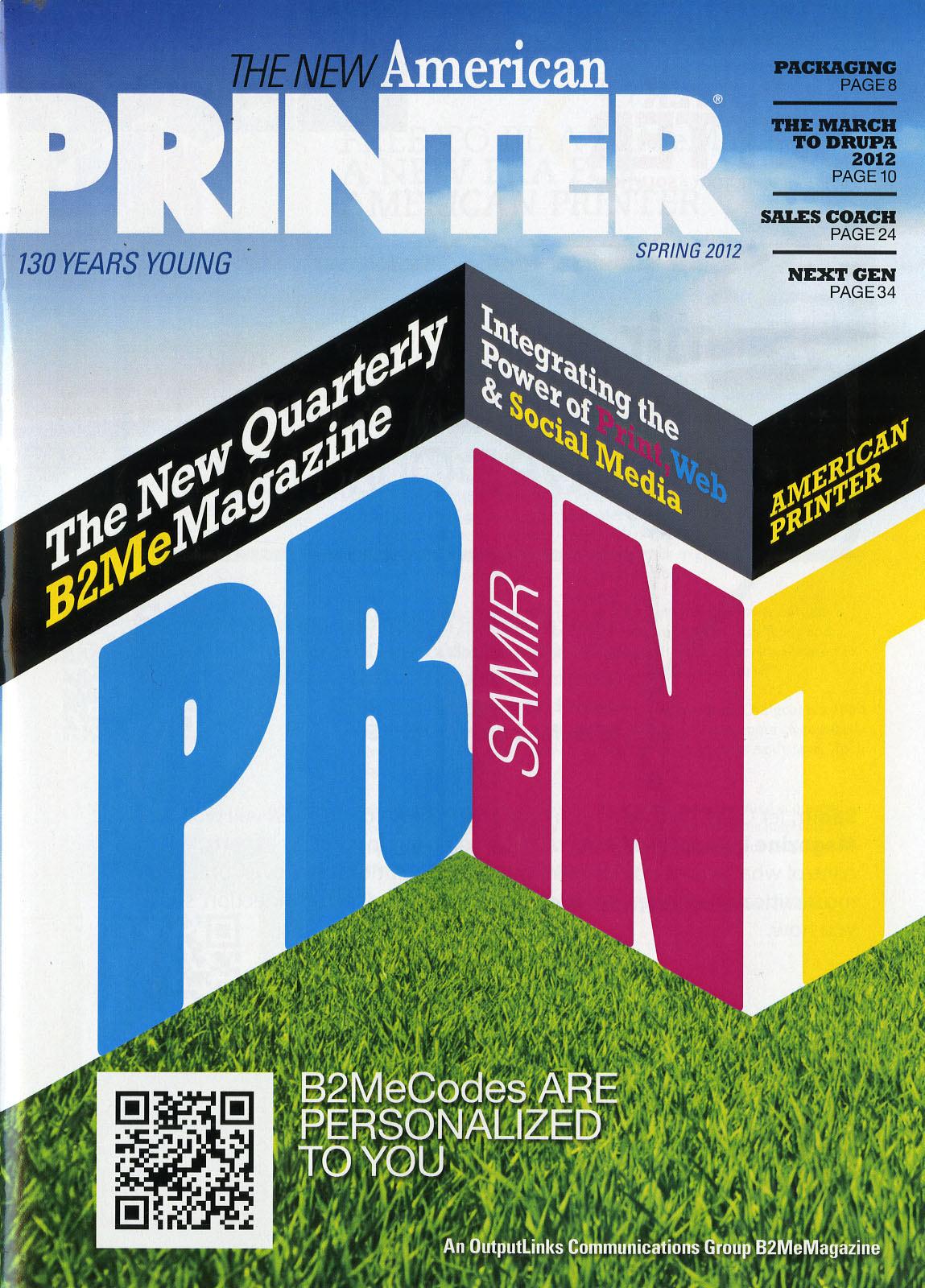
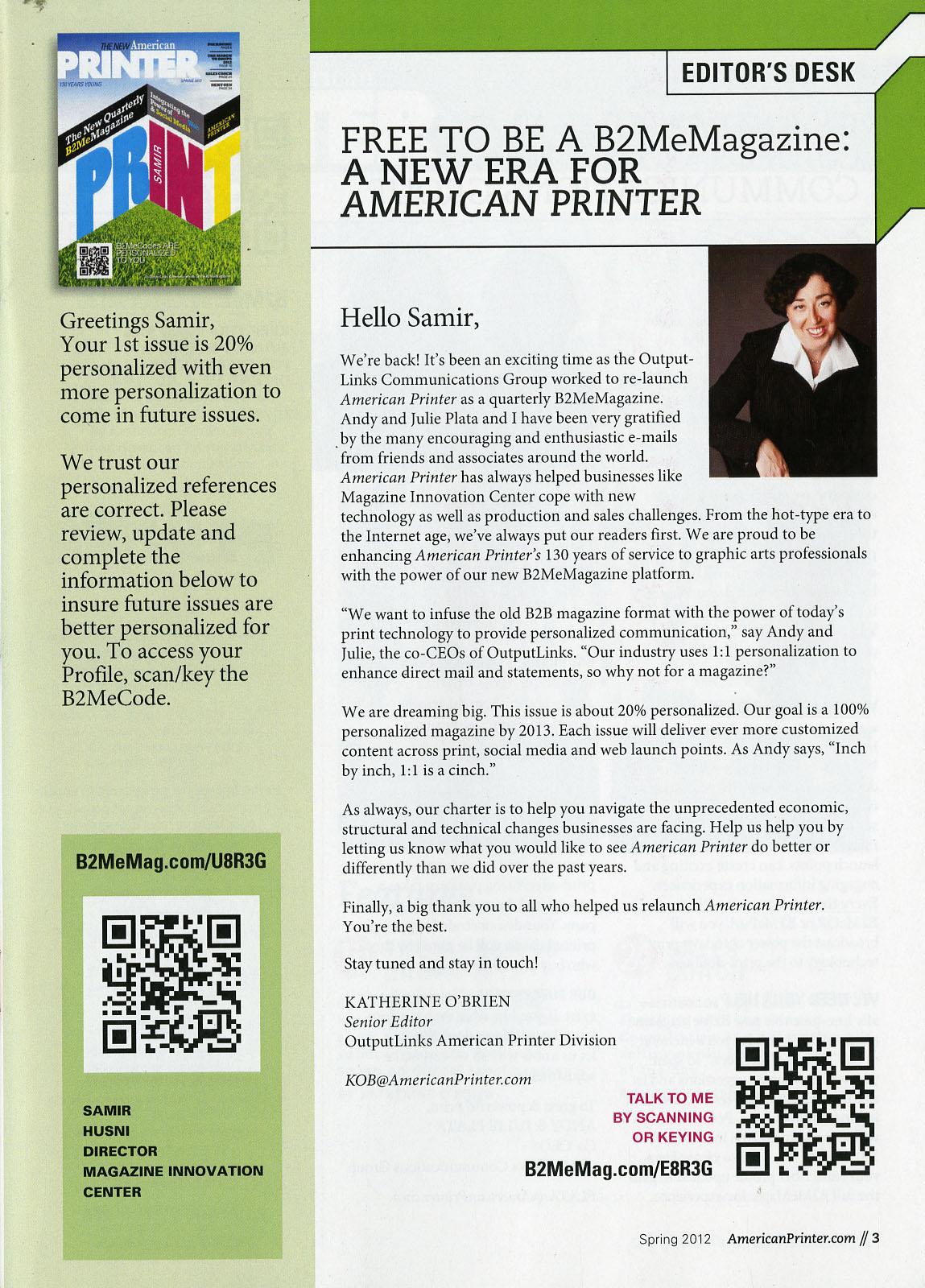
Magazines, successful ones, are much more than good content. The future of magazines is in the experiences a magazine can create with its audience. The more individualized the experience, the better the odds of making it. So, what if you create a magazine with YOU or Your Company specifically in mind and also have the capability to show me your creation in ink on paper. Not just in some ink-jet personalization of a cover or an inside page, but rather with a seamless integration of your name, the name of your company, the selection of the articles all combined in one issue mailed right to you with YOU as the bull’s eye of the dart board and the center of gravity for the entire issue.
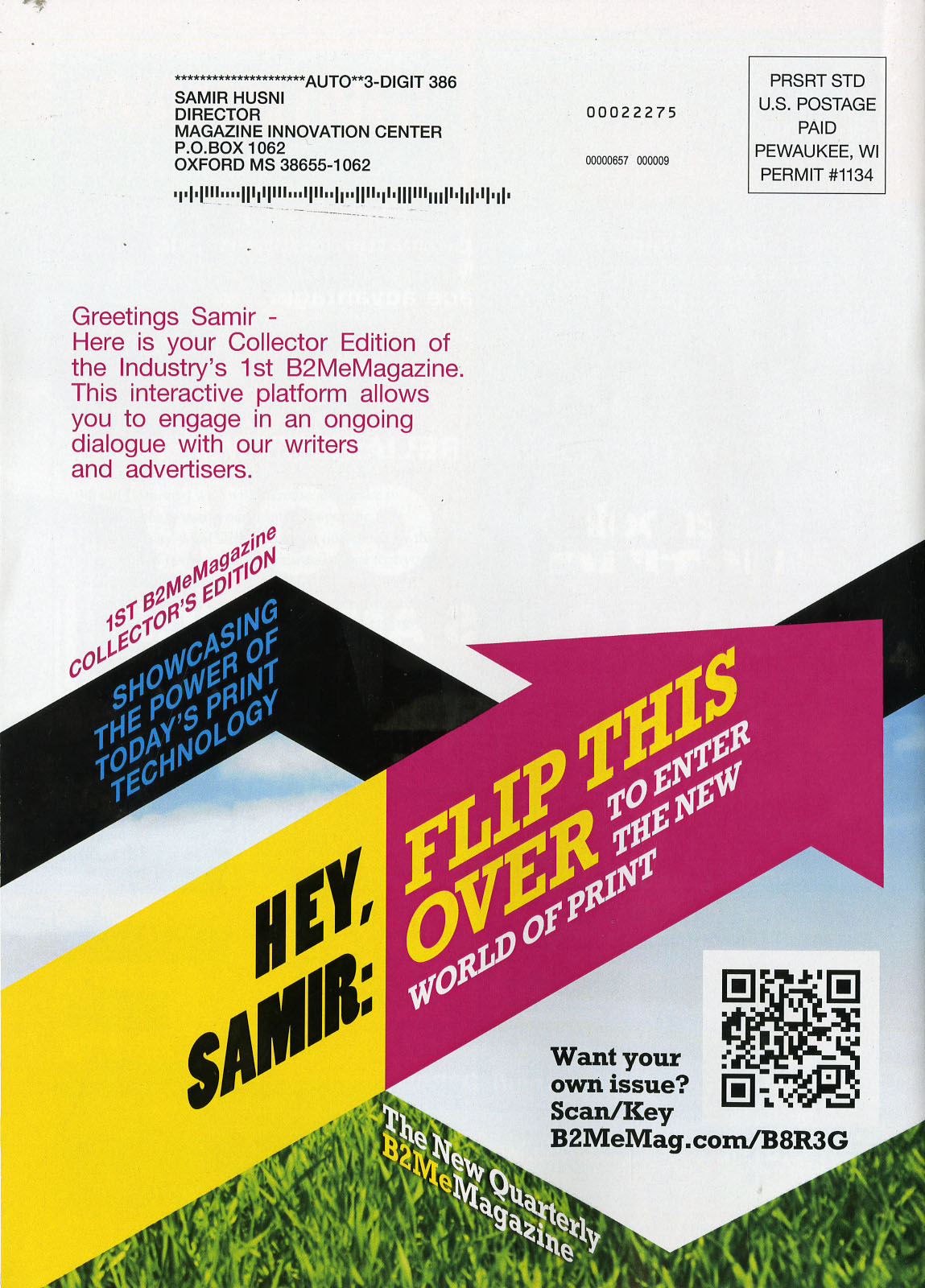
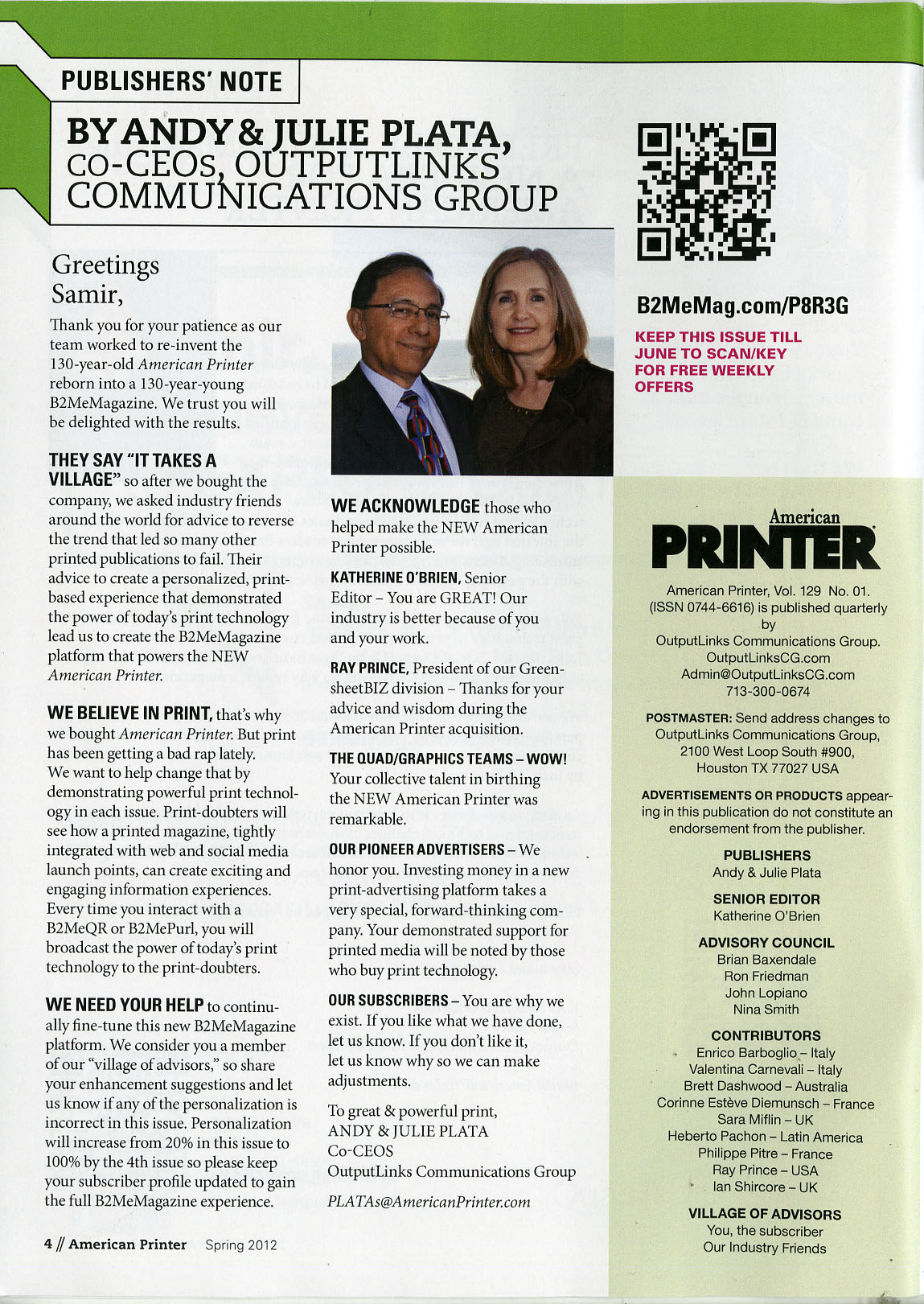
Well, that’s what Andy and Julie Plata have created as they relaunched American Printer magazine this month. They were on a mission to create the first B2MeMagazine–the first business to me rather than business to business magazine. They wanted to personalize the magazine, exactly like they have personalized direct mail campaigns, and they wanted to do it in print. “A B2MeMagazine is a ‘Business to Me Magazine’ that is created specifically for the individual subscriber. Articles and ads are dynamically generated at time of print in accordance to the subscriber’s demographic profile.”
My first copy arrived and to say that I was impressed will be an understatement. My name and the name of the Magazine Innovation Center were there, on the cover, on the back cover, in some of the ads and also in some of the editorial pages. Nothing out of the ordinary, just a seamless unpretentious mention of my name and the Magazine Innovation Center. The examples, following my interview with Mr. Plata, speak volumes of the innovative ways of enhancing and personalizing print in this digital age.
I reached out to Andy Plata, the co-publisher of the magazine, and asked him a few questions regarding this personalized venture in innovation in print, aptly in a magazine devoted and aimed at American Printers and named American Printer:
Samir Husni: What is the genesis of the idea behind the B2MeMagazine?
Andy Plata: We wanted American Printer to be born again for renewed life after we purchased it in September after it had been shut down by Penton Corporation in August. As we investigated the best way to accomplish this objective we developed the B2MeMagazine platform to provide the 130 year old American Printer and other subscriber-based publications with a 1:1 personalized platform that would provide the multimedia interactivity that today’s readers seemed to expect.
SH: Do you expect this concept to take hold in the magazine business?
AP: Yes. It just makes sense that it will. We have personalized computer screens, personalized TV and radio programming, personalized … so of course people should and will expect personalized magazines. And the good business people who publish magazines will provide their readers what they expect – a personalized magazine experience.
SH: Your relaunch issue have 20% personalized content with the promise that it will 100% by 2013… What is your plan to create a fully personalized magazine?
AP: We could produce a 100% personalized magazine right now but we chose to take a crawl/walk/run/fly approach instead. The reason is that B2MeAds™ require tight integration of subscriber database information to dynamically generate individualized content and graphic elements for each subscriber. This is a new concept for many of the designers and agencies who produce the corporate ads. So we decided to take time to help the creatives understand how best to support this exciting personalized 1:1 platform. They say it takes a village …
SH: American Printer now integrates the power of print, web and social media all in one… can you explain this concept and how it will amplify the future of print?
AP: The effectiveness of any kind of communication experience is increased by enhancing the richness of the communication. American Printer enhances the magazine reading experience through the B2MeMagazine platform. The platform provides subscribers a tactile print-magazine experience integrated with mobile and web experiences all via the personalized immediacy of B2MeCode™ launch points that include QR, Purl and other pattern-recognition. The future of print technology will be defined by how effectively printers seamlessly integrate current and future communications technology onto printed pages to provide the best communication platforms for their clients’ desired messages. American Printer’s endeavors to have its subscriber base of printers experience the future of print in each issue of the magazine. SH: Thank you.
To say that the magazine publishing business model is changing will be a major understatement. Change has become the only constant in this business and every publisher is looking for a new model that will lead the way to the future. Morgan Myrmo, founder and publisher of Fashion 5.0 magazine is one of those individuals who seems to have found a business model, and so far, so good, with that business model. Mr. Myrmo launched Fashion 5.0 magazine in October 2010. A year later Tenley Molzahn (from The Bachelor and Bachelor Pad TV shows on ABC) joined the magazine as its editor in chief.
Fashion 5.0 claims to be “the first US non-paid circulation women’s interest magazine, first US regional non-paid circulation women’s interest magazine, first US regional women’s interest magazine.” Of course, we all know that claiming something is the easy part, doing what you claim is the hard part. Well, Mr. Myrmo is practicing what he is preaching and saying. He hopes that one day this “young, hungry entrepreneur,” will be able with Fashion 5. 0 magazine “to gain market share and create value.”
So, in typical Mr. Magazine™ Interviews style, I reached out to Mr. Myrmo searching for some answers about the magazine, the ink on paper vs. digital, the regional vs. national and of course, what keeps him up at night and what lessons other wanna-be publishers can learn from his business model with Fashion 5.0 magazine.
And as with all the Mr. Magazine™ Interviews, first are the sound-bites followed by the entire questions and answers.
The Sound-bites:
On the magazine’s name: First you have “Five-O.” This is our official pronunciation, which like Hawaii Five-O, means police.
On the secrets of success: First, we created a solid business plan. Second, we raised capital. On the major competitors, the big ones: Once we have a large revenue stream with free-cash flow generation we will be in a great position to knock on their doors.
On the future plans to become a national magazine: Our expansion path is to cut and paste our model throughout multiple markets. Just like a Subway sandwich chain. On the distribution model: Picking up Fashion 5.0 is an impulse that women cannot turn down. When we put out 100 magazines at a gym, for example, they are gone in one day. It is like finding a five-dollar bill on the street for these women. It is definitely worth stopping for.
On print vs. digital: What makes print so good is that it establishes a relationship with the reader. Our readers take them home and save them.
On print vs. digital (take two): We trained our readers, through print, to how the technology worked.
On what keeps him up at night: When you are very busy, every minute counts. Learning how to become more efficient in work is a really cool experience. On the future: The media landscape continues to evolve rapidly and as a young, hungry entrepreneur, I am focused on exploiting these paths to gain market share and create value.
And now for the entire interview with Morgan Myrmo, founder and publisher of Fashion 5.0 magazine:
Samir Husni: I understand fashion 2.0, but why from the start fashion 5.0? What is the mission, vision and goal of the magazine? Tell me the story of Fashion 5.0.
Morgan Myrmo: Fashion 5.0 was created to showcase women’s fashion, in a classy, contemporary and engaging manner that people could easily access and share. We brought together the movers and shakers in San Diego with the understanding that we are helping to evolve local fashion. By reaching women in such a dynamic fashion we serve as a bridge for advertisers that seek the female demographic.
As women often make dating decisions and spend more of their disposable income on fashion and beauty-related purchases, we felt it made sense and that San Diego county was ready to support such an effort. Not only that, where the women go, the men follow. So what nightclub or entertainment venue wouldn’t want to reach our market? It is just a matter of creating something special for our demographic and on a consistent basis.
After our launch, we were quickly approached by the brightest in the industry to join us on multiple levels. Our current partnership list ranges from Bloomingdale’s to Forever 21, as well as local boutiques, nightclubs, venues and other retailers. We have also done multiple fashion-related events at several of San Diego’s hottest clubs, including Stingaree, Ivy Rooftop at Andaz, Float at The Hard Rock San Diego and the Palomar Hotel. Our clients all look for a way to bring people in the door and with our reach and demographic, they find Fashion 5.0 to be a great fit.
Our goal is to evolve from a regional into a multiple-market regional magazine that commands a powerful brand name that advertisers can benefit from. We seek to have a national brand that large advertisers can count on to bring their presence into the aggregate national women’s market. We also aim to expand into other media channels once our print-advertising goals are met.
The meaning of 5.0 is actually two-pronged. First you have “Five-O.” This is our official pronunciation, which like Hawaii Five-O, means police. Outsiders usually say “Five-Point-O,” which sounds like the highest possible high school grade point average for a student receiving straight A’s with all advanced placement classes. In this regards we are either the fashion police, which is what we intended, or the smartest fashion kid in class, which we like too. Our website is fashionfiveo.com, pronounced the first way.
SH: You have beaten the odds so far and survived when many others have died .What is your secret of success?
MM: Our success is based on two main concepts. First, we created a solid business plan. Second, we raised capital. Our business plan stated that the best time to invest is when others were not. So when the economy was still in the doldrums following the recent economic recession, we went for it.
As you know, magazines usually do not survive their first year in business. With consistent delivery, a great product and a highly-sought demographic, we have found the recipe for success.
SH: Fashion is not an easy topic to compete with the biggies. Why this topic and how do you plan to compete against all the big fashion titles out there?
MM: In reality, the large corporations cannot compete with us. Vogue or Elle, for example, cannot launch a free magazine with the same namesake. It would only devalue their brands. With that said, what Hearst or Condé Nast can do is invest in a new brand that offers exposure that no other company offers. Once we have a large revenue stream with free-cash flow generation we will be in a great position to knock on their doors.
SH: So far you have been limited to a specific region of the country. Any plans to go national? When?
MM: As mentioned in our goals, our expansion path is to cut and paste our model throughout multiple markets. Just like a Subway sandwich chain. All we have to do is prove ourselves as the market leader in San Diego County and investors will follow. We aim to do this within the next six quarters.
When Fashion 5.0 is a dominant brand that commands large advertising dollars from major fashion labels and beauty brands, our value will be something considerable to a large corporation. Think about it, would you rather have your brand in women’s hands or stand alone on a bus-stop sign or billboard?
SH: Needless to say you believe in print, otherwise you would have not launched the magazine. What is the future of print in your opinion and do you think you can survive in print alone in this digital age?
MM: Print is not dead. On the contrary, it is alive and thriving. There is growth in regional titles in general, as noted during the recent recession. Think about our concept. A magazine that looks like Vogue but is free and all about your locale. Picking up Fashion 5.0 is an impulse that women cannot turn down. When we put out 100 magazines at a gym, for example, they are gone in one day. It is like finding a five-dollar bill on the street for these women. It is definitely worth stopping for.
What makes print so good is that it establishes a relationship with the reader. Our readers take them home and save them. Nearly 90% of our readers state they save the magazine after expiration, whereas other publications are tossed or recycled quickly, such as newspapers and weeklys. Also, both people and businesses want to be in print. They see the value and we connect the dots.
Moving forward, digital is important. I see digital as both a natural compliment and natural expansion path for print. Having a good website is critical for any media company, as internet usage will continue to grow as far as we can see.
Regarding new technologies, we are in a sweet spot. We are a young, nimble company that follows the leaders closely. For example, we watched large investments in iPad magazine technology fizzle. If you stop and think, this makes total sense. Why would people want to read a magazine on an iPad? Websites are clearly designed for efficient Web navigation, whereas magazines are designed for efficient print navigation. Rather than spend dollars to keep ahead of the trend, we were able to see how the larger companies did first.
When a digital investment is made that works, such as an application, large investments are made by large companies to make the technology happen. Once it is proven, costs go down and new companies are formed to supply the demand of creating that new technology platform. One great example is Groupon, which took a substantial investment to create the deal-site model. Now that other companies have blazed this path, we can outsource the purchase of complete generic models that offer entry at an incredibly attractive price-point.
Today we remain at the forefront of new magazine technologies. We were the first to implement QR Codes in print in San Diego County, where large magazines such as Rolling Stone still don’t use them. We trained our readers, through print, to how the technology worked. The response was incredible. We also taught our advertisers what they were and how to use them. As our competitors caught on, they began implementing them but with lower success rates. As they were just jumping in the water, we had already navigated the path and knew how to package them for smooth sailing.
By engaging readers with digital interactions, the bond with the reader becomes stronger. With such digitally integrated technologies, a print publisher is able to turn a thirty minute read into a three hour multi-media presentation. The marriage of digital application within print, designed to work with your cell phone or even your glasses one day, will continue to expand moving forward.
SH: What has been the biggest hurdle facing you so far?
MM: Connecting the dots is a challenge at times. It is all about sales, and many companies want to pay public relations companies for free exposure rather than pay for advertising.
The largest hurdle in the new, regional magazine business however is longevity. We created a great business that women are demanding faster than we can produce, however many advertisers wanted to see longevity of one to two years before they committed. On the other hand, some really smart advertisers realized quickly that we created a new and efficient method for reaching the female demographic. These advertisers jumped on board right away. Now that we are closing in on our second year, we are seeing a strong response from advertisers.
We have learned that decision-makers need to validate their decision to work with us. By solving that problem, we are able to attract more business. A lot of marketing decision-makers are women these days, which helps as they immediately relate to and understand our brand. They know that women will be attracted to our brand as they are attracted to it themselves, which only helps.
SH: What keeps Morgan up at night? What makes Morgan tick and click every day?
MM: I am living the American dream! I am working with incredible talent and conducting something that nobody has seen before. When I hear from a stranger that they know our brand and love our magazine, I know that our team has done well. Just knowing that our team believes in our concept and trusts me to deliver is one of the nicest compliments I could ever ask for.
I tend to sleep less than the average person due to a high workload, so in this regard work keeps me up at night. When you are very busy, every minute counts. Learning how to become more efficient in work is a really cool experience.
SH: Any additional things you would like to add about you, the magazine, the future and the marriage of ink on paper and pixels on a screen….
MM: The media landscape continues to evolve rapidly and as a young, hungry entrepreneur, I am focused on exploiting these paths to gain market share and create value.
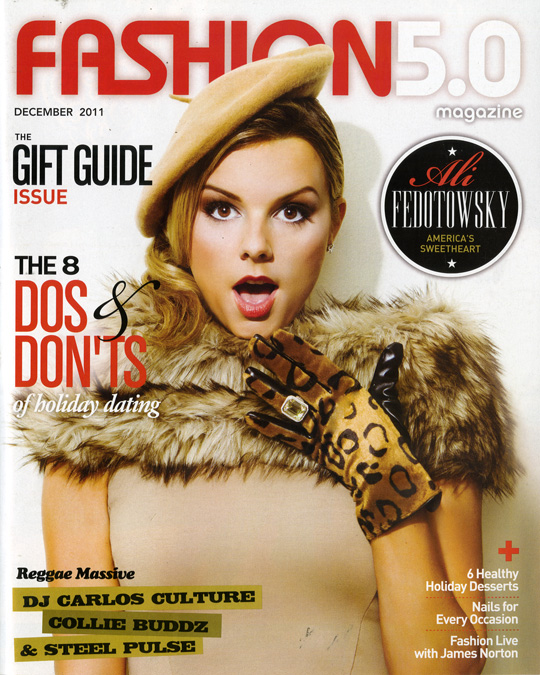
I am always open to new partnerships as well. We have created something that works and the response has been incredible. We have interviewed Patti Stanger from The Millionaire Matchmaker (February 2012), have shot Ali Fedotowsky from The Bachelorette (December 2011) and are featuring Alexis Bellino from The Real Housewives of Orange County: Season 7 in our annual May/June Summer Guide issue. In fact, Fedotowsky was on the cover of People the same month that she was our cover girl. If these people are responding to us and happy to be part of our magazine, the value is clear. We are making progress and people are taking notice.
The first quarter of 2012 was indeed a busy one in terms of the introduction of new magazines, specials and book-a-zine. Approximately one quarter of the 192 new magazines launched had a frequency of at least quarterly or more.
These numbers are indeed better than those of the first quarter of 2011. There were four more magazine launches than the 188 new consumer magazine titles that appeared on the nation’s newsstands in the first quarter of 2011, and a total of 41 regularly published magazines making it two more than the 39 titles of the same period of 2011.
Publishing is believing, and believing is seeing… so, don’t take my word for it. Just check all the titles yourself on the Mr. Magazine™ Launch Monitor. The Mr. Magazine™ Launch Monitor has the cover images of each and every one of those 192 new magazines. Click here to see all the magazines.
A spoken poem, in sound and picture, captivates the power of print. Released by InkGlobal in the United Kingdom The Journey is a must see. Enjoy the “Spoken poem; print is not dying. Produced by Ink, written and directed by David Bowden @ The Garden Studios.” Thank you Simon for sharing.
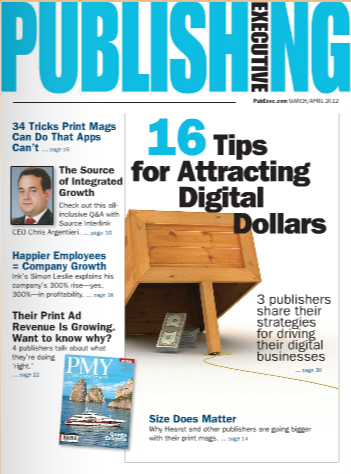
My latest column from the March/April issue of Publishing Executive magazine… Enjoy and Comment!
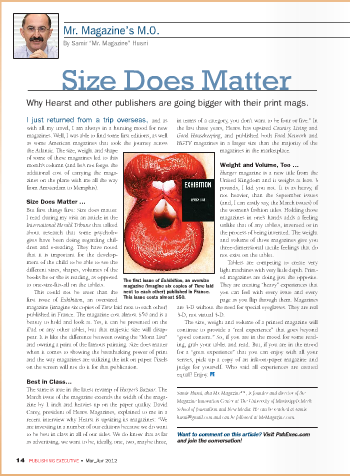
Mr. Magazine’s M.O. : Size Does Matter
Why Hearst and other publishers are going bigger with their print mags.
March 2012 By Samir “Mr. Magazine” Husni
I just returned from a trip overseas, and as with all my travel, I am always in a hunting mood for new magazines. Well, I was able to find some first editions, as well as some American magazines that took the journey across the Atlantic. The size, weight and shape of some of these magazines led to this month’s column (and let’s not forget the additional cost of carrying the magazines on the plane with me all the way from Amsterdam to Memphis).
Size Does Matter …
But first things first: Size does matter. I read during my visit an article in the International Herald Tribune that talked about research that some psychologists have been doing regarding children and e-reading. They have noted that it is important for the development of the child to be able to see the different sizes, shapes, volumes of the books he or she is reading, as opposed to one-size-fits-all on the tablets.
This could not be truer than the first issue of Exhibition, an oversized magazine (imagine six copies of Time laid next to each other) published in France. The magazine cost almost $50 and is a beauty to hold and look at. Yes, it can be presented on the iPad or any other tablet, but that majestic size will disappear. It is like the difference between owning the “Mona Lisa” and owning a print of the famous painting. Size does matter when it comes to showing the breathtaking power of print and the way magazines are utilizing the ink on paper. Pixels on the screen will not do it for that publication.
Best in Class…
The same is true in the latest revamp of Harper’s Bazaar. The March issue of the magazine extends the width of the magazine by 1 inch and heavies up on the paper quality. David Carey, president of Hearst Magazines, explained to me in a recent interview why Hearst is upsizing its magazines: “We are investing in a number of our editions because we do want to be best in class in all of our titles. We do know that as far as advertising, we want to be, ideally, one, two, maybe three; in terms of a category, you don’t want to be four or five.” In the last three years, Hearst has upsized Country Living and Good Housekeeping, and published both Food Network and HGTV magazines in a larger size than the majority of the magazines in the marketplace.
Weight and Volume, Too …
Hunger magazine is a new title from the United Kingdom and it weighs at least 3 pounds, I kid you not. It is as heavy, if not heavier, than the September issues (and, I can easily say, the March issues) of the women’s fashion titles. Holding those magazines in one’s hands adds a feeling unlike any on a tablet, invented or in the process of being invented. The weight and volume of those magazines give you three-dimensional tactile feelings that do not exist on the tablet.
Tablets are competing to create very light machines with very little depth. Printed magazines are doing just the opposite. They are creating “heavy” experiences that you can feel with every issue and every page as you flip through them. Magazines are 3-D without the need for special eyeglasses. They are real 3-D, not virtual 3-D.
The size, weight and volume of a printed magazine will continue to provide a “real experience” that goes beyond “good content.” So, if you are in the mood for some reading, grab your tablet and read. But, if you are in the mood for a “great experience” that you can enjoy with all your senses, pick up a copy of an ink-on-paper magazine and judge for yourself. Who said all experiences are created equal? Enjoy. PE
For other columns and articles from Publishing Executive magazine and website click here.
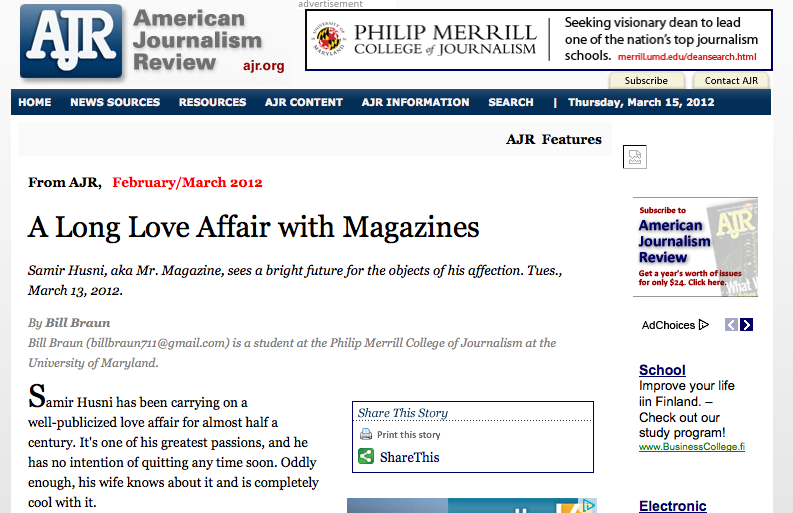
In celebration of my half century love affair with magazines, the American Journalism Review publication ran a profile on me on March 13, 2011. Here are the first two paragraphs:
Samir Husni has been carrying on a well-publicized love affair for almost half a century. It’s one of his greatest passions, and he has no intention of quitting any time soon. Oddly enough, his wife knows about it and is completely cool with it.
Husni, 59, is widely regarded as the United States’ leading authority on magazines. So much so that he has officially trademarked his nickname, “Mr. Magazine.”
The more magazines change, the more they remain the same. Fifty years ago I started on this journey that began as a hobby of buying and collecting first editions. It turned into an education that culminated in a Ph.D. in journalism and ended as a never-ending life-time profession of magazine education and consulting.
From the first time I bought a magazine at the ripe age of 9, I fell in love. I felt, all of sudden, that all the stories that my father and grandfather used to tell were captured in the palms of my hands. I was in control of the story. I had the story, the whole story, under my control. I was no longer dependent on my dad or my granddad to start or finish a story. It was there. Every page I turned made the experience of knowing the story and controlling its pace even more exceptional. The more I got hooked into the story the faster I was turning the pages. It was unlike any experience I have ever had with stories and story telling.
The first time I felt the pages, read the stories, and had the power to control both (flipping the pages and the pacing of the stories), I was hooked. I had never experienced anything like it. I was addicted. Needless to say that there was no way on earth, 50 years ago, I would have been able to define a magazine as an “experience maker” rather than a “content provider”; but now, after all these years, it is all clear to me. I can explain my addiction. I can explain my love affair. I can explain why I say that the more magazines change the more they stay the same. Magazines are much more than content providers; they are experience makers.
My hobby of collecting first issues that began 50 years ago turned into an education of studying those first issues and a profession of teaching and consulting on magazines. My hobby is still going strong, better yet, stronger than ever. My love of magazines is still as powerful as that very first love that I felt when I bought my very first issue in my hometown of Tripoli, Lebanon. Little did I know that there was no turning back.
What I’ve learned over the past 50 years is one thing that I know for sure: my love for those experience makers called magazines is forever.
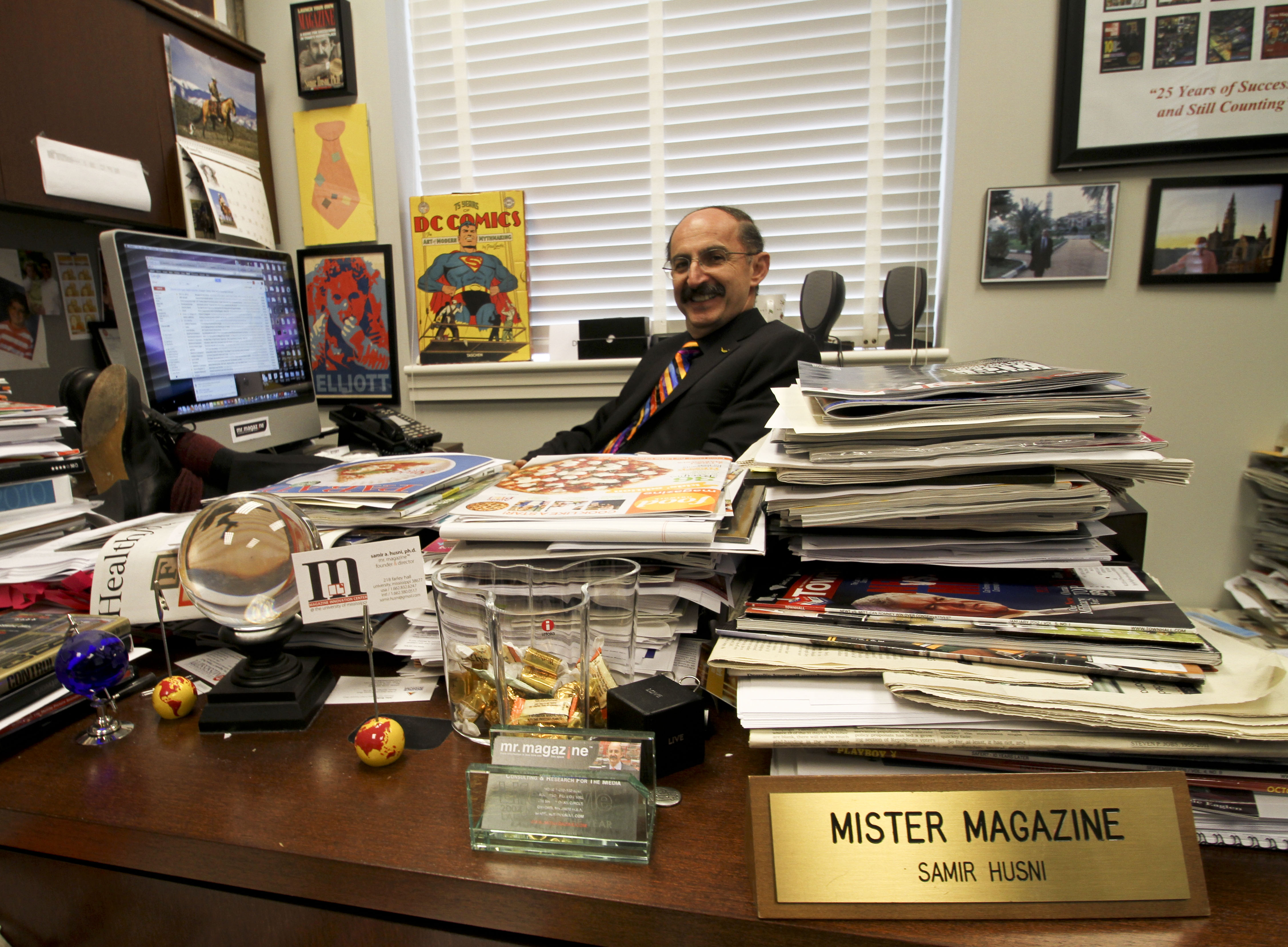
Photo by Mark K. Dolan, taken on my birthday March 8 in my office at the Meek School of Journalism and New Media.

 In the sea of new magazines, almost 60 new titles arrive at the newsstands every month, it is always a delight when one magazine stops you in your tracks and demands attention, much more attention than the rest of its siblings. Quilty is the new magazine for “fresh patchwork + modern quilts.” However, it was not the cover that demanded that attention nor the cover price. It was the editorial written by Mary Fons, Quilty’s editor.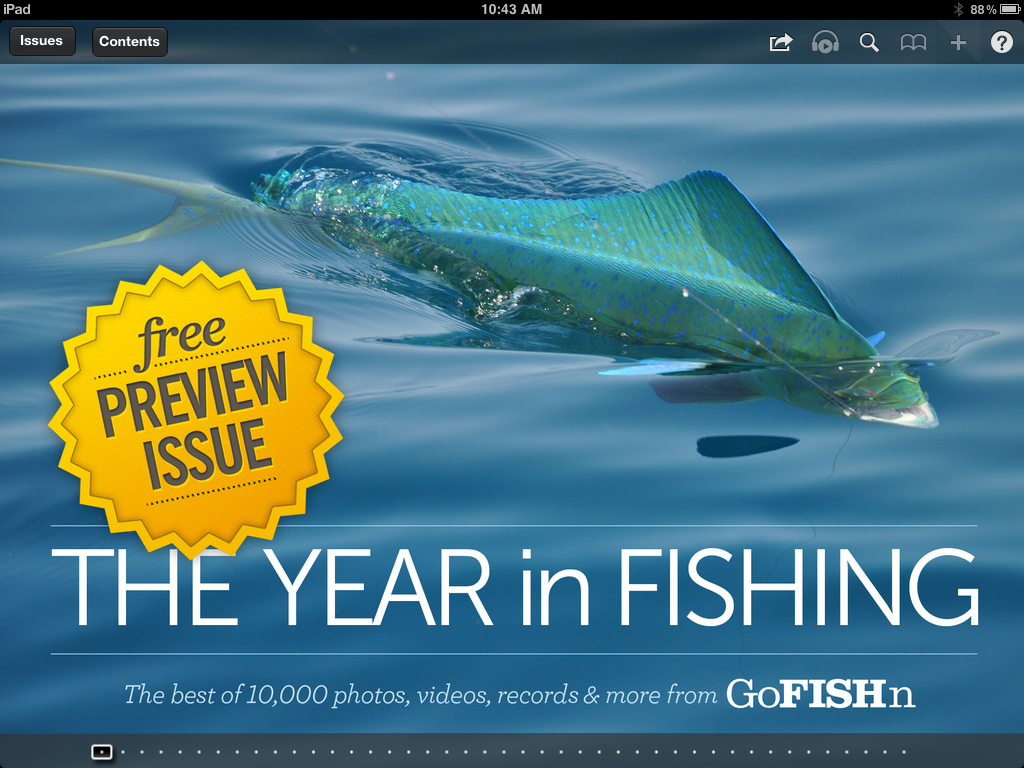








 Mr. Magazine