h1

Scoring a Strike Every Time. 100 Years of Bowlers Journal Magazine. The Mr. Magazine™ Interview with Keith Hamilton – President of Bowlers Journal International and the Man Behind the Ball.

April 16, 2013

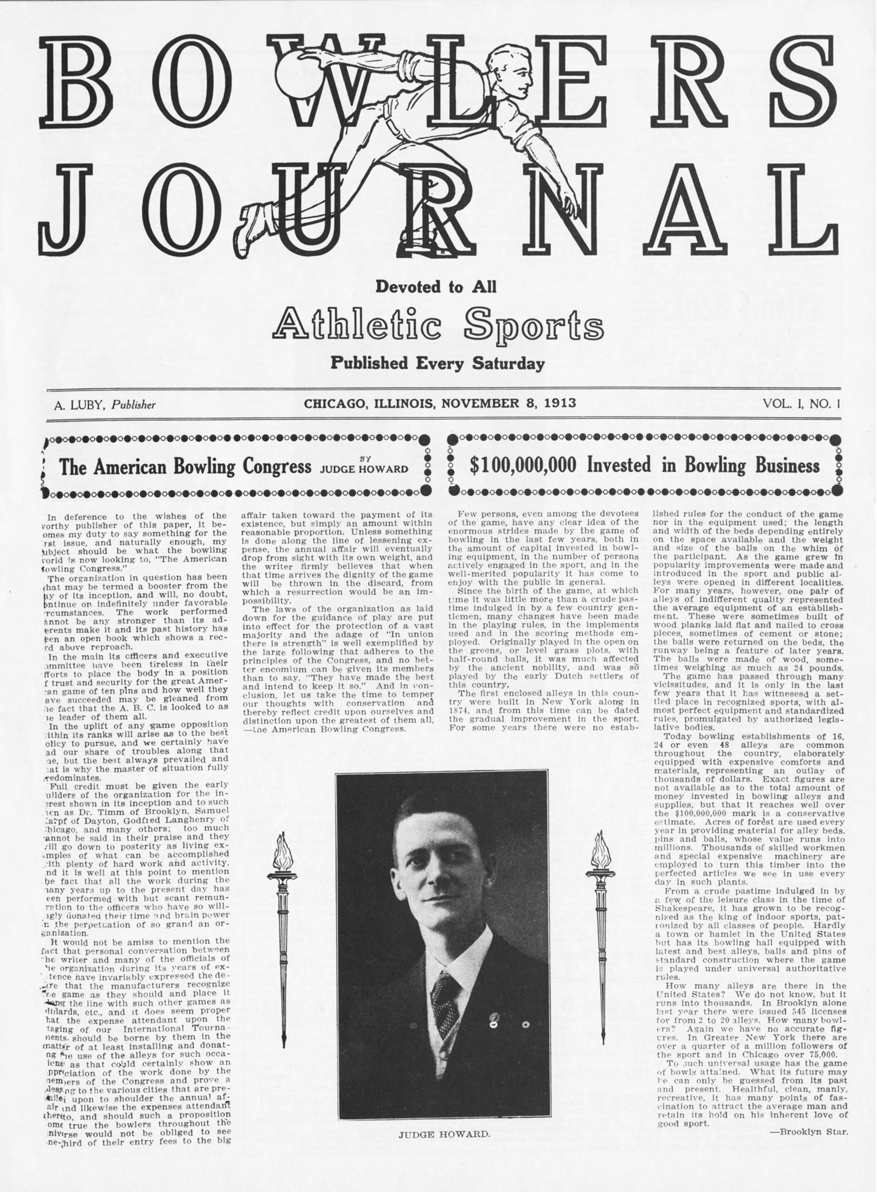
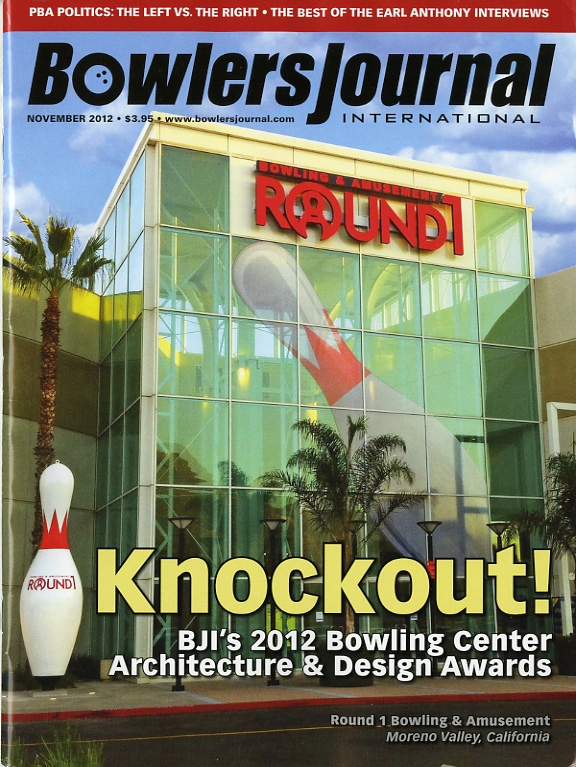
BJI_1913_PG1sm Bowlers Journal celebrates 100 years of magazine history in 2013. And Keith Hamilton – the magazine’s president – says he’s looking forward to the next 100 with innovation and passion.

“The readers of Bowlers Journal love bowling. And they want to know everything about it. So we’ve always kept our niche and we’ve always understood who our market was,” he said.

Targeting that clearly identified audience with that relevant message, something Keith Hamilton believes in fully.

Bowlers J.3-291The print magazine may be the mainstay of the business, but he’s also not afraid of digital. Bowlers Journal Interactive, coupled with a newsletter that reaches around 800,000 people, is combining these two facets of today’s magazine media – print and digital – into an integrated entity that is working very successfully for Bowlers Journal.

But it’s also the man at the helm’s passion about his subject matter that injects that human touch and special spark that only our species can give to an object of our desire. Be it digital or be it print, the human being controls the creativity and ideology that can sustain a magazine, proving why Bowlers Journal has withstood the test of time and is still among the land of the living magazines today. And proving it very successfully, I might add.

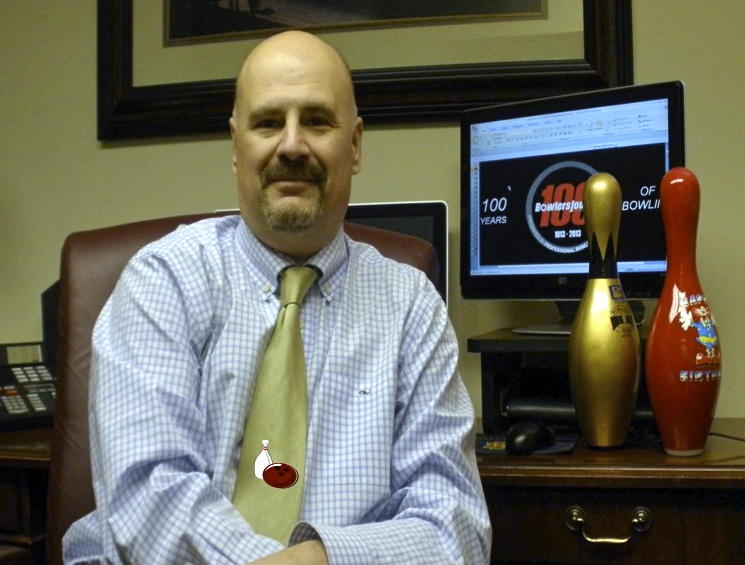
keith-vanityAnd while Keith Hamilton is all about print integrated with digital, he still firmly believes that the ink on paper product lends credibility to the industry that no other entity does, while still acknowledging the fact that no magazine can be a “news-type” product anymore in our day and age. With the amount of information available today for the consumer provided by the web, he believes we have to delve deeper to find that kernel of knowledge not yet unearthed by the cosmic investigators of the internet. We have to utilize our creativity and abilities to bring the reader things they cannot find elsewhere.

A valid point in this digital age, where anything can be discovered with the touch of a fingertip.

The excitement of the magazine’s 100th anniversary has the entire staff excited and doubly-so for its president. It’s been a great centennial and the second one looks even better.

So enjoy Mr. Magazine’s™ bowling adventure/interview with the man scoring the strikes at Bowlers Journal and share the experience of a magazine that has outlived most humans alive today.

A feather in Father Time’s cap, to say the least, and a blessing to bowling lovers around the world.

Click here to read the Mr. Magazine™ Interview with Keith Hamilton, president of Bowlers Journal International.

h1

When Print Seems Unhip, Digital Replacement is Not the Answer. The Mr. Magazine™ M.O. Column in Publishing Executive Magazine

April 12, 2013

Editor’s Note: My column this month in Publishing Executive magazine was accompanied by a short video that appears on your smart phone when you sit down with the magazine and enjoy some quality reading. So enjoy the video first and then read the column. Any and all comments are more than welcomed!

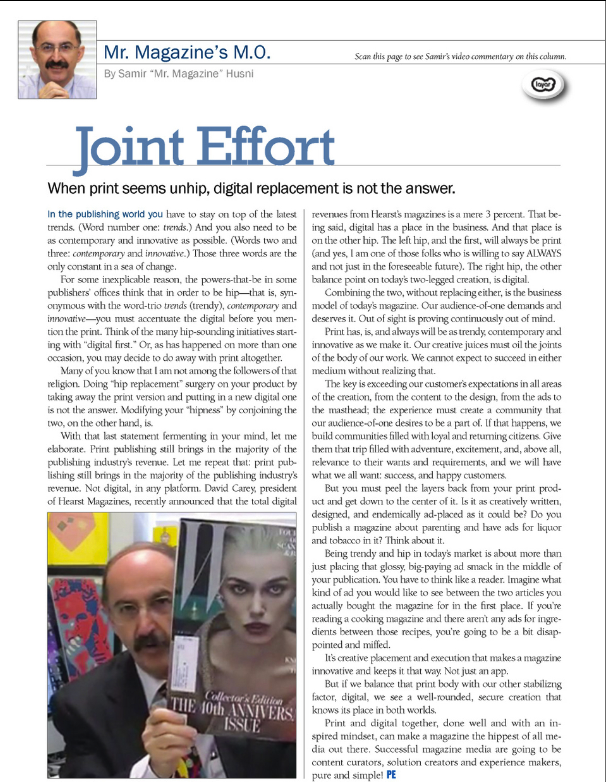
Joint Effort
When print seems unhip, digital replacement is not the answer
photoIn the publishing world you have to stay on top of the latest trends. (Word number one: trends.) And you also need to be as contemporary and innovative as possible. (Words two and three: contemporary and innovative.) Those three words are the only constant in a sea of change.

For some inexplicable reason, the powers-that-be in some publishers’ offices think that in order to be hip­—that is, synonymous with the word-trio trends (trendy), contemporary and innovative—you must accentuate the digital before you mention the print. Think of the many hip-sounding initiatives starting with “digital first.” Or, as has happened on more than one occasion, you may decide to do away with print altogether.

Many of you know that I am not among the followers of that religion. Doing “hip replacement” surgery on your product by taking away the print version and putting in a new digital one is not the answer. Modifying your “hipness” by conjoining the two, on the other hand, is.

With that last statement fermenting in your mind, let me elaborate. Print publishing still brings in the majority of the publishing industry’s revenue. Let me repeat that: print publishing still brings in the majority of the publishing industry’s revenue. Not digital, in any platform. David Carey, president of Hearst Magazines, recently announced that the total digital revenues from Hearst’s magazines is a mere 3 percent. That being said, digital has a place in the business. And that place is on the other hip. The left hip, and the first, will always be print (and yes, I am one of those folks who is willing to say ALWAYS and not just in the foreseeable future). The right hip, the other balance point on today’s two-legged creation, is digital.

Combining the two, without replacing either, is the business model of today’s magazine. Our audience-of-one demands and deserves it. Out of sight is proving continuously out of mind.

Print has, is, and always will be as trendy, contemporary and innovative as we make it. Our creative juices must oil the joints of the body of our work. We cannot expect to succeed in either medium without realizing that.

The key is exceeding our customer’s expectations in all areas of the creation, from the content to the design, from the ads to the masthead; the experience must create a community that our audience-of-one desires to be a part of. If that happens, we build communities filled with loyal and returning citizens. Give them that trip filled with adventure, excitement, and, above all, relevance to their wants and requirements, and we will have what we all want: success, and happy customers.

But you must peel the layers back from your print product and get down to the center of it. Is it as creatively written, designed, and endemically ad-placed as it could be? Do you publish a magazine about parenting and have ads for liquor and tobacco in it? Think about it.

Being trendy and hip in today’s market is about more than just placing that glossy, big-paying ad smack in the middle of your publication. You have to think like a reader. Imagine what kind of ad you would like to see between the two articles you actually bought the magazine for in the first place. If you’re reading a cooking magazine and there aren’t any ads for ingredients between those recipes, you’re going to be a bit disappointed and miffed.
It’s creative placement and execution that makes a magazine innovative and keeps it that way. Not just an app.

But if we balance that print body with our other stabilizng factor, digital, we see a well-rounded, secure creation that knows its place in both worlds.

Print and digital together, done well and with an inspired mindset, can make a magazine the hippest of all media out there. Successful magazine media are going to be content curators, solution creators and experience makers, pure and simple! PE

——————————————————————————————
Picture 43

h1

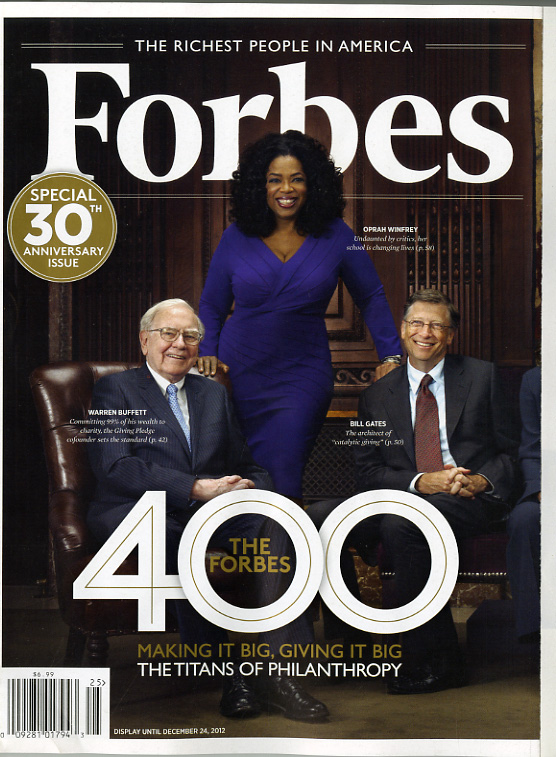
Mr. Magazine™ Minute: Lewis D’Vorkin, Chief Product Officer of Forbes Media, on the Future of Print and the Role Digital Plays in Helping and Enhancing Print

April 10, 2013

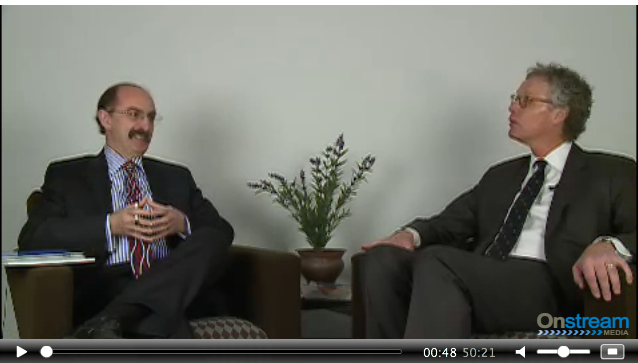
What is the future of print and how is digital helping and enhancing the printed magazine? Lewis D’Vorkin, the chief product officer of Forbes Media, answers these two questions in this segment of the Mr. Magazine™ Minute. Mr. D’Vorkin was visiting the Meek School of Journalism and New Media at the University of Mississippi. I asked him first about the future of print. Listen to his answer:

My second question to Mr. D’Vorkin was how did digital help the printed edition of Forbes magazine? His answer:

———————————————————————————————————————————————–
Picture 43

h1

Simply Gluten Free Magazine: The Story of a Print Launch Rooted in Recipe Making, Blogging, Television and Books. The Simply Gluten Free Passion and Duty of a Wife and Husband Team – Carol and Thom Kicinski – Revealed in The Mr. Magazine™ Interview.

April 8, 2013

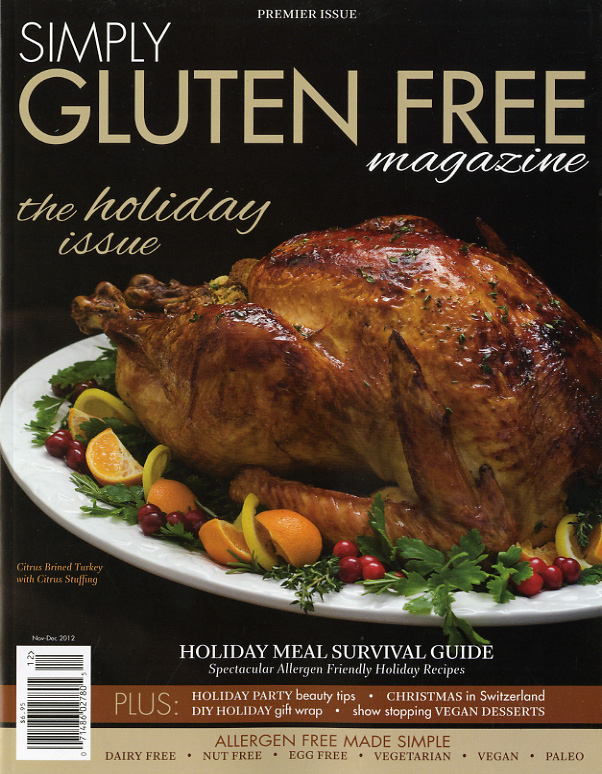
simply gluten free 3-12Carol and Thom Kicinski are a married couple who are used to adjusting the menu. Carol was diagnosed gluten sensitive many years ago, so she had to learn to prepare foods that not only she could eat, but that her husband and family could enjoy as well.

So when they decided to expand their media menu by adding a print magazine to the very successful blog, television appearances and cookbooks that Carol writes and maintains, they knew that they would have to shuffle breakfast to accommodate lunch to save room for dinner and dessert. And do it successfully. Much like Carol did all those years ago when she was devising novel and delicious ways to prepare her gluten free meals.

The new addition to their family fare is Simply Gluten Free Magazine; a print entity that the couple created based on Carol’s blog and has the unique feature of being written, for the most part, by some of the top bloggers in the gluten and allergen free fields today. It’s an ink on paper lifestyle creation that promotes the abundant life that a gluten sensitive person can live. From food, recipes and medical tips – straight from gluten sensitive doctors themselves, to travel, beauty and home tips, Simply Gluten Free encompasses the positive and decries any negative vibes from an issue that is very important in today’s society – having to live a gluten free lifestyle.

So sit back, grab a copy of Simply Gluten Free and follow along on Carol and Thom’s journey into the world of gluten free print. And if you’re not gluten sensitive, no worries, you can still enjoy it. The magazine promises to be delicious and very guilt-free…for anyone.

But first the sound-bites.

The Sound-Bites:

On the journey from digital to print: The reason I decided to go from digital to print is first and foremost, no matter how much I love digital, I read magazines. I subscribe to magazines, I buy magazines and I still read my print magazines. And I know a lot of other people who still read magazines.

On the unique content-providers for the print magazine: Carol chose gluten free bloggers to be her writers, not people who were coming to the blog. In other words, these are the top gluten free bloggers that she recruited to be her writers in specific niches within the gluten free community.

On how they handle the pressures of their multimedia business: So what we do and the decisions we make are based on purpose. It was never based on let’s make a whole lot of money and do a magazine. We probably would have never gotten off the ground if that had been the case.

On whether so far it’s been a nightmare or a dream-come-true: It’s been absolutely the fulfillment of a dream for Carol and the fulfillment of a challenge for me. I tend to handle more of the business end and she handles the creative and design end. So it’s turned out to be the magazine she always wanted and it’s given me an interesting and fun business challenge.

Thom and Carol1And now for the lightly edited transcript for the Mr. Magazine™ Interview with Simply Gluten Free magazine’s Carol and Thom Kicinski.


Samir Husni: Do you think it’s crazy to start a print magazine in this day and age? And what’s the story behind Simply Gluten Free?

Thom Kicinski: My wife was diagnosed gluten sensitive 20 years ago. She raised our two sons and me, who are not gluten sensitive, all during that time period and had to adjust her cooking skills to accommodate her diet and still satisfy us because we wouldn’t buy into the fact that we were going to eat food that “tasted healthy” or had any of that healthy texture to it. We wanted regular food. It sort of forced Carol into a cooking habit of making food that tasted and had the texture of regular food, yet was gluten free, so she wouldn’t get sick every time she would eat it.

In November 2007, Carol started a blog called “simplygluten-free.com” and that blog has now grown to be one of the largest blogs in the world on the gluten free topic. If you go to Google and you simply type in gluten free, you will see right under Wikipedia, which we’ll never beat, and under the Mayo Clinic, which we’ll never beat either, they have way too many topics on health, but right under those two typically always comes up Carol Kicinski and simply gluten-free.com next. And that’s all generated naturally. We’ve done no funky things to get that placement. It’s all been a natural generation as a result of the tremendous content that’s on her website.

She’s posting new recipes pretty much every other, if not every third day. It’s extremely popular. The website receives about 775,000 hits per month and that’s over 25,000 hits per day. And that’s from 150,000 absolute unique visitors per month. That’s people who are counted only once per month for having gone to the site, no matter how many times they revisited it. So you have 150,000 different people per month going to this website. Carol receives over 1,000 emails per day from the website, so she has a lot of traffic.

In 2009 the television show “Daytime TV” discovered Carol and they asked her to start doing gluten free recipes on TV and she’s since become their gluten free chef. She’s been on monthly episodes of the show, which is an NBC-based station and is nationally syndicated to about 97 million TV households per month, and she has the gluten free cooking episode every month. She’s now in her 4th season with that.

She then did a couple of cookbooks due to the many requests she’d had for her recipes. The first one was Simply Gluten Free Desserts and then Simply Gluten Free Quick Meals, which teaches people the most difficult areas of gluten free food preparation, and Simply Gluten Free Desserts is about baking and doing breakfast items and dessert items which are some of the biggest challenges for the gluten free person. And of course, Quick Meals is about how to get gluten free meals quickly onto the dinner table for busy moms with families who are challenged with gluten free sensitivities. That’s Carol’s background and then I’ll let her tell you why she decided last March to do a print magazine.

Samir Husni: Carol, you started with a blog, which put you on the digital side of things, then you moved to television, then books and now the print magazine. Take us through that journey.

Carol Kicinski: With the blog, I had people ask me for recipes and I was always a cook who just threw things in a pan. I never measured anything. I’d say, “Oh, just toss in a couple of handfuls of this and a pinch of that.” I didn’t go to culinary school and I’m not a chef. I’m a home cook, a mom who taught herself everything. So people would ask me for recipes and it was a little bit hard if they weren’t a very good cook themselves. So if I just said throw in a couple handfuls of this, pour in some of that, it wasn’t as specific as they needed. I thought that starting a blog would be a good way to force me to be more specific with my recipes. So I really started the blog to gain a bit more discipline in my recipes and really figure out how to make a recipe that’s workable, regardless of your skill-set.

And I’ve always been fascinated with taking pictures of food. We’d go to Europe and most people would come back with pictures of the Eiffel Tower, or the Coliseum and I’d come back with 42 pictures of cappuccinos. I also thought it would be a good way to force me to improve my photography skills and give me some accountability. I didn’t really know if anyone would go to my blog in the beginning. It was quite a surprise when I started getting comments and meeting people. And then I sort of organically grew.

The television show was a bit of a happenstance. I met the producer of the show at the time and she actually had some experience in dealing with people who were gluten sensitive. She told me that people needed to know about this and they needed to have recipes. She was a little ahead of her time because this was four years ago. So she asked me to come on the show and I did a segment and there was a lot of viewer response. She received a lot of emails, the gluten free community tends to be quite vocal, and then they asked me to come back and do a regular segment.

The cookbooks were also an evolution of the blog. I was approached by an editor at St. Martin’s Press who wondered if I would be interested in doing a book proposal for a cookbook. And I said sure. I didn’t really know what a book proposal was so I Googled it, put something together and there you go.

Thom Kicinski: We’re not very pretentious here.

Simply gluten free 2-11Samir Husni: That’s the best way of doing anything these days that succeeds.

Carol Kicinski: The reason I decided to go from digital to print is first and foremost, no matter how much I love digital, I read magazines. I subscribe to magazines, I buy magazines and I still read my print magazines. And I know a lot of other people who still read magazines.

And the other thing was I wanted to be able to go out and buy a gluten free lifestyle magazine, not just one that had recipes in it or that talked about the dietary challenges of being gluten free, but one that was a very pretty magazine that felt good in the hands and had great pictures in it. And I was really honestly hoping someone else would do it. I couldn’t find a magazine like that; no one else did do it, so I decided to create one. I brought the idea up to Thom and off we went.

Samir Husni: It’s my understanding that the way you developed the content of the magazine is also unique. Would you tell us a little bit about that?

Thom Kicinski: I’ll prelude it, and then Carol can tell you more. You know most magazines typically evolve from a producer who identifies the niche, hires some writers to write about that niche, then finds some advertisers and the magazine grows. In Carol’s case, what she did was a bit different from the typical. I’ll let her tell you a bit about bloggers first and then we can go into the evolution of how she organized this.

Carol Kicinski: Having been a blogger myself, I’ve come to realize that people trust bloggers and that’s because for the most part they are the people who are, in our case, living a gluten free lifestyle. We’re not people who are finding out about the gluten free lifestyle from a third party perspective and then writing about it. We’re the ones that are facing the challenges in the grocery store and in the kitchen every day, and people tend to trust that. Because of their no-vested interest and the real-life, on-the-ground experience they have with the subject, readers trust bloggers.

And I’m also very connected in the blogging world. And I happen to know a lot of the top gluten and allergen free bloggers. So I thought people would be interested in reading about the lifestyle and making the recipes if they were written by people who are actually living the gluten free lifestyle, and not people who are just writing about it. I organized about 20-25 of the top allergen free bloggers to write articles for each issue.

And because this is a lifestyle magazine and the medical side of gluten free is so important, I contacted three of the top doctors who specialize in gluten sensitivity. I wasn’t interested in doctors who were just studying it; I wanted doctors who were actually treating patients on a daily basis, because they would know how to communicate with the person who’s new to the gluten free diet. So I got three medical doctors who all happened to not only deal with gluten sensitivities, but also followed a gluten free lifestyle themselves, and also a nutritionist to write for us.

We cover the medical and we cover the recipes, but also things like travel and beauty. A lot of people don’t realize that if there’s gluten in products like your moisturizer or makeup and it’s absorbing into your skin, it may be affecting you. So it’s important to highlight that and do it in a fun way so that readers are learning something like how to do a new look.

We have a cocktail section and as I said, we cover travel. Traveling gluten free is sometimes challenging. We do things such as “Do It Yourself” – make your own vanilla extract, how to do gift wrapping, some things not necessarily particular to gluten free, but as a person who was looking for a lifestyle magazine, I think people are interested in a variety of things. We also cover children. I have a writer who writes every issue and she’s a mom dealing with this in the trenches. She gives her perspective and because sometimes there are bumps in the road, she’s very honest.

For the most part the magazine focuses on the celebration of the abundance of a gluten free lifestyle. We like to point out what you can have, what you can eat and what you can enjoy and not focus on the deprivation. And I believe people are really responding to that as well.

Samir Husni: You mentioned that people trust bloggers; do you mean they trust bloggers in a specific community? For example, if they come to the Simply Gluten Free blog, do they trust those bloggers and that content, or do you mean that people trust all bloggers in general? And do you think that by doing the magazine you have validated the blog, the writers and the stories?

Thom Kicinski: Carol chose gluten free bloggers to be her writers, not people who were coming to the blog. In other words, these are the top gluten free bloggers that she recruited to be her writers in specific niches within the gluten free community. For example, one blogger is very prolific on gluten free for children topics, another on gluten free travel, another on doing the Vegan diet gluten free, and another on the Paleo diet and doing it gluten free. She got the top bloggers in their specialty fields and then made them her writers for the magazine.

Samir Husni: If we actually trust bloggers however, are we giving them a shot in the arm when we then do the print magazine based on the bloggers, or based on their contribution? And does that make them more trustworthy? And is there a link between that vast vapor that is the digital word, with the blog and the print magazine now?

Carol Kicinski: According to some survey data that we had, and it asked various questions, such as whom do you go to with certain queries and whose information do you trust, bloggers came up number one. I believe, and this is my opinion, when somebody reads a blog, the person writing it becomes very real to the reader. They form a relationship. Being a blogger myself, I have been contacted numerous times by various magazines to write articles. Now the fact that I am a blogger is not necessarily played up in the other publications, but I just did a twist on what others are doing. So yes, I am validating the fact that these people are those who are on the ground and living the lifestyle and writing about it, and that they are bloggers.

Thom Kicinski: We did a survey on Carol’s website and the magazine’s website for the months of November and December. And one of the questions we asked was where you get your most reliable gluten free information from. They were allowed to pick from three different sources and 90% came in with the internet and bloggers. That was the item chosen, information from the internet and bloggers. And the next one under that, believe it or not, was an in-store shopping experience, and that was 40% who said they got their information while in the supermarket reading labels and looking at the products. And the third one was magazines, and that was 36%, and in fourth position were friends with 32% and 15% said support groups, while surprisingly only 13% said from a doctor. They were getting their most reliable information; they felt, from the internet and bloggers. It was actually 89.7%. So that tells you who they trust.

Samir Husni: So how is the magazine going to change that? I mean after three issues, what was the reaction to the printed magazine?

Carol Kicinski: I think that it just reinforces this. I don’t think that they are mutually exclusive of each other. I read blogs and I buy magazines. Also in our survey, we figured out who the typical gluten free consumer is. And I am smack-dab in the middle. I am the gluten free consumer. And I’m assuming I’m not alone in that. And I buy magazines.

Thom Kicinski: A blogger is very, very real to people. That’s the bottom line. They read bloggers and it’s just like reading about your neighbor or about themselves. Then when you translate and put all of that in a magazine, now you have a magazine full of content that people feel is very friendly to them. It’s not some writer from a third person position writing it; it’s the person themselves in very simple language, very common language, writing to them. And that is, I think, a very key element of the success of the magazine.

Samir Husni: How does a couple in the 21st century today handle this magazine media world? Carol is everywhere. Your name is everywhere…you’re the national sales advertiser, the publisher…how do you two do it? And what advice do you have for other couples or individuals thinking about launching a magazine? Tell me a little bit about the nightmare behind the dream.

Carol Kicinski: I am passionate about what I’m doing. And I love what I’m doing. We work hard and I think that passion is the basis for that.

Thom Kicinski: And Carol is very right. If you back away and look at it, we didn’t start a magazine to make money. There are two purposes in someone’s mind when they’re doing something like this: there’s the purpose to make money, or there’s the purpose to forward a duty or that purpose. If you just make decisions based on making money, I’ve found in life that those things tend to not do so well, because the decisions made sometimes aren’t the right ones. If you tend to make the decisions based on purpose or duty, it usually works out and makes sense.

Carol’s duty and purpose has always been to communicate to the gluten free, Vegan, vegetarian and Paleo diet world and to the other allergen free world, to communicate good solutions and tips, recipes, tricks and a lifestyle that will help them make healthy choices for themselves and their children. That was always her purpose. So what we do and the decisions we make are based on purpose. It was never based on let’s make a whole lot of money and do a magazine. We probably would have never gotten off the ground if that had been the case. The money end of it was scary and quite challenging, as you can guess when you’re starting something like that. But she’s always wanted to offer solutions to people so they could make good decisions that were healthy for themselves and their family. And I think that you have to look at that as the basis.
simply gluten free 1-10Samir Husni: So taking all that passion and duty, you launched a magazine. How has it been so far, nightmare or dream-like road trip?

Thom Kicinski: It’s been absolutely the fulfillment of a dream for Carol and the fulfillment of a challenge for me. I tend to handle more of the business end and she handles the creative and design end. So it’s turned out to be the magazine she always wanted and it’s given me an interesting and fun business challenge.

Our first magazine, we targeted to print 15,000 copies, which was modest but significant for a premiere issue of a magazine. I had zero intentions of being able to get into any stores with that issue. When I was selling the advertising, I simply told the advertisers that we would be going to doctor’s offices and of course to our subscribers. I had it all figured out how we would distribute that many issues into those areas.

Well as it turned out, the magazine, before the first issue was even printed in concept form only, happened to hit the vice president and the president’s desk at Ingram and they both said, “Hey, we want this. This is something that we can throw our shoulders behind.” And before we knew it, we were in all Barnes & Noble, all Whole Foods across the United States; we were in Sprouts, Wegmans, and many of the health food stores, overnight.

And as the store orders came in, we ended up having to print 18,000 of that first issue just to satisfy the store orders. And then with the second issue we intended to print 20,000 and we ended up having to print 27,000 because of the store orders. And then we thought we’d print 30,000 for the third issue and we were forced to print 40,000. Now with the fourth issue we were going to do 45,000, but wound up doing almost 52,000 just because the stores had been driving our orders.

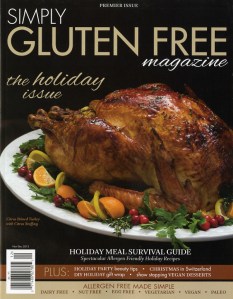
Carol did a tremendous job with the beautiful, gorgeous photograph of the turkey on the front of the first issue. It turned out to be just a great holiday issue. As you know, you have to pay up front before the printer even schedules your job. Well, about 3 nights after we had put the whole thing to bed with the printer, I remember sitting straight up in the middle of the night in bed and saying, “Oh my goodness! What if nobody buys it?” Literally I remember saying that, because that’s the one thing that we couldn’t control.

But as it turned out, it was a tremendous success, selling a very high percent of sales. The wholesaler compared it to when TV Guide came out. I asked him, “THE TV Guide?” And he said yes, “THE TV Guide.” And I went wow.

And then when the second issue came out, the first week it was in Whole Foods, and Whole Foods is sort of our bellwether, it tells us how well we’re doing. They have 500-600 stores across the United States, and we know how well we’re doing in all the health food stores based on how well we’re doing in Whole Foods. And they’re a terrific marketplace, of course, for people.

So all of a sudden we get the news that we’re selling in the number 7 position, total mag-volume sales, in all Whole Foods across the United States. That’s against magazines like Real Simple, Vanity Fair, and Psychology Today – the big boys. Here we are with our second issue and we’re asking, “Wow, how is that happening?”

And then the next week after that, we’re selling in 5th position, and the week after that in 5th position again, and with really high percentages. And then the third issue came out, which is the March/April issue and we got the news for the week ending March 8th that in Whole Foods market we were selling in 3rd position.

So it seems to be a success and it’s something that the consumer is definitely picking up off the shelf and reading. The magazine was 80 pages, 80 +4, in its first issue, and now with the fourth issue, which is the May/June 2013 issue, Carol has taken it to a 104 + 4 pages. It’s grown in size and circulation.

Samir Husni: Carol, what do you call yourself? Are you writer, editor, inventor, creator, housewife?

Carol Kicinski: For the magazine, I’m the editor –in- chief.

Samir Husni: Yes, but what would you like people to think about when they think about Carol?

Carol Kicinski: I think the truth of the matter is, as a skill-set, I’m a recipe developer. Whether I do it at home, for the magazine, or for the blog, that’s what I do. I make recipes, gluten free recipes.

Thom Kicinski: She’s a creator. She’s very modest. In all the years that we’ve been married, and you can imagine all the meals that she’s put on the dinner table for me and the kids when they were growing up, because we were a family that always ate dinner, every single night, and I could count on one hand the amount of times she ever repeated a recipe in our entire lifetime together. She was and is always doing something new.

Sometimes we would invite other people over and I would ask, “Honey, what are you going to make for dinner tonight?” and she would say, “Well, I’m making this, this and that.” And I would say, “Well, you’ve made that before, right?” And she would say, “No, not really.” And I would return with, “What do you mean, you’re trying a new dish? Tonight’s kind of important, you know?” And she would assure me that it would be fine and that’s the way she’s always been.

So you might ask her what she is and she’ll say a recipe developer. But if you ask me the same question, I’ll say, greater than that, she’s a creator. She’s always creating something new.

Samir Husni: Carol, how would you define Thom?

Carol Kicinski: I tell people, I’m the beauty and he’s the brains. I think I have vision and I can think of how I want something to be. For example, the magazine, I can envision it in my mind’s eye and Thom is the genius who can take that and turn it into fruition. He can figure out anything and he can drive anything through, from concept-stage to completion.

Samir Husni: Now Thom, how would you define yourself?

Thom Kicinski: Well, I think, coming back down to earth off of genius for a second; Carol had a purpose and a goal to do things, and she did. She’s always had her purposes and goals, and that is her driving force. And it became both of our driving force in business. But you have to provide enough of a financial platform so you can accomplish those purposes and goals. In other words, you can say we’re in this for the purpose or the goal of getting out correct information into people’s hands, but you still have to pay some attention to the money end of it. You don’t make your driving decisions based on money, but you’ve got to make correct decisions so that you do have the wherewithal to provide the platform to then be able to forward the purpose. And that’s probably what I am the best at doing.

Samir Husni: What keeps you up at night?

Carol Kicinski: For me it’s always concern. For instance, if I do a cover, like the cover of the magazine that we just put to bed, I really like it and I’m happy with it. But then I ask myself, “OK, but how is the next one going to be better?”

Thom Kicinski: What keeps me up at night is very simple; when she decided to do this project, I was already working a 10-12 hour day with the website and all her other ventures that she had going. So in order to make room for the magazine, I had to start my workday world at 1-2 a.m. So that literally does keep me up. I get about 6 hours of work in before anybody else comes to work and I can then handle the daily traffic of the day, but during that early morning time is when I can accomplish things.

Samir Husni: Thank you.

h1

Gregg Hano to Samir Husni: It Is All About Humans and the Human Brain. The CEO of MAG+ on the Integration of Magazine Media and The Need to Create a New Business Model Based on Building Communities and Creating Memberships. The Mr. Magazine™ Interview.

April 3, 2013

HanoWhen you find out that the iPad is having its 3rd birthday, you’ll probably have to shake your head a bit in an effort to add a few more numbers to the age of the apple of Apple’s eye. Has it only been three years since the heavenly scroller was created?

Yes, 3 years old today. But three years in the life of technology today, would compare to a century in years past. Technology is advancing so swiftly and at a speed that you can’t even imagine, much less realize, it confirms what I’ve been teaching and preaching lately: it is much more essential today to invest in human technology – customer, audience, viewer or user, because in this digital age humans are outlasting the technology.

Gregg Hano is CEO of Mag+, the touchscreen publishing pioneer. It is his job to stay one step ahead of this fast-paced beguiler we call technology. The following is the Mr. Magazine™ interview with a 30-year veteran of magazine media who comes face-to-face with obsolete on a daily basis and has learned to smile and move on to the newer version. He is a man with a passion and an excitement for the industry, the business of software development and especially for the technology he admits he’s still learning about.

So sit back, grab your iPad and sing it a chorus or two of Happy 3rd Birthday and enjoy Mr. Magazine’s™ interview with Gregg Hano, CEO of Mag+.

But first the sound-bites.

The Sound-Bites:

On how the audience is adapting to this rapidly-changing technology: What we’re seeing is an evolving human being. While it took some time to get to this place and we saw the same thing with the web from 1995 to 2007, 2008 and 2009, I think the same sort of migration or evolution is what’s happening right now with humans, and not with just content consumption, but with the way that they run their lives.

On why some publications that killed their ink on paper versions couldn’t survive as digital-only, even with all the creative enhancements: I think that the answer is in really building out communities and a membership model that includes all of the different types of content consumption devices. So I think that a premium print publication is extremely important to how brand content gets out, that a dynamic website, an html-type website, is extremely important and clearly apps are one of the content strategies, both apps that come out on a monthly basis or special interest pubs that we used to call SIPs.

On whether Mag+ believes ink on paper print limits creativity: We believe very, very strongly that a beautiful, rich print product that comes into your home, that sits on your coffee table, that you read in a relaxed moment and that says something about who you are is absolutely for many people one of the core parts of the brand.

On where the business model is moving in terms of teaching people to pay for apps or using apps as just an enhancement for the print subscription? I think the bundling of the content and thinking about the consumers as tribes or as communities that want to consume that content is the first step. You have to really think about how you’re going to deliver a bundle of content to the consumers. And I think that one of the core issues is that this is the moment to reset the consumer marketing pay model.

And now for the lightly edited transcript for the Mr. Magazine™ Interview with Gregg Hano, CEO of Mag+.

Samir Husni: It’s hard to believe that the iPad is only three years old. It seems that it’s been around for much longer. Where humans used to outlive technology, nowadays it would seem technology is outliving humans. The growth span of just three short years compares to yesterday’s century when you think about how fast technology is advancing. How do you think human beings, our customers, our audience is adapting to all this changing technology?

Gregg Hano: What we’re seeing is an evolving human being. As Moore’s Law continues at that same pace the reason why it’s moving so quickly, of course, is because of the speed of the processors and what used to be a huge main frame from the 60s and 70s is now the size of a handheld iPhone. While it took some time to get to this place and we saw the same thing with the web from 1995 to 2007, 2008 and 2009, I think the same sort of migration or evolution is what’s happening right now with humans, and not with just content consumption, but with the way that they run their lives. I always say to people when I start a presentation; I graduated from college in 1982 without ever having touched a computer. And here I am now the CEO of a software development company. And I think that what happens is you get introduced to a technology, see how much of it works for you, integrate some of that into your life and then you take the next step. I remember when people were afraid of buying things online and today there’s just as much bought online as in brick and mortar stores. And banking is another area. So I think in the area that we’re so in love with, content consumption, we’re seeing this evolution that only started three years ago and people are beginning to embrace different parts of it, the parts that work for them in their lives, and I think that that’s just going to continue for as long as we’re around.

Samir Husni: With all this new technology, why is it that some print publications that killed their ink on paper editions, couldn’t survive on a digital-only platform? Going as far back as 2006, there were many magazines that went digital-only that couldn’t make it for more than one or two years. Yet your publication, Popular Science, did do well digitally. But can it continue to thrive if you kill the print edition?

Gregg Hano: I think that the answer is in really building out communities and a membership model that includes all of the different types of content consumption devices. So I think that a premium print publication is extremely important to how brand content gets out, that a dynamic website, an html-type website, is extremely important and clearly apps are one of the content strategies, both apps that come out on a monthly basis or special interest pubs that we used to call SIPs. I think that breaking news in the subject areas of a brand, or perhaps events, webinars, are all extremely important parts of a way that a brand and gets its message out, but more importantly, connects with its consumers. You need all of the parts. I was over at Outside Magazine recently, which is one of our great customers, and they have an extremely large television/video portfolio, another extremely important part of all of this. Our friends over at New York Magazine, who earlier this week launched their new app, have really integrated web and what we would have called print, and now tablet content, into one app. So I think the answer to the question is it’s really a lot of different avenues, a lot of different media that will give the brand the best chance of success. And I think that print is one of the very strong areas, issue-based print, but that is just one of a series of areas that content owners need to consider as they’re delivering their content to consumers who want to pay for it.

Samir Husni: I want to ask you about a quote from a press release for Mag+ made by Mike Haney, to paraphrase, “Paper dinosaurs limit creativity.” Then it basically reads but what you are offering at Mag+ instead enhances that creativity. What would you say to a critic that would ask you if you thought Shakespeare was limited in his creativity because he only had ink on paper?

Gregg Hano: Mike Haney is one of the biggest supporters of printed media and believes strongly in curated content, issue-based curated content. We at Mag+ are all aligned in the fact that publishers that are creative, forward-thinking, that are looking at new ways to engage audiences and have them pay, simply enhances the brand’s equity and good will with those consumers. And we believe very, very strongly that a beautiful, rich print product that comes into your home, that sits on your coffee table, that you read in a relaxed moment and that says something about who you are is absolutely for many people one of the core parts of the brand. Along with that there are so many other ways now for brand owners and content owners to connect with consumers willing to pay for the content and I think that’s really the key – stick to really great curated, issue-based content. But think about how you can reimagine both the “issue” and how you distribute your content to those customers so that they can consume it in whatever format, on whatever devices and at whatever time suits them.

Samir Husni: I noticed that a lot of your clients, whether it is WebMD, Toyota, Outside, Shape, are aimed at, not the digital natives, but the digital immigrants. Do you think the digital natives are leaning more toward the digital-only platform and the digital immigrants are still enjoying a mix, or are the digital immigrants as platform savvy as the digital natives?

Gregg Hano: Many of the digital natives do like the tablet editions or websites, but I think there are also an awful lot of them who appreciate the rich feel of a print product. A lot of my friends like The New York Times web app, but also happen to love stretching out and reading the entire Sunday New York Times. I think that the digital natives, the ones who’ve been with it for quite a while, are interested in both the print and the digital enhancements that come. I think that the digital immigrants who are migrating there now clearly still have a somewhat stronger feel for the print products. I’m thinking in this scenario about my wife who absolutely loves her print brands and is now migrating over and finding the enhancements that come with the digital product. But I think it’s all part of this evolution that we human beings are going through right now as we have so many more options in ways to consume content. Both groups like both products, I think. It’s just when the right time is to consume it and in what format.

Samir Husni: You were able to, through Mag+ and the development of the software, move some of what I call “The Welfare Information Society” that media folks created for the web, where we give everything for free and we hope that advertisers will foot the bill, with the apps, you were able to move to a point where consumer revenue was generated. So how do you see this changing business model – when you have a company like Condè Nast, where you subscribe to GQ or Vogue and you get the whole thing, or a company like Hearst, where you subscribe to Good Housekeeping and you get the print edition only? If you want the digital, you have to pay for it. Where do you see this business model moving in terms of teaching people to pay for apps or using apps as just an enhancement for the print subscription?

Gregg Hano: I think the bundling of the content and thinking about the consumers as tribes or as communities that want to consume that content is the first step. You have to really think about how you’re going to deliver a bundle of content to the consumers. And I think that one of the core issues is that this is the moment to reset the consumer marketing pay model. And I urge anyone who cares to listen to strongly consider how they can make consumers pay by bundling their print, digital and other special items: breaking news, webinars, I’m not just focusing here on print and tablet. All forms of content into one membership or super-subscription. Should there be a silver, gold and platinum type of subscription or membership to this community that have like-minded people who share the vision. Both for the content and, quite frankly, for the advertising which is content in special interest publications. I like what Hearst has done. I think that they have been very successful. John Loughlin said the other day they have 900,000 paid digital subscribers and I think that’s a very exciting start. And I think it proves that people are willing to pay for content. And our customers from Popular Science and Popular Photography on have proven that when you have brand equity and good will with consumers and you deliver great content in formats that the consumers want to consume that content in, they will be willing to pay. So this is the moment to reset that pay model and I think that we all should take advantage of that.

Samir Husni: Why are the advertisers not following the consumers lead; why are they paying pennies on the dollar for digital ads compared to print?

Gregg Hano: There’s digital web and there’s digital tablets. As I said earlier, I was with some of my friends at Outside Magazine recently and they were sharing with me the ad model that they use, which is selling category-exclusive sponsorships to many of the advertisers that are in that space. And they’re doing very, very well with that effort. Popular Science, Wired and several other brands have seen really good ad creative. And I think that we’re going to see more and more as the agencies become better-versed in how to create this ad. We’ve seen a Kashi ad, for example, in Shape Magazine that’s really great, the digital belly band that Pop-Sci is doing with BASF and the Avis ad that we’ve seen, and the Shake Me ad that came out of Publicist, all really good creative. And I think that two of the most important things that we need to see happen to increase the ad is that we need to continue to see engagement rise, and we are seeing engagement move in the right direction, and we need to get some consistent metrics across platforms and devices to share with our advertising agency partners to prove that the people are seeing the ads. And I think the work that’s being done, both by the MPA with the tablet metrics taskforce and to a great degree by the AAM in auditing that is a great first start. So we, as publishers, prove that these ads are engaging, the people are seeing them, I think you’re going to see an increase in the number of ads and the quality of the ads that are being placed on tablets and smartphone publications.

Samir Husni: How would you describe the current status of the industry today? Are we in interesting times, intriguing times, pleasant times, or doom and gloom times?

Gregg Hano: I think that we’re in the most exciting times we could possibly be in for brand owners that have quality products that have great brand equity and good will with consumers. Right now is an incubator moment. When publishers and content owners can rethink ways to enhance their brand message, get their beautiful, curated content into the hands of interested consumers, and identify new consumers for the brand, which is clearly one of the things that the tablet is doing, it’s bringing new consumers into the brands, and finding smart ways to monetize it, both with consumer marketing and advertising. And having spent 30 years in the traditional magazines and then web media and now to find myself in this position of working with publishers and helping enable them to create and sell great content, I just couldn’t think of a more exciting moment to be in the industry that we’re all in. It’s not easy. And it’s early days for digital publishing, but it simply couldn’t be a more thrilling and exhilarating time to be doing what we’re doing.

Samir Husni: What keeps you up at night?

Gregg Hano: One of the things that keep me up at night is finding ways to help our clients grow their business and I think that app discovery and marketing is still an area of real education and learning. I think it’s something that we collectively as an industry should think about and try to find ways to share ideas and help with discovery and marketing. The fact that technology moves so quickly, I mean, back in the day we were asked to write three year plans. To sit down right now and to try to write a three year plan for Mag+ or for any brand would be a very challenging exercise. Who knows where it’s going? In my world, where development is everything and having to keep up with, not just our friends at Apple and IOS, but all the different platforms that are coming out and all the different products that are coming out on Android, now with Windows 8 and other platforms, it is the fragmentation of the devices, the screen sizes and then the speed with which these products will become obsolete and then we move on to version 3.0 or 4.0 and so on of the tablet and smartphone means that we have to be ahead of it and write code to support those. And that is a whole new way of thinking. It never ends. It’s constant evolution. It’s constantly being on the front end looking out ahead and making intelligent bets on which platforms to put resources behind when. And I think those are two huge issues: app marketing and just the constant evolution of the technology and with our organization here at Mag + trying to stay ahead of it. Those are the things that keep me up at night.

Samir Husni: Technically, we just came full circle, back to the human technology.

Gregg Hano: Yes, at the end of the day it’s all the brains of the people who are doing the work that make it happen and again, it’s part of the exciting world we’re in. I’ve learned more from the developers and guys like Mike Haney and our Chief Product Officer, Peter Vincent, than I ever thought I would learn at this stage of my career. It makes you feel like you need to go back to school and in a way what I’m doing is going back to school and learning a whole new business. But it’s simply thrilling.

Samir Husni: Any final thoughts?

Gregg Hano: I think that one of the most exciting things that we’re seeing is publishers working very, very hard to get consumers to come back to their app day after day and time after time and solve what I call “the other 28 day problem.” And I think what New York Magazine has done by releasing on our platform their new product which launched April 1 and integrating both web and tablet print is really exciting because they did an awful lot of smart research. They saw that there was a real increase in the usage of their website between 5-10 p.m. And they really wanted to integrate the content into their “magazine.” I think what they’ve done is used our SDK (Software Development Kit) to find a way to marry these two really important content areas: web and digital print. And I think that what they’re going to prove is that people will be willing to come back and use an app day in and day, over and over, and it’s going to make the print digital edition, the weekly or the monthly issue, be read more. It will have a longer duration of time-spent with the app itself, and I think it’s going to be a very, very interesting new product on the market. And I think that what they’ve done and other publishers like our friends over at August Home are doing in parsing out content on a more regular basis is really exciting. And rethinking, reimagining what their business can look like, both as far as the issue is concerned and then the enhancements around the issue is also exciting.

Samir Husni: Thank you.
——————————————————————————————-
Save the Date: Nov. 5 to 7, 2013
Don’t Let Digital Scare You: The Power of PRINT Integrated!

Screen shot 2013-04-02 at 9.42.53 PM

h1

New Magazine Launches Q1, 2013: Setting the Record Straight — At Least 45 New Magazine Launches and 146 Special Interest Publications.

April 2, 2013

Quarter 1 from 2013 has been a very active quarter in the life of the printed magazine. At least 45 titles were launched in the first three months of 2013 with an additional 146 annuals, specials, and book-a-zines. My numbers are ONLY for PRINTED INK ON PAPER magazines. I do not track any other platform out there.

So those are my numbers of printed magazines. Enough said.

However, you do not have to take my word for it. Just look at the cover images of every new magazine that I was able to find on the nation’s newsstands. I post all of them on the Mr. Magazine™ Launch Monitor. That is why I use the term “at least” because that is all what one person living in one state was able to find. So you can imagine there is more out there.

And, by the way, if I do not have a physical copy of the new magazine, it does not go up on the site. I wait until I have a copy and then post it on the site.

So until the March issues are posted on the Launch Monitor, here are few images from March magazines and be sure to check all the other images of new magazines arriving at the nation’s newsstands for the first time at the Launch Monitor.

Cake & Whiskey Read the rest of this entry »

h1

Randall Lane, Editor of Forbes, Believes Ink on Paper Can Do for Digital What Spinach Did for Popeye… The Mr. Magazine™ Interview

April 1, 2013

Forbes2-286Randall Lane is very clear when it comes to print and digital integration in Forbes magazine: “We put all our magazine stories online, all of them.”

“There’s no paywall,” Lane adds. “And what’s been amazing to watch is to see how these Forbes stories, when they’re put online, do so well.”

Lane attributes part of this on line success to the fact that the stories are in the magazine too. The stories on line are identified as stories that are from the X issue of Forbes magazine.

Lane makes many interesting and valid points, but the aforementioned, this idea that print complements and validates their digital venue because the stories are in the magazine as well, is an enlightening and exciting one.

Using print and digital together, making one platform define the diamond in the ring, while the other is the elegant finger it rests upon, is the intelligent and obvious answer to this condition the industry has created called the either/or syndrome. In the 21st century and with the technology and creative stimuli we enjoy today, there is no reason anything has to be either/or really, especially the magazine media experience.

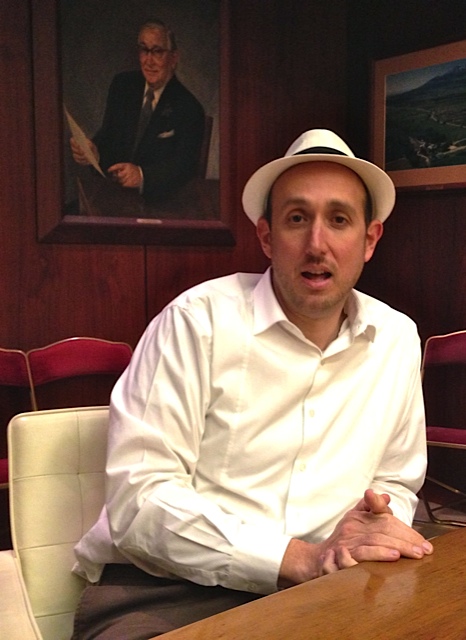
Randall LaneRandall Lane realizes this and revels in the entire package that is the Forbes magazine experience.

When you walk into the Forbes building on 60 Fifth Avenue in New York City, you are welcomed by a series of paintings, drawings, and portraits that offer a sense of the majestic and historical days gone by, of people who have occupied those offices over the years. Randall Lane, wearing his “trademark” hat that he wears inside and outside his Fifth Avenue office, arrives in the historic library lined with bookshelves and filled with (ink on paper) books from floor to ceiling.

The irony isn’t misplaced, nor is it ignored. We learn and grow from our past and we use those experiences to increase our futures. And the packaging that the editor of Forbes describes is one that encompasses all the platforms – print – digital – live events, the total experience for the reader, the right medium for the right story. Each and every one is necessary, sufficient and relevant.

Click here to read the entire Mr. Magazine’s™ interview with the always “spinach energized Popeye” Randall Lane, Editor of Forbes magazine – a man who treasures the traditions of the Forbes brand, but recognizes the potential of a joint venture in today’s digital realms.

h1

In Magazine Publishing, There’s Nothing More Exciting Than the “Launch”. An Excerpt from Our Wisconsin Magazine.

March 30, 2013

photoI love magazines, and I love magazine launches even more. That is no secret. So, when I acquire a new magazine or read a story about a magazine launch, the urge to share my love with the whole wide world is overwhelming. Saturday or no Saturday, I found myself emailing my friend Roy Reiman, Publisher of the new magazine Our Wisconsin, and Mike Beno, the magazine editor, to ask their permission to reprint parts of the introduction to the second issue of the magazine. So without any further ado, here is an excerpt from the February/March issue of Our Wisconsin magazine:

In magazine publishing, there’s nothing more exciting than the “launch.” Not many other things in business come close to this kind of adrenalin rush.
You begin by coming up with an idea or concept for a magazine you feel is “entirely different”. You’re sure potential subscribers have never seen anything like this before.
So you spend months (in our case, we began last spring) planning the format, the design and mostly the content. And then you start gathering that content…which isn’t easy when you don’t have a publication to show anyone. You just have to wave your hands a lot and write lengthy descriptions of what you plan to do.
Then you pull all this together…sort through hundreds of pictures and ideas for articles (some terrific, some not even close)…write and design 68 pages…and finallyput the first issue on the press, printing enough to “test the market”….
And then you wait.
And it drives you crazy. You wait for more than a week for the first response…any response, to see what total strangers think of your “baby”.
“Inventing” a magazine is much more personal than inventing a lawn mower or a toothbrush. It’s more revealing of who you are; it’s an extension of your personality. There’s a lot of you between those pages. So the fear of rejection is greater.
After you put that sample issue in the mail, you’re like a field goal kicker with the game on the line, with its heel or hero element. So you wait as the ball sails…for a long week or more.
If, when the early responses begin trickling in, you learn readers don’t like the first issue, it hurts. To a degree, it’s as though you learned they don’t like you.
But when you learn they like it–and some people even say they love it–wow! That ball is sailing through the middle of the uprights, and every subscription is a pat on the back.

And the people said AMEN!

h1

“New and Exciting Better Than Sexy”: WSJ’s Michael Rooney Tells Mr. Magazine™ in this On-Demand Webcast from the Offices of The Wall Street Journal (via CommPRO.biz)

March 28, 2013

Screen shot 2013-03-27 at 9.09.26 PMWhat’s the magic formula for newspapers to survive in a digital age?

Michael F. Rooney, the chief revenue officer and senior vice president for the Consumer Media Group, at The Wall Street Journal and I had a candid conversation about the ever-changing media landscape. This is the first Mr. Magazine™ Live Webcast. A new Mr. Magazine™ forum for insight and exchange with a maverick, experienced, ground-breaking and innovative publisher. Mr. Rooney’s publishing success story shows that he practices what he preaches.

Click below to listen in on the conversation between Mr. Magazine™ and Michael Rooney (via CommPRO.biz):

Mr. Magazine™ Webcast with Michael Rooney, WSJ, Chief Revenue Officer

h1

Mr. Magazine™ Minute: Rex Hammock, Founder & CEO, Hammock Inc., on the Future of Print and the Difference Between the Know and the Flow.

March 27, 2013

You can call Rex Hammock, the founder and chief executive officer of the Nashville-based Hammock Inc., any name you want, except that of a Luddite. Rex bought his first Apple Mac in 1984, and has been tempted by the Apple ever since. On Twitter he is simply known as @R. He is all over the web, the digital sphere and more.

So when Rex came to speak to my magazine students at the Meek School of Journalism and New Media yesterday, I seized the opportunity to ask him two questions, after he completed his presentation to the students.

The first question had to do with the future of print in this digital age. Click on the video below to hear the surprising answer from this multimedia chief executive officer:

My second question to Rex was about his dual concept of “Flow and Know” in defining the role of content in magazine media. His second “minute” answer is as surprising as the first. Click the video below to listen: