Archive for the ‘Redesigns’ Category

h1

Rachael Ray Every Day Magazine: The “Everyday Name” That Became THE Moniker For Food, Fun & Recipes, Celebrates Its 10th Anniversary. The Mr. Magazine™ Interview with Lauren Purcell, Editor-in-Chief.

October 5, 2015

“You’re not going to be surprised to hear me say that print is very important, I’m sure, but I will tell you why. And I’ll even go one step further, which is, although I certainly don’t have insight into all of the financials of the Rachael Ray brand, but I would guess that we’re not her main moneymaker, given that she has a national daily TV show. Obviously, we’re profitable and successful, but what I will say is the magazine for her is her legacy piece, no offense to television at all, but television doesn’t really have the longevity that a print product does. Rachael’s books and this magazine are where she can deliver a message that she can be unbelievably passionate about over and over again, so that the message is really sticky.” Lauren Purcell
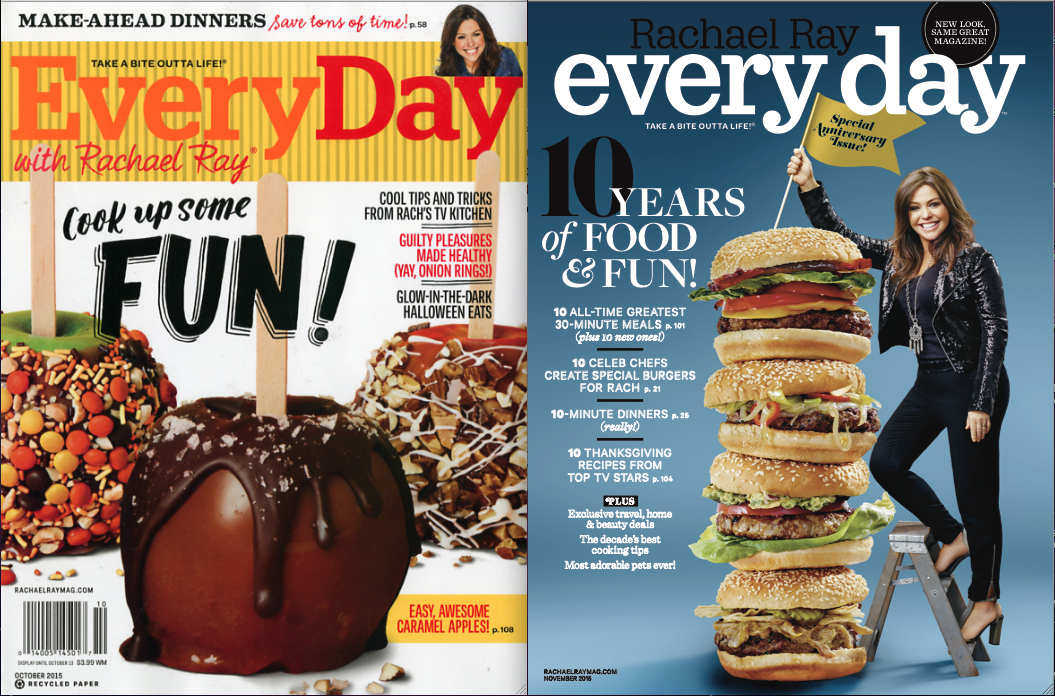
Rachael Ray Every Day: Before and After

Rachael Ray Every Day: Before and After

With its 10th anniversary, Every Day with Rachael Ray becomes Rachael Ray Every Day Magazine, reaching this milestone with plans for many more as the magazine moves forward into its next decade with an eye on maintaining and achieving even more success and audience relevance. It’s a new name and a new look, but the same resonating content that has made it one of the most popular titles out there for its entire 10 years.

Lauren Purcell has been editor-in-chief of the magazine for four years, coming from her position as executive editor at Self. I spoke with Lauren recently and we talked about the important changes that were made regarding the logo and title. Lauren believes that the new name makes a stronger, more immediate connection for the consumer with Rachael and her unique brand.

Lauren told me that Rachael considered multiple versions with both the original name, Every Day with Rachael Ray, and the new one, Rachael Ray Every Day, and Rachael and Lauren based their decision on both visual impact and reader recognition. She believes the new name more closely echoes what their readers call the magazine in casual use on Facebook, Instagram and Twitter, and in conversations both Rachael and she have had with readers in person, in which they often refer to the magazine as “Rachael Ray magazine.” In testing, fans were very engaged by seeing Rachael’s name more prominently placed.

Lauren and Rachael Ray have a collegial working relationship that is based on a mutual trust and love for the brand, something that is sometimes rare to find in celebrity/editor relationships.

So, I hope you enjoy this lively and entertaining conversation with a woman who knows how to keep relevance and freshness in a magazine that some might consider mature, but is in fact still evolving “Every day.” And now the Mr. Magazine™ interview with Lauren Purcell, Editor-in-Chief, Rachael Ray Every Day Magazine.

But first, the sound-bites:

Lauren Purcell, editor-in-chief, Rachael Ray Every Day magazine.

Lauren Purcell, editor-in-chief, Rachael Ray Every Day magazine.

On the 10th anniversary of Every Day with Rachael Ray and what she would say the state of the magazine is today: It’s interesting to be at the point of a 10th anniversary right now, because the tendency would be to perceive that as a mature magazine, but in truth Rachael’s brand has been evolving so quickly that I think we’re really looking forward. In fact, her real directive when I sat down with her about planning this particular issue was, sure, we can do a little bit of a lookback, but forward, forward, forward. Let’s look forward.

On working with Rachael Ray and whether or not it’s all the honeymoon phase or there have been some stumbling blocks: I don’t think it’s a honeymoon as much as it’s our third honeymoon. We’re like colleagues anywhere, we go through cycles of agreeing or disagreeing about things, but my relationship with Rachael has been really collegial from the beginning. The truth about Rachael is that she actually is that person that you see on TV who you believe might be sitting in your kitchen next Tuesday having a glass of wine and telling you a funny joke. It’s not spin; I would spin it, of course, Samir, if I had to, (Laughs) but I don’t have to. I really think that she’s an ideal editorial director.

On the fact that Rachael Ray is so down-to-earth and real: She’s truly a genuine person and one of the things that I hear from all of her people, people who work on her show and hair and makeup people, her PR people; she’s unbelievably loyal and I’ve really experienced that. When we’ve gone through times where we’re really tussling with something in the magazine, what direction we want to go in or should we try a different strategy, and we sit down together, she’s really as interested in coming out of it with me being comfortable and positive about the direction we take moving forward as she is. And we don’t stop until we have achieved some kind of collaboration that we’re both really happy with.

On the reinvention of the magazine for its second decade: It was really just a back and forth, with us doing all the nitty-gritty, really hardcore design work on our end, working with a great designer out in San Francisco, and then bringing them to Rachael and just having her react. And I think her vision of the brand is so internal to her that the easiest way for her to react is not to have to really articulate it, although she is very articulate about the brand; it’s just to say to me, this one feels like us, this one doesn’t. And then Heather and I were able to say, OK, what she’s reacting to is a slightly wider lettering or she likes this color palette of our back color palette and that’s really how Rachael and I handle the magazine in general. It’s really collaborative and yet to her credit, she has hired experts, such as me and my team, and she lets us run with the ball.

On whether we’ll see more or less of Rachael on the cover with the new redesign: We are going to see about the same, perhaps a tiny bit more. To be honest, in all the research, sales of the magazine are about the same, whether the main image on the cover is food or Rachael and there’s always a little image of Rachael. And because we haven’t suffered any sort of loss in showing food, some of it has to do with the fact that Rachael is busier than ever and when we can give her a break from needing to appear in a cover shoot; I think she’s appreciative of that.

On a typical day in her professional life as she puts the magazine together: I don’t know if I can describe a typical day to you, but you do hit on something that is crucial to this brand. And that is, how much Rachael can we deliver to the audience because the magazine is largely about our Rachael fans. Our audience is absolutely Rachael fans, but if there are people who feel lukewarm about her, they might be attracted to a food cover and that’s one of the reasons they began experimenting with just food on the cover and I’ve continued that.

On a major stumbling block she’s had to face and how she overcame it: The one thing that we continue to work on, and it has improved, we’ve done really well with it since I’ve been here, is that the arms of Rachael’s brand are so numerous and are headed by different people, and getting those arms to work together so that the TV show and the magazine and Meyer, which makes her cookware, and Yum-o! her philanthropic effort, even her Food Network show appearances, and they obviously have their own magazine and Rachael has hers, and yet our readers are interested in everything that Rachael does and that includes when she’s on Food Network.

On how important the ink on paper magazine is to a woman like Rachael Ray whose face is everywhere: I think that she sees the magazine as a mouthpiece for her philosophy. And the role of the TV shows is that they are popular and quicker and the ratings drive everything and the message has to be, I think, very upbeat and quick. And the magazine is a place where she can be more heartfelt and more earnest and really delve into why she started to this in the first place.

On anything else she’d like to add: You’ve been very good at letting me get across how excited I am about this 10th anniversary and as editor-in-chief; this is my first editor-in-chief role. And while I’ve put together anniversary books at other places I’ve worked, this is my first anniversary baby. And I’m so, so proud of it. And yet, also kind of grateful to Rachael for even setting me straight and saying, but we’re looking forward. We’re looking forward. So, I think you’re going to see great things from this magazine, whether I helm it or not; Rachael is it’s patron saint and she’s not going anywhere.

On what motivates her to get up in the morning and say it’s going to be a great day: To be honest, it’s the people. I have often said there are lots of great magazine makers out there and I take my cues from lots of them and I’ve borrowed lots of wisdom from people I’ve worked for who I think are great, but I think unless you can make a magazine that’s staff is happy in doing it, especially in this world where we’re constantly bombarded by the whole “print is dead” mantra, which as you can imagine, I completely don’t believe.

On what keeps her up at night: What keeps me up at night is that Rachael will not look both ways when she crosses the street. If you want to talk about the one vulnerability in a celebrity brand it is that she has to be alive and kicking.

And now the lightly edited transcript of the Mr. Magazine™ conversation with Lauren Purcell, editor-in-chief, Every Day with Rachael Ray.

Samir Husni: You’ve arrived at the 10th anniversary of Every Day with Rachael Ray and the magazine has now been under two owners, two major magazine publishers: Reader’s Digest and Meredith. What would you say is the state of the magazine today?
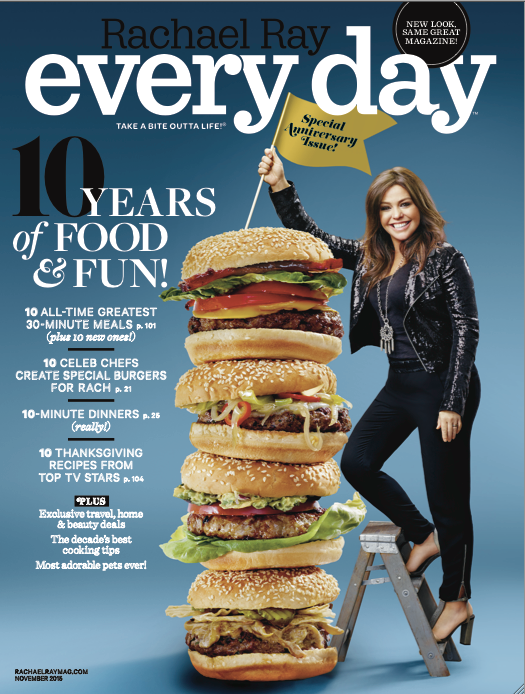
The 10th anniversary issue of Rachael Ray Every Day sporting a new name and logo.

The 10th anniversary issue of Rachael Ray Every Day sporting a new name and logo.

Lauren Purcell: It’s interesting to be at the point of a 10th anniversary right now, because the tendency would be to perceive that as a mature magazine, but in truth Rachael’s brand has been evolving so quickly that I think we’re really looking forward. In fact, her real directive when I sat down with her about planning this particular issue was, sure, we can do a little bit of a lookback, but forward, forward, forward. Let’s look forward.

She’s at the top of her game right now; the brand is incredibly vibrant. Her daytime TV show is popular; her cookware brands are selling like hotcakes; she is one of the most popular talk show hosts in the nation and the magazine is right along with that.

So, I really see the 10th anniversary as a moment to stop just for a second and say, look at what these brands have accomplished and then turn right around and look forward and say, but we’re still going to keep it fresh and interesting. It’s a success and I don’t see that as doing anything else but growing in the future.

What we’ve done to coincide with the anniversary is freshen up the logo, and in fact I’m dying to release it to you because it’s so terrific-looking, we’ve got it embargoed for just another few days.

But it’s the same great magazine, just with a look that reflects the fact that the brand is really contemporary and modern, and keeping up and changing really rapidly with the times. As the times really do right now; there’s nothing complacent, tired or boring about this brand.

So, we’ve changed the look of the cover and the inside, but the content and the message are essentially the same, because it’s just as resonant now. Rachael’s whole message is that “every day” can be a little bit of an adventure and you don’t need to be rich to live a rich life. And that was resonant 10 years ago and it has gone through all sorts of cycles, but the message really connects with readers just as much today. So, I’m looking forward to the next 10 years.

Samir Husni: That’s great and congratulations on this milestone.

Lauren Purcell: Thank you.

Samir Husni: You hear love stories and horror stories from editors about working with “celebrities,” but you sound so radiant when you talk about the magazine. As you work with Rachael, is it all fun, without stumbling blocks? Are you still on a honeymoon period with Rachael?

Lauren Purcell: I don’t think it’s a honeymoon as much as it’s our third honeymoon. We’re like colleagues anywhere, we go through cycles of agreeing or disagreeing about things, but my relationship with Rachael has been really collegial from the beginning.

I think one of the reasons that we hit it off from the very first time that I met her is that I really believe in what she’s doing and what her message is. I don’t know if you know this about my background, but in addition to coming from a women’s lifestyle kind of magazine background, I had also written a cookbook with my sister. But the message of it really was, look we’re just two girls from a small town in the south who moved to New York and proved that you can throw cocktail parties; it was a cocktail party how-to book, without having a culinary degree or hiring caterers or anything like that. And that is essentially so in line with Rachael’s overall message; she too is not a trained chef and she calls herself instead, a cook.

And so I think I just got her and her message from the very beginning and that has enabled her to really relax into letting us run the magazine, which is not to say that she’s not heavily involved. She sees every page, we talk about what we’re planning to do; she is really instrumental in setting new directions that we go in.

So, not so much a honeymoon period as it’s just really an excellent fit, I think. And that’s lucky because I came from Condè Nast and had my share of celebrity run-ins and that’s just not the way of this relationship. The truth about Rachael is that she actually is that person that you see on TV who you believe might be sitting in your kitchen next Tuesday having a glass of wine and telling you a funny joke. It’s not spin; I would spin it, of course, Samir, if I had to, (Laughs) but I don’t have to. I really think that she’s an ideal editorial director.

Samir Husni: I can attest to that. When I first met Rachael at the launch party for the magazine 10 years ago, my daughter, who lived in New York at the time, went with me and Rachael was talking with my daughter as if she had known her for years. I was simply stunned at how down-to-earth she was. She took pictures with my daughter and anyone else there who wanted to and mingled with everyone as if she were simply attending the party, instead of being the celebrity guest of honor.

Lauren Purcell: That’s actually a better description than I could even give you. She’s a real person and I do think that’s rare among celebrities; I don’t think that your observation is off the mark at all. I have funny stories about other celebrities that I’ve worked with in the past, but I just don’t have them about Rachael. The stories about her are always things like, she told me a joke when I was in her office one day and I almost fell off my chair laughing.

She’s truly a genuine person and one of the things that I hear from all of her people, people who work on her show and hair and makeup people, her PR people; she’s unbelievably loyal and I’ve really experienced that. When we’ve gone through times where we’re really tussling with something in the magazine, what direction we want to go in or should we try a different strategy, and we sit down together, she’s really as interested in coming out of it with me being comfortable and positive about the direction we take moving forward as she is. And we don’t stop until we have achieved some kind of collaboration that we’re both really happy with. And that dialogue being that open has been; I won’t lie to you, maybe a bit of a surprise. I wasn’t sure what to expect when I started working with her four years ago, but she is responsive, and the best thing about her is that she’s real, as you saw with her interaction with your daughter. And she’s truly accessible and really interested; none of that is fake and that’s my highest compliment to her.

Samir Husni: Tell me about the process, how the two of you or just you and the team, handled the redesign and essentially the reinvention of the magazine for its second decade.
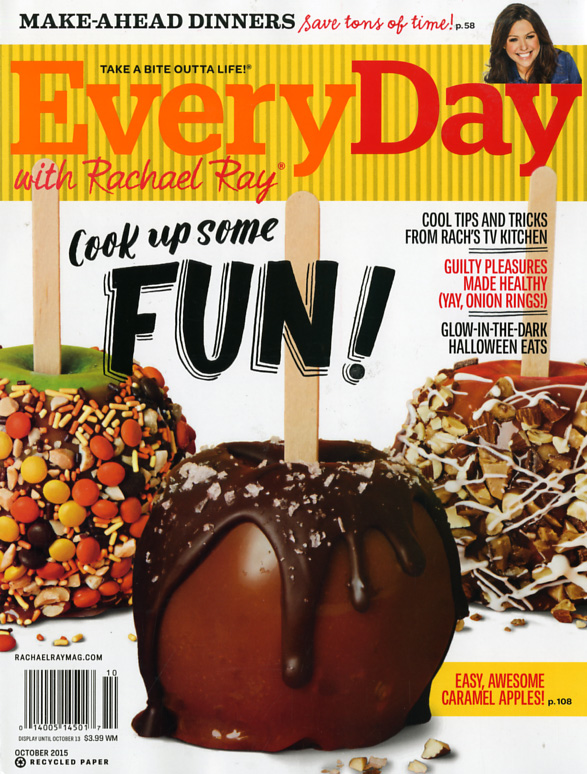
The last issue of Every Day with Rachael Ray before the name and logo changes.

The last issue of Every Day with Rachael Ray before the name and logo changes.

Lauren Purcell: Well, it’s been an interesting process because we started working on a new logo last December. So, we’re really talking about nine or ten months of working on that. And in the middle of that we had a change in creative directors. So, you can imagine that made things a little tricky in terms of continuity.

And I have to give credit to Heather Haggerty, who is my new creative director who isn’t so new anymore, but who joined us earlier this year, in picking up that ball and running with it. And for the logo in particular, I would take multiple iterations to Rachael, who is very visual, so it wasn’t the kind of thing where I could sit down and say, tell me what you envision or what kind of type styles you like or what would you like it to look like.

What I needed to do was sit down with my team, get a start on what we wanted and those words had to be modern, in keeping with the digital age, fresher, energetic and casual. And then do a bunch of designs and there must have been 70 iterations in the beginning that we just put in front of Rachael that she could say yea or nay to without having to worry about why she liked something. Yes, I like it or no, I don’t. And then we went back and we were able to interpret from that what kinds of things she liked. Would she like it to be more feminine, less feminine? Upper case, lower case; you’ll see a change in the logo towards lower case, which reflects a social media sensibility, a casualness about capitalization.

It was really just a back and forth, with us doing all the nitty-gritty, really hardcore design work on our end, working with a great designer out in San Francisco, and then bringing them to Rachael and just having her react.

And I think her vision of the brand is so internal to her that the easiest way for her to react is not to have to really articulate it, although she is very articulate about the brand; it’s just to say to me, this one feels like us, this one doesn’t. And then Heather and I were able to say, OK, what she’s reacting to is a slightly wider lettering or she likes this color palette of our back color palette and that’s really how Rachael and I handle the magazine in general. It’s really collaborative and yet to her credit, she has hired experts, such as me and my team, and she lets us run with the ball.

Samir Husni: Are we going to see more of Rachael on the cover or less of her?

Lauren Purcell: We are going to see about the same, perhaps a tiny bit more. To be honest, in all the research, sales of the magazine are about the same, whether the main image on the cover is food or Rachael and there’s always a little image of Rachael. And because we haven’t suffered any sort of loss in showing food, some of it has to do with the fact that Rachael is busier than ever and when we can give her a break from needing to appear in a cover shoot; I think she’s appreciative of that.

That being said, she’s happy to appear on all of them and you’ll see her on November and December and then she’s appearing again in March. So, you may see a little bit of an uptick in how often she appears on the cover, but I think we’re doing just as well with food and while that’s unusual to have two very different kinds of cover tracks like that, until I see that it’s confusing the consumer, and I see no evidence of that, I see no reason not to continue with both. They’ve both been really successful.

Samir Husni: Let’s go inside your mind for a moment as you put the magazine together and you’re thinking about the fact that you have a team and you’re working with Rachael, but at the same time you have an audience that could probably be described as a Rachael Ray cult. Can you describe a day in your life as editor-in-chief of a major magazine? How do you go through your day thinking about the millions who follow Rachael and who want everything to have Rachael Ray’s name on it and then knowing you also have an audience that you’re introducing to Rachael for maybe the first time and knowing that you have Rachael herself to consider?

Lauren Purcell: I don’t know if I can describe a typical day to you, but you do hit on something that is crucial to this brand. And that is, how much Rachael can we deliver to the audience because the magazine is largely about our Rachael fans. Our audience is absolutely Rachael fans, but if there are people who feel lukewarm about her, they might be attracted to a food cover and that’s one of the reasons they began experimenting with just food on the cover and I’ve continued that.

If you assume that, and we’re really now mostly talking about a newsstand audience, which is pretty small for us, but of course for an editor-in-chief it’s always a measure of vitality. If you assume that you’re capturing with a Rachael image Rachael fans, you still have to wonder about the people we might be able to convert into Rachael fans by the strength of what’s inside the magazine, which is terrific, accessible food, an approach to lifestyle that really does take into consideration the value and fun of life, and it’s not over the heads of its readers and it really speaks to her. And it’s largely women, although not completely, but it speaks to her where she lives, on a Tuesday or a busy Wednesday. What is she going to do tomorrow or next week as opposed to just special occasions and holidays?

I have actually taken advantage of how strong Meredith is in the research side of things and tested a lot of that, so as I said, one of the first things I did was test to see if the food cover was as popular as a Rachael cover and if not we need to change that. I was lucky to find out that they are and they actually perform the same in sales.

I’ve also asked my readers, frankly I’ve gone directly to them and asked, do you feel there is the right amount of Rachael in this magazine or do you wish there was more or less? And people feel there is the right amount. And I think my team does a very good job of understanding who Rachael is and that the brand is this woman. And also in fusing the magazine with everything we know about her and her voice.

And she’s also of course literally there; she writes her own 30-minute meals, so this is a woman who is very involved in the brand that has her name on it. But when you talk about day-to-day, what we think about all the time, and this is true of any magazine editor, so this is no particular secret sauce of mine, it’s just that I have a celebrity who is a real living, breathing brand, and so it’s easy for us to ask, would Rachael do that or does this feel like Rachael? Is this the kind of thing that Rachael is interested in? And if I don’t have a gut instinct, although I usually do, I text her and I ask her. And that’s really beautiful.

And as Rachael evolves, the magazine has this really natural permission to also change and grow and it doesn’t disconcert the readers; they’re not thinking to themselves, oh my goodness, what happened to my Every Day with Rachael Ray because they are aware of her and they know that, for instance, she is more interested in let’s say, vegetarian cooking, something that she decided she was interested in pursuing, which surprised me. That didn’t surprise the readers at all, they believe that she’s like them and she gets enthusiasm and she pursues them and then she reports back.

So, I have to say that rather than it being a difficult thing to have a celebrity, it makes it really easy. I have a touchstone that’s right there on the other end of the phone line or sitting across the desk from me and I can say, what do you think about doing x, y or z? It’s a great guideline and to her credit, never constraining because she herself shows interest and is open-minded.

Samir Husni: In the last four years since you’ve been at the helm of the magazine, what has been the major stumbling block that you’ve had to face and how did you overcome it?

Lauren Purcell: The one thing that we continue to work on, and it has improved, we’ve done really well with it since I’ve been here, is that the arms of Rachael’s brand are so numerous and are headed by different people, and getting those arms to work together so that the TV show and the magazine and Meyer, which makes her cookware, and Yum-o! her philanthropic effort, even her Food Network show appearances, and they obviously have their own magazine and Rachael has hers, and yet our readers are interested in everything that Rachael does and that includes when she’s on Food Network.

And so I think the thing I concentrate on as the magazine is running very smoothly, four years in, I think we do have a really good momentum and it runs very smoothly day-to-day, is how we can get more and more synergy among all the arms. And I know from speaking to the people who run all of those, they’re all concerned about doing that as well.

A good example is Rachael has her own book in print with Simon & Shuster and there just hadn’t been a lot of conversation between the magazine and the book. And that didn’t make any sense. We’re natural outlets for one another. So we just recently finished collaborating on a great program where if you purchase Rachael’s new book which is coming out at the end of October, you also get a free subscription to the magazine. And that sounds so simple, but because the properties are owned by entirely different corporations, it really took a lot of collaboration and me involving a lot of people on my corporate side, Simon & Shuster getting people involved from their corporate side and really working together over the course of weeks.

That was a small win, but a significant one. And I think that’s my major sort of challenge or objective going forward; how can we get more and more of those wins, where the arms of this brand all work together and we’re more than the sum of the parts. You can’t just work in isolation; that’s not how brands work anymore, as we all know. We want the TV show and the magazine to collaborate and the book to get involved too and then the product line and the philanthropic effort and all of the things that she’s going to do. And I expect her to do more and more things.

Samir Husni: So we can easily say that you have been Meredith-ized? That has been a Meredith trend for years. You used to buy the Better Homes and Gardens cookbook and you got the magazine subscription free.

Lauren Purcell: Right. And if our brand worked the way Better Homes and Gardens did within Meredith, I think that would be much more seamless and easy to accomplish. And because we are a little bit of a different business model, it has not been as natural a collaboration. I’m really proud of achieving and making strides in that arena and I just want to keep going with that because I think that there’s unlimited potential. The drawback is also the advantage; the fact that there are multiple arms with different companies means that there are lots and lots of resources that wholly-owned Meredith brands might not be able to take advantage of. But it’s my challenge to figure out how to make those collaborations work when they’re not wholly-owned by Meredith, of course, you have to figure out how everybody benefits. And that’s good business negotiation and I’m learning as I go, and as I said, have chocked up some wins, and frankly, have had some things that haven’t worked out in the end and we couldn’t come to an agreement.

But I think that going forward that’s going to be what I look back on and regard as my greatest success. Of course I’m proud of how successful the magazine is on its own, but to be able to look back and say that we really advanced the entire brand, with the magazine as an engine, that would be a terrific legacy.

Samir Husni: How important is the printed magazine for a woman like Rachael Ray, who is everywhere and on almost every pixel on every screen? She’s all over; how important is the ink on paper magazine?

Lauren Purcell: You’re not going to be surprised to hear me say that print is very important, I’m sure, but I will tell you why. And I’ll even go one step further, which is, although I certainly don’t have insight into all of the financials of the Rachael Ray brand, but I would guess that we’re not her main moneymaker, given that she has a national daily TV show. Obviously, we’re profitable and successful, but what I will say is the magazine for her is her legacy piece, no offense to television at all, but television doesn’t really have the longevity that a print product does. Rachael’s books and this magazine are where she can deliver a message that she can be unbelievably passionate about over and over again, so that the message is really sticky.

And so I think that she sees the magazine as a mouthpiece for her philosophy. And the role of the TV shows is that they are popular and quicker and the ratings drive everything and the message has to be, I think, very upbeat and quick. And the magazine is a place where she can be more heartfelt and more earnest and really delve into why she started to this in the first place.

And she’s been on-message from the beginning because it’s something that she feels so passionate about and that’s why she called it “Every Day” because she really believes that food and all the things that surround it are a way to make every single day a little bit better and a little bit more personal and a little bit more filled with love. As cheesy as that might sound, that’s a message that she’s never going to get tired of getting across and the print product is just the place where I think the audience has a lot more tolerance for that kind of deep, thoughtful message, packaged obviously with her humor and brilliant visuals and terrific food and all of those things. And we’ll never stop delivering that, but I know that she’s really proud of having a place where she can accomplish these things. And you’ll find this in the book too, to some extent. But the magazine is a place where over and over again, ten times every year, we can say, this is what Rachael Ray stands for.

Samir Husni: Is there anything else that you’d like to add?

Lauren Purcell: You’ve been very good at letting me get across how excited I am about this 10th anniversary and as editor-in-chief; this is my first editor-in-chief role. And while I’ve put together anniversary books at other places I’ve worked, this is my first anniversary baby. And I’m so, so proud of it. And yet, also kind of grateful to Rachael for even setting me straight and saying, but we’re looking forward. We’re looking forward. So, I think you’re going to see great things from this magazine, whether I helm it or not; Rachael is it’s patron saint and she’s not going anywhere. And I think everything that she has to say and everything that she’s done for American cooking; I’m really proud to be able to get that message across. It’s an exciting time to be here.

Samir Husni: What motivates you to get up in the mornings and say it’s going to be a great day?

Lauren Purcell: To be honest, it’s the people. I have often said there are lots of great magazine makers out there and I take my cues from lots of them and I’ve borrowed lots of wisdom from people I’ve worked for who I think are great, but I think unless you can make a magazine that’s staff is happy in doing it, especially in this world where we’re constantly bombarded by the whole “print is dead” mantra, which as you can imagine, I completely don’t believe.

I only want to go to work each day and make sure that my staff enjoys working there, is proud of what we’re putting out, feels creatively challenged, knows that I’m fostering their careers, and there’s kind of a joke within Meredith that I’m constantly needing to hire new editorial assistants, and the reason for that is because we mentor them so thoroughly that they get snapped up by other media companies and promoted, well beyond what I can offer them and I’m really proud of that. That there is a whole set of people walking around who got their chops working on this magazine under me. I believe in mentoring more than anything else and while obviously it is my job to make a terrific product and to make sure it sells and is relevant, I want to do that as well as create an atmosphere where great editors are being developed on my team and they’re proud of what they’re doing and are happy to come to work every day.

Samir Husni: My typical last question; what keeps you up at night?

Lauren Purcell: What keeps me up at night is that Rachael will not look both ways when she crosses the street. If you want to talk about the one vulnerability in a celebrity brand it is that she has to be alive and kicking. And I have said that to her. She used to a fan of skydiving and I don’t know if it was the insurance company, her husband or her own good sense that made her stop doing that, but I just saw an interview where she said that she would love to take it up again. And I texted her and said, please don’t. (Laughs)

Samir Husni: Thank you.
h1

Super Yachting Anyone? You Only Need A Net Worth Of $680 Million To Join The Fun – But Not To Enjoy The Magazine – The Mr. Magazine™ Interview With Louis Coletti, Associate Publisher Luxury Advertising, ShowBoats International Magazine.

August 14, 2015

“I think print is the most powerful medium. I think it’s an engagement opportunity for consumers to be hands-on (no pun intended) and connected with the content. I’ve been a magazine fan since high school; I believe in print and always will believe in print. It’s something that you can take with you and have an intimate experience with. The photography is bold; the typography is modern and continues to change. It’s something that you can take with you no matter where you are, from the beach to the boardroom, onboard a boat or onboard a plane; it can go with you everywhere. There’s no place that you can’t take a magazine.” Louis Coletti

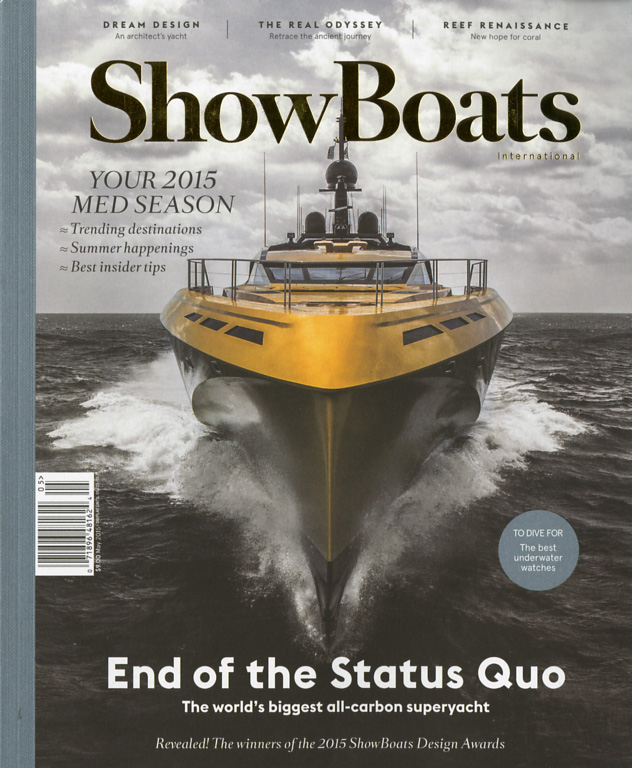
Showboats 3-14 For most of us the superyacht stratosphere of existence is but a mere fantasy that we dream about after a really large, superb dinner. But for some people, that’s not the case. Spending $10 million a year on maintenance alone for one of these magnificent vessels is just an annual expense that they write a check for unflinchingly. Just thinking about it makes me hyperventilate a bit.

ShowBoats International is a magazine dedicated to those individuals who can sail the seven seas in a style and luxury that many of us have never known, nor ever will. But it’s definitely entertaining to read about.

According to Louis Coletti, associate publisher luxury advertising for the magazine, ShowBoats International has the wealthiest readership of any publication in the United States, with the mean net worth of a superyacht owner estimated at $680 million. The magazine has the highest concentration of ultra-high net worth individuals and billionaire’s listed among its readership and provides the content this echelon of people need to stay up-to-date and abreast of what’s going on in the superyacht and mega yacht communities.

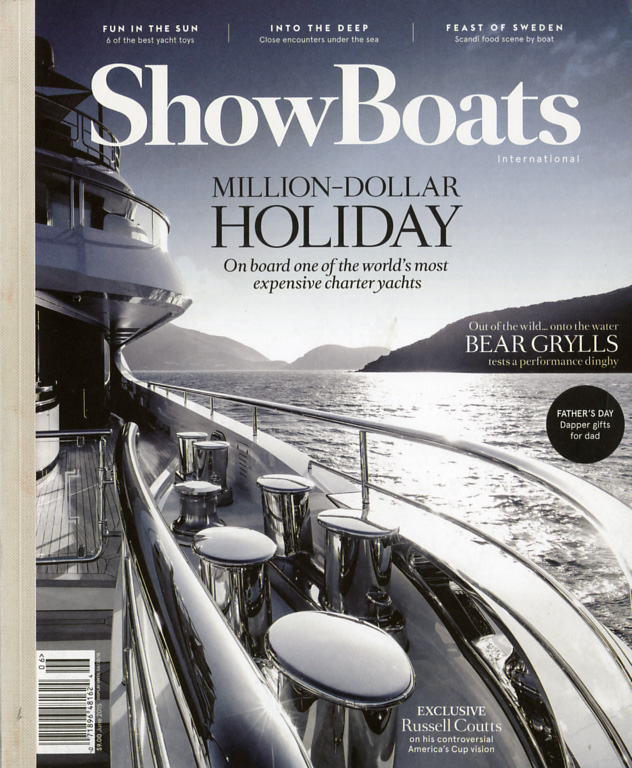
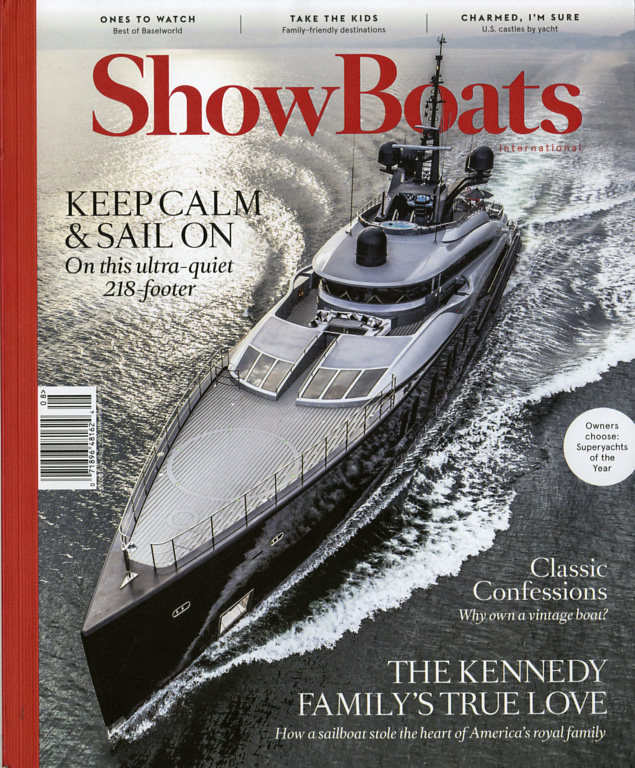
Louis is determined to take this superyacht brand to a whole new level. I spoke with him recently and we talked about the redesign and relaunch of the U.S. edition of the brand beginning with the March 2015 issue of the magazine. Louis said investments were made in editorial content, paper stock and the overall size and binding of the publication, proving that not only do us mere mortals appreciate the power of print, but so do the ultra-mega-rich as well.

Some mindboggling statistics that Louis provided for Mr. Magazine™ only goes to show that a niche audience takes on a whole new meaning when it comes to the superyacht community:


• Many superyacht owners keep their vessels for no more than three years before selling up.

• In 2013, 355 superyachts were sold with a total combined price of $3.4 billion U.S.

• Of the 125 owners’ nationalities identified, 14% were Americans, followed closely by Russians.

• Luxury yachts top the list of the ten most expensive asset purchases ever recorded.

• 10% of the yacht purchase price is usually paid immediately.

So, as you let those statistics sink in, I hope you enjoy the Mr. Magazine™ interview with a man who rubs elbows with the ultra-wealthy quite often, but keeps his feet firmly planted on the ground when it comes to the future of his brand, Louis Coletti, Associate Publisher Luxury Advertising, ShowBoats International Magazine.

But first, the sound-bites:

Louis Coletti
On defining the superyacht community:
It really is a fascinating community. The superyacht world is becoming more known and more aware in the United States now, thanks to social media and all of the entertainment channels. As you know, super yachting has been a very big presence in Europe; it’s been part of their culture for decades and centuries with Sardinia and St. Moritz, Monaco and the French Riviera and all over Italy. Yachts are in the harbors there and can be seen all year long, but it’s just becoming known here in the U.S., which is exciting for us.

On the need for a magazine like ShowBoats Magazine in the scheme of things: We’re globally the number one content provider in the superyacht world, for both the motor boat and sailing. We have the strongest hold on the community, in terms of the inside access to who these people are and the people who create this industry. We’ve been around for over 30 years and it’s the number one trusted media brand in the superyacht world. We host the largest and most high profile private event in the industry; we host over 14 global events, exclusively for superyacht and mega yacht owners, brokers and builders.

On the superyacht owner’s estimated net worth being $680 million and whether advertisers are waiting in line to get inside the magazine’s pages because of that:
Our advertising clients directly get it. Every time that I meet with a client, especially Europeans – Italians or French, they immediately understand exactly who this audience is. They’ve been around it, especially as a luxury marketer, they understand who these people are and how powerful and influential they are, and most importantly how private they are.

On the redesign, rebranding and relaunch of the magazine: We increased the trim size as you saw. We have top-quality paper stock and beautiful binding for the magazine; big, bold photography and to improve the design we cut the issue cover-to-cover, beginning with the March issue. And together with our investors as well as many of our readers that attend our events; they all kept speaking to my CEO and the editors about including luxury lifestyle content in the magazine.

On why he thinks we still need print in this digital age: I think print is the most powerful medium. I think it’s an engagement opportunity for consumers to be hands-on (no pun intended) and connected with the content. I’ve been a magazine fan since high school; I believe in print and always will believe in print. It’s something that you can take with you and have an intimate experience with. The photography is bold; the typography is modern and continues to change. It’s something that you can take with you no matter where you are, from the beach to the boardroom, onboard a boat or onboard a plane; it can go with you everywhere. There’s no place that you can’t take a magazine.

On the biggest stumbling block he’s had to face:
It’s brand development basically. We just opened a New York office in April 2015 and I’m here in charge of building all the luxury non-marine; everything that’s non-marine related. It’s just building the brand; making people aware that ShowBoats International is redesigned and relaunched. We have the most powerful audience, in terms of wealth and influence. It’s just about educating people on what the superyacht and mega yacht world is and what it’s about; the amount of money that it takes to participate in this community and that a superyacht is literally the most expensive consumer item for purchase on earth right now.

On how it makes him feel to be in the company of people with ultra-high net worth’s:
It’s exciting to be part of this development. I wish that it was easily understood, in terms of when I talk about super yachting, I just wish more people would understand exactly what it means. And what this industry is about.

On anything else he’d like to add:
The way I see this media opportunity/partnership with us is more a financial decision than a media decision. If marketers are looking to affect their bottom line in a significant way and move product; move a luxury auto off the lot; move a $150,000 timepiece out of the showcase; move custom, made-to-order pretty much anything that’s in their stable of offerings; this is the audience to do it.

On what keeps him up at night: What keeps me up the most honestly though is the excitement of wanting to get out and see more people and do more and just build this brand and take it to a whole new level. I’m in month four, going on month five, and sometimes it feels like it’s been two years and sometimes it feels like it’s been five weeks. Every day it’s new and exciting.

And now for the lightly edited transcript of the Mr. Magazine™ conversation with Louis Coletti, Associate Publisher Luxury Advertising, ShowBoats International Magazine.

Samir Husni: Tell me a little about the superyacht community.

Showboats 2-13 Louis Coletti: It really is a fascinating community. The superyacht world is becoming more known and more aware in the United States now, thanks to social media and all of the entertainment channels.

As you know, super yachting has been a very big presence in Europe; it’s been part of their culture for decades and centuries with Sardinia and St. Moritz, Monaco and the French Riviera and all over Italy. Yachts are in the harbors there and can be seen all year long, but it’s just becoming known here in the U.S., which is exciting for us.

I’m not sure if you’re aware of this, but Ft. Lauderdale is the third largest shipbuilding, manufacturing and marina setting in North and South America. It’s actually the third largest in the world. It’s the top largest in North and South America.

Most Europeans still have their superyachts here in Ft. Lauderdale during the wintertime when they’re doing the transatlantic trips. They send their boats ahead with the captain and the crew and then they meet up with them in Florida. So, it’s become really big, which is very exciting for us. We’re very happy about all of the attention the community has been getting.

Samir Husni: I’m hearing a lot lately that the reason we exist in print is because of the impact of social media and the Internet and how it’s introducing the world to each other. What is the need for ShowBoats International Magazine in the scheme of these introductions?

Louis Coletti: We’re globally the number one content provider in the superyacht world, for both the motor boat and sailing. We have the strongest hold on the community, in terms of the inside access to who these people are and the people who create this industry. We’ve been around for over 30 years and it’s the number one trusted media brand in the superyacht world. We host the largest and most high profile private event in the industry; we host over 14 global events, exclusively for superyacht and mega yacht owners, brokers and builders.

So, it’s really these great partnerships and we have access in terms of exclusive interviews; we get invited onboard for the new build before they’re launched. We have what’s called the Superyacht Design Symposium, which is an event that we host once a year where all the top superyacht architects and designers gather together. It’s a three-day event that’s an open forum and discussion, plus there are seminars and other types of events there as well. And they’ll all get together once a year to share the new updates and ideas on technology, regulations, design opportunities and new build that are coming out. So, we’re involved on the build side as well as the actual boats themselves being launched on the water.

Samir Husni: In addition to that, you have the Ultra High Net Worth individuals in the world; I’m quoting you from your email. You said the superyacht owner is estimated at $680 million, that’s the mean net worth. How do you utilize that audience in reaching the advertisers? You’re in charge of the luxury advertising for the magazines of the brand; when you go meet with an ad agency, are they just champing at the bit to advertise in the magazines?

Louis Coletti: That’s a very interesting question. When I meet with a client directly, they get it immediately. They understand the amount of money that it takes to be a superyacht owner. And additionally, the amount of money that it takes to support the lifestyle that evolves with this community.

On average, they spend two months out of the year on their superyachts. They have a whole life outside of their boating activities. So, for them to spend hundreds of millions of dollars on something they only spend two months a year on, they have an excessive amount of income to spend supporting their hobby and their luxuries.

So our advertising clients directly get it. Every time that I meet with a client, especially Europeans – Italians or French, they immediately understand exactly who this audience is. They’ve been around it, especially as a luxury marketer, they understand who these people are and how powerful and influential they are, and most importantly how private they are.

The ability to gain access is what we provide. We provide inside access with people who we have very intimate relationships with. And you can just imagine based on the size of these boats and they’re all new build that we feature in the magazine. Every issue when you receive ShowBoats International and you see the content, every boat in there is a new build; every boat that’s in there is one of our readers, and we only feature yachts of a 100 ft. or larger on the cover. So, if you have an 80 ft. yacht and it’s spectacular, it might not make the cover, because our rule is 100 ft. or larger.

Also another statistic is on average they spend 10% of the cost of the yachts annually on maintenance. For example, they’ll spend $100 million on their yacht at purchase and then they’re spending $10 million per year to maintain it. Between fuel, docking fees, insurance; whatever they pay in terms of a captain’s salary, crew salaries and everything else that goes along with it, it’s about 10% a year that they spend. That automatically increases the caliber of wealth behind these people. Steven Spielberg is one of our readers. He’s one of the biggest superyacht owners in the Americas, pretty much in the world, but definitely in the Americas.

This explains the difference between a high net worth individual and a very high net worth individual, (Laughs) or an ultra-high net worth person.

Samir Husni: (Laughs too) Yes, ultra-high indeed.

Louis Coletti: Yes, ultra, as they’re definitely called.

Samir Husni: I was in L.A. with a friend at the marina and he was showing me the yacht of Microsoft’s Paul Allen…

Louis Coletti: Yes, he owns three. He has three superyachts. And up until two years ago, he had the largest yacht on the water. He spent around $200 million building that boat. And one year later billionaire Roman Abramovich built a yacht 10 feet larger just to beat Paul Allen. (Laughs)

Samir Husni: (Laughs too).

Louis Coletti: It’s very competitive. Who wants to have the fastest boat; who wants to have the biggest boat; who wants to have one of the top architects and designers building their boat? It’s a very, very competitive community and it’s a very small community too. It’s just the richest people in the world.

Samir Husni: You said that Spielberg has the biggest now?

Louis Coletti: Well, there are two that are vying for the biggest superyacht on earth; one is a Malaysian businessman and one is a guy with no name from the Middle East. Those two are being discussed as the largest boats on the water. But that could always change.

Samir Husni: In March, the entire magazine was relaunched, redesigned and rebranded; tell me a little about the before and after of ShowBoats International.

Louis Coletti: Before it was a different trim size, a different paper stock, a different type of production quality and not as luxurious as you see it today. And it was strictly cover-to-cover boating. It was a place for the boats’ owners to have a showcase, but also for brokers to market and showcase their clients’ boats that were up for charter. Basically, it was a very specific trade-type of magazine, although it was for anyone who appreciated boating, but really for the superyacht owner.

We have a new group of investors in the company; Tara Getty, for instance, from the Getty family Art Foundation; Tara Getty is one of our investors. H
e’s a superyacht owner and very involved in the community.

And together with our investors as well as many of our readers that attend our events; they all kept speaking to my CEO and the editors about including luxury lifestyle content in the magazine. These are very, very busy people; they’re all over the world and they own several homes; they’re not in one place too often. So, the opportunity to read one publication that they’re most excited about; the number one passion point should be yachting. And to infuse it with other luxury content such as watches; they’re big collectors of luxury timepieces. That’s another thing that they spend so much of their money on is watches. Luxury automobiles, fashion, jewelry, spirits, technology and things like that.

We took the liberty to hire new editors; our editor-in-chief in the U.K. Sacha Bonsor; she comes from Hearst, where she worked at Harper’s Bazaar and she’s editor-in-chief in the U.K. overseeing all of the content. She’s very well connected in the luxury space and she’s bringing really fantastic contributors onboard to build the luxury content in the magazine. And it has been so well-received; readers are just praising the redesign; they love the fact that we’re including this new content in addition to boating. And it’s really brought a new element to the brand.

We increased the trim size as you saw. We have top-quality paper stock and beautiful binding for the magazine; big, bold photography and to improve the design we cut the issue cover-to-cover, beginning with the March issue.

Our sister publication, Boat International, which is for our European market and based in the U.K., they did their redesign first. Their redesign launched in October 2014. And then ShowBoats International for the U.S. was redesigned as of March 2015.

Samir Husni: With the redesign and relaunch of the brand; tell me a little about the power of the print publication. You’ve invested in the quality of the paper; you’ve invested in the branding; you’ve invested in the editorial content; why do you think in this digital age people still need print?

Louis Coletti: I think print is the most powerful medium. I think it’s an engagement opportunity for consumers to be hands-on (no pun intended) and connected with the content. I’ve been a magazine fan since high school; I believe in print and always will believe in print. It’s something that you can take with you and have an intimate experience with. The photography is bold; the typography is modern and continues to change. It’s something that you can take with you no matter where you are, from the beach to the boardroom, onboard a boat or onboard a plane; it can go with you everywhere. There’s no place that you can’t take a magazine.

And it’s a whole different experience, in terms of content. Does print and digital work well together? Absolutely. We have content online that’s not in the magazine. We also have videos online as well.

That’s another thing, our company has its own video production company and we produce videos for all of the major yacht builders. We produce videos for all of our events. We produce and host The Loro Piana Superyacht Regatta twice a year; once in Sardinia and once in the Caribbean and we’ve been doing it for eight years with Loro Piana. And we videotape the entire week’s events, from start to finish. All the races; all the interviews; all the entertainment; all of it is recorded in a beautiful documentary way. And we press those videos online.

We also host what’s called The World Superyacht Awards. It’s similar to The Oscars for the superyacht industry and it’s something that our readers look forward to every single year. It’s with several different, very high-profile luxury partners. Baccarat builds the statue for us that they win, it’s called The Neptune, and it’s a very big deal. It’s a black-tie event that’s hosted in a different country around the world every year. And we videotape that entire event and we press that online too.

So, the content online is much different. We also list now over 7,000 superyachts for sale and for charter; it’s the number one directory for sale and charter in the industry. And we host that on our sites. We also produce what’s called the Superyacht Register, which is an outline of every detail of the top superyachts in the world. And it lists the builder, the year it was built, the owner, the architect, the interior designer, the size and speed of the boat; all the specifics of the boats are registered.

My point with this is it’s a whole different experience and additional content that’s found online.

Showboats 1-12 Samir Husni: With all the glitz and glamour of the superyacht world; what has been the biggest stumbling block that you’ve had to face and how did you overcome it?

Louis Coletti: It’s brand development basically. We just opened a New York office in April 2015 and I’m here in charge of building all the luxury non-marine; everything that’s non-marine related. It’s just building the brand; making people aware that ShowBoats International is redesigned and relaunched.

We have the most powerful audience, in terms of wealth and influence. It’s just about educating people on what the superyacht and mega yacht world is and what it’s about; the amount of money that it takes to participate in this community and that a superyacht is literally the most expensive consumer item for purchase on earth right now. Until you can own private rocket-ships going up into space; there isn’t anything more expensive than superyachts. It costs more than any real estate, any watch, any piece of art, any automobile, and any airplane. The average cost of a plane is $5 million; these people spend more than that just maintaining their boat. (Laughs)

Samir Husni: (Laughs too).

Louis Coletti: It’s just a matter now of really educating the community. The challenge has been, I’d say, the ad agencies; not clients. Clients get it immediately. They’ve been on a superyacht; they know someone who owns a superyacht; they’ve been in St. Tropez, St. Bart’s or Sardinia and they see these superyachts in the harbors or out at sea, so they understand exactly what I’m saying. Several of my clients are part of this community. David Geffen is one of our readers; he owns two superyachts. I think I mentioned that Steven Spielberg is one of our readers; Paul Allen is one of our readers; Mark Zuckerberg is a reader; these people own superyachts and we’re the number one content provider in this community. If they own a boat, it’s registered with us; they get the magazine.

Samir Husni: How does it make you feel to be in such company?

Louis Coletti: It’s exciting to be part of this development. I wish that it was easily understood, in terms of when I talk about super yachting, I just wish more people would understand exactly what it means. And what this industry is about.

But like everything, it takes time and we’re making great progress. We’ve already secured seven new luxury clients that have never worked with us in this yachting space before. We’re getting a lot of interest for 2016 from a lot of the A-list top luxury brands across all categories, not just in the watch category. I wish there were more like me. (Laughs) I wish there were 10 of me; it would make it happen a lot faster.

We’re in building mode right now. We know our strengths. There are other magazines in this space, but they can’t compare to what we’re doing. They don’t have events and if they do, not at the caliber of the events that we have. They definitely don’t have the guest list of attendees that we have. They don’t have the respect and the appreciation for our quality content that we have.

It feels good to be the leader; it’s just being a leader in a space that’s not so widely-known in the U.S. yet.

Samir Husni: Is there anything else that you’d like to add?

Louis Coletti: The way I see this media opportunity/partnership with us is more a financial decision than a media decision. If marketers are looking to affect their bottom line in a significant way and move product; move a luxury auto off the lot; move a $150,000 timepiece out of the showcase; move custom, made-to-order pretty much anything that’s in their stable of offerings; this is the audience to do it.

It’s not about branding; it’s not about running ads in this magazine or that magazine because so-and-so is friends with the editor-in-chief or doing favors for a favor. I understand the importance of all that and that’s definitely a part of how this industry works, but in our case it really is about a financial decision. You invest in us and the rate of return is so much higher than pretty much any other magazine or media available. And it’s because of the amount of wealth and influence that these people have. And it’s a global community. ShowBoats International is for U.S.-based superyacht owners and Boat International is for European superyacht owners; however, combined together it’s a global community. They travel the circuit. They’re all in the Mediterranean at the same time and when the seasons change they go over to the Caribbean and spend time and then they travel to the Americas around the same time, based on the climate and the season. And it’s a circuit. Sometimes you can see five or ten, maybe more, of these superyachts in the same vicinity. We post on our website about whose yacht was spotted where.

Just keep an eye on us. If you’re ever going to follow the America’s Cup, now is an exciting time to do that. We publish America’s Cup updates on our site daily. Right now it’s going on as the World Series and so we’re featuring content on the America’s Cup for the next two years. The World Series just started in June.

The way I see this media opportunity/partnership with us was more a financial decision than a media decision. If marketers are looking to affect their bottom line in a significant way and move product; move a luxury auto off the lot; move a $150,000 timepiece out of the showcase; make custom made-to-order pretty much anything that’s in their stable of offerings; this is the audience to do it.

So, just keep an eye on us and it’ll be exciting to see the growth and the new achievements that we make.

Samir Husni: My typical last question; what keeps you up at night?

Louis Coletti: (Laughs) Thinking of everything that I have to get done the next day; things that I didn’t get to scratch off my to-do list that day, which carries over to tomorrow.

What keeps me up the most honestly though is the excitement of wanting to get out and see more people and do more and just build this brand and take it to a whole new level. I’m in month four, going on month five, and sometimes it feels like it’s been two years and sometimes it feels like it’s been five weeks. Every day it’s new and exciting. Just knowing how much we have yet to do is both exciting and keeps me up at night sometimes.

Samir Husni: Thank you.
h1

Country Living Goes “Country” In The June Issue For The First Time In Its 36-Year History – The Mr. Magazine™ Interview With Rachel Barrett, Editor-In-Chief, Country Living.

May 13, 2015

“Country Living had never dipped its toes fully into the country music waters, but if that audience is going to read a shelter decorating magazine, I think Country Living is the magazine for them. So, we talked about how to be very deliberate about penetrating that world without alienating our core readership, because I’m realistic; I know not all of our readers are country music fans and they don’t come to our magazine for celebrities and/or music.” Rachel Barrett

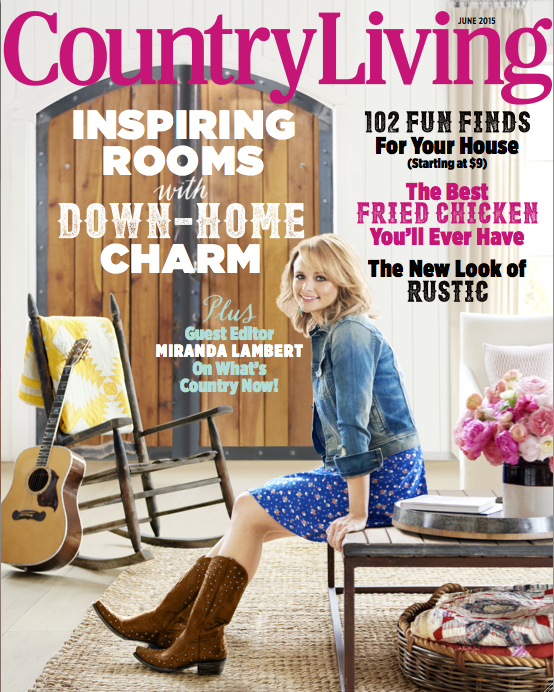
country living june 2015 Country Living magazine is taking its June issue on a long drive into the country with a guest editor and the first-ever person to appear on its cover in the magazine’s 36-year history. Grammy-Award winning singer, Miranda Lambert is the distinguished celebrity that received the honor. And it is a momentous event indeed.

Rachel Barrett is the magazine’s editor-in-chief and said the upcoming issue of Country Living showcases many firsts for the magazine as it rubs shoulders with the country music industry without deviating from its original DNA. No celeb-tell-alls here; Country Living merely continues to do what it does best, celebrating country style with tasteful class and easy fun.

I spoke with Rachel recently about the memorable June issue with all its ‘firsts,’ from the new feature: Turn This Country Room Into a Song to the first edition of Country Living Backstage, a free mini-mag created in partnership with the Country Music Association for the CMA Fan Fest held in Nashville June 11-14.

A true southern lady herself, Rachel graciously shared her enthusiastic excitement about the issue and the magazine in general. It was a conversation that was as refreshing as a mint julep on a hot southern day.

But of course, Country Living doesn’t happen only below the Mason-Dixon, as Rachel was quick to point out, even though it’s published in Birmingham, Ala. The magazine appeals to people everywhere who enjoy the country lifestyle; from New York to Nebraska; Country Living satisfies its audience all across the United States.

I hope you enjoy this fun and lively conversation with Rachel Barrett, Editor-in-Chief, Country Living magazine. I know Mr. Magazine™ did.

But first the sound-bites:

On why the June issue was chosen for the magazine’s maiden voyage into ‘country’: We began looking at what time of year to potentially do this issue and to be honest, we weren’t even seeking to put a person on the cover; we were just talking about the fact that country music is so mainstream. A lot of topics that just lined up with the country music lifestyle felt really right for the magazine to explore right now.

On the things she’s implementing in print to interact with the magazine’s audience: We’re just adding different levels of engagement. I mentioned that we moved Simple Country Pleasures to the back page of the magazine, so now we’re opening the feature well with a seasonal cross stitch and in June it’s a guitar because it’s a country themed issue, but we’ve done various cross stitch patterns.

On discovering Hearst was moving Country Living to Birmingham and her feelings about that when she was offered the job: I felt full support from Hearst; they handled the whole thing brilliantly. Transitioning a major national brand from New York to Birmingham, staffing it from scratch; I was also pregnant when I took the job, so that added to some of the chaos. (Laughs) But there were challenges and sometimes I’m floored, in retrospect, as to how we pulled it off. A lot of that credit goes to the New York-based Country Living team who sort of helped pass the torch in the most graceful manner.

On the major stumbling block she had to face: I think just starting from scratch. There was a small window of time where we had a temporary office space and a post-it note on the door that read Country Living. (Laughs) And our neighbors were like: what, the magazine?

On her most pleasant moment: The best moments are just every time we’ve added a person to the staff; it was also such a unique opportunity because the people would ask what’s the job description and we’d reply, well, what do you want it to be? (Laughs)

On anything else she’d like to add: One of the other exciting things on the heels of this country music play is that we have Country Living Backstage and I think this is a testament to how mainstream country has become.

On what keeps her up at night: What doesn’t keep me up at night? (Laughs) For one, my two children. I have a two-year-old and a one-year-old. But in addition to them, I think it’s just excitement for Country Living. You know, we’re really a small magazine, as I have reiterated a couple of times, and so everyone multi-tasks. We’re definitely kind of scrappy; I’m working on everything from brainstorming the reader page to big picture brand-building.

CLX050115_010 And now the lightly edited transcript of the Mr. Magazine™ conversation with Rachel Barrett, Editor-in-Chief, Country Living.

Samir Husni: There are so many firsts in the June issue of Country Living; we have the first celebrity guest editor, the first Backstage Pass, the first Country Living Backstage mini-magazine, you name it; I was just going through the list of how many firsts the magazine has in the June issue. Why now and why June for all these premier bonanzas?

Rachel Barrett: I’ve been onboard now for almost two years; I started in October 2013, and we took about six months to build a staff here in Birmingham and to complete the transition. And we’ve been a little slow about introducing some changes into the magazine, but recently I read an article in The New York Times about a study done by the MPD Group that talked about how country music had finally become the most popular musical format in the country with its widespread appeal.

Country Living had never dipped its toes fully into the country music waters, but if that audience is going to read a shelter decorating magazine, I think Country Living is the magazine for them. So, we talked about how to be very deliberate about penetrating that world without alienating our core readership, because I’m realistic; I know not all of our readers are country music fans and they don’t come to our magazine for celebrities and/or music.

We began looking at what time of year to potentially do this issue and to be honest, we weren’t even seeking to put a person on the cover; we were just talking about the fact that country music is so mainstream. Recently, even Steven Tyler announced that he was doing a country album; Nelly is also going to do one, and so there’s definitely widespread appeal. We decided to look at the lifestyle associated with the genre of country music.

As we started discussing the issue in more detail and brainstorming ideas, we thought that it would be more authentic and interesting to bring on a guest editor from that world to help us brainstorm. We bounced around a few names, but Miranda Lambert just seemed like the perfect choice for us; she’s the reigning queen of country; she took home a ton of awards recently at the ACM’s, I think more than any other country artist, and then we started digging a little deeper and found out that she’s from Lindale, Texas, where the town’s motto is actually “Good Country Living,” which was perfect. She chooses to live in the small town of Tishomingo, Oklahoma; I think the population is around 3,000 people.

So, we reached out to her publicist, who also happened to be a Country Living fan; it’s always great when an L.A. publicist is familiar with a magazine called Country Living. It turned out she’s a reader and so we didn’t really have this awkward back and forth, where we were trying to rope in the celebrity who didn’t really understand the magazine or was pitching content that was off brand. Miranda reads us on her tour bus.

She bounced around a ton of ideas on our first phone call; she had clearly taken notes and went over ideas with Blake (Shelton), it was a really nice back and forth. We photographed her for the inside story and of course, if you’re Country Living and you have a photo shoot and time carved out with Miranda Lambert, you’re going to shoot a vertical, a potential cover shot; it wasn’t necessarily the plan to put her on the cover, but it felt like the right move at the right time. I can’t think of anyone, particularly in the last five to ten years, who would be a better face for the magazine.

I felt strongly that everything we put in this issue needed to appeal to the Country Living reader who didn’t care at all about country music; the houses weren’t going to be chosen just because they were tied to a celebrity, they had to be houses that would be worth running in the magazine no matter who their owner was.

We found spaces that fit the bill. We have a story called ‘King of the Road’ and the title is inspired by a country song, but it’s a celebration of the new travel trailer culture. Of course, country stars drive around in their Airstreams and have these great, decked-out trailers, but our readers are also really into that lifestyle and we know they’re also into small spaces, so a lot of topics that just lined up with the country music lifestyle felt really right for the magazine to explore right now.

In terms of Backstage, that was just another thing we felt was right. We’d been talking about; generally speaking, people aren’t flocking to the newsstands as much as they used to, so we talked about how Country Living needed to be present where our readers are and where potential readers are. I’m originally from Tennessee and I know that the CMA Fan Fest is a huge event. I think 50,000-plus people flock to downtown Nashville to celebrate country music; HGTV has a presence there, they have this giant building called ‘The Lodge,’ and so we thought: how does Country Living build a presence at this event, because it’s great exposure for us, albeit a slightly different audience.

When I worked at Glamour, we had done a special publication during Golden Globe’s week and it was distributed throughout Los Angeles and Glamour has the Golden Globe’s weekend; this feels similar in spirit to that. It’s sort of Country Living’s inside guide to downtown Nashville throughout that weekend. The content gives attendees a sneak peek into our brand, but through the lens of the things they’re interested in.

One of the stories that we have in Country Living Backstage is ‘Turn this Country Song into a Room,’ so we’re taking four or five songs that will be performed through the CMA Fan Fest in downtown Nashville and we’re putting together a room. There’s one song called ‘Get Your Shine On’ by Florida Georgia Line, so we put together this living room with a bunch of fun, metallic touches and there’s, of course, some sort of Tennessee Moonshine resourcing on the page. (Laughs) Another song out right now is ‘American Kids’ by Kenny Chesney and so we built this whole Americana-inspired porch.

So, I think that we’re finding a way to tap into the world of country music without pandering to the celebrity side of things.

Samir Husni: One of the things that I remember about Country Living from the days of John Mack Carter and Rachel Newman, when the magazine was first launched, was it had that spirit of enjoying everything ‘country.’ And you seem to be bringing that trait back to the magazine. You’re not going miles from the original DNA, but you’re rebuilding upon that basic foundation.

Rachel Barrett: I appreciate your saying that. Country Living has only had four editors in the history of the magazine and I’ve received some sweet letters from readers who’ve said, I think it’s a promising sign that your name is Rachel. (Laughs)

Samir Husni: (Laughs too)

Rachel Barrett: You know, everyone sort of pines for their old issues, including myself; I love looking at magazines from their very beginnings and I’ve been in touch with Rachel Newman and Nancy Soriano, so there’s this nice connection from past editors; I’m sort of revisiting some of my favorite aspects of all of the incarnations of the magazine over the years. We’re definitely trying to celebrate that more in the magazine and we’re putting a little more heart and soul into the pages.

Samir Husni: We’ve named all the previous editors; let’s also add Sarah Gray…

Rachel Barrett: Yes, certainly. Even working in the magazine industry in New York, I’m from Tennessee and she’s from Mississippi; everybody was always saying that she and I needed to meet. And I’ve always been a huge fan of what she did at Country Living; I would say that I started reading Country Living even more regularly when she came onboard. And I think that she definitely seized upon the social trend of country becoming cool again. Even hipsters in Brooklyn were into canning. (Laughs)

Samir Husni: (Laughs as well)

Rachel Barrett: I think that she really embraced that in a smart way and brought a whole new readership into Country Living. I haven’t had a chance to communicate with her, but I’m definitely a fan.

Samir Husni: You also created ‘Find the Horseshoe’ inside the magazine, which was a staple of Country magazine that was started by Roy Reiman many years ago. What other types of things are you doing in print to engage people in this digital age and create that interactivity with the audience through ink on paper?

Rachel Barrett: Country Living was not a magazine that was broken, so we’re not trying to come in and fix it and introduce whiplash-inducing change, but one of the things we did modify was our section called ‘Collecting.’ The word collecting is great, it describes jut what it is, but I felt like it wasn’t tapping into the heart of collecting. So, we renamed the section ‘The Thrill of the Hunt’ because it opens up this section for us to feature some new merchandise. I had been at a Country Living fair in Columbus and they were doing a TV segment and we asked this woman: what brings you to the fair? And she said it’s the thrill of the hunt. And you really see that in action at our events and so we decided to rename the collecting section ‘The Thrill of the Hunt.’ And that’s when the Horseshoe Hunt came up and we thought to play off of The Thrill of the Hunt we’d incorporate that element into our pages, so we’ve been hiding a horseshoe in every issue. It’s just one way to have readers interacting with every page of the magazine.

A reader came up to me recently at the Nashville fair and she said the first thing that she always did when she got her issue of Country Living was look for the horseshoe. And that just made me so happy that that one little touch, a tiny, subtle little horseshoe, could bring such fun to a certain set of our readership.

Another example of that interaction, I would say, would be Simple Country Pleasures, which is this longstanding popular column in the magazine. It used to be the back page of the magazine, then it opened the feature well, and recently, we moved it back to the back page of the magazine. It’s an image of the countryside and then a great quote. To be candid, it’s one of the most popular pages and the easiest page to produce. Beautiful images of the countryside are not hard to come by. On our side, we said, OK, this is a page that we don’t have to really do anything new with; it’s successful as is, but is there some way we can build on this; some way we can do something to get readers really excited about it.

So, I read an article in The New York Times recently about how adults have gotten into coloring books and these childhood-inspired crafts. Even our guest editor, Miranda Lambert, had posted something on Instagram the other day; she was coloring in a coloring book while drinking beer. (Laughs) It was like hashtag beer and coloring book.

One thing that a lot of people shop for at the Country Living fairs is paint-by-numbers, those relics of the 70s and 80s; they’ve really had a big resurgence. So, we found this Kentucky-based company, Easy 123 Art, to team up with and they have turned every image now on the back page of the magazine into a paint-by-numbers kit that readers can order.

We didn’t really change the DNA of the page, there’s just a small redirect to the company. And the company has been inundated with thousands and thousands of orders for these paint-by-numbers kits. It’s really been amazing. Some readers are sharing their paint-by-numbers art online; we’ve tapped into the sort of crafty mindset of readers and given them something else to take away from their magazine experience. So, that’s another example.

This is another small example; we’re introducing in our July/August issue a column called ‘Ask a Country Vet.’ It’s another really popular franchise. We have a fairly new country vet that answers our reader’s questions and talks all things animal. We know from social media that people just love adorable pet pictures, so now we’re adding one pet photo that’s just captioned ‘This Pet Photo’ and it’ll be almost our version of The New Yorker caption contest. So, we’ll see how much readers get into that. It kind of gives them the chance to be clever and we’ll run their best answers in the next issue of the magazine and hopefully, eventually we’ll tie it to a prize.

We’re just adding different levels of engagement. I mentioned that we moved Simple Country Pleasures to the back page of the magazine, so now we’re opening the feature well with a seasonal cross stitch and in June it’s a guitar because it’s a country themed issue, but we’ve done various cross stitch patterns. We make the cross stitch pattern available online and readers are sharing that they’ve recreated our cross stitch. Of course, the ultimate goal would be to sell a Country Living brand of cross stitch kits down the road and it’s beautiful that our copy editor is actually the person who does the cross stitch every month; she’s definitely multi-tasking. (Laughs)

We’re still exploring it every month, but kind of looking at pages that are already successful, but figuring out if there is a way to give them more depth either in the magazine or off the page.

Samir Husni: When David Carey announced that Country Living was moving to Birmingham, there were a lot of skeptics out there who said this move was just a nice way of killing the magazine, shipping it from New York to Birmingham. When you took this job, did you have any doubts or any fears that screamed: I’m moving from an established magazine that was doing very well to a brand that people were sure was about to end? Can you recall your original feelings when you were offered the job? Were you skeptical as well or did you jump and say, no, I believe in this brand and I’m with it all the way?

Rachel Barrett: Even when I moved from Real Simple to Southern Living, I kind of felt like it was a similar challenge. I felt like Southern Living had been a brand that my grandmother had read, but didn’t have as much cache with a younger audience or a new audience, so at the time I think even people in New York were asking; what is she doing. (Laughs) And Southern Living has had this great resurgence and a lot of success recently, so I felt like that challenge only inspired me. I had always loved Country Living. Way back in the day, when I was an associate editor at Glamour and Eliot Kaplan would do his requisite check-in with you and he asked me what magazine at Hearst would I ever want to be editor-in-chief of and I pointed at Country Living and he remembered that.

I love the content, it’s great. And I know while you’re transitioning a magazine, there are a lot of question marks around that and it creates storylines, but Country Living has such a healthy subscriber base and that’s something we’re looking to build on with the Country Living fairs and other events; it’s a really strong subscriber base and they’re very loyal, so I didn’t feel as uncertain as other people around me felt.

And I felt full support from Hearst; they handled the whole thing brilliantly. Transitioning a major national brand from New York to Birmingham, staffing it from scratch; I was also pregnant when I took the job, so that added to some of the chaos. (Laughs) But there were challenges and sometimes I’m floored, in retrospect, as to how we pulled it off. A lot of that credit goes to the New York-based Country Living team who sort of helped pass the torch in the most graceful manner.

I think one of the advantages; obviously, having some sort of history with the magazine, there’s a lot to be said for that, and there were a lot of people at Southern Living and it was so helpful to have these people around you who had this knowledge of the brand and why certain things didn’t work. It’s also rare and maybe unprecedented to be able to look at and build upon a decades-old brand through the eyes of an entirely new team. That was very exciting. Our style director came from the New York-based Country Living staff, but for the most part we were a fresh staff. There was no one saying ‘but that’s not how we’ve always done it.’

I think in some ways it was such an interesting opportunity to be able to take a magazine with a strong subscriber base and look at it with fresh eyes and fresh energy; trying to build on, I hope, the best parts of all the decades of the magazine.

Samir Husni: What was the major stumbling block you had to face and how did you overcome it?

Rachel Barrett: I think just starting from scratch. There was a small window of time where we had a temporary office space and a post-it note on the door that read Country Living. (Laughs) And our neighbors were like: what, the magazine?

In terms of recruiting during that interim period; recruiting a staff from scratch was definitely challenging. I brought over a couple of people from Southern Living who I really admired, but I also saw it as an opportunity to expand within the talent pool of Birmingham. I didn’t want our filter to naturally skew Southern; I wanted to make sure we had people representing different parts of the country. I think seven or eight people on our staff relocated from New York City and other locations. And we’re a small staff right now; we’re at 16.

Just building a staff from scratch and finding office space and really just finding the right balance, sometimes when new editors come in they’re very eager to try a million new things, but I realized that this isn’t a magazine where you need to do that. So, part of the challenge is just reining myself in. (Laughs) I mean, you get very excited and have a ton of ideas. Ellen Levine had some great advice; sometimes I’m like trying to brainstorm some flashy, amazing new pet column, and she says Ask a Country Vet is working, readers love it; don’t overthink it. (Laughs again) Sometimes I need to be reminded of that.

Samir Husni: And what has been the most pleasant moment?

Rachel Barrett: There was a week when we were fully staffed. We have an open position right now; our executive editor was just named editor-in-chief of Coastal Living.

As a small staff we just have lots of great, little victories; we’re a very close-knit group. Every time we get our new issues in the box delivered, we have sort of an official unveiling in the conference room.

The best moments are just every time we’ve added a person to the staff; it was also such a unique opportunity because the people would ask what’s the job description and we’d reply, well, what do you want it to be? (Laughs)

Samir Husni: (Laughs too)

Rachel Barrett: When you have open headcount that’s entirely open; I mean normally at magazines you’re dealing with one very specific role, because one person leaves and they have a very decisive role and you’re filling that position. But with every new person that came onboard, I was asking well, what do you want to do and then we’ll hire the next person based on what you don’t want to do. It’s just been this really unique and interesting experience.

My dad is a recruiter, a headhunter, so maybe I learned a little from him. I was really pleasantly surprised. The most daunting thing probably was having a staff of one and three months pregnant. (Laughs) But one of the most surprising and rewarding things was building this really talented staff from scratch and seeing how well they work together and how everyone inspires each other here.

Samir Husni: The journalist in me has to ask you this question; was that like a Time Inc. revenge, getting your executive editor to be the editor-in-chief of Coastal Living because you left them? (Laughs)

Rachel Barrett: I don’t think so. (Laughs too) I feel like when you hire really talented people, other people are going to recognize their talent too. We were so excited for Steele (Marcoux). We had a champagne toast in the conference room and she was recently at High Point and uploaded a picture on Instagram with our address and I was like hands off, Steele Marcoux. (Laughs) I don’t see it as a revenge play at all, I think Steele is such a great hire; she was the first person I hired. Every meeting I was ever in with her, I was always in agreement.

So, I think if you’re looking to tap into the talent pool to hire a new editor-in-chief for Coastal Living, she was such a clear choice, regardless of where she was working. She also started her career there.

Samir Husni: Is there anything else that you’d like to add?

Rachel Barrett: One of the other exciting things on the heels of this country music play is that we have Country Living Backstage and I think this is a testament to how mainstream country has become. Back when I lived in New York City there wasn’t even a country station and now, of course, they have a country station and they’re also getting a huge country music festival this summer, in late June. It’s called FarmBorough and it’s a 3-day country music concert series that will be held on Randall’s Island. Country Living is also taking over the Green Room for that event. So, that’s exciting. Again, it’s a different audience; it’s a New York City-based audience and so we’re currently putting together the plans of how we’re going to decorate the Green Room for that event.

That’s been fun. It’s hard, because I left New York four years ago, and now I’m thinking if they’d only had a country station and a country concert festival when I lived there. (Laughs) But this is just another exciting thing that Country Living is doing, in tandem with this June issue.

Samir Husni: My typical last question; what keeps you up at night?

Rachel Barrett: What doesn’t keep me up at night? (Laughs) For one, my two children. I have a two-year-old and a one-year-old. But in addition to them, I think it’s just excitement for Country Living. You know, we’re really a small magazine, as I have reiterated a couple of times, and so everyone multi-tasks. We’re definitely kind of scrappy; I’m working on everything from brainstorming the reader page to big picture brand-building.

I think step two for Country Living is really building on our fair franchise; we just had a really successful first-time Country Living fair in Nashville. I think we had 22,000-plus people attending over three days. I go to the fair and it’s a huge success, but then my brain begins churning with how do we build on this franchise and how do we round out the experience? Do we add a sound stage; just that sort of thing. So, the things that keep me up at night probably change every single day, but I think it’s just that we have a great magazine and how do we expand upon it in ways that are really going to resonate with our subscribers.

And then also those toddlers. (Laughs)

Samir Husni: (Laughs too) Thank you.

h1

The Buzz Factor: A Man Who Knows His Niche & Strongly Believes In Print. The Mr. Magazine™ Interview With Buzz Kanter – Publisher, TAM Communications

January 26, 2015

“We keep hearing: print is dead, print is dead. Well, no, print is not dead. What’s happening is it’s shifting and the people who are on the internet, it’s in their best interests to promote the internet over print and they’re saying it as loud as they can.” Buzz Kanter

Buzz Kanter Buzz Kanter is a third generation print publisher (TAM Communications) and a man who knows his own mind when it comes to the things he believes we can do as an industry to grow our audience and breathe new life back into the print component of magazine media. His grandfather founded Classics Illustrated (comics) in the 1940s. His father worked for him and then left and grew what evolved into Penny Press/Dell puzzle magazines. Buzz worked for him for years and then started TAM Communications (as the thesis for his MBA in 1989). He now runs TAM Communications and its stable of magazines. Along with the reborn RoadBike to Motorcycle Rides & Culture, his list of niche magazines is impressive:

• American Iron Magazine
• American Iron Garage
• Motorcycle Bagger
• Motorcycle magazine
• Classic American Iron forum

With a redesign that lead to over 40% growth in readership and an increase in his magazine frequency to seven times per year instead of just six, his former RoadBike magazine was reborn into Motorcycle Rides & Culture about a year ago. And the response from readers has been phenomenal as the numbers prove.

Motorcycle Rides & Culture shares long-form articles and more exciting art and graphics that appeal to the thinking rider looking for more. And, based on the more than 40% growth in readership in the first year, the “Buzz Kanter” formula appears to be working.

I spoke with Buzz recently and we talked about the industry and the practice of discounting subscription prices to gain more readers, which he believes is not the answer. We talked about enthusiast magazines, such as his and their past, and we talked about the future and how print isn’t dead, no matter what the internet phantoms shout.

So, I hope you enjoy this very special conversation with a man who has a straightforward and clear focus on the future of print media. Sit back, relax and enjoy the Mr. Magazine™ interview with Buzz Kanter, Publisher, TAM Communications.

But first, the sound-bites:


IMG_8230 On why he thinks his formula is working:
I can’t speak for news magazines because I think that’s a whole different issue. But I can speak for special interest and enthusiast publications and I believe there is still plenty of room for them in print.

On whether he believes it’s the system that’s broken and not ink on paper:
I don’t think it’s black and white. There are a lot of different elements involved. We keep hearing: print is dead, print is dead. Well, no, print is not dead. What’s happening is it’s shifting and the people who are on the internet, it’s in their best interests to promote the internet over print and they’re saying it as loud as they can.

On how he responds to someone shouting: print is dead:
The easy thing to do is create shock value and tell them: no, print is not dead, I’m still in business and we’re doing OK, we’re paying our bills and we’re growing our product.

On the specifics of the Buzz formula:
The “Buzz” formula? (Laughs) My feeling is if a print magazine is just a print version of a digital website; why bother?

On his future publishing plans:
For Motorcycle Rides & Culture we went from 6 issues last year to 7 issues this year. If our growth continues and we get the support from our readers and advertisers, then we’ll continue to increase frequency.

On the outcome of the digital piracy of his magazines:
I think the company was called Issuu. Someone pointed out that my magazines were being offered free to whoever signed up with Issuu, without permission from us and they were current issues, not any they pulled out from the past. We go there once a month or so and check and the onus is on us. We’re not finding our magazines, but we’re finding enormous numbers of magazines out there.

On a major stumbling block he anticipates facing:
I would say the biggest challenge we have is uncertainty of the future. And if I had a really good answer for that, I’d be calling you from my yacht in the Bahamas right now. (Laughs)

On his most pleasant moment in publishing:
It’s very rewarding to produce a product that you’re proud of and that brings value to your audience. And I hope that doesn’t sound cliché.

On facts he’d like to add:
I certainly hope that magazine publishers stop doing foolish things that impact the industry. I think some of them are drawn on us and I think some of them are drawn to us and by us.

On what keeps him up at night:
As a third generation publisher, I question if there is going to be a viable industry for my children to become a 4th generation publisher. And if so, what’s it going to look like?

tam1 And now the lightly edited transcript of the Mr. Magazine™ conversation with Buzz Kanter, Publisher, TAM Communications…

Samir Husni: You’re a third generation print person. Why do you think you’re bucking the trends, doing better and enhancing your print product, while others are declining?

Buzz Kanter: I can’t speak for news magazines because I think that’s a whole different issue. But I can speak for special interest and enthusiast publications and I believe there is still plenty of room for them in print.

The problems are pretty widespread and they cross a lot of different areas. The three main revenue streams are single copy, subscriptions and advertising. And all three of them are under attack. Some of the attacks we’re bringing on ourselves and some of them the market is bringing to us. With single copy, the biggest challenge is that the wholesale system is badly flawed and for the most part the magazine wholesalers that are controlling it, and the national distributors that are banking it, are trying to apply the same solutions that haven’t worked for decades. Isn’t that the definition of insanity? Doing the same thing over and over and expecting different results?

I hate to say it, but what’s happening is the wholesalers are asking the publishers to subsidize their inefficiencies, rather than finding better ways or smarter solutions. They’re saying that this is the best that they can do and if you want them to carry your product, you’re going to have to pay them more money.

So, the single copy is a distribution issue; it’s not a demand issue or a product issue, it’s predominantly a financial distribution challenge. The wholesalers are basically cannibalizing each other and expecting someone else to subsidize them and make them whole. And it’s a very, very dangerous game because they’re getting farther and farther extended to where the publishers are saying, “You know what, it’s more economical to put an even cheaper price on subscriptions than to deal with the single copy system.”

Samir Husni: Do you believe then that it’s the system that’s broken and not the ink on paper product itself?

images Buzz Kanter: I don’t think it’s black and white. There are a lot of different elements involved. We keep hearing: print is dead, print is dead. Well, no, print is not dead. What’s happening is it’s shifting and the people who are on the internet, it’s in their best interests to promote the internet over print and they’re saying it as loud as they can.

What I find is that people don’t have as much free time or better stated they’re finding ways to use whatever free time they might have. How often have you been out in public and seen people standing at a bus stop or sitting in a restaurant looking at their cell phones? That used to be free time, where they would socialize, converse, think or observe, but now if people have a minute to spare, they pull out their cell phones and go on Facebook or check the stock market, read the latest news or whatever it is they’re doing with their cell phones.

What’s happening is these portable devices are vacuuming up all the spare time. And if that’s the case and it becomes a habit, and it is, I think; then how do you find time to sit down with a print magazine or a book? And I think that’s the issue.

Samir Husni: And we, as the magazine industry, are also to blame because we jumped onto that bandwagon wholeheartedly.

Buzz Kanter: Yes.

Samir Husni: Every time someone tells you either print is in decline or print is dead and you’re living the print process, producing a magazine and increasing circulation; how do you respond to that? What is the reality check?

Buzz Kanter: I guess it depends on what kind of mood I’m in at the time and who the person is I’m talking to. But the easy thing to do is create shock value and tell them: no, print is not dead, I’m still in business and we’re doing OK, we’re paying our bills and we’re growing our product.

What’s happening is most people are parodying what they hear, not necessarily what they’ve thought through carefully. And I think that’s not unusual. Print is not dead; there are still an awful lot of people reading newspapers and buying books and magazines. Go to an airport and look at how many people are on their tablets versus those actually reading magazines and books. Then what happens when you’re in the airplane and you don’t have Wi-Fi? Some people are reading off of Kindles and Nooks or whatever.

So, is print dead? No. Will it become more and more unusual with each generation? Yes, I think so. As the portable devices become better and easier to use, I think they will cut into it, as they already have.

It’s interesting; I talked to some of our advertisers and a number of them a couple of years ago would say, we’re cutting back our print advertising and going to the internet. We’d ask: what will you do on the internet? And they’d say, I don’t know, we’ve just been told we have to be there. We’d ask: how are you going to market there? And they’d respond, I don’t know, but I’m told I have to have a website. I’m told I have to have an internet presence. We’d ask: how are people going to find you? And they’d say, I don’t know. It didn’t matter what our ad department said, these people had to be on the internet and they had a limited ad budget which they’d pulled from print and went to online. Well, once that happened, everyone said print is dead because the advertisers were leaving. Many of the advertisers were leaving, but they didn’t know why or how.

And in the last year they’re starting to come back. They’re saying they tried the internet and it didn’t work. They got lost in the huge volume of data out there. Many of them are now coming back and saying, “Your magazine is focused and aimed at my audience, people who use my products and services.” And many of them are now coming back and pulling their dollars out of the internet because they found it was just overwhelming, whereas we can give them a targeted audience.

Samir Husni: You have a specific niche. Your magazines target a very definitive audience. Your magazine has increased readership, advertising and frequency to 7 times a year; what’s your secret? What’s the “Buzz” formula that’s making this happen?

Buzz Kanter: The “Buzz” formula? (Laughs) My feeling is if a print magazine is just a print version of a digital website; why bother? We can’t do it as well as the websites. I’m seeing a lot of enthusiast publications forcing over a print version of its website. Heavy on the graphics, lots of pictures, lots of charts and graphs, pulled quotes, little factoids and not much meat or substance. And my feeling is the people who pick up the magazine want some substance, they want a good read. If there is an article about something they’re interested in; the reason they bought the magazine in the first place, they don’t want to read five paragraphs and see three photographs like you would on a website.

The delivery of content in print should be more in depth, exciting and interesting for them to sit down for a half hour or an hour to read the article in a magazine. The internet is fabulous for quick information. Does it come in blue? Can I get one overnighted to me? Those types of things are great for the internet. But I personally don’t want to sit down and read a 3,000 word article online. I want to read that in print.

So what we did with our magazine called RoadBike; originally, it was a pretty good general interest magazine about motorcycles, but it couldn’t get traction. Rather than fold it, which we were considering, I said that I wanted to publish a long-form journalism magazine with terrific art and give the articles and the photography all the space they need, rather than try and squeeze it down and condense it like a website. I said let’s try it. If it works great; if not, we can always pull the plug if we have to. Something I was hoping not to have to do.

We renamed it Motorcycle Rides & Culture. Now, I suspected those were good search engine optimization words. (Laughs) But meanwhile, it also tells the reader what the magazine is in print. And instead of putting in 30 short articles in one magazine, we cut it down to 8 or 10 longer articles, with lots of great photos, information, and emotional content and knowing it’s in print and the people who still buy print, we threw in certain cultural things. We have some artists every issue who are involved in the motorcycle world. They might be a painter or a sculptor or a photographer; we do unusual cultural pieces involving motorcycles, beyond the Hollywood bikers and outlaw stuff.

And it seems to have resonated. We’re up 46% year over year. Our newsstand and subscriptions are climbing. I just received a report recently from Wal-Mart, which is the largest seller of magazines in America. And even though we did 6 issues last year; annually we were the 6th bestselling motorcycle magazine in there, outselling several of them that come out monthly, twice the frequency of ours. On an annualized basis, we’re outselling them.

tam2 Samir Husni: What’s the plan for the future? Anything up and coming you’d like to share with us?

Buzz Kanter: For Motorcycle Rides & Culture we went from 6 issues last year to 7 issues this year. If our growth continues and we get the support from our readers and advertisers, then we’ll continue to increase frequency. My feeling is we’re going to move this gradually. If we make a misstep, we want to have time to fix it.

I wish I had a crystal ball, I really do. If I knew where the media industry would be in 3 or 4 years, I’d be way ahead of the curve. But at this point I’m producing a product that we’re all proud of and that the consumers are responding to and we’ll continue to do that. We just have to stay flexible.

One thing we will not do and I’m seeing more and more of this, is the aggressive discounting of subscriptions. Many, many years ago I learned a lesson when I was watching some competitive titles, one was called Cycle and the other was Cycle World, and this was back in the 70s, and then ended up being owned by the same publishing company. And both of them were in a war to build subscriptions. It was a race in pricing and they were getting cheaper and cheaper. Then, as I said, they ended up with the same publisher and then the ad market dropped down. So they had this massive subscription liability with no ad revenue and no sub-revenue. One ended up inhaling the other one and they merged together. It took them years to get financially stable again.

My feeling is I never want to sacrifice the future of the magazine by using aggressive subscription discounts. If the advertising declines, then you’re left holding the bag. I think it’s a very dangerous place to be.

One of the things that we try to do is instead of making money on the newsstands; we try to make money on subscriptions and advertising. Even if it’s a break-even or a small profit, and that way we’re less susceptible to market shifts that could be fatal.

Samir Husni: If my memory serves me right, you tweeted once, and linked me and others to the Tweet, about a certain entity lifting your magazine and putting it onto a digital device without your permission. How did that turn out?

Buzz Kanter: I think the company was called Issuu. Someone pointed out that my magazines were being offered free to whoever signed up with Issuu, without permission from us and they were current issues, not any they pulled out from the past. So we contacted them. We had our intellectual property lawyers contact them and tell them to cease and desist. And they wrote back basically saying they were just a platform and not a policing agency and if we didn’t want our product on their platform, it was our responsibility to identify them and bring it to their attention and they would remove them. They said they were a type of YouTube for magazines, where YouTube isn’t responsible for whatever postings are there.

We go there once a month or so and check and the onus is on us. We’re not finding our magazines, but we’re finding enormous numbers of magazines out there.

Samir Husni: So, who’s posting those magazines; who is putting them on the platform?

Buzz Kanter: I couldn’t say, but many of them seem to be coming from overseas and it’s similar to YouTube. And I don’t know what the motivation is. I could understand if a publisher needed to bolster the circulation numbers or get more responses for advertisers, they could use that as a marketing tool. But I don’t know why someone would do it to my magazines without our permission or knowledge.

Samir Husni: Besides that major problem with the digital devices accessing your property without permission; what is the biggest stumbling block you can see or envision facing TAM and your publications and how do you plan to overcome it?

Buzz Kanter: That’s a good question. I would say the biggest challenge we have is uncertainty of the future. And if I had a really good answer for that, I’d be calling you from my yacht in the Bahamas right now. (Laughs)

As you know, I’m a third generation print publisher. I remember my grandfather’s biggest challenge was movies and black and white TV. They were told that TV sets in the house were going to kill magazines. And yet magazines survived.

My father’s business was Penny Press. His biggest challenge was cable. And they said that magazines weren’t going to survive cable television. And yet he survived the naysayers.

Now my generation has been told the internet is going to kill magazines. And while it’s definitely having its effect on magazines, it’s certainly not killing them. As long as there is a demand for quality print publications, there will be clever publishers who will figure out ways to financially succeed in delivering that content. The challenge is identifying the efficient ways to do that and then growing them. A lot of people are trying a lot of things now, some are putting them online and some aren’t. We have to keep our eyes opened and be flexible because the rules are changing.

tam4 Samir Husni: And to go in the opposite direction; what has been the most pleasant moment in your publishing experience so far?

Buzz Kanter: Other than talking to you today?

Samir Husni: (Laughs) Yes, other than that.

Buzz Kanter: It’s very rewarding to produce a product that you’re proud of and that brings value to your audience. And I hope that doesn’t sound cliché. I started my first motorcycle magazine in 1989 and it was out of a spare bedroom in my house. It was basically a classified ad magazine for old motorcycles and parts. This was before the internet, before Craig’s List or eBay or anything, and I launched it because I was rebuilding and riding old motorcycles and I couldn’t find a source for parts and information. In my youth, back in ’89, I started this magazine. It never really amounted to much, but it gave me a platform to then grow my business into enthusiast’s books.

To this day I have people say: wow, Old Bike Journal, yes I love it. I bought a bike here, the parts there. It’s very rewarding to hear how it helped people with similar interests to mine. I still get a kick out of meeting readers who say they read something in my magazine or they thank me and tell me how something in it helped them. It just made my passions that much stronger and better.

As a publisher of an enthusiast magazine, it’s wonderful to get feedback from people saying that what we do makes a difference.

Samir Husni: Anything you’d like to add?

Buzz Kanter: I certainly hope that magazine publishers stop doing foolish things that impact the industry. I think some of them are drawn on us and I think some of them are drawn to us and by us. These deeply discounted subscription deals are silly. Flooding product into the newsstand racks that has little chance of selling is silly. Too many publishers’ long-term strategies are I can hold my breath longer than my competitor. And I think that’s both dangerous and foolish.

Samir Husni: I agree, but sometimes you feel as though you’re a profit in the wilderness.

Buzz Kanter: I’m used to people telling me that I’m nuts or that it makes sense, but it’ll never happen. I spoke on a PBAA panel years ago and I said the future of our industry is to sell more copies of fewer magazines and that we’re pushing too much product through a system that can’t handle it. And everyone basically told me I was nuts.

Years later I gave basically the same presentation and everyone told me I was brilliant. But nothing has really happened. How can we justify distributing product that doesn’t meet some minimum criteria of sales efficiency or profitability.

Samir Husni: My typical last question; what keeps you up at night?

Buzz Kanter: Really good television shows? (Laughs) As a third generation publisher, I question if there is going to be a viable industry for my children to become a 4th generation publisher. And if so, what’s it going to look like?

Samir Husni: Thank you.
h1

A New Conversation With Consumers: The Revamping Of Consumer Reports. The Mr. Magazine™ Interview With Editor, Ellen Kampinsky & VP General Manager, Brent Diamond.

October 16, 2014

“A lot of the changes were designed to do two things: create a contemporary magazine, because readers are used to getting their information from a variety of media, particularly from contemporary, sophisticated magazines and we wanted to make our mission very obvious and clear.” Ellen Kampinsky

Consumer Reports-1 There is one rule of thumb for most any board game played; you have to roll the dice if you plan on moving around the board to win. Sometimes in the world of magazine media, the rules aren’t any different.

Since 1936 Consumer Reports magazine has been the most trusted source for reviews and comparisons of consumer products and reports from in-house laboratory testing in the world. But with the November 2014 issue, some things are changing, in fact a lot of things are changing, however the mission and focus of the magazine are not changing. Looking out for the consumer hasn’t changed nor will it change, according to Brent Diamond and Ellen Kampinsky, two of the driving forces behind the powerhouse magazine.

But is this the biggest gamble in the history of the magazine? Have they rolled the dice too hard with the revamp of a trusted brand with loyal and committed customers? And is having feature stories in a magazine that usually reports statistics, lists and reviews something the audience can relate to?

I went to Ellen Kampinsky, Editor, and Brent Diamond, VP General Manager, to find out the answer to those questions and many more about the “new & improved” Consumer Reports. I think you’ll find their answers very enlightening.

So sit back and enjoy the Mr. Magazine™ conversation with Ellen and Brent and learn how a 78-year-old brand can be reborn into the 21st century.

But first the sound-bites:


On the reasons for the change:
Really the impetus for the revamp was to create a much more relevant and deeper engagement with our readers and secondly to highlight all the great things that we do on behalf of consumers.

On the reaction to the November issue (the first new edition released Sept. 30) from the magazine’s readers and others:
Yes, we’ve gotten more feedback than we anticipated. Both positive, and there have been some detractors; change can be hard for people, these are very, very loyal, long-term subscribers. So, we’ve gotten a lot of both types of reactions.

On whether they went too far or this change was needed:
A lot of the changes were designed to do two things: create a contemporary magazine, because readers are used to getting their information from a variety of media, particularly from contemporary, sophisticated magazines and we wanted to make our mission very obvious and clear.

On the magazine’s “Advocate” section:
Part of the role of an advocate section is to be involved in a dialogue with the readers. It’s there for them and a lot of the information in that section is generated by them.

On whether they’re worried the revamp will shrink or obliterate the magazine’s original DNA:
The part of our DNA that will likely never change is that what we really offer that other magazines don’t is tested, unbiased information for consumers.

On why their “no advertising accepted” business model works for them:
There are people, as much today as ever before, who will pay for valuable information that helps them make smarter and better decisions.

On whether they ever envision a day when Consumer Reports will be digital-only with no print edition:
I can foresee delivering the product in various and different ways, but I don’t think the mission and the core of what we do will ever change, whether there continues to be a magazine 20 years from now or not. I don’t know.

On whether more book-a-zine type products are on the horizon:
Where we start from all the time is a need in the marketplace or a need that consumers have and if there’s a need there, we’ll try and find a way to fill it.

On what keeps them up at night:
This is not a cliché, but what keeps me up at night is the thought of not evolving and not changing quick enough to match how consumers are consuming information today. (Brent Diamond)

And now the lightly edited transcript of the Mr. Magazine™ interview with Ellen Kampinsky, Editor, and Brent Diamond, VP General Manager, Consumer Reports…

Samir Husni: Congratulations on the revamping of the magazine. And I know that it’s much more than just a redesign. Can you tell me why you decided now was the time for this and the reasoning behind the change?

Usage: Story: Brand: Model: Brent Diamond CU: Photographer: John Walsh Brent Diamond: I don’t know if you recall, but well over a year ago I had a brief conversation with you and that was just as we were exploring and really trying to decide where to go.

So what we have done is a fairly in depth analyses of our business and in the end a couple of things were highlighted: our subscriber base was pretty flat for the past six years. For every new subscriber that we brought in, we were losing a subscriber, so we were just maintaining and going along status quo.

Really the impetus for the revamp was to create a much more relevant and deeper engagement with our readers and secondly to highlight all the great things that we do on behalf of consumers. And we felt that if we combined those two things we could have a much more meaningful relationship with our customers and therefore we could find more customers and keep them. In a nutshell, that’s what we’re trying to do.

Samir Husni: I know the new issue has only been on the newsstand for a few days; what has been the reaction? Have you been bombarded with people sending you emails crying, “What have you done?” or have you been hearing the opposite, “Wow! We love it?”

Brent Diamond: One thing you should know is that newsstand is only about 7 % of our base of customers. And while that’s an important piece of our business, we’re more worried about the subscriber base. And yes, we’ve gotten more feedback than we anticipated. Both positive, and there have been some detractors; change can be hard for people, these are very, very loyal, long-term subscribers. So, we’ve gotten a lot of both types of reactions.

What we’ve done is invited the people who have expressed both the positive and the negative comments to join our advisory panel to help us to continue to shape and evolve the magazine.

Samir Husni: Ellen, as the editor it’s as though you’re taking this enormous cruise ship and trying to make a turn on a dime; do you think you’ve gone too far with the first issue or do you think you needed to make this drastic change?

Ellen Kampinsky Ellen Kampinsky: I think the magazine needed a couple of things to make it a successful, contemporary magazine. It needed some reorganization of the sections so that it was clear what the readers were seeing. We needed to highlight our mission; we added features that tell readers that we are working for them and tells them how they can get involved and be empowered. Some of these things are absolutely necessary I think, because we do something that no one else does; we’re there for the reader, not for advertisers, and I think it was really important to make that manifest. A lot of the changes were designed to do two things: create a contemporary magazine, because readers are used to getting their information from a variety of media, particularly from contemporary, sophisticated magazines and we wanted to make our mission very obvious and clear.

Samir Husni: And I noticed you’ve added an “Advocate” section to the magazine. So, are you going to be more involved than ever? The magazine has always had an advocacy role and a very consumer centric approach; how do you envision this new section adding to that existing role? Specifically because you’ve never had advertising and I doubt that you ever will and yet, you are one of the largest magazines in the industry.

Ellen Kampinsky: Part of the role of an advocate section is to be involved in a dialogue with the readers. It’s there for them and a lot of the information in that section is generated by them. And we get the intake on that, not just from the magazine, but also online and we recognize the reader is part of the media spectrum, so we ask them descending questions for the “Problem Solver” or “Ask Our Expert” and we ask them to get involved by signing a petition or by writing their congressperson or going online. We ask them to send in reader tips, either by mail or online and for the best reader tip we’ll pay them $100.

We just want this constant dialogue going on, this constant two-way street with the reader and that’s what the “Advocate” section is all about.

Samir Husni: Do you think that there’s a danger that you may have went too far and Consumer Reports is now competing with other magazines that focus on a single-topic cover story? I mean, do you feel that now the magazine is more in sync with the rest of the magazines that are available to the consumer? And how are you going to protect your DNA, which are the tests and the rankings that you offer your readers?

Brent Diamond: I think that particular issue (the first new issue) had fewer products in it than we normally have, that happened to be a fairly issue-oriented month for us and so while it might appear that we went a little too far, it was just the editorial make-up of that given month. I think you’ll see in the next issue that it’s much more heavily product-focused.

But the part of our DNA that will likely never change is that what we really offer that other magazines don’t is tested, unbiased information for consumers. So we have no problem telling you that this is a great product and you should buy it. On the other hand, we don’t have an issue with saying this really isn’t a great product and you should avoid it. And that will remain a very key component in what we do. And there is nobody else that does that.

Ellen Kampinsky: And the ratings will always be a part of our core product, the ratings and the listings. I mean, it’s a combination of product and services. And you’ll see a lot of that in the December issue.

Samir Husni: You are one of the few magazines left in the country that doesn’t accept advertising, not that you couldn’t get it, but you don’t take the advertising. Do you think this is a sustainable business model for 2014 and the future? And if so, why do you think other publishing houses aren’t going in your direction; you charge a hefty subscription price and you charge for your digital; why do you think it’s working for you and you’re unique?

Brent Diamond: There are people, as much today as ever before, who will pay for valuable information that helps them make smarter and better decisions. I can’t speak for why other publishers don’t do it, but for us it’s always going to be a value proposition for the reader, which really goes back to why we did all of this. We have to remain invaluable to all of these readers because that is our business and our revenue model. So the deeper we’re engaged with them, the more meaningful discussions we have with them, the more we’ve become a critical part of their lives, to the point where they don’t make big decisions without working with us.

And that’s what makes us different. I don’t know of another magazine or media company that really does that.

Samir Husni: Ellen, as an editor of a magazine that has no advertising; do you feel like you’re on cloud nine? Do you feel your responsibility is more or less?

Ellen Kampinsky: (Laughs) I absolutely do feel like I’m on cloud nine. It’s so terrific to be able to call a spade a spade, this works, this doesn’t work. It’s freeing and it makes you appreciate what journalism can do at its best.

Samir Husni: If the November issue is an indication of the future; where do you think the point of differentiation will be between Consumer Reports in 2015 and Consumer Reports before then?

Ellen Kampinsky: I think taking into account the people who consume their information in various ways, that the visuals are as much a part of the information as the text, they work hand-in-hand, recognizing how smart our readers are, how varied their lives are, and then I think it’s just cranking it up another notch to create the ultimate, ultimate service magazine; we’re already in first place there anyway, but then taking it up to the next level of service.

Samir Husni: You are doing all of these changes, but I read one of your comments where you said that you would never put one of the Kardashians on the cover. (Laughs)

Ellen Kampinsky: (Also laughs) Are you asking am I planning to change that? Maybe Justin Bieber? No, I don’t think so.

Samir Husni: You’re investing a lot of money in the revamp of the print edition, but do you ever envision a day when Consumer Reports will be only online or digital?

Brent Diamond: I don’t know. I think the way we all consume media is continually changing, but will there be a day when you don’t get a print edition of Consumer Reports? I can foresee delivering the product in various and different ways, but I don’t think the mission and the core of what we do will ever change, whether there continues to be a magazine 20 years from now or not. I don’t know. As long as people continue to want to consume media that way, we’ll continue doing it. But I believe the point is, we’ll evolve with our readers and the way they consume information.

Samir Husni: Ellen, do you think it would be different editing a magazine that does not have a print edition from an editorial point of view, one that is digital-only?

Ellen Kampinsky: Yes, it would. I think there is always going to be a role for print and that’s what we’re trying to do, evolve our print edition in concert with all our other products online and offline, into the highest form possible. I mean, we look at the graphics as one of our multiple entry points, we look at different ways to engage the reader and I think that’s our job right now, finding all those entry points and all those engagement points for them, that makes the print magazine being in concert with everything else we’re doing absolutely essential.

Samir Husni: Brent, I noticed you’re adding to the roster of special editions and SIP’s, having just launched the Reliability Guide; are we going to see more spinoffs along the lines of book-a-zines and the SIPs on the newsstands, from Consumer Reports?

Brent Diamond: What we always look for are our needs for information, so an SIP and a magazine is only one way of distributing that kind of information. But I think what we’re trying to do is give consumers information in the way that they want to consume it. Rather than us make the judgment as to how people should consume it, we’re kind of letting them decide.

Where we start from all the time is a need in the marketplace or a need that consumers have and if there’s a need there, we’ll try and find a way to fill it.

Samir Husni: Is there anything else you’d like to add or focus on that we haven’t discussed yet?

Brent Diamond: Well, I believe what is really key here is that by involving the consumer so heavily, we, in theory, should never have to go through a major revamp again, because if we do this right and we are having an ongoing dialogue with our customers, we should be able to evolve and change based on their input and their usage of what we’re doing. I think that’s a key component of what we’re trying to do, involve them in the process and not just be the spreader-of-all-wisdom; we’re trying to involve them in this process.

Ellen Kampinsky: I think a key point that Brent made is, OK – we’ve revamped the magazine, let’s sit back, we’re done now. No. This will continue to evolve as the readers respond, as we seek new ways to make it better and better. And that’s almost as exciting as not having any advertising. (Laughs) Almost, but not quite. (Laughs again)

Samir Husni: My typical last question; what keeps you both up at night?

Ellen Kampinsky: What keeps me up at night? Well, there’s always another issue to put out. I think any editor would say the next issue always keeps you up at night. Is it going to be the best, are we going to make the deadlines and is it being done to the very highest degree that we can.

Brent Diamond: This is not a cliché, but what keeps me up at night is the thought of not evolving and not changing quick enough to match how consumers are consuming information today. I worry about that all of the time. We have to continually evolve and change to help them make better decisions. That’s key.

Samir Husni: Thank you.

h1

A Self-Proclaimed User Experience Evangelist Whose Passionate Belief In The Power Of Interactive Design And Engagement Returns Him To Print – The Mr. Magazine™ Interview With Joe Natoli – Creative Director, Dinosaur Magazine

June 9, 2014

“Design is a part of communication and media; it’s a part of everything. It’s all very much interconnected.” Joe Natoli

Joe-Natoli-Promo What can you say about a man who has been designing creatively and passionately for over 25 years and is still filled with the excitement of a child when he talks about his work and once again designing for print as the art director of Dinosaur Magazine? The word amazing comes to mind.

Joe Natoli is a consultant, teacher and master of design and brings more to the table of interactive connection and engagement with the audience than any designer out there. He can visualize print pages as alive with movement as pixels on a screen and the best thing about his perception? He knows how to make that mobility happen.

I spoke with Joe recently about his theories and ideals on design, working at Dinosaur and the “Imposter Syndrome,” something he is definitely not when it comes to the creativity of his designs.

dinosaur2 So grab the latest issue of Dinosaur and follow along as you enjoy the Mr. Magazine™
Interview with Joe Natoli…

But first the sound-bites…

Sound-bites:

On going up onto the mountain of design and bringing down three commandments: I believe there are three components that are incredibly important and I think one of those is you have to have a mission and a focus if you’re going to put anything out onto the marketplace, magazines especially.

On the biggest challenge he’s faced in his career and how he overcame it: I think the biggest challenge that I ever faced was self-confidence, really believing enough in my ability, in my talent, in the gifts that I’m fortunate enough to have, and to sort of go out there and just do it.

On the most pleasant surprise of his career so far: I look at this from a very human perspective. When something I do helps someone in some way, I feel very good about what I do.

On what keeps him up at night: I think honestly, I’m still trying to decide what I want to do when I grow up.

And now the lightly edited transcript of the Mr. Magazine™ conversation with Joe Natoli, Creative Director, Dinosaur Magazine…

Samir Husni: There are hundreds of magazines out there, thousands of apps; what would be the three most important differentiation points that would say: OK, this is what needs to be done so that this picture, this article and this design is solely for Dinosaur? I mean, is this a scenario where Joe Natoli goes up onto the mountain and comes back down with these three commandments?

Joe-Natoli-Working Joe Natoli: I think so. I believe there are three components that are incredibly important and I think one of those is you have to have a mission and a focus if you’re going to put anything out onto the marketplace, magazines especially. You have to have a mission and a focus that is not presently being served. You cannot go out there with more of the same content-wise and just package it differently.

And whatever that is, it has to strike an emotional chord. From a psychological standpoint, one of the things that I tell designers all the time and marketing people as well is that a call to action is related to money and will only work if you’re not appealing directly to the act of subscribing or the act of making money. The call to action has to be in some sense, a personal connection. And we’re wired for personal stuff first, that’s what we respond to.

So if I get the idea that you’re going to make really good use of my time; you’re going to entertain and inspire me, you got me, you have my attention. I will at least take ten seconds to check this out. That’s the first part. You have to have that and it has to be something that’s not out there currently. I am a big believer in zigging when everyone else is zagging. I think that’s the first thing.

The second thing is the visual design part. The presentation has to be way beyond adequate. There is any number of templates out there for print design; web design and visually they look nice. They’re clean, everything is aligned, and the colors are nice, it’s pleasant to look at. It has to go beyond that.

Every visual design decision that you make has to support and exclusively communicate your specific vision, your mission; the design has to come to life and push all that. So it has to be extraordinary, it can’t just be good. There’s just too much out there that you’re competing with for it not to be extraordinary. You have to find a way, which means you have to spend money, to hire, not a “good” designer but a “great” designer. That’s the second thing.

The third thing is material. It’s format, size and it’s paper. One of the other things that I see a lot of is magazines have sort of been forced to cut cost and downsize, and I understand the pressure, I really do.

Also you see a lot of size changes, big magazines, oversized magazines are now getting smaller and the paper is a lot thinner. The problem with that is that you’re sacrificing the emotional components of numbers one and two that we’ve talked about. And again, the emotional component is what makes the connection with the reader. The emotional component is what makes people feel like they have a relationship with you. And the touch of that paper, the feel of it in your hand as you pick this thing up and it feels substantial, that has an impact. There’s an intangible, unconscious impact that happens because of that. Now Dinosaur is 10×14 in size. When we originally conceived this, we thought about 11×17; we wanted to go even bigger. We wanted it to be a coffee table piece and we kind of wanted to make it where people would have no choice but to pay attention to it.

But here’s the reality; paper costs money. So you hear from the printers and you say, wow, that’s a lot of money. So we had to rethink the size issue. So the way that we compensated for it, in our case, is we said we’re not sacrificing paper weight, so we moved to a different type of press and went to 10×14. It’s a compromise, but we didn’t go to 9×12 or 8½x11.

And for the first issue, we went to two colors. That saved us money, but also the real reason that we did it is at the end of the day the big deciding factor was that this was going to differentiate us because no one does this. Every other magazine is full color.

So the material form, the paper, the weight, the size, the message you use to produce it absolutely matters. People can see the difference. You can pick up two products in the store and if one feels heavier in your hand, there’s an immediate assumption that the heavier article is of higher quality. And that’s cognitive wiring, nothing more.

Samir Husni: What has been the biggest challenge that you’ve faced in your career as a designer and how did you overcome it?

Joe Natoli: Quite honestly, I think that the biggest challenge, and you may find this funny, a lot of people do after they talk to me awhile; I think the biggest challenge that I ever faced was self-confidence, really believing enough in my ability, in my talent, in the gifts that I’m fortunate enough to have, and to sort of go out there and just do it.

I don’t know if you ever completely overcome that, but what you do come to realize is that the only way to get that, and I think this holds true for my students as well, I have taught part-time for many years; the only thing that you can really do is go out there and get your nose broken. The first thing that happens when you fall hard that first time is you realize that it didn’t kill you. And then I think it also gives you a sense of what you’re made of and you start to understand just what you’re capable of. And if you keep at it what eventually happens is you start having some successes. And that hopefully gives you more confidence about what you can do and it feeds itself.

But I think it’s hard. I read something somewhere, and I don’t know if it’s just creative people or maybe smart people, but a lot of successful people in particular have something called “The Imposter Syndrome.” There’s a converse proportion where the more talented and successful and capable that you are, the more likely you are to have these moments where you say, “I’m an imposter. Everyone is going to find out that I really don’t know what I’m talking about. I really don’t know how to do any of this stuff.” It’s a weird correlation between ability and fear.

The fact is, and here’s the funny thing, you do have something that for whatever reason they’re not able to get to themselves. And that’s not a decision on anybody’s part, if you think about it it’s probably just a testament to the fact that we’re all very different. We all think about things in very different ways. And I wrestle with that a lot.

Samir Husni: What has been the most pleasant surprise of your career so far?

Joe Natoli: I don’t know if it’s been the most pleasant surprise, but I’ll tell you this thing that happens that makes me feel like this is absolutely what I should be doing.

When I’m in a room with people or in a room with a client’s team or with students or a one-on-one situation, coaching someone through something; when the light bulb moment happens and when everybody’s attention sort of perks up and everyone has that yes moment at the same time and they get it and when whatever it is gets implemented and the team comes back to me and says, “I cannot possibly explain to you how much this helped us.” That’s what matters to me. It may be cliché to say it, but my client’s successes are my successes. And it’s the truth.

I look at this from a very human perspective. When something I do helps someone in some way, I feel very good about what I do. It’s time well spent. It’s proof that you’re in the right place and I love that.

Samir Husni: My typical last question; what keeps you up at night?

Joe Natoli: I think honestly, I’m still trying to decide what I want to do when I grow up. It seems to be getting clearer in that the more consulting and speaking that I do and the teaching moments, because consulting is teaching in many ways; I think I’m figuring out that’s what makes me the happiest, but I’m interested in so many things.

Like I hadn’t done print design in probably ten years before Steven from Dinosaur called me about this. And who knew? I certainly didn’t.

So I don’t know; the problem is so many things get my attention and I’m like the proverbial dog, when they’re constantly distracted. Some part of me feels like I’m still trying to figure it out, but you have kids and you’re supporting them and trying to be there for them and you know that you can’t go diving off into every adventure you find because you have a wife and kids; a family.

Samir Husni: Thank you.

© Samir “Mr. Magazine™” Husni, Ph.D., All Rights Reserved.
______________________________________________________________________________________________________________________
Rights to excerpts and links to the blog are hereby permitted with proper credit. Copying the entire blog is NOT permitted and is a violation of the copyright laws.

h1

The Reinvention & Re-Launch of TIME.com – Henry Luce & Briton Hadden Would Be Proud…The Mr. Magazine™ Interview With Edward Felsenthal, Managing Editor, TIME.com

April 10, 2014

photo-1 On the 23rd floor of the Time & Life Building, Edward Felsenthal, managing editor of TIME.com has managed, together with a host of new editors and producers, to breathe new life into TIME.com’s website. The man from Memphis, TN, is determined to keep TIME.com’s audience first, while bulking up the new digital face of the brand with exciting interactive features and long-term, full stories reminiscent of days gone by in the world of print magazines.

I had the opportunity to visit with Mr. Felsenthal in his office in New York City, and being the true southerner himself, I was not able to convince him that my accent is the true southern accent of Oxford, Mississippi.

I asked Mr. Felsenthal about whether he believes that the fresh look of the site will complement the ink on paper product of the brand nicely and feels their 50 million digital fans will agree with him; competing with the print product isn’t his point; after all, you can never have enough time.

Our conversation ranged from the role of digital in today’s news magazines’ marketplace, to whether audiences are catching up with the changes in the magazine and magazine media world of publishing.

So before you sit back and take your “time” as you read the Mr. Magazine™ conversation with Edward Felsenthal, managing editor, TIME.com watch his answer to my question about journalism and native advertising. Is he afraid that native advertising is creeping into the journalism world and impacting journalism as a whole? His answer is below in the Mr. Magazine™ Minute.

And now for the sound-bites…

On the reinvention and re-launch of TIME.com and whether it’s complement or competition for the print magazine: It’s a complement. The recognition that it’s complementary is what has enabled us to change as much as we have in the past year and grow as much as we’ve grown.

On whether it’s a mistake to focus on print or digital first, rather than audience: Yes and no. I mean, I absolutely think it’s audience first and platforms only matter to the extent that it’s where the audience is.

On whether there’s an audience for TIME 360 and its multi-platform: I think one of our challenges, or maybe better to say, one of our opportunities is there’s not a lot of overlap in the TIME.com reader and the Time print reader. They’re largely different people.

On the biggest stumbling block faced when re-launching TIME.com: So I probably would have guessed that the biggest stumbling block would have been that not everyone was brought into the mission and maybe some people were still tethered to the magazine first and foremost, but that turned out not to be the case at all.

On what keeps him up at night: So we’ve made a tremendous amount of progress, but we our ambitions extend way beyond that. So getting from here to there is the next challenge. And that’s what keeps me up at night.

And now the lightly edited Mr. Magazine™ conversation with Edward Felsenthal, managing editor, TIME.com…

Screen shot 2014-04-09 at 9.10.54 PM

Samir Husni: You recently reinvented and re-launched TIME.com. In this digital age that we’re living in, how do you balance between the necessity of the printed version of TIME Magazine and TIME.com? Is it a complement or a competition?

Edward Felsenthal: It’s a complement. The recognition that it’s complementary is what has enabled us to change as much as we have in the past year and grow as much as we’ve grown.

My first week here, I started almost a year ago here at TIME, somebody handed me a memo that Henry Luce wrote in 1920-something about what Time should be and what’s amazing about that is it’s really spot-on for what TIME.com is today and what a smart news publication needs to be successful in the digital era.

The very name TIME comes from the fact that none of us ever have enough of it. TIME is brief was the Luce slogan. And in the original magazine no story was over 400 words. So TIME was the original aggregator.

What we’ve done on the web is totally complementary with TIME’s mission and our working slogan this year has been: we now do twenty-four-seven what the magazine has always done for the week, which is explain and shed light on what is happening in the world.

Samir Husni: The very first book I read when I came to America was “The Intimate History of Time Inc.” And I fell in love with the idea of the way Henry Luce and Briton Hadden came up with the idea for TIME. I don’t think that if Luce started TIME today he would do it any differently than going to digital and saying this is the platform where the audience is because he was an entrepreneur.

Edward Felsenthal: He won an Oscar. TIME was multi-platform before anybody.

Samir Husni: Do you think it’s a mistake today to focus on digital first or print first, rather than focusing on audience first?

Edward Felsenthal: Yes and no. I mean, I absolutely think it’s audience first and platforms only matter to the extent that it’s where the audience is. I think there’s a lot of reason for us to think in a digital first or even a mobile first way because the audience is moving there so quickly. And in fact 50 percent of our TIME.com audience is mobile, either phone or tablet, which is extraordinary. Higher than almost all of our competitors and we’re all growing in terms of percentages that are mobile, but 50 percent?

We have to think that way because the audience is going that way, but the thing I’m proudest of about our re-launch last month is that it was, in a sense digital first since it was a website re-launch, but it was a multi-platform event. We have lots of new elements on our website, a new look on our website and a new user experience on our website, but the stand-out feature of our launch was the One World Trade story in panorama, interactive video. It was a gatefold cover in print. It was a terrific story in the well, in print. It was at the top of our new website homepage linking to one of the most extraordinary interactive experiences; you can practically find your doorbell in your apartment in Brooklyn or Manhattan or any of the boroughs from the vantage point that John Woods stood at.

And there was a documentary film about the steelworkers with it. So it was an interactive, documentary video with incredible photography, plus a book about the making of One World Trade.

So we’re in a terrific position. We still have 3 million subscribers in print and the power of the Time cover is still, in my mind, the greatest showplace in journalism.

You phrased the question is it a mistake to think digital first as opposed to audience first, but I think we are audience first and we’re multi-platform even as we rapidly and radically reshape and speed up our digital efforts.

Samir Husni: You now have TIME 360 and it’s multi-platform. Do you have an audience that’s 360 now or is the audience lagging in becoming your 360 audience? Are we moving way ahead of them?

Edward Felsenthal: We’re not way ahead of our audience in the sense that we’ve got a huge audience like 50 million in digital, 3 million subscribers in print; so the audience is in all the places that we’re reaching them.

I think one of our challenges, or maybe better to say, one of our opportunities is there’s not a lot of overlap in the TIME.com reader and the Time print reader. They’re largely different people. So I think that’s a great opportunity for the Time brand and it’s true of a lot of brands at Time Inc. To attract the TIME.com user to content in the magazine experience to…if you like TIME, hopefully you’ll like TIME.com. It’s the same people doing all of it.

We’re lucky that we have significant audiences when it comes to getting our content on every platform. The opportunity for us is to deepen the loyalty to the brand across platforms.

Samir Husni: What was the biggest stumbling block that faced you launching the new TIME.com?

Edward Felsenthal: That’s a good question. What was incredible about this experience was that I’ve been in a lot of places and I’ve done a lot of launches and re-launches, but what was pretty amazing about this experience was, and I think it’s unusual, there was a unity of purpose across every department that was involved in launching this new site.

There’s a business strategy that Todd Larsen championed which got us the funding to do this. And unanimity within the company and in edit around that strategy and there may have once been a time when print and digital in edit were not in sync, but Nancy Gibbs, who’s my boss, has made it the really fundamental principal of her tenure, so far and that is we are one editorial staff across platforms.

So I probably would have guessed that the biggest stumbling block would have been that not everyone was brought into the mission and maybe some people were still tethered to the magazine first and foremost, but that turned out not to be the case at all. And I think the reason that we had a great launch and the reason traffic has performed as well as it has and the response of the site in general has been as strong as it has is because everybody on this floor and in TIME edit offices around the world is excited about the digital opportunity and wants to be a part of it.

Samir Husni: So you feel that was the most pleasant surprise?

Edward Felsenthal: I think that was the most pleasant surprise, yes. What we’ve done here is interesting because we’ve been in a lucky position to be able to hire a lot of people all over the time. We’ve hired people in sales, in technology, product and in edit. And we’ve hired in edit from a lot of places that TIME has never hired from before, from Business Insider to Vox to Gawker.

And that new talent has brought great things into TIME and a different way of approaching content and storytelling and a truly digital metabolism. At the same time, a lot of the reasons that those people came here was because they want to work with and learn from the legends of TIME. Almost everyone we’ve hired as part of the digital expansion is writing for the magazine as well and many of them are doing big, long-term, well stories.

At the same time the long timers at TIME have benefited tremendously and are learning from the newcomers, so it’s a whole new DNA that combines old and new and if you look at our traffic and at what performs well on our website, it’s a mix. One of the top performing items on the site was the Steve Brill, “Bitter Pill” story and it was a classic in the sense that it was the opposite of aggregation.

Samir Husni: My last question; what keeps you up at night?

Edward Felsenthal: We’ve made a lot of progress over the last year, but we have also big ambitions and a long way to go. I think the great news is that TIME.com lives up to what the Time brand enables us to do and requires us to do. It’s now a twenty-four-seven news source that brings the best of what Time has to offer all through the day and week.

Our ranking relative to competitors has grown a lot in the last 8 to 10 months. I think we all feel we have a brand that is strong enough to be really in the very top tier of destination when it comes to sites.

So we’ve made a tremendous amount of progress, but we our ambitions extend way beyond that. So getting from here to there is the next challenge. And that’s what keeps me up at night.

Samir Husni: Thank you.
© Samir “Mr. Magazine™” Husni, 2014

h1

Service of Discovery: The Secret Ingredient Behind the Reinvention of Good Housekeeping magazine. Rosemary Ellis and Pat Haegele Give GH Readers Something They Don’t Get Online: Discoverable Information. The Mr. Magazine™ Interview.

March 25, 2013

Good Housekeeping Magazine: An American Institution
“Getting a Good Housekeeping Seal of Approval may mean the difference between tepid and rapid sales.“ – CBS Sunday Morning, March 24, 2013

GOOD HOUSEKEEPINGGood Housekeeping has been around for almost 128 years and is still thriving today as it did in yesteryears. That is a fact. Another fact, like any good magazine, Good Housekeeping has been evolving with each issue since its inception. Case in point–the magazine was featured on CBS Sunday Morning, and another case in point, the recent reinvention of the magazine last January, which introduced a brand new Good Housekeeping. Recently, I was fortunate to visit with the editor and publisher of Good Housekeeping at the offices of the magazine at the Hearst Tower in New York City.

The entire history flashes in front of your eyes as you walk into the offices of the magazine, passing through the Good Housekeeping Institute. The day I was there it was like a beehive at work, the testing of products that has been taking place for more than a century. Today the winning tested “swimsuits” are put to the test as the models try the winning suits and the photographers snap the pictures for an upcoming issue of the magazine.

Passing the Institute, I reach the Good Housekeeping “living room,” and the “dining room,” adjacent to the living room. Unlike any other magazine interviews that I have conducted, there was a real “at home” feeling. Good Housekeeping is an American institution.

But what’s the future for this publishing mainstay in the age of digital?

Rosemary Ellis, Editor in Chief and Pat Haegele, Senior Vice President, Chief Revenue Officer, of the magazine have seen the future of Good Housekeeping and they are extremely excited about it. Picking the brains of their customers proved both enlightening and fascinating, as extensive research showed that today’s Good Housekeeping reader wants something a bit different than her mother before her: they want convenience, more extreme graphics, with visuals that pop, information between the pages that is so discoverable even Christopher Columbus would be impressed–and they want FUN.

TOFThe “service of discovery” is at Good Housekeeping’s helm and is what both the editor-in-chief and the publisher believe is most important in today’s magazine. The content must be fresh, conversational and extremely fun for today’s GH reader. The brand with the Seal and the Institute will still provide information about products that the reader loves and can trust, but will now also add an element of engaging discoverability to the mix.

It’s an interesting and long overdue concept. Rosemary Ellis defines it this way: “It’s what online cannot do; tell you what you didn’t ask for, but that you really want to know.”

Picking up a print magazine is a far different experience than going online, and both captains of this huge ship understand that. Flipping pages in print is always a discovery because the information between the cover and back page is something that the reader had absolutely no part of conceiving, far different from online, where to get information the reader has to ask for it first. And while the reader of Good Housekeeping’s print version discovers surprising and entertaining content, it’s always relevant because of the research and discussion that goes into each issue.

Of course, Good Housekeeping hasn’t ignored their digital companion website and other online resources in all of this, having revamped their online presence with the same discoverability. So it’s a win-win situation for everyone, but especially the reader–the most important part of a magazine’s success story.

Mr. Magazine’s™ Seal of Approval has been stamped all over this reinvention for Good Housekeeping’s future. It promises to be an exciting and entertaining tomorrow over that digital horizon.

Read my entire interview with Rosemary Ellis and Pat Haegele at the Mr. Magazine™ Interviews here
.

And watch the CBS Sunday Morning segment about Good Housekeeping by clicking on the link below.
http://www.cbsnews.com/8301-3445_162-57575960/earning-good-housekeepings-seal-of-approval/

h1

And the Winner is: A New Logo & Look for Good Housekeeping Starting with the January Issue…

November 16, 2012

After few months of testing, Good Housekeeping magazine has settled on a new logo that it will usher nationwide with its January issue. The magazine has been testing two new logos emphasizing the word GOOD over the word Housekeeping. Last week, in an ad in The New York Times, Good Housekeeping revealed the logo that seems to have won the test…

Take a look at the three logos available at selected newsstands:

Say goodbye to this logo:


Save this logo, it seems it did not make the cut:


And get used to this logo, that is the new face of Good Housekeeping magazine.

h1

A Sign of the Times: From Better to Good to ??? A New Direction for Women’s Service Journalism Magazines?

September 12, 2012

The two grand dames of the women’s service journalism magazines, Better Homes and Gardens and Good Housekeeping, are making careful, but drastic changes when it comes to their modus operandi.

Both magazines seem to be are treading, albeit very carefully, into very murky and uncertain waters.

Better Homes and Gardens is testing a complete departure from its founder E.T. Meredith’s dictate for the magazine. The famous “no fiction, no fashion, no piffle, no passion,” seems to have left the station.

Now, apparently, Better Homes and Gardens is treading into an area that some may consider different than that original mantra. Women like Michelle Obama and Heidi Klum are adoring the covers of the magazine. That should be a non-news item if the magazine was not BH&G. The first time BH&G ever had a woman on their cover was the August, 2011 issue and it featured the first lady. That issue also broke its 48 year streak of people-free covers.

Now their September, 2012 cover actually has dual offerings, a test cover with Heidi Klum on it, on some of the newsstands and their tried and true home decorating photo on the inspired ideas issue on some other newsstands. But even more noticeable than the cover are the cover lines of both issues. Each cover line features a major celebrity and either their “how-to” advice or describes some personal detail about what they enjoy or how they relax.

Katie Couric and her relaxing retreat, Guy Fieri and his backyard bash, Nate Berkus and how to decorate with what you love, and Sibella Court and her brave, beautiful color.

This step toward celebrity-filled content is, I hope, a test. So iffy that BH&G didn’t even reflect Heidi’s cover photo on the table of contents page. Baby steps.

Over at Good Housekeeping, our other grand dame, a magazine that’s always had celebrities on their covers and that always mixes their service content with “famous” advice, they’re trying on drastic for size too. They’re testing a new logo where the emphasis is on “Good” and less on “Housekeeping.”

The October, 2012 issue features three different covers as well. One has the lovely Jamie Lee Curtis sitting on a wicker divan with the top of her head gracefully blocking out the kee in “Keeping,” and the second cover has her, same position and divan, trying to compete with a giant “GOOD” that is stretched behind her head. The third cover that I found had yet a different variation of the word Good. I have no problem with it…Good is good…but I only wonder why we are trying so hard to show our uncertainty through these major cover testings that lean toward a complete opposite criteria than these publications have held in such high regard in the past?

When your content is good and you’ve proven that through years of success, such as with Good Housekeeping and Better Homes and Gardens, is it simply a way to stay relevant that we try to fix what isn’t broken?

Or is it, more aptly put, our underestimating the power of print in a digital age and our fear that we won’t remain on the tip of our readers’ tongue if we don’t try something different?

Yes, a sign of the times. A sign of the uncertain times, indeed.
(updated Sept. 17)


Click here to learn more about the ACT 3 Experience.