Archive for the ‘News and Views’ Category

h1

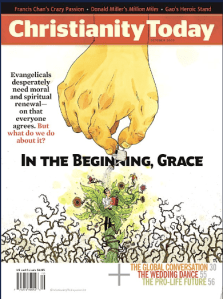
On the issue of “design catching up with editorial”: Christianity Today’s Mark Galli Answers Mr. Magazine’s™ Questions

September 17, 2009

Picture 4
It must be the season to redesign. I have seen and heard about more redesigns of magazines this month than any other month that I can recall. The last to join the redesign crowds is the leading Christian magazine that was founded by no other than America’s leading evangelical preacher Billy Graham: Christianity Today.

In a press release from the magazine, David Neff, CT’s editor in chief says, “Redesign a magazine and you could disorient some readers. But we hope that the redesigned Christianity Today will quickly give the reader a better sense of orientation. We believe the magazine is easier to use and more thoughtful than ever.”

As with every redesign the expectations of the editors and the readers may or may not be the same. To find out why the redesign and why now, I asked Mark Galli, Christianity Today’s senior managing editor to expand on the editor’s statement in the press release and to tell me why they opted for the redesign now and what are some of the innovative ways they are doing with the magazine.
Picture 5
Mark was quick to tell me that “the better question would be, ‘What took us so long?’ In fact, editorial has run ahead of design, in terms of how articles are pitched, what topics we’re covering, and so forth. We’ve become an editorially younger and broader magazine in some ways, and our design needed to catch up.”

SH: Are we designing for design sake, or is there a method for the redesign?

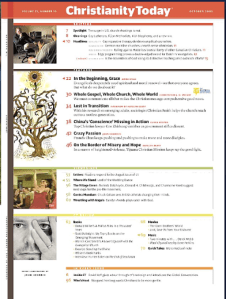
MG: One of the goals of the redesign was to increase coherence. We want people to have a better grasp of the magazine’s structure so that they will instinctively know where they are, and where to go if they are looking for another type of article.
Picture 6
We begin, as we have before, with a news section, but now all our news pieces will be in this section, including the longer news pieces, which used to be put in the features area because of length. There will be exceptions to the rule–that is, when we judge that “news” has become a “feature.” This happened in the inaugural issue! At the last minute, I decided we simply had to include the story of the imprisoned Christian Chinese dissident; his life is literally on the line, and I didn’t feel we should wait another issue to publicize his case. But it will be the rare news piece that will make it into the features; we’ll keep all those together in the news section.

In addition, we now put all opinion pieces–letters, editorials, columns–in one place. Previously they were spread throughout the magazine. And we’ll continue keeping all review material together. In addition, these sections are color coded across the top, again to help with orientation. So now, the reader will always know where to go to read a certain genre.

SH: What do you consider are the innovative steps you’ve taken through this change at CT?

MG: Again, it’s a matter of design catching up with editorial. Take for example our expanded attention to younger readers: We’ve added a feature called “Who’s Next?” at the very end of the book. In one page, it introduces readers to someone who will have an increasing influence in our movement in the years to come. This ends the magazine on a forward looking note.

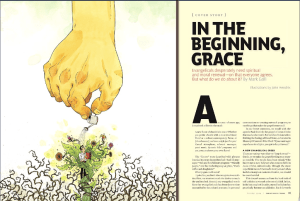
In addition, we’re trying to do some thing that can only be done in print. Our news section begins with a one-page, info-graphic intense summary of a news issue. In addition, factoids and quotes are stitched between columns of news. These are the types of things you cannot do as well online.

In addition, we increasingly see the magazine as a place where people in our larger community–evangelicalism–come to discuss, argue, debate issues of concern to the whole community. We still try to provide leadership though editorial–as expressed especially in our monthly editorial (a rarity in magazines these days), and by the subjects we choose to cover. But we are not a magazine just for evangelicals who agree with us. We are also a magazine of the broader movement. So we’ve inaugurated a feature called “The Village Green,” where we will have movement leaders present three view points on a different question each month. For example, in the October issue, we’re asking, in light of recent legislative and electoral defeats, where should pro-lifers put their energies in the months ahead–in works of compassion, in new legislative efforts, or what?

None of these efforts are innovative in the sense that they’ve never been done before. We’re merely taking tired-and-true magazine editorial ideas to integrate design and editorial ever more closely.

SH: How, if any, are you using digital to amplify the future of the printed magazine?

MG: We will continue posting our print articles on line gradually through the month after the print magazine comes out. Since we are in the middle of a online redesign, and since the economics of online publishing are shifting everywhere as we speak, we’re not sure how consistently we’ll do that in the future. How online and print work with one another is part of the discussion as we consider a redesign, which we hope to launch in January 2010.

SH: Thank you.

(Full disclosure: I have worked and consulted with Christianity Today Inc. for a period of more than three years from 2004 thru. 2007).

h1

The Mr. Magazine™ Interview: Scott Mowbray, Time Inc.’s Lifestyle Group Executive Editor, and Cooking Light’s Newest Editor: On Change, Magazines and the Future

September 13, 2009

Picture 3
On change, now is the time to seize the moment. On magazines, they are the equivalent of long form television; a long form TV show cannot be duplicated on the web . On the future, we’re all naïve optimists here in the magazine world. Those are, in short, the headlines from Scott Mowbray, Time Inc.’s Lifestyle Group Executive Editor who oversaw the restyling of the award winning Cooking Light magazine this month and is overseeing the restyling of Southern Living magazine that will debut next month. Keeping true to the change theme, Time Inc. announced last Friday that “After a journalism career spanning 30 years, including more than 23 at Southern Progress, Cooking Light Editor in Chief Mary Kay Culpepper has decided to change course.” Culpepper is leaving the magazine at the end of the month and Mowbray will become editor of Cooking Light magazine starting Oct. 1, in addition to maintaining his role as Time Inc.’s Lifestyle Group Executive Editor.

Is it change for change’s sake or is it an attempt to capitalize on the two cash cows of Time Inc.’s Lifestyle division after a series of bad news ranging from the killing of magazines such as Southern Accents and Cottage Living to the firing of many long time business and editorial employees who have been with the company for many years?

Mowbray, a veteran journalist with a career that spans a host of magazines including, but not limited to, Eating Well and Popular Science was assigned the job of restyling the aforementioned two magazines. Under the watchful eyes of Time Inc.’s Executive Vice President Sylvia Auton, Mowbray was dispatched to Birmingham, Alabama to spearhead the restyling operations at what used to be known as Time Inc.’s Southern Progress division. Armed with Ms. Auton British imported Rapid Prototyping Process, Mowbray, in a period of less nine months, was able to overhaul Cooking Light and Southern Living magazines.

Mowbray’s long ranging interview with me (the interview took place on Sept. 2, nine days before it was revealed that Mowbray will assume the editorship of Cooking Light magazine) covered the issues related to the redesign of Cooking Light magazine and the way it was done. He offered his views on the future of print and digital and gave a glimpse of what the newest editor in chief at Time Inc. really makes him tick in this business. Mowbray also talked about the difference between readers and users and took his best shot on what the future holds for magazines. He also offered candid advice for those thinking of starting a new magazine.

What follows is my lengthy and lightly edited (in the true spirit of the Mr. Magazine’s™ Interviews) phone interview with Scott Mowbray at his office in Birmingham:Scott_Mowbray

SH: Why change and why now?

SM: I think there’s a sense that in a changing and pressured market, you do need to keep up and you do need to know your readership and make sure that you offer “more choices than ever before.” In fact they choose you. When we did focus groups around Cooking Light earlier this year, I was amazed by a few things: one was the fundamental loyalty of the readers, which is incredibly encouraging, and the second was their openness to other media and other magazines. They were very much–no matter their age–into exploring new things in terms of media. And with Cooking Light, I don’t think there has been a better time for the health message in the food category than now. I think this is the perfect time and I think the business side (of our company), just saw that NOW is the time to seize the moment.

SH: You mentioned that the health message is a major chunk of Cooking Light, and yet if you look at some of the fastest growing food magazines, health is not a major chunk of their content. Do you think health is what makes Cooking Light the magazine it is today?

I think that Cooking Light is number one for a reason and I think it’s going to stay there. I was the editor, years and years ago, of Eating Well. We were seeing the first start of the complete convergence from processed food to supermarket foods and farmers markets, every part of the food movement, at least looking at the issues of not only health but sustainability. That was happening 18 years ago. And, Cooking Light was dominant then. Now, it sort of owns that category. I think it has credibility among cooks and has credibility on the health side. So, I would be very happy to have a position like this to defend. I would absolutely agree with you that it’s not the sole position at all, but it is nice to have a consistent message that is being supported, in some ways, at every turn. Whether it is the health care debate or the economic crunch, there are all kinds of reasons to be concerned about smart eating.

SH: One of the things I noticed with the re-vamp of Cooking Light, almost every single page has a recipe. At one stage, I felt like I was flipping through a cookbook.

SM: There are actually plenty of pages that don’t have recipes though. There aren’t many pages that don’t give you some idea about what you can do in terms of making a food choice or a cooking choice. But, you’re right. One of the things the readers said in the research is that they wanted a photo with every recipe, which actually increased the cost, not only increased the paper stock, but increased the obligation to shoot every single recipe was a big thing. This is a cook’s magazine. Another reason why I find the position of this magazine so strong to defend, if you want to call it that, is the passion about cooking. This is not an armchair magazine. The women are usually responsible for the food choices and they have a very strong sense of wanting to nurture their children and their spouses, their husbands. That means that they’re always taking action. They’re not simply getting ideas, they’re taking action in their shopping actions and in their cooking actions. This is sort of reaffirming the fact that this all about taking action, and taking action in this case is cooking. So, there is a huge interest in recipes. Also, cooking healthy doesn’t just come naturally or instinctively, necessarily, to everyone. You need to know how do to it.

SH: Do you find it a little bit paradoxical that the healthy cooking magazine is published from the South, where we are stereotyped as the most obese region in the country?

SM: I don’t call it paradoxical, I call it brilliant. You go down to the farmer’s market here and you see that there is plenty of interest in the same issues as everywhere else. I think it’s great, I think it’s positive. I’ll tell you another thing that is a positive: I’ve been in New York for 20 years, but it is a good thing to be out in the reader’s real world, shopping from food stores that are very similar to the ones that they shop from. I think that keeps it real. I think that’s important to the readers because they are a mainstream, everyday cooking readership. They’re not cooking everyday, but they’re much more about cooking in the week than on the weekend. It comes back to this idea of wanting solutions for getting food to their families.

SH: You’ve spearheaded this reinvention, restyling. If one of your readers met you in the street and said, “Scott, what did you do to my magazine?” What would you tell them?

SM: I think that the vision is very much about providing answers to this great conundrum of modern life, which is this thing we do three times a day where it is so easy to default to junk food and lousy food, and the bad decisions. These readers were folks who were very confident; they’re fascinating women, and they’re post-diet women. These women are sophisticated, they’re mature, they’re looking for answers; but the bond is very much about helping them in the kitchen, helping them put food on the table, which is central to their lives. They see it as, in this totally chaotic world, the thing that they can do positively for the people they love. This is very, very much a visceral and emotional bond with the readership that is about helping them. But the answer is that you see their eyes light up, you see them feeling that you’ve provided them with some answers last month and they look forward to getting more answers in the next month. That’s the bond. I’ve been trying to make the magazine as user friendly as possibly as it can be in an era of chaotic media. It’s good food that tastes good that’s good for you and helping you put it on your table. That’s pretty much it.

SH: Talking about the chaotic media environment we live in… Do you see a digital future that preserves print? Or is it going to be either, or?

SM: That’s a fascinating question, and I don’t imagine that anybody has the answer. I have become a Kindle freak, not completely a Kindle freak, because when I found out that you can’t get Flannery O’Conner on Kindle, I was like, “Whoa, wait a second here.” I’m reading the complete works right now and I believe I couldn’t find only one thing by her on my Kindle. What the Kindle points to a little bit to me is the fact that the immersive experience is certainly possible in a digital device. So, then the question is, is the color, the full color, beautiful immersive magazine experience with the great sort of random access that you have in print possible in a device? With my Popular Science background, I’m a bit of a gadget freak. I don’t personally have a problem with a device playing that role. I think that it is entirely possible, that you could preserve. I don’t know if you’re preserving print, but you’re preserving the immersive print experience in an additional form. I think that’s possible. I haven’t seen anything that comes close to it yet. I think a lot of digital magazines are not at all interesting, to me. And the devices aren’t there. To me, and I’m sure you’ve done way more thinking about this, but to me the iPod and the iPhone and the Kindle have all proven that it’s partly about the pleasure of the device. If the device provides a certain pleasure, and when it’s well designed, then you’re willing, or eager to use it and to have the information in it. That to me is really important. So, where is this device? I don’t know where it is now. I know people are working on it. The waterproof, flexible, completely wireless, color, and cheap version of the Kindle, it’s going to take a little while to come up with that I think. I found the Kindle surprisingly exciting when I started to read on it. To me, it was about that immersive thing. And, I read the piece in the New Yorker about that, and I’ve read books on the iPhone as well, but that’s all straight text. The one thing that I think we overestimated was the importance of incorporating hypertext and video into the digital version of a magazine. I’m not convinced that that is the added value. If I want that, why don’t I just go to a website?

SH: That’s actually one of the things we’re trying to study at the Magazine Innovation Center. Are readers really hoppers? Do they want to go from one place to the other when they are reading anything? Whether they are on the web, or… Why can’t we give them the complete experience in one medium?

SM: That’s exactly what I’m getting at. I personally know that I can go to my computer and Google something if I want to, but the act of leaving the immersive article of page and going to something completely different, which is very much a web experience, hopping around like you were describing, isn’t the essence of a magazine experience. It’s more the pleasure of the page I think can be reproduced digitally. I’m not sure that it’s as three-dimensional as we initially thought it was, but I’m just speculating.

SH: What makes you tick in this business? You have more doom and gloom surrounding you from every hallway at Southern Progress. What makes you say, “Yeah, I’m doing the right thing? This is what I really enjoy doing?”

SM: I think any magazine editor who feels that way isn’t using the right metaphor. This is not the replacement of a clearly inferior technology with a superior technology. It’s the widening of a media marketplace and the finding of the right position for everything. I’m convinced of that. Radio did not go away when television came along. This is not the telegram of media devices, or the telegraph; important in it’s time and gone tomorrow. I just don’t believe that. Secondly: I’m not 24 and I do think that a lot of the happenstance discoveries that are sort of characteristic in the invention of a lot of internet businesses are not for me. I’m not of that generation. I love print and I think there is plenty to be done in it. I think it’s going to continue to thrive, maybe not be as big, but size isn’t everything. I’m not naïve and that’s why I talked about the Kindle thing. I think if you asked the right question, which is how you preserve the print experience as opposed to how you preserve ink on paper, I’m sure ink on paper will proceed, but if half of what we did ended up being some kind of digital version of a magazine, fine.

SH: Do you see any future for print on demand? We are seeing folks like MagCloud and Newspaper Direct helping folks create printed products, one at a time. Is this the future?

SM: I think any smart editor is well aware that they’re in a business that is partly about permanence and partly about disposability. We’re sort of in the middle. Newspapers were much more disposable. They came in one day and they’re gone. Magazines are in 30 days and maybe you file them away, but how often do you really go back to them? So you’re in this funny place between the tactile object and the disposable thing on one hand and the completely ephemeral thing on the other, where people don’t own websites, they just own the computers that websites appear on. It’s a funny place, an interesting, playful place to be as far as I’m concerned. I also look at young people going into media and I understand the scary part of it because it’s not as predictable as it used to be 30 years ago. You got into and did well in a company like Time Inc. or Hearst. You’d have a career. Those days appear to be a little bit different than they were but I can’t imagine a more interesting time to be pushing into media. When I was at Pop Sci and ran Time4 Media, when I had really smart 25-year-old editors who had done three or more years of good work and found themselves 28-years-old and wondering what to do next, I told them to go back. Go back and get a web job and then come back to print. Not because they had to bring their digital skills back, although that was important, but to experience the full range of the media, not just taking the same job at different magazines. The other thing that’s funny about this is that you look at the scale of business of some of these magazines and yes, in some cases they’re certainly declining, but they dwarf that of many fizzy frothy websites. That’s an important thing to keep in mind is how successful some of these things are.

SH: If somebody comes to you today and said, “Scott, I want to start a new magazine.” What do you tell them?

SM: Wow. Well, wanting to start one and having the money to start one are two completely different things. If somebody came to me and had a lot of backing and said, “I have a magazine idea.” I would give them a lot of advice about how to test that idea and how to figure out whether it was going to work or not before they went to look at the business models. Because being business smart or finding a smart business partner who has been across the 1,000 miles of bad road that you have to cover before you actually launch is incredibly important. And more so now since there isn’t as much money to go around. Let me give you one example, when I was executive director of Time Inc., I was looking at new ideas all the time and a lot of those ideas were green magazine ideas to come around. That was about three years ago in the heyday of the explosive interest in the environment, but none of them had a credible business model, because they all looked for what I consider to be either peripheral versions of mainstream advertising. In other words, every car company wants to do some green related advertising, but it’s not their core. Or you have these very small start-up green companies that weren’t yet ready to really sustain a magazine. Every one of them had not thought out the business side. So the question is “have you figured out the business model?” Editors aren’t about that, but you have to find a partner who is.


SH: Can we still, in this day and age, create a complete immersing experience in one medium whether it is in print, online, iPod, etc. or do you have to be everywhere at the same time?

SM: I think I would say a bit of both. You want to branch out into these other media partly because now it’s expected, from an advertising point of view and some degree a consumer point of view. It’s expected that you will have a web presence and maybe an iPhone app and that kind of thing. I think you should be thinking that way, you may discover things in these other media that really teach you a lot. If your core business is a print business, you should not overestimate how much revenue your website will bring or underestimate how much of a diversion and how much work and how much of a different discipline your web business is. I learned at Health.com (we launched it from scratch, beside the magazine but not really with the magazine) just how immensely different the web business is. It is important to do it, but do not think it’s easy, and do not think it’s automatic. I do think you have to do those things, but I don’t think you should overestimate how much money they’re going to bring you in the short run or underestimate how difficult and how much of a separate discipline it really is.

We assume brands just sit easily in these different media. I think that the web is about technology. It’s about understanding search engine optimization and all this stuff that everybody on the web has known for 20 years now, but that print guys would not easily understand. Yeah, you should be multimedia but pick your medium first and know which one is your natural medium. It’s a technology. Magazines in their own sense are technology too; they’re just completely different.

SH: You mentioned earlier that the genesis of the redesign came from what you called the “Rapid Prototyping Process”. Can you expand on that?

SM: I think it’s worth noting that this redesign came out of as a result of the “Rapid Prototyping Process.” Essentially Sylvia Auton spearheaded this, and it’s something that came out of her work in the UK. There if you’re a newsstand’s based magazine, you can die in less than a year if you don’t keep up with your competitors or with readers. They came up with this very accelerated way of rapidly focus grouping and doing design so it lasts a matter of a week or two. It was a very intensive development process which got in front of readers over and over again and that happened in January and February. That really was the impetus for what became the redesign and the re-launch, if you want to call it that. It’s quite an interesting process. I’ve never done anything quite like it. It was the most intensive editorial work I’ve ever done in my life. I have two groups of six to eight people designing and producing pages, often hundreds of pages over two weeks, with focus groups in the middle. You are completely immersed in a way I’ve never been before.

SH: What is in your opinion the difference between our customers, the readers of magazines and the users of the websites?

SM: That’s actually interesting. Reading vs using? I’ve always, as I think most editors do, found focus groups painful enough. The usability studies are fascinating because there’s nothing more brutal. Even the loyal user is willing to leave immediately on the web if you don’t give them what they want. As you watch them go through your website and leave in droves. You realize you are entirely a slave to the user in that sense. In the web it’s sort of like you’re in a party but there’s a million doors open to a million other parties and they can leave at any time. They have to find you, and they have to stay there and you sit there. You talk about being close to your readers, and I think web, because of the nature of instantaneous response on the web, there’s closeness to the user in one sense that’s profound. That’s what I think magazine people could benefit from experiencing because it’s like a hyper newsstand. It desensitizes you. It’s not the only thing. It’s not the only way to do things, but it’s important to see the easy brutality of the dispassionate user who will just leave you in a heartbeat. Which I suspect is affecting magazines a little bit. I bet you can afford to be less connected with your readers, less than you used to be able to. I think that’s the worst thing now. Not just because of the precarious economy, but simply because people are used to getting what they want and moving on if they don’t get it.

SH: Is there a future for magazines?

SM: The thing that I find encouraging though is if you look at the cable television industry and you see the flourishing of quality programming on all these other cable channels and it still matters that things are good and that experience can’t be duplicated on the web. A long form TV show cannot be duplicated on the web unless you are simply watching a long form TV show on the web, but that’s irrelevant to me. It doesn’t matter. That’s just the platform, it has nothing to do with the content. Similarly I think magazines are the equivalent of long form television in a sense. They’re repeating, they’re serial, they happen at a regular time and they give you certain pleasure. I don’t think that can just be torn into pieces and put onto the web. I think that there is something unique about magazines. But, hey, we’re all naïve optimists here in the magazine world.

SH: Thank you.

h1

A record 75 new titles hits the newsstands in August

September 1, 2009

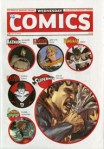
Afar - 6xGreen Craft - 4xClash - 12xPhotoshop Retouch - 4xProsper - 4xDC Comics - 52x

Talk about a hot August. I am not talking here about the weather temperature, but rather on the temperature of the new magazine launches. August ’09 surprised even the skeptics and brought a furry of launches and announcements of launches.

Earlier in the week Folio magazine reported on the increase of the pulse of companies bringing new titles. Today, the early statistics of August 09 show that there were a total of 75 titles launched, almost double the 43 ones in August 08 and even higher than August 07 with 61 new titles.

The August numbers include 17 titles with a frequency of four times or more, 2 annuals and 56 specials, including the Newsweek special edition on sale for $9.99 on the late senator Ted Kennedy.

Some of the noted August magazine launches are pictured above and include Afar, Clash, Photoshop Retouch, Green Craft, Wednesday Comics and Prosper.

I have noticed with interest all the news about the decline in newsstands sales for the ABC audited magazines, however, in almost all the reports no one stopped and checked the figures analyzed by John Harrington in his The New Single Copy newsletter that shows that we are still selling more than 23 million magazines every week on the nation’s newsstands. So, we are down by 2 million copies or so. What is the big deal? Can you name any other industry that has not suffered under the current economic climate that we are all witnessing? Why is it that a decline in magazine sales from a previous six month period always means the doom and gloom and demise of an industry, while a decline in attendance for a football or baseball game after few losses does not indicate the end of football or baseball?

I hope you will enjoy any or all of the 75 new titles of August and you will be willing and able to spend more than $800.00 on these titles, if for nothing else but to keep the prophets of doom and gloom and the media pundits at bay and keep our industry up and running.

h1

A new magazine to help you get “in and out” of the Bible: The Mr. Magazine™ Interview with John Barry, Editor in Chief of Bible Study magazine

August 24, 2009

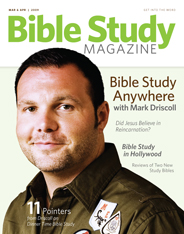
driscollcover
Bible Study magazine is just that: a magazine to study the Bible. Some will be quick to say, so what’s new about that? Aren’t there plenty of magazines that deal with Bible studies and such? Well, on the surface, the answer is yes, but the more I studied (no pun intended) the new magazine, the more I saw its point of difference. It is not your grandfather’s Bible study magazine and it is published by a tech firm. This last observation alone could have led me to interview the publishers of the ink on paper Bible Study magazine, however in addition to this fact, the “Weird but Important” content of the magazine also caught my attention. Add to that some of the facts that I have later learned about the magazine’s business model. All of the above made John Barry, the magazine’s editor in chief, the perfect person to “study” and interview for the Mr. Magazine’s™ Interview segment of my blog and web site.

For the skimmers, here are some soundbites:

On launching in ink on paper:
Because paper works. As long as waiting rooms, lobbies and bathrooms are around, magazines will exist… There are also business reasons for launching a print magazine. Logos Bible Software is all about forward thinking…
On the magazine’s concept:
We are the only publication devoted solely and entirely to Bible study. Sounds odd, but it’s true.
On their different business model:
We don’t have a single subscription card. We chucked that business model out the window before we even launched our publication.
On advising others to launch a magazine in today’s market place:
I am tempted to say, “Don’t!” But the truth of the matter is that today is a great day to start a magazine.

What follows is the complete interview with John Barry, editor in chief, of Bible Study magazine:
johnBarry_800x1200
SH: In the midst of the doom and gloom of the print industry, why would a tech firm Logos Bible Software publish a printed magazine?

JB: Because paper works. As long as waiting rooms, lobbies and bathrooms are around, magazines will exist. As Logos Bible Software’s president, Bob Pritchett, says, “Magazines are bathroom-compatible.” No one brings their laptop into the bathroom, but they do bring a magazine. I can sit in a hot tub with a magazine, but I wouldn’t bring a hand-held device in there. And even if hand-held devices takeover the magazine world, like they have a segment of the newspaper world, people will be charged for the content, and many will still want the print version because of the info-graphics, tables, layout, art, typesetting and general readability.
Logos Bible Software is a digital publisher with nearly 10,000 biblical and theological books available to purchase and download—fully linked to each other, powered by incredible searching technology, and databases. So, many customers asked us, why not publish our magazine for Logos Bible Software? Our answer was (and is) because inevitably there are amazing resources in anyone’s digital library that they are yet to learn about, like the early church fathers. The insight the church fathers shed on Bible study and faith in general is incredible. Or what about Josephus, the Jewish historian who wrote about Jesus? Or ancient translations of the Bible? Or ancient inscriptions contemporary to the Bible? Through something as simple as a print magazine, we can introduce people to these topics and peak their interest. We can teach them “What They Don’t Tell You in Church,” which is the name of one of our departments.
There are also business reasons for launching a print magazine. Logos Bible Software is all about forward thinking. This is why we developed a tool called RefTagger that automatically makes any Bible verse linkable to http://bible.logos.com with a tool tip window. Forward thinking is also why Logos recently launched a site called Ref.Ly that transforms Bible verses into short URL addresses for Twitter.com users. But the managers of our company realized that all the forward thinking about online sites in the world could not reach the entire market. We needed to reach the print community. Solution: Bible Study Magazine. Now we have the ability to teach the online and the print market about the book so many affirm as holy. And we have the ability to show people what is “Weird but Important” about the Bible, which is the title of another one of our departments.

SH: Do people need a Bible Study magazine to engage in a Bible study?

JB: Yes and no. Anyone can engage in Bible study—it just requires a Bible. But it’s like building a house. Sure I have wood and nails, but I don’t presume to know about carpentry, hanging dry wall, or plumbing. I don’t know squat about those things. Wood and nails don’t make a house, and neither does just labor; it requires knowledge and planning. And more often than not, a crew. Sure we have the Bible translated in our language, but we are separated from the culture by 2,000–4,000 years. Anyone with a Bible translation in their language can read it, but many people don’t know how to study it and draw their own conclusions about what it says. For this reason, we need a crew to help us—the world of biblical scholarship. But, it too is hard to connect with and confusing. So, we need a guide, a general contractor, and that is where Bible Study Magazine comes in. Our goal is not to tell people what to think about the Bible, but to teach them how to draw their own conclusions.

SH: What differentiate your magazine from the rest of Christian magazines out there?

JB: We are the only publication devoted solely and entirely to Bible study. Sounds odd, but it’s true. We surveyed all the Christian magazines out there, and there was a gap when it came to Bible study. This is the other reason why Logos Bible Software decided to launch Bible Study Magazine—we want to fill that gap.
We don’t want our magazine to be ordinary; we want it to be different and extraordinary. The stuff we put in our magazine, we haven’t seen anywhere else. For example, we have covered topics like “How Tall was Goliath and Who Really Killed Him?” In this article we propose, based on the earliest manuscript evidence, that Goliath is actually much shorter than what most translations say. In this article, we also solve the mystery of a Bible passage that claims that Elhanan, not David, killed Goliath. We take the reader straight into the Hebrew world, coloring Hebrew letters in several graphics, to show how to solve a very complicated textual issue. Our headlines also regularly push the envelope with titles like: “God’s Right Hand Woman?”; “Rock Music and Bible Study”; “Bible Study Anywhere” with Pastor Mark Driscoll; “The Real Ten Commandments?”; “Paul’s Lost Letters”; “Chapters and Verses: Who Needs Them?”; “A Fat Kind and a Left-Handed Man”; and “Did Jesus Believe in Reincarnation?” This sampling of our titles well illustrates our two major goals: (1) To get people inspired to read the Bible with human interest stories; and (2) To take a controversial or difficult topic and teach someone how to use in-depth scholastic tools and methods to solve it. We want readers to be able to walk away from a story both knowing more and knowing how to study the Bible for themselves.

SH: It is my understanding that you operate on a different, and maybe even unique, business model. Do you care to elaborate?

JB: We don’t have a single subscription card. We chucked that business model out the window before we even launched our publication. All our subscriptions come via http://www.biblestudymagazine.com, or people calling 1-800-875-6467. This cuts the cost of printing the cards, the additional mailing cost of the weight, the mailing costs of the cards being sent back to us, and the overhead of processing them. Plus, we get all the information we need to follow-up with the customer for renewals when they buy their subscription. We have substituted the cards with subscribe and renew ads.
We are also subscriber revenue based, rather than ad revenue driven. But unlike other subscriber revenue models, our subscription price is low, currently only $14.95 for six issues a year. We make this model work by cutting cost on all fronts.

SH: As you approach your first anniversary, what would you consider the major hurdle that the magazine leaped over, and what is the major hurdle still looming in the near future?

JB: Our first major hurdle was reaching 10,000 paid subscribers; we did that by the time we mailed the last copies of our third issue. We also sold nearly every advertisement in our first issue, which was a huge accomplishment. Our next major hurdle will be getting all of our nearly 13,000 paid circulation to renew. But my goals don’t end there, I want to double the amount of paid subscribers by our second anniversary.

SH: Where do you see Bible Study three years from you?

JB: Ideally, our paid circulation will be 1 million paid subscribers. (Kidding, of course; although that would be nice.) Three years from now, I envision Bible Study Magazine having 75,000 paid subscribers. Perhaps we will go monthly at that point. We will also hopefully have a very popular blog going, and an even larger online counterpart. Our interactive articles are very cool and unlike anything I have seen another publication do, but I want to see an online community built around Bible study as well. It will be a place where people can dialogue about our Bible studies and offer each other suggestions, so that we can all learn together. I believe churches will begin to look for Bible study solutions, and we will be the first place they turn. Our ongoing Bible study (covering the eight weeks between issues), for example, is a very inexpensive way for a church to a run a Bible study. Instead of a $29.95 book that lasts for one quarter that each class member would have to buy, we can offer a $14.95 subscription to each class member that lasts the whole year. And it does not just include a Bible study; it also includes word studies, guides and interesting articles. I am convinced that as word spreads about our publication, we will become the chosen solution for ministries.

SH: Any advice you are willing to give to someone who wants to start a print publication in this day and age?

JB: I am tempted to say, “Don’t!” But the truth of the matter is that today is a great day to start a magazine. Simply because everything is cheaper, outside of mailing. If you play smart, get good prices, and negotiate hard, you can do it. Find a niche market that has a need, learn how to reach that market, and then fill the need. But the business is risky, so do everything you can to stabilize your revenue sources. Use an auto-renewal system and get as many readers to agree to have their subscription automatically renewed as possible. Also, give advertisers substantial price breaks when they commit to advertising for a year. See them as business partners—you help them, and they help you. The business partnership opportunities are virtually limitless. In this vein, devote a lot of time to smart marketing—both finding your market and getting them to commit.

Finally, innovate, innovate, and re-innovate your business model. Those who stop evaluating will die. Watch every penny and be willing to make sacrifices. But remember, no matter how small a staff or budget, there are no excuses for mediocrity. At the end of the day, great publications reaching a real market can sell.

SH: Thank you.

h1

What’s in a name? A brand, a magazine, or a taboo…

August 21, 2009

Meredith Corp., publisher of Better Homes and Gardens, Ladies’ Home Journal and Family Circle among other magazines, reintroduced itself to the media world last week via an ad campaign in the trade press by stating that “Today’s Meredith is designed for today’s media, combining all the channels with the marketing expertise you need to connect with consumers at the speed of life.”
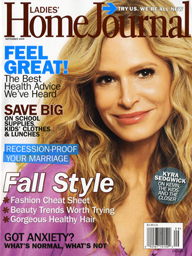
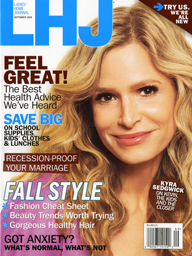
LadiesHomeJournal1LadiesHomeJournal2

What caught my attention is that the word magazine appeared only once in the new vocabulary of the company’s ad campaign. Magazines, as we knew them, are now referred to as “national media brands.” One of those “national media brands” is Ladies’ Home Journal. Well, I guess the magazine is also attempting to reintroduce itself. The September issue of the magazine is testing what seems to be a new name, or a new brand, or dare I say a new “national media brand.” LHJ, in bold blue color, replaces the Ladies’ Home Journal name on the cover. The test issue also reverses all the color from the regular issue. What’s blue in Ladies’ Home Journal is brown in LHJ and vice versa.

Now, the folks working at Ladies’ Home Journal may fondly refer to the magazine as LHJ, but do they really think the readers outside the magazine’s offices refer to the magazine as LHJ? If we are truly in the process of reinventing ourselves and reintroducing ourselves, should we make it easier for the readers to find our brand or should we make it harder? I hope that this test is not a sign of what “reintroducing Meredith” is going to be. Ladies’ Home Journal is a much bigger brand in the women’s magazine field to be reintroduced as LHJ… and so are the remaining magazines published by Meredith.

I hope that the word “magazine” is not going to be a “taboo” in the vocabulary of the “Reintroduced Meredith” and the same is true for Ladies’ Home Journal. There is a big difference between a “brand experience” and a “magazine experience.” Please do keep the “magazine experience” well and alive and the “brand experience” will follow.

h1

Pages that count and Customers who count…

August 19, 2009

… are the only two solutions for the American magazine publishing model. That was my message this morning on the Money for Breakfast show on the Fox Business Channel.
Picture 10
The show, hosted by Alexis Glick, focused on the news that only 12 magazines have witnessed an increase in their ad pages in the last six months. Eric Hoffman, Hoffman Media executive VP and COO, publisher of one of those 12 magazines, the highly successful, Cooking with Paula Deen magazine, and I were Alexis’s guests for the morning show segment “Turning A New Page?” Click here to watch the video from this morning show.

h1

Against all odds: Seventeen magazine is pretty, fun and flirty at 65

August 19, 2009

Seventeen2

What do Teen People, Cosmo Girl and Elle Girl have in common? I know that you are going to say that they are all dead. You are right. That is a fact. However, for a brief shinning moment in the last few years, the aforementioned magazines were the darlings of the media folks and were predicted to be the “hot new trend” in magazine publishing for teens. They all aimed to de-throne the mother queen of teen magazines: Seventeen. Guess what! Contrary to the predictions of the media pundits and “prophets of doom and gloom” the mother queen is still well, alive and kicking at 65.

Seventeen5Seventeen6Seventeen4

The magazine that carried the tag line “Young fashions & beauty, movies & music, ideas & people” on the cover of its first issue, back in September of 1944, is still offering its readers “pretty, fun and flirty” fashions, beauty, movies, music, ideas and people as “a relevant, trusted and fun resource for teens,” says the magazine publisher Jayne Jamison. So the next time you read about some upcoming new title that is taking the media pundits with a storm, stop, take a deep breath and do not lose faith in the good old established ones.

Magazines don’t age if they stay true to their DNAs. Magazine do age and die when you mess with their DNA. It is not the age that matters, but rather the DNA of the magazine. So, before you write off that old 60 something magazine, think twice and check its DNA. Seventeen is a shiny good example of a magazine at 65 that is still true to its DNA and thus still pretty, fun and flirty. It is necessary, sufficient and relevant. Read here my interview with publisher Jayne Jamison.

Happy anniversary and many many more!

h1

ESPN, The Magazine: Helping the economy or committing publishing suicide

August 14, 2009

ESPN1I love ESPN, The Magazine. I was one of three media critics who spoke positively about the launch of the magazine back when it started. This introduction is more than needed because what I witnessed at the post office last week sent shock waves through my system and caused me to stop and question the wisdom of what ESPN, The Magazine is doing.
Here is the story: I went to check my post office box at the main Post Office in Oxford. I saw a middle aged man taking a copy of ESPN, The Magazine from his box, he looked at the cover and then dropped the magazine at the garbage can. My heart almost stopped. Throwing ESPN, The Magazine in the garbage without even looking at the magazine. I dove into the garbage can and picked up the magazine. I looked at the cover that was half covered with a flap offering the subscriber “Your subscriber thank you gift!” The cover line on this flap screamed “What can you get for $1 these days? See inside.”

What was inside scared me even more than the moment the guy dropped the magazine in the garbage can. The answer to the cover question was “26 issues plus FREE ESPN Insider for $1.” The magazine told the “active subscriber” that “At ESPN, we are committed to delivering top value for you hard-earned money — especially during these tough economic times. That why we are offering our currently active subscribers a Thank You gift they can’t get anywhere else. 26 issues of ESPN The Magazine for just $1… That’s an unbelievable savings of $128.74 off the newsstand price!”

An entire year of the magazine for $1. Keep in mind, this is not an offer to new subscribers, or a trial offer. This offer “is valid for current subscriber renewals only and this offer is nontransferable.” My active subscriber did not even take the magazine home. Is the magazine really trying to help its subscribers in hard economic times? Or is the magazine committing publishing suicide by continuing to follow the dead American magazine publishing model: counting numbers rather than finding customers who count?

I do not believe that selling a one year subscription for $1 is the right answer to the hard economic times. It is, in my humble opinion, yet another example of a print publication committing publishing suicide.

If these hard times are not forcing the magazines to start selling to customers who count, rather than counting customers, I do not know what some publishers need to wake up and change their circulation methods. I do not know when the Audit Bureau of Circulation (ABC) will go back to the good old days when they only counted the “customers who count.” Now is the time to change. Tomorrow is too late.

h1

From “nice to have” to “must have”: Scientific American’s Bruce Brandfon recipe for success

August 12, 2009

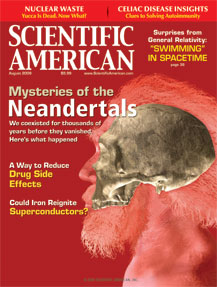
cover_2009-08What if some one tells you that the 21st century starts on Jan. 1, 2010? Well, you have to be stupid not to stop and listen to what that some one has to say. That is exactly what happened during my breakfast with Bruce Brandfon, Vice President and Publisher of Scientific American magazine, in New York City earlier in the week. Bruce’s comment reminded me with what Charles Overby said in his speech at the AEJMC’s convention last Friday that the last decade in the newspaper business was the lost decade.

Bruce told me that the reason he believes the 21st century starts January 1, 2010 “is because this first decade has been like stumbling in the dark clinging to the 20th century behavior. We woke up collectively when our 401k lost a major chunk of their value; when our kids graduated from college to find no jobs, and our business model collapsed…”

So I asked him, what do we need to do to prepare for the 21st century? His answer was three fold:

1. Deliver the most highly desirable, differentiated and satisfying content… If you are not different, the consumers will have harder time making a decision to pick you up… We are changing from nice to have, to must have.
2. Need to be able to justify for the other revenue stream, i.e. the advertiser, that you can deliver prospects who are involved in the content and not tricked into getting the content (like getting a one year’s sub for a dollar or five dollars). Your value proposition must be very clear.
3. You should be able to justify a premium price of whatever and wherever we are selling content…digital, print, etc. In your subject area you have to be dominant…no room left for middle of the way.

So what is needed to do all of the above? In Bruce’s book, we need two main ingredients:

1. Innovation: How to do every thing better… we have not innovated enough.
2. Sustainability: How to sustain the businesses we are involved in?

On the news front, Bruce told me “that starting with the January issue Scientific American is dropping its rate base to 450,000 from 575,000. The drop is 100% based on the decision to stop the direct mail method of acquiring new subscribers. It used to take 2 to 3 years to make any money on a new subscriber, now it is 7 to 8 years. Our new rate base will represent the loyal subscribers who renew at a phenomenal percentage and our 100,000 copies we sell at the newsstands.”

In addition to that, as of September 1 all feature articles on line will go behind a pay wall. People visiting the magazine’s web site via Google or other search engines will be able to see the first article for free, a synopsis of the second article and an invitation to subscribe or buy the digital edition.

His final words of wisdom for the day were, “We need to be THE THING for our audience. We need to create the BEST Scientific American yet.” Amen to that!

h1

Twelve Commandments for a Better News and Newspaper Future from Charles Overby, Chairman and CEO of the Freedom Forum

August 9, 2009

Charles and Andrea Overby at AEJMCThe last decade in the history of American newspapers is in fact the lost decade, so says Charles Overby, Chairman and CEO of the Freedom Forum and CEO of the Newseum. Mr. Overby, a journalist, editor and publisher was the recipient of The 2009 Gerald M. Sass Award for Distinguished Service to Journalism and Mass Communication at the Association for Educators in Journalism and Mass Communication annual convention this past week in Boston. Mr. Overby, in his acceptance speech, outlined the problems facing newsrooms and newspapers in today’s market place, and offered his views on how to reverse the declining trend facing the industry today. (Picture: Charles and Andrea Overby with the Gerald Sass Award)

Here are Mr. Overby’s “great dozen” ideas for the problems and solutions of today’s newsrooms and newspapers:

1. Free is not a business model:

Free is not a business model, certainly not for newspapers and news is and always has been a business. A free press does not mean free news. The survival of the free press, as we know it, depends on the public paying for it. If we want newspaper-size newsrooms, people have to pay for it. If we don’t, then forget it. It does not matter. But the idea that profits for newspapers are designed for greedy newspaper owners, I think, is missing the point. We need a revenue base that will support robust newsrooms and robust journalism.

2. Internet cannot replace the newspaper-sized newsroom:
We must resist the notion that the Internet, social networking and twitter can adequately replace newspaper-sized newsrooms. This doesn’t mean that you have to be against those new media. That is not the case at all. They are nice add-ons, but they are not a substitute for newspaper-sized newsrooms.

3. Preservation of the newsroom:

The issue is not narrowly the preservation of newspapers; it is the preservation of the adequately funded newsrooms.

4. Charging for content does not make you technically illiterate:

Rupert Murdoch announced this week that News Corp. plans to start charging for news content on the Internet at all his properties worldwide. Immediately Murdoch was labeled as technically illiterate. It is interesting to me that when cable companies charge fifty dollars or more a month to consumers they are not seen as technically illiterate.

5. Publishers are waking up:

I believe newspapers publishers are waking up to this reality and I think you will see many other legacy media outlets charging for their content. It is about time they did so. Not everybody will choose to pay for content. That’s OK, ten, twenty years ago not every body chose to subscribe to a newspaper. But many people who value substantive serious news will pay.

6. Publishers are to blame for their papers’ demise:

If people in the future asked the question who lost the news people, if traditional media disappeared as we knew it, whose fault will it be? I think the answer will be it was the fault of those who worried more about extending their brand for free on the Internet, than those who focused on preserving the value of their brand. Let us hope it will not come to that.

7. The underline principle of news has not changed:
The changes for the most part have involved the delivery of the news from drawing on cave walls, to smoke signals, to the pony express to satellites. But the underline principle of news has not changed; seek the truth, tell the story as fully and fairly as possible. There has been one other constant until recently. Over the years people have understood that you pay for news. That was true in the days of the colonial press; it was true even in the days of the penny press. But now it seems to be a debatable concept. For those who think that people should pay for the news, now incredibly, are often characterized as luddite, hopelessly out of touch. The dilemma has brought newspapers to the edge of a cliff. The future of newspapers, and I would say journalism as we know it, hangs in the balance. I recognize that some people have already written off newspapers and some of you may have already compared newspapers to dinosaurs. I believe that is a mistake.

8. The last decade is the lost decade

It is difficult for me to comprehend how steep the decline of newspapers has been in the last decade. I consider the last decade as the lost decade for newspapers. Virtually every thing about newspapers has gone down in the last decade. Circulation is down, advertising is down, profits are down and in some cases gone, news hole or the amount of space available for news stories is down, the number of editors and reporters is down.

9. Negative trends are the result of publishers’ disastrous decisions:

These negative trends are largely the result of the disastrous decision about ten years ago of newspaper publishers to put virtually all the newspapers’ content on the Internet for free. The thinking ten years ago went like this; we have to be on the Internet. We can’t miss this opportunity. We will figure out the business plan as we go along. The optimist thought the move to the Internet might ultimately allow newspapers to eliminate the two biggest expenses printing and distribution. The optimist also thought the Internet will bring in many new readers that will result in major profitable advertising.

10. Free is a trendy thing:

This move to free content is a very trendy thing, very seductive particularly with young people…there is even a book called Free. I point out that the book is not free it cost me $26.99.

11. Newspapers can’t survive if they continue to give their content for free:

Newspapers publishers are only now beginning to recognize that can’t survive if they continue to give their content free. If the free content trend continues you can bet the size of the newsrooms will decrease even more. That is bad for local communities, it is bad for journalism and I think it is bad for our democracy.

12. Reversing the trend:

The question is can this trend be reversed or stopped? Will people now pay for news content after growing accustomed for decade for getting this for free? I believe the trend can be reversed and that people will pay for news, perhaps in combination with print and the Internet. Readers have to see and understand substantive value for what they are paying for. They will not pay for a newspaper, or its equivalent, that continues to shrink in size and resources.