Archive for the ‘News and Views’ Category

h1

Innovation in Print: When Tech and Content Meet: Happy Father’s Day the Sactown Magazine Way…

June 18, 2010


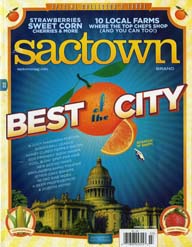
A lot has been written about the “scratch-and-sniff” cover of this month’s issue of Sactown magazine, the city magazine of Sacramento, CA. Sactown ventured into a new “value added print” (VAP) by introducing a scratch and sniff coating on the cover that makes the reader actually smell the slice of orange. FIPP Magazine World also introduces with this issue a “Peel ‘n Taste strip, one of the newest and most innovative techniques available in print magazine publishing.”

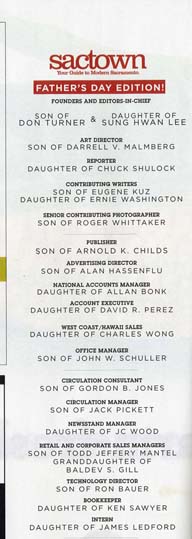
But the founders of Sactown magazine did not stop their innovation there. In addition to the technological innovation with the scratch and sniff cover, Rob Turner and his wife Elyssa Lee opted to innovate editorially with the masthead of the magazine. In celebration of Father’s Day this coming Sunday, the two decided to list every body on the masthead of the magazine as the son or daughter of rather than the given names of the staffers. Each and every staffer is listed as Son of or Daughter of.
A great combination of technological and editorial innovation that is just one example of how magazines are more than just content providers, but rather they are experience makers. Thank you Rob and Elyssa and Happy Father’s Day to all.

h1

So, What is a Magazine, Really? Read on…

June 11, 2010

Being in the content business and being in the magazine business are two completely different worlds. While the magazine business deals with content, content is only but a fraction of what makes a magazine. The myth that is now sweeping our industry that we are content providers and it does not matter how our customers get their information may be the Trojan horse that will aid some publishers continue on their print suicide path.

Content is good and content will continue to be king and queen of our profession, but magazines are not going to live and survive by content alone. It never stops to amaze me how the majority of people jumped on the bandwagon of equating magazines to music and wanted to sell magazines like the iTune store sells music. I said that before and I will say again, the only similarity between magazines and music is the letter m. Everything else is different. As a child I listened to music on the little transistor radio. Later I listened to records, tapes and even listened to music on television. I listened to my favorite songs over and over. I used earphones, loud speakers, any and all the things created to help me listen to the music. The goal was always to listen to my favorite song over and over again. I did not care how the song was broadcasted or delivered. I was not holding to that radio or television set, because the medium did not matter in that case. It was the message that mattered. It was so easy to separate the message from the medium, and it did not matter what medium delivered that message to me, because my addiction was to the message that I kept listening to, time after time. It was not a message meant for a one-time use. The physical medium was just the vehicle to deliver the message and it was never part of the message.

That brings me back to the printed magazine. Like music, each and every magazine can be used as a medium to deliver a message, but if that was all what magazines do, than we would have been out of business long time ago and we would have one format, maybe an iMagazine that delivers all the content you need to select and choose from for your daily needs, wants and desires.

Magazines are much more than content. Magazines are much more than information, words, pictures and colors all combined in a platform that serves nothing but as a delivery vehicle. Magazines, each and every one and each and every issue of every one, are a total experience that engages the customers five senses. Nothing is left to chance. It is a total package. Without the ink, the paper, the touch, the smell, the look, the taste, it will not be called a magazine. Every issue is a complete new experience with a sense of ownership, showmanship and membership and is renewed with the arrival of the next issue. The total experience of flipping through the pages of a magazine, looking at the different dimensions, shapes, and other physical properties (including the colors we use on every issue whether it is the famous TIME red border or National Geographic yellow border) create a unique relationship with the customer issue after issue.

So before we close the book on this great technology we call ink on paper and start moving with the tide of this new digital world, stop and think for a moment on what makes a magazine a magazine and why in this digital age millions of magazines worldwide are still thriving in ink on paper creating daily experiences, one issue at a time. Magazines are much more than content and they are even much more than ink on paper. The total physical aspect of each “storehouse” to use the original meaning of what a magazine is include all of its properties, from the size of the store to the content of the store, seen and felt together.

Take time and think about it. The digital age is helping us create new platforms and new media, but do not fool yourself and think you can recreate a similar experience to that we have in ink on paper magazines. It is one of a kind and I if we only devote five percent of our time, money and energy in this digital age focusing on how to enhance this existing ink on paper technology and what it is delivering, our business will be in a much better shape. Magazines are not just content providers, they are experience makers, one printed issue at a time. And, if it is not ink on paper, please try to find another name to define that new medium, because in my book if it is not printed it is not a magazine. I am living the digital age (you name the gadget I have it, including the iPad) but I am not living in a dream world. I have yet to see anything comes close to what an ink on paper magazine can deliver and do for its customers at such a great feel, not to mention a great price too. Go grab a magazine, any magazine and then let’s start talking about experience making!

Enjoy.

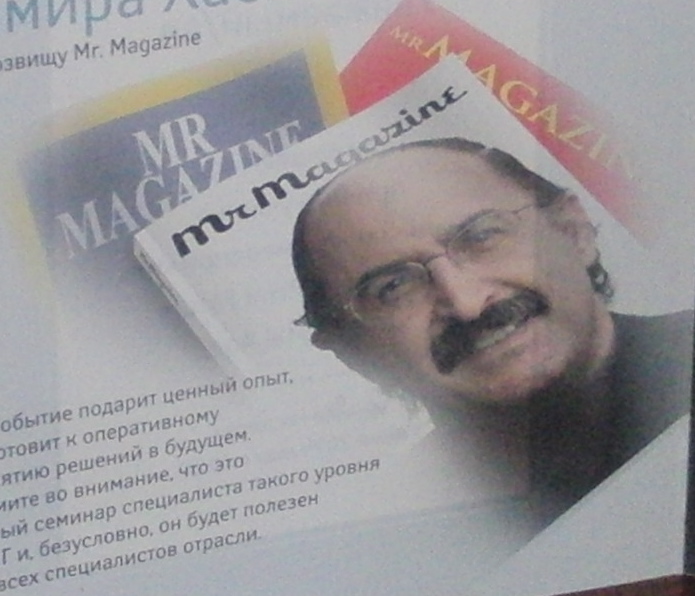
PS: The image above is taken from the invitation card used by Triada Printing Company in Kiev, Ukraine for the seminar I gave on June 9 in Kiev.

h1

Best advice for a new magazine launch: “Start a media brand,” says Jeff Wellington, publisher of ReadyMade magazine, in the “Mr. Magazine™ Interviews”

June 6, 2010

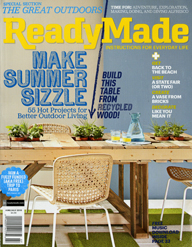
“Serve your audience and stay relevant,” is the secret ingredient that Jeff Wellington, publisher of ReadyMade magazine, believes is needed to ensure a successful publishing plan for magazines today. His advice for new comers to the magazine business is to “think for an idea for a media brand” rather than one for just a magazine. He should know. After all he is the one to lead ReadyMade, “the magazine for the innovator in all of us,” into the multi-channel multi-platform that it is today. “We have always had a strong print component, a solid web and digital foundation, as well as experiential events that reflect the passion of our readers and core audiences,” he told me in a recent interview. The publisher of the magazine that tags itself “Instructions For Everyday Life,” offers his instructions for everyday magazine publishing.

Mr. Wellington shares his views on the future of magazines, the story behind the name of the magazine and the user generated content in this installment of The Mr. Magazine™ Interviews. That, and other words of wisdom from the publisher who lead the “little small engine that could” to one of Adweek’s highest awards, are in the following complete, lightly edited, interview with the publisher of ReadyMade magazine Jeff Wellington:

Samir Husni: It has been said that there are three groups of new magazines: ground breakers, copycats and cheap imitators. ReadyMade is a groundbreaker with nothing like it on the market place. How do you publish and deal with a groundbreaker with no competitors in the market place?

Jeff Wellington: Regardless of how you are perceived, you have to stay focused on two critical things: serving your audience, and staying relevant. That sounds easy, but in today’s multichannel environment, it requires having an editorial voice that can connect on many different platforms.

SH: ReadyMade was founded by two entrepreneur women in San Francisco, now it is published by a major magazine publisher, Meredith… is it the same magazine or is it a different magazine? Why?

JW: The core focus of the title and its mission as a lifestyle brand for young, creative professionals interested in home design, decorating, and personal style and that environment has not changed. However, we have been able to expand the range of topics covered because of our ability to leverage the broad editorial assets of Meredith. This evolution of the title has been very organic, and well received by our audience.

SH: The name of the magazine is not the best reflector of what the magazine is all about. What is the mission and goal of the magazine and how can you adapt to such a non-descriptive name for the magazine?

JW: We believe the name is quite apt., actually. It was named after the term artist Marcel Duchamp coined in 1915 to describe a series of sculptures that playfully rethought the relationship between people, mass-produced objects, everyday items and art. Readymade is rooted in the idea of rethinking everyday items and how they might be reused or repurposed. ReadyMade is about people who make things and the culture of making. It’s a magazine for the innovator in all of us.

SH: The new business model for magazine publishing is becoming to resemble a three legged stool: print, the web and digital. What are the plans for ReadyMade?

JW: Fortunately, ReadyMade has always viewed itself as a brand so was fairly ahead of the curve when it came to creating multi-channel elements for our readers. We have always had a strong print component, a solid web and digital foundation, as well as experiential events that reflect the passion of our readers and core audiences. In addition, we are constantly looking at new platforms such as mobile that we believe are core to the DNA of the ReadyMade audience. The truly important points to remember is, content and context, and to be consistent to your brand voice.

SH: If you were to assign a competitive set for ReadyMade, both on the reader’s side and the advertiser’s side, who will be that competitive set?

JW: As you just mentioned in question #1, ReadyMade is a ground breaking concept with a unique editorial formula – 60% of our content is user generated which allows for an open dialogue between our editors and our readers. To that, our readers are highly engaged with our brand both in print and online. Competitively for both readers and advertisers ReadyMade is a hybrid of many elements, it has the creativity of a younger Martha Stewart, the design sense of an Elle Décor or Dwell and the lifestyle sensibility of a Real Simple – all wrapped around the idea of living a responsible green lifestyle.

SH: What advice will you offer someone coming to you and saying, “Jeff, I have an idea for a new magazine…”?

JW: I would make them first think of an idea for a media brand. In today’s world it is critical to think beyond the printed page since the flow of ideas is no longer a one- way street. For example, last year Meredith launched a social media site called MixingBowl.com. Later that site became a series of special interest print media publications featuring content created by the contributors to the site. You have to think much larger than one dimension for any new media brand.

SH: How do you see the future of magazines in general and print in particular?

JW: Generally, I avoid the crystal ball business. However, magazines remain a solid and important part of consumers lives. For example, the recent MRI numbers revealed that many titles actually increased their audience numbers, and that more younger people are reading magazines than ever before. There is something uniquely special about that relationship between a magazine and how consumers experience a magazine. Obviously, new platforms will create new options to engage those audiences, but the future of print magazines will remain vital as long as we create compelling and engaging editorial that taps into the passions of our readers.

SH: Thank you.

h1

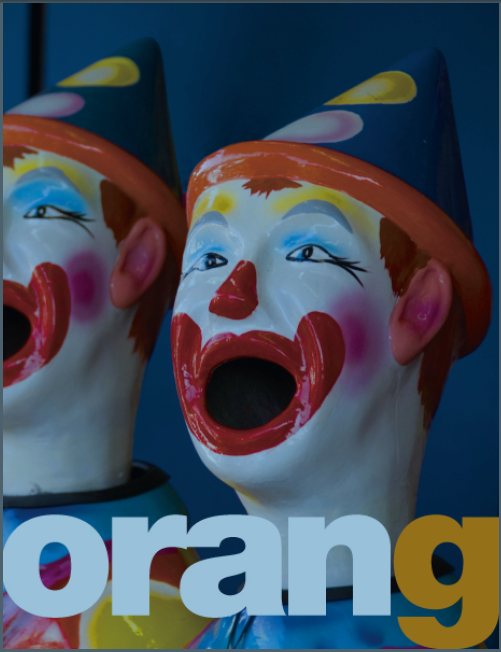
On “One-Night Stands and Love Affairs…” Orange magazine asks and Mr. Magazine™ answers

June 3, 2010

“With the launch of any new magazine—especially one that hopes to be “both inspirational and aspirational and sometimes even a bit confrontational”— there will be opinions on it, good, bad, and otherwise,” thus writes Jim Meyers President & Founder of the Imagination custom publishing and content marketing company.

Orange magazine Mr. Meyeres continues “is about providing some understanding and perspective, asking questions and exposing you—the reader—to things that maybe you haven’t thought of before. Working with leading companies and associations, Imagination has intimate knowledge about how to help you connect with your customers or members. We want to share that with you.”

In the second issue of the magazine Rene Ryan director for Imagination’s client strategy interviewed me on the topic of magazines, custom media, the future, free content among many other things. Her lead and first question are below:

His “little black book” is filled with numbers: 685 in 2008; 704 in 2009; 170 in the first quarter of 2010. But what do they mean? We discuss the print industry’s commitment issues with Mr. Magazine.

Q: To many of us in the industry you are known simply as “Mr. Magazine,” a champion for the printed word and director of the Magazine Innovation Center at the University of Mississippi. While that’s true, you’re also one of the industry’s harshest critics, saying that major media companies are “in a coma” and “not living in this world” if they think things are going to go back to the way they were. Since we’re not going back, what needs to change?

A: The No. 1 thing is to stop the “welfare information society.” We have been giving our content and our experiences away for free for years. We’ve put people on this information welfare model for so long that they have now the sense of entitlement; they expect everything to be for free. I laugh when I now hear media companies saying, “Oh, we need to start charging online. We need to start putting up paywalls.” How about you start charging for print first?…

To read the entire interview click here.

h1

So What Do You Do? Mediabistro.com Asks and Mr. Magazine™ Answers

May 26, 2010

If print is dead, Samir Husni has been working in a mausoleum. Running a $30,000 annual tab for his magazine collection, the issues are overflowing from his three storage units and onto his office floor and couch at the University of Mississippi, where he educates the next wave of journalists and runs the Magazine Innovation Center.

The aforementioned is the lead to an interview Blake Gernstetter mediabistro.com’s associate editor conducted with me and is published today in the Interview section on mediabistro.com

Part of an ongoing weekly segment on mediabistro.com “So What Do You Do” the interview sheds some light on both the personal and professional life of media folks.

Click here to read the mediabistro.com interview with me, “So What Do You Do, Samir Husni, Mr. Magazine? Husni shares his take on monetizing digital content and the outlook for print publications.”

h1

“Be Different, Be Better.” Words of Wisdom From Legendary Magazine Publisher Roy Reiman

May 11, 2010

When Roy Reiman talks, I listen. The man who has launched 14 successful magazines is a wealth of information and ideas. I had the opportunity to visit Mr. Reiman in beautiful Greendale, WI and could not resist the temptation to video tape some of those words of wisdom.

A storyteller and instant idea generator, Roy Reiman has been described as the man who “was born with an endless curiosity about people. He observed, listened and learned… and launched magazines that captured the interest of so many readers that he didn’t need advertising for support.”

From the humble beginnings of Farm Wife News magazine to the great success of Taste of Home, the largest food magazine in the country, Mr. Reiman knew how to treat his customers as friends and his magazines as letters from friends to friends. He sold his magazines few years back, but his love to this business brought him back to the world of publishing with Our Iowa magazine which he started less than three years ago.

In the following three videos, Roy talks about what it takes to launch a new magazine in today’s market place, on whether you can or can’t launch a magazine today without advertising, the realities of the marketplace and his latest entry to the magazine world with Our Iowa magazine.

So, I asked Mr. Reiman, “What would you tell someone who comes to you and say, I want to start a magazine?” Click on the video below to hear his answer:

“Can people still launch a magazine without advertising and what does it take to do so?” I asked. Click on the video below to hear his answer.

“And what about his latest magazine venture, Our Iowa?” Mr. Reiman offers the behind the scenes in and outs of making Our Iowa magazine. Click on the video below to hear the details.

Now, you know, why when Roy Reiman talks, I listen. Keep in mind, if you are going to start a new magazines the four simple WOW words of Roy Reiman: “Be different, be better.”

h1

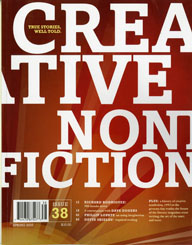
Digital maybe Goliath, but David is Out There (and that’s not Creative Nonfiction) with few other ink on paper magazines reminding us that PRINT IS NOT DEAD! Part 1

May 9, 2010

April has been a great month for new ink on paper magazines. Yes, I know, all the attention has been focused on the iPad and the future of digital publishing, so when 64 new magazines appeared on the newsstands for the first time last month no one took notice. Everyone was so busy counting how many iPads have been sold and how much should we charge for the magazine apps on the iPad. No one bothered to take note that the number of magazines launched in April of 2010 is 18 more magazines than that of April 2009. In addition to that 16 of those newly introduced titles have a frequency of 4 times or more. You can see each and every one of those magazines (and the first three months of 2010) here.

In the next few days I will be reporting on some of the new magazines being introduced on the marketplace, here and abroad. Here is part one with three magazines: DAVID, Out There and Creative Nonfiction.

DAVID: “For people whose understanding of history informs their contemporary identities,” writes Max and Joanne Friedland, the magazine publishers in the premier edition of David, the magazine. Aimed at the Las Vegas’ Jewish community, the Friedlands add, “in a city full of transplants, DAVID is our native son, born in this season of new beginnings, a testament to our creative will unbroken, and always inspired by what is possible.” The magazine editor in chief Martin Stein describes the mission of DAVID and its relation to Las Vegas as such. “This is Las Vegas, after all — the entertainment, dining and shopping capital of the world,” Stein writes. “With that in mind, we decided to create a bold, hip magazine that reflects our modern, Jewish reality,” he adds.

A hip, upbeat, necessary, sufficient and relevant magazine for the Las Vegas Jewish community with a lot of benefits for both Jews and Gentiles. A must if you live in Las Vegas, and a must if you plan to visit there.

Out There: The mission of this UK import is “to celebrate all aspects of homoculture, to scour the world to discover your talent, delight in your stories, to show just what a sexy, savvy, sweet and sour bunch we are.” Uwern Jong, the magazine publisher and Martin Perry, the creative/editorial director of Out There know that the launch issue of the magazine “isn’t a complete picture of the global gay experience, but there was only so much that we could fit into 200 pages. We are only what you make us, so if you like what you see, or think you know something we should be covering please let us know. We know you’re Out There.”

Out There could easily be dubbed the MONOCLE of the global gay culture. In fact, the size, design and type of paper Out There use is nothing but a reminder to me of Monocle. Whoever said imitation is the best form of flattery was never wrong. It is easy to say, Out There is one of the best new magazine launches I have seen out there.

Creative Nonfiction: Lee Gutkind, the creative non-fiction guru states it very well when he writes in the introduction to the first issue of the new magazine, “I believe there are many reasons for creative nonfiction’s popularity, beginning with the practical fact that people — readers — respond to stories, to narrative.” Started as journal in 1993, the publication evolved with this issue into a magazine. Why you may ask? Well, maybe the answer can be found in Gutkind’s remarks on the the status of society today. He writes, “Even as new technologies bring the world closer together, our lives are becoming increasingly isolated. Many of us don’t even know our neighbors’ names. Social media have replaced actual social life. And yet, we crave the intimacy that humans forge through storytelling, through sharing and comparing our experiences.”

And Mr. Gutkind is not telling you a fib. In this day and age of “isolated connectivity” people are hungrier than ever to hear a good story, to share a good story and to be part of a good story. In a world of celebrities and fiction, fantasy and virtual reality, the world needs some creative nonfiction. In fact it needs a lot!

To be continued…

h1

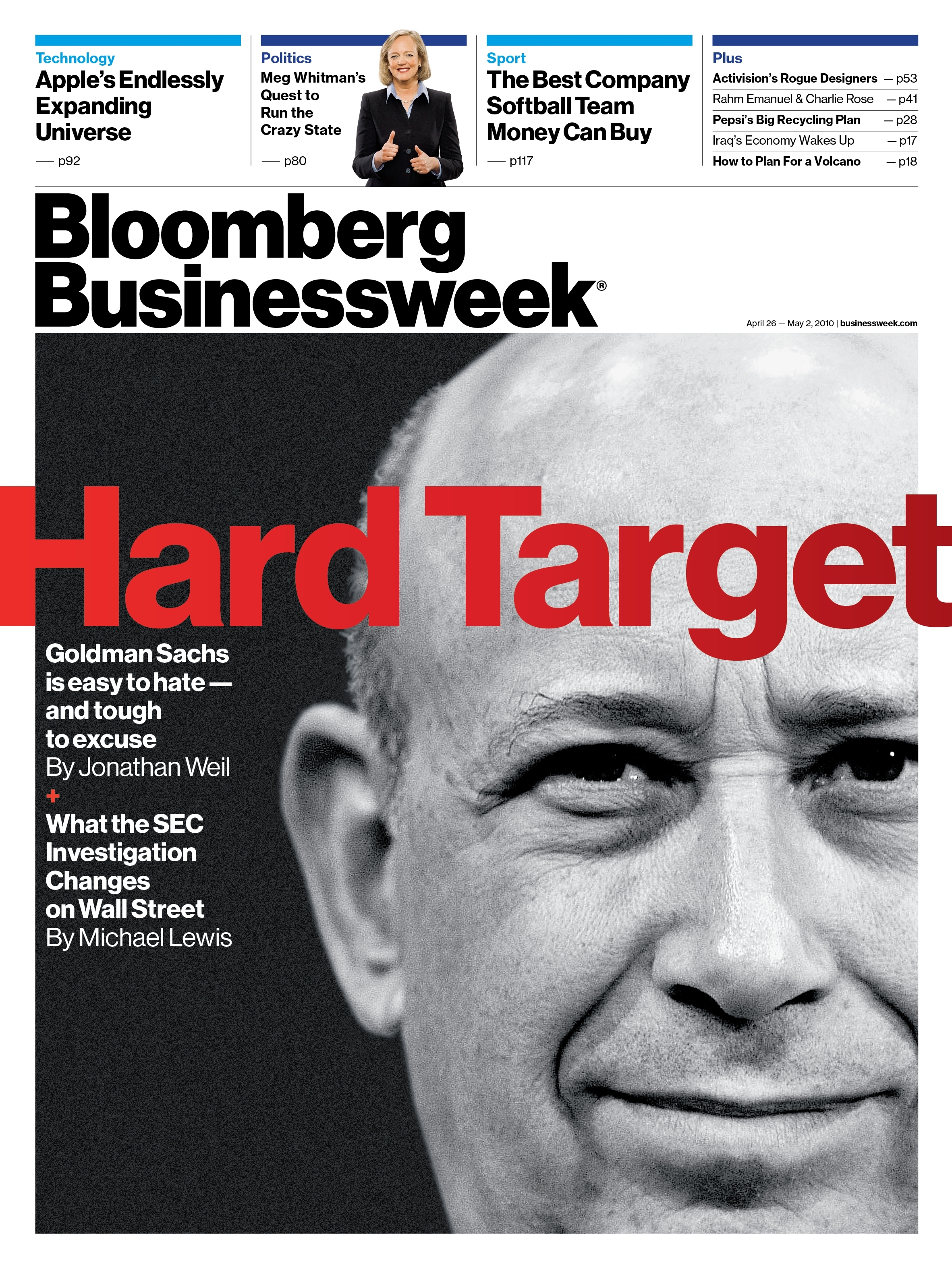
Josh Tyrangiel, Editor of the New Bloomberg Businessweek: Make a Great Magazine and You’ve Got a Great Future. The Mr. Magazine™ Interview.

April 26, 2010

Armed with a hefty dose of knowledge about the web and print and the way people use both media (from his days at Time.com), Josh Tyrangiel, Bloomberg Businessweek editor knows the web in and out and knows what the web can and can’t do. So, when he started planning the new ink on paper edition of the reinvented former Business Week magazine and turning in into Blommberg Businessweek, he knew that he needed “to be very conscious of the strengths of each medium.”

“What the web is good at is grazing, “ he told me in a phone interview. “Where magazines have made a mistake in the past couple years was going with really tiny short webby style stories and headlines. When you make a decision to open a magazine, you actually make a decision to shut out the rest of the world. You have a person’s focus in a way that you don’t online. You need to capitalize on that.”

Mr. Tyrangiel wants to create a magazine that can actually prepare people “to compete every week. You read our magazine on the weekend and you go into the office and you’re covered on a diversity of subjects. On top of that, in addition to being comprehensive, it’s a seductive magazine.”

What about the future of print, I asked. Mr. Tyrangiel answer, “I think the future of print is very bright for people who make great magazines and great newspapers, but the bar has been raised.”

What follows, is in typical Mr. Magazine™ Interviews style, my lightly edited interview with Josh Tyrangiel, editor of the new Bloomberg Businessweek:

Samir Husni: Congratulations on a job well done. It feels like you’ve created a monthly on a weekly basis.

Josh Tyrangiel: You know what? It feels like that. It’s a lot of work, but I really appreciate it.

SH: How are you going to follow up with issue two and three and four? Is it going to be that simple to create a monthly on a weekly basis?

JT: I’ll tell you, one thing that I have told the staff since day one about where we were headed is that it was going to be awfully hard work and that it was going to require us to think in ways that were slightly different to the ways magazines have been created before. You have to think not just about stories, but you have to think visually, you have to think about story mix. We have to really pack it full of things. Everybody has responded. We talk much more about story than we ever have before. The integration between the edit and the art department is much better than it’s ever been and that’s the way it has to be. There aren’t multiple ways to make this particular kind of magazine. It’s very difficult and I want to keep everybody focused. If I can do that, then the payoff is that (the magazine) feels like a really rich reading experience.

SH: Can it be done on a weekly basis? From a reader’s prospective, is it too much?

JT: I think it’s just right. Over the past five, ten years, one of the secular challenges we have is that we haven’t invested in our product particularly well. Paper stock got thin, more white space crept into the layout, story count went down and the price of the issue and the subscription went up. To me the value proposition was just off. What we’re trying to say here is, “We’re worth the money.” One of the ways you do that is being genuinely comprehensive so that you know you pick up this magazine, it arrives on your mailbox on a Friday, you read it and you covered for the week ahead. I would love for people to read the magazine front to back, every single word, but you and I both know that’s not necessarily how people interact with the book. But, for those who do, they’re going to be completely covered. For those who pick and choose, we’ll still give them enough coverage about the areas they care about that they feel like the magazine has an indispensability to it.

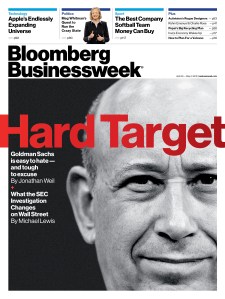
SH: Your cover reminds me so much of the front pages of The Guardian and The Observer, the UK papers. The cover has the look of a daily. Yet, once you go inside, it has the look of a monthly. What was the intention behind that cover design?

JT: Remember that this is only one issue and that the consistent aspects of the magazine are inside and that this is our first cover. The idea was to convey some urgency. This is a weekly magazine and one of the reasons that people stopped subscribing to weekly magazines is that they get piled up. My goal is to make sure our subscribers, on the walk from the mailbox to the front door, open this magazine. I want them to engage with it right away. No one expects us to tell them the future, but I think they expect us to be on the news. So, I want our covers to convey urgency. I want them to have enough stuff in those rooflines so that people always find something they’re interested in on those 20 steps from the mailbox to the front door.

SH: One of the things that caught my attention is that you are trying to ensure a future for print in a digital age. Whether you are enhancing the print quality, adding pages, using heavier paper weight, etc. But, so many others have done that before and six months later, we’re back to where we were before that. What’s the long term plan? Somebody just remarked to me today, “Are they going to drop “week” from “business”?” Is it going to be “Bloomberg Business” like Nissan did with Datsun? What’s the plan six months from now?

JT: We have the benefit of being privately owned and having tremendous support from our company. The plan six months from now is to keep growing and to keep doing work, week in and week out. Bloomberg has faith in journalism. The company has faith that if you put out a great product, people will come. So, that’s the plan. The plan is to make a great weekly magazine every week.

SH: Fortune just redesigned. Forbes will probably redesign. The three of you have always been looked at as the cornerstones for business journalism in this country. Besides the frequency, what can you tell your readers, “This is what you need Bloomberg Businessweek for, this is what you need Fortune for, and this is what you need Forbes for?”

JT: I can’t do the work of telling them what they need Fortune and Forbes for, but I can tell them, beyond just the frequency and periodicity, we’re packed with stories and packed with information. We can actually prepare for you to compete every week. You read our magazine on the weekend and you go into the office, you’re covered and you’re covered on a diversity of subjects. On top of that, in addition to being comprehensive, it’s a seductive magazine. There’s lots of stuff we’re telling people that they don’t know and taking them on journeys to meet people, to hear new ideas, to discover new companies they can impact their business lives. I think that’s something we can do uniquely and again, I don’t want to offer positioning statements for Forbes or Fortune, I think they’re both good magazine, but I think we’re in a kind of different category just based on what we’re trying to do.

SH: Sometime back, I think as far as the mid 1980s, some folks were saying the news weeklies are dying and that there is no room for weeklies. All of a sudden we are seeing a great emergence of the weeklies and all are trying to reinvent themselves. What are you doing in this digital age to ensure a print future?

JT: I think you have to be very conscious of the strengths of each medium. I’ve worked on both (mediums) for a long time now and what the web is good at is grazing. People use the web peculiarly for news between 11 a.m. and 2 p.m. They’re sitting at their desks, they’re eating lunch, the voicemail light is on and they’re looking for just a little bit of a break. Stories have to be pretty short, headlines have to be written a certain way, and the immediacy of those stories is the capital. In a magazine, you’re getting people in a different frame of mind. You need to recognize that. Where magazines have made a mistake in the past couple years was going with really tiny short webby style stories and headlines. When you make a decision to open a magazine, you actually make a decision to shut out the rest of the world. You have a person’s focus in a way that you don’t online. You need to capitalize on that. You need to think through some one in that frame of mind actually wants from their reading experience. I think there are some people who have done it very well and that is something I think about a whole lot when we redesigned and it’s something I think about with every story. What’s the frame of mind of our reader? What do they want from this? How can we deliver on that?

SH: I remember the first time I met you at Time when you told me about that 11 to 2 timeframe for the web.

JT: You’re running into vacant space. That’s the thing. One the weekend, if you’ve got a magazine, you’re running into prime time.

SH: What is the weakest link in this issue? After this issue came out, what was it that made you say, “I wish we did not do that.”

JT: That’s very funny. I’m going to give you a very honest answer. I just wish it wasn’t all so awesome. I’m going to go back, and part of the culture here, is that we do very brutal post-mortems. I want us to be our own toughest critic, but that’s why I’m really really happy with our issue.

SH: That negates my second question, which is what is your most proud moment in this issue?

JT: My most proud moment is how awesome it all was? Same answer? No, I proud of the fact that it feels original. People have been making magazines for a long time and it’s a beloved format, but I think there are things in here that feel genuinely original and I feel proud of that.

SH: Every time one of our weeklies change someone says, “it’s going to be like The Economist, or they are trying to be like The Economist.” Are you?

JT: No! We’re trying to be like Bloomberg Businessweek. The fact is that I certainly think The Economist is good magazine, but I read everything. On my desk right now is The Economist, People magazine, New York Review of Books, Spectator. I read a lot of stuff, but I just feel like our mission is a unique mission. I’m not trying to be like anybody else. That’s why I said I’m proudest of the fact that it feels original. We have a unique mission, we have readers who are unique and they’re asking for us to deliver to them something they haven’t see before and something that’s useful. So, I’m not trying to be like anybody else at all. I want our magazine to feel different.

SH: One final question, how do you see the future of print?

JT: I think the future of print is very bright for people who make great magazines and great newspapers, but the bar has been raised. Part of our problem is that there was way too much competition and not a lot of it was very good. There are many things that failed, that sadly probably should have. The medium itself is still very strong and has tremendous promise, but our reader and our advertisers are demanding great product. So, make a great product and you’ve got a great future. My own personal belief is that great things rarely fail. So, make a great thing and worry about the rest after you’ve done that first.

SH: Thank you.

h1

The One Minute Advisor: Be Reader Centric and Not Magazine Centric

April 25, 2010

James Elliott president of the James G. Elliott Company, a firm that specializes in media, marketing, research and sales, visited with my students at Ole Miss last week. As part of a new blog occasional series The One Minute Advisor, I asked Mr. Elliott on what he sees as the major mistake most magazine publishers are committing today and what advice he would offer them.

Click on the video below to hear Jim Elliott who has over 30 years experience in the advertising industry. Before founding the James G. Elliott Co., Inc. in 1984, he held numerous executive positions, including Director of Field Services at CBS Magazines and Western Advertising Manager for Road & Track Magazine.

h1

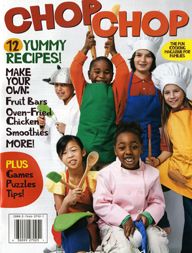
Knock Knock. Who’s There? ChopChop, the new food magazine for children. The Mr. Magazine™ Interview with ChopChop’s Editor in Chief Steven Slon

April 19, 2010

“Cooking is the one area where print beats digital for convenience.” “The very old and the very young are both still reading printed material.” “I think the classic magazine revenue model is dead.” The aforementioned soundbites are but three sentences of the many words of wisdom Steven Slon, the editor in chief of the new children’s magazine ChopChop had to see in the Mr. Magazine™ interview.

The newest entry to the children’s magazine market focuses on food as its corner stone, but also covers health and nutrition as it ventures into new areas no other children magazine have ventured before. Both on the business side and the editorial side ChopChop takes a completely different approach to launching a magazine and to reaching an audience ignored by magazine publishers for so long.

I asked Mr. Slon (via e mail) who was, for years, the editor of AARP, The Magazine (aimed at 50+), and now the editor in chief of the new magazine ChopChop (aimed at 5+) about the shift to editing a children’s magazine, the magazine marketplace today and the future of print. What follows is the complete exchange with Steven Slon.

Samir Husni: With the internet taking off faster than a speeding bullet, iPads and other tablets moving printed magazines and books out of the front page news, why would you start a printed childern’s magazine?

Steve Slon: Cooking is the one area where print beats digital for convenience. You want to be able to lay the pages displaying the recipe open next to where you’re working. No matter if it gets splattered on or lightly dusted with flour. You can’t place your ipad,iphone, or Kindle on the stove. Or near it. And, yes, you could print a recipe and carry it to the stove, but that’s a couple of extra steps. Having made all these points, we are building out a website as we speak, and have future plans for developing apps and other tools of the hand-held communication world.

SH: Do you know whether it makes a difference for kids to read from a laptop, digital device or a printed magazine or book? Any studies you are aware of? etc. etc.

SS: Don’t know of any studies per se, but our mission is to reach children of all economic levels, with special attention to children at and below poverty level. Low income families are much less likely to own a computer. According to a recent paper, “Home Computer Use and the Development of Human Capital,” in the U.S, “less than half of children with family incomes under $25,000 lived in a household with a computer, compared to 92 percent of those with family incomes over $100,000.” [Citation from Stephen J Dubner’s blog, PDF of paper at http://www.columbia.edu/%7Ecp2124/papers/computer.pdf.] That said, even young children who have computers enjoy the tactile and visual pleasures of holding a book or magazine in their hands.

SH: The Food Network magazines is doing very well and so are the rest of the new food magazines, what are the odds for ChopChop to make it in this crowded marketplace?

SS: There isn’t much in the market aimed at children. But what makes us different is primarily a) Quality and b) Authority. I’ll explain in a minute, but let me back up first and say that we’re competing, not as a magazine, but as a health and nutrition educational resource that happens to be in the form of a printed magazine. We began by marketing ourselves to pediatricians who are extremely frustrated by their inability to make the slightest dent in the massive and growing childhood obesity crisis. They feel that they are spitting into the wind when they tell a family with overweight children that the children need to watch their food intake and exercise more. Lecturing doesn’t work. ChopChop, for them, is a tool that they can “prescribe” to families. And pediatricians are telling us they are thrilled to have this tool at their disposal. The big goal is to move the dial in the direction of cooking and eating together as a family. So, our mission is not really to produce a magazine, but to encourage nutritional literacy that will last a lifetime. That said, it’s a great magazine! Unlike most “educational” materials, ChopChop is lively and engaging and fun. It has the look and feel of a consumer publication. So, back to the point of our differentiation: We’ve put together a top-notch team of veteran magazine-industry designers, photographers, and reporters—all working pro bono to support what we all feel is a valuable mission. (Please note especially the charming profile of a 14 year old chicken farmer by Susan Orlean.) As to the second point of differentiation, authority, our brilliant and charismatic founder Sally Sampson, a well-known cook book author, is deeply networked in the health community, particularly in the Boston area. She has put together an advisory team that includes leading names from Harvard, Tufts, BU and more. This kind of backing and knowledge can’t be replicated.

SH: How would you describe today’s children’s magazine marketplace? Is it in a state of growth or retreat?

SS: The beauty of ChopChop magazine is that it is completely outside the classic magazine model—children’s or otherwise—in that we do not depend on newsstand or advertising—and in fact, while we offer subscriptions, that’s not a serious revenue stream either; subs are only for the convenience of people who’ve heard of the publication and want to get it at home. We are supported in the most part by foundation, government and corporate dollars. We also receive modest levels of financial support from schools, children’s hospitals, childrens’ clubs and pediatricians.

SH: Will it matter where your great content is consumed? On the screen or on the pages of the magazine?

SS: For the present, it’s better in the printed magazine form, for reasons covered in the first question. And also because the product needs to be tangible in order for pediatricians and family physicians to “prescribe” it to their patients. In the future, that model may shift as the tools for transmitting information change. But for now, we think it works best as a physical entity.

SH: What advice you will give for someone coming to you and saying “I want to start a new kid’s magazine…” What would you tell that someone?

SS: Magazines succeed with their audience if they connect in a personal way. I would say, you’ve got to think like a kid and imagine what you’d want a magazine for you (as a kid) to be like. On the business side, I’d say, you’ve got to think very creatively. You have to do something different. I think the classic magazine revenue model is dead.

SH: On a personal note, you have made an 180 degrees switch from editing a magazine for the 50+ (AARP, The Magazine) to a magazine for the 5+. How does feel to make such a move?

SS: For one thing, the very young and the very old are both still reading printed material. The old because of custom, and the young because of school. (Schools are not completely wired…yet.) But, yes, of course it’s different. And, it’s a wonderful change of pace. I need regular change and big challenges to keep the juices flowing.

SH: What is the goal and vision of ChopChop and what do you expect to accomplish from launching such a magazine?

SS: I think I said some of this above, but our mission is to “Teach kids to cook and to be nutritionally curious and literate; Empower kids to actively participate as health partners with their families & doctors; Establish and support better eating habits for a lifetime of good nutrition; and σtem the tide of unhealthy children who are growing into unhealthy adults.” Our grand vision is to reverse and prevent childhood obesity.

SH: What are you doing to ensure a print future in a digital age?

To paraphrase the character Vinnie telling Robert De Niro about the murder of Joe Pesci in the movie Goodfellas, “[it’s] gone and we coudn’t do nothin about it.”