Archive for the ‘News and Views’ Category

h1

Bloomberg Businessweek’s More than One Way…

February 6, 2011

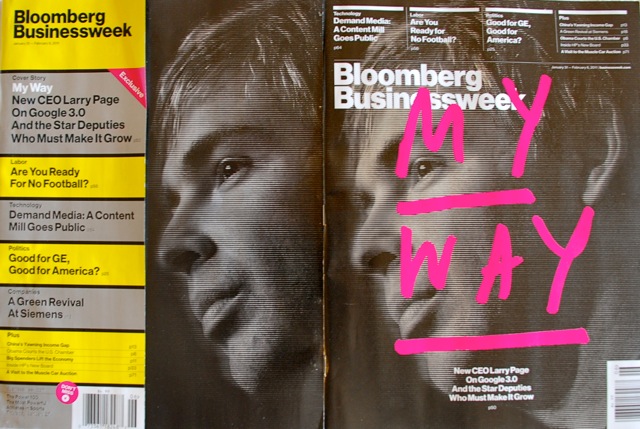
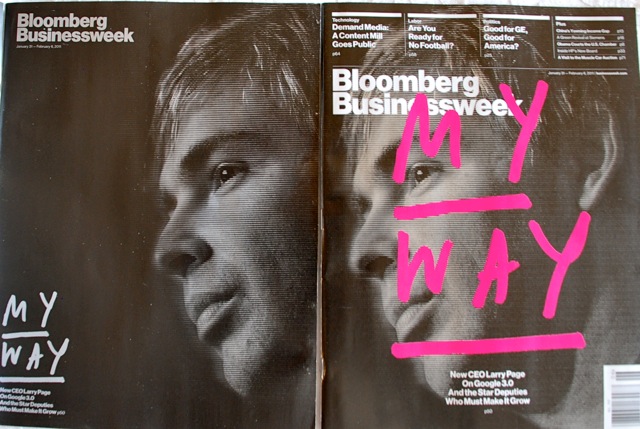
A big pink “My Way” may be on the cover of your Jan. 31 – Feb. 6, 2011 issue of Bloomberg Businessweek. And the reason I say may be is really very simple. The magazine is testing a cover flap on some newsstands (similar to that of The New Yorker’s cover flap) with more traditional cover lines and a very small magazine name. In fact if you remove the flap, the cover of the magazine is nothing but a black and white picture of Google’s new CEO Larry Page with even a much smaller “My Way” in the lower left corner of the page.

Take a look at both covers before and after the flap is opened.

Unlike the majority of the covers displayed at bookstores and that arrived at subscribers mailboxes, this new test seems to be a first departure from the recently redesigned magazine. While the cover test reveals a stunning use of black and white photography and typography, the cover flap however, provides a much easier way to skim, glance and read some of the important issues covered inside the now “must-read” weekly business magazine. This seems to be yet another major step for the not-so-new Bloomberg Businessweek to differentiate itself from other business titles in the marketplace and to reestablish its brand as the business market leader.

A job very well done. Enjoy!

h1

How Many Cover Prices Can One Magazine Issue Have? In the Case of Family Circle: at least Five

January 31, 2011

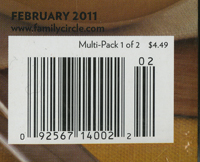
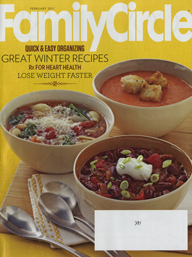
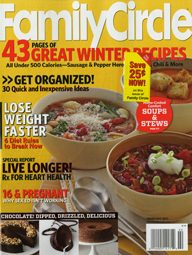
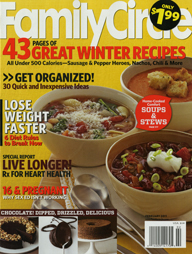
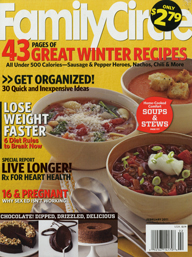
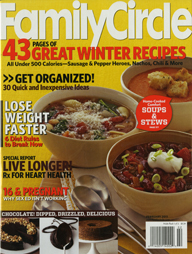
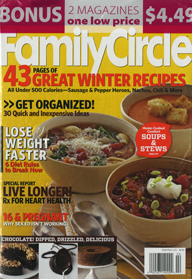
No one said that you have to have a Ph.D. in economic to be able to count the many different cover prices one magazine can have within a small radius of space. The Feb. issue of Family Circle magazine arrived earlier this month on the newsstand with a host of cover prices. From a mere $1.99 with a $.25 coupon from the cover price (at Wal-Mart), and the mere $1.99 with no coupon, to the only $1.99 with a star bust (at Books-A-Million), and the only $2.79 with a star bust (at Kroger), and the $3.29 as a two-magazines package (also at Wal-Mart, with Ladies’ Home Journal) and last but not least the $4.49 with yet another two-magazines package (also with Ladies’ Home Journal, at SAM’S Club). Look for yourself and judge! And while we are talking covers of one issue of one magazine, take a look at the subscribers’ cover and compare it with those of the newsstands. For some folks who say there is a science for the pricing of magazines on the newsstands, please help!

h1

On Magazines’ Successes, Flops and Time to Read: North East Mississippi Daily Journal Asks and Mr. Magazine™ Answers

January 23, 2011

The Food Network magazine is thriving, magazines that are big flops are a production of “ivory towers”, and when I am reading magazines I am doing my job. Those are the headlines from my interview with the editors of the Northeast Mississippi Daily Journal for their 3Qs spot in today’s newspaper.
Read the entire interview here

.

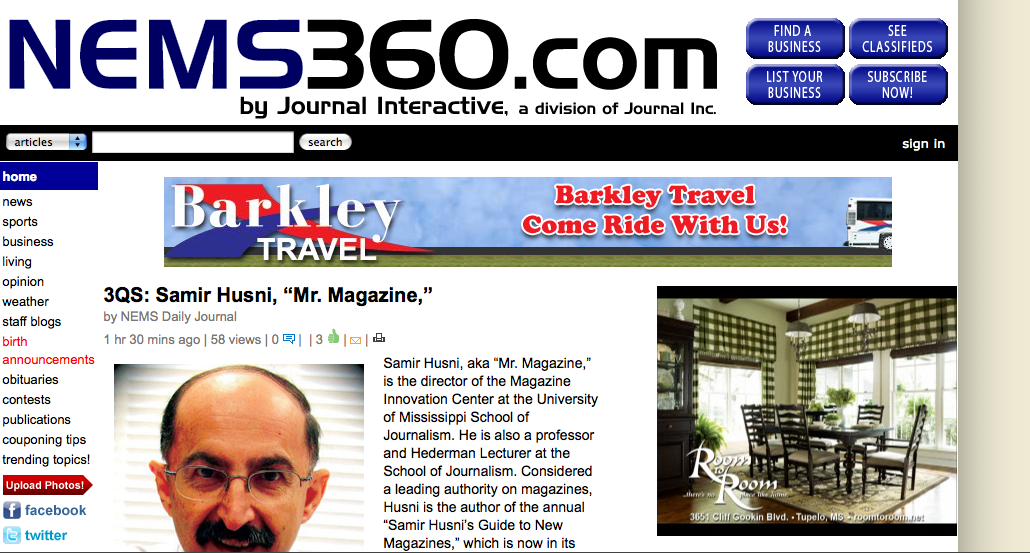
3QS: Samir Husni, “Mr. Magazine,”
by NEMS Daily Journal Nems360.Com

Samir Husni, aka “Mr. Magazine,” is the director of the Magazine Innovation Center at the University of Mississippi School of Journalism. He is also a professor and Hederman Lecturer at the School of Journalism. Considered a leading authority on magazines, Husni is the author of the annual “Samir Husni’s Guide to New Magazines,” which is now in its 25th year. He answered these questions from the Daily Journal last week.

Q: Which of today’s magazines do you consider successful and why?

A:Success is in the eye of the beholder, which is one main reason I do not attempt to define success these days by anything but survival. Staying in business these days is a success by itself. One magazine that emerged in the last three years and is not only surviving, but rather thriving, is Food Network Magazine. The magazine has been able to capture two basic addictions people have: food and celebrities. Folks who pick it up will not put it down until they start cooking.

Q:What do you consider the biggest magazine flops and why?

A:The history of American magazines is filled with flops and almost with no exception they all have one thing in common: the magazine was launched to satisfy the perceived needs of advertisers and not readers. Magazines that catered to what I call the concept of “counting customers rather than customers who count” have failed miserably. A few titles comes to mind: TV-Cable Week, which was published by Time Inc. in the 1980s, lost more than $47 million in less than a year, and Tina Brown’s magazine Talk in the early 2000s lost more than $55 million in a little over than a year. Both magazines had no connections with their audiences and were an “ivory tower” production, which leads me to conclude that the magazine that does not satisfy the needs, wants and desires of its readers first, no matter how much money is behind it, will not make it.

Q:Your office is full of magazines and other publications. How do you find time to go through them all?

A: I consider it a blessing from God that the gift He gave as a child – falling in love and creating handmade magazines from a very young age – has become my education and my profession. Not too many people can say when they are reading magazines in their office that they are doing their job. I can! If I am not at top of what is going on in the magazine world, I feel that I am doing my students and my university a disservice. The only way to serve my students is to stay on top of my field, and the only way I can do that is to make time for finding, buying and reading all the magazines that matter; and all of them do matter to me.

Copyright 2011 NEMS360.com. All rights reserved.

Read more: NEMS360.com – 3QS Samir Husni “Mr Magazine ”

h1

Collaborate, Innovate and Celebrate: What Can You Learn from Four Media Companies’ CEOs

January 18, 2011

The status and future of magazines distributed via newspapers will be the topic of the panel that I will be moderating on Thursday Jan. 20 in New York City. The panel will include the four CEOs of the major media companies that publish and distribute such magazines. The panelist are John Cobb III, CEO, Publishing Group of America; Stephen Duggan, CEO, Athlon Sports; Chuck Gabrielson, CEO, USA Weekend; and Jack Haire, CEO, Parade. (Full bios are at the end of the blog).

I have asked three colleagues to comment on the event and on the status of magazines distributed via newspapers. Lisa Scott, the executive director of PBAA and the event co-host answered my questions regarding who and why folks should attend the panel; Steve Cohn, editor in chief of min: media industry newsletter on the status of magazines distributed via newspapers; and Bob Sacks, founder and CEO of the Precision Media Group on the state and future of such titles.

I asked Lisa Scott who should attend such a panel? Her answer:

This panel, comprised of experienced CEO’s, offers anyone interested in the future of print media an opportunity to benefit from the panelists’ varied and cumulative insights, experiments, successes, mistakes, and reasons for optimism. Whether the attendee is a journalist, advertising professional, consumer marketer, media buyer, or supply-chain professional, there should be something to provoke or inspire or ponder on January 20.

And I asked, why should anyone attend such a panel?

Magazine and newspaper publishers and distributors will be able to understand why CEO’s are continuing to “bet” on print as a revenue source. More specifically, CEO’s can share real insight on the results of their research on their consumer audience, the role/value of digital media to these print-engaged consumers, and how and why they believe they can continue to woo investors in print media in the coming years. These insights can assist publishers and distributors to continue to build the case proving the vitality of print as a consumer’s media delivery vehicle in the years ahead.

As for Steve Cohn, the knowledgeable and well versed editor in chief of min:media industry newsletter, shed some light on the status of such magazines. He answered my questions about the magazines distributed via newspapers:

Newspaper-distributed magazines are growing because of (1) they fill a void created by the cessation of newspaper-published magazines due to their expense in a tough economy; and (2) they give newspapers added value.

Until 2000, newspaper-distributed magazines were the realm of Parade and USA Weekend (formerly Family Weekly). Then, Publishing Group of America came in with the successful launch of the largely “C”- and “D”-county targeted American Profile, followed by the monthly Relish (epicurean) and Spry (health). Now, there are periodically released health titles from Parade/USAW, and the Parade-owned epicurean magazine Dash is about to start a regular monthly frequency in February.

The advantage of newspaper-distributed magazines is that they don’t have to worry about circulation. Newspaper sales take care of that.

Disadvantage, until recently, was that newspaper-distributed magazines were solely dependent upon advertising for revenues. Online is beginning to make a contribution here.

Traditionally, advertising in newspaper-distributed magazines has held its own in tough economies, because the titles’ large circulations and low CPMs versus television makes them comparably a bargain.

And of course my friend Bob Sacks of the bosacks.com fame offered this view of the status and future of magazines distributed via newspapers:

Magazines inserted into newspapers surely are an interesting and successful business model for some on-going publications. It is still difficult to attain those types of huge circulations from any publisher’s perspective. The numbers in your blog are, indeed, large and will stay that way for some limited time to come. But simple trend analysis reveals some interesting long-term data. In 1960 the penetration rate of newspapers into the American home was in the range of 1.1 newspapers per household. By 1995 the year before the great Internet adoption, it was down to .60 per American household, and by 2010 the penetration rate was resting under 0.35 per household.

I guess my question is, where and when is the circulation plateau rather than the continued plummet of a 50-year decline? I would add that it is extremely important to note that the decline in household penetration for newspapers happened long before the rise of the Internet.

So, what do you think? Is the future bright and rosy for such publications? Or is it a lost cause? I guess on Thursday we will have the answers when we listen to those four CEOs answer the aforementioned questions. What follows are the short bios, in alphabetical order, of the four CEOs:

John W. Cobb III
John W. Cobb III is CEO of PGoA Media, a publishing, digital media and event company built around the American Profile, Relish and Spry brands.

Cobb’s extensive background managing the expansion of print and digital brands puts PGoA Media in the best possible position to continue to deliver outstanding results for advertisers, tremendous value for newspaper partners and robust content for consumers.

Prior to joining PGoA Media, Cobb was Senior Vice President, Digital at Source Interlink Media, which is the leading provider of automobile, action sports and high-tech content. He managed more than 100 web properties, including Motor Trend, Automobile, Hot Rod, Motorcyclist and Surfer with revenues of $50 million and 22 million unique visitors a month.

With more than 20 years as a senior media/internet executive, Cobb has led and developed large-scale, multi-media properties for Petersen Publishing, EMAP, PRIMEDIA and Source Interlink Media.

Cobb is based in New York and has a wife and two children. He’s an avid pilot and an active snow and water skier. He also enjoys golf, travel and technology.

Stephen Duggan
Stephen Duggan serves as President & Chief Executive Officer of Athlon Sports, publisher of Athlon Sports – the largest sports magazine in the U.S. with 9 million monthly circulation. Athlon is also the leading publisher of sports annuals with titles covering College Football, Pro Football, College Basketball, Pro Basketball, NASCAR, Pro Baseball and Golf.

Prior to joining Athlon, Stephen spent the previous decade working with private equity backed media companies. In 1999 Stephen helped found Publishing Group of America. Stephen was integrally involved in the successful launches of newspaper distributed American Profile, Relish and Spry magazines. Following the Sale of PGA in 2007, Stephen served as Chief Executive Officer of Alpha Media Group, publisher of Maxim magazine, where he led the Company’s successful business and balance sheet restructurings. Maxim is the leading magazine targeting young men 18-34 with a rate base of 2.5 million copies monthly.

Stephen currently serves on the Board of Directors for Questex Media Group, Inc, a leading global business-to-business (“B2B”) communications company serving multiple industries through a range of well-established, market-leading publications, events, interactive media, research, information and integrated marketing services.

Stephen is a graduate of Murray State University.

Chuck Gabrielson
Charles “Chuck” Gabrielson joined Gannett in 1971 at The Journal News in Westchester County, NY (then Westchester-Rockland Newspapers). He began his career as a management trainee in the advertising department then served in advertising and marketing management roles, including Advertising Director.
He joined USA WEEKEND in 1989 as Executive Vice President, named Publisher in 1996 and President and Publisher on January 2010. He previously served as Advertising Director of Macy’s Co. and Marketing/Sales Director of Advertising Age Magazine and Founder and Publisher of Creativity Magazine.

In 2009, Chuck was inducted to The Advertising Hall of Fame presented by MIN (Media Industry News). He is a graduate of Long Island University (LIU) and resides in New City, N.Y. with his wife Lisa.

Jack Haire
Jack Haire is President and CEO of Parade Publications. In his year and a half at the helm of the most widely read magazine in America, he has invested important resources in the brand and re-energized its business and editorial models. In addition to bringing top talent to Parade, Jack has helped forge strong partnerships with key newspaper and advertising partners. Under his leadership, Parade built a unique content distribution network with 40 million monthly unique visitors across 400 trusted newspaper web sites. Last November, Parade launched dash, a new food magazine and web business that will include branded content from Bon Appétit, Epicurious.com and Gourmet, marking the first editorial collaboration between Parade and Condé Nast.


Prior to joining Parade, Haire spent twenty-eight years at Time Warner Inc. During his tenure, he was publisher of Time Magazine, President of the Fortune/Money Group, and Chairman of the Time Warner Advertising Council. On his watch, both TIME and Fortune were chosen as Adweek’s Hottest Magazine, measured by 3 year advertising growth. He also partnered with CNN on the launch of CNNMoney.com, one of the Web’s most successful and profitable finance sites. He serves on the board of Concern Worldwide, U.S., an international humanitarian organization, and as a director of LodgeNet Interactive and Top Ten Reviews.


Haire lives in Connecticut with his wife and two children. He enjoys reading, golf, fishing, and playing or watching all sports.

To join us at this event, click here to register.

h1

The Mr. Magazine™ 2011 Manifesto for a Healthy, Wealthy and Lively New Media Year

January 2, 2011

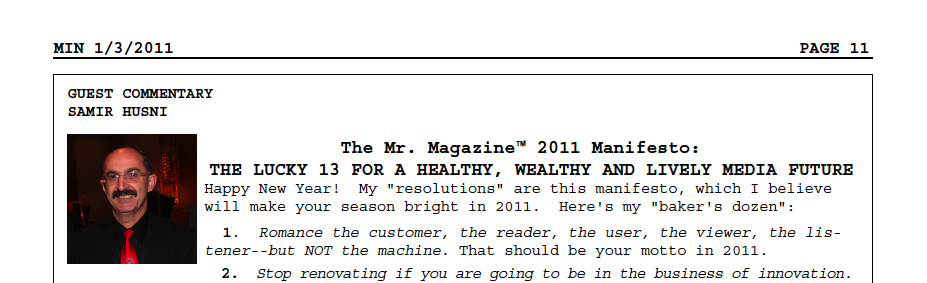
Today marks the beginning of a new year. A very good beginning indeed. A beginning that starts with nothing but ones. Today is 1, 1, 11. So, in honor of this new beginning, here is The Mr. Magazine™ 2011 Manifesto, published in min: media industry newsletter‘s Jan. 3, 2011 issue:


GUEST COMMENTARY
SAMIR HUSNI

The Mr. Magazine™ 2011 Manifesto:
THE LUCKY 13 FOR A HEALTHY, WEALTHY AND LIVELY MEDIA FUTURE

Happy New Year! My “resolutions” are this manifesto, which I believe will make your season bright in 2011. Here’s my “baker’s dozen”:

1. Romance the customer, the reader, the user, the viewer, the listener– but NOT the machine. That should be your motto in 2011.
2. Stop renovating if you are going to be in the business of innovation.
3. Throw a ball from left field, surprising your customers, readers, users, viewers, and listeners every time you interact with them. Give them what they expect, but surprise them with what they don’t.
4. Humanize your medium. Focus on the human voice, values, and vision behind the ink on paper, pixels on the screen, or bytes on the sound waves. In an age of isolated connectivity, humanizing the medium is a MUST, not an option.
5. Do not be afraid to charge for quality content. People are paying big money for what you think is not quality content.
6. Change your thinking and decide what is quality content based on your customers, readers, users, viewers, and listeners. Do not create based on you, but based on them. YOU are NOT THEM. Big surprise.
7. Hire someone younger, much younger, if you really want to innovate. Established folks drag a lot of luggage with them, intentionally or otherwise. Some may call this the wisdom of age, but I call it old habits that are hard to die hard. The “young and restless” drag very few and have yet to cement their feet in old or new habits.
8. Free yourself from the past but do not uproot yourself during the pruning season.
The new leaves and branches are what make a tree look good, not the roots. However, without the roots there will be no tree.
9. Keep in mind that only 9% of companies survive any disruptive innovation. Start thinking (and bring in someone new to think for you) on how to be a minority survivor rather than a majority has-been.
10. You are living the dawn of a new age, the age of Transcended Media. Are you ready to start the conversation with your customers, readers, users, viewers and listeners? Are you ready to keep the conversation going and whet their appetite for more?
11. 2011 is no different from 2010 or 2000. If you are NOT creating an engaging, addictive, repetitive conversation with your customers, readers, users, viewers, and listeners, that only means one thing: you are DEAD.
12. So show the world you are ALIVE and START romancing your customers, readers, users, viewers, and listeners. Make love to them and not to the platform or machine. You OWE it to them. And…
13. Stop being only a content provider and marketer. Start becoming an Experience Maker. There is where your media future starts.

And that, my friends, will lead you into a healthy, wealthy, and above all, lively media world of 2011 and beyond.

Samir Husni, Ph.D., is founder (2009) and director of the Magazine Innovation Center at the University of Mississippi, where he previously chaired the journalism department. Husni’s Mr. Magazine™ monicker comes from his tracking more than 18,000 launches since 1986, when his Guide to New Magazines debuted. The 26th edition of the Guide (Nautilus Publishing/Oxford, Miss.) will be released in February 2011.

A very happy and fruitful 2011 to all.

h1

From “O, The Oprah Magazine” to “OWN”, programming for a television network is born. The Mr. Magazine™ Interview with Jill Seelig, O, The Oprah Magazine’s Publisher and Chief Revenue Officer

December 28, 2010

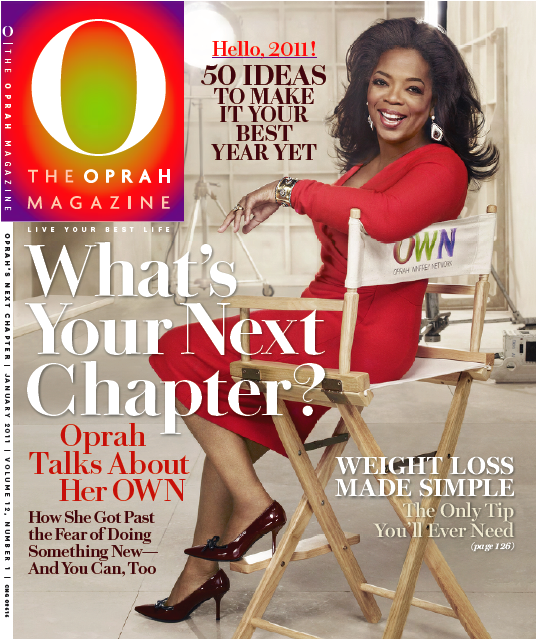
“Change” can easily be the word that defined the publishing world in 2010, and “Adapting to Change” will be the sentence defining the publishing world in 2011. One major change taking place in 2011 is Oprah Winfrey, the “show queen” of television, closing the “window” on her daily show and opening the “door” to her own television network OWN. A network that O, The Oprah Magazine is used “as the basis for the network’s programming.”

How will this end of an era, and the beginning of a new one, effect O, The Oprah Magazine, one of the most successful magazine launches of the last decade? I had the opportunity to ask Jill Seelig, vice president, publisher and chief revenue officer of O, The Oprah Magazine few questions regarding the forthcoming changes and in the words of the main cover-line of the January issue of O, The Oprah Magazine, “What’s Your Next Chapter?”

Here are the sound-bites followed by The Mr. Magazine™ Interview with Jill Seelig, publisher of O, The Oprah Magazine.

The magazine has very little duplication with viewers of The Oprah Winfrey Show.
Oprah loves the iPad – it was even part of her Favorite Things episode this year.
The app is an enhanced version of our print product, offering video and audio — much of it featuring Oprah herself – animation, interactivity, customization and tap-to-buy functionality.
The print and digital editions of our magazine live side by side comfortably.
O offers one of the most unique reading experiences for women. We are the only women’s magazine that comes from a place of optimism, inspiration and authenticity.
Advertisers tap into the depth of this reader connection, and it enhances and elevates the credibility of their brands.

And, now for the full interview:

Samir Husni: As the Oprah daily show comes to an end and a new era of Oprah starts, how will that effect O, The Oprah Magazine? Will the out of sight out of mind premise work here? Some say that repetition a major source of addiction, what will happen to the magazine without Oprah being seen on television every day?

Jill Seelig: O, The Oprah Magazine and OWN will be the go-to places for women who want to connect with Oprah and her message. Interestingly, the magazine has very little duplication with viewers of The Oprah Winfrey Show – currently only 19% of the show’s audience are O magazine readers. We believe that OWN – a 24/7 television presence – will drive more readers to the magazine, with more synergy and shared content living across both platforms. After all, as Oprah has said, David Zaslav came to her holding a copy of the magazine and said he wanted to use it as the basis for the network’s programming. OWN is dedicated to Oprah’s Live Your Best Life mission, just like the magazine.

SH: With Oprah now having her OWN, what are the plans to expand O, The Oprah Magazine? You’ve launched the first App. in Dec., any other plans of expanding and promoting the brand?

JS: We’re very excited about our iPad app, which launched as a monthly with our December issue. It has been extremely well-received, and was a featured app in the iTunes store from the moment it launched, taking the #1 spot in the lifestyle category right out of the gate, and we also have a digital edition available on the Nook as well as through Zinio.

Oprah loves the iPad – it was even part of her Favorite Things episode this year. Each month the O, The Oprah Magazine app gets richer and more compelling, as our editors incorporate innovative functionality and exclusive content – all filtered through the prism of Oprah’s philosophy and uplifting message. The app is an enhanced version of our print product, offering video and audio — much of it featuring Oprah herself – animation, interactivity, customization and tap-to-buy functionality. And Oprah loves books, and they are an important part of the magazine so one of the most unique features on the app is that users may access, for free, the first chapter of every book featured in the issue. If users like what they read, they can tap-to-buy through Amazon or Barnes and Noble.

SH: Hearst Magazines have invested a lot in enhancing and promoting their print products. What are you doing specifically with O, The Oprah Magazine to enhance and promote the print magazine? Are you working on ensuring a print future in a digital age?

JS: The print and digital editions of our magazine live side by side comfortably. O, The Oprah Magazine is the #3 monthly magazine at newsstand, and demand is high – readers love the tactile experience of holding our beautiful, glossy magazine and they love to interact with our brand up-close and in-person. Every year, thousands of readers join us at our signature event, O You!, which is a day of inspiration and education, delivered directly to our attendees by the experts they connect with every month in our pages. Over the years, we’ve held the event in cities from coast to coast. Speakers have included Dr. Oz, Suze Orman, Nate Berkus, Martha Beck, Donna Brazile and others, and of course our editor at large, Gayle King, who welcomes everyone and broadcasts her radio show from the venue. It is amazing to see the readers relating to our content in a dynamic way – we get (mostly) women from around the country and around the world who are passionate about the magazine.

Social media is proving to be a great way to stay in close contact with our audience – and it is not only the tweets from our magazine, or from creative director Adam Glassman or Gayle King – women can interact with nearly all of our contributors through social media. And of course we use emails and Facebook postings to ask for our readers’ opinions, encourage dialogue as well as invite them to attend events and enter amazing sweepstakes.

One recent example of print and digital working side-by-side was our 12 Day Holiday Give-O-Way, which was featured in the December issue, and awarded 12 winners all 70 products from the Holiday O List, plus select items from Oprah’s Favorite Things episode. Codes were hidden within the magazine’s pages and were accessible via the iPad, both of which drove readers to Oprah.com to enter every day for 12 days for a chance to win. In addition, we tweeted reminders, posted messages on Facebook and the result was more than 2.1 million entries!

SH: With the hope that the economy is rebounding, are there any plans to bring back O At Home or launch any other spinoffs?

JS: We’re focused on O, The Oprah Magazine and our digital editions at the moment.

SH: One of my mantras for the New Year is to Romance the Customer and not the platform. How do you see your readers, users, etc. interacting with the product and what are doing for them? The same when it comes to the advertisers? How would you answer the simple question for both readers and advertisers, “What is in it for me?”

JS: O offers one of the most unique reading experiences for women. We are the only women’s magazine that comes from a place of optimism, inspiration and authenticity, and because of that, 16 million readers connect with O on a deep emotional level every month. This magazine is truly a guide for our readers – helping them recognize what is wonderful about their lives and offering sage wisdom from our contributors on everything from achieving goals and dreams and making the most of their relationships, to financial planning to the best fashion and beauty buys.

Advertisers tap into the depth of this reader connection, and it enhances and elevates the credibility of their brands. Our readers tell us that when they consistently see an ad in O it’s a signal to them that the advertiser supports and shares the mindset of the women who read the magazine….that’s a powerful endorsement that moves readers to action and drives sales.

SH: If I am to give you a magic wand and you strike O, The Oprah Magazine to create a human being, who will it be? Can you describe that human being?

JS: That’s easy…it’s Oprah Winfrey. A woman in process who is curious about the world, eager to learn and grow, works in service of others, and challenges herself to Live Her Best Life everyday.

SH: Thank you.

h1

Innovation in Print: A Head, A Magazine and A Lot of Sifting… McSweeney’s Number Thirty-Six

December 21, 2010

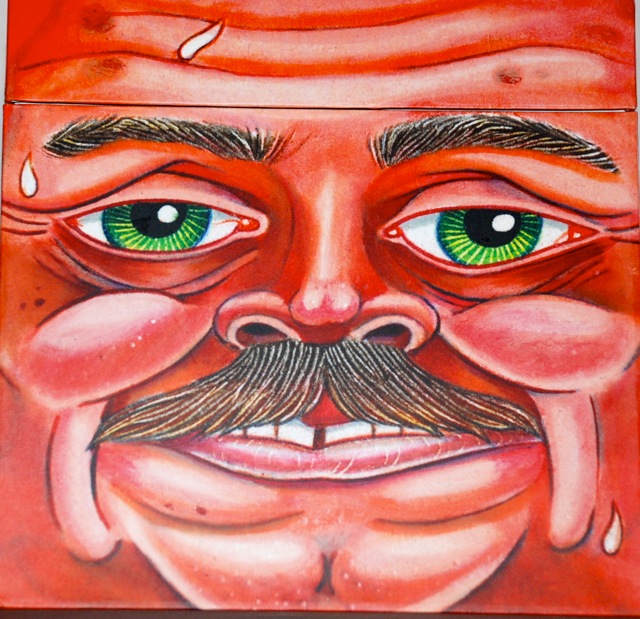
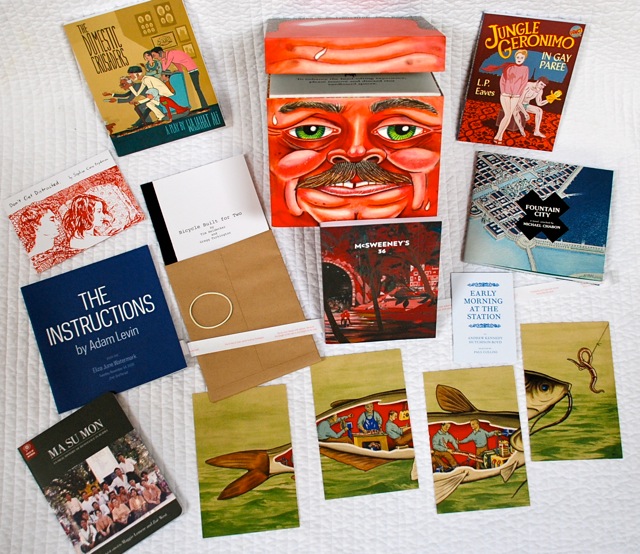
Taking the literary definition of a magazine as a storehouse, Dave Eggers and his team at Timothy McSweeney’s, delivers one of the best stores that can only be build in print. Inside the “head”, aka the store, McSweeney’s offers “a headful of new and unseen work” by Michael Chabon, John Brandon, Jack Pendarvis and Adam Levin among others. As you sift through the head you will find a roll of “fortunes” including the one that informs you that “Oliver Pratt is your real dad. Sorry for the late notice;” A “Catfish Scene” painting in four postcards; A mini “Fancy Times” book-a-zine; a novel in a bag; a mini booklet; and many other good, really good stuff, as you can see in the picture below.

The experience, and yes, it is an experience to open the “head” and take a peek inside. Pulling the ten different “products” from inside “the store,” the reader, turned shopper, gathers a wealth of information that is both entertaining and informative. An experience made for print and print only. And before your head starts spinning, take a look at the products inside the store.

In order for you to see the entire spinning store, I have shot of a mini video showing all sides of McSweeney’s Issue 36.

As for what is under the “head” or at the bottom of the store, well, I am not going to spoil all your fun. You have to buy the magazine to find out. Enjoy the experience! It is worth every penny of the $26 cover price.

h1

The Only “Trunk” You Need to Have and to Give This Holiday Season… The Mr. Magazine™ Interview with David Cicconi, Founder of Trunk magazine

December 20, 2010

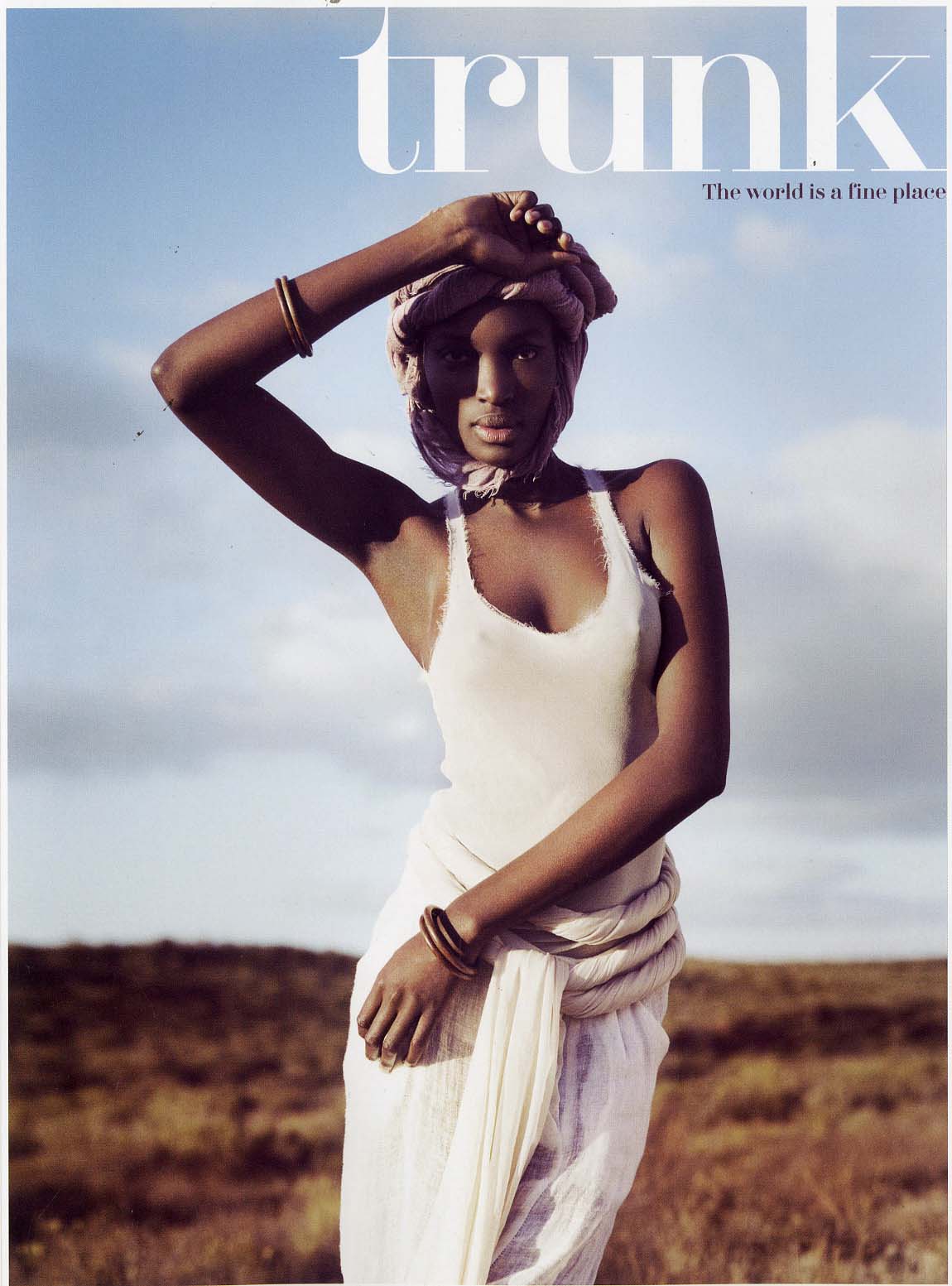
What happens when three creative magazine people put their energy and creativity in one trunk? Trunk magazine is born. The new magazine with the tagline “The World is a Fine Place,” is more than a welcomed addition to the world of magazines and media. It is the best gift that I, or anyone who shares my interest in the magazine, photography or design worlds, will find as a “wowing” ending for the 2010 and a “wowing” beginning for 2011. The best way to end a year and ring in the new year.

The “wowing” team behind Trunk is led by David Cicconi, the former photo director at Travel + Leisure.

“Trunk, in short, does what print was made to do,” Founder and Creative Director David Cicconi told me. “It is pure inspiration, with long reads and stunning images, for a demographic that embraces travel as a lifestyle. It will not compete with the internet: no lists. It will not talk down to its readers with travel tips: no articles through the eyes of locals or ex-pats. Our readers already know how to travel. It is simply a collection, issue after issue, of the most compelling and fascinating stories we could find around the world–nothing more… or less.”

“Trunk advertisers and controlled distribution for the debut issue are a testament to our niche,” Cicconi added. “The magazine was distributed at all Thompson Hotels, at Kartell, Swatch, Flight 001, Temperley of London, select Balazs properties, Emirates Airline lounges, Levis, Project No. 8, and many other similar travel, fashion and design venues. It can also be found (albeit sparingly) in locations in Paris, Milan, Rome, Berlin, London and Copenhagen.”

I had the opportunity to ask David few questions regarding this beautiful and inspiring magazine. What follows is the Mr. Magazine™ Interview with David Cicconi, founder and creative director of Trunk.

Samir Husni: Why Trunk and Why Now?

David Cicconi: Though it may not look like it or read like it, Trunk is a travel magazine. We see it as the only travel title occupying the Monocle / Wallpaper space. Much like these titles, Trunk is for an audience that leads an international lifestyle–people who embrace travel as a way of life rather than a break from life (or who at least have the curiosity and desire to do so). This is what makes Trunk unique–that it approaches travel as lifestyle and not merely a twice a year vacation. Nor are we about “how to travel like a local” or packing tips. Our readers know how to do this. They’re worldly, savvy, stylish and are just looking for inspiration and what to explore next.

Existing travel magazines are for a different audience and don’t offer content or an aesthetic consistent with the sensibility of the Trunk reader. Trunk’s mission is to showcase the most fascinating stories from around the world with as much style, originality and wit as we can muster. It also targets the very media professionals who produce it: writers, photographers, designers, etc. If we can please them with the results, then the general public is going to love what Trunk has to offer. We want to convey to our readers that same privilege and access to a culture/place/topic that our contributors experience on an assignment. As such, in the pages of Trunk it is the norm to find a 16-pg fashion spread with notes/backstory from the team behind it; or editorially, more beautiful and daring reads, including personal essays and fiction. We believe these types of stories paint a compelling picture of their setting and inspire readers to make a trip just as much or more so than a traditional travel narrative.

So “why Trunk?” It is the only magazine in its genre that does what it does and caters to this audience. And “why now?” This is a growing and influential niche in an ever-globalizing world. We’re doing it now because it’s a good idea and no one else has tapped this demographic by addressing (in an appropriate way) the very key to their mobile lifestyle: travel.

SH: You’ve launched both in print and online? What are you doing to ensure a print future for Trunk in a digital age?

DC: The short answer is that we have a more rudimentary site up right now. Over the next several issues, a full-blown website and iPad version / mobile app will become key components of the brand. But everything that I mentioned above–16-page photo essays, long reads, etc–is for the print medium. We’re surprised that travel magazines are moving more towards service and facts and lists, when that is exactly what the internet will always do much better and faster than any other medium.

Trunk, the print publication, will endure because, one, it does what print was meant to do and two it is the face of a larger lifestyle brand that will extend into TV, retail, branding, digital media, and beyond. The magazine is, in essence, the ultimate marketing tool and the principal aggregator of all content that will power the rest of the brand. It provides the inspiration, while the brand’s other extensions provide its audience with the facility and access to realize and attain whatever it is they read in the pages of Trunk. As such, the magazine is an indispensable element of the brand. Without it, how would we draw people in, motivate them to utilize Trunk’s other products and what would these products be offering without the original print content?

SH: The folks behind Trunk seem to have come from some very established magazines. Why is the reason for departure and what are they betting on this new launch?

DC: Our respective departures from our respective employers happened well before the launch of Trunk (some five+ years ago for all of us) and were for personal reasons to pursue a more freelance career. I moved to Europe (for a couple of years) to work as a freelance editorial photographer. Trunk’s editor-in-chief did the same as a freelance writer. And our design director moved to Italy with her family where she set up shop designing for a string of international titles. It was, however, this common experience of actually living abroad with an entirely mobile way of life that sparked Trunk’s evolution from its original incarnation of just an experiential travel magazine into the more refined concept of travel as lifestyle.

We are betting with Trunk that we can make a travel magazine that is more interesting to read, stylish to look at and that covers anything of interest from around the world without playing it safe and without tying our own hands creatively. We’d like to produce something more sophisticated and gutsy for an audience that would appreciate it–an audience that is much larger and more influential now than it ever was–and make the model work, without ever compromising the magazine’s mission. We’re also taking this uncompromising style, content, philosophy and breaking it out into a larger lifestyle brand that provides content and services for our target audience and beyond, with the same integrity and quality that people found in the print magazine.

SH: Your tagline, The World is a Fine Place shows rather a positive believe in our world rather than the doom and gloom attitude many are taking… Why? As founder, what are you trying to accomplish with this magazine?

DC: One of the key goals of Trunk is to demystify the world. We feel that a particular culture or destination does not need to be exoticized in order to make it interesting or worth visiting. In fact sometimes it is what’s familiar about a place that makes it more intriguing–to find out that people over there do things very similarly to how we do them over here is fascinating to Trunk. We obviously embrace what is singular about any given culture. But in our opinion, it’s that combination of the unique and universal–i.e. the common thread that connects us, coupled with indigenous nuance–that truly defines a place.

Trunk’s editor-in-chief and I spent two months in South Africa producing this debut issue. During that time, we were granted access to its budding design scene. Though we were in a country far from home, a place with its own history and issues, it was that dichotomy of a common ground amidst all the differences that made such an impact on us.

South Africa is a place with a dark past and a challenging present and future, to say the least. Until recently, there was not much positive coverage of the country, and American’s had (and still have) an incomplete view of what South Africa is about. One of Trunk’s goals is to break through the stereotypes and clichés–to not run away from the complexity of a foreign culture, but rather to embrace it, even extol it to the point that it is no longer so mysterious or alien. In fact, our alternate tagline for the magazine is, “There are no foreign lands.”

Destinations, the world over, are pigeon holed every day by the media. Africa is the perfect example of an entire continent with poor branding. This is something I read in Monocle a couple of years ago. There are obviously serious issues in many countries across Africa that need to be reported and addressed. But there are positives as well, and they also need to be exposed and explored.

Another perfect example of this is Kashmir. I was there over a year ago. And yes, there is still unrest. But it is a region struggling to get back on its feet–a place with hospitable people, beautiful scenery, and young minds passionate about resuscitating their homeland with innovation and determination. But western media is obsessed only with the doom and gloom of Kashmir. The people I met with did not want to contribute to more articles about the conflict. They were very hungry to convey to the world a different, more positive, and ultimately much more unique side to Kashmir. This is very similar to what Trunk’s photographer, Frédéric Lagrange, experienced when he produced his photo essay on the region. It is one of many things we hope to accomplish with Trunk, issue after issue.

SH: Thank you and best of luck on Trunk.

h1

An Industry Gone Insane: When One Issue Costs More Than a Year’s Subscrioption

December 17, 2010

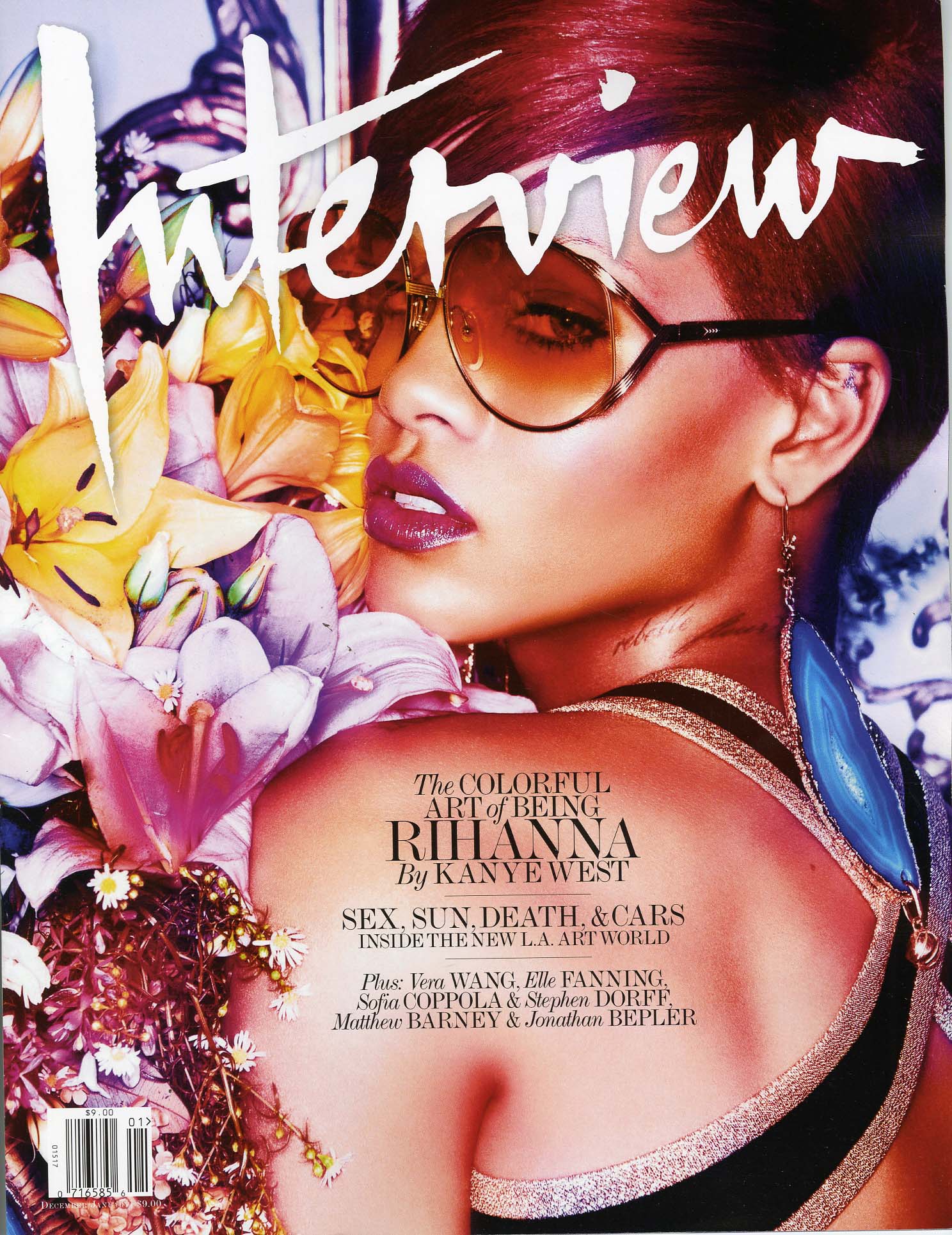
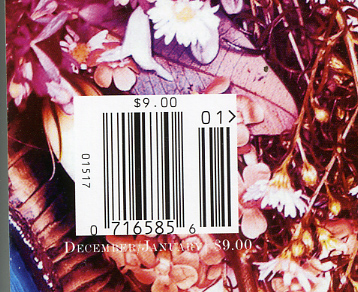
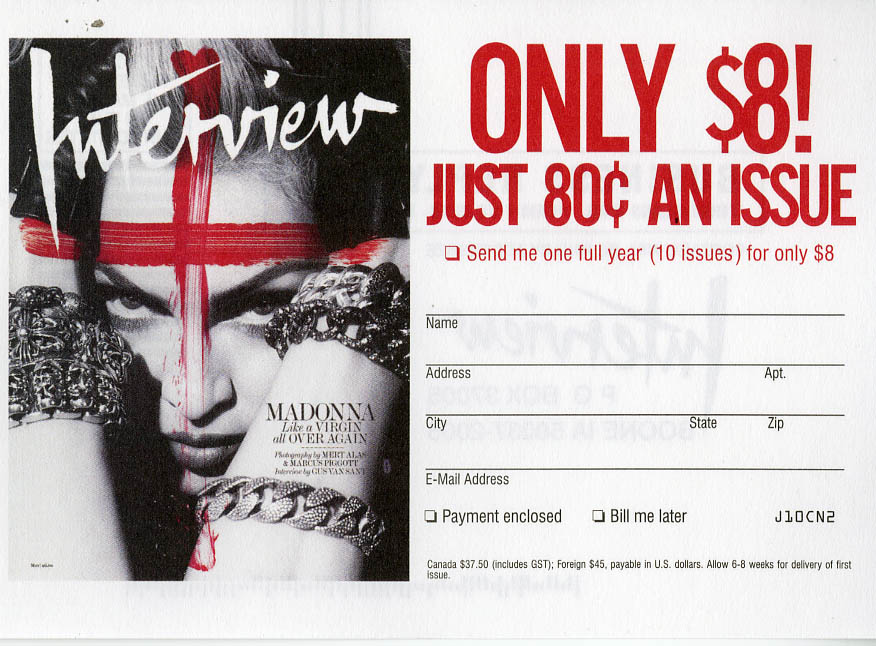
Every now and then, something on the newsstands really makes me shiver. I was doing my morning rounds on the newsstands and picked up a copy of the new issue of Interview magazine. The cover price: $9.00. Not a big surprise. Lately,I have been paying $9.00, $10.00 and $11.00 for single copy issues. However, the minute I opened the magazine the subscription card (the dandruff of our industry, as many like to call the sub. cards) fell to the ground. When I picked it up, it screamed at me, “You stupid Samir, you are going to spend $9.00 for one issue, when you could have received an entire year, 10 issues, for $8.00.”

A year for a price less than a single issue? Is this insanity or what? Next time when you read that the single copy sales are down, please do not blame the distributors or retailers.

Take a look our magazine industry practices and then judge for yourself. By the way, I wish I can say that this is the first time I write about Interview magazine and this practice, but it is not. I have written about it before and will continue to do so until we stop this insane practice of raising the cover price and reducing the subscription price so readers can save more that 90% of the cover price. It is insanity that needs to stop. We have to value the experiences we create, if our readers, users, listeners, viewers, all those so-called customers are to value those experiences. The time has come for our industry to change its old practices. This is NOT the 20th Century, and Interview magazine is NOT alone using this method of pricing for single copy and subscriptions!

h1

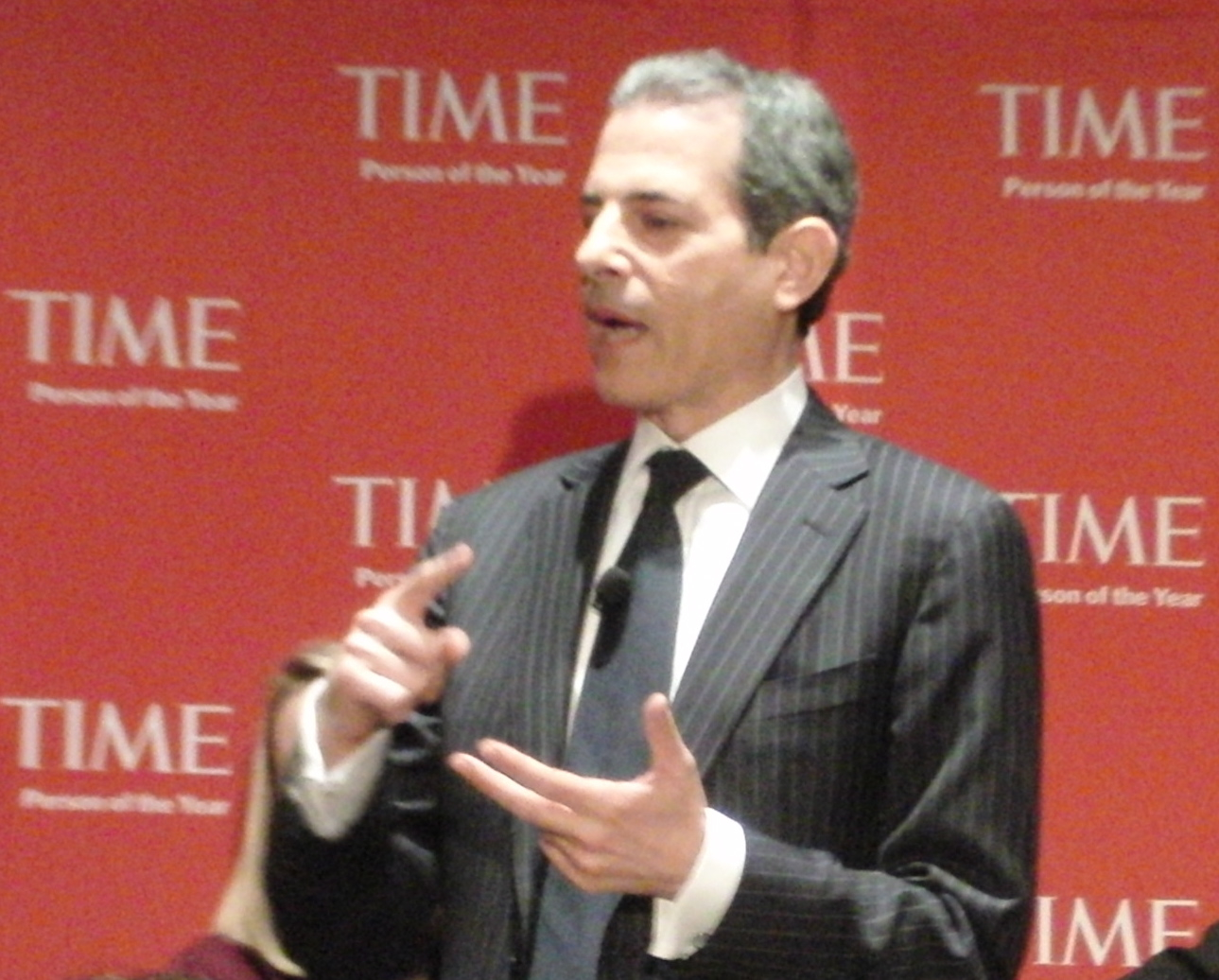
TIME’s Rick Stengel to Mr. Magazine™: That’s Why the TEA Party is NOT the Person of the Year. We Are Creators in Print and Curators Online and Other Words of Wisdom from TIME’s Managing Editor

December 15, 2010

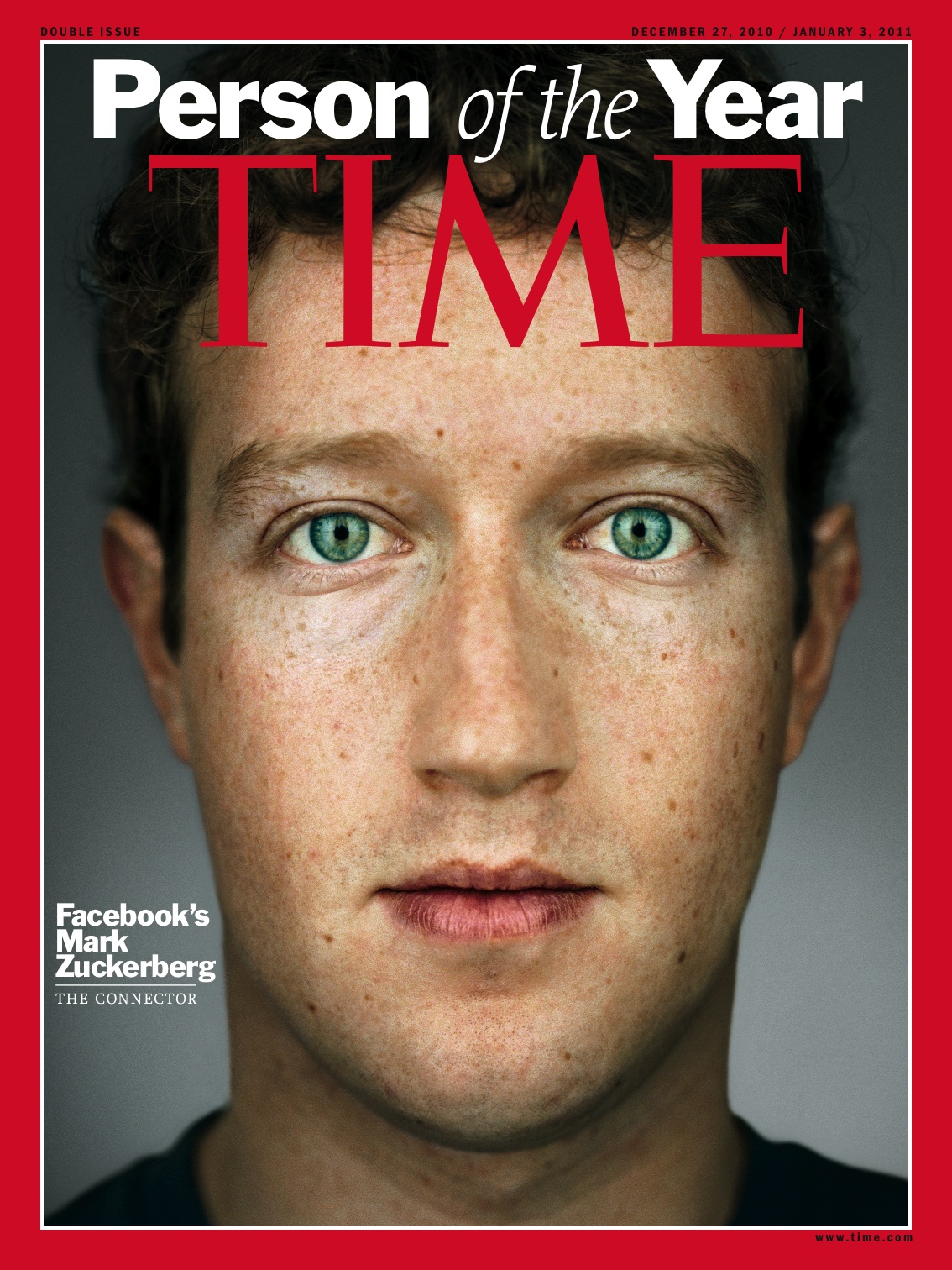
“In print we are creators and online we are curators,” that is the mantra Rick Stengel, managing editor of TIME believes in, and practices every day with his iconic brand TIME. In an exclusive interview with Mr. Magazine™ Mr. Stengel talks about his choice of Mark Zuckerberg as the Person of the Year; the reasons why the TEA Party was not chosen as the POY; the future of print and online; and the status of TIME as an iconic brand.

On whether TIME Person of the Year choices are getting softer and gentler, less controversial, after Sept. 11, 2001:

Last year we had Ben Bernanke, which a lot of people criticized, well they might have disagreed ideologically but I don’t think you could have a more serious newsy choice than the chairman of the Federal Reserve. Some people criticized it because it was dull. Obama was the year before that. Then as you know I did Vladimir Putin, which in some ways is probably the most controversial choice since the Ayatullah because he’s obviously not a good guy, he’s as authoritarian figure. So the answer is NO.
In Mark Zuckerberg’s particular case, what was clear is that Mark Zuckerberg in terms of the effect and the influence he is having across the globe, about to have six hundred million users on Facebook, is really historic in it’s reach and breath and I think something quite amazing is going on. I though a lot about Julian Assange, and as you know I interviewed him a couple of weeks ago, but in terms of the long-term in terms of greater effects, in terms of something that touches people’s lives everyday, Mark Zuckerberg seemed to me the clear choice.


On why the TEA Party was not selected as the POY:

There are a few reasons. First of all, our choice is an international choice. We have an international audience where we have readers all over the planet and so I’m always looking for something that is global in its influence. I’m not saying the TEA Party didn’t have some global influence, it really was an extraordinary year for the TEA Party. I’m biased in favor of choosing a person for the Person of the Year. We had gotten away from that. You know, there were a number of years in a row where it was a group, where it was Mr. and Mrs. Gates, and Bono, or the Whistle-Blowers, or the American soldier. I think people like to have a person to be the Person of the Year. Part of the problem for choosing the TEA Party was that it was really impossible to choose one person who is representative of the TEA Party. I think had we done that, no matter whom that person was, it wouldn’t necessarily have felt representative of what the TEA Party accomplished this past year. Another thing about the Tea Party, of course, is by design it doesn’t have a singular leader, it doesn’t have a centralized leadership and that makes it harder to choose a single person.

On the iconic status of TIME and its place in the media world today:

In this crazy media environment, great brands, iconic brands like TIME actually will thrive, provided you’re creating and continuing to create great content. One of the things we’ve done in the last few years is actually made the magazine newsier, more serious, more thoughtful about everything that is going on. That has made us even stronger in the marketplace and stronger in people’s loyalties. We’ve been growing in really every segment of our business. I also think that given this fractured, itemized media environment, people are looking for brands that they can trust and our trust meter continues to go up.

On being a creator and a curator of information:

We’re on every different platform there is and different platforms need different strategies and you want to do what is appropriate for each platform. We do more curation online than we do in print. To me the print product is also the place for original reporting and long-form journalism. Curation happens online, it happens on our iPad app. were we, for example, curate the best pictures of the week. I think you have to do what is appropriate to each medium and I also think, again, that one of the reasons people feel faithful to TIME is that we do a lot of original content and we do it with historical perspective and our actual expertise.

On the future, destruction and creativity

Well, even during the bad period, I always thought it’s an incredibly rich period for media. There are certain forms of media that it wasn’t good for. But, in terms of the amount of content that is being consumed, people are reading and watching and seeing as much news more than ever in the history of the media as they are now. I actually think it’s a great time in media. It’s just a difficult time for certain parts of old media. I’m optimistic and feel like it’s really a time of great creativity, you know destruction and creativity go together, but I see us moving ahead even more in a creative and fruitful direction.