Archive for the ‘News and Views’ Category

h1

Gone “Magazine” Fishin’ with Ned Desmond, President and Founder of GoSPORTn, GoFISHn and GoHUNTn. The Mr. Magazine™ Interview with the former President of Time Inc. Interactive on His Entrepreneurial New Ventures in the Digital World.

April 25, 2012

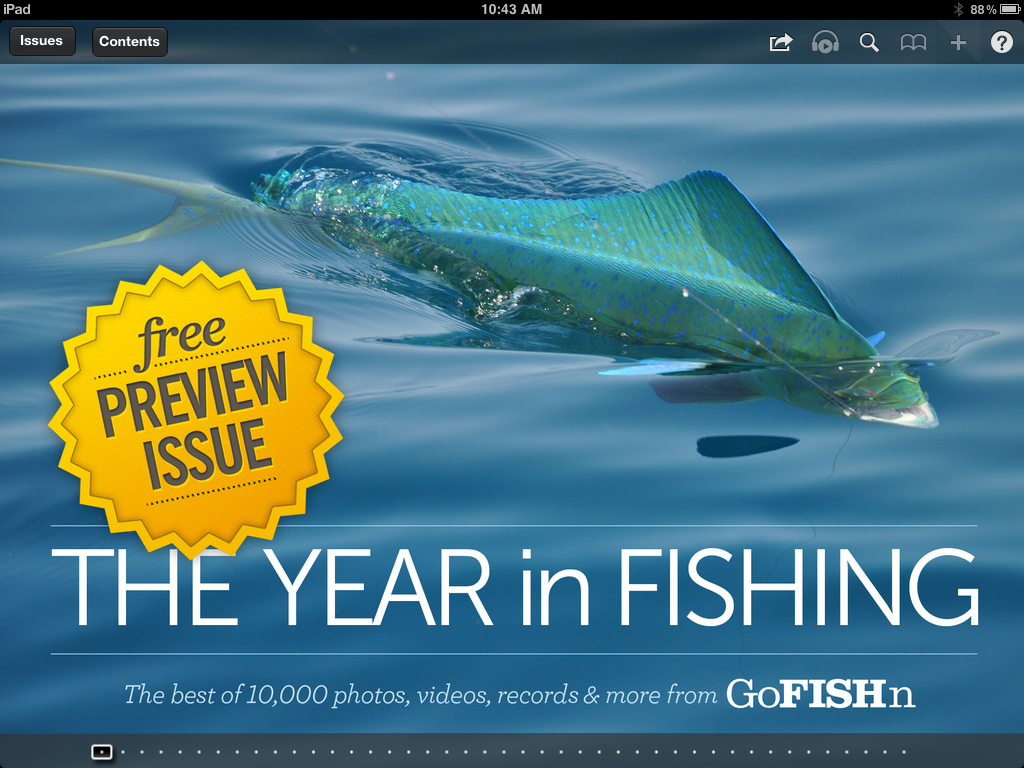
Before he founded GoSPORTn Inc. and hooked us with “The Year in Fishing” via GoFISHn’s new iPad magazine app, Ned Desmond was the head of Time Inc. Interactive, and also served as TIME magazine’s bureau chief in both Tokyo (’92-’96) and New Delhi (’88-’91), while wearing the hats of writer and researcher before that. He is a man who is grounded in print, but who became a digital enthusiast as the future of journalism began to take an exciting turn. Now he enjoys indulging his readers’ passion for hunting and fishing as president and founder of GoSPORTn and lives in the realms of the web whole-heartedly, while never relinquishing his love for the printed page. Find out what he thinks about the future of journalism, his thoughts on launching a digital-only enterprise, and of course, what keeps him up at night, in this segment of the Mr. Magazine™ Interviews.

And as is with every Mr. Magazine™ Interviews, first the video, followed by the sound-bites and the very lightly edited transcript of the entire interview.

So sit back, relax and watch the video interview, done via Skype, with Ned Desmond.

And now for the sound-bites:

On the difference between launching something that is digital only, versus using print as your web base: Well, I think when you have a big, established print business and editorial team and sales team; you have a lot to work with when you’re trying to develop an online property.

On how you make your brand’s app stand out from a million others:
Well, that’s the hardest question of all. You can create something really beautiful and it’s difficult to get attention.

On the advantages and disadvantages of creating an online presence on your own, versus when you have a mega brand behind you:
The advantages and disadvantages are pretty stark, I’d have to say. When you are a big company, of course, you have lots of help and you have an enormous, established base in everything, on the sales front, people return your calls, on the editorial front, you have very talented teams who are busy doing great work, on the brand front, you’re out there and consumers know who you are.

On why he picked hunting and fishing as his main focus for Go SPORTn:
When we were looking at the categories, we discovered that fishing, in particular, is the largest of all the enthusiast’s categories. There’s nothing that quite compares to it, in terms of the number of people who go fishing in the United States.

On his most pleasurable moment with Go SPORTn:
I would say the pleasurable moments come every few days when we discover some content in the fishing world or in the hunting world that is truly exciting, that has been uploaded by somebody who is an amateur, and all it really needs is exposure to a big audience and it takes off and you can see it go viral.

On the biggest hurdle he has to overcome to make Go SPORTn a success:
Well, I’d say that we’ve been a success from a brand standpoint, and we are successful from an audience standpoint, but trying to match the audience scale to the available ad dollars is very tricky.
And now the lightly edited transcript of the interview with Ned Desmond:

Samir Husni: You know, you spent so many years trying to develop some kind of a business model that integrated the print brand and digital. Now you are at this venture, which is digital only. What’s the difference between launching something that is digital only, and using print as the base to launch something?

Ned Desmond: Well, I think when you have a big, established print business and editorial team and sales team; you have a lot to work with when you’re trying to develop an online property. There is always a lot of, what we called, untapped assets, undiscovered assets that could be re-deployed for use on the web. One of the great examples at Time Inc. was how we used the People Magazine editorial team, the correspondence, in particular, to develop a breaking news product for the website, which didn’t have any relevance in the magazine, but was enormously successful online. When you’re starting from scratch, as we did with GoFISHn, you’ve got to think about how to create content and create it in an economical fashion, so that it’s in line with the economics of an ad-supported business online, which, as you know, are pretty demanding.

Samir Husni: One of the things that I always wondered about; if we have around 10,000 different magazines on the marketplace, there is probably now a billion apps available.

Ned Desmond: Probably.

Samir Husni: How can you break through that clutter, how can people find GoSPORTn or GoFISHn apps, from the gazillion number of apps that are out there?

Ned Desmond: Well, that’s the hardest question of all. You can create something really beautiful and it’s difficult to get attention. What we do is use our available distribution mechanisms to get the word around about the app that we created. What we did, essentially, was take the best of 10,000 posts that took place in 2011 on the GoFISHn website, that’s gofishn.com, and turned them into quite a beautiful app that has a magazine-like experience and we used all the folks whose content we included to help us promote the app, and we also used our Facebook presence which has nearly 200,000 fans to promote the app, and then we reached out to anyone we knew to download it, review it, to help us get the word out. But I’d say that we’re still in an experimental mode. We got some pretty strong initial response, we think we may have priced it a little bit too high; pricing is another function that seems to have a pretty dramatic impact on how widely-used your app might be. So, it’s tricky. It’s something that you really have to think about ahead of time. If you don’t have strong distribution ideas or vehicles, it’s really tough to get the word out.

Samir Husni: So, you’ve done it when you were a part of a major media company, and now you’re doing it on your own.

Ned Desmond: Yes.

Samir Husni: What are the advantages and disadvantages of both models?

Ned Desmond: The advantages and disadvantages are pretty stark, I’d have to say. When you are a big company, of course, you have lots of help and you have an enormous, established base in everything, on the sales front, people return your calls, on the editorial front, you have very talented teams who are busy doing great work, on the brand front, you’re out there and consumers know who you are. When you’re running a little business, like I am, all of those things go back to zero, basically. You only have the staff that you can afford, which, in my case, is almost nobody. The brand is something you still have to establish and all of those other things have to be built from scratch. So, it’s far more demanding from a kind of building standpoint. But, it’s also far easier from a coordination and communication standpoint; you don’t really have that many people to stay in touch with. Whereas, in a big company, like Time Inc., you have to reserve an enormous amount of time for feedback and explaining your plans, and making sure everybody is on board and is ready to support you.

Samir Husni: Why did you pick fishing and hunting? Your background as a journalist and the magazines that you’ve worked with, they’re as far from fishing and hunting as can be.

Ned Desmond: That’s a great question, Samir. I chose it because when I was at Time Inc. and my team was working across a lot of different properties and trying to figure out where the hidden assets were that could help revive or supplement the print businesses, and for a time we worked on some of the properties which were, at that time, in what was called the Time for Media Division of Time Inc., which included a lot of outdoor enthusiast titles, everything from snowboarding, to hunting and fishing, and all the rest. And the key insight that we had there was that user-supplied media, whether it was somebody skateboarding and making a video of it, or surfing and making a video of it, which has become a mainstay of those brands in recent years, that that was really the key to unlocking a lot of value within those brands. In other words, if you read Field & Stream, or if you read Surf, or if you read Skateboard Magazine, you wanted to be able to contribute your own exploits to that audience. We sold those properties to Bonnier. Bonnier has prospered with them; they’ve done really, really well. When I left, I thought it would be really interesting to try to build a publishing platform that would allow those enthusiasts, regardless of the category, to publish their pictures, their video and their stories. And then when we were looking at the categories, we discovered that fishing, in particular, is the largest of all the enthusiast’s categories. There’s nothing that quite compares to it, in terms of the number of people who go fishing in the United States. It was a little bit of a surprising insight for us because being Urbanites, more or less, we didn’t appreciate the depth of the passion for fishing that exists across the country, or the large numbers, or the significant amounts of money that gets spent in pursuit of fishing. So, we thought, why not begin in the biggest market? And that’s why we chose that. The platform we actually built was meant to extend into many categories, which is why it was easy to take into hunting, which has close affinities with fishing, that’s why we chose hunting. And then we stopped there in order to husband our resources and not get stretched too thin. But the plan was probably to go from there to gardening and some other arenas. So the real answer to your question is we thought that in the enthusiast’s publishing categories there was quite a big opportunity focused on media created by the enthusiast themselves.

Samir Husni: What has been the most pleasurable moment in this whole experience, in this whole creation of the app and the website?

Ned Desmond: I would say the pleasurable moments come every few days when we discover some content in the fishing world or in the hunting world that is truly exciting, that has been uploaded by somebody who is an amateur, and all it really needs is exposure to a big audience and it takes off and you can see it go viral, with hundreds, sometimes even thousands of ‘likes’ from Facebook and a lot of traffic in our traffic numbers. We really created these sites with the insight that amateurs in the enthusiast’s categories today are generating and posting most of the best content out there. So, our real goal is to get them big audiences and to create a media experience on the back of that.

Samir Husni: And what about the flip side of that? What was the biggest nightmare you had to face?

Ned Desmond: Well, there were plenty of nightmares. We, for instance, thought it would take us six months to develop the site, and it took us more like eighteen months, of course. We’ve had a number of big deals that we thought we were very close to signing and those deals didn’t materialize. There are lots of disappointments along the way; a lot of them are technical, just associated with trying to get things done that proved to either be too costly or unattainable. I have a business partner who is a terrific technologist and without his help we wouldn’t have gotten very far. But there are still a lot of challenges on the technical front. I would also say that one of the most surprising dimensions of this is getting people in the categories, the big brands and the categories, who were the likely advertisers, to participate. But what I have discovered is that in fishing and hunting, and this is one thing I really wasn’t prepared for, the businesses themselves are in pretty tough shape, and they aren’t all that keen on advertising in the digital realm. So, I brought some assumptions with me that I learned from the consumer product goods arena in mainstream publications, places like People and Time, and all the usual Time, Inc. titles, where the appetite was pretty strong among advertisers to participate on the digital side. And I would say, in some of these more specialized categories, that appetite isn’t so strong.

Samir Husni: What is your biggest hurdle now that you have to overcome to make this a success?

Ned Desmond: Well, I’d say that we’ve been a success from a brand standpoint, and we are successful from an audience standpoint, but trying to match the audience scale to the available ad dollars is very tricky. In that sense, we’re not any different from any other media business, any free ad supported media business online. The world that Google has created for us is so efficient, if that’s the right word, from an ad buyer’s perspective, that the return to the publishers is really pennies, where in other worlds, in other types of media, the returns were more like dollars. So scaling is a very, very big chore. If you’re going to get significant revenue out of the website, you have to hit very big audience numbers, or else figure out how to sell premium advertising. It’s a bit of a catch-22; if you make the investment to try and sell premium advertising, then you’ve taken your cost base up pretty far. The alternative is to figure out how to drive your audience through the roof, which is a function of time and improved Google page rank, and other things that are difficult to control, or to wait out in the event of time. So that’s sort of the conundrum. It’s the same, I think, that a lot of online publisher’s face.

Samir Husni: I’m going to take you back some years in your career, you were a journalist, a foreign correspondent, you worked in writing; how’s today different than those early years when you were active in the field, actually reporting, writing and doing the work of a journalist?

Ned Desmond: I was at the tail-end of the sort of traditional era of the foreign correspondent. So when I went overseas for Time Magazine we still had pretty big bureaus that were well-staffed, and they were well-staffed for a reason, it was difficult to just use the phone. I can remember when I was in the New Delhi bureau, we had a couple of young men who did nothing but dial the phone all day, just trying to get through because it was that time-consuming. And today, of course, that’s not an issue. I can remember my hands aching from using manual telexes in places like Kabul, where even if it was well-oiled, it was still very arduous to pound out a long, yellow tape that would eventually send your telex where it was going with your file back to headquarters in New York. And then near the end of that tour, I remember using some of the early laptop computers with a bulky modem that would actually transfer over the phone lines at a rate of 300 baud, which meant that it basically took an hour sometimes to send a whole file over the phone lines, but that was pretty revolutionary. Of course today correspondents and photographers, in particular, have it so much easier than they used to. They don’t have to get back to an airport and ship film and things like that. And correspondents generally can find whatever telecommunications hook-up that they need, even if they go direct to satellite with a local piece of equipment. So, from that standpoint everything is much more immediate. But I also think that for a lot of foreign correspondents, they probably don’t have as much help as they used to, the budgets are so much smaller than they once were and, of course, they’re much thinner on the ground than they used to be, which is really a shame because, I think, readers suffer terribly as a consequence. By the same token, most of the big news organizations, I think, do a pretty heroic and determined job of getting people where they need to be and trying to support them. So a lot has changed, but I think that the core commitment, but maybe with somewhat reduced budgets, is still there trying to get the good stories overseas.

Samir Husni: How do you see the future of journalism today?

Ned Desmond: That’s a really interesting question. I think that the demands on full-time professional journalists are tougher than ever. I think that because the ability of audiences to respond, and even compete with journalists is so easy to pursue. In other words, anyone can start a blog, anyone can post on Facebook and anyone can come up with better information if they put their minds to it. So journalists, in one sense, are more accountable because their audience can respond to them so much more quickly, and challenge them if need be. I don’t think that’s a bad thing, but it definitely makes a journalist’s job tougher. I think that the real problem for journalists is that the business model that made their work possible, obviously, is under siege. And the resources available to hire correspondents, to train them, to help develop their careers, to position them in foreign bureaus, or even domestic bureaus, those resources are diminished and, as a result, there are fewer working journalists. There’s less coverage and less competition and that’s really unfortunate. And I hope very much that there are business models that emerge that allow for a return of the numbers of journalists who have good, solid careers and good paychecks working for, whether it’s the new breed of organization, like Politico, or whether it’s revived daily newspapers and magazines, or whether it’s the big guys like Thomson Reuters or Bloomberg, who are going to continue to produce the independent journalism that I think the country and the world really depend upon. But I’d say it’s not really clear how that is going to happen at this juncture.

Samir Husni: What keeps Ned up at night?

Ned Desmond: What keeps Ned up at night? What keeps Ned up at night is this conundrum that I mentioned earlier. How do you scale fast enough to derive meaningful revenue from the websites? That’s really the toughest problem for online media folks.

Samir Husni: Is there anything else you’d like to add, or any question that I failed to ask you?

Ned Desmond: Well, I would like to mention our efforts with the app. I think they may be a little bit early for the marketplace. But I do think that the ability to take content from a website, which tends to be formatted in the way that is appropriate for websites. But it’s less beautiful, considerably less beautiful, and appealing than what you can do in a tablet, or in a mobile app. That is a very interesting pivot, if you will, or cut for a media business. I’ve really enjoyed creating “The Year in Fishing” app for the iPad because it felt so much more like a beautifully designed approach to the subject matter. And readers still respond so nicely to things that are beautifully designed. And it’s tough, as all content creators know, to do something that’s really beautiful in a browser because you end up being so concerned about other things: the performance of the page, the SEO, the navigation; all these things that tend to mitigate the pure delight of the experience. All that can come back again when you do it in an app. The simple flick of a finger and you turn the page. Every page can be packed with things that are really 100% about the visual design experience. So we’ve been really delighted by how people have responded to the app. We hope that advertisers will see the same possibilities that we see and support that in the future. We got a little bit of advertising support and we got a lot of interest. But there’s a lot of wait and see, as well. So I think that contrast between what you can really do to delight people in a browser versus in an app, is a pretty critical distinction. And I think it’s going to really serve content-makers in the future. Assuming we can get discovered at all, to your question, Samir. There’s an awful lot of content out there.

Samir Husni: So are you out of the print business?

Ned Desmond: I would say that I am out of the print business, yes, absolutely, until I am back into it. I’m a great believer in print. I just think that print in the future will have to be evermore beautiful and compelling, in order to be worthy of consumer’s attention. So I think that we can already see this… that magazines that really thrive as magazines that are beautiful, as magazines that really are perfect expressions of what the magazine designing art is all about; they are doing just fine. And consumers still want them and advertisers still want them. And a lot of other things that was just information tucked into the pages of a magazine because a distribution model or something else could support it as a good business, those have already, or will soon, fall by the wayside. And of course, digital will take up the slack. So I think that distinction will be there for a long time to come.

Samir Husni: Thank you.
h1

Innovation in Print: A B2Me Magazine… The Interactive One on One Printed Magazine. The Mr. Magazine™ Interview with American Printer magazine publisher Andy Plata

April 23, 2012

Magazines, successful ones, are much more than good content. The future of magazines is in the experiences a magazine can create with its audience. The more individualized the experience, the better the odds of making it. So, what if you create a magazine with YOU or Your Company specifically in mind and also have the capability to show me your creation in ink on paper. Not just in some ink-jet personalization of a cover or an inside page, but rather with a seamless integration of your name, the name of your company, the selection of the articles all combined in one issue mailed right to you with YOU as the bull’s eye of the dart board and the center of gravity for the entire issue.

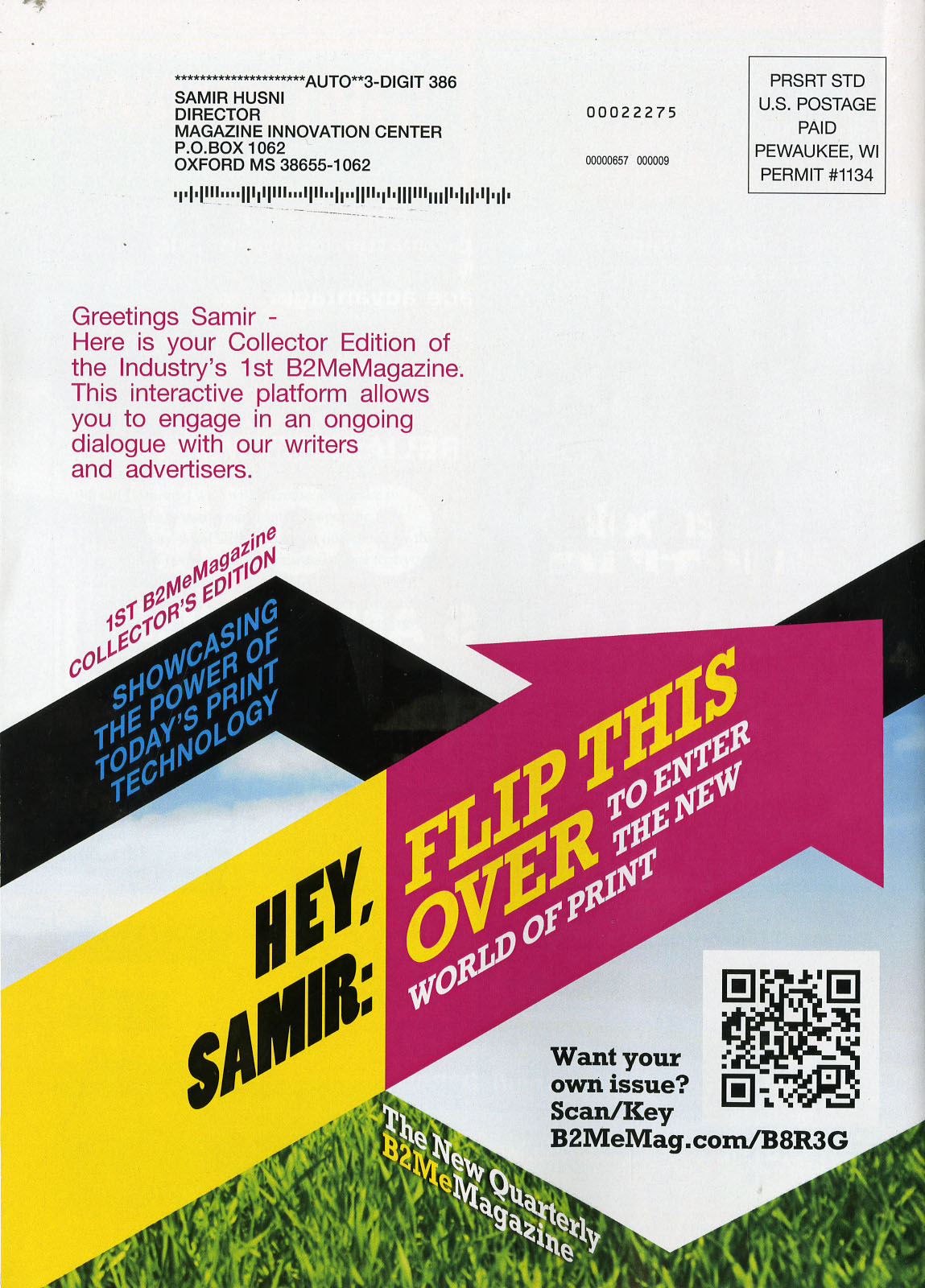
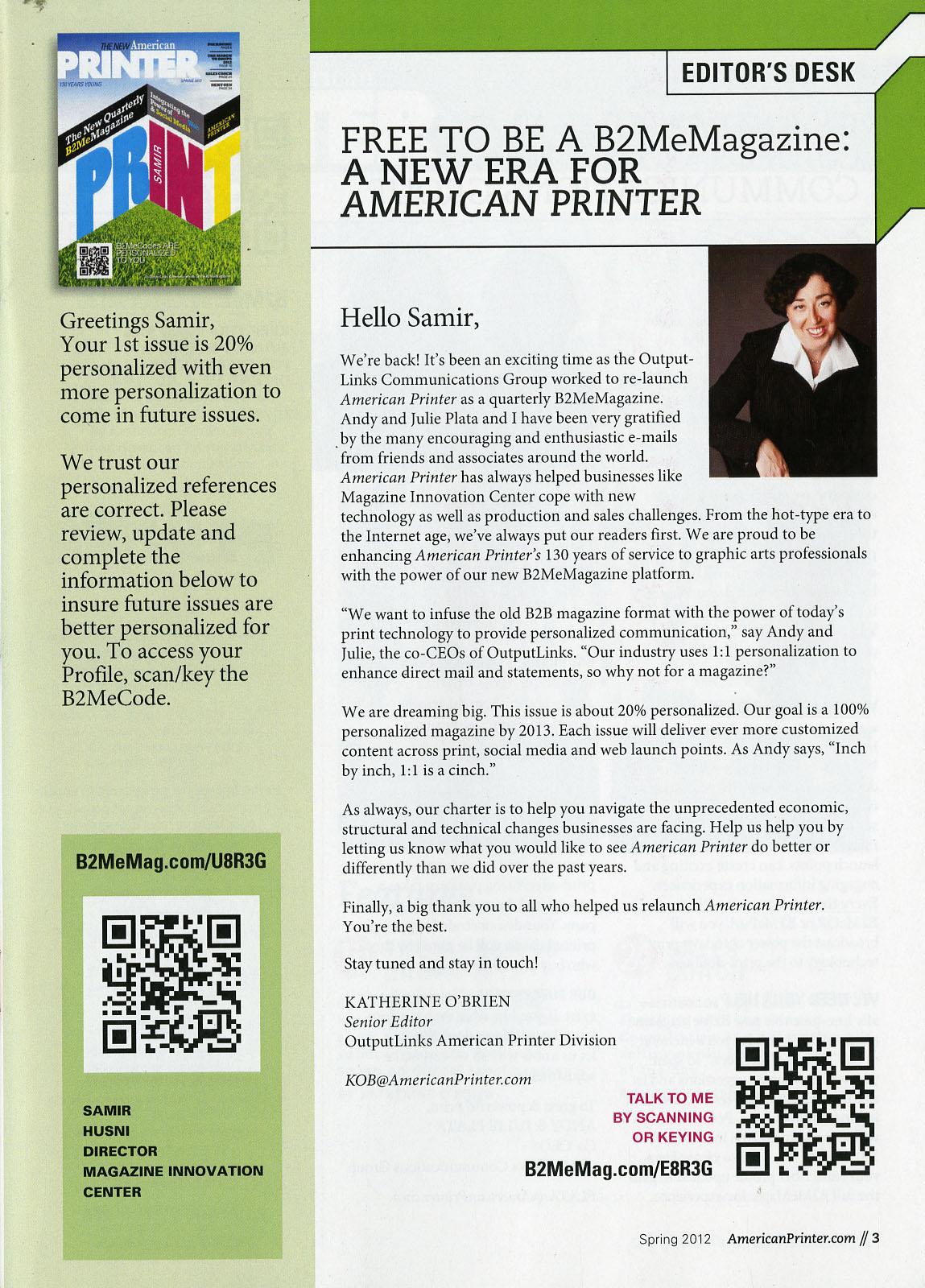
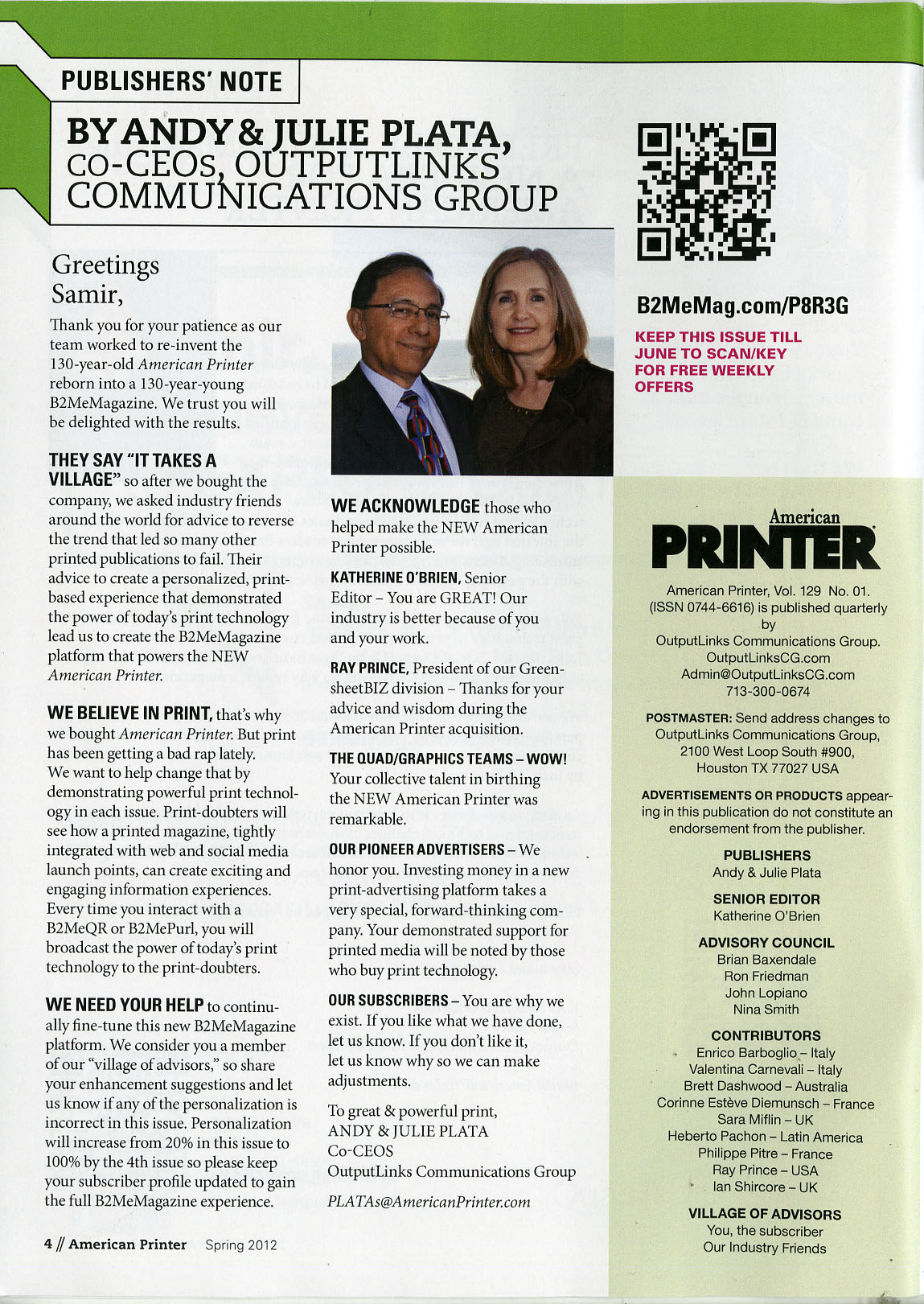
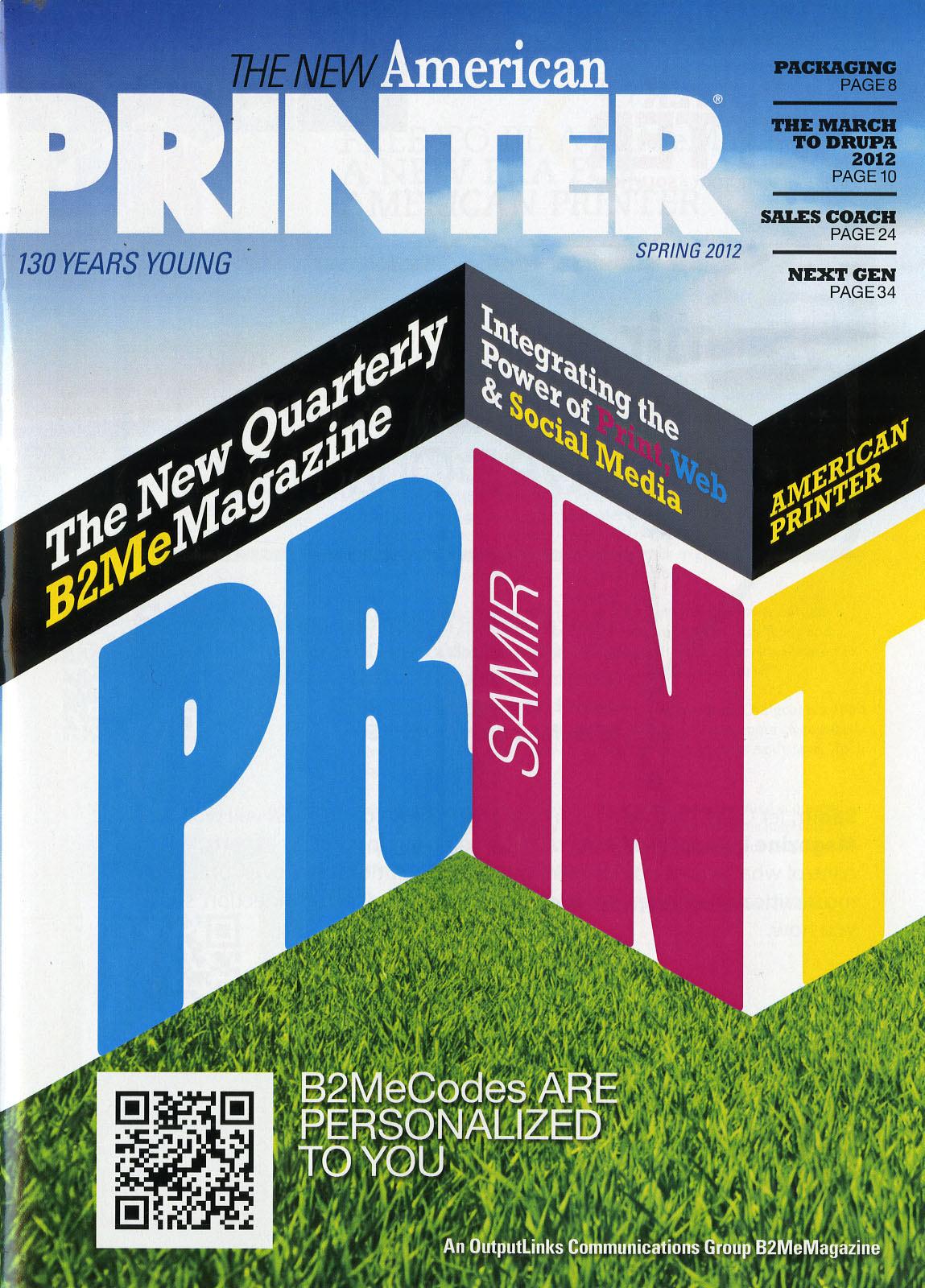
Well, that’s what Andy and Julie Plata have created as they relaunched American Printer magazine this month. They were on a mission to create the first B2MeMagazine–the first business to me rather than business to business magazine. They wanted to personalize the magazine, exactly like they have personalized direct mail campaigns, and they wanted to do it in print. “A B2MeMagazine is a ‘Business to Me Magazine’ that is created specifically for the individual subscriber. Articles and ads are dynamically generated at time of print in accordance to the subscriber’s demographic profile.”

My first copy arrived and to say that I was impressed will be an understatement. My name and the name of the Magazine Innovation Center were there, on the cover, on the back cover, in some of the ads and also in some of the editorial pages. Nothing out of the ordinary, just a seamless unpretentious mention of my name and the Magazine Innovation Center. The examples, following my interview with Mr. Plata, speak volumes of the innovative ways of enhancing and personalizing print in this digital age.

I reached out to Andy Plata, the co-publisher of the magazine, and asked him a few questions regarding this personalized venture in innovation in print, aptly in a magazine devoted and aimed at American Printers and named American Printer:

Samir Husni: What is the genesis of the idea behind the B2MeMagazine?

Andy Plata: We wanted American Printer to be born again for renewed life after we purchased it in September after it had been shut down by Penton Corporation in August. As we investigated the best way to accomplish this objective we developed the B2MeMagazine platform to provide the 130 year old American Printer and other subscriber-based publications with a 1:1 personalized platform that would provide the multimedia interactivity that today’s readers seemed to expect.

SH: Do you expect this concept to take hold in the magazine business?
AP: Yes. It just makes sense that it will. We have personalized computer screens, personalized TV and radio programming, personalized … so of course people should and will expect personalized magazines. And the good business people who publish magazines will provide their readers what they expect – a personalized magazine experience.

SH: Your relaunch issue have 20% personalized content with the promise that it will 100% by 2013… What is your plan to create a fully personalized magazine?

AP: We could produce a 100% personalized magazine right now but we chose to take a crawl/walk/run/fly approach instead. The reason is that B2MeAds™ require tight integration of subscriber database information to dynamically generate individualized content and graphic elements for each subscriber. This is a new concept for many of the designers and agencies who produce the corporate ads. So we decided to take time to help the creatives understand how best to support this exciting personalized 1:1 platform. They say it takes a village …

SH: American Printer now integrates the power of print, web and social media all in one… can you explain this concept and how it will amplify the future of print?

AP: The effectiveness of any kind of communication experience is increased by enhancing the richness of the communication. American Printer enhances the magazine reading experience through the B2MeMagazine platform. The platform provides subscribers a tactile print-magazine experience integrated with mobile and web experiences all via the personalized immediacy of B2MeCode™ launch points that include QR, Purl and other pattern-recognition. The future of print technology will be defined by how effectively printers seamlessly integrate current and future communications technology onto printed pages to provide the best communication platforms for their clients’ desired messages. American Printer’s endeavors to have its subscriber base of printers experience the future of print in each issue of the magazine.
SH: Thank you.

h1

The Power of Print: Enjoy The Journey

March 27, 2012

A spoken poem, in sound and picture, captivates the power of print. Released by InkGlobal in the United Kingdom The Journey is a must see. Enjoy the “Spoken poem; print is not dying. Produced by Ink, written and directed by David Bowden @ The Garden Studios.” Thank you Simon for sharing.

h1

Size Does Matter… and Shape, Weight and Volume… My Latest Publishing Executive magazine column

March 18, 2012

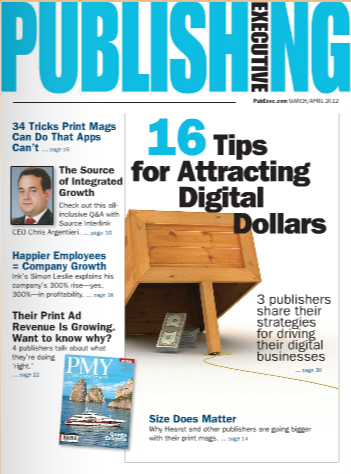
My latest column from the March/April issue of Publishing Executive magazine… Enjoy and Comment!


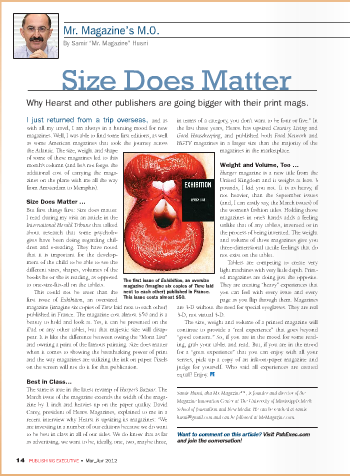
Mr. Magazine’s M.O. : Size Does Matter
Why Hearst and other publishers are going bigger with their print mags.
March 2012 By Samir “Mr. Magazine” Husni

I just returned from a trip overseas, and as with all my travel, I am always in a hunting mood for new magazines. Well, I was able to find some first editions, as well as some American magazines that took the journey across the Atlantic. The size, weight and shape of some of these magazines led to this month’s column (and let’s not forget the additional cost of carrying the magazines on the plane with me all the way from Amsterdam to Memphis).

Size Does Matter …

But first things first: Size does matter. I read during my visit an article in the International Herald Tribune that talked about research that some psychologists have been doing regarding children and e-reading. They have noted that it is important for the development of the child to be able to see the different sizes, shapes, volumes of the books he or she is reading, as opposed to one-size-fits-all on the tablets.

This could not be truer than the first issue of Exhibition, an oversized magazine (imagine six copies of Time laid next to each other) published in France. The magazine cost almost $50 and is a beauty to hold and look at. Yes, it can be presented on the iPad or any other tablet, but that majestic size will disappear. It is like the difference between owning the “Mona Lisa” and owning a print of the famous painting. Size does matter when it comes to showing the breathtaking power of print and the way magazines are utilizing the ink on paper. Pixels on the screen will not do it for that publication.

Best in Class…

The same is true in the latest revamp of Harper’s Bazaar. The March issue of the magazine extends the width of the magazine by 1 inch and heavies up on the paper quality. David Carey, president of Hearst Magazines, explained to me in a recent interview why Hearst is upsizing its magazines: “We are investing in a number of our editions because we do want to be best in class in all of our titles. We do know that as far as advertising, we want to be, ideally, one, two, maybe three; in terms of a category, you don’t want to be four or five.” In the last three years, Hearst has upsized Country Living and Good Housekeeping, and published both Food Network and HGTV magazines in a larger size than the majority of the magazines in the marketplace.

Weight and Volume, Too …

Hunger magazine is a new title from the United Kingdom and it weighs at least 3 pounds, I kid you not. It is as heavy, if not heavier, than the September issues (and, I can easily say, the March issues) of the women’s fashion titles. Holding those magazines in one’s hands adds a feeling unlike any on a tablet, invented or in the process of being invented. The weight and volume of those magazines give you three-dimensional tactile feelings that do not exist on the tablet.

Tablets are competing to create very light machines with very little depth. Printed magazines are doing just the opposite. They are creating “heavy” experiences that you can feel with every issue and every page as you flip through them. Magazines are 3-D without the need for special eyeglasses. They are real 3-D, not virtual 3-D.

The size, weight and volume of a printed magazine will continue to provide a “real experience” that goes beyond “good content.” So, if you are in the mood for some reading, grab your tablet and read. But, if you are in the mood for a “great experience” that you can enjoy with all your senses, pick up a copy of an ink-on-paper magazine and judge for yourself. Who said all experiences are created equal? Enjoy. PE

For other columns and articles from Publishing Executive magazine and website click here.

h1

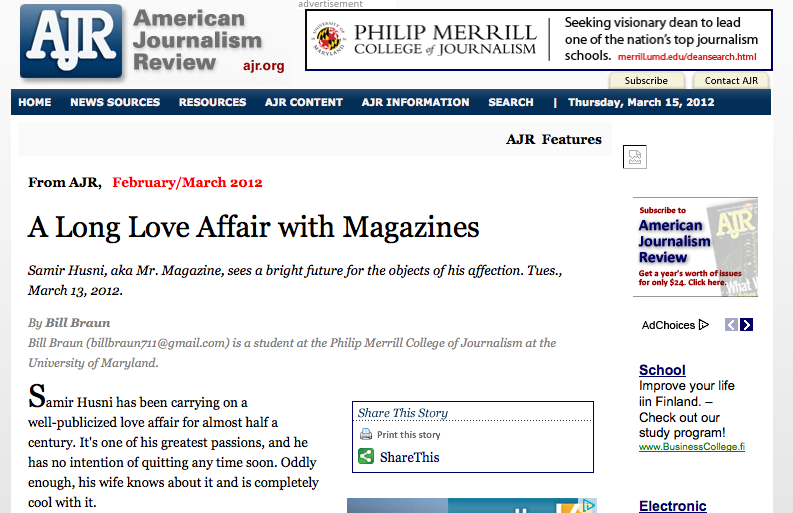
A Long Love Affair With Magazines: The American Journalism Review Profile on Mr. Magazine™

March 15, 2012

In celebration of my half century love affair with magazines, the American Journalism Review publication ran a profile on me on March 13, 2011. Here are the first two paragraphs:

Samir Husni has been carrying on a well-publicized love affair for almost half a century. It’s one of his greatest passions, and he has no intention of quitting any time soon. Oddly enough, his wife knows about it and is completely cool with it.

Husni, 59, is widely regarded as the United States’ leading authority on magazines. So much so that he has officially trademarked his nickname, “Mr. Magazine.”

To read the entire profile click here.

h1

My Love Affair with Magazines Turns 50… Love and Magazines, Both Eternal

March 12, 2012

The more magazines change, the more they remain the same. Fifty years ago I started on this journey that began as a hobby of buying and collecting first editions. It turned into an education that culminated in a Ph.D. in journalism and ended as a never-ending life-time profession of magazine education and consulting.

From the first time I bought a magazine at the ripe age of 9, I fell in love. I felt, all of sudden, that all the stories that my father and grandfather used to tell were captured in the palms of my hands. I was in control of the story. I had the story, the whole story, under my control. I was no longer dependent on my dad or my granddad to start or finish a story. It was there. Every page I turned made the experience of knowing the story and controlling its pace even more exceptional. The more I got hooked into the story the faster I was turning the pages. It was unlike any experience I have ever had with stories and story telling.

The first time I felt the pages, read the stories, and had the power to control both (flipping the pages and the pacing of the stories), I was hooked. I had never experienced anything like it. I was addicted. Needless to say that there was no way on earth, 50 years ago, I would have been able to define a magazine as an “experience maker” rather than a “content provider”; but now, after all these years, it is all clear to me. I can explain my addiction. I can explain my love affair. I can explain why I say that the more magazines change the more they stay the same. Magazines are much more than content providers; they are experience makers.

My hobby of collecting first issues that began 50 years ago turned into an education of studying those first issues and a profession of teaching and consulting on magazines. My hobby is still going strong, better yet, stronger than ever. My love of magazines is still as powerful as that very first love that I felt when I bought my very first issue in my hometown of Tripoli, Lebanon. Little did I know that there was no turning back.

What I’ve learned over the past 50 years is one thing that I know for sure: my love for those experience makers called magazines is forever.

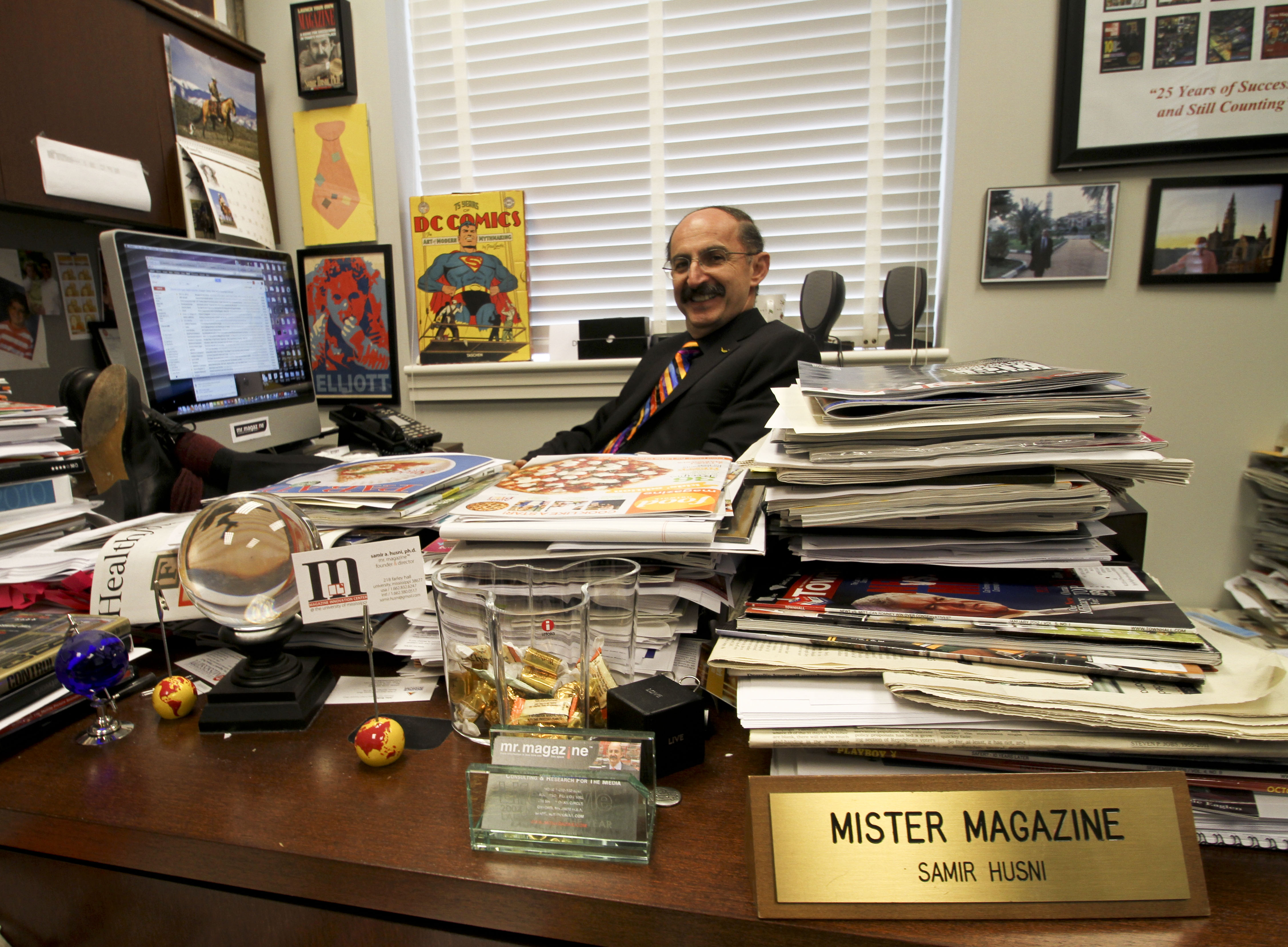
Photo by Mark K. Dolan, taken on my birthday March 8 in my office at the Meek School of Journalism and New Media.

h1

Garden & Gun’s editor-in-chief David DiBenedetto to Samir Husni: We Are Not in the Business of Bashing Other Magazines…

March 1, 2012

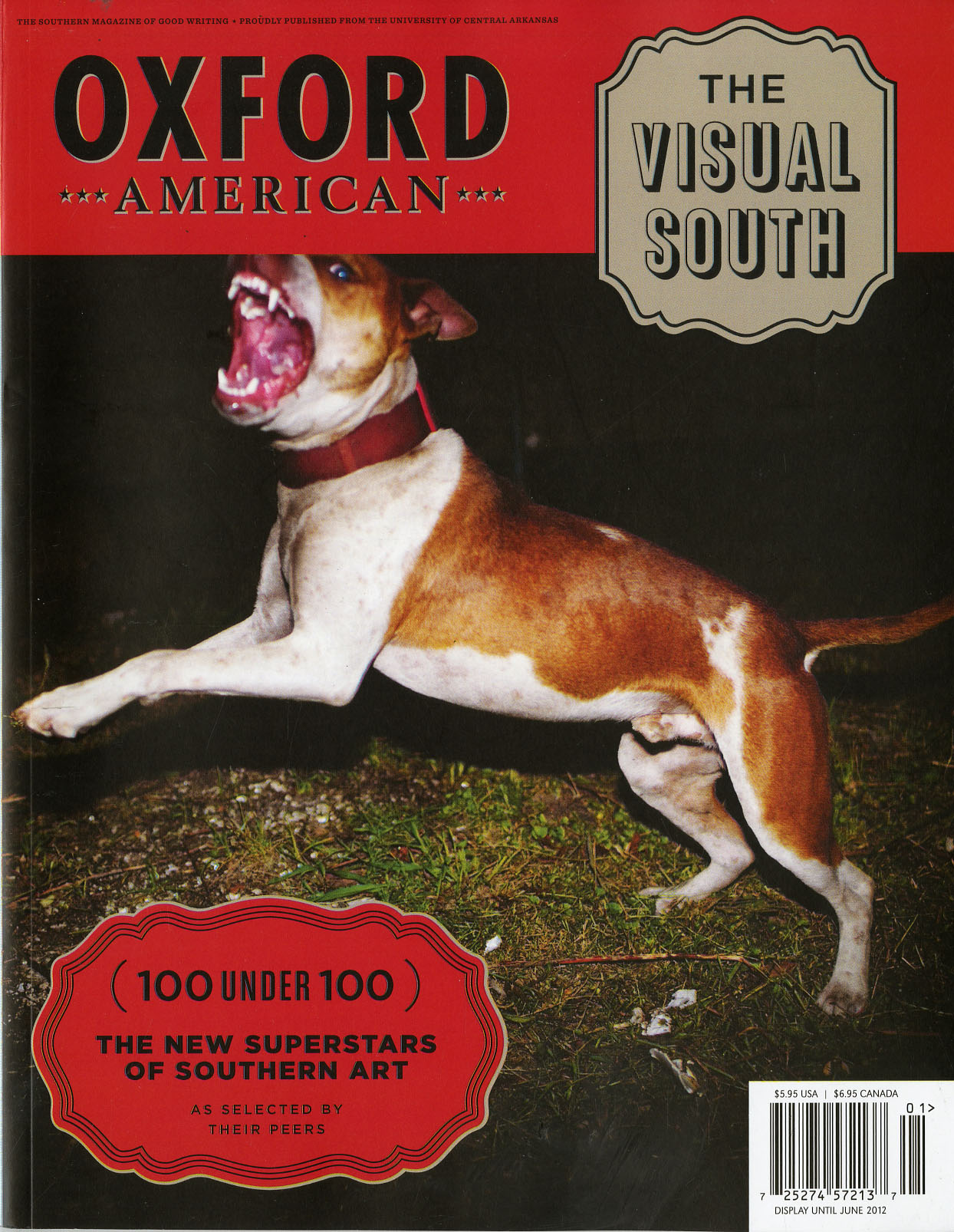
In the spirit of more is less, the editor in chief of Garden & Gun magazine, David DiBenedetto, decided to respond to The Oxford American’s editor Marc Smirnoff’s 3,600-word “critical analysis” of G&G. His response, exclusively via the Mr. Magazine™ blog follows:

Garden & Gun is not in the business of bashing other magazines, especially Southern ones. And while Mr. Smirnoff is entitled to his 3,600-word (and by his own admission “biased”) opinion, he seems to have either ignored or just not paid much attention to the bulk of G&G’s content. It would most likely come as a surprise to the many Southern artisans, craftsmen, farmers, shop owners, musicians, artists, authors, designers, dog trainers, sportsmen, chefs, barkeeps, filmmakers, pit masters, and others whom we’ve featured to learn that they don’t represent the real South. It would also surprise the long list of great writers who have contributed to G&G (some of whom, as Mr. Smirnoff notes, also contribute to the Oxford American) to hear that their work is devoid of substance. In any case, we do agree that the South is a big, dynamic, and diverse place, and there is more than enough room for a variety of viewpoints and magazines—even those that don’t appreciate a good porch. – David DiBenedetto

Read my interview with the editor of The Oxford American Marc Smirnoff below.

h1

Marc Smirnoff to Samir Husni: “You have gone on record calling Garden & Gun great. That is critical analysis. The same thing that I did. The only difference is that my critical analysis of G&G is negative and yours is positive.” The Mr. Magazine™ Interview with Marc Smirnoff, Editor, Oxford American magazine

March 1, 2012

“Is it pure trashiness for The Oxford American’s editor to bash another Southern magazine?” The question is not mine, but that of Marc Smirnoff, editor of The Oxford American magazine who wrote a three-page “critical analysis” of Garden & Gun magazine.

It is one of those rare moments in the history of American magazines, let alone Southern magazines, where one editor bashes another editor in public. Since moving to the South in 1984 I was told time and time again that it is not the “southern thing” to do, to air your dirty laundry in public.

So with that in mind, I emailed Marc Smirnoff to request an interview with him about the Garden & Gun “critical analysis”, The Oxford American, the future of print and what keeps him up at night. Marc declined to be interviewed on camera, but accepted to do an email interview.

What follows are, in typical Mr. Magazine™ Interviews style, the sound-bites first, followed by the unedited email interview.

The Sound-bites

On media-on-media attacks: What the BLEEP, Samir? We in the media shouldn’t act like we are members of a Good Ole Boys Club.

On why he wrote the critical analysis of G & G: Hype for a superficial magazine intent on dumbing down (and commodifying) a subject that I love was, finally, more than I could be silent about.

On the reasons behind The Oxford American survival: We fill a true void. We aren’t copying anybody; we aren’t redundant.

On the difference between print and digital: The online or electronic experience is not conducive to serious reading of the kind THE OXFORD AMERICAN strives to offer.

On his most pleasurable moment in the history of The Oxford American: I’d have to brood on it for days to single out one highlight from so many!

On what keeps him up at night: Magazine-creation, done ambitiously, shouldn’t be sleep-inducing…to readers or editors….


And now for the entire unedited interview with Marc Smirnoff, editor of The Oxford American:

Samir Husni: It is rare in the magazine business for one magazine to attack another magazine in public. Why now and why did you decide to break your “print silence” after 5 years of the launch of Garden & Gun?

Marc Smirnoff: “Attack”? Gee, I just thought it was a simple, but honest, critical analysis. But let’s use your term. There have been numerous such attacks in the history of magazines, and the writers who have attacked before me—like H.L. Mencken, Elizabeth Hardwick, Dwight Macdonald, or A.J. Liebling, to name just some—did so with lasting meaning.

In any case, I am sure you’ve noticed that magazines attack A LOT OF OTHER THINGS all the time. Since you don’t seem to have a problem with that, the implication is that you just don’t like media-on-media attacks. What the BLEEP, Samir? We in the media shouldn’t act like we are members of a Good Ole Boys Club; we shouldn’t just dish it out to strangers.

I don’t play golf, or make big business deals or racist jokes, so the idea of hanging out in a sauna with a bunch of good ole boys at The Club just does not do it for me. (I overheard one wag say, “GARDEN & GUN is a magazine for Republicans produced by Democrats.”)

I’ll also note that, from the start, you, Mister Magazine, have gone on record in calling G&G “great.” That is critical analysis. The same thing that I did. The only difference is that my critical analysis of G&G is negative and yours is positive.

SH: Some may say it is the “unsouthern thing” to do to air your dirty laundry on the pages of the magazine. How does your recent editorial help the cause of The Oxford American?

MS: The matter of Southern magazines, and how they examine or treat the South, is something that I care about and think about. I’m fine with you disagreeing with my assessment, but you seem to be bothered by the very act of my speaking up!

In the piece itself, I go into detail about why I finally chose to write about G&G, so I won’t repeat myself here. [Those in your audience who wish to see the piece for themselves can go to: http://oxfordamerican.org/articles/2012/feb/23/gg-me-buccellati-silver-spoon/ ] The short version is that I would not have written a substantive critique of GARDEN & GUN if somebody else had beaten me to it. But nobody did. Until now, all that existed in regard to critical analysis of G&G was vacuous praise (and, from G&G itself, vacuous self-praise). Hype for a superficial magazine intent on dumbing down (and commodifying) a subject that I love was, finally, more than I could be silent about.

Here are some of GARDEN & GUN’s flaws: They have a weird position on race (that’s me being kind of nice, actually). They promote a vulgar and aggressive materialism. They worship at the veranda of The Old South Plantation Myth. All that, and still they claim to be the “Soul of the South”; still they claim to speak for everyone.

THE OXFORD AMERICAN has flaws (by God, we do!), but they are different from GARDEN & GUN’s flaws—and I don’t mind saying so in print.

As far as whether the publishing of my editorial has helped the cause of THE OXFORD AMERICAN, all I can say is that I am convinced that our readership expects us to try to be honest and insightful. Why don’t YOU tell me how such an approach hurts the cause of THE OXFORD AMERICAN?

SH: The Oxford American has been the magazine with so many “near-death situations.” Twenty years later you are still at the helm of the magazine you’ve created. What is the secret of your survival? What is the secret of the magazine’s survival?

MS: Obviously, we want profitability. But first—and always first—THE OXFORD AMERICAN aims to forge true, deep connections with its readers. I like to think our readers respect that we don’t put moneymaking first. I hope they find that refreshing.

Another reason that THE OA keeps on going is that we fill a true void. We aren’t copying anybody; we aren’t redundant. We exist because the South—the American region that has produced, and produces, this country’s greatest writers—needs to have at least one ambitious magazine springing from its depths.

For a long time, whenever a good Southern writer wanted to appear in an ambitious magazine, she or he had to reach out or genuflect to New York magazines. We want to have a role in changing that pattern and keeping some of the action in-house.

SH: With an industry so engaged in digital, what do you think is the future of print in a digital age?

MS: The online or electronic experience is not conducive to serious reading of the kind THE OXFORD AMERICAN strives to offer. To paraphrase Harold Bloom, serious reading allows us to create a deeper relationship with ourselves. And the online experience, with all its chattering and blipping, and pushy, pulsating neon advertisements, is not friendly to the kind of prolonged, profound soul-exploration that serious reading provokes. That’s why people, when they find long and intellectually engaging articles online, often print them out. (The Internet is best suited for quick-hit reading.) One of these days, there will be an electronic invention that will completely duplicate the quiet, tactile, seemingly unbeatable technology of print-on-paper, but until that invention manifests itself, hard-copy magazines will have a place—for some of us, for enough of us. The majority, though, will probably give up on paper. With that group, we are as doomed as dinosaurs, Samir. Until then, though, I say: Viven los dinosaurs!

SH: What is the biggest hurdle facing The Oxford American today?

MS: We can best serve our contributors, and best address our money issues, by attracting more readers, more subscribers. As a poor nonprofit, we are often stifled by a lack of money. We’d love to have more staffers (and pay them better), bigger editorial budgets, BIG marketing budgets, paid interns, etc. Being poor increases the size of the hurdles, yes, but such hurdles just make our hard heads harder.

SH: What has been the most pleasurable moment in the history of The Oxford American?

MS: Wow. Very nice question, but I’d have to brood on it for days to single out one highlight from so many! Let’s keep it hush, but magazine editors have the most rewarding, enjoyable gig in the world.

SH: What keeps Marc Smirnoff up at night?

MS: William Faulkner once uttered writing advice that also works as editing advice. He said: “Be better than yourself.” The problem is that if you follow his (profound) decree, restless nights will dog you. On the other hand, hell, magazine-creation, done ambitiously, shouldn’t be sleep-inducing…to readers or editors….

SH: Thank you.

h1

Mr. Magazine’s™ Five Common Sense Strategies for New Magazine Media Success…

February 27, 2012

Magazine media publishing today is more complicated than ever. The options are unlimited and the choices are endless. The world of technology has added more possibilities to the world of publishing, whether ink on paper or pixels on a screen. The latest count of the number of Apps available for the general public is over one billion… yes, you’ve read that right: 1,000,000,000 Apps. And the number of magazines available for the general public is over ten thousand… yes: 10,000 magazines.

So, what’s one to do with an idea for a new publication or an App in this media jungle world? I have been thinking about this topic lately, and the one major thing that keeps popping in my head is the fact that, in the midst of this ocean of publication and Apps, one thing seems to be missing from most of the discussions regarding new magazine media launches: common sense. We have become so blinded by all the wizardry that technology can do that we have fallen in love with the technology and left the customers (whether they are readers, users, viewers or listeners) behind. In addition to the customers, I’ve noticed that we’ve left the experience that our content creates behind as well. So, to help those who ask, and those who are lost in the technology jungle who have no time to ask, here are my five pure “common sense” pieces of advice to help you plan and execute your next great magazine or App ever created:

1. Focus on the Customer first: No matter how great your idea is, ideas don’t live in a vacuum. You need to find other folks, a lot of folks, who share the interest, the need, the want, the lust (you get my drift) for that idea. Identify and define that customer. Learn anything and everything you can about them. Before you even test the validity of your idea, find the customers.

2. Check your Idea: People who tell me that they have a novel idea are immediately told that there is a good reason for that: someone else has tried this idea and it never worked. Of course, there is a very slim chance, less than .01%, that you are a genius and yes, your idea will bring in millions upon millions of dollars, but remember the odds are, with all due respect, that you are not a genius. Ask yourself whether your idea is based on content or on experience. Remember the best ideas are those that create a great experience for the customers. You can’t afford to be just a content provider anymore, you have to be an experience maker.

3. Study the Competition: Once you are sure of your idea, start looking at what is out there (while remembering that there are a billion Apps and ten thousand magazines). Write down what the strengths and weaknesses of the competition are. Study and analyze the competition. As long as you know that there is nothing unique anymore, find out how can you be “Better and Different”. The B and D factor is going to be essential for your success in the future.

4. Dig in for the Money, but Don’t Quit your Day Job: No matter what your idea is, you will need lots and lots of money to execute the idea. Write a budget and quadruple it. Then and only then will you be able to be close to what the execution of your idea is going to cost. If that number is scary, rest assured, it is only the beginning. You are better off quitting here and shelving your idea if you do not have easy access to that money. Keep in mind, that no matter what you do, if you’re that individual entrepreneur who is hoping to make it big in the marketplace with this idea, do not quit your day job. Ideas come by the dozen and they are worth a dime. It is the execution of the idea that counts. That execution, with no exception, is very costly.

5. Follow your Guts (after you take steps 1 through 4): No matter what type of idea or plan you have so far, folks are going to tell YOU, “this idea will never work.” However, keep in mind that folks said that about some great ideas that were successful and conquered the world. There is not a single amount of statistics nor formulas that you can use or apply that will give you the assurance you will need to achieve success. At the end of the day, it is your gut feeling that will give you that final approval to go ahead with your idea. Not the numbers, not the formulas, and above all not the consultants (me included)… It is you and only you who will give yourself the green light to proceed. So, are you ready?

I know exactly what you are thinking now. You are telling yourself this is just common sense. I know, isn’t that the title of this piece: the five “common sense” strategies for success? The biggest problem we have in the magazine media industry today is the lack of common sense. We have driven that car called common sense and parked it in a garage, five floors below, and, guess what, we left the keys in the car. Go figure?!

h1

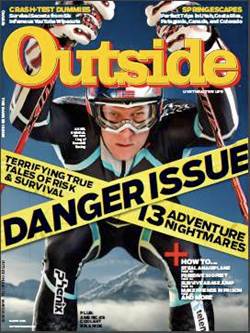
Chris Keyes to Samir Husni: If You Are in the Magazine Business and You Are Not Excited About All the Changes Taking Place Today, YOU NEED TO EXIT THE BUSINESS. The Mr. Magazine™ Interview With the VP and Editor of Outside Magazine Christopher Keyes.

February 20, 2012

If you are in the magazine business today and you are not excited about all the changes taking place, you should get out of the business. This is the simple and direct advice Chris Keyes, Outside’s magazine VP and editor, offers folks working in the magazine industry today. “I’m really excited about the opportunities of the future,” Keyes told me in this latest Mr. Magazine™ Interviews series of interviews with magazine industry leaders.

The future of the magazine industry, to Mr. Keyes, is a combination of print and digital. However, the printed magazine will always exist in the world he lives. But the challenge is coping with all the changes of the future with a small staff. Magazine editors used to have “the luxury of just working on a print edition,” Keyes said. Now they are “expected to be everywhere at once.” Yet, for Outside magazine, regardless of the platform, the first thing in Outsides life is “Audience; audience First.”

Click on the video below to watch my interview (via Skype) with Chris Keyes, VP and editor of Outside magazine, followed by the sound-bites and the very lightly edited transcript of the interview.

The Sound-bites

On the changes taken place in the magazine industry: I’m very excited about it, to be honest with you. There were certainly a lot of reasons to be tentative and afraid of these changes in the last couple of years.

On the differences between his experience of ink on paper versus digital: You’re just sitting there with a magazine and enjoying some great pieces and great writing; I find it hard to sit for a long period of time, the way I would with a magazine, in its digital format as an app.

On the idea that people don’t really want bells and whistles when it comes to their apps:
I think that’s largely true. But I don’t think that they necessarily want the exact same thing in terms of just a PDF format of the magazine..

On the new essay and long-form anthology app Outside recently launched: That kind of storytelling has always been really compelling to our readership and that’s why we decided to launch this first one with that idea in mind.

On all the changes new media brings to the forefront and his worries about the future of journalism: I’m really excited about the opportunities of the future and the fact that if you’re in this business right now and not excited about all the changes, then you should get out of the business.

On how his life has changed today from several years ago : I think 10 years ago, 15 years ago, a magazine editor had the luxury of just working on a print edition of the magazine and that was all you did.

On whether or not he envisions a day without the print edition of Outside: Not in the world that I want to live in, no. I really believe that there is a place for the magazine far into the future.

On what’s first in the life of Outside: Audience, audience first.

On his plans for the future: I want to see Outside grow and grow into all these platforms that are now available to us, to see the magazine continue to thrive, but also to see us thrive on these other platforms.

On what keeps him up at night: I think my biggest challenge, the thing that concerns me is the fact that we have a small staff and all brands in the media business now are expected to be everywhere at once.

And now for the lightly edited transcript of Mr. Magazine ™ Interviews Chris Keyes, VP and editor, Outside Magazine.

Samir Husni: Outside has been a cornerstone in the National Magazine Awards, it is nominated time after time. It’s a great read, a great experience. Now you’re creating those great reads in an iPad edition. How do you feel about this transition between digital/ink on paper; do you think you’re going to be able to recreate the same experience, a different experience; where are you headed?

Chris Keyes: I’m very excited about it, to be honest with you. There were certainly a lot of reasons to be tentative and afraid of these changes in the last couple of years. But one of the things that I’m most proud of, and I think all of us at Outside are most proud of is that we truly are a multi-platform brand and the fact that we’ve been able to do that as such a small, independent company is kind of a testament to the power of what the magazine is about. And I think the greatest evidence of the value of the long-form journalism we’ve always produced is how you’re seeing that translate online now. I think, obviously, when the internet came around there was the thinking that magazines couldn’t compete with that short, sound-bite type of journalism and that long-form was going to go away. As we’re seeing now, the biggest traffic spikes that we get on our website are from our best, most curated long-form pieces. So we’re really excited about that because it has value in the print edition, it has value online, and now it has value in the app edition where I think that is a great reading experience as well. Personally, I still prefer…I love our app, but I still prefer having a magazine in my hand. But I know that there are consumers out there that don’t and we want to reach them and now we can.

Samir Husni: How is your experience with the ink on paper different than the experience with the iPad, or the tablets, or the web?

Chris Keyes: Well, personally, I find that when I’m in a digital space, whether it’s online or whether it’s on our iPad app or somebody else’s iPad app; when I’m in a digital space I’m used to that freedom of being able to go anywhere, I’m jumping all over the place, from one website to another; whereas the magazine reading experience is much more self-contained and kind of refreshing in a way because you’re not inundated with a million options and a million opportunities to go somewhere else. You’re just sitting there with a magazine and enjoying some great pieces and great writing; so I find it hard to sit for a long period of time… the way I would with a magazine, in its digital format as an app, because I’m not used to that sort of being locked into one format.

Samir Husni: I don’t know if you saw some research that came out last week that a lot of people who read on digital platforms, want to see a replica, they’re not really interested in all these bells and whistles; and for some time we used to say we need to create something different, we need to do it and people are telling me, or telling the panel that we want the same thing.

Chris Keyes: I think that’s largely true. But I don’t think that they necessarily want the exact same thing in terms of just a pdf format of the magazine; I think you want to enhance it for the device that they’re reading it on, no question about that. But I largely agree and I think that’s probably a relief to a lot of magazines, because as we know, with the staffs that we have, to be able to also produce a ton of video content, sound, audio, and all these enhancements, that’s a huge burden on a magazine staff and we want to add a few layers of that to our iPad app to enhance it, but I think initially when you saw some of the first iPad apps come out for magazines they were sort of overloaded with every single story you could play. You could watch video, you could turn the picture around 360 degrees, and readers, I think, largely do want that magazine experience with a few bells and whistles.

Samir Husni: Recently, you launched a new app with a lot of essays. What was the reason behind creating this app for Outside?

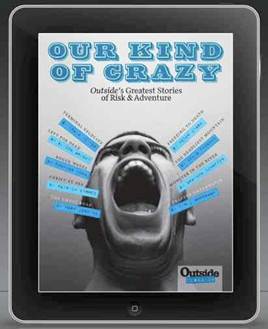
Chris Keyes: Well, what’s actually great about it is that it’s not an entirely new app, it’s a magazine sort of within the app; so once people download the Outside Plus app that gives them access to the Outside magazine and our buyer’s guides, they can also access anything we publish through that app. This is our first test into doing an anthology with some of our best writing of the past 35 years, and the genesis of it was a survey that we did with our readership last summer where we came up with 12 ideas for sample anthologies and we tested them with our readership, and by far, there were a few that were really popular, but by far the most popular was this idea of “Our Kind of Crazy” which are stories of our most extreme athletes and people who are taking their sports to levels that we haven’t seen before. And that kind of storytelling has always been really compelling to our readership and that’s why we decided to launch this first one with that idea in mind.

Samir Husni: Is Chris worried about the future of journalism?

Chris Keyes: No, I’m not at all; I’m really excited about it. I think the last couple of years for everybody and not strictly in the magazine business, but in just about any business, it was a really rough time, it was a lean time, but yet I go back to the fact that we’re a small, independent company, and there are not supposed to be small, independent companies in the magazine world anymore, but we’re thriving, we legitimately have all these platforms. We’ve got Outside television coming online, we just inked a deal with Comcast and we’ll be delivered there; so we really have an opportunity to reach a whole new set of readers and consumers and so I’m really excited about the opportunities of the future and the fact that if you’re in this business right now and not excited about all the changes, then you should get out of the business.

Samir Husni: So, my question to you then is, how is the 24 hours in the life of Chris has changed today from what it used to be like five-years-ago?

Chris Keyes: That’s changed quite a bit. Besides the fact that I’m up at five with a one-year-old, that’s one of the big changes. I think 10 years ago, 15 years ago, a magazine editor had the luxury of just working on a print edition of the magazine and that was all you did. I find it exciting to have my hands in all the different areas and so my day now, as opposed to just thinking about what is going to be in the print edition, is really thinking about the content of the website on a daily basis, and there’s a lot of stories in the past we would pass on because they involved some kind of breaking news and as a monthly you can’t reach people with breaking news, not in any way that was going to be still relevant in a month and a half from now. Now we can attack those stories online and we have done so successfully and that’s really exciting to me, and I think to all of our staff, knowing that there are kind of two mediums where we can reach an audience. And then the fact that I’m also involved in the development of the app and various brand extensions, there is certainly a lot more on my plate than there was five years ago, but it’s all exciting to me and like anybody in this business we thrive on some kind of a challenge; the more that there are these challenges and opportunities there, the more exciting the job gets.

Samir Husni: Do you envision a day when we don’t have the print edition of Outside?

Chris Keyes: Not in the world that I want to live in, no. I really believe that there is a place for the magazine far into the future. It’s just a different experience as I was describing before, and that’s not to say that all of these other devices and avenues to reach readers aren’t going to grow and maybe become even larger than print someday. But I do believe that there will always be a place for the print edition.

Samir Husni: Tell me about Outside TV. You say you’re launching a new television network?

Chris Keyes: The Outside television actually launched about a year and a half ago, it was a re-brand of a television network called “The Resort Sports Network” and again I think they approached Outside knowing that they wanted to re-brand and re-launch their network and so they came to Outside first and said that this would be a perfect marriage. Outside has this powerful brand. When you say Outside television you can kind of instantly envision what the network would look like. They came to us with this idea of partnering; that launched about a year and a half ago. Once that launch, the second phase of the partnership was to go out and get a distribution deal with one of the big, cable networks and they targeted Comcast first and that was inked last fall and distribution on that will be happening over the course of this year in various markets. And we’re really excited about that because it allows us to sell the magazine, to sell online, and to sell television all at the same time.

Samir Husni: If you want to summarize everything about Outside; is it a print company, audience company, customer company, digital company. What’s first in the life of Outside?

Chris Keyes: Audience, audience first. Even two-years-ago, you’d have to say it was a print company, but now that’s just not true anymore with the growth of our website, the growth of our app, with the growth of television, and the continuing strength of the magazine in general. All of those platforms are designed to reach an audience and I think again that’s what separates us. I think the magazines that died in the recession, a lot of them were built for an ad community, not an audience. And Outside has always been about its audience. We interpret the word Outside very broadly, but its also very definable and people can envision exactly what you’re talking about when you say Outside and what Outside is about. So that gives us a distinction in the marketplace that I think readers and a general audience want.

Samir Husni: What are Chris’s plans for the future?

Chris Keyes: I’d like to stay here as long as I can, this is my dream job and I arrived here a little earlier than I thought I would. I want to see Outside grow and grow into all these platforms that are now available to us, to see the magazine continue to thrive, but also to see us thrive on these other platforms. That’s what I want to stick around here for. I told Larry Burke when he hired me, I have never worked in New York; I don’t really have an interest to be in New York. I want to be here. I’m a true believer. So you won’t have to worry about me jumping ship.

Samir Husni: My traditional closing question in all these interviews, and now since I know that you have a one-year-old, besides the baby; what keeps Chris up at night?

Chris Keyes: Very few things, I sleep pretty well. But I think my biggest challenge, the thing that concerns me is the fact that we have a small staff and all brands in the media business now are expected to be everywhere at once, so we have to do well in print, but we have to also do well online, we also have to have a very active and vibrant presence in social media: Twitter and Facebook, and now there’s the app, the development of the app, and television and having some of my editors beyond the Outside television shows. And so how do we amplify the skills and abilities of the small staff to be able to be in all those places at once without one of those platforms suffering. I think that would be the biggest struggle right now and what would keep me up at night, but I think so far we’re doing well at it.

Samir Husni: Thank you.