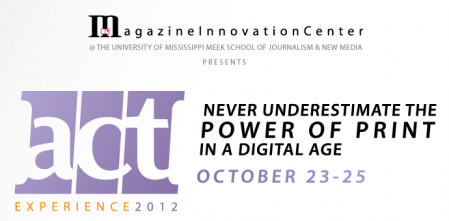
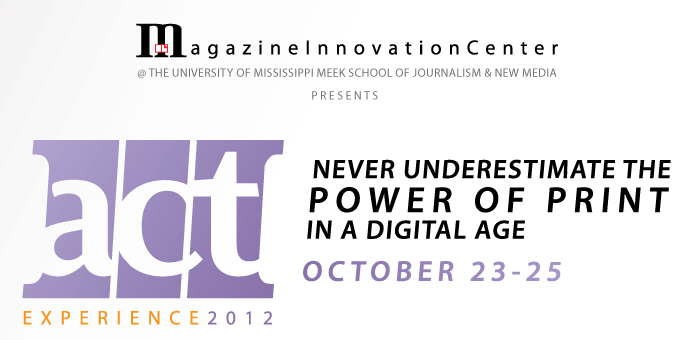
The ACT 3 (Amplify, Clarify and Testify) Experience is now in the history books. Sid Holt, the executive director of the American Society of Magazine Editors was the opening keynote speaker at the Experience. His speech, “So What is a Magazine,” set the stage for two and a half days of an experience themed “Never Underestimate the Power of Print in a Digital Age.” The event, hosted by the Magazine Innovation Center @ The University of Mississippi’s Meek School of Journalism and New Media, took place Oct. 23 – Oct. 25 and was attended by 145 magazine media experts from the publishing, printing, distributing, advertising and marketing industry.
Listen to Sid Holt as he attempts to define what is a magazine in this digital age:
The Magazine Innovation Center’s third ACT (Amplify, Clarify & Testify the power of print) just ended after three days of magazines, music and Mississippi. This year’s theme was Never Underestimate Print in a Digital Age.
What follows is the introduction that I wrote for the ACT 3 Experience’s program:
In 1962 I was introduced to the most magical experience of my life: the world of magazines. I was 9 years old and a new magazine was being advertised on television. That year Superman magazine arrived to Lebanon, and so was the heart of “Mr. Magazine™.”
Print is infectious and tangible. It’s the slick, shiny fashion magazines and the comics that kids have loved for generations. It’s that bewitching block of time where you sit mesmerized with your cup of coffee or your glass of wine and let the content of your favorite read transport you to that beach on the coast, or that cabin in the mountains. It is the experience that goes beyond the content. And if publisher’s today wouldn’t be so hasty as to put it out to pasture like an old nag who has served its purpose, it would be as stable today as it was thirty years ago.
To the naysayers of my last declaration, I say, prove it otherwise. I say, put as much thought, creativity and positive energy into print as you do digital and just see what happens.
Amplify, Clarify and Testify means just what it says. Amplify print, don’t smother it. Clarify print by distinguishing your brand with an indelible watermark that can’t be faded by the eons of cyber time that only last for a second. And then Testify about the results.
And if you gear your magazine media toward customers who count, instead of counting the customers you fear aren’t out there, I think you’ll be amazed at those results.
ACT III is the place for you to become fired up about print. It’s the round where you can dance to a different tune. Disco may be dead, but print isn’t. This years’ experience will celebrate and facilitate the creativity and longevity that print demands. Like a fine wine, print never goes bad or out of style. It is the mainstay of our industry that is proven and stationary, while digital roams cyberspace from the unverifiable realms to the unbelievable sectors.
As professionals, we cannot discount our digital audience either, however, but we can let print and digital co-exist if we are as creative and imaginative as both mediums demand and deserve. Audience first, or like I call it, customers first, should be our motto and guideline in every and all what we do in the magazine media of today and tomorrow.
We are here to serve our customers, with whatever venue they allow, but print has and is a relevant source for our customers. We must re-invent the excitement and the experience for our customers.
Like Clark Kent, my alter ego believes in unleashing power too: the power of print. The letters of print stand for something and here it is:
P: Power
R: Readers
I: Innovation
N: Nurturing
T: Tenacity
And that is the Power of Print.
So, enjoy the ACT III experience and fire up your creativity, folks, because you’re in for one heckuva’ ride! Let us unleash the power of print together…
On August 29 I wrote a blog about the new newsweeklies (see it below). Newsweek was absent for my list of the new newsweekly. It was not an error, but rather an editorial statement. The news about Newsweek today was no surprise to me, nor the predictions of the same doom and gloom media critics with their “print is dead” iconic analysis.
Print is not dead. Newsweek is committing suicide that is leading to its death in print first, and demise second. The magazine lost its DNA, or as I told the American Journalism Review earlier today, Newsweek ignored the audience. The magazine stopped giving the audience the intellectual stimulation magazines of that genre are in the business of giving. Newsweek is not The Daily Beast and The Daily Beast in NOT Newsweek. The audience was confused and so, it seems, the folks behind Newsweek. History teaches us, time and time again, that you can’t mess with your DNA and expect to survive.
On my twitter account I wrote, “Tina Brown has just become the Dr. Kevorkian of the newsweeklies. RIP Newsweek and may you enjoy live in digital heaven.”
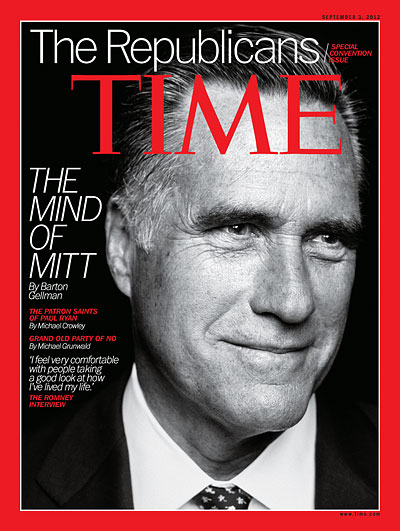
TIME is doing well, very well thank you. Bloomberg Businessweek is a must read (and may I add that it was bought at the same one dollar price Newsweek was bought). The Week is the “new air force one” inflight magazine.
So here is my earlier blog entry for those who are interested in the future of print and the future of the newsweeklies for that matter. Enjoy.
The Newsweeklies Are Dead; Long Live the “News” Weeklies: TIME, Bloomberg Businessweek and The Week. The Digital Age Ink on Paper Trio of “News” Weeklies
August 29, 2012
I am going to take the liberty to declare one word, newspaper, an oxymoron. That moment in time when you realize how contradictory a word is: news and paper. I mean, come on. Today, the two are definitely not synonymous. Most people are getting their news (as in Who, What, Where, When, Why and How) from anything but a paper: the internet, their cell, tablet and any other mobile apparatus that may come to mind. So if the “newspaper” is an oxymoron, what can one say about the “newsweeklies?” The words “news” and “weekly” maybe even a worse (if there is such a thing) oxymoron that the words news and paper.
But, in reality, there are some “news” weeklies out there today that are more relevant than ever before. Believe it or not, today’s “news” weeklies are not your father and grandfather’s traditional grab-your-pipe-sit-in-the-wing-back-chair-and-yawn-through-the-read-type weeklies.
Envision a three-legged barstool, draped in glossy black and white, with three titles wrapped around each spindly protrusion. The legs have always consisted of TIME, Newsweek and U.S. News & World Report. We have since seen the demise of the third leg: U.S. News & World Report, as a weekly magazine. And the change in Newsweek, from what it used to be, a magazine that featured a wide spectrum of information from politics to national breaking news stories, to what a friend of mine (who shall remain nameless) now refers to as “A British-Opinion” magazine, has made its ability to hold position iffy, to say the least.
So, it is with the picture of this precariously-standing barstool in mind, that I would like to introduce to you the weeklies that, in print, are as relevant and important in today’s market as the latest Apple app waiting to take over your iPad.
Leading the pack is the current first leg holder: Time Magazine. Under the leadership of Richard Stengel and his team, Time today is as relevant as it was when Henry Luce and Briton Hadden created it way back in 1923. In fact, the magazine coined the phrase “newsweekly” and has mastered the content and design ever since.
In 2007, when Time was reenergized under Stengel’s leadership, it exemplified the phrase: glossy, intelligent weekly. And five years later, Time continues to be the leader of the pack. It is the only of the original so called newsweeklies to have earned its first leg status in this digital age and seems to have no intention of relinquishing it.
However, it is now joined by two more weeklies that easily replace the leg U.S. News & World Report gave up and the one that Newsweek might as well let go of.
Bloomberg Businessweek, under the leadership of Josh Tyrangiel, since late 2009, has gone way beyond business and has become the pulse of every aspect of our daily lives. From business to politics, all presented in a package that offers both candy for the eye and food for the brain, Bloomberg Businessweek has become a force to be reckoned with in the realms of weekly magazines. Engaging and captivating, the magazine now offers a weekly surprise that, though unpredictable, remains positively surprising week in and week out.
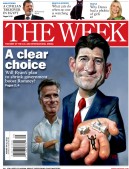
And the last leg, last but least, the one now occupied by the weekly that may make that phrase prophetic, is The Week. Under the leadership of William Falk, The Week was, is and will continue to be, the Rolls Royce of all weeklies and the new “presidential briefing” in publications. Not big in circulation nor in number of pages, The Week, by design, remains slim and trim. That is one magazine where truly size does not matter and it is the quality rather than the quantity that counts. Since its inception in 2001, the magazine has been a welcomed innovation in weekly news magazines. Although, as I have just mentioned, it has a limited number of pages, The Week overflows with an unlimited creativity and editing, and it provides the complete round-up of everything that matters to anyone that matters.
All three weeklies appear on your newsstand or in your mailbox on a Friday, prepping you for the weekend and really (to borrow a phrase from another great magazine, Mental Floss) make you feel smart again, without insulting your senses, all your senses, and by assuring you that they appreciate and value your time (no pun intended). Those magazines collectively are providing some of the best content and design that is out there, and are offering the biggest compliment a reader can get: a magazine that actually values YOU, the customer.
So, before you bemoan the “news” weeklies or the entire magazine business for their woeful presence in this digital world, go grab a copy of the three mentioned magazines and see whether they do value your time and that they do treat you like a customer who counts rather than just being a number in the business of counting customers.
And, please, no need to send me a thank-you note. Your enjoyment of the experience is thanks enough! Happy reading.
P.S.: And for those who are going to say what about The Economist? It is a great must-read “news” weekly, but it is not, historically speaking, part of the three American newsweeklies… and that’s what this post is all about this time around. Sorry.
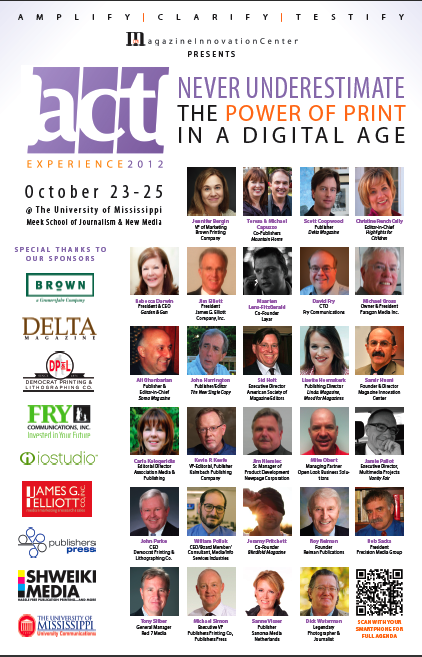
The third annual Magazine Innovation Center’s ACT 3 Experience will take place October 23rd through the 25th at the Meek School of Journalism and New Media — The University of Mississippi. A total of 29 power speakers are converging on Oxford, MS for three days of magazines, music and Mississippi. The ACT Experience is the only gathering of media thought leaders that focuses on “Amplifying, Clarifying and Testifying” about the future of print in a digital age. Registration to this year’s event is closed and the agenda for the event can be seen here.
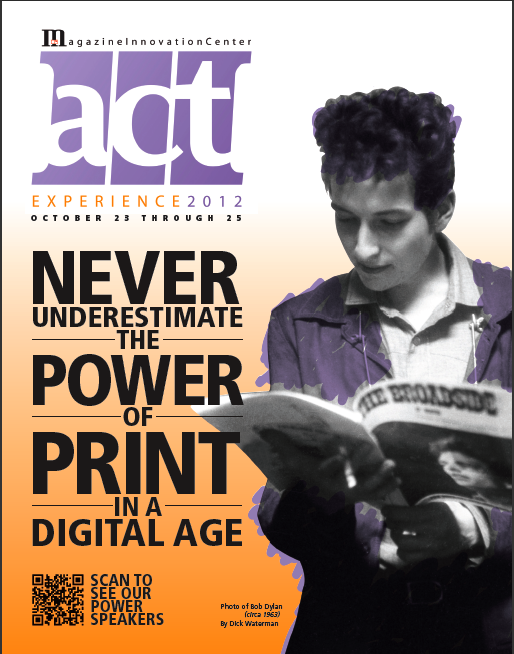
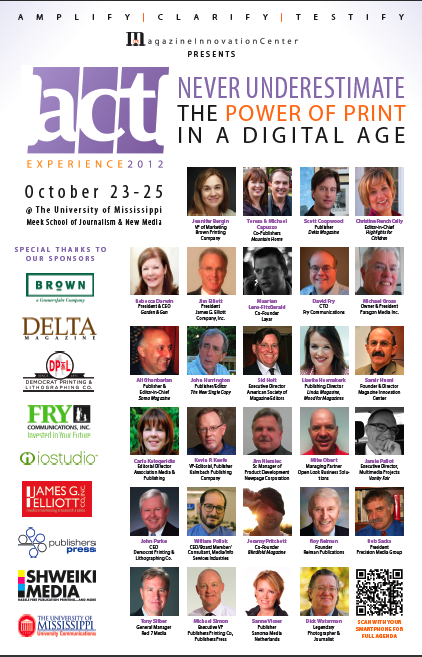
Two posters for the event have been designed. One featuring the theme of the event with a picture of Bob Dylan, taken by one of the ACT 3 speakers, legendary photographer Dick Waterman, and designed by Darren Sanefski, assistant professor of journalism at the Meek School of Journalism and New Media. The second poster featuring all the speakers at the ACT 3 Experience was designed by Allen Thigpen, the lead designer and web master for the Mr. Magazine™ and Magazine Innovation Center’s web and blog pages…
So, you are thinking of taking your business globally? Well, proceed with caution. The world is flat may be an exaggeration, because flat it is NOT and differences are plenty. As a magazine professional and educator, I draw a lot of examples from the only world I know: the magazine world (no surprise here)! So, without any further due let’s go global…
An overseas friend of mine once told me that in a gathering for the editors of all international editions of Cosmopolitan the American editor-in-chief of the magazine at that time (and no, it was not Helen Gurley Brown), was reprimanding an editor of one of the international editions, simply because she did not have enough sex lines on the cover. Now, granted, Cosmo is a magazine known for its sexual uninhibitedness, especially on the cover. The international editor replied calmly, “With all due respect, you in America talk a lot about sex, we, on the other hand, just do it.” Had the American editor known her audience, and by that, I mean the specific country’s customers that bought the magazine, she would have known that sex is not that big a deal overseas.
Tip 1: Know your audience.
Do not try to sell sex in a country that has been doing it longer than you have. It just doesn’t work.
That was the first tip that I want to share with you when attempting to establish your product, company or brand as a new entity in the global market. The tantalizing morsels I am dropping here are really just five common sense rules that must be adhered to if you want to maintain or garner success for your business.
There is nothing more rewarding for a business than to gain global recognition. For example, I was in Russia a few years ago and went into a book store. I was extremely anxious to pick up a “Russian” magazine. The clerk behind the counter was not exactly fluent in English, so when I asked her for a Russian magazine and she handed me Men’s Health, I thought that she had misunderstood. I repeated my request and she replaced Men’s Health with Cosmopolitan. It was then that I realized brand had crossed barriers, even in Russia. In the clerk’s mind, these two giants of the publishing world were Russian magazines.
Tip 2: Brand does matter.
You have to create your product, and then brand it as sure as any cowboy searing his steer. Until a Russian clerk who barely speaks English hands me your magazine when I ask her for a Russian one, you haven’t marked your entire herd. So, head ‘em up and move ‘em out. Time is wasting.
There was an Arabic edition of Reader’s Digest that was published back in the late seventies. At that time, Reader’s Digest was extremely popular here in the States. But when the magazine hit the Arabic markets, the articles had such an American slant that most of the Arab people couldn’t relate to content such as “How my cat survived the tornado.” For one, there are no tornadoes in the Arab world and secondly cats don’t live luxuriously there as they do in the States. It was as though the magazine was trying to re-culture the Arabic man or woman’s entire lifestyle. It wasn’t their best effort.
Tip 3: Yes, we’re becoming one world, but there are, and always will be, differences.
In order for your product to be appreciated, you must reciprocate. You must value your audience and study the culture of the world you’re trying to conquer. Flying by the seat of one’s pants will result only in a hole in the material that you may not be able to patch. The World Wide Web is a double-edged sword. Some see it as good, opening doors into domains that most of us have never known before. But there are those who believe it’s hurting their culture and way of life.
When you send your business on that global trek, you must remember that it’s not just about “putting something out there.” Your business has to be more than just another foyer that leads the way into a room your customers has visited a thousand times before. You can’t sell fish to a fisherman, but you can sell him worms.
Tip 4: No matter what you do, keep in mind that most products and brands are about experience-making.
In the magazine world I tell my clients, “You must become experience makers and not just content providers.” When you hand that fisherman a dead fish, he’s not all that excited, he has a dozen of his own in the cooler at his feet, but when you hand him squirming, shiny black worms; you have cracked the door for him to have an experience. One he can relish.
And finally, why did Men’s Health work in Russia, but not in Finland? Why do some magazines work in one demographic, but not the other? There has to be rhyme to the reason.
Tip 5: Study the different markets.
In the long run, it will save you many nights of sleeplessness. Prepare to be different. Prepare to be better. There is no such thing as unique anymore. There is only different and better.
Tip 6: When in doubt, repeat steps one through five.
The above article is a slightly edited article from my column published in .bizbuilder Sept/Oct issue. You can access .bizbuilder here.
Under the heading, The Power of Print, Knight Kiplinger, editor-in-chief of the “original personal finance” Kiplinger’s Personal Finance magazine, wrote “here at Kiplinger, we love the business of print publishing, and we’re committed to it.”
That editorial, an oasis in a digital desert world, was more than an incentive for me to reach out to Mr. Kiplinger and ask him few questions about print, the web, digital and the future of magazine publishing. In this segment of The Mr. Magazine™ Interviews, the editor-in-chief of Kiplinger’s Personal Finance, the weekly Kiplinger Letter and the very successful Kiplinger.com, shares his experience of having a robust website and a healthy ink on paper publication, proving that the two can breathe the same air without suffocating either.
In typical Mr. Magazine™ Interviews format, first the sound bites, followed by a brief video clips from the interview done via Skype (with apologies for the quality of the picture due to a bad Skype connection) and finally the entire, lightly edited, interview.
And as a first time bonus for the blog (think of it as a sidebar) Mr. Kiplinger’s recipe for a successful magazine launch at the end of this blog.
So sit back and enjoy Mr. Magazine’s™ interview with Knight Kiplinger. First the sound-bites, then the very lightly edited transcript.
The Sound-bites:
On the power of print and the people who love it:
People who love magazines on paper are not Luddites, they’re not Neanderthals, they’re not Technophobes. As a matter of fact, they tend to be smart, tech-savvy people who say they use all sorts of electronic media, tablets and smartphones.
On a Kiplinger’s Personal Finance reader response to online ads:
I don’t pay much attention to ads online. They just roll past me. But in the evening – in my leisure time with a magazine – I devour that magazine. I tear out pages of articles and advertising to save and to act upon later.
On the media Kiplinger’s prefers when reaching their audience:
Now, a smart publisher, and I like to think that at Kiplinger’s we’re smart publishers, is medium agnostic, channel neutral. We want to serve people with quality content. In our case, that’s personal fiance and investing information. We want to reach them in any medium that they’re most comfortable with.
On why publishers and advertisers fail to see that most of the industry’s money still comes from print not online:
Well, it is indeed, at most publishers. Print publishing existed for years on the two legs of advertising revenue and subscription revenue. We know that a lot of print advertising has migrated to the web. I would submit too much has migrated to the web and there’s a great opportunity for savvy marketers to rediscover this high quality print audience of people who are inquisitive and will pay attention to their ads.
On rightsizing magazine circulation:
Today, I think we’re moving into a period where magazines will rightsize, they will find the core of passionate, committed subscribers who renew strongly, and who will once again pay an economically viable subscription price and it won’t be, perhaps, a million or two million.
On the success of Kiplinger.com:
Our website, Kiplinger.com, is doing very well. It’s profitable, and not every publisher’s website really is profitable, as if on a standalone basis, with honest accounting.
On what keeps him up at night:
Trying to communicate the value of what we do to these different markets, especially advertisers. There is an under-appreciation of the buying power and the receptiveness to smart marketing on the part of older Americans; especially the well-educated older Americans who make up the audience of newsweeklies, business and financial magazines.
On the perception of the plight of magazines:
When people talk about the plight of magazines, you probably correct them and say, it’s not a uniform picture, and it’s not the same.
The video clip:
And now for the lightly edited interview:
Samir Husni: I was very intrigued with your editorial in the October issue of Kiplinger’s Personal Finance about the power of print. So, my first question to you, why are you writing about the power of print, when everybody else is talking about the death of print?
Knight Kiplinger: Well, the immediate occasion was the recent demise of SmartMoney Magazine, one of the three remaining personal finance magazines, down from eight or nine monthly magazines a decade ago. And I knew that a fair number of the readers of Kiplinger’s Personal Finance also read other personal finance magazines, Money Magazine and SmartMoney. And it didn’t seem the Dow Jones was communicating with those readers in any meaningful way, so I thought that I would have a candid, heart-to-heart talk with our subscribers and perhaps some of their subscribers too about the enormous challenges being faced today by print publishing and deputize my readers to share with me their thoughts, ideas and suggestions. And I asked some carefully tailored questions designed to draw them out: how they use online information, how they use print, the difference between the two, what they like about one and what they like about another. I also asked them for any suggestions they might have for a passionate, committed print publisher to stay in this game and continue to serve them in a medium that millions of people love. Well, I was astounded by the response I’ve gotten so far. We have over 400 emails and letters from Kiplinger’s Personal Finance readers answering these questions very intelligently, very astutely and very creatively. A few things emerged from this. People who love magazines are not Luddites, they’re not Neanderthals and they’re not Technophobes. As a matter of fact, they tend to be smart, tech-savvy people who use all sorts of electronic media, tablets and smartphones. They say, “I’m online all day at the office, but I also love magazines.”
This is a message many advertisers are overlooking or just not getting at all. Some of these people said that they’re online all day at the office and overdosing on technology all day long. In the evening, when they get home, they want to kick back on the deck or in the study with a cup of coffee, a glass of wine and a great magazine. They really bond with their magazines in this setting. And significantly, a lot of them said, “Mr. Kiplinger, I don’t pay much attention to ads online. They just roll past me. But in the evening, in my leisure time with a magazine, I devour that magazine. I tear out pages of articles and advertising to save and act upon later. I pay more attention to advertising in magazines than I do online.” A lot of advertisers say that they can reach the people they want to reach – affluent, well-educated and intelligent people – online. They say they don’t need to use magazines in their media mix. I think they’re mistaken about that. The message is coming across loud and clear from these people that reaching them through the print medium of a printed magazine is more effective than chasing them online. Sure, they’re online, but they don’t seem to be paying as much attention as they do to print ads. That was quite a revelations to me.
Samir Husni: So why do you think then that the majority of print publishers are like the advertisers, abandoning print, preaching the gospel of digital and committing suicide rather than dying?
Knight Kiplinger: Well, there is that. Now, a smart publisher, and I like to think that at Kiplinger’s we’re smart publishers, is medium agnostic, channel neutral; we want to serve people with quality content, in our case, personal finance and investing information, we want to reach them in any medium they’re most comfortable with. So at Kiplinger.com, our website is growing robustly in unique visitors, in page views, in advertising revenue; we’re not turning our back on this audience, but we think that the audience is, at least, a dual audience, maybe more than that. There are other media as well, broadcast media, radio and that sort of thing. But we are committed to serving our readers however they want this information. And I’m hearing loud and clear that among the 600,000 plus monthly subscribers at Kiplinger’s Personal Finance, there are a lot of people who really want this magazine to hold in their hands and to pay attention to. So, it’s not like publishers are committing suicide or turning their back on print, well some are, Dow Jones decided to pull the plug on SmartMoney as a printed publication, U.S. News is pretty much going all digital except for their special issues, and there are more. I did hear from a lot of our readers who said, “If you’re suffering from declining subscription revenues and a falling unit price for a subscription to a magazine, look in the mirror, because you probably brought this on yourself.” Some of them said, “I would gladly pay more for a subscription to Kiplinger’s Personal Finance magazine if you required me to, if you asked me to, and you didn’t keep reducing the price at the last minute on the fourth or fifth or sixth effort of renewal, because publishers have trained people to wait for the best offer. This struck a sensitive note with me. Because, in fact, the real value of a phenomenal price, and especially the inflation-adjusted price of magazines, has been falling for decades. And we are complicit in that as publishers, we allowed advertisers to subsidize the reader for too long, undervaluing and underpricing our product to subscribers. And now it’s very hard to put that genie back in the bottle and to gradually raise subscription prices. But many of these readers responding to my questions said, “I’m paying $16 to $18 a year for your magazine now, or in some cases less with introductory offers, and I would pay more. But make me pay more. Don’t undercut my willingness by throwing out a really low price at the last minute when you haven’t heard back from me for a while.”
Samir Husni: What is the solution? Where are the revenues coming from? Does it really take a genius to see that most of our money is still coming from print?
Knight Kiplinger: Well, it is indeed, at most publishers. Print publishing existed for years on the two legs of advertising revenue and subscription revenue. We know that a lot of print advertising has migrated to the web. I would submit too much has migrated to the web, and there’s a great opportunity for savvy marketers to rediscover this high quality print audience of people who are inquisitive and will pay attention to their ads. That other leg on which publishing was standing – subscription revenue – has fallen. I think that publishers brought some of this on themselves by putting too much free content online. They expected that they could monetize those eyeballs and achieve equivalent revenue to the eroded subscription and advertising revenue. Of course, that hasn’t happened. You’re quite right – advertising unit prices on the web continue to fall, web advertising is pretty much a commodity and like all commodities the price tends to fall as supply proliferates, more and more websites are seeking marketing dollars. So I really think that smart publishers have to re-balance their focus and pay more attention to their print product and rightsize their magazines. Many magazines for years were carrying rate bases and guaranteed circulations that were too high and to feed the monster. They had to slash their subscription prices to maintain artificially high guarantees to advertisers. They did this for advertisers who turned out to be awfully fickle anyway and unappreciative of the audience. Today I think we’re moving into a period where magazines will rightsize. They will find the core of passionate, committed subscribers who renew strongly, and who will once again pay an economically viable subscription price. It won’t be, perhaps, a million or two million. It will be an half a million, perhaps, or 200,000 or 300,000 minted readers paying a higher subscription price. The very evidence of their commitment and their willingness to pay more for that magazine, I think, will be the evidence that advertisers need that this is a valuable audience in front of which the method should be put.
Samir Husni: How are you, Mr. Kiplinger, going to implement those changes at Kiplinger’s Personal Finance?
Knight Kiplinger: We are processing these emails, letters and phone calls and mining them for nuggets of valuable marketing intelligence that are contained in these emails. And we are constantly price testing. Most publishers are price testing. We mail samples at different prices to see what works and we know that there is a trade-off between a higher subscription price and a lower response to a direct mail package. We know that – it’s been going on forever. And I think we’re going to experiment with the right base rate. Right now we’re at 600,000 paid subscribers. We have some devoted advertisers who know the value of our audience. The advertisers know that our audience is attentive and responsive to their marketing message. So we’re going to be using this intelligence to continue to find the right size, the right trade-off in circulation, subscription revenue and advertising revenue that fits us. And I imagine, over at Time Inc., the people at Money Magazine are doing the same thing. Money Magazine, with the largest rate base, guaranteed circulation in the personal finance field, led the charge to lower and lower subscription prices. They were the ones who slashed the price down to $12, $10 and sometimes even less, trying to maintain at all costs a rate base. Many people thought this was too high, which I might argue is too high today, and it forced the other magazines in the field, especially SmartMoney and Kiplinger’s, to lower our subscription prices because they were out there in the mail with a lower-priced offer for a magazine that sounded very similar and we were kind of forced into this arms race of lower and lower discount prices. I’d like to drop out of this arms race. I’d like to properly price and properly size our magazine to be viable for years to come. That’s what we’re going to be working on.
Samir Husni: Do you think that we’re making the same mistake by counting customers, instead of customers who count, even now on the digital side?
Knight Kiplinger: I think that’s true. I think that every publisher is looking at its core base of committed customers and asking what additional products and services these customers will buy from us. Will it be books, DVDs or computer software? At Kiplinger, we’re broadening our product line all the time. We recently brought out a fabulous new computer software product that helps people pinpoint the ideal age for them to start their social security benefits. This is a natural extension of our editorial mission. We’ve been writing about smart social security claiming strategies for starting benefits for years. This new product, Kiplinger’s Social Security Solutions – $50 or for a premium edition edition with a lot more hand-holding, $125 – fits perfectly with our editorial mission of personal finance guidance. This is the sort of thing that we and other publishers are doing. We’re not putting all our chips in print nor online. As I mentioned earlier, our website, Kiplinger.com, is doing very well. It’s profitable. Not every publisher’s website is really profitable, on a standalone basis, with honest accounting. We don’t load all the editorial expenses onto the magazine as some publishers do to make the website look artificially prosperous. We share the expenses equitably between the print and online side. On that basis, we’re breaking even across the board, and that’s no mean feat in this era.
Samir Husni: That was going to be my next question, because everybody that tells me my website is profitable I say, how are you doing the accounting. So you had the answer before I asked the question.
Knight Kiplinger: Well, that’s very smart of you. Over the last 10 years, I’ve talked to a lot of fellow publishers about this. And I usually find that they are allocating the expenses in a clever way to make one side or the other look like the hero or the goat. And we have a consolidated editorial staff that writes for both the website and the magazine. They do good work in both media, very important that way. We believe that for a website to be truly profitable, the accounting has to be very, very honest. We insist on that. And since I’m a financial journalist, I wouldn’t have accepted any less.
Samir Husni: Here is my typical Mr. Magazine™ interview question: What keeps you up at night?
Knight Kiplinger: In this age what keeps me up at night is trying to communicate the value of what we do to these different markets, especially advertisers. Much of the advertising and media-buying decisions today are made by very young advertising personnel. They’re inexperienced and they don’t know the relationship selling that advertising, and buying that advertising, used to entail. They have commoditized their media buying. They do media buys from a PC. The greatest challenge is how to communicate the value of a print audience – especially a somewhat older, affluent and well educated audience – to media buyers who look very different from our audience in many cases. There is an under-appreciation of the buying power and the receptiveness to smart marketing on the part of older Americans – especially the well-educated older Americans who make up the audience of newsweeklies, business and financial magazines. When people talk about the plight of magazines, you probably correct them and say that it’s not a uniform picture and it’s not the same. If I published a magazine of celebrity and entertainment and men’s and women’s health and travel, a hobbyist magazine, maybe I’d be doing great because many of those categories are doing very, very well, fashion and fitness, and all that. But ironically, the magazines that are most challenged today are the more serious magazines, the magazines of news and opinions and edification, financial advice and business news. They’re very important subject matters, but many of these magazines are more challenged that the frothier, lighter magazines, many of which seem to be doing well.
Samir Husni: Is that a reflection of our country or is it a reflection of the advertising community?
Knight Kiplinger: It’s a little of both. Even serious people – serious, hardworking, successful people – like some froth occasionally. Some just like entertainment. Not all of them want to kick back in the evening with Kiplinger’s Personal Finance magazine. They want to kick back with People or US Weekly or Men’s Health, or something like that. There are different sides to all of our lives. There are people who think that they can get everything they need by way of news, information and advice online. Well maybe it’s out there. But one reader, more than one reader, had an astute observation about the value of print publications, whether it’s the front page of their newspaper or it’s a magazine. One woman said, “I read magazines to tell me what I don’t know that I don’t know – to tell me what I need to know and didn’t know that I needed to know and didn’t know.” She said that the selection of stories in our magazines each month is what brings her attention to important things. Maybe she could have hunted all over the web and found them, but she wouldn’t have known the questions to ask. She didn’t know that there was a problem brewing that we could help her with. A lot of people said we use the internet, we use online, to find out things for questions we have framed ourselves. Something that we know is out there and we need to find it and we use clever searching to find it. But they use magazines and newspapers, and the wise editors of those publications to bring to their attention things they didn’t know that they didn’t know.
Samir Husni: My final question to you is: being a financial journalist, how do you gauge the health of the magazine industry today? From a financial point of view.
Knight Kiplinger: I think that it is clearly a troubled industry today. But as I said earlier, there are segments of the magazine publishing industry that are doing very well. You drop a Vogue magazine on your foot and you’re going to break the bones of your instep. But there’s a magazine that people buy for the ads, it’s chocked full of ads and people buy it less for the so-called editorial content and the features than the ads themselves. We see magazines abandoning print and going online only, but there is an important message there. We heard from hundreds and hundreds of readers of ours that they have not followed some of their favorite magazines online. A number of them said that they’re not going to follow SmartMoney magazine to Smartmoney.com. It’s just not their thing. They’ll continue to read our magazine. Perhaps they’ll continue to read Money Magazine. Some people said that they loved U.S. News when it was a weekly magazine, but they have not followed it to the website. Advertisers have to be very careful, publishers first have to be very careful, and advertisers have to be very careful that they are not turning their back on their audience thinking that they can reach all these people effectively through online only. I think they need to use a mix of media and magazines should remain a very valuable part of that media mix.
Samir Husni: Thank you very much.
So, you want to start a magazine? Follow Mr. Kiplinger’s recipe for a successful launch:
Knight Kiplinger Recipe to Launch a New Magazine
1. First you need to answer some preliminary questions:
A. Is there something special about the medium of a print magazine that suits the content that makes it better than it would be online?
B. Is there a category of advertisers who will gravitate toward the subject matter.
C. How do you plan to find readers for your magazine?
D. Where are you going to market your magazine so that people can find it.
2. Many young, would-be publishers don’t know about the enormous expense of direct-mail solicitation, the dominant way print publishers find readers.
A. The best way to find the reader is to put your idea in front of another reader.
B. The best predictor of whether someone will open your direct-mail packages, fill out the order card and subscribe to your magazine is whether or not they subscribe to magazines now.
C. Every publisher tries out new lists, so-called compiled lists, they mail to professionals, executives and senior people in a certain occupational area. They mail to financial planners and similar people, but the best predictor of whether someone will subscribe to a magazine is not what field they’re in, not their age, not their income, but whether they subscribe to a magazine now. That’s why the most effective lists to mail for a magazine publisher are lists of similar magazines.
D. With SmartMoney, Money Magazine and Kiplinger’s Magazine, we all mail each other’s lists and we trade lists with business titles like The Wall Street Journal. The best predictor is not their occupation or something similar but if they are buying reading material by mail now and reading it on paper.
E. Many young, would-be publishers don’t understand this. And I say to them: What is the universe of direct mail available names on effective publishers’ lists that you can mail to with your test package? Is there a big enough universe for you to get only one percent or a half percent, one-and-a-half percent response and launch your magazine off those lists?
3. Some people say that they will advertise their magazine online. Well, one of the dirty secrets of publishers is that it’s difficult to sell printed material – magazine material – online. Like sells like, it seems.
4. These are the tough realities of print publishing that starry-eyed, would-be publishers need to hear, whether they’re 25 years old or 45 years old.
5. So, ask the tough questions. Play devil’s advocate. We all love print, but launching a new publication these days is no mean feat.
The two grand dames of the women’s service journalism magazines, Better Homes and Gardens and Good Housekeeping, are making careful, but drastic changes when it comes to their modus operandi.
Both magazines seem to be are treading, albeit very carefully, into very murky and uncertain waters.
Better Homes and Gardens is testing a complete departure from its founder E.T. Meredith’s dictate for the magazine. The famous “no fiction, no fashion, no piffle, no passion,” seems to have left the station.
Now, apparently, Better Homes and Gardens is treading into an area that some may consider different than that original mantra. Women like Michelle Obama and Heidi Klum are adoring the covers of the magazine. That should be a non-news item if the magazine was not BH&G. The first time BH&G ever had a woman on their cover was the August, 2011 issue and it featured the first lady. That issue also broke its 48 year streak of people-free covers.
Now their September, 2012 cover actually has dual offerings, a test cover with Heidi Klum on it, on some of the newsstands and their tried and true home decorating photo on the inspired ideas issue on some other newsstands. But even more noticeable than the cover are the cover lines of both issues. Each cover line features a major celebrity and either their “how-to” advice or describes some personal detail about what they enjoy or how they relax.
Katie Couric and her relaxing retreat, Guy Fieri and his backyard bash, Nate Berkus and how to decorate with what you love, and Sibella Court and her brave, beautiful color.
This step toward celebrity-filled content is, I hope, a test. So iffy that BH&G didn’t even reflect Heidi’s cover photo on the table of contents page. Baby steps.
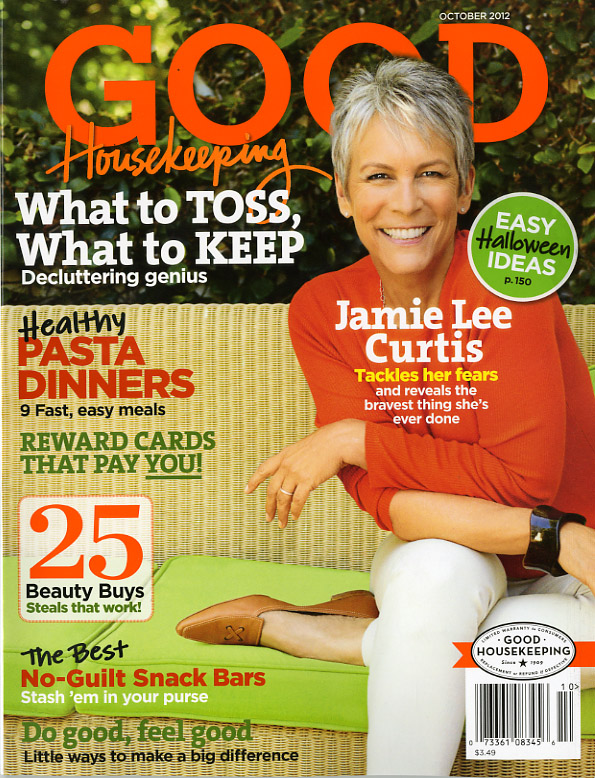
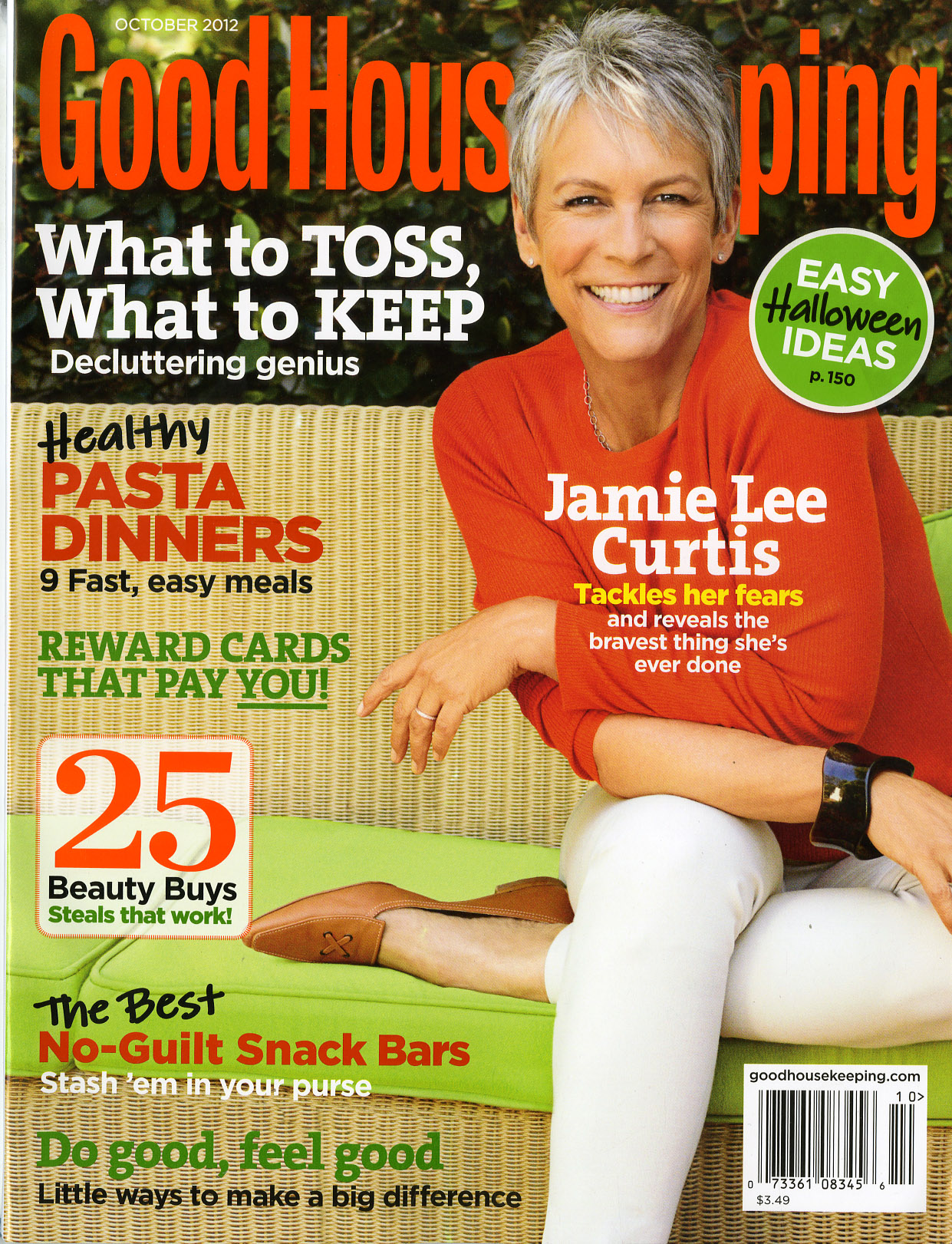
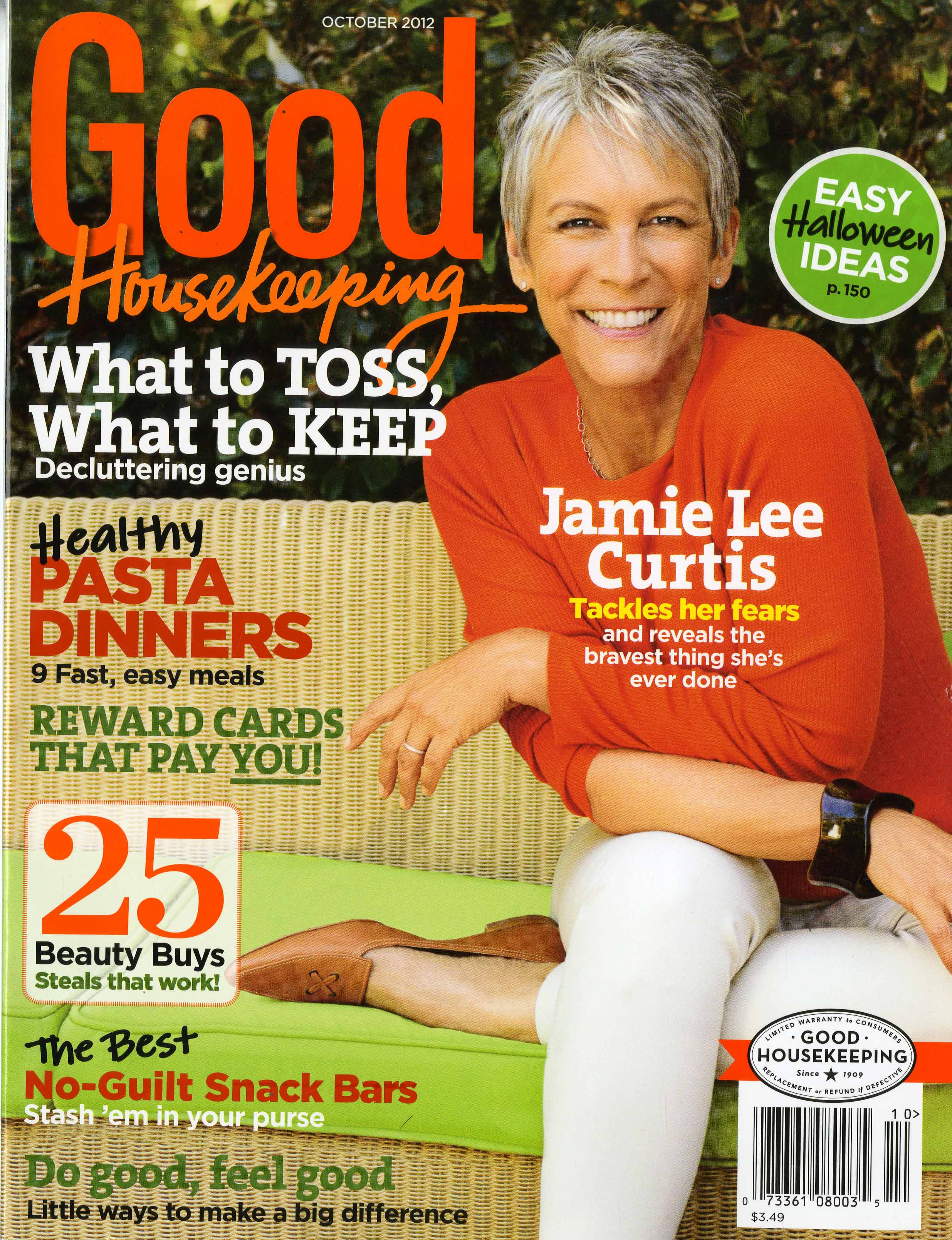
Over at Good Housekeeping, our other grand dame, a magazine that’s always had celebrities on their covers and that always mixes their service content with “famous” advice, they’re trying on drastic for size too. They’re testing a new logo where the emphasis is on “Good” and less on “Housekeeping.”
The October, 2012 issue features three different covers as well. One has the lovely Jamie Lee Curtis sitting on a wicker divan with the top of her head gracefully blocking out the kee in “Keeping,” and the second cover has her, same position and divan, trying to compete with a giant “GOOD” that is stretched behind her head. The third cover that I found had yet a different variation of the word Good. I have no problem with it…Good is good…but I only wonder why we are trying so hard to show our uncertainty through these major cover testings that lean toward a complete opposite criteria than these publications have held in such high regard in the past?
When your content is good and you’ve proven that through years of success, such as with Good Housekeeping and Better Homes and Gardens, is it simply a way to stay relevant that we try to fix what isn’t broken?
Or is it, more aptly put, our underestimating the power of print in a digital age and our fear that we won’t remain on the tip of our readers’ tongue if we don’t try something different?
Yes, a sign of the times. A sign of the uncertain times, indeed.
(updated Sept. 17)
I am going to take the liberty to declare one word, newspaper, an oxymoron. That moment in time when you realize how contradictory a word is: news and paper. I mean, come on. Today, the two are definitely not synonymous. Most people are getting their news (as in Who, What, Where, When, Why and How) from anything but a paper: the internet, their cell, tablet and any other mobile apparatus that may come to mind. So if the “newspaper” is an oxymoron, what can one say about the “newsweeklies?” The words “news” and “weekly” maybe even a worse (if there is such a thing) oxymoron that the words news and paper.
But, in reality, there are some “news” weeklies out there today that are more relevant than ever before. Believe it or not, today’s “news” weeklies are not your father and grandfather’s traditional grab-your-pipe-sit-in-the-wing-back-chair-and-yawn-through-the-read-type weeklies.
Envision a three-legged barstool, draped in glossy black and white, with three titles wrapped around each spindly protrusion. The legs have always consisted of TIME, Newsweek and U.S. News & World Report. We have since seen the demise of the third leg: U.S. News & World Report, as a weekly magazine. And the change in Newsweek, from what it used to be, a magazine that featured a wide spectrum of information from politics to national breaking news stories, to what a friend of mine (who shall remain nameless) now refers to as “A British-Opinion” magazine, has made its ability to hold position iffy, to say the least.
So, it is with the picture of this precariously-standing barstool in mind, that I would like to introduce to you the weeklies that, in print, are as relevant and important in today’s market as the latest Apple app waiting to take over your iPad.
Leading the pack is the current first leg holder: Time Magazine. Under the leadership of Richard Stengel and his team, Time today is as relevant as it was when Henry Luce and Briton Hadden created it way back in 1923. In fact, the magazine coined the phrase “newsweekly” and has mastered the content and design ever since.
In 2007, when Time was reenergized under Stengel’s leadership, it exemplified the phrase: glossy, intelligent weekly. And five years later, Time continues to be the leader of the pack. It is the only of the original so called newsweeklies to have earned its first leg status in this digital age and seems to have no intention of relinquishing it.
However, it is now joined by two more weeklies that easily replace the leg U.S. News & World Report gave up and the one that Newsweek might as well let go of.
Bloomberg Businessweek, under the leadership of Josh Tyrangiel, since late 2009, has gone way beyond business and has become the pulse of every aspect of our daily lives. From business to politics, all presented in a package that offers both candy for the eye and food for the brain, Bloomberg Businessweek has become a force to be reckoned with in the realms of weekly magazines. Engaging and captivating, the magazine now offers a weekly surprise that, though unpredictable, remains positively surprising week in and week out.
And the last leg, last but least, the one now occupied by the weekly that may make that phrase prophetic, is The Week. Under the leadership of William Falk, The Week was, is and will continue to be, the Rolls Royce of all weeklies and the new “presidential briefing” in publications. Not big in circulation nor in number of pages, The Week, by design, remains slim and trim. That is one magazine where truly size does not matter and it is the quality rather than the quantity that counts. Since its inception in 2001, the magazine has been a welcomed innovation in weekly news magazines. Although, as I have just mentioned, it has a limited number of pages, The Week overflows with an unlimited creativity and editing, and it provides the complete round-up of everything that matters to anyone that matters.
All three weeklies appear on your newsstand or in your mailbox on a Friday, prepping you for the weekend and really (to borrow a phrase from another great magazine, Mental Floss) make you feel smart again, without insulting your senses, all your senses, and by assuring you that they appreciate and value your time (no pun intended). Those magazines collectively are providing some of the best content and design that is out there, and are offering the biggest compliment a reader can get: a magazine that actually values YOU, the customer.
So, before you bemoan the “news” weeklies or the entire magazine business for their woeful presence in this digital world, go grab a copy of the three mentioned magazines and see whether they do value your time and that they do treat you like a customer who counts rather than just being a number in the business of counting customers.
And, please, no need to send me a thank-you note. Your enjoyment of the experience is thanks enough! Happy reading.
P.S.: And for those who are going to say what about The Economist? It is a great must-read “news” weekly, but it is not, historically speaking, part of the three American newsweeklies… and that’s what this post is all about this time around. Sorry.
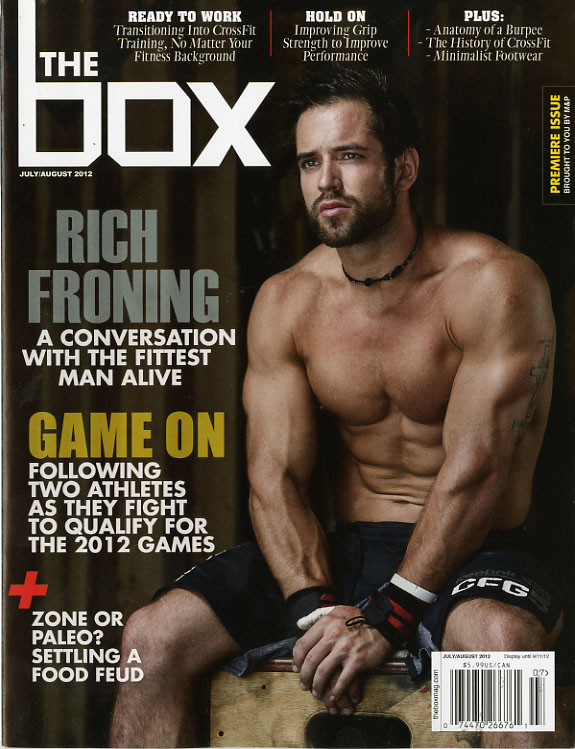
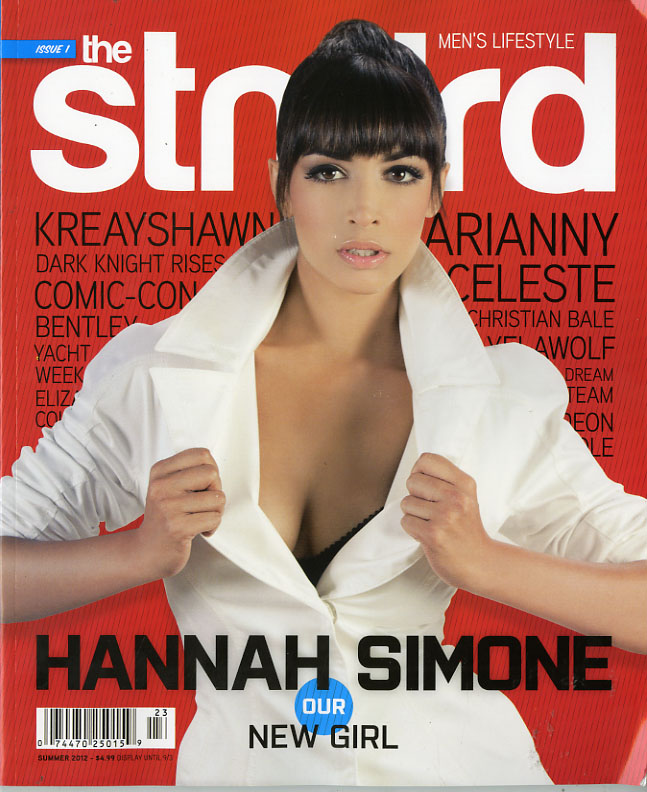
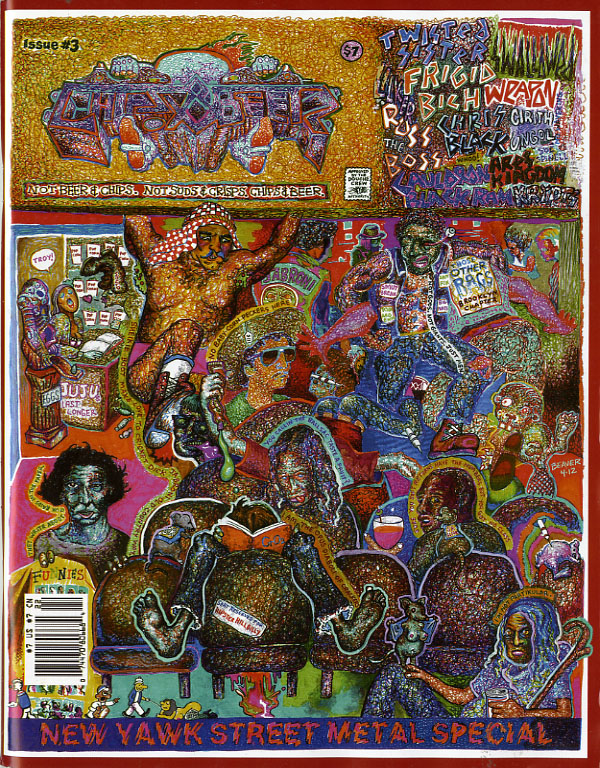
The Mr. Magazine™ Launch Monitor was able to track a total of 54 new magazines that arrived at the marketplace in the month of July. 14 of the new titles were published with an intended frequency. Take a peek below at three of such titles and check all the images of the July titles at the Mr. Magazine™ Launch Monitor.
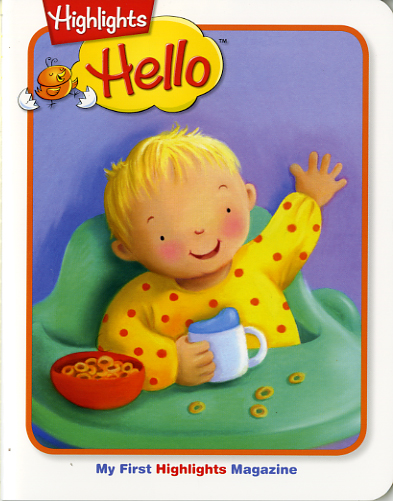
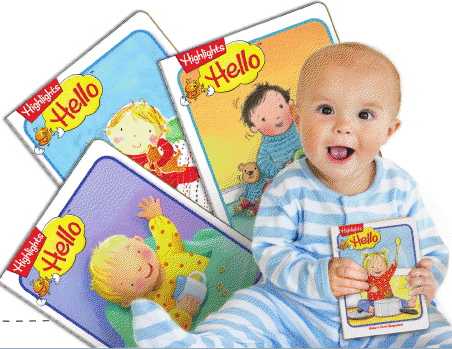
Imagine that… a printed magazine that you can throw in the washing machine, together with all your clothes, and still be able to read and enjoy it when it comes out of the dryer. That’s what the folks who brought us Highlights For Children magazine almost 67 years ago are about to introduce to the marketplace this coming January. Highlights Hello, the new ink on paper monthly magazine, with crystal clear display, is the latest addition to the family of Highlights magazines that include Highlights, Highlights High Five and now Highlights Hello. All three monthlies are 100% circulation driven and advertising free (I guess they do believe in the concept of customers who count rather than counting customers). The three magazines aim to cover the different stages of a child’s life starting from age 0 to age 11.
Highlights Hello is “printed with non-toxic ink containing soy and/or vegetable oils, on durable, washable, paper with rounded corners.” The magazine even survived the test of being put in a washing machine according to Chris Cully, the magazine’s editor in chief. Highlights Hello dubbed “the first Highlights magazine” is dedicated to “parents embarking on the journey to help their children become their best selves.”
I asked Chris why now and why ink on paper. Her answer,
“The research is clear about the benefits of reading aloud to babies and toddlers. The cuddling, talking, laughing, and singing are all part of the experience. A magazine like Hello makes it easier for parents to create these experiences often.
Also HELLO is lightweight and portable. It fits easily into mom’s purse or diaper bag. It fits toddler hands perfectly. It can be wiped clean–and it can withstand a little chewing. It is hard to imagine a digital product that could be so perfectly tailored to the needs of this audience.
And for those of us who believe children’s books and magazines on paper are going to be around a long time, this creates a great first experience and early memories.”
The 16-page-monthly is intended to be read aloud and in an engaging way (it even comes with the handy instructions to the parents in the corner of every new section) so that the content of the magazine becomes much more like an experience rather than just ink on paper content. The magazine targets babies 0 to 2 years old, their parents and caregivers.
In this digital age, there is still a place for lots and lots of good ink on paper ideas. As I have often mentioned on this blog, the so-called problem with print is not the ink on paper, but rather the message it carries. There is no need to shoot the messenger just because some messages or even a lot of messages stink!
By the way, please don’t try the washing machine test on your iPad, Kindle, or any other digital device. I can guarantee the results and I can guarantee that you will not be happy with them.








 Mr. Magazine