Archive for the ‘Magazine Power’ Category

h1

A Return To Print: Plough Quarterly Digs Deep Into Christian Issues One Cause At A Time… The Mr. Magazine™ Interview With Publisher Sam Hine

February 19, 2015

“We had a very successful website, but we felt that the engagement with the material was superficial. People were only spending a few minutes, even less than a minute, on an article and not really thinking deeply about the topics we were raising.” Sam Hine
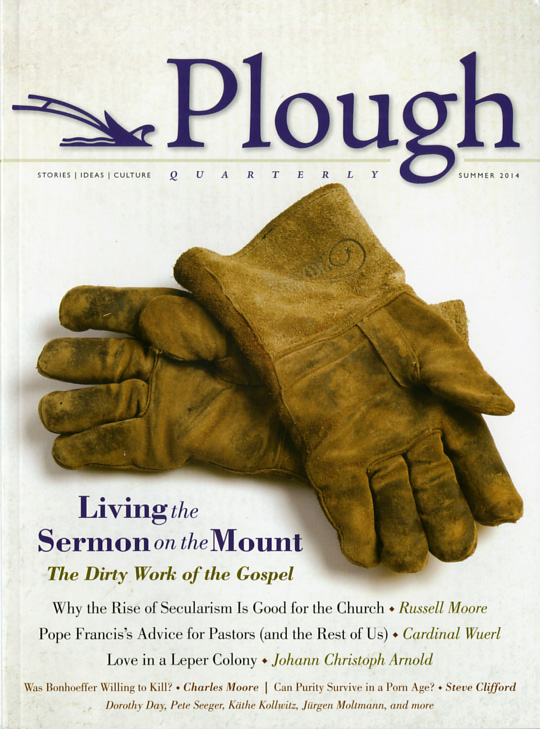
Plough1-1 In a world sometimes gone mad with violence from social and religious contentions and other issues that can only be handled from the far left or the far right; we all need a message of hope and renewal to refresh our hearts and souls and assure us that there is a greater good out there and we do have hope when it comes to a peaceful and loving future.

Not that socially and religiously-charged conflicts haven’t been going on since the Garden of Eden, it’s just that Adam and Eve didn’t have a Smartphone, iPad or computer to send them notifications about the battles every five seconds. Today the dissent is extremely in-your-face and there is no reprieve from it. But there are people out there dedicated to bringing us a different notification and message; one of hope and salvation from all the disunity we see in the world today.

Plough Publishing re-launched its 94-year-old magazine as Plough Quarterly on June 10, 2014. It had been twelve years since the publication went online-only. Since then Plough.com had become a top destination for Christian e-books and online inspiration, and it seemed the editors learned a few things from its success online.

“Magazines are more relevant than ever,” said Sam Hine, publisher of Plough Quarterly in a press release that was released before the magazine’s re-launch. “They have been reimagined to answer a widespread dissatisfaction with the online reading experience. People are hungry for something that isn’t ephemeral—a quick scan, then on to the next thing with a click, swipe or tap. If content has integrity, people will be happy for a beautifully crafted product they can keep around or pass around.”

I spoke with Sam recently about the reasons behind Plough Publishing’s decision to bring back the print component of the brand and the message and mission of the company. As he talked about the compassion and genuineness of the magazine’s purpose: to proclaim the good news of Jesus Christ, his voice was soft-spoken and even, yet firm in his passion for the magazine’s mission and his determination to give his readers a more meaningful and engaging way to connect with that calling, through the power of the printed word.

I hope you enjoy this uplifting and inspiring conversation as much as I did. The words are real and the feelings behind them absolute: love and peace are much more satisfying than their antonyms any day of the week.

And now the Mr. Magazine™ conversation with Sam Hine, Publisher, Plough Quarterly.

But first the sound-bites:

Sam Hine On why Plough Publishing brought back their print magazine after 12 years:
There is also a limit to presentation, how nice you can make the reading experience online. And we heard from readers who missed the print magazine and told us that they would love to receive a quarterly journal from us. All of those things convinced us that it was time to bring back print.
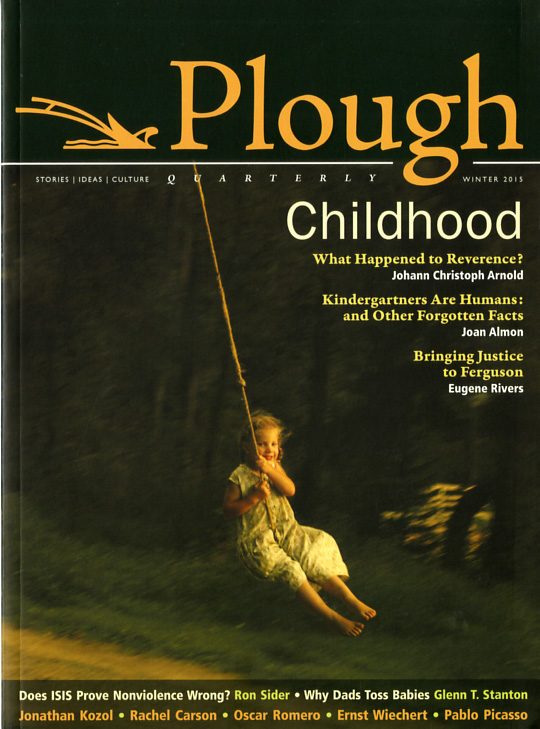
On the DNA of Plough Quarterly and its focus:
It’s published by Plough Publishing House and we also publish books, currently about 12 titles per year, on faith, spirituality and social issues. And the focus of the magazine is to encourage people who want to put their faith into practice.

On why Christian magazines seem to be on the rise with consumers:
I think the United States has always been a very religious country. And I think people have always been serious about their faith. For a magazine like ours to succeed, it needs to offer something different and Plough Quarterly is really for people who are looking to go deeper with their faith and who are very serious about putting their faith into practice every day, not just on Sunday.

On what made him feel there was a place on the newsstands for Plough Quarterly:
Our sales are primarily subscription, but for us it’s important to be on the newsstands too so that new people discover us; that is the main reason we’re there.

On his biggest stumbling block during the re-launch and how he overcame it:
The decision was easy; we just had a lot to learn. The world has changed in many respects; how to promote and market a magazine; how to publish a product that offers something unique and different from what consumers can get online. And I think with each issue we’ve learned something and gotten better.

On his most pleasant moment:
The best thing was hearing from individual readers about how much they appreciated the magazine.

On what keeps him up at night:
Our mission as a publication and a publishing house is to proclaim the good news of Jesus Christ and to reach as many people as possible with the message of forgiveness, reconciliation and renewal that comes when we apply our faith to the needs of our time and we’ve hardly scratched the surface. Every day I think of how few people we’re reaching in comparison to how many are actually out there who need that message.

And now the lightly edited transcript of the Mr. Magazine™ interview with Sam Hine, Publisher, Plough Quarterly.

Samir Husni: Like the rest of the masses 12 or 13 years ago; your company said there’s no future for print, everyone is going online, so let’s fold our printed magazine and go digital. But then last summer you came back with a beautiful, very well-done, quarterly ink on paper magazine; what changed your mind after 12 years and made you decide you needed the print component again?

Sam Hine: The decision was made in 2002 to close the print magazine because we decided we could reach more people at less cost online only. And that was probably true, but over the years since, we had a very successful website, but we felt that the engagement with the material was superficial. People were only spending a few minutes, even less than a minute, on an article and not really thinking deeply about the topics we were raising.

There is also a limit to presentation, how nice you can make the reading experience online. And we heard from readers who missed the print magazine and told us that they would love to receive a quarterly journal from us. All of those things convinced us that it was time to bring back print.

Plough2-2 Samir Husni: For readers who are not familiar with Plough Quarterly, can you give me a little background? I know the magazine was founded in Germany in 1920, but can you give me more about the actual magazine, the movement and its mission?

Sam Hine: It’s published by Plough Publishing House and we also publish books, currently about 12 titles per year, on faith, spirituality and social issues. And the focus of the magazine is to encourage people who want to put their faith into practice. So, it’s applied Christianity; how can we apply what we believe to every area of life, from social issues to current events and popular culture. It’s a magazine of stories, ideas and art to inspire people to put their faith into action.

Samir Husni: Is the magazine published only in the United States, in English, or does it still exist in Germany?

Sam Hine: We’re only publishing in English, but it’s available worldwide. We have many subscribers in the United Kingdom, for example.

Samir Husni: I interviewed Carol Brooks last month from Bauer Publishing and they’re coming out with a new magazine called Simple Grace in April. And this is a secular publishing house that’s putting out a Christian-based monthly magazine on the nation’s newsstands. She quoted a lot of the same statistics that your company did in your press release, such as 77% of Americans are Christians and she also quoted the figures of how many copies the book Jesus Calling is selling. So, they decided to come up with this Christian magazine for the newsstands with a daily meditation for readers. Why do you think we’re seeing this resurgence maybe or renewed interest in Christianity now? Is it the political world that we live in or simply the changes that are happening? Why now?

Sam Hine: I think the United States has always been a very religious country. And I think people have always been serious about their faith. For a magazine like ours to succeed, it needs to offer something different and Plough Quarterly is really for people who are looking to go deeper with their faith and who are very serious about putting their faith into practice every day, not just on Sunday. It is a niche publication for people who are looking to dig deeper.

Another gap that we see we’re filling that other Christian publications for the most part are not, is the ability to build bridges between denominations. There are over 40,000 different Christian denominations and many Christian publications are published by a particular group or geared toward a particular segment. So, one of our goals and focuses is to really reach out across all these barriers and to include voices from all the different streams of Christianity. Plough Quarterly is a place where we can build unity and understanding between Christians of many different flavors and stripes. Jesus’ last prayer was for all of his disciples to be one.
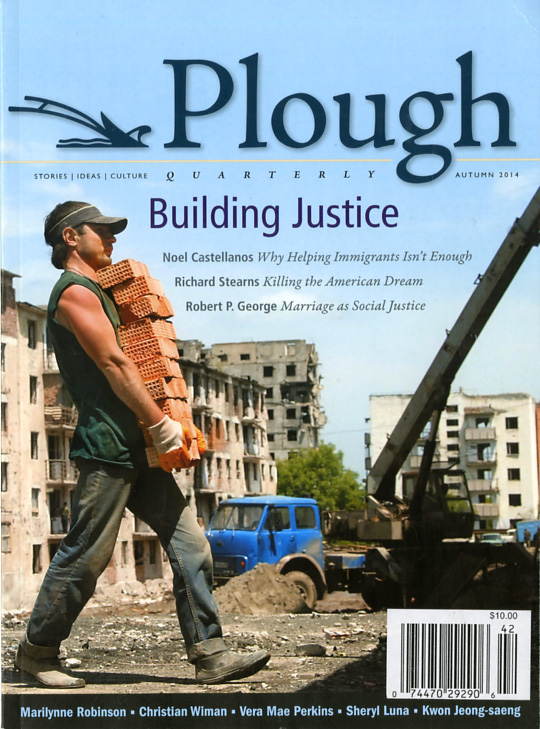
Plough3-3 Samir Husni: I noticed that you put the magazine on the newsstands; in fact I found my copy at Books-A-Million. What made you feel that there was a place on the newsstands for this niche Christian-living type magazine?

Sam Hine: Our sales are primarily subscription, but for us it’s important to be on the newsstands too so that new people discover us; that is the main reason we’re there. We’re in Barnes & Noble as well as Books-A-Million and other independent newsstands. So, the main reason is that new people find the magazine and hopefully subscribe.

Samir Husni: When the decision was made to bring back the printed magazine; what was the biggest stumbling block that you faced and how did you overcome it? Or was the decision and the process easy and it was done?

Sam Hine: The decision was easy; we just had a lot to learn. The world has changed in many respects; how to promote and market a magazine; how to publish a product that offers something unique and different from what consumers can get online. And I think with each issue we’ve learned something and gotten better. And another important facet was that it had to be graphically pleasing. We’ll also sit down and spend a long time with an article and with print we’re able to do a longer form of journalism.

Samir Husni: What was the most pleasant moment with the re-launch?

Sam Hine: The best thing was hearing from individual readers about how much they appreciated the magazine. We’ve been pleasantly surprised; we passed our subscription goals for the first year within the first six months. We were a bit surprised at the reception.

Samir Husni: My typical last question; what keeps you up at night?

Sam Hine: Not Plough Quarterly. (Laughs) Our mission as a publication and a publishing house is to proclaim the good news of Jesus Christ and to reach as many people as possible with the message of forgiveness, reconciliation and renewal that comes when we apply our faith to the needs of our time and we’ve hardly scratched the surface.

Every day I think of how few people we’re reaching in comparison to how many are actually out there who need that message. We’re a mission-driven organization; we’re not for profit and we’ve barely begun. There is so much violence and suffering in the world and if we can encourage a few people each day to make a difference, to step out and do something for others, makes it worthwhile for me to come to work each morning and helps me sleep at night.

Samir Husni: Thank you.

_______________________________________________________________________________________________________________________________
Picture 40

h1

Magazine Launches: “Magazine Power By The Numbers.” A Mr. Magazine™ Exclusive

February 11, 2015

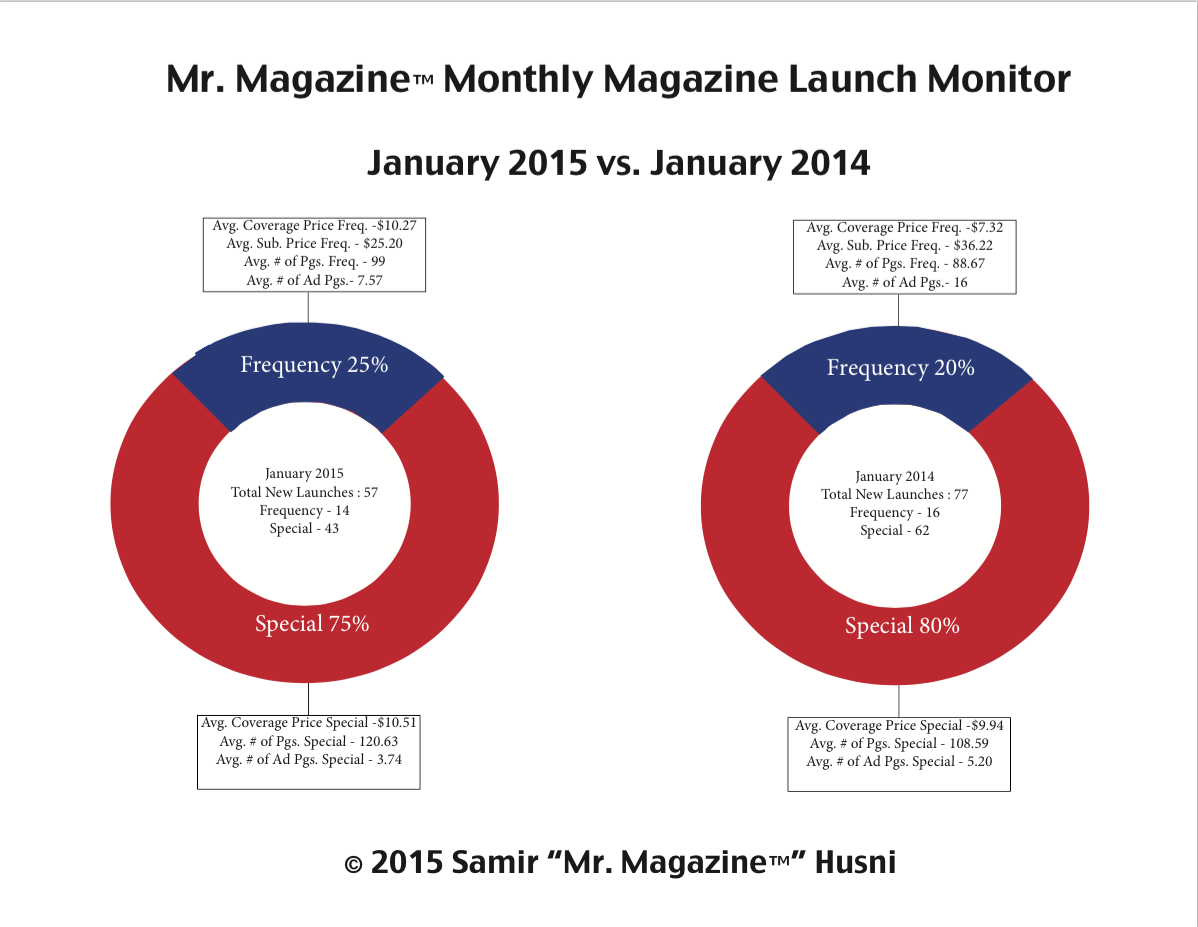
I’ve always said that the vivacity and life’s blood of the magazine industry is in its new launches, as in ink on paper new launches. There is nothing, be it human or otherwise that can continue its species without new birth. And that certainly applies to ink on paper in every way.

The very essence of growth and sustainability is within the confines of creation itself. And Mr. Magazine’s™ Launch Monitor was born from that idea. It is the nursery window where proud parents and relatives or friends of the family can stand and admire the beauty and potential of each newborn ink on paper at their leisure.

monitor
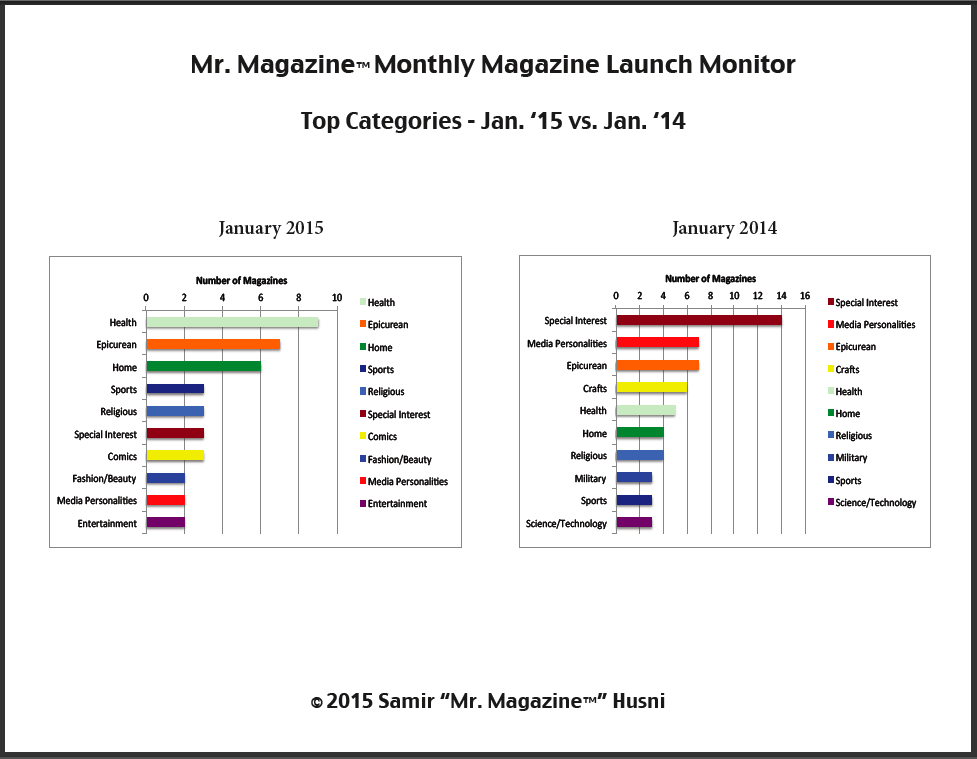
For the year 2015, I’m adding a new feature to the Launch Monitor: yearly comparisons. From the Top 10 categories to the Average Cover Price – each month will have the numbers for 2015 and 2014 for you to parallel and consider. The numbers will speak for themselves and the information will be available along with the usual new magazine launches and their covers.

jan by category

I hope you enjoy this new feature and I hope it brings another detail of our fascinating world of magazines into a clearer focus and understanding, because it’s a given; we can’t know where we’re going until we know where we’ve been…

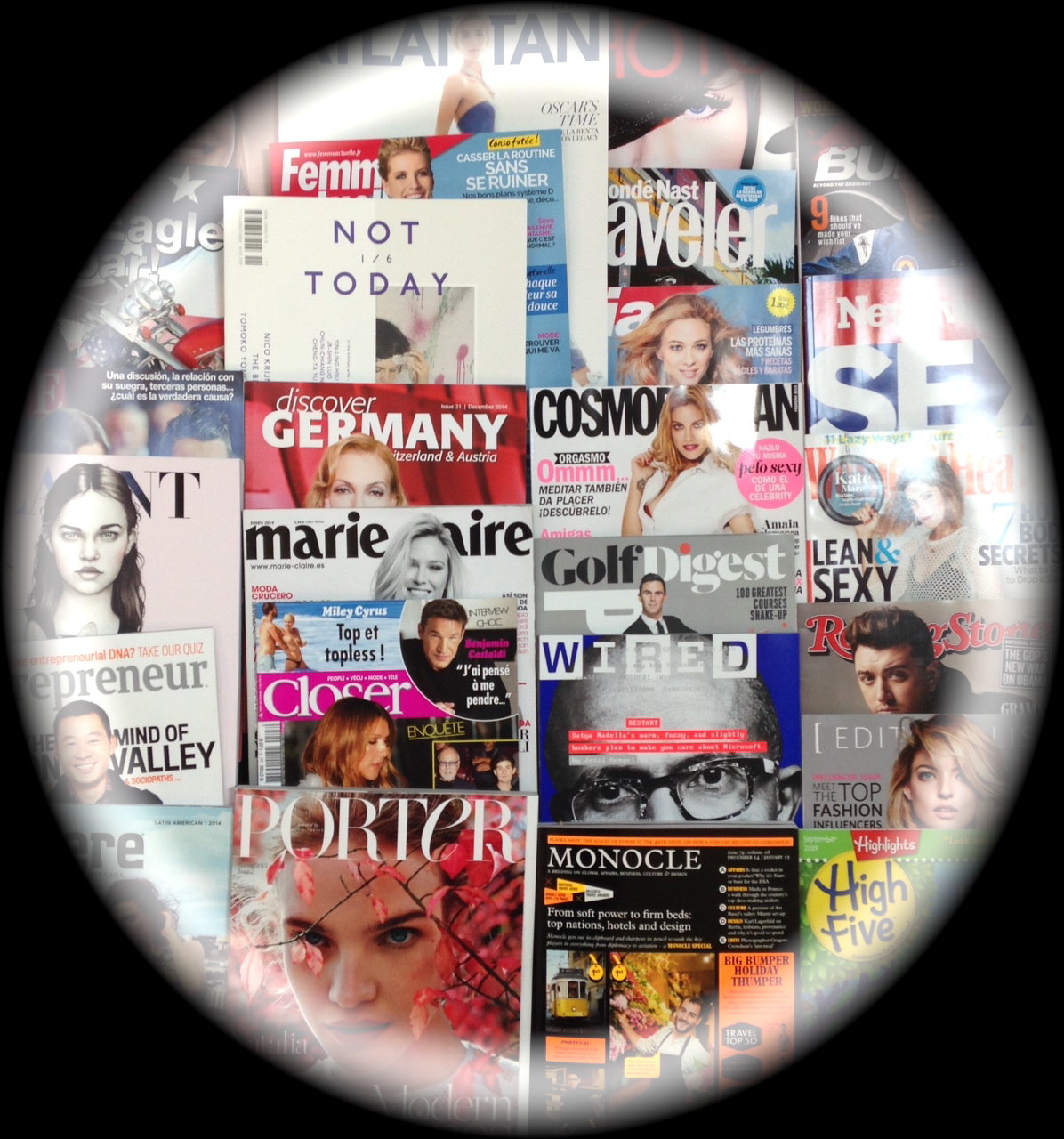
It goes without saying that I have each and every one of the magazines posted on the Mr. Magazine™ Launch Monitor and remember my soon to be trademarked phrase “If It Is Not Ink On Paper, It Is Not A Magazine.”

h1

Monogamy, Addiction and Storytelling – A Trio That Can’t Be Beat…1,001 Mr. Magazine’s™ Blog Posts Takes A Lesson From 1,001 Nights And Passes It On To Magazines.

February 10, 2015

There was a story written long ago, that I’m sure many of you remember reading or hearing about, called One Thousand and One Nights, often known in English as Arabian Nights. Now I won’t give you a long, drawn-out refresher course in literature; suffice it to say, the premise of the story was the King, Shahryar, is shocked to discover his sister-in-law has been unfaithful to his brother for quite some time and subsequently finds out his own beloved bride isn’t so lily-white either when it comes to the art of fidelity.

Magazines Magazines and More Magazines Worldwide... Monogamy, Addiction and Storytelling.

Magazines Magazines and More Magazines Worldwide… Monogamy, Addiction and Storytelling.

The King has her executed and becomes bitter toward all women, marrying a succession of virgins, only to execute them one by one due to his mistrust of the fairer sex. Eventually the Vizier, whose duty it is to provide them, cannot find any more virgins. Scheherazade, the Vizier’s daughter, offers herself as the next bride and her father reluctantly agrees. On the night of their marriage, Scheherazade begins to tell the king a tale, but does not end it; she only leaves him longing for more each night, which does wonders for her ability to stay alive.

And hence, Mr. Magazine’s™ narrative begins where Scheherazade’s left off. Magazines could learn a few things from One Thousand and One Nights. When Digital showed her curvaceous pixels onto the magazine scene, publishing kings were definitely affected by the temptations she offered. And while print was certainly more monogamous than Shahryar’s brother’s wife proved to be; publishing kings were merely chomping at the bit to ‘execute’ their ink on paper spouse and marry every digital maiden that happened along, seeing visions of digital empires and fruitful offspring throughout that new kingdom called cyberspace.

Unfortunately, it didn’t quite work that way for magazine media, or King Shahryar, for that matter; albeit their situations were slightly reversed, with the kings of publishing trusting their new digital brides just a bit too much.

But while Shahryar was always distrustful of women after his brother’s experience, there was one thing for certain, he was still addicted to the opposite sex and kept coming back for more with as many different young ladies as the Vizier could find.

The addiction must be there. Without the desire and magnetic pull urging and demanding the King to try again or in the magazine’s case, the customer’s habitual return to the product, there would never have been a continuing relationship with Scheherazade for him, or a recurrence of connection and relevance with the audience for the magazine.

There is absolutely nothing wrong with the customer being obsessed with your product. In fact, it’s encouraged, just in case someone out there was wondering. A printed magazine is one of the most obsessional items around for human beings who enjoy reading. It’s an experience that plays on all the senses on many levels. So don’t kick it to the curb just because it’s the 21st century. In fact, most publishers today are finding print to be the collectable part of their digital/ink on paper duo, with a lot of digital companies conceiving print components just to add that attribute to their brand. You can’t exactly stick a webpage in the bottom drawer of your grandmother’s antique dresser to pull out later when you have the time to savor it. I suppose you could stick your laptop there, but trust me, the experiences are much different. Not to mention, the computer would most likely be dead anyway, depending on how long it took you to get back to it.

Once you’ve established the addiction factor into your kingdom, never forget the allure and deep satisfaction people have for the art of storytelling. After all, it’s what kept Scheherazade alive every night, that ability that she had to keep the King wanting more.

Weaving enchanting stories into the content of your product will continue that all-important addiction and perpetuate audience connection and repetition in a way that nothing else can.

Just remember that the King’s curiosity about the story Scheherazade told always bought her another day of life. Magazines would do well to remember that lesson.

Monogamy, addiction and storytelling – three points of interest in One Thousand and One Nights and three points of interest in Mr. Magazine’s™ 1,001 blog post. And as it was in Scheherazade’s case, there is always hope when you’re willing to innovate, create and motivate your product to be the best it possibly can.

Until 1,002…

h1

This Pineapple Is To Have, Hold, And Enjoy! The Story Of The Latest Travel Magazine Launch. The Mr. Magazine™ Interview with Publisher Christopher Lukezic.

January 30, 2015

“We believe print is a really unique way to experience content and a really unique way to engage with our readers. The tactile quality of the paper that we’re producing the magazine on, the photography; all of it, really comes to life on paper in a way you can’t necessarily get on a digital screen.” Christopher Lukezic

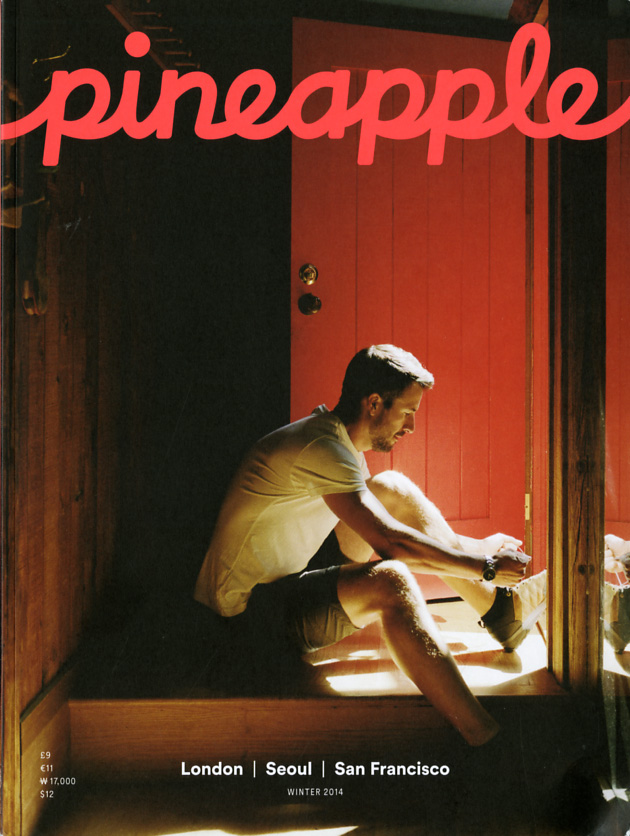
Pineapple-1 Airbnb, the world’s leading community-driven hospitality company, has added another component to their online presence: an ink on paper component, Pineapple magazine. Long known as the symbol for hospitality and welcome, the pineapple was a fruit that survived much during the 1400s and still managed to thrive, according to Pineapple publisher, Christopher Lukezic. It was brought to Europe from the West Indies and quickly became a sweet symbol of cordiality.

And the heritage of the “Pineapple” was a Godsend to Christopher as it represented everything he and his team wanted to present with their very unique travel magazine, which is slated to become the content force and driver of Airbnb’s community of readers and travelers, a hale and hearty symbol of travel that welcomes and greets warmly.

The magazine marks a major step for Airbnb to become not just a platform where stories are created, but where stories are told. Pineapple will reflect the unique perspective of Airbnb’s global community, with deeply local and personal content that hopefully will inspire travelers everywhere.

I reached out to Christopher recently and we talked about the excitement this ink on paper product has produced within the company and about the reasons for it. From the beauty displayed between the printed pages to the tactile feel of the paper itself; Christopher shared why he and Airbnb believe in the power of print as a digital entity themselves and why the distinct point-of-view of the magazine will go a long way in distinguishing it from the multitudes of competition on the newsstands already.

The magazine will cover a wide variety of topics – such as culture, art, food, and style – from a local’s perspective with neighborhood guides, insider tips, and unique, personal stories. Each issue will showcase three different cities through the lens of local community members and global travelers.

So grab your traveling gear and follow Mr. Magazine™ and Christopher Lukezic, Publisher of Pineapple, as they take you on a trip around the world of travel…

But first, the sound-bites:


Christopher Lukezic On why Airbnb chose a print component in a digital age:
I think that Airbnb wanted to be a bigger part of a producer of really high quality travel content. The magazine is a part of a larger effort by the company to move into the world of publishing and producing travel content.

On why he thinks more digital entities are adding a print component to their equation these days:
I believe that there is a certain tactile quality to print that engages with people and that’s something that doesn’t necessarily happen on a digital screen.

On the unique selling proposition he is offering the marketplace with so much competition out there already:
One of the things that we try to do is not to have a prescriptive travel magazine. We’re not a team of editors trying tell people what they should and should not do in a city.

On the major stumbling block he has had to face during the magazine’s conception and launch: You said it earlier: a digital company moving into print. It’s a very new world for us and we’ve been learning a lot as we go.

On that “aha” moment when he knew he’d hit on something special:
We went through a couple of iterations and a couple of ideas early on and we shifted course a few times, but I think for us it really all kind of came to fruition when we landed on the name. And I think that was the moment that we knew we were going to do something really special.

On his distribution strategy for the magazine:
We’re still trying to figure out what the future of the distribution strategy of the magazine will be. You will be able to purchase it and we’ll also distribute it to our community, so both of those ways will continue.

On the relationship between Airbnb the company and Pineapple the magazine: It’s very much a two-way street relationship. The future of this and how it ties into the business and how it relates to our core business, we’re still working on a lot of that, but it will very much be an integral part of the Airbnb experience.

On what he hopes to have accomplished with Pineapple a year from now:
Our real goal with Pineapple is for people to start to think about it as a place where they can come to plan their trip experience, as well as to book accommodations.

On what keeps him up at night:
Not much actually. I’m pretty happy with where things are and I’m really excited about the potential for this magazine and the future of it. The only thing that would maybe keep me up at night is not being able to do everything that we want to do.

And now the lightly edited transcript of the Mr. Magazine™ conversation with Christopher Lukezic, Publisher, Pineapple magazine…

Samir Husni: Airbnb has been a digital entity for almost seven years now, having begun in 2008; why did they decide to go with a print magazine now?

Christopher Lukezic: I think that Airbnb wanted to be a bigger part of a producer of really high quality travel content. We wanted to be a source for people to come to, not only to find great places to stay while they’re on a trip, but also when planning the trip itself; a source where they can find content that inspires them to visit places and also informs them about places they’re already going.

The magazine is a part of a larger effort by the company to move into the world of publishing and producing travel content.

Picture 36 Samir Husni: These days we are seeing more than one digital entity bring print into their equation and in this age where everyone not long ago was predicting the demise of print, we’re actually seeing a reversal of that bleak forecast. Why do you think this reversal is taking place?

Christopher Lukezic: I believe that there is a certain tactile quality to print that engages with people and that’s something that doesn’t necessarily happen on a digital screen. People are surrounded by screens all day long; they’re reading on their phones and their laptops and other digital devices. The engagement of content with print is that you can really get at someone in a different way with it. It’s a little bit of a slower experience and people will come back to it over and over again in the course of a few months, not consuming the magazine all at once, but in sort of bits here and there.

I think that from a travel standpoint print is still a really big part of the travel experience. Every year Google does a lot of research around different industries and they try to figure out what the different experiences are for the different industries. And for travel they put together an insight study every year. And actually they’ve shown year after year that print remains the most important source for travel, once they’re at a destination. When a traveler arrives in a city, print is still the predominant source of information that people use for planning their trip once they’re at the destination.

Those things combined make it an attractive opportunity for us as we move into content, to have a print aspect that is very much at the forefront of our content efforts as a whole.

Samir Husni: As a publisher of a new travel magazine and as you go on your sales calls; what is the unique selling proposition that you are offering the marketplace knowing that there are so many competitors out there?

Christopher Lukezic: One of the things that we try to do is not to have a prescriptive travel magazine. We’re not a team of editors trying tell people what they should and should not do in a city.

All of the content of the magazine is actually from people who live in these places, so we’ve actually gone and found people from every community in the cities that we feature. And we try to discover the city through their eyes. Not only places to see and eat, but to showcase what the life there is really all about.

We try to get at what the actual experience of living in the featured cities is and how these communities have formed over time and how people interact with each other in these cities. And on top of that, there are some tidbits and guides that are more digestible and easier to consume content which is important to travelers as they plan their trips.

But what we really wanted to get at was to honor the cities and unpack them from the inside out, rather than from the outside in. I think a lot of travel magazines approach that in the opposite direction; there’s a team of editors going to places and telling the reader about their experiences in the city and not necessarily going and finding people who live there and allowing them to tell the story.

Samir Husni: What has been the major stumbling block for you as a publisher and how did you overcome it?

Christopher Lukezic: You said it earlier: a digital company moving into print. It’s a very new world for us and we’ve been learning a lot as we go.

The big thing was trying to figure out what direction that we wanted to take with the magazine and how we could engage with our community in the right way. And we really wanted that balance of having this be something that was a collaborative effort that we made in conjunction with our community, but still contain a lot of interesting editorial content which engaged people in the right way. And we found a happy medium.

I think the challenge now is the future and continuing to expand the magazine and our content efforts as a whole, doing that both in print and online. So, we have a lot of work ahead of us and this is just the beginning of the process.

Samir Husni: And what has been your most pleasant moment or that instance when you just sat back and went “aha?”

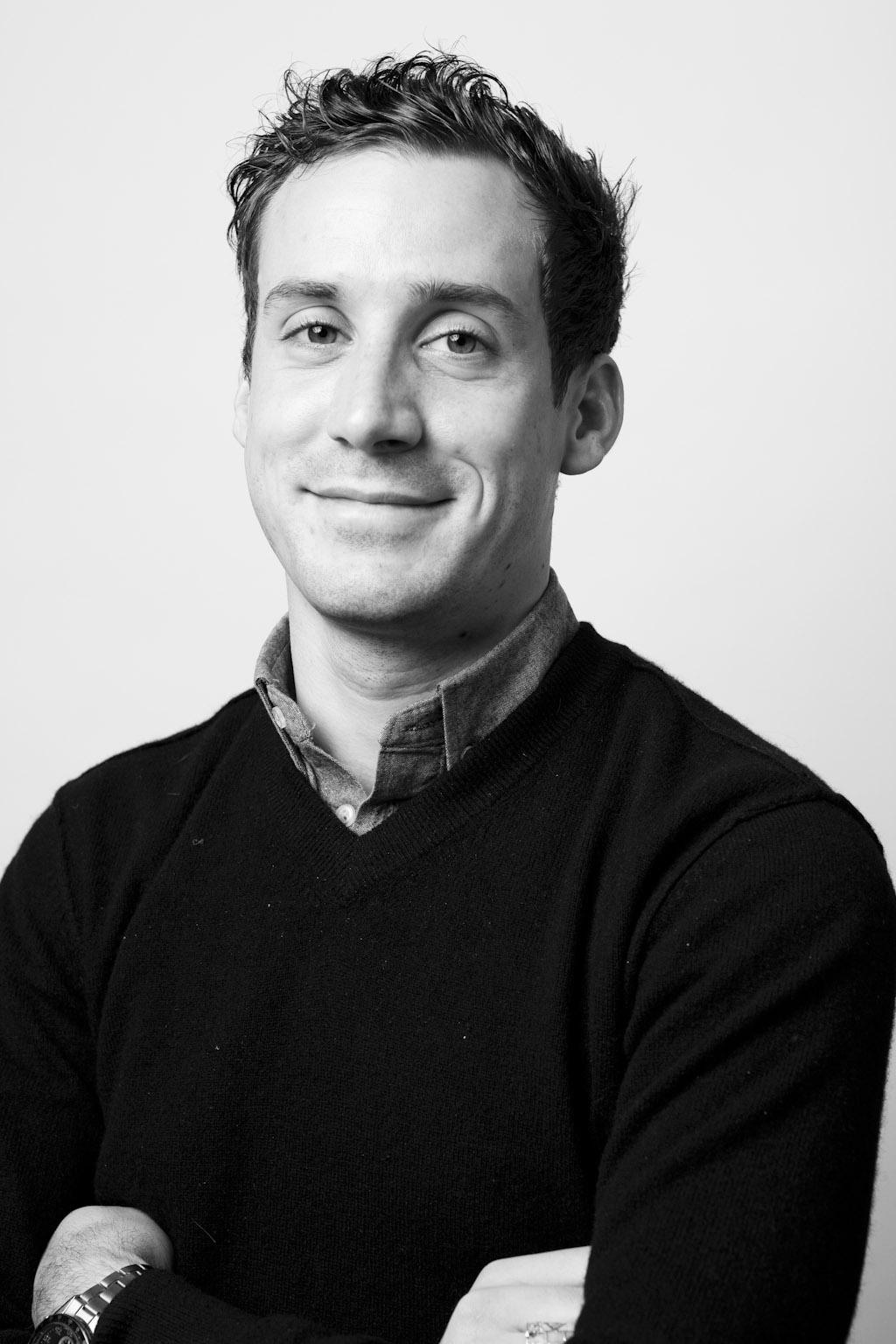
Picture 38 Christopher Lukezic: This has been a team effort and there were four of us that were very involved in the production of the magazine.

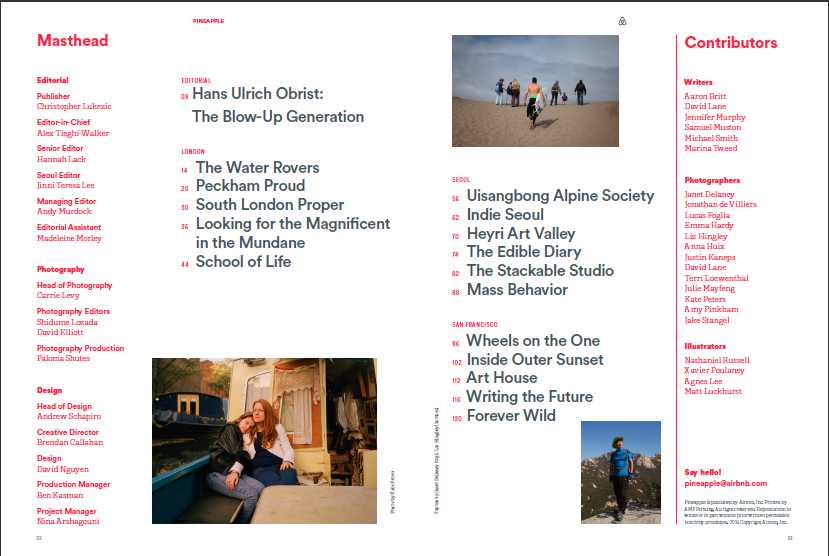
Our editor-in-chief is Alex Tieghi-Walker and Brendan Callahan, who is our creative director and our photo editor, Carrie Levy. The three of them are all from magazine backgrounds and Alex has actually published a couple of his own magazines before and worked for Wallpaper, and so we have some great experience here. But trying to do something new and create something in a crowded market that we really felt proud of was important.

We went through a couple of iterations and a couple of ideas early on and we shifted course a few times, but I think for us it really all kind of came to fruition when we landed on the name. And I think that was the moment that we knew we were going to do something really special. We were struggling to find the right name for this magazine and when it did it was one of those moments when everything just seemed to fall into place. The name really tied together what the magazine is all about.

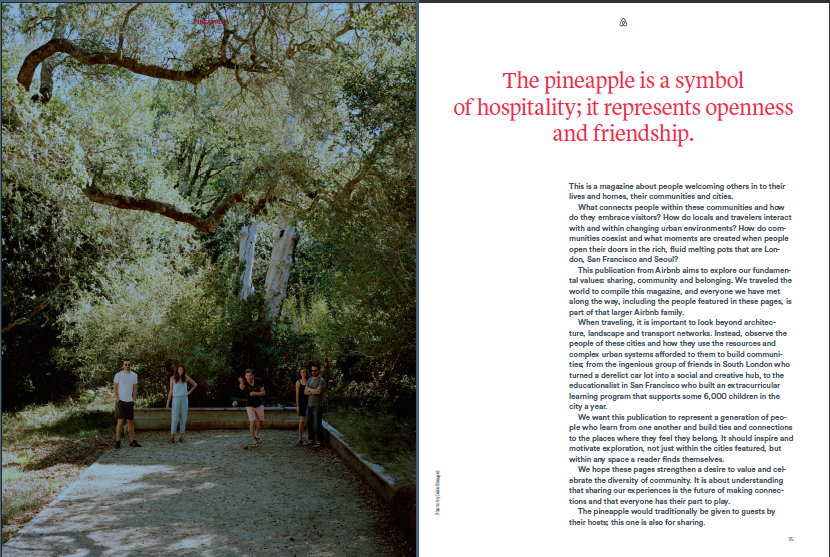
The name Pineapple is a descendant of hospitality; it’s a symbol that has been recognized for a very long time. The fruit was discovered back in the 1400s and was taken back to Europe by travelers and it’s one of the only fruits that survived the voyage from the West Indies back to Europe. And it became the symbol of hospitality. It was something you would leave for a guest when they came to visit you. It was a gracious sign that a host would leave.

And that’s what the magazine presents. We wanted the magazine to be a gift that a host would give to a guest when they arrived at their destination. So, naming the magazine Pineapple really reached the core of what we were trying to do with the content and the print magazine overall. We wanted this to be something that would greet the traveler when they arrived in their city somewhere around the world.

Samir Husni: I noticed that your distribution is divided; once people arrive at the place they are staying, part of Airbnb’s community of customers will get the magazine, or people can buy it on the newsstands at select bookstores. Will that be the norm for distribution, or are you thinking of building more of a presence on the nation’s newsstands and also of having a subscription base?

Christopher Lukezic: We’re still trying to figure out what the future of the distribution strategy of the magazine will be. You will be able to purchase it and we’ll also distribute it to our community, so both of those ways will continue.

We wanted this initial pilot issue to be a limited edition copy and there are 20,000 copies of this first issue, so we knew that it would be something quite special. We actually gave away a number of copies to our community free as a gift. But we also made them available for sale through very boutique shops and newsstands around the world. We’ll most likely be expanding our circulation into something much larger than it is now. But how we’ll actually distribute the magazine, we haven’t decided on.

Samir Husni: Can you describe for me the relationship between the magazine and Airbnb? Are the two entities separate or is it a two-way street relationship?

Christopher Lukezic: It’s very much a two-way street relationship. This is something that we created and all of the people that we feature in the magazine are from our community. These are all people who are active travelers, who are active hosts in the communities, so we have an incredibly diverse audience who read us and also an incredibly diverse community base who want to contribute to the magazine.

This is really a snapshot of the creative process of the world and I think that we’ve captured the most interesting people from our community and in these cities and brought their stories forward. The real pride of the community and the real pride for me is that the whole magazine is produced with the cooperation and in conjunction with our community. The photographers, the illustrators and all of the people we feature are Airbnb community members.

And the future of this and how it ties into the business and how it relates to our core business, we’re still working on a lot of that, but it will very much be an integral part of the Airbnb experience. Pineapple is our content arm, if you will.

Samir Husni: If a year from now, you and I are sitting down and talking about what Pineapple has accomplished in that year; what would you tell me?

Christopher Lukezic: Our real goal with Pineapple is for people to start to think about it as a place where they can come to plan their trip experience, as well as to book accommodations. So we’re clearly seeing it as a place where people come. Maybe they know where they want to go and they might actually rely on some of our hosts when they get to a destination to figure out what they want to do while they’re there.

We think that there is a real opportunity for content to play an important part in that experience. To help people plan trips and also to help people figure out what they want to do once they get to their destination. For us, that is the real goal of the magazine. We really want to be seen as a source for trusted, travel content.

Picture 37 Samir Husni: Will the frequency stay quarterly or are you planning something different for the future?

Christopher Lukezic: We’ve started issue two and it looks like we’ll launch sometime in the summer. From there, our goal is to continue to produce quarterly.

Samir Husni: Would you like to add anything else?

Christopher Lukezic: This is something that is very exciting for us as a company. It’s a new venture. In terms of a company going into print; I think print is very strong and I think it has changed.

We believe print is a really unique way to experience content and a really unique way to engage with our readers. The tactile quality of the paper that we’re producing the magazine on, the photography; all of it, really comes to life on paper in a way you can’t necessarily get on a digital screen. And for us that is really important. It means that the engagement with the magazine’s content and the relationship that people have with it is going to be much deeper than if we only did it onscreen.

Samir Husni: My typical last question; what keeps you up at night?

Christopher Lukezic: Not much actually. I’m pretty happy with where things are and I’m really excited about the potential for this magazine and the future of it. The only thing that would maybe keep me up at night is not being able to do everything that we want to do. We have to limit the things that we put into the magazine and for me that’s sometimes tough. There are things that we want to feature, write about and cover and produce, but we have a limited team and a limited number of resources we have to work with.

But for me, I’m really excited about where things are and I’m looking forward to the future of the magazine.

Samir Husni: Thank you.