I have always been an advocate for a strong editorial letter in the first issue of any magazine. It is essential to introduce the magazine to your audience and to ensure the fact that they understand its mission statement and the role it is going to play in their life. Magazines that launch without such an introduction, to me, are a sign of laziness and lack of care of their audience.
What follows is the launch editorial of Digest Of Treatment that its first issue appeared on the nation’s newsstands in July 1937 and was aimed mainly at doctors. Under the heading “We Begin,” the editorial went on to say, “First issues, to almost everyone, are an exciting curiosity. To the collectors, they have intrinsic value; to the critics, they have a dissecting table value; and to the editors, authors, and publishers, they have a deep sentimental value.”
It continued, “Our purpose in presenting a monthly periodical, “Digest of Treatment,” free from any suggestion of advertising bias, is three-fold: first, to bring to the practitioner, in brief form, the newer developments in the technic of treatment; second, to stimulate an interest in the worthwhile current medical literature today; and third, to bring to those physicians who have become defined as specialists, a well-rounded viewpoint regarding branches of medicine other than their own.”
The editorial added, “Each month, Medical Editors, every one a clinical practitioner, carefully select, from over two hundred journals, material to be condensed. In their selections they choose both the favorable and unfavorable reports, realizing that the physician is keenly interested in the unbiased evaluation of the therapy he contemplates trying. The digests and condensations, selected and made by men of clinical experience, fill a need expressed by physicians many times.”
Digest of Treatment continued, “No physician engaged in practice has available the complete current literature of the medical profession, nor does he have the time to look over thoroughly more than three or four periodicals. The presentation of outstanding articles in this convenient form, “Digest of Treatment,” saves the practitioner many hours of research.”
The editorial concluded by stating that, “The editors will always welcome suggestions and criticisms from their fellow workers. They invite a hearty participation in the enterprise through which they serve the interests of medicine. All communications will find a receptive ear.”
It’s a known fact that the average sell-through (number of copies sold from the copies sent to the newsstands) is at best 30% and at its worst less then 20%. That is to say that from every ten magazines sent to the newsstands, only 2 or 3 magazines are sold, and the rest are returned to “the shredder.” You will say, this is a lot of waste in this environmentally conscience world we live in.
However, it is also known that if you reduce the number of copies you place on the newsstands, you will reduce the number of copies you will sell. This dilemma is not new; it dates back as far as magazines were placed on the newsstands.
So how do we solve this problem? One solution comes from the United States government: No returns are accepted. Yes, that was the solution of the issue of returns in 1918, more than a century ago.
In an editorial titled “Roycroft on News Stands” dated September 19, 1918, in the October 1918 issue of Roycroft magazine, the editors wrote, “We have always tried to give ROYCROFT a very thorough distribution on all the News Stands throughout the country, and in doing so, of course, have had to be generous in the matter of returns from the dealers.”
The editorial continues, “The Government now asks all publishers to restrict these returns. This means that practically every News Dealer will order only such quantities of ROYCROFT as he has advance orders for. He cannot take chances on being stuck with a bunch of unsold copies. There should be no unsold copies, anyway, but occasionally there are.”
The editors came up with a solution to this problem by suggesting to “all readers of ROYCROFT who have been purchasing the Magazine on the News Stands, that it will be necessary for them to order the Magazine – NOW—from their dealer, or else they may be unable to get it on the Stand.”
Another option the editors offered the readers of Roycroft magazine, “If, for any reason you would rather not place a definite order with your local News Dealer, send in your subscription to us. This will insure your getting the Magazine every month.”
The editorial ends up with a plug about the magazine, “ROYCROFT will present to its readers a series of articles each month, touching upon vital things and viewed from the unusual standpoint. It will continue to be of vital interest, and we want you with us for all time.”
So, here you have it, a solution from 1918 only preserved in print where history comes alive on every page of the printed magazine. Print preserves history and history needs print to be preserved.
To find out more of the golden olden gems from magazines please visit the Samir Husni Magazine Collection at The University of Missouri-Columbia by clicking here.
I am holding in my hands a copy of Life magazine from March 26, 1925. Yes, you read that right, a copy of a magazine published 100 years ago. The magazine feels, looks, and reads like many magazines published today. A nice cover, good content, plenty of illustrations, and a promise for the future, “While there is Life There’s Hope.” And hope is what I see and feel every time I pick up a copy of a magazine from a century or two ago.
Print is permanent. A magazine, once printed, is permanent. You can’t change a thing, not even a comma. There is no backspace or delete button. What you see is what you get: yesterday, today, and tomorrow. You can own it and you can proudly say it is mine. That sense of ownership satisfies the human need in all of us to own things, lots of things (Just look at your house or apartment and see how many things you have, even those you do not need).
Flipping through the pages of this issue of Life, I am transformed to a simpler, calmer world where, I can “select colors and upholstery,” for my “custom Cadillac,” or enjoy my Wrigley’s chewing gum “after every meal.”
I am also reading the prize winner’s answer to the question, “Is Democracy a Success?” H.W. Davis won the $50 prize for the following answer: “ Democracy is a rip-roaring success. If you don’t believe so, say out loud that it isn’t – and run for your life. Democracy pats the greatest number of people on the back and makes the most promises. Of course it seldom delivers. But what of that? We live and are made happy by promise, not performance.
And happiness is success, for all that anybody has been able to prove to the contrary. Ergo, democracy is a success.
There! The pup has his tail in his teeth.”
So, here you have it. I am reading and flipping the pages of a magazine from 100 years ago, exactly like I read and flip the pages of a magazine from March 26, 2025. I wonder if I can say the same thing about any of my digital devices? Heck, I can’t even use my camcorder from 20 years ago, yet I can look at my printed pictures from 50 years ago.
Long live print and long live permeance. Print will be here long after I am gone, the same it was here long before I was born.
One final note, there is nothing permanent about digital, even a PDF can be changed and altered. You can’t do that to a magazine. It is permanent.
Enough of that, I have some reading to do…the first issue of Art Lovers magazine from January 1925…To be continued.
PS: If you want to journey through thousands of magazines from yesteryears, check The Samir Husni’s Magazine Collection at my Alma Mater The University of Missouri-Columbia here.
Unlike today’s mass media, magazines in the year 1942, specifically July, were united across content, audience, genre, age, etc. United they stood and proudly displayed the American flag on their covers to celebrate and educate their audience that the country was “United We Stand” as the country entered WWII.
Picking up any magazine in July of 1942, people felt patriotic. Regardless of the nature of the magazine, all magazines were dedicated to a campaign to support the war and unity among the people of the United States of America. Compare this to today’s mass media, whether satellite or cable television, social media, or even magazines, readers and viewers feel that they live in two countries. No longer United We Stand, but rather Divided We Sit.
As we approach the elections of 2024, both presidential and congressional, I hope these magazines of July 1942, will bring back that spirit of optimism and freedom that engulfed our nation in the 40s. Of special note is the July 25, 1942 issue of Liberty magazine with General James Doolittle on the cover. This copy of the special collector’s issue is signed by the general himself. For those of you who are too young to remember him, he is the one who flew over Japan in what is known as the Doolittle Raid.
Liberty magazine, as I mentioned earlier, was but one of many American magazines joining forces in the United We Stand campaign in supporting the country in times of crisis. Other magazines included the general interest magazines led by Reader’s Digest and National Geographic.
Even the children magazines joined the campaign. Jack and Jill magazine sported the American flag on the front cover and the Pledge of Allegiance on the back cover. The magazine used red and blue colors on every page.
Not to be outdone by the general interest and children magazines, women and men magazines did the same. American Home and Pic are but two examples of those genres. United We Stand indeed. When the mass media were a force to unite and not divide. For what it’s worth, I blame the 24/7 cable news channels with the beginning of division in the country that was then rapidly accelerated by social media.
I recall my former journalism professor telling us one day, “if everyone thinks that he or she is a journalist, then no one is a journalist.” That is the beginning of our problem and that’s why divided we sit in front of our phones, tablets, and the many cable and satellite channels. I hope it is not too late to be United We Stand, because the alternative is nothing short of a disaster.
As always keep in mind that if you would like to take a dive into the “oldies but goldies” magazines of the past, feel free to reach to John Henry at the Special Collections division of The University of Missouri Libraries and ask for the Samir Husni Magazine Collection. Until the next musing, stay tuned …
Magazine making is an art. It was, is, and always will be. However, there is great art, mediocre art and just plain bad ugly art. To each its own. Continuing my journey into the magazines from years gone by, let alone a century, I happened to come across the first issue of Horizon magazine from September 1958. It is a hard back that is encyclopedic in look and content.
The editors wrote in the foreword (two full pages) to the first issue: “We take for our title the word horizon because it is here, where earth and sky meet, that one may observe those jagged interruptions in the landscape that are the words of man: the squat mud houses of ancient Sumer;” The editors continued, “the gleaming statuary of the isles of Greece; the stately sky line of Venice when “she did hold the gorgeous East in fee”; a perfect bridge in Peking; our own soaring, protean civilization; all that moved Milton to write that
Towered Cities please us then,
And the busie humm of men.
I wonder if today’s reader would need a translation of the above. Remember, this is just part of the foreword of the magazine. The editors continue, “Culture, the concern of this new magazine, is both achievement and dream, a work of hands and a movement of the spirit, the special property of man since the great miracle of the Sixth Day – since Darwin’s hairy quadruped dropped from his tree and (how many millennia later?) first lifted up his gaze to seek something beyond mere food and drink.”
If that’s not enough of pure excellent prose, read on and say how magazines were made and how they were meant to be. The editors of Horizon continued, “ Culture is art and ideas, past and present, taken in sum as a guide to life. It is history too, the science which Dionysius tells us is “philosophy teaching by examples,” with philosophy suspended between the I-believe of theology and the I-know of science.”
The editors added, “ This magazine in any case is commenced in the belief that some better guide than now exist in America is needed to the house of culture, with all its thousands of rooms.” In conclusion, the editors wrote, “We invite all those whose interests lie in this broad field, whether as contributors or readers, to join us in this venture.”
When was the last time you read something like this? Something that makes the magazine a piece of art to keep and collect? Are the magazines of today worth keeping? Are they a “better guide than” what exists in America today? You be the judge and the jury.
Would love to read your comments. As always keep in mind that if you would like to take a dive into the “oldies but goldies” magazines of the past, feel free to reach to John Henry at the Specia Collections division of The University of Missouri Libraries and ask for the Samir Husni Magazine Collection.
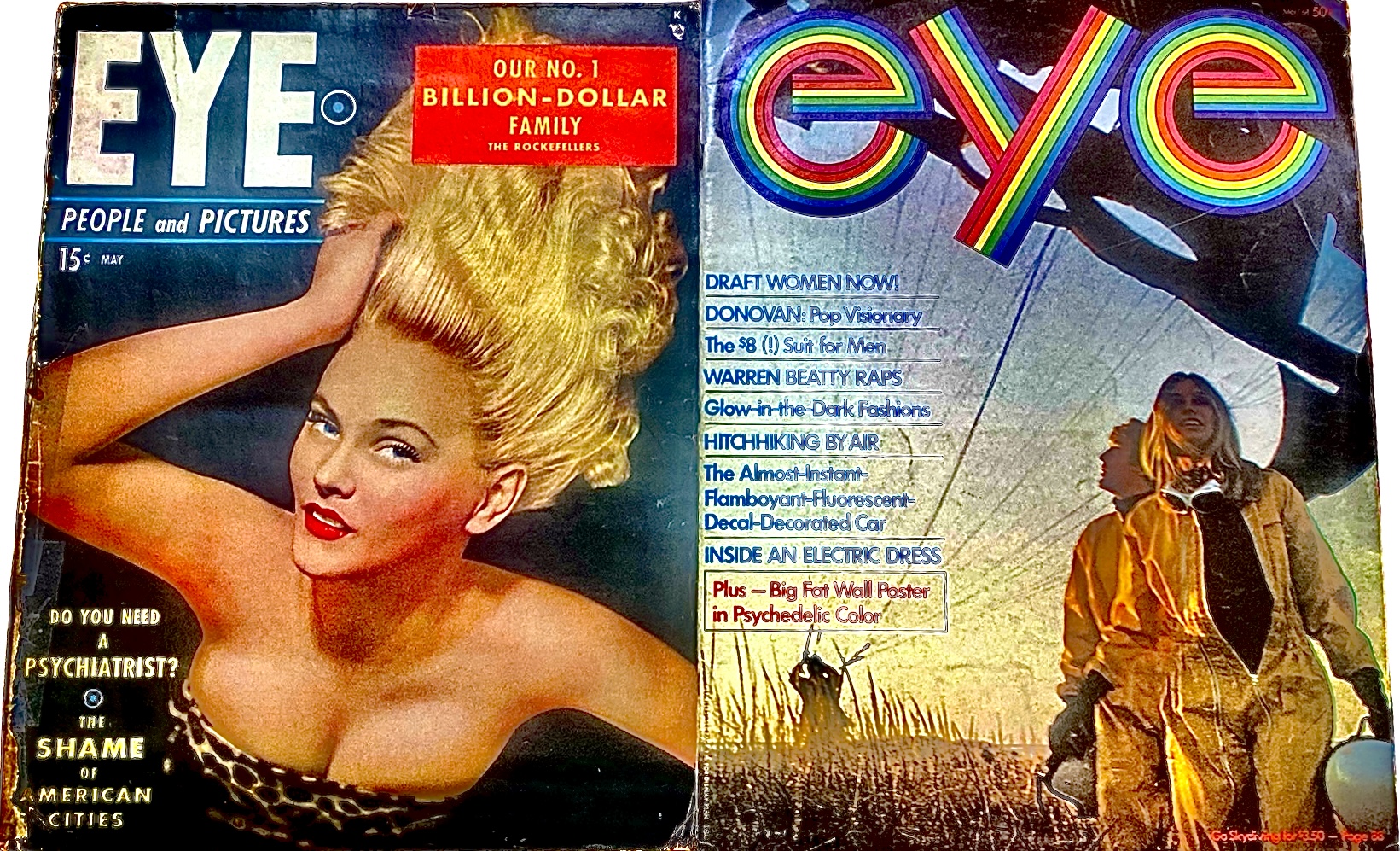
That is two Eye magazines. One from the days before I was born, and the other when I was a 13-year-old teenager. However the two Eyes have a lot in common and few good lessons to learn if you ever thought or think of going into the magazine business. And by magazine, I mean the ink on paper publication that is published on some regular frequency.
So without any further ado, here are the lessons I have found in those two Eyes that are still applicable in the year 2024, some 75 years after the first EYE was born:
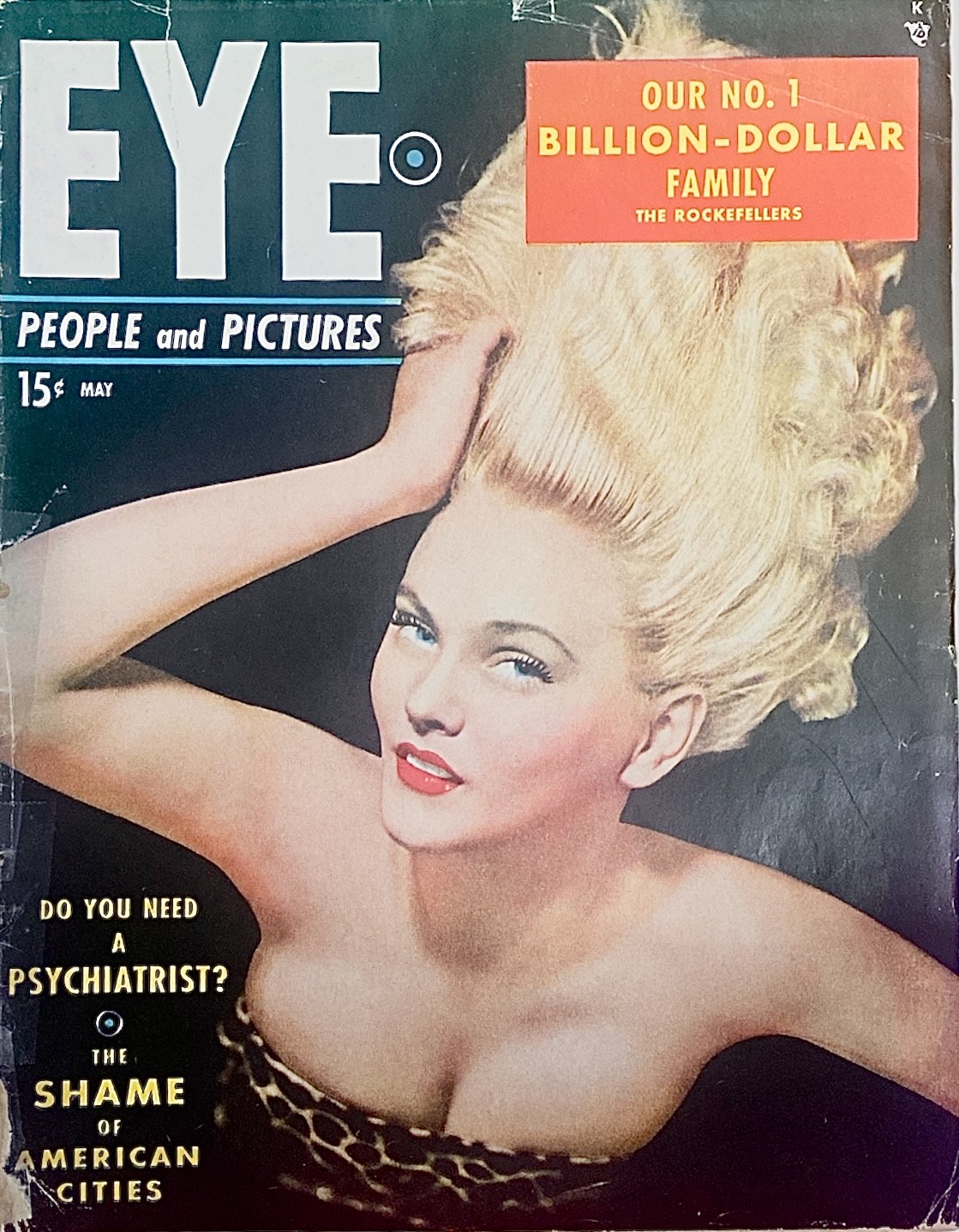
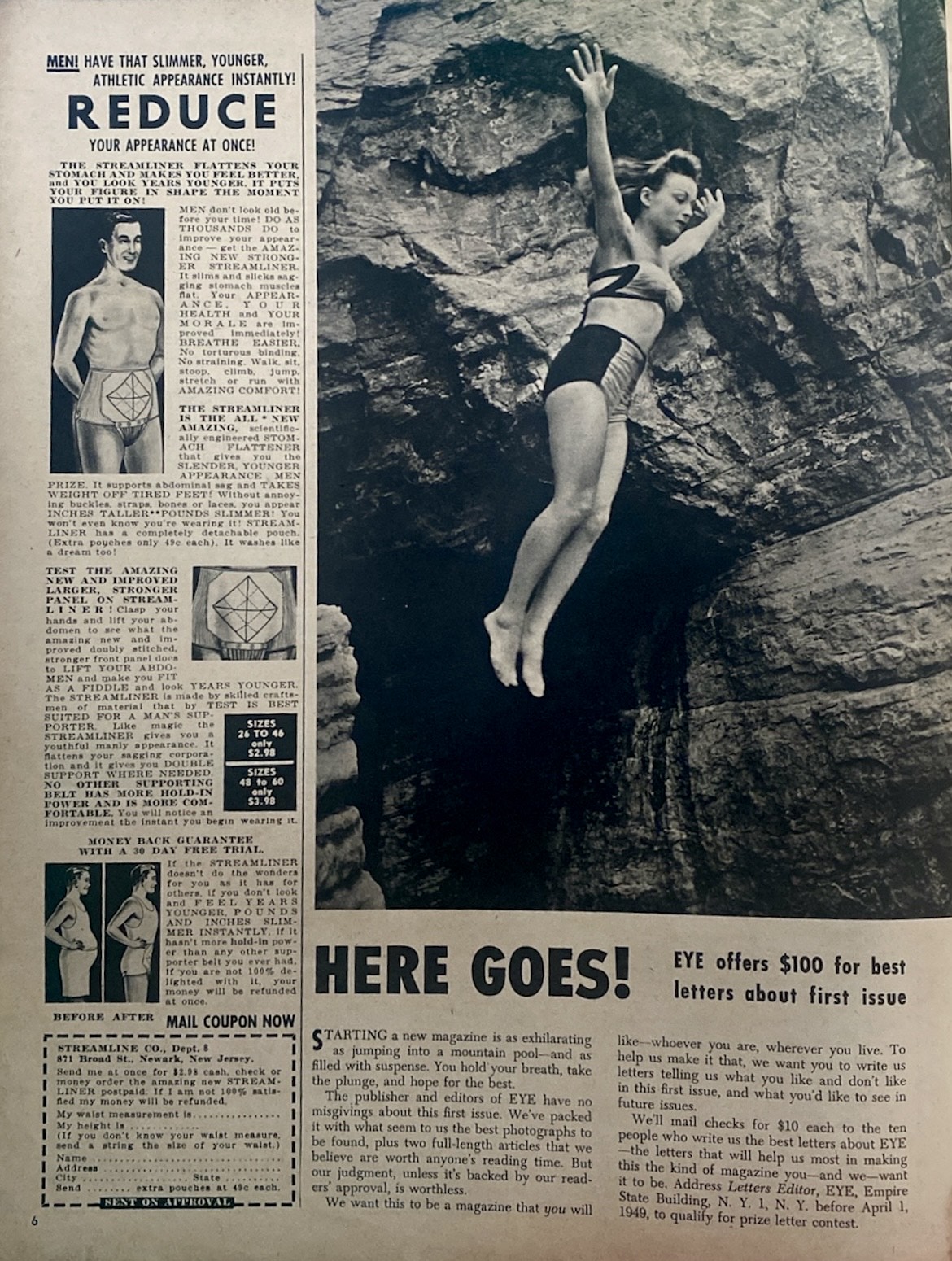
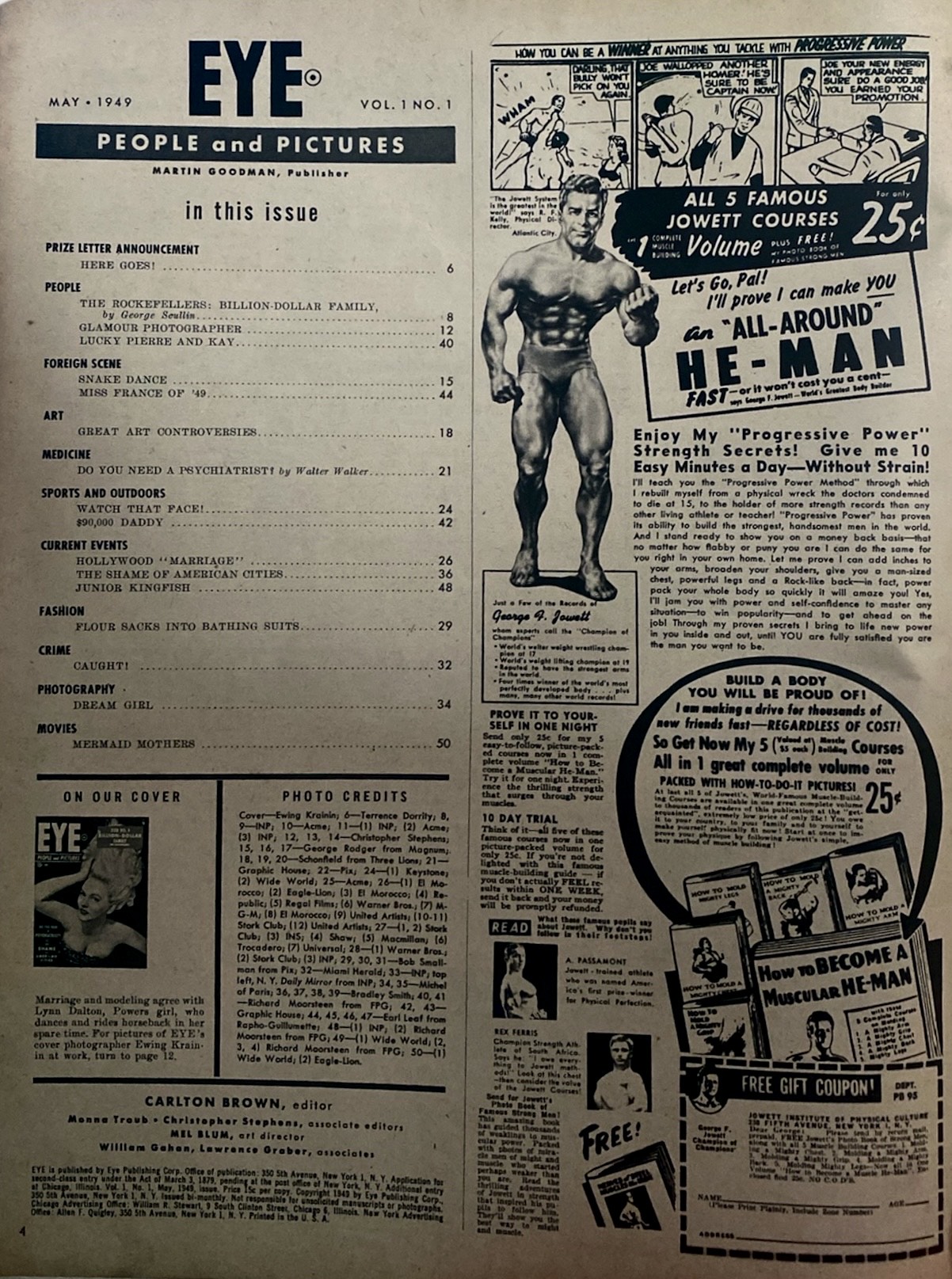
Lesson number 1: Magazine publishing is not for the faint of heart. In 1949 when the first EYE ( Martin Goodman, publisher and Carlton Brown, editor) was published, magazines were the only mass medium available to the public nationwide. This EYE was first published in May 1949 with the tag line “People and Pictures.” The editors wrote in the first letter to the readers, “Starting a new magazine is as exhilarating as jumping into a mountain pool – and as filled with suspense. You hold your breath, take the plunge, and hope for the best.”
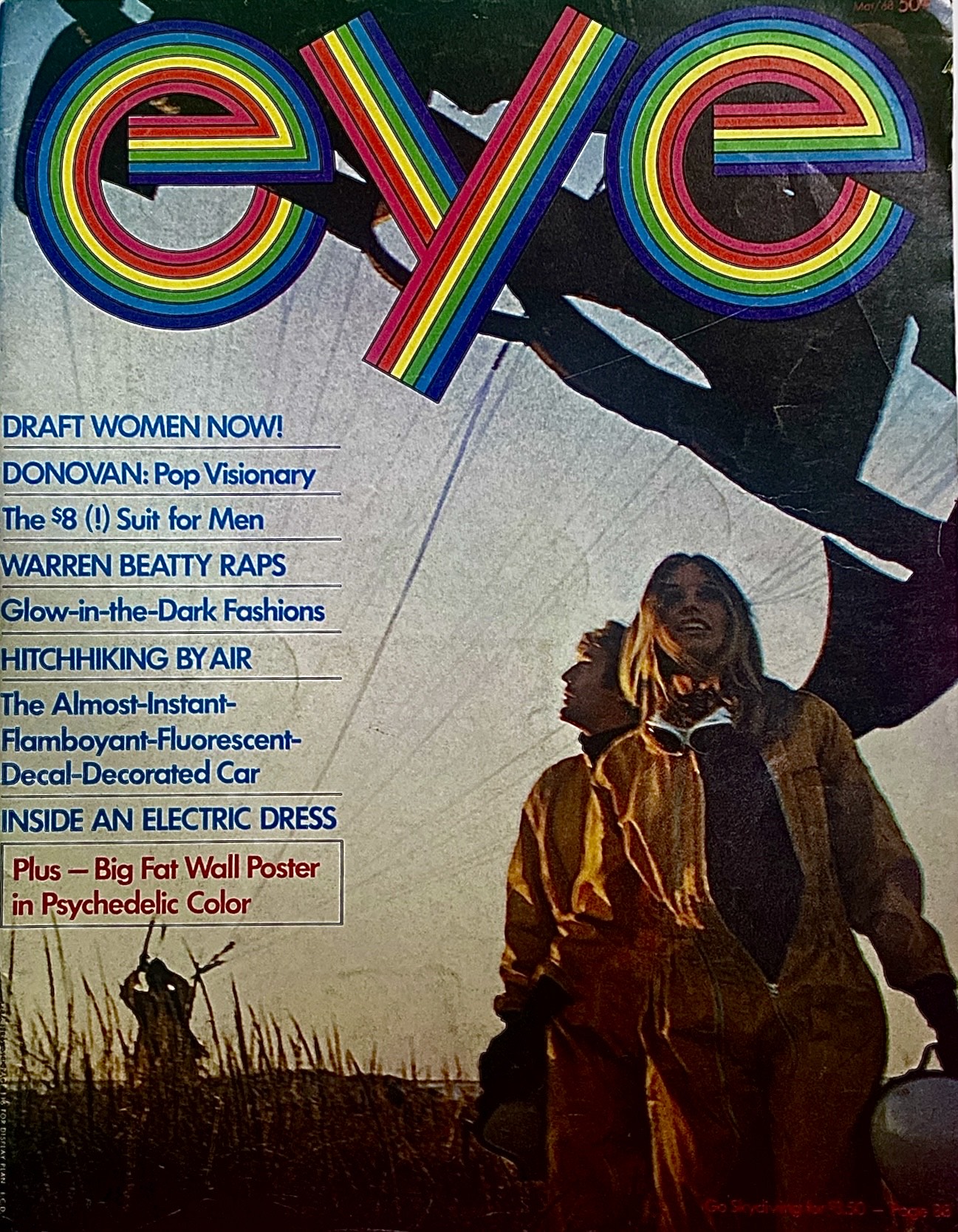
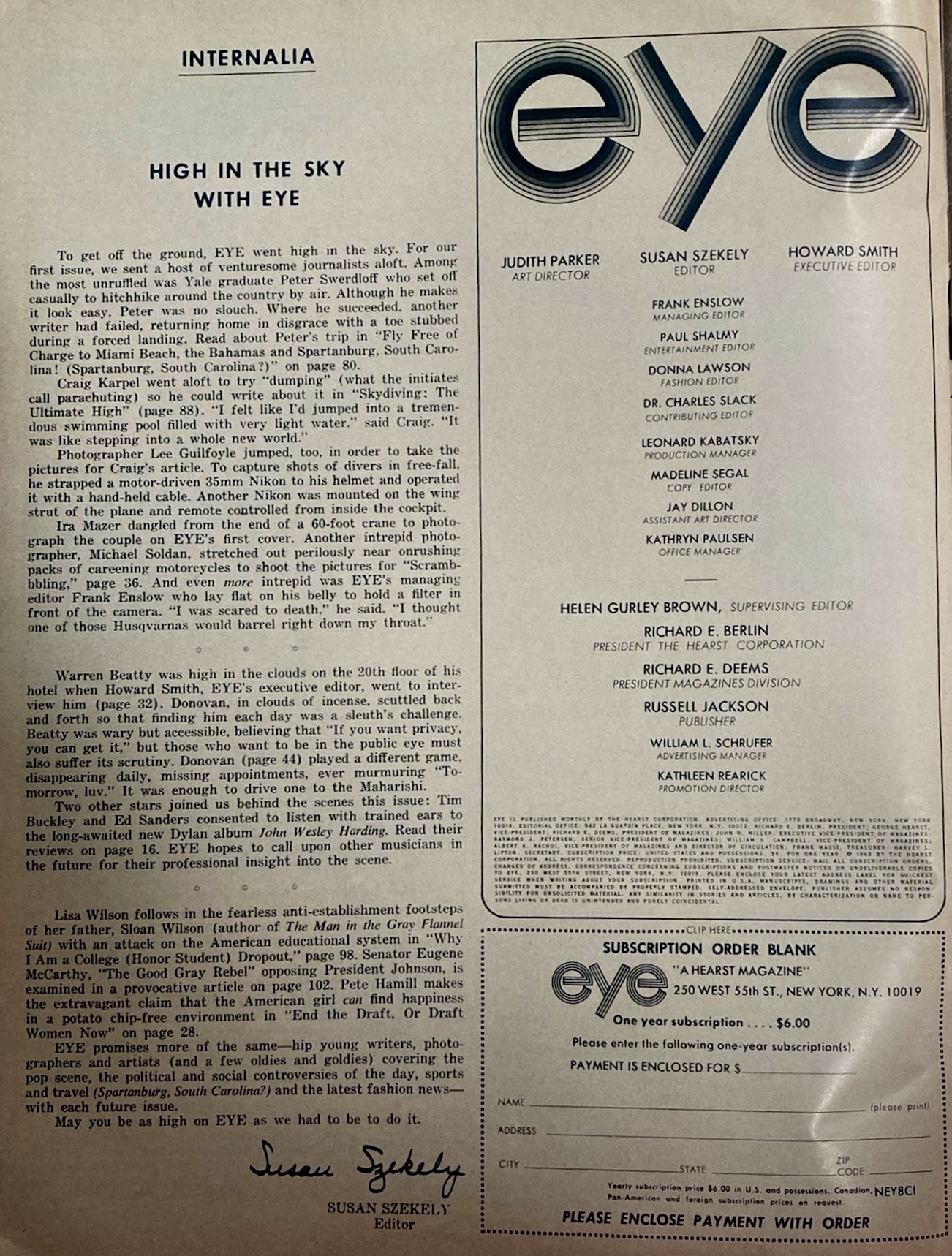
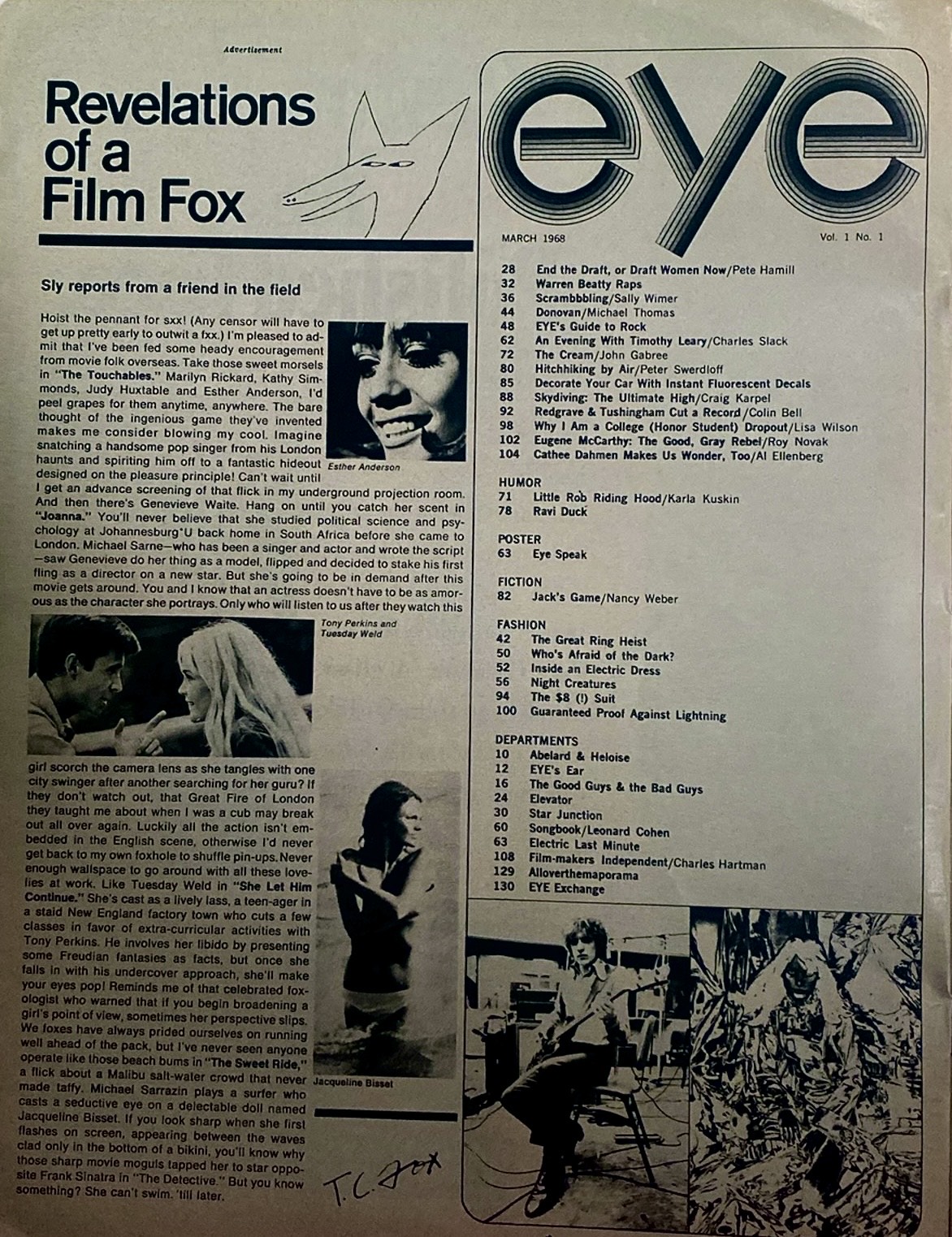
In March of 1968 editor Susan Szekely, wrote in the first issue of the Eye published by the Hearst Corporation (Helen Gurley Brown was the supervising editor), “ To get off the ground, EYE went high in the sky. For our first issue, we sent a host of venturesome journalists aloft. Among the most unruffled was Yale graduate Peter Swerdloff who set off casually to hitchhike around the country by air. Although he makes it look easy, Peter was no slouch. Where he succeeded, another writer had failed, returning home in disgrace with a toe stubbed during a forced landing.”
Both magazines took calculated risks and knew that magazine publishing, even in the 40s and 60s of the last century was not for the faint of heart.
Lesson number 2: Plea for help from the audience.
Without your readers, the magazine is not going anywhere. Readers input is essential. EYE of 1949 offered readers money for the best letters about the first issue. “We want this to be a magazine that you will like – whoever you are, wherever you live. To help us make it that, we want you to write us letters telling us what you like and don’t like in this first issue, and what you’d like to see in future issue,” the editors wrote. They continued, ‘We’ll mail checks for $10 each to the ten people who write us the best letters about EYE – the letters that will help us most in making this the kind of magazine you – and we – want it to be.”
Hearst’s eye was more on the wishful side of things with the audience. “May you be as high on EYE as we had to be to do it,” wrote the editor.
Lesson number 3: Great content was and will always be king and queen.
The importance of good quality content is as important as it was in 1949. For magazine content goes beyond good writing to include good photography, design, and the art of packaging a coherent and pleasing publication both for the eye (pun intended) and the brain. “The publishers and editors of EYE, have no misgivings about this first issue. We’ve packed it with what seem to us the best photographs to be found,” EYE’s editors wrote, “plus two full-length articles that we believe are worth anyone’s reading time.” The editors were humble enough to admit, “But our judgment, unless it’s backed by our readers’ approval, is worthless.”
As for the May 1968 Hearst’s eye, the editor wrote, after paragraphs of introducing the writers and photographer for the volume 1, number 1 issue, “EYE promises more of the same—hip young writers, photographers and artists (and a few oldies and goldies) covering the pop scene, the political and social controversies of the day, sports and travel (Spartanburg, South Carolnia?) and the latest fashion news—with each future issue.”
Publishing a magazine, a good magazine still depends on those three premises stated above. Recognizing it is not for the faint of heart, engaging your audience from the very beginning, and providing excellent content that can’t be found any other place.
If you would like to take a dive into the “oldies but goldies” magazines of the past, feel free to reach to John Henry at the Special Collections division of The University of Missouri Libraries and ask for the Samir Husni Magazine Collection
It happened to me. I don’t need to read about it or get the proof from any other place. Ad fraud on our digital devices and platforms is well documented, so, my story is but a drop in a sea of fraud. Here is my story:
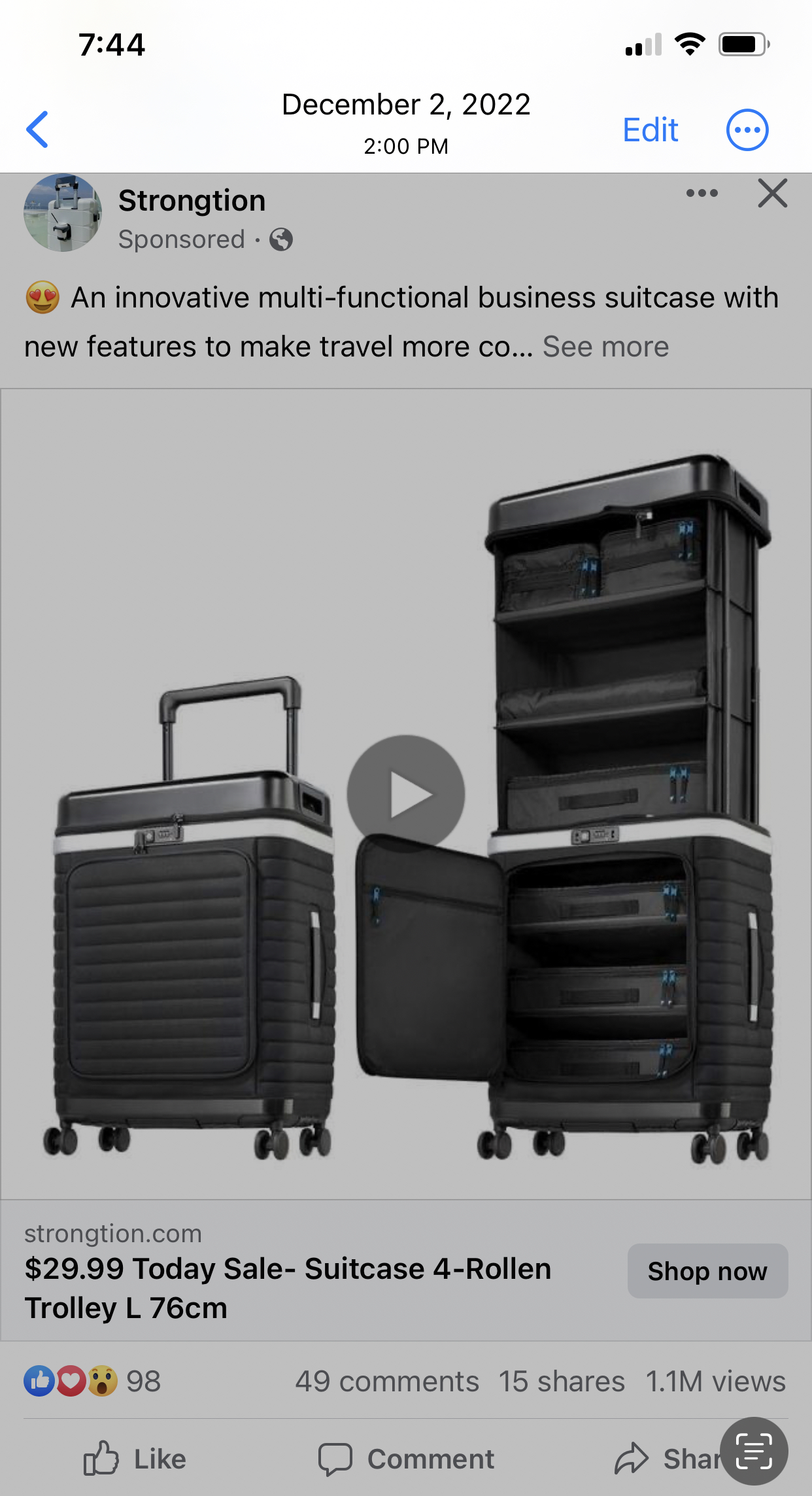
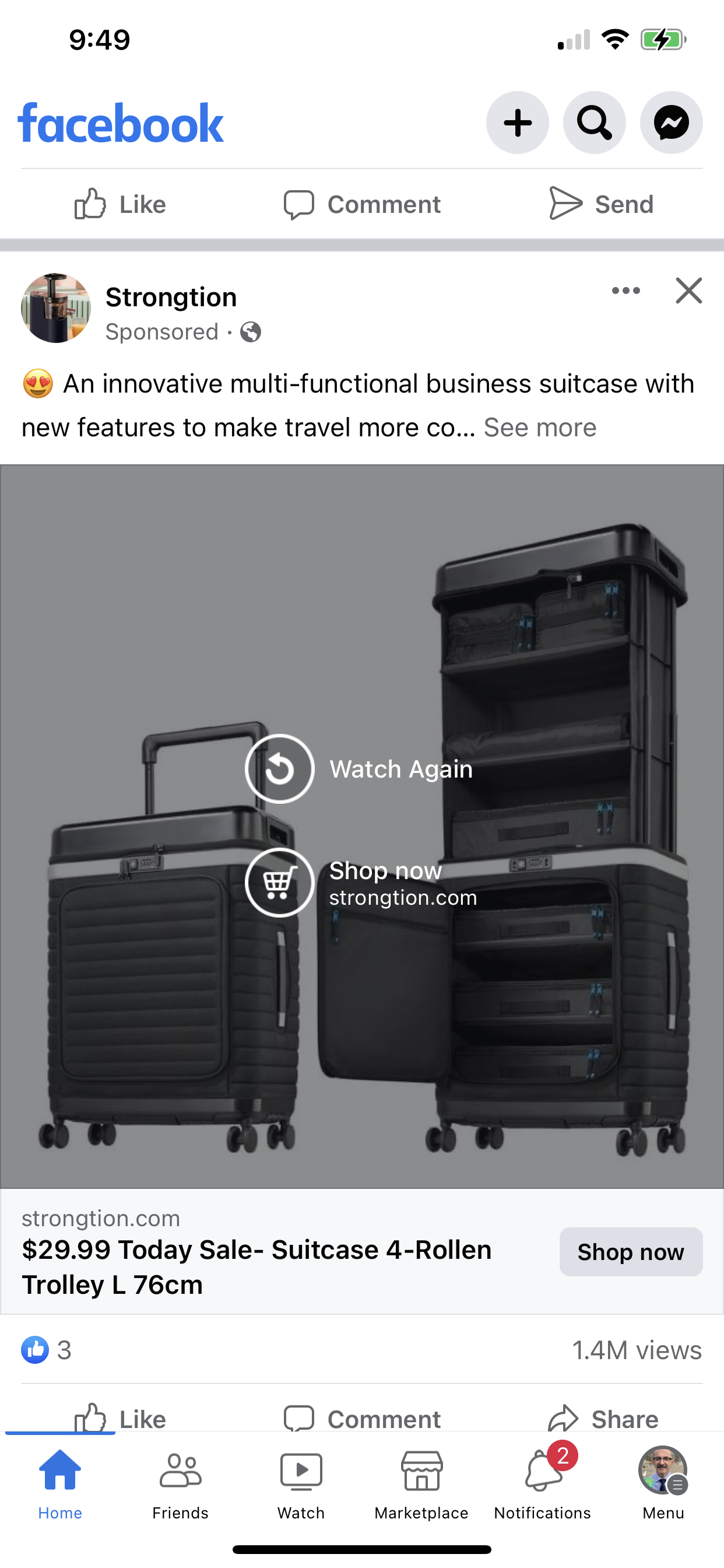
An ad appeared on my Facebook page promising a beautiful carry on piece of luggage for an unbelievable price. See below:
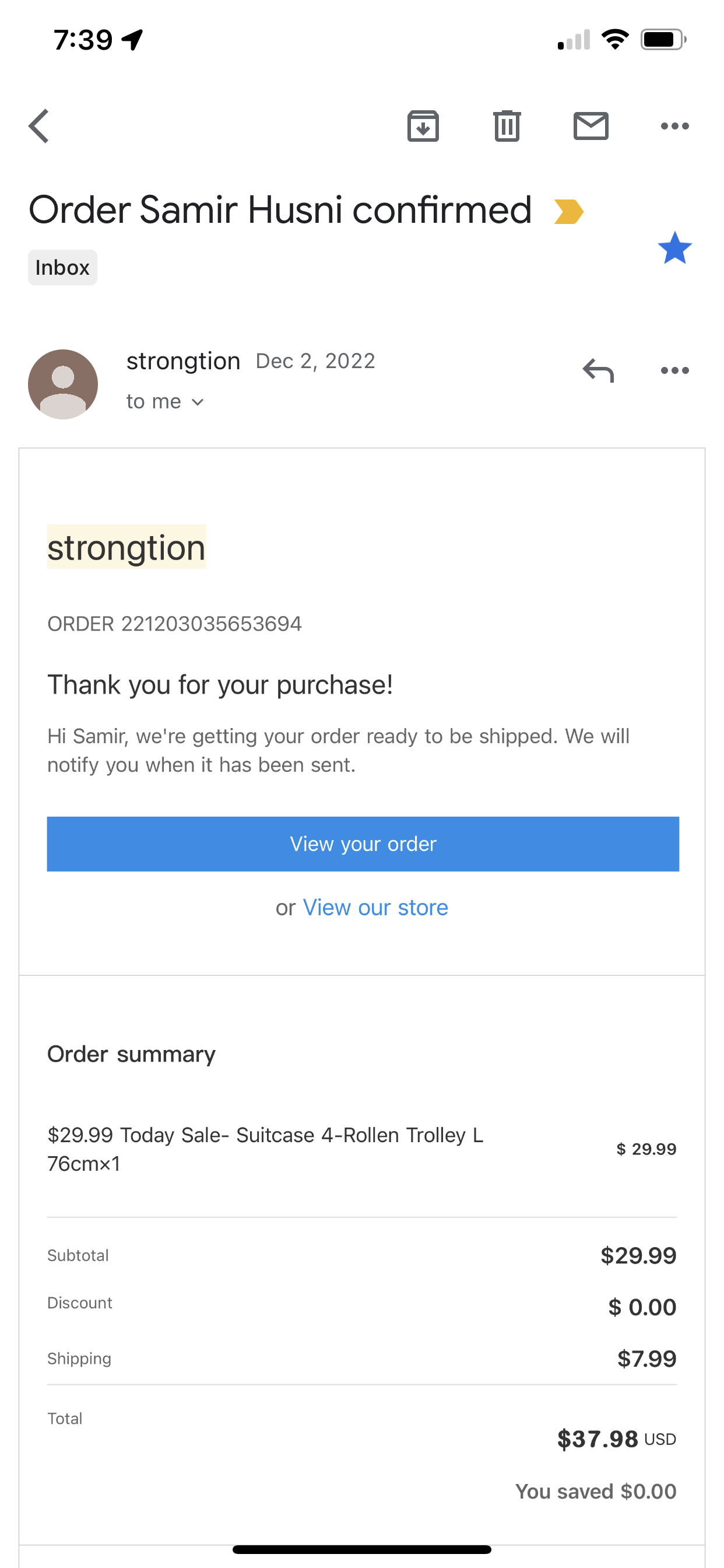
Notice the date: Dec. 2, 2022. I ordered the suitcase and paid using my credit card. My mistake, I did not read all the comments that warned me that this is a scam. However, I received a confirmation email that my order has been received. See below:
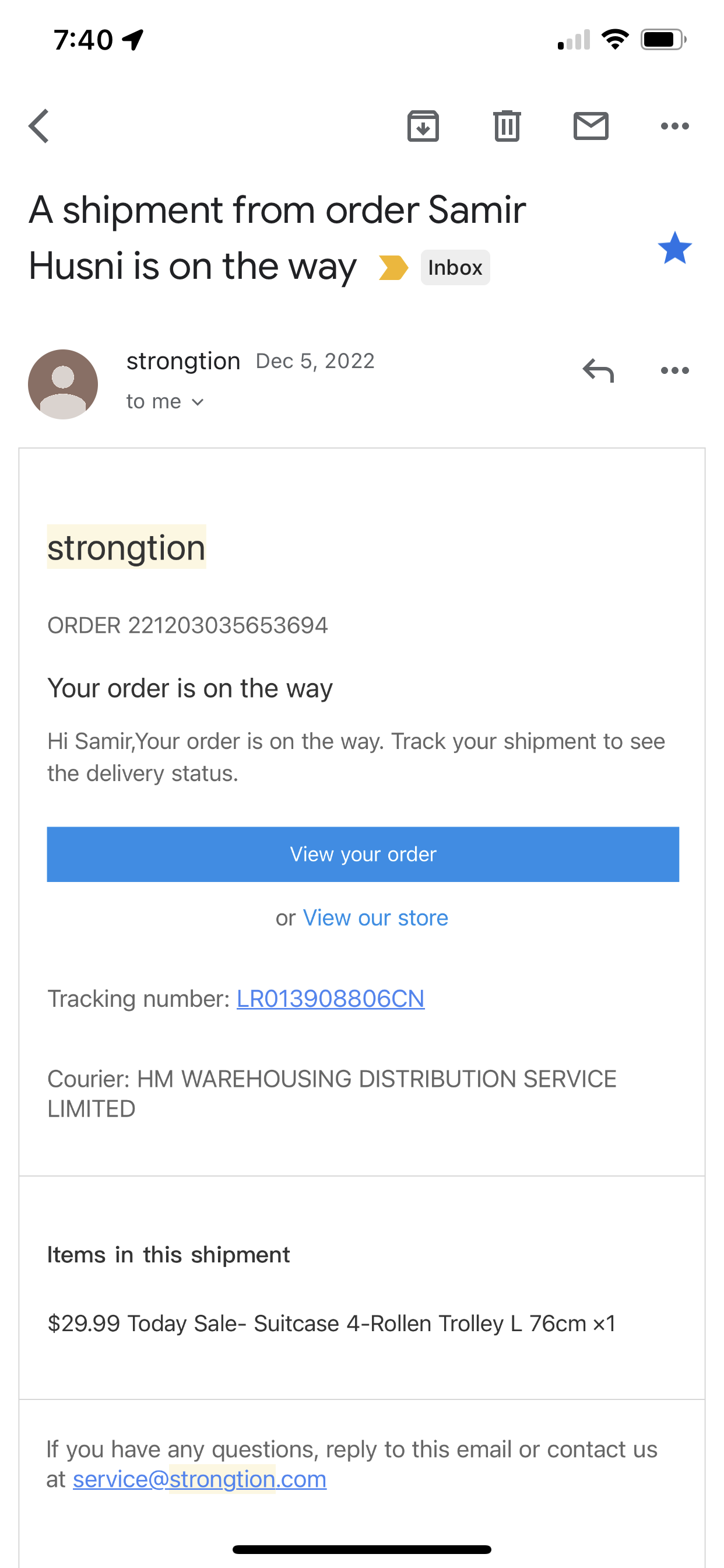
But when I checked my credit card, the recipient was not Strongtion.com but a Grocery Shop in Hong Kong. So I called my credit card company and told them that is order maybe a scam. Few days later I received the below email:
So, I thought maybe I was too quick to rush to judgment. Please note the tracking number and the content of the shipment. Exactly as advertised: Suitcase 4-Rollen Trolley L 76cm x 1.
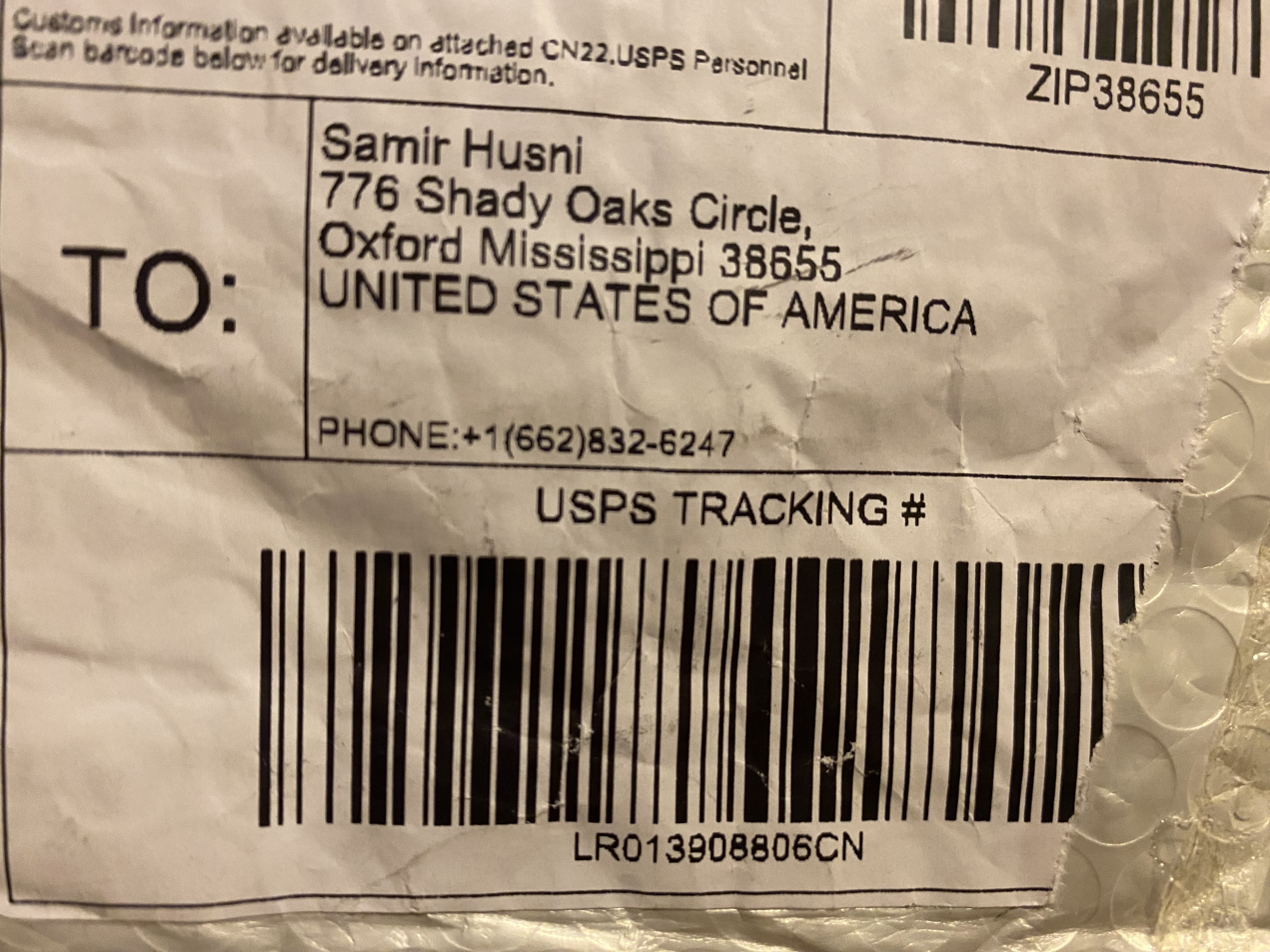
So I waited and waited. On January 3, 2023 I was notified by the USPS that my shipment has arrived and it is in my mailbox. “Wait a second,” I said to myself. A suitcase in my mailbox? Well I went to my mailbox to retrieve my suitcase and here is what I found:
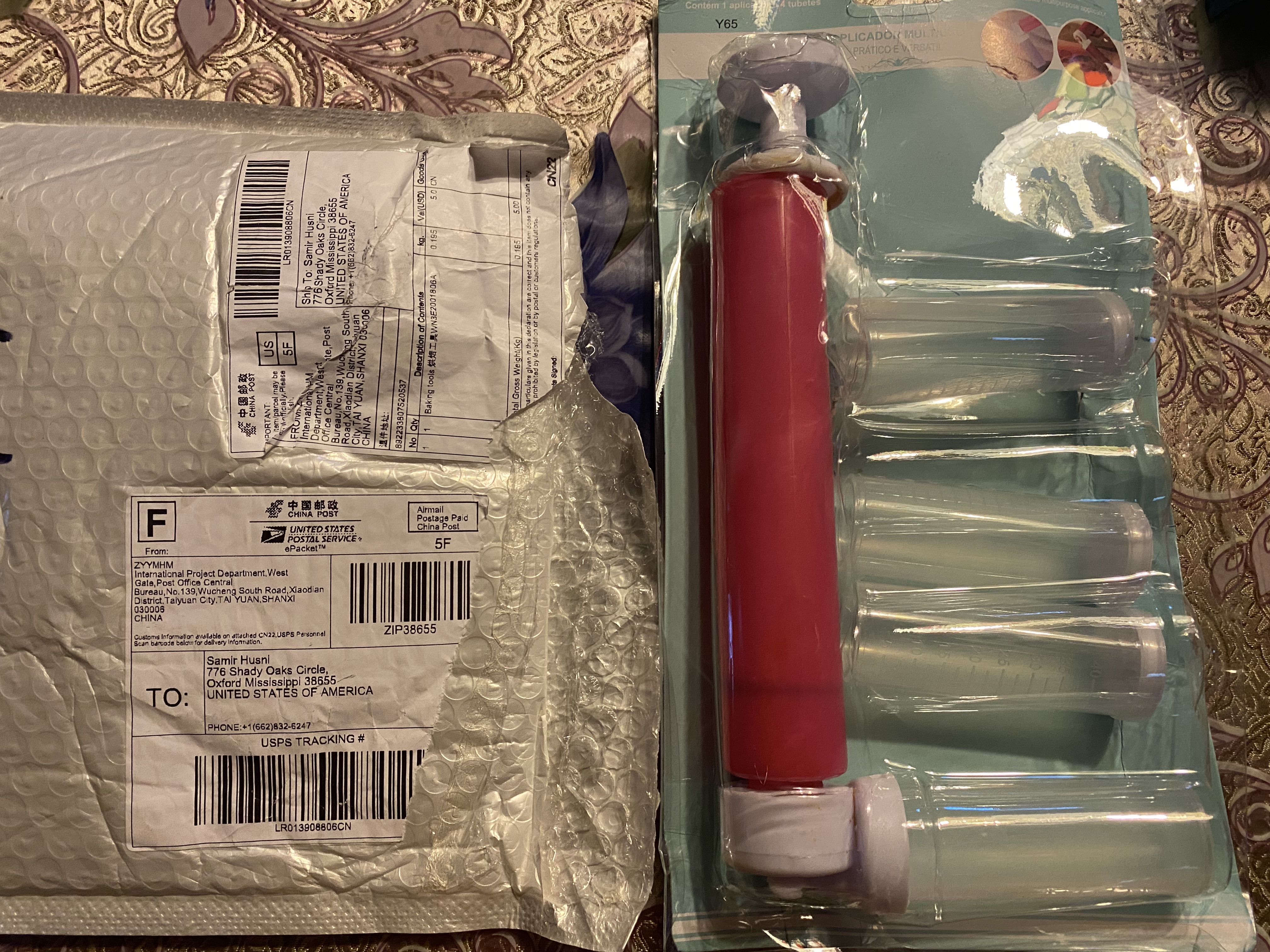
Note the tracking number… the same that supposedly is used to deliver the suitcase. But wait, there is more, look at what the envelope said it contained… and the contents of the envelope. It is for sure not a suitcase, but few broken pieces of a cake decorating kit.
The sad part, the same ad reappeared on my Facebook page the same day the aforementioned junk arrived in my mailbox:
So, you ask me why I believe in brick and mortar stores and ink on paper magazines? I don’t think I need to answer this question. Unless you are looking for a cake decorating kit, DO NOT ORDER your suitcase from Strongtion.com because now you know the rest of the story.
Magazines: United We Stand; Television, Internet, And Social Media: Divided We Sit. Part Two
Lessons from the past for today’s magazine editors and publishers… “Whoever has ears, let them hear.” Matthew 13:9
October 1942, 80 years ago, Harper’s Bazaar was celebrating its 75th anniversary. On page 32 of that issue there was an ad for Hearst Magazines, publisher of Harper’s Bazaar and seven other magazines back then. The ad read:
“Looking backward takes history
For three-quarters of a century, Harper’s Bazaar has brilliantly chronicled, year-by-year, step-by-step, the expanding life of a great nation, the more or less intimate details of burgeoning frontiers in many fields of thought and expression. In similar capacities these seven other magazines of the Hearst Group have reflected in their turning pages, the living history of a people – what they saw and wanted and liked, what they ate and wore and did for a living, what they reasoned and argued about and cared for deeply – as no single historian will ever be able to write it down. These magazines are an integral portion of the past in the country. No complete picture of that past can really be obtained without consulting them. For they are history.”
“Looking forward makes history
These gratifying records of years of continuous publication and esteemed public service are rooted primarily in the determination and the capacity of these magazines to set the pace. They have made and continue to make history because they accept the challenge of the future – accept it and forecast it and help to shape it. Longevity in magazines is no happen-so, but the carefully considered and earnestly dedicated efforts of their publishers to give them a useful and valiant purpose to contribute workable material to the lives of their readers, to make them an instrument for good in the hands of the people they seek to serve.” Harper’s Bazaar, October 1942, Page 32.
And all what I can add to the above ad is a quote from the Good Book, “Whoever has ears, let them hear.”
In the first part of this blog I wrote (if you read part one of this blog, you can skip down to Cosmopolitanmagazine, October 1942):
“In 1788, George Washington wrote a letter to Philadelphia publisher Matthew Carey in which he expressed the hope that American magazines would succeed because he considered them “easy vehicles of knowledge” that are “more happily calculated than any other, to preserve the liberty, stimulate the industry and meliorate the morale of an enlightened and free people.”
John Tebbel, in his book The Magazine In America, commenting on Washington’s letter, noted that magazines were incomparably better purveyors of knowledge than the newspapers of Washington’s time. I agree and would add that magazines are incomparably much better purveyors of knowledge than the internet and social media which, together with television, are becoming the major source of news and information for the people, according to a recent study by the Pew Research Center.
80 years ago, in 1942, American consumer and trade magazines led a campaign titled “United We Stand.” Almost every magazine in the country carried the American flag on its July cover and continued with the slogan “United We Stand” until the end of WWII. This was a coordinated effort by the collective body of magazine publishers of that time. Unlike today’s internet and social media, magazines back then were attempting to unite the country, while social media, the internet and television now are allowing the country to live a “virtual civil war” with no end in sight.
Some of those magazines from 1942 are still alive and kicking. They are still promoting the good things in life, nurturing the many changes that took and are taking place in the country. For better or worse, magazines and their brands have contributed to the betterment of the country and its people regardless of the prevailing trends. They were and are innovators, influencers, and educators at the same time. This is a far cry from what social media is today or what it will be tomorrow. Indeed, social media, with all its platforms, could be said to be united under one term, “Divided We Sit.” The majority of magazines adhered to their roles, both social and financial, with great responsibility, unlike today’s social media that only carries the name “social” without any responsibility. In fact, social media is as unsocial as unsocial can be.
I truly believe that the war of the 1940s was much less dangerous to our country than the “virtual civil war”we are witnessing today. The magazines of the 1940s united together to help the country stay united and to help the American public survive and thrive in every aspect of its lives. What follows are a few randomly selected examples, from the Samir “Mr. Magazine™” Husni magazine collection, from 1942 of how magazines and their advertisers supported the war effort and helped keep our country united. The contents and magazine experiences, both in editorial and advertising, were much more than a slogan (“United We Stand”),but rather a way of life and a call to action.
May the editors and publishers of today’s magazines look at the history of American magazines and discover how magazines served their customers first–both advertisers and readers–and never veered from their mission of editing and publishing for that intended subscriber or newsstand buyer…”
In addition to the aforementioned ad from Harper’s Bazaar above, here is the second set of examples starting in alphabetical order and based on the magazines that I own:
Cosmopolitan, October 1942
In an article by Ralph Barton Perry on page six of the October 1942 issue, he writes, “AN ARMY sergeant remarked after hearing a friend of mine explain where Hitler got his ideas, “That Machiavelli certainly was no cream puff.” He was beginning to see that something was fundamentally wrong with the present state of the world. As long as two years ago a New Hampshire farmer of my acquaintance, who had been reading the newspapers, said, “Well, I suppose that sooner or later we’ve got to lick that man Hitler; and the sooner we get at it the better. I’ll be seeing you on the other side.”
“Mr. Average American doesn’t regard war as a picnic or a great adventure: he can think of lots of things he’d rather be doing. But once he is convinced that there’s a job to be done, he’ll do it and he’ll see it through…”
“So when I am asked what sort of world we want, and I try to speak for other Americans as well as for myself, I say that we want a safe world, and a free world, and a just world. We want safety, freedom and justice; we want them for others, as well as for ourselves and we have come to see that we cannot have them for ourselves unless we share them with others in a common world, All who would live in such a world must fight for it together along the hard road that ascends through the valley of war to the heights of victory.”
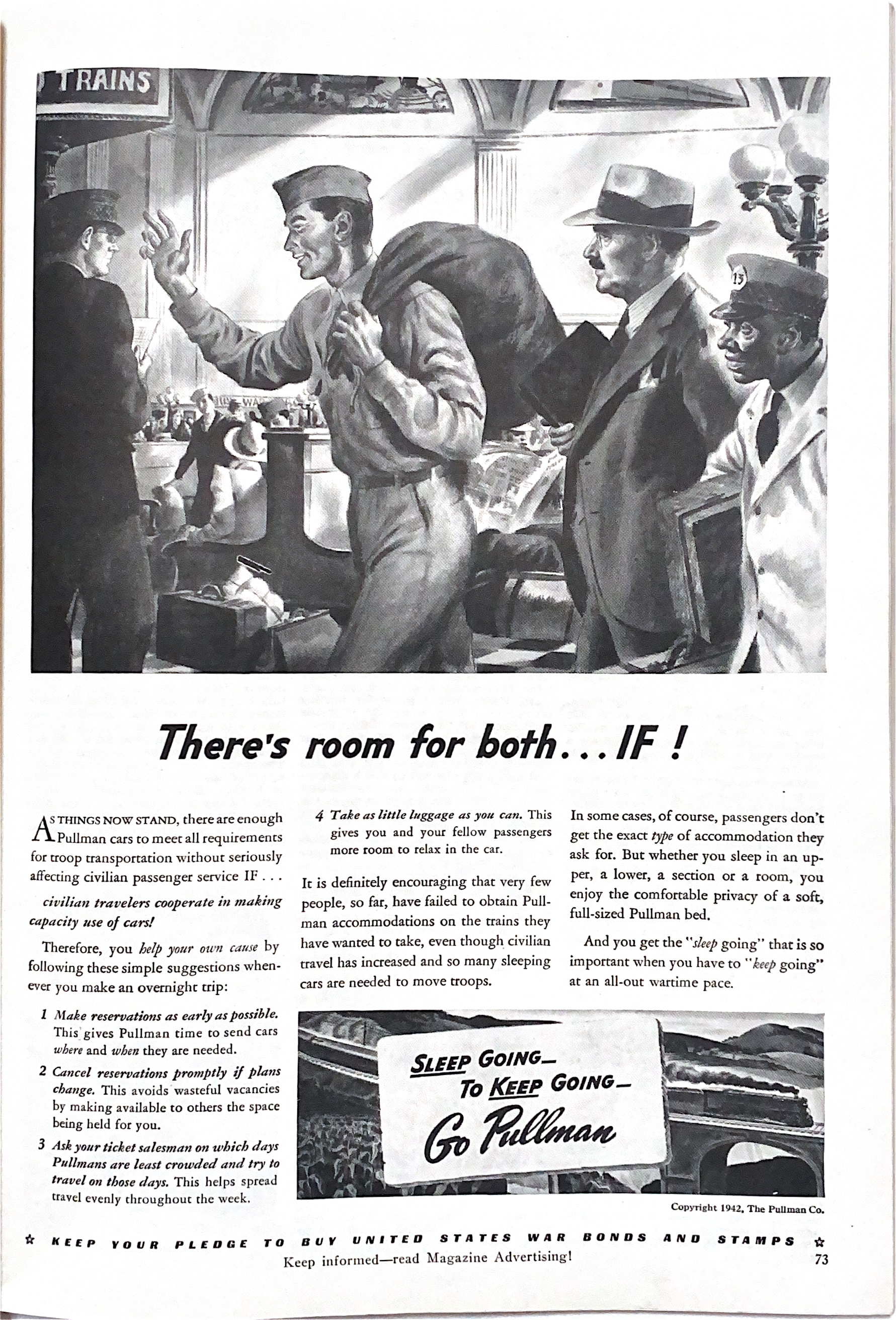
As for the ads, the “United We Stand” could easily be seen in the majority of the ads including this one for Pullman (The Greyhound of the 1940s)… The ad reads:
“There’s room for both…IF !
AS THINGS NOW STAND, there are enough Pullman cars to meet all requirements for troop transportation without seriously affecting civilian passenger service IF… civilian travelers cooperate in making capacity use of cars!
Therefore, you help your own cause by following these simple suggestions whenever you make an overnight trip:
Make reservations as early as possible.
Cancel reservations promptly if your plans change.
Ask your ticket salesman on which days Pullmans are least crowded and try to travel on those days.
Take as little luggage as you can.
And you get the “sleep going” that is so important when you have to “keep going” at all-out wartime pace.”
On final note, every ad page in the magazine had a sentence in the folio of the ad-page, “Keep informed – read Magazine Advertising!”
Esquire, July and October 1942
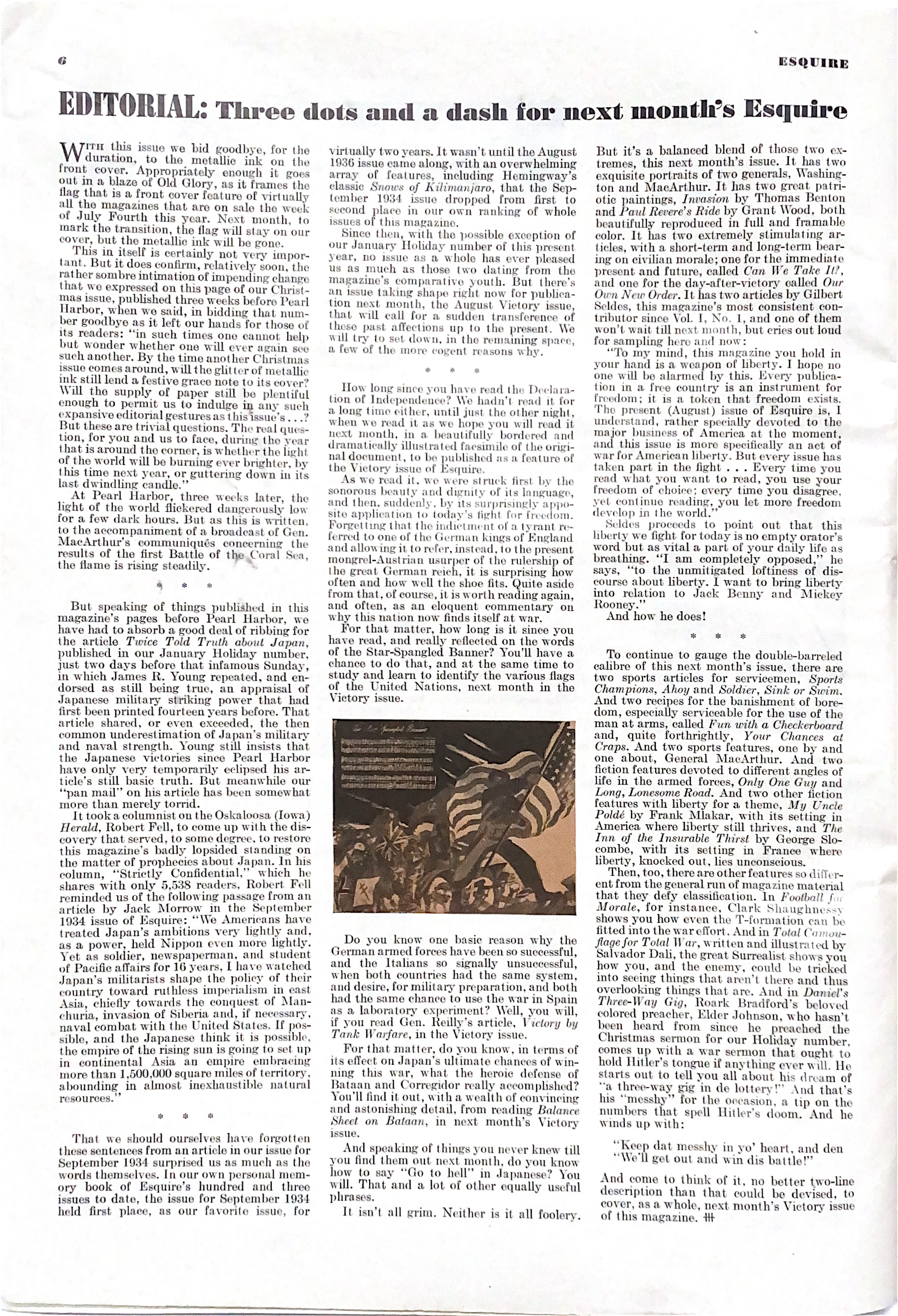
The July 1942 issue of Esquire had not one, not two, but three American flags on the cover. The main flag appeared on the traditional metallic ink section that was a trademark of Esquire’s right hand side of the cover with a list of the contents of that issue on it. In an editorial on page 6 of this issue, the editors wrote, “WITH this issue we bid goodbye, for the duration to the metallic ink on the front cover. Appropriately enough it goes out in a blaze of Old Glory, as it frames the flag that is a front cover feature of virtually all the magazines that are on sale the week of July Fourth this year. Next month, to mark the transition the flag will stay on our cover, but the metallic ink will be gone…”
“At Pearl Harbor… the light of the world flickered dangerously low for a few dark hours. But ss this is written, to the accompaniment of a broadcast of Gen. MacArthur’s communiqués concerning the results of the first Battle of the Coral Sea, the flame is rising steadily.”
And in October 1942, Esquire, “The Magazine for Men”, and “the largest selling fifty cents magazine in the world,” continued its United We Stand campaign and Old Glory draped the content on the cover sans the metallic ink. Old Glory continued to appear on the cover one more issue and it was retired with the December 1942 cover.
As for the advertisers, and there were plenty, they played their role in the United We Stand campaign. Here is one example from the October issue from the United States Rubber Company.
“Thanks for the Rubber that Saved his Life!”
“Already in America any one of a million mothers might have written that line. Planned is an army of six million, many of them destined for overseas.
On every transport there is life-saving equipment for every man… on every plane that flies far over the water there is a rubber boat. Such essential protection must not be skimped. It is unthinkable…
Precious life will be sacrificed unless each one of us helps. Will you do your part to the utmost limit? Will you take watchful care of your tires and every other rubber product you own so that they will last for the duration of the war?
Field & Stream, July 1942
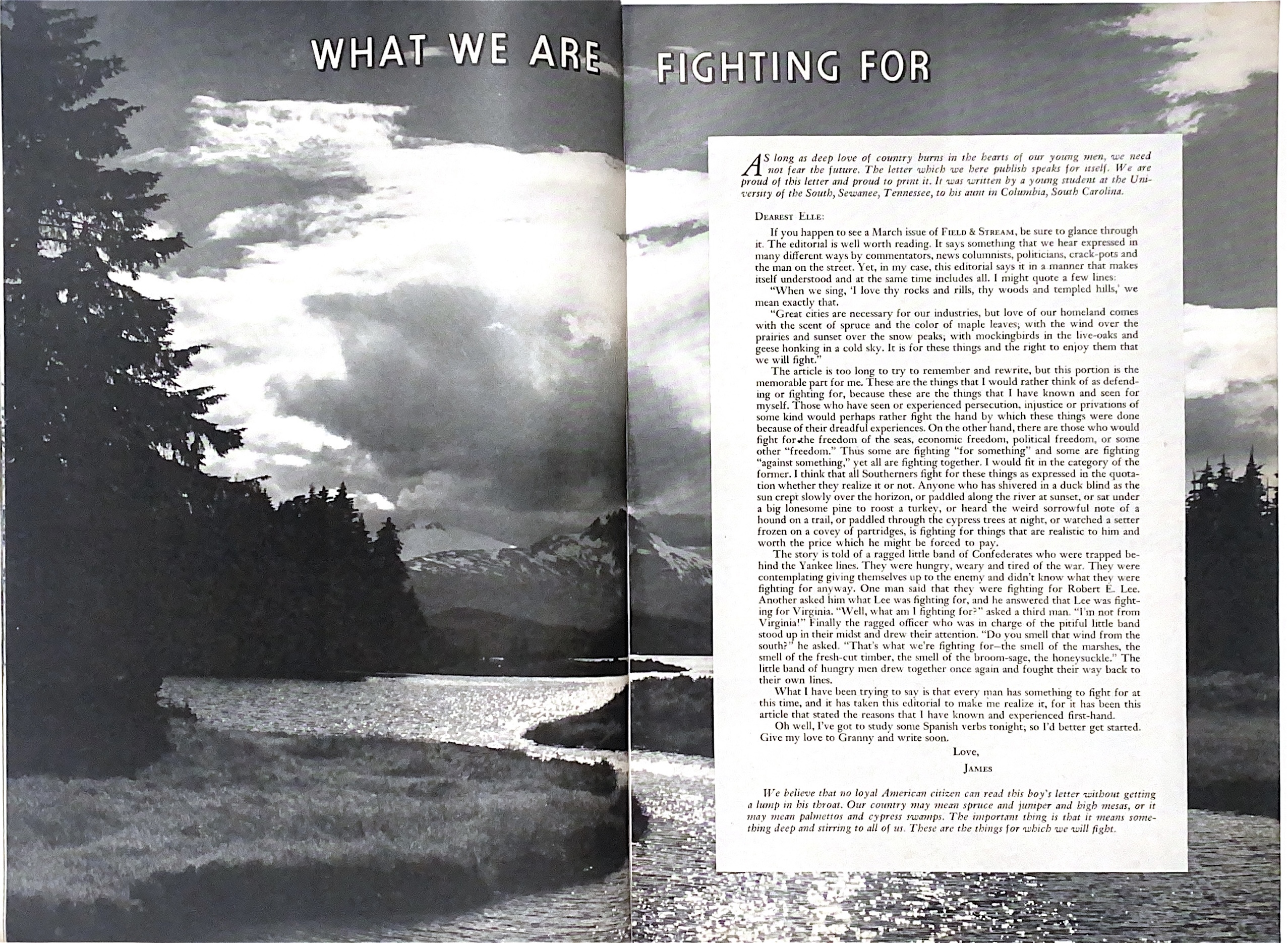
Field & Stream, like the majority of the magazines, had a painting of the American flag on the cover together with “United We Stand” and “Buy United States War Savings bonds And Stamps.” What was unlike the rest of the magazines was a spread headlined WHAT WE ARE FIGHTING FOR :
“AS long as deep love of country burns I the hearts of our young men, we need not fear the future. The letter which we here publish speaks for itself. We are proud of this letter and proud to print it. It was written by a young student at the University of the South, Sewanee, Tennessee, to his aunt in Columbia, South Carolina.”
The magazine published the letter and followed it with,
“We believe that no loyal American citizen can read this boy’s letter without getting a lump in his throat. Our country may mean spruce and juniper and high mesas, or it may mean palmettos and cypress swamps. The important thing is that it means something deep and stirring to all of us. These are the things for which we will fight.”
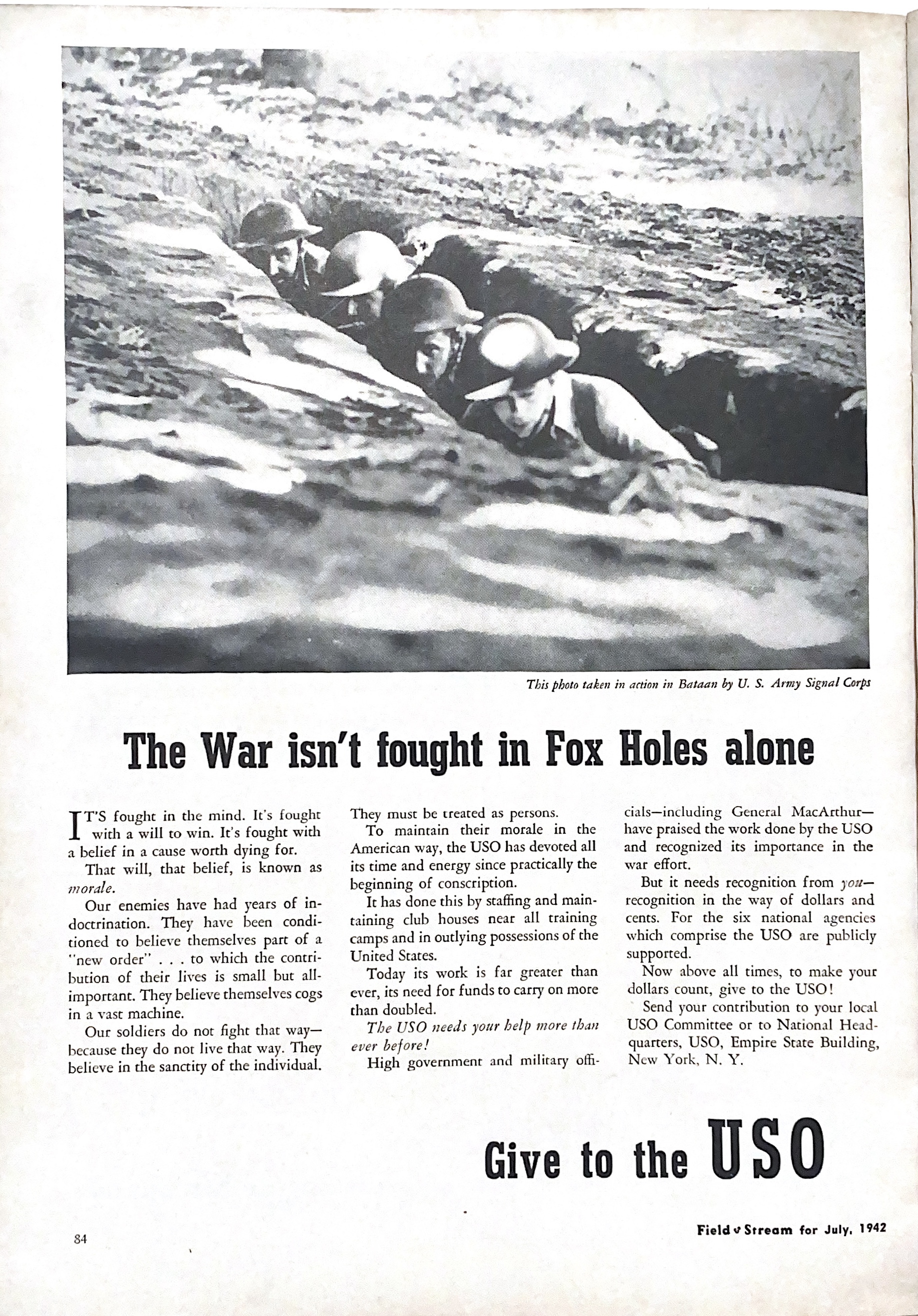
On the ad front, an ad on page 84 asking readers to Give to the USO. Under the heading The War isn’t fought in Fox Holes alone
“It’s fought in the mind. It’s fought with a will to win. It’s fought with a belief in a cause worth dying for.
That will, that belief, is known as morale.
Our enemies have had years of indoctrination. They have been conditioned to believe themselves part of a “new order”… to which the contribution of their lives is small but important. They believe themselves cogs in a vast machine.
Our soldiers do not fight that way – because they do not live that way. They believe in the sanctity of the individual. They must be treated as persons…
Now above all times, to make your dollars count, give to the USO!
Harper’s Bazaar, October 1942
It’s the 75th anniversary issue of the magazine that was launched in 1867. An ad on pages 16 f and 16 g for the New York Dress Institute sums the state of the magazine during the United We Stand efforts. The ad reads:
“A Woman’s Right of Choice”
“IN TEN SHORT MONTHS we have been hurled into a strange new world – a world battling to determine whether freedom of choice shall survive. As a people, we have cheerfully chosen to restrict our freedoms nowthat freedom itself might live.
ENTHUSIASTICALLY, we are investing our savings in the greatest cause I history. Eagerly, we have entered into various war works. Willingly, we have chosen to share our riches with those who share our hopes. For ours is a land of plenty in a very empty world.
IN MAKING SUCH A CHOICE, we have deliberately limited the quantity of many times essential to the war effort. This is as it should be. But, there are other goods and many workers which cannot be absorbed into war industries. These industries must be kept earning that they, too, can contribute their share to the war economy in taxes and bonds…”
And the ad concludes,
“SO BUY YOUR FULL QUOTA OF WAR BONDS – more if you can. Then, erase every doubt that you are being unpatriotic when you choose fashions to keep you lovely.”
To be continued…
Samir “Mr. Magazine™”Husni
Founder and Director
Magazine Media Center
Preserving the Past, Present, and Future of Magazine Media
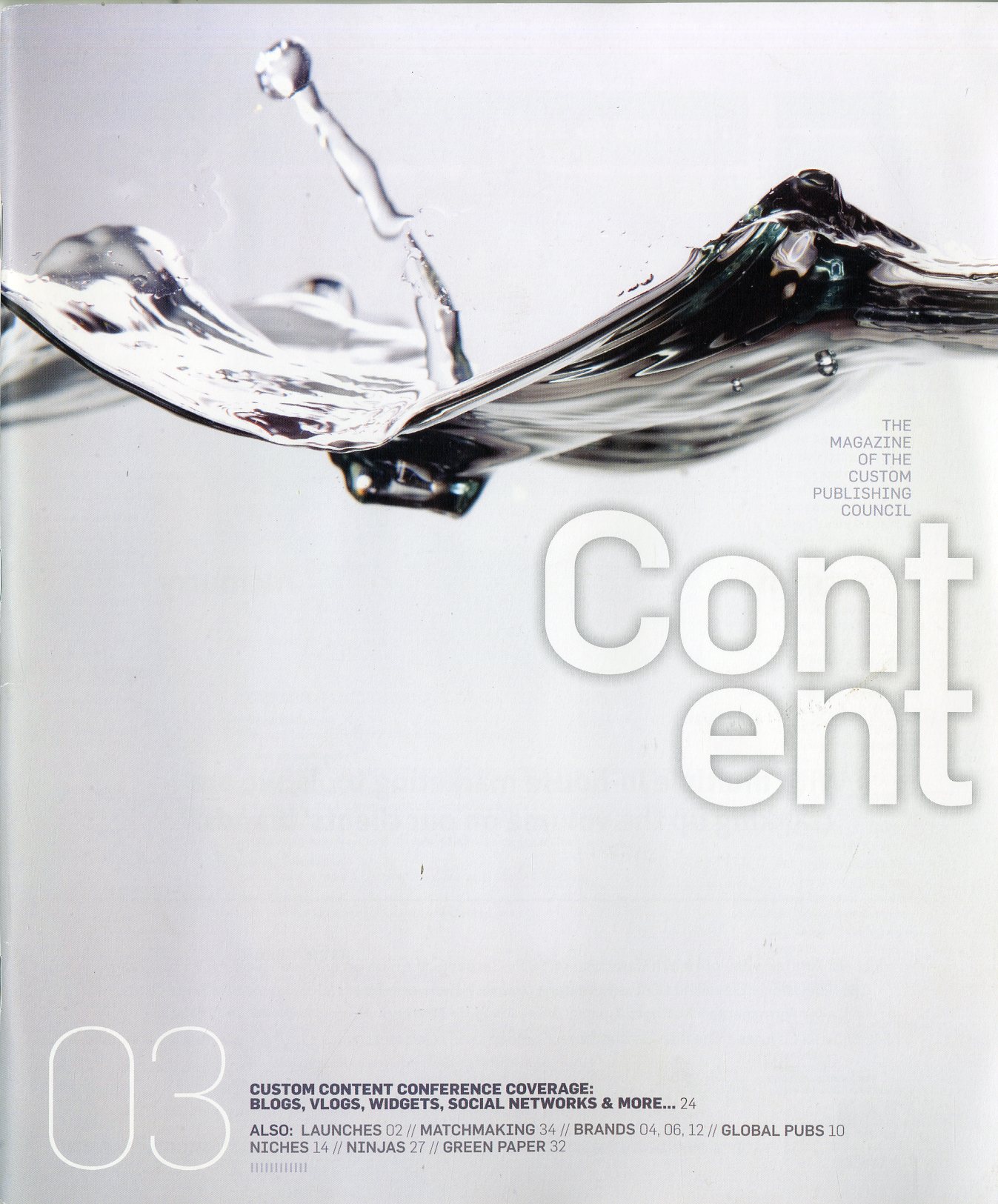
The following is a column I wrote for Content magazine back in 2008. Although it has been 14 years since I wrote it, I still stand by every word in it. Enjoy this journey through the Mr. Magazine™ Vault.
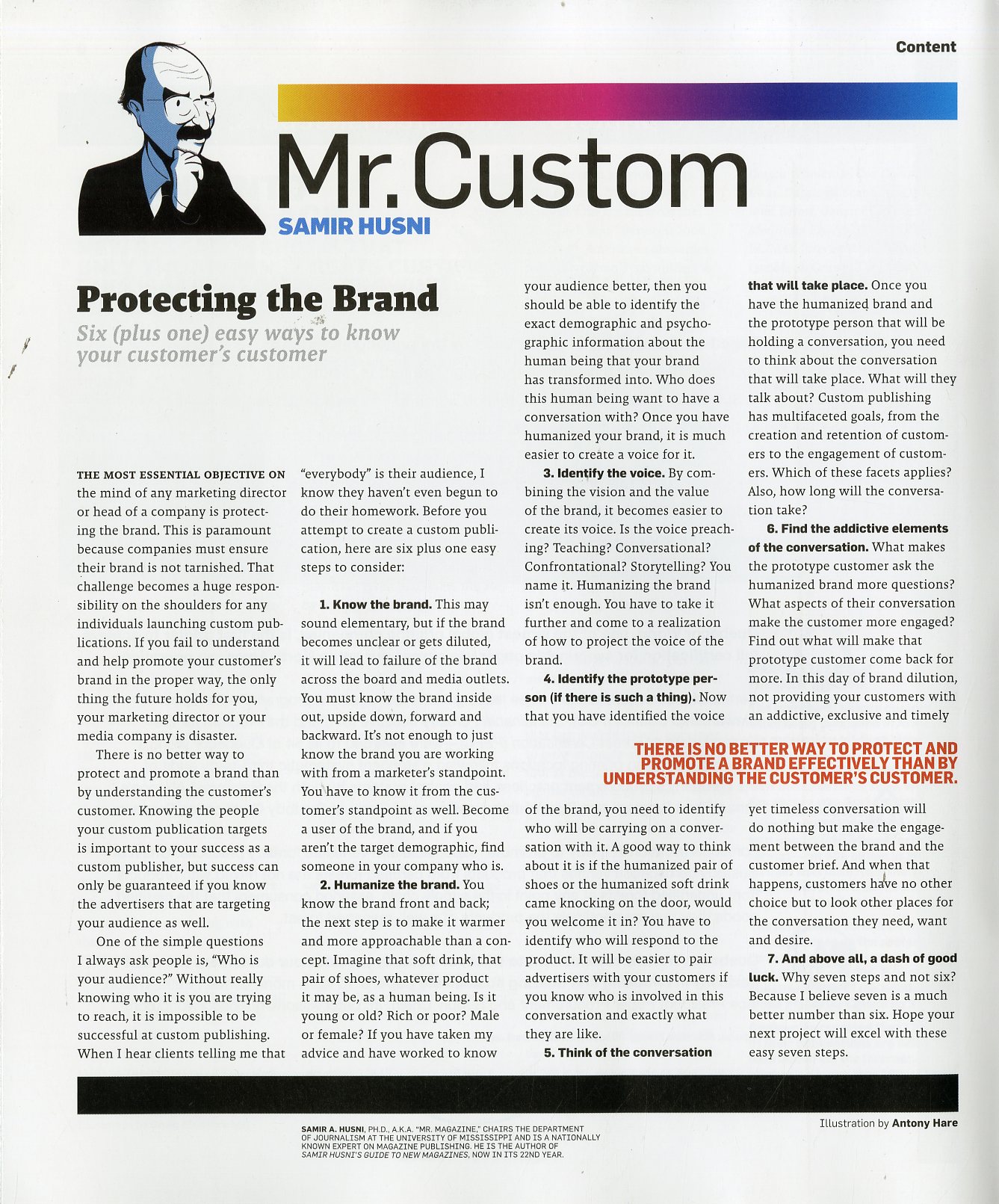
Protecting the Brand Six (plus one) easy ways to know your customer’s customer
Content Magazine Issue 03 Spring 2008
The most essential objective on the mind of any marketing director or head of a company is protecting the brand. This is paramount because companies must ensure their brand is not tarnished. That challenge becomes a huge responsibility on the shoulders for any individuals launching custom publications. If you fail to understand and help promote your customer’s brand in the proper way, the only thing the future holds for you, your marketing director or your media company is disaster.
There is no better way to protect and promote a brand than by understanding the customer’s customer. Knowing the people your custom publication targets is important to your success as a custom publisher, but success can only be guaranteed if you know the advertisers that are targeting your audience as well.
One of the simple questions I always ask people is, “Who is your audience?” Without really knowing who it is you are trying to reach, it is impossible to be successful at custom publishing. When I hear clients telling me that “everybody” is their audience, I know they haven’t even begun to do their homework. Before you attempt to create a custom publication, here are six plus one easy steps to consider:
1. Know the brand. This may sound elementary, but if the brand becomes unclear or gets diluted, it will lead to failure of the brand across the board and media outlets. You must know the brand inside out, upside down, forward and backward. It’s not enough to just know the brand you are working with from a marketer’s standpoint. You have to know it from the customer’s standpoint as well. Become a user of the brand, and if you aren’t the target demographic, find someone in your company who is.
2. Humanize the brand. You know the brand front and back; the next step is to make it warmer and more approachable than a concept. Imagine that soft drink, that pair of shoes, whatever product it may be, as a human being. Is it young or old? Rich or poor? Male or female? If you have taken my advice and have worked to know your audience better, then you should be able to identify the exact demographic and psychographic information about the human being that your brand has transformed into. Who does this human being want to have a conversation with? Once you have humanized your brand, it is much easier to create a voice for it.
3. Identify the voice. By combining the vision and the value of the brand, it becomes easier to create its voice. Is the voice preaching? Teaching? Conversational? Confrontational? Storytelling? You name it. Humanizing the brand isn’t enough. You have to take it further and come to a realization of how to protect the voice of the brand.
4. Identify the prototype person (if there is such a thing). Now that you have identified the voice of the brand, you need to identify who will be carrying on a conversation with it. A good way to think about it is if the humanized pair of shoes or the humanized soft drink came knocking on the door, would you welcome it in? You have to identify who will respond to the product. It will be easier to pair advertisers with your customers if you know who is involved in this conversation and exactly what they are like.
5. Think of the conversation that will take place. Once you have the humanized brand and the prototype person that will be holding a conversation, you need to think about the conversation that will take place. What will they talk about? Custom publishing has multifaceted goals, from the creation and retention of customers to the engagement of customers. Which of these facets applies? Also, how long will the conversation take?
6. Find the addictive elements of the conversation. What makes the prototype customer ask the humanized brand more questions? What aspects of their conversation make the customer more engaged? Find out what will make that prototype customer come back for more. In this day of brand dilution, not providing your customers with an addictive, exclusive and timely yet timeless conversation will do nothing but make the engagement between the brand and the customer brief. And when that happens, customers have no other choice but to look other places for the conversation they need, want and desire.
7. And above all, a dash of good luck. Why seven steps and not six? Because I believe seven is a much better number than six. Hope your next project will excel with these easy seven steps.
Until next time… all my best
Samir “Mr. Magazine™” Husni, Ph.D.
Founder and Director
Magazine Media Center
Preserving the Past, Present, and Future of Magazine Media
Our Wisconsin magazine is approaching its tenth anniversary in 2023. In its second issue there was an editorial talking about the “joys of magazine publishing.” I found myself emailing my friend Roy Reiman, Publisher of the new magazine Our Wisconsin, and Mike Beno, the magazine editor, to ask their permission to reprint parts of the introduction to the second issue of the magazine. So without any further ado, here is an excerpt from the February/March issue of Our Wisconsin magazine:
In magazine publishing, there’s nothing more exciting than the “launch.” Not many other things in business come close to this kind of adrenalin rush. You begin by coming up with an idea or concept for a magazine you feel is “entirely different”. You’re sure potential subscribers have never seen anything like this before. So you spend months (in our case, we began last spring) planning the format, the design and mostly the content. And then you start gathering that content…which isn’t easy when you don’t have a publication to showanyone. You just have to wave your hands a lot and write lengthy descriptions of what you plan to do. Then you pull all this together…sort through hundreds of pictures and ideas for articles (some terrific, some not even close)…write and design 68 pages…and finallyput the first issue on the press, printing enough to “test the market”…. And then you wait. And it drives you crazy. You wait for more than a week for the first response…any response, to see what total strangers think of your “baby”. “Inventing” a magazine is much more personal than inventing a lawn mower or a toothbrush. It’s more revealing of who you are; it’s an extension of your personality. There’s a lot of you between those pages. So the fear of rejection is greater. After you put that sample issue in the mail, you’re like a field goal kicker with the game on the line, with its heel or hero element. So you wait as the ball sails…for a long week or more. If, when the early responses begin trickling in, you learn readers don’t like the first issue, it hurts. To a degree, it’s as though you learned they don’t like you. But when you learn they like it–and some people even say they love it–wow! That ball is sailing through the middle of the uprights, and every subscription is a pat on the back.
I love magazines, and I love magazine launches even more. That is no secret. So, when I acquire a new magazine or read a story about a magazine launch, the urge to share my love with the whole wide world is overwhelming.
A revised copy of the aforementioned blog was first published on March 30, 2013.












 Mr. Magazine