Archive for August, 2007

h1

Will magazines die? Not any time soon, not ever I say…

August 17, 2007

Krishna Prasad, the journalist behind the Sans Serif blog from India interviewed me last week for his blog. What follows are his comments and the link to the video interview conducted in Washington, D.C. He wrote:

WASHINGTON, DC: In a journalism ocean full of gloom and impending doom—full of pornographic navel-gazing over its current state—Professor Samir Afif Husni comes across like an isle of hope that American publishers, investors, and editors either can’t see or are trying desperately to swim away from.

Not only does the chair of the department of journalism at the University of Mississippi believe that news of the death of newspapers is vastly exaggerated, the man trademarked as “Mr Magazine” believes—pinch yourself—that magazines will not only survive but thrive.

That optimism may seem natural for a “minority among the minorities”, a Presbyterian among the Lebanese, who seen far worse. But that optimism is also a reflection of the passion for a genre of journalism that has captivated America’s “leading magazine expert” since he was eight.

Dr Husni, who holds a doctorate in journalism from the University of Missouri-Columbia and a master’s degree in journalism from the University of North Texas, has over 24,000 magazines in his private collection—and over 800 neckties in his wardrobe.

And when he is not in his office reading magazines, he is at the newsstands buying magazines, as he was in Washington, DC, while attending the annual conference of the Association of Educators in Journalism and Mass Communications (AEJMC) last week.

In this sans serif exclusive video, shot against the backdrop of the Washington Public Library, Dr Husni explains why magazines will always be around—and just what they will need to do so as not to be overwhelmed by the surging waters of pessimism that has very nearly consumed American newspapers.

To watch the video click the play key above and to read the Sans Serif blog click here.

h1

The good news about online magazine sites…

August 16, 2007

Online magazine web sites at Hearst are helping the company’s print products, says Chuck Cordray VP and general manager at Hearst Magazines Digital Media. In an in-depth interview posted on PBS MediaShift blog site, writer and freelancer Mark Glaser interviewed Mr. Cordray on a variety of topics related to print and online. Two highlights from the blog-in-depth interview:

“The print subscribers who subscribe online are generally eight to 10 years younger on average than the ones who subscribe through the traditional methods. The online people are finding us sooner. And of the online subscribers, more than 90% of them are brand new to the Hearst subscription world — they’ve never subscribed to any of our magazines before. They look the same as our other subscribers but we’re getting them earlier.”

“The likelihood of an individual online visitor to subscribe [to a print magazine] has gone up more than 50 percent,” he said. “We have had sites that have doubled their propensity for an individual visitor to subscribe. This isn’t about cannibalization, it’s about brand experience. If you have a good experience in print, you might try out the mobile experience. If you have a good experience online, you might subscribe to the print publication. This is about brand reinforcement, not about cannibalization.”

To read the entire interview with Corday click here.

h1

Condé Nast Portfolio: Cashing in the Gold

August 14, 2007

portfolio-blog-1-3.jpgportfolio-blog-1.jpg
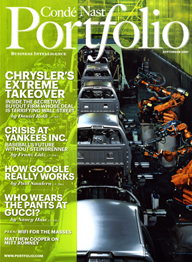
The second issue of Condé Nast Portfolio is out. No more four months waiting period for the next issue. Its glowing gold premiere issue has ushered a bright green second issue cashing in all the gold accolades that the first issue has received. I loved the first issue and I was glad it took few months for the second one to arrive. The articles were engaging and educating and they hooked me longer than any magazine I have ever read. As I get myself ready for issue two, I better do some speed reading since the issues will arrive monthly now. I do not believe there is another new magazine that has been under the microscope more than Condé Nast Portfolio. Two simple reasons maybe the cause: it is the only major launch this year and the money Condé Nast is spending on the title is a major source of envy. The prophets of doom and gloom, and there is no shortage of them in our industry, prophesied the demise of the newborn even before they read the magazine or saw the issue. It seems that in the current climate of magazine publishing nobody dares to write about success. Failure and magazine foldings fill our pages, websites and blogs. A host of new magazines from Harris Publications, Highlights for Children, National Geographic Society and others have arrived to the market place this year with no, or little, kudos from the those prophets of doom and gloom. Condé Nast Portfolio is a different type of a business magazine, one that follows in the footsteps of the original Fortune magazine that Henry Luce started in 1930. I hope people will be able, for a change, to see the tree from the forest. You can sell magazines once based on the cover, but it takes good solid content to sell them twice. I for one is planning on buying Condé Nast Portfolio not once or twice but for years to come, if and only if the first two issues are nothing but a sample of things to come. I have no doubt they are. Pick some green using your own green. The return on your investment is going to be worth it in gold.

h1

Numbers don’t lie…wholesalers take a second look

August 14, 2007

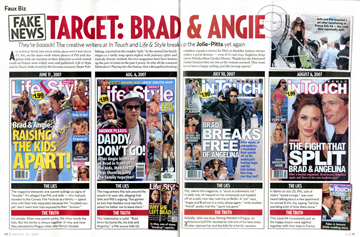
The Audit Bureau of Circulation numbers for the last six month are out and they provide yet another reason why wholesalers should reconsider their decision on how they want to handle the low-priced magazines they distribute or plan not to distribute. The three high-priced celebrity weeklies all witnessed a decline in single copy sales. People down 5.6%, Us Weekly down 3.4% and Star down 3.5%. On the other hand the so called low-priced celebrity weeklies witnessed yet another surge in single copy sales. OK weekly, that prides itself right on the cover that it is 50 cents less than Us Weekly, increased its single copy sales for the last six months period by 25.3%, In Touch up 10.6% and Life & Style up 6.8%.
Needless to say that there is an audience, big audience for single copy sales for the low-priced magazines; an audience that is responsible for bringing people to the check out counters to buy those magazines. I wonder if the wholesalers decided to stop distributing those titles what would replace them on the check out counters? Candy bars or chewing gum? Another sad day in the magazine distribution world.

h1

How do I love Good magazine? Let me count the ways…

August 13, 2007

good.jpg
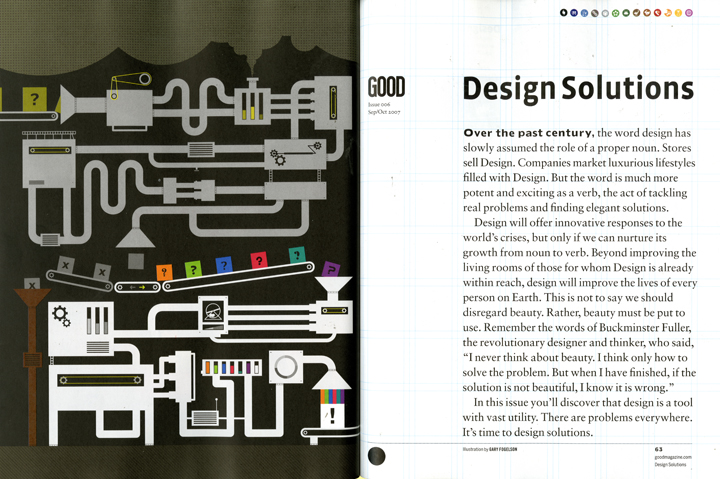
The first anniversary issue of Good magazine is out and it is a shame that this magazine is only published six times a year. When Good was in its planning stages, I was doubtful of the idea. When it came out they made a believer out of me. It is such a captivating magazine and from the first issue I fell in love. Now issue six is out and here are the three main reasons I love this magazine:

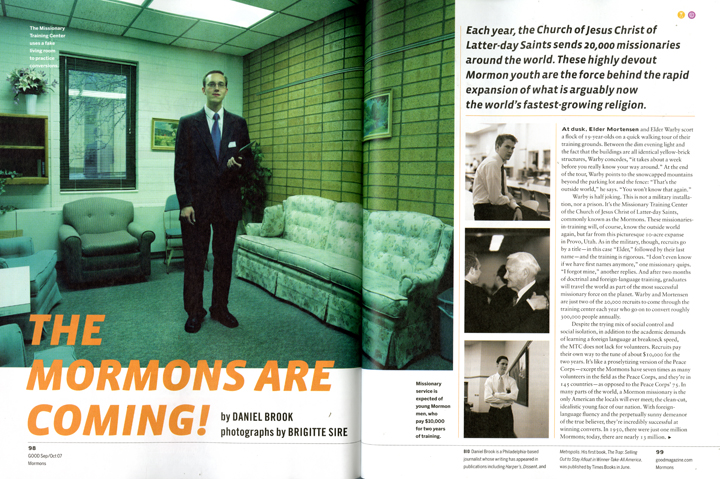
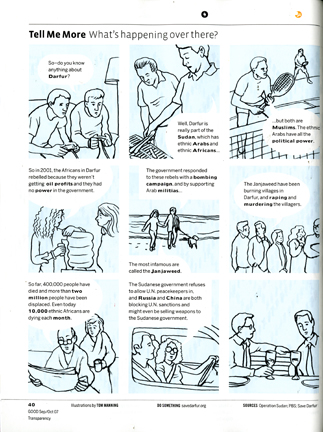
Reason Number One: I love the “journalism that matters” in Good. Whether it is a feature story or a one page comic strip, content matters to this magazine. Below are two examples of such content. The Mormons Are Coming and Tell Me More.
good-spread-1.jpggood-spread-5.jpg
Reason Number Two: I love the info-graphic. They are by far one of the best in the industry. And by best I do not just mean design wise. Talk about delivering more information in less time and less space. Well researched and well executed. The Girl Power and Are You Done In There? are but two examples.
good-spread-7.jpggood-spread-6.jpg
Reason Number Three: I love the design of the magazine. Typography and photography working together to bring the best VIP factor: the visual impact of print. Anyone that doubts the survivability of print need to take a look at this magazine.
good-spread-2.jpg good-spread-4.jpg
So what are you still waiting, run to the nearest newsstand and pick up a copy of Good. If it is not in your area check them on the web here. Keep in mind that Good “is for people who give a damn.”

h1

The dangers of the “good enough” concept in journalism…

August 10, 2007

I am spending this week in Washington, D.C. attending the annual convention of the Association for Education in Journalism and Mass Communication. On Wed. I was part of a panel on convergence and the future of newspapers in this country. Other panelists included folks from washingtonpost.com, The New York Times and the Honolulu Advertiser. A lot of talk took place on the fact that journalism on the net contains more errors and more mistakes than its counter-part in print. The need to speed to publish was mentioned as one reason and the young age of the medium was another reason. The scary part, at least to me, is that statement which I have now heard for the third time at the last three different conventions I have attended around the country. All what journalists need to do to go online is to have a “good enough” product. I heard the same message preached over and over by all kind of experts who are trying to help newspapers transition themselves from print to the web. For some reason my heart aches every time I hear the phrase “good enough.” What type of future are we heading towards if we are going to settle for “good enough?” I was so thankful to hear Bill Moyers, the convention’s keynote speaker last night, reminding people that “journalism matters.” He repeated it time after time during his address and recited name after name of journalists who were killed in the midst of doing their job of “journalism that matters.” Journalism that matters cannot be journalism that is “good enough.” Please spread the word. “Journalism Matters.” Thank you Mr. Moyers for being the voice of hope and wisdom in the midst of the jungle of “good enough journalism.” Thank you for reminding us that “journalism matters.”

h1

Few reasons behind July’s decline in new magazine launches

August 8, 2007

Under the headline “Fewer New Mags Launch in July” Erik Sass wrote a brief article, based on an interview with me, in Tuesday’s MediaPost’s Media Daily News . The article’s lead is here:

JULY SAW THE FEWEST NEW magazine launches in years, according to Samir Husni, a professor of journalism at the University of Mississippi, better known as “Mr. Magazine” for his obsessive observation and analysis of the business. Although it’s easy to jump to the conclusion that Internet competition is to blame–reciting the familiar if inaccurate mantra that “print is dead”–Husni says the reason has nothing to do with the Web.

To read the rest of Sass’s article click here.

h1

Help US…

August 8, 2007

us-weekly.jpglife-and-style-weekly.jpgus-weekly-spread2.jpg
Is it payback time or is it a thank you for all the “free advertisements” Us Weekly has been running for weeks for Bauer’s Life & Style Weekly and In Touch Weekly? For sometime now, Us Weekly has been running a spread in every issue trying to tell readers about all the wrongs in the coverage of the stars in Bauer’s two celebrity weeklies. Well, this week, as fate may have it, both Us Weekly and Life & Style Weekly have a similar main cover story with almost the same headline: HELP. I do not know whether or not the editors at Life & Style Weekly added US to their help intentionally or not. In any case, it seems like a nice payback to me from the folks at Bauer for all that free advertisements Us Weekly has been running for the Bauer’s magazines.

h1

Wholesalers are not dying, they are committing suicide…take 3

August 6, 2007

This is week three after my blog on the future of wholesalers and magazine distribution in general was published. The reactions and comments did not stop yet and the complete lack of interest in trying to find a real solution for a major problem in our industry still amazes me. The publishers are only willing to talk “off the record” and in e-mails “not for publications.” The wholesalers are in a defend mode, big times; those who were “stunned” by my blog did not expect those opinions from me, and those who questioned my knowledge “with all due respect” such as the president of a wholesaler company who wrote Bob Sacks on www.bosacks.com stating,

“I am a wholesaler and through my family has been since 1917. I take huge exception to the comments on our learned title counter Dr Husni. With all due respect what does he know of wholesale economics. I am sure that since 1995 every publisher worth his salt has looked at better ways to get to market. The long and the short of it is that the current method is the best.”

(On a side note, I love the fact that I am referred to as the “learned title counter.” All my research and studies have been boiled down to title counting…)

The other two major silent watchers in this major debate that sooner or later will affect the entire magazine business (especially when wholesalers start owning magazines as in the case of the Source Interlink, one of the four major wholesalers in the country now), are the National Distributors (whose future role is being highly questioned by both magazine publishers and wholesalers) and the magazine industry leading associations who do not seem to see the impact of the major changes taking place in the single copy sales today.

As for the reactions to my comments, John Harrington, published the following in this week’s edition of The New Single Copy.

“For the last few weeks, the issue of magazine retail pricing has been a subject of The New Single Copy. Last week, University of Mississippi journalism professor Samir Husni was quoted as saying, “They [magazine wholesalers] need to force other publishers to lower the single copy prices of other magazines to be equal or close to that of [their] subscription prices.” That inspired the following response from Brian O’Leary, a principal of Magellan Media Consulting Partners: “I say this pointedly, Husni’s argument that wholesalers should pressure publishers to price newsstand copies at subscription rates is both naïve and economically disastrous. It’s naive because publishers have shown very little willingness to use anything other than the ‘publisher next door’ as a benchmark for price. Whether or not the source could be helpful, wholesalers are the last place publishers would go for advice on pricing. “It’s economically disastrous because subs already lose money at prevailing prices. Capell’s survey data in [The New Single Copy, 7/30/07] tells the tale: on average, direct-mail subs lose $10.28 an order. This reflects both the poor economics of obtaining new subs from this source as well as the miserably low per-copy prices most publishers charge to gain a subscription. There is virtually no way that monthly subscriptions sold for $1 a copy can make money for a publisher in any way other than advertising. Pushing single-copy prices to that price isn’t going to help, even at an unobtainable 100% sell-through. At $1 a copy, the expenses associated with printing, distribution, marketing and selling these copies eat all of the margin, and more.”

With all due respect to Mr. O’Leary, I know at $1 a copy the magazine publisher cannot make any money, thus when I argue that magazines should reduce their newsstand prices to that of subscriptions, it does not mean to sell it at $1 a copy. But rather if you are willing to charge $2.95 for the single copy price, then charge $2.50 for the subscription price per issue. No 90% discount from the cover price, but 20% at most. Mr. O’Leary is right, publishers lose money selling subscriptions at $1, $.50 and .$35 a copy. Yet, if you look at magazines like People and The Economist, I doubt that they are losing money selling subscriptions at almost $2.00 a copy (and that’s much more than my 20% discount from the single copy price I am advocating).

In short, I feel that if wholesalers have the right to tell the low priced magazines that they are not going to distribute them anymore unless they change their prices to over $2.49, they should practice that same right by telling publishers who sell their subscription copies for $.50 and their newsstand copies for $4.95 that they are not going to distribute their magazines too. In addition, what about the publishers who use the newsstands to showcase (mainly for advertisers’ sake) their 5% or less from their total circulation on the newsstands, while spending all their efforts on the 95% subscription copies. I know that we need to stop the single copy magazine sales abuse, but I also continue to believe that the approach the wholesalers are taking now is still not the right one.

I am sure there will more to come on this subject matter and I, once again, encourage you to comment on line, in public and without starting your e-mail with “Samir, you are right, but this respond is not for publication.” Please get engaged in the conversation. Hit that comment link below and let me know what you think?


h1

New Magazine Launches in July as Cold as Feb. ’07

August 3, 2007

beckett-plushie-pals-6x.jpgdiesel-tech-magazine-6x.jpgpremier-business-4x.jpgcooks-illustrated-americas-test-kitchen-special.jpg
If the trend continues throughout the rest of the year, the total number of new magazine launches will set a record in terms of the percentage of decline in launches. The only hot activity last month was the heat index rather than the magazine launches. July new launches hit a record low equal to that of last February. Only 36 new magazines were introduced to the marketplace last month with five published bimonthly, six published quarterly and 25 specials and one shots. The 36 new titles of July ’07 are 16 titles less than July ’06. In all ’07 has witnessed the birth of 378 titles through July compared to 607 for the same period last year.