


I met Ravi Pathare for the first time at the Amsterdam Airport last March. We were on our way together to the We Love Magazines Colophon 2007 meeting in Luxembourg. His card read “Chief Magazineologist” at Mag Nation Pty Ltd. in New Zealand. Mag Nation is a chain of magazine stores in New Zealand and Australia. Having never met a Magazineologist I was delighted to meet him and learn more about this Magazineologist background. Well, enough suspense…here is the story of the world’s first Chief Magazineologist in his own words.
“I graduated in 1979 as a doctor, completed my post graduation in Pathology four years later (nothing as gruesome as BONES and other whodunnit thrillers) and practiced as a Consulting Pathologist in busy Bombay to develop a very flourishing private practice in a few years time. Got tired of the rat race and chucked it all up to enjoy the green pastures of down under NZ where I moved to in 1994. Got sucked into the world of magazines in 2000 (and delighted for it), chucked up my profession and been doing it for the last 7 years. It was originally called Mega Mags but rebranded to Mag Nation in March 2006.Currently have 4 stores, 3 in Auckland and 1 in Melbourne. Our flagship Melbourne store stocks close to 4000 titles. Our 4th store (3rd in Auckland) opened in March 2007 and the fifth one opens in Melbourne in Sept. 2007. Plan to have 6 stores by the end of 2007 and 14 by end of 2008. We do trendy, quirky, innovative stuff like having theme weeks in the stores – T-World week, Sneaker Freaker Week, Knit in Week, Stencil art week in conjunction with POL Oxygen magazine etc. There. The story of my life.”
Ravi Pathare
Ravi recently send me the above three first issues of new magazines to add to my growing collection of first editions. Thanks Ravi and it was great to have met the world’s first ever magazineologist. I can’t wait to visit Mag Nation and have a cup of Java while spending a few hours, make that days from the look in the pictures of the stores, in yet another “heaven on earth” magazine location Down Under.
Archive for May, 2007

Meet the world’s Chief Magazineologist
May 3, 2007Everything you always wanted to know about me… and a little bit more
May 2, 2007Mark Glaser the host of MediaShift, a weblog on the PBS website that tracks “how new media—from weblogs to podcasts to citizen journalism—are changing society and culture” interviewed me yesterday for his weblog. The interview Digging Deeper:’Mr. Magazine’ Believes We’ll Always Crave Ink on Paper, starts with the following lead:
“When Lebanese journalist Samir Husni was teaching students at the University of Mississippi about magazine journalism in 1986, one student had trouble pronouncing his Arabic name and took the simple route, calling him “Mr. Magazine.” The student eventually gave Husni a plaque with the moniker engraved, and the name was so apt for the lover of print magazines that he eventually trademarked the Mr. Magazine name and launched a website with the same name. Now almost every news story about the magazine business includes an expert quote from Husni, whether it’s about Teen People closing shop online or about Garden & Gun magazine’s awkward name . He’s done consulting for magazine companies, and he’s written the popular Magazine Guide profiling each year’s magazine launches for 22 years running.” To read the entire conversation click here.
“Heal”ing after the Cure: a great role for magazines
May 2, 2007

First there was Cure the magazine for Cancer Updates, Research and Education. Cure launched in 2002 as a “quarterly magazine that combines the science and humanity of cancer for those who have to deal with it on a daily basis. CURE provides scientific information in easy-to-understand language with equally understandable illustrations.” Now comes Heal: Living Well After Cancer, a magazine “for cancer survivors from the day treatment ends, and for the rest of their lives.” For anyone who doubts the power of magazines in creating communities that can be felt, connected and shared, those two magazines are the prime example for that. My friend Eija Ailasmaa, CEO of Sanoma Magazines recently sent me a copy of Magazine, a book celebrating Sanoma’s Magazines fifth anniversary. In it I found this wonderful quote that best describes Heal and Cure among many other magazines. “Today, lifestyle magazines answer the question of how people can realize the potential in themselves and overcome all anxiety. How they can handle their human relationships, how to show to others a favorable picture of themselves; and how to set and achieve their life goals. People read these magazines with great enthusiasm. The chaotic richness of the problems described and their suggested therapies by magazines is astonishing. There are a wide variety of questions which arise with answers provided for all.” I guess the comments of Elemér Hankis, a Hungarian sociologist and philosopher, will more than suffice as a comment on both Heal and Cure.
God and War: Newsweek’s Meacham “favorite things” and other words of wisdom
May 1, 2007
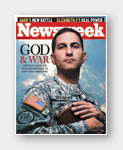
This week’s cover of Newsweek happens to reflect editor Jon Meacham’s “two favorite topics”: God and War. Meacham shared his views about his favorite topics and many others in an hour-long Q and A session with the journalism students at the University of Mississippi during a meeting with them on the Oxford campus. The Newsweek editor told students that these are “interesting times” and that the business of “printing on dead trees” will continue to be with us in the future. Armed with a circulation of over three million copies every week, a readership of over 20 million readers, and five to five and a half million unique visitors on the web, Meacham compared the reading habits of consumers in print and online. Meacham said “people do not read long form on the internet. 500 words is the max. An average cover story of Newsweek is 4,000 words, so it takes eight pages on the web.” Meacham asked the students to guess the percentage of viewers/readers who go from page one to page two on the web. “80% DO NOT…they drop before they flip to page two.” And how many stay until page 8 on the web with the story, he asked and quickly answered, “My mom will be the only one.” He reminded the students that journalism is not for the faint hearted and the future is always going to be for good writing…however he warned the students that we have to earn people’s attention and respect their most precious resource, time (I am sure he did not mean TIME). “In a blizzard of choices,” Meacham said, “To reach your audience, you need to be eloquent in the narrative with something new on every page to stop the readers.” Good words of wisdom for everyone who believes that our future is based on good reporting, good writing, good editing and above all a good sense of news judgment. Thank you Jon, we indeed live in “interesting times.”


 Mr. Magazine